 |
| ||||||||||||||||||||||||||||
|
| ||||||||||||||||||||||||||||
Institut f�r berufliche Entwicklung e.V.
Berlin
Original title:
Arbeitsmaterial f�r den Lernenden
"Bohren"
Author: Fritz Dienemann
First edition © IBE
Institut f�r berufliche Entwicklung e.V.
Parkstra�e
23
13187 Berlin
Order No.: 93-35-3305/2
|
| ||||||||||||||||||||||||||||
1. Purpose and Meaning of Boring
Wood boring is a cutting operation to produce round holes in wood. Boring is either vertical, parallel or at an angle to the wood grain direction or panel plane.
Boring serves different purposes:
- Boring of through holes for mounting of screws, fitting or nails.
- Boring of holes of limited depth for end grain dowels or dowel joints.
- Pre-boring of wood screw holes.
- Boring of conical holes.
The precision and accuracy to size of the holes is decisive for the quality and durability of the component produced.
|
| ||||||||||||||||||||||||||||
2. Construction and Mode of Action of Bore Bits
Bore bits are cutting tools to produce holes in wood. Normally the bore bit is rotated around its axis. During such rotation it advances in axial direction. The wood to be removed must not be squeezed off or torn off but be removed by a clean cut. A bore bit consists of various parts (see Fig. 1).

Figure 1 Bit
1 square tang, 2 shang, 3 chip-removing screw, 4 pre-cutters, 5 brad point, 6 cutting edge
- The chip-removing screw presses the cut chips out of the bore hole.
- The parallel shank carries the cutting edges and the drill screw.
- The square tang is chucked in the jaw chuck of the bit brace.
- The brad point serves for exact location of the bit in the centre point. Bits intended for boring of holes vertically to the board plane have a very small brad point. Brad points of bits for boring of holes parallel to the wood grain have a draw-in thread.

Figure 2 Bore bit head
1 brad point, 2 draw-in thread
- The cutting edges (also called cutters) cut the chip between the brad point and the pre-cut circumference of the bore hole.- Compared to the cutting edges, the pre-cutters (also called pre-cutting edges) are in advanced cutting position and cut the wood grains already before the chip is removed by the cutting edges.
Most bore bits are held in and rotated by means of a boring appliance, i.e. an electric hand gun drill or a mechanical bit brace.

Figure 3 Bit brace
1 steel sweep handle with chuck, 2 ratchet, 3 supporting handle
The bit brace consists of a steel sweep handle with chuck, a supporting handle and a ratchet.
The ratchet is used for holes which are accessible from one side only and where a full rotation of the steel sweep handle is not possible. It is provided with idle gear for clockwise or counterclockwise rotation, which can be set.
The chuck serves for holding the bore bit.
What are the parts of a bore bit?
__________________________________________________
What is the advantage of a bit brace with ratchet?
__________________________________________________
|
| ||||||||||||||||||||||||||||
3. Types of Bore Bits
Bore bits have a wide field of application.
The different properties of wood cut parallel with or across the grain or of cross-grained wood and wood fibreboards call for different types of boring tools.
- The types of bore bits described in Table 1 are tools which can be used in manually operated boring appliances only, except for the Forstner auger bits and twist drills which can be operated manually and on machines.

Figure 4-1 Types of bore bits: auger
bit (Douglas type),
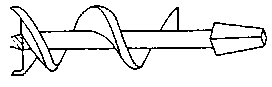
Figure 4-2 Types of bore bits: auger
bit (Irwin type),
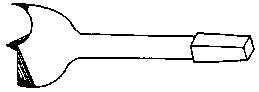
Figure 4-3 Types of bore bits: centre
bit,
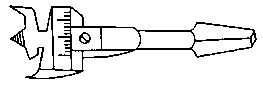
Figure 4-4 Types of bore bits:
expansive centre bit,
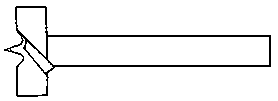
Figure 4-5 Types of bore bits:
Forstner auger bit,
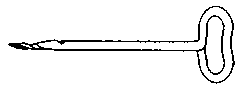
Figure 4-6 Types of bore bits: gimlet
with ring handle,

Figure 4-7 Types of bore bits: twist
drill,

Figure 4-8 Types of bore bits: spoon
bit,
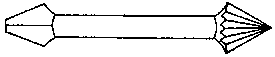
Figure 4-9 Types of bore bits: wood
countersink (rose bit),
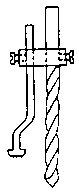
Figure 4-10 Types of bore bits: depth
setter
Table 1: Types of Bore Bits
|
Designation |
Features |
Application |
|
Auger bit |
- Diameter 6 mm ... 30 mm |
- Boring of long-grained wood |
| |
- Length 185 ... 250 mm |
- Deep holes |
| |
- Douglas double twist type |
- Particularly for holes in hard wood |
|
Centre bit |
- Diameter 10 mm ... 40 mm |
- For holes of small depth in cross-grained wood (not suitable for end-grained wood) |
|
Expansive centre bit |
- Diameter 16 mm ... 40 mm |
- For holes of varying sizes (not suitable for hard wood) |
|
Forstner auger bit |
- Diameter 8 mm ... 40 mm |
- For flat and very clean-cut holes with plane bottom for
mounting of fittings |
|
Gimlet with ring handle |
- Diameter 2 mm... 10 mm |
- Pre-boring of nail and screw holes in end-grained wood and long-grained wood |
|
Twist drill |
- Diameter 2 mm ... 12 mm |
- For holes in thin material |
|
Spoon bit |
- Diameter 10 mm ... 60 mm |
- For producing conical holes |
|
Rose bit |
- Diameter 16 mm and 20 mm |
- For reaming of screw holes |
|
Depth setter |
- Appliance as boring aid |
- Helps to observe the required depth of hole |
All bore bits specified in the table are to be classified according to the following criteria!
|
without |
with |
without |
with |
without |
with |
|
brad point |
thread |
pre-cutters | |||
| |
| | |
| |
| | |
| | |
|
In addition to the various types of bore bits, auxiliary tools are used for boring to safely guide the boring tool in the desired position of the bore hole axis.

Figure 5 Piece of wood as boring aid
1 bit center line
Depth setters guarantee that the specified depth of the hole is not exceeded.
|
| ||||||||||||||||||||||||||||
4. Maintenance of Bore Bits
The quality of the holes and the performance depend on the sharpness of the cutting edges and on the state of the boring tools and boring appliances.
Knife, three-square or square files with fine cut are used for sharpening. Correct sharpening of the boring tools requires utmost care, a lot of experience and exact knowledge of the mode of action of the individual types of bore bits.
The brad point, draw-in thread, pre-cutters and cutting edges are sharpened.
The sharpening process involves the following operations:
- Brad points without draw-in thread are uniformly filed from all sides so as to remain in the centre of the axis of rotation of the bit.- Draw-in threads are carefully filed by means of a knife file while the bit is rotating. No steps must be produced.
- Pre-cutters are sharpened on the inside only and against the direction of rotation of the bit.
- The cutting edge is sharpened so that the edge angles are not changed.
- All filed areas are stoned with an oil stone until no filing marks are left. This considerably increases the life of the boring tools.
What tools are used for sharpening of boring tools?
__________________________________________________
Why must pre-cutters not be sharpened on the outside?
__________________________________________________
On completion of boring, resin and dirt deposits are to be removed by means of hot water, petroleum or thinner. A thin film of acid-free grease will protect the boring tools against corrosion.
The bore bits are to be stored so as not to touch each other.
Three possible ways of storing are:
- The bits are stored in lying position in a box with several compartments.

Figure 6 Box with compartments for
storing bits
- The bits are suspended on a wooden suspension stand by means of the square tangs.
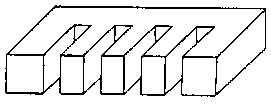
Figure 7 Bit suspension device
- The bits are stored in a wooden block with holes with the bits standing in upright position and their points pointing upwards.
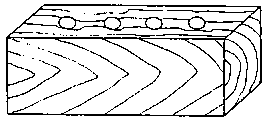
Figure 8 Bit stand
Why must the bits not touch each other during storage?
__________________________________________________
|
| ||||||||||||||||||||||||||||
5. Working Rules for Boring
According to the mode of action of the bits, forces are required for the rotary motion of the bit brace and for the feed motion in the in the direction of the bore hole depth.
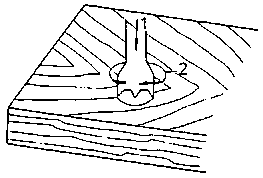
Figure 9 Boring forces
1 feed motion, 2 working motion
The magnitude of the required force depends on
- the strength of the material to be cut,
- the diameter of the bit,
- the cutting edge geometry of the bit,
- the desired quality of cutting and
- the feed rate.
All bits with brad point and pre-cutters are a potential source of accidents unless they are properly handled. Therefore, specific rules of labour safety are to be defined and observed.
Bits must not be left lying around but be stored in proper holders! Bits must not be used for scribe-marking or similar purposes!
Boring is to be carried out as follows:
- The part to be bored is to be clamped, if possible, in order to prevent it from being moved by the rotary motion of the bit.- If it is not possible to clamp the workpiece, assistance by a second worker is required.
- The face to be bored must be horizontal to permit the bit to cut vertically from top to bottom. In that case less feed force is required.
- Before boring the scribe-marked centre of the hole (pencil or scriber marking) should be punched to prevent the bit from running off centre.
- During boring the position of the bit with the boring appliance is to be constantly checked from all sides to make sure that the hole is produced in the correct position.
- A boring fixture should be used, if possible, to facilitate keeping up the correct position.
- When using bits with brad points without draw-in thread, the feed rate is to be selected so as to achieve favourable chip thicknesses.
- When boring through holes it is to be made sure that no wood fibres are torn off at the bottom side of the workpiece. This can be prevented in two different ways:
. Clamp a piece of waste wood under the bottom side and bore through into such piece of wood.. Check during boring whether the brad point has reached the bottom side. If that is the case, stop boring, turn the workpiece over and complete boring from the second side.
Why is it necessary to constantly check the position of the boring tool during boring?
__________________________________________________