|
| ||||||||||||||||||||||||||||||||||||
WHO/SDE/WSH/00.2
Prepared by
Fran�ois Brikk�
Operation and Maintenance Network of the Water Supply and Sanitation Collaborative Council
IRC International Water and Sanitation Centre
Delft,
Netherlands

World Health Organization
Geneva,
Switzerland
2000
IRC International Water and Sanitation Centre
PO Box
2869
2601 CW Delft
The Netherlands
Tel: +31 (15) 219 29 39
Fax: +31
(15) 219 09 55
E-mail: general@irc.nl
World Health Organization
20 Avenue Appia
CH-1211
Geneva
Switzerland
Tel: +41 22 791 2111
Fax: +41 22 791 0746
Water Supply and Sanitation Collaborative Council
c/o
World Health Organization
Tel: +41 22 791 3685
Fax: +41 22 791 4847
Operation and Maintenance Network
c/o World Health
Organization
Copyright © IRC International Water and Sanitation Centre and World Health Organization 2000
This document is not a formal publication of the World Health Organization (WHO), and all rights are reserved by the Organization. The document may, however, be freely reviewed, abstracted, reproduced and translated, in part or in whole, but not for sale nor for use in conjunction with commercial purposes.
Designed by minimum graphics
Printed in
Malta
|
| ||||||||||||||||||||||||||||||||||||
Preface
The aim of Operation and Maintenance (O&M) programmes, as described in this training package, is to improve the efficiency, effectiveness and sustainability of water supply and sanitation services. Operation and Maintenance activities, which encompass not only technical issues, but also managerial, social, financial and institutional issues, must be directed towards the elimination or reduction of the major constraints which prevent the achievement of sustainability.
This document and the training activities described in it are intended for managers and planners who are concerned with the challenging problem of how to implement effective operation and maintenance of rural water supply and sanitation services in developing countries. In addition to the traditional management aspects of operation and maintenance, this training package highlights the importance of community participation, with a right gender balance, in order to make more efficient use of local human resources for sustainability.
The courses in this training package are based on participatory training methodologies, an important feature of which is to draw on the experiences of all the participants, under the guidance of an experienced facilitator and resource persons. The courses should be adapted to the local situation, and the modules can be modified with additions or deletions according to local needs.
The package is based on material and documentation of global experiences provided by various agencies and institutions in the water supply and sanitation sector. This work was initiated in 1991 at a meeting in Oslo, Norway, which called for an overall effort and the establishment of the Operation and Maintenance Working Group (currently the Operation and Maintenance Network) of the Water Supply and Sanitation Collaborative Council.
We are confident that this document will make an effective and useful contribution to progress in the rural water supply and sanitation sector.
Jos� A. Hueb
Coordinator
Operation and Maintenance Network
|
| ||||||||||||||||||||||||||||||||||||
Acknowledgements
This training package was first designed in 1991 by Teun Bastemeyer from the IRC International Water and Sanitation Centre, under the guidance and advice of the Operation and Maintenance Working Group of the Water Supply and Sanitation Collaborative Council. Subsequently, Fran�ois Brikk� - with the help of the following staff of IRC: Peter Bury, Christine van Wijk, David Saunders, Jennifer Francis, Jo Smet, Michael Seager, Kathleen Shordt and Ineke van Hooff, and Johnny Rojas of CINARA (Centro Inter-regional de Abastecimiento y Remoci�n de Agua) in Colombia - developed it through various stages into the present version.
Professor Harry MacPherson and the staff of the National Directorate of Water of Namibia carried out the first testing of this package in 1993. The staff of ETSHER (Ecole Inter Etats des Techniciens Sup�rieurs de l’Hydraulique et de l’Equipement Rural) subsequently developed the French version of this course in Burkina Faso, while staff from the Direc��o Nacional de �guas of Mozambique, together with the Centro de Forma��o Profisional de �guas y Saneamiento in Maputo, the Swiss Development Cooperation agency, UNICEF, and the Netherlands Embassy in Maputo, helped to develop the Portuguese version. Some elements of the latest version of this package have been tested in Vietnam by the staff of the Centre for Rural Water and Environmental Sanitation in Hanoi and UNICEF.
Members of the Operation and Maintenance Network are thanked for their commitment and contribution to the development of this package, particularly Mr Jos� Hueb, Coordinator of this Network, for his constant support and encouragement. Special thanks are due to Mr Franz Gahwiler from SKAT (Swiss Centre for Development Cooperation in Technology and Management, St Gallen, Switzerland), for his excellent review of this material, which now incorporates most of his comments.
Finally, the World Health Organization supported and promoted the development and use of this training package through the WHO Regional and Country Offices in the world. This has helped to make earlier versions of this document known to the potential beneficiaries through national workshops and training courses.
|
| ||||||||||||||||||||||||||||||||||||||||||
Operation and Maintenance of Rural Water Supply and Sanitation Systems: A Training Package for Managers and Planners (IRC - WHO, 2000, 298 p.)
Part 1: Trainer’s guide
1. Welcome!
How was this Training Package prepared?
In response to the shortcomings of the International Drinking Water Supply and Sanitation Decade of the 1980s, a training package was designed in 1991 by a group of sector experts from the Operation and Maintenance Working Group of the Water Supply and Sanitation Collaborative Council. A draft version was developed by the IRC International Water and Sanitation Centre in the Netherlands and tested in 1992 in Namibia. The recommendations resulting from this field-test were then incorporated in the English version, which was subsequently translated into French and Portuguese. The revised version has since been implemented in various countries in Africa and Asia. In 1998 the World Health Organization (WHO) and the IRC decided to update the package.
The present version is therefore the result of seven years of work and experience worldwide. It incorporates recent developments and the latest findings and methodologies, which will help to improve the management of operation and maintenance (O&M) of rural water supply and sanitation services in developing countries.
Why “Management of Operation and Maintenance”?
Operation and Maintenance. These two key words appeared in the answers of many sector professionals and community workers when they were asked about what could be done to improve the performance, efficiency and sustainability of the rural water supply and sanitation services in developing countries. It is well known that O&M has been neglected in the past, or been discussed and introduced only after a project was completed. This neglect or delay in applying proper operation and maintenance has adversely affected the credibility of the investments made, the functioning of the services, the well-being of rural populations, and the development of further projects.
However, the importance of O&M has gained considerable visibility over the past few years, and it appears that policy-makers and project designers are now more conscious of the direct links between improved O&M practices and the sustainability of water supply and sanitation services. There is also greater recognition of the need to approach these projects in a comprehensive way, emphasizing not only the design and construction but also post-construction activities.
Professionals in the sector are realizing that the implementation of O&M is not just a technical issue, but has social, community, gender, financial, institutional, political, managerial and environmental aspects as well. This is why the training package focuses on management of operations and maintenance. O&M must be organized and planned at both national and local levels, and should be managed at the community level with appropriate support from the local authorities and the private sector. This package looks into these different issues, with the aim of raising awareness and providing guidelines on O&M to project planners, programme managers and community specialists on how to improve the performance, efficiency, and sustainability of their rural water supply and sanitation services.
What is the structure of the package?
The training package is designed as a guide to facilitators who will conduct courses or workshops on management of operation and maintenance of rural water supply and sanitation services for working-level managers, as well as engineers, social workers and planners, and other specialists involved in this sector. The structure of the guide is flexible, which permits adaptation to local circumstances - e.g. shortening certain sessions, extending others, or adding locally relevant information. The package is divided into two parts: 1) Trainer’s guide, 2) Course contents.
The Trainer’s guide provides guidelines and hints on how best to facilitate the course sessions. Adult training calls for more than teaching; it should make use of the participants’ own experiences in a constructive way in order to effectively transmit basic relevant knowledge and experience. It was therefore considered pertinent to advise trainers and facilitators on how to conduct sessions that would give optimum benefits to the participants. Facilitation is an art, and you are invited to contact the sponsors and authors of this package, or other sector professionals, if your project or organization needs further advice on training-of-trainers sessions.
The Course contents focus on the main issues which are relevant today to improve O&M performance - such as the links between water, health, sanitation, and environmental protection; requirements and choice of technologies for operation and maintenance; institutional set-up; community management, including gender awareness and working and planning with communities; cost recovery; and monitoring for effectiveness. The contents demonstrate the use of various managerial techniques, such as analysing participation and constraints, identifying the objectives, setting up a planning matrix and indicators, planning with communities, and presenting a project. Experience has shown that the quality of the course improves if it includes working towards a concrete outcome, supported by awareness-raising which goes on throughout the course. At the end of the course, the participants are asked to prepare an individual assignment based on their experience and situation, and applying the concepts and approaches learned during the course.
We extend a cordial welcome to all who will use this training package. You may contact WHO or IRC, at the addresses given below, if you have any queries or need further information.
World Health Organization
Programme for Protection of Human Health
Operation and
Maintenance Network
20 Avenue Appia
1211 Geneva 27, Switzerland
Fax
41-22-791 41 59
e-mail huebj@who.ch
IRC
International Water and Sanitation Centre
P.O. BOX
2869
2601 CW Delft
The Netherlands
Fax 31-15-219 09 55
e-mail
general@irc.nl
2. About the training package
What are the objectives?
The general objective of the course in this training package is to improve water supply and sanitation programmes and projects by enhancing their ability to sustain adequate O&M activities.
The specific objectives are as follows:
· to update knowledge on the operation and maintenance aspects of rural water supply and sanitation programmes and projects;· to reinforce management skills with regard to sustainable operation and maintenance;
· to specify approaches for better working and planning with communities;
· to develop the capacity to plan for operation and maintenance in one’s own working environment through individual assignments.
What is the target group and its size?
This training package is designed for working-level managers including engineers, planners, and development and social workers who are involved in the development and management of water and sanitation projects.
The ideal number of participants, which permits intensive exchange of experiences, is 12 to 15, but could go up to 20 if the course is guided by experienced trainers and facilitators. Larger groups will need a team of at least two facilitators, because the work will have to be divided frequently into two groups, some presentations and lectures being given to the whole group and participatory exercises to smaller groups. The course includes the preparation of an assignment, individually or by the group, which will require individual and team coaching; the larger the group, the more assistance is required.
What is the duration of the course?
The course is designed for a minimum duration of 80 hours of classes, plus a field visit of one day which is strongly recommended. This is feasible within a period of two weeks, including time for any adaptations required by local circumstances and demand.
However, the course duration also depends on the participants’ professional level and responsibilities. For example, high-level managers and directors may not be able to afford more than a week away from their normal duties. While the cost per participant increases if the course lasts longer, it can gain in quality if the participants are given more time to reflect on key issues and to prepare their individual assignments.
What are the expected outputs?
Experience has shown that the participants benefit most from a course if they work to produce a result, i.e. they work towards a defined product. Participants are therefore expected to carry out an individual or group assignment at the end of the course, based on their own situation and on what they learned during the course.
What is the course methodology?
The course in this package makes use of participatory learning methodologies, as far as possible, but also includes background information and overhead sheets for lectures and presentations.
When learning, people remember 20% of what they hear, 40% of what they hear and see, and 80% of what they discover by themselves. This calls for a change in the way of teaching, from typical lecturing to a more participatory approach.
The participatory approach to training is based on the concept that professionals learn more effectively when they are presented with activities which take into account their knowledge and experience and which meet their needs. By being involved in this process, both individuals and the group gain a new awareness of their potential, develop greater self-confidence, and see new possibilities. They also become more critically aware of the reasons that underlie their perceptions, attitudes and actions.
The training also proposes the use of a video film, “Prescription for Health”, produced by IDRC1 from Canada, which can be bought or hired through any Canadian Embassy or High Commission, or by sending an order to the National Film Board of Canada.
1 IDRC, P.O. Box 8500, Ottawa ONK1G 3H9, Canada. Tel: +1 (613) 236 6163; e-mail: info@idrc.ca
What is in the training package?
The training package is divided into two parts:
1. Trainer’s guide
2. Course contents.
The first part includes a welcome note and basic information about the training package. It provides guidelines on how to be an effective facilitator, as well as advice on the preparation of course sessions and the field visit and on evaluation of the course.
The second part is divided into four modules which are subdivided into units, each one linked to a particular theme. The first module is an introduction to concepts and trends, and integration of water, health, sanitation and environmental protection. The second proposes an analysis of the present situation of O&M. The third deals with the main factors which can lead to effective O&M. And the fourth module gives practical guidance on how to plan for effective O&M.
The course follows a logical sequence of progressive learning, through raising awareness in Module 1; situation analysis in Module 2; learning in Module 3; and application of tools and knowledge in Module 4.
Each unit is organized in the same way, according to the following format:
|
1. Outline of session · Objectives · Handouts |
|
2. Notes for the facilitator · Detailed review of each step of the session, with exercises |
|
3. Overhead sheets · Proposed text for transparencies to be used during a session |
|
4. Background information · Summary of new concepts · References for further reading |
Proposed time-table
|
Week 1 |
Monday |
Tuesday |
Wednesday |
Thursday |
Friday |
|
Session A |
Introduction |
O&M requirements |
Analysis of constraints |
Community management |
Monitoring for effectiveness |
|
Session B |
Presentations |
O&M requirements |
Analysis of objectives |
Community management |
Monitoring for effectiveness |
|
Session C |
Concepts and trends |
Analysis of participation |
Linking technology choice with O&M |
Cost recovery |
Gender awareness |
|
Session D |
Linking water, health, sanitation and environmental protection |
Analysis of constraints |
Institutional set-up |
Cost recovery |
Preparation of field trip |
| |
Daily evaluation |
Daily evaluation |
Daily evaluation |
Daily evaluation | |
|
Week 2 |
Monday |
Tuesday |
Wednesday |
Thursday |
Friday |
|
Session A |
Field trip |
Working with communities |
Individual assignments |
Preparation of presentations |
Presentations |
|
Session B |
Field trip |
Working with communities |
Individual assignments |
Preparation of presentations |
Presentations |
|
Session C |
Lessons learnt from field trip |
Planning tools |
Individual assignments |
Presentations |
Evaluation |
|
Session D |
Lessons learnt from field trip |
Planning tools |
Individual assignments |
Presentations |
|
|
|
Daily evaluation |
Daily evaluation |
Daily evaluation | | |
Each session is planned to last about two hours, depending on local circumstances and demand. The structure of the course is flexible enough to allow modifications and adaptations. For example, the one-week course in Vietnam turned out to be more of an awareness-raising workshop than a course. While in Burkina Faso, the course was implemented for a period of three weeks, which permitted a longer field study and gave more time for individual assignments.
What are the course contents?
Module 1: Introduction
Unit 1: Course introduction
Unit 2: Presentations
Unit 3: Concepts and trends
Unit 4: Linking water, health, sanitation and environmental protection
Module 2: Situation analysis
Unit 1: O&M requirements
Unit 2: Analysis of participation
Unit 3: Analysis of constraints
Unit 4: Analysis of objectives
Module 3: Towards sustainable O&M
Unit 1: Linking technology choice with O&M
Unit 2: Institutional set-up
Unit 3: Community management
Unit 4: Gender awareness
Unit 5: Cost recovery
Unit 6: Monitoring for effectiveness
Unit 7: Working and planning with communities
Unit 8: Field visit
Module 4: Planning
Unit 1: Planning tools
Unit 2: Individual assignments
Unit 3: Final presentations
3. How to be an effective facilitator1
1 This section contains extracts from A manual for group facilitators, by Brian Auvine et al., published by the Center for Conflict Resolution, 731 State Street, Madison, Wisconsin 53703, USA.
Profile
The facilitator should be a professional (resource person or trainer) who is acquainted with participatory training methodologies. This is because the course is based on using facilitation techniques rather than “conventional” teaching techniques, although the latter (such as lectures and presentations) are not excluded.
If the facilitator is going to be involved through the whole course, he/she should preferably be knowledgeable about new developments in the water and sanitation sector.
It is advisable to have a team of facilitators rather than just one because many of the activities require the participants to work in small groups. It is sometimes necessary and useful to have a facilitator to work with each small group, as well as to coach each participant during the individual assignments.
Role of the facilitator
In the conventional teaching methodology, the teacher presents a set of concepts and provides students with exercises for assimilation - in a “top-down” approach. In the participatory approach to training, the role of the facilitator is to facilitate the process of learning, using his/her own experiences and those of the participants in order to raise awareness or transmit knowledge on a particular subject - in a “sharing” approach.
Facilitation works best when certain values are accepted and practised not only by the facilitator, but also by the entire group - values such as democracy (each person has the opportunity to participate without prejudice), responsibility (each person is responsible for his/her experiences and behaviour), and cooperation (the facilitator and participants work together to achieve the same collective goal).
As a facilitator, you can influence the group dynamics and discussions by how you present your information, what kind of atmosphere you set within the group, and your attitudes towards the people you are working with.
Many participants will be unfamiliar with facilitation as a leadership style. You should make sure everyone in the group understands what your role is. Your own attitude towards your skills and resources should be a humble one. Demonstrate to the participants that their opinions count, by respecting their ideas as if they were your own.
Communication
Communication is the essential ingredient of any group. Your effectiveness as a facilitator depends on your ability to communicate well with the group and to help the group members to communicate effectively with each other. Some factors will enable you to communicate better, such as:
· Your language (making sure that the terms you use are easily understood by the group)· Your style (the way you dress and interact with others)
· The way you listen (when someone is talking, you are often not really listening but thinking about what you are going to say in answer; therefore, when you listen to someone, try not to immediately evaluate what is being said in terms of how it affects you; instead, try to understand what it means from the other person’s perspective)
· Being aware of what is happening in the group (restlessness, silence, attention, postures)
· Giving feedback (after an exercise, a discussion, or a session, it helps the group to be made aware of the progress made).
Facilitating discussions
Your role as a facilitator in a discussion is also important. Here are some hints which could enhance your work in facilitating discussions:
1. Everyone should know exactly what the discussion is about, and what is the reason for having it.2. Use questions to stimulate discussion. The following provocative “open” questions enable the facilitator to encourage a group to find ideas in a creative way: “What is similar? What can be changed? Why? How? Who? When? By which means?”. Avoid “closed” questions requiring “yes” or “no” answers, which are unsuitable for group discussions.
3. Prepare questions in advance.
4. Relate the discussion to the participant’s experience (it is difficult for people to feel involved in a discussion which is highly abstract or beyond their own experience; give examples from field experiences).
5. List ideas on a board as they are proposed, and regroup or summarize them.
6. Clarify and interpret (you may sometimes rephrase what has been said to make it clearer).
7. Keep the discussion focused on the subject (your role may include reminding the group when the discussion strays off the subject or goes into matters not in the agenda that was agreed on at the beginning).
8. Keep track of time (it may be your role to make the group aware of how the discussion is proceeding and when it may be time to move on).
9. Use humour to break tension and boredom.
The use of exercises
Exercises are group activities, usually designed to aid learning and awareness. Exercises can be used to illustrate a concept or demonstrate a specific point, to promote self-awareness, to stimulate thought and discussion, or to train participants in a certain skill.
Select exercises that fit the group and its goals, and be sure you know why you are using a particular exercise. Be familiar with the exercise by previewing it before you use it; indeed, you should know what it will accomplish and how that happens. Do not present participants with a battery of exercises, all designed to make much the same point.
Giving instructions is a very important part of using exercises. The way you introduce an exercise can make a big difference to the group’s understanding; you should include an explanation of the objectives, a description of what exactly the participants are supposed to do, and an estimation of how much time the exercise will take.
You should also know your own role during the exercise. Are you going to participate, or simply observe, or remove yourself entirely from the scene? At the end of the exercise, it is important for the participants and you to reflect on the results and how they relate to the participants’ own day-to-day situation.
Overview of training tools which can be used by a facilitator1
1 Adapted from Training of trainers: methods for experiential learning, by F. Little & J. van de Geer, P.O. Box 4040, 6803 EA Arnhem, Netherlands.
The various tools described in the Table below are training techniques which are most commonly found in adult learning sessions. This course will use most of the techniques described, and it is recommended that facilitators should be familiar with a new technique before using it. Some reference documents are listed at the end of this section.
|
TRAINING TOOLS |
REMARKS |
|
- Group discussion/Conversation |
· Optimal use: to
introduce a subject; a structured conversation helps to focus
thinking. |
|
- Brainstorming |
· Optimal use: common
method to help group members to think of possible changes or give new
orientations. |
|
- Feedback |
· Optimal use: for
creating awareness on participant’s skills and performance. |
|
- Lecture |
· Optimal use: for
transfer of model, concept or framework. |
|
- Demonstration |
· Optimal use: start of a
session on a topic which needs sensitization or awareness-raising. |
|
- Field visit |
· Optimal use: to show
real life situation. |
|
- Reading assignments |
· Optimal use: Creates
opportunity to digest written material; can be given for evening
reading. |
|
- Case study |
· Optimal use: to
practise analytical skills and reflect on a situation as a group. |
|
- Games |
· Optimal use: to
practise and simulate a given situation. |
|
- Exercises |
· Optimal use: to teach
complex skills or concepts. |
|
- Role-play |
· Optimal use: to
demonstrate or practise a situation which the participants are likely to
face. |
|
- Small workshops |
· Optimal use: to help
the group to take decisions or make plans and formulate recommendations at the
end of a major event. |
|
- Individual assignment |
· Optimal use: integrates
learning within one’s own situation. |
Role-playing1
1 Adapted from: Experience with newer techniques for training managers, by Sidney Mailick & Nancy A. Bord, published by the United Nations Institute for Training and Research (UNITAR).
Role-playing is a training technique in which the participants assume an identity other than their own, in order to experience and deal with a real or hypothetical situation or problem. It can be employed in almost any training context, e.g. to broaden a primarily teaching-oriented design.
In playing their roles, the participants act out behaviour patterns which they believe are characteristic of those roles in specific social situations. For example, during the course, a role-playing sequence is proposed between two actors, “an engineer” and “a community member”, in order to illustrate the process of resistance to change.
This way of simulating reality eliminates many of the risks inherent in real life, while retaining many other aspects of the interaction which are relevant. Role-playing thus permits testing out different ways of behaviour in a given situation.
The role-playing session should start with the facilitator briefing all participants - first outlining the situation which is be acted through role-playing, and then giving a concise description of the characters involved. At the end of the role-playing, the actors and audience discuss and draw conclusions from what has taken place.
In planning for a role-playing session, you should discuss with the participants the basic principle of the approach, the problem to be acted, and the message to be conveyed. These points should be kept in mind while preparing the role-playing with the actors prior to the session.
Brainstorming1
1 From: Cooperation planning - A working aid for beginners and for more experienced planners, published in 1993 by Swiss Development Cooperation, Evaluation Service, CH 3003 Berne, Switzerland.
Brainstorming produces ideas, explanations and interpretations. In an organized “storming of thoughts”, a small group of participants can put forward many possible suggestions on a precisely formulated theme. The method stimulates intuitive seeking and spontaneous creative associations.
Hints on preparation: the topic must be formulated precisely, with a clear statement on who is to participate and the time available. For the actual brainstorming there are some definite rules: no discussion, but note every idea without criticizing, and encourage the development of combinations and associations of ideas. Indeed, no one has a monopoly of good ideas. The contributed suggestions are written on cards and put up on a poster or board, then grouped, analysed and evaluated by a small panel. Some sort of classification is useful, such as “immediately feasible” or “needs more development”.
Visualization
The visualization method uses written cards which are pasted or pinned on posters, pinboards or other surfaces in a specific order. This facilitates a clear structuring of the meeting, discussions, and workshops and the recording of statements in a concise and visible way. Concentration and attention are improved considerably and even shy participants are able to take part actively. Visualization makes the discussion more objective and even enhances the preceding steps. Evaluation and prioritizing of options are much easier when using a visible presentation.
Trouble-shooting
When there is not enough time to do what you had planned. This is the most common problem you are likely to encounter. When your agenda will not fit into the time you have, get the group to assign probable time limits to each section remaining, while prioritizing items on the agenda. Ask one person in the group to be responsible for keeping track of time, and to remind the group when the time limit is close or has been reached. When it is apparent that there is definitely not enough time, discuss alternatives with the group - such as prolonging the meeting, scheduling a later one, etc. Avoid forcing the pace in a limited time, or “stuffing” the participants with all that remains to be covered, or else the session could rapidly deteriorate.
When an exercise flops. The first thing to do is to admit it, point out where your expectations let you down, and find out the reactions of others. You should discuss what could have happened and, in this way, learn a valuable lesson. After this, prepare to switch to something completely different, which will focus everyone’s attention on another subject.
Your session and material are too simple or too complex for the group. If what you are saying is too simple for the group, boredom will result. If what you are saying is too complex, you can expect confusion and blank looks. Unfortunately, blank looks and boredom look remarkably alike, so it is not always easy to figure out which of these you are dealing with. Here are some points which will help you to be alert to the group’s level of comprehension: a) before starting an exercise, ask the participants if they have done anything similar; b) begin a session by asking for an account of the group’s previous experience; c) pause regularly to put questions to the group; d) avoid using “jargon” or technical terms without prior explanation; and e) consider carefully the questions put by the participants because these usually indicate whether they have understood or not.
Conflict resolution
Conflicts can arise in any group. They should first be treated as something natural, and sometimes even useful, because they can force a group to become more aware of the way the group works and thus encourage change and growth. However, conflicts can be destructive, hurt people’s feelings, and destroy efforts to reach a common goal, as well as inhibit full participation within the group.
There are many points to consider in seeking solutions to a conflict. The main one is to try to sort out real disagreements from perceptual disagreements. Some disagreements could result from a wrong perception of a situation. In this case, clarification and information can help. However, many conflicts are the result of poor communication or misunderstandings about goals and expectations.
Once you have identified a conflict and understood its nature, you will be in a better position to decide what kind of behaviour is appropriate to adopt. If the conflict is serious, stay calm and trust your intuition. You may want to intervene as a facilitator, but before attempting to do this, consider your options carefully. Beware of your own biases and weaknesses, and be sure that you are not going to overreact. Consider whether the problem can be dealt with by proposing a break (and discussing it later in another place privately), or by exercising restraint and being patient (waiting till the difficult moment passes), or by getting help (from someone with experience who is not involved in the conflict). Does the whole group appear to perceive the problem? During a crisis, people’s feelings are especially important. So, allow them to express their feelings, but do not get emotionally involved.
4. Getting prepared!
Organization
A certain amount of preparatory work is required and should begin preferably six months in advance, e.g. fixing the dates of the course. This will allow those involved to fit these dates into their work schedule and plans. In setting the dates, account has to be taken of public and religious holidays and important meetings or events which the participants will have to attend.
Secretarial support greatly facilitates the organization of the course. All information and correspondence about the planning, implementation and evaluation of the course should be filed in an orderly manner. During the course, the secretary will be required to make administrative arrangements and contacts, make photocopies, and word-process the work produced by the participants and the facilitator. A record of the work produced throughout the course should be made and kept.
The accommodation should include 1) a large meeting room for the plenary sessions, 2) separate rooms for the working groups, and 3) a place for serving refreshments, as well as lunches, during breaks. Make sure that the meeting room is available for the duration of the whole course and is not noisy, and has adequate ventilation and light, sufficient power points for a video and overhead projector, and enough space on the walls to stick up paper sheets or posters.
All teaching aids, equipment and stationery should be ordered well in advance of the course. They will include a) a white or black board; b) sufficient marker pens for white boards, to be used by the facilitator and participants; c) a flip-chart stand and paper; d) masking tape (removable) for sticking cards or paper on a wall; e) large pieces of carton paper (different colours), which can be made into cards by cutting them to the size required; f) an overhead projector with transparencies; g) a screen or white wall for projection; h) a video recorder and monitor; i) access to a photocopy machine; j) note pads, pencils and pens; and k) a pinboard, paper and pins.
A certificate of attendance should be prepared in advance, signed by the relevant authorities or sponsors of the course, which is given to all participants who complete the course.
An invitation should be sent to prospective participants through the appropriate channels of your organization. The invitation should include clear statements on the course’s objectives, structure and duration, the importance of full-time attendance, arrangements for accommodating and transporting the participants, insurance and medical coverage, costs, and per diem (if available). The invitation should include a form to be filled in and returned containing information on personal data and education, curriculum vitae, present function and job description, and expectations from the course, as well as a request for financial sponsorship if available.
The field visit, which is part of the course, gives the participants an opportunity to look at the operation and maintenance arrangements in a particular community or situation. To be successful the visit has to be planned in advance, so that the local authority and community are given the date and time of arrival as well as details of the programme. Arrangements for transport and food and drink should also be made. The exact programme will depend on the distance to be travelled and the local community’s size and willingness to be involved in the field visit. If the course group is large, it will have to be divided to make it easier for the participants and the community.
It is suggested that the best time for the field visit is in the morning. Many activities associated with rural water supply take place very early in the morning - e.g. the women may traditionally collect water before or at sunrise, and operators will open the valves, start the pumps, and dose the tanks with chlorine, etc. at the start of the day in order to provide sufficient water for early collections. The next peak period for water collection may be in the late afternoon or early evening, which is too late for a field visit. Special arrangements may have to be made to ensure the group’s arrival early in the morning at the selected site, and the participants should be ready to make an early start.
For further details about the field visit, see Unit 8 of Module 3.
Course contents
Facilitators should be thoroughly familiar with all the material in the learning package. In addition, because of the importance of adaptation to the local circumstances, it is proposed that the facilitator researches all relevant themes and includes this information (taken from project reports, technical or policy documents, etc.) in the course.
One or more experts with experience in the subject and in new developments could be listed as resource persons and invited to give a lecture or make a presentation during the course. It is important that these persons should be fully briefed about the course’s objectives, concepts and main messages. The course unit which corresponds to the presentation should also be sent as a reference or example. These arrangements should be made well in advance.
Some countries may have difficulties in gaining access to relevant additional information, and in identifying suitable resource persons. Specialized universities or agencies in your country may be consulted. Or contact WHO or IRC, or other sector organizations and external support agencies (ESA) for further information and assistance in organizing a training-of-trainers course.
Getting started for the session
While planning for your session, make sure that you know exactly what you want to accomplish and that all the activities relate to that goal. The material you use should be relevant to the objective of the session and properly understood by the participants. Material should be presented in a logical order. After reviewing all the objectives and contents of the session, determine the time needed for each segment and make your agenda flexible. Plan to introduce variety in the pace and methods used. Every session should start with making introductions, discussing plans, and defining expectations, and end with a synthesis and summary of the session.
Before you begin, spend some time alone by yourself and make sure your agenda is clear in your mind. Seating arrangements are important, and you must decide whether the participants will be seated in a U-shape round a long table or in rows without desks, depending on the exercise to be carried out.
As you enter the room, the first few moments will influence your interaction with the group through your mutual perceptions and impressions. It is important to arrive on time, or even early. Besides setting an example by always being punctual, you will be showing courtesy and respect to the group.
Your introduction should include your credentials (justifying your being there!). This is also an opportunity to present yourself not only as an “expert”, but also as a “person” and “facilitator”. It may be difficult to remember all the participants’ names immediately, so you can have their names written on stiff paper in front of their places, and they could also carry name labels on the front of their clothing.
The first session each day should begin with a review of the previous day’s work. This can be done in a relaxed way, with some humour, by asking the participants to recall what they did, and what were the main messages conveyed at that time. The facilitator’s role will be to explain the link between the previous topic and the new one.
Leisure and recreation
Some thought should be given to the organization of free time, during which the participants will interact and can contribute to team building. Social evenings and excursions are also particularly important for participants who are away from their families during the course.
Some references on participatory training
· CEDPA (1995). Training trainers for development: conducting a workshop on participatory training techniques. Washington, DC, USA, Centre for Development and Population Activities.· Narayan D, Srinivasan L. (1994). Participatory development tool kit: training materials for agencies and communities. Washington, DC, World Bank.
· Servaes J, White SA. eds. (1996). Participatory communication for social change. New Delhi, India, Sage Publications.
· Thompson J, Pretty JN, Scoones I, Guijt I. (1995). A trainer’s guide for participatory learning and action. London, International Institute for Environment and Development.
5. Evaluation
Evaluation should be carried out daily, with a final evaluation at the end of the course.
The object of the daily evaluations is to improve the group process by letting the participants express how they feel about what is going on. This is often the only time when some participants will feel comfortable enough to express their ideas. It also makes a good ending to the day’s work. However, it is not a compulsory activity which has to be done every day; a good idea is to install a “mood barometer”, on which each participant can put a sticker on a scale, expressing his/her feelings about the day. Daily evaluations can help to improve the sessions in the future (with regard to facilitation, exercises, contents), as well as to identify possible points which will need to be reinforced during what is left of the course. The daily evaluation can be carried out through 1) an informal discussion, 2) a focused conversation, or 3) a daily evaluation form.
The informal discussion will start with questions which you will pose. This gives you the opportunity to ask for comments and make clarifications. This procedure may not reflect the whole group’s views because some participants will be silent. Examples of questions are: “What went well in...?” “What could be improved?” “What specifically do you think you have gained from today’s sessions?” “Were your expectations met today?” “Why?” “Why not?”
The focused conversation will start with an exercise in which all participants write two “positive” and two “critical” comments about the day’s session in general. Each participant is given two cards for the “positive” comments, and two cards for the “critical” comments (cards should be of different colours, e.g. yellow for “negative” and green for “critical”; only one comment per card). All the cards are then pinned or taped on a board, and grouped by categories as they are submitted. The results are discussed with the whole group, who will be asked to make clarifications and comments. This method allows every participant to express him/herself. As this type of evaluation takes considerable time, it might be used once or twice during the course.
A daily evaluation form can be prepared, on which each participant ranks the content, relevance and presentation of each session along a scale from 1 to 5 (1 = poor, 2 = limited, 3 = reasonable, 4 = good, 5 = excellent), or another system of grading. If the facilitator adopts this method, he/she will have to share the results of this evaluation before starting the next morning’s session.
A final evaluation form, which may be anonymous, is proposed in the next pages to evaluate in detail all the different aspects of the course. The results of this evaluation should be included in the final report of the course.
Evaluation form
Management of operation and maintenance in rural drinking water supply and sanitation
Please mark with a tick, where applicable.
1. What do you think about the overall length of the course?
|
|
|
|
|
|
2. During the course, you worked from Monday till Friday from 9.00 a.m. till 5.00 p.m. What is your opinion about this time schedule?
_____________________________________________________________
_____________________________________________________________
_____________________________________________________________
_____________________________________________________________
_____________________________________________________________
3. What do you think of the allocation of time for the different components of this course?
| |
Far too much |
Too much |
Just right |
Too little |
Far too little |
|
Lectures | |
| | | |
|
Exercises | |
| | | |
|
Discussions |
| | |
| |
|
Individual work |
| | |
| |
|
Leisure | |
| | | |
Additional comments:
_____________________________________________________________
_____________________________________________________________
_____________________________________________________________
_____________________________________________________________
_____________________________________________________________
4. How would you grade the relevance of the course to your country’s needs?
|
|
|
|
|
|
Comments:
_____________________________________________________________
_____________________________________________________________
_____________________________________________________________
_____________________________________________________________
_____________________________________________________________
5. What do you think of the balance between theory and practice?
|
|
|
|
|
|
6. How did you find this course in general?
|
|
|
|
|
|
7. Have your expectations, which you had when you applied to join the course, been realized?
|
|
|
|
|
|
8. To what extent, in your opinion, did this course achieve its objectives?
|
Objectives |
Completely |
Largely |
Partly |
Hardly |
Not at all |
|
1. Upgrade knowledge on the O&M aspects of RWS&S |
| | | | |
|
2. Reinforce management skills with regard to O&M | | | | | |
|
3. Specify approaches to working and planning with communities | | | | | |
|
4. Develop the capacity to plan for O&M in one’s own project | | |
| | |
9. How useful has this course been to the specific requirements of your own job?
|
|
|
|
|
|
10. Please name any technique or method from this course which you would like to introduce or apply in your own organization.
_____________________________________________________________
_____________________________________________________________
_____________________________________________________________
_____________________________________________________________
_____________________________________________________________
11. How relevant, on average, were the handouts and reading material provided, most of which you have probably examined?
|
|
|
|
|
|
12. In the list below, please give a mark for each topic or
session dealt with during the course, with regard to its relevance and quality.
Make additional remarks, if necessary.
(1 = poor, 2 =
limited, 3 = reasonable, 4 = good, 5 = excellent)
|
Topic or session |
Relevance |
Quality |
Remarks |
|
Course introduction |
| | |
|
Presentations |
| | |
|
Concepts and trends |
| | |
|
Links between W, H, S, E* | | | |
|
O&M technical requirements | | | |
|
Analysis of participation | | | |
|
Analysis of constraints | | | |
|
Institutional set-up |
| | |
|
Community management |
| | |
|
Gender awareness |
| | |
|
Cost recovery |
| | |
|
Monitoring for effectiveness | | | |
|
Working with communities | | | |
|
Field visit |
| | |
|
Capacity-building |
| | |
|
Setting up objectives | | | |
|
Planning tools |
| | |
|
Individual assignments | | | |
|
Final presentations |
| | |
* Water, Health, Sanitation and Environment
13. What are the major professional problems in your work, if there are any, which were NOT discussed sufficiently in this training course?
_____________________________________________________________
_____________________________________________________________
_____________________________________________________________
14. What was your experience of working relations with the following:
|
Main facilitator(s) |
Other training staff |
Administration |
Participants |
|
|
|
|
|
|
|
|
|
|
|
|
|
|
|
|
|
|
|
|
|
|
|
|
|
Comments:
_____________________________________________________________
_____________________________________________________________
_____________________________________________________________
15. How do you rate the internal organization and logistical support during the course?
|
|
|
|
|
|
Comments:
_____________________________________________________________
_____________________________________________________________
_____________________________________________________________
_____________________________________________________________
_____________________________________________________________
16. How satisfied were you with the accommodation (classroom, etc.)?
|
|
|
|
|
|
Comments:
_____________________________________________________________
_____________________________________________________________
_____________________________________________________________
_____________________________________________________________
_____________________________________________________________
17. Please write down any suggestions for improving this course.
_____________________________________________________________
_____________________________________________________________
_____________________________________________________________
_____________________________________________________________
_____________________________________________________________
|
| ||||||||||||||||||||||||||||||||||||||||||||||||||||||||||||||||||||||||||||||||||||||||||||||||||||||||||||||||||||||||||||||||||||||||||||||||||||||
Operation and Maintenance of Rural Water Supply and Sanitation Systems: A Training Package for Managers and Planners (IRC - WHO, 2000, 298 p.)
Part 2: Course contents
Module 1: Introduction
Unit 1: Course introduction
1. Outline of session
· Objectives
To introduce the participants to one another
· Methodology
1. Welcome address
2. Exercise for group interaction
3. Group discussion on expectations and fears
4. Interactive presentation on course objectives, methodology and programme
· Materials
Ö Transparencies on the course’s objectives and programmeÖ Flip chart and masking tape
Ö Overhead projector, screen or white wall
Ö Stationery for each participant, including note pad, binder, pencil, eraser, pen and marker
Ö The binder should contain the following: the course’s objectives and programme, full list of participants, and practical information concerning food, lodging, transport, recreation areas, access to telephone, medical help, and contact person for information and emergencies.
· Handouts
Ö Information on the place where the course is being held (optional)
2. Notes for the facilitator
Welcome address and introduction
The welcome address can be given by the Director of the Institute where the course is being held, or by a well-known specialist. The facilitator’s introduction must clearly state his/her credentials and role, including some personal facts that would interest the participants, and he/she presents the team who will be working with the participants through the whole course. This is followed by an explanation of how the session will proceed, its objectives, and the methodology.
Interactive exercise
One way of making introductions is to ask the participants to pair up and spend a few minutes introducing themselves to each other. The facilitator then goes to each pair and, in turn, one of them will introduce the other, giving his/her name, nationality, place of residence, education, professional function, and one or two personal facts. In a course where the participants are meeting for the first time, this approach allows everyone to get acquainted with at least one person very quickly, and helps the participants to be relaxed and informal. At the end of this exercise, the participants are asked to write the name by which they would like to be called during the course on a folded sheet of paper, which will be placed in front of their respective places.
Expectations and fears
A group discussion can be started by asking the participants, “What are your expectations from this course?”, or “What did you think you would get out of this course at the time when you registered for it?” If no one volunteers to speak, the facilitator chooses someone with whom to start developing ideas, which are written on the flip chart. If any statement is not expressed clearly, these persons should be helped so that it becomes clear. Once the group’s views have been stated, the facilitator summarizes the participants’ expectations and relates them to the objectives of the course.
The same procedure is followed with regard to anxieties within the group concerning the course’s content, logistics, follow-up, etc., which can be started by asking the participants, “Have you any worries about this course?” Removal of such fears is important and allows the facilitator to get to know the group’s strengths and weaknesses, and to help the participants with any problems or difficulties that may arise.
Course’s objectives, structure, methodology and programme
The facilitator describes the course’s objectives, structure, methodology and programme, using the overhead projector and transparencies (see Part 1, Trainer’s Guide, in the section “About the training package”). In this process the participants’ expectations, which were discussed earlier (see above), should be related to the programme’s objectives. Time must be set aside for questions and clarifications, so that the objectives will be clear to all and any doubts can be dispelled. However, some of the expectations may not be met, and some concerns may remain. These matters should be discussed with the group, and the facilitator should help to clear up any misunderstandings. Questions on technical matters, e.g. a maintenance plan for diesel engines, could be deferred, if feasible, till the appropriate session during the course. If any concerns still remain, the matter should be referred to the course organizers and administration.
3. Overhead sheets: Sheet 1
|
Course objectives General objective · To contribute to the sustainability of water supply and sanitation programmes and projects in rural areas Specific objectives · To update knowledge on O&M issues · To develop individual assignments based on the lessons learnt and each participant’s workplace |
Overhead sheet 2
|
Course outline Module 1: Introduction Unit 1: Course introduction Module 2: Situation analysis Unit 1: O&M requirements Module 3: Towards sustainable O&M Unit 1: Linking technology choice with O&M Module 4: Planning Unit 1: Planning tools Unit 3: Final presentations |
Overhead sheet 3
Proposed timetable
|
Week 1 |
Monday |
Tuesday |
Wednesday |
Thursday |
Friday |
|
Session A |
Introduction |
O&M requirements |
Analysis of constraints |
Community management |
Monitoring for effectiveness |
|
Session B |
Presentations |
O&M requirements |
Analysis of objectives |
Community management |
Monitoring for effectiveness |
|
Session C |
Concepts and trends |
Analysis of participation |
Linking technology choice with O&M |
Cost recovery |
Gender awareness |
|
Session D |
Linking water, health, sanitation and environmental protection |
Analysis of constraints |
Institutional set-up |
Cost recovery |
Preparation of field trip |
| |
Daily evaluation |
Daily evaluation |
Daily evaluation |
Daily evaluation |
Daily evaluation |
|
Week 2 |
Monday |
Tuesday |
Wednesday |
Thursday |
Friday |
|
Session A |
Field trip |
Working with communities |
Individual assignments |
Preparation of presentations |
Presentations |
|
Session B |
Field trip |
Working with communities |
Individual assignments |
Preparation of presentations |
Presentations |
|
Session C |
Lessons learnt from field trip |
Planning tools |
Individual assignments |
Presentations |
Evaluation Closing |
|
Session D |
Lessons learnt from field trip |
Planning tools |
Individual assignments |
Presentations |
|
|
|
Daily evaluation |
Daily evaluation |
Daily evaluation | | |
Unit 2: Presentations
1. Outline of session
· Objectives
· Methodology
1. Individual or group exercise
2. Presentations by the participants
· Materials
Ö Transparencies on the forms to be filled in
Ö Flip chart and masking tape
Ö Large sheets of paper
Ö Overhead projector, screen or white wall
· Handouts
Ö Information about operation and maintenance services in the host country
Ö Forms for the exercise on initial presentations
2. Notes for the facilitator
The presentations allow the participants to share their personal experiences in different backgrounds with the group, and to give an overview of the problems which they have encountered or are likely to encounter in their professional life. This approach will help the facilitator to plan future sessions, taking into account these problems and the distinctive features of each group.
The facilitator will explain the object of the presentations and distribute a prepared form for each participant to fill in (see exercise sheet). Participants from the same department, region or project could be asked to join together and prepare a single presentation.
The group is given a maximum of 20 minutes to prepare the presentations. Each presentation is allowed 3 minutes, plus 2 minutes for questions or clarifications. Long discussions are not permitted at this stage since time will be given later during the course.
Each presentation should be written on large sheets, which will be put up on the wall during the presentation. If possible, a secretary should type out the main points and results of the presentations after the session is over, and distribute this information to all the participants.
One problem frequently encountered in this exercise is the tendency to exceed the time allocated. The facilitator must therefore be prepared to warn the participants when their time is nearly over. This responsibility could be shared with one of the participants.
Different presentations often tend to be repetitive as regards the problems or experiences that are described. One way of overcoming this is to organize the presentations by subject, taking all the participants who work on similar projects (e.g. gravity systems, or small piped systems with motorized water lifting, etc.) and grouping them together. Questions will be allowed only after all the participants in the subject area have completed their presentations.
3. Exercise sheet
|
Form for initial presentations 1. Personal
data 2. Programme/project 3. Main O&M and management
problems |
Unit 3: Concepts and trends
1. Outline of session
· Objectives
· Methodology
1. Introductory note
2. Focused discussion on the importance of O&M
3. Interactive presentation of the factors and process dealing with sustainability
4. Group exercise on definition of concepts
5. Exercise on the attributes of good management
6. Focused discussion on what is rural
· Materials
Ö Transparencies on the forms for exercises
Ö Flip chart and masking tape
Ö Overhead projector, screen or white wall
· Handouts
Ö Forms for exercises
Ö Copies of selected parts of background information
Ö Copies of all transparencies
2. Notes for the facilitator
Introductory note
The aim of this session is to clarify and define the key concepts around which the course has been designed. It is important for all participants to understand that the issues relating to O&M are not only technical, but also social, managerial, institutional, financial and environmental. Recent advances in water supply and sanitation projects reflect these concepts, which are the result of trials and experiences during the past 20 years. The session will also serve to introduce the group to a participatory teaching methodology, which does not exclude presentations and lectures. It is recommended that the group should be reminded, from time to time during the course, of these concepts which are the cornerstone of the whole approach.
Focused discussion on the importance of O&M
After reminding the participants that their decision to attend this course was because they believed O&M was an important issue in their profession, the facilitator asks them, “Why is O&M important?” The group’s answers to this question are written on the flip chart or board by the facilitator or one of the participants. If an answer is not clear, the facilitator helps this person and, in addition, may ask the participants to illustrate their answers with an example from personal experience in order to improve comprehension. The facilitator should ensure that the following ideas are mentioned and discussed by the group: proper functioning, user’s satisfaction, sustainability, quality of life, health standards, and credibility of investments. After the session, the results of the discussion may be typed out and distributed. The facilitator should not forget to keep track of time.
Interactive presentation of the factors and process dealing with sustainability
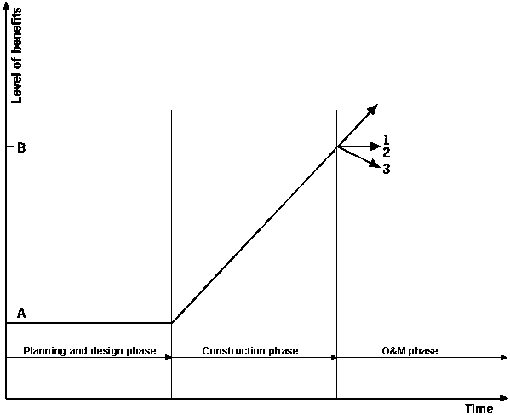
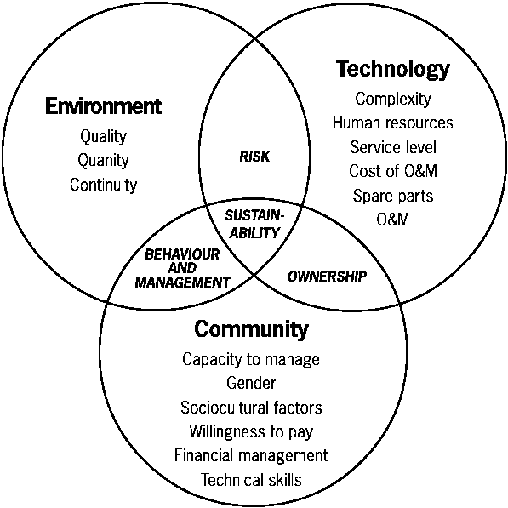
In an interactive presentation the facilitator, from time to time during the presentation, poses questions so that the group can interact, e.g. by explaining the situation in their own words or by experiencing or proposing new ideas. The presentation starts by reminding the participants of the close links between operation and maintenance and sustainability. The first message to be conveyed is that sustainability is a process which starts right from the planning stage, and that O&M is not simply what happens after the system has been constructed. The first overhead sheet, representing a graphic of sustainability, may now be presented. More details are provided below in the section on background information. The second message deals with the factors that influence sustainability. The facilitator can refer to the second overhead sheet and to the content details under background information. Another effective way to help the participants’ comprehension is to explain the drawing with sustainability circles, step by step.
Group exercise on definition of concepts
The facilitator asks the group to define the following terms: 1) sustainability, 2) operation, and 3) maintenance. Key words suggested by the participants are then written on the board, and from these a definition is gradually formulated for each term. At this stage, full phrases may not be required for the definitions.
A set of overhead sheets provides definitions for this course (pages 41-43), which are compared with what the participants proposed. Any difficulties in understanding should be discussed until the whole group reaches a consensus.
Exercise on the attributes of good management
Management is one of the key terms in this course. It is therefore important to have a common understanding about what it entails. There are no right or wrong answers, but the objective is to highlight the participants’ perception of management and to compare this with what the course will provide in terms of management tools.
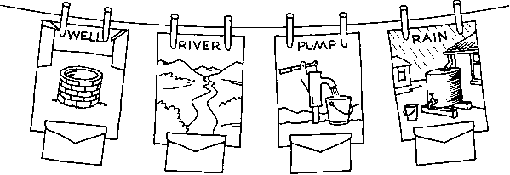
The facilitator divides the participants into three or four groups and gives them an envelope containing labels, each representing a major attribute generally connected with management (see exercise sheet). Each group must choose five major attributes, which they think are needed for the proper management of projects. Some 15 to 20 minutes are required for this exercise.
Each group puts up their labels on the board and explains briefly (in five minutes) the reasons for their choice. The facilitator then presents the group with a definition of management and highlights some issues on management, which will be worked upon in the course. Time should be set aside for discussion and questions to promote clarification.
Focused discussion on what is rural
To end the session, the facilitator asks the group to reflect on this key term in the title of the course, i.e. what do they understand by “rural”? The participants’ answers may cause some difficulty because countries vary in their rural situations and characteristics. To facilitate consensus it can be proposed that, in the present context, the focus must be on low-cost technologies, including small piped-water supply systems. The aim here is not to give a precise definition of what is rural, but to provide a framework for improving rural water supply and sanitation, and to give an overview of the size and socioeconomic conditions of human settlements in the rural areas. Water supply and sanitation technologies will be reviewed during the session on “O&M requirements” (see Module 2, Unit 1).
3. Overhead and exercise sheets: Sheet 1
|
1 & 2: Development reaches sustainability · Careful planning and design of O&M must already be completed during the planning and design phase · What are the factors that influence sustainability? |
Overhead sheet 2
|
Factors which influence sustainability1 1 From CINARA-IRC course material: Gestion para la sostenibilidad en programas de agua potable y saneamiento (Management of sustainability in drinking-water and sanitation programmes), 1994-98.
|
Overhead sheet 3
|
Processes which influence sustainability · Demand from the community · Co-responsibility between communities and municipalities |
Overhead sheet 4
|
Definitions Sustainability A service is sustainable when: · it functions and is being used · it does not affect the environment negatively. |
Overhead sheet 5
|
Definitions Operation Operation deals with the actual running of a service (e.g. provision of fuel, starting or handling of pumps, control of water collection points, general mechanical or water treatment procedures, hygienic handling, etc.). Maintenance Maintenance deals with the activities that keep the system in proper working condition, including management, cost recovery, repairs and preventive maintenance. · Crisis maintenance: maintenance undertaken only in response to breakdowns and/or public complaints, leading to poor service level, high O&M costs, faster wear and tear of equipment, and user’ s dissatisfaction. · Preventive maintenance: maintenance activities undertaken in response to prescheduled systematic inspection, repair and replacement, leading to continuity in service level, O&M costs spread over time, extension of life-span of equipment, user’ s satisfaction and willingness to pay. |
Overhead sheet 6
|
Definitions Management Management deals with the control and organization of a service and encompasses the following main functions: · Development of a vision and strategy This course focuses on the following managerial issues: · Strategy development · Planning with communities. |
Exercise sheet
|
Management attributes1 1 Adapted from: Srinivasan L. Exercise in tools for community participation - A manual for training trainers in participatory techniques (PROWWESS/UNDP Technical Series). PROWWESS/UNDP - World Bank Water and Sanitation Program, New York, 1993. Prepare in advance an envelope containing the following labels which describe a possible management attribute. Each group will have to choose the five most important attributes for managing O&M.
|

4. Background information
4.1 Operation and maintenance in the context of sustainability
Sustainability depends to a large extent on effective and efficient operation and maintenance. Many factors and processes that contribute to sustainability have a direct influence on operation and maintenance.
Sustainability can be analysed in time, as shown in the Figure on project phases. A service is sustainable when:
a) it is functioning and being used; b) it is able to deliver an appropriate level of benefits (quality, quantity, convenience, comfort, continuity, affordability, efficiency, equity, reliability, health); c) it continues over a prolonged period of time (which goes beyond the life-cycle of the equipment); d) its management is institutionalized (community management, gender perspective, partnership with local authorities, involvement of formal/informal private sector); f) its operation, maintenance, administrative and replacement costs are covered at local level (through user fees, or alternative financial mechanisms); g) it can be operated and maintained at local level with limited but feasible external support (technical assistance, training, monitoring); and h) it does not affect the environment negatively.
Proper operation and maintenance activities will contribute to the sustainability of a service after its construction, depending on a series of factors and processes which will have to be developed during the design and planning phase, and consolidated during the construction phase. In other words, the sustainability of operation and maintenance starts right from the planning stage.
4.2 Factors which contribute to sustainability and to effective operation and maintenance
As described in the chart with circles, sustainability relies on four interrelated factors (adapted from CINARA - IRC course material, 1994 to 1998): a) technical factors, b) community factors, c) environmental factors, and d) the legal and institutional framework.
The technical factors which are likely to influence operation and maintenance as well as sustainability as a whole are: technology selection; complexity of technology; its capacity to respond to a demand and a desired service level; its impact on the environment; the technical skills needed to operate and maintain a system; the availability, accessibility and costs of spare parts; and the cost of maintenance.
The community factors which are likely to influence operation and maintenance as well as sustainability as a whole are: availability of technical skills to operate and maintain a service, and implement preventive maintenance activities and small and big repairs; capacity and willingness to pay; participation of all social groups in the community and both men and women; financial and administrative management carried out by a legitimate and organized community structure; the felt need for an improved service; socio-cultural aspects related to water; and individual, domestic and collective behaviour regarding hygiene and sanitation.
The intersection between the technical circle and the community circle indicates the level of ownership and responsibility of communities towards the service. Ownership and responsibility are the key prerequisites for sustainable operation and maintenance.
The environmental factors which are likely to influence operation and maintenance as well as sustainability as a whole are: the quality of the water source (which will in turn influence the technology choice, and its need for treatment); and its quantity and continuity.
The intersection between the environmental circle and the community circle represents the way the community will manage water resources and especially the impact on the environment of community behaviour in terms of sanitation and management of used waters. Water resources management, pollution control, hygienic behaviour, and proper wastewater management are all crucial components for sustaining a water supply service, to which operation and maintenance must contribute.
All these factors evolve within a legal and institutional framework. At the national level there must be clear policies and strategies towards operation and maintenance, which can be implemented. Support activities, such as technical assistance, training, monitoring, water quality control, and the setting up of alternative financing mechanisms are all likely to influence operation and maintenance activities.
Financial factors are key components inherent in all the above factors (technical, community, environment and institutional).
4.3 Processes which influence sustainable operation and maintenance
Processes differ from factors since they focus on the approach and the methodology of working. In the past, it was thought that the development or consolidation of factors alone could contribute to greater efficiency, effectiveness and sustainability. Now, however, it is realized that processes also have an important role to play. Among the processes can be listed the following: demand from the communities; responsiveness from supporting institutions and agencies; participation of communities (men and women) through the whole project cycle; linking technology choice with operation and maintenance; integration of water, sanitation, health and environment; planning with a gender perspective; effective decentralization; communication among all stakeholders; public/private partnership; co-responsibility between community and municipality; and capacity-building at all levels.
Demand for an improved service by the communities is a prerequisite for sustainability. It is an expression of their commitment, and a way to make communities responsible for their choices and future tasks. However, demand should be promoted because communities must be made aware of the different technology options available, and of their financial consequences. The concrete expression of demand varies from one country to another and from one development agency to another. Demand can be manifested in the form of an initial contribution in cash or in kind to the capital costs, or in the form of a written solicitation from an organized community group to the municipality.
Responsiveness of support institutions and agencies is the capacity of municipalities, nongovernmental organizations (NGOs), and other institutions and agencies to respond adequately to the needs and demand of communities. In many countries, municipalities need to be consolidated in their ability to deal with rural communities.
Participation of communities (men and women) throughout the whole project cycle is essential since it is a way to motivate, make responsible and build the capacities of communities in their new tasks and functions.
Linking technology choice with operation and maintenance at the planning stage is the key in the technology selection process. Indeed, communities must be able and willing to operate, maintain, administrate and finance the new service.
Planning with a gender perspective implies that the roles and functions of both men and women are clearly defined for management, operation and maintenance, since these might also highlight the need for specific capacity-building activities.
The decentralization process, which is underway in most developing countries, has a definite impact on the way institutions deal with the provision of water supply services. The main trend is for municipalities to be responsible, while the private sector (formal and informal) can contribute actively in the maintenance of systems.
Communication from central to local level and vice versa, and between private agencies and development agencies can enhance the coordination of activities and implementation of policies. Furthermore, a proper information and monitoring system relies on effective communication channels.
Public/private partnership can have an important role in the operation and maintenance of improved water supply and sanitation services, where the private sector can operate, maintain, and manage the service under contractual agreements.
Co-responsibility between communities and municipalities implies that the tasks, responsibilities and functions of both parties are clearly defined. This is especially true now that municipalities are increasingly being given the legal and constitutional responsibility for the provision of public services. At the same time, community management is being promoted as a key element of sustainability. Efficient dialogue and a clear definition of roles need to be worked out, developed and consolidated.
Capacity-building at all levels is needed, especially in an environment of changing roles and responsibilities induced by the decentralization process.
Unit 4: Linking water, health, sanitation and environmental protection
1. Outline of session
· Objectives
· Methodology
1. Introductory note2. Video presentation followed by a discussion
3. Interactive presentation on the links between major health preventive measures and environmental protection
4. Focused discussion on behavioural change
5. Exercise in plenary using a behavioural change matrix
· Materials
Ö Overhead transparencies
Ö Flip chart and masking tape
Ö Overhead projector, screen or white wall
Ö Video projector
Ö Video: “Prescription for Health”
· Handouts
Ö Copies of all transparencies
Ö Selected extracts from background information
2. Notes for the facilitator
Introductory note
It was mentioned in a previous session that there is a trend to link water supply, health, sanitation and environmental protection activities because an adequate water supply by itself cannot solve all health problems. Proper handling and hygienic use of water, hygienic maintenance of water points and water sources, protection of the environment, safe sanitation disposal and cleaning of hands all contribute to the improvement of health. The facilitator must therefore focus on the importance of linking water supply, health, sanitation and environmental protection, and help all participants to see the need for such integration.
Video presentation followed by a discussion
A 23-minute video film, “Prescription for Health”, was produced by the IDRC (International Development Research Centre), P.O. Box 8500, Ottawa K1G 3H9, Canada, and is suitable for audiences of diverse cultural backgrounds. It was filmed in Bangladesh, Kenya, Philippines, Sri Lanka and Thailand, with extensive animation sequences to illustrate clearly the contamination path. The video promotes personal hygiene and community practices linked to water supply and sanitation, which can help to break the cycle of infection. Produced in collaboration with the World Health Organization and OXFAM, the video is primarily aimed at health care workers and water and sanitation engineers. It is a source of information for planners and policy-makers, and particularly strong in raising awareness.
After viewing the video, the participants are asked by the facilitator to comment on the key messages brought up in the film. Their main ideas are written on the board, together with statements from the video which are added by the facilitator who must be thoroughly familiar with the film. The facilitator then asks the participants how far this type of approach has been or could be utilized in their own working environment, and encourages them to discuss freely based on their personal experiences.
Identification of obstacles that inhibit the link between water supply, health, sanitation and environmental protection is discussed in a plenary session. The aim of this exercise is to show the constraints that must be overcome in order to reach integration. Such issues as no priority, not our mandate, no knowledge about it, poor financial resources, and poor inter-sectoral cooperation might come out during the discussion. The course does not try to solve these problems, but tries to show how O&M activities can contribute to this integration.
Interactive presentation on major preventive measures and environmental protection
Using the overhead sheets provided, the facilitator shows the major preventive measures for reducing the transmission of diseases related to water and sanitation. Some explanations are available in the background information and supporting material.
The topic of environmental protection is dealt with in the same way. In both cases, it is important to show how these issues are related to O&M and its management. After an overhead sheet is presented, the group is asked, “How can a better O&M contribute to this situation?”
Focused discussion on behavioural change
Since hygiene practices and environmental protection activities are linked to specific individual, domestic or collective behaviours, the facilitator initiates a discussion with the group by asking the following questions: “Can you give examples from your professional experience of activities that aimed at changing behaviour, or specific outcomes which depended on behaviour change?” “Were they successful?” “What made them successful or not successful?” The facilitator then discusses with the group some basic aspects which make behavioural change not always successful (see background information).
Exercise in plenary using a behavioural change matrix
Key criteria for activities to promote behavioural change have been developed in a matrix by UNICEF, which can be presented to the whole group as an exercise in a plenary session. The matrix is given in an exercise sheet.
The facilitator asks the group for examples of behavioural change which all participants are familiar with, such as “Use of chlorine tablets to disinfect water at household level”. The facilitator goes through the whole matrix with the participants, analysing the chosen behaviour change, and scores the total number of points. The final result is evaluated according to the ranges given in the exercise.
3. Overhead and exercise sheets: Sheet 1
|
Prevention of diseases related to water and sanitation Major preventive measures 1. Safe human excreta disposal* *Link with Operation and Maintenance. |
|
Overhead sheet 2
|
Relationship between infection and preventive measures1 1 From: Boot M, Cairncross S. Action speaks: the study of hygiene behaviour in water and sanitation projects. The Hague, IRC (and London School of Hygiene and Tropical Medicine), 1993. | |||||||||||||
|
Infection |
Safe human excreta disposal* |
Personal hygiene* |
Domestic hygiene |
Food hygiene |
Water hygiene* |
Drainage* | |||||||
|
Diarrhoea | |
| | |
| | |||||||
|
Roundworm |
| | | | | | |||||||
|
Hookworm | |
| | | | | |||||||
|
Beef and pork tapeworms | | | | | | | |||||||
|
Schistosomiasis | | | | | | | |||||||
|
Guinea worm | | | | | | | |||||||
|
Scabies | | | | | | | |||||||
|
Trachoma | | | | | | | |||||||
|
Louse-borne typhus | | | | | | | |||||||
|
Malaria | | | | | | | |||||||
|
Bancroftian filariasis | | | | | | | |||||||
* Can be influenced by adequate operation and maintenance. |
| ||||||||||||
Overhead sheet 3
|
Drinking water source protection1 1 From: Bastemeyer TF, Lee MD. Drinking water source protection. The Hague, IRC, 1991. · Appropriate source selection and intake * Can be influenced by adequate operation and maintenance practices. |
|
Exercise sheet
|
Behavioural change matrix Criteria for evaluating the likelihood of behavioural change (Source: van Wijk C, Murre T, Esrey S. Motivating for better hygiene and behaviour. New York, UNICEF - IRC, 1996) | |||
|
Health impact of behavioural change |
Complexity of behavioural change |
Direct consequences of behavioural change | |
|
0. No impact on health |
0. Unrealistic |
0. No consequences | |
|
1. Minor impact |
1. Involves too many actions |
1. Minor consequences | |
|
2. Some impact |
2. Involves many actions |
2. Some consequences | |
|
3. Significant impact |
3. Involves few actions |
3. Significant consequences | |
|
4. Very significant impact |
4. Involves two actions |
4. Major consequences | |
|
5. Eliminates the problem |
5. Involves one action |
5. Consequences guaranteed | |
|
Frequency of behaviour |
Cost and effort of engaging behavioural change |
Persistence needed to induce behavioural change |
|
|
0. Too cumbersome |
0. Unrealistic |
0. Unrealistic | |
|
1. Must be done hourly |
1. Requires important resources and effort |
1. Requires compliance for several weeks | |
|
2. Must be done once a day |
2. Requires significant |
2. Compliance for a week | |
|
3. May be done every few days |
3. Requires some resources and effort |
3. Compliance for several days | |
|
4. May be done once a week |
4. Few resources or effort |
4. Compliance for a day | |
|
5. May be done occasionally |
5. Requires only existing resources |
5. Very brief compliance | |
|
Compatibility with existing activities |
Observability |
Similar practices | |
|
0. Totally incompatible |
0. Cannot be observed by an outsider |
0. Nothing like this is done | |
|
1. Significantly incompatible |
1. Very difficult to observe |
1. Slightly similar | |
|
2. Some incompatibility |
2. Difficult to observe |
2. Existing practice similar | |
|
3. Little incompatibility |
3. Is observable with attention |
3. Several similar practices | |
|
4. Easy to incorporate in existing activities |
4. Observable |
4. Many similar practices | |
|
5. Type of activity already widely practised |
5. Cannot be missed |
5. Similar practices widely existing | |
|
| |||
4. Background information
4.1 Why is behaviour not changed by conventional hygiene education?1
1 From: van Wijk C, Murre T, Esrey S. Motivating better hygiene behaviour: importance for public health - Mechanisms of change. New York, UNICEF - IRC, 1996.
Planners of hygiene programmes and practitioners often believe that it is possible to give universal hygiene messages to the population. Such messages are based on the assumption that the knowledge of health educators is superior to local insights and practices. The fact that people have adapted their lifestyle to local circumstances and developed their insights and knowledge over years of trial and error is overlooked. General hygiene messages can therefore be irrelevant, incomplete or unrealistic.
The methods used to get the information across are often not suitable to create behavioural change. Many health messages are given in the form of lectures at health clinics, talks in meetings and gatherings, and through the mass media (e.g. posters, radio talks, brochures and booklets). Even if the educators succeed in reaching the intended audiences using the media, the people are only “told what to do”, and often do not get the chance to relate the message to their own experiences. It is important to realize that people can make sense of new information only in the light of their own experiences, perceptions and cultural backgrounds.
Many health education programmes teach people about water and sanitation-related diseases - what they are, how they are caused, and how they are prevented. But education does not, by itself, reduce the risks of transmitting these diseases. Only action can do this; knowledge is useful but not sufficient. Reviews of hygiene programmes show that appropriate settings to promote particular changes are rare.
4.2 What motivates people to improve their hygiene?
If general messages and information on disease transmission do not change people’s behaviour, what is it that can bring people to take action on the risky practices and conditions in their own environment?
An individual will adopt new behaviour when he or she believes that the practice has clear benefits - for health or other reasons - and considers these benefits as important. Change of behaviour is also considerably influenced by convenience, comfort, and status. The individual will then develop a positive attitude to the change. Positive or negative views on the environment from others can also influence a person’s decision to try the new practice. Thus, an individual’s attitude and situation will determine if the practice is taken up, and when this is found to be beneficial, it is continued.
What hygiene education programmes can do is to support water and sanitation projects, which are planning to install new facilities for the community’s use:
a) by assessing if water, sanitation and hygiene have a high priority among the various groups in the community, and by promoting their understanding of the implications of the existing conditions and proposed technical options for both community and family health;b) by following up people’s use of the newly installed facilities and their hygiene practices in order to provide feedback to planners who will be better prepared to reduce other disease transmission risks, which prevent the realization of health improvements in the communities concerned.
Certain practices cannot produce results by individual change alone, but require concerted action by larger groups and the whole community. Making choices together, assigning responsibilities, and monitoring action will increase the people’s commitment to put into practice the agreed changes. Communal change is only possible when the community members themselves feel there is a problem and jointly undertake action that will permanently improve the conditions and their practices.
When learning, people remember 20% of what they hear, 40% of what they hear and see, and 80% of what they discover for themselves. This calls for a change in the way teaching is carried out - from a didactic to a more participatory and growth-centred education.
Four major factors stimulate people to change their behaviour: 1) facilitation (convenience, making life easier); 2) practical understanding; 3) influence of others; 4) capacity to change.
4.3 Experiences in better water resource management1
1 Extracts from: Bastemeyer T. Drinking-water source protection. The Hague, IRC, 1991.
Source selection and siting of intakes
Field experience shows that good source selection and adequate siting of intakes contribute to the reliability of the water supply system. For the selection of groundwater sources, in particular for small point source supplies, procedures could be more systematic, both in terms of locating high-yielding sites and in terms of avoiding sites with a high potential for contamination by seepage from the surface.
For the siting of shallow drilled and hand-dug wells, the risk associated with faecal contamination from on-site sanitation are poorly understood and quantified. Where water supply points are located within or adjacent to settlements, two elements have not been adequately addressed with respect to possible contamination by existing sanitation units and/or waste disposal practices. The first element concerns the risk of contamination of drinking-water sources from waste. The second is the lack of criteria for the establishment of safe distances between water source and possible contamination points.
With increasing population pressures and expansion of human activities into previously undisturbed catchment areas, risk assessment must take into account both current and projected activities within the catchment area.
Catchment protection
More active protection of catchment areas is needed, which involves a systematic appraisal of catchment areas for surface or groundwater sources and the identification of environmental factors related to land use. There is a need for practical experience to develop checklists for small sources to be effectively managed and maintained by local communities.
The groundwater pollution risk is the product of the contaminant load applied to the subsurface by human actions and the natural pollution vulnerability of the aquifer. To protect aquifers, it must be clear which pollutants and pollution sources affect them most. This knowledge forms the basis for delimiting protection zones within which human activities must be regulated.
Protection zones are important for the design, prioritization and distribution of water resources protection measures. The zones can be delimited with respect to the level and nature of the risk, resulting in more coherent and incisive protection strategies. The effectiveness of protection zones depends on the commitment of the local population to observe established protection measures. Protected areas are obviously increasingly vulnerable as population density increases.
Sanitary surveying
Sanitary surveys are a form of risk assessment in which the bacteriological, physical and chemical quality of a water source, the technical quality of the water supply point, the way it will be used by the communities, the surrounding environmental hygiene conditions, and the potential causes for contamination are examined. Their purpose is to minimize the level of risks of on-site contamination by identifying remedial measures which can quickly and easily be undertaken.
Improvement in sanitation
The problem of contamination of the water supply by users through poor sanitation and hygiene is widespread. Use of latrines and other sanitary systems reduces the risk of faecal pollution by excluding contamination of the topsoil or ground surface so that excreta are not washed into the surface water or transported by animals. The design of latrines should in principle ensure that there is no direct sub-surface link between the excreta and the groundwater supply, which involves taking into consideration the site, soil type and depth, and seasonal and daily water levels.
Physical protection of wells and intakes
Users pollute their water sources due to the lack of awareness about ways and means to ensure adequate physical protection of the water supply point. Community water supply projects, which are engaged in groundwater development through construction of wells, recognize the importance of simple site protection against pollution. The addition of well-aprons, soakway drains, covers and handpumps protect the water’s quality by preventing the inflow of contaminated water back into the well.
Soil and water conservation techniques
Soil and water conservation activities can decrease turbidity by preventing sediment transport, increasing groundwater recharge, and decreasing surface flow peaks by increasing infiltration. A full range of erosion control techniques and strategies has been pioneered for developing countries and applied with considerable success.
However, soil erosion has expanded at a faster pace than most national governments have been able to cope with. A large proportion of soil erosion problems resulted from the expansion of shifting cultivation techniques into marginal areas. Additionally, they result from the settling of previously semi-nomadic people who have little history of terrace building or other traditional forms of soil stabilization.
Wastewater treatment
Both industrial effluent and domestic sewage should be treated to minimize pollution risks. For domestic sewage, different on-site and off-site technical options are available, but they are not always applied. In the developing countries, sewage lagoons and oxidation ditches are among the most economical methods. There is little experience in the use of simple and effective, low-cost treatment technologies for small-scale industrial polluters, especially for small rural agro-industries. There are no feasible treatment possibilities to deal with the many toxic elements originating from industries and the misapplication of fertilizers. Preventive measures against contamination from industrial and agricultural activities are therefore crucial.
Wastewater recycling
Wastewater treatment is complementary to wastewater recycling. As such, sewage waste may only need partial treatment in order to be used on farmland for irrigation or in a range of industrial processes where water quality standards are not critical. Wastewater recycling, if carried out correctly, can be a form of water source protection as well as conservation. The risk of contamination of water sources is decreased through proper recycling and increases the efficient use of the water source. In this way, water is treated by less expensive methods, since treatment requires mainly the removal of coliforms and helminths (e.g. wastewater treatment ponds).
Artificial recharge
Ground-water resources can be managed in order to decrease water table recession and saltwater intrusion, by artificial recharge. On the small and medium scale, recharge is predominantly performed from infiltration ditches, ponds and basins, retention of river underflow (using sub-surface dams), and through the retention of river floodwater. Sand storage dams can also be used to increase the dimensions of the shallow ground-water reservoir.
Reforestation
Reforestation programmes coupled with anti-erosion, soil and water conservation techniques are considered essential for the improvement of many water source problems. However, at the present time many more trees are cut down than planted.
Community motivation and awareness
Many water pollution problems are due to a lack of awareness of the causes of health problems among communities. The link between water, hygiene and illness is not strongly perceived since water is assumed to be beneficial and cleansing rather than a potential source of infection.
Partnership between communities and government agencies
A reliable and functioning water supply system may greatly contribute to the protection of water sources, and vice versa. Community-based maintenance and management of water supply systems is a good starting point for a more integrated approach to water source protection and environmental conservation. Although community water management strategies are possible, there must generally be direct links between the community and the water source. Communities must be the users of the water source or derive some other benefit from the protective action such as commercial benefits from tree planting or increased crop production following soil conservation. Conflict of interest between upstream and downstream users is a serious problem worldwide. That is why a sound legal basis for community water supply systems is very important. Government institutions and local authorities should support community efforts to manage and protect their drinking-water sources.
Legislation and enforcement
At the present time, water resource and environmental legislation in most developing countries has evolved over the years in response to specific water management problems, which were associated with economic and demographic growth. The legislation has usually been directed towards controlling the use of water from major rivers or lakes, which are of economic significance, and currently does not provide a good basis for the protection of drinking-water sources.
WHO has listed the following legal issues which require attention:
- regulations are needed to ensure that the source exploited for community water supply is the most favourable in terms of quality, quantity, and access;- regulations are needed to ensure health and environmental protection for wastewater use since there are obvious public health hazards;
- legal provisions are required to ensure that potential water sources are adequately protected from the harmful effects of wastewater infiltration;
- legislation and regulations are needed to ensure that the costs of community water supply and sanitation are recovered from all water source users.
Module 2: Situation analysis
Unit 1: Operation and maintenance requirements
1. Outline of session
· Objectives
· Methodology
1. Introductory note2. Focused discussion on rural water supply and sanitation technologies most frequently used in the participants’ projects
3. Group assessment of operation and maintenance requirements and problems most frequently encountered
4. Presentation on spare parts availability.
· Materials
Ö Overhead transparencies
Ö Flip chart and masking tape
Ö Overhead projector, screen or white wall
· Handouts
Ö Copies of all transparencies
Ö Selected extracts from background information
Ö Forms for the exercise
2. Notes for the facilitator
Introductory note
Situation analysis starts by reviewing the main technical activities for the operation and maintenance of rural water supply and sanitation services. It allows the participants to understand and be familiar with the various technologies presented in the course.
Focused discussion on rural water supply and sanitation technologies
The facilitator asks the participants what types of technologies are being promoted in their rural water supply and sanitation projects. These are listed on the board and, with the aid of the transparencies (see overhead sheets, pages 65-67), compared with the technologies presented in the course.
The course deals with only human excreta disposal systems, which is the basic sanitation option in many projects. This does not mean that other aspects of sanitation, such as wastewater disposal, solid waste disposal, and drainage of surface (rain) water, are not important because they are all important.
All water supply and sanitation project planners should, as if automatically, be able to integrate their basic and simple wastewater disposal services with water supply services. However, the course does not advocate systems which cannot be sustained by rural communities.
Group assessment of basic O&M requirements
The aim of this exercise is to assess the basic O&M activities in a particular system which will be chosen by the groups, including their frequency, human resources and skills, and requirements for tools, equipment, materials and spare parts. The participants are divided into groups corresponding to the main technologies, including sanitation. All participants are asked to fill in a form (see exercise sheet on “Assessment of basic O&M requirements”). Each group then rapidly presents their work, with an emphasis on the problems encountered which will be considered throughout the course. The present session deals with the problem of spare parts availability.
Interactive presentation on spare parts availability
Problems in the availability of spare parts are often encountered in the operation and maintenance of water supply and sanitation projects. This session reviews the main characteristics of the problem, which must be taken into account in planning for spare parts. The overhead sheets and background information (see below) will be useful in preparing the presentations, in which the participants will describe their experiences. In addition, a spare parts supplier could be invited to share his experience and perceptions during the session.
3. Overhead and exercise sheets: Sheet 1
|
Water sources for low-cost water supply technologies Rain water Rooftop water harvesting Groundwater Spring water captation Surface water Protected side intake Sump intake |
|
Water-lifting technologies Rope and bucket: loose, through a pulley, or on a windlass Hydraulic ram |
Overhead sheet 2
|
Power systems Human power Diesel engines |
|
Water treatment devices At the household level Heating At the community level Pot chlorination in well Chlorination in piped water supply systems |
Overhead sheet 3
|
Low-cost sanitation technologies Dry systems · Basic improved traditional latrine Wet systems · Pour-flush latrine with leaching pits Pit-emptying techniques · Vacuum tanker Liquid effluent disposal systems · Soakaway · Small-bore sewerage |
Exercise sheet
|
Assessment of basic Operation and Maintenance requirements | |||
|
Technology choice (Fill in when applicable) | |||
|
Type: |
Power system |
Distribution system |
Water treatment |
|
Major O&M activities |
Frequency |
Tools, materials, spare parts |
Skills and human resources |
|
Conclusion | |||
|
Tools, materials, and spare parts needed: | |||
|
Skills and human resources needed: | |||
|
Main problems: | |||
Overhead sheet 4
|
Sustainable provision of spare parts depends on: 1. The demand for spare parts · Spare parts needs 2. The supply of spare parts · Use of local materials and manufacture 3. Strategic issues · Efficient planning · Capacity-building |
4. Background information
4.1 What is sanitation?
Sanitation encompasses the following: 1) human excreta disposal systems, 2) wastewater disposal devices, 3) solid waste disposal, and 4) drainage of surface (rain) water. This course focuses mainly on human excreta disposal, which is considered to be the basic sanitation option. The other three areas are also important and some comments on them are given below.
Wastewater is either sullage (greywater), which is wastewater from kitchens and bathrooms, or sewage (blackwater), which includes sullage and is settled wastewater containing parts of human excreta, and water-borne waste. Problems are mainly encountered in areas with a high density of houses and people, where the wastewater is liable to flooding if there is no proper drainage, or can be a source of smells, rodents and contamination (see Module 1, Unit 4). Wastewater can contaminate drinking-water supplies through broken pipes or the spread of stagnant water, depending on the absorption capacity of the soil. The problem with water-borne disposal is its high rate of water consumption, regular blockage in the drainage system, and high O&M costs.
Plans for simple wastewater disposal and drainage devices should be made during the initial technical design phase. Proper maintenance of small gutters, drainage devices, or areas surrounding water points is essential, and communities should actively participate to prevent blockages and stagnant water forming around the water points.
Solid waste generally includes household refuse, waste from institutions, industrial waste and hospital waste. Rural areas are mainly concerned with the first two of these, but can be contaminated indirectly by pollution from industrial waste. Populations in developing countries produce different wastes from those in industrialized countries; there is a similar difference in wastes between urban and rural areas. Vegetable waste accounts for, on average, 30% of the total waste in industrialized countries and 75% in developing countries; the possibilities for composting and recycling depend on the composition. Improper solid waste disposal can present a public health risk, and is often the cause of drainage blocks and aesthetic problems. Unplanned and uncontrolled dumpsites can generate ground and groundwater pollution, as well as lead to air pollution and proliferation of rodents.
Maintenance activities linked to wastewater and solid waste disposal in rural areas are to a large extent a matter of preventive maintenance by the active involvement of users. Behavioural changes in communities to improve the operation and maintenance of basic sanitation systems can be induced by effective awareness campaigns, together with participatory sanitary problem assessment (see Module 1, Unit 4).
4.2 Water supply and sanitation O&M fact sheets
The fact sheets given below are extracted from: Linking technology choice with operation and maintenance, in the context of low-income water supply and sanitation, by F. Brikk� et al. Published by the Operation and Maintenance Network of the Water Supply and Sanitation Collaborative Council, 1997, and available from WHO headquarters (contact Mr J. Hueb) or from IRC.
O&M FACT SHEET
Rooftop water harvesting
a. Brief description of technology
Rooftop catchment systems gather rainwater caught on the roof of a house, school, etc. using gutters and downpipes (made of local wood, bamboo, galvanized iron or PVC) and lead it to one or more storage containers ranging from simple pots to large ferrocement tanks. If properly designed, a foul flush device or detachable downpipe is fitted for exclusion of the first 20 litres of runoff during a rainstorm, which is mostly contaminated with dust, leaves, insects and bird droppings. Sometimes runoff water is led through a small filter consisting of gravel, sand and charcoal before entering the storage tank. Water may be abstracted from the tank by a tap, handpump or a bucket and rope system.
|
Initial cost: |
In Southern Africa, US$ 320 for a system with 11 m galvanized iron gutter, 1.3 m3 galvanized iron tank, downpiping, tap and filters, excluding transport (Erskine, 1991). Where the roof is not suitable for water harvesting, the cost of improving the roof and gutters will have to be added to the cost of the tank. Such costs were found to vary between about US$ 4 (in Kenya, subsidized) and US$ 12 (in Togo) per m2 (Lee & Visscher, 1992). Total capital costs for rooftop rainwater catchment systems are usually higher than for other water supply systems. |
|
Yield: |
Potentially almost 1 litre per horizontal square metre per mm rainfall. The quantities usually are only sufficient for drinking purposes. |
|
Area of use: |
Most developing countries with one or two rainy seasons (especially in arid and semi-arid zones, with average annual rainfall ranging from 250 to 750 mm) and where other improved water supply systems are difficult to realize. |
|
Construction: |
Systems are usually produced locally. |
b. Description of O&M activities
In case there is no foul flush device, the user or caretaker has to divert away the first 20 litres or so of every rainstorm. Fully automatic foul flush devices are often not very reliable. Water is taken from the storage tank by tapping, pumping, or using a bucket and rope. For reasons of hygiene, the first two methods are preferred. Just before the start of the rainy season, the complete system has to be checked for holes and broken parts and repaired if necessary. Taps or handpumps have to be serviced. During the rainy season the system is checked regularly, and cleaned when dirty and after every dry period of more than a month. Filters should be cleaned every few months, filter sand should be washed at least every six months, and the outside of metal tanks may be painted about once a year. Leaks have to be repaired throughout the year, especially leaking tanks and taps, as they present health risks. Chlorination of the water may be necessary. All operation and maintenance activities can normally be executed by the users of the system. Major repairs, such as a broken roof or tank, can usually be executed by a local craftsman using locally available tools and materials. Maintenance is simple but should be given ample attention.
Organizational aspects
The organization of O&M of communally shared roof or ground tank supplies is considerably more difficult than for privately owned systems. Rooftop harvesting systems at schools, for instance, may suffer water losses from a tap left dripping, and padlocks are often needed to ensure careful control over the supply. Ideally, one person should be responsible for overseeing the regular cleaning and occasional repair of the system, control of water use, etc. Selling the water is an option to ensure income for O&M and to restrict water use. Where several households have installed a communal system, e.g. where several roofs are connected to one tank, the users may want to establish a water committee to manage O&M activities, which may include collection of fees, control of the caretaker’ s work, and control of water use by each family. External agents can play an important role in monitoring the condition of the system and the water quality, in providing access to credit facilities to buy or replace a system, in training of users/caretakers for management and execution of O&M, and training of local craftsmen for larger repairs.
c. O&M requirements
|
Activity |
Frequency |
Human resources |
Materials and spare parts |
Tools and equipment |
|
Clean the system |
1 - 3 times per year |
Local |
Chlorine |
Broom, brush, bucket |
|
Divert foul flush |
Every storm |
Local | | |
|
Clean the filters |
Twice a year |
Local |
Sand, charcoal, plastic mesh | |
|
Disinfect the reservoir |
Occasionally |
Local |
Chlorine |
Bucket |
|
Repair roof, gutters and piping |
Occasionally |
Local |
Tiles, metal sheet, asbestos cement sheet etc., bamboo or PVC pipes, nails, wire |
Hammer, saw, pliers, tin cutter |
|
Repair tap or pump |
Occasionally |
Local or area |
Washers, cupseals etc. |
Spanner, screwdriver |
|
Paint outside of metal reservoir |
Annually |
Local |
Anticorrosive paint |
Steelbrush, paintbrush |
|
Repair ferrocement reservoir |
Occasionally |
Local |
Cement, sand, gravel, metal mesh, wire |
Trowel, bucket, pliers |
d. Actors implied and skills required in O&M
|
Actor |
Role |
Skills |
|
User |
Close taps after taking water, keep the system clean |
No special skills |
|
Caretaker |
Check functioning, divert first flush, clean the filters and rest of the system, perform small repairs |
Basic skills |
|
Water committee |
Supervise caretaker, collect fees |
Organizational skills |
|
Local craftsman |
Repair roof, piping and tank |
Basic plumbing and masonry |
|
External support |
Check water quality, stimulate and guide local organization, train the users |
Microbial analysis, extension work |
e. Recurrent costs
Recurrent costs for materials and spare parts are very low. In most cases these costs are even considered negligible. However, the recurrent costs for personnel - in cash or kind (for caretakers, committee members and craftsmen) will need to be added.
f. Problems, limitations and remarks
Frequent problems. Corrosion of metal roofs, gutters, etc. Failure of functioning of the foul flush devices due to neglect of maintenance. Leaking taps at the reservoir and problems with handpumps. Contamination of uncovered tanks, especially where water is abstracted with a rope and bucket. Tanks may provide a breeding place for mosquitos, which may increase the risk of diseases like malaria.
Limitations. The water may be insufficient to fulfil the drinking-water needs at certain times in the year, making it necessary to develop other sources or go back to traditional sources during these periods. The investment needed for the construction of a tank and suitable roofing is often beyond the financial capacity of households or communities.
Remarks. Tiled or metal roofs give the cleanest water. Thatched roofs yield less water which is more contaminated. The acceptance of rooftop water harvesting as a suitable system may depend on the users’ views on the water’ s taste.
Spring water captation
a. Brief description of technology
Spring water captation systems abduct and protect groundwater flows at the points where these arrive at the surface to facilitate their abstraction. Spring water is usually fed from a sand or gravel water-bearing ground formation (aquifer), or a water flow through fissured rock. Where solid or clay layers block the underground flow of water, it is forced upward and can come to the surface. The water may emerge either in the open as a spring, or invisibly as an outflow into a river, stream, lake or the sea. The main parts of a spring water captation are a drain under the lowest natural water level, a protective structure providing stability and a seal to prevent surface water from leaking in. The drain is usually placed in a gravel pack covered with sand and may lead to a conduit or a reservoir. The protective structure may be made of concrete or masonry and the seal is usually made of puddled clay and sometimes plastic. A screened overflow pipe guarantees that the water can flow freely out of the spring at all times. To prevent contamination infiltrating from the surface, a ditch (known as the interceptor drain) diverts surface water away from the spring box and a fence keeps animals out of the spring area. There are many types of spring captations, ranging from a simple headwall with backfill to more complicated structures like tunnel systems for collecting water from a larger area.
|
Initial cost: |
Capital costs vary considerably and depend on a large number of factors. In Nepal, a relatively large spring box serving 150 households including facilities for clothes washing was constructed for about US$ 1000 (1989 data, Rienstra 1990), including costs for unskilled labour. In Kenya, minor structures for an average of 110 persons were constructed for US$ 200, including a headwall, backfill, fencing, and labour and transportation costs. Major spring structures for an average of 350 persons cost about US$ 400, including a spring box (1986 data, Nyangeri 1986). |
|
Dimensions: |
From 0.5 m2 to many square metres. |
|
Yield: |
From many litres per second to less than 0.1 l/s. |
|
Area of use: |
In areas where groundwater arrives at the surface, usually at hillsides or mountainsides. |
|
Construction: |
Spring water captation systems are constructed on-site, often by local craftsmen. |
b. Description of O&M activities
Operation
Water should be permitted to flow out freely all the time so that it will not find another way out of the aquifer. Operation may include activities such as opening or closing valves to divert the water to a reservoir, a conduit or a drain. The spring and surroundings must be kept clean.
Maintenance
Prevent contamination (e.g. from open defecation, latrines, cattle-gathering places, use of pesticides, chemicals, etc.) both in the area where the spring water infiltrates into the ground (if possible) and in the immediate surroundings of the spring. Check the surface drains, the animal-proof fence and gate, and repair if necessary. Protect from vegetative growth both in the area where the spring water infiltrates into the ground (if possible) and in the immediate surroundings of the spring (prevent clogging of the aquifer by growth of roots). Check the water flow from the spring box. If there is an increase in turbidity or flow after a rain storm, surface run-off has to be identified and the protection of the spring improved. If the water flow decreases, it has to be suspected that the collection system is clogged. It may then be necessary to take out the gravel and replace with new gravel or, in case a seep collection system is used, to clean the collection pipes. Regular water samples must be taken and analysed to check for evidence of faecal contamination. Annually, open the washout and remove all accumulated silt. Check all screens; if damaged or blocked, replace with non-rusting materials, e.g. copper or plastic screening, and clean if dirty. After cleaning, make sure to close the washout valve thoroughly and replace and seal the manhole cover. Disinfect the spring box every time a person enters to clean or repair it, or when there is bacteriological contamination. Leaks in the protective seal, undermining of the headwall, and damage caused by erosion or settlement of soil must be repaired.
Organizational aspects
In many cases, springs are communally owned. Users may need to establish an association which can effectively deal with issues such as control and supervision of water use, prevention of contamination of water, execution of O&M activities, financing of O&M, monitoring of water quality and the system’ s performance, etc. Proper management may also prevent conflicts over these and other matters. For the execution of O&M tasks at the spring site, a person who lives or farms near the site could be appointed. This person could also be made responsible for water allocation to users at or near the site, and be involved in monitoring activities. His or her authority should be clear and accepted by all users.
c. O&M requirements
|
Activity |
Frequency |
Human resources |
Materials and spare parts |
Tools and equipment |
|
Clean well surroundings |
Weekly |
Local | |
Broom, bucket, hoe, machete |
|
Check turbidity |
After each flood |
Local | | |
|
Check water quantity |
Occasionally |
Local | |
Bucket, watch |
|
Repair fence and clean surface drains |
Occasionally |
Local |
Wood, rope, wire |
Machete, axe, knife, hoe, spade, pickaxe |
|
Check water quality |
Regularly |
Area |
Laboratory reagents |
Laboratory equipment |
|
Wash and disinfect the spring |
Annually |
Local |
Chlorine |
Bucket, wrench, brush |
|
Repair piping and valves |
Occasionally |
Local or area |
Spare pipes and valves, cement, sand, gravel |
Bucket, trowel, wrench, flat spanners |
|
Repair cracks |
Annually |
Local |
Cement, sand, gravel, clay |
Bucket, trowel, hoe, spade, wheelbarrow |
d. Actors implied and skills required in O&M
|
Actor |
Role |
Skills |
|
User |
Use water, report malfunctioning, keep site clean, assist in major repairs |
No special skills |
|
Caretaker |
Keep site clean, check for damage, perform small repairs |
Basic skills |
|
Water committee |
Organize bigger repairs, control caretaker’ s work |
Organizational skills |
|
Mason |
Repair masonry or concrete |
Masonry |
|
External support |
Check water quality, guide and stimulate local organization |
Microbial analysis, extension work |
e. Recurrent costs
Recurrent material costs are usually very low. The recurrent personnel costs, in cash or kind (for caretakers, watchmen, labourers, committee members and craftsmen), will need to be added but will also usually be low. Total recurrent costs are usually less than US$ 1 per year per capita, which often includes O&M costs for the water transport system. Several sources report that “ O&M costs are minimal and, for this reason, spring water technology is the technology of choice wherever the sites permit it.” However, problems may arise when a sudden large investment is needed for a large repair or replacement of the system.
f. Problems, limitations and remarks
Frequent problems. Erosion or collapse of the spring box due to wrong design, construction errors, large surface runoff flows, and damage caused by people or animals. Leaks in the box or leaking taps and valves. Contamination of the spring water due to cracks in the seal or to people’ s behaviour. Damaged piping because of faulty construction, abuse or corrosion. Improper drainage of surface runoff, outflow and wastewater. Clogged pipes because of siltation or plant roots. Poor accessibility for water users.
Limitations. Springs may not deliver enough water or become dry during certain seasons of the year. Not all springs produce clean water of acceptable taste. Springs may be sited too far from households or on privately owned land. In some cases, the cost of construction, large repairs or replacements may be beyond the capacity of communities. Some spring water is very corrosive.
Remarks. Usually spring water is of good quality but this should be checked; examples exist where the water was fed from a polluted stream which had gone underground or where the catchment area was contaminated. Unprotected springs are almost always contaminated at the outlet.
Drilled well
a. Brief description of technology
Drilled wells, tubewells or boreholes give access to groundwater in an aquifer and facilitate its abstraction. They differ from dug wells in the small diameter, generally varying between 0.10 m and 0.25 m for the casing, which does not allow a person to enter for cleaning or deepening. The well is usually the most expensive part of a handpump drinking-water supply project. Boreholes can be constructed by machine or by hand-operated equipment and usually consist of three main parts:
· At ground level, a concrete apron around the borehole with an outlet adapted to the water abstraction method prevents surface water from seeping down the sides of the well, provides a hard standing, and directs wastewater away from the well to a drainage channel.· Below ground but not in the desired aquifer(s), these parts are usually lined with pipe material (mostly PVC and sometimes galvanized iron) to prevent it from collapsing, especially in unconsolidated formations. In consolidated formations, a lining may not be required.
· Below water level in the aquifer sections, the pipe material is slotted to allow groundwater to enter the well. A gravel filter layer surrounding this part facilitates groundwater movement towards the slotted pipes and, at the same time, prevents ground material from entering the well. In consolidated formations this gravel may not be required.
A proper combination of slot size, gravel filter and aquifer material, and extensive sand pumping before the well is brought into production (well development) can considerably improve long-term performance.
|
Initial cost: |
Capital costs vary considerably and depend on a large number of factors. According to Arlosoroff et al. (1987), the initial cost for a 50 m deep hand-drilled well in the alluvial plains in South Asia could be as low as US$ 200. More recent data state that typical costs for a 50 m drilled well in India were US$ 770 and in Mozambique US$ 10 000 (Wurzel & Rooy, 1993). |
|
Range of depth: |
From a few metres to over 200 metres. |
|
Yield: |
From less than 0.3 litre to over 10 litres per second. |
|
Expected life: |
Over 25 years. |
|
Area of use: |
In areas with suitable aquifers. |
|
Construction: |
In most countries, drilled wells are constructed by public or private sector drilling companies. |
b. Description of O&M activities
Operation
Operation of the well itself is usually not required. When the production capacity of the well is lower than the demand, daily monitoring of the water level may be necessary. Abstraction of the water from the well is usually done by the users, often women and children, or by a caretaker.
Maintenance
Apart from cleaning the apron daily and occasionally cleaning the drain and repairing the fence, if there is one, there are hardly any maintenance activities. Rarely, when a well has to be desilted or rehabilitated, all appliances have to be removed and a specialized company will have to come and do the job. There are various rehabilitation techniques such as forced air and water pumping, brushing, and treatment with chemicals. It is very difficult to deepen an existing drilled well.
Organizational aspects
Users may need to establish an organization that can effectively deal with issues such as the control or supervision of water use, prevention of water contamination, execution of O&M activities, financing of O&M, and monitoring of water quality. Although the number of O&M activities required is limited and they usually cost very little, they should be given ample attention, as many wells have been abandoned because they were contaminated or had collapsed as a result of lack of maintenance.
c. O&M requirements
|
Activity |
Frequency |
Human resources |
Materials and spare parts |
Tools and equipment |
|
Clean well site |
Daily |
Local | |
Broom, bucket |
|
Clean drain |
Occasionally |
Local | |
Hoe, spade, wheel- barrow |
|
Repair fence |
Occasionally |
Local |
Wood, nails, wire etc. |
Saw, machete, axe, hammer, pliers, etc. |
|
Repair apron |
Annually |
Local |
Cement, sand, gravel |
Trowel, bucket |
|
Rehabilitate well |
Very rarely |
National |
Gravel, pipe material etc. |
Various special equipment |
d. Actors implied and skills required in O&M
|
Actor |
Role |
Skills |
|
Water user |
Use water, keep site clean, assist with major maintenance tasks |
No special skills |
|
Caretaker |
Monitor water use, keep site clean |
Basic skills for cleaning and disinfection |
|
Water committee |
Supervise caretaker, organize major maintenance, collect fees |
Organizational skills |
|
Specialized well company |
Rehabilitate the well |
Very special skills |
|
External support |
Check water quality, stimulate and guide users’ organization |
Microbial analysis, extension work |
e. Recurrent costs
Recurrent material costs are usually low. The recurrent personnel costs, in cash or kind (for caretakers, watchmen, labourers, committee members and craftsmen), will need to be added but will also usually be low. Occasional large maintenance activities such as rehabilitation of the well may require a high investment, which may pose problems if this has to be financed by the community. The life expectancy of a good well is over twenty years but after a few years the yield may diminish drastically and rehabilitation may be necessary. In Ghana (Baumann, 1993), rehabilitation costs were estimated at US$ 750 once every ten years.
f. Problems, limitations and remarks
Frequent problems. Bad water quality or collapse due to corrosion of the galvanized iron lining, poor water inflow because of inadequately developed well, entrance of ground particles in the well because of wrong screens or wrong development, contamination due to wrong apron design or construction or neglect of maintenance, collapsing of borehole where no lining is applied or where the lining is not strong enough.
Limitations. Well construction depends on geohydrological conditions like presence, depth and yield of aquifers and presence of rock formations above them. Wells constructed at locations which are too far from the users’ households, or which are too difficult to reach, will not be sufficiently used or maintained. Wells should not be drilled near places with latrines or where cattle gather and vice versa. The usually recommended minimum distance is 30 metres, although this is no guarantee that contamination will not occur. The investment in labour, cash or kind needed for the construction of an improved dug well may be beyond the capacity of the community. It may be impossible to transport the heavy equipment and materials needed to the drilling site.
Remarks. In many cases, wells are not only used for drinking-water supply but also for irrigation. When assessing the development potential of wells with the community, it is important to place this in a wider context, including all water uses and their effect on water availability.
Rope and bucket: loose, through a pulley or on a windlass
a. Brief description of technology
Mostly used with hand-dug wells. A bucket on a rope is lowered into the water. When hitting the water, the bucket dips and fills itself and is pulled up with the rope. The rope might be held only with the hands, run through a pulley or be wound on a windlass. Sometimes animal traction is used in combination with a pulley. Improved systems use a rope through a pulley and two buckets, one on each end of the rope. For water depths of less than 10 metres, one can use a windlass with a hose running from the bottom of the bucket to a spout at the side of the well. Even with this system and a protected well, hygiene is poorer than with a bucket pump.
|
Initial cost: |
US$ 6 for a plastic bucket and 5-metre rope to US$ 150 for a windlass, hose and closed superstructure in Liberia (Milkov 1987). |
|
Range of depth: |
0 - 15 m (greater depths are possible). |
|
Yield: |
0.25 litre per sec at 10 m. |
|
Area of use: |
All over the world, mainly in rural areas. |
|
Construction: |
Buckets, ropes, pulleys and windlasses are manufactured locally; buckets and ropes also by larger industries. |
b. Description of O&M activities
Operation
Lower and raise the bucket by paying out and pulling in the rope or rotating the windlass. One must be careful not to dirty the rope or bucket.
Maintenance
Preventive maintenance consists of greasing the bearings of the windlass or pulley. Small repairs are limited to patching of holes in bucket and hose, reconnecting the bucket hinge and fixing the windlass bearings or handle. All repairs can be done by local people and with tools and materials available in the community or area. Other repairs and replacements mainly consist of replacing a bucket, hose, rope or part or all of the windlass. Woven nylon ropes may last two years, twined nylon or sisal ropes only last a couple of months. A good quality hose may last over two years and buckets, depending on material and quality, may last a year.
Organizational aspects
When people use their own rope and bucket, no extra organization is required. For community wells, usually a committee organizes the maintenance and cleaning of the well, maintenance of the windlass, etc. Most repairs can be paid with ad hoc fund-raising.
c. O&M requirements
|
Activity |
Frequency |
Human resources |
Materials and spare parts |
Tools and equipment |
|
Grease axles of windlass or pulley |
Every two weeks |
Local |
Grease or oil |
Lubricator |
|
Replace bucket |
Each year |
Local |
Bucket, wire |
Knife |
|
Replace rope |
Every two years |
Local |
Rope, wire |
Knife |
|
Replace hose |
Every two years |
Local |
Hose, wire, rubber straps from tyres |
Knife, tongs |
d. Actors implied and skills required in O&M
|
Actor |
Role |
Skills |
|
User |
Lower and lift the bucket |
No special skills |
|
Caretaker |
Keep site clean, do small repairs |
Basic maintenance |
|
Water committee |
Organize well cleaning, collect fees |
Organizing skills |
|
Local artisan |
Repair of bucket, windlass, well cover, etc. |
Tinkering, carpentry |
|
Shopkeeper/trader |
Sale of rope, bucket, etc. |
No special skills |
|
External support |
Check water quality, stimulate and guide local organization |
Microbial analysis, extension work |
e. Recurrent costs
These consist in occasional purchase of rope, bucket, hose, wire, etc. Occasional windlass repair costs are low. Annual per capita costs for rope and bucket in Upper Volta were reported to range from US$ 0.56 to 1.36 (Hofkes, 1983). These costs varied with the depth of the well and family size.
f. Problems and limitations
Frequent problems. Fast deterioration of bad quality rope. Sisal rope only lasts for a few months. Bucket falls into the well. To prevent this, communities can keep a spare bucket available and fit the bucket in a protective cage, for instance like the design described by D. Carty (1990). In windlass with hose systems the hose breaks frequently.
Limitations. Very poor hygiene, especially when the rope and bucket touch the hands or ground. Communal wells often tend to get more contaminated than family-owned wells. Therefore the latter should be aimed for where possible. Only suitable for limited depths, although examples are known of rope and bucket systems exceeding 50 metres.
Direct-action handpump
a. Brief description of technology
Direct-action handpumps are usually made of PVC and other plastics and installed on boreholes of limited depth. The user at the pumpstand directly moves the pump rod in an up-and-down motion, holding a T-bar handle. The plunger at the lower end of the pump rod is located under the groundwater level. On the up-stroke, the plunger lifts water into the rising main and replacement water is drawn into the cylinder through the foot valve.
On the down-stroke, the foot valve closes, and water passes the plunger to be lifted on the next up-stroke. The elimination of the mechanical advantage (which, for example, deep-well handpumps have through a lever or flywheel) restricts the application of direct-action pumps to the depth from which an individual can physically lift the column of water (about 12 m). The mechanical simplicity and the potential for low-cost, lightweight construction makes these pumps well equipped to meet VLOM (Village Level Operation and Maintenance) objectives.
|
Initial cost: |
Varying from about US$ 100 to over US$ 900 (1985 prices, Arlosoroff et al., 1987). Models that are particularly suitable for village level O&M cost less than US$ 150. |
|
Range of depth: |
0- 12 metres. |
|
Yield: |
0.25- 0.42 litre per sec at 12 m. |
|
Area of use: |
Rural and low-income peri-urban areas where groundwater tables are within 12 m from the surface. |
|
Construction: |
Blair, Ethiopia BP50, Malawi Mark V, Nira AF85, Tara, Wavin. |
b. Description of O&M activities
Operation
The pump is operated by moving the handle up and down. As the plunger is located under water, no priming is needed. Adults and even children can pump, although if the water table is more than 5 metres it may be difficult for children. Pumpstand and site must be kept clean.
Maintenance
Maintenance of direct-action pumps is relatively simple and can be taught to users or caretakers, sometimes within a few hours. For preventive maintenance, usually only one or two persons are needed. Activities consist in checking pump performance and appearance of the water daily (if the water is cloudy with silt, the borehole must be cleaned). The pump should be taken apart and checked annually. Small repairs are the replacement of worn cupseals and washers, straightening of bent pump rods, and replacement of corroded lock nuts. For major repairs (e.g. broken pump rod or rising main, cracks in welding of metal parts), more highly skilled persons may be needed.
Organizational aspects
O&M can very well be organized at community level. As maintenance is relatively simple, good organization will result in a reliable service.
c. O&M requirements
|
Activity |
Frequency |
Human resources |
Materials and spare parts |
Tools and equipment |
|
Clean pump and site |
Daily |
Local | |
Broom |
|
Check performance |
Daily |
Local | | |
|
Check whole pump |
Annually |
Local | |
Spanners, screwdriver |
|
Replace cupseals and washers |
Occasionally |
Local |
Cupseals, washers |
Spanners, screwdriver |
|
Replace pump rod and/or pump handle |
Occasionally |
Local |
Pump rod, pump handle |
Spanners, wrench |
|
Replace cylinder and/or plunger and/or foot valve |
Occasionally |
Local or area |
Cylinder, plunger, foot valve |
Spanners, wrench, screwdriver |
|
Repair rising mains |
Occasionally |
Local or area |
PVC tubing, PVC solvent and sandpaper or galvanized iron tubing, teflon or hemp |
Saw and file or two pipe wrenches |
|
Repair pump platform |
Annually |
Local |
Cement, sand, gravel |
Bucket, trowel |
d. Actors implied and skills required in O&M
|
Actor |
Role |
Skills |
|
User |
Pump water |
No special skills required |
|
Caretaker |
Keep site clean |
Basic maintenance skills |
|
Water committee |
Organize maintenance collect fees |
Basic organizational skills |
|
Local merchant |
Sell spare parts |
No special skills |
|
Local or area mechanic |
Perform more major repairs |
Welding |
|
External support |
Check water quality |
Microbial analysis, extension work |
e. Recurrent costs
Apart from personnel costs, recurrent costs mainly consist in expenses for spare parts. In Ghana the annual costs recently were found to be US$ 3.35 per capita per year or US$ 0.61 per m3, based on 15 litres/capita/day, including capital amortization and other costs at an interest rate of 10% (Baumann 1993a). According to Reynolds (1992), a Tara handpump can be sustained for about US$ 0.10 per user per year.
f. Problems, limitations and remarks
Frequent problems. Worn washers, plungers and footvalve parts. Abrasion of the seal on the PVC cylinder and between the pump rod and rising main (nitrile rubber seals have proven substantially better). Broken or damaged handles.
Limitations. The maximum lift is limited to about 12 m. The forces required at the handle to pump the water may be too high for children, especially when the water table is deeper than 5 m.
Remarks. At least a moderate industrial base is recommended for manufacturing these pumps, because good quality PVC is needed. Some designs have a relatively low discharge (Peter. 1990).
Deep-well piston handpump
a. Brief description of technology
In a deep-well piston handpump, the piston is placed in a cylinder below the water level which is usually in the range of 15 to 45 metres below the ground. The pumping motion by the user at the pumpstand is transferred to the piston by means of a series of connected pumping rods inside the rising main. On the up-stroke, the plunger lifts water into the rising main and replacement water is drawn into the cylinder through the footvalve. On the down-stroke, the footvalve closes, and water passes the plunger to be lifted on the next up-stroke. The pumping height is limited only by the effort needed to lift water to the surface. Nowadays most cylinders have an open top, which allows the piston and footvalve to be removed through the rising main for servicing and repairs while the rising main and cylinder can stay in place. The pump rods have special connectors allowing for assembly and dismantling with no or only very simple tools. The joints incorporate pump rod centralizers that prevent wear of the rising main. To a large extent improved models can be maintained at village level.
|
Initial cost: |
For well depths of 25- 35 m, prices vary from about US$ 40 for a cylinder, plunger and footvalve set, to be installed under a locally made pump head, to over US$ 2300 for a complete pump with many stainless steel parts (1985 prices, Arlosoroff et al.). Most good pumps cost US$ 300- 500. |
|
Range of depth: |
15- 45 metres, depths up to about 100 m are possible |
|
Yield: |
0.25- 0.36 litre per sec at 25 m and 0.18- 0.28 litre per sec at 45 m depth |
|
Useful life: |
6 to 12 years |
|
Area of use: |
Rural and low-income peri-urban areas where groundwater tables are within 100 m, but preferably within 45 m from the surface |
|
Construction: |
Afridev/Aquadev, Bestobell Micro, Bush pump, Blair pump, India Mark II and III, Kardia, Tropic (Duba), UPM, Volanta, etc. |
b. Description of O&M activities
Operation
Operation of the pump is done by moving a handle up and down or by rotating the handle of a flywheel. This can be done by adults and even children. Handle forces are usually kept within acceptable limits (depending on brand and lifting heights). Pump and site must be kept clean.
Maintenance
Preventive maintenance usually consists in checking pump functioning and cleaning the pump and site daily, greasing weekly, checking all parts of the pump stand monthly, and taking the whole pump apart for a check, cleaning the parts with clean water and painting the pump stand annually. Pump rods that show bad corrosion must be replaced. Under normal conditions, a galvanized steel pump rod needs replacement every five to six years. Rising mains consisting of galvanized iron have to be removed and checked and pipes with badly corroded threads must be replaced. Small repairs are the replacement of bearings, cupseals and washers, straightening bent pumping rods, etc. Major repairs may involve the replacement of the plunger, footvalve, cylinder, pump rods, rising main, pump handle, fulcrum, etc. With open-top cylinder pumps, all preventive maintenance activities can normally be executed by a village pump caretaker. For major repairs and problems, external support may be needed. Closed-top cylinder pumps often need special lifting equipment to pull up the rising main and cylinder for maintenance of parts down in the hole.
Organizational aspects
Most deep well pumps are too expensive for family use and will have to be used at communal level. The price of these pumps also means extra effort in fund-raising. Communities have to organize themselves in order to maintain the pump in good working condition. Often a caretaker is appointed and a pump committee coordinates activities. External support is often provided by state or nongovernmental organizations but becomes costly. In some cases small private enterprises, paid directly by the communities, are now doing this job very satisfactorily.
c. O&M requirements
|
Activity |
Frequency |
Human resources |
Materials and spare parts |
Tools and equipment |
|
Clean pump and site |
Daily |
Local | |
Broom, brush |
|
Grease bearings |
Weekly |
Local |
Grease or oil |
Lubricator |
|
Check pump stand parts |
Monthly |
Local | |
Spanner |
|
Replace pump stand parts |
Occasionally |
Local |
Nuts and bolts, bearings, pump handle |
Spanners, screw- driver |
|
Replace cupseals |
Annually or less |
Local or area |
Cupseals |
Spanners, wrench, knife, screwdriver etc. |
|
Redo threads in pump rod or main |
Occasionally |
Local or area |
Oil |
Pipe threader, tackle |
|
Replace footvalve, plunger or cylinder |
Occasionally |
Area |
Footvalve, plunger or cylinder |
Spanners, wrench |
|
Replace pump rod or main |
Occasionally |
Area |
Pump rods or main tubing |
Spanners, wrench, pipe threader |
|
Repair platform |
Annually |
Local |
Gravel sand, cement |
Bucket, trowel |
d. Actors implied and skills required in O&M
|
Actor |
Role |
Skills |
|
User |
Pump water |
No special skills |
|
Caretaker |
Keep site clean |
Basic maintenance |
|
Water committee |
Supervise caretaker |
Organizing skills |
|
Area mechanic |
Perform more major repairs |
Some special skills, depending on brand |
|
External support |
Check water quality, stimulate and guide local organization |
Microbial analysis, extension work |
e. Recurrent costs
The costs for preventive maintenance may range between US$ 12 and US$ 60 per pump per year for spare parts and materials (based on price indications from several brands). The recurrent personnel costs, in cash or kind (for caretakers, committee members, and, in case larger repairs are needed, mechanics or other skilled people), will need to be added.
f. Problems, limitations and remarks
Frequent problems. Replacement of plunger seals is the most common repair needed. Problems with local manufacture, centring mostly around quality control, are often reported, especially in African countries. Hook and eye connections of pump rods tend to break more often than conventional connections. Rods also reportedly get disconnected or bend spontaneously sometimes. Especially where groundwater is corrosive, corrosion has been reported to affect the pump rods (if not made of stainless steel), the rising main (if galvanized iron), the cylinder, and the pump head bearing housing and other pump stand parts. Broken or shaky handles, mainly due to worn-out or otherwise affected bearings.
Limitations. The maximum lift differs by brand, varying between about 45 and 100 metres. The forces required to turn the handle of the pump may be high in certain cases, depending on the brand and on the depth of the well.
Remarks. The quality of the material used for the rising main should be as high as possible to reduce the number of repairs needed on this part. Many of these pumps can be produced in developing countries. Rigorous quality control is needed. Piston pumps may be driven by a windmill but often rotary pumps are preferred because of their lower starting torque.
Diesel engine
a. Brief description of technology
Diesel engines are very often used as a stationary power source. The main parts of the engine are the cylinders, pistons, valves, and crankshaft. The number of cylinders may vary from one to more than six. When air is heavily compressed by a piston inside a cylinder and diesel fuel is injected to it, this mixture comes to a controlled explosion that moves the piston. This movement is transferred to the crankshaft and from there it can be put to use, for example to drive a pump or an electricity generator. Valves in the cylinder regulate the inflow of fuel and air and the outflow of exhaust gasses. A high pressure pump forces the diesel fuel into the cylinder at the right moment. Diesel engines differ from petrol engines in that they use a different fuel, do not have spark ignition plugs and work at much higher pressures. Efficiency of diesel engines is higher and they need less maintenance than petrol engines. Engines can differ in size, speed (revolutions per minute), cycle (two-stroke and four-stroke cycles), cooling system (water or air), etc. Generally, low-speed four-stroke engines last longer and high speed two-stroke engines produce more power per kg of engine weight. Water-cooled engines generally need less maintenance than air-cooled engines.
|
Initial cost: |
From US$ 200 per kW for 25 kW engines to US$ 600 per kW for 2 kW engines (1990 data, McGowan and Hodgkin, 1992); installation and other costs not included. |
|
Range of power: |
Commonly starting at 2 kW |
|
Life cycle: |
Average 20 000 hours of operation ranging from less than 5000 to 50 000 hours, depending on the quality of the engine, installation and O&M. |
|
Area of use: |
All over the world, especially for high-power needs and where no grid electricity is available. |
|
Trademarks: |
Kubota, Lister-Petter, Lambardini and many others. |
b. Description of O&M activities
Operation
The engine must be operated by a trained caretaker. Every engine has its own typical operating instructions. Before starting it, the levels of fuel, oil and cooling water (if not air-cooled) are checked. If these levels are low, extra fuel, oil or water has to be added. During operation, the fuel level, oil pressure, and engine speed are checked and also the functioning of the pump or generator. Some moving parts may need manual lubrication. When the engine is operated at very low speeds, its efficiency is low and carbon builds up rapidly in the engine, increasing the need for servicing. All data on liquid levels and running hours are written down in a log book.
Maintenance
Every day the outside of the engine must be cleaned, and in dusty conditions the air filter must be checked and cleaned. Some parts may need manual lubrication. In moderately dusty conditions, oil-bath air filters are cleaned once a week, dry-paper air filters a little less frequently. The engine is serviced for preventive maintenance according to the number of hours it has run. Every 50 hours, the clutch (if present) must be greased. Every 250 hours, clean all filters (replace if necessary), change oil, check nuts and bolts and exhaust pipe. Every 1500 hours, major service overhaul with decarbonizing, adjusting valve clearance, etc. If the engine is connected to a pump or generator with a V-belt, this will regularly need replacement. Once a year the engine house must be painted and occasionally repaired. If a generator is present it will have its own maintenance needs. The Table below shows only the most important O&M activities.
Organizational aspects
Diesel engines require a lot of simple maintenance and, if this is done well, they can have a long service life. Therefore training and supervision of the caretaker are important. More complicated maintenance tasks and repairs have to be done by a well-trained mechanic with access to sufficient spare parts. Good organization will guarantee scheduled services at the right times and a quick response in case of breakdown.
c. O&M requirements
|
Activity |
Frequency |
Human resources |
Materials and spare parts |
Tools and equipment |
|
Check liquid levels and add if necessary |
Daily |
Local |
Fuel, engine oil, cooling liquid |
Funnels, containers for liquids |
|
Start and stop engine |
Daily |
Local | | |
|
Keep logbook |
Daily |
Local |
Paper, pen | |
|
Check air filter, clean or replace if necessary |
Daily or weekly |
Local |
New dry paper filter, or kerosene and engine oil |
Wrench |
|
Check for oil and fuel leaks |
Weekly |
Local | | |
|
Tighten nuts and bolts |
Weekly |
Local | |
Spanners |
|
Change engine oil |
Every 250 hours |
Local |
Engine oil |
Spanners |
|
Clean or replace filters |
Regularly |
Local |
Oil filter, fuel filter |
Spanners, special tools |
|
Decarbonize, clean injector nozzles, adjust valves, etc. |
Every 500 to 2000 hours |
Specialist | |
Spanners, brass wire brush, special tools |
|
Replace drive belt |
Regularly |
Local |
Drive belt |
Spanners |
|
Replace engine parts |
Occasionally |
Specialist |
Nozzles, injectors, gaskets, bearings, fuel pump, etc. |
Depending on part to be replaced |
|
Repair engine mounting and housing |
Occasionally |
Local or area |
Cement, sand, gravel, nuts and bolts, nails, galvanized corrugated iron sheets, wood, etc. |
Trowel, bucket, hammer, chisel, saw, spanners, etc. |
d. Actors implied and skills required in O&M
|
Actor |
Role |
Skills |
|
Caretaker |
Operate engine, keep logbook, perform minor service, warn in case of irregularities |
Special training is needed for basic diesel O&M |
| | |
|
|
Water committee |
Supervise caretaker, collect fees, organize major service and repairs |
Organizational skills |
|
Area mechanic |
Perform major service and repairs |
Special training needed |
|
External support |
Train caretaker and area mechanics |
Training and technical skills |
e. Recurrent costs
Where fuel and spare parts are scarce, the costs for these may amount to 50% of the annual system capital cost (McGowan and Hodgkin, 1992).
f. Problems, limitations and remarks
Frequent problems. Excessive wear due to wrong O&M, neglect or misunderstanding. Rapid carbon buildup and low efficiency due to running the engine under full loading. Broken drive belts.
Limitations. Frequent maintenance. High fuel costs and difficulty to get fuel. From time to time a specialist mechanic is needed for service and repairs.
Remarks. Diesel engines are especially suited for high stationary power output. With good maintenance they are dependable energy sources. It is very important to select a brand of good reputation and locally available service and spare parts.
Chlorination in piped water supply systems
a. Brief description of technology
Chlorination is a chemical method for disinfecting water which kills nearly all pathogens and provides a barrier against reinfection. It can be applied as the last stage in a drinking-water treatment process or as the only measure when the water quality is already reasonably good. The most frequently used low technology methods are batch chlorination and flow chlorination.
For batch chlorination a concentrated chlorine solution is added to the water in a reservoir with inlets and outlets closed. The water is stirred and the chlorine is left to react for at least 30 minutes. After that, the outlets can be opened. When the reservoir is empty the outlets are closed, the reservoir is refilled and a new batch is disinfected. This method will not be discussed further in this fact sheet.
Flow chlorinators continuously feed small quantities of weakly concentrated chlorine solution to a flow of fresh water, often at the instream of a clear water reservoir. Usually a small reservoir containing the chlorine solution is placed on top of the water reservoir and the solution is administered close to the point where the fresh water comes in and turbulence guarantees good mixing. A special device like the floating bowl chlorinator enables precise dosage. Sometimes a special electric pump is used for this purpose. For on-site chlorine production, electrical devices can be bought that convert a solution of kitchen salt to a chlorine solution (Oliveira, Tavares and Meyers, 1995).
Chlorine doses must be monitored and adjusted to the water quality and quantity. For this purpose, small test kits are available. Chlorine-producing chemicals must be stored and prepared with care.
|
Initial cost: |
A chlorinator and hoses can cost as little as US$ 15. This excludes the cost of the tank for the concentrated solution and the construction costs of a protective shelter. |
|
Yield: |
Generally 350 to 1400 m3 of treated water per kg of 70% chlorine compound. |
|
Area of use: |
Where drinking-water needs extra disinfection and chlorine is available. |
|
Trademarks: |
Chlorine compounds have many trademarks. |
b. Description of O&M activities
Operation
The chlorine tank has to be refilled with a freshly prepared solution once or twice a week. The flow rate has to be checked and adjusted if necessary. Operators must be very careful to avoid contact of chlorine compounds or solutions with eyes or clothes. In some cases, a logbook is kept with data on the amounts of chlorine applied and residual chlorine levels measured. Chlorination can easily be learnt.
Maintenance
Chlorinators regularly have to be adjusted and cleaned of chlorine salts. When hoses get affected by chlorine they have to be replaced. If a steel chlorine tank is used, it must be painted and checked for corrosion annually. Protective gloves and utensils used for the preparation of the chlorine solution occasionally need replacement, and the shelter of the chlorine solution tank needs maintenance.
Organizational aspects
Usually the water committee appoints a caretaker who is trained for the job. The chlorine compound has to be obtained through a merchant or the health department and an adequate supply of chlorine compound must be kept in stock. An external organization like a governmental health or water department will have to provide training for caretakers and monitoring.
c. O&M requirements
|
Activity |
Frequency |
Human resources |
Materials and spare parts |
Tools and equipment |
|
Refill chlorine tank |
Once or twice a week |
Local |
Chlorine compound, water |
Spoon, scale, bucket, stirring rod |
|
Adjust and clean chlorinator |
Regularly |
Local |
Water |
Measuring cup, stopwatch |
|
Replace hose or chlorinator |
Occasionally |
Local |
Hose, small tubes of plastic, glass etc., plug, bowl |
Knife, nail |
|
Paint steel tank |
Annually |
Local |
Latex paint |
Steel brush, paint brush |
|
Check and adjust doses |
Regularly |
Area |
Test medium, water sample |
Test kit |
d. Actors implied and skills required in O&M
|
Actor |
Role |
Skills |
|
Caretaker |
Refill chlorine tank and prepare solution, clean and adjust chlorinator, perform small repairs |
Basic skills |
|
Water committee |
Supervise caretaker, collect fees |
Organizational skills |
|
Local health worker, shopkeeper or merchant |
Provide or sell chlorine compound |
No special skills |
|
External support |
Check residual chlorine in water and adjust doses, train caretaker |
Basic testing and calculation, training skills |
e. Recurrent costs
Recurrent costs for chlorine-producing chemicals in the USA are about US$ 7 per kg of available chlorine. In other countries this figure may differ substantially. One kg of available chlorine (1.4 to 4 kg of compound) is needed for disinfection of 500- 2000 m3 of water. Cost of rubber gloves, hoses and other spare parts is generally low. Apart from this, there will be recurrent costs for the caretaker’ s fee, monitoring and training.
f. Problems, limitations and remarks
Frequent problems. Bad quality hoses wear quickly. Some chlorine compounds are very sensitive to storage conditions and rapidly lose strength. If the chlorinator gets clogged or residual chlorine is not monitored, disinfection may not be sufficient.
Limitations. Chlorination does not kill all pathogenic organisms but is generally very effective. In alkaline water, pH above 8, chlorination is less effective. When the water contains a lot of organic matter or suspended material, pretreatment will be needed. High cost and unavailability of the chlorine compound can be serious limitations.
Remarks. Chlorination affects the taste of water and for that reason may be rejected by consumers. On the other hand, sometimes a chlorine taste is appreciated. The taste of chlorine in water is no proof of proper disinfection. Often a chlorine taste is caused by the application of too little chlorine.
Slow sand filtration
a. Brief description of technology
Slow sand filter water purification is a combination of biological, chemical and physical processes occurring when water slowly passes downwards through a bed of sand. Fine particles are filtered out, and in the sand and on top of the filterbed a population of micro-organisms develops which feed on bacteria, viruses and organic matter in the water. The filter reservoirs have drains on the bottom, covered with gravel and the filter sand. An inlet provides for smooth entrance of the raw water and an outlet structure leads the clean water from the drains to the clean water mains. During operation the filter sand is covered with a water layer of 0.3 to 1.0 m. For good functioning there must be a continuous flow in the range of 0.1 to 0.3 m/hour. For community use, filter reservoirs can be made of concrete, bricks, ferrocement etc. At least two filters are needed to provide continuous operation.
It is recommended to combine slow sand filters with a dynamic roughing filter pretreatment unit. When raw water quality is low, adding upflow roughing filters is recommended. Sometimes the water is chlorinated afterwards to prevent recontamination. For small-scale application, see also the fact sheet on household slow sand filter. With good operation and maintenance a slow sand filter produces water virtually free from harmful organisms.
|
Initial cost: |
Data from rural India, in 1983, indicated US$ 60- 130 per m2 of filter area. In Colombia, this was US$ 105 215 per m2 in 1987. |
|
Yield: |
0.1- 0.3 m/hour or 0.028- 0.083 litres per sec per m2. |
|
Area of use: |
All over the world. |
|
Manufacturers: |
Slow sand filters can be built by experienced building contractors or even by communities, with external technical assistance. |
b. Description of O&M activities
Operation
Operation of a slow sand filter is crucial to its effectiveness. The flow of water must be maintained in the range of 0.1 0.3 m per hour to provide the organisms in the filter with a stable flow of nutrients and oxygen and give them time to purify the water. After several weeks to a few months the population of micro-organisms gets too dense and starts to clog the filter. Depending on the filter design, flow rates may have to be adjusted accordingly or the layer of supernatant water on the filter will get too high. The caretaker of a slow sand filter keeps a logbook with flow rates and operation and maintenance activities. Slow sand filters can be operated and even monitored by communities, provided caretakers are trained well. It takes less than one hour a day for a caretaker to check the functioning and adjust the flow rates. Cleaning the site and other activities may take more time.
Maintenance
When flow velocities get too low the filter is drained and the top layer of the sand is scraped off, washed, dried in the sun and stored. After several scrapings the sand is restored, together with new sand to make up for losses during washing. It takes one day for several people to clean a filter unit. Hygienic measures must be taken every time someone enters a filter unit for maintenance or inspection. Valves must be opened and closed every two months to keep them from getting stuck. Any leaks must be repaired immediately. If well-designed and constructed, hardly any repairs of the filter tanks and drainage system will be needed, although valves and metal tubing may need occasional attention. Test kits are available which only require some basic training to monitor water quality.
Organizational aspects
A slow sand filter for community use requires some organization in order to have enough workers for scraping and resanding the filter units. A local caretaker will have to be trained and some other people may need training for water quality testing and to be able to replace the caretaker. It may take some time for people to get to trust that a green and slimy filter is capable of producing safe water. Apart from extra sand, some chlorine and test materials very few external inputs are needed. With proper external assistance, water organizations can become very independent in managing their water treatment.
c. O&M requirements
|
Activity |
Frequency |
Human resources |
Materials and spare parts |
Tools and equipment |
|
Check inflow |
Daily |
Local | | |
|
Regulate flow |
Daily |
Local | | |
|
Keep logbook |
Daily |
Local |
Logbook, pen |
|
|
Clean site |
Daily |
Local |
Broom | |
|
Scrape off sand, wash, dry and store |
About every six weeks |
Local |
Water, disinfectant for tools, boots or feet |
Wheelbarrow, hoe, rake, spade, rope, bucket, ladder, planks, broom, wash basin |
|
Resand filter |
About every 18 months |
Local |
Recycled and new sand, water, disinfectant for tools, boots or feet |
Sieve, wheelbarrow, hoe, rake, spade, rope, bucket, ladder, planks |
|
Repair valve |
Occasionally |
Local |
Washers, spare valve |
Spanners, screwdriver, wrench |
|
Replace metal tubing |
Occasionally |
Local or area |
Nipples and accessories, plumbing sealant or teflon, cement, sand |
Steel saw, wrench, pipe threader, hammer, chisel, trowel, bucket |
|
Disinfect filter outlets |
Occasionally |
Local |
Chlorine |
Bucket, brush |
|
Analyse water quality |
Regularly |
Local or area |
Water sample, test media |
Test kit |
d. Actors implied and skills required in O&M
|
Actor |
Role |
Skills |
|
Local caretaker |
Regulate flow, keep site clean, scraping and resanding |
Fair understanding of filter process and hygiene, organizational skills |
|
Water user or paid worker |
Assist in scraping and resanding of filter units |
No special skills |
|
Water committee |
Supervise caretaker, monitor water quality, collect fees, organize scraping and resanding |
Organizational skills, basic water quality testing |
|
Local plumber |
Repair valves and piping |
Basic plumbing |
|
External support |
Train caretaker, monitor water quality |
Training and microbial testing skills |
e. Recurrent costs
The caretaker’ s fee and the cost of additional sand are the main recurrent costs, assuming that the users occasionally do some of the work free of charge.
f. Problems, limitations and remarks
Frequent problems. If flow rates through the filter are too high, water quality drops. Excessive turbidity (>30 NTU) in the raw water can cause the filter to clog rapidly; in this case a prefilter may be needed. When water quality is very bad, may be formed in the lower layers of the filter. If water flow is harmful and badly tasting products like NH3 and H2NO3 interrupted for more than a few hours, beneficial micro-organisms in the filter may die and filter action is disturbed. Smooth vertical surfaces can cause short circuits in the water flow, producing poor quality water.
Limitations. In some regions, sand is expensive or difficult to get. Slow sand filters require a substantial initial investment and dedicated operation and maintenance.
Remarks. After re-sanding a filter it takes a few days to ripen; in this period water quality is lower.
Public standpost
a. Brief description of technology
At a public standpost or tapstand people from several households can take water from one or more taps. Because they are used by many people and are often not so well taken care of, their design and construction must be sturdy compared with domestic connections. The standpost includes a service connection to the supplying water conduit, a supporting column or wall, and one or more 0.5-inch (or 1.25-cm) taps protruding far enough from this column or wall to enable easy filling of the water containers.
The taps can be a globe or a self-closing type. The column or wall may be of wood, brickwork, dry stone masonry, concrete, etc. Some standposts have a regulating valve in the connection to the mains, which can be set and locked to limit maximum flow. A water meter may also be included. A solid stone or concrete slab or apron under the tap and a drainage system must lead spilled water away and prevent the formation of muddy pools. A fence may be needed to keep cattle away. The residual pressure head of the water at the tapstand should preferably be between 10 and 30 metres and should never be under 7 or over 56 metres. The location and design of public standposts have to be determined in close collaboration with the future users.
|
Initial cost: |
In 1995, the cost of a self-closing tap for 0.5 to 1-inch pipes was US$ 12 (UNDP/APSO, 1995). Cheaper taps can be found. Other costs depend largely on the standpost design. |
|
Number of taps: |
Usually 1 to 3, or more. |
|
Users per tap: |
Maximum 200 people. |
|
Yield: |
0.2- 0.4 litres per sec per tap. |
|
Area of use: |
Piped public water systems. |
b. Description of O&M activities
Operation
Users clean and fill their containers at the tap. Bathing and washing of clothes is usually not permitted at the standpost itself. The tap site has to be cleaned daily and the drain inspected.
Maintenance
The drain must be cleaned at least once a month. Formation of pools must be prevented at all times. Occasionally, a rubber washer or other part of a tap may have to be replaced. The fence may need repair too. Serious cracks in the structure must also be repaired, and when wood rots it must be treated or replaced. Occasionally the tubing may leak or need replacement.
Organizational aspects
A caretaker or tap committee may be appointed to keep the tap functioning and the surroundings clean, and to regulate the amounts of water used. The committee may also collect the fees for water use. Sometimes water vendors fill their tanks at public tapstands at special rates for resale to people living far away.
c. O&M requirements
|
Activity |
Frequency |
Human resources |
Materials and spare parts |
Tools and equipment |
|
Tap water |
Daily |
Local | |
Jar, bucket, can, etc. |
|
Clean site |
Daily |
Local | |
Broom or brush |
|
Inspect and clean drain |
Daily |
Local | |
Hoe, spade |
|
Repair or replace valve |
Occasionally |
Local |
Rubber or leather washer, gland seal, Teflon, flax, spare valve |
Spanners, screwdriver, pipe wrench |
|
Repair fence |
Occasionally |
Local |
Wood, steel wire, nails |
Machete, pliers, hammer |
|
Repair valve stand, apron or drain |
Occasionally |
Local |
Wood, nails, cement, sand, water, etc. |
Hammer, saw, trowel, bucket, etc. |
|
Repair piping |
Occasionally |
Local |
Pipe nipples, connectors, elbows etc., oil, Teflon, flax or plumbing putty |
Pipe wrench, pipe cutter, saw, file, pipe threader |
d. Actors implied and skills required in O&M
|
Actor |
Role |
Skills |
|
User |
Tap water, keep site clean |
No special skills |
|
Caretaker or tap committee |
Clean site, perform small repairs, collect fees |
Basic skills |
|
Communal water committee |
Organize more major repairs, collect fees |
Organizing and bookkeeping skills |
|
Mason |
Repair tapstand and apron |
Masonry |
|
Plumber |
Repair piping and taps |
Basic plumbing |
|
External support |
Monitor hygiene, train committee members |
Training skills and microbial testing |
e. Recurrent costs
Recurrent costs for a tapstand comprise a few minor repairs to the taps every year and occasional repairs to the pipes, column, wall, apron or drain.
f. Problems, limitations and remarks
Frequent problems. Tampering, insufficient maintenance, and conflicts over use due to bad location of tapstand or unsolved social problems. Poor drainage. Often taps are not closed after use and even left open on purpose to irrigate a nearby plot. Tapstands at the tail end of a piped system often have insufficient water pressure.
Limitations. If people are willing to organize communal use and maintenance, the only limitation is the cost.
Remarks. Special attention should be given to how the water is handled after collection at the tapstand in order to prevent subsequent contamination.
O&M FACT SHEET
Ventilated improved pit latrine
a. Brief description of technology
Ventilated improved pit (VIP) latrines are designed to reduce two problems frequently encountered by traditional latrine systems - smells and flies or other insects. A VIP latrine differs from a traditional latrine in having a vent pipe covered with a fly screen. Wind blowing across the top of the vent pipe creates a flow of air which sucks out the foul-smelling gases from the pit. As a result, fresh air is drawn into the pit through the drop hole and the superstructure is kept free from smells. The vent pipe also has an important role to play in fly control. Flies are attracted to light and if the latrine is suitably dark inside, they will fly up the vent pipe to the light. They cannot escape because of the fly screen, so they are trapped at the top of the pipe until they dehydrate and die. Female flies, searching for an egg-laying site, are attracted by the odours from the vent pipe but are prevented from flying down the pipe by the fly screen at its top.
VIP latrines can also be constructed with a double pit. The latrine has two shallow pits, each with its own vent pipe but only one superstructure. The cover slab has two drop holes, one over each pit. Only one pit is used at a time. When this becomes full, its drop hole is covered and the second pit is used. After a period of at least one year, the contents of the first pit can be removed safely and used as soil conditioner. The pit can be used again when the second pit has filled up. This alternating cycle can be repeated indefinitely.
|
Initial cost: |
Single-pit VIP family latrine: about US$ 70- 400. |
|
Area of use: |
Rural or peri-urban areas, household and public use. |
b. Description of O&M activities
Operation
Operation of pit latrines is quite simple and consists in regularly cleaning the slab with water (and a little disinfectant if available) to remove any excreta and urine. The door must always be closed so the superstructure remains dark inside. The drop hole should never be covered as this would impede the airflow. Appropriate anal cleaning materials should be available in or near the latrine. Stones, glass, plastic, rags, and other non-biodegradable materials should not be thrown in the pit as they reduce the effective volume of the pit and hinder mechanical emptying.
Maintenance
Every month the floor slab has to be checked for cracks and the vent pipe and fly screen must be inspected to ensure they are not corroded or damaged. Rainwater should drain away from the latrine. Any damage should be repaired. Repair of the superstructure (especially light leaks) may be necessary too. When the contents of the pit reach the level of 0.5 metre below the slab, a new pit has to be dug and the old pit covered with soil. Another possibility is to empty the pit mechanically. With double-pit systems, the second pit is used when the first is full. The full pit can be emptied safely by hand after a period of a year or longer and is then ready for use again.
Organizational aspects
Where latrines are used by a single household, O&M tasks are implemented by the household itself or by hired workers. If two or more households use the latrine, arrangements for rotation of cleaning tasks have to be made and agreed upon to avoid conflict. Pits can only be emptied manually if their contents have been left to decompose for at least a year. In all other cases, either new pits have to be dug when a pit is full or the pit has to be emptied mechanically. If double-pit latrines are used, the users must fully understand the concept of the system in order to be able to operate it properly. User education has to cover aspects such as the reasons for switching after using only one pit at a time, use of excreta as manure, and the need to leave the full pit for at least a year before emptying. The users also need to know how to switch pits and how to empty the pit, even when they do not do these tasks themselves. Where these tasks are carried out by privately hired labourers, the latter must also be educated in the operational requirements of the system.
c. O&M requirements
|
Activity |
Frequency |
Human resources |
Materials and spare parts |
Tools and equipment |
|
Clean drop hole, seat and superstructure |
Daily |
Household |
Water, soap |
Brush, bucket |
|
Inspect floor slab, vent pipe and fly screen |
Monthly |
Household | |
|
|
Clean fly screen and vent inside |
Every one to six months |
Household |
Water |
Twig or long bendable brush |
|
Repair slab, seat, vent pipe, fly screen or superstructure |
Occasionally |
Household or local workers |
Cement, sand, water, nails local building materials |
Bucket or bowl, trowel, saw, hammer, knife |
|
Dig new pit and transfer latrine slab and superstructure (if applicable) |
Depending on size and number of users |
Household or local workers |
Sand, possibly cement, bricks, nails and other local building materials |
Shovels, picks, buckets, hammer, saw, etc. |
|
Switch to other pit when pit is full |
Depending on size and number of users |
Household or local workers | |
Shovels, buckets, wheelbarrow, etc. |
|
Empty pit (if applicable) |
Depending on size and number of users |
By hand: household or local workers (not recommended) |
By hand: water |
By hand: shovel, bucket |
| | |
By mechanical means: specialized service |
By mechanical means: water, spare parts for machinery |
By mechanical means: pit- emptying equipment |
d. Actors implied and skills required in O&M
|
Actor |
Role |
Skills |
|
User |
Use latrine, keep clean, inspect and perform small repairs, empty full pit and switch over, dig new pit and replace latrine |
Understanding of hygiene |
|
Local unskilled workers (sweepers/scavengers) |
Dig pits, transfer structures, empty full pits in double-pit systems, small repairs, solving small problems |
Knowledge about the concept of a double-pit system (when working with such systems), knowing how to solve simple problems. |
|
Local mason |
Build and repair or transfer latrines |
Basic masonry, latrine building |
|
Health department |
Monitor latrines and hygienic behaviour of users, train users |
Training skills and knowledge on sanitation |
e. Recurrent costs
These costs are usually very low, maximum about US$ 1 to 2 per capita per year, as normally maintenance activities are few (mainly cleaning) and can be done by the households themselves. Even if local labour has to be hired for digging a new pit, the recurrent costs per time unit and user are low although paying in full may pose a problem. The same applies to the cost of mechanical emptying of the pit. Emptying a double VIP latrine can be done by hand, either by the household itself or by hired workers. Sometimes the humus can be sold to farmers.
f. Problems, limitations and remarks
Frequent problems. Bad quality of the floor slab due to inappropriate materials or improper curing of concrete. Inferior quality fly screens get damaged easily by the effects of solar radiation and foul gases. Improperly sited latrines can get flooded or undermined. Children may be afraid to use the latrine because of the dark or because of fear of falling into the pit. If the superstructure allows too much light to come in, flies will be attracted by the light coming through the squat hole and may fly out into the superstructure; this may jeopardize the whole VIP concept. Odour problems may occur during the night and early morning hours in latrines relying more on solar radiation for the air flow in the vent pipe than on wind speed. Leakages between pits can occur because the dividing wall is not impermeable or the soil is too permeable.
Limitations. In hard soils it may be impossible to dig a proper pit. Pits should preferably not reach groundwater level and latrines must be 15 to 30 metres away from ground and surface water sources. VIP latrines cannot prevent mosquitos from breeding in the pits. Families may not be able to bear the much higher costs for construction of a VIP latrine in comparison to a simple pit latrine.
Remarks. Cultural resistance to handling human waste may prevent some households from emptying their double pits themselves. Usually local workers can be hired to do the job.
Double-vault compost latrine
a. Brief description of technology
The double-vault compost latrine consists of two watertight chambers (vaults) to collect faeces. Urine is collected separately as the contents of the vault have to be kept relatively dry. Initially, a layer of absorbent organic material is put in the vault and after each use, the faeces is covered with ash (or sawdust, shredded leaves or vegetable matter) to deodorize the faeces, soak up excessive moisture and improve the C/N ratio, which ensures that sufficient nitrogen is retained to make a good fertilizer. When the first vault is three-quarters full, it is completely filled with dry powdered earth and sealed so that the contents can decompose anaerobically. The second vault is used until it is three-quarters full and the first vault is emptied by hand, the contents being used as fertilizer. The vaults have to be large enough to keep faeces for at least a year in order to become pathogen-free. A superstructure is built over both vaults with a squat hole over each vault which can be sealed off. The latrine can be built in any place as there is no risk of pollution from the watertight chambers to the surroundings. Where there is rock or a high watertable, the vaults can be placed above the ground.
|
Initial cost: |
US$ 35- 70 (in 1978 US$) in Guatemala (Winblad & Kilama, 1985). Prices include the cost of materials and local labour, construction with vaults of 0.3 m3 each above the ground and a movable raised seat. |
|
Area of use: |
Areas where people are motivated to handle and use humus or human excreta as a fertilizer and where no water is used for anal cleansing. |
b. Description of O&M activities
Operation
Initially some absorbent organic material is put in the empty vault after each use and, whenever available, wood ash and organic material are added. When urine is collected separately it is often diluted with 3 6 parts of water and utilized as fertilizer. This may cause a health hazard and should be avoided. Adding lime or ash may help, but there is no guarantee that the urine will then be safe. Water used for cleaning should not be allowed to go into the latrine as it will make the contents too wet.
Maintenance
When the vault is three-quarters full, the contents are levelled with a stick, after which dry powdered earth is added till the vault is full. The squat hole is then sealed and the other vault emptied with a spade and bucket, after which it is ready for use. The removed contents can be used safely as a fertilizer. Householders may grow insect-repelling plants like citronella around the latrine.
Organizational aspects
Extensive investigation among potential users is needed to find out if the system is culturally acceptable and if they are motivated and capable of operating and maintaining the system properly. Prolonged support by the agency is needed to ensure that users understand the system and operate it properly.
c. O&M requirements
|
Activity |
Frequency |
Human resources |
Materials and spare parts |
Tools and equipment |
|
Clean toilet and super structure, empty urine collection pot |
Daily |
Household |
Water, lime, ashes |
Brush, water container |
|
Add ashes or other organic material |
After each defecation and whenever available |
Household |
Wood ashes and organic material, |
Pot to contain the material, small shovel |
|
Inspect floor, superstructure and vaults |
Monthly |
Household | |
|
|
Repair floor, superstructure or vaults |
When necessary |
Household or local |
Cement, sand, water, nails, local building materials |
Bucket or bowl, trowel, saw, hammer, knife |
|
Close full vault after levelling and adding soil, empty other vault, open its squat hole and add absorbent organic material before starting to use, store humus (or use directly) |
Depending on size and number of users |
Household or local pit emptier |
Water, absorbent organic material |
Shovel and bucket |
|
Use humus as fertilizer |
When needed |
Household or other users |
Humus |
Shovel, bucket, wheelbarrow |
d. Actors implied and skills required in O&M
|
Actor |
Role |
Skills |
|
User, householder |
Use latrine, remove urine, keep clean, inspect and perform small repairs, empty pit and switch |
Understanding of hygiene, understanding of system and its O&M |
|
Local mason |
Build and repair latrines |
Basic masonry, latrine building skills |
|
Local pit emptier |
Empty pit and switch, check system and perform small repairs |
Understanding of hygiene, understanding of system and its O&M |
|
External support organization |
Investigate applicability, monitor users’ O&M and hygienic behaviour and provide feedback, train users and local artisans |
Research and surveying skills, training skills, knowledge of the system, organizational skills, communicative skills |
e. Recurrent costs
When the system is well designed and constructed and O&M is done properly, the recurrent costs will be limited to the costs of small repairs and emptying of a vault when full. Sometimes the humus can be sold to farmers.
f. Problems, limitations and remarks
Frequent problems. Proper operation needs full understanding of the concept. This is often lacking and, as a result, the contents are left too wet, making the vault malodorous and difficult to empty. Where people are eager to use the contents as fertilizer, they may not allow sufficient time for the excreta to become pathogen-free.
Limitations. Only to be used where people are motivated to use human excreta as a fertilizer. The system is not appropriate where water is used for anal cleansing.
Remarks. Double-vault latrines have been successfully used in Vietnam and Central America (Guatemala, Honduras, Nicaragua, El Salvador). When tried elsewhere they have usually been unsatisfactory.
Septic tank and aqua-privy
a. Brief description of technology
Septic tanks and aqua-privies have a water-tight settling tank with one or two compartments, to which waste is carried by water flushing down a pipe connected to the toilet. If there is a tank immediately under the latrine, excreta drop directly into the tank through a pipe submerged in the liquid layer (aqua-privy). If the tank is located away from the latrine (septic tank) the toilet usually has a U-trap. The systems do not dispose of wastes; they only help to separate the solid matter from the liquid. Some of the solids float on the surface, where they are known as scum, while others sink to the bottom where they are broken down by bacteria to form a deposit called sludge. The liquid effluent flowing out of the tank is, from a health point of view, as dangerous as raw sewage and remains to be disposed of, normally by soaking into the ground through a soakaway or with a connection to small-bore sewers. The sludge accumulating in the tank must be removed regularly, usually once every 1- 5 years, depending on size, number of users and kind of use. When sullage disposal is also in the tank, a larger capacity is required for both the tank and the liquid effluent disposal system. Connection to small-bore sewers may then be needed. Where high groundwater tables or rocky or impermeable undergrounds occur, this may also be the case. Every tank must have a ventilation system to allow escape of explosive methane and malodorous gases (generated when bacteria decompose some of the sewage constituents) from the tank. Septic tanks are more expensive than other on-site sanitation systems and require sufficient piped water. Aqua-privies are slightly less expensive and need less water for flushing.
Initial cost: S$ 90- 375, including cost of labour and materials
Area of use: Rural or peri-urban areas where water is available.
Amount of water needed per toilet flushing: About 2 to 5 litres if a pour-flush pan or aqua-privy system is used.
b. Description of O&M activities
Operation
Regular cleaning of the toilet with soap in normal amounts is unlikely to be harmful, but the use of large amounts of detergents or chemicals may disturb the biochemical process in a tank. In aqua-privies the amount of liquid in the tank should be kept high enough to keep the bottom of the drop pipe at least 75 mm below the liquid level. A bucket of water should be poured down the drop pipe daily in order to clear scum (in which flies may breed) from the bottom of the drop pipe and to maintain the water seal. When starting with a new tank, adding some sludge from another tank will ensure the presence of micro-organisms so that the anaerobic digestion process can start directly and more completely.
Maintenance
Routine inspection is necessary to check whether desludging is needed and to ensure that there are no blockages at the inlet or outlet. The tank should be emptied when solids occupy between one-half and two-thirds of the total depth between the water level and the bottom of the tank.
Organizational aspects
Organizational aspects revolve around the reliability of the emptying services, the availability of skilled contractors for construction and repair, and the control of sludge disposal.
c. O&M requirements
|
Activity |
Frequency |
Human resources |
Materials and spare parts |
Tools and equipment |
|
Clean squatting pan or seat and shelter |
Daily |
Household |
Water |
Brush, water container |
|
Unblock U-trap when blocked |
Occasionally |
Household |
Water |
Flexible brush or other flexible material |
|
Inspect if entry pipe is still submerged |
Regularly |
Household |
Water |
Stick |
|
Inspect floor, squatting pan or seat and U-trap |
Monthly |
Household | |
|
|
Repair squatting pan or seat, U-trap or shelter |
Occasionally |
Household or local artisan |
Cement, sand, water, nails, local building materials |
Bucket or bowl, trowel, saw, hammer, knife |
|
Control vents |
Annually |
Household |
Rope or wire, screen material, pipe parts |
Scissors or wire- cutting tool, pliers, saw |
|
Empty tank |
Every 1- 5 years |
Service crew |
Water, fuel, lubricants, etc. |
Vacuum tanker (large or mini) or MAPET equipment, if possible |
d. Actors implied and skills required in O&M
|
Actor |
Role |
Skills |
|
User |
Flush, keep clean, inspect vents, keep record of emptying dates, control contents in tank and contact municipality or other organization for emptying when necessary |
Understanding of hygiene, basic bookkeeping, measuring skills |
|
Sanitation service |
Empty tank, control tank and vents, repair if needed |
Skills to work with vacuum tanker or MAPET, basic masonry |
|
Agency |
Monitor tank performance, and tank emptying by emptying teams, train emptying teams |
Training skills, monitoring skills, organizational skills and technical knowledge |
e. Recurrent costs
The main cost involved is the emptying of the tank. The frequency of emptying depends on the amount of solids and liquids entering into the tank. The average annual O&M cost per capita measured over 39 countries was US$ 3.09, while in Brazil this cost was only US$ 0.67 (World Bank studies, quoted in Wilson H., 1988 (in 1987 US$).
f. Problems, limitations and remarks
Frequent problems. Many problems are due to inadequate consideration being given to liquid effluent disposal. Large surges of flow entering the tank may cause a temporarily high concentration of suspended solids in the effluent owing to disturbance of the solids which have already settled out. Leaking tanks may cause insect and odour problems in aqua-privies because the water seal is not maintained.
Limitations. Unsuitable for areas where water is scarce, where financial resources are insufficient for construction of the system, or where safe tank emptying cannot be done or afforded. Where not enough space is available for soakaways or drainage fields, small-bore sewers will have to be installed. Aqua-privies only function properly when they are very well designed and constructed and operated.
Remarks. Septic tank additives - such as yeast, bacteria, and enzymes - which are often sold for digesting scum and sludge” and “ avoiding expensive pumping” have not proved to be effective.
Drainage field
a. Brief description of technology
Drainage fields consist of gravel-filled underground trenches called leachlines or drainage trenches, into which the liquid effluents coming from a septic tank are led through open-jointed (stoneware) or perforated (PVC) pipes, allowing the effluents to infiltrate into the ground. Initially the infiltration into the ground may be high, but after several years the soil clogs and an equilibrium infiltration rate is reached. If the sewage flow exceeds the equilibrium rate of the soil, eventually the sewage will surface over the drainage field..
Trenches are usually 0.3- 0.5 m wide with a depth of 0.6- 1.0 m below the top of the pipes. They are laid with a 0.2 0.3% gradient and contain 20- 50 mm diameter gravel with 0.3- 0.5 m of soil on top, with a barrier of straw or plastic sheets to prevent soil from washing down. They should be laid in series so that as each trench fills, it overflows to the next one. This ensures that each trench is used either fully or not at all. Trenches should be 2 m apart, or twice the trench depth if this is greater than 1 m. The bottom of a trench should be at least 0.5- 1 m above groundwater, bedrock or impermeable soil, and land slope should not exceed 10%. An equal area of land should be kept in reserve for possible extension or replacement of the drain field if it becomes clogged.
Compared to soakaways, drainage fields are often used where larger quantities of liquid effluents are produced.
Initial cost: No data found.
Area of use: Rural or peri-urban areas where sufficient water and space are available and the soil is permeable.
b. Description of O&M activities
Operation
Hardly any activities for operation are required, except observing if there are overflows and switching to a second drainage field every 6 to 12 months and fixing the dates of switching (if applicable).
Maintenance
Clean the tank outflow and check if it is still in order (if not, it should be cleaned or repaired). Deblocking of the delivery pipe may be necessary occasionally. Diversion boxes have to be cleaned from time to time. Control plant growth to prevent the roots from entering the pipes or trenches.
Organizational aspects
Minor O&M and bookkeeping are organized and executed by households, groups of households or a community organization. The government department needs to monitor the performance of drainage fields and train users (and their organizations), artisans and caretakers on the technical aspects of O&M.
c. O&M requirements
|
Activity |
Frequency |
Human resources |
Materials and spare parts |
Tools and equipment |
|
Control plant growth |
Regularly |
Household or caretaker | |
Shovel, bucket, panga, etc. |
|
Switch to other drainage field |
Once every 6- 12 months |
Household or caretaker |
Bricks or other material to block pipes |
Tools to open diversion box |
|
Deblock delivery pipe |
Occasionally |
Household, caretaker or local artisan |
Water, piece of pipe, glue |
Brush, shovel, long stick or flexible brush, knife, saw |
|
Clean diversion boxes |
Every month |
Household or caretaker |
Water |
Shovel, brush |
|
Check outflow of tank and clean |
Once a month |
Household or caretaker |
Water |
Brush, tools to open access hole |
d. Actors implied and skills required in O&M
|
Actor |
Role |
Skills |
|
Household user or local caretaker |
Check outflow tank and performance of drainage field and control plant growth |
Understanding of hygiene, some technical knowledge of tank and field |
|
Local artisan |
Repair parts if broken, remove obstructions in delivery pipes |
Basic masonry, piping techniques, knowledge of system techniques and functioning |
|
Agency |
Monitor performance of systems, train users, caretakers and local artisans, provide assistance with big problems |
Training skills, technical skills for repair and maintenance of drainage fields, monitoring skills |
e. Recurrent costs
If the system is well designed, repairs are needed only very occasionally and the recurrent costs are therefore low.
f. Problems, limitations and remarks
Frequent problems. Overflowing leachlines, unpleasant odour, groundwater contamination, and social conflict (over siting of the drainage fields, odour, etc.).
Limitations. Unsuitable where the available space, water or financial resources for construction are insufficient, where the permeability of the soil is poor, or where bedrock or groundwater are at a shallow depth.
Remarks. Pressure can be taken off drainage fields by reducing the amount of water and solids flowing into the solids interceptor tank, e.g. by improved design of toilets which use less water or by preventing sullage from entering the tank.
Small-bore or settled sewerage
a. Brief description of technology
Small-bore sewerage (or settled sewerage) is a sewerage system that is designed to receive only the liquid fraction of household wastewater. The solid components of the waste, which settle, are kept in an interceptor tank (basically a single-compartment septic tank) which needs periodic desludging. Because the sewers only receive the liquid sewage, they are designed differently from conventional sewers and have the following advantages:
· the system needs less water because solids are not transported;· excavation costs are reduced because the pipes can be laid at shallow depths and do not need to maintain self-cleansing velocity;
· material costs are reduced because the diameter of the pipes can be small (peak flow is attenuated by the interceptor tanks) and there is no need for large manholes;
· treatment requirements are reduced because the solids are kept in the interceptor tanks.
The small-bore sewer system consists of a house connection, an interceptor tank, sewers, cleanouts/manholes, vents, sewage treatment plant, and lift stations (if there is no gravity flow). The system is most appropriate in areas that already have septic tanks but where the soil cannot (or can no longer) absorb the effluent or where densities are such that there is no room for soakaways. It also provides an economical way to upgrade existing sanitation facilities to a level more comparable to conventional sewers.
Initial cost: No recent data available, but the cost of the system in Brotas (Brazil) was calculated to be 78% cheaper than conventional sewerage; in Australia and the USA there were 25- 35% savings on the construction cost, but this excluded the cost of the interceptor tanks.
Area of use: Areas where individual soakaways are not appropriate (soil conditions or densities), or areas where pour-flush latrines with soakpits can be upgraded to a small-bore sewer system.
b. Description of O&M activities
Operation
The main operational requirement is for the household to ensure that no solids can enter the system and that the interceptor tank functions properly.
Maintenance
Regular removal of the sludge in the interceptor tank. This has to be checked by the local sewerage authority because the system will be at risk if solids can enter. Also, removal of blockages, regular control of sewage pipes, and periodic flushing. The performance of accessories in the pipeline system such as cleanouts, manholes, (possible) lift stations, and ventilation points should be regularly checked and maintained.
Organizational aspects
These are mainly the organization of desludging services for the interceptor tanks. The principal problems related to desludging revolve around responsibility. Normally this lies with the property owners since the interceptor tank is on their property. Residents who are not owners have no incentive to desludge regularly. Desludging costs money and is inconvenient; sludge overflowing in the sewerage system will not directly affect the resident but will affect the communal sewer system downstream. If the sewer system is to work effectively, the responsibility for tank desludging must fall on the organization which is responsible for maintenance of communal sewers. This organization must therefore bear the responsibility for treatment of the liquid from the sewers and the sludge from the interceptor tanks.
c. O&M requirements
|
Activity |
Frequency |
Human resources |
Materials and spare parts |
Tools and equipment |
|
Clean grease trap |
Daily/weekly |
Household |
Water | |
|
Repairs and removal of blockages |
When needed |
Local workers or mechanic |
Water, specialized materials and spare parts |
Rodding tool, mechanic’ s tool set |
|
Check inspection chambers, appurtenances such as pumps and controls, vacuum and surge chambers, check valves |
At least annually |
Household or mechanic |
Water |
Basic tool set |
|
Inspect street sewers |
Regularly |
Staff sewerage department |
Specialized spare parts and materials |
Specialized tools and equipment |
d. Actors implied and skills required in O&M
|
Actor |
Role |
Skills |
|
Householder |
Check appurtenances within plot, assist community organization in maintenance of inspection chambers and common block sewer line |
Understanding of system, some technical skills to check appurtenances |
|
Local workers/mechanic |
Check on-site appurtenances, perform small repairs, removal of blocks |
Mechanical skills |
|
Community organization |
Organize regular checking of block sewer, notify agency of problems that cannot be solved, collect sewer charges |
Understanding of system and bookkeeping skills, organizational skills, monitoring skills, communicative skills |
|
Agency |
Monitor system’ s performance; keep regular contacts with community organizations and monitor their performance; train teams, mechanics, organization staff and community organization members, operate and maintain collector sewer, pumping station and treatment plant |
Technical skills, administrative skills, organizational skills, monitoring skills, communicative skills, training skills |
e. Recurrent costs
The main recurrent cost is the emptying of the interceptor tanks, which varies by country and city. Other recurrent costs are for occasional flushing of the system, and repairs to maintain the system.
f. Problems, limitations and remarks
Frequent problems. Overflowing interceptor tanks because they have not been desludged in time. Blockages due to illegal connections bypassing the interceptor tank.
Limitations. Basically only suitable where septic tanks or other on-site systems are already in existence. If a new system needs to be installed, the shallow sewer system is more appropriate as it does not need an interceptor tank. The need for regular desludging of the interceptor tank calls for a well-organized sewerage department.
Remarks. The small-bore sewerage system needs a regular lay-out along back lanes or streets and a regular (even if limited) water supply system. These are absent in many low-income urban areas so that this system is not appropriate. So far, positive experiences with the system have all been in developed countries.
4.3 Spare parts provision in general
Instead of being one of the principal items on a check-list for sustainability, spare parts are often considered long after the technical and operational designs of a water supply or sanitation project have been decided. Spare parts provision should therefore be one of the deciding factors in technology selection, and not merely an unplanned consequence.
Spare parts can be defined as all the materials and items needed for the efficient and sustainable operation and maintenance of a water supply or sanitation system. They include:
· Mechanical, hydraulic, electrical and electronic parts
· Tools
· Seals and washers
· Fuel, lubricants
· Paint
· Chemicals and other consumables
· Parts for essential transport and communication equipment
· Stationery
4.4 Towards sustainable spare parts provision
Spare parts provision should be viewed as much from the demand side as from the supply side. Furthermore, sustainable spare parts provision depends also on strategic issues.
Such elements as the need for spare parts, their cost, and accessibility to spare parts are likely to influence the demand for spare parts. The following items should be considered in analysing this demand.
Need for spare parts
· Assessment of the spare parts needed for a particular technical option, based on the technical characteristics and experience;· Identification and inventory of the spare parts required, based on an accurate diagnosis of the problems most likely to occur, and their periodicity;
· Estimate of the spare parts needed for emergency repairs, accidents, or scheduled replacement;
· Variations in the frequency of this need, which communities should be aware of;
· Determination of proper timing for initiating repairs or replacement, in addition to the activities needed for simple maintenance of the system;
· Proper operation and maintenance, including effective preventive maintenance, in order to decrease the need for spare parts and their frequency;
· Interchangeability of some spare parts with other brands or technologies.
Cost of spare parts
· Can the cost of spare parts be met according to the tariff in place?· Are the transport costs to obtain the spare parts included in the tariff? If not, how may these be met?
· What financial mechanisms are available in case the budget cannot cover the cost of spare parts?
· How does the cost of imported spare parts compare with similar parts produced locally or in neighbouring countries?
· How significant are exchange rate fluctuations on the cost of spare parts?
Accessibility to spare parts
· The distance between the village and the location of the shop which is selling the spare parts could be a factor influencing the demand for spare parts;· This demand can be divided into three categories: 1) frequently needed spare parts, for which the sales outlet or mechanic should be in the village or as close as possible to it; 2) occasionally needed spare parts (every six months to a year), for which the distance should not be too far; 3) spare parts for major repairs or replacement, which may be ordered only from the regional or state capital.
Factors likely to have an influence on the supply side are the availability and use of local materials and locally manufactured parts, location of marketing and sales points, and the profit perspective. The following items should be reviewed.
Use of local materials and locally manufactured parts
· Making better use of materials from sustainable local sources;· Having options for recycling and re-use or restoration of worn-out parts;
· Improving the reliability of the products (quality control) and the guarantees;
· Improving compliance with delivery deadlines through bonuses or other mechanisms, including penalties for delay;
· Encouraging local entrepreneurs or cooperatives to undertake the manufacture of spare parts;
· Making sure that the parts are guaranteed to remain available over a period of time;
· Learning from the experience of local manufacturers in other sectors;
· Balancing the proportion of imported spare parts with those manufactured locally;
· Offering incentives to local entrepreneurs (e.g. tax breaks, subsidies, preferential consideration against foreign suppliers, etc.).
Quality of spare parts
· Type of material used;
· Quality of manufacture, quality control;
· Interchangeability.
Marketing and sales points
· Encouraging local entrepreneurs, mechanics and shops to undertake the distribution and supply of spare parts, making them aware of the market potential and of the three categories of spare parts, as described above under “accessibility”;· Installing, where possible, a revolving fund for spare parts which is managed by a cooperative of users or mechanics;
· Making sure that the provision of spare parts through donor assistance or government channels is only temporary, and promoting the development of the private sector;
· Creating better links between the supplier and the user;
· Ensuring stock control, warehousing and sustainable outlet options.
Perspective on profits
· Involving local manufacturers, entrepreneurs, mechanics and shops by offering them some kind of benefits or profit (e.g. a defined profit margin, percentage of sales as own income, free stock for first sales, etc.);· Making sure that donor-assisted or heavily subsidized prices do not “kill” the market, which means that market prices should be realistic right from the start in order to keep the system sustainable.
Strategic issues for improving spare parts provision include efficient planning, whether to standardize or not, approaches to reducing the need for spare parts, appropriate pricing policy, private sector involvement, and capacity-building.
Efficient planning
· Planning for spare parts provision should start as early as possible in the project cycle.· During a feasibility study, the project should assess the following: types of spare parts currently available locally or in neighbouring countries; the distribution network; type of equipment used in other projects and regions; the possibility of interchangeability; the possibility of local manufacture (in steel works and plastic works); the cost of spare parts to the customer; the level of import taxes; and national policy regarding spare parts provision.
· Implementation of the project should ensure the sustainability of spare parts provision on a long-term basis.
· After the construction phase, regular monitoring and evaluation of the equipment will help to determine the right time for repairs and rehabilitation within the economic life-span of the scheme; feed-back to the manufacturers on any weakness in the manufacturing of the equipment can help them.
Whether to standardize
Several countries have chosen to standardize their choice of technology. There are positive as well as negative aspects which should be carefully considered (see Table below) before making a decision. Whatever the choice, it could be for a certain number of years only.
|
FOR STANDARDIZATION |
AGAINST STANDARDIZATION |
|
· Wide use of the same item of
equipment encourages agents and shopkeepers to store and supply these spare
parts because of the “guaranteed demand” |
· The chosen technology does not
respond totally to the needs and preference of the users |
Approaches to reducing the need for spare parts
· Better design of equipment to make them last longer.· Better engineering to reduce operation and maintenance requirements.
· Better use and operation, by instructing the users on how to reduce wear and tear in the equipment.
· Introduction of a maintenance “culture” that promotes prevention rather than cure.
Appropriate pricing policy
· At the outset, donor assistance often includes subsidized prices for spare parts, which can have a negative effect later on. While this type of pricing by donors may be an incentive to local distributors initially, it raises false expectations and does not help to stabilize the market.· Highly subsidized prices may not be sustainable over a long period.
· Pricing policy could include an agreed margin of benefits for the intermediaries up to the final outlet point, with prices which the users can afford and are willing to pay.
· Free price policies could open up the market for spare parts and their distribution, but will result in higher prices for consumers initially; however, competition between various brands could lead to a fall in prices.
· High taxes on imported foreign equipment for water supply could be reduced.
· Appropriate pricing of spare parts should be one of the key elements in the technology selection process.
Private sector involvement
· Is there a policy towards private sector incentives and promotion?· Are there manufacturers of spare parts in other sectors, from whom lessons can be learnt and with whom resources and experiences can be shared?
· What are the opportunities for interregional cooperation in terms of shared markets, marketing, agreements on prices, or division of specialization?
· What are the possibilities for joint ventures with firms and manufacturers in developed countries, which will provide technical, entrepreneurial and managerial training?
· Can the links between manufacturers be strengthened?
· How can the informal private sector at local level contribute to the manufacture and provision of spare parts?
Capacity-building
· Assessment of training needs in the private sector for stock management, as well as manufacture, distribution, supply and use of spare parts.· Opportunities for learning from the experiences in neighbouring countries and from partners.
Unit 2: Analysis of participation
1. Outline of session
· Objectives
· Methodology
1. Introductory note
2. Interactive group exercise
3. Concluding remark
· Materials
Ö Overhead transparencies
Ö Flip chart and masking tape
Ö Overhead projector, screen or white wall
· Handouts
Ö Background information
2. Notes for the facilitator
Introductory note
The object of operation and maintenance is to deal with people and institutions on technical issues. This session aims to identify all the actors who are directly and indirectly involved in the operation and maintenance of water systems, their roles and interests (interests can be contradictory or complementary between different actors), and their major problems.
The work in this session and the next will involve the whole group. Different seating arrangements should be made, because the participants will not have to take down notes or carry out any special exercises. Tables are not required, and the chairs should be placed in a semi-circle facing a wall. The results of the two sessions, when completed, should be distributed to the participants.
Analysis by participation is an integral part of the OOPP (Objective Oriented Project Planning) analytical method. A full explanation of the methodology is given in the supporting material below. Some elements have been adapted especially for this course.
Before the session, the facilitator puts up sheets of paper (craft paper or flip chart sheets) on the wall and draws the framework of a Table for the participation analysis. Participants will only need their marker pens.
Group exercise on analysis of participation
Once the framework has been explained, the facilitator will proceed in three steps:
Step 1: Ask the group what actors are involved in the operation, maintenance and management of rural water supply and sanitation systems. The analysis can be carried out for either water supply or sanitation services, or both. The choice depends on the previously identified demand and needs of the group. All contributions are made on cards, on which the name of an actor is written down, and these are placed within the Table on the wall. The participants may assist the facilitator in writing down the names of the actors. Some of the cards can be grouped if necessary.
Step 2: The group is asked to give the main roles of each major actor and follows the same procedure as in Step 1. See background information (below) for further details.
Step 3: The participants are divided into groups corresponding to the major groups of actors (national level, provincial/district level, local level, etc.) that have been identified. They then describe the interests and problems of each group. All the results are written down on the cards which are placed within the Table. Each group then presents its cards and explains the meaning behind each one. Some rules about how to write the statements on the cards are given below:
|
Rule 1: |
CARDS SHOULD BE WRITTEN WITH CAPITAL LETTERS |
|
Rule 2: |
CARDS SHOULD BE WRITTEN IN A LEGIBLE WAY |
|
Rule 3: |
CARDS SHOULD DESCRIBE ONLY ONE IDEA |
|
Rule 4: |
CARDS SHOULD HAVE NOT MORE THAN THREE LINES |
The next session will describe how to present the statement of problems in an appropriate way. The facilitator should accept the statements given on the cards; however, if their formulation should be unclear, he could ask for clarification or reformulation.
Concluding remark
The facilitator goes over the whole Table, highlighting the main roles, interests and problems that have arisen. The last column (“Present degree of involvement”) can be filled in at the same time, following discussions with the group.
The facilitator will point out that this analysis has shown that O&M is concerned with a large number of actors and that it is important to see how all of them can cooperate in an optimal and effective way. The initial identification of problems is the starting point for the next session, which deals with the analysis of constraints.
3. Overhead sheets
There are no overhead sheets because the Table for the analysis of participation should be prepared on a large sheet of paper which is put up on a wall. For details, see below.
4. Background information
An analysis of participation can rapidly show that various actors are involved in the operation and maintenance of rural water supply and sanitation systems. The analysis consists in listing all the actors involved at various levels, highlighting their roles in operation, maintenance and management, their interests, the main constraints each actor is facing, and their degree of involvement, as shown in the Table below.
|
Actors/group |
Role in O&M of actors |
Interest |
Problems |
Degree of involvement* | |
| | | | |
Present |
Future |
|
National level |
| | |
| |
|
Provincial/district level | | | | | |
|
Local and community level | | | | | |
* Three degrees: 1, little involvement; 2, medium involvement; 3, major involvement. Future involvement should be filled in after the decentralization policies have been reviewed.
Roles usually include policy-making for maintenance; sector planning and programming for maintenance; coordination; budget allocations; follow-up and monitoring; normative control; regulation; training; technical assistance; tariff setting; payment of services; day-to-day operation of the system; preventive maintenance; small repairs; major repairs; rehabilitation; manufacture of spare parts; provision of spare parts.
This analysis can be summarized in the Table below, which gives an overview of the degree of involvement of the major actors in the operation and maintenance of water supply and sanitation systems.
| |
Degree of involvement | ||
|
Major actors |
Little |
Medium |
Major |
|
National institutions | | | |
|
Provincial institutions | | | |
|
Local authorities |
| | |
|
Community organizations | | | |
|
Users | | | |
|
Private sector and NGOs | | | |
|
External support agencies | | | |
The above analysis can also be done in a more detailed way by analysing the degree of involvement of each actor for each role, as identified in the first Table.
Unit 3: Analysis of constraints
1. Outline of session
· Objectives
· Methodology
1. Introductory note
2. Focused discussion
3. Interactive group exercise
· Materials
Ö Overhead transparencies
Ö Flip chart and masking tape
Ö Overhead projector, screen or white wall
Ö Large sheet of paper (craft paper), hung on the wall for the problem tree exercise
Ö Cards of various colours (code is important: for example, yellow for problems)
· Handouts
Ö Copies of transparencies, background information
2. Notes for the facilitator
Introductory note
The present session is directly linked to the previous one. The OOPP (Objective Oriented Project Planning) methodology will now be introduced for application in this course (see below, background information and overhead sheets). This adaptation of the original methodology provides a flexible management and analytical tool. The session deals with problem analysis in the context of operation and maintenance of water supply and sanitation systems; other activities will be developed later in the course. It should be noted that the full use of the methodology is not essential, especially in a training session to work on a situation analysis. OOPP is not an end in itself, it is just a tool.
Focused discussion
Before starting with the OOPP methodology, the participants will be asked to indicate the planning tools which are being used in their professional setting. This list of tools will be written on the board by the facilitator, who will ask for comments from the participants.
Interactive group exercise
The group should have the same informal seating arrangements as in the last session. The facilitator will proceed in the following way:
· Problems which are linked to operation and maintenance of water supply and sanitation systems are formulated. For this exercise, a large group can be divided into smaller subgroups, who will have to prioritize the problems and produce a maximum of seven cards; some of these problems could come from the analysis in the previous session, with others added.· All the subgroups should clearly understand each problem; the facilitator may have to rewrite some of the cards.
· All the identified problems are put up on one side of the sheet on the wall in order to leave enough space for the actual analysis.
· The analysis starts by asking the participants which of the problems could be direct causes of the main problem for “poor O&M”, until all the problems have been examined and linked to form a tree.
· The analysis also examines the effects of poor O&M; if some problems have not been highlighted, the group can do so now.
· The whole logic of the tree can be checked in terms of cause-effect relationships.
· At the end of the analysis, lines should be drawn linking the cards in order to visualize the relationship between problems, thereby building an objective tree.
This session is highly participatory and the facilitator should be careful to keep good track of the time. The aim is not unanimous agreement on a hypothetical situation, but an acceptable compromise by the group. At this stage, the object is to examine the main problems in order to see how they are interrelated. The participants will have the opportunity to develop this in more detail during their individual assignments later in the course.
3. Overhead sheets: Sheet 1
|
OOPP 1. Analytical phase 2. Planning phase |
|
Overhead sheet 2 1. Analytical phase a. Analysis of participation 2. Planning phase a. Development of planning matrix f. Time planning |
Overhead sheet 3
|
Problem analysis 1 Identification and formulation of problems 7 Drawing of lines to create a problem tree |
Overhead sheet 4
|
Cause-effect relationships
|
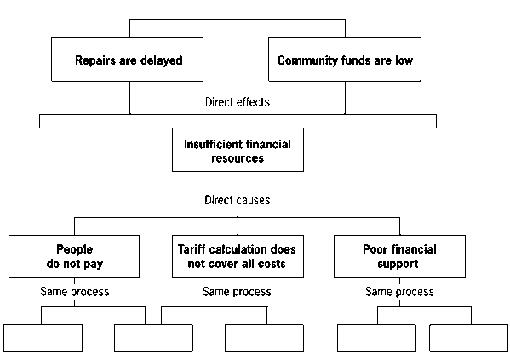
4. Background information
4.1 The importance of problem analysis
One of the first tasks for a manager or a group of persons is to understand and assess the present situation. There are many different ways to go about this - reading reports and studies which have been written on a particular project; holding a series of interviews and meetings, and asking staff about their perceptions on the situation; making field visits in order to visualize the situation; deciding to analyse successes and focus on them only.
Experience has shown that good plans are based on an appropriate understanding of a situation, which is based not only on an analysis of successes, but also of constraints and problems. However, many managers will limit themselves only to the identification of problems, and omit their analysis. Furthermore, there are often as many interpretations of a problem as there are professionals.
Without denying the positive aspects of other working methodologies, this methodology proposes to assess a situation on the basis of a common understanding of the problems. It is simple, participatory, democratic and motivating. It allows a group of professionals at different levels, from different departments or sectors, to reach consensus on the situation, which is vital for the effective implementation of a plan. The logical sequential analysis shows that problems are interrelated and cannot be isolated.
4.2 What is a problem?
According to the Collins Cobuild English Language Dictionary, a problem is a situation or a state of affairs that causes difficulties for people, so that they try to think of a way to deal with it.
People do not always have the same perceptions and vision of a problem, since they belong to different cultures and have different priorities in their working or living environments. However, the above definition helps to focus our vision on what is a problem.
It causes difficulties for people, so that they try to think of a way to deal with it. A problem is based on a real, existing situation, which becomes troublesome in a way that one has to react to it. Therefore, a problem is not an interpretation of a situation, it is a fact, a reality. Furthermore, it is significant enough that people do want to react to it, thus avoiding minor troubles which life is usually filled with anyway.
Many people will identify a problem in terms of a desired situation which they do not have, visualizing a problem as an absent solution. For example, some will say that “no equipment”, “no vehicle” or “no money” are problems while analysing a situation of long delays for repairs. This could be hiding the fact that there is poor planning, that villages are far away, that tools and equipment are obsolete, that the project is understaffed, that spare parts are not available, etc. However, lack of equipment or poor budget allocations could also be a reality.
In this course, we will consider problems with a negative formulation, since this helps to raise an issue, a challenge to be met. A formulation just stating “spare parts” does not raise an issue, and does not say what is wrong, although spare parts can be a problem. This could be formulated as “poor availability of spare parts”, or “high cost of spare parts”, etc., depending the situation.
In summary, we will define a problem as:
1. A real, existing situation
2. Significant
3. Preferably not an absent solution
4. A negative formulation
4.3 The OOPP methodology
This methodology was first developed in 1983 by the German Organization for Development Cooperation (GTZ). It combines the logical framework tool with new communication techniques (Metaplan) into an analytical and planning tool called Objective Oriented Project Planning (OOPP, or ZOPP in German). This is now being used as a major planning tool by the great majority of agencies involved in development cooperation. Other planning tools are also proposed in this course.
OOPP is based on a logical sequence of reflection, and the team work approach is its essential feature. It uses a strong visualization tool, i.e. cards, in order to see what would otherwise be abstract. The result of the thinking process is accepted by the group. The analytical method is based on the analysis of a logical sequence of cause-effect relationships between various problems as will be exposed later.
OOPP is composed of two phases: an analytical phase and a planning phase.
The analytical phase comprises participation analysis, problem analysis, objective analysis, and an analysis of alternatives.
The planning phase consists in the development of a planning matrix, determination of assumptions and conditions, determination of activities, formulation of indicators, estimation of financial and human resources needed, and the development of a chronogram (for timing of activities).
What are the advantages of the methodology?
· Reaches a common understanding of problems· Clarifies cause-effect relationships
· Provides clear planning documents
· Allows the participation of various staff and professionals, as well as beneficiaries of the project
· Establishes a consensus
· Easier to implement because of broad acceptance.
What are the limitations of the methodology?
· Truth is not only rational and logical; the methodology puts aside all intuition, contradictions and feelings.· Can lead to a simplified “linear” representation of reality.
· The whole planning depends on an adequate and accurate problem analysis.
· Creative thinking only done for the problem analysis, but gets lost in the mechanical sequences afterwards.
· The emphasis on problems can put a shadow on the perception of existing potentials and successes.
· Certain groups are not familiar with an abstract and logical analytical sequence of thinking, which can create problems in its application.
· Needs a good and experienced facilitator.
4.4 How to analyse problems
After the problems have been identified and listed by all the participants, the group is asked to select one problem as essential, which will be used to start the analysis. Criteria of selection can be: most pressing problem, or most frequently occurring problem. As an example for illustration, we have chosen the problem of “insufficient financial resources”.
From the listed problems, the group then identifies those that are the main causes for this essential problem, and are directly linked to it. It is possible to formulate additional problems if they are not all present yet. It is also possible to reformulate some cards, which appear to be too vague. It is also possible to eliminate cards that appear to be totally out of context. The question to be asked in order to find the direct causes, is WHY?
In a second step, it is now proposed to select from among the list of identified problems, those that can be the effects of the essential problem, and are directly linked to it. Problems can be added, or eliminated as shown above. The question to be asked in order to find the direct effects, is WHAT are the direct consequences of this essential problem? What will it lead to? This process is then repeated for each cause. What are the causes of this problem? Same applies for the effects, until all the cards have been placed. Lines are then drawn showing the relationship between each card. The final result is a problem tree. There is no perfect problem tree. All problem trees are different, since all groups are different. It just represents the consensus and understanding of a particular situation for a given group, at a given time, in a given context.
Unit 4: Analysis of objectives
1. Outline of session
· Objectives
· Methodology
1. Introductory note
2. Interactive group exercise
3. Concluding remark
· Materials
Ö Overhead transparencies
Ö Flip chart and masking tape
Ö Overhead projector, screen or white wall
Ö Large sheet of paper (craft paper), hung on the wall for the problem tree exercise
Ö Cards of various colours (code is important: for example, green for problems)
· Handouts
Ö Copies of transparencies and background information
2. Notes for the facilitator
Introduction
This session is the immediate follow-up of the problem analysis. It looks into the future on the basis of an analysis of the present situation, the problem analysis.
Interactive group exercise
The group exercise is in two parts: 1) construction of the objective tree; 2) selection of a strategy.
1) Using the problem tree, the facilitator asks the participants to restate the negatively formulated problems into objectives which are positive and achievable. Avoid statements of objectives with an ultimate or long-term improvement, but indicate, on the basis of the problem analysis, an improved situation. For example, do not indicate the problem of lack of funds as plenty of funds, but rather as improved financial situation, etc.
It may be that some problems cannot be changed into objectives, because the project will not be able to solve them, e.g. “corruption”. These cards in the exercise will remain as problems, even in the objective tree.
It is important to use cards of two different colours for objectives and problems.
The facilitator, with the help of the participants, can rebuild an objective tree, similar to the structure of the problem tree. However, they will have to look at the means-end relationship (as opposed to cause-effect for problems). It can very well be that the logic is not always the same and that some analyses need to be examined again; also, other objectives may have to be added in order to complete the analysis.
The end product is an objective tree, in which the facilitator can circle the various entities that appear, such as “community”, “technical aspects”, “institutional support”, etc.
2) The selection of a strategy consists in the selection of objectives. It would be impossible for a project to tackle all the objectives which are formulated in the objective tree, mainly for the following reasons:
· All the objectives are not within the mandate and responsibility of a project.
· There are not enough financial and human resources to work on all objectives.
· The project has to respond to some priority or urgent issues first.
The management and staff will therefore have to choose and prioritize in a participatory way. The selection process can be performed in the following way:
· Identify those objectives which are not within the mandate and the responsibility of the project (in this case, it might be difficult because the project is hypothetical).· Identify key objectives (maximum seven) which can greatly influence the main objective, i.e. “Improved O&M”. These objectives should generate a maximum impact for a minimum input of resources, which are limited; it could be that the main objective is not completely resolved, but the chosen objectives will greatly contribute to it.
Procedure. The facilitator asks the participants to form small groups of three persons. Each group will have the task of identifying a maximum of seven objectives which will contribute to the main objective. They will also have to give a priority to each objective.
After the objectives have been chosen, the facilitator draws the following Table on the board:
|
Selected objectives |
Number of groups who selected this objective |
Priority given by the group |
|
1. | | |
|
2. | | |
|
3. | | |
|
4. | | |
|
5. | | |
|
6. | | |
|
7. | | |
This Table, when filled in, will allow a participatory decision to be made on which objectives to choose. The final selection will correspond to the objectives which obtained the best score, taking into account the priority as well.
Conclusion
The project has now selected precise objectives to work on, which are based on an analysis of a real situation.
3. Overhead sheets: Sheet 1
|
How to do an objective tree |
|
Step 1: Reformulate all negative conditions into positive attainable conditions |
|
Step 2: Check whether rewording has led to unrealistic or ethically questionable statements |
|
Step 3: Examine the means ends” relationships, thus derived to assure the validity and completeness of the tree; add cards if necessary |
|
Step 4: Draw lines between all objectives showing relationships and finalize the objective tree |
|
Step 5: Circle different groups or entities which appear within the objective tree and give them a name |
Overhead sheet 2
|
|

4. Background information
4.1 Discussion on alternatives: identifying potential alternative solutions
The chief criterion when evaluating and selecting alternatives is whether the project is realistic and more beneficial than problematic. The following aspects can be significant:
· Priorities in policy development· Specific conditions in the country
· Suitability of the chosen project to the donor agency and the national departments which support it
· Availability of funding
· Project’s experience in the region or sector
· Available manpower
· Complementary or competitive activities of other projects.
The choice between alternatives will be determined by cost-benefit analyses, additional analysis of various interest groups, and management discussions and decisions.
Module 3: Towards sustainable operation and maintenance
Unit 1: Linking technology choice with operation and maintenance
1. Outline of session
· Objectives
· Methodology
1. Introductory note
2. Plenary discussion on criteria
3. Group exercise on technology selection process
4. Conclusion
· Materials
Ö Overhead transparencies
Ö Overhead projector, screen or white wall
Ö Flip chart and markers
· Handouts
Ö Copies of transparencies
Ö Exercise sheet
Ö Extracts from background information
2. Notes for the facilitator
Introductory note
Module 3 deals with the main issues that influence effective operation and maintenance of water supply and sanitation services, including technology choice. The latter is the first determining factor for effective operation and maintenance. Indeed, the type of technology and its selection are likely to have an impact on future operation and maintenance activities. This session highlights the criteria as well as processes that link technology choice with operation and maintenance.
Plenary discussion on criteria
The facilitator draws 10 columns on the board, five for water supply and five for sanitation, which correspond to the following sustainability factors: 1) technical aspects; 2) community aspects; 3) environmental aspects; 4) institutional and legal aspects; 5) other aspects. Past experience has shown that participants like to add financial factors to this list, even though financial factors are implicit in all the other factors. The facilitator asks the participants with respect to each column, “What are the important O&M criteria to consider during the planning stage?”, and writes down their answers. If needed, the facilitator can add the information given below (see background information).
Group exercise on technology selection process
The facilitator divides the participants into two groups for 1) water supply technology choice, and 2) sanitation technology choice. Each group receives a set of prepared cards (A4 size, divided into three), describing typical activities involved in the process of technology selection. The cards should be arranged in a logical way. This exercise shows how technical and social factors should be integrated. Each group discusses the best way to arrive at a choice, and presents the results in a plenary session. The facilitator can use the model given under background information to propose some feasible and realistic alternatives. The cards can be made using the text in the exercise sheets. As participants usually find it useful to keep a record of all the exercises, it is recommended to have secretarial support to record these exercises and distribute a copy to all the participants.
Conclusion
Linking technology choice with operation and maintenance is a key factor for sustainability; the resulting choice depends on the use of appropriate criteria and the selection process.
3. Exercise sheets: Sheet 1
|
Process of water supply technology choice The facilitator should prepare beforehand a set of cards as described below, leaving some blank ones for additional activities if needed, and distribute a complete set to the group. The group will have to organize the cards in a logical sequence (some activities can be done in parallel with others). All these activities have a definite direct or indirect impact on future O&M activities.
|
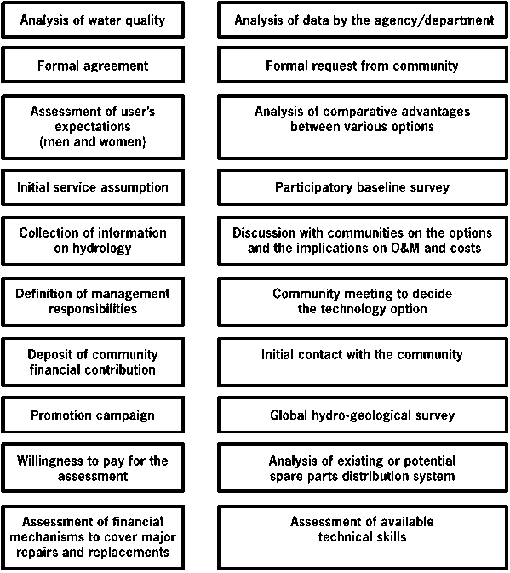
Exercise sheet 2
|
Process of sanitation technology choice The facilitator should prepare beforehand a set of cards as described below, leaving some blank ones for additional activities if needed, and distribute a complete set to the group. The group will have to organize the cards in a logical sequence (some activities can be done in parallel with others). All these activities have a definite direct or indirect impact on future O&M activities.
|
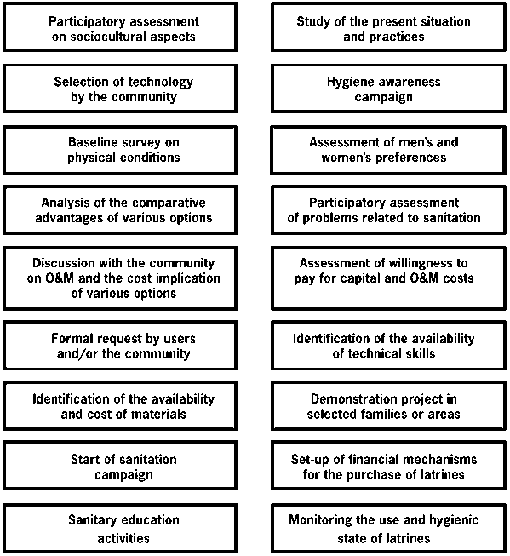
4. Background information
4.1 Operation and maintenance specific criteria affecting water supply technology choice
|
Technical criteria |
· Technical standards; quality
and longevity of equipment; spare parts needs, costs, availability and
accessibility |
|
Environmental criteria |
· Quality of water
source |
|
Institutional and legal criteria |
· Legal framework and national
strategy for O&M |
|
Community criteria |
· Responsibility and ownership
feeling |
4.2 Operation and maintenance specific criteria affecting sanitation technology selection
Experience has shown that many sanitation projects adopted interventions and technologies that were selected with poor assessment of the demand for sanitation. In these instances, there was hardly any communication between the future users and the project planners, and the social, gender, cultural and religious aspects were not taken into sufficient consideration.
In some cases, environmental factors were not considered in the design, which led to unsafe situations and even the collapse of pit walls. Hygiene education to change sanitation behaviour was hardly mentioned in the adopted project approaches. Planning for sanitation interventions therefore requires a comprehensive approach covering many aspects. The Table below presents four groups of general and specific criteria which influence sanitation technology choice.
| |
General criteria |
Specific O&M criteria |
|
1. Technical |
· Technical standards |
· O&M requirements |
|
2. Environmental |
· Soil texture, stability,
permeability |
· O&M implications for
environmental protection |
|
3. Institutional |
· Existing national/local
strategies |
· Pit-emptying services
(municipal/private) |
|
4. Community |
· Sociocultural
aspects: |
· O&M costs |
Upgrading an existing sanitation facility can be the first option for improving the sanitation conditions if it matches the social and cultural preferences of the community, as well as the local economic and technical capacities. If the existing facilities do not meet basic hygiene requirements, then upgrading must be considered. If no sanitation facilities are present, the simplest technology option is to be considered, taking into account the factors mentioned above.
4.3 Technology selection process
The technology selection process will depend on the strategies adopted by the planners and on basic principles which are emerging in the water and sanitation sector. One principle is the need to involve communities right from the start of the selection process. The agencies, the communities and users should therefore work together as partners, and plan their activities based on mutual agreement. The latter is particularly important in contexts where both men and women in the community and among the users are increasingly taking on the responsibilities of operating, maintaining and managing their water supply systems.
Various formulations of the word “technology” can be found in the literature, such as: appropriate technology, progressive technology, alternative technology, intermediate technology, village technology, low-cost technology, labour-intensive technology, self-help technology, and technology with a human face. In this course, we advocate a sustainable technology, i.e. a technology that should, as much as possible, match the people’s needs, expectations, preferences and cultural habits. It should be convenient, manageable, maintainable and affordable.
Linking operation and maintenance with technology selection covers several aspects, such as technical, environmental, financial, institutional and social aspects, and requires the testing and feasibility study of the O&M system to be put in place. The O&M framework defines all the actors and their roles and organization in O&M, as well as their interrelationships with one another.
Experience shows that the effectiveness of O&M is determined to a considerable extent by non-technical issues. Therefore, the persons involved in assessing and developing O&M should come from a wide range of disciplines - social development, economics, health, management, and engineering. It is important that all of them should function in partnership with the operators and users of the relevant services.
Rehabilitation of defective schemes is an economic alternative to investing in a new project, but that decision should not be made lightly. The rehabilitation option has to be evaluated, as one would a new scheme, by taking into consideration the community’s needs, preferences and capacities to sustain whatever is undertaken, as well as the support potential of the water agency. In assessing the scope for rehabilitation, community members and the agency should review the reasons for which the system needs to be rehabilitated, by means of problem analysis, and carefully examine various feasible technologies. Furthermore, rehabilitation should not simply be a matter of replacing defective equipment or repairing damaged infrastructure because the most common cause of failure is organizational. Finally, a word of caution: the community might in some cases get the feeling that O&M does not concern them - believing that when the system is out of order someone will come and put it right!
If a risk analysis is carried out for each water supply option, then an attempt can be made to anticipate factors which may change and affect O&M. This will not be easy, especially in unstable economies, e.g. with high inflation rates and restrictions on imports, where equipment and spare parts are not easily available. However, a comparison of technologies can indicate the degree of risk attached to each option.
4.4 The process of community water supply technology choice
The following steps are proposed:
1. The community requests the agency for support to improve its water supply (demand-driven approach); this could be preceded by promotion and mobilization campaigns. The expectations and preferences of the users (both men and women) and their motivation should be assessed.2. Initial service-level assessment - what service level is responsible for dealing with environmental issues and the preferences of users (both men and women)? What are the comparative advantages between various options (e.g. standposts and yard connections)? The validity of hydrological, technical and institutional data collected by agencies must be confirmed by local resource persons.
3. Participatory baseline survey, including needs and problem analysis with the community.
· What reliable water source is available?· Can this source provide the required quantity and quality of water?
· What is the treatment needed?
· What materials, spares and skills are needed to sustain the desired service level?
· What is the most appropriate structure to sustain the desired service level which corresponds to the management capacity of the communities?
· What is the capacity of present community organization to manage, operate and maintain an improved water supply system?
· What is the involvement of women and men in community activities?
· What are the costs (capital and recurrent) of the options considered?
· What are the financial resources available and the willingness to pay?
· What is the present approach to the application of O&M within the programme or country area?
· What are the causes and effects of poor O&M within the area?
· Should technology match the available O&M system and capacity (including spare parts distribution), or should the O&M system be adjusted to match the most suitable technology?
· What type of support can the communities receive, in terms of technical, financial and capacity-building assistance?
· What is the overall impact of the option selected?
4. Analysis of data by the agency, leading to the possible selection of the most suitable technologies and service levels, including a review and appreciation of all specific O&M criteria.5. Presentation and discussions with the community of the most sustainable technologies, considering all O&M implications and commitment to long-term management of O&M. Clarifications should be made at the same time on all necessary adjustments of the existing O&M system, with a definition of the responsibilities of the actors involved in the development of the project. Communities should be given enough time to consider the options and the future implications of each one.
6. Formal agreement on technology selection between the community and all partners, once the community has made its informed choice. This agreement can be formalized with a contract, and include a financial contribution (in cash or kind) from the communities.
7. Finalization of planning for implementation.
4.5 The process of low-cost sanitation technology choice
It is assumed that the technology selection process is based on a participatory needs assessment, which is carried out following an expressed demand for improved sanitation facilities. Hygiene awareness and promotion campaigns can result in an increase in the demand for improved facilities. The process of choosing sanitation technology should include at least the following steps:
1. Participatory assessment of problems in the existing human excreta disposal system, as well as in hygiene behaviour, environmental hygiene and human excreta-related diseases. Participatory assessment of the cultural, social and religious influences on the disposal of human excreta and choice of sanitation technology. Participatory assessment of local conditions, convenience, capacities and resources (material resources, human resources and finance).2. Initial awareness-raising of the community on hygiene and sanitary matters - about the benefits of safe human excreta disposal and appropriate human behaviours linked to sanitation and personal hygiene.
3. Identification of local preferences and capacities for sanitation facilities and possible variations. Matching these preferences with local capacities and environmental conditions including contamination risks, and determining the O&M requirements and other implications of the technology options.
4. Discussions with the community about implementing different sanitation technology options and their implications in terms of operation and maintenance.
5. Selection of one technology option by the community.
Improvement of sanitation facilities should be accompanied by activities in Information-Education-Communication (IEC) to promote safe sanitation behaviour and proper hygiene. These activities have a longer time horizon than the time required for improvement of physical structures. Schools and other institutions, churches, and social and community groups have an important role to promote proper hygiene and sanitation behaviour. Attention must be paid to selecting the most appropriate technology, design, and site in order to prevent environmental pollution, particularly of water resources and the living environment. Control measures must be carried out to minimize these risks.
Unit 2: Institutional set-up
1. Outline of session
· Objectives
· Methodology
1. Introductory note
2. Review of analysis of participation exercise
3. Presentation and discussion on decentralization using a graphic
4. Document analysis on management options
5. Short presentation on various management models
6. Conclusion on the importance of communication
· Materials
Ö Overhead sheets
Ö Overhead projector, screen or white wall
Ö Flip chart
· Handouts
Ö Exercise sheet
Ö Copies of transparencies
Ö Copies of selected parts of background information
2. Notes for the facilitator
Introductory note
The analysis of participation has shown that many actors are involved in different ways and degrees in the operation, maintenance and management of rural water supply and sanitation services. This session reviews how the organization of all these actors provides an effective maintenance system. Most developing countries today are undergoing structural and institutional reforms, which have a far-reaching impact on the way maintenance will be organized and on who will be responsible. The session analyses the framework in which the actors evolve, which has links with the next session on community management.
Review of analysis of participation exercise
If the participation analysis exercise proposed in Module 2 has not yet been carried out, it should be done now by referring to the directions given. The review of this exercise consists in determining the degree of involvement and what could happen at this stage, given the problems that have been identified. This review by the whole group can be summarized in the following Table (the shading given below is an example).
| |
Degree of involvement in O&M | ||
|
Major actors |
Slight |
Medium |
Major |
|
National institutions | | | |
|
Provincial institutions | | | |
|
Local authorities |
| | |
|
Community organizations | | | |
|
Users | | | |
|
Private sector and NGOs | | | |
|
External support agencies | | | |
Some conclusions can be drawn by the facilitator from this Table, e.g. that some sectors are greatly involved, that the process is still very much “donor-driven”, that the small role of the private sector and NGOs could be enhanced in the future, that the users appear not to be sufficiently involved, etc.
Presentation and discussion on decentralization
The various trends affecting the sector especially on sustainability, decentralization, private sector involvement, and new approaches are presented and discussed. The facilitator can first recall the main points of sustainability, which have been stated in Module 1, Unit 3.
Document analysis on management options
The exercise sheets include descriptions of various forms of management options for piped water supply projects. The management of handpumps systems will be reviewed in the next session on community management. The participants will be divided into three groups, corresponding to, for example, the management options proposed in the exercise sheets: 1) Concession to a community association; 2) Direct municipal management; 3) Cooperative association of public administration. Each group will review its management option, and highlight the strengths and weaknesses. The groups will briefly present the results of their work in a plenary session.
Short presentation on various management models for a piped rural water supply system
The facilitator will review the Table which summarizes these management models (see background information, below).
Final conclusion on the importance of communication between all stakeholders
The facilitator starts a short game. He says to the group: “I will count to three and ask you to clap your hands.... One... two...” (while speaking, the facilitator imitates the clapping of the hands without really clapping). The result is that everyone claps. The facilitator says: “I asked you to clap at three, and everyone claps at two!... Where is the communication? Is this type of situation frequent in our workplace?” Allow time for discussion. The facilitator then uses some of the information contained in the background information to make a concluding presentation on the importance of communication, and on how to set a communication strategy.
3. Overhead and exercise sheets: Sheet 1
|
After having reviewed the situation analysis done previously, mark the squares with a cross accordingly | |||
| |
Degree of involvement in O&M | ||
|
Major actors |
Slight |
Medium |
Major |
|
National institutions | | | |
|
Provincial institutions | | | |
|
Local authorities |
| | |
|
Community organizations | | | |
|
Users | | | |
|
Private sector and NGOs | | | |
|
External support agencies | | | |
Overhead sheet 2
|
Substitution of responsibilities between government and community in a context of decentralization, with necessary accompanying measures Accompanying measures: a. Building the capacity of communities
|
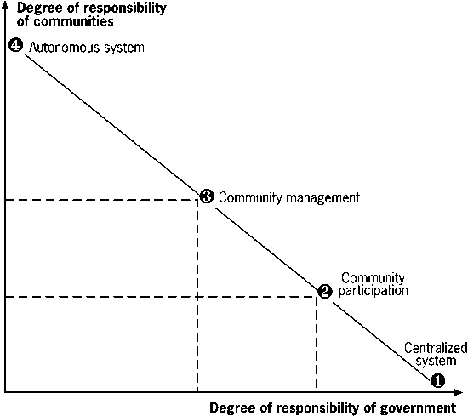
Overhead sheet 3
Who constitutes the private sector?
|
Actors in the private sector |
O&M support role |
|
International and national manufacturers and suppliers |
· design and manufacture pumps
and other equipment for operation and maintenance at the village level |
|
International and national consultants |
· design schemes for community
management |
|
International and national contractors |
· rehabilitate and extend
schemes for community O&M |
|
Local contractors |
· service and maintenance
contracts |
|
Small-scale industries |
· local manufacture of spare parts and tools |
|
Nongovernmental organizations (NGOs) |
· training, raising community
awareness |
|
Self-employed artisans in the formal and informal sectors |
· local skills for preventive
and corrective maintenance and repair work: mechanics, plumbers, builders,
masons, blacksmiths, electricians, etc. |
|
Local shops |
· provision of spare parts |
|
Administrators and accountants |
· billing, rate collection, auditing of accounts |
|
Banks |
· banking facilities for O&M
funds |
Overhead sheet 4
|
Approaches to development
|
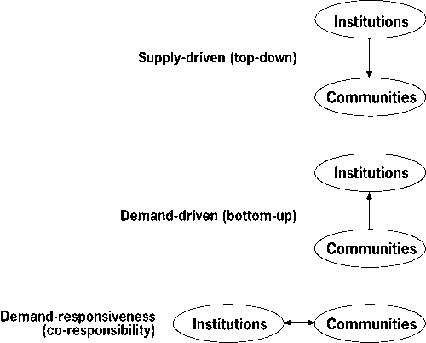
Overhead sheet 5
|
A communication planning sequence includes: · Identification and formulation of key issues to be communicated · Assessment of impact and adjustment of programme design |
DOCUMENT ANALYSIS 1
Concession to community associations
Briefly highlight the strong and weak points of this management option for rural piped water supply systems
Communities can already count on existing associations, which sometimes have been organized in an informal way. It is important in this case that associations are organized in a formal way, and obtain legal status. They will be established as non-profit-making associations with the aim of providing a public service, which could give access not only to community resources but also resources coming from the municipality, the province or the central government. The mayor can be a member of the association but has to promote community participation and facilitate access to municipal, provincial and national funding. The community association is organized in the following way:
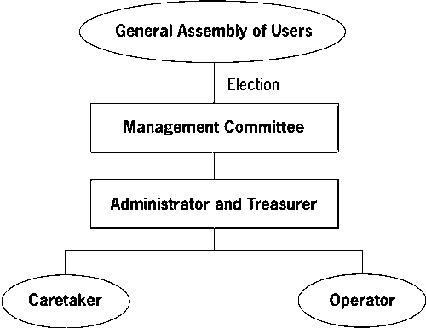
Figure
The General Assembly adopts decisions and elects the members of the Management Committee of the Association. The Management Committee is composed of a President, a Vice-President, a Treasurer or Administrator, a Secretary, representatives from the users, a representative from the local administration (if decided by the General Assembly, and if the local conditions allow it). The General Assembly has the responsibility to supervise and control all managerial, technical and financial aspects of the service. The caretaker and operator are responsible for the operation, maintenance and conservation of the whole system; they participate in tariff collection as well. The Association has to be created by a decision of the General Assembly which passes an Act constituting the Committee. The General Assembly must study and approve the Rules and Regulations for the functioning of the organization. The Constituting Act and the Rules, together with a written application, are registered with the Chamber of Commerce. The creation of such an Association will be authorized through an official document of the Municipal Council.
DOCUMENT ANALYSIS 2
Direct municipal management
Briefly highlight the strong and weak points of this management option for rural piped water supply systems
In this management option, the municipality is directly responsible for the administration of the water supply service, through a department or unit which has been created for that purpose. However, several conditions are applicable:
· direct municipal management will be possible only if the municipality has made a public call for firms to operate, manage and maintain the system, and if no one has proposed its services;· direct municipal management will be possible even if a private or public firm is available, only after a study has shown that the operating cost of direct municipal management will be lower than that of the private firm, and the quality of the service to the users will be higher.
It is stipulated that the accounts for the running of the service must be separated from the general accounts of the municipality, and must distinguish between incomes through tariffs and income through subsidies. Direct municipal management is organized in the following way:
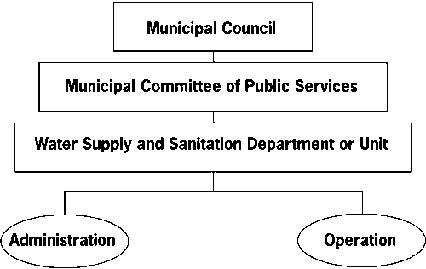
Figure
DOCUMENT ANALYSIS 3
Cooperative association of public administration
Briefly highlight the strong and weak points of this management option for rural piped water supply systems
The cooperative association is an organization in private law, which aims at solving a social need through the production and provision of a service. It is composed of associates including: users of the service, representatives of local authorities, representatives of other associations or public/private firms.
How is a cooperative association created? After an authorization obtained from the Municipal Council, a General Assembly composed of all the associates elects the members of the Governing Board, approves the charter and regulations, establishes policies and programmes, and gives the general orientation. The Governing Board is the permanent body for the management and administration of the cooperative association. It will nominate or remove the manager, determine the profile for the staff, propose the budget for control (which will have to be approved by the General Assembly), and convene the General Assembly. It is composed of a President, Vice-President, a Secretary, and a Controller who are elected for a period of one year. The cooperative association is organized in the following way:
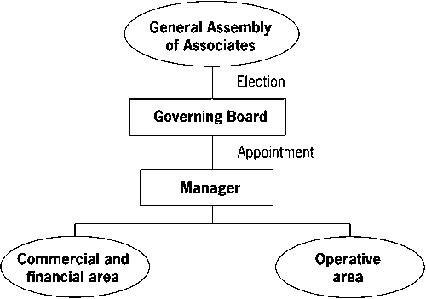
Figure
DOCUMENT ANALYSIS 4
Private management
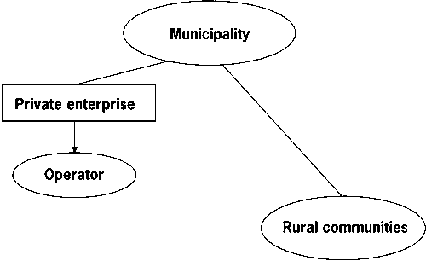
Figure
The municipality, after constant dialogue with the rural communities, contracts the services of a private firm to manage, operate and maintain the water supply system, with the understanding that the communities will be consulted over all matters that have a financial implication for them. The actual operation is done by an operator who is employed by the private firm. The community, in turn, ensures basic preventive maintenance and the payment of a fee. The firm will have to recover the costs through a tariff system, agreed with the community and the municipality.
The contract with the private firm is renewable, and only concerns management, operation and maintenance. All other activities, such as decisions for extension, rehabilitation and replacements, are the responsibility of the municipality, in consultation with the community.
4. Background information
4.1 Institutions are evolving
The concept of sustainability implies making some institutional changes as it highlights the importance of community and user involvement, working in coordination with the local authorities, in the demand, design, management, operation and maintenance of the system. Sustainability also encourages the use of local resources, e.g. artisans and shops, as well as NGO assistance to help develop the local economy.
Several countries are now implementing decentralization policies which have a direct or indirect impact on the water and sanitation sector. The institutional implications, however, vary from one country to another. The main aim for implementing a decentralization process is greater efficiency, effectiveness and sustainability of public services. It is based on the assumption that local institutions can better respond to the needs of the population, and therefore adapt strategies and policies to the local context. Central-level institutions must change their role from provider of services to that of coordinator, facilitator and support. This can be done by: 1) transfer of responsibilities from national to provincial/communal level; 2) “deconcentration” of activities from national to local levels; 3) transfer of various activities to other actors such as NGOs and the private sector.
The graphic describes this decentralization process and its consequences.
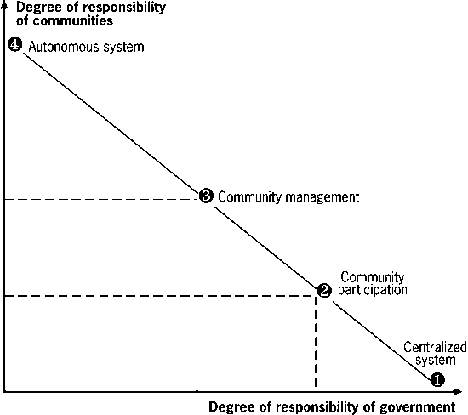
Figure
In  , the government is responsible for
everything and the communities have no legal authority in such a centralized
system. This system has proved to be very inefficient, especially with regard to
O&M of rural water supply and sanitation systems.
, the government is responsible for
everything and the communities have no legal authority in such a centralized
system. This system has proved to be very inefficient, especially with regard to
O&M of rural water supply and sanitation systems.
In· , the communities have a certain
degree of responsibility ranging from participation in labour to payment of
services. The government still keeps an important role in the management of the
system. This situation, which is now commonly accepted and implemented in many
projects around the world, corresponds to community participation but not
community management.
, the communities have a certain
degree of responsibility ranging from participation in labour to payment of
services. The government still keeps an important role in the management of the
system. This situation, which is now commonly accepted and implemented in many
projects around the world, corresponds to community participation but not
community management.
In  , communities manage their system, but
still rely on technical assistance and support. This situation corresponds to
community management.
, communities manage their system, but
still rely on technical assistance and support. This situation corresponds to
community management.
In  , communities are autonomous; very few
communities in the world have been able to sustain their activities in a
completely autonomous way.
, communities are autonomous; very few
communities in the world have been able to sustain their activities in a
completely autonomous way.
The main consequence of this process from government to community level is that it increases the financial, operational, technical, and managerial burden at the local level, which communities do not have the capacity to carry. This process must therefore rely on accompanying measures such as:
· Building the capacity of communities in technical, financial and managerial terms, with awareness of gender questions.· Reinforcing the role of local authorities in coordination with communities, and giving the technical and financial means to do so.
· Promoting the participation of local nongovernmental organizations and small private firms (formal and informal) in the provision of services (technical assistance, training, repairs, spare parts provision).
· Changing the role of government institutions from provider of services to coordinator and facilitator.
Accompanying measures:
a. Building the capacity of communities
b. Reinforcing the role of the local authority
c. Promoting NGO/private sector participation
d. Changing the role of government
4.2 Changes in the approach
Water supply and sanitation improvements may also be characterized by being either a supply-driven or a demand-driven approach. In the present case, we shall be promoting a demand-responsive approach.
The supply-driven approach (top-down) is based on pre-selection of the intervention area, with village and technology selection criteria based on policies of replication of successful experiences in other countries or projects. This approach can have serious implications for the sustainability of projects, particularly in terms of community acceptance, functioning, use and O&M costs - the community not being involved in any phase of the project cycle.
In the case of a demand-driven project (bottom-up), the problems and needs are identified with and by the communities. This may be preceded by some awareness-raising by extension workers. The advantages are that the motivation of the community to participate in the planning, implementation and O&M phases will be high, and that community-based management will be better accepted and implemented.
A demand-responsive approach (sharing responsibilities) puts the accent on two sides - the need to elaborate projects around a demand emerging from the communities, but also on the capacity of the public and private, formal and informal organizations to respond to this demand. As we have seen in the participation analysis, many actors are involved in the operation, maintenance and management of water supply and sanitation systems.
4.3 Summary of various management options
|
MANAGEMENT OPTIONS |
MAIN CHARACTERISTICS |
|
Direct municipal management | |
|
Direct administration |
Administration by the municipal service or department, with no autonomous budget. Controlled by the mayor. |
|
Autonomous administration |
Administration by the municipal service or department, with autonomous budget and separate services. |
|
Semi-direct municipal management | |
|
Inter-municipal administration |
Administration agreements between several municipalities, with a coordination unit controlled by the municipalities, for managing the system. |
|
Direct or autonomous administration with some activities delegated to other firms |
Administration by the municipal service, with activities delegated under a contractual service agreement to other firms for a specific task, and a limited period of time. |
|
Delegated management | |
|
Management contract to a firm or individual |
While the municipality remains responsible for the service in investment and tariff setting, it delegates their management to a firm or an individual, under a remuneration contract. |
|
Special management contract to a firm or an individual |
Same as management contract described above, but with a remuneration based on a fixed agreement with the municipality and a percentage of the collected tariffs. |
|
Leasing/renting contractual arrangements with a firm |
The municipality establishes a contract with a firm, which will not be responsible for the investments, but only for the operation and maintenance of the system, whose remuneration comes through collected tariffs. |
|
Public administration (cooperative association) |
Distinct legal status, and financial autonomy. Controlled by the Assembly of Associates (where the municipality is a member among others), with the authorization of the Municipal Council. |
|
Concession to community associations |
Associations created by a General Assembly of users, with the authorization of the Municipal Council. It manages and operates the system. |
|
Concession to a private firm or society |
Under a contractual agreement between the firm and the Municipal Council, the firm will fully manage, operate and maintain the system, with complete financial autonomy. The firm will invest with its own resources, at its own risks, but the municipality must approve them. |
|
Private management | |
|
BOOT contractual agreement (Build-Own-Operate-Transfer). Also possible: BOT (Build-Operate-Transfer); BOO (Build-Own-Operate); Inverse BOOT. |
Under a contractual agreement, a private firm is totally responsible for the construction, operation and management of a system, but will transfer it to the municipality at the end of the contract, which is usually long term. For the inverse BOOT, the public authority builds, but the system becomes private at the end of the contract. |
|
Private management with public/private capital |
Private company whose shares are public and private; some control is kept at the shareholders’ assembly. |
|
Private management |
Private company owns the system and is totally responsible. |
As described above, the management options consist in a blend of ownership and responsibilities between the public sector and the private or social sector (social sector = associations). This can be graphically represented in the following way:
Towards more ownership or responsibility of the public sector
|
|
1. Direct/autonomous administration |

Towards more ownership and responsibility of the private or social sector
4.4 Issues affecting the choice of management models for the operation and maintenance of rural water supply and sanitation systems1
1 Extracts from: Management models for the operation and maintenance of rural water supply and sanitation systems, by Phil Roark. Arlington, VA, WASH Project of the U.S. Agency for International Development, 1993 (WASH Technical Paper No. 71).
The choice of an O&M management model is influenced by several key issues that are listed below and are discussed in detail: capacity of traditional community organizations; key community skills; health education and community participation; gender-balanced development; complexity of technology; availability of spare parts; standardization and local manufacture of equipment; requirements shared with other sectors; capacity of the private sector; cost recovery mechanisms; ability and willingness to pay; national and regional economies; logistics and transportation; government leadership; strength of government agencies and staff; regional autonomy; policies and legislation; communication and information sharing.
Capacity of traditional community organizations
The community is a focal point in the management of rural WSS (water supply and sanitation) systems because it has a vested interest in efficient operation and maintenance. By their very nature, communities are structured to provide leadership, conduct social and religious activities, and attend to legal, property, and economic matters affecting their members. The control of traditional water supply sources and waste disposal sites is part of this structure, since all communities have some type of WSS facilities, however primitive these might be.
Some communities have a highly sophisticated set of rules and responsibilities for managing their WSS facilities. For instance, communities located near rivers may not have a rigorous management system, since water is readily available, but communities with limited water supplies usually have strict rules governing individual rights and responsibilities and impose penalties for violations. Similarly, densely populated communities usually have a tighter management system for sanitation facilities than those more sparsely settled.
While the physical environment dictates the need for certain levels of management, so does the character of the society. There are significant differences between societies and their view of management needs for WSS. Some societies have a strong communal approach to meeting their needs; others prefer an individualistic approach. Some are hierarchical while others are more diffuse in structure. These differences must be considered, and, whenever possible, the traditional management system should be empowered. However, certain technologies may require skills which the traditional management system does not have, and new management models may need to be introduced.
Key community skills
Among the key community skills that must be considered in assessing local management capacities are leadership, accounting, and mechanical aptitude. Leadership is required to organize, motivate, and educate the community. Many decisions require a consensus after the issues and alternatives have been clearly explained. For example, the siting of a well or standpipe could be controversial, since one location will be more convenient to some users only. The level of service and fee structures are questions that deserve wide discussion. Many WSS projects rely upon community participation for the construction of facilities. To marshal this work force requires leadership skills. Often communities can draw on their experience in sectors unrelated to WSS, such as building a school.
Accounting and record-keeping skills are necessary for the proper collection and disbursement of funds. Typically, families in a community pay a flat fee or one that is based on the service received. In some cases, fund-raising such as the sale of crops from a communal field is organized for the WSS facility. Community confidence must be ensured by public disclosure of collections and spending and scrupulous accounting. Further, decisions reached at meetings should be placed on record. In some developing countries where literacy levels in rural areas are low, this is not always possible.
Some mechanical skills within the community are necessary. Depending on the technology involved, these can range from simple caretaker skills to repair skills for sophisticated machinery. Deep wells, for example, may be the only option for supplying potable water to a community, but the pumping requirements may be beyond local repair capability. In such cases, the community will provide only caretaker and operational labour and call upon outside assistance for repairs.
Training is one way of upgrading community skills. Of course, there are limits to training adults with a low level of literacy, but for most areas of community need, instruction within these limits can achieve adequate results. Many projects provide WSS management committee members with training in the maintenance and repair of pumping equipment.
Health education and community participation
In addition to technical and management training, the community’s understanding of health, hygiene and community participation is important. This understanding may vary considerably from region to region. For a WSS facility to be effective it must not only be functional but also be used. Many properly designed WSS facilities have not been utilized sufficiently or correctly due to ignorance of their health benefits. When poor quality water is more easily available, good quality facilities are often allowed to fall into disrepair. Sometimes clean water at the distribution point is polluted by the user through improper transportation and storage.
Other areas of health awareness, particularly child survival activities, are also important. Widely disseminated information on the benefits of immunization, oral rehydration therapy, breastfeeding, and nutrition will reinforce understanding of the causes and effects of disease and lead to effective use of WSS facilities. Female literacy is a particularly important determinant of community health, since women are the key implementers of health practices. Since WSS projects usually are cited as a priority need among potential beneficiaries, they often serve as a catalyst for the introduction of other health interventions.
Gender-balanced development
Women are primarily responsible for obtaining and using water, but generally have not been given much say in decision-making. The result has been facility designs and management structures that hamper effective use. A gender balance of roles and responsibilities between men and women is therefore important in the design, construction, management, and utilization of WSS systems.
The role of women as decision-makers varies among societies. While there is general progress in increasing their participation, some societies maintain barriers that must be respected in designing management systems.
Complexity of technology
Technologies for rural or periurban water systems range from capped springs that feed gravity distribution systems, to deep wells equipped with electric pumps and a distribution system consisting of a storage tank and pipelines, to household connections. Sanitation systems in rural or periurban areas range from simple latrines to flush toilets with cesspools. Many of these technologies have been in use for decades with only minor changes. However, research has produced many new improvements adapted to the needs of developing countries. For example, handpumps are now designed to be more robust and easier to repair. Drilling rigs for shallow wells have been reduced in size and cost. Pumping systems relying on wind and solar energy have been developed. Low-cost latrines that are sanitary and well ventilated are now easily available.
Given this range of technological choice, the fundamental maxim is that the technology should be compatible with the beneficiaries’ ability to handle it. If repairs are too complex for them, the next tier up must assume this responsibility. Some communities may be able to repair part of a system, such as a pipeline, but not an electrical generator. In this case the responsibility would have to be shared. Generally, it is preferable for the beneficiaries to be primarily responsible for managing the system even if they require outside mechanical assistance.
Availability of spare parts
The availability of spare parts has been a recurring problem for many WSS projects. Some have installed hundreds of handpumps and presumed that market mechanisms would impel local hardware dealers to provide the needed parts. In certain countries government agencies retain this responsibility, in others they import spare parts and rely on a commercial system for distribution. In any case, the laws of supply and demand do not always work as expected. Too often the systems fail because spare parts are simply inaccessible.
Standardization and local manufacture of equipment
The installation of pumps made by several foreign manufacturers has led to a chaotic situation in many countries. Spare parts are often not available and repairers are not familiar with certain pump designs. This situation is largely the result of bilateral aid which restricts procurement to pumps manufactured in the donor country. Some developing countries, in response, have insisted on specifying which pumps they will accept.
Many of these countries are now developing an indigenous capacity for the manufacture of plastics for pipes and well casing. Local manufacture also eliminates the need for hard currency, which is always in short supply.
Requirements shared with other sectors
Procurement problems often can be eased by considering the requirements that the WSS sector shares with other sectors. The irrigation sector, for example, uses considerable quantities of pumping equipment, pipes, and related materials. The housing sector uses faucets, toilets, pipes, and building materials. The market for equipment in one sector can influence decisions in another sector. Thus, a new irrigation project could determine the type of pump the WSS sector would select for a project in the same region.
Capacity of private sector
The private sector may have a role in the design, construction, maintenance, and repair of WSS facilities. In urban areas there is seldom a question of its capacity; in rural areas its presence may be limited or nonexistent. Some projects have trained repairers to maintain several facilities in a region. Others have presumed that a sufficiently large market will in itself attract repairers to the target area. This generally is true of WSS facilities near urban centres.
If the profits to be made are reasonable, private sector participation is usually assured. Some projects have established prices for services and parts to protect the communities from being cheated. But prices must be fixed with due regard to adequate financial returns in the context of the local economy. Tasks such as well drilling and the construction of storage reservoirs are best contracted to the private sector. Many projects arrange franchised regional repairers for the equipment installed.
Cost recovery mechanisms
Government policies requiring cost recovery in WSS projects have two objectives: to make the beneficiaries pay for the benefits they enjoy; and to ensure that the beneficiaries gain a sense of ownership and thereby a concern for preserving the facilities. The costs of many rural WSS projects are beyond the means of the communities they serve, and the government or a donor subsidizes all or part of these costs. The philosophy behind this is that state revenues are to be distributed for the national good, and that rural health and living standards are entitled to special attention if this goal is pursued. However, if a project is to be sustainable, the beneficiaries must be able to fully cover all operation and maintenance and replacement costs.
Among the cost recovery mechanisms employed in WSS projects, perhaps the most common is a flat monthly fee levied on each family or household. In arid zones, where water is at a premium and conservation is essential, water typically is sold by the unit volume. When water is pumped by a fuel-driven engine, volume sales are the norm. In areas where cash is not in general use, communal sales of agricultural products are earmarked for the WSS system. Some communities insist on payment from every consumer, while others may provide free water to the very poor. In some notable instances, communities receive funds from richer members who have moved to the city or to foreign countries.
Ability and willingness to pay
The ability to pay is a function of disposable income and depends on the absolute wealth of the wage earners in a household. WSS interventions must be scaled to a level compatible with the ability to pay.
Willingness to pay is a different matter, influencing all expenditures including that for WSS service. Where there is no alternative water choice, the willingness to pay may be quite high, resulting in vastly inflated prices. Thus, water vendors in peri-urban areas often charge several times the price that is paid in the adjacent urban zone. In contrast, improved water supplies may not be used if there are streams nearby and the cost of water from the improved source is considered high. Water quality is often ignored if water can be obtained free from an unimproved source. In societies where women control money, they are often more willing to pay for water than men are, realizing the benefit of a clean and convenient source. For sanitation facilities, convenience and privacy are paramount. Dwellers in dense housing neighbourhoods appear more willing than their rural counterparts to pay for latrines or toilets.
Because of difficulties with payment, many projects require funds to be collected in advance for O&M, and sometimes for construction, as evidence of the community’s willingness to participate. In other cases, potential participants are surveyed to determine their willingness to pay. These surveys require the use of appropriate sampling techniques to ensure accurate answers to delicate questions related to personal financial preferences.
National and regional economies
Many developing countries have high rates of inflation, cost of living, and unemployment, all of which have a significant effect on O&M management. High inflation requires careful attention to budget planning. Many meticulous plans have crumbled because of the loss of buying power by local currencies. Rapidly rising prices of basic commodities also plague certain countries. Fuel prices are often critical for WSS projects that use engines for well drilling or pumping.
Unemployment can create a large labour pool for labour-intensive tasks such as the digging of a pipeline. This lessens the need for expensive machinery and places responsibility in the hands of the beneficiaries. Some communities carry out such tasks without remuneration as their contribution to the project. These tasks should be arranged to coincide with seasonal levels of unemployment, so that they do not interfere with the regular agricultural cycles for planting and harvesting, when everyone is busy.
Some countries have regional pockets with distinctive characteristics that set them apart from the national economy. These may be areas of high poverty which lack natural resources, or they may border a country that has a more developed economy and thus be in a more favourable position to support development projects.
Logistics and transportation
Isolated areas are difficult to reach because of long distances, and bad roads will add to project costs and increase the uncertainties in planning. These matters will require special attention in the logistics of communication and transport of supplies.
Government leadership
The strength of government leadership in the WSS sector is an important factor in selecting a management model. However, it should be noted that most countries are now going through a process of decentralization, which gives a new perspective to the role of the government. This role is changing from a supplier of services to that of sector coordinator and facilitator. Some prudence is necessary, however, in evaluating public pronouncements. It is not uncommon for politicians to develop platforms that call for improvements in the WSS sector. Some governments take a paternalistic attitude to providing for the people’s welfare.
Visible and active leadership is needed to bring issues relating to WSS to the forefront. Where government leadership is lacking, more emphasis must necessarily be placed on management approaches adapted to fit local conditions.
Strength of government agencies and staff
Institutional effectiveness is a critical factor in the sector and is influenced particularly by the organizational framework and the quality of the staff. The organizational framework should encompass all the components of the sector from planning and design to operation and maintenance, with support for programmes of health education and community participation. There should be clear lines of authority and responsibility, and when several government agencies are involved, coordinating mechanisms are essential. Often the Ministry of Public Works and the Ministry of Health are each assigned special tasks: the former is responsible for constructing the systems, while the latter is responsible for health education and community surveys. Coordination is crucial but difficult unless there is a formal organizational agreement and framework. Extension agents are the vital link between the agency and the community. There must be enough of them to cover vast rural areas, and they must have adequate transportation and be skilled in community outreach techniques. Another important requirement for a successful agency is a budget large enough to carry out the mandate, including budget lines for staff salaries, administration, equipment, transportation, and training. Attractive salaries and benefits are necessary for retaining good workers since the private sector often competes for their skills.
Regional autonomy
Many countries have wide regional differences in climate, topography, land use, social and religious customs, economy, and access to services and materials. Climates may range from tropical to arid, requiring significant differences in the approach to WSS projects. Mountainous regions may offer abundant spring development, while flat lands may require deep drilling. Local cultures can differ considerably and can be separated by their beliefs and geographical distances. Some regions may have a relative abundance of natural resources. In large countries travel to outlying areas may be arduous. All these differences are conducive to the creation or strengthening of regional administrations. Decentralization brings power nearer to the beneficiaries. Central control of the WSS sector in countries with significant regional autonomy can be detrimental to development.
Policies and legislation
Without sound policies and legislation, there is little chance for significant WSS development. Policies must express government goals and objectives, and issues must be clearly defined. Policies governing the following issues are particularly important:
· the responsibilities of the communities and their ownership of the WSS systems;
· technology choices affecting equipment standardization and the procurement of spare parts;
· the role of the private sector;
· cost recovery mechanisms and fee structures;
· the role of government agencies and the scope of their support.
The application and enforcement of government policies and legislation must be judged by the results. Comparisons between stated goals and actual outputs offer useful insights.
Communication and information sharing
Communication and information sharing spring from a commitment to the process. Objectives can be met only if adequate information is available at all levels from the communities to the central government. All players within the sector should be fully aware of policies, legislation, decrees, administrative decisions, and any other pertinent matters. While the lack of technological hardware sometimes impedes communication with distant points, more often it is a lack of will that is the cause.
Mass communication techniques such as radio messages in local languages have been successfully used to inform dispersed populations in rural areas. Frequent visits by extension agents to the communities are also an important means of communication, as are audiovisual aids such as posters, bulletins, and videos.
4.5 The importance of communication1
1 Extracts from: Study of the institutional arrangements for the provision of rural water supply and sanitation services in Mozambique. Toronto (Canada), Cowater International Inc. (with the National Directorate of Water of Mozambique in Maputo), 1993.
One area often overlooked in planning a water and sanitation programme is the need for a clearly articulated and systematic communication strategy. The inclusion of a planned communication strategy not only recognizes the necessity of communicating with people, it articulates the needs of each stakeholder and helps find a way to bridge the gap between planners, government agencies, the private sector and communities.
Communication can also both complement and, in some cases, substitute for the regulatory work. It can complement because the design and successful implementation of a rural water policy requires a level of dialogue between those who design or implement the policy and those who are addressed by it. It substitutes for other instruments when it motivates people to change their behaviour voluntarily.
Communication is not the same as “telling”; to “communicate” implies a two-way process. A communication strategy must include the opportunity for feedback from the audience to the sender and back again. When people are allowed to participate in the process of defining and implementing the rules for their own water strategy, the potential for sustainability is accelerated. A corollary to this is the need to “listen”, and therefore communication requires “listening”. If the messages coming back across the feedback loop are not listened to (and acted upon where appropriate), communication is not taking place.
In order to be effective, a communication strategy must be deliberately and systematically planned. While most programme planners assume that some level of communication will take place, whenever it does, it does so on an ad-hoc basis without necessarily reflecting the communication needs of different groups of people, nor does it facilitate a two-way dialogue between planners and people.
A communication planning sequence can include the following activities:
· Identification and formulation of key issues to be communicated· Identification of target audiences
· Research on current knowledge, attitude and practice of each target group which will help to promote the required future change in behaviour
· Development of messages based on current knowledge and behaviour
· Pre-test messages Identification of appropriate communication channels
· Preparation of communication materials
· Pre-test of materials
· Training of communicators
· Development of indicators to assess impact
· Implementation of communication programme
· Assessment of impact and adjustment of programme design.
Unit 3: Community management
1. Outline of session
· Objectives
· Methodology
1. Introduction
2. Discussion on: “What is a community?” and “What is management?”
3. Role-play on resistance to change and ways to deal with it
4. Participatory lecture on community management
5. Concluding exercise on the prerequisites for community management
· Materials
Ö Overhead transparencies
Ö Overhead projector, screen or white wall
Ö Flip chart and markers
· Handouts
Ö Copies of transparencies
Ö Exercise sheet
Ö Extracts from background information
2. Notes for the facilitator
Introduction
One major element of the concept of sustainability is community management. This session highlights this element, which will be followed by a session on gender issues and another on how to approach and work with communities.
Discussion on “What is a community?” and “What is community management?”
It is important first to assess the participants’ familiarity with community management approaches by having a discussion. The concept of community management contains the word “community”. Too often the community is taken for granted. Support and development agencies just assume that the people they support form some kind of a ‘common-unity’, that is a group of people sharing common values and interests. Too often it is assumed that people living in a specific geographic unit or administrative service area (e.g. a district, a subdistrict or ward, a village, a village quarter, or a group of households sharing a water point) form a homogeneous group. Is this true?
Participants should reflect on this by asking themselves questions like: “Are you a member of a community? Which one? Are you a member of other communities? Which ones?”
Similarly a rural community does not necessarily consist of a homogeneous group of people. Participants can identify typical subgroups within a community (e.g. rich/poor, peasants/cattle owners, women/men, groups using water for different purposes, polluters/nonpolluters, people living in the centre/in the periphery, and highly/poorly educated people).
Support agents should be aware of this and take into account these differences within a ‘community’ when promoting community-based management.
In the term community management is also the word “management”. It is important to make some clear distinction on what is meant by management in “community management”. The facilitator therefore asks the participants the question, “What does management mean in community management?”, and highlights the difference between community participation and community management. The overhead sheets and background information provide more information on this matter.
Role-play on resistance to change and ways to deal with it
This exercise has several objectives: a) the receptivity of a community to a water project can be very different; b) as communities are not all the same, it would be wrong to apply only one type of approach to all communities; c) there are appropriate responses to each type of community.
The role-play should be prepared beforehand. It is in fact both a role-play and a presentation, and basically involves two persons: 1) an “engineer”, who represents the project assistance, and 2) a “peasant” (preferably a woman), who represents the community. The latter can wear traditional clothing or the traditional headgear of a peasant.
The facilitator prepares in advance some cards, which correspond to the various steps of the role-play/presentation, similar to that shown in the overhead sheet (Resistance to change continuum). On a board should be drawn only the “climbing” steps. The seven steps will be filled in gradually.
Step 1: The community does not see the need for any improvement; there are no problems!
|
· Cards needed: |
No! |
and |
Awareness-raising |
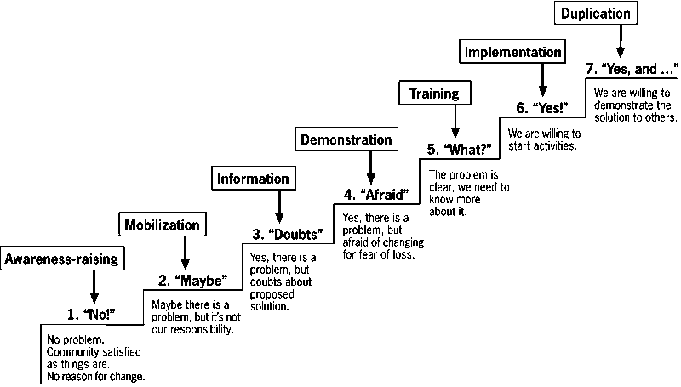






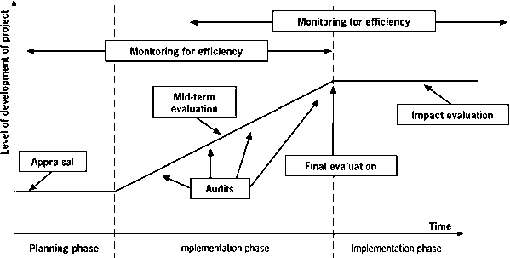


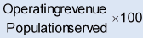





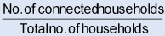
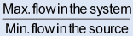
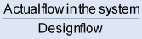
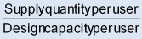

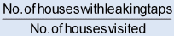
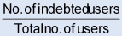



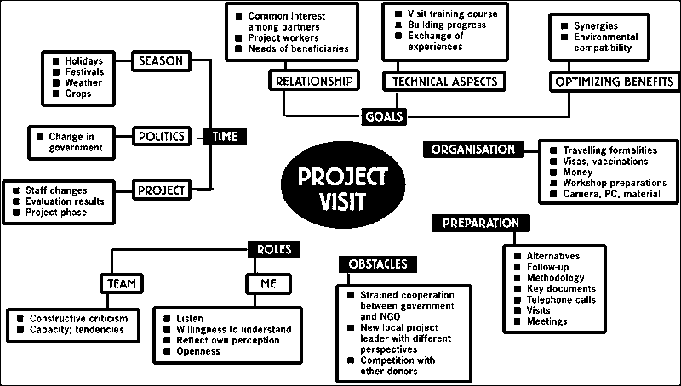

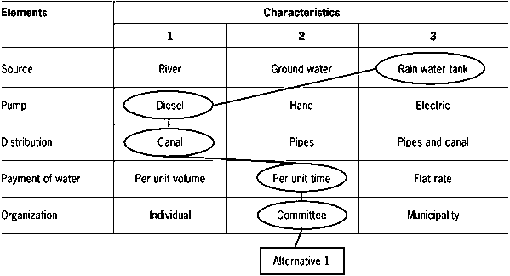
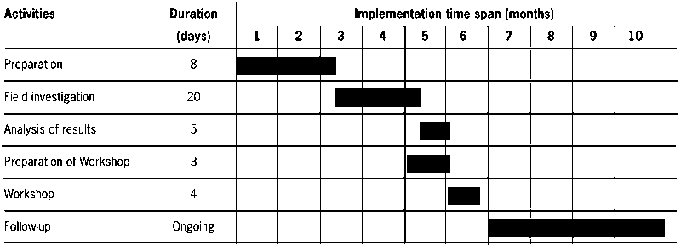
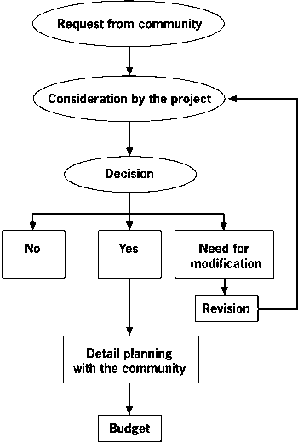
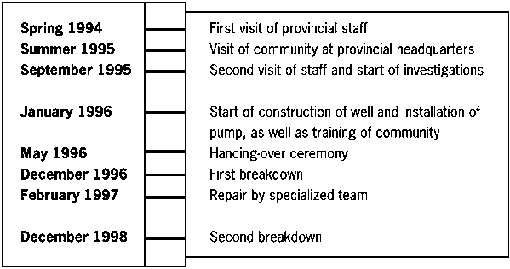

 = conflict; ······ = intermittent
relationships, etc.).
= conflict; ······ = intermittent
relationships, etc.).