Business Administration - Basic Skills Guide (SKAT, 1994, 162 p.)
Contents — 10 sections
- Section 1
- Section 2
- Business Administration - Basic Skills Guide (SKAT, 1994, 162 p.)
- Business Administration - Basic Skills Guide (SKAT, 1994, 162 p.)
- Business Administration - Basic Skills Guide (SKAT, 1994, 162 p.)
- Business Administration - Basic Skills Guide (SKAT, 1994, 162 p.)
- Business Administration - Basic Skills Guide (SKAT, 1994, 162 p.)
- Business Administration - Basic Skills Guide (SKAT, 1994, 162 p.)
- Business Administration - Basic Skills Guide (SKAT, 1994, 162 p.)
- Business Administration - Basic Skills Guide (SKAT, 1994, 162 p.)
 | | | Business Administration - Basic Skills Guide (SKAT, 1994, 162 p.) | | | (introduction...) | | | Introduction | | | Preface | | | Purpose | | | History | | | Toolkit Series | | | Supporters | | | (introduction...) | | | BASIN | | | SKAT | | | RAS | | | Network | | | ILO | | | Contact Address | | | Recognition | | | Comments | | | Introduction to Business Administration Basic Skills Guide | | | Purpose | | | Target Group | | | Structure | | | Application | | | Local Currency | | | Module 1: The Business | | | The Business and its Environment | | | Definition | | | Community | | | Resources | | | Environment | | | The Business Cycle | | | Definition | | | The Structure of a Business | | | Purpose | | | Production | | | Finance | | | Marketing | | | Management | | | Module 2: Management | | | Introduction | | | Goal | | | Purpose | | | Decision-Making | | | Purpose | | | Process | | | Implementation | | | Purpose | | | Process | | | Planning | | | Purpose | | | Products | | | Capacity | | | Sales | | | Production | | | Cash | | | Appendix A: Questionnaire for an Analysis | | | Appendix B: Exercises | | | Module 3: Cash and Credit Management | | | Cash Management | | | Goal | | | Purpose | | | Vouchers | | | (introduction...) | | | Receipt | | | Invoices | | | Filing | | | Cash Box | | | (introduction...) | | | Family | | | Withdrawals | | | Excess Cash | | | Cash Control | | | The Cash Book | | | Definition | | | Format | | | Cash Check | | | Change of the Year | | | Purpose | | | Tasks | | | Credit Management | | | Purpose | | | Credit | | | (introduction...) | | | Debtors | | | Creditors | | | Conclusion | | | Credit Control | | | (introduction...) | | | Debtors | | | Creditors | | | Cash Planning | | | Purpose | | | Basic Method | | | (introduction...) | | | Limitations | | | The Cash Budget | | | Definition | | | Format | | | (introduction...) | | | Sales | | | Other Cash In | | | Raw Materials | | | Withdrawals | | | Exercise | | | Analysis | | | (introduction...) | | | Cash Shortage | | | Adjustment | | | Poor Cash | | | Appendix A: Cash Book Exercise | | | Appendix B: Cash Budget Exercise | | | Module 4: Costing and Pricing | | | Introduction | | | Goal | | | Purpose | | | Types of Costs | | | Definition | | | Material Costs | | | Labour Costs | | | Depreciation | | | (introduction...) | | | Calculation | | | Inflation | | | Format | | | Summary Format | | | Credit Costs | | | Other Costs | | | Costing | | | Purpose | | | Variable Costs | | | Fixed Costs | | | Calculating the Production Costs | | | Format | | | Variable Costs | | | Fixed Costs | | | Total Costs | | | Pricing | | | Purpose | | | Pricing Factors | | | (introduction...) | | | Costs | | | Market | | | Price - Quantity | | | Reducing Costs | | | Conclusion | | | Appendix A: Exercise in Costing | | | 1. Depreciation Calculation | | | 2. Costs Calculation | | | Module 5: Profit and Loss Statement | | | Profit and Loss Statement | | | Goal | | | Purpose | | | Concept | | | (introduction...) | | | Goods Sold | | | Expenses | | | Basic Formula | | | An Example of a Profit and Loss Statement | | | Introduction | | | Value of Stock | | | Depreciation | | | Cash book | | | Calculation | | | Appendix A: Exercise in Profit and Loss Statement | | | (introduction...) | | | 1. Value of Stock | | | 2. Depreciation of Equipment and Workshop | | | 3. Cash Transactions | | | 4. Profit and Loss Statement | | | 5. Answers to the Exercises | | | a. Stock Record | | | b. Depreciation | | | c. Cash Book | | | d. Profit and Loss Statement | | | Appendix B: The Difference between Cash and Profit | | | 1. The Question | | | 2. Where the Difference Comes From | | | 3. Example | | | Module 6: Financial Analysis | | | Introduction | | | Goal | | | Purpose | | | Profit and Loss Statement | | | Purpose | | | Why Profit? | | | What is profit? | | | Analysis | | | Improve Profit | | | Break-Even Point | | | Purpose | | | Definition | | | Calculation | | | Capacity | | | Price | | | Extra Costs | | | Example Format | | | Exercise | | | Module 7: Marketing | | | Introduction | | | Goal | | | Purpose | | | The Product | | | Definition | | | Features | | | Quality | | | Price/Quantity | | | Marketing Tools | | | Purpose | | | Distribution | | | Promotion | | | Selling | | | (introduction...) | | | Main Points | | | Impression |
|
| | | Business Administration - Basic Skills Guide (SKAT, 1994, 162 p.) | | | (introduction...) | | | Introduction | | | Module 1: The Business | | | Module 2: Management | | | Module 3: Cash and Credit Management | | | Module 4: Costing and Pricing | | | Module 5: Profit and Loss Statement | | | Module 6: Financial Analysis | | | Module 7: Marketing |
|
|
FCR/MCR TOOLKIT |
ELEMENT 30 |
Swiss Centre for Development Cooperation in Technology and
Management
International Labour Office
Basic knowledge in administration of small workshops for the
production of FCR and MCR Tiles.
With ready-to-use toolkit.
COPY FOR EVALUATION
This copy for evaluation is distributed to a limited audience
for commentary.
Please send any contribution to SKAT, Vadianstrasse 42, 9000 St.
Gallen,
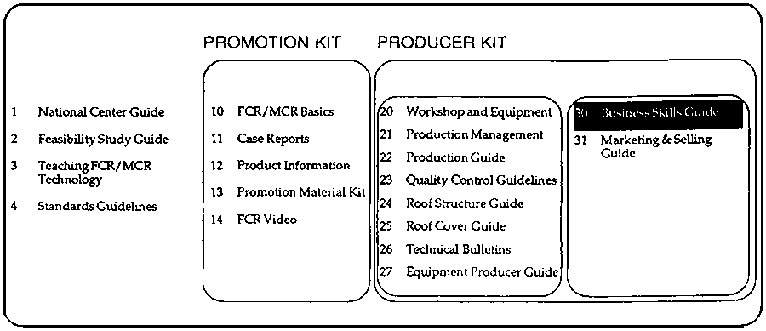
FCR/MCR TOOLKIT-OVERVIEW
NATIONAL CENTER KIT
Figure
|
Author: |
Charles Sarasin |
|
|
|
Illustrations: |
Egon Meier, St. Gallen |
|
|
|
Layout: |
Charles Sarasin |
|
|
|
Cover: |
SKAT, Egon Meier |
|
|
|
English: |
John Grierson
Barbara Ikin
Tauni Sanchez |
|
|
|
Editing Committee: |
Michel Gressot, ILO
Heini M�ller, SKAT
Karl Wehrle |
|
|
|
Co-Published by: |
SKAT, Swiss Centre for Development Cooperation in
Technology and Management
in collaboration with
ILO, International
Labour Office, INSTEAD |
|
|
|
First edition: |
1994 by
SKAT, Swiss Centre for Development Cooperation in
Technology and Management and ILO, International Labour Office |
|
|
|
Copyright: |
by SKAT, St. Gallen, Switzerland, and ILO, Geneva, Switzerland
|
|
|
|
Comments: |
Please send any comments concerning this publication to SKAT or
ILO |
|
|
|
Printed by: |
|
|
|
|
ISBN: |
|
|
|
|
Distribution by: |
SKAT-BOOKSHOP
Vadianstrasse 42
CH-9000 St. Gallen,
Switzerland
Phone: +41 (0) 71 228 54 54
Fax: +41 (0) 71 228 54
55
ILO
INSTEAD
Route des Morillions 4
CH-1211 Geneve 22,
Switzerland
Phone: +41 (0) 22 799’61’11, Fax: +41 (0) 22
798’86’85 |
May
1994
____________________________________________________________________________
The designations employed in ILO publications, which are in
conformity with United Nations practice, and the presentation of material
therein do not imply the expression of any opinion whatsoever on the pan of the
International Labour Office concerning the legal status of any country, area or
territory or of its authorities, or concerning the delimination of its
frontiers.
The responsibility for opinions expressed in signed articles,
studies and other contributions rests solely with their authors, and publication
does not constitute an endorsement by the International Labour Office of the
opinions expressed in them.
Reference to names of firms and commercial products and
processes does not imply their endorsement by the International Labour Office,
and any failure to mention a particular firm, commercial product or process is
not a sign of
disapproval.
| | | Business Administration - Basic Skills Guide (SKAT, 1994, 162 p.) | | | Introduction | | | Preface | | | Purpose | | | History | | | Toolkit Series | | | Supporters | | | (introduction...) | | | BASIN | | | SKAT | | | RAS | | | Network | | | ILO | | | Contact Address | | | Recognition | | | Comments | | | Introduction to Business Administration Basic Skills Guide | | | Purpose | | | Target Group | | | Structure | | | Application | | | Local Currency |
|
Business Administration - Basic Skills Guide (SKAT, 1994, 162 p.)
Introduction
Preface
Purpose
This guide is part of the FCR/MCR (Fibre Concrete Roofing/Micro
Concrete Roofing) toolkit series although not restricted to this type of
business.
History
The FCR/MCR technology was developed in the 1970s based on many
years of experiences made with concrete tiles and asbestos cement sheets. During
the 1980s it found applications in many countries all over the world. Today the
technology is at a mature stage and experiences have shown that it offers a
reliable roofing material which can compete in most cases with conventional
roofing
materials.
Toolkit Series
The FCR/MCR Toolkit series impart the entire know-how that is
required in the field of FCR/MCR technology, covering technical as well as
economic, organisational, management and marketing aspects. The FCR/MCR Toolkits
Overview shows the structure of its
contents.
Supporters
SKAT and ILO are co-publishers of the FCR/MCR Toolkit Series
which this guide is one
element.
BASIN
SKAT is a member of BASIN (Building Advisory Service and
Information Network), a coordinated network of experienced international
professionals, which was established to provide qualified advice and information
in the field of building materials and construction technologies.
The activities of BASIN are divided amongst four leading
European, non-profit organisations in the field of appropriate technology viz.
GTZ/GATE Germany, ITDG Britain, SKAT Switzerland, CRATerre France.
Each of these organisations covers a separate specialised
subject area, thus providing more qualified expertise with greater
efficiency.
SKAT
SKAT is an information and documentation centre and a
consultancy group engaged in promoting and implementing appropriate technology
in partner countries
worldwide.
RAS
As a member of BASIN, SKAT specialises in roofing technology,
particularly FCR/MCR technology. Within BASIN, SKAT established the Roofing
Advisory Service (RAS). To facilitate the promotion and dissemination of roofing
technologies, SKAT/RAS produce the FCR/MCR Toolkit Series of which this Business
Administration Basic Skills Guide is one
element.
Network
A worldwide network of specialists and specialised institutions
provides technical support to new and existing producers of FCR/MCR. This helps
to ensure the reliability and quality of the products in this growing market.
This FCR/MCR network is coordinated by
SKAT/RAS.
ILO
A programme for the development, promotion and application of
appropriate building technologies suitable for low-cost construction is
currently being implemented by the Micro-enterprise and Informal Sector Section
of the Entrepreneurship and Management Development Branch of ILO.
The objectives of this programme are to minimise construction
costs, maximise the use of locally-available raw materials and generate
productive employment. The program also aims at developing small and
micro-enterprises in this sector and at demonstrating their commercial
viability. It makes use of an innovative approach whereby some of the activities
are carried out in on-going technical cooperation projects for the development
of small and micro-enterprises. These projects are executed by ILO or other
agencies such as UNDP, as multilateral or bilateral projects. Various approaches
are used by this programme: research and development, dissemination of
technological information, advisory services to governments and implementation
of technical assistance
projects.
Contact Address
This literature, as well as further information, is available
from:
Roofing Advisory Service
c/o
SKAT/RAS
Vadianstrasse 42
CH-9000 St. Gallen, Switzerland
Tel
+41 (0) 71/23 74 75
Fax +41 (0) 71/23 75 45
and
ILO
INSTEAD
Route des Morillions 4
CH-1211
Geneve, Switzerland
Tel +41 (0) 22/799 61 11
Fax +41 (0) 22/798 86
85
Recognition
We would like to thank all the experts, technicians and
producers who helped us with valuable comments and remarks based on their
extensive experiences. Main resource persons were:
· Michel Gressot,
ILO International Labour Organisation, Geneva, Switzerland
· John Grierson, SKAT, Switzerland
· Dr. J�rg Gr�tter, Swisscontact, Switzerland
· Paul Gut and Roland Stulz, INTEP, Zurich,
Switzerland
Comments
Comments and feedback information are welcome and will help to
further improve this guide. They may be sent to SKAT/RAS or
ILO.
Introduction to Business Administration Basic Skills Guide
Purpose
Doing good business is not just a question of using the
appropriate technology. You must also be an ‘entrepreneur’ and have
business skills to be successful. This guide is prepared especially to help you
develop the business skills you will need to succeed in business. In a popular
rather than in a scientific way the principles of business administration are
explained. Moreover, a ready-to-use toolkit is
provided.
Target Group
It is not possible to make a business skills guide which would
suit all the needs of all entrepreneurs all over the world. The present guide is
designed as a reference source or teaching aid for the education of
microentrepreneurs with no or very little knowledge about business
administration.
Structure
The “Business Administration Basic Skills Guide”
contains the following modules:
|
Module 1 |
The Business: What is a business and how it works. |
|
|
|
Module 2 |
Management: Decision-making, implementation and planning.
|
|
|
|
Module 3 |
Cash and Credit Management: Managing cash, cash book,
cash budget, creditors’ and debtors’ records. |
|
|
|
Module 4 |
Costing and Pricing: Calculating production costs and
determining the best selling price. |
|
|
|
Module 5 |
Profit and Loss Statement: Profit and loss statements and
exercises. |
|
|
|
Module 6 |
Financial Analysis: Analysis of profit and loss
statements, controlling and managing for profitability and calculation of the
breakeven point. |
|
|
|
Module 7 |
Marketing: Distribution, promotion and selling. |
Module Structure
Each module is structured in the following way:
· Purpose or
Definition,
· Introduction to the
Topic,
· Basic Concept and
Examples,
· Exercises with
Answers.
Each section is a self-contained module which includes a cover,
table of contents and
appendices.
Application
The “Business Administration Basic Skills Guide”
covers the financial aspects of running a business. The production aspects are
covered by other guides in this series.
The guide can be used as is or, if necessary, changed, adapted
and expanded to suit local conditions and requirements. The modular structure
allows to use only those sections which are appropriate and necessary. The order
in which the modules are presented is not fixed. The modules should be
rearranged to suit the demands in your specific
situation.
Local Currency
As this toolkit will be used in a number of countries each with
its own currency, a special currency called Local unit of currency (LU)
has been used throughout this toolkit. Readers are asked to insert their own
currencies and values when doing calculations based on their own
businesses.
| | | Business Administration - Basic Skills Guide (SKAT, 1994, 162 p.) | | | Module 1: The Business | | | The Business and its Environment | | | Definition | | | Community | | | Resources | | | Environment | | | The Business Cycle | | | Definition | | | The Structure of a Business | | | Purpose | | | Production | | | Finance | | | Marketing | | | Management |
|
Business Administration - Basic Skills Guide (SKAT, 1994, 162 p.)
Module 1: The Business
The Business and its Environment
Definition
The business is an organization which produces and sells, or
only sells goods or services, or both. There exist several links between a
business and its ecological and social environment.

Figure
Community
Workers are human beings and have the right to be well treated.
Most of them have a family with one or more children. They all have to live from
the wage, you pay to them. Please keep in mind that the future of your country
depends to a great extent on the education and the way of thinking of
today’s children. Thus, pay wages which allow your workers to send their
children to school. Do not abuse children as cheap
workers.
Resources
Most raw materials are made from natural resources. Moreover,
you may need water and air in your production process. Please keep in mind that
natural resources are limited in our world. Thus, do not waste
them.
Environment
A workshop not only produces goods, but it may also produce
rubbish, sewage and exhaust fumes. All these things pollute or even contaminate
the environment in which we are all living. Therefore, the production of
rubbish, sewage and exhaust fumes should be minimized. Normal rubbish is put
into a disposal. Contaminated rubbish needs special treatment, never put it into
normal disposal. Sewage needs to be purified in a purification plant. Oil,
solvents, dye, contaminated water and so on need special treatment, never put
them into the drain. Contaminated exhaust fumes need to be filtered.
|
Be a smart and modern businessman, feel responsible for the
social community and the environment! |
The Business Cycle
Definition
A new business starts with a good idea and some money. Some of
the money is needed to establish the workshop and to buy equipment and raw
materials. Money is also used to pay the workers and operate the business until
you gain enough money from selling goods.
Once the business has been established, the next step is to
begin producing; raw materials must be transformed into goods by your workers.
These goods are then sold and the money received from selling them is used to
pay your workers and to buy new raw materials. If you have sold your goods for
more than it cost you to make them, you will have made a profit. Profit can be
taken out of the business in the form of withdrawals or left in the business and
used to improve and enlarge the business.
A business runs through the business cycle all the time:

Figure
The sooner you get back the money you spent on raw materials,
workers’ wages and operating expenses, the sooner you will make a profit.
Large stocks of raw materials and finished goods tie up money and slow down the
cycle. Raw materials should be used quickly to produce goods and the finished
goods should be sold as soon as possible.
|
Attention
All businesses keep some raw materials in stock so that
production can continue without interruption. In most cases a business should
keep stocks of raw materials as low as possible. However, in certain
circumstances it may be necessary to keep large stocks of raw materials on hand.
For example:
· When the prices
are high for small lots,
· When the
transportation costs are high,
· When the
inflation is high (and raw materials keep their value better than cash
does).
Conclusion: The management task is to find the correct
stock levels for your business. The stocks of finished goods “on
hand”, and of raw materials available for production, should be large
enough to meet customer demand and allow continuous production - but they should
not be much larger! |
The Structure of a Business
Purpose
It is important to understand how a business is structured. A
short description is given below of the most important areas of a
business.
Production
Production is that part of the business which is responsible for
turning raw materials into goods with the help of workers and equipment. The
shape, quality and quantity of the produced goods should meet customer needs.
The production costs should be kept as low as possible. Specific production
tasks include:
·
Organization of the workshop (who produces what, how much, where and
when). Trained workers are an expensive and precious resource. It is
important to select persons who are the most suited for a specific job and to
train them until they are as skilled as possible in their work. They should be
motivated and well-treated because, output will be higher in a good working
atmosphere. Their work should be organized in an efficient way to help reduce
operation costs.
· Quality control,
wellknown high quality is the best propaganda for your products.
· Organisation of the
stock.
· Operation and maintenance of
the equipment.
The organization of production is not the subject of the
present guide.

Figure
Finance
The financial part of a business is that part which deals with
money. The specific financial tasks are:
· Cash
management (module 3).
·
Managing debtors and creditors (module 3).
· Maintaining a cashbook (module
3).
· Cost control and
pricing (module 4).
· Profit
and loss statement and its analysis (modules 5 and
6).
The financial organization of a business is the main topic of
the present guide.

Figure
Marketing
This is the component of the business structure which is
responsible for making sure that the customers know about your products. One of
the most important goals of the business is to fulfil your customers’
needs. The main task of marketing is therefore to find out what these needs are
and how to fulfil them with products and services. The specific tasks of
marketing are:
· Market
studies (What do customers like? What are your competitors offering? Are
there new trends in the roofing and building materials market?)
· Design of the products
(shape, colour, services)
· Quality and
price of the products.
· Distribution channels
(Direct or via retailers?)
· Promotion activities
(Public relations? Expositions? Fairs? Advertising?)
· All selling
activities.
Module 7 gives a brief description of the main
tasks of marketing.

Figure
Management
There are interrelations between the areas. For example,
the production section should only produce the types, quality and quantities of
goods that the marketing section has determined can be sold to customers. The
marketing section is limited by the marketing budget made available by the
finance section and by the manufacturing capacity of the production section.

Figure
The coordination of resources, in order to reach a
specific goal in a continously changing world, is a management task. In a normal
small tile business the entrepreneur himself will manage most of the business
tasks described above. The entrepreneur will probably be the marketing,
production, personnel and finance manager in one! As the business grows, more
and more of the specific business tasks will be assigned to employees of the
business.
Module 2 looks at management. The main topics are how to
make decisions, how to implement them and how to do
planning.
| | | Business Administration - Basic Skills Guide (SKAT, 1994, 162 p.) | | | Module 2: Management | | | Introduction | | | Goal | | | Purpose | | | Decision-Making | | | Purpose | | | Process | | | Implementation | | | Purpose | | | Process | | | Planning | | | Purpose | | | Products | | | Capacity | | | Sales | | | Production | | | Cash | | | Appendix A: Questionnaire for an Analysis | | | Appendix B: Exercises |
|
Business Administration - Basic Skills Guide (SKAT, 1994, 162 p.)
Module 2: Management
Introduction
Goal
This module explains, how to plan and make decisions, and how to
implement
them.
Purpose
Management is the coordination of resources, such as
money and production capacity, to reach a specific goal. Managing also means to
make decisions: What goal should be reached and how. At least, the management is
also responsible for the realization of projects and the planning of the whole
business.
Decision-Making
Purpose
When doing business, you need to make decisions every day: Do I
have do order raw materials? To what date? Where? Sometimes, however, you need
to make decisions with a high impact on the future of your business: Should I
enlarge the capacity of my workshop? Should I hire or fire workers? Should I
change my products? Because of their importance, these latter decisions need to
be well-reasoned. For that reason, it’s worth thinking about a process
which leads to such well-reasoned decisions. The following hints may help to
improve your decision-making
ability.
Process
Before you can make a decision, you have to know, what are the
problems to solve, what are your goals, what are the possibilities you have to
solve the problems and what advantages and disadvantages every solution has.
Thus, the process of making good decision is as follows:
Step 1
Analyse your situation!
First, analyse the actual situation and consider the most likely
future possibilities. See appendix A for the type of questions, you should make.
|
Mr. Garcias is not satisfied with his business. He would like to
improve the situation. First, he analyses his situation;
Mr. Garcia makes a list of his most important problems:
1. He cannot live from his tile-making
business. Why not? He does not sell enough tiles. Why not? Only a few people
know about his tiles; others do not trust their quality.
2. His workshop and equipment are old and worn
out
3. The quality of the tiles is not very good.
|
Step 2
Set goals!
Now, think about your goals. How would you like the situation to
be?
|
Mr. Garcia has the following goals:
· Mr. Garcia’s
ultimate goal is to make enough money for his family to live on and to be able
to save enough money to buy new equipment after five years.
· In order to reach this
ultimate goal, Mr. Garcia has set the following goals:
· His
customers’ needs should be found out and fulfilled. For his business to be
successful, he needs to sell his products. To sell his products, he needs to
know what is needed and what will be bought by the customers.
· The quality of the tiles
should be very good.
· Make his business profitable
by keeping his production costs as low as
possible.
· Be
able to withdraw LU 20’000 from his business every month for the living
costs of his family. This means he has to sell a certain number of tiles every
month. |
Step 3
Determine your possibilities!
Determine what the possibilities are for reaching your goals.
|
Mr. Garcia, together with his foreman, goes to a friend who is a
good businessman to discuss his problems as identified above. Together they work
out a few possibilities for solving these problems and for thus reaching the
goals:
1. Mr. Garcia could advertise in local
newspapers, on radio or television. He could put up posters all over town. He
could write letters to all the architects and building contractors in town.
2. He could overhaul his vibrating table or buy a new,
improved one.
3. The quality of his tiles could be
improved by educating and training the workers. |
Step 4
Make an assessment of the possibilities!
Every possibility has its strong and its weak points. This is
the reason why you have to analyse the possibilities to see whether they would
help to solve your problems. It is also important to calculate the costs of each
possibility and assess whether it corresponds to your goals.
|
Mr. Garcia writes down all the possibilities and estimates their
costs and benefits:
1. Marketing activities:
· Advertising in
newspapers: medium costs, low benefit,
·
Advertising on radio/TV: high costs, high benefit,
· Posters: low costs, medium benefit,
· Letter to architects and building contractors: low
costs, high benefit.
2. Equipment:
· Overhauling the
old vibrating table would be much cheaper - about a quarter of the cost - than
buying a new one and the additional lifespan would be three years.
· A new table, although more
expensive, would last longer.
3. Quality of tiles:
· Sending all the
workers to a training course offered by a special organisation would be
expensive.
· Sending the
foreman to such a training course would be less expensive. He could then train
his workers |
Step 5
Decide!
You now have enough information to make important decisions
about the future of your business. However, your resources (money, equipment and
workers) are limited. You cannot solve all your problems or take advantage of
all opportunities all at once. You will have to decide which problems to address
first, and which opportunities offer the best chance of improving your business.
In other words, it is necessary to set priorities and make plans.
|
Mr. Garcia makes a ranking of his business problems from the
most important to the least important problem:
· Marketing
activities,
· Tile quality,
· Production equipment.
At the moment the resources of the business are limited. Only
the expansion of marketing activities can be financed. Mr. Garcia decides to do
the following:
1. Write letters to all the architects and
building contractors in his town. In his letter he will explain the many
benefits of FCR/MCR tiles as a roofing material and offer discounts for bulk
purchases of his tiles.
2. Put up posters in town.
|
Implementation
Purpose
The projects, you decided for should be implemented, because
without implementation the best idea is not worth very much. The implementation
of projects is the primary responsibility of the business owner or
manager.
Process
The following steps will help you implement any project:
Step 1
Determine, how to do it!
Decide how to implement your project. List on a sheet of paper
the whole way of implementation, step by step. This list is your
action plan (see next page for an example).
|
Mr. Garcia decided to put up posters in town. Now, he thinks
about the implementation of this decision: First he needs attractive posters to
put up. However, he is not an artist Thus, he needs an artist, who could create
posters. He knows a few artists. But, who is the best? He has to evaluate one
artist. When the artist comes along with his ideas, he has to decide for one
idea. Then the artist needs some time to create the poster. NOW the poster has
to be printed. When the posters are ready, there are workers needed to fasten
them all around the city. He has not enough workers to do so, he needs to hire
additional workers. Then, he has to instruct his workers. When the workers have
done their work, he has to check it and, if necessary, fasten some additional
posters. He writes all these actions down, step by step. Then he thinks about
the dates and the responsibilities. |
Step 2
Determine the dates, when specific steps have to be
completed!
Set the date when each step should be completed.
Step 3
Determine the responsabilities!
Determine who is responsible for each step.
Step 4
Instruct your workers!
Make sure every worker knows what he has to do and when he has
to do it.
Step 5
Check the work!
Find the answers to the following questions:
· Are there problems
which require the help of others?
· Is the
quality of work satisfactory?
· Is the work
being done on time?
Checking should be done as frequently as necessary.
Step 6
Keep your action plan up to date!
Your action plan is an important tool and should be kept up to
date.
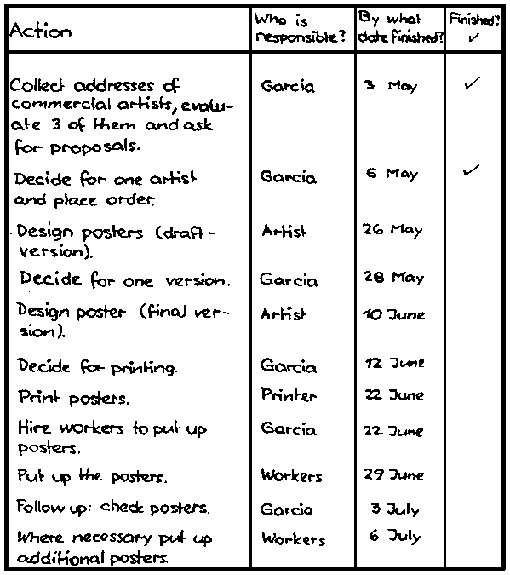
Example of an action
plan
Planning
Purpose
Everyone makes plans as part of their day-to-day activities.
Before going to the market you think about the things you will need to buy - and
plan for the money to pay for them, the time needed to shop, and how to
transport them. Before buying an expensive item, such as a car, you think about
your present and future financial situation - do you have enough money?
Business planning is the same process as personal or household
planning. You should estimate your future sales, make a cash-budget, plan your
production and think about the future of your
products.
Products
Customer preferences may change from time to time. The
demand for a certain type of tile may change. It is important to be aware of
these changes and to react in time.
|
Mr. Garcia produces only gray tiles. When a competitor starts
producing red tiles his sales increase white Mr. Garcia’s decrease. If Mr.
Garcia wants to be competitive he will also have to start producing red tiles!
|
Capacity
The capacity of your workshop should be big enough to
meet the demand for tiles. On the other hand, the equipment should be in use
full-time, to minimize the fixed costs per tile. From time to time you will have
to decide whether the capacity should be increased or decreased. This decision
always depends on the market situation - will the overall demand increase or
decrease? This is a difficult, but very important
question.
Sales
In order to plan production and make a cash management plan, it
is necessary to estimate future sales. Every six months you should
estimate and record the expected sales for the next six
months.
Production
During production you need raw materials and workers. You must
plan for raw materials and workers in advance. Employees should be hired or
scheduled and raw materials should be ordered on time. If you know the
amount of raw materials needed per day, you can calculate exactly when you have
to order more raw materials. It is best to keep some extra stock for unforeseen
events!
|
During normal production, Mr. Garcia uses 1 bag of cement per
day. When he orders cement, he has to wait 10 working days until the cement is
delivered to his workshop. Mr. Garcia always likes to have at least 5 bags of
cement in reserve. When does he order new cement?
He orders cement when his stock is down to 15 bags. Thus when
delivery is made after ten days, ho will still have 5 bags in reserve. |
Cash
If you have no cash you cannot do business. In most
businesses the cash level varies considerably: sometimes there is a lot of cash
and at other times there is almost no cash in the cash box. You should try to
avoid running out of cash. Before ordering equipment or raw materials, make sure
that you have enough cash to pay for them. Module 3 (“Cash and Credit
Management”) will explain how you can plan and manage your cash and avoid
cash
bottlenecks.
Appendix A: Questionnaire for an Analysis
· Marketing area
· Are you selling
enough tiles? If not, why not?
· What type of customer buys
your tiles?
· What types of roofs and tiles
do your customers like?
· Are their needs changing?
· How do the shape, selling
price and quality of your tiles compare with those of your competitors?
· What are the strong and weak
points of the competitors’ tiles and other roofing materials?
· What are the strong and weak
points of your tiles compared to the tiles and roofing materials of your
competitors?
· What are the trends in the
roofing and tile market?
· How is the general economic
situation and in what direction is it developing? What are the plans of the
government and how could they influence your business?
· Production area
· Is the quality of
the raw materials good?
· Is the quality of your tiles
good?
· Is the capacity of your
workshop satisfactory? Or is it too small or too large?
· What are your production
costs?
· Is your equipment in good
condition? Should it be repaired or adapted to improve quality and productivity?
Do you have equipment breakdowns? How often?
· Do you know of any new
technologies? If so, what influence could they have on your own business? Is the
technology level of your equipment still competitive?
· Personnel area
· Do your workers
produce tiles of a good quality?
· Is the
productivity of the workers satisfactory?
·
Are their levels of education and training high enough?
· Are your workers motivated? How is the working
atmosphere?
· How are their wages?
· Do you have the right number of workers?
· Is your employee turnover high? If so, why? How does
this affect the productivity of your workshop?
· Financial area
· Do you have enough
money available to continue production?
· Is
your business profitable? Is there a trend in your profit? Is it decreasing or
increasing?
· Do you have money set aside to
buy new equipment?
· Can you repay your
loans? Will you be able to get a new
loan?
Appendix B: Exercises
1. Decision-making
Think about your own business and do the following:
· Analyse
your present situation and write down the most important problems.
· Analyse your future
potential: What are the market trends? What will be the direction of
technical development? What are the expected government strategies? Write down
the expected effects of these aspects on your business.
· Think about your goals.
Write them down, ranking them according to their priorities.
· Think about your problems and
your goals. What problem has the highest priority? Make a ranking and
write it down.
· Consider potential
solutions to your problems. Write them down.
· Rate every potential
solution. What advantages and disadvantages do they have? How much do they cost
and how much labour capacity would they involve? Rank the solutions and for
every problem decide on the best solution. Write this down.
· Think about your
resources. Write down how much money and labour you could invest in a
project to improve your situation.
· Make some decisions.
What problem(s) should be solved first and which solution(s) should be
chosen?
2. Implementation
Considering the problem(s) and solution(s) you have chosen,
think about implementation:
· Make an action
plan of things to be done.
· Your action plan should
indicate:
·
What action is necessary.
· Who is
responsible for each action.
· When
each action should be carried out.
· Write down the
specific instructions for each person who has responsibility for part of
the action plan.
· Use your action plan to
manage implementation. Follow up frequently and check to see if each action
was carried out as planned.
3. Planning
Write down what planning activities you should do,
why you should do them and when you should do
them.
| | | Business Administration - Basic Skills Guide (SKAT, 1994, 162 p.) | | | Module 3: Cash and Credit Management | | | Cash Management | | | Goal | | | Purpose | | | Vouchers | | | (introduction...) | | | Receipt | | | Invoices | | | Filing | | | Cash Box | | | (introduction...) | | | Family | | | Withdrawals | | | Excess Cash | | | Cash Control | | | The Cash Book | | | Definition | | | Format | | | Cash Check | | | Change of the Year | | | Purpose | | | Tasks | | | Credit Management | | | Purpose | | | Credit | | | (introduction...) | | | Debtors | | | Creditors | | | Conclusion | | | Credit Control | | | (introduction...) | | | Debtors | | | Creditors | | | Cash Planning | | | Purpose | | | Basic Method | | | (introduction...) | | | Limitations | | | The Cash Budget | | | Definition | | | Format | | | (introduction...) | | | Sales | | | Other Cash In | | | Raw Materials | | | Withdrawals | | | Exercise | | | Analysis | | | (introduction...) | | | Cash Shortage | | | Adjustment | | | Poor Cash | | | Appendix A: Cash Book Exercise | | | Appendix B: Cash Budget Exercise |
|
Business Administration - Basic Skills Guide (SKAT, 1994, 162 p.)
Module 3: Cash and Credit Management
Cash Management
Goal
This module explains how to handle cash, how to plan for and how
to control cash
needs.
Purpose
You need cash to do business. You have to buy raw materials, pay
your workers for their labour, meet all other expenses and have some cash for
your own purposes.
It is very important to keep control over the cash situation. To
keep control, you should always know exactly how much cash you have in your cash
box, how much cash comes in, how much is spent, and what cash is used for. Cash
control is done with vouchers and a cash book. Many businesses
make a cash budget to help plan and manage their cash
needs.
Vouchers
For every cash transaction you should have a voucher.
There are several reasons for this:
· Vouchers tell you,
how much cash comes in, how much is spent and what cash is used for. So vouchers
for cash control are necessary.
· Vouchers explain and document
the figures in your cash book.
· Vouchers serve as proof that
payments have been made.
· Vouchers are required by law
in many countries.
|
For every financial transaction there should be a
voucher |
There are two basic types of vouchers: receipts and
invoices.
Receipt
The receipt is a voucher for cash which comes in or goes out.
With a receipt you can prove that you have paid a certain amount to a certain
person. Therefore, there should be a receipt from everyone who has received
money from you. Persons who receive money from you can include suppliers of raw
materials, bank cashier, or your employees. Your customers will also want a
receipt for the cash they pay for your products. A copy of their receipt can be
used as the voucher for money coming in.
A receipt should contain the following information:
· The number of
receipt,
· The name and address of the person
or business who received the money,
· The
name and address of the person or business who paid,
· What the money was paid for,
· The amount paid, in figures and in words,
· The place and date of payment,
· The signature of the person who received the
money.
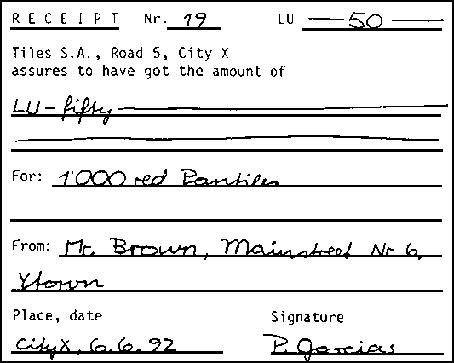
An example of a receipt is given
below:
Invoices
If your supplier of raw materials comes along with an invoice,
you do not need to write a receipt. In this case, the invoice can also be used
as a receipt. It is sufficient, when your supplier writes on the invoice that he
has received the money and signes this statement (town, date and signature) as
it is shown below.
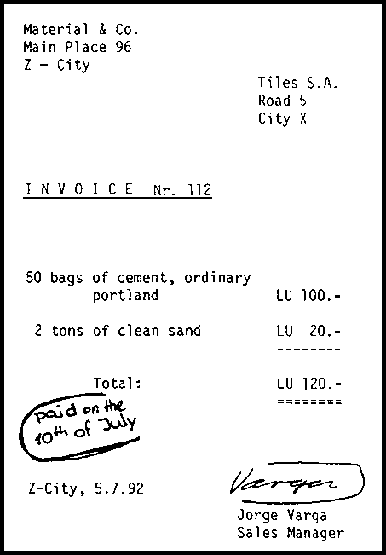
Figure
If you pay the invoice by bank or postal account
the voucher from the bank or post office will serve as a
receipt.
Filing
In order to retina them, it is a good idea to keep the vouchers
in a safe place and in an organised way. You may wish to keep all vouchers in a
file according to the date of issue, or the number of the voucher.
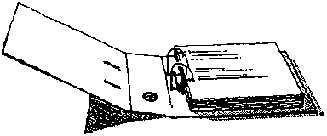
Figure
Cash Box
The cash box is for business purposes only. Therefore, only the
cash of the business should be stored in the cash box. If money from the
business and your own money are mixed up, it is difficult to keep control over
the actual financial situation of your business.
According to many experiences it is hard to keep control over
the cash situation if too many persons have access to the cash box. For that
reason, it is better to have one specified cashier which keeps control over the
cash box and all of the vouchers. His motto should be:
|
Cash (in and out) only in exchange for a voucher
|

Figure
Family
Cash and materials taken from the business are
withdrawals from the business. They are an expense of the business, unless
you receive compensation. Keep a record of all cash and materials which are
taken from your business by members of your family:
· Record all
cash and materials taken by family members,
· From time to time add
up the amount of cash and materials taken by family members, and ask for
compensation in the form of money, goods or services.
|
Once, Mr. Garcia gave some cash to his brother to pay for the
doctor. A few months later his brother helped him to finance new equipment.
|
Withdrawals
Decide how much cash you can withdraw for yourself and your
family. Try to keep personal withdrawals low. Remember, you must also put
aside money to buy raw materials, pay wages, replace old equipment, pay
taxes and so forth. In addition you should have cash reserves in case business
is slow or you want to
expand.
Excess Cash
If you have a large amount of cash in your cash box it might be
best to put it in a bank, building society or post office savings
account. Money saved in this way can be used as a reserve for emergencies or
to buy new
equipment.
Cash Control
Even if there is a cashier it is necessary to check the cash
every day. Below you find a basic method to do so:
1. Count the cash when business opens in the
morning.
2. Each time you receive cash or make a cash payment you
should prepare a voucher (receipt or invoice).
3. Count the cash again at the end of the business day.
4. Each day you should add up all the vouchers for
cash received and subtract all the vouchers for cash paid out. The
difference between cash in and cash out is then added to (or subtracted from)
the amount of cash you had in the morning. This figure should correspond to the
actual amount of cash in the cash box at the end of the business
day.
The procedure is shown by the following formula:
|
cash at days beginning
+ cash in
- cash out
=
cash at days end |

Figure
If the amount in the above calculation corresponds to the actual
amount of cash which you have in your cash box at the end of the day, your cash
is in order. If not, there may have been an error when handling the cash or
adding up the vouchers and you should find out, where the difference lies.
|
In the morning of the 15th of January, Mr. Garcia
counts his cash. There are LU 85.- in the cash box. In the afternoon, 200 bags
of cement are delivered and Mr. Garcia has to pay LU 60.- for it. The driver of
the truck gives him a receipt. In the evening. Mr. Garcia counts again the cash
in his cash box. There are LU 24 in the cash box. He makes the
calculation to control it:
85 + 0 - 60 = LU 25
The result of the calculation (LU 25) does not correspond to the
actual amount of cash In the cash box (LU 24). Suddenly Mr. Garcia remembers
that he spent LU 1.- for the meal, the driver had in the restaurant.
Unfortunately he has forgotten to ask for a receipt. He quickly writes a voucher
and closes hie workshop. |
The method shown above is very simple, but it has some
disadvantages:
· It is tedious and
time-consuming,
· It is not suitable as an
overview of all transactions,
· It is not
suitable for drawing conclusions such as the amount of money spent for raw
materials during the last month.
For these reasons it is better to keep a cash
book.
The Cash Book
Definition
A better alternative to adding up all the daily vouchers
is to keep a cash book. A cash book is simply a book in which all cash
transactions of your business are written down.
With the help of a cash book, a supervisor or bookkeeper can
analyse the financial situation of your business and give you advice on how to
make improvements.
|
A cash book helps you control your financial
situation
You should keep a cash book regularly and carefully
|
Format
If you already have a cash book and are satisfied with your
system, there is no need to change it. If not you will find an example below on
how a cash book could be kept.
The following hints will help you to make proper use of
the cash book:
· On the first line
you enter the starting cash. The starting cash is the actual amount of
cash in your cash box when you start your cash book or when you start a new page
in your cash book.
|
In the example shown on the next page the starting cash in the
cash box on January 1st was LU 80. |
Use one line for each transaction. For each transaction include
the following information:
· The date.
Under date enter the date on which the cash transaction took place, i.e., the
date when the cash was actually put into or taken from the cash
box.
|
The date of the sample transaction was ‘5 Jan’. |
· The item.
Under item briefly describe the transaction.
|
Mr. Garcia had to pay for a lot of cement: ‘50 Bags of
Cement’. |
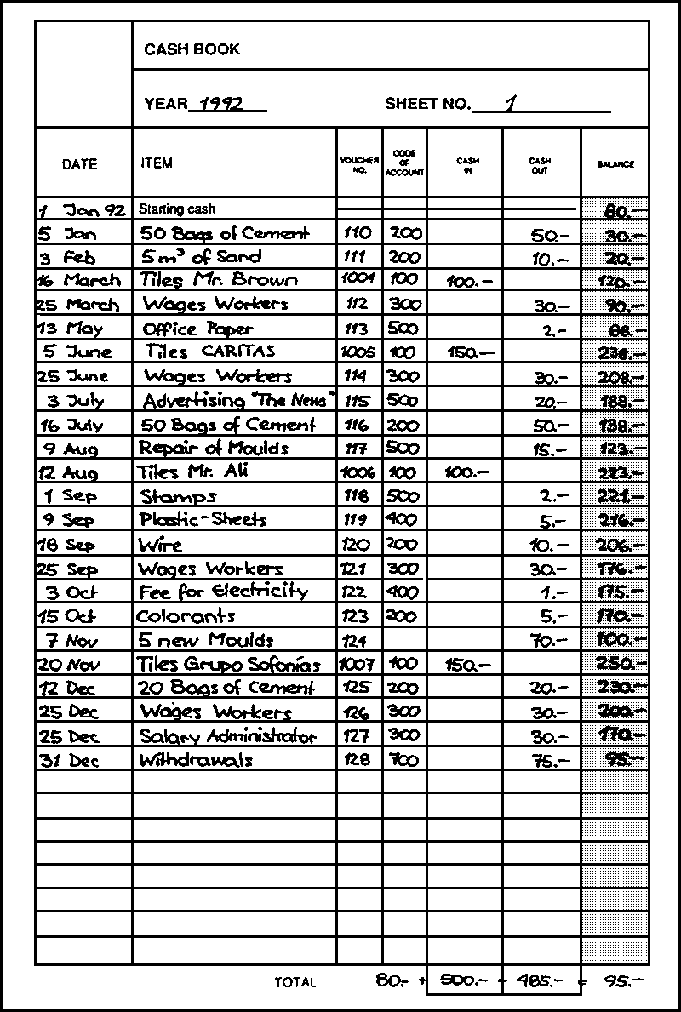
Figure
· Voucher
number. Sometimes you need to consult a specific voucher. If the vouchers
are filed according to their number they can easily be refound if their number
is written in the cash book.
|
The voucher from the last transaction had the number
‘109’. The present voucher therefore has the number ‘110’.
|
· Code of
account. One purpose of the cash book is to keep control over the cash
situation. Another purpose is to prepare the data for the profit and loss
statement (see module 5), which allows you to analyse the financial situation of
your workshop. In order to relate the cash transactions to the positions of the
profit and loss statement, every position of the profit and loss statement is
identified with a code and all cash transactions which correspond to that
position receive the same code.
The coding system used in the profit and loss statement
of module 5 looks as follows:
|
- Sales (of products and services)
.............................................................................
|
100 |
|
- Raw Materials
..........................................................................................................
|
200 |
|
- Working Costs (wages, salaries, social expenses)
................................................. |
300 |
|
- Production Inputs (water, energy, consumables, others)
........................................ |
400 |
|
- Overheads (office, marketing, transports, maintenance, |
|
|
taxes and fees, interests, others)
...............................................................................
|
500 |
|
- Depreciation (buildings and equipment)
.................................................................. |
600 |
|
- Withdrawals
.............................................................................................................
|
700 |
|
Cement is raw material, the code of account therefore is:
‘200’. |
· Cash In
or Cash Out. The next two columns are for recording whether cash came
in or went out. Use only one column depending on whether there was cash
in (cash received) or cash out (cash paid).
|
Mr. Garcia had to pay LU 50 for the cement. He therefore writes
in the column of ‘Cash Out’: ‘50’ |
· Balance.
Next you must determine the actual amount of cash there should be in the cash
box after the transaction has been completed, that is the balance. To find the
balance:
1. Start with the balance from
the preceding transaction.
2. Add to (cash in) or subtract from
(cash out) the previous balance.
3. Write down the answer in the
balance column.
|
Before paing the 50 bags of cement, Mr. Garcia has LU 80 in
the cash box.
After paying LU 50 for the cement, he still has LU 30 in his
cash box:
LU 80 - LU 50 = LU 30 |
Cash Check
To be sure that the amount of cash in your cash box is the same
as the balance in the cash book, you should count the cash in the cash
box every day, compare the two amounts and, if necessary, correct your
calculation or recording mistakes.
In Appendix A you will find a cash book exercise.
You can use it for your own
practice.
Change of the Year
Purpose
It is a good idea to control the whole bookkeeping system once a
year and to begin every year with new
books.
Tasks
At the end of the year the following should be done:
1. Close the cash book: Add up all
“cash in” and “cash out” figures for the year and make the
following calculation:
|
Initial balance + cash in - cash out = final balance
|
If there is a difference, make the calculation
again. If the same difference remains, control all the figures for “cash
in”, “cash out” and “balance”.
2. Make sure that the amount of cash in the cash
box corresponds to the final balance. If it does not, you should investigate
to find out why there is a difference. Did you forget to record some cash
transactions? Is the arithmetic correct? Is some money lost?
3. Prepare a profit and loss statement (see module
5) for the preceding year and determine the Net Profit (or Loss).
4. Determine the appropriate amount of
withdrawals. Make the end of year withdrawals and enter the amounts in the
cash book and profit and loss statement. Determine the retained profit
(or loss).
5. Start the New Year with a new cash
book.
Credit Management
Purpose
If your customers do not pay for their tiles, you would not be
able to pay your workers or pay for raw materials. Very soon your workers would
look for new jobs, your suppliers would no longer supply your raw materials and
finally, production would stop. If your business is to succeed, you must manage
the credit you give to your customers, just as you must manage the credit you
receive from your
suppliers.
Credit
Sometimes, your customers will not be able to pay immediately,
although they take home the goods they have purchased in your business. That
means: You give credit to your customers. The customers to whom you have given
credit are called debtors.
Sometimes, you do not need to pay immediately for the things you
purchase with your suppliers. Your suppliers may also give you credit. The
suppliers who have given you credit are called creditors.
There is an important difference to regular credits from a bank:
No interest is
paid.
Debtors
You should keep the number of your debtors as low as
possible. When you give credit your cash is tied up. You receive no interest and
the value of the credit given may be reduced by inflation. By the time your
debtors pay their bills, the value of the money may be less than when you gave
the
credit.
Creditors
You should not have many creditors either, and always be
able to pay your debts within the agreed upon time
limit.
Conclusion
The following two rules should form the basis of your credit
management system:
|
1. The number of your debtors and creditors should be kept as
low as possible.
2. The amount of creditors should not be higher than the
amount of debtors. |
Credit Control
It is possible to have a profitable business that has no cash
because your customers have not yet paid for the goods they received on credit.
For this reason you need a credit control
system.
Debtors
Your debtors can be controlled in an efficient way by using two
files:
· Customer
invoice file. When you write an invoice keep one copy in the customer
invoice file. File the invoices in numerical order (voucher no. or date). In
this file you will always be able to see who owes you how much. From time to
time look through the old invoices and write reminders to the customers who have
not yet paid their invoices, or visit them and collect the amount owed to you.
When a customer only pays part of an invoice, make a note on it and leave it in
the file.
· Paid customer invoices.
When a customer pays the full amount of the invoice, stamp or write
“paid” on your copy of the invoice. Remove this invoice from the file
‘customer invoice file’ and put it into a tile labelled ‘paid
customer
invoices.
Creditors
Your creditors can be controlled by the same way:
· The supplier
invoice file. Use this file for invoices which you have received from
suppliers for goods or raw materials.
· Paid suppliers
invoices. Once you have made payment, write “paid” on the invoice,
stating when and by whom payment was authorised and confirming that the details
have been checked. Transfer the invoice to the file ‘paid suppliers
invoices’.
Cash Planning
Purpose
Sometimes a business will have a large amount of cash and
sometimes there will be almost no cash in the cash box. Though this is a normal
situation, it is one that calls for careful planning to make sure that
there is always enough cash to pay the workers and buy raw materials. Always
make a cash plan before ordering equipment or raw materials and make sure
that there is enough cash to pay for them.
|
You should plan your expenses |
Basic Method
A basic method to prevent cash shortages is the following:
Always keep a certain amount of cash as reserve. When a payment leads to a
situation where you have to make use of this reserve, you make the following:
1. Write down the most important expected
expenses and incomings of the immediate future (one to three months).
2. If you see that there is no danger of a cash shortage
you can pay cash without worrying. If, however, you see that a cash shortage is
likely to occur you should act immediately. Try to find an acceptable solution
for everybody through negotiations.
To determine the amount of the reserve, start with a
small amount, e.g., one month’s expenses. If you always have a lot of cash
in the cash box, the amount of reserve is too high and might be reduced by
puting some money in a bank account. If you often run into situations with cash
shortages, the amount of reserve is too low. After a certain amount of
experience, you will find out, what amount of reserve is best for you.
|
Attention
If you frequently run into a cash shortage, and cannot manage to
keep a sufficient cash reserve, you may have a severe problem. Below (‘Poor
Cash’), you will find further information. |
|
Mr. Garcia always trys to keep at least LU 50 in his cash box.
On the 16th of March 1992, he has LU 50 in his cash box. In other words, he is
on the limit of his cash reserve. Therefore, he decides to estimate future
income and expenses to prevent a future cash shortage: |
|
Date |
Item |
In |
Out |
Balance |
|
16.3.92 |
Starting Cash |
|
|
LU 50 |
|
25.3.92 |
Wages |
|
LU 30 |
LU 20 |
|
10.4.92 |
Raw Material |
|
LU 40 |
(LU 20) |
|
12.4.92 |
Taxes |
|
LU 10 |
(LU 30) |
|
15.4.92 |
Sales |
LU 100 |
|
LU 70 |
|
Without a doubt Mr. Garcia will run into a cash shortage by
the 10th of April! The cash plan he made shows that he will need LU 20 more than
he will have on 10th April, and that he will need a total of LU 30 more than he
will have by the 15th of April. The tax payment cannot be delayed and the raw
material must be paid for on delivery. Mr. Garcia looks at his production plan
and sees that he still has enough raw material to produce until the 24th of
April. He decides to postpone the planned purchase of cement, to prevent a cash
shortage. He makes a new cash plan to see if this will solve the problem of the
anticipated cash shortage. His new cash plan looks like this:
|
|
Date |
Item |
In |
Out |
Balance |
|
16.3.92 |
Starting Cash |
|
|
LU 50 |
|
25.3.92 |
Wages |
|
LU 30 |
LU 20 |
|
12.4.92 |
Taxes |
|
LU 10 |
LU 10 |
|
15.4.92 |
Sales |
LU 100 |
|
LU 110 |
|
24.4.92 |
Raw Material |
|
LU 40 |
LU 70 |
|
The new cash plan shows that Mr. Garcia can continue
production, pay his workers and his taxes and still have no cash
shortage.
|
Limitations
The basic method may lead to a high cash reserve which is only
used exceptionally. In other words, normally there is too much money in the cash
box and it cannot be used for other purposes. When this becomes a problem, you
should use a more sophisticated method - the cash budget. The next
section tells you how to prepare such a cash
budget.
The Cash Budget
Definition
The cash budget is a plan which shows the future movements of
cash - the cash flow - in and out of the business. A cash budget is a
projection - a look into the future. Some amounts will be known, but others will
have to be estimated. The following is an example of a simple cash
budget:
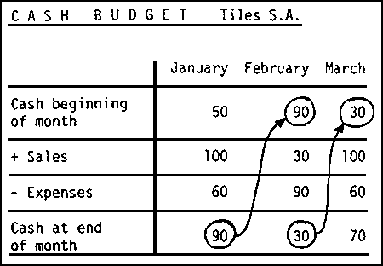
Figure
At the beginning of January there are LU 50.- in the cash box.
The incoming cash from selling products is estimated to be LU 100.-, the cash
flowing out of business through expenses is estimated to be LU 60.- Therefore,
at the end of January there are still LU 90.- in the cash box. LU 90.-, however,
is the amount of cash present at the beginning of February, and so
on.
Format
An example of a cash budget format is given on the next
side. The following hints will help you prepare and use the cash
budget:
Sales
Sales are based on past sales and adjusted for estimated future
sales trends. The figure for sales is entered in the field for the month for
which the cash for sales is received. When tiles are sold on credit,
payment is not received at the time of the sale. Cash payment is received later,
when your customers pay their
accounts.
Other Cash In
If you expect to receive cash from any other
source, for example from selling a machine, enter the estimated amount on
the line ‘Other Cash In’.

Figure
Raw Materials
From the products you plan to produce the next six months, you
calculate how much raw materials you need for this time. Then you estimate, what
batches you have to order at what date, when they arrive and when payment is
due.
The cash budget must show cash payment for raw materials
when it is expected to be made, not when the order is placed or when delivery is
made.
Withdrawals
Estimate how much cash will be withdrawn from the business each
month and enter the amounts for each month on the line for
‘Withdrawals’.
Exercise
In Appendix B you will find a cash budget
exercise. You can use it for your own
practice.
Analysis
The purpose of the cash budget is to have enough cash at all the
times. The cash budget is a useful tool to help you plan your cash requirements.
A business cannot keep running if it has no cash - even if it is making a
profit. For that reason, the “Cash at End” is the information
to be
analysed:
Cash Shortage
If your cash budget indicates a negative or very small cash
amount, such as the ‘Cash at End’ in September as shown in the example
above, then you must analyse the situation and take corrective action. Can you
postpone delivery of raw materials? Can you negotiate credit from your
suppliers? Can you collect credit payments that are due from your customers? Can
you borrow money from a bank, or from your family? Some action must be taken so
that your business does not run out of cash. On the next page, you will find an
example.
Adjustment
If you postpone the investments planned for August and September
until November, you can avoid a cash shortage in September.
The cash budget below shows the result of planning to meet the
expected cash shortage by post-poning investments until November.
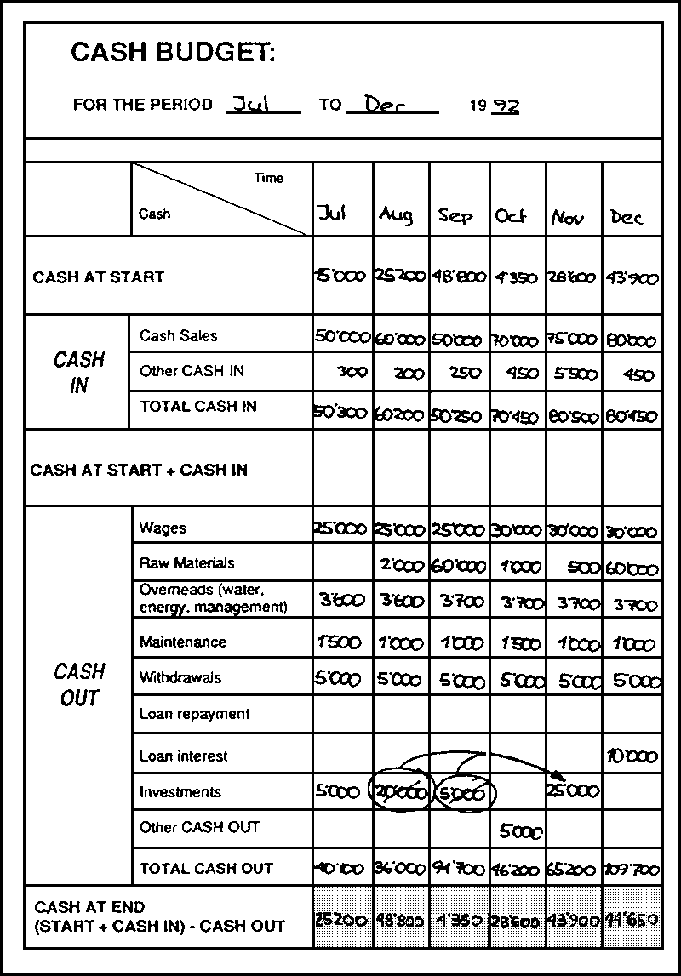
Figure
Poor Cash
If the amount of ‘Cash at End’ is always small and
often negative, it is a clear sign of a problem. You should analyse the
situation and take corrective action. The problem may be caused by one or more
of the following:
· Low
profits. The business is not doing well. Cash may be low because profits are
low or even negative (then you are in a loosing business). The profit and loss
account (see module 5) shows whether the business is making a profit or a loss.
· Too much customer
credit. The business may be making a profit, but the profit might be tied up
in credit sales that have not yet been paid. The business may need to collect
outstanding credit and reduce credit sales. Add up your sales credits and look
whether their collection would help.
· Excessive withdrawals.
A low cash level can result if the owner or family members take too much cash
from the business.
· Stocks of raw materials are
too big. The business may have too much money tied up in raw materials. In
normal circumstances raw materials should be just sufficient to meet current
production needs - plus a little
reserve.
Appendix A: Cash Book Exercise
Make a copy of the cash book format and enter the
following transactions from Garcia’s Tile Factory:
|
1 Jan 91 |
Start of the new year. There are LU 85 in the cash box. |
|
|
|
15 Jan 91 |
Purchase: 200 bags of cement for LU 60. Voucher no. 100. |
|
|
|
18 Jan 91 |
Purchase: 5 tons of sand for LU 10. Voucher no. 101. |
|
|
|
23 Jan 91 |
Pay: water and electricity fee, LU 3. Voucher no. 102. |
|
|
|
13 Feb 91 |
Cash Sale: Mr. Brown pays LU 80 for tiles. Voucher no. 1002.
|
|
|
|
3 Mar 91 |
Purchase: plastic sheets for LU 1. Voucher no. 105. |
|
|
|
25 Mar 91 |
Pay: workers’ wages, LU 30. Voucher no. 106. |
|
|
|
12 Apr 91 |
Pay: maintenance (repair moulds), LU 10. Voucher no. 108. |
|
|
|
22 May 91 |
Cash Sale: Mr. Grey pays LU 150 for tiles. Voucher no. 1003.
|
|
|
|
20 Jun 91 |
Pay: workers’ wages, LU 35. Voucher no. 109. |
|
|
|
3 Jul 91 |
Cash Sale: Mr. Mwangi pays LU 100 for tiles. Voucher no. 1004.
|
|
|
|
15 Jul 91 |
Purchase: new moulds, LU 40. Voucher no. 110. |
|
|
|
18 Aug 91 |
Purchase: office supplies, LU 1. Voucher no. 111. |
|
|
|
23 Aug 91 |
Pay: manager’s salary, LU 40. Voucher no. 112. |
|
|
|
6 Sep 91 |
Cash Sale: an NGO pays LU 100 for tiles. Voucher no. 1005. |
|
|
|
25 Sep 91 |
Pay: workers’ wages, LU 40. Voucher no. 113. |
|
|
|
3 Oct 91 |
Pay: The News’ LU 8 for an advertisement. Voucher no. 114.
|
|
|
|
16 Oct 91 |
Purchase: 200 bags of cement for LU 60. Voucher no. 115. |
|
|
|
16 Oct 91 |
Purchase: 5 tons of sand for LU 10. Voucher no. 116. |
|
|
|
31 Dec 91 |
Withdrawal: Mr. Garcia withdraws LU 40. Voucher no. 117. |
The answer to the cash book exercise is given next.
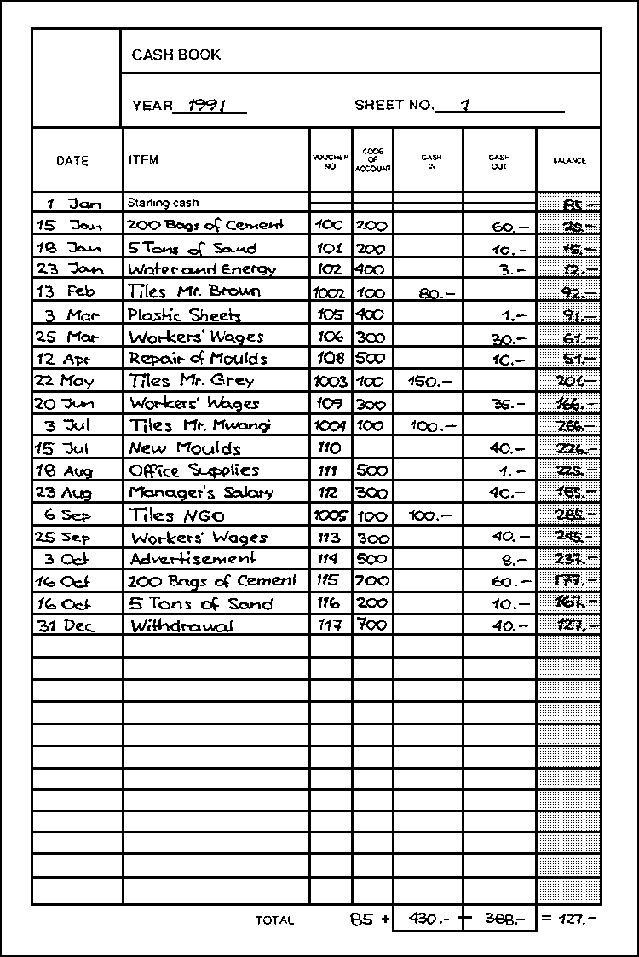
Figure
Appendix B: Cash Budget Exercise
Make a copy of the cash budget format and enter the
following transactions from Garcia’s Tile Factory:
· The cash
budget is for the period from January 1992 to June 1992.
· The ‘Cash at
Start’ on the 1st of January is LU 50.
· The sales manager estimates
that future sales will be:
·
January: LU 100
· February: LU 50 cash sales
(directly paid), LU 50 credit sales (paid one month later).
· March: LU 110
·
April: LU 120
· May: LU 140
· June: LU 140
· He plans to pay
the following wages to his workers:
·
January, February, March and April: LU 40 per month
· May and June: LU 50 per
month
· Based on the
figures from the sales of tiles, the production manager estimates the cash
needed to buy raw materials:
·
January: LU 20
· February: LU 40. Moreover, new
sand is delivered. It costs LU 30. The invoice says that it must be paid in
March.
· March and April: LU 50 per
month
· May and June: LU 60 per
month
· Overhead
expenses are estimated to be LU 10 per month in April, May and June.
· Maintenance expenses
are estimated to be LU 10 per month in March and June.
· In June Mr. Garcia
withdraws LU 50, and a loan interest of LU 10 is paid.
· In May he plans an
investment in new equipment of LU 50. The old equipment will be sold to a
friend in June for LU 20.
The answer to the cash budget exercise is given next.
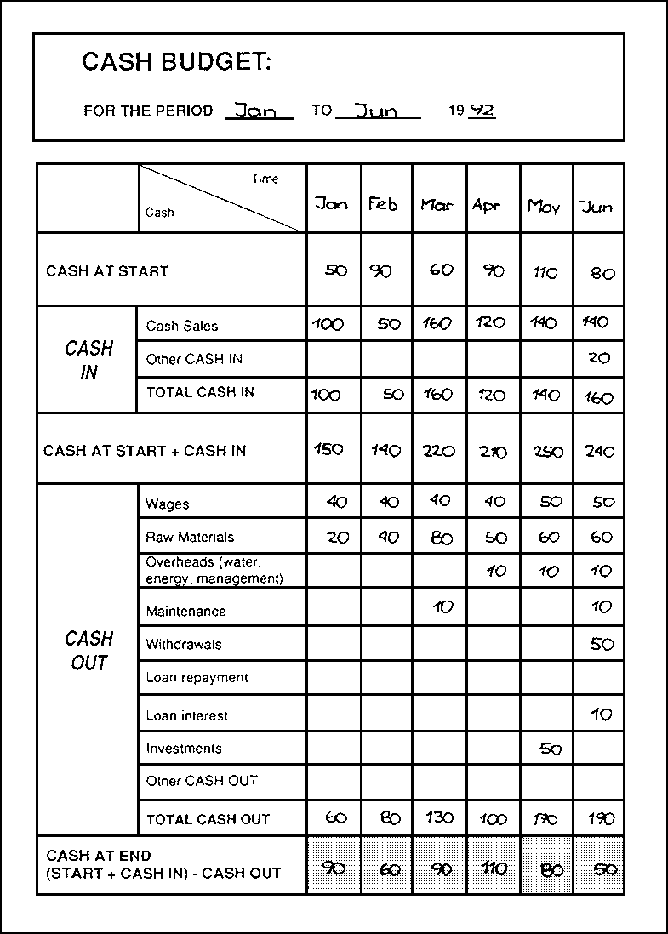
Figure
| | | Business Administration - Basic Skills Guide (SKAT, 1994, 162 p.) | | | Module 4: Costing and Pricing | | | Introduction | | | Goal | | | Purpose | | | Types of Costs | | | Definition | | | Material Costs | | | Labour Costs | | | Depreciation | | | (introduction...) | | | Calculation | | | Inflation | | | Format | | | Summary Format | | | Credit Costs | | | Other Costs | | | Costing | | | Purpose | | | Variable Costs | | | Fixed Costs | | | Calculating the Production Costs | | | Format | | | Variable Costs | | | Fixed Costs | | | Total Costs | | | Pricing | | | Purpose | | | Pricing Factors | | | (introduction...) | | | Costs | | | Market | | | Price - Quantity | | | Reducing Costs | | | Conclusion | | | Appendix A: Exercise in Costing | | | 1. Depreciation Calculation | | | 2. Costs Calculation |
|
Business Administration - Basic Skills Guide (SKAT, 1994, 162 p.)
Module 4: Costing and Pricing
Introduction
Goal
This module explains, what costs are and how to calculate
them. In addition, some hints are given on how to find the best selling price
for your
products.
Purpose
The main purpose of business is to make money, but it is not
always easy to know whether you are making or losing money. If you spend more
money producing goods than you get from selling them, you will lose money.
To avoid getting into this situation, it is important to know
the production costs per piece. Only if you set a selling price that
allows you at least to cover all your production costs, you will make a
profit.
Types of Costs
Definition
Costs are all expenses which result from producing
and selling goods. The main types of costs that you should know are
described
below.
Material Costs
To produce any goods you need the following types of material:
· Raw
materials. These are the basic materials which are combined to make your
goods. Examples are cement, sand, aggregate, colorants and wire to produce
MCR-tiles.
· Consumables.
Consumables are the materials that are used up - consumed - in the
process of producing and selling goods. However, consumables do not make part of
the final product. Examples are plastic sheets to produce
MCR-tiles.
Labour Costs
You have to pay the employees of your business:
· Wages.
These are payments made to the workers who are directly involved in producing
goods. Wages are usually based on time or on volume of production.
· Salaries. Payments to
staff who are not directly involved in the production process. These include
foremen, administrators, salesmen and drivers. Normally salaries are based on
time worked and are not related to the amount of goods produced.
· Social security. In
many countries employers have to make social insurance payments for every
worker. Social security can include payments into a pension plan and payments
during illness or maternity leave.
· Holidays. In some
countries workers are paid for a few weeks of
holiday.
Depreciation
Depreciation is the special term used when referring to the
costs to the business that results from investments losing their value over
time.
Investments are all the items owned by the business that
last a long time. Investments include production equipment such as machines,
administrative equipment such as office furniture, storage cabinets,
calculators, and land and buildings which belong to the business. With the
exception of land, all investments lose their value over time. For example, an
old building is worth much less than a new one.

Figure
This loss in value are costs. Therefore, depreciation
must be included when calculating production costs.
|
Attention
Depreciation falls under costs, but cash spent on investments
does not! For this reason costs and cash spent on the business must be
regarded as separate things. |
Calculation
The yearly amount of depreciation is determined as
follows:
Step 1
Estimate how many years an investment will last. This number of
years is known as the lifetime.
Step 2
Divide the costs of the investment by the lifetime in years to
get the yearly amount of depreciation.
|
In 1988 Mr. Garcia buys a vibrating table (machine to produce
MCR-tiles) for LU 3’000. The estimated lifetime is 5 years. Therefore the
yearly depreciation is:

The yearly depreciation costs of the machine are LU 600.
Or, to put it another way, an investment of LU 3’000 which lasts 5 years,
costs the business LU 600 per year. |
If a profit and loss statement (see Module 5) is made every
month, the monthly depreciation must be calculated. A year has twelve
months; therefore the monthly depreciation is one twelfth of the yearly
depreciation. If the yearly depreciation is LU 600, the monthly depreciation is
600 divided by 12 = LU
50.
Inflation
If the rate of inflation is high, e.g., 100% per year, the LU
600.- do not reflect the actual loss in value after one year, because now the LU
600.- are only worth half. The higher the rate of inflation, the stronger is
this effect. Therefore, in countries with a rate of inflation higher than
30%, the calculation of depreciation should be based on a hard
currency such as US dollars.
|
Mr. Garcia makes an example with one of his vibration tables:
1. Price of a new machine is US$
1’200
2. The lifetime of a new machine is estimated to be 5
years
3. Depreciation in $: 1’200 divided by 5 = $240 per
year
4. Exchange rate: LU: $ = 2:1
5.
Depreciation in LU: $ 240 × 2 = LU 480 |
The monthly depreciation is calculated in the same way.
First calculate the monthly depreciation in dollars, then calculate the monthly
depreciation in local
currency.
Format
With the format shown below the yearly depreciation can be
determined, even in a country with a high rate of inflation. In the upper part,
the yearly depreciation amount is determined as shown above. In the lower part,
the amounts of yearly depreciation in the local currency are determined.
The effect of a growing rate of inflation can be seen very well:
The amount of depreciation in local currency is increasing all the time.
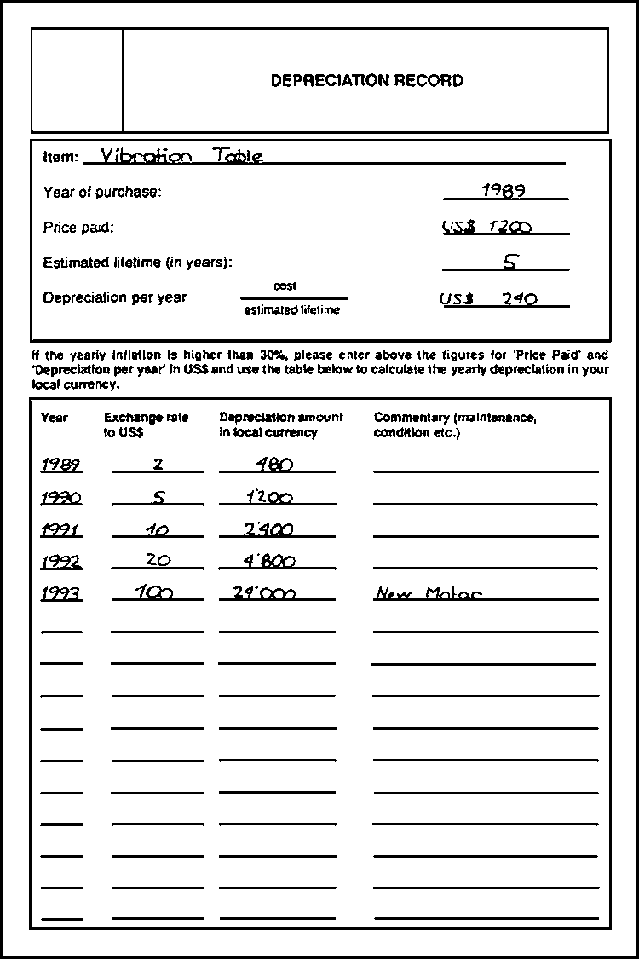
Figure
Summary Format
In the profit and loss statement (see module 5) the total amount
of depreciation is needed. To determine this figure you may need the format
“Depreciation
Summary”.
Credit Costs
Most businesses need credit from time to time. Money borrowed
from a bank or moneylender is not free. Interest charges and bank fees
normally must be paid when a business borrows
money.
Other Costs
There are many other types of costs such as
· Water and
energy, including electricity, firewood, and fuel costs,
· Transports, including shipping
costs,
· Maintenance, including
repairs to buildings and equipment,
·
Office expenses, including stationery, postage and telephone,
· Marketing, including advertising and selling
costs,
· Taxes and
fees,
· Education of your
workers.
Costing
Purpose
The purpose of costing is to find the best selling price for
your products. The costs of producing goods must be calculated before the
selling price can be determined.
You must know which costs change as the quantity of goods
produced changes and which costs remain the same even when the production volume
increases or decreases. Thus, there are two major categories of costs:
‘variable costs’ and ‘fixed
costs’.
Variable Costs
Variable costs are costs that are directly related to the
volume of production. If the volume changes, variable costs will change
proportionally. The following costs are variable costs:
· Raw
materials,
· Wages and social security
payments for production workers,
·
Energy,
· Water,
·
Transports.
Fixed Costs
Fixed costs are those costs that do not change - that is, they
remain fixed - even when the volume of production increases or decreases.
The following costs are fixed costs:
·
Consumables,
· Salaries and social security
payments for employees not directly involved in producing tiles,
· Depreciation,
·
Interest charges and bank fees,
· Repairs and
maintenance,
· Office and administrative
expenses,
· Marketing expenses,
· Taxes and fees,
·
Education.
Calculating the Production Costs
Format
The costs per piece are the total of all variable and fixed
costs divided by the number of pieces produced. The following is an example of a
cost calculation for FCR/MCR tiles:

Figure
Variable Costs
We need to know the costs per piece. Sometimes, it would
however be rather difficult to calculate these costs per piece. For that reason,
it may be advisable to base the calculation on a certain number of pieces.
|
Mr. Garcia finds it too difficult to calculate the grammes of
cement and minutes of work used to produce one tile. But he knows that with his
vibrating table he produces about 1’000 tiles per week. He also knows his
raw materials and labour costs for one week. Therefore he bases his variable
costs on the raw materials and labour needed to produce a lot of 1’000
tiles. |
Step 1
Determine the total costs of the raw materials needed to
produce a lot of goods. Please keep in mind: The same dimension of lot,
for example 1’000 tiles, must be used for all variable cost
calculations.
|
One bag of cement costs LU 380, and one m3 of sand
costs LU 300. To produce 1’000 tiles Mr. Garcia needs: |
|
· |
15 bags of cement |
LU |
5’700 |
|
· |
1 m3 of sand |
LU |
300 |
|
Total costs for raw materials |
LU |
6’000 |
Step 2
Determine the total labour costs needed to produce the
same lot of goods.
|
It takes one week to produce 1’000 tiles. In Mr.
Garcia’s workshop there are three workers and one foreman; each of them
work 50 hours per week. The workers are I paid LU 32 per hour; the foreman is
paid LU 44 per hour. |
|
· |
Wages, foreman (50 × 44) |
LU |
2’200 |
|
· |
Wages, workers (3 × 50 × 32) |
LU |
4’800 |
|
Total labour costs for one week |
LU |
7’000 |
Step 3
Add the raw materials costs and the labour costs together to get
the total variable costs of producing one lot of goods.
|
To produce 1’000 tiles Mr. Garcia needs: |
|
· |
Raw materials |
LU |
6’000 |
|
· |
Labour costs |
LU |
7’000 |
|
Total variable costs: |
LU |
13’000 |
Principally, the expenses for water, energy and transports would
make part of the variable costs. However, these costs are small and it would be
difficult to determine them even for a whole lot of goods.
For that reason in this example the costs for water, energy and
transports are considered to be fixed costs.
Step 4
Divide the total variable costs of producing a whole lot by the
number of pieces in a lot to get the total variable costs per piece.
|
The variable costs per tile are: LU 13’000 divided
by 1’000 = LU 13 |
Fixed Costs
Total fixed costs do not depend on the quantity of goods
produced. However, the fixed costs per piece do vary with the number of
pieces produced. If you only produce and sell one piece per year, all the fixed
costs have to be covered by this one piece and the fixed costs per piece would
be very high. However, if you produce a great many pieces per year the fixed
costs per piece are much smaller.
|
Let’s assume that the total fixed costs of Mr.
Garcia’s workshop are LU 300’000 per year.
· If he
produces 20’000 tiles per year, the fixed costs per tile would be
(300’000/20’000) = LU 15 and the total costs per tile would be (LU 13
+ LU 15) = LU 28.
· If he produces 60’000
tiles per year, the fixed costs per tile would be (300’000/60’000)
= LU 5 and the total costs per tile would be (LU 13 + LU 5) = LU
18.
In the second case, the total costs per tile are only 55% of the
total costs per tile of the first case. |
As this example clearly demonstrates, the selling price would
have to be much higher if production is low - because at low levels of
production the fixed costs per piece are high. This leads to the following
conclusion:
|
1. The fixed costs per piece decrease as production
increases, and increase as production decreases.
2. The calculation of fixed costs per piece must be based on
a certain number of pieces produced in a certain period (normally one year).
|
The fixed costs per piece are calculated as follows:
Step 5
The time period and the number of pieces produced
during the specified time period must be determined.
|
Mr. Garcia is preparing a costing. He thinks that he will self
about 50’000 tiles next year. He decides to base his costing on a period
of one year and a production volume of 50,000 tiles. |
Step 6
Determine the total fixed costs. A common method of
determining costs is to base them on the costs of previous years with some
increase added to account for inflation and changes in sales volume.
|
Last year Mr. Garcia sold 40’000 tiles and had total fixed
costs of LU 250’000. This year he plans to sell more tiles. He takes the
figures from last year’s profit and loss I statement and adjusts them for
Inflation and other anticipated increases. For example he knows that he has to
pay more taxes and he plans to make an advertising campaign. He estimates that
his fixed costs will increase to LU 300’000. To simplify the calculation,
the expenses for water, energy and transports are considered to be fixed costs.
|
Step 7
Divide the total fixed costs by the number of pieces to be
produced to get the fixed costs per piece.
|
Mr. Garcia makes the calculation: LU 300’000/50’000
= LU 6 |
Total Costs
The total costs per piece are the sum of the variable
costs per piece and the fixed costs per piece.
Step 8
Add together the fixed costs per piece and the variable costs
per piece.
|
In Mr. Garcia’s case the total costs per tile are: (13 + 6)
= LU 19 |
In Appendix A, you will find a calculation
exercise. You can use it for your
practice.
Pricing
Purpose
It is very important that the selling price of your goods is
correct. If the selling price is too high, nobody will buy your products,
because people will buy from cheaper competitors. If the price is too low, you
will make a loss, because you will not cover your production costs. The various
factors which influence the price must be taken into consideration and then a
price must be fixed which optimally fits the
situation.
Pricing Factors
The price of a product is mainly determined by its cost and by
the market
situation:
Costs
The costs of production are the best basis for
determining the selling price. The selling price should always be higher than
the costs; the difference between costs and selling price is known as
profit.
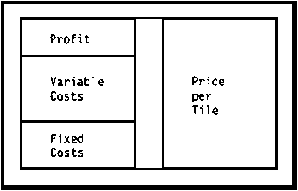
Figure
The higher the selling price, the higher the profit and the
greater your
gain.
Market
If, however, the selling price of your goods is too high, your
customers will buy from your competitors. Or they may use other products. They
will for example use rooting materials such as iron sheets or clay tiles.
|
In Mr. Garcia’s workshop the production costs of each tile
are LU 19. He hopes to make a profit of LU 3 per tile. Therefore he sets the
price per tile at LU 22 (LU 19 + LU 3 = LU 22). If the competitors sell their
tiles for more than LU 22, he is in a good position. If the competitors’
selling prices are in the range of LU 19 to LU 22 he can lower his price and
still make a profit. If, however, the competitors’ selling prices are below
LU 19 he will be unable to compete with them - and still make a profit. If he
sells his tiles for less than his production costs, he will make a loss. |
Price - Quantity
The demand for goods might vary strongly with the price. Because
of this, it is possible for a small price reduction to lead to a big increase in
sales. It is often better to sell many pieces at a low price rather than to sell
a few pieces at a high price. A cost calculation will quickly show which
alternative is best.
|
The variable costs per tile are considered to be LU 13 and the
total fixed costs are LU 300’000 per year. Now let’s analyse two
cases:
· Selling
30’000 tiles per year
· The
fixed costs per tile are 300’000/30’000 = LU 10
· Total costs per tile are 13 + 10 = LU 23
The
selling price should thus be at least LU
23.
· Selling
60’000 tiles per year
· The
fixed costs per tile are 300’000/60’000 = LU 5
· Total costs per tile are 13 + 5 = LU 18
The
selling price has to be at least LU 18.
If the market price is LU 21 per tile, Mr. Garcia would make a
loss if he produced only 30’000 tiles. However, if he produces and sells
60’000 tiles at LU 20 each, he will make a profit. But this is only
true, on condition that, he can sell all these 60’000 tiles. |
In the ‘Financial Analysis’ section you will learn how
to calculate the ‘breakeven point’. The ‘breakeven point’ is
the exact level of production, at a given price, where you make no profit and no
loss - that is the point at which the costs of production and the selling price
are
‘even’.
Reducing Costs
When production costs are higher than the selling price, you
have the following possibilities:
· Reduce
costs. Can you find a supplier of raw materials who will give you a better
price? Can you employ less workers or increase the productivity of your existing
workers?
· Make different or
additional products with a better cost - price relation. Can you for example
change your tiles so that they are a special colour, unique shape or a different
form? Do they have a better cost - price relation?
· Produce more. Can you
produce and sell more goods and benefit from the lower fixed costs per
piece?
Conclusion
Please never forget the following rule:
|
The selling price should be higher than the production costs,
but low enough so that the price is attractive to your customers and competitive
with other producers and other products. |

Figure
Appendix A: Exercise in Costing
1. Depreciation Calculation
In January 1988, Mr. Garcia bought a new vibration table for LU
3’000. The lifetime of the table is estimated to be 5 years. The inflation
is about 50% per year. For that reason, Mr. Garcia decides to calculate the
depreciation in US$. The exchange rates to the US$ were the following:
|
· |
1 Jan 88: |
2.00 |
|
· |
31 Dec 88: |
3.00 |
|
· |
31 Dec 89: |
4.50 |
|
· |
31 Dec 90: |
7.00 |
|
· |
31 Dec 91: |
10.50 |
|
· |
31 Dec 92: |
16.00 |
Please determine the depreciation amount in local currency for
the 31st of December of the years 1988, 1989, 1990, 1991 and 1992. On
the next page, you find the answer.
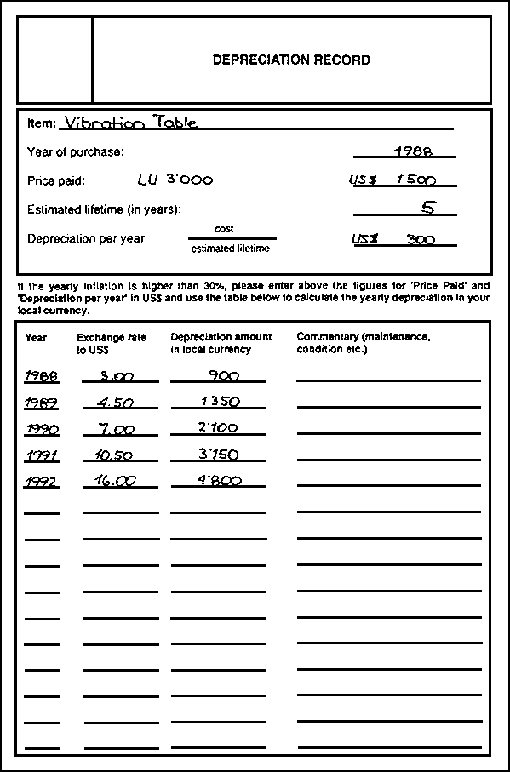
Figure
2. Costs Calculation
Calculate the production costs per tile, based on the
following figures:
· All costs are
given in LU (Local Units of currency). Variable costs calculations are based on
the costs of producing 1’000 tiles. All figures are based on the period
from the 1st of January to the 31st of December 1992.
· 20 bags of cement and 1
m3 of sand are needed to produce 1’000 tiles. One bag of cement
costs LU 300. One m3 of sand costs LU 280.
· There are three workers and
one foreman. They produce 1000 tiles in one week (40 working hours). The workers
are paid LU 30 per hour. The foreman is paid LU 40. Social security costs, paid
by the business, are an additional 10% of the wages.
· All fixed costs are based on
estimates for one year. Mr. Garcia expects to produce 50’000 tiles per
year.
· Mr. Garcia estimates that
his yearly fixed costs will be:
· Water
and energy: LU 1’000,
· Transports: LU 2’000,
· Mr. Garcia will pay himself a
monthly salary of LU 5’000. In addition there will be social security costs
of 10% of his salary,
· Mr. Garcia’s records give
the following information needed to calculate
depreciation:
- The buildings cost LU
150’000. They will last for ten years,
- Equipment costs LU
300’000. It will last for five
years,
· Mr.
Garcia has a bank loan of LU 100’000. The yearly interest rate is 18%,
· Maintenance: LU 20’000,
· Office expenses: LU
2’000,
· Marketing: LU 40’000,
· Fees: LU 16’000,
· Other fixed costs: LU
10’000.
The following page has a few hints to help you
find the answer.
Hints
· Wages, salary and social
security expenses
The social security expenses should be added to the hourly wage
of the workers and the foreman.
|
10% of LU 30 = LU 3. Therefore, the total wage per hour is LU 30
+ LU 3 = LU 33. Mr. Garcia bases his calculation of variable costs per tile on
the costs of producing 1’000 tiles. It takes three workers one week or 3
× 40 = 120 hours to produce 1’000 tiles. Therefore, the weekly amount
of wages is:
3 (number of workers) × 40 (hours per week) × LU 33
(wage per hour) × = LU 3’960 |
The social security expenses should be added to the monthly
salary of Mr. Garcia.
|
10% of LU 5’000 = LU 500. Therefore, the total salary per
month is:
(LU 5’000 + LU 500) = LU 5’500 |
A monthly salary must be multiplied by 12 to get the yearly
salary (because there are 12 months in a year).
· Depreciation
To determine the yearly depreciation, divide the costs of each
investment by its lifetime.
|
The investment costs of Mr. Garcia’s building was LU
150’000. The building will last ten years. Therefore, the depreciation per
year is the investment costs divided by the life of the investment:
LU 150’000 (investment)/10 (lifetime in years) = LU
15’000 (depreciation per year) |
To determine the total yearly depreciation for all
investment items add together the yearly depreciation for each investment item.
· Financial Costs
The financial costs are the yearly loan interest.
|
In Mr. Garcia’s case the yearly interest is determined by
multiplying the amount of the loan by interest rate:
LU 100’000 (loan) × 0.18 (interest rate/100) =
LU 18’000 (yearly interest) |

Figure
| | | Business Administration - Basic Skills Guide (SKAT, 1994, 162 p.) | | | Module 5: Profit and Loss Statement | | | Profit and Loss Statement | | | Goal | | | Purpose | | | Concept | | | (introduction...) | | | Goods Sold | | | Expenses | | | Basic Formula | | | An Example of a Profit and Loss Statement | | | Introduction | | | Value of Stock | | | Depreciation | | | Cash book | | | Calculation | | | Appendix A: Exercise in Profit and Loss Statement | | | (introduction...) | | | 1. Value of Stock | | | 2. Depreciation of Equipment and Workshop | | | 3. Cash Transactions | | | 4. Profit and Loss Statement | | | 5. Answers to the Exercises | | | a. Stock Record | | | b. Depreciation | | | c. Cash Book | | | d. Profit and Loss Statement | | | Appendix B: The Difference between Cash and Profit | | | 1. The Question | | | 2. Where the Difference Comes From | | | 3. Example |
|
Business Administration - Basic Skills Guide (SKAT, 1994, 162 p.)
Module 5: Profit and Loss Statement
Profit and Loss Statement
Goal
This module explains, what a profit and loss statement is used
for and how it is
made.
Purpose
As long as there is some cash, a business will live. But after a
certain time of loss, the business will cease to exist, because all the money
will be used up. Please keep in mind:
|
1. Cash and profit are not the same thing.
2. There
is no direct relationship between cash and profit. |
Therefore, it is not enough to control the cash of your
business, you need to know, whether your business is making a profit or not.
The cash book tells you, how much cash you have in your
cash box. The profit and loss statement is used to determine how much
profit (or loss) your business has made. If you have a cash book and a profit
and loss statement you can clearly see how much of your cash really is profit
(see Appendix B for further
information).
Concept
The following formula shows the basic structure and components
of the profit and loss statement:
|
Sales |
|
- Costs of Goods Sold |
|
= Gross Profit (or Loss) |
|
- Expenses |
|
= Net Profit (or Loss) |
|
- Withdrawals |
|
= Retained Profit (or Loss) |
There are three different types of profit: gross profit, net
profit, and retained profit. For the business person net profit is
important because it shows how much can be withdrawn from the business. For
the business the retained profit is important because it shows how much
of the profit is available to expand the business after the owner or
partners have withdrawn their
share.
Goods Sold
The costs of goods sold means the total cost of all
materials which make part of the products sold during a given period. Therefore
costs of goods sold might be costs of all raw materials.
If you only do one profit and loss statement per year and do not
need exact figures, this definition will do. Normally, however, the profit and
loss statement is done every one to three months. Within this period the amount
of raw materials bought does not correspond exactly to the amount of raw
materials used. For example, the cement bought in one month may be sufficient
for the following three months. The costs of goods sold would be high in one
month and low in the next months, even though the same amount of raw materials
was used every month. This effect distorts the result of the profit and loss
statement. For that reason, changes in stock should be taken into account:
If the stocks of raw materials are reduced in one
period, this is considered to be costs.
The following formula shows how to calculate a more
accurate costs of goods sold:
|
Raw Materials at the Beginning |
|
+ Raw Materials Purchased During the Period |
|
= Raw Materials Available for Production |
|
- Raw Materials Remaining at the End of the Period |
|
= Costs of Goods Sold |
Expenses
All the other costs of production are called expenses.
They include:
· Wages and
salaries,
· Social security
expenses,
· Water and energy,
· Transports,
·
Marketing,
· Maintenance,
· Rent,
·
Depreciation,
· Taxes and fees,
· Interest on loans.
|
Attention
The following two points are very important and must not be
forgotten:
· Money spent on
investments is not an expense, but depreciation
is.
· Loan repayments
are not expenses, but loan interest is.
Investments and loan repayments are normally irregular and
large. They would distort the result of the profit and loss statement. For that
reason, depreciation and loan interest are used in the profit and loss
statement. |
Basic Formula
The basic formula needed to calculate profit and loss is:
|
+ Total sales |
|
+ Final value of stock |
|
- Initial value of stock |
|
- Purchase of raw materials |
|
= Gross profit |
|
- Working costs (wages, salaries and social expenses) |
|
- Production inputs (water, energy, consumables) |
|
- Overheads (transports, office, marketing, maintenance, taxes
and fees, interests) |
|
- Depreciation (buildings and equipment) |
|
= Net profit (or loss) |
|
|
- Withdrawals |
|
= Retained profit (or loss) |
An Example of a Profit and Loss Statement
Introduction
A profit and loss statement should be prepared monthly,
quarterly or annually. The information shown in the profit and loss statement is
obtained from three sources:
· The Stock
Record format gives the data for initial and final value of stock.
· The depreciation figures are found in the
Depreciation Summary.
· All the other
figures are found in the Cash Book.
These three sources are illustrated
below.
Value of Stock
The value of stock is taken from the stock record.
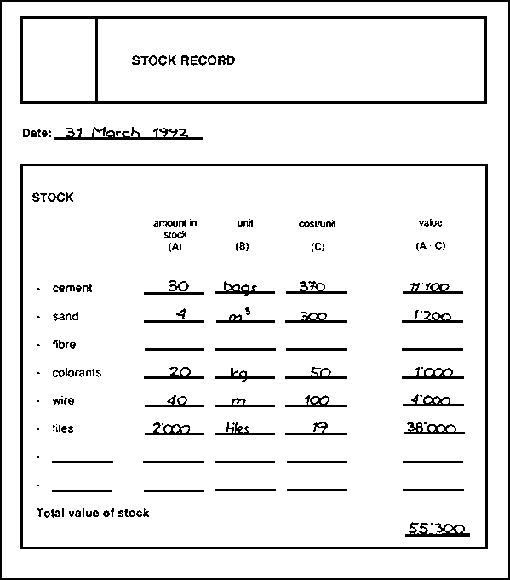
Figure
The following points are important:
· The value of stock
has to be determined at the beginning and at the end of each accounting
period. Normally, the beginning of one period is the same as the end of the
previous period.
|
In Mr. Garcia’s Stock record from the 31st of
March shown above, the “total value of stock” is the final value of
stock on 31.3.92 (at the end of the First Quarter of 1992). Therefore, the
same amount will be the initial value of stock on 1.4.92 (at the
start of the Second Quarter of 1992). |
· Make sure that the
value is based on the actual costs for raw materials as well as for final
products. To determine the “costs/unit” of the raw materials, consult
the invoices of the most recent deliveries. The costs per piece of final product
has to be calculated as shown in Module 4, “Costing and
Pricing”.
Depreciation
The method for calculating the depreciation of buildings and
equipment is described in the Module 4, “Costing and Pricing”. The
amount shown in the profit and loss statement is based on the total in the
“Depreciation Summary”:
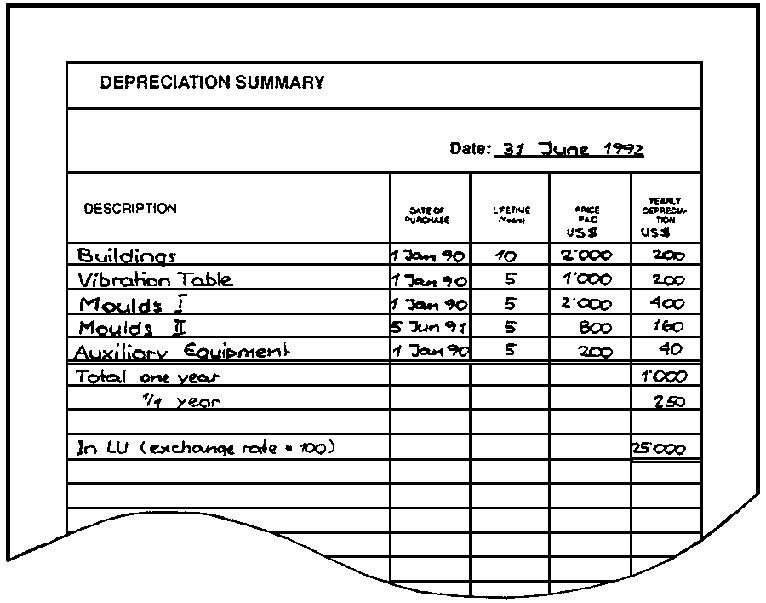
Figure
|
Attention
The Depreciation Summary shows the depreciation as calculated
per year. Remember, all calculations must be for the same period. If the
profit and loss statement is made for three months, the amount of depreciation
is only one forth of the total amount of the yearly depreciation shown in
the Depreciation Summary. |
Cash book
The cash book is already known from Module 3, “Cash
Management”:
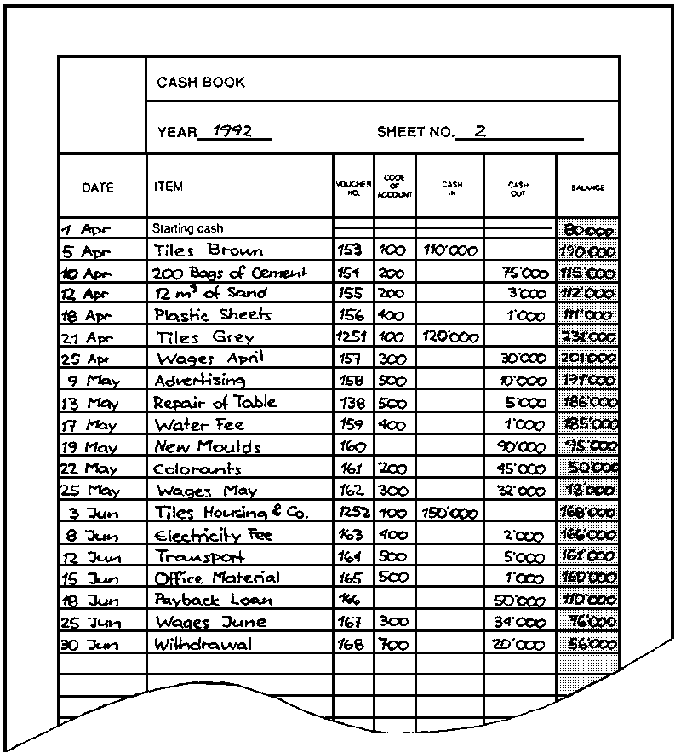
Figure
Calculation
The profit and loss statement is now made as follows (for an
example see next page):
Step 1
Decide on the time period, for which you need to make the
profit and loss statement. If there is no inflation and your business is doing
well, once per year is enough. If you have a lot of changes in quantities, costs
and prices or if you frequently have a lack of cash, then the profit and loss
statement should be prepared monthly or quarterly.
|
Mr. Garcia decides to prepare a profit and loss statement
quarterly. |
Step 2
Determine the value of stock at the beginning and at the
end of the period. Fill in the figures in the profit and loss statement.
|
Above, you can see the format, Mr. Garcia filled in on the
31st of March. The stock has a value of LU 55’300. On the
30th of June, Mr. Garcia determines once more the value of his stock
and finds out that it is LU 71’900. |
Step 3
The “Depreciation Summary” may help to determine
the depreciation. Determine the depreciation for the time period and, if
necessary, calculate it in LU. Then fill the figure in the profit and loss
statement.
|
Mr. Garcia has to depreciate $ 1’000 per year. Per quarter
of a year, he has to depreciate one forth, that is $ 250. By the end of June
1992, the exchange rate is 100. That means, for one dollar, LU 100 has to be
paid. Therefore, the $ 250 are the same as LU 25’000. |
Step 4
Now take the cash book. Within the calculation period of
the statement, all cash transactions with a certain code are added up and the
result is entered into the corresponding field of the statement. This is done
with all the codes of the statement.
|
Mr. Garcia takes the cash book and starts with the first code
100 for sales. He finds three entries corresponding to that code:
Tiles for Mr. Brown at the 5th of April, Tiles for Mr. Grey on the
21th of April and tiles for Housing and Co. on the 3rd Of
June. The total amount of sold tiles is 110’000 + 120’000 +
150’000 = LU 380’000. He enters the figure into the profit and
loss statement. Then he takes the next code, 200, raw materials, and
again finds three entries in the cash book. He adds up the entries and enters
the total (LU 123’000) into the profit and loss statement. He does so with
all other codes. Only two entries of the cash book are not taken into account:
The investments (new moulds on the 19th of May) and the pay back of
loans (on the 18th of June). The net profit is LU
127’600. Mr. Garcia decides to withdraw LU 20’000. The retained
profit therefore is LU 107’600. |
The corresponding profit and loss statement looks now as
follows:

Figure
|
Attention
Not all of the figures from the cash book are used for the
profit and loss statement. The following cash transactions are not
used to calculate profit and loss:
· Investments (for
example, “New Moulds”.),
· Loan Repayments. |
How to analyse the result of the profit and loss statement is
explained in the next module (module 6: “Financial Analysis”).
Appendix A is an exercise for your
practice.
Appendix A: Exercise in Profit and Loss Statement
Mr. Garcia decides on preparing a profit and loss statement for
the first quarter of 1992. For that reason he is looking for the figures needed
to do
so:
1. Value of Stock
On the 1st of January Mr. Garcia counts his stocks.
He has the following raw materials:
· 20 bags of
cement,
· 10 m3 of sand,
· 50 kg of colorants,
· 20 m of wire,
·
1’000 tiles.
Next, Mr. Garcia checks his records to find out how much he paid
for each item:
· He paid LU
80’000 for 200 bags of cement,
· He paid
LU 6’000 for 12 m3 of sand,
·
Each kg of colorant costs LU 100,
· 100 m of
wire cost LU 5’000.
Using this information Mr. Garcia determines that it cost LU
18’000 to produce 1’000 tiles.
What is the value of Mr. Garcia’s stock on the 1st of
January? To find the answer to this question, make a copy of the Stock Record
Format, and use the figures given above. Below, you will find the answer.
Now, make a copy of the Profit and Loss Statement Format and
enter the figure in the field “Initial Value of Stock”.
Mr. Garcia also determines the stock on the 31st of
March and finds that it is LU 20’000. Please enter this figure in the field
“Final Value of Stock” in the profit and loss
statement.
2. Depreciation of Equipment and Workshop
|
Description |
Value ($) |
Yearly Depreciation ($) |
|
Site/Buildings |
3’000 |
200 |
|
Equipment |
1’000 |
400 |
What is the yearly and quarterly depreciation, when the exchange
rate is 100? Please enter the figure for the quarterly depreciation into
the profit and loss statement in the field
“Depreciation”.
3. Cash Transactions
Please prepare a cash book for Garcia’s Tile Factory. Enter
the following cash transactions in the cash book and determine the
transaction codes used for the profit and loss statement.
Remember: Investments and repay of loans are
not expenses and, therefore, do not make part of the
profit and loss statement.
· On the 1st of
January there are LU 60’000 in the cash box.
· On the 5th of
January Mr. Garcia buys plastic sheets for LU 5’000. The voucher number is
101.
· On the 10th of
January Mr. Brown pays last year’s invoice. The amount is LU 100’000
and the invoice number is 356.
· On the 15th of
January 200 bags of cement are delivered. Mr. Garcia pays LU 75’000. The
invoice number is 102.
· On the 25th of
January Mr. Garcia pays his workers: LU 30’000. The voucher number is 103.
· On the 3rd of
February, Mr. Garcia buys office material for LU 2’000. The voucher number
is 104.
· On the 7th of
February, Mr. Garcia starts an advertising action in the newspaper “Daily
Mail” and pays LU 18’000. The invoice number is 105.
· On the 12th of
February, Mr. de Rivero fetches his tiles and pays LU 150’000. The invoice
number is 106.
· On the 18th of
February, Mr. Garcia pays LU 5’000 for transport. The invoice number is
107.
· On the 21st of
February, new moulds are delivered. Mr. Garcia pays LU 70’000. The invoice
number is 108.
· On the 25th of
February, Mr. Garcia pays his workers: LU 30’000. The voucher number is
109.
· On the 28th of
February, Mr. Domingues pays LU 100’000 for tiles he received. The invoice
number is 110.
· On the 8th of
March, 20m3 of sand are delivered. They cost LU 5’000. The
invoice number is 111.
· On the 11th of
March, Mr. Garcia pays for the repair of his vibrating table LU 10’000. The
invoice number is 112.
· On the 17th of
March, Mr. Garcia has to pay the water fee of LU 10’000. The invoice number
is 113.
· On the 25th of
March, Mr. Garcia pays his workers: LU 30’000. The voucher number is 114.
· On the 30th of
March, the interest for the first quarter has to be paid: LU 15’000. The
invoice number is 115.
· On the 31st of
March, Mr. Garcia decides to draw LU 20’000. The voucher number is
116.
4. Profit and Loss Statement
Please prepare now the profit and loss statement for
Garcia’s Tile Factory for the period from the 1st January to the 31st of
March.
All the information you need to prepare the profit and loss
statement is given
above.
5. Answers to the Exercises
a. Stock Record
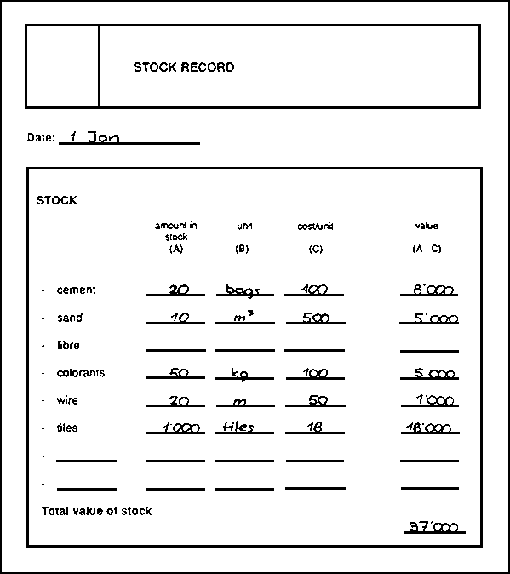
Figure
b. Depreciation
The total yearly depreciation is $ 600. The quarterly
depreciation is one forth of that:

With an exchange rate of 100, the quarterly depreciation is 150
× 100 = LU 15’000. This figure is entered into the
profit and loss
statement.
c. Cash Book

Figure
d. Profit and Loss Statement
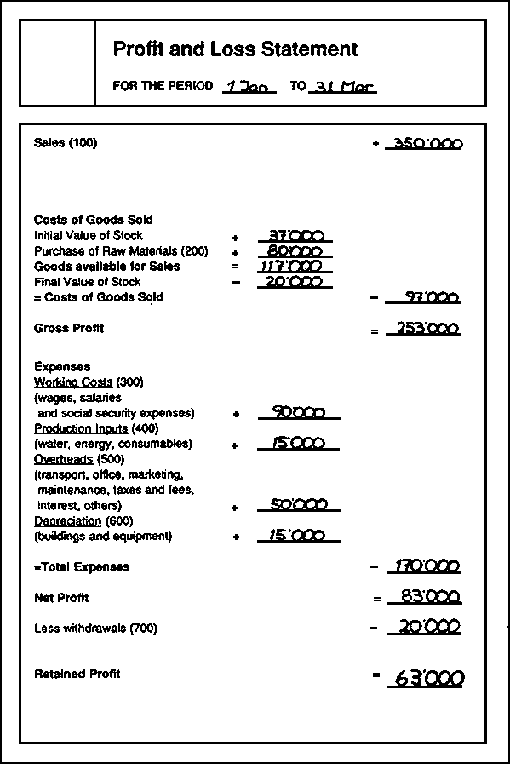
Figure
Appendix B: The Difference between Cash and Profit
1. The Question
In appendix A you find an exercise, where you make a profit and
loss statement from a stock record, the depreciation summary and the cash book.
There you find the following figures:
· The Retained
Profit from the 1st January to 31st March is LU 63’000
· The Cash on Hand in the Cash Box on 31st March
is LU 85’000
Question: Where does this difference come
from?
2. Where the Difference Comes From
The difference between cash and profit can be explained by the
following:
· Investments
(“new moulds”) reduce the cash, but they are not expenses. Investments
are irregular and large cash transactions. If they were included in the
expenses, the result of the profit and loss statement would be distorted.
· Depreciation is an
expense but it does not reduce cash.
· Loan Repayments reduce
cash, but they are not expenses. Loan repayments are irregular and large cash
transactions. If they were included in the expenses, the result of the profit
and loss statement would be distorted. However, the costs of loans are
taken into consideration. The loan interest is an expense (and also
reduces cash).
· Changes in the value of
stock change the profit but do not change
cash.
3. Example
In the case of Garcia’s tile factory, the difference
between cash and profit can be explained by the following calculations:
|
Final Cash |
+ 85’000 |
|
Less: Initial cash (On the 1st of January) |
- 60’000 |
|
|
= Cash difference between 1.1. and 31.3. |
+ 25’000 |
|
Plus: Investments (reduced cash, but not profit) |
+ 70’000 |
|
|
Less: Depreciation (reduced profit, but not cash) |
- 15’000 |
|
|
Less: Stock Changes (reduced profit, but not cash) |
- 17’000 |
|
|
= Retained Profit |
63’000 |
| | | Business Administration - Basic Skills Guide (SKAT, 1994, 162 p.) | | | Module 6: Financial Analysis | | | Introduction | | | Goal | | | Purpose | | | Profit and Loss Statement | | | Purpose | | | Why Profit? | | | What is profit? | | | Analysis | | | Improve Profit | | | Break-Even Point | | | Purpose | | | Definition | | | Calculation | | | Capacity | | | Price | | | Extra Costs | | | Example Format | | | Exercise |
|
Business Administration - Basic Skills Guide (SKAT, 1994, 162 p.)
Module 6: Financial Analysis
Introduction
Goal
This module explains, how to analyse and interpret the figures
from the profit and loss statement and how to determine and analyse the
breakeven
point.
Purpose
Good decisions are necessary to manage a business successfully.
Good decisions are based on the analysis of information about the business
itself, the local and national economy, and the market potential for your
products. Your books and records provide part of the information about the state
of the business, namely, basic financial information. This section tells you how
to analyse and interpret financial information about your
business.
Profit and Loss Statement
Purpose
Module 5, “Profit and Loss Statement”, explained how
to calculate profit. But why should you make a profit? And what information can
you draw from a profit and loss statement?
After you have analysed the profit and loss statement, you
should be able to identify and understand your financial
problems.
Why Profit?
Even if a business makes a loss every year, it may still live as
long as there is cash. But only for a certain time, because all money initially
invested for workshop and equipment will be used up and there will be no money
left to replace old equipment or to expand the workshop. After a certain time of
loss, the business will even cease to exist, namely then, when all the money is
used up. But there are also other reasons for making a profit.
· Loan
repayments,
· Unexpected costs and
emergencies,
· Cash reserve for when business
is slack,
· Business expansion,
· Income for you and your family.
|
Profit is necessary for the survival of the business
|
What is profit?
Generally speaking, profit is the difference between income (=
gross profit) and costs (= expenses).

Figure
The higher the income is, compared to the costs, the higher the
profit. Normally, income and costs are not stable, they change all the time. If,
for example, the income increases and the costs stay stable, the profit will
increase. If, on the other hand, the income stays stable and the costs increase,
the profit becomes smaller or even turns to a loss.
|
Costs should be kept as low as possible. It is important to
analyse costs whenever they increase. Income should be as high as possible.
Decreasing income should be analysed carefully. |
Analysis
The Analysis is made in three steps:
Step 1
What trend has profit/loss?
Make an actual profit and loss statement. Is there a profit or a
loss? Is it higher or lower compared to earlier profits/losses? Is there a trend
over the last periods? If there is an increasing loss, you are in a very bad
situation. If there is a loss, but losses becoming smaller every period, you
still are in a bad, but improving situation. If there is a profit, but profits
are becoming smaller every period, you should carefully analyse your situation.
Only if there is an increasing or at least stable profit, you are in a good
position.

Figure
|
In the last quarter Mr. Garcia made a profit of LU 63’000.
He is satisfied with this profit. But he recognizes with sorrow that the profit
is becoming smaller from period to period. |
Step 2
What trend has sales income?
Use the last three to five profit and loss statements and
compare the figures for sales income. What general trends do you see? Are sales
increasing or decreasing? What types of good had increasing or decreasing sales?
Did customer preferences change? Were your prices too high? Was a certain type
of good of poor quality?

Figure
|
Income from tile sales was as follows: The turnover of gray
tiles steadily decreased because in Mr. Garcia’s town they are too
expensive for low cost housing. The turnover of red and traditional tiles,
however, was increasing as a result of NGOs and wealthier people buying these
types of tiles. Mr. Garcia could sell much more red tiles if he could produce
enough of them. But in the past, he could never produce enough tiles, because
his untrained workers had a low productivity and wasted raw material. |
Step 3
What trends have costs?
Use the last three to five profit and loss statements and
compare the figures for costs. What general trends do you see? Are costs
increasing or decreasing? Which prices and costs are increasing faster than
others? Was there a loss or waste of raw materials? Did you need more raw
material because of poor quality?

Figure
|
The raw material prices increased. This can be explained by
increases in the price of cement. An analysis of cement prices from several
suppliers shows that although the cement price rose generally, Mr. Garcia’s
supplier’s price was always 15% higher than that of other suppliers. |
Improve Profit
If there is a loss or a decreasing profit, the question arises,
how the profit could be improved.
Step 4
How do you improve the situation?
There are four basic ways to improve the situation:
1. Decrease costs
Costs should be as low as possible. You should use every chance
to cut your costs. In Module 4, “Costing and Pricing”, you may find
some ideas, how to do so.
2. Increase sales
When you increase your sales through a marketing effort, you
must also increase your production. With higher production levels, fixed costs
such as administration, management, marketing, depreciation and interest
normally remain stable, resulting in a decrease in the fixed costs per
piece and an increase in the profit per piece (see Module 4,
“Costing and Pricing”).
3. Increase the price
If you increase your prices while your costs remain stable, your
profits will increase. However, before increasing your prices, you must make
sure that your prices remain competitive in the market and that you are still
able to sell all the tiles you produce.
4. Change the product
Another product or changes in the actual product, such as new
colours, unique shapes and original designs may make the product more attractive
to customers and they may be willing to pay more for it. Moreover, there may be
less competition for other or changed products. You may sell more products at a
higher price.
It depends on the situation which strategy is the best. In some
cases, even a combination of two or more strategies may be required.
|
Mr. Garcia thinks about his possibilities to improve the
situation.
· Mr. Garcia decides
to stop the production of gray tiles for a moment and to increase the production
of red tiles.
· Mr. Garcia decides to send his
workers into a training course for tile producers in order to improve their
productivity. He also decides to change his foreman and to hire one experienced
in producing tiles.
· Mr.
Garcia decides to look for a cheaper supplier for cement to decrease his raw
material costs. |
Break-Even Point
Purpose
The profit not only depends on the price but also on the
quantity of goods sold. If you are able to produce and sell much more goods than
before, the profit may be higher even if you sell your goods at a much lower
price. But what quantity of goods do you have to produce and to sell at a given
price to be profitable? How is the relation between quantity, price and
profit?
Definition
The key to understand the relation between quantity, price and
profit are the fixed costs. They stay stable when you produce more goods, but
the fixed costs per good will decrease.
|
Suppose your fixed costs (consumables, administration,
maintenance, depreciation, interest, etc.) per year are LU 10’000 and the
variable costs (workers, raw material) are LU 1 per tile. When you produce
1’000 tiles per year, each tile has to cover LU 10 of the fixed costs (LU
10 × 1’000 tiles = LU 10’000). Thus, the production of each tile
costs you LU 11 (fixed costs per tile + variable costs per tile). Now suppose,
your customers are prepared to pay LU 2 per tile. HOW many tiles do you have to
produce and sell each year, at a selling price of LU 2, just to cover all your
costs? The variable costs per tile still are LU 1. So another LU 1 is left to
pay for the fixed costs. Therefore, you have to sell 10’000 tiles to cover
the LU 10’000 fixed costs. When you sell 10’000 tiles, your costs and
your Income will be LU 20’000. |
At the break-even-point, the total income is the same as your
total costs - you make neither a loss nor a profit. In other words, you
‘breakeven’.
|
The break-even-point is the level of sales at a given price
where you make neither a profit nor a loss |
If you sell more goods, you will make a profit. If you sell less
goods, you will make a loss. Before you decide how many goods to produce it is
always good to know the breakeven point at the current market
price.
Calculation
The breakeven point is calculated as follows:
Step 1
Determine the variable costs per piece. The total
variable costs for a specific period is divided by the amount of pieces sold in
that period.
|
In the period from the 1st of January to the
31st of December, Mr. Garcia has variable costs of LU 550’000
(B) and sells 50’000 tiles (C). The variable costs per piece is: |
Step 2
Determine that part of the selling price which can be used to
cover the fixed costs. This is the difference between the selling price (D)
and variable costs per piece (B/C).
|
The selling price per tile is LU 18. The variable costs per tile
are LU 11. The difference between selling price and variable costs is: |
Step 3
Determine the number of pieces which have to be sold to
reach the breakeven point. This is the total amount of fixed costs (A) divided
through the part of the selling price which can be used to cover the fixed costs
(D - (B/C)).
|
The total fixed costs In this period are LU 280’000. The
part of the selling price which can be used to cover the fixed costs is LU 7.
Thus the breakeven point is: |
Capacity
It is important to know if it is possible to produce the amount
of goods needed to reach the breakeven point. For this reason, the capacity
utilization at breakeven point should be calculated. If the resulting
utilization is about 90% or higher, then the capacity of the workshop is not
enough. In such a case either the capacity would have to be increased -
perhaps with additional equipment - or the breakeven point can be reduced by
lowering costs or increasing the selling price. Keep in mind that
all tiles produced have to be sold, and that the selling price cannot be higher
than your customers are willing to pay. Capacity utilization at the breakeven
point is the relationship between the capacity used at breakeven point and total
productive capacity of the business.
|
The maximal capacity of Mr. Garcia’s workshop is
60’000 tiles per year. At the break-even-point of 40’000 tiles per
year, only (40’000 * 100/60’000) = 67% of the maximal capacity
is used.
Conclusion: The capacity of Mr. Garcia’s workshop is
high enough to be profitable. |
Price
Sometimes it is important to know the lowest price at which a
certain number of goods can be sold without making a loss. This is the
break-even price. If you sell the goods at a higher price than the
break-even price you will make a profit. If you sell them at a lower price, you
will make a loss. Remember, the break-even price increases if the number of
goods produced and sold decreases. To calculate the breakeven price divide the
total costs (fixed + variable costs) by the number of goods sold. The result
will be the breakeven price.
|
In Mr. Garcia’s workshop, the total (fixed + variable)
costs of the 50’000 tiles produced and sold per year are LU 830’000.
Thus, every tile has to be sold at least for (830’000/50’000) = LU
16.60 to cover total costs.
Conclusion: As long as costs and quantity are unchanged,
every price above LU 16.60 will lead to a profit. |
Extra Costs
Sometimes it is necessary to take extra costs into account, for
example, the repayment of loans. In such a case, you would have to sell
additional goods to make a profit. To calculate the breakeven point including
loan repayment, calculate the fixed costs plus the repayment amount, then
divide this amount by the part of the selling price, you can use to cover the
fixed costs. The result of this calculation will be the number of goods you must
produce and sell to reach break-even point including loan repayment.
|
Mr. Garcia would like to pay back his loan of LU 70’000 The
part of the price, which can be used to cover the fixed costs still is LU 7 (see
above). To calculate the new breakeven-point, the amount of loan repay (LU
70’000) has to be added to the fixed costs: (280’000 + 70’000)/7
= 50’000 tiles
Conclusion: The new break-even-point is within the
maximal capacity of the workshop. |
Example Format
On the following page, you see an example how the calculation of
break-even-point, capacity utilization, break-even-price and breakeven-point
with loan repayment could look like. The figures needed for the
calculations are taken from a profit and loss statement, the manufacturer’s
equipment specifications, or are estimated based on actual experiences.
|
Attention
Please make sure that all amounts used in calculations are from
the same period (i.e., year, month, half-year). The calculations will not be
accurate if the figures used are from different periods of time. |
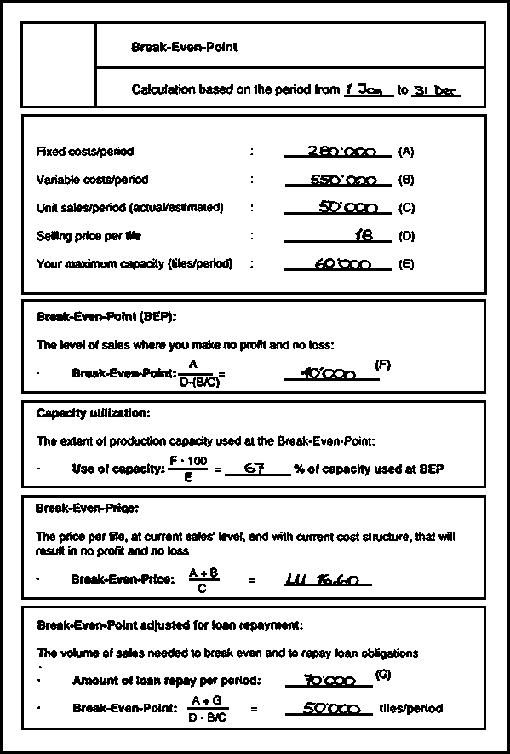
Example format to calculate the
break-even-point
Exercise
Determine the figures for your own business and then calculate
the breakeven point, the capacity utilization, the breakeven price and the
breakeven point adjusted for loan
repayment.
| | | Business Administration - Basic Skills Guide (SKAT, 1994, 162 p.) | | | Module 7: Marketing | | | Introduction | | | Goal | | | Purpose | | | The Product | | | Definition | | | Features | | | Quality | | | Price/Quantity | | | Marketing Tools | | | Purpose | | | Distribution | | | Promotion | | | Selling | | | (introduction...) | | | Main Points | | | Impression |
|
Business Administration - Basic Skills Guide (SKAT, 1994, 162 p.)
Module 7: Marketing
Introduction
Goal
This module explains basically, what marketing is and gives some
ideas how marketing can be
done.
Purpose
The purpose of marketing is to find out who your customers are,
what their needs are and how these needs can be fulfilled. Marketing is
responsible for the design and distribution of products. Selling is necessary
for a successful business and marketing is necessary to sell goods. Marketing is
an essential part of running a business and should not be neglected.
The purpose of this module is to give you a little basic
knowledge about marketing and show how this knowledge can be used to improve
your business. The most important aspects of the product are described and the
marketing tools “distribution”, “promotion” and
“selling” are presented.
For more detailed information please consult the “Marketing
and Selling
Guide”.
The Product
Definition
Marketing is concerned with finding out what customers need. It
is also responsible for the design of products. Tiles, for example, vary with
regard to shape, size, colour, quality and
price.
Features
You need to find out what your customers need,
when they need it, and where they want it. There are many ways to
find out what customers want. Below some possibilities are given how to do this:
· Ask existing and
potential customers what they need. When you visit a customer, listen to him and
try to find out what he really needs. You may have to offer new products
to meet the needs of your customers.
· Analyse your sales: How many
goods of each type were sold? Are there trends?
· Find out current trends in the
market. Are there new products? What advantages and disadvantages do they have
compared to your products?
· What are your competitors
doing? Are they having more success? If so, what are the reasons for this?
· Analyse your own and your
competitors’ products. What are the strong points and what are the weak
points of your products compared to those of your competitors? Could you improve
your position? And if so, how?
|
A few architects asked Mr. Garcia if he could offer green
pantiles. Others would prefer to buy whole roofs instead of loose tiles. Mr.
Garcia decides to produce a few green pantiles and try to sell them for a good
price. Moreover, he will took for a carpenter. Together they could offer whole
roofs. |
Quality
Most customers do not like products with poor quality. They will
hardly buy the same product again, even if the quality has improved. High
quality is one of your best marketing tools. Therefore, only offer products with
a high quality.
Test every product before selling it, to see whether it meets
your high quality standard.
|
A roof is expensive and should be of good quality. If potential
customers see roofs which are not constructed well or have broken tiles, they
wilt not trust the quality of FCR/MCR tiles and prefer to use other roofing
materials. |
Price/Quantity
As you have seen in module 4 “Costing and Pricing” and
in module 6 “Financial Analysis”, price and quantiy are
interdependent. If the demand for a certain product is high enough, it may be
interesting to produce and sell more pieces at a lower price. However, the
selling-price should always be higher than the production costs of that product.
|
Mr. Garcia finds out that with his production of 20’000
gray tiles per year, the costs per tile are LU 19 and the market price is LU 18.
However, if he produces 50’000 gray tiles per year, the costs per tile will
be LU 14. As long as he can sell all the gray tiles he produces, he should
produce more tiles and sells them at a lower price. |
Marketing Tools
Purpose
Even if your products meet customer needs, you cannot be sure
that your customers will buy them. You have to inform potential customers about
your products and their advantages. For this reason you have to think about
distribution channels as well as promotion and
selling.
Distribution
When starting your business, it may be quite difficult to inform
people about your products and to sell enough goods to make a profit. It may be
a good idea to sell to retailers who then sell at speciality shops (for example
building materials shops). The price a retailer pays will be lower than the one
a customer will pay. Your marketing costs, however, are lower and the greater
turnover will help to cover fixed costs. In addition, because retailers normally
pay cash on delivery, you will have less
debtors.
Promotion
Even if you offer an attractive product at an attractive price,
people will not buy your products if they do not know about them. For this
reason, you should promote your products and other services. When
planning a promotion campaign, the following points should be considered:
· You need to have a
clear idea who should know about your product. Who decides whether your
tiles will be bought and used?
· Next, you should find a way to
make people aware of your product. How can potential customers learn
about the advantages of your products?
· You have to think about the
message: what would you like to tell people?
|
Mr. Garcia knows that architects normally decide what roofing
material is used. Therefore, his promotion campaign will be designed to reach
architects. Mr. Garcia consults the telephone book and finds the addresses of 34
architects in his town. He decides to write personal letters to each of them and
enclose a folder about the advantages of FCR/MCR technology.
He also plans to visit each of them. Mr. Garcia knows from
experience that many architects use FCR/MCR tiles for the roofs of expensive
houses. Thus he presents the tiles as a “modern, attractive and high
quality roofing material for people with high social ambitions”. |
A few more ideas for promotion campaigns are given below:
· To make people
aware of your products, you can demonstrate your products at fairs
or at busy places where people can see them.
|
Mr. Garcia installs a demonstration roof at a bus station in the
centre of his city. |
· You might rent
a display window to show your products.
· You can place
advertisements in newspapers, on the radio and television.
· It is also a good idea to make
special conditions for customers who are important people. If they have
trust in your product, other people will
follow.
Selling
Even if potential customers know about your products, you still
have to actively sell your products. Selling skills can be learned. You
can learn more about selling in the special toolkit on marketing. In this module
only a few essential points are
mentioned:
Main Points
Normally, there will be other businesses selling the same
products. You need to have good arguments and reasons why your products
are better than those of your competitors. This means that you must know the
strong points of your products. Unfortunately, most products also have
weak points. It is important to know their disadvantages and to have good
arguments to dispel your customers’ doubts.
However, do not tell your customers things which are not true.
|
If a customer asks you if it is possible to walk on an FCR/MCR
tile-covered roof, you must not say “yes”, when you know that walking
on the tiles will break them. You can, however, ask him how often and why he
needs to walk on his roof and he may realise that it is not necessary to walk on
the roof. |
Impression
An important point is the impression a potential customer
has of you and your workshop during negotiations. If he has a positive
impression, it is more likely that he will decide to buy your tiles.
|
|
CASH BOOK |
|
|
YEAR _____________ |
SHEET NO. __________________________ |
|
DATE |
ITEM |
VOUCHER NO |
CODE OF ACCOUNT |
CASH IN |
CASH OUT |
BALANCE |
|
|
Starting cash |
|
|
|
|
|
|
|
|
|
|
|
|
|
|
|
|
|
|
|
|
|
|
|
|
|
|
|
|
|
|
|
|
|
|
|
|
|
|
|
|
|
|
|
|
|
|
|
|
|
|
|
|
|
|
|
|
|
|
|
|
|
|
|
|
|
|
|
|
|
|
|
|
|
|
|
|
|
|
|
|
|
|
|
|
|
|
|
|
|
|
|
|
|
|
|
|
|
|
|
|
|
|
|
|
|
|
|
|
|
|
|
|
|
|
|
|
|
|
|
|
|
|
|
|
|
|
|
|
|
|
|
|
|
|
|
|
|
|
|
|
|
|
|
|
|
|
|
|
|
|
|
|
|
|
|
|
|
|
|
|
|
|
|
|
|
|
|
|
|
|
|
|
|
|
|
|
|
|
|
|
|
|
|
|
|
|
|
|
|
|
|
|
|
|
|
|
|
|
|
|
|
|
|
|
|
|
|
|
|
|
|
|
|
|
|
|
|
|
|
|
|
|
|
TOTAL |
|
|
|
|
|
|
CASH BUDGET:
FOR THE PERIOD ____________ TO ____________ 19 ____ |
|
Time |
|
|
|
|
|
|
|
|
Cash |
|
|
|
|
|
|
|
CASH AT START
|
|
Cash Sales |
|
|
|
|
|
|
|
CASH IN |
Other CASH IN |
|
|
|
|
|
|
|
TOTAL CASH IN |
|
|
|
|
|
|
|
CASH AT START + CASH IN
|
|
Wages |
|
|
|
|
|
|
|
Raw Materials |
|
|
|
|
|
|
|
Overheads (water, energy, management) |
|
|
|
|
|
|
|
Maintenance |
|
|
|
|
|
|
|
CASH OUT |
Withdrawals |
|
|
|
|
|
|
|
Loan repayment |
|
|
|
|
|
|
|
Loan interest |
|
|
|
|
|
|
|
Investments |
|
|
|
|
|
|
|
Other CASH OUT |
|
|
|
|
|
|
|
TOTAL CASH OUT |
|
|
|
|
|
|
|
CASH AT END
(START + CASH IN) - CASH OUT |
|
|
|
|
|
|
|
DEPRECIATION RECORD
|
|
Item:
_______________________________________________________ |
|
Year of purchase: |
|
________________ |
|
Price paid: |
|
________________ |
|
Estimated lifetime (in years): |
|
________________ |
|
Depreciation per year |
cost |
________________ |
|
|
estimated lifetime |
________________ |
|
If the yearly inflation is higher than 30%, please enter
above the figures for ‘Price Paid’ and ‘Depreciation per
year’ in US$ and use the table below to calculate the yearly depreciation
in your local currency. |
|
Year |
Exchange rate to US$ |
Depreciation amount in local currency |
Commentary (maintenance, condition etc.) |
|
|
|
|
|
____ |
_______________ |
______________ |
________________________ |
|
____ |
_______________ |
______________ |
________________________ |
|
____ |
_______________ |
______________ |
________________________ |
|
____ |
_______________ |
______________ |
________________________ |
|
____ |
_______________ |
______________ |
________________________ |
|
____ |
_______________ |
______________ |
________________________ |
|
____ |
_______________ |
______________ |
________________________ |
|
____ |
_______________ |
______________ |
________________________ |
|
____ |
_______________ |
______________ |
________________________ |
|
____ |
_______________ |
______________ |
________________________ |
|
____ |
_______________ |
______________ |
________________________ |
|
____ |
_______________ |
______________ |
________________________ |
|
____ |
_______________ |
______________ |
________________________ |
|
____ |
_______________ |
______________ |
________________________ |
|
____ |
_______________ |
______________ |
________________________ |
|
Costs per Tile |
|
Calculation based on figures for the period from ________
to ________
Estimated production: _____________________________ |
|
|
Variable costs per 1’000 tiles |
|
Material |
quantity |
unit |
price/unit |
costs |
|
Cement |
________ |
_____ |
___________ |
____________________ |
|
Sand |
________ |
_____ |
___________ |
____________________ |
|
Fibre/Aggr. |
________ |
_____ |
___________ |
____________________ |
|
Wire |
________ |
_____ |
___________ |
____________________ |
|
|
|
|
TOTAL |
____________________ |
|
|
|
Labour |
hours |
costs/hour* |
costs |
|
unskilled |
________ |
___________________ |
____________________ |
|
skilled |
________ |
___________________ |
____________________ |
|
|
|
TOTAL |
|
|
|
|
Total variable costs for 1000 tiles |
____________________ |
|
-->Total variable costs per tile |
____________________ |
|
|
|
Fixed costs |
|
- Water, energy |
____________________ |
|
- Transport |
____________________ |
|
- Fixed salaries + social security expenses |
____________________ |
|
- Depreciation |
____________________ |
|
- Financial costs |
____________________ |
|
- Maintenance |
____________________ |
|
- Office |
____________________ |
|
- Marketing |
____________________ |
|
- Fees |
____________________ |
|
- Other fixed costs |
____________________ |
|
|
Total fixed costs |
____________________ |
|
|
Estimated production |
____________________ |
|
|
Fixed costs per tile (Total costs ÷ production)
|
____________________ |
|
|
|
Costs per tile (fixed costs + variable costs) |
____________________ |
* Including direct social security
expenses
|
STOCK RECORD
|
|
|
Date: ________________________________ |
|
STOCK |
|
|
|
|
|
amount in stock
(A) |
unit
(B) |
cost/unit
(C) |
value
(A-C) |
|
- cement |
_____________ |
_____________ |
_____________ |
_____________ |
|
- sand |
_____________ |
_____________ |
_____________ |
_____________ |
|
- fibre |
_____________ |
_____________ |
_____________ |
_____________ |
|
- colorants |
_____________ |
_____________ |
_____________ |
_____________ |
|
- wire |
_____________ |
_____________ |
_____________ |
_____________ |
|
- tiles |
_____________ |
_____________ |
_____________ |
_____________ |
|
- _________ |
_____________ |
_____________ |
_____________ |
_____________ |
|
- _________ |
_____________ |
_____________ |
_____________ |
_____________ |
|
Total value of stock |
_____________ |
|
DEPRECIATION SUMMARY |
|
Date: ______________ |
|
DESCRIPTION |
DATE OF PURCHASE |
LIFETIME (Years) |
PRICE PAID |
YEARLY DEPRECIATION |
|
|
|
|
|
|
|
|
|
|
|
|
|
|
|
|
|
|
|
|
|
|
|
|
|
|
|
|
|
|
|
|
|
|
|
|
|
|
|
|
|
|
|
|
|
|
|
|
|
|
|
|
|
|
|
|
|
|
|
|
|
|
|
|
|
|
|
|
|
|
|
|
|
|
|
|
|
|
|
|
|
|
|
|
|
|
|
|
|
|
|
|
|
|
|
|
|
|
|
|
|
|
|
|
|
|
|
|
|
|
|
|
|
|
|
|
|
|
|
|
|
|
|
|
|
|
|
|
|
|
|
|
|
|
|
|
|
|
|
|
|
|
|
|
|
|
|
|
|
|
|
|
|
|
|
|
|
|
|
|
|
|
|
TOTAL |
|
|
|
Profit and Loss Statement
FOR THE PERIOD _______ TO _______ |
|
|
Sales (100) |
|
________________ |
+ |
________________ |
|
|
|
Costs of Goods Sold |
|
|
|
|
|
Initial Value of Stock |
+ |
________________ |
|
|
|
Purchase of Raw Materials (200) |
+ |
________________ |
|
|
|
Goods available for Sales |
= |
________________ |
|
|
|
Final Value of Stock |
- |
________________ |
|
|
|
= Costs of Goods Sold |
|
|
- |
________________ |
|
|
|
Gross Profit |
|
|
= |
________________ |
|
|
|
Expenses |
|
|
|
|
|
Working Costs (300)
(wages, salaries and social
security expenses) |
+ |
________________ |
|
|
|
Production Inputs (400)
(water, energy, consumables)
|
+ |
________________ |
|
|
|
Overheads (500)
(transport, office, marketing,
maintenance, taxes and fees, interest, others) |
+ |
________________ |
|
|
|
Depreciation (600)
(buildings and equipment) |
+ |
________________ |
|
|
|
|
|
= Total Expenses |
|
|
- |
________________ |
|
|
|
Net Profit |
|
|
= |
________________ |
|
|
|
Less withdrawals (700) |
|
|
- |
________________ |
|
|
|
Retained Profit |
|
|
= |
________________ |
|
Break-Even-Point |
|
Calculation based on the period from ___________ to
___________ |
|
Fixed costs/period |
: |
____________________ (A) |
|
|
Variable costs/period |
: |
____________________ (B) |
|
|
Unit sales/period (actual/estimated) |
: |
____________________ (C) |
|
|
Selling price per tile |
: |
____________________ (D) |
|
|
Your maximum capacity (tiles/period) |
: |
____________________ (E) |
|
Break-Even-Point (BEP):
The level of sales where you make no profit and no loss:
·
Break-Even-Point:  ____________________ (F)
 |
|
|
Capacity utilization:
The extent of production capacity used at the Break-Even-Point:
· Use of
capacity:  ____________________ %
of capacity used at BEP ____________________ %
of capacity used at BEP |
|
|
Break-Even-Price:
The price per tile, at current sales’ level, and with
current cost structure, that will result in no profit and no loss
·
Break-Even-Price:  ____________________
 |
|
|
Break-Even-Point adjusted for loan repayment:
The volume of sales needed to break even and to repay loan
obligations
· Amount of loan
repay per period: ____________________ (G)
· Break-Even-Point:  ____________________ tiles/period ____________________ tiles/period
|
|



