 |
| ||||||||||||||||||||||||||||||||||||
|
| ||||||||||||||||||||||||||||||||||||
Institut f�r berufliche Entwicklung e.V.
Berlin
Original title:
Arbeitsmaterial f�r den Lernenden
“Zentrieren, Bohren,
Senken, Reiben und Gewindeschneiden auf der Bohrmaschine”
Author: Dieter Frank
First edition © IBE
Institut f�r berufliche Entwicklung e.V.
Parkstra�e
23
13187 Berlin
Order No.: 90-35-3501/2
|
| ||||||||||||||||||||||||||||||||||||
1. Purpose of centring, drilling, counterboring and countersinking, reaming and tapping
The techniques of centring, drilling, counterboring and countersinking, reaming and tapping serve to make internal rotationally symmetrical workpiece surfaces. They are cutting operations with single-edged multiple-edge tools which are constantly in action (single-edged tools as exception for making bores with boring bars).
Centring is applied for carrying out subsequent operations. Centring creates the conditions of fixing the workpiece in a certain position (mostly central position) to the tool axis. This cutting operation is carried out mainly with two-edged tools (centre drill), but also with multiple-edged tools (counterboring or countersinking). Centring can often be substituted by centre punching.
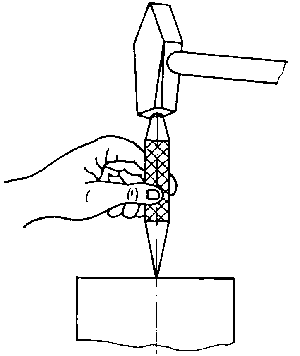
Figure 1. Centre punching by hand
Drilling is like centring a cutting operation with single-edged or two-edged tools (twist drill). A distinction is made between drilling and boring. Rotationally symmetrical through bores, stepped bores and blind bores are produced.

Figure 2. Kinds of bores (basic
types)
1 through bore, 2 stepped bore, 3 blind bore
Counterboring or countersinking as cutting operation with a multiple-edge tool serves to remachine bores (deburring, chamfering, expanding).
Reaming is a cutting operation with a multiple-edge tool which is constantly in action. Bores of high dimensional accuracy and surface finish can be produced.
Tapping is a cutting operation with a multiple-edge tool (tap). Tapping provides a hole with a thread as non-permanent joint.
For what purpose are centring, drilling and reaming applied when internal rotationally symmetrical workpiece surfaces are machined?
Cent
ring:
__________________________________________________
__________________________________________________
__________________________________________________
Drilling:
__________________________________________________
__________________________________________________
__________________________________________________
Reaming:
__________________________________________________
__________________________________________________
__________________________________________________
|
| ||||||||||||||||||||||||||||||||||||
2. Kinds, construction and applications of drilling machines
In machine-tool building a distinction is made between the following kinds of drilling machines:
horizontal boring, drilling and milling machines
- table-type
- with cross-sliding column
- floor-type
- special-purpose boring machines
- machining centres
vertical drilling machines
- bench-type
- pillar-type
- box-type
- radial drilling machines
- coordinate drilling machines
In addition to this, various types of hand drills are used, mainly for assembly purposes.
Due to the machine inventory being made up mainly of vertical drilling machines of the pillar and box type the construction, mode of action and application of these types will be explained in greater detail in the following section.
Basic construction of the pillar and box-type drilling machines (box-column drilling machines):
The pillar drilling machine is of the round column type. The work-table is arranged to swivel and is, therefore, not provided with any additional support.
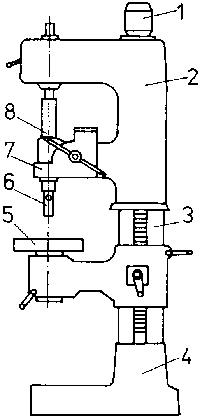
Figure 3. Pillar drilling machine
(box-column drilling machine)
1 driving motor, 2 driving head, 3 round column with geared rack for height adjustment of the drilling-machine table, 4 column base, 5 drilling machine table with T-slots, 6 drilling spindle, 7 spindle head, 8 hand lever for manual feed
Compared with the pillar drilling machine the box-type drilling machine has a higher stiffness. Its column is prismatic. An inline arrangement (see Fig. 5) is possible and more economical.
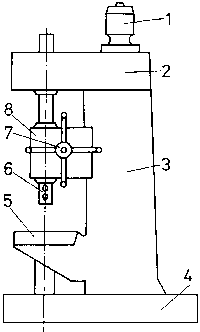
Figure 4. Box-type drilling machine
(box-column drilling machine)
1 driving motor, 2 driving head, 3 machine column, 4 column base, 5 drilling-machine table, 6 drilling spindle, 7 hand lever for feed, 8 spindle head
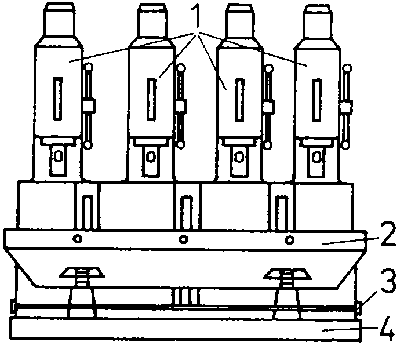
Figure 5. In-line multiple-spindle
drilling machine
1 drilling-machine upper parts (work independently from each other), 2 drilling-machine table (vertically adjustable), 3 treadle as emergency switch, 4 column base
The cutting values (speed, feed) are set on pillar and box-type drilling machines by means of control panels. This is done, as a rule, via change-speed drives which must be operated when the machine is at rest or is slowing down.
Applications:
Stationary drilling machines (pillar and box-type drilling machines) are used for drilling as well as boring, counterboring or countersinking, reaming and tapping.
With compound table types even easy milling operations can be performed within the range of capacity. The machines are used in small-batch and medium-batch production as well as in assembly work and auxiliary processes.
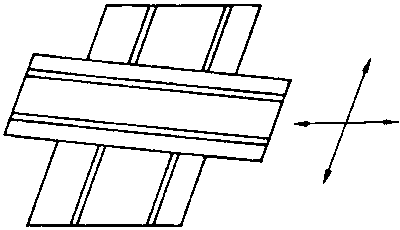
Figure 6. Compound table
What kinds of stationary vertical drilling machines are used in
machine-tool
building?
__________________________________________________
__________________________________________________
__________________________________________________
__________________________________________________
What is the basic construction of a box-column drilling
machine?
__________________________________________________
__________________________________________________
__________________________________________________
What applications does the vertical drilling machine
have?
__________________________________________________
__________________________________________________
__________________________________________________
|
| ||||||||||||||||||||||||||||||||||||
3. Kinds and construction of centring, drilling, counterboring and countersinking, reaming and tapping tools
The following main tools are applied: centre punch, centre drill, twist drill, counterbores and countersinks (spiral-flute counterbore, 60° and 90° included angle countersinks, piloted counterbore), reamer, tap.

Figure 7. Centre punch

Figure 8. Centre drill

Figure 9. Twist drill

Figure 10. 60° or 90°
included angle countersink

Figure 11. Spiral-flute counterbore

Figure 12. Reamer

Figure 13. Tap
The basic construction of the tools to be used differs only in the shape and number of tool cutting edges. The tools to be used can have a parallel shank or a taper shank. The basic construction of the tools can be seen in Figures 7 - 13.
Which tools can be used for reaming a bore, taking the
technological sequence of operations into
consideration?
__________________________________________________
__________________________________________________
__________________________________________________
__________________________________________________
|
| ||||||||||||||||||||||||||||||||||||
4. Clamping possibilities for workpieces and tools
Clamping the workpieces
Work-holding devices have the following special functions for machining on drilling machines:
positioning - fixing of the workpiece position in relation to the tool
clamping - neutralization of cutting forces during the machining operation
The clamping elements to be used must both neutralize the cutting forces (feed and speed) and hold down the workpiece during the machining operation.
Especially when drilling is made with twist drills the torque caused by the cutting force is of great importance for a safe clamping of the workpiece. The torque subjects the tool to torsion and simultaneously tries to drag along the workpiece.
Therefore, greatest importance shall be attached to a firm, job-related workpiece clamping according to labour safety regulations.
The choice of the respective clamping equipment depends on
- the shape, size and number of workpieces to be machined
- the number of bores in a workpiece and their size
- the angular position of the bores
- the cutting forces acting on the workpiece
- the type of drilling machine to be used
- the position, direction and necessary quality of the bore.
There is a great number of variants of the various clamping elements and fixtures.
As main variants for clamping workpieces, the following ones are applied:
Clamping against a stop
for loose workpiece clamping with medium-sized and bulky workpieces as a safeguard against displacement and distortion.
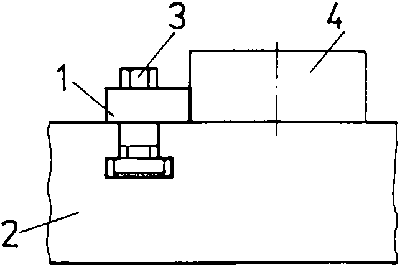
Figure 14. Clamping the workpiece
against a stop
1 stop, 2 table, 3 work-holding bolt, 4 workpiece
Vice clamping
Loose vice clamping for quickly fixing the workpiece's central positions in single-piece production or at low cutting pressure. Firm vice clamping with determination of fixed position in series production or at high cutting pressure.
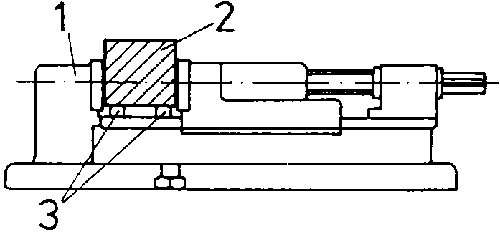
Figure 15. Vice clamping
1 vice, 2 workpiece, 3 parallels
Chucking
for clamping rotationally symmetrical workpieces and machining of their end faces.
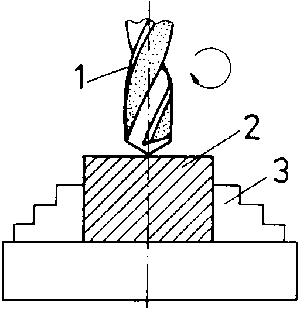
Figure 16. Chucking
1 tool, 2 workpiece, 3 chuck
Clamping by means of clamps
for clamping large or bulky workpieces on the table. We distinguish between flat, U-shaped, fork-shaped and cranked clamps of fixed and adjustable design.
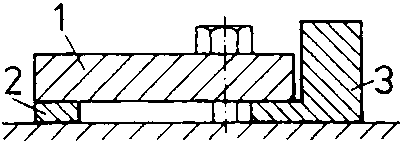
Figure 17. Clamping by means of clamp
1 clamp, 2 support, 3 work piece
Make sure by means of supports that the clamps are arranged horizontally.
Clamping in fixtures
for clamping workpieces which due to their geometrical shape can not or only with considerable effort be clamped with usual clamping equipment such as vice, stop and clamp. This is the safest kind of clamping ensuring high quality. It is, however, dependent on the specific workpiece and construction of the fixture.
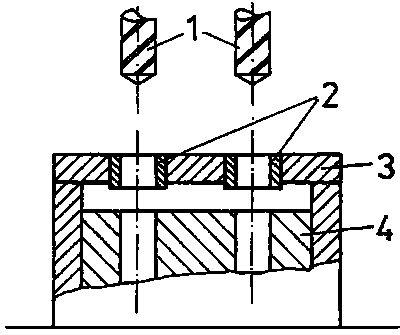
Figure 18. Fixture
1 tools, 2 drill bushes, 3 fixture, 4 workpiece
In addition to this, angle-plates, parallel clamps and toe dogs can be used.
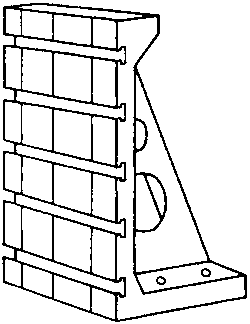
Figure 19. Angle-plate
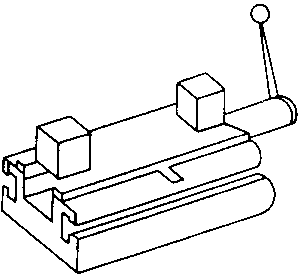
Figure 20. Parallel clamp
Clamping of tools
The following tool holders are applied:
Taper sleeves
for tools or tool holders with taper shank and for compensating different tapers per inches between drilling spindle and tool taper.
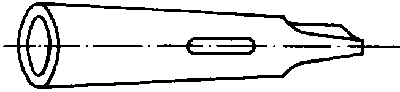
Figure 21. Taper sleeve
Drill chuck
for chucking tools with parallel shank or cylindrical tool holders.
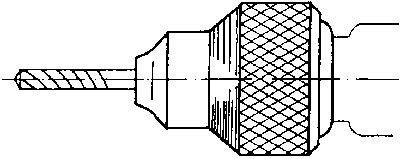
Figure 22. Drill chuck
Quick-action chuck
for chucking tools by friction. It makes a quick change of the clamping of different tools possible and is applied when work-pieces have different hole contours and hole qualities.
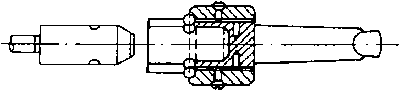
Figure 23. Quick-action chuck
Tap chuck
for drilling of tapped holes with safety clutch preventing breakage of taps by interrupting the operation when 2/3 of the ultimate torque of the tap are reached.
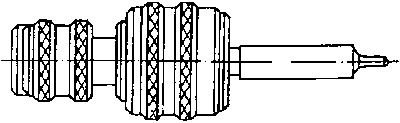
Figure 24. Tap chuck
What function do work-holding devices
have?
__________________________________________________
__________________________________________________
What kinds of vice clamping can be
applied?
__________________________________________________
__________________________________________________
|
| ||||||||||||||||||||||||||||||||||||
5. Preparation of work
The prophylactic health and fire protection and labour safety are an essential requirement for carrying out this technique. Therefore, the following is to be observed:
- Keep your workplace always clean and in order.- Use only such working tools which are in a good condition.
- Use appropriate protection for your body (safety glasses, protective gloves).
- For cleaning, checking and clamping place the machine out of operation. Do not make safety devices ineffective.
- Use appropriate aids for chip removal (brush, broom, etc.).
- In case of defects which affect the operational reliability of the machine do not start the machine and eliminate the defects.
Prepare the work in such a manner that all necessary working tools and objects of work can immediately be used without losing any time. This includes above all:
- Receive the work order, instructions and workpieces to be machined. Check the workpieces for completeness and accuracy to size, i.e. check the premachining quality.- Study the technical drawings (working drawing) and data sheets
- Lay out and check the necessary working tools (tools, measuring and testing means, clamping equipment) according to the instructions for work or your own decision.
- Determine cutting values.
- Fix sequence of operations.
Choice of cutting values
When determining the cutting values, pay attention to the following hints:
As a rule, the tools for centring, drilling, counterboring and countersinking, reaming and tapping consist of tool steel or high-speed steel. The choice of cutting values will depend on this.
The required speed (n) is calculated by rearranging


The machining recommendation for v (cutting speed) is as follows:
|
centring |
25 m/min. |
reaming |
5 m/min. |
|
drilling |
18 m/min. |
tapping (boring) |
3 m/min. |
|
counterboring or |
15 m/min. | |
|
|
Countersinking |
| | |
The feed can be effected both mechanically (by using the feed gear) and manually. When tapping, consider the thread lead. Choose such a feed that the surface finish required is guaranteed. Always choose clockwise rotation as direction of rotation of the tools. Maintain this clockwise rotation also for returning the tools (with the exception of tapping).
A bore with a diameter of 20 mm is to be machined into a work-piece by means of a twist drill. What speed is to be chosen?
n = _________________________ r.p.m.
Setting of the machine places high demands on the knowledge and skills of the operator. This includes:
- Fix the workpiece and tool in a certain position to each other
- Set the cutting values accordingly.
- Lay out further necessary working tools and auxiliary equipment.
In view of these factors the techniques are carried out in the following sequence and show a degree of technological unity:
1. centring or punch marking
2. drilling
3. counterboring or countersinking
4. reaming and tapping.
In order to reduce the wear of the tool cutting edges, it is necessary in most cases to use a coolant or lubricant. In this connection the following should be considered:
- Cast iron is always machined without fluid.
- For machining aluminium it is advisable to add spirit (pay attention to danger of fire).
- For other metallic materials use an emulsion of water and oil (drilling emulsion).
- For reaming and tapping use cutting oil.
In what technological sequence of operations is a tapped hole
made?
____________________________________________________
____________________________________________________
____________________________________________________
____________________________________________________
|
| ||||||||||||||||||||||||||||||||||||
6. Centring, drilling and counterboring or countersinking
Centring is made by means of the drill chuck and the centre drill in the marked centre of the workpiece. It is often substituted by centre punching. The choice of the centre drill depends on the kind of the necessary centre bore.
If subsequent operations (drilling, etc.) are to be carried out, use a centre drill according to Fig. 25.
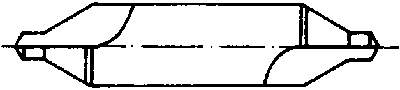
Figure 25. Centre drill (A-centring
60°)

Figure 26. Centre drill (B-centring
60°, 120°)
Feeding is made by hand. Uniform guiding is necessary to prevent tool breakage.
Drilling can be made by means of the drill chuck or taper sleeves by using a twist drill. Preparation by centring or centre punching is necessary. Twist drills are available in different designs with parallel shank (standard type up to a diameter of 10 mm) and taper shank (tool taper size MK 1-6 for drills with a diameter of more than 10 mm). For especially hard materials carbide-tipped drills are applied.
Almost every drill makes larger bores than is specified by its diameter. It is advisable to make a test bore.
If chips collect in the spiral flutes of the drill, heavy friction occurs on the bore wall. This may lead to drill breakage.
For this reason the drill must often be withdrawn from the bore hole and the chips must be removed. On principle, the drill cutting edge must be cooled, not the workpiece! For an economic machining it is also possible to use combination tools (stepped drill, multi-cut drill).

Figure 27. Stepped drill

Figure 28. Multi-cut drill
Counterboring is made by means of counterbores with cylindrical shank by using the drill chuck. If tools have a taper shank, taper sleeves are used. Combination tools are possible here as well (piloted counterbore, step counterbore).

Figure 29. Piloted counterbore

Figure 30. Step counterbore
The spiral-flute counterbore (see Fig. 11) is often applied. Being a three-lipped tool, it is used for expanding holes (preparation) for reaming. Thanks to its three-lip shape it has good guiding properties and corrects centre-distance displacements in bores. As for counterboring and countersinking always multiple-cutting-edge tools are applied, chatter marks (surface defects of the machined surfaces) may occur at high cutting values. In this case the cutting values are to be reduced.
A fitting bore of � 32 E8 is to be machined into a workpiece by
means of the technique of reaming. Determine the
limits.
____________________________________________________
____________________________________________________
As far as the machine reamers are concerned which are used as tools, we distinguish between non-adjustable (see Fig. 12), adjustable, shell, helically fluted and taper reamers. Non-adjustable machine reamers are most frequently used. Helically fluted machine reamers are used for workpieces with interrupted cut (grooved workpieces).

Figure 31. Reamer with helical flutes
In addition to this, hand reamers are used for assembly purposes. It is to be considered that the final size of a reamed bore does not only depend on the correct diameter of the reamer. The kind of material to be reamed, the axial alignment between workpiece and tool and the kind of coolant and lubricant used also influence the dimensional stability. One and the same reamer, for example, can produce quite different diameters with tough steel and with brittle cast iron. Therefore, a test bore must always be made. If there is a deviation from the dimensional stability, the tool must be changed, as there is no reamer which completely equals another one in its dimensions.
What machining allowance is to be chosen for a � 16 F7
bore?
____________________________________________________
____________________________________________________
What commonly used possibilities of combination of counterboring
or countersinking tools
exist?
____________________________________________________
____________________________________________________
|
| ||||||||||||||||||||||||||||||||||||
7. Reaming and tapping
Reaming is made with reamers. As a rule, the reamers are firmly mounted in the drilling spindle by means of taper sleeves. They are fed into the hole by manual feeding. Cylindrical as well as taper holes can be made by the technique of reaming.
Machine reaming is applied, if for a great number of workpieces a high surface finish is to be reached and another fine-finishing operation (e.g. grinding) is not possible.
Table 1. Recommended values for machining allowances
|
Final size in mm |
Machining allowance (undersize) in mm |
|
< 5 |
0.1 - 0.2 |
|
5-20 |
0.2 - 0.3 |
|
21 - 32 |
0.3 |
|
33 - 50 |
0.5 |
|
51-70 |
0.8 |
|
71 - 120 |
1 - 1.2 |
|
> 121 |
1.3 - 1.5 |
For reaming the workpiece bore must be precisely premachined and have a sufficient machining allowance (see Table 1). The machining allowance depends on the diameter of the hole to be machined.
The dimensional variations of bores (fitting holes) can be taken from corresponding standard tables (see Table 2), if necessary.
Example:
Fitting hole
|
� 50 H7 |
upper limit 50.025 |
|
� 50 - nominal size |
lower limit 50.000 |
|
h - position in the tolerance zone |
|
|
7 - quality index |
|
When is the technique of reaming
applied?
____________________________________________________
____________________________________________________
____________________________________________________
____________________________________________________
Tapping on the drilling machine is made by means of taps and the necessary tool holders (normally tapping chuck). The feed is mostly operated by hand. Depending on the thread lead, it can be effected, however, also mechanically (s = p, feed = thread lead). The tapped hole is always premachined. Kind of thread, minor diameter and thread lead must be known.

Figure 32. Thread sizes (simplified)
1 minor diameter, 2 major diameter, 3 lead
This information is mostly compiled in tabular form and must be available.
Tapped holes are made as through bores and blind bores. The tap is to be chosen accordingly. Taps with long chamfer are used for through bores and taps with short chamfer are used for blind bores. Tapping on the drilling machine is applied when non-permanent joints are to be manufactured with uniform quality. It is applied for tapped holes below 50 mm and for simple workpiece shapes (not bulky).
Table 2. Common kinds of fit (except from ISO system of fits/basic holes)
|
Tolerance zone | |
E 8 |
F 7 |
H 6 |
H 7 |
H 8 |
H 11 |
|
nominal |
size |
| | |
| | |
|
range |
(mm) |
nominal sizes in µm | |||||
|
over |
1 |
+ 28 |
+ 16 |
+ 7 |
+ 9 |
+ 14 |
+ 60 |
|
up to |
3 |
+ 14 |
+ 7 |
0 |
0 |
0 |
0 |
|
over |
3 |
+ 38 |
+ 22 |
+ 8 |
+ 12 |
+ 18 |
+ 75 |
|
up to |
6 |
+ 20 |
+ 10 |
0 |
0 |
0 |
0 |
|
over |
6 |
+ 47 |
+ 28 |
+ 9 |
+ 15 |
+ 22 |
+ 90 |
|
up to |
10 |
+ 25 |
+ 13 |
0 |
0 |
0 |
0 |
|
over |
10 |
+ 59 |
+ 34 |
+ 11 |
+ 18 |
+ 27 |
+110 |
|
up to |
18 |
+ 32 |
+ 16 |
0 |
0 |
0 |
0 |
|
over |
18 |
+ 73 |
+ 41 |
+ 13 |
+ 21 |
+ 33 |
+130 |
|
up to |
30 |
+ 40 |
+ 20 |
0 |
0 |
0 |
0 |
|
over |
30 |
+ 89 |
+ 50 |
+ 16 |
+ 25 |
+ 39 |
+160 |
|
up to |
50 |
+ 50 |
+ 25 |
0 |
0 |
0 |
0 |
|
over |
50 |
+106 |
+ 60 |
+ 19 |
+ 30 |
+ 46 |
+190 |
|
up to |
80 |
+ 60 |
+ 30 |
0 |
0 |
0 |
0 |
|
over |
80 |
+126 |
+ 71 |
+ 22 |
+ 35 |
+ 54 |
+220 |
|
up to |
120 |
+ 72 |
+ 36 |
0 |
0 |
0 |
0 |
|
over |
120 |
+148 |
+ 83 |
+ 25 |
+ 40 |
+ 63 |
+250 |
|
up to |
180 |
+ 85 |
+ 43 |
0 |
0 |
0 |
0 |
|
over |
180 |
+172 |
+ 96 |
+ 29 |
+ 46 |
+ 72 |
+290 |
|
up to |
250 |
+100 |
+ 50 |
0 |
0 |
0 |
0 |
|
over |
250 |
+191 |
+108 |
+ 32 |
+ 52 |
+ 81 |
+320 |
|
up to |
315 |
+110 |
+ 56 |
0 |
0 |
0 |
0 |
|
over |
315 |
+214 |
+119 |
+ 36 |
+ 57 |
+ 89 |
+360 |
|
up to |
400 |
+125 |
+ 62 |
0 |
0 |
0 |
0 |
|
over |
400 |
+232 |
+131 |
+ 40 |
+ 63 |
+ 97 |
+400 |
|
up to |
500 |
+135 |
+ 68 |
0 |
0 |
0 |
0 |
The connection between drilling spindle and square end of the tap is effected over the tool holder which can be designed as tap chuck (see Fig. 24) or as square hole with tool taper. In the tap chuck the tool is firmly clamped, in the square hole with tool taper it is held loosely.
In order to avoid tool breakage, tap chucks should be used, if possible. This possibility is limited, however, to taps smaller than 10 mm, as the force balance of the overload clutch would otherwise be nullified too quickly.
Therefore, tapping of larger bores requires considerably greater skills and attention.
Tapping is carried out as one technological process according to the following working steps:
1. centring
2. drilling of the minor diameter
3. chamfering of the minor diameter
4. tapping
5. checking
When machining tapped holes, always mark the depth of the thread on the cutting part of the tap (wound wire, colour marking) for checking purposes to prevent tool breakage.
When changing the running direction of the drilling spindle, note its lag time (time from switching off to the change of the running direction).
Tapped holes are made, as a rule, with the use of cutting oil. The following hints on labour safety must be followed:
- Carry out operations near the tool only when the drilling spindle is at rest.
- An emergency tripping of the machine must always be guaranteed.
- It must be possible to apply coolants or lubricants on the tap without any danger.
What is the minor diameter of an M 14 x 1.5 tapped
hole?
____________________________________________________
____________________________________________________
____________________________________________________
What kind of clamping is to be preferred for the
tap?
____________________________________________________