 |
| ||||||||||||||||||||||||||||||
Institut f�r berufliche Entwicklung e.V.
Berlin
Original title:
Arbeitsmaterial f�r den
Lernenden
“Arbeiten an Pressen”
Author: G�nter Hanisch
First Edition © IBE
Institut f�r berufliche Entwicklung e.V.
Parkstra�e
23
13187 Berlin
Order-No.: 93-35-3408/2
|
| ||||||||||||||||||||||||||||||
1. The Purpose of Working with a Press
The working technique of pressing serves to produce various timber materials by gluing the separate parts of the material to compound material.
The working technique of pressing in its basic form is applied when manufacturing ply material in veneer technology and producing thick pieces of work from thin basic material. In order to manufacture high quality furniture and other interior decoration additional technical and technological measures have to be considered with this working technique. Veneer technology is one possibility of improving materials. Here you change the technical and visual features of the pieces of work.
To secure a high stability of the glued joint a forced feed between 0.1 MPa and 1.3 MPa is necessary. The manufacturing of large face pieces of work requires a great total pressing power which can be yielded only with special presses.
Different types of presses are applied with wood working:
Mechanical presses
The forced feed is produced by spindles (a spindle press). This press is mainly applied with the manufacturing of one-off parts furniture and structural elements. Mainly width face gluings are carried out with this press.
Pneumatic presses
The forced feed is produced with air pressure by a compressor. These presses are mainly produced as narrow face presses, frame presses or corpus presses.
Hydraulic presses
The forced feed is produced by oil pressure. With these presses a very high forced feed can be achieved. They are applied with the manufacturing of furniture parts in mass production by width face gluing.
In the present material the construction and technological application of a spindle press is described. With a spindle press there can be manufactured solid wood sheets, composition plates, frame elements and ply-wood. Wide face material can be glued up with veneer or similar materials.
|
| ||||||||||||||||||||||||||||||
2. The Construction of a Press
The stand of the press serves as the power input when pressing. All bearing elements of the stand are made of sectional steel and are screwed home.

Figure 1 - Spindle press
1 press stand, 2 pressure spindle, 3 cross beam, 4 clamp lever, 5 pressing plate, 6 pressing table, 7 spindle controlling unit
The total pressing surface of the machine is devided into three separate pressing tables with their respective pressing plates and spindles. Depending on the size of the piece of work one, two or three spindles are applied. In order to provide the press easier with material the pressing tables can be pulled out on sliding rollers out of the press stand.
To produce the forced feed the press spindle is used. It ends with the narrow thread in the spindle screw. The female screw is made of grey cast iron and is screwed beneeth the cross beams of the press stand. The lower end of the spindle sits in the pressure shoe with a pivot.
The pressure distribution ensues through the spindle pivot, the pressure plate, two crossed grills made of sectional steel on to the pressing plate and then on to the piece of work.
The pressing plate is made of wood and its underface is slightly domed on all sides. The forced feed should first operate in the centre of the piece of work in order to press out excess glue at the edges.
The different ructions - open the presses - or - close the presses - are adjusted by means of a tongue on the spindle controller (s. Figure 2 and 3).
To tighten the press spindle a 1500 mm long lever is used. The tightening is carried out depending on the size of the occupied face of the table by one or two people (with man power). The lever should not be prolonged by using a tube. Otherwise the pressure power achieved in this way can damage the mechanically loaded parts of the press!

Figure 2 - Press (cut-away
model)
1 cross beam, 2 spindle screw, 3 pressure spindle, 4 lever guide, 5 clamp lever, 6 grill made of sectional steel, 7 pressing plate, 8 pressing table, 9 press stand
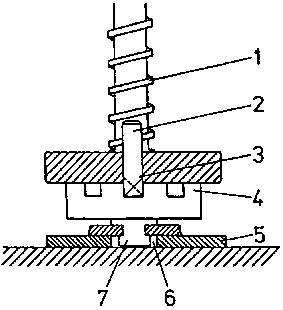
Figure 3 - Spindle controlling
unit
1 pressure spindle, 2 notch pawl, 3 / close the press; open the press, 4 notch wheel, 5 pressure bearing, 6 grease chamber, 7 spindle mortise tenon
The press is provided with a set of intermediate layers made of 2 mm to 3 mm aluminium. They are placed between the pressing table and the piece of work and between the piece of work and the pressing plate, as well as between separate pieces of work. Maintenance and service of the press is easy. It includes a regular lubrication of the spindle and the spindle bearing as well as to keep the pressing surfaces and the sheets clean.
|
| ||||||||||||||||||||
Working with Presses - Course: Mechanical woodworking techniques.Trainees' handbook of lessons (Institut f�r Berufliche Entwicklung, 16 p.)
3. Technological Application of the Press
3.1. Gluing of Pieces of Work
The gluing in sheets of different solid wood thicknesses is especially necessary in frame furniture production. If skillfully manufactured the produced pieces of work are of an especially high stability. The shrinkage and swelling behaviour can be adjusted to the corresponding purpose of application.

Figure 4 - Block of single
pieces of work with triangle marking and numbering
When the glued blocks are put together the shrinkage and swelling behaviour of the separate pieces of work should be taken into consideration. If only two pieces of work are placed together their left faces are put one on to the other. These faces become hollow when loosing moisture. A splitting up of the joint edges cannot occur with the glued piece of work. With more than two pieces of work always the left sides and the right sides are joined.
In the middle sheets you may also place shorter pieces of work with a cross joint. Because during the bending stress of the ready-made pieces of work mainly the edge zones are subjected to stress a cross joint has little effect on the stability.
To manufacture a glued block also other timber materials can be used as basic material.
The used glue should have a high viscosity but it should not be soaked up by the material or dry out when the glue is put on and the piece of work being fastened in the press. The features of the various glues are different.
Dispersion glues do not need a hardener for binding. With little extraction of water these glues loose their viscosity quickly. When placing the forced feed the glue cannot spread uniformly in the joint which results in failure gluings. Because of these features dispersion glue should be applied very thin and in large amounts.
The period of time between putting the glue on and clamping the piece of work should be very short and that is why only a few pieces of work should be clamped together. When the forced feed is starting the glue must be still liquid!
The application of glue on urea-formaldehyd basis allows the clamping of a larger amount of pieces of work because this glue alters its viscosity only little after the glue has been put on. But it is subject to dry quickly.
That is why after the glue had been put on the joint should be closed immediately by joining both the joint faces. Urea-formaldehyd glues require a special hardener for binding. By mixing it with a 2 % to 3 % binding agent it is made ready to use. The processing period starting now should not be exceeded. The processing period depends on the type of the binding agent and on the room temperature. To avoid losses of time the working process prior to the clamping of the piece of work must be well prepared.
Before using the glue for the first time you should study the processing instructions carefully.
The stability of a glued joint is increased if the glue layer between the pieces of work is thin. That is why the joint faces should be clean and even. If too much binding agent is added to the glue its solidity is reduced!
The pieces of work should be arranged on the pressing table always symmetrically to the press spindle.

Figure 5 - Example for the
distribution of the pieces of work on the pressing table
Why must always the left sides of the pieces of work form a
joint when two wooden pieces are glued to a
block?
_____________________________________________
_____________________________________________
_____________________________________________
Why can the pieces of work in the middle be short and lengthwise
arranged when gluing a
block?
_____________________________________________
_____________________________________________
_____________________________________________
Why should only a few pieces of work be pressed together at the
same time when applying dispersion
glue?
_____________________________________________
_____________________________________________
_____________________________________________
Wall-to-wall elements or inside doors are often manufactured in lightweight construction. Here thin plates are glued on to a wooden frame. With this kind of planking the stability of the frame element is increased many times over. The edge joint of the frame is subject to stress only during pressing. That is why a simple and saving joining can be applied.

Figure 6 - Putting glue on
frame woods
The glue should not be put up to the inner edge of the frame. The excess glue emerging from the frame edges features a great shrinkage measure when drying out. The resulting forces would damage the plates inwards the frame. Then the outlines of the frame woods would be visible on the outside faces of the plates.

Figure 7 - Gluing
(1) Gluing the full frame width, marks on the board's face
(2) Right gluing, no marks
3.2. Finishing of Even Pieces of Work by Veneering
Application of this technique
By the subject “veneering” we understand the gluing of a thin wooden layer on to a basic material. Veneering first of all is the visual forming of the surface concerned. Symmetric pictures resulting from the growth conditioned graining of the timber can be manufactured by placing several thin wooden sheets (called veneer) together. High-quality varieties of timber can be glued on timbers of less quality in a thin and saving layer.
By an purposeful processing of the veneers the mechanical features of the pieces of work can be improved.
With the manufacturing of composition plates, veneer plates and layer woods this method of application is put into practise.
The manufacturing of veneer faces
The veneers are sold in packages with a maximum number of sheets of 32 (the number of sheets can always be devided by four) and a length from 0.8 m to 4 m. For processing veneer faces of the desired visual features and the required sizes are manufactured from the single veneer sheets.
When selecting the veneer and blanking it the following basic rule should be considered:
- The sequence of the veneer sheets in the package should not be altered. Otherwise the texture pictures will not fit.- Faulty veneer parts (discolourings, bothering branches, large fissures, ...) should not or later be used for not visible faces.
- The best grainings of the veneer sheets are selected for the exterior faces which are visible later on.
- The number of the required veneer sheets should be determined before blanking.
Examples how to calculate the number of sheets and the blank measures for teh veneer face to be placed together:
A piece of work with a width of 550 mm and a length of 1200 mm shall be veneered.
How many veneer sheets do you need?
Which size should the
veneer sheets be cut to?
The given width of the veneer sheets in the package is 320 mm.
To cover a veneer face of 550 mm two widths of veneer sheets are necessary. For the front and the opposite sides of the piece of work
4 veneer sheets are needed.
The blank length results from the length of the piece of work + an allowance of 50 mm for further processing in the press
= 1200 mm + 50 mm = 1250 mm.
The veneer sheets are cut to a length of
1250 mm.
The width of the blank results from the width of the piece of work + an allowance of 30 mm for further processing in the press + an allowance of 10 mm for trimming the joint edges and devided by 2 (number of sheets per face).
|
|
550 mm |
|
+ |
30 mm |
|
+ |
10 mm |
| |
590 mm : 2 = 295 mm |
The veneer sheets are cut to a width of 295 mm.
One side of the veneer sheets features small fissures with the grain. These result from the manufacturing of the veneers. The depth of the fissures depends on the type of the wood. These fissures become visible when the veneer sheet is carefully bend across the grain.

Figure 8 - Principle of veneer
production
Veneers with very deep surface fissures should be glued with the side of the fissures, if possible. These fissures can result in surface damages of the varnished face later on. Such veneers are therefore less good for the arrangement of wide veneer faces because here the shaken face appears reciprocally on the front and on the opposite sides. For inside faces of furniture and later not visible faces this fact is of no significance.
After blanking follows the arrangement of the veneer sheets to veneer faces. Thereby the order of the veneer sheets should be followed, every other sheet is turned. The arranged face has to be marked with triangles and the number of the piece of work in order not to be mixed up.

Figure 9 - Arrangement of a
wide veneer face with separate veneer sheets (1, 2, 3, 4)
After that the veneer sheets are arranged in the original order again. And now they are clamped with two boards on a suitable longer board. The veneers should be arranged flush with the edges and should project the boards by 5 mm. The edge should be trimmed with a jack-plane in straight line.

Figure 10
After this job the veneer faces are placed together separately. The joint density can be checked by pressing the two veneer sheets together at the joint edges. Now the joint should be unvisible.
On the marked side of the veneer the joint is now secured by using joint paper. The graining of both the veneer sheets should now diverge in the joint exactly. Short pieces of joint paper are now glued at a distance of 10 mm starting from the middle of the joint.

Figure 11 (1)
After that a long stripe of joint paper is glued over the total length of the joint. This stripe avoids the overlapping of the joint parts and the penetration of glue when pressing.

Figure 11 (2)
Another two stripes of joint paper are glued near the upper and the lower edges of the veneer face. These should avoid the formation of fissures at the edges.

Figure 11 (3)
The faces prepared in this way are stored covered until further processing. Too much drying out of the wood would make the faces rough and brittle.
Why should veneers with large surface wracks be glued with the
shaken side on to the basic piece of work, if
possible?
______________________________________________
______________________________________________
______________________________________________
The technological process of veneering
Pressing should be carried out without disturbances and loses of time. The time limit is determined by the processing time of the applied glue. This period is the basis for the determination of the number of pieces of work to be manufactured in one process.
The working processes should be prepared carefully. Here you should pay attention to that there is enough room to move in the area of the press and in the area of the glue stands. All material should be at hand and be arranged in the right order. Before you start the necessary number of sandwiching sheets has to be cleaned. When using warm binding glues the sheets should be heated up to 60°C. The press spindles are adjusted to a sufficient height so that the pieces of work and the sandwiching sheets can be placed into the press without problems.
After all these preparations are done the glue can be made ready for processing. The processing instructions of the glue producer should be considered by all means. Urea-Formaldehyd glues are mixed with a binding agent. Too much mixed glue cannot be stored for other jobs. After a certain period of time it hardens out. That is why the necessary amount of glue should be worked and measured out in advance.
Calculation examples:
Four pieces of work with the sizes of 1200 mm length and 550 mm width shall be veneered.
How much glue do you need for an average coating of 200 g · m-2?

|
|
1056 g (calculated quantity) |
|
+ |
105 g (10 % allowance for processing loss) |
| |
1161 g |
You have to mix 1200 g of glue.
With larger faces you should put the glue on with a putty knife. The size of the filed in teeth is important for the applied amount of glue. For veneering jobs only the minimum amount of glue should be used. Excess glue can penetrate through the veneer's thickness under pressing. The result is glue penetration. The glue will be visible later on the piece of work.

Figure 12 - Putting on glue
with a putty knife
The glue coated face should immediately be covered with a veneer face. Thus you avoid the glue to loose too much moisture.
To turn the pieces of work and to place them into the press two people are needed. Pieces of work and sandwiching sheets are placed into the press layerwise.
First the press is fastened with little pressure. The excess glue needs a certain time to emerge from the middle of the joint to the edges.
When fastening one spindle the neighbouring spindles become loose because of the deformation of the press stand. These have to clamped by all means!When loosening one spindle the pressure on the neighbouring spindles is increased if they were under pressure. That is why all spindles have to be loosened simultaneously.
Possible reasons for faulty gluings
The most often fault occuring with veneering works is glue penetration. With large porous veneer woods it cannot be avoided. The penetration of glue can be reduced by a saving, but sufficient application of glue. With the help of binding agents (pea flour, soya flour or other swelling agents) the glue can be thickened. In doing so, the ability of penetration of the glue is reduced. When manufacturing dark veneer woods the glue should be made suitable to the colour of the wood by adding suitable dyes.
Bleb shaped faulty gluings can be of different reasons:
- at the parts concerned there was put no or too little glue- there have been oil, fat, dust, water or other pollutions on the face of the piece of work or the veneer's
- the face is uneven, at the place concerned pressure was missing
- before starting with the forced feed the glue did already bind.

Figure 13
Glue bulges are rolling glue piles under the veneer face.
Reasons:
- too much glue, the press has been tightened too fast
- the face was hollow, the press could not press
- you have used unequal veneer thicknesses

Figure 14
Overlapping are veneers lying over each other.
Reasons:
- the joint was not trimmed in a straight line- the veneer face had been damaged when placing into the press (here open fissures in the veneer can occur)
- you applied too rolling veneer which had not be fastened even enough when being trimmed

Figure 15
Foreign substances on or under the veneer face.
Reasons:
- unclean glue or putty knife
- glue remains on the sandwiching sheet

Figure
16
|
| ||||||||||||||||||||||||||||||
4. Labour Safety with the Spindle Presses
When operating the spindle press it carries out only slow motions. That is why there are no accident hazards resulting from the driving parts of the machine.
However faulty handling of the clamp lever and the spindle controlling unit can lead to accidents.
The press is closed and opened with strong man power. If the clamping strength of the clamp lever stops suddenly the operating person comes to fall. On the press stand or other objects you can be injured seriously. That is why you always shall pay attention to the right sitting of the clamp lever in the lever lead. Before you exert pressure you have to check that the notch pawl has locked in the notch wheel (visual inspection).
Hardened urea-formaldehyde glue forms very sharp edges. There is
a hazard of getting injured when unclamping, so please do it carefully. It is
not permitted to use an additional clamp lever prolongation. Otherwise the press
can be damaged because of
overloading.