This book is printed on paper suitable for recycling and made
from fully managed and sustained forest sources.
A catalogue record for this book is available from the British
Library
Printed in Malaysia
Any parts of this book, including the illustrations may be
copied, reproduced, or adapted to meet local needs, without permission from the
author or publisher, provided the parts reproduced are distributed free or at
cost - not for profit. For any reproduction with commercial ends, permission
must first be obtained from the author or the Hesperian Foundation. The author
would appreciate being sent a copy of any materials in which text or
illustrations have been used.
Note to those considering translation: To avoid
duplication of efforts, and for suggestions about adapting the information in
this book, before beginning any translation please contact the Hesperian
Foundation.
THIS REVISED EDITION CAN BE IMPROVED WITH YOUR HELP.
If you are a village health worker, doctor, mother, or anyone
with ideas or suggestions for ways this book could be changed to meet the needs
of your people better, please write to the author at the Hesperian Foundation
address. Thank you for your help.
Cover photograph courtesy of Dr John Hubley
Thanks to the work and dedication of many groups and individuals
around the world. Where There Is No Doctor has been translated into more
than 50 languages. The following are some of the translations and the addresses
where you can obtain them.
SPANISH AND ENGLISH:
The Hesperian Foundation 1919 Addison Street,
Suite 304 Berkeley, CA 94704 U.S.A.
HINDI AND ENGLISH:
VHAI 40, Institutional Area (Near Qutab Hotel,
S. of I.T.T.) New Delhi, 11016 INDIA
Edicoes Paulinas Caixa Postal 8. 107 Sao
Paulo, S.P. BRAZIL
ARABIC:
Arab Resource Collective P.O. Box
7047 Nicosia, CYPRUS
INDONESIAN:
Yayasan Essentia Medica P.O. Box
58 Yogyakarta, INDONESIA
SWAHILI:
Rotary Club of Dar es Salaam P.O. Box 1533 Dar
es Salaam, TANZANIA
VIETNAMESE:
CIDSE-Vietnam G.P.O. Box 2914 General Post
Office Bangkok, THAILAND
ITALIAN:
Lay Volunteers Internat'l Assoc. Via Meucci
35 12100 Cuneo, ITALY
For information about lower costs in poor countries or for large
orders, contact the Hesperian Foundation, TALC or one of the other addresses.
Please write to the Hesperian Foundation for information on
other editions, including Amharic, Bengali, Chinese, Dari, German, Iban,
Kannada, Korean, Lao, Marathi, Marshallese, Miskito, Nepalese, Pushtu, Quechua,
Shuar, Sindhi, Sinhala, Tamil, Thai, Tigre, Tigrina, Tswana, and Urdu as well as
English editions adapted for specific countries.
Where There is No Doctor - A new revised edition for
Africa
A new revised edition of the special English language edition
for Africa is now available. It has been edited to take into account medical
conditions which are more prevalent in Africa, as well as social and cultural
factors. The illustrations have been placed in the African context.
It is available from The Macmillan Press Ltd and from
TALC, P.O. Box 49, St. Albans, Herts AL1 4AX. U.K.
ISBN 0-333-51652-4
Tel: + 44 727 853869 Fax: +44 727 846852
Where There Is No Doctor - A Village Health Care Handbook (Hesperian Foundation, 1993, 516 p.)
(introduction...)
HOW TO USE THIS BOOK
THANKS
TEACHING AIDS AT LOW COST
INTRODUCTION
NOTE ABOUT THIS NEW EDITION
WORDS TO THE VILLAGE HEALTH WORKER (Brown Pages)
Chapter 1 - HOME CURES AND POPULAR BELIEFS
Chapter 2 - SICKNESSES THAT ARE OFTEN CONFUSED
Chapter 3 - HOW TO EXAMINE A SICK PERSON
Chapter 4 - HOW TO TAKE CARE OF A SICK PERSON
Chapter 5 - HEALING WITHOUT MEDICINES
Chapter 6 - RIGHT AND WRONG USES OF MODERN MEDICINES
Chapter 7 - ANTIBIOTICS: WHAT THEY ARE AND HOW TO USE THEM
Chapter 8 - HOW TO MEASURE AND GIVE MEDICINE
Chapter 9 - INSTRUCTIONS AND PRECAUTIONS FOR INJECTIONS
Chapter 10 - FIRST AID
Chapter 11 - NUTRITION: WHAT TO EAT TO BE HEALTHY
Chapter 12 - PREVENTION: HOW TO AVOID MANY SICKNESSES
Chapter 13 - SOME VERY COMMON SICKNESSES
Chapter 14 - SERIOUS ILLNESSES THAT NEED SPECIAL MEDICAL ATTENTION
Chapter 15 - SKIN PROBLEMS
Chapter 16 - THE EYES
Chapter 17 - THE TEETH, GUMS, AND MOUTH
Chapter 18 - THE URINARY SYSTEM AND THE GENITALS
Chapter 19 - INFORMATION FOR MOTHERS AND MIDWIVES
Chapter 20 - FAMILY PLANNING - HAVING THE NUMBER OF CHILDREN YOU WANT
Chapter 21 - HEALTH AND SICKNESSES OF CHILDREN
Chapter 22 - HEALTH AND SICKNESSES OF OLDER PEOPLE
Chapter 23 - THE MEDICINE KIT
THE GREEN PAGES - The Uses, Dosage, and Precautions for the Medicines Referred to in This Book
THE BLUE PAGES - New Information
VOCABULARY - Explaining Difficult Words
ADDRESSES FOR TEACHING MATERIALS
Dosage Blanks - For Giving Medicines to Those Who Cannot Read
If you have suggestions for improving this book, please let
us know. Your ideas are very important to us!
The Green Pages now include some additional medicines.
This is because some diseases have become resistant to the medicines that were
used in the past. So it is now harder to give simple medical advice for certain
diseases - especially malaria, tuberculosis, typhoid, and sexually spread
diseases. Often we give several possibilities for treatment. But for many
infectious diseases you will need local advice about which medicines are
available and effective in your area.
In updating the information on medicines, we mostly include only
those on the World Health Organization's List of Essential Drugs.
(However, we also discuss some widely used but dangerous medicines to give
warnings and to discourage their use) In trying to cover health needs and
variations in many parts of the world, we have listed more medicines than will
be needed for any one area. To persons preparing adaptations of this book, we
strongly suggest that the Green Pages be shortened and modified to meet the
specific needs and treatment patterns in your country.
In this new edition of Where There Is No Doctor we
continue to stress the value of traditional forms of healing, and have added
some more “home remedies.” However, since many folk remedies depend on
local plants and customs, we have added only a few which use commonly found
items such as garlic. We hope those adapting this book will add home remedies
useful to their area.
Community action is emphasized throughout this book. For
example, today it is often not enough to explain to mothers that 'breast is
best'. Communities must organize to make sure that mothers are able to breast
feed their babies at work. Likewise, problems such as misuse of pesticides, drug
abuse, and unsafe abortions are best solved by people working together to make
their communities safer, healthier, and more fair.
Figure
“Health for all” can be achieved only through the
organized demand by people for greater equality in terms of land, wages,
services, and basic rights. More power to the people!
Where There Is No Doctor - A Village Health Care Handbook (Hesperian Foundation, 1993, 516 p.)
WORDS TO THE VILLAGE HEALTH WORKER (Brown Pages)
(introduction...)
Health Needs and Human Needs
Many Things Relate to Health Care
Take a Good Look at Your Community
Using Local Resources to Meet Needs
Deciding What to Do and Where to Begin
Trying a New Idea
Working Toward a Balance Between People and Land
Working Toward a Balance Between Prevention and Treatment
Sensible and Limited Use of Medicines
Finding Out What Progress Has Been Made (Evaluation)
Teaching and Learning Together - The Health Worker as an Educator
Tools for Teaching
Making the Best Use of This Book
Where There Is No Doctor - A Village Health Care Handbook (Hesperian Foundation, 1993, 516 p.)
WORDS TO THE VILLAGE HEALTH WORKER (Brown Pages)
Who is the village health worker?
A village health worker is a person who helps lead family and
neighbors toward better health. Often he or she has been selected by the other
villagers as someone who is especially able and kind.
Some village health workers receive training and help from an
organized program, perhaps the Ministry of Health. Others have no official
position, but are simply members of the community whom people respect as healers
or leaders in matters of health. Often they learn by watching, helping, and
studying on their own.
In the larger sense, a village health worker is anyone who
takes part in making his or her village a healthier place to live.
This means almost everyone can and should be a health worker:
· Mothers and
fathers can show their children how to keep clean;
· Farm people can work together
to help their land produce more food;
· Teachers can teach
schoolchildren how to prevent and treat many common sicknesses and injuries;
· Schoolchildren can share what
they learn with their parents;
· Shopkeepers can find out about
the correct use of medicines they sell and give sensible advice and warning to
buyers;
· Midwives can counsel parents
about the importance of eating well during pregnancy, breast feeding, and family
planning.
This book was written for the health worker in the larger sense.
It is for anyone who wants to know and do more for his own, his family's or his
people's well-being.
If you are a community health worker, an auxiliary nurse, or
even a doctor, remember: this book is not just for you. It is for all the
people. Share it!
Use this book to help explain what you know to others.
Perhaps you can get small groups together to read a chapter at a time and
discuss it.
THE VILLAGE HEALTH WORKER LIVES AND
WORKS AT THE LEVEL OF HIS PEOPLE. HIS FIRST JOB IS TO SHARE HIS
KNOWLEDGE.
Health Needs and Human Needs
Dear Village Health Worker,
This book is mostly about people's health needs. But to
help your village be a healthy place to live, you must also be in touch with
their human needs. Your understanding and concern for people are just as
important as your knowledge of medicine and sanitation.
Here are some suggestions that may help you serve your people's
human needs as well as health needs:
1. BE KIND. A friendly word, a smile, a hand on the
shoulder, or some other sign of caring often means more than anything else you
can do. Treat others as your equals. Even when you are hurried or
worried, try to remember the feelings and needs of others. Often it helps to ask
yourself, “What would I do if this were a member of my own family?”
Treat the sick as people. Be especially kind to those who
are very sick or dying. And be kind to their families. Let them see that you
care.
HAVE COMPASSION.
Kindness often helps more than medicine. Never be
afraid to show you care.
2. SHARE YOUR KNOWLEDGE. As a health worker, your first
job is to teach. This means helping people learn more about how to keep from
getting sick. It also means helping people learn how to recognize and manage
their illnesses - including the sensible use of home remedies and common
medicines.
LOOK FOR WAYS TO SHARE YOUR
KNOWLEDGE.
There is nothing you have learned that, if carefully explained,
should be of danger to anyone. Some doctors talk about self-care as if it
were dangerous, perhaps because they like people to depend on their costly
services. But in truth, most common health problems could be handled earlier
and better by people in their own homes.
3. RESPECT YOUR PEOPLE'S TRADITIONS AND IDEAS.
Because you learn something about modern medicine does not mean
you should no longer appreciate the customs and ways of healing of your people.
Too often the human touch in the art of healing is lost when medical science
moves in. This is too bad, because...
If you can use what is best in modern medicine, together with
what is best in traditional healing, the combination may be better than either
one alone.
In this way, you will be adding to your people's culture, not
taking away.
Of course, if you see that some of the home cures or customs are
harmful (for example, putting excrement on the freshly cut cord of a newborn
baby), you will want to do something to change this. But do so carefully, with
respect for those who believe in such things. Never just tell people they are
wrong. Try to help them understand WHY they should do something differently.
People are slow to change their attitudes and traditions, and
with good reason. They are true to what they feel is right. And this we must
respect.
Modern medicine does not have all the answers either. It has
helped solve some problems, yet has led to other, sometimes even bigger ones.
People quickly come to depend too much on modern medicine and its experts, to
overuse medicines, and to forget how to care for themselves and each other.
So go slow - and always keep a deep respect for your people,
their traditions, and their human dignity. Help them build on the knowledge and
skills they already have.
WORK WITH TRADITIONAL HEALERS AND
MIDWIVES - NOT AGAINST THEM.
Learn from them and encourage them to learn from
you.
4. KNOW YOUR OWN LIMITS.
KNOW YOUR LIMITS
No matter how great or small your knowledge and skills, you can
do a good job as long as you know and work within your limits. This means: Do
what you know how to do. Do not try things you have not learned about or
have not had enough experience doing, if they might harm or endanger someone.
But use your judgment.
Often, what you decide to do or not do will depend on how far
you have to go to get more expert help.
KNOW YOUR LIMITS.
For example, a mother has just given birth and is bleeding more
than you think is normal. If you are only half an hour away from a medical
center, it may be wise to take her there right away. But if the mother is
bleeding very heavily and you are a long way from the health center, you may
decide to massage her womb or inject an oxytocic even if you were not taught
this.
Do not take unnecessary chances. But when the danger is clearly
greater if you do nothing, do not be afraid to try something you feel reasonably
sure will help.
Know your limits - but also use your head. Always do your
best to protect the sick person rather than yourself.
5. KEEP LEARNING. Use every chance you have to learn
more. Study whatever books or information you can lay your hands on that will
help you be a better worker, teacher, or person.
Always be ready to ask questions of doctors, sanitation
officers, agriculture experts, or anyone else you can learn from.
Never pass up the chance to take refresher courses or get
additional training.
Your first job is to teach, and unless you keep learning more,
soon you will not have anything new to teach others.
KEEP LEARNING - Do not let anyone
tell you there are things you should not learn or know.
6. PRACTICE WHAT YOU TEACH.
People are more likely to pay attention to what you do than what
you say. As a health worker, you want to take special care in your personal life
and habits, so as to set a good example for your neighbors.
Before you ask people to make latrines, be sure your own family
has one.
Also, if you help organize a work group - for example, to dig a
common garbage hole - be sure you work and sweat as hard as everyone else.
PRACTICE WHAT YOU TEACH (or who will
listen to you?)
Good leaders do not tell people what to do. They set the
example.
7. WORK FOR THE JOY OF IT.
If you want other people to take part in improving their village
and caring for their health, you must enjoy such activity yourself. If not, who
will want to follow your example?
Try to make community work projects fun. For example, fencing
off the public water hole to keep animals away from where people take water can
be hard work. But if the whole village helps do it as a 'work festival' -
perhaps with refreshments and music - the job will be done quickly and can be
fun. Children will work hard and enjoy it, if they can turn work into play.
You may or may not be paid for your work. But never refuse to
care, or care less, for someone who is poor or cannot pay.
This way you will win your people's love and respect. These are
worth far more than money.
WORK FIRST FOR THE PEOPLE-NOT THE
MONEY. (People are worth more.)
8. LOOK AHEAD - AND HELP OTHERS TO LOOK AHEAD.
A responsible health worker does not wait for people to get
sick. She tries to stop sickness before it starts. She encourages people to take
action now to protect their health and well-being in the future.
Many sicknesses can be prevented. Your job, then, is to help
your people understand the causes of their health problems and do something
about them.
Most health problems have many causes, one leading to another.
To correct the problem in a lasting way, you must look for and deal with the
underlying causes. You must get to the root of the problem.
For example, in many villages diarrhea is the most common cause
of death in small children. The spread of diarrhea is caused in part by lack of
cleanliness (poor sanitation and hygiene). You can do something to
correct this by digging latrines and teaching basic guidelines of cleanliness.
But the children who suffer and die most often from diarrhea
are those who are poorly nourished. Their bodies do not have strength to
fight the infections. So to prevent death from diarrhea we must also prevent
poor nutrition.
And why do so many children suffer from poor nutrition?
· Is it because
mothers do not realize what foods are most important (for example, breast milk)?
· Is it because the family does
not have enough money or land to produce the food it needs?
· Is it because a few rich
persons control most of the land and the wealth?
· Is it because the poor do not
make the best use of land they have?
· Is it because parents have
more children than they or their land can provide for, and keep having more?
· Is it because fathers lose
hope and spend the little money they have on drink?
· Is it because people do not
look or plan ahead? Because they do not realize that by working together and
sharing they can change the conditions under which they live and
die?
HELP OTHERS TO LOOK AHEAD.
You may find that many, if not all, of these things lie behind
infant deaths in your area. You will, no doubt, find other causes as well. As a
health worker it is your job to help people understand and do something about as
many of these causes as you can.
But remember: to prevent frequent deaths from diarrhea will take
far more than latrines, pure water, and 'special drink' (oral rehydration). You
may find that child spacing, better land use, and fairer distribution of wealth,
land, and power are more important in the long run.
The causes that lie behind much sickness and human suffering are
short-sightedness and greed. If your interest is your people's well-being, you
must help them learn to share, to work together, and to look
ahead.
Many Things Relate to Health Care
We have looked at some of the causes that underlie diarrhea and
poor nutrition. Likewise, you will find that such things as food production,
land distribution, education, and the way people treat or mistreat each
other lie behind many different health problems.
The chain of causes leading to death
from diarrhea.
If you are interested in the long-term welfare of your whole
community, you must help your people look for answers to these larger questions.
Health is more than not being sick. It is well-being: in body,
mind, and community. People live best in healthy surroundings, in a place where
they can trust each other, work together to meet daily needs, share in times of
difficulty and plenty, and help each other learn and grow and live, each as
fully as he or she can.
Do your best to solve day-to-day problems. But remember that
your greatest job is to help your community become a more healthy and more human
place to live.
You as a health worker have a big responsibility.
Where should you
begin?
Take a Good Look at Your Community
Because you have grown up in your community and know your people
well, you are already familiar with many of their health problems. You have an
inside view. But in order to see the whole picture, you will need to look
carefully at your community from many points of view.
As a village health worker, your concern is for the well-being
of all the people - not just those you know well or who come to you. Go
to your people. Visit their homes, fields, gathering places, and schools.
Understand their joys and concerns. Examine with them their habits, the things
in their daily lives that bring about good health, and those that may lead to
sickness or injury.
Before you and your community attempt any project or activity,
carefully think about what it will require and how likely it is to work. To do
this, you must consider all the following:
1. Felt needs - what people feel are their
biggest problems.
2. Real needs - steps people can take to correct these
problems in a lasting way.
3. Willingness - or readiness of people to plan and take
the needed steps.
4. Resources - the persons, skills, materials, and/or
money needed to carry out the activities decided upon.
As a simple example of how each of these things can be
important, let us suppose that a man who smokes a lot comes to you complaining
of a cough that has steadily been getting worse.
1. His felt need is to get
rid of his cough.
2. His real need (to correct
the problem) is to give up smoking.
3. To get rid of his cough will
require his willingness to give up smoking. For this he must understand
how much it really matters.
4. One resource that may help
him give up smoking is information about the harm it can do him and his family.
Another is the support and encouragement of his family, his friends, and you.
Finding Out the Needs
As a health worker, you will first want to find out your
people's most important health problems and their biggest concerns. To gather
the information necessary to decide what the greatest needs and concerns really
are, it may help to make up a list of questions.
On the next 2 pages are samples of the kinds of things you may
want to ask. But think of questions that are important in your area. Ask
questions that not only help you get information, but that get others asking
important questions themselves.
Do not make your list of questions too long or complicated -
especially a list you take from house to house. Remember, people are not
numbers and do not like to be looked at as numbers. As you gather
information, be sure your first interest is always in what individuals want and
feel. It may be better not even to carry a list of questions. But in considering
the needs of your community, you should keep certain basic questions in mind.
Figure
Figure
Sample Lists of Questions
To Help Determine Community Health Needs And at the Same
Time Get People Thinking
FELT NEEDS
Figure
What things in your people's daily lives (living conditions,
ways of doing things, beliefs, etc.) do they feel help them to be healthy?
What do people feel to be their major problems, concerns, and
needs - not only those related to health, but in general?
Figure
HOUSING AND SANITATION
Figure
What are different houses made of? Walls? Floors? Are the houses
kept clean? Is cooking done on the floor or where? How does smoke get out? On
what do people sleep?
Are flies, fleas, bedbugs, rats, or other pests a problem? In
what way? What do people do to control them? What else could be done?
Is food protected? How could it be better protected?
What animals (dogs, chickens, pigs, etc.), if any, are allowed
in the house? What problems do they cause?
What are the common diseases of animals? How do they affect
people's health? What is being done about these diseases?
Where do families get their water? Is it safe to drink? What
precautions are taken?
How many families have latrines? How many use them properly?
Is the village clean? Where do people put garbage? Why?
Figure
POPULATION
Figure
How many people live in the community? How many are under 15
years old?
How many can read and write? What good is schooling? Does it
teach children what they need to know? How else do children learn?
How many babies were born this year? How many people died? Of
what? At what ages? Could their deaths have been prevented? How?
Is the population (number of people) getting larger or smaller?
Does this cause any problems?
How often were different persons sick in the past year? How many
days was each sick? What sickness or injuries did each have? Why?
How many people have chronic (long-term) illnesses? What are
they?
How many children do most parents have? How many children died?
Of what? At what ages? What were some of the underlying causes?
How many parents are interested in not having any more children
or in not having them so often? For what reasons? (See Family Planning)
NUTRITION
Figure
How many mothers breast feed their babies? For how long? Are
these babies healthier than those who are not breast fed? Why?
What are the main foods people eat? Where do they come from?
Do people make good use of all foods available?
How many children are underweight or show signs of poor
nutrition?
How much do parents and schoolchildren know about nutritional
needs?
How many people smoke a lot? How many drink alcoholic or soft
drinks very often? What effect does this have on their own and their families'
health?
LAND AND FOOD
Figure
Does the land provide enough food for each family? How long will
it continue to produce enough food if families keep growing?
How is farm land distributed? How many people own their land?
What efforts are being made to help the land produce more?
How are crops and food stored? Is there much damage or loss?
Why?
HEALING, HEALTH
Figure
What role do local midwives and healers play in health care?
What traditional ways of healing and medicines are used? Which
are of greatest value? Are any harmful or dangerous?
What health services are nearby? How good are they? What do they
cost? How much are they used?
How many children have been vaccinated? Against what sicknesses?
What other preventive measures are being taken? What others
might be taken? How important are they?
SELF-HELP
Figure
What are the most important things that affect your people's
health and well-being - now and in the future?
How many of their common health problems can people care for
themselves? How much must they rely on outside help and medication?
Are people interested in finding ways of making self-care safer,
more effective, and more complete? Why? How can they learn more? What stands in
the way?
What are the rights of rich people? Of poor people? Of men? Of
women? Of children? How is each of these groups treated? Why? Is this fair? What
needs to be changed? By whom? How?
Do people work together to meet common needs? Do they share or
help each other when needs are great?
What can be done to make your village a better, healthier place
to live? Where might you and your people
begin?
Using Local Resources to Meet Needs
How you deal with a problem will depend upon what resources are
available.
Some activities require outside resources (materials, money, or
people from somewhere else). For example, a vaccination program is possible only
if vaccines are brought in - often from another country.
Other activities can be carried out completely with local
resources. A family or a group of neighbors can fence off a water hole or build
simple latrines using materials close at hand.
Some outside resources, such as vaccines and a few important
medicines, can make a big difference in people's health. You should do your best
to get them. But as a general rule, it is in the best interest of your people to
Use local resources whenever possible.
The more you and your people can do for yourselves, and the less
you have to depend on outside assistance and supplies, the healthier and
stronger your community will become.
Not only can you count on local resources to be on hand when you
need them, but often they do the best job at the lowest cost. For example, if
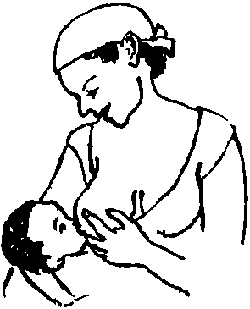
you can encourage mothers to breast feed rather than bottle feed their babies,
this will build self-reliance through a top quality local resource - breast
milk! It will also prevent needless sickness and death of many babies.
Encourage people to make the most of local resources.
BREAST MILK - A TOP QUALITY LOCAL
RESOURCE - BETTER THAN ANYTHING MONEY CAN BUY!
In your health work always remember:
The most valuable resource for the health of the people is
the people themselves.
Deciding What to Do and Where to Begin
After taking a careful look at needs and resources, you and your
people must decide which things are more important and which to do first. You
can do many different things to help people be healthy. Some are important
immediately. Others will help determine the future well-being of individuals or
the whole community.
In a lot of villages, poor nutrition plays a part in other
health problems. People cannot be healthy unless there is enough to eat.
Whatever other problems you decide to work with, if people are hungry or
children are poorly nourished, better nutrition must be your first concern.
There are many different ways to approach the problem of poor
nutrition, for many different things join to cause it. You and your community
must consider the possible actions you might take and decide which are most
likely to work.
Here are a few examples of ways some people have helped meet
their needs for better nutrition. Some actions bring quick results. Others work
over a longer time. You and your people must decide what is most likely to work
in your area.
POSSIBLE WAYS TO WORK TOWARD BETTER NUTRITION
FAMILY GARDENS
CONTOUR DITCHES to prevent soil from
washing away
ROTATION OF CROPS
Every other planting season plant a crop that returns strength
to the soil - like beans, peas, lentils, alfalfa, peanuts or some other plant
with seed in pods (legumes).
This year maize
Next year beans
MORE WAYS TO WORK TOWARD BETTER NUTRITION
IRRIGATION OF LAND
FISH BREEDING
BEEKEEPING
NATURAL FERTILIZERS - Compost pile
BETTER FOOD STORAGE
SMALLER FAMILIES - THROUGH FAMILY
PLANNING
Trying a New Idea
Not all the suggestions on the last pages are likely to work in
your area. Perhaps some will work if changed for your particular situation and
resources at hand. Often you can only know whether something will work or not by
trying it. That is, by experiment.
START SMALL
When you try out a new idea, always start small. If you
start small and the experiment fails, or something has to be done differently,
you will not lose much. If it works, people will see that it works and can begin
to apply it in a bigger way.
Do not be discouraged if an experiment does not work. Perhaps
you can try again with certain changes. You can learn as much from your failures
as your successes. But start small.
Here is an example of experimenting with a new idea.
You learn that a certain kind of bean, such as soya,
is an excellent body-building food. But will it grow in your area? And if it
grows, will people eat it?
Start by planting a small patch - or 2 or 3 small patches in
different conditions of soil or water. If the beans do well, try preparing them
in different ways, and see if people will eat them. If so, try planting more
beans in the conditions where you found they grew best. But try out still other
conditions in more small patches to see if you can get an even better
crop.
There may be several conditions you want to try changing. For
example, type of soil, addition of fertilizer, amount of water, or different
varieties of seed. To best understand what helps and what does not, be sure to
change only one condition at a time and keep all the rest the same.
For example, to find out if animal fertilizer
(manure) helps the beans grow, and how much to use, plant several small bean
patches side by side, under the same conditions of water and sunlight, and using
the same seed. But before you plant, mix each patch with a different amount of
manure, something like this:
no
manure
1 shovel manure
2 shovels manure
3 shovels manure
4 shovels manure
5 shovels manure
This experiment shows that a certain amount of manure helps, but
that too much can harm the plants. This is only an example. Your experiments may
give different results. Try for
yourself!
Working Toward a Balance Between People and Land
Health depends on many things, but above all it depends on
whether people have enough to eat.
Most food comes from the land. Land that is used well can
produce more food. A health worker needs to know ways to help the land better
feed the people - now and in the future. But even the best used piece of land
can only feed a certain number of people. And today, many of the people who
farm do not have enough land to meet their needs or to stay healthy.
In many parts of the world, the situation is getting worse, not
better. Parents often have many children, so year by year there are more mouths
to feed on the limited land that the poor are permitted to use.
Many health programs try to work toward a balance between people
and land through 'family planning', or helping people have only the number of
children they want. Smaller families, they reason, will mean more land and food
to go around. But family planning by itself has little effect. As long as people
are very poor, they often want many children. Children help with work without
having to be paid, and as they get bigger may even bring home a little money.
When the parents grow old, some of their children - or grandchildren - will
perhaps be able to help care for them.
For a poor country to have many children may be an economic
disaster. But for a poor family to have many children is often an economic
necessity - especially when many die young. In the world today, for most
people, having many children is the surest form of social security they can hope
for.
Some groups and programs take a different approach. They
recognize that hunger exists not because there is too little land to feed
everyone, but because most of the land is in the hands of a few selfish persons.
The balance they seek is a fairer distribution of land and wealth. They work to
help people gain greater control over their health, land, and lives.
It has been shown that, where land and wealth are shared more
fairly and people gain greater economic security, they usually choose to have
smaller families. Family planning helps when it is truly the people's choice. A
balance between people and land can more likely be gained through helping people
work toward fairer distribution and social justice than through family planning
alone.
It has been said that the social meaning oflove
isjustice. The health worker who loves her people should
help them work toward a balance based on a more just distribution of land and
wealth.
Figure
Working Toward a Balance Between Prevention and Treatment
Figure
A balance between treatment and prevention often comes down to a
balance between immediate needs and long-term needs.
As a health worker you must go to your people, work with them on
their terms, and help them find answers to the needs they feel most. People's
first concern is often to find relief for the sick and suffering. Therefore,
one of your first concerns must be to help with healing.
But also look ahead. While caring for people's immediate felt
needs, also help them look to the future. Help them realize that much sickness
and suffering can be prevented and that they themselves can take preventive
actions.
But be careful! Sometimes health planners and workers go too
far. In their eagerness to prevent future ills, they may show too little concern
for the sickness and suffering that already exist. By failing to respond to
people's present needs, they may fail to gain their cooperation. And so they
fail in much of their preventive work as well.
Treatment and prevention go hand in hand. Early treatment
often prevents mild illness from becoming serious. If you help people to
recognize many of their common health problems and to treat them early, in their
own homes, much needless suffering can be prevented.
Early treatment is a form of preventive medicine.
If you want their cooperation, start where your people
are. Work toward a balance between prevention and treatment that is
acceptable to them. Such a balance will be largely determined by people's
present attitudes toward sickness, healing, and health. As you help them look
farther ahead, as their attitudes change, and as more diseases are controlled,
you may find that the balance shifts naturally in favor of prevention.
You cannot tell the mother whose child is ill that prevention is
more important than cure. Not if you want her to listen. But you can tell her,
while you help her care for her child, that prevention is equally important.
Work toward prevention - do not force it.
Use treatment as a doorway to prevention. One of the best
times to talk to people about prevention is when they come for treatment. For
example, if a mother brings a child with worms, carefully explain to her how to
treat him. But also take time to explain to both the mother and child how the
worms are spread and the different things they can do to prevent this from
happening (see Chapter 12). Visit their home from time to time, not to find
fault, but to help the family toward more effective self-care.
Use treatment as a chance to teach prevention.
Sensible and Limited Use of Medicines
One of the most difficult and important parts of preventive care
is to educate your people in the sensible and limited use of medicines. A few
modern medicines are very important and can save lives. But for most
sicknesses no medicine is needed. The body itself can usually fight off
sickness with rest, good food, drinking lots of liquid, and perhaps some simple
home remedies.
People may come to you asking for medicine when they do not need
any. You may be tempted to give them some medicine just to please. But if you
do, when they get well, they will think that you and the medicine cured them.
Really their bodies cured themselves.
Instead of teaching people to depend on medicines they do not
need, take time to explain why they should not be used. Also tell
people what they can do themselves to get well.
This way you are helping people to rely on local resources
(themselves), rather than on an outside resource (medicine). Also, you are
protecting their health, for there is no medicine that does not have some
risk in its use.
REMEMBER: MEDICINES CAN KILL
Three common health problems for which people too often request
medicines they do not need are (1) the common cold, (2) minor cough, and (3)
diarrhea.
The common cold is best treated by resting, drinking lots
of liquids, and at the most taking aspirin. Penicillin, tetracycline, and other
antibiotics do not help at all.
For minor coughs, or even more severe coughs with thick
mucus or phlegm, drinking a lot of water will loosen mucus and ease the
cough faster and better than cough syrup. Breathing warm water vapor brings even
greater relief. Do not make people dependent on cough syrup or other medicines
they do not need.
For most diarrhea of children, medicines do not make them
get well. Many commonly used medicines (neomycin, streptomycin, kaolin-pectin,
Lomotil, chloramphenicol) may even be harmful. What is most important
is that the child getlots of liquids and enough food. The
key to the child's recovery is the mother, not the medicine. If you can help
mothers understand this and learn what to do, many children's lives can be
saved.
Medicines are often used too much, both by doctors and by
ordinary people. This is unfortunate for many reasons:
· It is wasteful.
Most money spent on medicine would be better spent on food.
· It makes people depend on
something they do not need (and often cannot afford).
· Every medicine has some risk
in its use. There is always a chance that an unneeded medicine may actually do
the person harm.
· What is more, when some
medicines are used too often for minor problems, they lose their power to fight
dangerous sicknesses.
An example of a medicine losing its power is chloramphenicol.
The extreme overuse of this important but risky antibiotic for minor infections
has meant that in some parts of the world chloramphenicol no longer works
against typhoid fever, a very dangerous infection. Frequent overuse of
chloramphenicol has allowed typhoid to become resistant to it.
For all the above reasons the use of medicines should be
limited.
But how? Neither rigid rules and restrictions nor permitting
only highly trained persons to decide about the use of medicines has prevented
overuse. Only when the people themselves are better informed will the limited
and careful use of medicines be common.
To educate people about sensible and limited use of
medicines is one of the important jobs of the health worker.
This is especially true in areas where modern medicines are
already in great use.
WHEN MEDICINES ARE NOT NEEDED, TAKE
TIME TO EXPLAIN WHY.
For more information about the use and misuse of medicines, see
Chapter 6. For the use and misuse of injections, see Chapter 9. For sensible use
of home remedies, see Chapter
1.
Finding Out What Progress Has Been Made (Evaluation)
From time to time in your health work, it helps to take a
careful look at what and how much you and your people have
succeeded in doing. What changes, if any, have been made to improve health and
well-being in your community?
You may want to record each month or year the health activities
that can be measured. For example:
· How many families
have put in latrines?
· How many farmers take part in
activities to improve their land and crops?
· How many mothers and children
take part in anUnder-Fives Program (regular check-ups and
learning)?
This kind of question will help you measure action taken.
But to find out the result or impact of these activities on health, you
will need to answer other questions such as:
· How many children
had diarrhea or signs of worms in the past month or year - as compared to before
there were latrines?
· How much was harvested this
season (corn, beans, or other crops) - as compared to before improved methods
were used?
· How many children show normal
weight and weight-gain on their Child Health Charts - as compared to when the
Under-Fives Program was started?
· Do fewer children die now than
before?
To be able to judge the success of any activity you need to
collect certain information both before and after. For example, if you want to
teach mothers how important it is to breast feed their babies, first take a
count of how many mothers are doing so. Then begin the teaching program and each
year take another count. This way you can get a good idea as to how much effect
your teaching has had.
You may want to set goals. For example, you and the health
committee may hope that 80% of the families have latrines by the end of one
year. Every month you take a count. If, by the end of six months, only one-third
of the families have latrines, you know you will have to work harder to meet the
goal you set for yourselves.
Setting goals often helps people work harder and get more
done.
To evaluate the results of your health activities it helps to
count and measure certain things before, during, and after.
But remember: The most important part of your health work
cannot be measured. It has to do with the way you and other people relate to
each other; with people learning and working together; with the growth of
kindness, responsibility, sharing, and hope. It depends on the growing strength
and unity of the people to stand up for their basic rights. You cannot measure
these things. But weigh them well when you consider what changes have been
made.
Teaching and Learning Together - The Health Worker as an Educator
As you come to realize how many things affect health, you may
think the health worker has an impossibly large job. And true, you will never
get much done if you try to deliver health care by yourself.
Only when the people themselves become actively responsible
for their own and their community's health, can important changes take
place.
Your community's well-being depends on the involvement not of
one person, but of nearly everyone. For this to happen, responsibility and
knowledge must be shared.
This is why your first job as a health worker is to teach
- to teach children, parents, farmers, schoolteachers, other health workers
- everyone you can.
The art of teaching is the most important skill a person can
learn. To teach is to help others grow, and to grow with them. A good teacher
is not someone who puts ideas into other people's heads; he or she is someone
who helps others build on their own ideas, to make new discoveries for
themselves.
Teaching and learning should not be limited to the schoolhouse
or health post. They should take place in the home and in the fields and on the
road. As a health worker one of your best chances to teach will probably be when
you treat the sick. But you should look for every opportunity to exchange ideas,
to share, to show, and to help your people think and work together.
On the next few pages are some ideas that may help you do this.
They are only suggestions. You will have many other ideas yourself.
TWO APPROACHES TO HEALTH
CARE
Tools for Teaching
Flannel-graphs are good for talking with groups because
you can keep making new pictures. Cover a square board or piece of cardboard
with a flannel cloth. You can place different cutout drawings or photos on it.
Strips of sandpaper or flannel glued to the backs of cutouts help them stick to
the flannelboard.
Figure
Posters and displays. “A picture is worth a thousand
words.” Simple drawings, with or without a few words of information, can be
hung in the health post or anywhere that people will look at them. You can copy
some of the pictures from this book.
If you have trouble getting sizes and shapes right, draw light,
even squares in pencil over the picture you want to copy.
Figure
Now draw the same number of squares lightly, but larger, on the
poster paper or cardboard. Then copy the drawing, square for square.
Figure
If possible, ask village artists to draw or paint posters. Or
have children make posters on different subjects.
Models and demonstrations help get ideas across. For
example, if you want to talk with mothers and midwives about care in cutting the
cord of a newborn child, you can make a doll for the baby. Pin a cloth cord to
its belly. Experienced midwives can demonstrate to others.
Figure
Color slides and filmstrips are available on different
health subjects for many parts of the world. Some come in sets that tell a
story. Simple viewers and battery-operated projectors are also available.
Figure
A list of addresses where you can send for teaching materials to
use for health education in your village can be found in chapter Addresses
for teaching materials.
Other Ways to Get Ideas Across
Story telling. When you have a hard time explaining
something, a story, especially a true one, will help make your point.
For example, if I tell you that sometimes a village worker can
make a better diagnosis than a doctor, you may not believe me. But if I tell you
about a village health worker called Irene, who runs a small nutrition center in
Central America, you may understand.
One day a small sickly child arrived at the
nutrition center. He had been sent by the doctor at a nearby health center
because he was badly malnourished. The child also had a cough, and the doctor
had prescribed a cough medicine. Irene was worried about the child. She knew he
came from a very poor family and that an older brother had died a few weeks
before. She went to visit the family and learned that the older brother had been
very sick for a long time and had coughed blood. Irene went to the health center
and told the doctor she was afraid the child had tuberculosis. Tests were made,
and it turned out that Irene was right.... So you see, the health worker spotted
the real problem before the doctor - because she knew her people and visited
their homes.
Stories also make learning more interesting. It helps if health
workers are good story tellers.
Play acting. Stories that make important points can reach
people with even more force if they are acted out. Perhaps you, the
schoolteacher, or someone on the health committee can plan short plays or
'skits' with the schoolchildren.
For example, to make the point that food should be protected
from flies to prevent the spread of disease, several small children could dress
up as flies and buzz around food. The flies dirty the food that has not been
covered. Then children eat this food and get sick. But the flies cannot get at
food in a box with a wire screen front. So the children who eat this food stay
well.
Figure
The more ways you can find to share ideas, the more people
will understand and remember.
Working and Learning Together for the Common Good
There are many ways to interest and involve people in working
together to meet their common needs. Here are a few ideas:
1. A village health committee. A group of
able, interested persons can be chosen by the village to help plan and lead
activities relating to the well-being of the community - for example, digging
garbage pits or latrines. The health worker can and should share much of his
responsibility with other persons.
2. Group discussions. Mothers, fathers, schoolchildren,
young people, folk healers, or other groups can discuss needs and problems that
affect health. Their chief purpose can be to help people share ideas and build
on what they already know.
3. Work festivals. Community projects such as putting in
a water system or cleaning up the village go quickly and can be fun if everybody
helps. Games, races, refreshments, and simple prizes help turn work into play.
Use imagination.
4. Cooperatives. People can help keep prices down by
sharing tools, storage, and perhaps land. Group cooperation can have a big
influence on people's well-being.
Figure
5. Classroom visits. Work with the village schoolteacher
to encourage health-related activities, through demonstrations and play acting.
Also invite small groups of students to come to the health center. Children not
only learn quickly, but they can help out in many ways. If you give children a
chance, they gladly become a valuable resource.
6. Mother and child health meetings. It is especially
important that pregnant women and mothers of small children (under five years
old) be well informed about their own and their babies' health needs. Regular
visits to the health post are opportunities for both check-ups and learning.
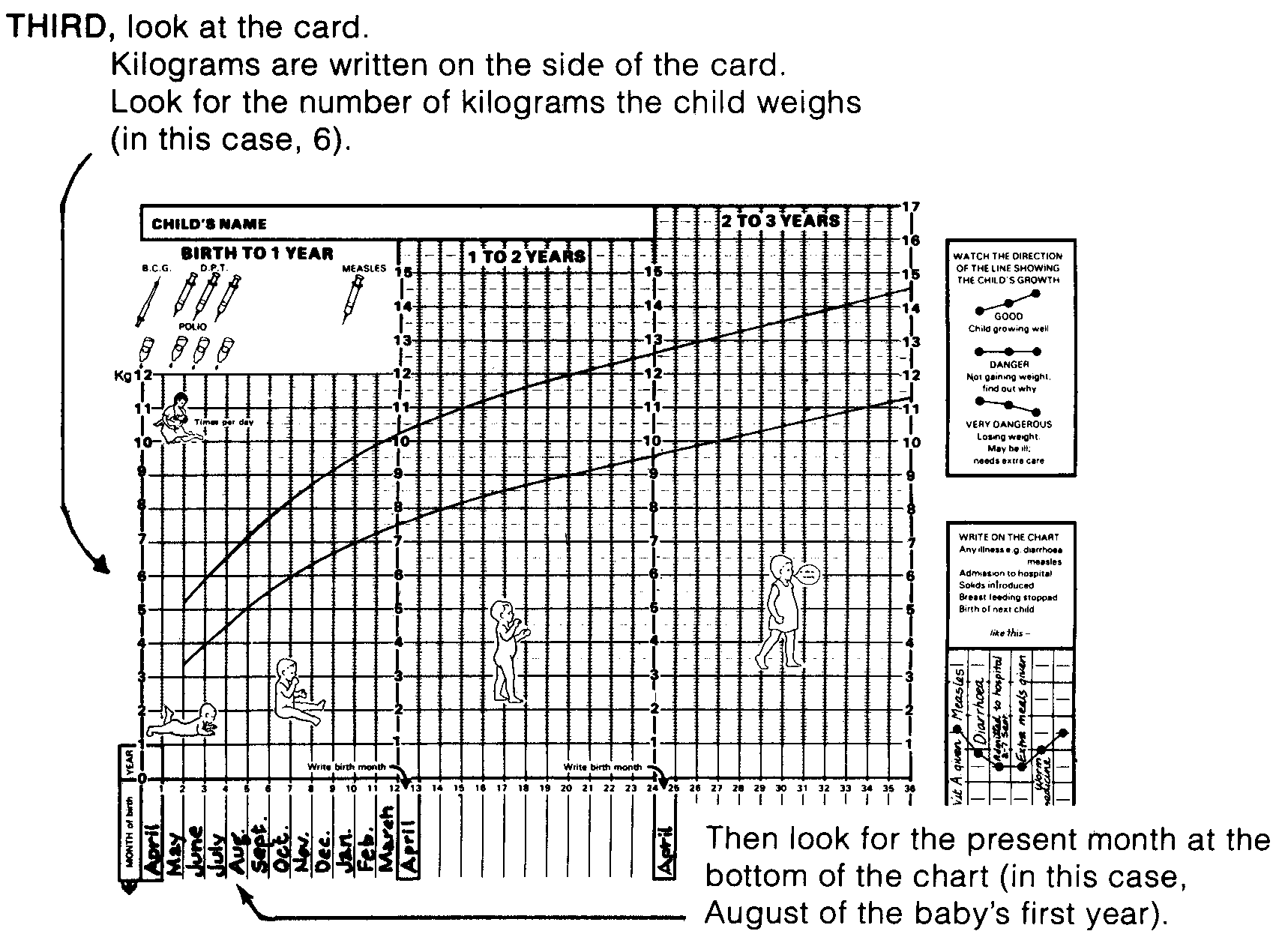
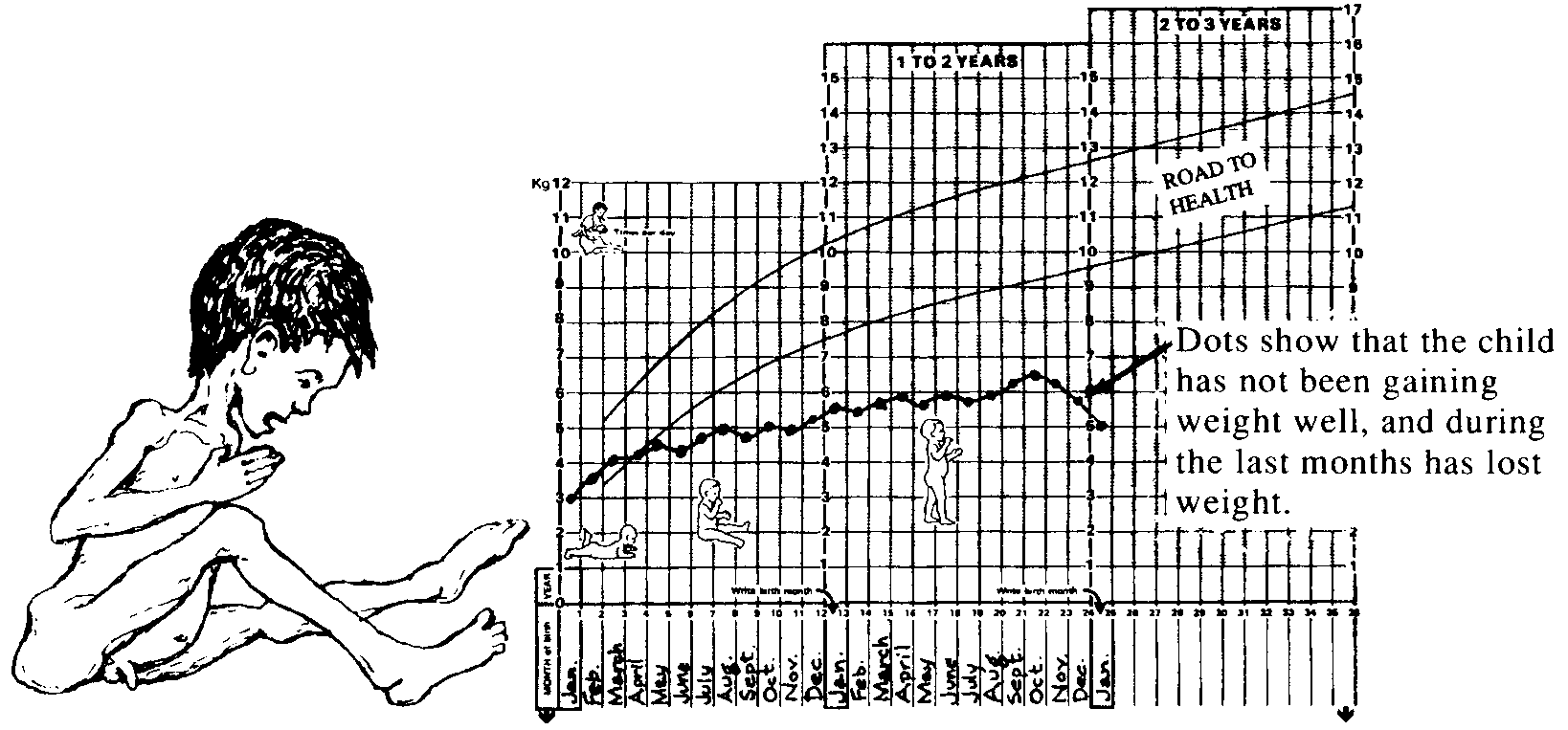
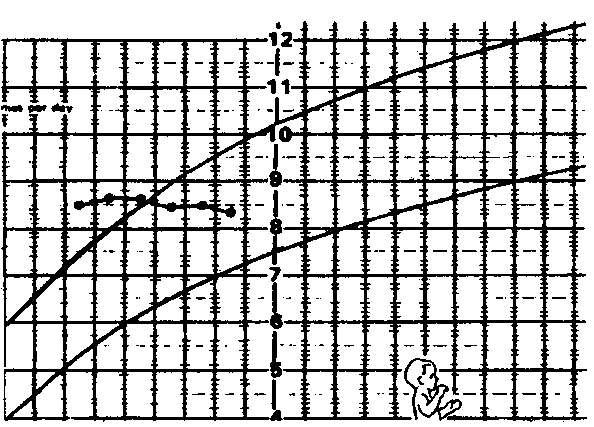
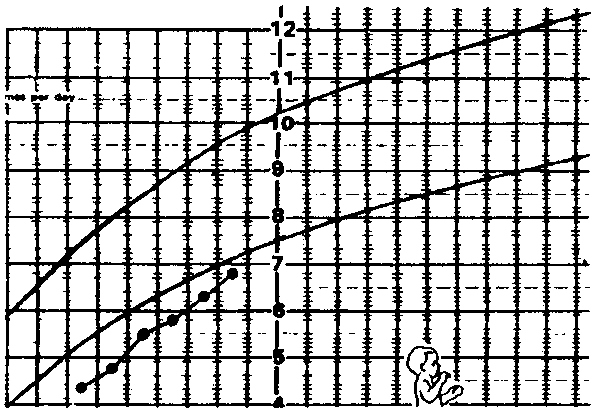
Have mothers keep their children's health records and bring them each month to
have their children's growth recorded (see the Child Health Chart). Mothers who
understand the chart often take pride in making sure their children are eating
and growing well. They can learn to understand these charts even if they cannot
read. Perhaps you can help train interested mothers to organize and lead these
activities.
7. Home visits. Make friendly visits to people's homes,
especially homes of families who have special problems, who do not come often to
the health post, or who do not take part in group activities. But respect
people's privacy. If your visit cannot be friendly, do not make it - unless
children or defenseless persons are in danger.
Ways to Share and Exchange Ideas in a Group
As a health worker you will find that the success you have in
improving your people's health will depend far more on your skills as a teacher
than on your medical or technical knowledge. For only when the whole community
is involved and works together can big problems be overcome.
People do not learn much from what they are told. They learn
from what they think, feel, discuss, see, and do together.
So the good teacher does not sit behind a desk and talk
at people. He talks and works with them. He helps his people to think
clearly about their needs and to find suitable ways to meet them. He looks for
every opportunity to share ideas in an open and friendly way.
TALK WITH PEOPLE
NOT AT THEM
Perhaps the most important thing you can do as a health worker
is to awaken your people to their own possibilities... to help them gain
confidence in themselves. Sometimes villagers do not change things they do not
like because they do not try. Too often they may think of themselves as ignorant
and powerless. But they are not. Most villagers, including those who cannot read
or write, have remarkable knowledge and skills. They already make great changes
in their surroundings with the tools they use, the land they farm, and the
things they build. They can do many important things that people with a lot of
schooling cannot.
If you can help people realize how much they already know and
have done to change their surroundings, they may also realize that they can
learn and do even more. By working together it is within their power to bring
about even bigger changes for their health and well-being.
Then how do you tell people these things?
Often you cannot! But you can help them find out some of these
things for themselves - by bringing them together for discussions. Say little
yourself, but start the discussion by asking certain questions. Simple pictures
like the drawing on the next page of a farm family in Central America may help.
You will want to draw your own picture, with buildings, people, animals, and
crops that look as much as possible like those in your area.
USE PICTURES TO GET PEOPLE TALKING
AND THINKING TOGETHER
Show a group of people a picture similar to this and ask them to
discuss it. Ask questions that get people talking about what they know and can
do. Here are some sample questions:
· Who are the people
in the picture and how do they live?
· What was this land like before
the people came?
· In what ways have they changed
their surroundings?
· How do these changes affect
their health and well-being?
· What other changes could these
people make? What else could they learn to do? What is stopping them? How could
they learn more?
· How did they learn to farm?
Who taught them?
· If a doctor or a lawyer moved
onto this land with no more money or tools than these people, could he farm it
as well? Why or why not?
· In what ways are these people
like ourselves?
This kind of group discussion helps build people's confidence in
themselves and in their ability to change things. It can also make them feel
more involved in their community.
At first you may find that people are slow to speak out and say
what they think. But after a while they will usually begin to talk more freely
and ask important questions themselves. Encourage everyone to say what he or she
feels and to speak up without fear. Ask those who talk most to give a chance to
those who are slower to speak up.
You can think of many other drawings and questions to start
discussions that can help people look more clearly at problems, their causes,
and possible solutions.
***
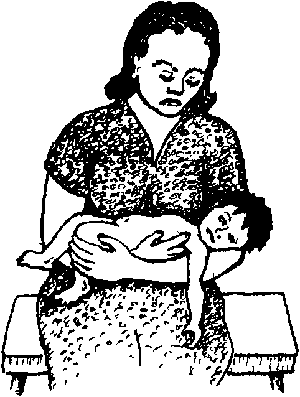
What questions can you ask to get people thinking about the
different things that lead to the condition of the child in the following
picture?
Figure
Try to think of questions that lead to others and get people
asking for themselves. How many of the causes underlying death from diarrhea
will your people think of when they discuss a picture like
this?
Making the Best Use of This Book
Figure
Anyone who knows how to read can use this book in her own home.
Even those who do not read can learn from the pictures. But to make the fullest
and best use of the book, people often need some instruction. This can be done
in several ways.
A health worker or anyone who gives out the book should make
sure that people understand how to use the list of Contents, the Index, the
Green Pages and the Vocabulary. Take special care to give examples of how to
look things up. Urge each person to carefully read the sections of the book
that will help her understand what may be helpful to do, what could be
harmful or dangerous, and when it is important to get help (see
especially Chapters 1, 2, 6, and 8, and also the SIGNS OF DANGEROUS ILLNESS).
Point out how important it is to prevent sickness before it starts.
Encourage people to pay special attention to Chapters 11 and 12, which deal
with eating right (nutrition) and keeping clean (hygiene and
sanitation).
Also show and mark the pages that tell about the most common
problems in your area. For example, you can mark the pages on diarrhea
and be sure mothers with small children understand about 'special
drink' (oral rehydration). Many problems and needs can be explained briefly.
But the more time you spend with people discussing how to use the book or
reading and using it together, the more everyone will get out of it.
You as a health worker might encourage people to get together
in small groups to read through the book, discussing one chapter at a
time. Look at the biggest problems in your area - what to do about health
problems that already exist and how to prevent similar problems in the future.
Try to get people looking ahead.
Perhaps interested persons can get together for a short
class using this book (or others) as a text. Members of the group could
discuss how to recognize, treat, and prevent different problems. They could take
turns teaching and explaining things to each other.
To help learning be fun in these classes you can act out
situations. For example, someone can act as if he has a particular sickness
and can explain what he feels. Others then ask questions and examine him
(Chapter 3). Use the book to try to find out what his problem is and what can be
done about it. The group should remember to involve the 'sick' person in
learning more about his own sickness - and should end up by discussing with him
ways of preventing the sickness in the future. All this can be acted out in
class.
Exciting and effective ways to teach about health care are in
the book Helping Health Workers Learn, also available from the Hesperian
Foundation.
As a health worker, one of the best ways you can help people use
this book correctly is this: When persons come to you for treatment, have them
look up their own or their child's problem in the book and find out how to treat
it. This takes more time, but helps much more than doing it for them. Only when
someone makes a mistake or misses something important do you need to step in and
help him learn how to do it better. In this way, even sickness gives a chance
to help people learn.
Dear village health worker - whoever and wherever you are,
whether you have a title or official position, or are simply someone, like
myself, with an interest in the well-being of others - make good use of this
book. It is for you and for everyone.
But remember, the most important part of health care you will
not find in this book or any other. The key to good health lies within you and
your people, in the care, the concern, and appreciation you have for each other.
If you want to see your community be healthy, build on these.
Caring and sharing are the key to health.
Yours truly,
David Werner
Figure
Figure
Figure
NOTICE
This book is to help people meet most of their common health
needs for and by themselves. But it does not have all the answers. In case of
serious illness or if you are uncertain about how to handle a health problem,
get advice from a health worker or doctor whenever possible.
Figure
Figure
Where There Is No Doctor - A Village Health Care Handbook (Hesperian Foundation, 1993, 516 p.)
Chapter 1 - HOME CURES AND POPULAR BELIEFS
(introduction...)
Home Cures That Help
Beliefs That Can Make People Well
Beliefs That Can Make People Sick
Witchcraft - Black Magic - and the Evil Eye
Questions and Answers on Some Folk Beliefs and Home Remedies
Sunken Fontanel or Soft Spot
Ways to Tell Whether a Home Remedy Works or Not
Medicinal Plants
Homemade Casts-for Keeping Broken Bones in Place
Enemas, Laxatives, and Purges: When to Use Them and When Not To
Where There Is No Doctor - A Village Health Care Handbook (Hesperian Foundation, 1993, 516 p.)
Chapter 1 - HOME CURES AND POPULAR BELIEFS
Everywhere on earth people use home remedies. In some places,
the older or traditional ways of healing have been passed down from
parents to children for hundreds of years.
Many home remedies have, great value. Others have less. And some
may be risky or harmful. Home remedies, like modern medicines, must be used with
caution.
Try todo no harm.
Only use home remedies if you are sure they are safe and
know exactly how to use them.
Home Cures That Help
For many sicknesses, time-tested home remedies work as well as
modern medicines - or even better. They are often cheaper. And in
some cases they are safer.
For example, many of the herbal teas people use for home
treatment of coughs and colds do more good and cause fewer problems than cough
syrups and strong medicines some doctors prescribe.
Also, the 'rice water', teas, or sweetened drinks that many
mothers give to babies with diarrhea are often safer and do more good than any
modern medicine. What matters most is that a baby with diarrhea gets plenty of
liquids.
FOR COUGHS, COLDS, AND COMMON
DIARRHEA, HERBAL TEAS ARE OFTEN BETTER, CHEAPER AND SAFER THAN
MODERN MEDICINES.
The Limitations of Home Remedies
Some diseases are helped by home remedies. Others can be treated
better with modern medicine. This is true for most serious infections.
Sicknesses like pneumonia, tetanus, typhoid, tuberculosis, appendicitis,
diseases caused by sexual contact, and fever after childbirth should be treated
with modern medicines as soon as possible. For these diseases, do not lose time
trying to treat them first with home remedies only.
It is sometimes hard to be sure which home remedies work well
and which do not. More careful studies are needed. For this reason:
It is often safer to treat very serious illnesses with
modern medicines - following the advice of a health worker if possible.
Old Ways and New
Some modern ways of meeting health needs work better than old
ones. But at times the older, traditional ways are best. For example,
traditional ways of caring for children or old people are often kinder and work
better than some newer, less personal ways.
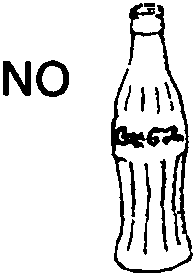
Not many years ago everyone thought that mother's milk was the
best food for a young baby. They were right! Then the big companies that make
canned and artificial milk began to tell mothers that bottle feeding was better.
This is not true, but many mothers believed them and started to bottle feed
their babies. As a result, thousands of babies have suffered and died needlessly
from infection or hunger. For the reasons breast is best.
Respect your people's traditions and build on them.
For more ideas for building on local traditions, seeHelping Health Workers Learn, Chapter
7.
Beliefs That Can Make People Well
Some home remedies have a direct effect on the body. Others seem
to work only because people believe in them. The healing power of belief can
be very strong.
For example, I once saw a man who suffered from a very bad
headache. To cure him, a woman gave him a small piece of yam, or sweet potato.
She told him it was a strong painkiller. He believed her - and the pain went
away quickly.
It was his faith in her treatment, and not the yam itself, that
made him feel better.
Figure
Many home remedies work in this I way. They help largely because
people have faith in them. For this reason, they are especially useful to
cure illnesses that are partly in people's minds, or those caused in part by a
person's beliefs, worry, or fears.
Included in this group of sicknesses are: bewitchment or hexing,
unreasonable or hysterical fear, uncertain 'aches and pains' (especially in
persons going through stressful times, such as teenage girls or older women),
and anxiety or nervous worry. Also included are some cases of asthma, hiccups,
indigestion, stomach ulcers, migraine headaches, and even warts.
For all of these problems, the manner or 'touch' of the
healer can be very important. What it often comes down to is showing you
care, helping the sick person believe he will get well, or simply helping him
relax.
Sometimes a person's belief in a remedy can help with problems
that have completely physical causes.
For example, Mexican villagers have the following home cures for
poisonous snakebite:
1. to use 'guaco' leaves
2. to bite the snake
3. to apply tobacco
4. to apply the skin of a poisonous
lizard
5. to smear the snake's bile on the
bite
In other lands people have their own snakebite remedies - often
many different ones. As far as we know, none of these home remedies has any
direct effect against snake poison. The person who says that a home remedy
kept a snake's poison from harming him at all was probably bitten by a
non-poisonous snake!
Yet any of these home remedies may do some good if a person
believes in it. If it makes him less afraid, his pulse will slow down, he will
move and tremble less, and as a result, the poison will spread through his body
more slowly. So there is less danger!
But the benefit of these home remedies for snakebite is limited.
In spite of their common use, may people still become very ill or die. As far as
we know:
No home cure for poisonous bites(whether from
snakes, scorpions, spiders, or other poisonous animals) has much effect beyond
that of the healing power of belief.
For snakebite it is usually better to use modern treatment. Be
prepared: obtain 'antivenoms' or 'serums' for poisonous bites
before you need them. Do not wait until it is too
late.
Beliefs That Can Make People Sick
The power of belief can help heal people. But it can also harm
them. If a person believes strongly enough that something will hurt him, his own
fear can make him sick. For example:
Once I was called to see a woman who had just had a
miscarriage and was still bleeding a little. There was an orange tree
near her house. So I suggested she drink a glass of orange juice. (Oranges have
vitamin C which helps strengthen blood vessels.) She drank it - even though she
was afraid it would harm her.
Her fear was so great that soon she became very ill. I examined
her, but could find nothing physically wrong. I tried to comfort her, telling
her she was not in danger. But she said she was going to die. At last I gave her
an injection of distilled (completely pure) water. Distilled water has no
medical effect. But since she had great faith in injections, she quickly got
better.
Figure
Actually, the juice did not harm her. What harmed her was her
belief that it would make her sick. And what made her well was her faith in
injections!
In this same way, many persons go on believing false ideas about
witchcraft, injections, diet, and many other things. Much needless suffering is
the result.
Perhaps, in a way, I had helped this woman. But the more I
thought about it, the more I realized I had also wronged her; I had led her to
believe things that were not true.
I wanted to set this right. So a few days later, when she was
completely well, I went to her home and apologized for what I had done. I tried
to help her understand that not the orange juice, but her fear had made
her so sick. And that not the injection of water, but her freedom from
fear had helped her get well.
By understanding the truth about the orange, the injection, and
the tricks of her own mind, perhaps this woman and her family will become freer
from fear and better able to care for their health in the future. For
health is closely related to understanding and freedom from
fear.
Many things do harm only because people believe they are
harmful.
Witchcraft - Black Magic - and the Evil Eye
If a person believes strongly enough that someone has the power
to harm him, he may actually become ill. Anyone who believes he is bewitched or
has been given theevil eye is really the victim of his own fears
(see Susto).
A 'witch' has no power over other people, except for her ability
to make them believe that she has. For this reason:
It is impossible to bewitch a person who does not believe
in witchcraft.
Some people think that they are 'bewitched' when they have
strange or frightening illnesses (such as tumors of the genitals
or cirrhosis of the liver). Such sicknesses have nothing to do with
witchcraft or black magic. Their causes are natural.
Figure
Do not waste your money at 'magic centers' that claim to cure
witchcraft. And do not seek revenge against a witch, because it will not solve
anything. If you are seriously ill, go for medical help.
If you have a strange sickness:
do not blame a witch,
do not go to a magic center,
but ask for medical advice.
Questions and Answers on Some Folk Beliefs and Home Remedies
These examples are from the mountains of Mexico, the area that I
know best. Perhaps some of the beliefs of your people are similar. Think about
ways to learn which beliefs in your area lead to better health and which do not.
When people think someone is bewitched, is it true that he will
get well if his relatives harm or kill the witch?
Figure
FALSE! No one is ever helped by harming someone else.
Is it true that when the 'soft spot' on top of a baby's head
sinks inward this means the baby will die of diarrhea unless he gets special
treatment?
Figure
This is often true. The 'soft spot' sinks because the baby has
lost too much liquid. Unless he gets more liquid soon, he may die.
Is it true that if the light of the eclipsing moon falls on a
pregnant mother, her child will be born deformed or retarded?
Figure
This is not true! But children may be born retarded, deaf, or
deformed if the mother does not use iodized salt, if she takes certain
medicines, or for other reasons.
Is it true that mothers should give birth in a darkened room?
Figure
It is true that soft light is easier on the eyes of both the
mother and the newborn child. But there should be enough light for the midwife
to see what she is doing.
Is it true that a newborn baby should not be bathed until the
cord falls off?
Figure
True! The stump of the cord should be kept dry until it falls
off. But the baby can be gently cleaned with a clean, soft, damp cloth.
How many days after giving birth should a mother wait before she
bathes?
Figure
A mother should wash with warm water the day after giving
birth. The custom of not bathing for weeks following childbirth can lead to
infections.
Is it true that traditional breast feeding is better than
'modern' bottle feeding?
Figure
TRUE! Breast milk is better food and also helps protect the baby
against infection.
What foods should women avoid in the first few weeks after
childbirth?
Figure
In the weeks following childbirth, women should not avoid any
nutritious foods. Instead, they should eat plenty of fruit, vegetables,
meat, milk, eggs, whole grains, and beans.
Is it a good idea to bathe a sick person, or will it do him
harm?
Figure
It is a good idea. Sick people should be bathed in warm water
every day.
Is it true that oranges, guavas, and other fruits are harmful
when one has a cold or a fever?
Figure
NO! All fruits and juices are helpful when one has a cold or
fever. They do not cause congestion or harm of any kind.
Is it true that when a person has a high fever, he should be
wrapped up so that the air will not harm him?
Figure
NO! When a person has a high fever, take off all covers and
clothing. Let the air reach his body. This will help the fever go down.
Is it true that tea made from willow bark will help bring fever
down and stop pain?
Figure
True. It helps. Willow bark has a natural medicine in it very
much like aspirin.
Sunken Fontanel or Soft Spot
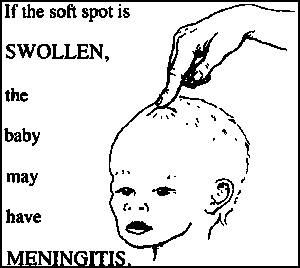
The fontanel is the soft spot on the top of a newborn
baby's head. It is where the bones of his skull have not formed completely.
Normally it takes a year to a year and a half for the soft spot to close
completely.
Mothers in different lands realize that when the soft spot sinks
inward their babies are in danger. They have many beliefs to explain this. In
Latin America mothers think the baby's brains have slipped downward. They try to
correct this by sucking on the soft spot, by pushing up on the roof of the
mouth, or by holding the baby upside down and slapping his feet. This does not
help because... A sunken soft spot is really caused by dehydration.
Figure
This means the child is losing more liquid than he is
drinking. He is too dry - usually because he has diarrhea, or diarrhea with
vomiting.
Treatment:
1. Give the child plenty of liquid: breast milk,
Rehydration Drink made with water, sugar/and salt only or boiled water...
2. If necessary, treat the causes of the diarrhea and vomiting.
For most diarrheas, medicine is not needed, and may do more harm than
good.
TO CURE A SUNKEN SOFT SPOT...
Note: If the soft spot is swollen or bulges
upward, this may be a sign of meningitis. Begin treatment at once, and get
medical
help.
Ways to Tell Whether a Home Remedy Works or Not
Because a lot of people use a home cure does not necessarily
mean it works well or is safe. It is often hard to know which remedies are
helpful and which may be harmful. Careful study is needed to be sure. Here are
four rules to help tell which remedies are least likely to work, or are
dangerous. (Examples are from Mexican villages.)
1. THE MORE REMEDIES THERE ARE FOR ANY ONE ILLNESS, THE LESS
LIKELY IT IS THAT ANY OF THEM WORKS.
For example: In rural Mexico there are many home remedies
for goiter, none of which does any real good. Here are some of them:
1. to tie a crab on the goiter
2. to rub the goiter with the hand
of a dead child
3. to smear the brains of a vulture
on the goiter
4. to smear human feces on the
goiter
Not one of these many remedies works. If it did, the others
would not be needed. When a sickness has just one popular cure, it is more
likely to be - a good one. For prevention and treatment of goiter use
iodized salt.
2. FOUL OR DISGUSTING REMEDIES ARE NOT LIKELY TO HELP - AND
ARE OFTEN HARMFUL.
For example:
1. the idea that leprosy can be
cured by a drink made of rotting snakes
2. the idea that syphilis can be
cured by eating a vulture
These two remedies do not help at all. The first one can cause
dangerous infections. Belief in remedies like these sometimes causes delay in
getting proper medical care.
3. REMEDIES THAT USE ANIMAL OR HUMAN WASTE DO NO GOOD AND CAN
CAUSE DANGEROUS INFECTIONS. NEVER USE THEM.
Examples:
1. Putting human feces around the
eye does not cure blurred vision and can cause infections.
2. Smearing cow dung on the head to
fight ringworm can cause tetanus and other dangerous infections.
Also, the droppings of rabbits or other animals do not help heal
burns. To use them is very dangerous. Cow dung, held in the hand, cannot help
control fits. Teas made from human, pig, or any other animal feces do not cure
anything. They can make people sicker. Never put feces on the navel of a
newborn baby. This can cause tetanus.
4. THE MORE A REMEDY RESEMBLES THE SICKNESS IT IS SAID TO
CURE, THE MORE LIKELY ITS BENEFITS COME ONLY FROM THE POWER OF BELIEF.
The association between each of the following illnesses and its
remedy is clear in these examples from Mexico:
1. for a nosebleed, using yesca
(a bright red mushroom)
2. for deafness, putting powdered
rattlesnake's rattle in the ear
3. for dog bite, drink tea made from
the dog's tail
4. for scorpion sting, tying a
scorpion against the stung finger
5. to prevent diarrhea when a child
is teething, putting a necklace of snake's fangs around the baby's neck
6. to 'bring out' the rash of
measles, making tea from kapok bark
These remedies, and many other similar ones, have no curative
value in themselves. They may be of some benefit if people believe in them. But
for serious problems, be sure their use does not delay more effective
treatment.
Medicinal Plants
Many plants have curative powers. Some of the best modern
medicines are made from wild herbs.
Nevertheless, not all 'curative herbs' people use have medical
value... and those that have are sometimes used the wrong way. Try to learn
about the herbs in your area and find out which ones are worthwhile.
CAUTION! Some medicinal herbs are very poisonous if taken
in more than the recommended dose. For this reason it is often safer to use
modern medicine, since the dosage is easier to control.
Here are a few examples of plants that can be useful if used
correctly:
ANGEL'S TRUMPET (Datura arborea)
The leaves of this and certain other members of the nightshade
family contain a drug that helps to calm intestinal cramps, stomach-aches, and
even gallbladder pain.
Figure
Grind up 1 or 2 leaves of Angel's Trumpet and soak them for a
day in 7 tablespoons (100 ml.) of water.
Dosage: Between 10 and 15 drops every 4 hours (adults
only).
WARNING: Angel's Trumpet is very poisonous if you
take more than the recommended dose.
CORN SILK (the tassels or 'silk' from an ear of maize)
A tea made from corn silk makes a person pass more urine. This
can help reduce swelling of the feet - especially in pregnant women.
Boil a large handful of corn silk in water and drink 1 or 2
glasses. It is not dangerous.
Figure
GARLIC
A drink made from garlic can often get rid of pinworms.
Chop finely, or crush, 4 cloves of garlic and mix with 1 glass
of liquid (water, juice, or milk).
Dosage: Drink 1 glass daily for 3 weeks.
To treat vaginal infections with garlic.
Figure
CARDON CACTUS (Pachycerius pectin-aboriginum)
Cactus juice can be used to clean wounds when there is no boiled
water and no way to get any. Cardon cactus also helps stop a wound from
bleeding, because the juice makes the cut blood vessels squeeze shut.
Figure
Cut a piece of the cactus with a clean knife and press it firmly
against the wound.
Figure
When the bleeding is under control, tie a piece of the cactus to
the wound with a strip of cloth.
Figure
After 2 or 3 hours, take off the cactus and clean the wound with
boiled water and soap. There are more instructions on how to care for wounds and
control bleeding on pages 82 to 87.
ALOE VERA (Sabila)
Aloe vera can be used to treat minor burns and wounds. The
thick, slimy juice inside the plant calms pain and itching, aids healing, and
helps prevent infection. Cut off a piece of the plant, peel back the outer
layer, and apply the fleshy leaf or juice directly to the burn or wound.
Figure
Aloe can also help treat stomach ulcers and gastritis. Chop the
spongy leaves into small pieces, soak them in water overnight, and then drink
one glass of the slimy, bitter liquid every 2 hours.
PAPAYA
Ripe papayas are rich in vitamins and also aid digestion, Eating
them is especially helpful for weak or old people who complain of upset stomach
when they eat meat, chicken, or eggs. Papaya makes these foods easier to digest.
Figure
Papaya can also help get rid of intestinal worms, although
modern medicines often work better. Collect 3 or 4 teaspoons (15-20 ml.) of the
'milk' that comes out when the green fruit or trunk of the tree is cut. Mix this
with an equal amount of sugar or honey and stir it into a cup of hot water. If
possible, drink along with a laxative.
Or, dry and crush to a powder the papaya seeds. Take 3 teaspoons
mixed with 1 glass water or some honey 3 times a day for 7 days.
Papayas can also be used for treating pressure sores. The fruit
contains chemicals that help soften and make dead flesh easier to remove. First
clean and wash out a pressure sore that has dead flesh in it. Then soak a
sterile cloth or gauze with 'milk' from the trunk or green fruit of a papaya
plant and pack this into the sore. Repeat cleaning and repacking 3 times a
day.
Homemade Casts-for Keeping Broken Bones in Place
In Mexico several different plants such astepeguaje (a tree of the bean family) andsolda con solda
(a huge, tree-climbing arum lily) are used to make casts. However, any plant
wilt do if a syrup can be made from it that will dry hard and firm and will not
irritate the skin. In India, traditional bone-setters make casts using a mixture
of egg whites and herbs instead of a syrup made from plant juices. But the
method is similar. Try out different plants in your area.
For a cast using tepeguaje: Put 1 kilogram of the bark
into 5 liters of water and boil it until only 2 liters is left. Strain and boil
it until a thick syrup is formed. Dip strips of flannel or clean sheet in the
syrup and carefully use as follows.
Figure
Make sure the bones are in a good position.
Do not put the cast directly against the skin.
Wrap the arm or leg in a soft cloth.
Then follow with a layer of cotton or wild kapok.
Finally, put on the wet cloth strips so that, they form a cast
that is firm but not too tight.
Figure
Most doctors recommend that the cast cover the joint above and
the joint below the break, to keep the broken bones from moving.
This would mean that, for a broken wrist, the cast
should cover almost the whole arm, like this:
Figure
Leave the finger tips uncovered so that you can see if they keep
a good color.
However, traditional bone-setters in China and Latin America use
a short cast on a simple break of the arm saying that a little movement
of the bone-ends speeds healing. Recent scientific studies have proven this to
be true.
Figure
A temporary leg or arm splint can be made of cardboard, folded
paper, or the thick curved stem of dried banana leaf, or palm leaf.
Figure
CAUTION: Even if the cast is not very tight when
you put it on, the broken limb may swell up later. If the person complains that
the cast is too tight, or if his fingers or toes become cold, white, or blue,
take the cast off and put on a new, looser one.
Never put on a cast over a cut or a
wound.
Enemas, Laxatives, and Purges: When to Use Them and When Not To
Many people give enemas and take laxatives far too often. The
'urge to purge' is world wide.
Enemas and purges are very popular home cures. And they are
often very harmful. Many people believe fever and diarrhea can be 'washed out'
by giving an enema (running water into the gut through the anus) or by
using a purge, or strong laxative. Unfortunately, such efforts to clean
or purge the sick body often cause more injury to the already damaged gut.
Figure
Rarely do enemas or laxatives do any good at all. Often
they are dangerous - especially strong laxatives.
CASES IN WHICH IT IS DANGEROUS TO USE ENEMAS OR
LAXATIVES
Never use an enema or laxative if a person has a severe
stomach-ache or any other sign of appendicitis or 'acute abdomen', even if he
passes days without a bowel movement.
Never give an enema or laxative to a person with a bullet
wound or other injury to the gut.
Never give a strong laxative to a weak or sick person. It
will weaken him more.
Never give an enema or purge to a baby less than 2 years
old.
Never give a laxative or purge to a child with high
fever, vomiting, diarrhea or signs of dehydration. It can increase dehydration
and kill the child.
Do not make a habit of using laxatives often (see
Constipation)
THE CORRECT USES OF ENEMAS
1. Simple enemas can help relieve constipation (dry, hard,
difficult stools). Use warm water only, or water with a little soap in it.
2. When a person with severe vomiting is dehydrated, you can try
replacing water by giving an enema of Rehydration Drink made with water, sugar,
and salt only, very slowly.
PURGES AND LAXATIVES THAT ARE OFTEN USED
CASTOR OIL SENNA LEAF CASCARA (cascara sagrada)
These are irritating purges that often do more harm than good it
is better not to use them
MAGNESIUM CARBONATE MILK OF MAGNESIA EPSOM SALTS
(magnesium sulfate)
These are salt purges. Use them only in low doses, as laxatives
for constipation. Do not use them often and never when there is pain in the
belly.
MINERAL OIL
This is sometimes used for constipation in persons with piles
but it is like passing greased rocks. Not recommended
CORRECT USES OF LAXATIVES AND PURGES
Laxatives are like purges but weaker. All the products listed
above are laxatives when taken in small doses and purges when taken in large
doses. Laxatives soften and hurry the bowel movement; purges cause diarrhea.
Purges: The only time a person should use a strong dose
of a purge is when he has taken a poison and must clean it out quickly. At any
other time a purge is harmful.
Laxatives: One can use milk of magnesia or other
magnesium salts in small doses, as laxatives, in some cases of constipation.
People with hemorrhoids (piles) who have constipation can take mineral
oil but this only makes their stools slippery, pot soft. The dose for mineral
oil is 3 to 6 teaspoons at bedtime (never with a meal because the oil will rob
the body of important vitamins in the food). This is not the best way.
Suppositories, or bullet-shaped pills that can be pushed
up the rectum, can also be used to relieve constipation or piles.
A BETTER WAY
Foods with fiber. The healthiest and most gentle way to
have softer, more frequent stools is to drink a lot of water and to
eat more foods with lots of natural fiber, or 'roughage' like cassava,
yam, or bran (wheat husks) and other whole grain cereals. Eating
plenty of fruits and vegetables also helps.
People who traditionally eat lots of food with natural fiber
suffer much less from piles, constipation, and cancer of the gut than do people
who eat a lot of refined 'modern' foods. For better bowel habits, avoid refined
foods and eat foods prepared from unpolished or unrefined
grains.
Where There Is No Doctor - A Village Health Care Handbook (Hesperian Foundation, 1993, 516 p.)
Chapter 2 - SICKNESSES THAT ARE OFTEN CONFUSED
What Causes Sickness?
Different Kinds of Sicknesses and Their Causes
Non-Infectious Diseases
Infectious Diseases
Sicknesses That Are Hard to Tell Apart
Examples of Local Names for Sicknesses
Misunderstandings Due to Confusion of Names
Confusion between Different Illnesses That Cause Fever
Where There Is No Doctor - A Village Health Care Handbook (Hesperian Foundation, 1993, 516 p.)
Chapter 2 - SICKNESSES THAT ARE OFTEN CONFUSED
What Causes Sickness?
Persons from different countries or backgrounds have different
ways to explain what causes sickness.
A baby gets diarrhea. But why?
People in small villages may say it is because the
parents did something wrong, or perhaps because they made a god or spirit angry.
A doctor may say it is because the child has an
infection.
A public health officer may say it is because the
villagers do not have a good water system or use latrines.
A social reformer may say the unhealthy conditions that
lead to frequent childhood diarrhea are caused by an unfair distribution of land
and wealth.
A teacher may place the blame on lack of education.
Figure
People see the cause of sickness in terms of their own
experience and point of view. Who then is right about the cause? Possibly
everyone is right, or partly right. This is because...
Sickness usually results from a combination of causes.
Each of the causes suggested above may be a part of the reason
why a baby gets diarrhea.
To prevent and treat sickness successfully, it helps to have as
full an understanding as possible about the common sicknesses in your area and
the combination of things that causes them.
In this book, different sicknesses are discussed mostly
according to the systems and terms of modern or scientific medicine.
To make good use of this book, and safe use of the medicines
it recommends, you will need some understanding of sicknesses and their causes
according to medical science. Reading this chapter may help.
“Why my
child?”
Different Kinds of Sicknesses and Their Causes
When considering how to prevent or treat different sicknesses,
it helps to think of them in two groups: infectious and non-infectious.
Infectious diseases are those that spread from one person
to another, Healthy persons must be protected from people with these sicknesses.
Non-infectious diseases do not spread from person to
person. They have other causes. Therefore, it is important to know which
sicknesses are infectious and which are
not.
Non-Infectious Diseases
Non-infectious diseases have many different causes. But they are
never caused by germs, bacteria, or other living organisms that attack the body.
They never spread from one person to another. It is important to realize that
antibiotics, or medicines that fight germs, do not help cure
non-infectious diseases.
Remember:Antibiotics are of no use for
non-infectious diseases.
EXAMPLES OF NON-INFECTIOUS DISEASES
Problems caused by something that wears out or goes wrong
within the body:
rheumatism
heart attack
epileptic fits
stroke
migraine headaches
cataract
cancer
Problems caused by something from outside that harms or
troubles the body:
allergies
asthma
poisons
snakebite
cough from smoking
stomach ulcer
alcoholism
Problems caused by a lack of something the body needs:
malnutrition
anemia
pellagra
night blindness and xerophthalmia
goiter and cretinism
cirrhosis of the liver
(part of the cause)
Problems people are born with:
Problems that begin in the mind (mental 'illnesses'):
harelip
crossed or wall-eyes (squint)
other deformities
epilepsy (some kinds)
retarded (backward) children
birthmarks
fear that something is harmful when it is not (paranoia)
nervous worry (anxiety)
belief in hexes (witchcraft)
uncontrolled fear (hysteria)
Infectious Diseases
Infectious diseases are caused by bacteria and otherorganisms (living things) that harm the body. They are spread in many
ways. Here are some of the most important kinds of organisms that cause
infections and examples of sicknesses they cause:
from someone who is sick, through the air, by coughing, flies,
etc.
aspirin and other painkillers (There are no medicines that fight
viruses effectively. Antibiotics do not help.) Vaccinations help prevent some
virus infections.
rabies
animal bites
warts
touch
fungus
ringworm athlete's foot jock itch
by touch or from clothing
sulfur and vinegar ointments: undecylenic, benzoic, salicylic
acid griseofulvin
internal parasites (harmful animals living in the body)
In the gut: worms amebas (dysentery)
feces-to-mouth lack of cleanliness
different specific medicines
In the blood:
malaria
mosquito bite
chloroquine (or other malaria medicine)
external parasites (harmful animals living on the body)
lice fleas bedbugs scabies
by contact with infected persons or their clothes
insecticides, lindane
Bacteria, like many of the organisms that cause infections,are so small you cannot see them without a microscope - an instrument that
makes tiny things look bigger. Viruses are even smaller than bacteria.
Figure
Antibiotics (penicillin, tetracycline, etc.) are medicines that
help cure certain illnesses caused by bacteria. Antibiotics have no effect on
illnesses caused by most viruses, such as colds, flu, mumps, chickenpox,
etc. Do not treat virus infections with antibiotics. They will not help
and may be harmful (see
Antibiotics).
Sicknesses That Are Hard to Tell Apart
Sometimes diseases that have different causes and require
different treatment result in problems that look very much alike. For example:
1. A child who slowly becomes thin and wasted, while his
belly gets more and more swollen, could have any (or several) of the following
problems:
·
malnutrition · a lot of roundworms, (usually
together with malnutrition) · advanced
tuberculosis · a long-term severe urinary
infection · any of several problems of the
liver or spleen · leukemia (cancer of the
blood)
Figure
2. An older person with a big, open, slowly growing sore on
the ankle could have:
· bad circulation
that results from varicose veins or other causes · diabetes ·
infection of the bone (osteomyelitis) ·
leprosy · tuberculosis of the skin · advanced syphilis
Figure
The medical treatment for each of these diseases is different,
so to treat them correctly it is important to tell them apart.
Many illnesses at first seem very similar. But if you ask the
right questions and know what to look for, you can often learn information and
see certain signs that will help tell you what illness a person has.
This book describes the typical history and signs for many
illnesses. But be careful! Diseases do not always show the signs described for
them - or the signs may be confusing. For difficult cases, the help of a
skilled health worker or doctor is often needed. Sometimes special tests or
analyses are necessary.
Work within your limits!
In using this book, remember it is easy to make
mistakes.
Never pretend you know something you do not.
If you are not fairly sure what an illness is and how to
treat it, or if the illness is very serious - get medical help.
SICKNESSES THAT ARE OFTEN CONFUSED OR GIVEN THE SAME NAME
Many of the common names people use for their sicknesses were
first used long before anyone knew about germs or bacteria or the medicines that
fight them. Different diseases that caused more or less similar problems - such
as 'high fever' or 'pain in the side' - were often given a single name. In many
parts of the world, these common names are still used. City-trained doctors
often neither know nor use these names. For this reason, people sometimes think
they apply to 'sicknesses doctors do not treat'. So they treat these home
sicknesses with herbs or home remedies.
Actually, most of these home sicknesses or 'folk diseases' are
the same ones known to medical science. Only the names are different.
For many sicknesses, home remedies work well. But for some
sicknesses, treatment with modern medicine works much better and may be
life-saving. This is especially true for dangerous infections like
pneumonia, typhoid, tuberculosis, or infections after giving birth.
To know which sicknesses definitely require modern medicines and
to decide what medicine to use, it is important that you try to find out what
the disease is in the terms used by trained health workers and in this book.
If you cannot find the sickness you are looking for in this
book, look for it under a different name or in the chapter that covers the same
sort of problem. Use the list of CONTENTS and the INDEX.
If you are unsure what the sickness is - expecially if it seems
serious - try to get medical help.
The rest of this chapter gives examples of common or
traditional names people use for various sicknesses. Often a single name
is given to diseases that are different according to medical science.
Examples cannot be given for each country or area where this
book may be used. Therefore, I have kept those from the Spanish edition, with
names used by villagers in western Mexico. They will not be the same names you
use. However, people in many parts of the world see and speak of their illnesses
in a similar way. So the examples may help you think about how people name
diseases in your area.
Can you think of a name your people use for the following 'folk
diseases'? If you can, write it in after the Spanish name, where it says.
Name in Your Area:
______________________
Examples of Local Names for Sicknesses
Spanish Name:EMPACHO (STOPPED-UP GUT) Name in
Your Area: ______________________
In medical terms empacho (impaction) means that the gut
is stopped up or obstructed. But in Mexican villages any illness causing
stomach-ache or diarrhea may be called empacho. It is said that a ball of
hair or something else blocks a part of the gut. People put the blame on witches
or evil spirits, and treat with magic cures and cupping (see picture).
Sometimes folk healers pretend to take a ball of hair and thorns out of the gut
by sucking on the belly.
Figure
Different illnesses that cause stomach pain or discomfort and
are sometimes calledempacho are:
· diarrhea or
dysentery with cramps · worms · swollen stomach due to malnutrition · indigestion or stomach ulcer · and rarely, true gut obstruction or
appendicitis
Most of these problems are not helped much by magic cures or
cupping. To treat empacho, try to identify and treat the sickness that
causes it.
Spanish Name:DOLOR DE IJAR (SIDE PAINS) Name in
Your Area: ______________________
This name is used for any pain women get in one side of their
belly. Often the pain goes around to the mid or lower back. Possible causes of
this kind of pain include:
· an infection of
the urinary system (the kidneys, the bladder, or the tubes that join
them) · cramps or gas pains (see
diarrhea) · menstrual pains · appendicitis · an
infection, cyst, or tumor in the womb or ovaries or an out-of-place
pregnancy
Figure
Spanish Name:LA CONGESTION (CONGESTION) Name in
Your Area: ____________________
Any sudden upset or illness that causes great distress is called
la congesti�n by Mexican villagers. People speak of congesti�n of:
the head,
the chest,
the stomach,
or the whole body.
It is said that la congesti�n strikes persons who break
'the diet', by eating foods that are forbidden or taboo after childbirth,
while taking a medicine, or when they have a cold or cough. Although these
foods usually cause no harm and are sometimes just what their bodies need,
many people will not touch them because they are so afraid of getting la
congesti�n.
Different illnesses that are sometimes called la congesti�n
are:
· Food poisoning,
from eating spoiled food: causes sudden vomiting followed by diarrhea, cramps,
and weakness.
· A severe allergic reaction, in
allergic persons after they eat certain foods (shellfish, chocolate, etc.), take
certain medicines, or are injected with penicillin. May cause vomiting,
diarrhea, cold sweat, breathing trouble, itchy rash, and severe distress.
· Any sudden upset of the
stomach or gut: see diarrhea, vomiting, and acute abdomen.
· Sudden or severe difficulty
breathing: caused by asthma, pneumonia, or something stuck in the throat.
· Illnesses that cause fits or
paralysis: see fits, tetanus, meningitis, polio, and stroke.
· Heart attacks: mostly in older
persons.
Spanish Name:LATIDO (PULSING) Name in Your Area:
____________________
Latido is a name used in Latin America for a pulsing or
'jumping' in the pit of the stomach. It is really the pulse of the aorta
or big blood vessel coming from the heart. This pulse can be seen and felt on a
person who is very thin and hungry. Latido is often a sign of
malnutrition - or hunger! Eating enough good food is the only real treatment.
Spanish Name:SUSTO (HYSTERIA, FRIGHT) Name in
Your Area: ____________________
According to Mexican villagers, susto is caused by a
sudden fright a person has had, or by witchcraft, black magic, or evil spirits.
A person with susto is very nervous and afraid. He may shake, behave
strangely, not be able to sleep, lose weight, or even die.
Possible medical explanations for susto:
1. In many people, susto is a state of fear or
hysteria, perhaps caused by the 'power of belief. For example, a woman
who is afraid someone will hex her becomes nervous and does not eat or sleep
well. She begins to grow weak and lose weight. She takes this as a sign she has
been hexed, so she becomes still more nervous and frightened. Her susto gets
worse and worse.
2. In babies or small children, susto is usually very different.
Bad dreams may cause a child to cry out in his sleep or wake up frightened. High
fevers from any illness can cause very strange speech and behavior
(delirium). A child that often looks and acts worried may be
malnourished. Sometimes early signs of tetanus or meningitis are also called
susto.
Treatment:
When the susto is caused by a specific illness, treat the
illness. Help the person understand its cause. Ask for medical advice, if
needed.
When thesusto is caused by fright, try to comfort
the person and help him understand that his fear itself is the cause of his
problem. Magic cures and home remedies sometimes help.
If the frightened person is breathing very hard and fast, his
body may be getting too much air - which may be part of the problem:
EXTREME FRIGHT OR HYSTERIA WITH FAST HEAVY BREATHING
(HYPERVENTILATION)
Signs:
· person very
frightened · breathing fast and
deep · fast, pounding heartbeat · numbness or tingling of face, hands, or
feet · muscle cramps
Figure
Figure
Figure
Treatment:
· Keep the person as
quiet as possible.
· Have her put her face in a
paper bag and breathe slowly. She should continue breathing the same air for 2
or 3 minutes. This will usually calm her down.
· Explain to her that the
problem is not dangerous, and she will soon be all
right.
Misunderstandings Due to Confusion of Names
This page shows 2 examples of misunderstandings that can result
when certain names like 'cancer' and 'leprosy' mean one thing to medical workers
and something else to villagers. In talking with health workers - and in using
this book:
Avoid misunderstanding - go by the signs and history of a
person's sickness, not the name people give it!
Spanish Name:CANCER (CANCER) Name in Your Area:
____________________
Mexican villagers use the word cancer for any severe infection
of the skin, especially badly infected wounds or gangrene.
In modern medical language, cancer is not an infection, but an
abnormal growth or lump in any part of the body. Common types of cancer that you
should watch out for are:
cancer of the skin
breast cancer
cancer of the womb or ovaries
Any hard, painless, slowly growing lump in any part of your body
may be cancer. Cancer is often dangerous and may need surgery.
At the first suspicion of cancer seek medical help.
Spanish Name:LEPRA (LEPROSY) Name in Your Area:
____________________
Mexican villagers call any open spreading sore lepra.
This leads to confusion, because medical workers use this term only for true
leprosy (Hansen's disease). Sores commonly called lepra are:
· impetigo and other
skin infections · sores that come from insect
bites or scabies · chronic sores or skin
ulcers such as those caused by poor circulation · skin cancer · less
commonly, leprosy or tuberculosis of the skin
This child has impetigo, not
leprosy.
Confusion between Different Illnesses That Cause Fever
Spanish Name:LA FIEBRE (THE FEVER) Name in Your
Area: ___________________
Correctly speaking, a fever is a body temperature
higher than normal. But in Latin American, a number of serious illnesses
that cause high temperatures are all called la fiebre - or 'the fever'.
To prevent or treat these diseases successfully, it is important
to know how to tell one from another.
Figure
Here are some of the important acute illnesses in which fever is
an outstanding sign. The drawings show the fever pattern (rise and fall
of temperature) that is typical for each disease.
Malaria:
Begins with weakness, chills and fever. Fever may come and go
for a few days, with shivering (chills) as the temperature rises, and sweating
as it falls. Then, fever may come for a few hours every second or third day. On
other days, the person may feel more or less well.
MALARIA - TYPICAL FEVER
PATTERN
Typhoid:
Begins like a cold. Temperature goes up a little more each day.
Pulse relatively slow. Sometimes diarrhea and dehydration. Trembling or delirium
(mind wanders). Person very ill.
TYPHOID - TYPICAL FEVER
PATTERN
Typhus:
Similar to typhoid. Rash similar to that of measles, with tiny
bruises.
Hepatitis:
Person loses appetite. Does not wish to eat or smoke. Wants to
vomit (nausea). Eyes and skin turn yellow; urine orange or brown; stools
whitish. Sometimes liver becomes large, tender. Mild fever. Person very weak.
HEPATITIS-TYPICAL FEVER
PATTERN
Pneumonia:
Fast, shallow breathing. Temperature rises quickly. Cough with
green, yellow, or bloody mucus. May be pain in chest. Person very ill.
PNEUMONIA - TYPICAL FEVER
PATTERN
Rheumatic fever:
Most common in children and teenagers. Pain in joints. High
fever. Often comes after a sore throat. May be pain in the chest with shortness
of breath. Or uncontrolled movements of arms and legs.
RHEUMATIC FEVER - TYPICAL FEVER
PATTERN
Brucellosis (undulant fever, Malta fever):
Begins slowly with tiredness, headache, and pains in the bones.
Fever and sweating most common at night. Fever disappears for a few days only to
come back again. This may go on for months or years.
BRUCELLOSIS - TYPICAL FEVER
PATTERN
Childbirth fever:
Begins a day or more after giving birth. Starts with a slight
fever, which often rises later. Foul-smelling vaginal discharge. Pain and
sometimes bleeding.
CHILDBIRTH FEVER - TYPICAL FEVER
PATTERN
All of these illnesses can be dangerous. In addition to
those shown here, there are many other diseases (especially in tropical
countries) that may cause similar signs and fevers. These illnesses are not
always easy to tell apart. Most are serious or dangerous. When possible - seek
medical
help.
Where There Is No Doctor - A Village Health Care Handbook (Hesperian Foundation, 1993, 516 p.)
Chapter 3 - HOW TO EXAMINE A SICK PERSON
(introduction...)
Questions
General Condition of Health
Temperature
How to Use a Thermometer
Breathing (Respiration)
Pulse (Heartbeat)
Eyes
Ears, Throat, and Nose
Skin
The Belly (Abdomen)
Muscles and Nerves
Where There Is No Doctor - A Village Health Care Handbook (Hesperian Foundation, 1993, 516 p.)
Chapter 3 - HOW TO EXAMINE A SICK PERSON
To find out the needs of a sick person, first you must ask
important questions and then examine him carefully. You should look for
signs and symptoms that help you tell how ill the person is and
what kind of sickness he may have.
Always examine the person where there is good light, preferably
in the sunlight - never in a dark room.
There are certain basic things to ask and to look for in anyone
who is sick. These include things the sick person feels or reports (symptoms),
as well as things you notice on examining him (signs). These signs can be
especially important in babies and persons unable to talk. In this book the word
'signs' is used for both symptoms and signs.
When you examine a sick person, write down your findings and
keep them for the health worker in case he is
needed.
Questions
Start by asking the person about her sickness. Be sure to ask
the following:
What bothers you most right now?
What makes you feel better or worse?
How and when did your sickness begin?
Have you had this same trouble before, or has anyone else in
your family or neighborhood had it?
Figure
Continue with other questions in order to learn the details of
the illness.
For example, if the sick person has a pain, ask her:
Where does it hurt? (Ask her to point to the exact
place with one finger.)
Does it hurt all the time, or off and on?
What is the pain like? (sharp? dull? burning?)
Can you sleep with the pain?
If the sick person is a baby who still does not talk, look for
signs of pain. Notice his movements and how he cries. (For example, a child with
an earache sometimes rubs the side of his head or pulls at his
ear.)
General Condition of Health
Before touching the sick person, look at him carefully. Observe
how ill or weak he looks, the way he moves, how he breathes, and how clear his
mind seems. Look for signs of dehydration and of shock.
Notice whether the person looks well nourished or poorly
nourished. Has he been losing weight? When a person has lost weight slowly over
a long period of time, he may have a chronic illness (one that lasts a
long time).
Also note the color of the skin and eyes. These sometimes change
when a person is sick. (Dark skin can hide color changes. So look at parts of
the body where the skin is pale, such as palms of the hands or soles of the
feet, the fingernails, or the insides of the lips and eyelids.)
· Paleness,
especially of the lips and inside the eyelids, is a sign of anemia. Skin may
also go lighter as a result of tuberculosis or kwashiorkor.
· Darkening of the skin may be a
sign of starvation.
· Bluish skin, especially
blueness or darkness of the lips and fingernails, may mean serious problems with
breathing or with the heart. Blue-gray color in an unconscious child may be a
sign of cerebral malaria.
· A gray-white coloring, with
cool moist skin, often means a person is in shock.
· Yellow color (jaundice) of the
skin and eyes may result from disease in the liver (hepatitis, cirrhosis, or
amebic abscess) or gallbladder. It may also occur in newborn babies, and in
children born with sickle cell disease.
Look also at the skin when a light is shining across it from one
side. This can show the earliest sign of measles rash on the face of a feverish
child.
Temperature
It is often wise to take a sick person's temperature, even if he
does not seem to have a fever. If the person is very sick, take the temperature
at least 4 times each day and write it down.
Figure
If there is no thermometer, you can get an idea of the
temperature by putting the back of one hand on the sick person's forehead and
the other on your own or that of another healthy person. If the sick person has
a fever, you should feel the difference.
Figure
It is important to find out when and how the fever comes, how
long it lasts, and how it goes away. This may help you identify the disease. Not
every fever is malaria, though in some countries it is often treated as such.
Remember other possible causes. For example:
· Common cold, and
other virus infections. The fever is usually mild.
· Typhoid causes a fever that
goes on rising for 5 days. Malaria medicine does not help.
· Tuberculosis sometimes causes
a mild fever in the afternoon. At night the person often sweats, and the fever
goes
down.
How to Use a Thermometer
Every family should have a thermometer. Take the temperature of
a sick person 4 times a day and always write it down.
How to read the thermometer (using one marked in degrees
centigrade - °C):
Figure
How to take the temperature:
1. Clean the thermometer well with soap and water or alcohol.
Shake it hard, with a snap of the wrist, until it reads less than 36 degrees.
Figure
2. Put the thermometer...
under the tongue (keeping the or
mouth shut)
or
in the armpit if there is danger of
biting the thermometer
or
carefully, in the anus of a small
child (wet or grease it first)
3. Leave it there for 3 or 4 minutes.
4. Read it. (An armpit temperature will read a little lower than
a mouth reading; in the anus it will read a little higher.)
5. Wash the thermometer well with soap and water.
Note: In newborn babies a temperature that is unusually
high or unusually low (below 36°) may mean a serious infection.
· To learn about
other fever patterns. · To learn what to do
for a
fever.
Breathing (Respiration)
Pay special attention to the way the sick person breathes - the
depth (deep or shallow), rate (how often breaths are taken), and difficulty.
Notice if both sides of the chest move equally when she breathes.
If you have a watch or simple timer, count the number of breaths
per minute (when the person is quiet). Between 12 and 20 breaths per minute is
normal for adults and older children. Up to 30 breaths a minute is normal for
children, and 40 for babies. People with a high fever or serious respiratory
illnesses (like pneumonia) breathe more quickly than normal. More than 40
shallow breaths a minute in an adult, or 60 in a small child, usually means
pneumonia.
Listen carefully to the sound of the breaths. For example:
· A whistle or
wheeze and difficulty breathing out can mean asthma.
· A gurgling or snoring noise
and difficult breathing in an unconscious person may mean the tongue, mucus
(slime or pus), or something else is stuck in the throat and does not let enough
air get through.
Look for 'sucking in' of the skin between ribs and at the angle
of the neck (behind the collar bone) when the person breathes in. This means air
has trouble getting through. Consider the possibility of something stuck in the
throat, pneumonia, asthma, or bronchitis (mild sucking in).
If the person has a cough, ask if it keeps her from sleeping.
Find out if she coughs up mucus, how much, its color, and if there is blood in
it.
Pulse (Heartbeat)
To take the person's pulse, put your
fingers on the wrist as shown. (Do not use your thumb to feel for the pulse.)
If you cannot find the pulse in the
wrist, feel for it in the neck beside the voicebox,
or put your ear directly on the
chest and listen for the heartbeat (or use a stethoscope if you have one).
Pay attention to the strength, the rate, and the regularity of
the pulse. If you have a watch or timer, count the pulses per minute.
NORMAL PULSE FOR PEOPLE AT REST
adults
from 60 to 80 per minute
children
80 to 100
babies
100 to 140
The pulse gets much faster with exercise and when a person is
nervous, frightened, or has a fever. As a general rule, the pulse increases 20
beats per minute for each degree (°C) rise in fever.
When a person is very ill, take the pulse often and write it
down along with the temperature and rate of breathing.
It is important to notice changes in the pulse rate. For
example:
· A weak, rapid
pulse can mean a state of shock. · A very
rapid, very slow, or irregular pulse could mean heart trouble. · A relatively slow pulse in a person with a high fever
may be a sign of
typhoid.
Eyes
Look at the color of the white part of the eyes. Is it normal,
red, or yellow? Also note any changes in the sick person's vision.
Have the person slowly move her eyes up and down and from side
to side. Jerking or uneven movement may be a sign of brain damage.
Pay attention to the size of the pupils (the black
'window' in the center of the eye). If they are very large, it can mean a state
of shock. If they are very large, or very small, it can mean poison or the
effect of certain drugs.
Look at both eyes and note any difference between the two,
especially in the size of the pupils:
Figure
A big difference in the size of the pupils is almost always a
medical emergency.
· If the eye with
the larger pupil hurts so badly it causes vomiting, the person probably has
GLAUCOMA.
· If the eye with the smaller
pupil hurts a great deal, the person may have IRITIS, a very serious problem.
· Difference in the size of the
pupils of an unconscious person or a person who has had a recent head injury may
mean brain damage. It may also mean STROKE.
Always compare the pupils of a person who is unconscious or
has had a head
injury.
Ears, Throat, and Nose
Ears: Always check for signs of pain and infection in the
ears - especially in a child with fever or a cold. A baby who cries a lot or
pulls at his ear often has an ear infection.
Pull the ear gently. If this increases pain, the infection is
probably in the tube of the ear (ear canal). Also look for redness or pus inside
the ear. A small flashlight or penlight will help. But never put a stick, wire,
or other hard object inside the ear.
Figure
Find out if the person hears well, or if one side is more deaf
than the other. Rub your thumb and fingers together near the person's ear to see
if he can hear it. For deafness and ringing of the ears see chapter 22.
Throat and Mouth: With a torch (flashlight) or sunlight
examine the mouth and throat. To do this hold down tongue with a spoon handle or
have the person say 'ahhhhh...' Notice if the throat is red and if the tonsils
(2 lumps at the back of the throat) are swollen or have spots with pus. Also
examine the mouth for sores, inflamed gums, sore tongue, rotten or abscessed
teeth and other problems. (Read Chapter 17.)
Nose: Is the nose runny or plugged? (Notice if and how a
baby breathes through his nose.) Shine a light inside and look for mucus, pus,
blood; also look for redness, swelling, or bad smell. Check for signs of sinus
trouble or
hayfever.
Skin
It is important to examine the sick person's whole body, no
matter how mild the sickness may seem. Babies and children should be undressed
completely. Look carefully for anything that is not normal, including:
· sores, wounds, or
splinters · rashes or welts · spots, patches, or any unusual markings · inflammation (sign of infection with redness,
heat, pain and swelling) · swelling or
puffiness · swollen lymph nodes
(little lumps in the neck, the armpits, or the groin) · abnormal lumps or masses · unusual thinning or loss of hair, or loss of its
color or shine · loss of eyebrows
(leprosy?)
Always examine little children between the buttocks, in the
genital area, between the fingers and toes, behind the ears, and in the hair
(for lice, scabies, ringworm, rashes, and sores).
Figure
The Belly (Abdomen)
If a person has pain in the belly, try to find out exactly where
it hurts.
Learn whether the pain is steady or whether it suddenly comes
and goes, like cramps or colic.
When you examine the belly, first look at it for any unusual
swelling or lumps.
The location of the pain often gives a clue to the cause (see
the following page).
First, ask the person to point with
one finger where it hurts.
Then, beginning on the opposite side
from the spot where he has pointed, press gently on different parts of the belly
to see where it hurts most.
See if the belly is soft or hard and whether the person can
relax his stomach muscles, A very hard belly could mean an acute abdomen -
perhaps appendicitis or peritonitis.
If you suspect peritonitis or appendicitis, do the test for
rebound pain.
Feel for any abnormal lumps and hardened areas in the belly.
If the person has a constant pain in the stomach, with nausea,
and has not been able to move her bowels, put an ear (or stethoscope) on the
belly, like this:
Listen for gurgles in the
intestines. If you hear nothing after about 2 minutes, this is a danger sign.
(See Emergency Problems of the Gut, p. 93.)
A silent belly is like a silent dog. Beware!
These pictures show the areas of the belly that usually hurt
when a person has the following problems:
Ulcer
Appendicitis
Gallbladder
Liver
Urinary system
Inflammation or tumor of the
ovaries, or out-of-place pregnancy,
etc.
Muscles and Nerves
If a person complains of numbness, weakness, or loss of control
in part of his body, or you want to test it: notice the way he walks and moves.
Have him stand, sit, or lie completely straight, and carefully compare both
sides of his body.
Face: Have him smile, frown, open his eyes wide, and
squeeze them shut. Notice any drooping or weakness on one side.
Figure
If the problem began more or less suddenly, think of a head
injury, stroke, or Bell's palsy.
If it came slowly, it may be a brain tumor. Get medical advice.
Also check for normal eye movement, size of pupils, and how well
he can see.
Arms and legs: Look for loss of muscle. Notice - or
measure - difference in thickness of arms or legs.
Have him squeeze your fingers to
compare strength in his hands
and push and pull with his feet
against your hand.
Any string or ribbon will do to
check if the distance around the arms or legs is different.
Also have him hold his arms straight
out and turn his hands up and down
Note any weakness or trembling
Have him lie down and lift one leg
and then the other
Watch how he moves and walks. If muscle loss or weakness affects
the whole body, suspect malnutrition or a chronic.(long-term) illness like
tuberculosis.
If muscle loss and weakness is uneven or worse on one side, in
children, think first of polio; in adults, think of a back problem, a back or
head injury, or stroke.
For more information on muscle testing and physical examination
of disabled persons, see Disabled Village Children, Chapter 4.
Check for stiff ness or tightness of different muscles:
· If the jaw is stiff or will
not open, suspect tetanus or a severe infection of the throat or of a tooth. If
the problem began after he yawned or was hit in the jaw, he may have a
dislocated jaw.
Figure
· If the neck or back is stiff
and bent backwards, in a very sick child, suspect meningitis. If the head will
not bend forward or cannot be put between the knees, meningitis is likely.
Figure
· If a child always has
some stiff muscles and makes strange or jerky movements, he may be
spastic.
· If strange or jerky movements
come suddenly, with loss of consciousness, he may have fits. If fits happen
often, think of epilepsy. If they happen when he is ill, the cause may be high
fever or dehydration or tetanus or meningitis.
Figure
To check for loss of feeling in the hands, feet, or other
parts of the body:
Have the person cover his eyes. Lightly touch or prick the skin
in different places. Ask him to say 'yes' when he feels it.
· Loss of feeling in
or near spots or patches on the body is probably leprosy. · Loss of feeling in both hands or feet may be due to
diabetes or leprosy. · Loss of feeling on one
side only could come from a back problem or injury.
Figure
Where There Is No Doctor - A Village Health Care Handbook (Hesperian Foundation, 1993, 516 p.)
Chapter 4 - HOW TO TAKE CARE OF A SICK PERSON
(introduction...)
The Comfort of the Sick Person
Special Care for a Person Who Is Very Ill
Liquids
Food
Cleanliness and Changing Position in Bed
Watching for Changes
Signs of Dangerous Illness
When and How to Look for Medical Help
What to Tell the Health Worker
Patient Report
Where There Is No Doctor - A Village Health Care Handbook (Hesperian Foundation, 1993, 516 p.)
Chapter 4 - HOW TO TAKE CARE OF A SICK PERSON
Sickness weakens the body. To gain strength and get well
quickly, special care is needed.
The care a sick person receives is frequently the most
important part of his treatment.
Medicines are often not necessary. But good care is always
important. The following are the basis of good
care:
The Comfort of the Sick Person
1. The Comfort of the Sick Person
A person who is sick should rest in a quiet, comfortable place
with plenty of fresh air and light. He should keep from getting too hot or cold.
If the air is cold or the person is chilled, cover him with a sheet or blanket.
But if the weather is hot or the person has a fever, do not cover him at all.
Figure
2. Liquids
In nearly every sickness, especially when there is fever or
diarrhea, the sick person should drink plenty of liquids: water, tea, juices,
broths, etc.
Figure
3. Personal Cleanliness
It is important to keep the sick person clean. He should be
bathed every day. If he is too sick to get out of bed, wash him with a sponge or
cloth and lukewarm water. His clothes, sheets, and covers must also be kept
clean. Take care to keep crumbs and bits of food out of the bed.
A SICK PERSON SHOULD BE BATHED EACH
DAY
4. Good Food
If the sick person feels like eating, let him. Most sicknesses
do not require special diets.
A sick person should drink plenty of liquids and eat a lot of
nourishing food (see Chapter 11).
If the person is very weak, give him as much nourishing food as
he can eat, many times a day. If necessary, mash the foods, or make them into
soups or juices.
Figure
Energy foods are especially important - for example, porridges
of rice, wheat, oatmeal, potato, or cassava. Adding a little sugar and vegetable
oil will increase the energy. Also encourage the sick person to drink plenty of
sweetened drinks, especially if he will not eat much.
A few problems do require special diets:
stomach ulcers and heartburn appendicitis, gut
obstruction, acute abdomen (in these cases take no food at
all) diabetes heart problems gallbladder
problems
Special Care for a Person Who Is Very Ill
Figure
Liquids
1. Liquids
It is extremely important that a very sick person drink enough
liquid. If he only can drink a little at a time, give him small amounts often.
If he can barely swallow, give him sips every 5 or 10 minutes.
Measure the amount of liquids the person drinks each day. An
adult needs to drink 2 liters or more every day and should urinate at least a
cup (60 cc.) of urine 3 or 4 times daily. If the person is not drinking or
urinating enough, or if he begins to show signs of dehydration, encourage him to
drink more. He should drink nutritious liquids, usually with a little
salt added. If he will not drink these, give him a Rehydration Drink. If he
cannot drink enough of this, and develops signs of dehydration, a health
worker may be able to give him intravenous solution. But the need for
this can usually be avoided if the person is urged to take small sips
often.
Food
2. Food
If the person is too sick to eat solid foods, give her soups,
milk, juices, broths, and other nutritious liquids (see Chapter 11). A porridge
of cornmeal, oatmeal, or rice is also good, but should be given together with
body-building foods. Soups can be made with egg, beans, or well-chopped meat,
fish, or chicken. If the person can eat only a little at a time, she should eat
several small meals each
day.
Cleanliness and Changing Position in Bed
3. Cleanliness
Personal cleanliness is very important for a seriously ill
person. She should be bathed every day with warm water.
Change the bed clothes daily and each time they become dirty.
Soiled or bloodstained clothes, bedding, and towels of a person with an
infectious disease should be handled with care. To kill any viruses or germs,
wash these in hot soapy water, or add some chlorine bleach.
4. Changing Position in Bed
A person who is very weak and cannot turn over alone should be
helped to change position in bed many times each day. This helps prevent bed
sores.
A child who is sick for a long time should be held often on her
mother's lap.
Frequent changing of the person's position also helps to prevent
pneumonia, a constant danger for anyone who is very weak or ill and must stay in
bed for a long time. If the person has a fever, begins to cough, and breathes
with fast, shallow breaths, she probably has
pneumonia.
Watching for Changes
5. Watching for Changes
You should watch for any change in the sick person's condition
that may tell you whether he is getting better or worse. Keep a record of his
'vital signs'. Write down the following facts 4 times a day:
temperature (how many degrees)
pulse (beats per minute)
breathing (breaths per minute)
Also write down the amount of liquids the person drinks and how
many times a day he urinates and has a bowel movement. Save this information for
the health worker or doctor.
It is very important to look for signs that warn you that the
person's sickness is serious or dangerous. A list of Signs of Dangerous
Illness is on the next page. If the person shows any of these signs, seek
medical help
immediately.
Signs of Dangerous Illness
Figure
A person who has one or more of the following signs is probably
too sick to be treated at home without skilled medical help. His life may be in
danger. Seek medical help as soon as possible.
1. Loss of large amounts of blood from anywhere in
the body
2. Coughing up blood
3. Marked blueness of lips and nails (if it is new)
4. Great difficulty in breathing; does not improve with rest
5. The person cannot be wakened (coma)
6. The person is so weak he faints when he stands up
7. A day or more without being able to urinate
8. A day or more without being able to drink any liquids
9. Heavy vomiting or severe diarrhea that lasts for more than
one day or more than a few hours in babies
10. Black stools like tar, or vomit with blood or feces
11. Strong, continuous stomach pains with vomiting in a person
who does not have diarrhea or cannot have a bowel movement
12. Any strong continuous pain that lasts for more than 3 days
13. Stiff neck with arched back, with or without a stiff jaw
14. More than one fit (convulsions) in someone with fever or
serious illness
15. High fever (above 39° C) that cannot be brought down or
that lasts more than 4 or 5 days
16. Weight loss over an extended time
17. Blood in the urine
18. Sores that keep growing and do not go away with treatment
19. A lump in any part of the body that keeps getting bigger
20. Problems with pregnancy and childbirth: any bleeding during
pregnancy swollen face and trouble seeing in the last months long delay once the
waters have broken and labor has begun severe
bleeding
When and How to Look for Medical Help
Seek medical help at the first sign of a dangerous illness. Do
not wait until the person is so sick that it becomes difficult or impossible to
take him to a health center or hospital.
If a sick or injured person's condition could be made worse by
the difficulties in moving him to a health center, try to bring a health worker
to the person. But in an emergency when very special attention or an operation
may be needed (for example, appendicitis), do not wait for the health worker.
Take the person to the health center or the hospital at once.
When you need to carry a person on a stretcher, make sure he is
as comfortable as possible and cannot fall out. If he has any broken bones,
splint them before moving him. If the sun is very strong, rig a sheet over the
stretcher to give shade yet allow fresh air to pass underneath
Figure
What to Tell the Health Worker
For a health worker or doctor to recommend treatment or
prescribe medicine wisely, she should see the sick person. If the sick person
cannot be moved, have the health worker come to him. If this is not possible,
send a responsible person who knows the details of the illness. Never send a
small child or a fool.
Before sending for medical help, examine the sick person
carefully and completely. Then write down the details of his disease and general
condition (see Chapter 3).
On the next page is a form on which you can make a PATIENT
REPORT. Several copies of this form are at the end of this book. Tear out one of
these forms and carefully complete the report, giving all the details you can.
When you send someone for medical help, always send a
completed information form with him.
Patient Report
TO USE WHEN SENDING FOR MEDICAL HELP
Name of the sick person: ________________________ Age:
_________ Male _____ Female _____ Where is he (she)?
_____________________ What is the main sickness or problem right now?
___________________ ___________________________________________________________ ___________________________________________________________ ___________________________________________________________ When
did it begin? ___________________________________________ How did it begin?
____________________________________________ Has the person had the same
problem before? ____ When? ___________ Is there fever? ____ How high? ____
When and for how long? ________ Pain? ________Where? ____________________What
kind? _________
What is wrong or different from normal in any of the
following?
Skin: _________________________ Ears:
_______________________ Eyes: ________________________Mouth and
throat: _____________ Genitals:
__________________________________________________ Urine: Much or
little? __________Color? ______ Trouble urinating? __ Describe:
________________ Times in 24 hours: ___Times at night: ___ Stools:
Color? _____________ Blood or mucus? _______ Diarrhea?____ Number of times a
day: ____ Cramps? ____ Dehydration? _____ Mild or severe?
______________Worms? ____ What kind? _________________ Breathing:
Breaths per minute: _____ Deep, shallow, or normal? ______ Difficulty
breathing (describe): _____________ Cough (describe): _____ _______________
Wheezing? _____ Mucus? _____ With blood? ______ Does the person have any
of the SIGNS OF DANGEROUS ILLNESS? __________ Which? (give details)
_______________________________ Other signs:
________________________________________________ Is the person taking
medicine? ______ What? ______________________ Has the person ever used
medicine that has caused a rash, hives (or bumps) with itching, or other
allergic reactions? ______ What? _______________ The state of the sick person
is: Not very serious: ______ Serious: _______ Very serious: ______________
On the back of this form write any other information you
think may be
important.
Where There Is No Doctor - A Village Health Care Handbook (Hesperian Foundation, 1993, 516 p.)
Chapter 5 - HEALING WITHOUT MEDICINES
(introduction...)
Healing with Water
Times When the Right Use of Water May Do More Good than Medicines
Where There Is No Doctor - A Village Health Care Handbook (Hesperian Foundation, 1993, 516 p.)
Chapter 5 - HEALING WITHOUT MEDICINES
For most sicknesses no medicines are needed. Our bodies have
their own defenses, or ways to resist and fight disease. In most cases, these
natural defenses are far more important to our health than are medicines.
People will get well from most sicknesses - including the
common cold and 'flu' - by themselves, without need for medicines.
To help the body fight off or overcome a sickness, often all
that is needed is to:
keep clean
get plenty of rest
eat well and drink a lot of liquid
Even in a case of more serious illness, when a medicine may be
needed, it is the body that must overcome the disease; the medicine only
helps. Cleanliness, rest, nutritious food, and lots of water are still very
important.
Much of the art of health care does not - and should not -
depend on use of medications. Even if you live in an area where there are no
modern medicines, there is a great deal you can do to prevent and treat most
common sicknesses - if you learn how.
Many sicknesses can be prevented or treated without
medicines.
If people simply learned how to use water correctly, this
alone might do more to prevent and cure illnesses than all the medicines they
now use... and
misuse.
Healing with Water
Most of us could live without medicines. But no one can live
without water. In fact, over half (57%) of the human body is water. If everyone
living in farms and villages made the best use of water, the amount of sickness
and death - especially of children - could be reduced.
For example, correct use of water is basic both in the
prevention and treatment of diarrhea. In many areas diarrhea is the most common
cause of sickness and death in small children.Contaminated
(unclean) water is often part of the cause.
An important part of the prevention of diarrhea and many other
illnesses is to make sure that drinking water is safe. Protect wells and springs
from dirt and animals by putting fences or walls around them. Use cement or rock
to provide good drainage around the well or spring, so that rain or spilled
water runs away from it.
Where water may be contaminated, an important part of the
prevention of diarrhea is to boil or filter the water used for drinking or for
preparing foods. This is especially important for babies. Babies' bottles and
eating utensils should also be boiled. If regular boiling of bottles is not
possible, it is safer to use a cup and spoon. Washing hands with soap and water
after a bowel movement (shifting) and before eating or handling foods is also
important.
PREVENTION
A common cause of death in children with diarrhea is severe
dehydration, or loss of too much water from the body. By giving a child
with diarrhea plenty of water (best with sugar or cereal and salt), dehydration
can often be prevented or corrected (see Rehydration Drink).
TREATMENT
Giving lots of liquids to a child with diarrhea is more
important than any medicine. In fact, if enough liquid is given, no medicine
is usually needed in the treatment of diarrhea.
On the next 2 pages are a number of other situations in which
it is often more important to use water correctly than to use
medicines.
Times When the Right Use of Water May Do More Good than Medicines
drink a lot of water and breathe hot water vapors (to loosen
mucus)
Figure
6. sores, impetigo, ringworm of skin or scalp, cradle cap,
pimples
scrub with soap and clean water
Figure
7. infected wounds, abscesses, boils
hot soaks or compresses
8. stiff, sore muscles and joints
hot compresses
Figure
9. itching, burning, or weeping irritations of the skin
cold compresses
10. minor burns
hold in cold water at once
Figure
11. sore throat or tonsillitis
gargle with warm salt water
12. acid, lye, dirt, or irritating substance in eye
flood eye with cool water at once, and continue for 30 minutes
Figure
13. stuffed up nose
sniff salt water
Figure
14. constipation, hard stools
drink lots of water (also, enemas are safer than laxatives, but
do not overuse)
15. cold sores or fever blisters
hold ice on blister for 1 hr. at first sign
Figure
In each of the above cases (except pneumonia) when water is used
correctly, often medicines are not needed. In this book you will find many
suggestions for ways of healing without need for medicine. Use medicines only
when absolutely
necessary.
Where There Is No Doctor - A Village Health Care Handbook (Hesperian Foundation, 1993, 516 p.)
Chapter 6 - RIGHT AND WRONG USES OF MODERN MEDICINES
(introduction...)
Guidelines for the Use of Medicine
The Most Dangerous Misuse of Medicine
When Should Medicine Not Be Taken?
Where There Is No Doctor - A Village Health Care Handbook (Hesperian Foundation, 1993, 516 p.)
Chapter 6 - RIGHT AND WRONG USES OF MODERN MEDICINES
Some medicines sold in pharmacies or village stores can be very
useful. But many are of no value. Of the 60,000 medicines sold in most
countries, the World Health Organization says that only about 200 are necessary.
Also, people sometimes use the best medicines in the wrong way,
so that they do more harm than good. To be helpful, medicine must be used
correctly.
Many people, including most doctors and health workers,
prescribe far more medicines than are needed - and by so doing cause much
needless sickness and death.
There is some danger in the use of any medicine.
Some medicines are much more dangerous than others.
Unfortunately, people sometimes use very dangerous medicines for mild
sicknesses. (I have seen a baby die because his mother gave him a dangerous
medicine, chloramphenicol, for a cold.) Never use a dangerous medicine for a
mild illness.
REMEMBER: MEDICINES CAN
KILL
Guidelines for the Use of Medicine
Guidelines for the use of medicine:
1. Use medicines only when necessary. 2. Know the
correct use and precautions for any medicine you use (see the GREEN
PAGES). 3. Be sure to use the right dose. 4. If the medicine does not
help, or causes problems, stop using it. 5. When in doubt, seek the advice of
a health worker.
Note: Some health workers and many doctors give medicines
when none is needed, often because they think patients expect medicine and will
not be satisfied until they get some. Tell your doctor or health worker you only
want medicine if it is definitely needed. This will save you money and be safer
for your health.
Only use a medicine when you are sure it is needed and when
you are sure how to use it.
The Most Dangerous Misuse of Medicine
Here is a list of the most common and dangerous errors people
make in using modern medicines. The improper use of the following medicines
causes many deaths each year. BE CAREFUL!
1. Chloramphenicol(Chloromycetin)
The popular use of this medicine for simple diarrhea and other
mild sicknesses is extremely unfortunate, because it is so risky. Use
chloramphenicol only for very severe illnesses, like typhoid. Never give it to
newborn babies.
2. Oxytocin(Pitocin), Pituitrin, and
Ergonovine(Ergotrate)
Unfortunately, some midwives use these medicines to speed up
childbirth or 'give strength' to the mother in labor. This practice is very
dangerous. It can kill the mother or the child. Use these medicines only
to control bleeding after the child is born.
3. Injections of any medicine
The common belief that injections are usually better than
medicine taken by mouth is not true. Many times medicines taken by mouth
work as well as or better than injections. Also, most medicine is more
dangerous injected than when taken by mouth. Injections given to a child who
has a mild polio infection (with only signs of a cold) can lead to paralysis.
Use of injections should be very limited (read Chapter 9 carefully).
4. Penicillin
Penicillin works only against certain types of
infections. Use of penicillin for sprains, bruises, or any pain or fever
is a great mistake. As a general rule, injuries that do not break the skin, even
if they make large bruises, have no danger of infection; they do not need to be
treated with penicillin or any other antibiotic. Neither penicillin nor other
antibiotics helps colds.
Penicillin is dangerous for some people. Before using it, know
its risks and the precautions you must take.
5. Kanamycin and Gentamicin(Garamycin)
Too much use of these antibiotics for babies has caused
permanent hearing loss (deafness) in millions of babies. Give to babies only for
life-threatening infections. For many infections of the newborn, ampicillin
works as well and is much less dangerous.
6. Anti-diarrhea medicines with hydroxyquinolines
(Clioquinol, di-iodohydroxyquinoline, halquinol, broxyquinoline:Diodoquin, Enteroquinol, Amicline, Quogyl, and many other brand names)
In the past clioquinols were widely used to treat
diarrhea. These dangerous medicines are now prohibited in many countries - but
in others are still sold. They can cause permanent paralysis, blindness, and
even death. For treatment of diarrhea, see Chapter 13.
7. Cortisone and cortico-steroids (Prednisolone,
dexamethasone, and others)
These are powerful anti-inflammatory drugs that are occasionally
needed for severe attacks of asthma, arthritis, or severe allergic reactions.
But in many countries, steroids are prescribed for minor aches and pains because
they often give quick results. This is a big mistake. Steroids cause serious or
dangerous side effects - especially if used in high doses or for more than a few
days. They lower a person's defenses against infection. They can make
tuberculosis much worse, cause bleeding of stomach ulcers, and make bones so
weak that they break easily.
8. Anabolic steroids (Nandrolone decanoate,Durabolin, Deca-Durabolin, Orabolin; stanozolol,Cetabon; oxymetholone,Anapolon; ethylestrenol,Organaboral. There are many other brand names.)
Anabolic steroids are made from male hormones and are mistakenly
used in tonics to help children gain weight and grow. At first the child may
grow faster, but he will stop growing sooner and end up shorter than he would
have if he had not taken the medicine. Anabolic steroids cause very dangerous
side effects. Girls grow hair on their faces like boys, which does not go away,
even when the child stops taking the medicine. Do not give growth tonics to
children. Instead, to help your child grow, use the money to buy food.
9. Arthritis medicines (Butazones:
oxyphenbutazone,Amidozone; and phenylbutazone,Butazolidin)
These medicines for joint pain (arthritis) can cause a
dangerous, sometimes deadly, blood disease (agranulocytosis). They can also
damage the stomach, liver, and kidneys. Do not use these dangerous
medicines. For arthritis, aspirin or ibuprofen is much safer and cheaper.
For pain and fever only, acetaminophen can be used.
10. Vitamin B12, liver extract, and iron
injections
Vitamin B12 and liver extract do not help anemia or
'weakness' except in rare cases. Also, they have certain risks when injected.
They should only be used when a specialist has prescribed them after testing
the blood. Also, avoid injectable iron, such as Imferon. To combat
anemia, iron pills are safer and work as well.
11. Other vitamins
As a general rule, DO NOT INJECT VITAMINS. Injections are more
dangerous, more expensive, and usually no more effective than pills.
Unfortunately, many people waste their money on syrups, tonics,
and 'elixirs' that contain vitamins. Many lack the most important vitamins. But
even when they contain them, it is wiser to buy more and better food.
Body-building and protective foods like beans, eggs, meat, fruit, vegetables,
and whole grains are rich in vitamins and other nutrients. Giving a thin, weak
person good food more often will usually help him far more than giving him
vitamin and mineral supplements.
A person who eats well does not need extra vitamins.
THE BEST WAY TO GET VITAMINS:
For more information about vitamins, when they are necessary,
and the foods that have them, read Chapter 11.
12. Combination medicines
Sometimes, 2 or more medicines are combined in the same pill or
tonic. Usually they are less effective, and more expensive, when prepared this
way. Sometimes they do more harm than good. If someone wants to prescribe
combination medicines, ask him or her to prescribe only the medicine that is
really necessary. Do not waste your money on these medicines.
Some common combination medicines that should be avoided
are:
· cough
medicines which contain medicines both to suppress a cough and also to get
rid of mucus. (Cough medicines are almost always useless and a waste of money,
whether or not they combine medicines.)
· antibiotics combined
with anti-diarrhea medicine
· antacids to treat
stomach ulcers together with medicine to prevent stomach cramps
· 2 or more pain
medicines (aspirin with acetaminophen - sometimes also with
caffeine)
13. Calcium
Injecting calcium into a vein can be extremely dangerous. It can
quickly kill someone if not injected very slowly. Injecting calcium into
the buttocks sometimes causes very serious abscesses or infections.
Never inject calcium without first seeking medical
advice!
Note: In Mexico and other countries where people eat a
lot of corn tortillas or other foods prepared with lime, it is foolish to use
calcium injections or tonics (as is often done to 'give strength' or 'help
children grow'). The body gets all the calcium it needs from the lime.
14. 'Feeding' through the veins (Intravenous or 'I.V.'
solutions)
In some areas, persons who are anemic or very weak spend their
last penny to have a liter of I.V. solution put into their veins. They believe
that this will make-them stronger or their blood richer. But they are wrong!
Intravenous solution is nothing more than pure water with some salt or sugar in
it. It gives less energy than a large candy bar and makes the blood thinner, not
richer. It does not help anemia or make the weak person stronger.
Also when a person who is not well trained puts the I.V.
solution into a vein, there is danger of an infection entering the blood. This
can kill the sick person.
Intravenous solution should be used only when a person can take
nothing by mouth, or when she is badly dehydrated.
If the sick person can swallow, give her a liter of water
with sugar (or cereal) and salt (see Rehydration Drink). It will do as much for
her as injecting a liter of I.V. solution. For people who are able to eat,
nutritious foods do more to strengthen them than any type of I.V. fluid.
If a sick person is able to swallow and keep down
liquids...
Figure
When Should Medicine Not Be Taken?
Many people have beliefs about things they should not do or eat
when taking medicines. For this reason they may stop taking a medicine they
need. In truth, no medicine causes harm just because it is taken with certain
foods - whether pork, chili pepper, guava, oranges, or any other food. But foods
with lots of grease or spices can make problems of the stomach or gut worse -
whether or not any medicine is being taken. Certain medicines will cause bad
reactions if a person drinks alcohol (see metronidazole).
There are situations when, without a doubt, it is best
not to use certain medicines:
1. Pregnant women or women who are breast feeding
should avoid all medicines that are not absolutely necessary. (However, they can
take limited amounts of vitamins or iron pills without danger.)
Figure
2. With newborn children, be very careful when using medicines.
Whenever possible look for medical help before giving them any type of medicine.
Be sure not to give too much.
3. A person who has ever had any sort of allergic reaction -
hives, itching, etc. - after taking penicillin, ampicillin, a
sulfonamide, or other medicines, should never use that medicine again for the
rest of his life because it would be dangerous (see Dangerous reactions from
injections of certain medicines).
Figure
4. Persons who have stomach ulcers or heartburn should avoid
medicines that contain aspirin. Most painkillers, and all steroids make ulcers
and acid indigestion worse. One painkiller that does not irritate the stomach is
acetaminophen (paracetamol).
Figure
5. There are specific medicines that are harmful or dangerous to
take when you have certain illnesses. For example, persons with hepatitis should
not be treated with antibiotics or other strong medicines, because their liver
is damaged, and the medicines are more likely to poison the body.
6. Persons who are dehydrated or have disease of the kidneys
should be especially careful with medicines they take. Do not give more than one
dose of a medicine that could poison the body unless (or until) the person is
urinating normally. For example, if a child has high fever and is dehydrated, do
not give him more than one dose of acetaminophen or aspirin until he begins to
urinate. Never give sulfa to a person who is
dehydrated.
Where There Is No Doctor - A Village Health Care Handbook (Hesperian Foundation, 1993, 516 p.)
Chapter 7 - ANTIBIOTICS: WHAT THEY ARE AND HOW TO USE THEM
(introduction...)
Guidelines for the Use of Antibiotics
What to Do if an Antibiotic Does Not Seem to Help
Importance of Limited Use of Antibiotics
Where There Is No Doctor - A Village Health Care Handbook (Hesperian Foundation, 1993, 516 p.)
Chapter 7 - ANTIBIOTICS: WHAT THEY ARE AND HOW TO USE THEM
When used correctly, antibiotics are extremely useful and
important medicines. They fight certain infections and diseases caused bybacteria. Well-known antibiotics are penicillin, tetracycline,
streptomycin, chloramphenicol, and the sulfa drugs, or sulfonamides.
The different antibiotics work in different ways against
specific infections. All antibiotics have dangers in their use, but some are far
more dangerous than others. Take great care in choosing and using
antibiotics.
There are many kinds of antibiotics, and each kind is sold under
several 'brand names'. This can be confusing. However, the most important
antibiotics fall into a few major groups:
antibiotic group (generic name)
examples of brand names
brand names in your area (write in)
PENICILLINS
Pen-V-K
___________________
AMPICILLINS*
Penbritin
___________________
TETRACYCLINES
Terramycin
___________________
SULFAS (SULFONAMIDES)
Gantrisin
___________________
CO-TRIMOXAZOLE
Bactrim
___________________
STREPTOMYCIN, etc.
Ambistryn
___________________
CHLORAMPHENICOL
Chloromycetin
___________________
ERYTHROMYCIN
Erythrocin
___________________
CEPHALOSPORINS
Keflex
___________________
* Note: Ampicillin is a type of penicillin
that kills more kinds of bacteria than do ordinary penicillins.
If you have a brand-name antibiotic and do not know to which
group it belongs, read the fine print on the bottle or box. For example, if you
have some Paraxin 'S' but do not know what is in it, read the fine print.
It says 'chloramphenicol'.
Look up chloramphenicol in the GREEN PAGES. You will find it
must be used only for a few very serious illnesses, like typhoid, and is
especially dangerous when given to the newborn.
Never use an antibiotic unless you know to what group it
belongs, what diseases it fights, and the precautions you must take to use it
safely.
Information on the uses, dosage, risks, and precautions for the
antibiotics recommended in this book can be found in the GREEN PAGES. Look for
the name of the medicine in the alphabetical list at the beginning of those
pages.
Guidelines for the Use of Antibiotics
GUIDELINES FOR THE USE OF ALL ANTIBIOTICS
1. If you do not know exactly how to use the antibiotic and what
infections it can be used for, do not use it.
2. Use only an antibiotic that is recommended for the infection
you wish to treat. (Look for the illness in this book.)
3. Know the risks in using the antibiotic and take all the
recommended precautions (see the GREEN PAGES).
4. Use the antibiotic only in the recommended dose - no more, no
less. The dose depends on the illness and the age or weight of the sick person.
5. Never use injections of antibiotics if taking them by mouth
is likely to work as well. Inject only when absolutely necessary.
6. Keep using the antibiotics until the illness is completely
cured, or for at least 2 days after the fever and other signs of infection have
gone. (Some illnesses, like tuberculosis and leprosy, need to be treated for
many months or years after the person feels better. Follow the instructions for
each illness.)
7. If the antibiotic causes a skin rash, itching, difficult
breathing, or any serious reactions, the person must stop using it and never
use it again.
8. Only use antibiotics when the need is great. When
antibiotics are used too much they begin not to work as well.
GUIDELINES FOR THE USE OF CERTAIN ANTIBIOTICS
1. Before you inject penicillin or ampicillin, always have ready
ampules of Adrenalin (epinephrine) to control an allergic reaction if one
occurs.
2. For persons who are allergic to penicillin, use another
antibiotic such as erythromycin or a sulfa.
3. Do not use tetracycline, ampicillin, or another
broad-spectrum antibiotic for an illness that can probably be controlled
with penicillin or another narrow-spectrum antibiotic. Broad-spectrum
antibiotics attack many more kinds of bacteria than narrow-spectrum antibiotics.
4. As a rule, use chloramphenicol only for certain severe or
life-threatening illnesses like typhoid. It is a dangerous drug. Never
use it for mild illness. And never give it to newborn children (except perhaps
for whooping cough).
5. Never inject tetracycline or chloramphenicol. They are safer,
less painful, and do as much or more good when taken by mouth.
6. Do not give tetracycline to pregnant women or to children
under 8 years old. It can damage new teeth and bones.
7. As a general rule, use streptomycin, and products that
contain it, only for tuberculosis - and always together with other
anti-tuberculosis medicines. Streptomycin in combination with penicillin can be
used for deep wounds to the gut, appendicitis, and other specific infections
when ampicillin is not available (or is too costly), but should never be used
for colds, flu, and common respiratory infections.
8. All medicines in the streptomycin group (including kanamycin
and gentamicin) are quite toxic (poisonous). Too often they are prescribed for
mild infections where they may do more harm than good. Use only for certain very
serious infections for which these medicines are recommended.
9. Eating yogurt or curdled milk helps to replace necessary
bacteria killed by antibiotics like ampicillin and to return the body's natural
balance to normal (see next
page).
What to Do if an Antibiotic Does Not Seem to Help
For most common infections antibiotics begin to bring
improvement in a day or two. If the antibiotic you are using does not seem to
help, it is possible that:
1. The illness is not what you think. You may be
using the wrong medicine. Try to find out more exactly what the illness is - and
use the right medicine.
2. The dose of the antibiotic is not correct. Check it.
3. The bacteria have become resistant to this antibiotic
(they no longer are harmed by it). Try another one of the antibiotics
recommended for that illness.
4. You may not know enough to cure the illness. Get medical
help, especially if the condition is serious or getting worse.
These three children had a cold...
What was the villain?
Figure
Penicillin!
(see Allergic Shock)
What took the toll?
Figure
Chloramphenicol!
(see risks and precautions for this drug)
Why did this child get well again?
Figure
He got no risky medicine - just fruit juice, good food, and
rest.
Antibiotics do no good for the common cold.
Use antibiotics only for infections they are known to
help.
Importance of Limited Use of Antibiotics
The use of all medicines should be limited. But this is
especially true of antibiotics, for the following reasons:
1. Poisoning and reactions. Antibiotics not only kill
bacteria, they can also harm the body, either by poisoning it or by causing
allergic reactions. Many people die each year because they take antibiotics they
do not need.
2. Upsetting the natural balance. Not all bacteria in the
body are harmful. Some are necessary for the body to function normally.
Antibiotics often kill the good bacteria along with the harmful ones. Babies who
are given antibiotics sometimes develop fungus or yeast infections of the mouth
(thrush) or skin (moniliasis). This is because the antibiotics kill the bacteria
that help keep fungus under control.
For similar reasons, persons who take ampicillin and otherbroad-spectrum antibiotics for several days may develop diarrhea.
Antibiotics may kill some kinds of bacteria necessary for digestion, upsetting
the natural balance of bacteria in the gut.
3. Resistance to treatment. In the long run, the most
important reason the use of antibiotics should be limited, is that WHEN
ANTIBIOTICS ARE USED TOO MUCH, THEY BECOME LESS EFFECTIVE.
When attacked many times by the same antibiotic, bacteria become
stronger and are no longer killed by it. They become resistant to the
antibiotic. For this reason, certain dangerous diseases like typhoid are
becoming more difficult to treat than they were a few years ago.
In some places typhoid has become resistant to chloramphenicol,
normally the best medicine for treating it. Chloramphenicol has been used far
too much for minor infections, infections for which other antibiotics would be
safer and work as well, or for which no antibiotic at all is needed.
Throughout the world important diseases are becoming resistant
to antibiotics - largely because antibiotics are used too much for minor
infections. If antibiotics are to continue to save lives, their use must be
much more limited than it is at present. This will depend on their wise use
by doctors, health workers, and the people themselves.
For most minor infections antibiotics are not needed and should
not be used. Minor skin infections can usually be successfully treated with mild
soap and water, or hot soaks, and perhaps painting them with gentian violet.
Minor respiratory infections are best treated by drinking lots of liquids,
eating good food, and getting plenty of rest. For most diarrheas, antibiotics
are not necessary and may even be harmful. What is most important is to
drink lots of liquids, and provide enough food as soon as the child will eat.
Do not use antibiotics for infections the body can fight
successfully by itself. Save them for when they are most needed.
For more information on learning to use antibiotics sensibly,
see Helping Health Workers Learn, Chapter
19.
Where There Is No Doctor - A Village Health Care Handbook (Hesperian Foundation, 1993, 516 p.)
Chapter 8 - HOW TO MEASURE AND GIVE MEDICINE
(introduction...)
Medicine in Liquid Form
How to Give Medicines to Small Children
How to Take Medicines
Dosage Instructions for Persons Who Cannot Read
Where There Is No Doctor - A Village Health Care Handbook (Hesperian Foundation, 1993, 516 p.)
Chapter 8 - HOW TO MEASURE AND GIVE MEDICINE
SYMBOLS:
= means:
is equal to or
Figure
is the same as
+ means:
and or plus
HOW FRACTIONS ARE SOMETIMES WRITTEN:
1 tablet = one whole tablet =
1/2 tablet = half of a tablet =
1 1/2 tablet = one and one-half tablets =
1/4 tablet = one quarter or one-fourth of a tablet =
1/8 tablet = one-eighth of a tablet (dividing it into 8 equal
pieces and taking 1 piece) =
MEASURING
Medicine is usually weighed in grams (gm.) and milligrams (mg.).
1000 mg. = 1 gm. (one thousand milligrams make one
gram) 1 mg. =.001 gm. (one milligram is one one-thousandth part of a
gram)
Examples:
One adult aspirin tablet contains 300 milligrams of aspirin.
.3 gm. 0.3 gm. 0.300 gm. 300 mg.
All these are different ways of saying 300 milligrams.
One baby aspirin contains 75 milligrams of aspirin.
.075 gm. 0.075 gm. 75.0 mg. 75 mg.
All these are different ways of saying 75 milligrams.
Note: In some countries some medicines
are still weighed in grains; gr. = grain and 1 gr. = 65 mg. This means a 5 gr.
aspirin tablet weighs about 300 mg.
Many times it is important to know how many grams or milligrams
are in a medicine.
For example, if you want to give a small piece of adult aspirin
to a child, instead of baby aspirin, but you do not know how big a piece to
give...
read the small print on the labels of each. It says aspirin:
acetylsalicylic acid .3 gm. (acetylsalicylic acid = aspirin)
Figure
.3 gm. = 300 mg. and .075 gm. = 75 mg. So, you can see that one
adult aspirin weighs 4 times as much as one baby aspirin.
75 mg.
75 mg.
4 baby aspirin
75 mg.
75 mg.
add up to
300 mg.
1 regular aspirin
If you cut the adult aspirin into 4 equal pieces, each quarter =
one baby aspirin
Figure
Figure
So if you cut an adult aspirin into 4 pieces, you can give the
child 1 piece in place of a baby aspirin. Both are equal, and the piece of adult
aspirin costs less.
CAUTION: Many medicines, especially the antibiotics, come
in different weights and sizes. For example, tetracycline may come in 3 sizes of
capsules:
Figure
Be careful to only give medicine in the recommended
amounts. It is very important to check how many grams or milligrams the
medicine contains.
For example: if the prescription says: Take tetracycline,
1 capsule of 250 mg. 4 times a day, and you have only 50 mg. capsules, you have
to take five 50 mg. capsules 4 times a day (20 capsules a day).
Figure
MEASURING PENICILLIN
Penicillin is often measured in units.
U. = unit
1,600,000 U. = 1 gm. or 1,000 mg.
Many forms of penicillin (pills and injections) come in doses of
400,000 U.
400,000 U. = 250
mg.
Medicine in Liquid Form
Syrups, suspensions, tonics, and other liquid medicines are
measured in milliliters:
ml. = milliliter
liter = 1000 ml.
Often liquid medicines are prescribed in tablespoons or
teaspoons:
Figure
When instructions for a medicine say: Take 1 tsp., this means
take 5 ml.
Many of the 'teaspoons' people use hold as much as 8 ml. or as
little as 3 ml. When using a teaspoon to give medicine, it is important that
it measure 5 ml. - No more. No less.
How to Make Sure that the Teaspoon Used for Medicine Measures
5 ml.
1. Buy a 5 ml. measuring spoon.
Figure
Figure
2. Buy a medicine that comes with a plastic spoon. This measures
5 ml. when it is full and may also have a line that shows when it is half full
(2,5 ml.). Save this spoon and use it to measure other medicines.
3. Fill any small spoon that you have at home with 5 ml. of
water, using a syringe or something else to measure, and make a mark on the
spoon at the level of the liquid.
Figure
How to Give Medicines to Small Children
Many medicines that come as pills or capsules also come in
syrups or suspensions (special liquid form) for children. If you compare
the amount of medicine you get, the syrups are usually more expensive than pills
or capsules. You can save money by making your own syrup in the following way:
Grind up the pill very well
and mix the powder with boiled water (that has cooled) and sugar
or honey.
You must add lots of sugar or honey
when the medicine is very bitter (tetracycline or chloroquine).
or open the capsule
When making syrups for children from pills or capsules, be
very careful not to give too much medicine.
CAUTION: To prevent choking, do not give medicines to a
child while she is lying on her back, or if her head is pressed back. Always
make sure she is sitting up or that her head is lifted forward. Never give
medicines by mouth to a child while she is having a fit, or while she is asleep
or unconscious.
HOW MUCH MEDICINE SHOULD YOU GIVE TO CHILDREN WHEN YOU ONLY HAVE
THE INSTRUCTIONS FOR ADULTS?
Generally, the smaller the child, the less medicine he needs.
Giving more than needed can be dangerous. If you have information about the
doses for children, follow it carefully. If you do not know the dose, figure it
out by using the weight or age of the child. Children should generally be given
the following portions of the adult dose:
1 kilogram (kg.) = 2.2 pounds (lb.)
Adults: 1 dose
Children 8 to 13 years: 1/2 dose
Children 4 to 7 years: 1/4 dose
Children 1 to 3 years: 1/8 dose
Give a child under 1 year old the
dose for a child of 1 year, but ask medical advice when
possible.
How to Take Medicines
It is important to take medicines more or less at the time
recommended. Some medicines should be taken only once a day, but others must be
taken more often. If you do not have a clock, it does not matter. If the
directions say '1 pill every 8 hours', take 3 a day: one in the morning, one in
the afternoon, and one at night. If they say '1 pill every 6 hours', take 4 each
day: one in the morning, one at midday, one in the afternoon, and one at night.
If the directions are '1 every 4 hours', take 6 a day, allowing more or less the
same time between pills.
Figure
Whenever you give a medicine to someone else, it is a good idea
to write the instructions and also to have the person repeat to you how and when
to take the medicine. Make very sure he
understands.
Dosage Instructions for Persons Who Cannot Read
To remind people who cannot read when to take their medicine,
you can give them a note like this (1)
In the blanks at the bottom draw the amount of medicine they
should take and carefully explain what it means. (2)
Figure
For example:
This means 1 tablet 4 times a day, 1 at sunrise (3), 1 at noon,
1 at sunset, and 1 in the middle of the night.
Figure
This means 1/2 tablet 4 times a day.
This means 1 capsule 3 times a day.
This means 1/4 tablet twice a day.
This means 2 teaspoons twice a day.
WHEN YOU GIVE MEDICINES TO ANYONE...
Always write all the following information on the note with the
medicine - even if the person cannot read:
· the person's name
(1) · the name of the medicine (2) · what it is for (3) · the dosage (4)
This information can be put on the
same note as the drawing for dosage.
A page of these dosage blanks is included at the end of the
book. Cut them out and use them as needed. When you run out, you can make more
yourself.
When you give medicine to someone, it is a good idea to keep a
record of this same information. If possible, keep a complete Patient Report.
TAKING MEDICINES ON A FULL OR EMPTY STOMACH
Some medicines work best when you take them when the stomach is
empty - that is, one hour before meals.
Other medicines are less likely to cause upset stomach or
heartburn (chest pain) when taken along with a meal or right afterwards.
Take these medicines 1 hour before meals:
·
penicillin · ampicillin · tetracycline
It is better not to drink milk an hour before or after taking
tetracycline.
Take these medicines together with or soon after meals (or with
a lot of water):
· aspirin and
medicine that contains aspirin · iron
(ferrous sulfate) ·
vitamins
· erythromycin
Antacids do the most good if you take them when the stomach is
empty, 1 or 2 hours after meals and at bedtime.
Note: It is best to take medicines while you are standing
or sitting up. Also, try to drink a glass of water each time you take a
medicine. If you are taking a sulfa medicine, it is important to drink lots
of water, at least 8 glasses a day, to prevent harm to the
kidneys.
Where There Is No Doctor - A Village Health Care Handbook (Hesperian Foundation, 1993, 516 p.)
Chapter 9 - INSTRUCTIONS AND PRECAUTIONS FOR INJECTIONS
When to Inject and When Not To
Emergencies When It Is Important to Give Injections
Medicines Not to Inject
Risks and Precautions
Dangerous Reactions From Injecting Certain Medicines
How to Avoid Serious Reactions to a Penicillin Injection
How to Prepare a Syringe for Injection
How to Inject
How Injections Can Disable Children
How to Clean (Sterilize) Equipment
Where There Is No Doctor - A Village Health Care Handbook (Hesperian Foundation, 1993, 516 p.)
Chapter 9 - INSTRUCTIONS AND PRECAUTIONS FOR INJECTIONS
When to Inject and When Not To
Figure
Injections are not needed often. Most sicknesses that require
medical treatment can be treated as well or better with medicines taken by
mouth. As a general rule:
It is more dangerous to inject medicine than to take it by
mouth.
Injections should be used only when absolutely necessary. Except
in emergencies, they should be given only by health workers or persons trained
in their use.
The only times medicines should be injected are:
1. When the recommended medicine does not come in a
form that can be taken by mouth. 2. When the person vomits often, cannot
swallow, or is unconscious. 3. In certain unusual emergencies and special
cases (see the next page).
WHAT TO DO WHEN THE DOCTOR PRESCRIBES INJECTIONS
Doctors and other health workers sometimes prescribe injections
when they are not needed. After all, they can charge more money for injections.
They forget the problems and dangers of giving injections in rural areas.
1. If a health worker or healer wants to give you an injection,
be sure the medicine is appropriate and that she takes all the necessary
precautions.
2. If a doctor prescribes injections, explain that you live
where no one is well trained to give injections and ask if it would be possible
to prescribe a medicine to take by mouth.
3. If a doctor wants to prescribe injections of vitamins, liver
extract, or vitamin B12 but has not had your blood tested, tell him
you would prefer to see another
doctor.
Emergencies When It Is Important to Give Injections
In case of the following sicknesses, get medical help as fast as
you can. If there will be any delay in getting help or in taking the sick person
to a health center, inject the appropriate medicine as soon as possible. For
details of the doses, consult the pages listed below. Before injecting, know the
possible side effects and take the needed precautions (see the Green Pages).
¯ For these sicknesses
¯ Inject these
medicines
Severe pneumonia Infections after childbirth Gangrene
penicillin in high doses
Tetanus
penicillin and tetanus antitoxin and phenobarbital or
diazepam
Appendicitis Peritonitis and bullet wound or other puncture
wound in the belly
ampicillin in high doses or penicillin with streptomycin
Poisonous snakebite Scorpion sting (in children)
snake antivenom scorpion antivenom
Meningitis when you do not suspect tuberculosis
ampicillin or penicillin in very high doses
Meningitis when you suspect tuberculosis
ampicillin or penicillin together with streptomycin and, if
possible, other TB medicines
Vomiting when it cannot be controlled
antihistamines, for example, promethazine
Severe allergic reaction allergic shock and severe asthma
epinephrine (Adrenalin) and, if possible, diphenhydramine
(Benadryl).
The following chronic illnesses may require injections, but they
are rarely emergencies. It is best to consult a health worker for treatment.
Tuberculosis
streptomycin together with other TB medicines
Syphilis
benzathine penicillin in very high doses
Gonorrhea
kanamycin or penicillin
WHEN NOT TO INJECT:
Never give injections if you can get medical help
quickly. Never give an injection for a sickness that is not
serious. Never give injections for a cold or the flu. Never
inject a medicine that is not recommended for the illness you want to
treat. Never inject a medicine unless you know and take all the
recommended precautions.
Medicines Not to Inject
In general, it is better never to inject the following:
1. Vitamins. Rarely are injected vitamins any better than
vitamins taken by mouth. Injections are more expensive and more dangerous. Use
vitamin pills or syrups rather than injections. Better still, eat foods rich in
vitamins.
2. Liver extract, vitamin B12, and iron
injections (such as Imferon). Injecting these can cause abscesses or
dangerous reactions (shock). Ferrous sulfate pills will do more good for almost
all cases of anemia.
3. Calcium. Injected into a vein calcium is extremely
dangerous, if not given very slowly. An injection in the buttock may
cause a large abscess. Untrained people should never inject calcium.
4. Penicillin. Nearly all infections that require
penicillin can be effectively treated with penicillin taken by mouth. Penicillin
is more dangerous when injected. Use injectable penicillin only for dangerous
infections.
5. Penicillin with streptomycin. As a general rule, avoid
this combined medicine. Never use it for colds or the flu because it does not
work. It can cause serious problems - sometimes deafness or death. Also, overuse
makes it more difficult to cure tuberculosis or other serious illness.
6. Chloramphenicol or tetracycline. These medicines do as
much or more good when taken by mouth. Use capsules or syrups rather than
injections.
7. Intravenous (I.V.) solutions. These should be used
only for severe dehydration and given only by someone who is well trained. When
not given correctly they can cause dangerous infections or death.
8. Intravenous medicines. There is so much danger in
injecting any medicine in the vein that only well-trained health workers should
do it. However, never inject into a muscle (the buttock) medicine that says 'for
intravenous use only'. Also, never inject in the vein medicine that says 'for
intramuscular use
only'.
Risks and Precautions
The risks of injecting any medicines are (1) infection caused by
germs entering with the needle and (2) allergic or poisonous reactions caused by
the medicine.
1. To lower the chance of infection when injecting, take great
care that everything is completely clean. It is very important to boil the
needle and syringe before injecting. After boiling, do not touch the needle with
your fingers or with anything else.
Never use the same needle and syringe to inject more than one
person without boiling it again first. Carefully follow all of the
instructions for injecting (see following pages).
Be sure to wash your hands well before preparing or
giving injections.
An abscess like this one comes from
injecting with a needle that has not been well boiled and is not sterile
(completely clean and germ-free).
2. It is very important to know what reactions a medicine can
produce and to take the recommended precautions before injecting.
If any of the following signs of allergic or poisonous reaction
appear, never give the same or similar medicine again:
· hives
(patchy swellings on skin) or a rash with itching · swelling anywhere · difficulty breathing · signs of shock ·
dizzy spells with nausea (wanting to vomit) ·
problems with vision · ringing in the ears or
deafness · severe back pain · difficulty urinating
Hives, or a rash with itching, can
appear a few hours or up to several days after getting an injection. If the same
medicine is given to the person again, it may cause a very severe reaction or
even death.
This child was injected with a needle that was not
sterile (boiled and completely free of germs).
The dirty needle caused an infection that produced a large,
painful abscess (pocket of pus) and gave the child a fever. Finally, the abscess
burst as shown in the picture below.
This child was injected for a cold. It would have been far
better to give him no medicine at all. Rather than doing good, the injection
caused the child suffering and harm.
CAUTION: If possible, always give medicine by mouth instead of
by injection - especially to children.
Figure
Figure
To avoid problems like these:
Inject only when absolutely necessary.
· Boil the syringe and needle
just before giving the injection and be very careful to keep them completely
clean.
· Use only the medicine
recommended for the disease and be sure it is still in good condition and not
spoiled.
· Inject in the correct place.
Do not inject infants and small children in the buttock. Instead, inject them in
the upper, outer part of the thigh. (Notice that this child was injected too
low on the buttock, where it is possible to damage the
nerve.)
Dangerous Reactions From Injecting Certain Medicines
The following groups of medicines sometimes produce a dangerous
reaction called ALLERGIC SHOCK a short time after injection:
· penicillins (including
ampicillin) · antitoxins that are made from
horse serum
The risk of a serious reaction is greater in a person who has
previously been injected with one of these medicines or with another medicine of
the same group. This risk is especially great if the medicine caused an allergic
reaction (hives, rash, itching, swelling, or trouble breathing) a few
hours or days after the injection was given.
Figure
Rarely, ALLERGIC SHOCK may result from the sting of a wasp or
bee or from medicine taken by mouth.
Figure
To prevent a serious reaction from an injection:
1. Use injections only when absolutely necessary.
2. Before injecting one of the medicines listed above, always
have ready 2 ampules of epinephrine (Adrenalin) and an ampule of an
antihistamine like promethazine (Phenergan) or diphenhydramine
(Benadryl).
3. Before injecting, always ask if at any other time a similar
injection caused itching or other reactions. If the person says yes, do not use
this medicine or any other medicine of the same group, either injected or taken
by mouth.
4. In very serious cases, like tetanus or snakebite, if there is
a good chance that the antitoxin might produce an allergic reaction (if the
person suffers from allergies or asthma or has had horse serum before), inject
promethazine or diphenhydramine 15 minutes before giving the antitoxin: adults,
25 to 50 mg.; children, 10 to 25 mg, depending on their size.
5. After injecting any medicine, always stay with the person for
30 minutes to watch for any of the following signs of ALLERGIC SHOCK:
· cool, moist, pale,
gray skin (cold sweat) · weak, rapid pulse or
heartbeat · difficulty breathing · loss of consciousness
6. If these signs appear, immediately inject epinephrine
(Adrenalin): adults, 1/2 ml.; children, 1/4 ml. Treat the person for
SHOCK. Follow by giving an antihistamine in double the normal
dose.
How to Avoid Serious Reactions to a Penicillin Injection
1. For mild to moderate infections: give penicillin pills
Figure
2. Before injecting ask the person:
“Have you ever had a rash, itching, swelling, or trouble
breathing after getting an injection of penicillin?” instead of injections.
Figure
If the answer is yes, do not use penicillin or ampicillin. Use
another antibiotic like erythromycin or a sulfonamide.
3. Before injecting penicillin:
always have ampules of EPINEPHRINE (Adrenalin) ready.
Figure
4. After injecting:
Figure
stay with the person for at least 30 minutes.
5. If the person becomes very pale, his heart beats very fast,
he has difficulty breathing, or he starts to faint, immediately inject into a
muscle (or just under the skin) half an ampule of EPINEPHRINE (Adrenalin,
a quarter of an ampule in small children) and repeat in 10 minutes if necessary.
Figure
How to Prepare a Syringe for Injection
Before preparing a syringe, wash hands with soap and
water.
1. Take the syringe apart and boil
it and the needle for 20 minutes.
2. Pour out the boiled water without
touching the syringe or the needle.
3. Put the needle and the syringe
together, touching only the base of the needle and the button of the plunger.
4. Clean the ampule of distilled
water well, then break off the top.
5. Fill the syringe. (Be careful
that the needle does not touch the outside of the ampule.)
6. Rub the rubber of the bottle with
clean cloth wet with alcohol or boiled water.
7. Inject the distilled water into
the bottle with the powdered medicine.
8. Shake until the medicine
dissolves.
9. Fill the syringe again.
10. Remove all air from the syringe.
Be very careful not to touch the needle with anything - not
even the cotton with alcohol. If by chance the needle touches your finger or
something else, boil it again.
WHERE TO GIVE AN INJECTION
Before injecting, wash hands with soap and water.
It is preferable to inject in the muscle of the buttocks, always
in the upper outer quarter.
Figure
WARNING: Do not inject into an area of skin that is
infected or has a rash.
Do not inject infants and small children in the buttock. Inject
them in the upper outer part of the thigh.
Figure
How to Inject
1. Clean the skin with soap and
water (or alcohol - but to prevent severe pain, be sure the alcohol is dry
before injecting).
2 Put the needle straight in, all
the way (If it is done with one quick movement, it hurts less)
3. Before injecting, pull back on
the plunger. (If blood enters the syringe, take the needle out and put it in
somewhere else).
4. If no blood enters, inject the
medicine slowly.
5. Remove the needle and clean the
skin again.
6. After injecting, rinse the syringe and needle at once. Squirt
water through the needle and then take the syringe apart and wash it. Boil
before using
again.
How Injections Can Disable Children
When used correctly, certain injected medicines are important
to health.
Vaccinations, including those that are injected, help to protect
a child's health and prevent disability. However, to reduce the chance of
paralysis from polio, it is best not to give vaccinations
(immunizations) or any other injections when a child has a fever or signs of a
cold. This could be a mild polio infection without paralysis. If so, the
irritation caused by an injection could cause permanent paralysis from
the polio. Some experts say that each year thousands of children are
paralyzed by polio because of injections. Most of these injections are not
needed.
1 out of every 3 cases of polio is
caused by injections.
For more information on how injections disable children, see
Disabled Village Children, Chapter 3.
For ideas on teaching people about the danger of unnecessary
injections, see Helping Health Workers Learn, Chapters 18, 19, and
27.
How to Clean (Sterilize) Equipment
Many infectious diseases, such as AIDS, hepatitis, and tetanus,
can be passed from a sick person to a healthy person through the use of
syringes, needles, and other instruments that are not sterile (this includes the
instruments used for piercing ears, acupuncture, tattoos, or circumcision). Many
skin infections and abscesses also start because of this. Any time the skin
is cut or pierced, it should only be done with equipment that has been
sterilized.
Here are some ways to sterilize equipment:
· Boil for 20
minutes. (If you do not have a clock, add 1 or 2 grains of rice to the water.
When the rice is cooked, the equipment will be sterile.)
· Or steam for 15 minutes in a
special pot called a pressure cooker (or autoclave).
· Or soak for 20 minutes in a
solution of 1 part chlorine bleach to 7 parts water, or in a solution of 70%
ethanol alcohol. If possible, prepare these solutions fresh each day, because
they lose their strength. (Be sure to sterilize the inside of a syringe by
pulling some solution inside and then squirting it out.)
When you are helping someone who has an infectious disease, wash
your hands often with soap and
water.
Where There Is No Doctor - A Village Health Care Handbook (Hesperian Foundation, 1993, 516 p.)
Chapter 10 - FIRST AID
Fever
Shock
Loss of Consciousness
When Something Gets Stuck in the Throat
Drowning
What to Do When Breathing Stops: Mouth-to-Mouth Breathing
Emergencies Caused by Heat
How to Control Bleeding from a Wound
How to Stop Nosebleeds
Cuts, Scrapes, and Small Wounds
Large Cuts: How to Close Them
Bandages
Infected Wounds: How to Recognize and Treat Them
Bullet, Knife, and Other Serious Wounds
Emergency Problems of the Gut (Acute Abdomen)
Appendicitis, Peritonitis
Burns
Broken Bones (Fractures)
How to Move a Badly Injured Person
Dislocations (Bones that Have Come Out of Place at a Joint)
Strains and Sprains (Bruising or Tearing in a Twisted Joint)
Poisoning
Snakebite
Other Poisonous Bites and Stings
Where There Is No Doctor - A Village Health Care Handbook (Hesperian Foundation, 1993, 516 p.)
Chapter 10 - FIRST AID
Fever
When a person's body temperature is too hot, we say he has a
fever. Fever itself is not a sickness, but a sign of many different
sicknesses. However, high fever can be dangerous, especially in a small
child.
When a person has a fever:
1. Uncover him completely.
Small children should be undressed completely and left naked
until the fever goes down.
Figure
This helps the fever go down. (1)
Never wrap the child in clothing or blankets.
Figure
This makes the fever go up. (2)
To wrap up a child with fever is dangerous.
Fresh air or a breeze will not harm a person with fever. On the
contrary, a fresh breeze helps lower the fever.
2. Also take aspirin to lower fever. For small children, it may
be safer to give acetaminophen (paracetamol). Be careful not to give too much.
3. Anyone who has a fever should drink lots of water,
juices, or other liquids. For small children, especially babies, drinking water
should be boiled first (and then cooled). Make sure the child passes urine
regularly. If she does not pass much urine, or the urine is dark, give a lot
more water.
4. When possible, find and treat the cause of the fever.
Very High Fevers
A very high fever can be dangerous if it is not brought down
soon. It can cause fits (convulsions) or even permanent brain damage (paralysis,
mental slowness, epilepsy, etc.). High fever is most dangerous for small
children.
When a fever goes very high (over 40°), it must be
lowered at once:
1. Put the person in a cool place.
2. Remove all clothing.
3. Fan him.
4. Pour cool (not cold) water over him, or put cloths soaked in
cool water on his chest and forehead. Fan the cloths and change them often to
keep them cool. Continue to do this until the fever goes down (below 38°).
Figure
5. Give him plenty of cool (not cold) water to drink.
6. Give a medicine to bring down fever. Aspirin or acetaminophen
works well.
Dosage for aspirin or acetaminophen (using 300 mg. adult
tablets):
Persons over 12 years: 2 tablets every 4
hours Children 6 to 12 years: 1 tablet every 4 hours Children 3 to 6
years: 1/2 tablet every 4 hours Children under 3 years: 1/4 tablet every 4
hours
Note: Acetaminophen is safer than aspirin for a child
under 12 years old who has a cold, flu, or chickenpox.
If a person with fever cannot swallow the tablets, grind them
up, mix the powder with some water, and put it up the anus as an enema or
with a syringe without the needle.
If a high fever does not go down soon, or if fits
(convulsions) begin, continue cooling with water and seek medical help at
once.
Shock
Shock is a life-threatening condition that can result from a
large burn, losing a lot of blood, severe illnesses, dehydration, or severe
allergic reaction. Heavy bleeding inside the body - although not seen - can also
cause shock.
Signs of SHOCK:
· weak, rapid pulse
(more than 100 per minute) · 'cold sweat';
pale, cold, damp skin · blood pressure drops
dangerously low · mental confusion, weakness,
or loss of consciousness.
What to do to prevent or treat shock:
At the first sign of shock, or if there is risk of shock...
· Have the person
lie down with his feet a little higher than his head, like this:
Figure
However, if he has a severe head injury, put him in a
'half-sitting' position.
· Stop any bleeding.
· If the person feels cold,
cover him with a blanket.
· If he is conscious and able to
drink, give him sips of water or other drinks. If he looks dehydrated, give a
lot of liquid, and Rehydration Drink.
· Treat his wounds, if he has
any.
· If he is in pain, give him
aspirin or another pain medicine - but not one with a sedative such as
codeine.
· Keep calm and reassure the
person.
If the person is unconscious:
· Lay him on his
side with his head low, tilted back and to one side (see above). If he seems to
be choking, pull his tongue forward with your finger.
· If he has vomited, clear his
mouth immediately. Be sure his head is low, tilted back, and to one side so he
does not breathe vomit into his lungs.
· Do not give him anything by
mouth until he becomes conscious.
· If you or someone nearby knows
how, give intravenous solution (normal saline) at a fast drip.
· Seek medical help
fast.
Loss of Consciousness
Common causes of loss of consciousness are:
·
drunkenness · a hit on the head (getting
knocked out) · shock · fits ·
poisoning · fainting (from fright, weakness,
etc.) · heat stroke · stroke · heart
attack
Figure
If a person is unconscious and you do not know why,
immediately check each of the following:
1. Is he breathing well? If not, tilt his
head way back and pull the jaw and tongue forward. If something is stuck in his
throat, pull it out. If he is not breathing, use mouth-to-mouth breathing at
once.
2. Is he losing a lot of blood? If so, control the
bleeding.
3. Is he in shock (moist, pale skin; weak, rapid pulse)?
If so, lay him with his head lower than his feet and loosen his clothing.
4. Could it be heat stroke (no sweat, high fever, hot,
red skin)? If so, shade him from the sun, keep his head higher than his feet,
and soak him with cold water (ice water if possible) and fan him.
How to position an unconscious person:
very pale skin: (shock, fainting,
etc.)
red or normal skin: (heat stroke,
stroke, heart problems, head injury)
If there is any chance that the unconscious person is badly
injured:
It is best not to move him until he becomes conscious. If you
have to move him, do so with great care, because if his neck or back is broken,
any change of position may cause greater injury.
Look for wounds or broken bones, but move the person as little
as possible. Do not bend his back or neck.
Never give anything by mouth to a person who is
unconscious.
When Something Gets Stuck in the Throat
Choking
When food or something else sticks in a person's throat and he
cannot breathe, quickly do this:
· Stand behind him
and wrap your arms around his waist, (1)
Figure
· put your fist against his
belly above the navel and below the ribs,
· and press into his belly with
a sudden strong upward jerk.
This forces the air from his lungs and should free his throat.
Repeat several times if necessary.
If the person is a lot bigger than you, or is already
unconscious, quickly do this:
· Lay him on his
back.
· Tilt his head to one side.
· Sit over him like this, with
the heel of your lower hand on his belly between his navel and ribs. (For fat
persons, pregnant women, persons in wheelchairs, or small children, place hands
on the chest, not the belly.)
· Make a quick, strong upward
push.
· Repeat several times if
necessary.
· If he still cannot breathe,
try mouth-to-mouth breathing.
Figure
Drowning
A person who has stopped breathing has only 4 minutes to live!
You must act fast!
Start mouth-to-mouth breathing at once (see next page) -
if possible, even before the drowning person is out of the water, as soon as it
is shallow enough to stand.
If you cannot blow air into his lungs, when you reach the shore,
quickly put him on his side with his head lower than his feet and push his belly
as described above. Then continue mouth-to-mouth breathing at once.
ALWAYS START MOUTH-TO-MOUTH BREATHING AT ONCE before trying
to get water out of the drowning person's chest.
Figure
What to Do When Breathing Stops: Mouth-to-Mouth Breathing
Common causes for breathing to stop are:
· something stuck in
the throat · the tongue or thick mucus
blocking the throat of an unconscious person · drowning, choking on smoke, or poisoning · a strong blow to the head or chest · a heart attack
A person can die within 4 minutes if he does not breathe.
If a person stops breathing, begin mouth-to-mouth breathing
IMMEDIATELY.
Do all of the following as quickly as you can:
Step 1: Quickly use a finger to remove anything stuck in
the mouth or throat. Pull the tongue forward. If there is mucus in the throat,
quickly try to clear it out.
Figure
Step 2: Quickly but gently lay the person face up. Gently
tilt his head back, and pull his jaw forward.
Figure
Step 3: Pinch his nostrils closed with your fingers, open
his mouth wide, cover his mouth with yours, and blow strongly into his lungs so
that his chest rises. Pause to let the air come back out and blow again. Repeat
about once every 5 seconds. With babies and small children, cover the nose and
mouth with your mouth and breathe very gently about once every 3 seconds.
Figure
Continue mouth-to-mouth breathing until the person can
breathe by himself, or until there is no doubt he is dead. Sometimes you must
keep trying for an hour or
more.
Emergencies Caused by Heat
Heat Cramps
In hot weather people who work hard and sweat a lot sometimes
get painful cramps in their legs, arms, or stomach. These occur because the body
lacks salt.
Treatment: Put a teaspoon of salt in a liter of boiled
water and drink it. Repeat once every hour until the cramps are gone. Have the
person sit or lie down in a cool place and gently massage the painful areas.
Figure
Heat Exhaustion
Signs: A person who works and sweats a lot in hot weather
may become very pale, weak, and nauseous, and perhaps feel faint. The skin is
cool and moist. The pulse is rapid and weak. The temperature of the body is
usually normal.
Treatment: Have the person lie down in a cool place,
raise his feet, and rub his legs. Give salt water to drink: 1 teaspoon of salt
in a liter of water. (Give nothing by mouth while the person is unconscious.)
Heat Stroke
Heat stroke is not common, but is very dangerous. It occurs
especially in older people and alcoholics during hot weather.
Signs: The skin is red, very hot, and dry. Not even the
armpits are moist. The person has a very high fever, sometimes more than
42°C. Often he is unconscious.
Treatment: The body temperature must be lowered
immediately. Put the person in the shade. Soak him with cold water (ice
water if possible) and fan him. Continue until the fever drops. Seek medical
help.
DIFFERENCES BETWEEN 'HEAT EXHAUSTION' AND 'HEATSTROKE':
HEAT EXHAUSTION
· sweaty, pale, cool skin
(1) · large pupils (2) · no fever ·
weakness
Figure
HEAT STROKE
· dry, red, hot skin
(3) · high fever · the person is very ill or unconscious
How to Control Bleeding from a Wound
1 Raise the injured part
2. With a clean thick cloth (or your hand if there is no cloth)
press directly on the wound. Keep pressing until the bleeding stops. This may
take 15 minutes or sometimes an hour or more. This type of direct
pressure will stop the bleeding of nearly all wounds - sometimes even when a
part of the body has been cut off.
Figure
Occasionally direct pressure will not control bleeding,
especially when the wound is very large or an arm or leg has been cut off. If
this happens, and the person is in danger of bleeding to death, do the
following:
· Keep pressing on
the wound.
· Keep the wounded part as high
as possible.
· Tie the arm or leg as close to
the wound as possible - between the wound and the body. Tighten by twisting the
stick enough to control the bleeding.
· For the tie, use a folded
cloth or a wide belt; never use thin rope, string, or wire.
Figure
PRECAUTIONS:
· Tie the limb
only if bleeding is severe and cannot be controlled by pressing directly on
the wound.
· Loosen the tie for a moment
every half hour to see if it is still needed and to let the blood circulate.
Leaving it too long may damage the arm or leg so much it must be cut off.
· Never use dirt,
kerosene, lime, or coffee to stop bleeding.
· If bleeding or injury is
severe, raise the feet and lower the head to prevent
shock.
How to Stop Nosebleeds
1. Sit quietly.
2. Blow the nose gently to remove mucus and blood.
3. Pinch the nose firmly for 10 minutes or until the bleeding
has stopped.
Figure
If this does not control the bleeding...
Pack the nostril with a wad of cotton, leaving part of it
outside the nose. If possible, first wet the cotton with hydrogen peroxide,
Vaseline, cardon cactus juice, or lidocaine with epinephrine.
Figure
Then pinch the nose firmly again. Do not let go for 10 minutes
or more. Do not tip the head back.
Figure
Leave the cotton in place for a few hours after the bleeding
stops; then take it out very carefully.
In older persons especially, bleeding may come from the back
part of the nose and cannot be stopped by pinching it. In this case, have the
person hold a cork, corn cob, or other similar object between his teeth and,
leaning forward, sit quietly and try not to swallow until the bleeding stops.
(The cork helps keep him from swallowing, and that gives the blood a chance to
clot.)
Figure
Prevention:
If a person's nose bleeds often, smear a little Vaseline
inside the nostrils twice a day. Or sniff water with a little salt in it.
Eating oranges, tomatoes, and other fruits may help to
strengthen the veins so that the nose bleeds
less.
Cuts, Scrapes, and Small Wounds
Cleanliness is of first importance in preventing infection
and helping wounds to heal.
To treat a wound...
First, wash your hands very well with soap and water.
Then wash the skin around the wound with soap and cool, boiled
water.
Now wash the wound well with cool, boiled water (and soap, if
the wound has a lot of dirt in it. Soap helps clean but can damage the flesh).
Figure
When cleaning the wound, be careful to clean out all the dirt.
Lift up and clean under any flaps of skin. You can use clean tweezers, or a
clean cloth or gauze, to remove bits of dirt, but always boil them first to be
sure they are sterile.
Figure
If possible, squirt out the wound with boiled water in a syringe
or suction bulb.
Any bit of dirt that is left in a wound can cause an infection.
Figure
After the wound has been cleaned, place a piece of clean gauze
or cloth over the top. It should be light enough so that the air can get to the
wound and help it to heal. Change the gauze or cloth every day and look for
signs of infection.
NEVER put animal or human feces or mud on a wound. These
can cause dangerous infections, such as tetanus.
NEVER put alcohol, tincture of iodine, or Merthiolate
directly into a wound; doing so will damage the flesh and make healing
slower.
Large Cuts: How to Close Them
A recent cut that is very clean will heal faster if you bring
the edges together so the cut stays closed.
Close a deep cut only if all of the following are true:
· the cut is less
than 12 hours old, · the cut is very clean,
and · it is impossible to get a health worker
to close it the same day.
Before closing the cut, wash it very well with cool, boiled
water (and soap, if the wound is dirty). If possible, squirt it-out with a
syringe and water. Be absolutely sure that no dirt or soap is left hidden in the
cut.
There are two methods to close a cut:
'BUTTERFLY' BANDAGES OF ADHESIVE TAPE
STITCHES OR SUTURES WITH THREAD
To find out if a cut needs stitches see if the edges of the skin
come together by themselves. If they do, usually no stitches are needed.
To stitch a wound:
· Boil a sewing
needle and a thin thread (nylon or silk is best) for 20 minutes. · Wash the wound with cool, boiled water, as has been
described. · Wash your hands very well with
boiled water and soap. · Sew the wound like
this:
Figure
HOW TO TIE A GOOD KNOT
Make the first stitch in the middle of the cut, and tie it
closed (1. and 2.).
If the skin is tough, hold the needle with a pair of pliers (or
needle holder) that has been boiled.
Make enough other stitches to close the whole cut (3.).
Leave the stitches in place for 5 to 14 days (on the face 5
days; the body 10 days; the hand or foot 14 days). Then remove the stitches: cut
the thread on one side of the knot and pull the knot until the thread comes out.
WARNING: Only close wounds that are very clean and less
than 12 hours old. Old, dirty, or infected wounds must be left open. Bites from
people, dogs, pigs, or other animals should also be left open. Closing these can
cause dangerous infections.
If the wound that has been closed shows any signs of
infection, remove the stitches immediately and leave the wound
open.
Bandages
Bandages are used to help keep wounds clean. For this reason,
bandages or pieces of cloth used to cover wounds must always be clean
themselves. Cloth used for bandages should be washed and then dried with an iron
or in the sun, in a clean, dust-free place.
Make sure the wound has first been cleaned. If possible, cover
the wound with a sterile gauze pad before-bandaging. These pads are often sold
in sealed envelopes in pharmacies.
Or prepare your own sterile gauze or cloth. Wrap it in thick
paper, seal it with tape, and bake it for 20 minutes in an oven. Putting a pan
of water in the oven under the cloth will keep it from charring.
It is better to have no bandage at all than one that is
dirty or wet.!
If a bandage gets wet or dirt gets under it, take the bandage
off, wash the cut again, and put on a clean bandage. Change the bandage every
day.
Examples of bandages:
Note: For children it is often better to bandage the
whole hand or foot instead of one finger or toe. The bandage will not come off
as easily.
CAUTION:
Be careful that a bandage that goes around a limb is not so
tight it cuts off the flow of blood.
Many small scrapes and cuts do not need bandages. They heal best
if washed with soap and water and left open to the air. The most important thing
is to keep them
clean.
Infected Wounds: How to Recognize and Treat Them
A wound is infected if:
· it becomes red,
swollen, hot, and painful, · it
has pus, · or if it begins to smell
bad.
The infection is spreading to other parts of the body if:
· it causes
fever,
· there is a red line above
the wound,
· or if the lymph nodes
become swollen and tender. Lymph nodes - often called 'glands' - are little
traps for germs that form small lumps under the skin when they get
infected.
Figure
Swollen lymph nodes behind the ear are a sign of an infection on
the head or scalp, often caused by scores of lice. Or German measles may be the
cause. (1)
Swollen nodes below the ear and on the neck indicate infections
of the ear, face, or head (or tuberculosis). (2)
Swollen nodes below the jaw indicate infections of the teeth or
throat. (3)
Swollen nodes in the armpit indicate an infection of the arm,
head, or breast (or sometimes breast cancer). (4)
Swollen nodes in the groin indicate an infection of the leg,
foot, genitals, or anus. (5)
Treatment of infected wounds:
· Put hot compresses
over the wound for 20 minutes 4 times a day. Or hold an infected hand or foot in
a bucket of hot water.
· Keep the infected part at rest
and elevated (raised above the level of the heart).
· If the infection is severe or
if the person has not been vaccinated against tetanus, use an antibiotic like
penicillin.
WARNING: If the wound has a bad smell, if brown or gray
liquid oozes out, or if the skin around it turns black and forms air bubbles or
blisters, this may be gangrene. Seek medical help fast. Meanwhile, follow the
instructions for gangrene.
WOUNDS THAT ARE LIKELY TO BECOME DANGEROUSLY INFECTED
These wounds are most likely to become dangerously
infected:
· dirty wounds, or
wounds made with dirty objects · puncture
wounds and other deep wounds that do not bleed much · wounds made where animals are kept: in corrals, pig
pens, etc. · large wounds with severe mashing
or bruising · bites, especially from pigs,
dogs, or people · bullet wounds
Figure
Special care for this type of 'high risk' wound:
1. Wash the wound well with boiled water and
soap. Remove all pieces of dirt, blood clots, and dead or badly damaged
flesh. Squirt out the dirt using a syringe or suction bulb.
2. If the wound is very deep, if it is a bite, or if there is a
chance that it still has dirt in it, use an antibiotic. The best is penicillin.
If you do not have penicillin, use ampicillin, erythromycin, tetracycline,
co-trimoxazole, or a sulfa. For dosages, see the GREEN PAGES.
3. Never close this type of wound with stitches or
'butterfly' bandages. Leave the wound open. If it is very large, a
skilled health worker or a doctor may be able to close it later.
The danger of tetanus is very great in people who have not been
vaccinated against this deadly disease. To lower the risk, a person who has not
been vaccinated against tetanus should use penicillin or ampicillin immediately
after receiving a wound of this type, even if the injury is small.
If the wound of this type is very severe, a person who has not
been vaccinated against tetanus should take large doses of penicillin or
ampicillin for a week or more. An antitoxin for tetanus should also be
considered - but be sure to take precautions if using tetanus antitoxin made
from horse
serum.
Bullet, Knife, and Other Serious Wounds
Figure
Danger of infection: Any deep bullet or knife wound runs
a high risk of dangerous infection. For this reason an antibiotic, preferably
penicillin or ampicillin should be used at once.
Persons who have not been vaccinated against tetanus should, if
possible, be given an injection of an antitoxin for tetanus, and also be
vaccinated against tetanus.
If possible, seek medical help.
Bullet Wounds in the Arms or Legs
Figure
· If the wound is bleeding a
lot, control the bleeding.
· If the bleeding is not
serious, let the wound bleed for a short while. This will help clean it out.
· Wash the wound with cool,
boiled water and apply a clean bandage. In the case of a gunshot wound, wash the
surface (outside) only. It is usually better not to poke anything into the hole.
· Give antibiotics.
CAUTION:
Figure
If there is any possibility that the bullet has hit a bone, the
bone may be broken. (1)
Figure
Using or putting weight on the wounded limb (standing, for
example) might cause a more serious break, like this: (2)
If a break is suspected, it is best to splint the limb and not
to use it for several weeks.
When the wound is serious, raise the wounded part a
little higher than the heart and keep the injured person completely still.
Figure
This way the wound will heal faster and is less likely to become
infected. (1)
Figure
Walking on an injured leg or sitting with the leg hanging down
will slow healing and encourage infection. (2)
Figure
Make a sling like this to support an arm with a gunshot wound or
other serious injury. (3)
Deep Chest Wounds
Chest wounds can be very dangerous. Seek medical help at once.
· If the wound has reached the
lungs and air is being sucked through the hole when the person breathes, cover
the wound at once so that no more air enters. Spread Vaseline or
vegetable fat on a gauze pad or clean bandage and wrap it tightly over the hole
like this: (CAUTION: If this tight bandage makes breathing more
difficult, try loosening or removing it.)
Figure
· Put the injured person in the
position in which he feels most comfortable.
· If there are signs of shock,
give proper treatment.
· Give antibiotics and
painkillers.
Bullet Wounds in the Head
· Place the injured person in a
'half-sitting' position.'
· Cover the wound with a clean
bandage.
· Give antibiotics (penicillin).
· Seek medical help.
Figure
Deep Wounds in the Abdomen
Any wound that goes into the belly or gut is dangerous. Seek
medical help immediately. But in the meantime:
Cover the wound with a clean bandage.
If the guts are partly outside the wound, cover, them with a
clean cloth soaked in lightly salted, cool, boiled water. Do not try to push the
guts back in. Make sure the cloth stays wet.
Figure
If the wounded person is in shock, raise his feet higher than
his head.
Figure
Give absolutely nothing by mouth: no food, no drink, not
even water - unless it will take more than 2 days to get to a health center.
Then give water only, in small sips.
Figure
If the wounded person is awake and thirsty, let him suck on a
piece of cloth soaked in water.
Never give an enema, even if the stomach swells up or the
injured person does not move his bowels for days. If the gut is torn, an enema
or purge can kill him.
Figure
Inject antibiotics (see the following page for instructions).
Figure
DO NOT WAIT FOR A HEALTH WORKER.
IMMEDIATELY TAKE THE INJURED PERSON TO THE CLOSEST HEALTH
CENTER OR HOSPITAL. He will need an operation.
Figure
MEDICINE FOR A WOUND THAT GOES INTO THE GUT (Also for
appendicitis or peritonitis)
Inject penicillin (crystalline, if possible), 5
million units immediately; after that, 1 million units every 4 hours.
Together with the penicillin, give an injection of either:
streptomycin, 2 ml. (1 gm.), 2 times a day or chloramphenicol, 2 ampules of 250
mg. every 4 hours.
If you cannot obtain these antibiotics in injectable form, give
ampicillin or penicillin by mouth together with chloramphenicol or tetracycline,
and very little water.
Emergency Problems of the Gut (Acute Abdomen)
Acute abdomen is a name given to a number of sudden,
severe conditions of the gut for which prompt surgery is often needed to prevent
death. Appendicitis, peritonitis, and gut obstruction are examples. In women,
pelvic inflammatory disease, or an out-of-place pregnancy can also cause an
acute abdomen. Often the exact cause of acute abdomen will be uncertain until a
surgeon cuts open the belly and looks inside.
If a person has continuous severe gut pain with vomiting,
but does not have diarrhea, suspect an acute abdomen.
ACUTE ABDOMEN:
Take to a hospital-surgery may be needed
· continuous severe pain that
keeps getting worse
· constipation and vomiting
· belly swollen, hard, person
protects it
· severely ill
LESS SERIOUS ILLNESS:
Probably can be treated in the home or health center
· pain that comes and goes
(cramps)
· moderate or severe diarrhea
· sometimes signs of an
infection, perhaps a cold or sore throat
· he has had pains like this
before
· only moderately ill
If a person shows signs of acute abdomen, get him to a
hospital as fast as you can.
Obstructed Gut
An acute abdomen may be caused by something that blocks or
'obstructs' a part of the gut, so that food and stools cannot pass. More common
causes are:
· a ball or knot of
roundworms (Ascaris) · a loop of gut that is
pinched in a hernia · a part of the gut that
slips inside the part below it (intussusception)
Almost any kind of acute abdomen may show some signs of
obstruction. Because it hurts the damaged gut to move, it stops moving.
Signs of an obstructed gut:
Figure
Steady, severe pain in the belly.
This child's belly is swollen, hard, and very tender. It hurts
more when you touch it. He tries to protect his belly and keeps his legs doubled
up. His belly is often 'silent'. (When you put your ear to it, you hear no sound
of normal gurgles.) (1)
Sudden vomiting with great force! The vomit may shoot out a
meter or more. It may have green bile in it or smell and look like feces. (2)
He is usually constipated (little or no bowel movements). If
there is diarrhea, it is only a little bit. Sometimes all that comes out is some
bloody mucus. (3)
Get this person to a hospital as fast as possible. His
life is in danger and surgery may be
needed.
Appendicitis, Peritonitis
These dangerous conditions often require surgery. Seek medical
help fast.
Appendicitis is an infection of the appendix, a
finger-shaped sac attached to the large intestine in the lower right-hand part
of the belly. An infected appendix sometimes bursts open, causing
peritonitis.
Peritonitis is an acute, serious infection of the lining of the
cavity or bag that holds the gut. It results when the appendix or another part
of the gut bursts or is torn.
Figure
Signs of appendicitis:
· The main sign is a
steady pain in the belly that gets worse and worse.
· The pain often begins around
the navel ('bellybutton'), but it soon moves to the lower right side.
· There may be loss of appetite,
vomiting, constipation, or a mild fever.
Figure
TESTS FOR APPENDICITIS OR PERITONITIS:
Have the person cough and see if this causes sharp pain in the
belly.
Or, slowly but forcefully, press on the abdomen a little above
the left groin until it hurts a little.
Figure
Then quickly remove the hand.
If a very sharp pain (rebound pain) occurs when the hand
is removed, appendicitis or peritonitis is likely.
Figure
If no rebound pain occurs above the left groin, try the same
test above the right groin.
IF IT SEEMS THAT A PERSON HAS APPENDICITIS OR PERITONITIS:
· Seek medical
help immediately. If possible, take the person where he can have surgery.
Figure
· Do not give anything by
mouth and do not give an enema. Only if the person begins to show signs of
dehydration, give sips of water or Rehydration Drink made with sugar and salt -
but nothing more.
· The person should rest very
quietly in a half-sitting position.
Note: When peritonitis is advanced, the belly becomes
hard like a board, and the person feels great pain when his belly is touched
even lightly. His life is in danger. Take him to a medical center immediately
and on the way give him the medicines indicated at the box: “MEDICINE FOR A
WOUND THAT GOES INTO THE GUT (Also for appendicitis or
peritonitis)”
Burns
Prevention:
Most burns can be prevented. Take special care with children:
· Do not let small
babies go near a fire. · Keep lamps and
matches out of reach. · Turn handles of pans
on the stove so children cannot reach them.
Figure
Minor Burns that Do Not Form Blisters (1st degree)
To help ease the pain and lessen the damage caused by a minor
burn, put the burned part in cold water at once. No other treatment is
needed. Take aspirin for pain.
Burns that Cause Blisters (2nd degree)
Do not break blisters.
If the blisters are broken, wash gently with soap and boiled
water that has been cooled. Sterilize a littleVaseline by heating
it until it boils and spread it on a piece of sterile gauze. Then put the gauze
on the burn.
If there is no Vaseline, leave the burn uncovered. Never
smear on grease or butter.
It is very important to keep the burn as clean as possible.
Protect it from dirt, dust, and flies.
If signs of infection appear - pus, bad smell, fever, or swollen
lymph nodes - apply compresses of warm salt water (1 teaspoon salt to 1 liter
water) 3 times a day. (If possible, add 2 tablespoons of bleach to the salt
water.) Boil both the water and cloth before use. With great care, remove the
dead skin and flesh. You can spread on a little antibiotic ointment such as
Neosporin. In severe cases, consider taking an antibiotic such as
penicillin or ampicillin.
Deep Burns (3rd degree) that destroy the skin and expose
raw or charred flesh are always serious, as are any burns that cover large areas
of the body. Take the person to a health center at once. In the meantime wrap
the burned part with a very clean cloth or towel.
If it is impossible to get medical help, treat the burn as
described above. If you do not have Vaseline, leave the burn in the open
air, covering it only with a loose cotton cloth or sheet to protect it from dust
and flies. Keep the cloth very clean and change it each time it gets dirty with
liquid or blood from the burn. Give penicillin.
Never put grease, fat, hides, coffee, herbs, or feces on a
burn.
Covering the burn with honey helps prevent and control
infection and speed healing. Gently wash off the old honey and put on new at
least twice a day.
Special Precautions for Very Serious Burns
Any person who has been badly burned can easily go into
shock because of combined pain, fear, and the loss of body fluids from
the oozing burn.
Comfort and reassure the burned person. Give him aspirin for the
pain and codeine if you can get it. Bathing open wounds in slightly salty water
also helps calm pain. Put 1 teaspoon of salt for each liter of cool, boiled
water.
Give the burned person plenty of liquid. If the burned area is
large (more than twice the size of his hand), make up the following drink:
Figure
To a liter of water add: (1)
Figure
half a spoon of salt (2)
and half a teaspoon of bicarbonate of soda. (3)
Also put in 2 or 3 tablespoons of sugar or honey and some orange
or lemon juice if possible.
The burned person should drink this as often as possible,
especially until he urinates frequently. He should try to drink 4 liters a day
for a large burn, and 12 liters a day for a very large burn.
It is important for persons who are badly burned to eat foods
rich in protein. No type of food needs to be avoided.
Burns around the Joints
When someone is badly burned between the fingers, in the armpit,
or at other joints, gauze pads with, Vaseline on them should be put
between the burned surfaces to prevent them from growing together as they heal.
Also, fingers, arms, and legs should be straightened completely several times a
day while healing. This is painful but helps prevent stiff scars that limit
movement. While the burned hand is heating, the fingers should be kept in a
slightly bent position.
Figure
Broken Bones (Fractures)
When a bone is broken, the most important thing to do is keep
the bone in a fixed position. This prevents further damage and lets it mend.
Before trying to move or carry a person with a broken bone, keep
the bones from moving with splints, strips of bark, or a sleeve of cardboard.
Later a plaster cast can be put on the limb at a health center, or perhaps you
can make a 'cast' according to local tradition.
Setting broken bones: If the bones seem more or less in
the right position, it is better not to move them - this could do more harm than
good.
If the bones are far out of position and the break is recent,
you can try to 'set' or straighten them before putting on a cast. The sooner the
bones are set, the easier it will be. Before setting, if possible inject or give
diazepam to relax the muscles and calm pain. Or give codeine.
HOW TO SET A BROKEN WRIST
Pull the hand with a slow, steady
force for 5 to 10 minutes, increasing the force, to separate the bones.
With one person still pulling the
hand, have another gently line up and straighten the bones.
WARNING: It is possible to do a lot of damage while
trying to set a bone. Ideally, it should be done with the help of someone with
experience. Do not jerk or force.
HOW LONG DOES IT TAKE FOR BROKEN BONES TO HEAL?
The worse the break or the older the person, the longer healing
takes. Children's bones mend rapidly. Those of old people sometimes never join.
A broken arm should be kept in a cast for about a month, and no force put on it
for another month. A broken leg should remain in a cast for about 2 months.
BROKEN THIGH OR HIP BONE
A broken upper leg or hip often needs special attention. It is
best to splint the whole body like this:
Figure
and to take the injured person to a health center at once.
BROKEN NECKS AND BACKS
If there is any chance a person's back or neck has been
broken, be very careful when moving him. Try not to change his position.
If possible, bring a health worker before moving him. If you must move him, do
so without bending his back or neck. For instructions on how to move the injured
person, see the next page.
BROKEN RIBS
These are very painful, but almost always heal on their own. It
is better not to splint or bind the chest. The best treatment is to take aspirin
- and rest. To keep the lungs healthy, take 4 to 5 deep breaths in a row, every
2 hours. Do this daily until you can breathe normally. At first, this will be
very painful. It may take months before the pain is gone completely.
A broken rib does not often puncture a lung. But if a rib breaks
through the skin, or if the person coughs blood or develops breathing
difficulties (other than pain), use antibiotics (penicillin or ampicillin) and
seek medical help.
BROKEN BONES THAT BREAK THROUGH THE SKIN (OPEN FRACTURES)
Since the danger of infection is very great in these cases, it
is always better to get help from a health worker or doctor in caring for the
injury. Clean the wound and the exposed bone very gently but thoroughly with
cool, boiled water. Cover with a clean cloth. Never put the bone back into
the wound until the wound and the bone are absolutely clean.
Figure
Splint the limb to prevent more injury.
If the bone has broken the skin, use an antibiotic immediately
to help prevent infection: penicillin, ampicillin, or tetracycline.
CAUTION: Never rub or massage a broken limb or a
limb that may possibly be broken.
How to Move a Badly Injured Person
With great care, lift the injured
person without bending him anywhere. Take special care that the head and neck do
not bend.
Have another person put the
stretcher in place.
With the help of everyone, place the
injured person carefully on the stretcher.
If the neck is injured or broken,
put tightly folded clothing or sandbags on each side of the head to keep it from
moving.
When carrying, try to keep the feet up even on
hills.
Dislocations (Bones that Have Come Out of Place at a Joint)
Three important points of treatment:
· Try to put the
bone back into place. The sooner the better! · Keep it bandaged firmly in place so it does not slip
out again (about a month). · Avoid forceful
use of the limb long enough for the joint to heal completely (2 or 3
months).
HOW TO SET A DISLOCATED SHOULDER:
Have the injured person lie face down on a table or other firm
surface with his arm hanging over the side. Pull down on the arm toward the
floor, using a strong, steady force, for 15 to 20 minutes. Then gently let go.
The shoulder should 'pop' back into place.
Figure
Or attach something to the arm that weighs 10 to 20 lbs. (start
with 10 lbs., but do not go higher than 20 lbs.) and leave it there for 15 to 20
minutes.
After the shoulder is in place, bandage the arm firmly against
the body. Keep it bandaged for a month. To prevent the shoulder from becoming
completely stiff, older persons should unbandage the arm for a few minutes 3
times a day and, with the arm hanging at the side, move it gently in narrow
circles.
Figure
If you cannot put the dislocated limb back in place, look for
medical help at once. The longer you wait, the harder it will be to
correct.
Strains and Sprains (Bruising or Tearing in a Twisted Joint)
Many times it is impossible to know whether a hand or foot is
bruised, sprained, or broken. It helps to have an X-ray taken.
But usually, breaks and sprains are treated more or less the
same. Keep the joint motionless. Wrap it with something that gives firm support.
Serious sprains need at least 3 or 4 weeks to heal. Broken bones take longer.
To relieve pain and swelling, keep the sprained part raised
high. During the first day or two, put ice wrapped in cloth or plastic, or cold,
wet cloths over the swollen joint for 20 to 30 minutes once every hour. This
helps reduce swelling and pain. After 24 to 48 hours (when the swelling is no
longer getting worse), soak the sprain in hot water several times a day.
For the first day soak the sprained
joint in cold water.
After one or two days use hot soaks.
You can keep the twisted joint in the correct position for
healing by using a homemade cast or an elastic bandage.
Wrapping the foot and ankle with an elastic bandage will also
prevent or reduce swelling. Start from the toes and wrap upward, as shown here.
Be careful not to make the bandage too tight, and remove it briefly every hour
or two. Also take aspirin.
Figure
If the pain and swelling do not start to go down after 48 hours,
seek medical help.
CAUTION: Never rub or massage a sprain or broken
bone. If does no good and can do more harm.
If the foot seems very loose or 'floppy' or if the person has
trouble moving his toes, look for medical help. Surgery may be
needed.
Poisoning
Many children die from swallowing things that are poisonous. To
protect your children, take the following precautions:
Keep all poisons out of reach of
children:
Never keep kerosene, gasoline, or
other poisons in cola or soft drink bottles, because children may try to drink
them.
SOME COMMON POISONS TO WATCH OUT FOR:
· rat
poison · DDT, lindane, sheep dip, and other
insecticides or plant poisons · medicine (any
kind when much is swallowed; take special care with iron pills) · tincture of iodine · bleach ·
cigarettes · rubbing or wood
alcohol · poisonous leaves, seeds, berries,
or mushrooms · castor beans · matches ·
kerosene, paint thinner, gasoline, petrol, lighter fluid · lye or caustic soda · salt - if too much is given to babies and small
children · spoiled food
Treatment:
If you suspect poisoning, do the following immediately:
· If the child is
awake and alert, make him vomit. Put your finger in his throat or give him a
tablespoon of syrup of ipecac followed by 1 glass of water. Or make him drink
water with mild soap or salt in it (6 teaspoons salt to 1 cup water).
· If you have it, give him a cup
of activated charcoal, or a tablespoon of powdered charcoal, mixed into a
cup of water, (For an adult, give 2 glasses of this mixture.)
CAUTION: Do not make a person vomit if he has swallowed
kerosene, gasoline (petrol), or strong acids or corrosive substances (lye), or
if he is unconscious. If he is awake and alert, give him plenty of water or milk
to dilute the poison. (For a child, give 1 glass of water every 15 minutes.)
Cover the person if he feels cold, but avoid too much heat.
If poisoning is severe, look for medical
help.
Snakebite
Note: Try to get information on the kinds of snakes in
your area and put it on this page.
RATTLESNAKE - North America, Mexico,
and Central America
When someone has been bitten by a snake, try to find out if the
snake was poisonous or harmless. Their bite marks are different:
POISONOUS SNAKE
NON-POISONOUS SNAKE
People often believe that certain harmless snakes are poisonous.
Try to find out which of the snakes in your area are truly poisonous and which
are not. Contrary, to popular opinion, boa constrictors and pythons are not
poisonous. Please do not kill non-poisonous snakes, because they do no harm. On
the contrary, they kill mice and other pests that do lots of damage. Some even
kill poisonous snakes.
Treatment for poisonous snakebite:
1. Stay quiet; do not move the bitten part. The more it
is moved, the faster the poison will spread through the body. If the bite is on
the foot, the person should not walk at all. Send for medical help.
2. Wrap the bitten area with a wide elastic bandage or clean
cloth to slow the spread of poison. Keeping the arm or leg very still, wrap it
tightly, but not so tight it stops the pulse at the wrist or on top of the foot.
If you cannot feel the pulse, loosen the bandage a little.
Figure
3. Wind the bandage over the hand or foot, and up the whole arm
or leg. Make sure you can still feel the pulse.
Figure
4. Then, put on a splint to prevent the limb from moving.
Figure
5. Carry the person, on a stretcher if possible, to the nearest
health center. If you can, also take the snake, because different snakes may
require different antivenoms (antitoxins). If an antivenom is needed, leave the
bandage on until the injection is ready, and take all precautions for ALLERGIC
SHOCK. If there is no antivenom, remove the bandage.
6. Give acetaminophen, not aspirin, for pain. If possible, give
tetanus vaccine. If the bite becomes infected, give penicillin.
7. Also, ice helps to reduce pain and slow the poison.
Wrap the arm or leg with a plastic sheet and a thick cloth. Then pack crushed
ice around it. (Caution: Too much cold can damage skin and flesh. When it
is getting too cold it begins to ache. So let the person decide when to remove
the ice for a few minutes.)
Have antivenoms for snakes in your area ready and know how
to use them - before someone is bitten!
Poisonous snakebite is dangerous. Send for medical help - but
always do the things explained above at once.
Most folk remedies for snakebite do little if any good.
Never drink alcohol after a snakebite. It makes things
worse!
Other Poisonous Bites and Stings
BITE OF THE BEADED LIZARD (GILA MONSTER)
The bite of the beaded lizard is treated just like a poisonous
snakebite, except that there are no good antivenoms for it. The bite can be very
dangerous. Wash the bite area well. Avoid movement and keep the bite below the
level of the heart.
Figure
Southern U.S.A. and Northern Mexico
SCORPION STING
Some scorpions are far more poisonous than others. To adults,
scorpion stings are rarely dangerous. Take aspirin and if possible put ice on
the sting to help calm the pain. For the numbness and pain that, sometimes last
weeks or months, hot compresses may be helpful.
Figure
To children under 5 years old, scorpion stings can be dangerous,
especially if the sting is on the head or body. In some countries scorpion
antitoxin is available. (In Latin America it is called Antialacr�n.) To
do much good it must be injected within 2 hours after the child has been stung.
Give acetaminophen or aspirin for the pain. If the child stops breathing, use
mouth-to-mouth breathing. If the child who was stung is very young or has been
stung on the main part of the body, or if you know the scorpion was of a deadly
type - seek medical help fast.
BLACK WIDOW AND OTHER SPIDER BITES
The majority of spider bites, including that of the tarantula,
are painful but not dangerous. The bite of a few kinds of spiders - such as the
'black widow' and related species - can make an adult quite ill. They can be
dangerous for a small child. A black widow bite often causes painful muscle
cramps all over the body, and extreme pain in the stomach muscles which become
rigid. (Sometimes this is confused with appendicitis!)
Figure
Give acetaminophen or aspirin and look for medical help. The
most useful medicines are not found in village stores. (Injection of 10% calcium
gluconate, 10 ml., injected intravenously very slowly over a 10-minute
period, helps to reduce the muscular spasms. Also diazepam, may be helpful. If
signs of shock develop, treat for allergic shock. Injections of cortisone may be
needed in children.) A good antivenom exists but is hard to
get.
Where There Is No Doctor - A Village Health Care Handbook (Hesperian Foundation, 1993, 516 p.)
Chapter 11 - NUTRITION: WHAT TO EAT TO BE HEALTHY
Sicknesses Caused by Not Eating Well
Why It is Important to Eat Right
Preventing Malnutrition
Main Foods and Helper Foods
Eating Right to Stay Healthy
How to Recognize Malnutrition
Ways of Eating Better When You Do Not Have Much Money or Land
Where to Get Vitamins: In Pills, Injections, Syrups - or in Foods?
Things to Avoid in Our Diet
The Best Diet for Small Children
Harmful Ideas about Diet
Special Diets for Specific Health Problems
Anemia
Rickets
High Blood Pressure (Hypertension)
Fat People
Constipation
Diabetes
Acid Indigestion, Heartburn, and Stomach Ulcers
Goiter (A Swelling or Lump on the Throat)
Where There Is No Doctor - A Village Health Care Handbook (Hesperian Foundation, 1993, 516 p.)
Chapter 11 - NUTRITION: WHAT TO EAT TO BE HEALTHY
Sicknesses Caused by Not Eating Well
Good food is needed for a person to grow well, work hard, and
stay healthy. Many common sicknesses come from not eating enough.
Figure
A person who is weak or sick because he does not eat enough, or
does not eat the foods his body needs, is said to be poorly nourished - or
malnourished. He suffers from malnutrition.
Poor nutrition can result in the following health problems:
in children
· failure of a child
to grow or gain weight normally
· slowness in walking, talking,
or thinking
· big bellies, thin arms and
legs
· common illnesses and
infections that last longer, are more severe, and more often cause death
· lack of energy, child is sad
and does not play
· swelling of feet, face, and
hands, often with sores or marks on the skin
· thinning, straightening, or
loss of hair, or loss of its color and shine
· poor vision at night, dryness
of eyes, blindness
in anyone
· weakness and
tiredness · loss of appetite · anemia · sores in
the corners of the mouth · painful or sore
tongue · 'burning' or numbness of the
feet
Although the following problems may have other causes, they are
sometimes caused and are often made worse by not eating well:
· diarrhea · frequent infections · ringing or buzzing in the ears · headache ·
bleeding or redness of the gums · skin
bruises easily · nosebleeds · stomach discomfort · dryness and cracking of the skin · heavy pulsing of the heart or of the 'pit' of the
stomach (palpitations) · anxiety (nervous
worry) and various nerve or mental problems ·
cirrhosis (liver disease)
Poor nutrition during pregnancy causes weakness and
anemia in the mother and increases the risk of her dying during or after
childbirth. It is also a cause of miscarriage, or of the baby being born dead,
too small, or defective.
Eating right helps the body resist sickness.
Not eating well may be the direct cause of the health problems
just listed. But most important, poor nutrition weakens the body's ability to
resist all kinds of diseases, especially infections:
· Poorly nourished
children are much more likely to get severe diarrhea, and to die from it, than
are children who are well nourished.
· Measles is especially
dangerous where many children are malnourished.
· Tuberculosis is more common,
and gets worse more rapidly, in those who are malnourished.
· Cirrhosis of the liver, which
comes in part from drinking too much alcohol, is more common and worse in
persons who are poorly nourished.
· Even minor problems like the
common cold are usually worse, last longer, or lead to pneumonia more often in
persons who are poorly nourished.
Eating right helps the sick get well.
Not only does good food help prevent disease, it helps the sick
body fight disease and become well again. So when a person is sick, eating
enough nutritious food is especially important.
Unfortunately, some mothers stop feeding a child or stop giving
certain nutritious foods when he is sick or has diarrhea - so the child becomes
weaker, cannot fight off the illness, and may die. Sick children need food!
If a sick child will not eat, encourage him to do so.
Feed him as much as he will eat and drink. And be patient. A
sick child often does not want to eat much. So feed him something many times
during the day. Also, try to make sure that he drinks a lot of liquid so that he
pees (passes urine) several times a day. If the child will not take solid foods,
mash them and give them as a mush or gruel.
Often the signs of poor nutrition first appear when a person has
some other sickness. For example, a child who has had diarrhea for several days
may develop swollen hands and feet, a swollen face, dark spots, or peeling sores
on his legs. These are signs of severe malnutrition. The child needs more good
food! And more often. Feed him many times during the day.
During and after any sickness, it is very important to eat
well.
EATING WELL AND KEEPING CLEAN ARE THE
BEST GUARANTEES OF GOOD HEALTH.
Why It is Important to Eat Right
People who do not eat right develop malnutrition. This
can happen from not eating enough food of any kind (general malnutrition or
'undernutrition'), from not eating the right kinds of foods (specific types of
malnutrition), or from eating too much of certain foods (getting too fat).
Anyone can develop general malnutrition, but it is especially
dangerous for:
· children,
because they need lots of food to grow well and stay healthy;
· women of child-bearing
age, especially if they are pregnant or breast feeding, because they need extra
food to stay healthy, to have healthy babies, and to do their daily work;
· elderly persons,
because often they lose their teeth and their taste for food, so they cannot eat
much at one time, even though they still need to eat well to stay
healthy.
A malnourished child does not grow well. She generally is
thinner and shorter than other children. Also, she is more likely to be
irritable, to cry a lot, to move and play less than other children, and to get
sick more often. If the child also gets diarrhea or other infections, she will
lose weight. A good way to check if a child is poorly nourished is to measure
the distance around her upper arm.
Checking Children for Malnutrition: The Sign of the Upper
Arm
After 1 year of age, any child whose middle upper arm measures
less than 13 ½ cm. around is malnourished - no matter how 'fat' his feet,
hands, and face may look. If the arm measures less than 12 ½ cm., he is
severely malnourished.
Figure
Another good way to tell if a child is well nourished or poorly
nourished is to weigh him regularly: once a month in the first year, then once
every 3 months. A healthy, well-nourished child gains weight regularly. The
weighing of children and the use of the Child Health Chart are discussed fully
in Chapter
21.
Preventing Malnutrition
To stay healthy, our bodies need plenty of good food. The food
we eat has to fill many needs. First, it should provide enough energy to
keep us active and strong. Also, it must help build, repair, and
protect the different parts of our bodies. To do all this we need to eat a
combination of foods every
day.
Main Foods and Helper Foods
In much of the world, most people eat one main low-cost
food with almost every meal. Depending on the region, this may be rice,
maize, millet, wheat, cassava, potato, breadfruit, or banana. This main food
usually provides most of the body's daily food needs.
However, the main food alone is not enough to keep a
person healthy. Certain helper foods are needed. This is especially true
for growing children, women who are pregnant or breast feeding, and older
people.
Even if a child regularly gets enough of the main food to fill
her, she may become thin and weak. This is because the main food often has so
much water and fiber in it, that the child's belly fills up before she gets
enough energy to help her grow.
We can do 2 things to help meet such children's energy needs:
1. Feed children more often - at least 5 times a day when
a child is very young, too thin, or not growing well. Also give her snacks
between meals.
Figure
CHILDREN, LIKE CHICKENS, SHOULD ALWAYS BE PECKING.
Figure
2. Also add high energy 'helper foods' such as oils and
sugar or honey to the main food. It is best to add vegetable oil or foods
containing oils - nuts, groundnuts (peanuts), or seeds, especially pumpkin or
sesame seeds.
To meet her energy needs, a child
would need to eat this much boiled rice.
If the child's belly fills up before her energy needs are met,
the child will become thin and weak.
But she needs only this much rice
when some vegetable oil is mixed in.
High energy foods added to the main food help to supply extra
energy. Also, 2 other kinds of helper foods should be added to the main
food:
When possible, add body-building foods (proteins) such as
beans, milk, eggs, groundnuts, fish, and meat.
Also try to add protective foods such as orange or yellow
fruits and vegetables, and also dark green leafy vegetables. Protective foods
supply important vitamins and
minerals.
Eating Right to Stay Healthy
The 'main food' your family eats usually provides most - but
not all - of the body's energy and other nutritional needs. By adding
helper foods to the main food you can make low-cost nutritious meals.
You do not have to eat all the foods listed here to be healthy. Eat the main
foods you are accustomed to, and add whatever 'helper foods' are available in
your area. Try to include 'helper foods' from each group, as often as
possible.
REMEMBER: Feeding children enough and feeding them
often (3 to 5 times a day) is usually more important than the types of
food you feed them.
Figure
Note to nutrition workers: This plan for meeting food
needs resembles teaching about 'food groups', but places more importance on
giving enough of the traditional 'main food' and above all, giving frequent
feedings with plenty of energy-rich helpers.
This approach is more adaptable to the resources and limitations
of poor
families.
How to Recognize Malnutrition
Among poor people, malnutrition is often most severe in
children, who need lots of nutritious food to grow well and stay healthy.
There are different forms of malnutrition:
MILD MALNUTRITION
This is the most common form, but it is not always obvious. The
child simply does not grow or gain weight as fast as a well-nourished child.
Although he may appear rather small and thin, he usually does not look sick.
However, because he is poorly nourished, he may lack strength (resistance) to
fight infections. So he becomes more seriously ill and takes longer to
get well than a well-nourished child.
Figure
Children with this form of malnutrition suffer more from
diarrhea and colds. Their colds usually last longer and are more likely to turn
into pneumonia. Measles, tuberculosis, and many other infectious diseases are
far more dangerous for these malnourished children. More of them die.
It is important that children like this get special care and
enough food before they become seriously ill. This is why regular
weighing or measuring around the middle upper arm of young children is so
important. It helps us to recognize mild malnutrition early and correct it.
Follow the guidelines for preventing malnutrition.
SEVERE MALNUTRITION
This occurs most often in babies who stopped breast feeding
early or suddenly, and who are not given sufficient high energy foods often
enough. Severe malnutrition often starts when a child has diarrhea or another
infection. We can usually recognize children who are severely malnourished
without taking any measurements. The 2 main examples are:
DRY MALNUTRITION - OR MARASMUS
This child does not get enough of any kind of food. He is said
to have dry malnutrition or marasmus. In other words, he is
starved. His body is small, very thin and wasted. He is little more than skin
and bones.
THIS CHILD IS JUST SKIN AND
BONES.
This child needs more food - especially energy foods.
WET MALNUTRITION - OR KWASHIORKOR
This child's condition is called wet malnutrition
because his feet, hands, and face are swollen. This can happen when a
child does not eat enough 'body-building' helper foods - or proteins. More often
it happens when he does not get enough energy foods, and his body burns up
whatever proteins he eats for energy.
Eating beans, lentils, or other foods that have been stored in a
damp-place and are a little moldy may also be part of the cause.
This child needs more food more often - a lot of foods rich in
energy, and some foods rich in protein.
Also, try to avoid foods that are old, and may be spoiled or
moldy.
First the child becomes swollen. The other signs come
later.
THIS CHILD IS SKIN, BONES, AND
WATER.
OTHER FORMS OF MALNUTRITION
Among poor people the most common forms of severe malnutrition
are due either to hunger (marasmus) or lack of protein (kwashiorkor). However,
other forms of malnutrition may result when certain vitamins and minerals are
missing from the foods people eat. Many of these specific types of malnutrition
are discussed more fully later in this chapter and in other parts of this book:
· Night
blindness in children who do not get enough vitamin A.
· Rickets from lack of
vitamin D.
· Various skin problems,
sores on the lips and mouth, or bleeding gums from not eating enough
fruits, vegetables, and other foods containing certain vitamins.
· Anemia in people who do
not get enough iron.
· Goiter from lack of
iodine.
For more information about health problems related to nutrition,
see Helping Health Workers Learn, Chapter 25, and Disabled Village
Children, Chapters 13 and 30.
Figure
This mother and child are from a poor family and are both poorly
nourished. The father works hard, but he does not earn enough to feed the family
well. The patches on the mother's arms are a sign of pellagra, a type of
malnutrition. She ate mostly maize and not enough nutritious foods such as
beans, eggs, fruit, meat, and dark green vegetables.
The mother did not breast feed her baby. She fed him only maize
porridge. Although this filled his belly, it did not provide enough nutrition
for him to grow strong. As a result, this 2-year-old child is severely
malnourished. He is very small and thin with a swollen belly, his hair is thin,
and his physical and mental development will be slower than normal. To
prevent this, mothers and their children need to eat
better.
Ways of Eating Better When You Do Not Have Much Money or Land
Figure
There are many reasons for hunger and poor nutrition. One main
reason is poverty. In many parts of the world a few people own most of the
wealth and the land. They may grow crops like coffee or tobacco, which they sell
to make money, but which have no food value. Or the poor may farm small plots of
borrowed land, while the owners take a big share of the harvest. The problem
of hunger and poor nutrition will never be completely solved until people learn
to share with each other fairly.
But there are many things people can do to eat better at low
cost - and by eating well gain strength to stand up for their rights. On pages
of “Words to the Village Health Worker” are several suggestions for
increasing food production. These include improved use of land through
rotating crops, contour ditches, and irrigation; also ideas for
breeding fish, beekeeping, grain storage, and family gardens. If the
whole village or a group of families works together on some of these things, a
lot can be done to improve nutrition.
When considering the question of food and land, it is important
to remember that a given amount of land can feed only a certain number of
persons. For this reason, some people argue that 'the small family lives
better'. However, for many poor families, to have many children is an economic
necessity. By the time they are 10 or 12 years old, children of poor families
often produce more than they cost. Having a lot of children increases the chance
that parents will receive the help and care they need in old age.
In short, lack of social and economic security creates the need
for parents to have many children. Therefore, the answer to gaining a balance
between people and land does not lie in telling poor people to have small
families. It lies in redistributing the land more fairly, paying fair wages, and
taking other steps to overcome poverty. Only then can people afford small
families and hope to achieve a lasting balance between people and land. (For a
discussion of health, food, and social problems, see Helping Health Workers
Learn.)
When money is limited, it is important to use it wisely. This
means cooperation and looking ahead. Too often the father of a poor family will
spend the little bit of money he has on alcohol and tobacco rather than on
buying nutritious food, a hen to lay eggs, or something to improve the family's
health. Men who drink together would do well to get together sometime when they
are sober, to discuss these problems and look for a healthy solution.
Also, some mothers buy sweets or soft drinks (fizzy drinks) for
their children when they could spend the same money buying eggs, milk, nuts or
other nutritious foods. This way their children could become more healthy for
the same amount of money. Discuss this with the mothers and look for solutions.
Figure
IF YOU HAVE A LITTLE MONEY AND WANT TO HELP YOUR CHILD GROW
STRONG:
DO NOT BUY HIM A SOFT DRINK OR SWEETS-BUY HIM 2 EGGS OR A
HANDFUL OF NUTS.
Figure
Better Foods at Low Cost:
Many of the world's people eat a lot of bulky, starchy foods,
without adding enough helper foods to provide the extra energy, body-building,
and protection they need. This is partly because many helper foods are expensive
- especially those that come from animals, like milk and meat.
Most people cannot afford much food from animals. Animals
require more land for the amount of food they provide. A poor family can usually
be better nourished if they grow or buy plant foods like beans, peas,
lentils, and groundnuts together with a main food such as maize or rice, rather
than buy costly animal foods like meat and fish.
People can be strong and healthy when most of their
proteins and other helper foods come from plants.
However, where family finances and local customs permit, it is
wise to eat, when possible, some food that comes from animals. This is because
even plants high in protein (body-building helpers) often do not have all of the
different proteins the body needs.
Try to eat a variety of plant foods. Different plants
supply the body with different proteins, vitamins, and minerals. For example,
beans and maize together meet the body's needs much better than either beans or
maize alone. And if other vegetables and fruits are added, this is even better.
Here are some suggestions for getting more vitamins, minerals,
and proteins at low cost.
1. Breast milk. This is the cheapest, healthiest, and
most complete food for a baby. The mother can eat plenty of plant foods and turn
them into the perfect baby food-breast milk. Breast feeding is not only best for
the baby, it saves money and prevents diseases!
Figure
2. Eggs and chicken. In many places eggs are one of the
cheapest and best forms of animal protein. They can be cooked and mixed with
foods given to babies who cannot get breast milk. Or they can be given along
with breast milk as the baby grows older.
Figure
Eggshells that are boiled, finely ground, and mixed with food
can provide needed calcium for pregnant women who develop sore, loose teeth or
muscle cramps.
Chicken is a good, often fairly cheap form of animal protein -
especially if the family raises its own chickens.
3. Liver, heart, kidney, and blood. These are especially
high in protein, vitamins, and iron (for anemia) and are often cheaper than
other meat. Also fish is often cheaper than other meat, and is just as
nutritious.
Figure
4. Beans, peas, lentils, and other legumes are a good
cheap source of protein. If allowed to sprout before cooking and eating, they
are higher in vitamins. Baby food can be made from 'beans by cooking them well,
and then straining them through a sieve, or by peeling off their skins, and
mashing them.
Figure
Beans, peas, and other legumes are not only a low-cost form of
protein. Growing these crops makes the soil richer so that other crops will grow
better afterwards. For this reason, crop rotation and mixed crops are a good
idea.
5. Dark green leafy vegetables have some iron, a lot of
vitamin A, and some protein. The leaves of sweet potatoes, beans and peas,
pumpkins and squash, and baobab are especially nutritious. They can be dried,
powdered, and mixed with babies' gruel.
Figure
Note: Light green vegetables like cabbage and lettuce
have less nutritional value. It is better to grow ones with dark-colored leaves.
6. Cassava (manioc) leaves contain 7 times as much
protein and more vitamins than the root. If eaten together with the root, they
add food value - at no additional cost. The young leaves are best.
Figure
7. Lime-soaked maize (corn). When soaked in lime before
cooking, as is the custom in much of Latin America, maize is richer in calcium.
Soaking in lime also allows more of the vitamins (niacin) and protein to be used
by the body.
Figure
8. Rice, wheat, and other grains are more nutritious if
their outer skins are not removed during milling. Moderately milled rice and
whole wheat contain more proteins, vitamins, and minerals than the white,
over-milled product.
Figure
NOTE: The protein in wheat, rice, maize, and other grains
can be better used by the body when they are eaten with beans or lentils.
9. Cook vegetables, rice, and other foods in little
water. And do not overcook. This way fewer vitamins and proteins are lost.
Be sure to drink the leftover water, or use it for soups or in other foods.
Figure
10. Many wild fruits and berries are rich in vitamin C as
well as natural sugars. They provide extra vitamins and energy. (Be careful not
to eat berries or fruit that are poisonous.)
Figure
11. Cooking in iron pots or putting a piece of old iron
or horseshoe in the pan when cooking beans and other foods adds iron to food and
helps prevent anemia. More iron will be available if you also add tomatoes.
Figure
For another source of iron, put some iron nails in a little
lemon juice for a few hours. Then make lemonade with the juice and drink it.
Figure
12. In some countries, low-cost baby food preparations
are available, made from different combinations of soybean, cotton seed,
skim milk, or dried fish. Some taste better than others, but most are
well-balanced foods. When mixed with gruel, cooked cereal, or other baby food,
they add to its nutrition content - at low cost.
Figure
Where to Get Vitamins: In Pills, Injections, Syrups - or in Foods?
Anyone who eats a good mixture of foods, including vegetables
and fruits, gets all the vitamins he needs. It is always better to eat well than
to buy vitamin pills, injections, syrups, or tonics.
Figure
Sometimes nutritious foods are scarce. If a person is already
poorly nourished, he should eat as well as he can and perhaps take vitamins
besides.
Vitamins taken by mouth work as well as injections, cost less,
and are not as dangerous. Do not inject vitamins! It is better to swallow
them - preferably in the form of nutritious foods.
If you buy vitamin preparations, be sure they have all
these vitamins and minerals:
· Niacin
(niacinamide)
· Vitamin B1
(thiamine)
· Vitamin B2
(riboflavin)
· Iron (ferrous sulfate, etc.) -
especially for pregnant women. (For people with anemia, multi-vitamin pills do
not have enough iron to help much. Iron pills are more helpful.)
In addition, certain people need extra:
· Folic Acid
(folicin), for pregnant women
· Vitamin A, for small children
· Vitamin C (ascorbic acid), for
small children
· Vitamin D, for small children
· Iodine (in areas where goiter
is common)
· Vitamin B6
(pyridoxine), for small children and persons taking medicine for
tuberculosis
· Calcium, for
children and breast feeding mothers who do not get enough calcium in foods such
as milk, cheese, or foods prepared with lime
Things to Avoid in Our Diet
A lot of people believe that there are many kinds of foods that
will hurt them, or that they should not eat when they are sick. They may think
of some kinds of foods as 'hot' and others as 'cold', and not permit hot foods
for 'hot' sicknesses or cold foods for 'cold' sicknesses. Or they may believe
that many different foods are bad for a mother with a newborn child. Some of
these beliefs are reasonable but others do more harm than good. Often the foods
people think they should avoid when they are sick are the very foods they need
to get well.
A sick person has even greater need for plenty of nutritious
food than a healthy person. We should worry less about foods that might harm a
sick person and think more about foods that help make him healthy - for example:
high energy foods together with fruit, vegetables, legumes, nuts, milk, meat,
eggs, and fish. As a general rule:
The same foods that are good for us when we are healthy are
good for us when we are sick.
Also, the things that harm us when we are healthy do us even
more harm when we are sick. Avoid these things:
alcoholic drinks
tobacco
a lot of sugar and sweets
greasy food
too much coffee
· Alcohol causes or makes worse
diseases of the liver, stomach, heart, and nerves. It also causes social
problems.
· Smoking can cause chronic
(long-term) coughing or lung cancer and other problems. Smoking is especially
bad for people with lung diseases like tuberculosis, asthma, and bronchitis.
· Too much greasy food or coffee
can make stomach ulcers and other problems of the digestive tract worse.
· Too much sugar and sweets
spoil the appetite and rot the teeth. However, some sugar with other foods may
help give needed energy to a sick person or poorly nourished child.
A few diseases require not eating certain other foods. For
example, people with high blood pressure, certain heart problems, or swollen
feet should use little or no salt. Too much salt is not good for anyone. Stomach
ulcers and diabetes also require special
diets.
The Best Diet for Small Children
THE FIRST 4 MONTHS OF LIFE:
For the first 4 months give the baby mother's milk and
nothing else.
Figure
Breast milk is the best and purest food for babies. It is better
than any baby food or milks you can buy. If you give the baby only breast milk
during the first 4 to 6 months, this helps protect him against diarrhea and many
infections. It is best not to give extra water or teas, even in hot weather.
Some mothers stop breast feeding early because they think that
their milk is not good enough for their baby, or that their breasts are not
making enough milk. However, a mother's milk is always very nutritious for
her baby, even if the mother herself is thin and weak. Also, nearly all
mothers can produce all the breast milk their babies need:
· The best way for a
mother to keep making enough breast milk is to breast feed the baby
often. Do not begin to feed the baby other foods before he is 4 months old.
After the baby begins to eat other foods, always breast feed him before
giving other foods.
· If a mother's breasts produce
little or no milk, she can often start producing plenty of milk again. She
should eat well, drink lots of liquid, and let her baby suck her breasts
often, before giving other foods. After each breast feeding, give the baby,
by cup (not bottle), some other type of milk - like boiled cow's or goat's milk,
canned milk, or powdered milk. (Do not use condensed milk.) Add a little sugar
or vegetable oil to any of these milks.
Note: Whatever type of milk is used, some cooled, boiled
water should be added. Here are two examples of correct formulas:
Figure
If non-fat milk is used, add another spoonful of oil.
· If possible, boil the milk and
water. It is safer to feed the baby with a cup (or cup and spoon) than to use
a baby bottle. Baby bottles and nipples are hard to keep clean and can cause
infections and diarrhea. If a bottle is used, boil it and the nipple each time
before the baby is fed.
· If you cannot buy milk for the
child, make a porridge from rice, cornmeal, or other cereal. Always add to this
some skinned beans, eggs, meat, chicken, or other protein. Mash these well and
give them as a liquid. If possible add sugar and oil.
WARNING: Cornmeal or rice water alone is not enough
for a baby. The child will not grow well. He will get sick easily and may die.
The baby needs a main food with added helper foods.
FROM 4 MONTHS TO 1 YEAR OF AGE:
1. Keep giving breast milk, if possible until the baby is
2 or 3 years old.
2. When the baby is between 4 and 6 months old, start giving
her other foods in addition to breast milk. Always give the breast first,
and then the other foods. It is good to start with a gruel or porridge made from
the main food such as maize meal or rice cooked in water or milk. Then start
adding a little cooking oil for extra energy. After a few days, start
adding other helper foods. But start with just a little of the new
food, and add only 1 at a time or the baby may have trouble digesting
them. These new foods need to be well cooked and mashed. At first they
can be mixed with a little breast milk to make them easier for the baby to
swallow.
3. Prepare inexpensive, nutritious feedings for the baby by
adding helper foods to the main food. Most important is to add foods that give
extra energy (such as oil) and - whenever possible - extra iron (such as dark
green leafy vegetables).
Remember, a young child's stomach is small and cannot hold much
food at one time. So feed her often, and add high-energy helpers
to the main food:
A spoonful of cooking oil added to a
child's food means he has to eat only ¾ as much of the local main food in
order to meet his energy needs. The added oil helps make sure he gets enough
energy (calories) by the time his belly is full.
CAUTION: The time when a child is most likely to become
malnourished is from 6 months to 2 years old. This is because breast milk by
itself does not provide enough energy for a baby after 6 months of age. Other
foods are needed, but often the foods given do not contain enough energy either.
If the mother also stops breast feeding, the child is even more likely to become
malnourished.
For a child of this age to be healthy we should:
KEEP FEEDING HER BREAST MILK - AS MUCH AS BEFORE.
FEED HER OTHER NUTRITIOUS FOODS ALSO, ALWAYS STARTING WITH JUST
A LITTLE.
FEED HER AT LEAST 5 TIMES A DAY AND GIVE HER SNACKS BETWEEN
MEALS.
MAKE SURE THE FOOD IS CLEAN AND FRESHLY PREPARED.
FILTER, BOIL, OR PURIFY THE WATER SHE DRINKS.
KEEP THE CHILD AND HER SURROUNDINGS CLEAN.
WHEN SHE GETS SICK, FEED HER EXTRA WELL AND MORE OFTEN, AND GIVE
HER PLENTY OF LIQUIDS TO DRINK.
Figure
ONE YEAR AND OLDER:
After a child is 1 year old, he can eat the same foods as
adults, but should continue to breast feed (or drink milk whenever
possible).
Every day, try to give the child plenty of the main food that
people eat, together with 'helper' foods that give added high energy, proteins,
vitamins, iron, and minerals so that he will grow up strong and healthy.
To make sure that the child gets enough to eat, serve him in
his own dish, and let him take as long as he needs to eat his meal.
Children and candy: Do not accustom small children to
eating a lot of candy and sweets or drinking soft drinks (colas). When they have
too many sweets, they no longer want enough of the other foods they need. Also,
sweets are bad for their teeth.
However, when food supply is limited or when the main foods have
a lot of water or fiber in them, adding a little sugar and vegetable oil to the
main food provides extra energy and allows children to make fuller use of the
protein in the food they get.
THE BEST DIET FOR CHILDREN
THE FIRST 4 TO 6 MONTHS
FROM 6 MONTHS TO 2
YEARS
Harmful Ideas about Diet
1. The diet of mothers after giving birth:
In many areas there is a dangerous popular belief that a woman
who has just had a baby should not eat certain foods. This folk diet - which
forbids some of the most nutritious foods and may only let the new mother eat
things like cornmeal, noodles, or rice soup - makes her weak and anemic. It may
even cause her death, by lowering her resistance to hemorrhage (bleeding) and
infection.
After giving birth a mother needs to eat the most
nutritious foods she can get.
In order to fight infections or bleeding and to produce enough
milk for her child, a new mother should eat the main food together with
plenty of body-building foods like beans, eggs, chicken, and if possible, milk
products, meat, and fish. She also needs protective foods like fruits and
vegetables, and high-energy helpers (oils and fatty foods). None of these foods
will harm her; they will protect her and make her stronger.
Here is a healthy mother who ate
many kinds of nutritious foods after giving birth:
Here lies a mother who was afraid to
eat nutritious foods after giving birth:
2. It is not true that oranges, guavas, or other fruits are
bad for a person who has a cold, the flu, or a cough. In fact, fruits like
oranges and tomatoes have a lot of vitamin C, which may help fight colds and
other infections.
3. It is not true that certain foods like pork, spices, or
guavas cannot be eaten while taking medicine. However, when a person has a
disease of the stomach or other parts of the digestive system, eating a lot of
fat or greasy foods may make this worse - whether or not one is taking
medicines.
Special Diets for Specific Health Problems
Anemia
A person with anemia has thin blood. This happens when blood is
lost or destroyed faster than the body can replace it. Blood loss from large
wounds, bleeding ulcers, or dysentery can cause anemia. So can malaria, which
destroys red blood cells. Not eating enough foods rich in iron can cause anemia
or make it worse.
Women can become anemic from blood loss during monthly bleeding
(menstrual periods) or childbirth if they do not eat the foods their bodies
need. Pregnant women are at risk of becoming severely anemic, because they need
to make extra blood for their growing babies.
In children anemia can come from not eating foods rich in iron.
It can also come from not starting to give some foods in addition to breast
milk, after the baby is 6 months old. Common causes of severe anemia in children
are hookworm infection, chronic diarrhea, and dysentery.
The signs of anemia are:
· pale or
transparent skin (1)
· pale insides of eyelids (2)
· white fingernails (3)
· pale gums (4)
· weakness and fatigue
· If the anemia is very severe,
face and feet may be swollen, the heartbeat rapid, and the person may have
shortness of breath.
· Children and women who like to
eat dirt are usually anemic.
Figure
Treatment and prevention of anemia:
· Eat foods rich
in iron. Meat, fish, and chicken are high in iron. Liver is especially high.
Dark green leafy vegetables, beans, peas, and lentils also have some iron. It
also helps to cook in iron pots. To help the body absorb more iron, eat raw
vegetables and fruit with meals, and avoid drinking coffee and tea with food.
· If the anemia is moderate or
severe, the person should take iron (ferrous sulfate pills). This is especially
important for pregnant women who are anemic. For nearly all cases of anemia,
ferrous sulfate tablets are much better than liver extract or vitamin
B12. As a general rule, iron should be given by mouth, not
injected, because iron injections can be dangerous and are no better than
pills.
· If the anemia is caused by
dysentery (diarrhea with blood), hookworm, malaria, or another disease, this
should also be treated.
· If the anemia is severe or
does not get better, seek medical help. This is especially important for a
pregnant woman.
Many women are anemic. Anemic women run a greater risk of
miscarriage and of dangerous bleeding in childbirth. It is very important
that women eat as much of the foods high in iron as possible, especially
during pregnancy. Allowing 2 to 3 years between pregnancies lets the woman
regain strength and make new blood (see Chapter
20).
Rickets
Children whose skin is almost never exposed to the sunlight may
become bowlegged and develop other bone deformities (rickets). This problem can
be combatted by giving the child fortified milk and vitamin 0 (found in fish
liver oil). However, the easiest and cheapest form of prevention is to be
sure direct, sunlight reaches the child's skin for at least 10 minutes a day
or for longer periods more often. (Be careful not to let his skin burn.) Never
give large doses of vitamin D over long periods, as it can poison the child.
SUNLIGHT IS THE BEST PREVENTION AND
TREATMENT OF
RICKETS.
High Blood Pressure (Hypertension)
High blood pressure can cause many problems, such as heart
disease, kidney disease, and stroke. Fat people are especially likely to have
high blood pressure.
Signs of dangerously high blood pressure:
· frequent
headaches · pounding of the heart and
shortness of breath with mild exercise ·
weakness and dizziness · occasional pain in
the left shoulder and chest
All these problems may also be caused by other diseases.
Therefore, if a person suspects he has high blood pressure, he should see a
health worker and have his blood pressure measured. (1)
A BLOOD PRESSURE CUFF for measuring
blood pressure
WARNING: High blood pressure at first causes no signs,
and it should be lowered before danger signs develop. People who are
overweight or suspect they might have high blood pressure should have their
blood pressure checked regularly. For instructions on measuring blood pressure.
What to do to prevent or care for high blood pressure:
· If overweight,
lose weight.
· Avoid fatty foods, especially
pig fat, and foods with a lot of sugar or starch. Always use vegetable oil
instead of pig fat.
· Prepare and eat food with
little or no salt.
· Do not smoke. Do not drink
much alcohol, coffee, or tea.
· When the blood pressure is
very high, the health worker may give medicines to lower it. Many people can
lower their blood pressure by losing weight if they are fat (next page), and by
learning to
relax.
Fat People
To be very fat is not healthy. Too much fat helps cause high
blood pressure, heart disease, stroke, gallstones, diabetes, arthritis in legs
and feet, and other problems.
Figure
Fat people should lose weight by:
· eating less
greasy, fatty, or oily foods..
· eating less sugar or sweet
foods.
· getting more exercise.
· not eating so much of
anything, especially starchy foods, like corn, bread, potatoes, rice, pasta,
cassava, etc. Fat people should not eat more than one piece of bread, tortilla,
or chapati with each meal. However, they can eat more fruit and
vegetables.
Prevention: When you begin to get overweight, start
following the above guidelines.
To lose weight, eat only half of what you now eat.
Constipation
A person who has hard stools and has not had a bowel movement
for 3 or more days is said to be constipated. Constipation is often caused by a
poor diet (especially not eating enough fruits, green vegetables', or foods with
natural fiber like whole grain bread) or by lack of exercise.
Drinking more water and eating more fruits, vegetables,
and foods with natural fiber like whole grain bread, cassava, wheat bran, rye,
carrots, turnips, raisins, nuts, pumpkin or sunflower seeds, is better than
using laxatives. It also helps to add a little vegetable oil to food each day.
Older people especially may need to walk or exercise more in order to have
regular bowel movements.
A person who has not had a bowel movement for 4 or more days, if
he does not have a sharp pain in his stomach, can take a mild salt laxative like
milk of magnesia. But do not take laxatives often.
Do not give laxatives to babies or young children. If a baby is
severely constipated, put a little cooking oil up the rectum (asshole). Or, if
necessary, gently break up and remove the hard shit with a greased finger.
Never use strong laxatives or purgatives - especially if
there is stomach pain.
Diabetes
Persons with diabetes have too much sugar in their blood. This
can start when a person is young (juvenile diabetes) or older (adult diabetes).
It is usually more serious in young people, and they need special medicine
(insulin) to control it. But it is most common in people over age 40 who eat too
much and get fat.
Early signs of diabetes:
· always
thirsty · urinates (pees) often and a
lot · always tired · always hungry ·
weight loss
Later, more serious signs:
· itchy
skin · periods of blurry eyesight · some loss of feeling in hands or feet · frequent vaginal infections · sores on the feet that do not heal · loss of consciousness (in extreme cases)
All these signs may be caused by other diseases. In order to
find out whether a person has diabetes, test her urine to see if there is sugar
in it. One way to test the urine is to taste it. If it tastes sweet to you, have
2 other persons taste it. Have them also taste the urine of 3 other people. If
everyone agrees that the same person's urine is sweeter, she is probably
diabetic. (CAUTION: Do not taste urine if there is any chance she has
AIDS.)
Another way of testing urine is to use special paper strips (for
example, Uristix). If these change color when dipped in the urine, it has
sugar in it.
If the person is a child or young adult, he should be seen by an
experienced health worker or doctor.
When a person gets diabetes after he is 40 years old, it can
often be best controlled without medicines, by eating correctly. The diabetic
person's diet is very important and must be followed carefully for life.
The diabetic diet: Fat people with diabetes should lose
weight until their weight is normal. Diabetics must not eat any sugar or
sweets, or foods that taste sweet. It is important for them to eat lots of
high-fiber foods, such as whole grain breads. But diabetics should also eat some
other starchy foods, like beans, rice, and potatoes, and also foods high in
protein.
Diabetes in adults can sometimes be helped by drinking the sap
of the prickly pear cactus (nopal, Opuntia). To prepare, cut the cactus
into small pieces and crush them to squeeze out the liquid. Drink 1 ½ cups
of the liquid 3 times each day before meals.
To prevent infection and injury to the skin, clean the teeth
after eating, keep the skin clean, and always wear shoes to prevent foot
injuries. For poor circulation in the feet (dark color, numbness), rest often
with the feet up. Follow the same recommendations as for varicose
veins.
Acid Indigestion, Heartburn, and Stomach Ulcers
Acid indigestion and 'heartburn' often come from eating too much
heavy or greasy food or from drinking too much alcohol or coffee. These make the
stomach produce extra acid, which causes discomfort or a 'burning' feeling in
the stomach or mid-chest. Some people mistake the chest pain, called
'heartburn', for a heart problem rather than indigestion. If the pain gets worse
when lying down, it is probably heartburn.
Frequent or lasting acid indigestion is a warning sign of an
ulcer.
An ulcer is a chronic sore in the stomach or small intestine,
caused by too much acid.
It may cause a chronic, dull (sometimes sharp) pain in the pit
of the stomach. As with acid indigestion, often the pain lessens when the person
eats food or drinks a lot of water. The pain usually gets worse an hour or more
after eating, if the person misses a meal, or after he drinks alcohol or eats
fatty or spicy foods. Pain is often worse at night. Without a special
examination (endoscopy) it is often hard to know whether a person with frequent
stomach pain has an ulcer or not.
Figure
If the ulcer is severe, it can cause vomiting, sometimes with
fresh blood, or with digested blood that looks like coffee grounds. Stools with
blood from an ulcer are usually black, like tar.
WARNING: Some ulcers are painless or 'silent', and the
first sign is blood in vomit, or black, sticky stools. This is a medical
emergency. The person can quickly bleed to death. GET MEDICAL HELP FAST.
Prevention and Treatment:
Whether stomach or chest pain is caused by heartburn, acid
indigestion, or an ulcer, a few basic recommendations will probably help calm
the pain and prevent it from coming back.
· Do not eat too much.
Eat small meals and eat frequent snacks between meals. Eat mainly foods that
seem to calm and not to cause the pain.
· Notice what foods or drinks
make the pain worse and avoid them. These usually include alcoholic drinks,
coffee, spices, pepper, carbonated drinks (soda, pop, colas), and fatty or
greasy foods.
· If the heartburn is worse at
night-when lying flat, try sleeping with the upper body somewhat raised.
Figure
· Drink a lot of water.
Try to drink 2 big glasses of water both before and after each meal. Also drink
a lot of water frequently between meals. If the pain comes often, keep drinking
water like this, even in those times when you have no pain.
Figure
· Avoid tobacco. Smoking
or chewing tobacco increases stomach acid and makes the problem worse.
Figure
· Take antacids. The
best, safest antacids contain magnesium and aluminum hydroxide.
· For severe pain or ulcers that
do not get better, try to get cimetidine (Tagamet), or ranitidine. These
are very costly but usually very effective at calming the pain and helping to
heal the sore. But the ulcer may come back.
· Aloe vera is a plant
found in many countries that is said to heal ulcers. Chop the spongy leaves into
small pieces, soak them in water overnight, and then drink one glass of the
slimy, bitter water every 2 hours.
Figure
CAUTION:
1. Many doctors used to recommend milk for treatment of
ulcers. But although milk may calm the pain at first, it causes an increase in
stomach acid which can make an ulcer worse. Most doctors now say do not drink
milk as a treatment for ulcers.
2. Like milk, some antacids such as sodium bicarbonate
(baking soda) and Alka-Seltzer may quickly calm acid indigestion, but
soon cause more acid. They should be used only for occasional indigestion, never
for ulcers. This is also true for antacids with calcium.
3. Some medicines, such as aspirin and iron salts, make
ulcers worse. Persons with signs of heartburn or acid indigestion should avoid
them - or take them with extra care (with meals, lots of water, and perhaps
antacids). Cortico-steroids also make ulcers worse, or cause them.
It is important to treat an ulcer early. Otherwise it may
lead to dangerous bleeding or peritonitis. Ulcers usually get better if the
person is careful with what he eats and drinks. Anger, tension, and nervousness
increase acid in the stomach. Learning to relax and keep calm will help.
Continued care is necessary to prevent the ulcer from returning.
Better still, avoid problems caused by stomach acid by not
eating too much, by not drinking much alcohol or coffee, and by not
smoking.
Goiter (A Swelling or Lump on the Throat)
A goiter is a swelling or big lump on the throat that results
from abnormal growth of a gland called the thyroid.
Most goiters are caused by a lack of iodine in the diet. Also, a
lack of iodine in a pregnant woman's diet sometimes causes babies to die or to
be born mentally slow and/or deaf (cretinism). This can happen even though the
mother does not have a goiter.
Goiter and cretinism are most common in mountain areas where
there is little natural iodine in the soil, water, or food. In these areas,
eating a lot of certain foods like cassava makes it more likely for a person to
get a goiter.
How to prevent or cure a goiter and prevent cretinism:
Everyone living in areas where people get goiters should use
iodized salt. Use of iodized salt prevents the common kind of goiter and
will help many goiters go away. (Old, hard goiters can only be removed by
surgery, but this is usually not necessary.)
If it is not possible to get iodized salt, use tincture of
iodine. Put 1 drop in a glass of water each day and drink. BE CAREFUL: Too much
tincture of iodine is poisonous. More than the recommended amount of 1 drop a
day can make a goiter worse. Keep the bottle where children cannot reach it.
Iodized salt is much safer.
Most home cures for goiter do not do any good. However, eating
crab and other seafood can do some good because they contain iodine. Mixing a
little seaweed with food also adds iodine. But the easiest way is to use
iodized salt.
HOW TO KEEP FROM GETTING A GOITER
NEVER use regular salt.
IONIZED SALT costs only a little more than other salt and
is much better.
ALWAYS use iodized salt.
Also, if you live in an area where goiters are common, or you
are beginning to develop a goiter, try to avoid eating much cassava or cabbage.
Note: If a person with a goiter trembles a lot, is very
nervous, and has eyes that bulge out, this may be a different kind of goiter
(toxic goiter). Seek medical
advice.
Where There Is No Doctor - A Village Health Care Handbook (Hesperian Foundation, 1993, 516 p.)
Chapter 12 - PREVENTION: HOW TO AVOID MANY SICKNESSES
(introduction...)
Cleanliness - and Problems that Come from Lack of Cleanliness
Where There Is No Doctor - A Village Health Care Handbook (Hesperian Foundation, 1993, 516 p.)
Chapter 12 - PREVENTION: HOW TO AVOID MANY SICKNESSES
An ounce of prevention is worth a pound of cure! If we
all took more care to eat well, to keep ourselves, our homes, and our
villages clean, and to be sure that our children are vaccinated, we
could stop most sicknesses before they start. In Chapter 11 we discussed eating
well. In this chapter we talk about cleanliness and
vaccination.
Cleanliness - and Problems that Come from Lack of Cleanliness
Cleanliness is of great importance in the prevention of many
kinds of infections - infections of the gut, the skin, the eyes, the lungs, and
the whole body. Personal cleanliness (or hygiene) and public cleanliness
(or sanitation) are both important.
Many common infections of the gut are spread from one person to
another because of poor hygiene and poor sanitation. Germs and worms (or their
eggs) are passed by the thousands in the stools or feces (shit) of
infected persons. These are carried from the feces of one person to the mouth of
another by dirty fingers or contaminated food or water. Diseases that are
spread or transmitted from feces-to-mouth in this way, include:
· diarrhea and
dysentery (caused by amebas and bacteria) ·
intestinal worms (several types) · hepatitis,
typhoid fever, and cholera · certain other
diseases, like polio, are sometimes spread this same way
The way these infections are transmitted can be very direct.
For example: A child who has worms and who forgot to wash his
hands after his last bowel movement, offers his friend a cracker. His fingers,
still dirty with his own stool, are covered with hundreds of tiny worm eggs (so
small they cannot be seen). Some of these worm eggs stick to the cracker. When
his friend eats the cracker, he swallows the worm eggs, too.
Figure
Soon the friend will also have worms. His mother may say this is
because he ate sweets. But no, it is because he ate shit!
Many times pigs, dogs, chickens, and other animals spread
intestinal disease and worm eggs. For example:
A man with diarrhea or worms has a
bowel movement behind his house.
A pig eats his stool, dirtying its
nose and feet.
Then the pig goes into the house.
In the house a child is playing on
the floor. In this way, a bit of the man's stool gets on the child, too.
Later the child starts to cry, and
the mother takes him in her arms.
Then the mother prepares food,
forgetting to wash her hands after handling the child.
The family eats the food.
And soon, the whole family has
diarrhea or worms.
Many kinds of infections, as well as worm eggs, are passed from
one person to another in the way just shown.
If the family had taken any of the following precautions,
the spread of the sickness could have been prevented:
· if the man had
used a latrine or out-house, · if the family
had not let the pigs come into the house, ·
if they had not let the child play where the pig had been, · if the mother had washed her hands after touching the
child and before preparing food.
If there are many cases of diarrhea, worms, and other intestinal
parasites in your village, people are not being careful enough about
cleanliness. If many children die from diarrhea, it is likely that poor
nutrition is also part of the problem. To prevent death from diarrhea, both
cleanliness and good nutrition are important (see Chapter
11).
Basic Guidelines of Cleanliness
PERSONAL CLEANLINESS (HYGIENE)
1. Always wash your hands with soap when you get up in the
morning, after having a bowel movement, and before eating.
Figure
2. Bathe often - every day when the weather is hot. Bathe after
working hard or sweating. Frequent bathing helps prevent skin infections,
dandruff, pimples, itching, and rashes. Sick persons, including babies, should
be bathed daily.
Figure
3. In areas where hookworm is common, do not go barefoot or
allow children to do so. Hookworm infection causes severe anemia. These worms
enter the body through the soles of the feet.
Figure
4. Brush your teeth every day and after each time you eat
sweets. If you do not have a toothbrush and toothpaste, rub your teeth with salt
and baking soda. For more-information about the care of teeth, see Chapter 17.
Figure
CLEANLINESS IN THE HOME
1. Do not let pigs or other animals come into the house or
places where children play.
Figure
2. Do not let dogs lick children or climb up on beds. Dogs, too,
can spread disease.
Figure
3. If children or animals have a bowel movement near the house,
clean it up at once. Teach children to use a latrine or at least to go farther
from the house.
Figure
4. Hang or spread sheets and blankets in the sun often. If there
are bedbugs, pour boiling water on the cots and wash the sheets and blankets -
all on the same day.
Figure
5. De-louse the whole family often. Lice and fleas carry many
diseases. Dogs and other animals that carry fleas should not come into the
house.
Figure
6. Do not spit on the floor. Spit can spread disease. When you
cough or sneeze, cover your mouth with your hand or a cloth or handkerchief.
Figure
7. Clean house often. Sweep and wash the floors, walls, and
beneath furniture. Fill in cracks and holes in the floor or walls where roaches,
bedbugs, and scorpions can hide.
Figure
CLEANLINESS IN EATING AND DRINKING
1. Ideally all water that does not come from a pure water system
should be boiled, filtered, or purified before drinking. This is especially
important for small children and at times when there is a lot of diarrhea or
cases of typhoid, hepatitis, or cholera. However, to prevent disease having
enough water is more important than having pure water. Also, asking
poor families to use a lot of time or money for fire wood to boil drinking water
may do more harm than good, especially if it means less food for the children or
more destruction of forests. For more information on clean water, see Helping
Health Workers Learn, Chapter 15.
A good, low-cost way to purify water is to put it in a clear
plastic bag or clear bottle and leave it in direct sunlight for a few hours.
This will kill most germs in the water. (1)
Figure
2. Do not let flies and other insects land or crawl on food.
These insects carry germs and spread disease. Do not leave food scraps or dirty
dishes lying around, as these attract flies and breed germs. Protect food by
keeping it covered or in boxes or cabinets with wire screens.
Figure
3. Before eating fruit that has fallen to the ground, wash it
well. Do not let children pick up and eat food that has been dropped - wash it
first.
Figure
4. Only eat meat and fish that is well cooked. Be careful that
roasted meat, especially pork and fish, do not have raw parts inside. Raw pork
carries dangerous diseases.
Figure
5. Chickens carry germs that can cause diarrhea. Wash your hands
after preparing chicken before you touch other foods.
6. Do not eat food that is old or smells bad. It may be
poisonous. Do not eat canned food if the can is swollen or squirts when opened.
Be especially careful with canned fish. Also, be careful with chicken that has
passed several hours since it was cooked. Before eating left-over cooked foods,
heat them again, very hot. If possible, give only foods that have been freshly
prepared, especially to children, elderly people, and very sick people.
Figure
7. People with tuberculosis, flu, colds, or other infectious
diseases should eat separately from others. Plates and utensils used by sick
people should be boiled before being used by others.
Figure
HOW TO PROTECT YOUR CHILDREN'S HEALTH
1. A sick child like this one (1) should sleep apart from
children who are well. (2)
Figure
Figure
Sick children or children with sores, itchy skin, or lice should
always sleep separately from those who are well. Children with infectious
diseases like whooping cough, measles, or the common cold should sleep in
separate rooms, if possible, and should not be allowed near babies or small
children.
2. Protect children from tuberculosis. People with long-term
coughing or other signs of tuberculosis should cover their, mouths whenever they
cough. They should never sleep in the same room with children. They
should see a health worker and be treated as soon as possible.
Figure
Children living with a person who has tuberculosis should be
vaccinated against TB (B.C.G. Vaccine).
3. Bathe children, change their clothes, and cut their
fingernails often. Germs and worm eggs often hide beneath long fingernails.
Figure
4. Treat children who have infectious diseases as soon as
possible, so that the diseases are not spread to others.
Figure
5. Follow all the guidelines of cleanliness mentioned in this
chapter. Teach children to follow these guidelines and explain why they are
important. Encourage children to help with projects that make the home or
village a healthier place to live.
6. Be sure children get enough good food. Good nutrition
helps protect the body against many infections. A well-nourished child will
usually resist or fight off infections that can kill a poorly nourished child
(read Chapter 11).
Figure
Public Cleanliness (Sanitation)
1. Keep wells and public water holes clean. Do not let animals
go near where people get drinking water. If necessary, put a fence around the
place to keep animals out.
Do not defecate (shit) or throw garbage near the water hole.
Take special care to keep rivers and streams clean upstream from any place where
drinking water is taken.
2. Burn all garbage that can be burned. Garbage that cannot be
burned should be buried in a special pit or place far away from houses and the
places where people get drinking water.
3. Build latrines (out-houses, toilets) so pigs and other
animals cannot reach the human waste. A deep hole with a little house over it
works well. The deeper the hole, the less problem there is with flies and smell.
Here is a drawing of a simple out-house that is easy to build.
Figure
It helps to throw a little lime, dirt, or ashes in the hole
after each use to reduce the smell and keep flies away.
Out-houses should be built at least 20 meters from homes or the
source of water.
If you do not have an outhouse, go far away from where people
bathe or get drinking water. Teach your children to do the same.
Use of latrines helps prevent many sicknesses.
Ideas for better latrines are found on the next pages. Also
latrines can be built to produce good fertilizer for gardens.
BETTER LATRINES
The latrine or out-house shown on the previous page is very
simple and costs almost nothing to make. But it is open at the top and lets in
flies.
Closed latrines are better because the flies stay out and the
smell stays in. A closed latrine has a platform or slab with a hole in it and a
lid over the hole. The slab can be made of wood or cement. Cement is better
because the slab fits more tightly and will not rot.
One way to make a cement slab:
1. Dig a shallow pit, about 1 meter square and 7 cm. deep. Be
sure the bottom of the pit is level and smooth.
Figure
2. Make or cut a wire mesh or grid 1 meter square. The wires can
be 1/4 to 1/2 cm. thick and about 10 cm. apart. Cut a hole about 25 cm. across
in the middle of the grid.
Figure
3. Put the grid in the pit. Bend the ends of the wires, or put a
small stone at each corner, so that the grid stands about 3 cm. off the ground.
Figure
4. Put an old bucket in the hole in the grid.
Figure
5. Mix cement with sand, gravel, and water and pour it until it
is about 5 cm. thick. (With each shovel of cement mix 2 shovels of sand and 3
shovels of gravel.)
Figure
6. Remove the bucket when the cement is beginning to get hard
(about 3 hours). Then cover the cement with damp cloths, sand, hay, or a sheet
of plastic and keep it wet. Remove slab after 3 days.
Figure
If you prefer to sit when you use the latrine, make a cement
seat like this: Make a mold, or you can use 2 buckets of different sizes, one
inside the other. (1)
Figure
To make the closed latrine, the slab should be placed
over a round hole in the ground. Dig the hole a little less than 1 meter across
and between 1 and 2 meters deep. To be safe, the latrine should be at least 20
meters from all houses, wells, springs, rivers, or streams. If it is anywhere
near where people go for water, be sure to put the latrine downstream.
CLOSED LATRINE:
Keep your latrine clean. Wash the slab often. Be sure the hole
in the slab has a cover and that the cover is kept in place. A simple cover can
be made of wood.
Figure
THE FLY-TRAPPING VIP LATRINE:
Figure
To make the ventilated improved pit (VIP) latrine, make a larger
slab (2 meters square) with 2 holes in it. Over one hole put a ventilation pipe,
covered with fly screen (wire screen lasts longer). Over the other hole build an
out-house, which must be kept dark inside. Leave this hole uncovered.
This latrine helps get rid of odors and flies: smells escape
through the pipe, and flies get trapped there and
die!
Worms and Other Intestinal Parasites
There are many types of worms and other tiny animals (parasites)
that live in people's intestines and cause diseases. Those which are larger are
sometimes seen in the stools (feces, shit):
1. ROUNDWORM (Ascaris)
2. PINWORM (threadworm)
3. WHIPWORM (Trichuris)
4. HOOKWORM
5. TAPEWORM
The only worms commonly seen in the stools are roundworms,
pinworms, and tapeworms. Hookworms and whipworms may be present in the gut in
large numbers without ever being seen in the stools.
Note on worm medicines: Many 'worm medicines' contain
piperazine. These work only for roundworms and pinworms and should not be given
to babies and small children. Mebendazole (Vermox) is safer and attacks
many more kinds of worms. Albendazole and pyrantel also work for many kinds of
worms, but they may be expensive. Thiabendazole attacks many kinds of worms, but
causes dangerous side effects and should usually not be
used.
Roundworm (Ascaris)
Figure
20 to 30 cm. long. Color: pink or white.
How they are spread:
Feces-to-mouth. Through lack of cleanliness, the
roundworm eggs pass from one person's stools to another person's mouth.
Effect on health:
Once the eggs are swallowed, young worms hatch and enter the
bloodstream; this may cause general itching. The young worms then travel to the
lungs, sometimes causing a dry cough or, at worst, pneumonia with coughing of
blood. The young worms are coughed up, swallowed, and reach the intestines,
where they grow to full size.
Many roundworms in the intestines may cause discomfort,
indigestion, and weakness. Children with many roundworms often have very large,
swollen bellies. Rarely, roundworms may cause asthma, or a dangerous obstruction
or blockage in the gut. Especially when the child has a fever, the worms
sometimes come out in the stools or crawl out through the mouth or nose.
Occasionally they crawl into the airway and cause gagging.
Prevention:
Use latrines, wash hands before eating or handling food, protect
food from flies, and follow the guidelines of cleanliness described in the first
part of this chapter.
Treatment:
Mebendazole will usually get rid of roundworms. Piperazine also
works. Some home remedies work fairly well. For a home remedy using papaya see
page 13.
WARNING: Do not use thiabendazole for roundworms. It
often makes the worms move up to the nose or mouth and can cause
gagging.
Pinworm, Threadworm, Seatworm (Enterobius)
Figure
1 cm. long. Color: white. Very thin and threadlike.
How they are transmitted:
These worms lay thousands of eggs just outside the anus (ass
hole). This causes itching, especially at night. When a child scratches, the
eggs stick under his nails, and are carried to food and other objects. In this
way they reach his own mouth or the mouths of others, causing new infections of
pinworms.
Figure
Effect on health:
These worms are not dangerous. Itching may disturb the child's
sleep.
Treatment and Prevention:
· A child who has
pinworms should wear tight diapers or pants while sleeping to keep him from
scratching his anus.
· Wash the child's hands and
buttocks (anal area) when he wakes up and after he has a bowel movement. Always
wash his hands before he eats.
· Cut his fingernails very
short.
· Change his clothes and bathe
him often - wash the buttocks and nails especially well.
· Put Vaseline in and
around his anus at bedtime to help stop itching.
· Give mebendazole worm
medicine. Piperazine also works, but should not be used for babies. When one
child is treated for these worms, it is wise to treat the whole family at the
same time. For a home remedy using garlic.
· Cleanliness is the best
prevention for threadworms. Even if medicine gets rid of the worms, they will be
picked up again if care is not taken with personal hygiene. Pinworms only live
for about 6 weeks. By carefully following the guidelines of cleanliness, most
of the worms will be gone within a few weeks, even without
medicine.
Whipworm (Trichuris, Trichocephalus)
Figure
3 to 5 cm. long. Color: pink or gray.
This worm, like the roundworm, is passed from the feces of one
person to the mouth of another person. Usually this worm does little harm, but
it may cause diarrhea. In children it occasionally causes part of the intestines
to come out of the anus (prolapse of the rectum).
Prevention: The same as for roundworm.
Treatment: If the worms cause a problem, give
mebendazole. For prolapse of the rectum, turn the child upside down and pour
cool water on the intestine. This should make it pull back
in.
Hookworm
Figure
1 cm. long. Color: red.
Hookworms cannot usually be seen in the feces. A stool analysis
is needed to prove that they are there.
How hookworms are spread:
Hookworm infection can be one of the most damaging diseases of
childhood. Any child who is anemic, very pale, or eats dirt may have hookworms.
If possible, his stools should be analyzed.
Treatment: Use mebendazole. Treat anemia by eating foods
rich in iron and if necessary by taking iron pills .
Prevent hookworm: Build and use latrines. Do not let
children go barefoot.
Tapeworm
In the intestines tapeworms grow several meters long. But the
small, flat, white pieces (segments) found in thefeces are usually about
1 cm. long. Occasionally a segment may crawl out by itself and be found in the
underclothing.
Figure
People get tapeworms from eating pork (pig meat), beef (cow
meat) or other meat or fish that is not well cooked.
Prevention: Be careful that all meat is well cooked,
especially pork. Make sure no parts in the center of roasted meat or cooked
fish are still raw.
Figure
Effect on health: Tapeworms in the intestines sometimes
cause mild stomach-aches, but few other problems.
The greatest danger exists when the cysts (small sacs
containing baby worms) get into a person's brain. This happens when the eggs
pass from his stools to his mouth. For this reason, anyone with tapeworms
must follow the guidelines of cleanliness carefully - and get treatment as soon
as possible.
Treatment: Take niclosamide (Yomesan), or
praziquantel. Follow instructions
carefully.
Trichinosis
These worms are never seen in the stools. They burrow through
the person's intestines and get into her muscles. People get these worms, like
tapeworms, from eating infected pork or other meat that is not well cooked.
Effect on health: Depending on the amount of infected
meat eaten, the person may feel no effects, or she may become very sick or die.
From a few hours to 5 days after eating the infected pork, the person may
develop diarrhea and feel sick to her stomach.
In serious cases the person may have:
· fever with
chills · muscle pain · swelling around the eyes and sometimes swelling of
the feet · small bruises (black or blue
spots) on the skin · bleeding in the whites
of the eyes
Severe cases may last 3 or 4 weeks.
Treatment: Seek medical help at once. Thiabendazole or
mebendazole may help. (Cortico-steroids may help, but should be given by a
health worker or doctor.)
Important: If several people who ate meat from the same
pig get sick afterward, suspect trichinosis. This can be dangerous; seek medical
attention.
Prevention of trichinosis:
· Only eat pork and
other meat that has been well cooked.
· Do not feed scraps of meat or
leftovers from butchering to pigs unless the meat has first been
cooked.
Amebas
Ameba as seen under a microscope
These are not worms, but tiny animals - or parasites - that can
be seen only with amicroscope (an instrument that makes things
look much bigger).
How they are transmitted:
The stools of infected people contain millions of these tiny
parasites. Because of poor sanitation, they get into the source of drinking
water or into food, and other people become infected.
Microscope
Signs of infection with amebas:
Many healthy people have amebas without becoming sick. However,
amebas are a common cause of severe diarrhea or dysentery (diarrhea with
blood) - especially in persons already weakened by other sickness or poor
nutrition. Less commonly, amebas cause painful, dangerous abscesses in the
liver.
Typical amebic dysentery consists of:
· diarrhea that
comes and goes - sometimes alternating with constipation
· cramps in the belly and a need
to have frequent bowel movements, even when little or nothing - or just mucus -
comes out
· many loose (but usually not
watery) stools with lots of mucus, sometimes stained with blood
· in severe cases, much blood;
the person may be very weak and ill
· usually there is no
fever
Diarrhea with blood may be caused by either amebas or bacteria.
However, bacterial dysentery (Shigella) begins more suddenly, the stools are
more watery, and there is almost always fever. As a general rule:
Occasionally bloody diarrhea has other causes. To be sure of the
cause, a stool analysis may be necessary.
Sometimes amebas get into the liver and form an abscess
or pocket of pus. This causes tenderness or pain in the right upper belly. Pain
may extend into the right chest and is worse when the person walks. (Compare
this with gallbladder pain; hepatitis; and cirrhosis.) If the person with these
signs begins to cough up a brown liquid, an amebic abscess is draining into his
lung.
Treatment:
· If possible get
medical help and a stool analysis.
· Amebic dysentery can be
treated with metronidazole, if possible together with diloxanide furoate or
tetracycline.
· For amebic abscess, treat as
for amebic dysentery, and then take chloroquine for 10 days.
Prevention: Make and use latrines, protect the source of
drinking water, and follow the guidelines of cleanliness. Eating well and
avoiding fatigue and drunkenness are also important in preventing amebic
dysentery.
Giardia
The giardia, like the ameba, is a microscopic parasite that
lives in the gut and is a common cause of diarrhea, especially in children. The
diarrhea may be chronic or intermittent (may come and go).
Giardia as seen under a microscope
A person who has yellow, bad-smelling diarrhea that is frothy
(full of bubbles) but without blood or mucus, probably has giardia. The
belly is swollen with gas and uncomfortable, there are mild intestinal cramps,
and the person farts and burps a lot. The burps have a bad taste, like sulfur.
There is usually no fever.
Giardia infections sometimes clear up by themselves. Good
nutrition helps. Severe cases are best treated with metronidazole. Quinacrine
(Atabrine) is cheaper and often works well, but causes worse side
effects.
Blood Flukes (Schistosomiasis, Bilharzia)
This infection is caused by a kind of worm that gets into the
bloodstream. Different types of blood flukes are found in different parts of the
world. One kind, common in Africa and the Middle East, causes blood in the
urine. Other types, which cause bloody diarrhea, occur in Africa, South America,
and Asia. In areas where these diseases are known to occur, any person who
has blood in his urine or stools should have a sample of it tested for fluke
eggs.
Signs:
· The most common
sign is blood in the urine (especially when passing the last drops) - or,
for other kinds of flukes, bloody diarrhea.
· Pain may occur in the lower
belly and between the legs; it is usually worst at the end of urinating. Low
fever, weakness, and itching may occur.
· After months or years, the
kidneys or liver may be badly damaged, which can eventually cause death.
· Sometimes there are no early
signs. In areas where schistosomiasis is very common, persons with only mild
signs or belly pain should be tested.
Treatment:
Praziquantel works for all types of blood flukes. Metrifonate
and oxamniquine work for some kinds of blood flukes. Medicines should be given
under direction of an experienced health worker.
SNAIL, REAL SIZE
Prevention:
Blood flukes are not spread directly from person to person. Part
of their life they must live inside a certain kind of small water snail.
Blood flukes spread like
this:
To prevent schistosomiasis, cooperate with programs to kill
snails and treat infected persons. But most important: Everyone should learn
to use latrines and NEVER URINATE OR DEFECATE IN OR NEAR
WATER.
Vaccines give protection against many dangerous diseases. If
health workers do not vaccinate in your village, take your children to the
nearest health center to be vaccinated. It is better to take them for
vaccinations while they are healthy, than to take them for treatment when they
are sick or dying. Vaccinations are usually given free. (Different countries use
different schedules.) The most important vaccines for children are:
1. D.P.T., for diphtheria, whooping cough (pertussis), and
tetanus. For full protection, the child needs 3 injections. These are
usually given at 2 months old, the second at 3 months old, and the third at 4
months old.
2. POLIO (infantile paralysis). The child needs drops in
the mouth at birth, and once each month for 3 months (these are usually given
with the D.P.T. injections). It is best not to breast feed the baby for 2 hours
before or after giving the drops.
POLIO VACCINE - The drops taste
sweet.
3. B.C.G., for tuberculosis. A single injection is given
into the skin of the right shoulder. Children can be vaccinated at birth
or anytime afterwards. Early vaccination is especially important if any member
of the household has tuberculosis. The vaccine makes a sore and leaves a scar.
4. MEASLES. One injection only, given no younger than 9
to 15 months of age, depending on the country.
5. TETANUS. For adults and children over 12 years old,
the most important vaccine is for tetanus (lockjaw). One injection every month
for 3 months, another after a year, and then one every 10 years. Everyone should
be vaccinated against tetanus. Pregnant women should be vaccinated during each
pregnancy so that their babies will be protected against tetanus of the newborn.
6. SMALL POX. This vaccination, put on the left
shoulder, leaves a round scar. Thanks to world-wide vaccination in the past,
small pox no longer exists. So vaccination against it is now not needed.
In some places there are also vaccinations for cholera, yellow
fever, typhus, mumps, and German measles. The World Health Organization is also
working to develop vaccines for leprosy, malaria, and meningitis.
WARNING: Vaccines spoil easily and then do not
work. Measles vaccine must be kept frozen. Try to keep the polio vaccine
frozen until shortly before it is used. For up to 3 months it can be thawed and
refrozen. But it must be kept cold or it will spoil. D.P.T, B.C.G., and Tetanus
must be kept cold (0° to 8° C.) but never frozen. Good D.P.T.
remains cloudy at least 1 hour after shaking. If it becomes clear within 1 hour,
it is spoiled. For suggestions on how to keep vaccines cold, see Helping
Health Workers Learn, Chapter 16.
Vaccinate your children on time. Be sure they get the
complete series of each vaccine they need.
Other Ways to Prevent Sickness and Injury
In this chapter he have talked about ways to prevent intestinal
and other infections through hygiene, sanitation, and vaccination.
All through this book you will find suggestions for the prevention of sickness
and injury - from building healthy bodies by eating nutritious foods to the wise
use of home remedies and modern medicines.
The Introduction to the Village Health Worker gives ideas
for getting people working together to change the conditions that cause poor
health.
In the remaining chapters, as specific health problems are
discussed, you will find many suggestions for their prevention. By following
these suggestions you can help make your home and village healthier places to
live.
Keep in mind that one of the best ways to prevent serious
illness and death is early and sensible treatment.
Early and sensible treatment is an important part of
preventive medicine.
Before ending this chapter, I would like to mention a few
aspects of prevention that are touched on in other parts of the book, but
deserve special
attention.
Habits That Affect Health
Some of the habits that people have not only damage their own
health but in one way or another harm those around them. Many of these habits
can be broken or avoided - but the first step is to understand why breaking
these habits is so important.
DRINKING
If alcohol has brought much joy to man, it has also brought much
suffering - especially to the families of those who drink. A little alcohol now
and then may do no harm. But too often a little leads to a lot. In much of the
world, heavy or excessive drinking is one of the underlying causes of major
health problems - even for those who do not drink. Not only can drunkenness harm
the health of those who drink (through diseases such as cirrhosis of the liver,
and hepatitis), but it also hurts the family and community in many ways. Through
the loss of judgment when drunk - and of self-respect when sober - it leads to
much unhappiness, waste, and violence, often affecting those who are loved most.
Figure
How many fathers have spent their last money on drink when their
children were hungry? How many sicknesses result because a man spends the little
bit of extra money he earns on drink rather than on improving his family's
living conditions? How many persons, hating themselves because they have hurt
those they love, take another drink - to forget?
Once a man realizes that alcohol is harming the health and
happiness of those around him, what can he do? First he must admit that his
drinking is a problem. He must be honest with himself and with others. Some
individuals are able to simply decide to stop drinking. More often people need
help and support - from family, friends, and others who understand how hard it
may be to give up this habit. People who have been heavy drinkers and have
stopped are often the best persons to help others do the same. In many areas
Alcoholics Anonymous (AA) groups exist where recovering alcoholics help one
another to stop drinking.
Drinking is not so much a problem of individuals as of a whole
community. A community that recognizes this can do much to encourage those who
are willing to make changes. If you are concerned about the misuse of alcohol in
your community, help organize a meeting to discuss these problems and decide
what actions to take. For more about harm from alcohol and community action, see
Helping Health Workers Learn, Chapters 5 and 27.
Many problems can be resolved when people work together and
give each other help and support.
SMOKING
There are many reasons why smoking is dangerous to your own and
your family's health.
Figure
1. Smoking increases the risk of cancer of the lungs, mouth,
throat, and lips. (The more you smoke, the greater the chance of dying of
cancer.)
2. Smoking causes serious diseases of the lungs, including
chronic bronchitis and emphysema (and is deadly for persons who already have
these conditions or have asthma).
3. Smoking can cause stomach ulcers or make them worse.
4. Smoking increases your chance of suffering or dying from
heart disease or stroke.
5. Children whose parents smoke have more cases of pneumonia and
other respiratory illness than children whose parents do not smoke.
6. Babies of mothers who smoked during pregnancy are smaller and
develop more slowly than babies whose mothers did not smoke.
7. Parents, teachers, health workers, and others who smoke set
an unhealthy example for children and young people, increasing the likelihood
that they too will begin smoking.
8. Also, smoking costs money. It looks like little is spent, but
it adds up to a lot. In poorer countries, many of the poorest persons spend more
on tobacco than the country spends per person on its health program. If money
spent on tobacco were spent for food instead, children and whole families could
be healthier.
Anyone interested in the health of others should not smoke,
and should encourage others not to smoke.
CARBONATED DRINKS (soft drinks, soda pop, Coke, fizzy drinks,
colas)
In some areas these drinks have become very popular. Often a
poor mother will buy carbonated drinks for a child who is poorly nourished, when
the same money could be better used to buy 2 eggs or other nutritious food.
IF YOU WANT HEALTHY CHILDREN AND HAVE A LITTLE MONEY TO BUY
THEM SOMETHING...
buy them a couple of eggs or other
nutritious food,
not carbonated drinks!
Carbonated drinks have no nutritional value apart from sugar.
And for the amount of sugar they contain, they are very expensive. Children who
are given a lot of carbonated drinks and other sweet things often begin to get
cavities and rotten teeth at an early age. Carbonated drinks are especially bad
for persons with acid indigestion or stomach ulcer.
Natural drinks you make from fruits are healthier and often much
cheaper than carbonated drinks.
Do not get your children used to drinking carbonated
drinks.
Where There Is No Doctor - A Village Health Care Handbook (Hesperian Foundation, 1993, 516 p.)
Chapter 13 - SOME VERY COMMON SICKNESSES
Dehydration
Diarrhea and Dysentery
The Care of a Person with Acute Diarrhea
Vomiting
Headaches and Migraines
Colds and the Flu
Stuffy and Runny Noses
Sinus Trouble (Sinusitis)
Hay Fever (Allergic Rhinitis)
Allergic Reactions
Asthma
Cough
Bronchitis
Pneumonia
Hepatitis
Arthritis (Painful, Inflamed Joints)
Back Pain
Varicose Veins
Piles (Hemorrhoids)
Swelling of the Feet and Other Parts of the Body
Hernia (Rupture)
Fits (Convulsions)
Where There Is No Doctor - A Village Health Care Handbook (Hesperian Foundation, 1993, 516 p.)
Chapter 13 - SOME VERY COMMON SICKNESSES
Dehydration
Most children who die from diarrhea die because they do not
have enough water left in their bodies. This lack of water is called
dehydration.
Dehydration results when the body loses more liquid than it
takes in. This can happen with severe diarrhea, especially when there is
vomiting too. It can also happen in very serious illness, when a person is too
sick to take much food or liquid.
People of any age can become dehydrated, but dehydration
develops more quickly and is most dangerous in small children.
Any child with watery diarrhea is in danger of
dehydration.
It is important that everyone - especially mothers - know the
signs of dehydration and how to prevent and treat it.
Signs of dehydration:
· thirst is often a
first, early sign of dehydration · little or
no urine; the urine is dark yellow (1) ·
sudden weight loss (2) · dry mouth
(3) · sunken, tearless eyes (4) · sagging in of the ‘soft spot’ in infants
(5) · loss of elasticity or stretchiness of
the skin... (6)
Figure
Very severe dehydration may cause rapid, weak pulse (see Shock),
fast, deep breathing, fever, or fits (convulsions).
When a person has watery diarrhea, or diarrhea and vomiting, do
not wait for signs of dehydration. Act quickly - see the next page.
To prevent or treat dehydration: When a person has watery
diarrhea, act quickly:
· Give lots of
liquids to drink: Rehydration Drink is best. Or give a thin cereal porridge
or gruel, teas, soups, or even plain water.
· Keep giving food. As
soon as the sick child (or adult) will accept food, give frequent feedings of
foods he likes and accepts.
· To babies, keep giving
breast milk often - and before other drinks.
A special Rehydration Drink helps to prevent or treat
dehydration, especially in cases of severe watery diarrhea:
2 WAYS TO MAKE 'HOME MIX' REHYDRATION DRINK
1. WITH SUGAR AND SALT (Raw sugar or molasses can be used
instead of sugar.)
Figure
CAUTION: Before adding the sugar, taste the drink and be
sure it is less salty than tears.
To either Drink you can add half a cup of fruit juice, coconut
water, or mashed ripe banana, if available. This provides potassium which may
help the child accept more food and drink.
2. WITH POWDERED CEREAL AND SALT (Powdered rice is best.
Or use finely ground maize, wheat flour, sorghum, or cooked and mashed
potatoes.)
Figure
Boil for 5 to 7 minutes to form a liquid gruel or watery
porridge. Cool the Drink quickly and start giving it to the child.
CAUTION: Taste the Drink each time before you give it to
be sure it is not spoiled. Cereal drinks can spoil in a few hours in hot
weather.
IMPORTANT: Adapt the Drink to your area. If liter
containers or teaspoons are not in most homes, adjust quantities to local forms
of measurement. Where people traditionally give cereal gruels to young children,
add enough water to make it liquid, and use that. Look for an easy and simple
way.
Give the dehydrated person sips: of this Drink every 5 minutes,
day and night, until he begins to urinate normally. A large person needs 3 or
more liters a day. A small child usually needs at least 1 liter a day, or 1
glass for each watery stool. Keep giving the Drink often in small
sips, even if the person vomits. Not all of the Drink will be vomited.
WARNING: If dehydration gets worse or other danger
signs appear, go for medical help. It may be necessary to give liquid in a
vein (intravenous solution).
Note: In some countries packets of
Oral, Rehydration Salts (ORS) are available for mixing with water. These contain
a simple sugar, salt, soda, and potassium. However, homemade drinks - especially
cereal drinks - when correctly prepared are often cheaper, safer, and more
effective than ORS
packets.
Diarrhea and Dysentery
When a person has loose or watery stools, he has
diarrhea. If mucus and blood can be seen in the stools, he has
dysentery.
Diarrhea can be mild or serious. It can be acute (sudden and
severe) or chronic (lasting many days).
Diarrhea is more common and more dangerous in young children,
especially those who are poorly nourished.
This child is well nourished. He is
less likely to get diarrhea. If he gets it he usually will get well again
quickly.
This child is poorly nourished. - He
is more likely to get diarrhea - and there is a much greater chance he will die
from it.
Diarrhea has many causes. Usually no medicines are
needed, and the child gets well in a few days if you give him lots of
Rehydration Drink and food. (If he does not eat much, give him a little food
many times a day.) Occasionally, special treatment is needed. However, most
diarrhea can be treated successfully in the home, even if you are not sure
of the exact cause or causes.
THE MAIN CAUSES OF DIARRHEA:
poor nutrition. This weakens the child and makes diarrhea from
other causes more frequent and worse.
shortage of water and unclean conditions (no latrines) spread
the germs that cause diarrhea
virus infection or 'intestinal flu'
an infection of the gut caused by bacteria, amebas, or giardia
worm infections (most worm infections do not cause diarrhea)
infections outside the gut (ear infections; tonsillitis;
measles; urinary infections)
malaria (falciparum type - in parts of Africa, Asia, and
the Pacific)
foodpoisoning (spoiled food)
AIDS (long-lasting diarrhea may be an early sign)
inability to digest milk (mainly in severely malnourished
children and certain adults)
difficulty babies have digesting foods that are new to them
allergies to certain foods (seafood, crayfish, etc.);
occasionally babies are allergic to cow's milk or other milk
side effects produced by certain medicines, such as ampicillin
or tetracycline
laxatives, purges, irritating or poisonous plants, certain
poisons
eating too much unripe fruit or heavy, greasy foods
Preventing diarrhea:
Although diarrhea has many different causes, the most common are
infection and poor nutrition. With good hygiene and good food, most
diarrhea could be prevented. And if treated correctly by giving lots of
drink and food, fewer children who get diarrhea would die.
Children who are poorly nourished get diarrhea and die from it
far more often than those who are well nourished. Yet diarrhea itself can be
part of the cause of malnutrition. And if malnutrition already exists, diarrhea
rapidly makes it worse.
This results in a vicious circle, in which each makes the other
worse. For this reason, good nutrition is important in both the prevention
and treatment of diarrhea.
THE 'VICIOUS CIRCLE' OF MALNUTRITION
AND DIARRHEA TAKES MANY CHILDREN'S LIVES.
Prevent diarrhea by preventing malnutrition. Prevent
malnutrition by preventing diarrhea.
To learn about the kinds of foods that help the body resist or
fight off different illnesses, including diarrhea, read Chapter 11.
The prevention of diarrhea depends both on good nutrition
and cleanliness. Many suggestions for personal and public cleanliness are
given in Chapter 12. These include the use of latrines, the importance
of clean water, and the protection of foods from dirt and flies.
Here are some other important suggestions for preventing
diarrhea in babies:
· Breast feed
rather than bottle feed babies. Give only breast milk for the first 4 to 6
months. Breast milk helps babies resist the infections that cause diarrhea. If
it is not possible to breast feed a baby, feed her with a cup and spoon. Do
not use a baby bottle because it is harder to keep clean and more likely to
cause an infection.
Figure
· When you begin to give the
baby new or solid food, start by giving her just a little, mashing it well, and
mixing it with a little breast milk. The baby has to learn how to digest new
foods. If she starts with too much at one time, she may get diarrhea. Do not
stop giving breast milk suddenly. Start with other foods while the baby is still
breast feeding.
Figure
· Keep the baby clean - and in a
clean place. Try to keep her from putting dirty things in her mouth.
· Do not give babies unnecessary
medicines.
Treatment of diarrhea:
For most cases of diarrhea no medicine is needed. If the
diarrhea is severe, the biggest danger is dehydration. If the diarrhea
lasts a long time, the biggest danger is malnutrition. So the most
important part of treatment has to do with giving enough liquids and
enough food. No matter what the cause of diarrhea, always take care with the
following:
1. PREVENT OR CONTROL DEHYDRATION. A person with diarrhea must
drink a lot of liquids. If diarrhea is severe or there are signs of dehydration,
give him Rehydration Drink. Even if he does not want to drink, gently insist
that he do so. Have him take several swallows every few minutes.
2. MEET NUTRITIONAL NEEDS. A person with diarrhea needs food
as soon as he will eat. This is especially important in small children or
persons who are already poorly nourished. Also, when a person has diarrhea, food
passes through the gut very quickly and is not all used. So give the person
food many times a day - especially if he only takes a little at a time.
· A baby with
diarrhea should go on breast feeding.
· An underweight child should
get plenty of energy foods and some body-building foods (proteins) all the time
he has diarrhea - and extra when he gets well. If he stops eating because he
feels too sick or is vomiting, he should eat again as soon as he can. Giving
Rehydration Drink will help the child be able to eat. Although giving food
may cause more frequent stools at first, it can save his life.
· If a child who is underweight
has diarrhea that lasts for many days or keeps coming back, give him more food
more often - at least 5 or 6 meals each day. Often no other treatment is
needed.
FOODS FOR A PERSON WITH DIARRHEA
When the person is vomiting or feels too sick to eat, he should
drink:
As soon as the person is able to eat, in addition to giving the
drinks listed at the left, he should eat a balanced selection of the following
foods or similar ones:
watery mush or broth of rice, maize powder, or
potato
rice water (with some mashed rice)
chicken, meat, egg, or bean broth
Kool-Aid or similar sweetened drinks
REHYDRATION DRINK
Breast milk
energy foods
ripe or cooked bananas crackers
rice, oatmeal, or other well-cooked grain
fresh maize (well cooked and mashed)
potatoes
applesauce (cooked)
papaya
(It helps to add a little sugar or vegetable oil to the cereal
foods.)
body-building foods
chicken (boiled or roasted)
eggs (boiled)
meat (well cooked, without much fat or grease)
beans, lentils, or peas (well cooked and mashed)
fish (well cooked)
milk (sometimes this causes problems)
fatty or greasy foods most raw fruits
DO NOT EAT OR DRINK
any kind of laxative or purge
highly seasoned food alcoholic drinks
Diarrhea and milk:
Breast milk is the best food for babies. It helps prevent
and combat diarrhea. Keep giving breast milk when the baby has diarrhea.
Cow's milk, powdered milk, or canned milk can be good
sources of energy and protein. Keep on giving them to a child with diarrhea. In
a very few children these milks may cause more diarrhea. If this happens, try
giving less milk and mixing it with other foods. But remember: a poorly
nourished child with diarrhea must have enough energy foods and protein. If
less milk is given, well-cooked and mashed foods such as chicken, egg yolk,
meat, fish, or beans should be added. Beans are easier to digest if their skins
have been taken off and they are boiled and mashed.
As the child gets better, he will usually be able to drink more
milk without getting diarrhea.
Medicines for diarrhea:
For most cases of diarrhea no medicines are needed. But
in certain cases, using the right medicine can be important. However, many of
the medicines commonly used for diarrhea do little or no good. Some are actually
harmful:
GENERALLY IT IS BETTER NOT TO USE THE FOLLOWING
MEDICINES IN THE TREATMENT OF DIARRHEA:
'Anti-diarrhea' medicines with kaolin and pectin (such
as Kaopectate) make diarrhea thicker and less frequent. But they do not
correct dehydration or control infection. Some anti-diarrhea medicines, like
loperamide (Imodium) or diphenoxylate (Lomotil) may even cause
harm or make infections last longer.
Figure
'ANTI-DIARRHEA MEDICINES' ACT LIKE PLUGS. THEY KEEP IN THE
INFECTED MATERIAL THAT NEEDS TO COME OUT.
Figure
'Anti-diarrhea' mixtures containing neomycin or
streptomycin should not be used. They irritate the gut and often do more
harm than good.
Antibiotics like ampicillin and tetracycline are useful
only in some cases of diarrhea. But they themselves sometimes cause
diarrhea, especially in small children. If, after taking these antibiotics for
more than 2 or 3 days, diarrhea gets worse rather than better, stop taking them
- the antibiotics may be the cause.
Chloramphenicol has certain dangers in its use and should
never be used for mild diarrhea or given to babies less than 1 month old.
Laxatives and purges should never be given to persons
with diarrhea. They will make it worse and increase the danger of dehydration.
Special treatment in different cases of diarrhea:
While most cases of diarrhea are best treated by giving
plentyof liquids and food, and no medicine,
sometimes special treatment is needed.
In considering treatment, keep in mind that some cases of
diarrhea, especially in small children, are caused by infections outside the
gut. Always check for infections of the ears, the throat, and
the urinary system. If found, these infections should be treated. Also
look for signs of measles.
If the child has mild diarrhea together with signs of a cold,
the diarrhea is probably caused by a virus, or 'intestinal flu', and no special
treatment is called for. Give lots of liquids and all the food the child will
accept.
In certain difficult cases of diarrhea, analysis of the stools
or other tests may be needed to know how to treat it correctly. But usually you
can learn enough from asking specific questions, seeing the stools, and looking
for certain signs. Here are some guidelines for treatment according to signs.
1. Sudden, mild diarrhea. No fever. (Upset stomach?
'Intestinal flu'?)
· Drink lots of
liquids. Usually no special treatment is needed. It is usually best not to use
'diarrhea plug' medicines such as kaolin with pectin (Kaopectate) or
diphenoxylate(Lomotil). They are never necessary and do not help
either to correct dehydration or get rid of infection - so why waste money
buying them? Never give them to persons who are very ill, or to small
children.
2. Diarrhea with vomiting. (Many causes)
· If a person with
diarrhea is also vomiting, the danger of dehydration is greater, especially in
small children. It is very important to give the Rehydration Drink, tea, soup,
or whatever liquids he will take. Keep giving the Drink, even if the person
vomits it out again. Some will stay inside. Give sips every 5 to 10 minutes.
If vomiting does not stop soon, you can use medicines like promethazine or
phenobarbital.
Figure
· If you cannot control the
vomiting or if the dehydration gets worse, seek medical help fast.
3. Diarrhea with mucus and blood. Often chronic. No fever.
There may be diarrhea some days and constipation other days. (Possibly
amebic dysentery.)
· Use metronidazole
or diloxanide furoate. Take the medicine according to the recommended dose. If
the diarrhea continues after treatment, seek medical advice.
4. Severe diarrhea with blood, with fever. (Bacterial
dysentery - caused by Shigella?)
· Give
co-trimoxazole or ampicillin. Shigella is now often resistant to ampicillin, and
sometimes to co-trimoxazole. If the first medicine you try does not bring
improvement within 2 days, try another or seek medical help.
5. Severe diarrhea with fever, usually no blood.
· Fever may be
partly caused by dehydration. Give-lots of Rehydration Drink. If the person is
very ill and does not improve within 6 hours after beginning Rehydration Drink,
seek medical help.
· Check for signs of typhoid
fever. If present, treat for typhoid.
· In areas where
falciparum malaria is common, it is a good idea to treat persons with
diarrhea and fever for malaria, especially if they have a large
spleen.
6. Yellow, bad-smelling diarrhea with bubbles or froth,
without blood or mucus. Often a lot of gas in the belly, and burps that
taste bad, like sulfur. (Giardia?)
· This may be caused
by microscopic parasites called giardia or perhaps by malnutrition. In either
case, plenty of liquid, nutritious food, and rest are often the only treatment
needed. Severe giardia infections can be treated with metronidazole. Quinacrine
(Atabrine) is cheaper, but has worse side effects.
7. Chronic diarrhea (diarrhea that lasts a long time or keeps
coming back).
· This can be in
part caused by malnutrition, or by a chronic infection such as that caused by
amebas or giardia. See that the child eats more nutritious food more times a
day. If the diarrhea still continues, seek medical help.
8. Diarrhea like rice water. (Cholera?)
· 'Rice water'
stools in very large quantities may be a sign of cholera. In countries where
this dangerous disease occurs, cholera often comes in epidemics (striking
many people at once) and is usually worse in older children and adults. Severe
dehydration can develop quickly, especially if there is vomiting also. Treat the
dehydration continuously, and give tetracycline, co-trimoxazole, or
chloramphenicol. Cholera should be reported to the health authorities. Seek
medical help.
A 'cholera bed' like this can
he made for persons with very severe diarrhea. Watch how much liquid the person
is losing and be sure he drinks larger amounts of Rehydration Drink. Give him
the Drink almost continuously, and have him drink as much as he can.
Care of Babies with Diarrhea
Diarrhea is especially dangerous in babies and small children.
Often no medicine is needed, but special care must be taken because a baby can
die very quickly of dehydration.
· Continue breast
feeding and also give sips of Rehydration Drink made with water,
sugar and salt only.
· If vomiting is a problem, give
breast milk often, but only a little at a time, Also give Rehydration Drink in
small sips every 5 to 10 minutes (see Vomiting).
· If there is no breast milk,
try giving frequent small feedings of some other milk or milk substitute (like
milk made from soybeans) mixed to half normal strength with boiled water.
If milk seems to make the diarrhea worse, give some other protein (mashed
chicken, eggs, lean meat, or skinned mashed beans, mixed with sugar or
well-cooked rice or another carbohydrate, and boiled water).
· If the child is younger than 1
month, try to find a health worker before giving any medicine. If there is no
health worker and the child is very sick, give him an 'infant syrup' that
contains ampicillin: half a teaspoon 4 times daily. It is better not to use
other antibiotics.
GIVE HIM BREAST MILK
AND ALSO REHYDRATION DRINK
When to Seek Medical Help in Cases of Diarrhea
Diarrhea and dysentery can be very dangerous - especially in
small children. In the following situations you should get medical help:
· if diarrhea lasts
more than 4 days and is not getting better - or more than 1 day in a small child
with severe diarrhea
· if the person shows signs of
dehydration and is getting worse
· if the child vomits everything
he drinks, or drinks nothing, or if frequent vomiting continues for more than 3
hours after beginning Rehydration Drink
· if the child begins to have
fits, or if the feet and face swell
· if the person was very sick,
weak, or malnourished before the diarrhea began (especially a little child or a
very old person)
· if there is much blood in the
stools. This can be dangerous even if there is only very little diarrhea (see
gut
obstruction).
The Care of a Person with Acute Diarrhea
Figure
Vomiting
Many people, especially children, have an occasional 'stomach
upset' with vomiting. Often no cause can be found. There may be mild stomach or
gut ache or fever. This kind of simple vomiting usually is not serious and
clears up by itself.
Vomiting is one of the signs of many different problems, some
minor and some quite serious, so it is important to examine the person
carefully. Vomiting often comes from a problem in the stomach or guts, such as;
an infection (see diarrhea), poisoning from spoiled food, or 'acute abdomen'
(for example, appendicitis or something blocking the gut). Also, almost any
sickness with high fever or severe pain may cause vomiting, especially malaria,
hepatitis, tonsillitis, earache, meningitis, urinary infection, gallbladder pain
or migraine headache.
Figure
Danger signs with vomiting - seek medical help quickly!
· dehydration that
increases and that you cannot control
· severe vomiting that lasts
more than 24 hours
· violent vomiting, especially
if vomit is dark green, brown, or smells like shit (signs of obstruction)
· constant pain in the gut,
especially if the person cannot defecate (shit) or if you cannot hear gurgles
when you put your ear to the belly (see acute abdomen: 'obstruction,
appendicitis)
· vomiting of blood (ulcer;
cirrhosis).
To help control simple vomiting:
· Eat nothing while
vomiting is severe. · Sip a cola drink or
ginger ale. Some herbal teas, like camomile, may also help. · For dehydration give small frequent sips of cola,
tea, or Rehydration Drink. · If vomiting does
not stop soon, use a vomit-control medicine like promethazine or
diphenhydramine.
Figure
Most of these come in pills, syrups, injections, and
suppositories (soft pills you push up the anus). Tablets or syrup can
also be put up the anus. Grind up the tablet in a little water. Put it in with
an enema set or syringe without a needle
When taken by mouth, the medicine should be swallowed with very
little water and nothing else should be swallowed for 5 minutes. Never give more
than the recommended dose. Do not give a second dose until dehydration has been
corrected and the person has begun to urinate. If severe vomiting and diarrhea
make medication by mouth or anus impossible, give an injection of one of the
vomit-control medicines. Promethazine may work best. Take care not to give too
much.
Headaches and Migraines
SIMPLE HEADACHE can be helped by rest and aspirin. It
often helps to put a cloth soaked in hot water on the back of the neck and to
massage (rub) the neck and shoulders gently. Some other home remedies also seem
to help.
Headache is common with any sickness that causes fever. If
headache is severe, check for signs of meningitis, aspirin
Headaches that keep coming back may be a sign of a chronic
illness or poor nutrition. It is important to eat well and get enough sleep. If
the headaches do not go away, seek medical help.
For simple or nervous headache, folk cures sometimes work as
well as modern medicine.
Mexican folk cure
aspirin
A MIGRAINE is a severe throbbing headache often on one
side of the head only. Migraine attacks may come often, or months or years
apart:
A typical migraine begins with blurring of vision, seeing
strange spots of light, or numbness of one hand or foot. This is followed by
severe headache, which may last hours or days. Often there is vomiting.
Migraines are very painful; but not dangerous.
TO STOP A MIGRAINE, DO THE FOLLOWING AT THE FIRST SIGN:
· Take 2 aspirins
with a cup of strong coffee or strong black tea.
aspirin
Figure
· Lie down in a dark, quiet
place. Do your best to relax. Try not to think about your problems.
· For especially bad migraine
headaches, take aspirin, if possible with codeine, or with another sedative. Or
obtain pills of ergotamine with caffeine(Cafergot). Take 2 pills
at first and 1 pill every 30 minutes until the pain goes away. Do not take more
than 6 pills in 1 day.
Figure
WARNING: Do not use Cafergot during
pregnancy.
Colds and the Flu
Colds and the flu are common virus infections that may cause
runny nose, cough, sore throat, and sometimes fever or pain in the joints. There
may be mild diarrhea, especially in young children.
Figure
Colds and the flu almost always go away without medicine. Do
not use penicillin, tetracycline, or other antibiotics, as they will not
help at all and may cause harm.
· Drink plenty of
water and get enough rest.
· Aspirin or acetaminophen helps
lower fever and relieve body aches and headaches. More expensive 'cold tablets'
are no better than aspirin. So why waste your money?
· No special diet is needed.
However, fruit juices, especially orange juice or lemonade, are
helpful.
For treating coughs and stuffy noses that come with colds, see
the next pages.
WARNING: Do not give any kind of antibiotic or
injections to a child with a simple cold. They will not help and may cause harm.
Sometimes signs of cold are caused by the polio virus, and giving the child an
injection could bring on paralysis from polio. '
If a cold or the flu lasts more than a week, or if the person
has fever, coughs up a lot of phlegm (mucus with pus), has shallow fast
breathing or chest pain, he could be developing bronchitis or pneumonia. An
antibiotic may be called for. The danger of a cold turning into pneumonia is
greater in old people, in those who have lung problems like chronic bronchitis,
and in people who cannot move much.
Sore throat is often part of a cold. No special medicine is
needed, but it may help to gargle with warm water. However, if the sore throat
begins suddenly, with high fever, it could be a strep throat. Special treatment
is needed.
Prevention of colds:
· Getting enough
sleep and eating well helps prevent colds. Eating oranges, tomatoes, and other
fruit containing vitamin C may also help.
· Contrary to popular belief,
colds do not come from getting cold or wet (although getting very cold, wet, or
tired can make a cold worse). A cold is 'caught' from others who have the
infection and sneeze the virus into the air.
· To keep from giving his cold
to others, the sick person should eat and sleep separately - and take special
care to keep far away from small babies. He should cover his nose and mouth when
he coughs or sneezes.
· To prevent a cold from leading
to earache, try not to blow your nose - just wipe it. Teach children to
do the
same:
Stuffy and Runny Noses
A stuffy or runny nose can result from a cold or allergy (see
next page). A lot of mucus in the nose may cause ear infections in children or
sinus problems in adults.
To help clear a stuffy nose, do the following:
1. In little children, carefully suck the mucus out of the nose
with a suction bulbor syringe without a needle, like this:
Figure
2. Older children and adults can put a little salt water into
their hand and sniff it into the nose. This helps to loosen the mucus.
Figure
3. Breathing hot water vapor, helps clear a stuffy nose.
4. Wipe a runny or stuffy nose, but try not to blow it.
Blowing the nose may lead to earache and sinus infections.
5. Persons who often get earaches or sinus trouble after a cold
can help prevent these problems by usingdecongestant nose drops
like phenylephrine. Or make nose drops of ephedrine tablets. After sniffing a
little salt water, put the drops in the nose like this:
With the head sideways, put 2 or 3 drops in the lower nostril.
Wait a couple of minutes and then do the other side.
Figure
CAUTION: Use decongestant drops no more than 3 times a
day, for no more than 3 days.
A decongestant syrup (with phenylephrine or something similar)
may also help.
Prevent ear and sinus infections - try not to blow your
nose, just wipe it.
Sinus Trouble (Sinusitis)
Sinusitis is an acute or chronic (long-term) inflammation of the
sinuses or hollows in the bone that open into the nose. It usually occurs after
a person has had an infection of the ears or throat, or after a bad cold.
Signs:
· Pain in the face
above and below the eyes, here, (It hurts more when you tap lightly just over
the bones, or when the person bends over.) (1, 2)
Figure
· Thick mucus or pus in the
nose, perhaps with a bad smell. The nose is often stuffy.
· Fever (sometimes).
· Certain teeth may
hurt.
Treatment:
· Drink a lot of
water. · Sniff a little salt water into the
nose, or breathe steam from hot water to clear the nose. · Put hot compresses on the face. · Use decongestant nose drops such as phenylephrine
(Neo-synephrine). · Use an antibiotic
such as tetracycline, ampicillin, or penicillin. · If the person does not get better, seek medical
help.
Prevention:
When you get a cold and a stuffy nose, try to keep your nose
clear.
Hay Fever (Allergic Rhinitis)
Runny nose and itchy eyes can be caused by an allergic reaction
to something in the air that a person has breathed in (see the next page). It is
often worse at certain times of year.
Figure
Treatment:
Use an antihistamine such as chlorpheniramine. Dimenhydrinate
(Dramamine), usually sold for motion sickness, also works.
Prevention:
Find out what things cause this reaction (for example: dust,
chicken feathers, pollen, mold) and try to avoid
them.
Allergic Reactions
An allergy is a disturbance or reaction that affects only
certain persons when things they are sensitive or allergic to are...
· breathed
in · eaten · injected · or
touch the skin
Allergic reactions, which can be mild or very serious, include:
· itching rashes,
lumpy patches or hives · runny nose
and itching or burning eyes (hay fever) ·
irritation in the throat, difficulty breathing, or asthma · allergic shock ·
diarrhea (in children allergic to milk - a rare cause of diarrhea)
An allergy is not an infection and cannot be passed from one
person to another. However, children of allergic parents also tend to have
allergies.
Often allergic persons suffer more in certain seasons - or
whenever they come in touch with the substances that bother them. Common causes
of allergic reactions are:
Figure
Asthma
A person with asthma has fits or attacks of difficult breathing.
Listen for a hissing or wheezing sound, especially when breathing out. When he
breathes in, the skin behind his collar bones and between his ribs may suck in
as he tries to get air. If the person cannot get enough air, his nails and lips
may turn blue, and his neck veins may swell. Usually there is no fever.
sitting up to breathe
Asthma often begins in childhood and may be a problem for life.
It is not contagious, but is more common in children with relatives who
have asthma. It is generally worse during certain months of the year or at
night. Persons who have had asthma for years may develop emphysema.
An asthma attack may be caused by eating or breathing things to
which the person is allergic. In children asthma often starts with a common
cold. In some persons nervousness or worry also plays a part in bringing on an
asthma attack.
Treatment:
· If asthma gets
worse inside the house, the person should go outside to a place where the air is
cleanest. Remain calm and be gentle with the person. Reassure him.
· Give a lot of liquids. This
loosens mucus and makes breathing easier. Breathing water vapor may also help.
· For mild attacks give
ephedrine, theophylline, or salbutamol.
· For severe asthma, ephedrine
or salbutamol can be used with theophylline.
· If the asthma
attack is especially bad, inject epinephrine(Adrenalin). Adults:
1/3 cc.; children ages 7 to 12: 1/5 cc. You can repeat the dose every half hour,
as needed up to 3 times.
Inject epinephrine just
under the skin.
· If the person has
a fever, or if the attack lasts more than 3 days, give tetracycline capsules or
erythromycin.
· In rare cases, roundworms
cause asthma. Try giving piperazine to a child who starts having asthma if you
think she has roundworms.
· If the person does not get
better, seek medical help.
Prevention:
A person with asthma should avoid eating or breathing things
that bring on attacks. The house or work place should be kept clean. Do not let
chickens or other animals inside. Put bedding out to air in the sunshine.
Sometimes it helps to sleep outside in the open air. Drink at least 8 glasses of
water each day to keep the mucus loose. Persons with asthma may improve when
they move to a different area where the air is cleaner.
If you have asthma do not smoke smoking damages your lungs
even more.
Cough
Coughing is not a sickness in itself, but is a sign of many
different sicknesses that affect the throat, lungs, orbronchi
(the network of air tubes going into the lungs). Below are some of the problems
that cause different kinds of coughs:
DRY COUGH WITH LITTLE OR NO PHLEGM:
COUGH WITH MUCH OR LITTLE PHLEGM:
COUGH WITH A WHEEZE OR WHOOP AND TROUBLE BREATHING:
cold or flu
worms - when passing through the lungs
measles
smoker's cough (smoking)
bronchitis
pneumonia
asthma
smoker's cough, especially when getting up in the morning
asthma
whooping cough
diphtheria
heart trouble
something stuck in the throat
CHRONIC OR PERSISTENT COUGH:
COUGHING UP BLOOD:
tuberculosis
smoker's or miner's cough
asthma (repeated attacks)
chronic bronchitis
emphysema
tuberculosis
pneumonia (yellow, green, or blood-streaked phlegm)
severe worm infection
cancer of the lungs or throat
Coughing is the body's way of cleaning the breathing system and
getting rid of phlegm (mucus with pus) and germs in the throat or lungs. So when
a cough produces phlegm, do not take medicine to stop the cough, but rather
do something to help loosen and bring up the phlegm.
Treatment for cough:
1. To loosen mucus and ease any kind of cough, drink
lots of water. This works better than any medicine.
Also breathe hot water vapors. Sit on a chair with a
bucket of very hot water at your feet. Place a sheet over your head and cover
the bucket to catch the vapors as they rise. Breathe the vapors deeply for 15
minutes. Repeat several times a day. Some people like to add mint or eucalyptus
leaves or Vaporub, but hot water works just as well alone.
Figure
CAUTION: Do not use eucalyptus or Vaporub
if the person has asthma. They make it worse.
2. For all kinds of cough, especially a dry cough, the
following cough syrup can be given:
Figure
Take a teaspoonful every 2 or 3 hours. For little children and
people who have difficulty in breathing, leave out the alcohol. For babies under
1 year, if possible, use sugar instead of honey.
3. For a severe dry cough that does not let you sleep,
you can take a syrup with codeine. Tablets of aspirin with codeine (or even
aspirin alone) also help. If there is a lot of phlegm or wheezing, do not use
codeine.
4. For a cough with wheezing (difficult, noisy
breathing), see Asthma, Chronic Bronchitis, and Heart Trouble.
5. Try to find out what sickness is causing the cough and
treat that. If the cough lasts a long time, if there is blood, pus, or
smelly phlegm in it, or if the person is losing weight or has continual
difficulty breathing, see a health worker.
6. If you have any kind of a cough, do not smoke. Smoking
damages the lungs.
To prevent a cough, do not smoke. To cure a cough,
treat the illness that causes it - and do not smoke. To calm a cough,
and loosen phlegm, drink lots of water - and do not smoke.
HOW TO DRAIN MUCUS FROM THE LUNGS (POSTURAL DRAINAGE):
When a person who has a bad cough is very old or weak and cannot
get rid of the sticky mucus or phlegm in his chest, it will help if he drinks a
lot of water. Also do the following:
· First, have him
breathe hot water vapors to loosen the mucus.
· Then have him lie partly on
the bed, with his head and chest hanging over the edge. Pound him lightly on the
back. This will, help to bring out the mucus.
Figure
Bronchitis
Bronchitis is an infection of the bronchi or tubes that carry
air to the lungs. It causes a noisy cough, often with mucus or phlegm.
Bronchitis is usually caused by a virus, so antibiotics do not generally help.
Use antibiotics only if the bronchitis lasts more than a week and is not
getting better, if the person shows signs of pneumonia or if he already
has a chronic lung problem.
CHRONIC BRONCHITIS:
Signs:
· A cough, with
mucus that lasts for months or years. Sometimes the cough gets worse, and there
may be fever. A person who has this kind of cough, but does not have another
long-term illness such as tuberculosis or asthma, probably has chronic
bronchitis.
· It occurs most frequently in
older persons who have been heavy smokers.
· It can lead to
emphysema, a very serious and incurable condition in which the tiny air
pockets of the lungs break down. A person with emphysema has a hard time
breathing, especially with exercise, and his chest becomes big 'like a
barrel'
Emphysema can result from chronic
asthma, chronic bronchitis, or smoking
Treatment:
· Stop smoking.
· Take an anti-asthma medicine
with ephedrine or theophylline.
· Persons with chronic
bronchitis should use ampicillin or tetracycline every time they have a cold or
'flu' with a fever.
· If the person has trouble
coughing up sticky phlegm, have him breathe hot water vapors and then help him
with postural drainage.
Figure
If you have a chronic cough (or want to prevent
one), DO NOT SMOKE!
Figure
Pneumonia
Pneumonia is an acute infection of the lungs. It often
occurs after another respiratory illness such as measles, whooping cough, flu,
bronchitis, asthma - or any very serious illness, especially in babies and old
people. Also, persons with AIDS may develop pneumonia.
Signs:
· Sudden chills and
then high fever.
· Rapid, shallow breathing, with
little grunts or sometimes wheezing. The nostrils may spread with each breath.
· Fever (sometimes newborns and
old or very weak persons have severe pneumonia with little or no fever).
· Cough (often with yellow,
greenish, rust-colored, or slightly bloody mucus)
· Chest pain (sometimes).
· The person looks very ill.
· Cold, sores often appear on
the face or lips.
Figure
A very sick child who takes more than 60 shallow breaths
a minute probably has pneumonia.
(If breathing is rapid and deep, check for dehydration,
or hyperventilation)
Treatment:
· For pneumonia,
treatment with antibiotics can-make the difference between life and death. Give
penicillin, co-trimoxazole, or erythromycin. In serious cases, inject procaine
penicillin, adults: 400,000 units (250 mg.) 2 or 3 times a day, or give
ampicillin by mouth, 500 mg., 4 times a day. Give small children 1/4 to 1/2 the
adult dose. For children under 6, ampicillin is usually best.
· Give aspirin or acetaminophen
to lower the temperature and lessen the pain.
· Give plenty of liquids. If the
person will not eat, give him liquid foods or Rehydration Drink.
· Ease the cough and loosen the
mucus by giving the person plenty of water and having him breathe hot water
vapors. Postural drainage may also help.
· If the person is wheezing, an
anti-asthma medicine with theophylline or ephedrine may
help.
Hepatitis
Hepatitis is a virus infection that harms the liver. Even though
in some places people call it 'the fever', hepatitis often causes little or no
rise in temperature. The disease is usually mild in small children and more
serious in older persons and in women who are pregnant. A person is often very
sick for 2 weeks and weak for 1 to 3 months after. (He can spread hepatitis
easily to others until 3 weeks after the yellow in his eyes disappears.)
Figure
Signs:
· Does not want to
eat or smoke. Often goes days without eating anything. (1) · Sometimes there is a pain on the right side near the
liver. (2) · May have a fever (3) · After a few days, the eyes turn yellow. (4) · Sight or smell of food may cause vomiting.
(5) · The urine turns the color of Coca-Cola,
and the stools become whitish. (6)
Treatment:
· Antibiotics do not
work against hepatitis. In fact some medicines will cause added damage to the
sick liver. Do not use medicines.
· The sick person should rest
and drink lots of liquids. If he refuses most food, give him orange juice,
papaya, and other fruit, plus broth or vegetable soup. It may help to take
vitamins.
· To control vomiting.
· When the sick person can eat,
give a balanced meal. Vegetables and fruit are good, with some protein. But do
not give a lot of protein (meat, eggs, fish, etc.) because this makes the
damaged liver work too hard. Avoid lard and fatty foods. Do not drink any
alcohol for at least 6 months.
Prevention:
· The hepatitis
virus passes from the stool of one person to the mouth of another by way of
contaminated water or food. To prevent others from getting sick, bury or burn
the sick person's stools and keep him very clean. The person providing care
should wash his hands well after each time he goes near the sick person.
· Small children often have
hepatitis without any signs of sickness, but they can spread the disease to
others. It is very important that everyone in the house follow all the
guidelines of cleanliness with great care.
· For at least 3 weeks after the
signs of hepatitis go away, take steps to prevent passing it to others. Use
separate dishes for eating, avoid sex, even with a condom, and do not handle
food.
WARNING: Hepatitis can also be transmitted by
giving injections with unsterile needles. Always boil needles and syringes
before each
use.
Arthritis (Painful, Inflamed Joints)
Most chronic joint pain, or arthritis, in older people cannot be
cured completely. However, the following offer some relief:
· Rest. If
possible, avoid hard work and heavy exercise that bother the painful joints. If
the arthritis causes some fever, it helps to take naps during the day.
· Place cloths soaked in hot
water on the painful joints.
· Aspirin helps relieve
pain; the dose for arthritis is higher than that for calming other pain. Adults
should take 3 tablets, 4 to 6 times a day. If your ears begin to ring, take
less. To avoid stomach problems caused by aspirin, always take it with
food, or a large glass of water. If stomach pain continues, take the aspirin
not only with food and lots of water, but also with a spoonful of an antacid
such as Maalox or Gelusil.
· It is important to do simple
exercises to help maintain or increase the range of motion in the painful
joints.
If only one joint is swollen and feels hot, it may
be infected - especially if there is fever. Use an antibiotic such as penicillin
and if possible see a health worker. (1)
Figure
Painful joints in young people and children may be a sign of
other serious illness, such as rheumatic fever or tuberculosis. For more
information on joint pain, see Disabled Village Children, Chapters 15 and
16.
Back Pain
Back pain has many causes. Here are some:
Figure
Treatment and prevention of back pain:
· If back pain has a
cause like TB, a urinary infection, or gallbladder disease, treat the cause.
Seek medical help if you suspect a serious disease.
· Simple backache, including
that of pregnancy, can often be prevented or made better by: always standing
straight sleeping on a firm flat surface like this back-bending exercises (done
very slowly)
always standing straight
sleeping on a firm flat surface like
this
back-bending exercises (done very
slowly)
· Aspirin and hot soaks help
calm most kinds of back pain.
· For sudden, severe, low back
pain that comes from twisting, lifting, bending, or straining, quick relief can
sometimes be brought like this:
Have the person lie with one foot
tucked under his knee.
Then, holding this shoulder down,
gently but steadily push this knee over so as to
twist the back.
Do this first on one side and then the other.
Figure
CAUTION: Do not try this if the back pain is from
a fall or injury.
· If back pain from
lifting or twisting is sudden and severe with knife-like pain when you bend
over, if the pain goes into the leg(s), or if a foot becomes numb or weak, this
is serious. A nerve coming from the back may be 'pinched' by a slipped disc (pad
between the bones of the back). It is best to rest flat on your back for a few
days. It may help to put something firm under the knees and mid back.
· Take aspirin and use hot
soaks. If pain does not begin to get better in a few days, seek medical
advice.
Figure
Varicose Veins
Varicose veins are veins that are swollen, twisted, and often
painful. They are often seen on the legs of older people and of women who are
pregnant or who have had many children.
Treatment:
There is no medicine for varicose veins. But the following will
help:
· Do not spend much
time standing or sitting with your feet down. If you have no choice but to sit
or stand for long periods, try to lie down with your feet up (above the level of
the heart) for a few minutes every half hour. When standing, try to walk in
place. Or, repeatedly lift your heels of the ground and put them back down.
Also, sleep with your feet up (on pillows).
· Use elastic stockings (support
hose) or elastic bandages to help hold in the veins. Be sure to take them off at
night. (1)
Figure
· Taking care of your veins in
this way will help prevent chronic sores or varicose ulcers on the
ankles.
Piles (Hemorrhoids)
Piles or hemorrhoids are varicose veins of the anus or rectum,
which feel like little lumps or balls. They may be painful, but are not
dangerous. They frequently appear during pregnancy and may go away afterwards.
· Certain hitter
plant juices (witch hazel, cactus, etc.) dabbed on hemorrhoids help shrink them.
So do hemorrhoid suppositories.
· Sitting in a bath of warm
water can help the hemorrhoid heal.
· Piles may be caused in part by
constipation. It helps to eat plenty of fruit or food with a lot of fiber, like
cassava or bran.
· Very large hemorrhoids may
require an operation. Get medical advice.
If a hemorrhoid begins to bleed, the bleeding can sometimes be
controlled by pressing with a clean cloth directly on the hemorrhoid. If the
bleeding still does not stop, seek medical advice. Or try to control the
bleeding by removing the clot that is inside the swollen vein. Tweezers like
these can be used after they have been sterilized by boiling.
Figure
CAUTION: Do not try to cut the hemorrhoid out. The
person can bleed to
death.
Swelling of the Feet and Other Parts of the Body
Swelling of the feet may be caused by a number of different
problems, some minor and others serious. But if the face or other parts of the
body are also swollen, this is usually a sign of serious illness.
Women's feet sometimes swell during the last three months of
pregnancy. This is usually not serious. It is caused by the weight of the child
that presses on the veins coming from the legs in a way that limits the flow of
blood. However, if the 'woman's hands and face also swell, she feels dizzy, has
problems seeing, or does not pass much urine, she may be suffering from
poisoning or toxemia of pregnancy. Seek medical help fast.
Old people who spend a lot of time sitting or standing in one
place often get swollen feet because of poor circulation. However, swollen feet
in older persons may also be due to heart trouble or, less commonly, kidney
disease.
Swelling of the feet in small children may result from anemia or
malnutrition. In severe cases the face and hands may also become swollen (see
Kwashiorkor).
Treatment:
To reduce swelling, treat the sickness that causes it. Use
little or no salt in food. Herbal teas that make people urinate a lot usually
help (see corn silk). Also do the following:
WHEN YOUR FEET ARE SWOLLEN:
Do not spend time sitting with your feet down. This makes them
swell more.
When you sit, put your feet up high. This way the swelling
becomes less. Put your feet up several times a day. Your feet should be above
the level of your heart.
Also sleep with your feet raised.
Figure
Hernia (Rupture)
A hernia is an opening or tear in the muscles covering the
belly. This permits a loop of gut to push through and form a lump under the
skin. Hernias usually come from lifting something heavy, or straining (as during
childbirth). Some babies are born with a hernia. In men, hernias are common in
the groin. Swollen lymph nodes may also cause lumps in the groin. However...
Figure
How to prevent a hernia:
Lift heavy things like this
not like this
How to live with a hernia:
· Avoid lifting
heavy objects. · Make a truss to hold the
hernia in.
PLAN FOR A SIMPLE TRUSS:
Figure
Figure
CAUTION: If a hernia suddenly becomes large or
painful, try to make it go back in by lying with the feet higher than the head
and pressing gently on the bulge. If it will not go back, seek medical help.
If the hernia becomes very painful and causes vomiting, and
the person cannot have a bowel movement, this can be very dangerous. Surgery may
be necessary. Seek medical help fast. In the meantime, treat as for
Appendicitis.
Fits (Convulsions)
We say a person has a fit when he suddenly loses consciousness
and makes strange, jerking movements (convulsions). Fits come from a problem in
the brain. In small children common causes of fits are highfever
and severe dehydration. In very ill persons, the cause may be
meningitis, malaria of the brain, or poisoning. A person who often
has fits may have epilepsy.
· Try to figure out
the cause of a fit and treat it, if possible.
· If the child has a high fever,
lower it at once with cool water.
· If the child is dehydrated,
give an enema of Rehydration Drink slowly. Send for medical help. Give
nothing by mouth during a fit.
· If there are signs of
meningitis, begin treatment at once and seek medical help.
· If you suspect cerebral
malaria, inject a malaria medicine.
EPILEPSY
Epilepsy causes fits in people who otherwise seem fairly
healthy. Fits may come hours, days, weeks, or months apart. In some persons they
cause loss of consciousness and violent movements. The eyes often roll back. In
mild types of epilepsy the person may suddenly 'blank out' a moment, make
strange movements, or behave oddly. Epilepsy is more common in some families
(inherited). Or it may come from brain damage at birth, high fever in infancy,
or tapeworm cysts in the brain. Epilepsy is not an infection and cannot be
'caught'. It is often a life-long problem. However, babies sometimes get over
it.
Medicines to prevent epileptic fits:
Note: These do not 'cure' epilepsy; they help prevent
fits. Often the medicine must be taken for life.
· Phenobarbital
often controls epilepsy. It costs little. ·
Phenytoin may work when phenobarbital does not. Use the lowest possible dose
that prevents fits.
When a person is having a fit:
· Try to keep the
person from hurting himself: move away all hard or sharp objects.
Figure
· Put nothing in the person's
mouth while he is having a fit - no food, drink, medicine, nor any object to
prevent biting the tongue.
· After the fit the person may
be dull and sleepy. Let him sleep.
· If fits last a long time,
inject phenobarbital or phenytoin. If the fit still has not stopped after 15
minutes, give a second dose. Or if someone knows how, inject IV diazepam
(Valium) or phenobarbital into the vein. Liquid or injectable medicine
can be put up the rectum with a plastic syringe without a needle. Or grind up a
pill of diazepam or phenobarbital, mix with water, and put it lip the
rectum.
For more information on fits, see Disabled Village
Children, Chapter
29.
Where There Is No Doctor - A Village Health Care Handbook (Hesperian Foundation, 1993, 516 p.)
Chapter 14 - SERIOUS ILLNESSES THAT NEED SPECIAL MEDICAL ATTENTION
(introduction...)
Tuberculosis (TB, Consumption)
Rabies
Tetanus (Lockjaw)
Meningitis
Malaria
Dengue (Breakbone Fever, Dandy Fever)
Brucellosis (Undulant Fever, Malta Fever)
Typhoid Fever
Typhus
Leprosy (Hansen's Disease)
Where There Is No Doctor - A Village Health Care Handbook (Hesperian Foundation, 1993, 516 p.)
Chapter 14 - SERIOUS ILLNESSES THAT NEED SPECIAL MEDICAL ATTENTION
The diseases covered in this chapter are often difficult or
impossible to cure without medical help. Many need special medicines that are
difficult to get in rural areas. Home remedies will not cure them. If a person
has one of these illnesses, THE SOONER HE GETS MEDICAL HELP, THE BETTER HIS
CHANCE OF GETTING WELL.
CAUTION:Many of the illnesses covered in other
chapters may also be serious and require medical assistance. See the Signs of
Dangerous
Illness.
Tuberculosis (TB, Consumption)
Tuberculosis of the lungs is a chronic (long-lasting),
contagious (easily spread) disease that anyone can get. But it often
strikes persons between 15 and 35 years of age - especially those who have AIDS,
or who are weak, poorly nourished, or live with someone who has TB.
Tuberculosis is curable. Yet thousands die needlessly from this
disease every year. Both for prevention and cure, it is very important to
treat tuberculosis early. Therefore, you should know the signs of
tuberculosis and be on the lockout for them.
Figure
Most frequent signs of TB:
· Chronic cough,
often worse just after waking up. · Mild
fever in the afternoon and sweating at night. · There may be pain in the chest or upper
back. · Chronic loss of weight and increasing
weakness.
In serious or advanced cases:
· Coughing up blood
(usually a little, but insome cases a lot). · Pale, waxy skin. The skin of a dark-skinned person
tends to get lighter, especially the face. ·
Voice grows hoarse (very serious).
In youngchildren: The cough may come late.
Instead, look for:
· Steady weight
loss. · Frequent fever. · Lighter skin color. · Swellings in the neck (lymph nodes), or the
belly.
Tuberculosis is usually only in the lungs. But it can affect any
part of the body. In young children it may cause meningitis. For skin problems
from TB.
If you thinkyou might have tuberculosis: Seek
medical help. At the first sign of tuberculosis, go to a health center where the
workers can give you a skin test, take an X-ray, and examine the stuff you cough
up (phlegm or sputum) to see if you have TB or not. Many
governments give the medicines free. Ask at the nearest health center. You will
probably be given 2, 3, or 4 of the following:
It is very important to take the medicines as directed. At least
2 must be taken at the same time. For a choice of treatment plans and for
risks and precautions in the use of these medicines. Continue taking the
medicines until the health worker says you are cured. Do not stop taking the
medicines just because you feel better. To cure tuberculosis completely
usually takes from 6 months to more than a year.
Eat as well as possible: plenty of energy foods and also foods
rich in proteins and vitamins.
Rest is important. If possible, stop working and take it easy
until you begin to get better. From then on, try not to work so hard that you
become tired or breathe with difficulty. Try to always get enough rest and
sleep.
Tuberculosis in any other part of the body is treated the same
as TB of the lungs. This includes TB in the glands of the neck, TB of the
abdomen, TB of the skin, and TB of a joint (like the knee). A child with severe
TB of the backbone may also need surgery to prevent paralysis (see Disabled
Village Children, Chapter 21).
TB of the backbone
Tuberculosis is very contagious. Persons (especially
children) who live with someone who has TB, run a great risk of catching the
disease.
If someone in the house has TB:
· If possible, see
that the whole family is tested for TB (Tuberculin test).
· Have the children vaccinated
against TB with B.C.G. vaccine.
· Everyone, especially the
children, should eat plenty of nutritious food.
· The person with TB should eat
and sleep separately from the children, if possible in a different room, as long
as he has any cough at all.
· Also, ask him to cover his
mouth when coughing and not spit on the floor.
· Watch for weight loss and
other signs of TB in members of the family. If possible, weigh each person,
especially the children, once a month, until the danger is past.
TB in family members often starts very slowly and quietly. If
anyone in the family shows signs of TB, have tests done and begin treatment
at once.
Early and full treatment is a key part of prevention.
Rabies
Rabies comes from the bite of a rabid or 'mad' animal, usually a
rabid dog, cat, fox, wolf, skunk, or jackal. Bats and other animals may also
spread rabies.
Figure
Signs of rabies:
In the animal:
· Acts strangely -
sometimes sad, restless, or irritable. ·
Foaming at the mouth, cannot eat or drink. ·
Sometimes the animal goes wild (mad) and may bite anyone or anything
nearby. · The animal dies within 5 to 7
days.
Signs in people:
· Pain and tingling
in the area of the bite. · Irregular
breathing, as if the person has just been crying. · Pain and difficulty swallowing. A lot of thick,
sticky saliva. · The person is alert, but
very nervous or excitable. Fits of anger can occur. · As death nears, fits (convulsions) and
paralysis.
If you have any reason to believe an animal that has bitten
someone has rabies:
· Tie or cage the
animal for a week.
· Clean the bite well with soap,
water, and hydrogen peroxide. Do not close the wound; leave it open.
· If the animal dies before the
week is up (or if it was killed or cannot be caught), take the bitten person at
once to a health center where he can be given a series of anti-rabies
injections.
The first symptoms of rabies appear from 10 days up to 2 years
after the bite (usually within 3 to 7 weeks). Treatment must begin before the
first signs of the sickness appear. Once the sickness begins, no treatment known
to medical science can save the person's life.
Prevention:
· Kill and bury (or
cage for one week) any animal suspected of having rabies. · Cooperate with programs to vaccinate dogs. · Keep children far away from any animal that seems
sick or acts strangely.
Take great care in handling any animal that seems sick or
acts strangely. Even if it does not bite anyone, its saliva can cause
rabies if it gets into a cut or scratch.
Tetanus (Lockjaw)
Tetanus results when a germ that lives in the feces of animals
or people enters the body through a wound. Deep or dirty wounds are especially
dangerous.
WOUNDS VERY LIKELY TO CAUSE TETANUS
animal bites, especially those of
dogs and pigs
gunshot and knife wounds
holes made with dirty needles
injuries caused by barbed wire
puncture wounds from thorns,
splinters, or nails
CAUSES OF TETANUS IN THE NEWBORN CHILD
Tetanus germs enter through the umbilicalcord of
a newborn baby because of lack of cleanliness or failure to take other simple
precautions. The chance of tetanus is greater...
· when the cord has
been cut with an instrument that has not been boiled and kept completely clean
or (1)
· when the cord has not been cut
close to the body or (2)
· when the newly cut cord is
tightly covered or is not kept dry.
WHEN THE CORD IS CUT A LONG WAY FROM
THE BODY, LIKE THIS, THE CHANCE OF TETANUS IS GREATER.
Signs of tetanus:
· An infected wound
(sometimes no wound can be found).
· Discomfort and difficulty in
swallowing.
· The jaw gets stiff (lockjaw),
then the muscles of the neck and other parts of the body. The person has
difficulty walking normally.
· Painfulconvulsions (sudden tightening) of the jaw and finally of the whole
body. Moving or touching the person may trigger suddenspasms like
this:
Sudden noise or bright light may
also bring on these spasms.
In the newborn, the first signs of tetanus generally
appear 3 to 10 days after birth. The child begins to cry continuously and is
unable to suck. Often the umbilical area is dirty or infected. After several
hours or days, lockjaw and the other signs of tetanus begin.
It is very important to start treating tetanus at the first
sigh. If you suspect tetanus (or if a newborn child cries continuously or stops
nursing), make this test:
TEST OF KNEE REFLEXES
With the leg hanging freely tap the
knee with a knuckle just below the kneecap.
If the leg jumps just a little bit,
the reaction is normal.
If the leg jumps high, this
indicates a serious illness like tetanus (or perhaps meningitis or poisoning
with certain medicines or rat poison).
This test is especially useful when you suspect tetanus in a
newborn baby.
What to do when there are sighs of tetanus:
Tetanus is a deadly disease. Seek medical help at the first
sign. If there is any delay in getting help, do the following things:
· Examine the whole
body for infected wounds or sores. Often the wound will contain pus. Open the
wound and wash it with soap and cool, boiled water; completely remove all dirt,
pus, thorns, splinters, etc.; flood the wound with hydrogen peroxide if you have
any.
· Inject 1 million units of
procaine penicillin at once and repeat every 12 hours. (For newborn babies
crystalline penicillin is better.) If there is no penicillin, use another
antibiotic, like tetracycline.
· If you can get it, inject
5,000 units of Human Immune Globulin or 40,000 to 50,000 units of
Tetanus Antitoxin. Be sure to follow all the precautions. Human Immune
Globulin has less risk of severe allergic reaction, but may be more expensive
and harder to obtain.
· As long as the person can
swallow, give nutritious liquids in frequent, small sips.
· To control convulsions, inject
phenobarbital (for the dose) or diazepam (Valium), adults: 10 to 20 mg,
to start with, and more as necessary.
· Touch and move the person as
little as possible. Avoid noise and bright light.
· If necessary, use acatheter (rubber tube) connected to a syringe to suck the mucus from
the nose and throat. This helps clear the airway.
· For the newborn with tetanus,
if possible, have a health worker or doctor put in a nose-to-stomach tube and
feed the baby the mother's breast milk. This provides needed nutrition and
fights infection.
How to prevent tetanus:
Even in the best hospitals, half the people with tetanus die. It
is much easier to prevent tetanus than to treat it.
·
Vaccination: This is the surest protection against tetanus. Both children
and adults should be vaccinated. Vaccinate your whole family at the nearest
health center. For complete protection, the vaccination should be repeated once
every 10 years. Vaccinating women against tetanus each time they are pregnant
will prevent tetanus in newborn infants.
· When you have a wound,
especially a dirty or deep wound, clean and take care of it.
· If the wound is very big,
deep, or dirty, seek medical help. If you have not been vaccinated against
tetanus, take penicillin. Also consider getting an injection of an antitoxin for
tetanus.
· In newborn babies, cleanliness
is very important to prevent tetanus. The instrument used to cut the umbilical
cord should be sterilized; the cord should be cut short, and the umbilical area
kept clean and dry.
THIS BABY’S CORD WAS CUT SHORT, KEPT DRY, AND LEFT
OPEN TO THE AIR.
Figure
HE STAYED HEALTHY
THIS BABY’S CORD WAS LEFT LONG, KEPT TIGHTLY COVERED,
AND NOT KEPT DRY.
Figure
HE DIED OF TETANUS.
Meningitis
This is a very serious infection of the brain, more common in
children. It may begin as acomplication of another illness, such
as measles, mumps, whooping cough, or an ear infection. Children of mothers who
have tuberculosis sometimes get tubercular meningitis in the first few months of
life.
Signs:
· Fever.
· Severe headache.
· Stiff neck. The child looks
very ill, and lies with his head and neck bent back, like this: (1)
Figure
· The back is too stiff to put
the head between the knees.
· In babies under a year old:
the fontanel (soft spot on top of the head) bulges out.
· Vomiting is common.
· In babies and young children,
early meningitis may be hard to recognize. The child may cry in a strange way
(the 'meningitis cry'), even when the mother puts the child on her breast. Or
the child may become very sleepy.
· Sometimes there are fits
(convulsions) or strange movements.
· The child often gets worse and
worse and only becomes quiet when he loses consciousness completely.
· Tubercular meningitis develops
slowly, over days or weeks. Other forms of meningitis come on more quickly, in
hours or days.
Treatment:
Get medical help fast - every minute counts! If possible
take the person to a hospital. Meanwhile:
· Inject ampicillin,
500 mg. every 4 hours. Or inject crystalline penicillin, 1,000,000 U. every 4
hours. If possible, also give chloramphenicol.
· If there is high fever (more
than 40°), lower it with wet cloths and acetaminophen or aspirin.
· If the mother has tuberculosis
or if you have any other reason to suspect that the child has tubercular
meningitis, inject him with 0.2 ml. of streptomycin for each 5 kilos he weighs
and get medical help at once. Also, use ampicillin or penicillin in case the
meningitis is not from TB.
Prevention:
For prevention of tubercular meningitis, newborn babies of
mothers with tuberculosis should be vaccinated with B.C.G. at birth. Dose for
the newborn is 0.05 ml. (half the normal dose of 0.1
ml.).
Malaria
Malaria is an infection of the blood that causes chills and high
fever. Malaria is spread by mosquitos. The mosquito sucks up the malaria
parasites in the blood of an infected person and injects them into the next
person it bites.
Signs of malaria:
· The typical attack
has 3 stages:
1. It begins
with chills - and often headache. The person shivers or shakes for 15 minutes to
an hour.
2. Chills are followed by fever,
often 40° or more. The person is weak, flushed (red skin), and at times
delirious (not in his right mind). The fever lasts several hours or days.
3. Finally the person begins to
sweat, and his temperature goes down. After an attack, the person feels weak,
but may feel more or less OK.
· Usually malaria
causes fevers every 2 or 3 days (depending on the kind of malaria), but in the
beginning it may cause fever daily. Also, the fever pattern may not be regular
or typical. For this reason anyone who suffers from unexplained fevers should
have his blood tested for malaria.
· Chronic malaria often causes a
largespleen and anemia.
· In young children, anemia and
paleness can begin within a day or two. In children with malaria affecting the
brain (cerebral malaria), fits may be followed by periods of unconsciousness.
Also, the palms may show a blue-gray color, and breathing may be rapid and deep.
(Note: Children who have not been breast fed are more likely to get
malaria.)
Analysis and treatment:
· If you suspect
malaria or have repeated fevers, if possible go to a health center for a blood
test. In areas where an especially dangerous type of malaria called
falciparum occurs, seek treatment immediately.
· In areas where malaria is
common, treat any unexplained high fever as malaria. Take the malaria medicine
known to work best in your area.
· If you get better with the
medicine, but after several days the fevers start again, you may need another
medicine. Get advice from the nearest health center.
· If a person who possibly has
malaria begins to have fits or other signs of meningitis he may havecerebral malaria. If possible, inject malaria medicine at
once.
HOW TO AVOID MALARIA (AND DENGUE)
Malaria occurs more often during hot, rainy seasons. If everyone
cooperates, it can be controlled. All these control measures should be practiced
at once.
1. Avoid mosquitos. Sleep where there are no
mosquitos or underneath a sheet. Cover the baby's cradle with a mosquito netting
or a thin cloth. Netting treated with insecticide works best.
Figure
2. Cooperate with the malaria control workers when they come to
your village. Tell them if anyone in the family has had fevers and let them take
blood for testing.
Figure
3. If you suspect malaria, get treatment quickly. After you have
been treated, mosquitos that bite you will not pass malaria on to others.
Figure
4. Destroy mosquitos and their young. Mosquitos breed in water
that is not flowing. Clear ponds pits, old cans, or broken pots that collect
water. Drain or put a-little oil on pools or marshes where mosquitos breed. Fill
the tops of bamboo posts with sand.
Figure
5. Malaria can also be prevented, or its effects
greatly reduced, by taking anti-malaria medicines on a regular
schedule.
Dengue (Breakbone Fever, Dandy Fever)
This illness is sometimes confused with malaria. It is caused by
a virus that is spread by mosquitos. In recent years it has become much more
common in many countries. It often occurs in epidemics (many persons get it at
the same time), usually during the hot, rainy season. A person can get dengue
more than once. Repeat illnesses are often worse. To prevent dengue,
control mosquitos and protect against their bites, as described above.
Signs:
· Sudden high fever
with chills. · Severe body aches, headache,
sore throat. · Person feels very ill, weak,
miserable. · After 3 to 4 days person feels
better for a few hours to 2 days. · Then
illness returns for 1 or 2 days, often with a rash that begins on hands and
feet. · The rash then spreads to arms, legs,
and finally the body (usually not the face). · In Southeast Asia, a severe form of dengue may cause
bleeding into the skin (small dark spots), or dangerous bleeding inside the
body.
Treatment:
· No medicine cures
it, but the illness goes away by itself in a few days · Rest, lots of liquids, acetaminophen (but not
aspirin) for fever and pain; · In case of
severe bleeding, treat for shock, if
necessary.
Brucellosis (Undulant Fever, Malta Fever)
This is a disease that comes from drinking fresh milk from
infected cows or goats. It may also enter the body through scrapes or wounds in
the skin of persons who work with sick cattle, goats, or pigs, or by breathing
it into the lungs.
PREVENT BRUCELLOSIS: NEVER
DRINK UNBOILED MILK
Signs:
· Brucellosis may
start with fever and chills, but it often begins very gradually, with increasing
tiredness, weakness, loss of appetite, headache, stomach-ache, and sometimes
joint pains.
· The fevers may be mild or
severe. Typically, these begin with afternoon chills and end with sweating in
the early morning. In chronic brucellosis, the fevers may stop for several days
and then return. Without treatment, brucellosis may last for years.
· There may be swollen lymph
nodes in the neck, armpits, and groin.
Treatment:
· If you suspect
brucellosis, get medical advice, because it is easy to confuse this disease with
others, and the treatment is long and expensive.
· Treat with tetracycline,
adults: two 250 mg. capsules 4 times a day for 3 weeks. Or use
co-trimoxazole.
Prevention:
· Drink only
cow's or goat's milk that has been boiled or pasteurized. In areas where
brucellosis is a problem, it is safer not to eat cheese made from unboiled milk.
· Be careful when handling
cattle, goats, and pigs, especially if you have any cuts or scrapes.
· Cooperate with livestock
inspectors who check to be sure your animals are
healthy.
Typhoid Fever
Typhoid is an infection of the gut that affects the whole body.
It is spread from feces-to-mouth in contaminated food and water and often
comes in epidemics (many people sick at once). Of the different
infections sometimes called 'the fever', typhoid is one of the most dangerous.
Signs of typhoid:
First week:
· It begins like a
cold or flu.
· Headache, sore throat, and
often a dry cough.
· The fever goes up and down,
but, rises a little more each day until it reaches 40° or more.
· Pulse is often relatively slow
for the amount of fever present. Take the pulse and temperature every half
hour. If the pulse gets slower when the fever goes up, the person probably
has typhoid.
· Sometimes there is vomiting,
diarrhea, or constipation.
Figure
Second week:
· High fever, pulse
relatively slow. · A few pink spots may
appear on the body. · Trembling. · Delirium (person does not think clearly or make
sense). · Weakness, weight loss,
dehydration.
Third week:
· If there are no
complications, the fever and other symptoms slowly go away.
Treatment:
· Seek medical help.
· In areas where typhoid has
become resistant to chloramphenicol and ampicillin, give co-trimoxazole for at
least 2 weeks.
· Or, try chloramphenicol,
adults: 3 capsules of 250 mg. 4 times a day for at least 2 weeks. If there is no
chloramphenicol, use ampicillin or tetracycline.
· Lower the fever with cool wet
cloths.
· Give plenty of liquids: soups,
juices, and Rehydration Drink to avoid dehydration.
· Give nutritious foods, in
liquid form if necessary.
· The person should stay in bed
until the fever is completely gone.
· If the person shits blood or
develops signs of peritonitis or pneumonia, take her to a hospital at
once.
Prevention:
· To prevent
typhoid, care must be taken to avoid contamination of water and food by human
feces. Follow the guidelines of personal and public hygiene in Chapter 12. Make
and use latrines. Be sure latrines are a safe distance from where people get
drinking water.
· Cases of typhoid often appear
after a flood or other disaster, and special care must be taken with cleanliness
at these times. Be sure drinking water is clean. If there are cases of typhoid
in your village, all drinking water should be boiled. Look for the cause of
contaminated water or food.
· To avoid the spread of
typhoid, a person who has the disease should stay in a separate room. No one
else should eat or drink from the dishes he uses. His stools should be burned or
buried in deep holes. Persons who care for him should wash their hands right
afterwards.
· After recovering from typhoid,
some persons still carry the disease and can spread it to others. So anyone who
has had typhoid should be extra careful with personal cleanliness and should not
work in restaurants or where food is handled. Sometimes ampicillin is effective
in treating typhoid
carriers.
Typhus
Typhus is an illness similar to but different from typhoid. The
infection is transmitted by bites of: lice ticks rat fleas
lice
ticks
rat fleas
Signs:
· Typhus begins like
a bad cold. After a week or more fever begins, with chills, headache, and pain
in-the muscles and chest.
· After a few days of fever a
typical rash appears, first in the armpits and then on the body, then the arms
and legs (but not on the face, palms of the hands, or soles of the feet). The
rash looks like many tiny bruises.
· The fever lasts 2 weeks or
more. Typhus is usually mild in children and very severe in old people. An
epidemic form of typhus is especially dangerous.
· In typhus spread by ticks,
there is often a large painful sore at the point of the bite, and the lymph
nodes near the bite are swollen and painful.
Treatment:
· If you think
someone may have typhus, get medical advice. Special tests are often needed.
· Give tetracycline, adults: 2
capsules of 250 mg., 4 times a day for 7 days. Chloramphenicol also works, but
is riskier.
Prevention:
· Keep clean.
De-louse the whole family regularly.
· Remove ticks from your dogs
and do not allow dogs in your house.
· Kill rats. Use cats or traps
(not poison, which can be dangerous to other animals and children).
· Kill rat fleas. Do not handle
dead rats. The fleas may jump off onto you. Drown and burn the rats and their
fleas. Put insecticide into rat holes and nests.
Figure
Leprosy (Hansen's Disease)
This mildly infectious disease develops slowly, often over many
years. It can only spread from persons who have untreated leprosy, to persons
who have 'low resistance' to the disease. In areas where leprosy is common,
children should be checked every 6 to 12 months - especially children living
with persons who have leprosy.
Signs: Leprosy can cause a variety of skin problems, loss
of feeling, and paralysis of the hands and feet.
The first sign of leprosy is often a slowly growing
patch on the skin that does not itch or hurt. At first, feeling inside the
patch may be normal. Keep watching it. If feeling in the patch becomes reduced
or absent it is probably leprosy.
Examine the whole body for skin patches, especially the face,
arms, back, butt,and legs.
Figure
Figure
Patches are a different color from surrounding skin,
but never completely white or scaly.
Later signs differ according to the person's natural
resistance to the disease. Watch out for:
· Tingling, numbness
or loss of feeling in hands or feet. Or deformities or loss of feeling in skin
patches.
Figure
· Slight weakness or deformities
in the hands and feet.
· Swollen nerves that form thick
cords under the skin. Nerves may or may not be painful when you press
them.
Advanced signs may include:
Figure
Figure
Figure
Figure
Treatment of leprosy: Leprosy is usually curable, but
medicine must usually be taken for years. The best medicine is dapsone, if
possible combined with rifampin and clofazimine. If a 'lepra reaction' (fever, a
rash, pain and perhaps swelling of hands and feet, or eye damage) occurs or gets
worse while taking the medicine, keep taking it but get medical help.
Prevention of damage to hands, feet, and eyes: The large
open sores often seen on the hands and feet of persons with leprosy are not
caused by the disease itself and can be prevented. They result because, when
feeling has been lost, a person no longer protects himself against injury.
For example, if a person with normal feeling walks a long way
and gets a blister, it hurts, so he stops walking or limps.
Figure
1. Protect hands and feet from things that can cut, bruise,
blister, or burn them:
Do not go barefoot, especially not where there are sharp stones
or thorns. Wear shoes or sandals. Put soft padding inside shoes and under straps
that may rub. (1)
Figure
When working or cooking meals, wear gloves. Never pick, up an
object that might be hot without first protecting your hand with a thick
glove or folded cloth. If possible, avoid work that involves handling sharp or
hot objects. Do not smoke.
Figure
2. At the end of each day (or more often if you work hard or
walk far) examine your hands and feet very carefully - or have someone else
examine them. Look for cuts, bruises, or thorns. Also look for spots or areas on
the hands and feet that are red, hot, swollen or show the beginnings of
blisters. If you find any of these, rest the hands or feet until the skin is
completely normal again. This will help callous and strengthen the skin. Sores
can be prevented.
3. If you have an open sore, keep the part with the sore very
clean and at rest until it has completely healed. Take great care not to injure
the area again.
4. Protect your eyes. Much eye damage comes from not blinking
enough, because of weakness or loss of feeling. Blink your eyes often to keep
them wet and clean. If you cannot blink well, close your eyes tightly often
during the day, especially when dust blows. Wear sun glasses with side shades,
and maybe a sun hat. Keep eyes clean and flies away.
Figure
If you do these things and begin treatment early, most
deformities with leprosy can be prevented. For more information about
Hansen's disease, see Disabled Village Children, Chapter
26.
Where There Is No Doctor - A Village Health Care Handbook (Hesperian Foundation, 1993, 516 p.)
Chapter 15 - SKIN PROBLEMS
(introduction...)
General Rules for Treating Skin Problems
Instructions for Using Hot Compresses (Hot Soaks)
Identifying Skin Problem
Scabies (Seven Year Itch)
Lice
Bedbugs
Ticks and Chiggers
Small Sores with Pus
Impetigo
Boils and Abscesses
Itching Rash, Welts, or Hives (Allergic Reactions in the Skin)
Plants and Other Things That Cause Itching or Burning of the Skin
Shingles (Herpes Zoster)
Ringworm, Tinea (Fungus Infections)
White Spots on the Face and Body
Mask of Pregnancy
Pellagra and Other Skin Problems Due to Malnutrition
Warts (Verrucae)
Corns
Pimples and Blackheads (Acne)
Cancer of the Skin
Tuberculosis of the Skin or Lymph Nodes
Erysipelas and Cellulitis
Gangrene (Gas Gangrene)
Ulcers of the Skin Caused By Poor Circulation
Bed Sores (Pressure Sores)
Skin Problems of Babies
Eczema (Red Patches with Little Blisters)
Psoriasis
Where There Is No Doctor - A Village Health Care Handbook (Hesperian Foundation, 1993, 516 p.)
Chapter 15 - SKIN PROBLEMS
Some skin problems are caused by diseases or irritations that
affect the skin only - such as ringworm, diaper rash, or warts. Other skin
problems are signs of diseases that affect the whole body - such as the rash of
measles or the sore, dry patches of pellagra (malnutrition). Certain kinds of
sores or skin conditions may be signs of serious diseases - like tuberculosis,
syphilis, or leprosy.
This chapter deals only with the more common skin problems in
rural areas. However, there are hundreds of diseases of the skin. Some took so
much alike that they are hard to tell apart - yet their causes and the specific
treatments they require may be quite different.
If a skin problem is serious or gets worse in spite of
treatment, seek medical help.
General Rules for Treating Skin Problems
Although many skin problems need specific treatment, there are a
few general measures that often help:
RULE #1
If the affected area is hot and painful, or oozes pus,
treat it with heat. Put hot, moist cloths on it (hot compresses).
Figure
RULE #2
If the affected area itches, stings, or oozes clear fluid, treat
itwith cold. Put cool, wet cloths on it (cold compresses).
Figure
RULE #1 (in greater detail)
If the skin shows signs of serious infection such as:
· inflammation
(redness or darkening of skin around the affected areas) · swelling ·
pain · heat (it feels hot) · pus
Do the following:
· Keep the affected
part still and elevate it (put it higher than the rest of the body). · Apply hot, moist cloths.
Figure
· If the infection is severe or
the person has a fever, give antibiotics (penicillin, a sulfonamide, or
erythromycin).
Figure
Danger signs include: swollen lymph nodes, a red or dark line
above the infected area, or a bad smell. If these do not get better with
treatment - use an antibiotic and seek medical help quickly.
RULE#2 (in greater detail)
If the affected skin forms blisters or a crust, oozes, itches,
stings, or burns, do the following:
· Apply cloths
soaked in cool water with white vinegar (2 tablespoons of vinegar in 1 quart of
pure or boiled water).
· When the affected area feels
better, no longer oozes, and has formed tender new skin, lightly spread on a
mixture of talc and water (1 part talc to 1 part water).
· When healing has taken place,
and the new skin begins to thicken or flake; rub on a little vegetable lard or
body oil to soften it.
Figure
RULE #3
If the skin areas affected are on parts of the body often
exposed to sunlight, protect them from the sun.
Figure
RULE #4
If the skin areas most affected are usually covered by clothing,
expose them to direct sunlight for 10 to 20 minutes, 2 or 3 times a day.
Figure
Instructions for Using Hot Compresses (Hot Soaks)
1. Boil water and allow it to cool until you can just hold your
hand in it.
Figure
2. Fold a clean cloth so it is slightly larger than the area you
want to treat, wet the cloth in the hot water, and squeeze out the extra water.
Figure
3. Put the cloth over the affected skin.
Figure
4. Cover the cloth with a sheet of thin plasticor
cellophane.
Figure
5. Wrap it with a towel to hold in the heat.
Figure
6. Keep the affected part raised.
7. When the cloth starts to cool, put it back in the hot water
and repeat.
Figure
Identifying Skin Problem
SKIN PROBLEMS - A Guide to
Identification (a)
SKIN PROBLEMS - A Guide to
Identification (b)
SKIN PROBLEMS - A Guide to
Identification
(c)
Scabies (Seven Year Itch)
Scabies is especially common in children. It causes very itchy
little bumps that can appear all over the body, but are most common:
Figure
Small itchy sores on the penis and
scrotum of young boys are almost always scabies.
Scabies is caused by little animals - similar to tiny ticks or
chiggers - which make tunnels under the skin. It is spread by touching the
affected skin or by clothes and bedding. Scratching can cause infection,
producing sores with pus, and sometimes swollen lymph nodes or fever.
Treatment:
· If one, person has
scabies, everyone in his family should be treated.
· Personal cleanliness is of
first importance. Bathe and change clothes daily.
· Cut fingernails very short to
reduce spreading and infection:
· Wash all clothes and bedding
or, better still, boil them and hang them in the sun.
· Make the following ointment
from lindane (gamma benzene hexachloride) and Vaseline (petroleum jelly).
In many countries lindane is sold as a sheep or cattle 'dip'.
Wash the whole body vigorously with soap
and hot water.
Heat 15 parts Vaseline (or body oil) and mix well with 1
part lindane. Smear this ointment on the whole body (except the face - unless it
is affected). Leave for 1 day and then bathe well.
After treating, put on clean clothes and use clean bedding.
Repeat treatment 1 week later.
· Instead of this
ointment, you can put 4 drops of lindane on half a lemon. Leave it for 5 minutes
and then rub the lemon over your whole body, except the face, starting with the
areas most affected.
Figure
Note: Lindane comes in commercial ointments or solutions
(Kwell, Gammexane) but these are more expensive.
CAUTION:Lindane can cause poisoning if used too
often. Do not apply more than once a week and bathe well the day after
treatment. Do not use lindane on babies under 1 year old. See the next page for
some safer treatments.
· Sulfur powder
mixed with lard or body oil - use 1 part sulfur to 10 parts lard or oil. Apply
to whole body (except face) 3 times a day for 3 days.
· Benzyl benzoate lotion
· Crotamiton(Eurax).
Lice
Figure
There are 3 kinds: head lice, body lice, and pubic lice (or
'crabs') that live in the hairy parts of the body. Lice cause itching, and
sometimes skin infections and swollen lymph nodes. To avoid lice, take great
care with personal cleanliness. Wash clothing and bedding often and hang them in
the sun. Bathe and wash hair often. Check children's hair. If they have lice,
treat them at once. Do not let a child with lice sleep with others.
Figure
Treatment:
For head and pubic lice: You can often get rid of lice
without medicines by scrubbing the hair well with regular soap or shampoo for 10
minutes. Rinse well and comb thoroughly with a fine-tooth comb. Repeat every day
for 10 days.
· If necessary, make
a shampoo of lindane, water, and soap (1 part lindane to 10 parts water). Wash
hair, being careful not to get lindane in the eyes. Leave the shampoo for 10
minutes; then rinse well with clean water. Repeat a week later. Medications
containing pyrethrins with piperonyl (RID) also work well for lice and
are safer.
· To get rid of nits (lice
eggs), soak hair with warm vinegar water (1 part vinegar to 1 part water) for
half an hour, then comb it thoroughly with a fine-tooth comb.
Figure
For body lice: Soak your whole body in a bath of hot
water every day for 10 days. After each bath, wash your entire body thoroughly
with soap and rinse well. Use a fine-tooth comb on any hairy places. If
necessary, treat as for scabies. Keep clothing and bedding
clean.
Bedbugs
Figure
These are very small, flat, crawling insects that hide inside
mattresses, bedding, furniture, and walls. They usually bite at night. The bites
often appear in groups or lines.
Figure
To get rid of bedbugs, wash bedding and, pour boiling water on
cots and bed frames. Sprinkle sulfur on mattresses, cloth furniture, and rugs
and do not use them for 3 weeks. Be sure to clean off the powder well before
using again.
To prevent bedbugs, spread bedding, mats, and cots in the sun
often.
Ticks and Chiggers
Some dangerous infections or paralysis are spread by tick bites.
But careful removal within a few hours usually prevents these problems. So check
the whole body well after walking in areas where ticks are common.
When removing a tick that is firmly attached, take care that its
head does not remain in the skin, since this can cause an infection. Never pull
on the body of a tick. To remove a tick:
· With tweezers,
grasp the tick as close as possible to its mouth - the part sticking into the
skin. (Try not to squeeze its swollen belly.) Pull the tick out gently but
firmly. Do not touch the removed tick. Burn it.
· Or, hold a lit cigarette near
it. Or put some alcohol on it.
Figure
To remove very small ticks or chiggers, use one of the remedies
recommended for scabies. To relieve itching or pain caused by tick or chigger
bites, take aspirin and follow the instructions for treatment of itching.
To help prevent chiggers and ticks from biting you, dust sulfur
powder on your body before going into the fields or forests. Especially dust
ankles, wrists, waist, and
underarms.
Small Sores with Pus
Skin infections in the form of small sores with pus often result
from scratching insect bites, scabies, or other irritations with dirty
fingernails.
Treatment and Prevention:
· Wash the sores
well with soap and cooled, boiled water, gently soaking off the scabs. Do this
daily as long as there is pus.
· Leave small sores open to the
air. Bandage large sores and change the bandage frequently.
· If the skin around a sore is
red and hot, or if the person has a fever, red lines coming from the sore, or
swollen lymph nodes, use an antibiotic - such as penicillin tablets or sulfa
tablets.
· Do not scratch. This makes the
sores worse and can spread infection to other parts of the body. Cut the
fingernails of small children very short. Or put gloves or socks over their
hands so they cannot scratch.
· Never let a child with sores
or any skin infection play or sleep with other children. These infections are
easily spread.
Figure
Impetigo
This is a bacterial infection that causes rapidly spreading
sores with shiny, yellow crusts. It often occurs on children's faces especially
around the mouth. Impetigo can spread easily to other people from the sores or
contaminated fingers.
Figure
Treatment:
· Wash the affected
part with soap and cooled, boiled water 3 to 4 times each day, gently soaking
off the crusts.
· After each washing, paint the
sores with gentian violet or spread on an antibiotic cream containing bacitracin
such asPolysporin.
· If the infection is spread
over a large area or causes fever, give penicillin tablets or dicloxacillin. If
the person is allergic to penicillin, or if these medicines do not seem to be
helping, give erythromycin or co-trimoxazole.
Prevention:
· Follow the
Guidelines of Personal Cleanliness. Bathe children daily and protect them from
bedbugs and biting flies. If a child gets scabies, treat him as soon as
possible.
· Do not let a child with
impetigo steep or play with other children. Begin treatment at the first
sign.
Boils and Abscesses
A boil, or abscess, is an infection that forms a sac of pus
under the skin. This can happen when the root of a hair gets infected. Or it can
result from a puncture wound or an injection given with a dirty needle. A boil
is painful and the skin around it becomes red and hot. It can cause swollen
lymph nodes and fever.
Figure
Treatment:
· Put hot compresses
over the boil several times a day.
· Let the boil break open by
itself. After it opens, keep using hot compresses. Allow the pus to drain, but
never press or squeeze the boil, since this can cause the infection to spread to
other parts of the body.
· If the abscess is very painful
and does not open after 2 or 3 days of hot soaks, it may help to have it cut
open so the pus can drain out. This will quickly reduce the pain. If possible,
get medical help.
· If the boil causes swollen
nodes or fever, take penicillin tablets or
erythromycin.
Itching Rash, Welts, or Hives (Allergic Reactions in the Skin)
Figure
Touching, eating, injecting, or breathing certain things can
cause an itching rash or hives in allergic persons. For more details, see
Allergic Reactions.
Hives are thick, raised spots or patches that look like bee
stings and itch like mad. They may come and go rapidly or move from one spot to
another.
Be on the watch for any reaction caused by certain medicines,
especially injections of penicillin and the antivenoms or antitoxins made from,
horse serum. A rash or hives may appear from a few minutes up to 10 days after
the medicine has been injected.
If you get an itching rash, hives, or any other allergic
reaction after taking or being injected with any medicine, stop using it and
never use that medicine again in your life!
This is very important to prevent the danger of ALLERGIC SHOCK.
Treatment of itching:
· Bathe in cool
water or use cool compresses - cloths soaked in cold water or ice water.
· Compresses of cool oatmeal
water also calm itching. Boil the oatmeal in water, strain it, and use the water
when cool. (Starch can be used instead of oats.)
· If itching is severe, take an
antihistamine like chlorpheniramine.
· To protect a baby from
scratching himself, cut his fingernails very short, or put gloves or socks over
his hands.
Figure
Plants and Other Things That Cause Itching or Burning of the Skin
Figure
Nettles, 'stinging trees', sumac, 'poison ivy', and many other
plants may cause blisters, burns, of hives with itching when they touch the
skin. Juices or hairs of certain caterpillars and other insects produce similar
reactions.
In allergic persons rashes or 'weeping' sore patches may be
caused by certain things that touch or are put on the skin. Rubber shoes,
watchbands, ear drops and other medicines, face creams, perfumes, or soaps may
cause such problems.
Treatment:
All these irritations go away by themselves when the things that
cause them no longer touch the skin. A paste of oatmeal and cool water helps
calm the itching. Aspirin or antihistamines may also help. In severe cases, you
can use a cream that contains cortisone or a cortico-steroid. To prevent
infection, keep the irritated areas
clean.
Shingles (Herpes Zoster)
Signs:
A line or patch of painful blisters that suddenly appears on one
side of the body is probably shingles. It is most common on the back, chest,
neck, or face. The blisters usually last 2 or 3 weeks, then go away by
themselves. Sometimes the pain continues or returns long after the blisters are
gone. (1)
Figure
Shingles is caused by the virus that causes chickenpox and
usually affects persons who have had chickenpox before. It is not dangerous.
(However, it is occasionally a warning sign of some other more serious problem -
perhaps cancer or AIDS.)
Treatment:
· Put light bandages
over the rash so that clothes do not rub against it. · Take aspirin for the pain. (Antibiotics do not
help.)
Ringworm, Tinea (Fungus Infections)
Fungus infections may appear on any part of the body, but occur
most frequently on:
the scalp (tinea)
the parts without hair (ringworm)
between the toes or fingers
(athlete's foot)
between the legs (jock itch)
Most fungus infections grow in the form of a ring. They often
itch. Ringworm of the head can produce round patches with scales and loss of
hair. Finger and toe nails infected with the fungus become rough and thick.
Treatment:
· Soap and water.
Washing the infected part every day with soap and water may be all that is
needed.
· Do your best to keep the
affected areas dry and exposed to the air or sunlight. Change underwear or socks
often, especially when sweaty.
· Use a cream of sulfur and lard
(1 part sulfur to 10 parts lard).
· Creams and powders with
salicylic or undecylenic acid, or tolnaftate (Tinactin) help cure the
fungus between the fingers, toes, and groin.!
· For severe tinea of the scalp,
or any fungus infection that is widespread or does not get better with the above
treatments, take griseofulvin, 1 gram a day for adults and half a gram a day for
children. It may be necessary to keep taking it for weeks or even months to
completely control the infection.
· Many tineas of the scalp clear
up when a child reaches puberty (11 to 14 years old). Severe infections forming
large swollen patches with pus should be treated with compresses of warm water.
It is important to pull out all of the hair from the infected part. Use
griseofulvin, if possible.
Figure
How to prevent fungal infections:
Ringworm and all other fungus infections are contagious
(easily spread). To prevent spreading them from one child to others:
· Do not let a child
with a fungal infection sleep with the others.
· Do not let different children
use the same comb, or use each other's clothing or towel, unless these are
washed or well cleaned first.
· Treat an infected child at
once.
White Spots on the Face and Body
Figure
Tinea versicolor is a mild fungus infection that causes
small dark or light spots with a distinct and irregular border that are often
seen on the neck, chest, and back. The spots may be slightly scaly but usually
do not itch. They are of little medical importance.
Treatment:
· Make a cream with
sulfur and lard (1 part sulfur to 10 parts lard) and apply it to the whole body
every day until they disappear. Or use an anti-fungal cream.
· Sodium thiosulfate works
better. This is the 'hypo' photographers use when developing film. Dissolve a
tablespoon of sodium thiosulfate in a glass of water and apply it to the whole
upper body. Then rub the skin with a piece of cotton dipped in vinegar.
· To prevent the spots from
returning, it is often necessary to repeat this treatment every 2 weeks.
· Selenium sulfide or
Whitfield's ointment may also help:
Figure
There is another kind of small whitish spot that is
common on the cheeks of dark-skinned children who spend a lot of time in the
sun. The border is less clear than in tinea versicolor. These spots are not an
infection and are of no importance. Usually they go away as the child grows up.
Avoid harsh soaps and apply oil. No other treatment is needed.
Contrary to popular opinion, none of these types of white spots
is a sign of anemia. They will not go away with tonics or vitamins. The spots
that are only on the cheeks do not need any treatment.
CAUTION:Sometimes pale spots are early signs
of leprosy. Leprosy spots are never completely white and may have
reduced feeling when pricked by a pin. If leprosy is common in your area,
have the child checked.
Vitiligo (White Areas of the Skin)
Figure
In some persons, certain areas of the skin lose their natural
color (pigment). Then white patches appear. These are most common on the hands,
feet, face, and upper body. This loss of normal skin color - called vitiligo -
is not an illness. It can be compared to white hair in older people. No
treatment helps or is needed, but the white skin should be protected from
sunburn - with clothing or an ointment of zinc oxide. Also, special coloring
creams can help make the spots less noticeable.
Other Causes of White Skin Patches
Figure
Certain diseases may cause white spots that look like vitiligo.
In Lath America an infectious disease called pinta starts with bluish or
red pimples and later leaves pale or white patches.
Treatment of pinta is 2.4 million units of benzathine penicillin
injected into the buttocks (1.2 million units in each buttock). For a person
allergic to penicillin give tetracycline or erythromycin, 500 mg. 4 times each
day for 15 days.
Some fungus infections also cause whitish spots (see tinea
versicolor, on the opposite page).
General or patchy, partial loss of skin and hair color in
children may be caused by severe malnutrition (kwashiorkor; or
pellagra).
Mask of Pregnancy
Figure
During pregnancy many women develop dark, olive-colored areas on
the skin of the face, breasts, and down the middle of the belly. Sometimes these
disappear after the birth and sometimes not. These marks also appear sometimes
on women who are taking birth control pills.
They are completely normal and do not indicate weakness or
sickness. No treatment is
needed.
Pellagra and Other Skin Problems Due to Malnutrition
Pellagra is a form of malnutrition that affects the skin and
sometimes the digestive and nervous systems. It is very common in places where
people eat a lot of maize (corn) or other starchy foods and not enough beans,
meat, fish, eggs, vegetables, and other body-building and protective foods.
Skin signs in malnutrition (see the pictures on the
following page):
In adults with pellagra the skin is dry and cracked; it peels
like sunburn on the parts where the sun hits it, especially:
Figure
In malnourished children, the skin of the legs (and sometimes
arms) may have dark marks, like bruises, or even peeling sores; the ankles and
feet may be swollen.
Figure
When these conditions exist, often there are also other signs of
malnutrition: swollen belly; sores in the corners of the mouth; red, sore
tongue; weakness; loss of appetite; failure to gain weight; etc. (see Chapter
11).
Treatment:
· Eating nutritious
foods cures pellagra. Every day a person should try to eat beans, lentils,
groundnuts, or some chicken, fish, eggs, meat, or cheese. When you have a
choice, it is also better to use wheat (preferably whole wheat) instead of maize
(corn).
· For severe pellagra and some
other forms of malnutrition, it may help to take vitamins, but good food is
more important. Be sure the vitamin formula you use is high in the B
vitamins, especially niacin. Brewer's yeast is a good source of B
vitamins.
The swelling and dark spots on this
boy's legs and feet are the result of poor nutrition. He was eating mostly maize
(corn) without any foods rich in proteins and vitamins. (BEFORE THIS BOY BEGAN
TO EAT WELL)
One week after he began to eat beans
and eggs along with the maize, the swelling was gone and the spots had almost
disappeared. (AND AFTER)
The 'burnt' skin on the legs of this
woman is a sign of pellagra - which results from not eating well.
The white spots on the legs of this
woman are due to an infectious disease called
pinta.
Warts (Verrucae)
Figure
Most warts, especially those in children, last 3 to 5 years and
go away by themselves. Flat, painful wart-like spots on the sole of the foot are
often 'plantar warts'. (Or they may be corns. See below.)
Treatment:
· Magical or
household cures often get rid of warts. But it is safer not to use strong acids
or poisonous plants, as these may cause burns or sores much worse than the
warts.
· Painful plantar warts
sometimes can be removed by a hearth worker.
· For warts on the: penis or
vagina.
Corns
A corn is a hard, thick part of the skin. It forms where sandals
or shoes push against the skin, or one toe presses against another. Corns can be
very painful.
Treatment:
· Get sandals or
shoes that do not press on the corns. · To
make corns hurt less, do this:
1. Soak the foot in warm water for 15
minutes.
Figure
2. With a file or rasp, trim down the corn until if is thin.
Figure
3. Pad the foot around the corn so that
it will not press against the shoe or another toe. Wrap the foot or toe in a
soft cloth to make a thick pad and cut a hole around the corn.
Figure
Pimples and Blackheads (Acne)
Figure
Young people sometimes get pimples on their face, chest, or back
- especially if their skin has too much oil in it. Pimples are little
lumps that form tiny white 'heads' of pus or blackheads of dirt.
Sometimes they can become quite sore and large.
Treatment:
· Wash the face
twice a day with soap and hot water.
· Wash the hair every 2 days, if
possible.
· Sunshine helps clear pimples.
Let the sunlight fall on the affected parts of the body.
· Eat as well as possible, drink
a lot of water, and get enough sleep.
· Do not use skin or hair
lotions that are waxy, oily, or greasy.
· Before you go to bed, put a
mixture of alcohol with a little sulfur on the face (10 parts alcohol to 1 part
sulfur).
· For serious cases forming
lumps and pockets of pus, if these do not get better with the methods already
described, tetracycline may help. Take 1 capsule 4 times a day for 3 days and
then 2 capsules daily. It may be necessary to take 1 or 2 capsules daily for
months.
Cancer of the Skin
Skin cancer is most frequent in light-skinned persons who spend
a lot of time in the sun. It usually appears in places where the sun hits with
most force, especially:
Figure
Skin cancer may take many forms. It usually begins as a little
ring the color of pearl with a hole in the center. It grows little by little.
Most cancers of the skin are not dangerous if treated in
time. Surgery is needed to remove them. If you have a chronic sore that
might be skin cancer, see a health worker.
To prevent skin cancer, light-skinned persons should protect
themselves from the sun and always wear a hat. Persons who have suffered from
cancer of the skin and have to work in the sun can buy special creams that
protect them. Zinc oxide ointment is cheap and works
well.
Tuberculosis of the Skin or Lymph Nodes
The same microbe that causes tuberculosis of the lungs also
sometimes affects the skin, causing painless
tumors that disfigure
chronic patches of sores
skin ulcers
or
big warts.
As a rule, TB of the skin develops slowly, lasts a long time,
and keeps coming back over a period of months or years.
Also, tuberculosis sometimes infects the lymph nodes - most
often those of the neck or in the area behind the collar bone, between the neck
and the shoulder. The nodes become large, open, drain pus, seal closed for a
time, and then open and drain again. Usually they are not painful.
TUBERCULOSIS OF THE LYMPH NODES, OR
SCROFULA
Treatment:
In the case of any chronic sore, ulcer, or swollen lymph nodes,
it is best to seek medical advice. Tests may be needed to learn the cause.
Tuberculosis of the skin is treated the same as tuberculosis of the lungs. To
keep the infection from returning, the medicines must be taken for many months
after the skin looks
well.
Erysipelas and Cellulitis
Erysipelas (or St. Anthony's fire) is a very painful,
acute (sudden) infection in the skin. It forms a hot, bright red, swollen patch
with a sharp border: The patch spreads rapidly over the skin. It often begins on
the face, at the edge of the nose. This usually causes swollen lymph nodes,
fever, and chills. (1)
Figure
Cellulitis is also a very painful, acute infection of the
skin that can appear anywhere on the body. It usually occurs after a break in
the skin. The infection is deeper and the borders of the patch are less clear
than with erysipelas.
Treatment:
For both erysipelas and cellulitis, begin treatment as soon as
possible. Use an antibiotic: penicillin tablets, 400,000 units, 4 times a day;
in serious cases, injectable procaine penicillin, 800,000 units daily. Continue
using the antibiotic for 2 days after all sighs of infection are gone. Also use
hot compresses - and aspirin for
pain.
Gangrene (Gas Gangrene)
Figure
This is a very dangerous infection of a wound, in which a
foul-smelling gray or brown liquid forms. The skin near the wound may have dark
blisters and the flesh may have air bubbles in it. The infection begins between
6 hours and 3 days after the injury. It quickly gets worse and spreads fast.
Without treatment it causes death in a few days.
Treatment:
· Open up the wound
as wide as possible. Wash it out with cool, boiled water and soap. Clean out the
dead and damaged flesh. If possible, flood the wound with hydrogen peroxide
every 2 hours.
· Inject penicillin (crystalline
if possible), 1,000,000 (a million) units every 3 hours.
· Leave the wound uncovered
so that air gets to it. Get medical
help.
Ulcers of the Skin Caused By Poor Circulation
Figure
Skin ulcers, or large, open sores, have many causes. However,
chronic ulcers on the ankles of older persons, especially in women with varicose
veins, usually come from poor circulation. The blood is not moved fast enough
through the legs. Such ulcers may become very large. The skin around the ulcer
is dark blue, shiny, and very thin. Often the foot is swollen.
Treatment:
· These ulcers heal
very slowly - and only if great care is taken. Most important: keep the foot
up (1) high as often as possible. Sleep with it on pillows. During the day,
rest with the foot up high every 15 or 20 minutes. Walking helps the
circulation but standing in one place and sitting with the feet down are
harmful.
Figure
· Put warm compresses of weak
salt water on the ulcer - 1 teaspoon salt to a liter of boiled water. Cover the
ulcer loosely with sterile gauze or a clean cloth. Keep it clean.
· Support the varicose veins
with elastic stockings (1) or bandages. Continue to use these and to keep the
feet up after the ulcer heals. Take great care not to scratch or injure the
delicate scar.
Figure
· Treating the ulcers with honey
or sugar may help.
Prevent skin ulcers - care for varicose veins early.
Bed Sores (Pressure Sores)
These chronic open sores appear in persons so ill they cannot
roll over in bed, especially in sick old persons who are very thin and weak. The
sores form over bony parts of the body where the skin is pressed against the
bedding. They are most often seen on the buttocks, back, shoulders, elbows, or
feet.
Figure
For a more complete discussion of pressure sores, seeDisabled Village Children, Chapter 24.
How to prevent bed sores:
· Turn the sick
person over every hour: face up, face down, side to side.
· Bathe him every day and rub
his skin with baby oil.
· Use soft bed sheets and
padding. Change them daily and each time the bedding gets dirty with urine,
stools, vomit, etc.
· Put cushions under the person
in such a way that the bony parts rub less.
Figure
· Feed the sick person as well
as possible. If he does not eat well, extra vitamins and iron may help.
· A child who has a severe
chronic illness should be held often on his mother's
lap.
Treatment:
· Do all the things
mentioned above.
· 3 times a day, wash the sores
with cool, boiled water mixed with mild soap. Gently remove any dead flesh.
Rinse well with cool, boiled water.
· To fight infection and speed
healing, fill the sore with honey, sugar, or molasses. (A paste made of honey
and sugar is easiest to use.) It is important to clean and refill the sore at
least 2 times a day. If the honey or sugar becomes too thin with liquid from the
sore, it will feed germs rather than kill
them.
Skin Problems of Babies
Diaper Rash
Reddish patches of irritation between a baby's legs or buttocks
may be caused by urine in his diapers (nappy) or bedding. (1)
Figure
Treatment:
· Bathe the child
daily with lukewarm water and mild soap. Dry her carefully.
· To prevent or cure the
rash, the child should be kept naked, without diapers, and he should be taken
out into the sun.
Figure
· If diapers are used, change
them often. After washing the diapers, rinse them in water with a little
vinegar.
· It is best not to use talc
(talcum powder), but if you do, wait until the rash is gone.
Cradle Cap (Seborrhea, Dandruff) (1)
Figure
Cradle cap is an oily, yellow crust that forms on a baby's
scalp. The skin is often red and irritated. Cradle cap usually results from not
washing the baby's head often enough, or from keeping the head covered.
Treatment:
· Wash the head
daily. If possible use a medicated soap
· Gently clean off all the
dandruff and crust. To loosen the scales and crust, first wrap the head with
towels soaked in lukewarm water.
· Keep the baby's head
uncovered, open to the air and sunlight.
DO NOT COVER A BABY'S HEAD WITH A
CAP OR CLOTH. KEEP THE HEAD UNCOVERED.
· If there are signs of
infection, treat as for
impetigo.
Eczema (Red Patches with Little Blisters)
Figure
Signs:
· In small children:
a red patch or rash forms on the cheeks or sometimes on the arms and hands. The
rash consists of small sores or blisters that ooze or weep (burst and leak
fluid).
· In older children and
grown-ups: eczema is usually drier and is most common behind the knees and on
the inside of the elbows.
· It does not start as an
infection but is more like an allergic reaction.
Treatment:
· Put cold
compresses on the rash. · If signs of
infection develop, treat as for impetigo. ·
Let the sunlight fall on the patches. · In
difficult cases, use a cortisone or cortico-steroid cream. Or coal tar may help.
Seek medical
advice.
Psoriasis
Figure
Signs:
· Thick, rough
patches of reddish or blue-gray skin covered with whitish or silver-colored
scales. The patches appear most commonly in the parts shown in the drawings.
· The condition usually lasts a
long time or keeps coming back. It is not an infection and is not
dangerous.
Treatment:
· Leaving the
affected skin open to the sunlight often helps. · Bathing in the ocean sometimes helps. · Seek medical advice. Treatment must be continued for
a long
time.
Where There Is No Doctor - A Village Health Care Handbook (Hesperian Foundation, 1993, 516 p.)
Chapter 16 - THE EYES
(introduction...)
Danger Signs
Injuries to the Eye
How to Remove a Speck of Dirt from the Eye
Chemical Burns of the Eye
Red, Painful Eyes - Different Causes
‘Pink Eye’ (Conjunctivitis)
Trachoma
Infected Eyes in Newborn Babies (Neonatal Conjunctivitis)
Iritis (Inflammation of the Iris)
Glaucoma
Infection of the Tear Sac (Dacryocystitis)
Trouble Seeing Clearly
Cross-Eyes and Wandering Eyes
Sty (Hordeolum)
Pterygium
A Scrape, Ulcer, or Scar on the Cornea
Bleeding in the White of the Eye
Bleeding behind the Cornea (Hyphema)
Pus Behind the Cornea (Hypopyon)
Cataract
Night Blindness and Xerophthalmia (Vitamin A Deficiency)
Spots or 'Flies' before the Eyes (Mouches Volantes)
Double Vision
River Blindness (Onchocerciasis)
Where There Is No Doctor - A Village Health Care Handbook (Hesperian Foundation, 1993, 516 p.)
Chapter 16 - THE EYES
Figure
Danger Signs
The eyes are delicate and need good care. Get medical help fast
when any of the following danger signs occurs:
1. Any injury that cuts or ruptures (goes through)
the eyeball.
2. Painful, grayish spot on the cornea, with redness around the
cornea (corneal ulcer).
3. Great pain inside the eye (possibly iritis or glaucoma).
4. A big difference in the size of the pupils when there is pain
in the eye or the head.
A big difference in the size of
the pupils may come from brain damage, stroke, injury to the eye, glaucoma, or
iritis. (A small difference is normal in some people.)
5. Blood behind the cornea inside the eyeball.
Figure
6. If vision begins to fail in one or both eyes.
7. Any eye infection or inflammation that does not get better
after 5 or 6 days of treatment with an antibiotic eye
ointment.
Injuries to the Eye
All injuries to the eyeball must be considered dangerous, for
they may cause blindness.
Even small cuts on the cornea (the transparent layer
covering the pupil and iris) may get infected and harm the vision if not cared
for correctly.
If a wound to the eyeball is so deep that it reaches the black
layer beneath the outer white layer, this is especially dangerous.
If a blunt injury (as with a fist) causes the eyeball to fill
with blood, the eye is in danger. Danger is especially great if pain suddenly
gets much worse after a few days, for this is probably acute glaucoma.
Treatment:
· If the person
still sees well with the injured eye, put an antibiotic eye ointment in the eye
and cover it with a soft, thick bandage. If the eye is riot better in a day or
two, get medical help.
· If the person cannot see well
with the injured eye, if the wound is deep, or if there is blood inside the eye
behind the cornea, cover the eye with a clean bandage and go for medical help at
once. Do not press on the eye.
· Do not try to remove
thorns or splinters that are tightly stuck in the eyeball. Get medical
help.
Figure
How to Remove a Speck of Dirt from the Eye
Have the person close her eyes and look to the left, the right,
up and down. Then, while you hold her eye open, have her look up and then down.
This will make the eye produce more tears and the dirt often comes out by
itself.
Or, you can try to remove the bit of dirt or sand by flooding
the eye with clean water or by using the corner of a clean cloth or some moist
cotton. If the particle of dirt is under the upper lid, look for it by turning
the lid up over a thin stick. The person should look down while you do this:
Figure
If you cannot get the particle out easily, use an antibiotic eye
ointment, cover the eye with a bandage, and go for medical
help.
Chemical Burns of the Eye
Figure
Battery acid, lye, gasoline, or a pesticide that gets into the
eye can be dangerous. Hold open the eye. Immediately flood the eye with
clean, cool water. Keep flooding for 30 minutes, or until it stops hurting.
Do not let the water get into the other
eye.
Red, Painful Eyes - Different Causes
Many different problems cause red, painful eyes. Correct
treatment often depends on finding the cause, so be sure to check carefully for
signs of each possibility. This chart may help you find the cause:
foreign matter (bit of dirt, etc.) in the eye
usually affects one eye only;
redness and pain variable
burns or harmful liquids
one or both eyes;
redness and pain variable
pink eye' (conjunctivitis)
hay fever (allergic conjunctivitis)
trachoma measles
usually both eyes (may start or be worse in one)
usually reddest at outer edge
Figure
'burning' pain, usually mild
acute glaucoma
iritis
scratch or ulcer on the cornea
usually one eye only;
reddest next to the cornea
Figure
pain often great
‘Pink Eye’ (Conjunctivitis)
This infection causes redness, pus, and mild “burning”
in one or both eyes. Lids often stick together after sleep. It is especially
common in children.
Treatment:
First clean pus from the eyes with a clean cloth moistened with
boiled water. Then put in antibiotic eye ointment. Pull down the lower lid and
put a little bit of ointment inside, like this: Putting ointment outside
the eye does no good.
Figure
CAUTION: Do not touch the tube against the eye.
Prevention:
Most conjunctivitis is very contagious. The infection is easily
spread from one person to another. Do not let a child with pink eye play or
sleep with others, or use the same towel. Wash hands after touching
eyes.
Trachoma
Trachoma is a chronic infection that slowly gets worse. It may
last for months or many years. If not treated early, it sometimes causes
blindness. It is spread by touch or by flies, and is most common where people
live in poor, crowded conditions.
Figure
Signs:
· Trachoma begins
with red, watery eyes, like ordinary conjunctivitis.
· After a month or more, small,
pinkish gray lumps, called follicles, form inside the upper eyelids. (1)
· The white of the eye is a
little red. (2)
· After a few months, if you
look very carefully, or with a magnifying glass, you may see that the top edge
of the cornea looks grayish, because it has many tiny new blood vessels in it
(pannus). (3)
· The combination of both
follicles and pannus is almost certainly trachoma.
· After several years, the
follicles begin to disappear, leaving whitish scars. (4)
These scars make the eyelids thick
and may keep them from opening or closing all the way.
Or the scarring may pull the
eyelashes down into the eye, scratching the cornea and causing blindness.
Treatment of trachoma:
Put 1% tetracycline eye ointment inside the eye 3 times each
day, or 3% tetracycline eye ointment 1 time each day. Do this for 30 days. For a
complete cure, also take tetracycline or a sulfonamide by mouth for 2 to 3
weeks.
Prevention:
Early and complete treatment of trachoma helps prevent its
spread to others. All persons living with someone who has trachoma, especially
children, should have their eyes examined often and if signs appear, they should
be treated early. Washing the face every day can help prevent trachoma. Also, it
is very important to follow the Guidelines of Cleanliness, explained in Chapter
12.
Cleanliness helps prevent trachoma.
Infected Eyes in Newborn Babies (Neonatal Conjunctivitis)
Figure
In the first 2 days of life, if a newborn baby's eyes get red,
swell, and have a lot of pus in them, this is probably gonorrhea. It must
be treated at once to prevent the baby from going blind. If the eye
infection begins between 1 and 3 weeks after birth, she may have
chlamydia. The baby has picked up one or both of these diseases from the
mother at birth.
Treatment for gonorrhea:
· Give one injection
of 50 to 75 mg. of kanamycin. Or, penicillin sometimes works: inject 200,000
units of crystalline penicillin twice a day for 3 days. Or, try 1/2 teaspoon of
co-trimoxazole syrup by mouth 2 times a day for a week. (If available, one
injection of 125 mg. of ceftriaxone is the best treatment.)
· Also use tetracycline eye
ointment: put a little in the baby's eyes every hour for the first day, and then
3 times a day for 2 weeks.
Treatment for chlamydia: Treat with tetracycline eye
ointment as described above. Also give erythromycin syrup by mouth, 30 mg. 4
times a day for 2 weeks. (This will treat pneumonia, which often affects babies
with chlamydia.)
Prevention:
All babies' eyes should be protected against gonorrhea
and chlamydia, especially the eyes of babies whose mothers may have these
diseases or whose fathers have pain when passing urine. (Mothers may have
gonorrhea or chlamydia without knowing it.)
Put a drop of 1% silver nitrate solution once only in
each eye at birth. Or, put a little 1% tetracycline eye ointment, or .5%
erythromycin eye ointment, in each eye at birth.
If a baby develops gonorrhea or chlamydia of the eyes, both
parents should be treated for these
infections.
Iritis (Inflammation of the Iris)
Signs:
NORMAL EYE
EYE WITH IRITIS
Iritis usually happens in one eye only. Pain may begin suddenly
or gradually. The eye waters a lot. It hurts more in bright light. The eyeball
hurts when you touch it. There is no pus as with conjunctivitis. Vision is
usually blurred.
This is an emergency. Antibiotic ointments do not
help. Get medical
help.
Glaucoma
This dangerous disease is the result of too much pressure in the
eye. It usually begins after the age of 40 and is a common cause of blindness.
To prevent blindness, it is important to recognize the signs of glaucoma and
get medical help fast.
There are 2 forms of glaucoma.
ACUTE GLAUCOMA:
This starts suddenly with a headache or severe pain in the eye.
The eye becomes red, the vision blurred. The eyeball feels hard to the touch,
like a marble. There may be vomiting. The pupil of the bad eye is bigger than
that of the good eye.
normal
glaucoma
If not treated very soon, acute glaucoma will cause blindness
within a few days. Surgery is often needed. Get medical help fast.
CHRONIC GLAUCOMA:
The pressure in the eye rises slowly. Usually there is no pain.
Vision is lost slowly, starting from the side, and often the person does not
notice the loss. Testing the side vision may help detect the disease.
Have the person cover one eye, and with the other look at an
object straight ahead of him. Note when he can first see moving fingers coming
from behind on each side of the head.
TEST FOR GLAUCOMA
Normally fingers are first seen here. (1)
In glaucoma, finger movement is first seen more toward the
front. (2)
If discovered early, treatment with special eyedrops
(pilocarpine) may prevent blindness. Dosage should be determined by a doctor or
health worker who can measure the eye pressure periodically. Drops must be used
for the rest of one's life. When possible, eye surgery is usually the surest
form of treatment.
Prevention:
Persons who are over 40 years old or have relatives with
glaucoma should try to have their eye pressure checked once a
year.
Infection of the Tear Sac (Dacryocystitis)
Signs:
Redness, pain, and swelling beneath the eye, next to the nose.
The eye waters a lot. A drop of pus may appear in the corner of the eye when the
swelling is gently pressed. (1)
Figure
Treatment:
· Apply hot
compresses. · Put antibiotic eye drops or
ointment in the eye. · Take
penicillin.
Trouble Seeing Clearly
Children who have trouble seeing clearly or who get
headaches or eye pain when they read may need glasses. Have their eyes examined.
In older persons, it is normal that, with passing years,
it becomes more difficult to see close things clearly. Reading glasses often
help. Pick glasses that let you see clearly about 40 cm. (15 inches) away from
your eyes. If glasses do not help, see an eye doctor.
Figure
Cross-Eyes and Wandering Eyes
Figure
If the eye sometimes wanders like this, but at other times looks
ahead normally, usually you need not worry. The eye will grow straighter in
time. But if the eye is always turned the wrong way, and if the child is not
treated at a very early age, she may never see well with that eye. See an eye
doctor as soon as possible to find out if patching of the good eye, surgery, or
special glasses might help.
Surgery done at a later age can usually straighten the eye and
improve the child's appearance, but it will not help the weak eye see better.
IMPORTANT: The eyesight of every child should be
checked as early as possible (best around 4 years). You can use an 'E' chart
(see Helping Health Workers Learn). Test each eye separately to discover
any problem that affects only one eye, eye. If sight is poor in one or both
eyes, see an eye doctor.
Figure
Sty (Hordeolum)
Figure
A red, swollen lump on the eyelid, usually near its edge. To
treat, apply warm, moist compresses with a little salt in the water. Use of an
antibiotic eye ointment 3 times a day will help prevent more sties from
occurring.
Pterygium
Figure
A fleshy thickening on the eye surface that slowly grows out
from the edge of the white part of the eye near the nose and onto the cornea;
caused in part by sunlight, wind, and dust. Dark glasses may help calm
irritation and slow the growth of a pterygium. It should, be removed by surgery
before it reaches the pupil. Unfortunately, after surgery a pterygium often
grows back again.
Folk treatments using powdered shells do more harm than good; To
help calm itching and burning you can try using cold compresses. Or use eye
drops of camomile (well boiled, then cooled, and without
sugar).
A Scrape, Ulcer, or Scar on the Cornea
When the very thin, delicate surface of the cornea has been
scraped, or damaged by infection, a painful corneal ulcer may result. If
you look hard in a good light, you may see a grayish or less shiny patch on the
surface of the cornea.
Figure
If not well cared for, a corneal ulcer can cause blindness.
Apply antibiotic eye ointment, 4 times a day for 7 days, give penicillin, and
cover the eye with a patch. If the eye is not better in 2 days, get medical
help.
A corneal scar is a painless, white patch on the cornea.
It may result from a healed corneal ulcer, burn, or other injury to the eye. If
both eyes are blind but the person still sees light, surgery (corneal
transplant) to one eye may return its sight. But this is expensive. If one eye
is scarred, but sight is good in the other, avoid surgery. Take care to protect
the good eye from injury.
Figure
Bleeding in the White of the Eye
Figure
A painless, blood-red patch in the white part of the eye
occasionally appears after lifting something heavy, coughing hard (as with
whooping cough), or being hit on the eye. The condition results from the
bursting of a small vessel. It is harmless, like a bruise, and will slowly
disappear without treatment in about 2 weeks.
Small red patches are common on the eyes of newborn babies. No
treatment is
needed.
Bleeding behind the Cornea (Hyphema)
Figure
Blood behind the cornea is a danger sign. It usually results
from an injury to the eye with a blunt object, like a fist. If there is pain and
loss of sight, refer the person to an eye specialist immediately. If the pain is
mild and there is not loss of sight, patch both eyes and keep the person at rest
in bed for several days. If after a few days the pain becomes much worse, there
is probably hardening of the eye (glaucoma). Take the person to an eye doctor
at
once.
Pus Behind the Cornea (Hypopyon)
Figure
Pus behind the cornea is a sign of severe inflammation.
It is sometimes seen with corneal ulcers and is a sign that the eye is in
danger. Give penicillin and get medical help at once. If the ulcer is treated
correctly, the hypopyon will often clear up by
itself.
Cataract
Figure
The lens of the eye, behind the pupil, becomes cloudy making-the
pupil look gray or white when you shine a light into it. Cataract is common in
older persons, but also occurs, rarely, in babies. If a blind person with
cataracts can still tell light from dark and notice movement, surgery may let
him see again. However, he will need strong glasses afterward, which take time
to get used to. Medicines do not help cataracts. (Now sometimes during surgery
an artificial lens is put inside the eye - so that strong eyeglasses are not
needed.)
Night Blindness and Xerophthalmia (Vitamin A Deficiency)
This eye disease is most common in children between 1 and 5
years of age. It comes from not eating enough foods with vitamin A. If not
recognized and treated early, it can make the child blind.
Signs:
· At first, the
child may have night blindness. He cannot see as well in the dark as
other people can. (1)
Figure
· Later, he develops dry
eyes (xerophthalmia). The white of the eyes loses its shine and begins to
wrinkle. (2)
· Patches of little gray bubbles
(Bitot's spots) may form in the eyes. (3)
Figure
· As the disease gets worse, the
cornea also becomes dry and dull, and may develop little pits. (4)
Figure
· Then the cornea may quickly
grow soft, bulge, or even burst. Usually there is no pain. Blindnessmay
result from infection, scarring, or other damage. (5)
Figure
· Xerophthalmia often begins, or
gets worse, when a child is sick with another illness like diarrhea, whooping
cough, tuberculosis, or measles. Examine the eyes of all sick and underweight
children. Open the child's eyes and look for signs of vitamin A
deficiency.
Prevention and treatment:
Xerophthalmia can easily be prevented by eating foods that have
vitamin A. Do the following:
Figure
· Breast feed the baby - up to 2
years, if possible.
· After the first 6
months, begin giving the child foods rich in vitamin A, such as dark green leafy
vegetables, and yellow or orange fruits and vegetables such as papaya (paw paw),
mango, and squash. Whole milk, eggs, and liver are also rich in vitamin
A.
· If the child is
not likely to get these foods, or if he is developing signs of night blindness
or xerophthalmia, give him vitamin A, 200,000 units (60 mg. retinol, in capsule
or liquid) once every 6 months. Babies under 1 year of age should get 100,000
units.
· If the condition is already
fairly severe, give the child 200,000 units of vitamin A the first day, 200,000
units the second day, and 200,000 units 14 days later. Babies under 1 year old
should get half that amount (100,000 units).
· In communities where
xerophthalmia is common, give 200,000 units of vitamin A once every 6 months to
women who are breast feeding, and also to pregnant women during the second half
of their pregnancy.
WARNINGS: Too much vitamin A is poisonous. Do not
give more than the amounts advised here.
If the condition of the child's eye is severe, with a dull,
pitted, or bulging cornea, get medical help. The child's eye should be bandaged,
and he should receive vitamin A at once, preferably an injection of 100,000
units.
Dark green leafy vegetables, and yellow or orange fruits
and vegetables, help prevent blindness in children.
Spots or 'Flies' before the Eyes (Mouches Volantes)
Sometimes older persons complain of small moving spots when they
look at' a bright surface (wall, sky). The spots move when the eyes move and
look like tiny flies. These spots are usually harmless and need no treatment.
But if they appear suddenly in large numbers and vision begins to fail from one
side, this could be a medical emergency (detached retina). Seek medical help
at
once.
Double Vision
Figure
Seeing double can have many causes.
If double vision comes suddenly, is chronic, or gradually gets
worse, it is probably a sign of a serious problem. Seek medical help.
If double vision occurs only from time to time, it may be a sign
of weakness or exhaustion, perhaps from malnutrition. Read Chapter 11 on good
nutrition and try to eat as well as possible. If sight does not improve, get
medical
help.
River Blindness (Onchocerciasis)
This disease is common in many parts of Africa and certain areas
of southern Mexico, Central America, and northern South America. The infection
is caused by tiny worms that are carried from person to person by small,
hump-backed flies or gnats known as black flies (simulids).
BLACK FLY
The worms are 'injected' into a person when an infected black
fly bites him.
Signs of river blindness:
· Several months
after a black fly bites and the worms enter the body, lumps begin to form under
the skin. In the Americas the lumps are most common on the head and upper body;
in Africa on the chest, the lower body, and thighs. Often there are no more than
3 to 6 lumps. They grow slowly to a size of 2 to 3 cm. across. They are usually
painless. (1)
Figure
· There may be itching when the
baby worms are spreading.
· Pains in the back, shoulder or
hip joints, or 'general pains all over'.
· Enlargement of the lymph nodes
in the groin.
· Thickening of the skin on the
back or belly, with big pores like the skin of an orange. To see this, look at
the skin with light shining across it from one side.
· If the disease is not treated,
the skin gradually becomes more wrinkled, like an old man's. White spots and
patches may appear on the front of the lower legs. A dry rash may appear on the
lower limbs and trunk.
· Eye problems often lead to
blindness. First there may be redness and tears, then signs of iritis. The
cornea becomes dull and pitted as in xerophthalmia. Finally, sight is lost
because of corneal scarring, cataract, glaucoma, or other problems.
Treatment of river blindness:
Early treatment can prevent blindness. In areas where river
blindness is known to occur, seek medical testing and treatment when the first
signs appear.
· Ivermectin(Mectizan) is the best medicine for river blindness, and it may be
available at no cost through your local health department. Diethylcarbamazine
and suramin are other medicines used to treat river blindness, but these can
sometimes do more harm than good, especially when eye damage has already begun.
They should only be given by experienced health workers. For dosage and
precautions on all these medicines.
· Antihistamines help reduce
itching.
· Early surgical removal of the
lumps lowers the number of worms.
Prevention:
· Black flies breed
in fast-running water. Clearing brush and vegetation back from the banks of
fast-running streams may help reduce the number.
· Avoid sleeping out-of-doors -
especially in the daytime, which is when the flies usually bite.
· Cooperate with programs for
the control of black flies.
· Early treatment prevents
blindness and reduces spread of the
disease.
Where There Is No Doctor - A Village Health Care Handbook (Hesperian Foundation, 1993, 516 p.)
Chapter 17 - THE TEETH, GUMS, AND MOUTH
Care of the Teeth and Gums
If You Do Not Have A Toothbrush
Toothaches and Abscesses
Pyorrhea, a Disease of the Gums
Sores or Cracks at the Corners of the Mouth
White Patches or Spots in the Mouth
Cold Sores and Fever Blisters
Where There Is No Doctor - A Village Health Care Handbook (Hesperian Foundation, 1993, 516 p.)
Chapter 17 - THE TEETH, GUMS, AND MOUTH
Care of the Teeth and Gums
Taking good care of teeth and gums is important because:
· Strong, healthy
teeth are needed to chew and digest food well.
· Painful cavities (holes in the
teeth caused by decay) and sore gums can be prevented by good tooth care.
· Decayed or rotten teeth:
paused by lack of cleanliness can lead to serious infections that may affect
other parts of the body.
To keep the teeth and gums healthy:
1. Avoid sweets. Eating a lot of sweets (sugar cane,
candy, pastry, tea or coffee with sugar, soft or fizzy drinks like colas) rots
the teeth quickly.
Do not accustom children to sweets or soft drinks if you want
them to have good teeth.
“This child has a sweet tooth -
but soon he'll have no more” (no more teeth).
2. Brush teeth well every day - and always brush
immediately after eating anything sweet. Start brushing your children's teeth as
the teeth appear. Later, teach them to brush their teeth themselves, and watch
to see that they do it right.
Figure
3. In areas where there is not enough natural fluoride in
water and foods, putting fluoride in the drinking water or directly on teeth
helps prevent cavities. Some health programs put fluoride on children's teeth
once or twice a year. Also, most foods from the sea contain a large amount of
fluoride.
CAUTION: Fluoride is poisonous if more than a
small amount is swallowed. Use with care and keep it out of the reach of
children. Before adding fluoride to drinking water, try to get the water tested
to see how much fluoride is needed.
4. Do not bottle feed older babies. Continual sucking on
a bottle bathes the baby's teeth in sweet liquid and causes early decay. (It is
best not to bottle feed at
all.)
If You Do Not Have A Toothbrush
A TOOTHBRUSH IS NOT NECESSARY
You can use the twig of a tree, like this:
Figure
Or tie a piece of rough towel around the end of a stick, or wrap
it around your finger, and use it as a toothbrush.
piece of rough towel
TOOTHPASTE IS NOT NECESSARY
Just water is enough, if you rub well. Rubbing the teeth and
gums with something soft but a little rough is what cleans them. Some people rub
their teeth with powdered charcoal or with salt. Or you can make a tooth powder
by mixing salt and bicarbonate of soda (baking soda) in equal amounts. To make
it stick, wet the brush before putting it in the powder.
Figure
IF A TOOTH ALREADY HAS A CAVITY (a hole caused by rot)
Figure
To keep it from hurting as much or forming an abscess, avoid
sweet things and brush well after every meal.
If possible, see a dental worker right away. If you go soonenough, he can often clean and fill the tooth so it will last for many
years.
When you have a tooth with a cavity, do riot wait until it
hurts a lot. Have it filled by a dental worker right away.
Toothaches and Abscesses
To calm the pain:
· Clean the hole in
the tooth wall, removing all food particles. Then rinse the mouth with warm salt
water.
· Take a pain medicine like
aspirin.
· If the tooth infection is
severe (swelling, pus, large tender lymph nodes), use an antibiotic: tablets of
penicillin or sulfonamide, or tetracycline capsules (for adults
only).
Figure
A toothache results when a cavity becomes infected.
An abscess results when the infection reaches the tip of
a root and forms a pocket of pus.
If the pain and swelling do not go away or keep coming back, the
tooth should probably be pulled.
Treat abscesses right away - before the infection spreads to
other parts of the
body.
Pyorrhea, a Disease of the Gums
AN INFECTION OF THE GUMS PYORRHEA
Figure
Inflamed (red and swollen), painful gums that bleed easily are
caused by:
1. Not cleaning the teeth and gums well or often
enough. 2. Not eating enough nutritious foods (malnutrition).
Prevention and treatment:
· Brush teeth well
after each meal, removing food that sticks between the teeth. Also, if possible,
scrape off the dark yellow crust (tartar) that forms where the teeth meet the
gums. It helps to clean under the gums regularly by passing a strong thin
thread (or dental floss) between the teeth. At first this will cause a lot of
bleeding, but soon the gums will be healthier and bleed less.
· Eat protective foods rich in
vitamins, especially eggs, meat, beans, dark green vegetables, and fruits like
oranges, lemons, and tomatoes (see Chapter 11). Avoid sweet, sticky, and stringy
foods that get stuck between the teeth.
Note: Sometimes medicines for fits (epilepsy), such as
phenytoin (Dilantin), cause swelling and unhealthy growth of the gums. If
this happens, consult a health worker and consider using a different
medicine.
Sores or Cracks at the Corners of the Mouth
Figure
Narrow sores at the corners of children's mouths are often a
sign of malnutrition.
Children with these sores should eat foods rich in vitamins and
proteins: like milk, meat, fish, nuts, eggs, fruits, and green
vegetables.
White Patches or Spots in the Mouth
The tongue is coated with white 'fur'. Many illnesses
cause a white or yellowish coating on the tongue and roof of the mouth. This is
common when there is a fever. Although this coating is not serious, it helps to
rinse the mouth with a solution of warm water with salt and bicarbonate of soda
several times a day.
Figure
Tiny white spots, like salt grains, in the mouth of achild with fever may be an early sign of measles.
Thrush: small white patches on the inside of the mouth
and tongue that look like milk curds stuck to raw meat. They are caused by a
fungus or yeast infection called moniliasis. Thrush is common in newborn babies,
in persons with the AIDS virus, and in persons using certain antibiotics,
especially tetracycline or ampicillin.
Figure
Unless it is very important to keep taking the antibiotic, stop
taking it. Paint the inside of the mouth with gentian violet. Chewing garlic or
eating yogurt may also help. In severe cases, use nystatin.
Canker sores: small, white, painful spots inside the lip
or mouth. May appear after fever or stress (worry). In 1 to 3 weeks they go
away. Rinse mouth with salt water, or put on a little hydrogen peroxide or
cortico-steroid ointment. Antibiotics do not help.
Figure
Cold Sores and Fever Blisters
Small painful blisters on lips (or genitals) that break and form
scabs. May appear after fever or stress. Caused by a herpes virus. They heal
after 1 or 2 weeks. Holding ice on the sores for several minutes, several times
a day may help them to heal faster. Putting alum, camphor, or bitter plant
juices (see Cardon) on them may help. No medications do much good. For
information about herpes on the genitals.
For more information on caring for the teeth and gums, seeWhere There Is No Dentist, also available from the Hesperian
Foundation.
Where There Is No Doctor - A Village Health Care Handbook (Hesperian Foundation, 1993, 516 p.)
Chapter 18 - THE URINARY SYSTEM AND THE GENITALS
(introduction...)
Urinary Tract Infections
Kidney or Bladder Stones
Enlarged Prostate Gland
Diseases Spread By Sexual Contact (Sexually Transmitted Diseases)
Gonorrhea (Clap, VD, the Drip) and Chlamydia
Syphilis
Bubos: Bursting Lymph Nodes in the Groin (Lymphogranuloma Venereum)
How and When to Use a Catheter (A Rubber Tube to Drain Urine from the Bladder)
Problems of Women
Vaginal Discharge (a mucus or pus-like stuff that comes from the vagina)
How a Woman Can Avoid Many Infections
Pain or Discomfort in the Lower Central Part of a Woman's Belly
Men and Women Who Are Not Able to Have Children (Infertility)
Where There Is No Doctor - A Village Health Care Handbook (Hesperian Foundation, 1993, 516 p.)
Chapter 18 - THE URINARY SYSTEM AND THE GENITALS
The urinary system or tract serves the body by
removing waste material from the blood and getting rid of it in the form of
urine:
Figure
The genitals are the sex organs.
The man
The woman
PROBLEMS OF THE URINARY TRACT
There are many different disorders of the urinary tract. They
are not always easy to tell apart. And the same illness can show itself
differently in men and women. Some of these disorders are not serious, while
others can be very dangerous. A dangerous illness may begin with only mild
symptoms. It is often difficult to identify these disorders correctly by simply
using a book like this one. Special knowledge and tests may be needed. When
possible, seek advice from a health worker.
Common problems with urinating include:
1. Urinary tract infections. These are most common
in women. (Sometimes they start after sexual contact, but may come at
other-times, especially during pregnancy.)
2. Kidney stones, or bladder stones.
3. Prostate trouble (difficulty passing urine caused by an
enlarged prostate gland; most common in older men).
4. Gonorrhea or chlamydia (infectious diseases spread by sexual
contact that often cause difficulty or pain in passing urine).
5. In some parts of the world schistosomiasis is the most common
cause of blood in the urine. This is discussed with other worm infections. See
page
146.
Urinary Tract Infections
Signs:
· Sometimes fever
and chills' or headache. (1) · Sometimes pain
in the side. (2) · Painful urination and need
to urinate very often. (3) · Unable to hold
in urine (especially true for children). ·
Urine may be cloudy or reddish (bloody). ·
Sometimes it feels as though the bladder does not empty completely. · Sometimes there is pain in the lower back (kidneys).
(4) · Sometimes the pain seems to go down the
legs. (5) · In serious cases (kidney disease)
the feet and face may swell. (6)
Figure
Many women suffer from urinary infections. In men they are much
less common. Sometimes the only symptoms are painful urination and the
need to urinate often. Other common signs are blood in the urine and
pain in the lower belly. Pain in the mid or lower back, often spreading
around the sides below the ribs, with fever, indicates a more serious problem.
Treatment:
· Drink a lot of
water. Many minor urinary infections can be cured by simply drinking a lot
of water, without the need for medicine. Drink at least 1 glass every 30 minutes
for 3 to 4 hours, and get into the habit of drinking lots of water. (But if the
person cannot urinate or has swelling of the hands and face, she should not
drink much water.)
Figure
· If the person does not get
better by drinking a lot of water, or if she has a fever, she should take pills
of co-trimoxazole or another sulfonamide, ampicillin, or tetracycline. Pay
careful attention to dosage and precautions. To completely control the infection
it may be necessary to take the medicine for 10 days or more. It is very
important to continue to drink a lot of water while taking these
medicines, especially the sulfonamides.
· If the person does not get
better quickly, seek medical
advice.
Kidney or Bladder Stones
Signs:
· The first sign is
often sharp or severe pain in the lower back, the side, or the lower belly, or
in the base of the penis in men.
· Sometimes the urinary tube is
blocked so the person has difficulty passing urine - or; cannot pass any. Or
drops of blood may come out when the person begins to urinate.
· There may be a urinary
infection at the same time.
Treatment:
· The same as for
the urinary infections described above.
· Also give aspirin or another
painkiller and an antispasmodic.
· If you cannot pass urine, try
to do it lying down. This sometimes allows a stone in the bladder to roll back
and free the opening to the urinary tube.
· In severe cases, get medical
help. Sometimes surgery is
needed.
Enlarged Prostate Gland
This condition is most common in men over 40 years old. It is
caused by a swelling of the prostate gland, which is between the bladder and the
urinary tube (urethra).
· The person has
difficulty in passing urine and sometimes in having a bowel movement. The urine
may only dribble or drip or become blocked completely. Sometimes the man is not
able to urinate for days.
· If he has a fever, this is a
sign that infection is also present.
Treatment for an enlarged prostate:
· If the person
cannot urinate, he should try sitting in a tub of hot water, like this: If this
does not work, a catheter may be needed.
· If he has a fever, use an
antibiotic such as ampicillin or tetracycline.
· Get medical help. Serious or
chronic cases may require surgery.
Figure
Note: Both prostate trouble and gonorrhea (or
chlamydia) can also make it hard to pass urine. In older men it is more likely
to be an enlarged prostate. However, a younger man - especially one who has
recently had sex with an infected person - probably has gonorrhea or
chlamydia.
Diseases Spread By Sexual Contact (Sexually Transmitted Diseases)
On the following pages, we discuss some common diseases spread
by sexual contact (STD): gonorrhea, chlamydia, syphilis, and bubos.
AIDS, a new, dangerous illness, and some sexually transmitted diseases that
cause sores on the genitals (genital herpes, genital warts, and
chancroid) are discussed in the Blue
Pages.
Gonorrhea (Clap, VD, the Drip) and Chlamydia
These diseases are usually spread by sexual contact, and have
the same early signs. Often a person has both gonorrhea and chlamydia at the
same time, so usually both diseases should be treated.
Signs:
Figure
In the man:
· Pain or difficulty
with urination. · Drops of pus from the
penis. · Sometimes there is painful swelling
of the testicles.
After weeks or months:
· Painful swelling
in one or both knees, ankles or wrists, or many other problems. · Rash or sores all over the
body.
· He may become sterile
(cannot make a woman pregnant).
In the woman:
· At first, there
are often no symptoms (she may feel a little pain when urinating or have a
slight vaginal discharge).
· If a pregnant woman with
gonorrhea is not treated before giving birth, the infection may get in the
baby's eyes and make him blind.
After weeks or
months:
· Pain in the lower
belly (pelvic inflammatory disease). ·
Menstrual problems. · She may becomesterile.
· Urinary
problems.
In a man, the first signs begin 2 to 5 days (or up to 3 weeks or
more) after sexual-contact with an infected person. In a woman, signs may not
show up for weeks or months. But a person who does not show any signs can
give the disease to someone else, starting a few days after becoming
infected.
Treatment:
· In the past,
gonorrhea was usually treated with penicillin. But now in many areas the disease
has become resistant to penicillin, so other antibiotics must be used. It
is best to seek local advice about which medicines are effective, available, and
affordable in your area. If the drip and pain have not gone away in 2 or 3 days
after trying a treatment, the gonorrhea could be resistant to the
medicine, or the person could have chlamydia.
· If a woman has gonorrhea or
chlamydia and also has fever and pain in the lower belly, she may have pelvic
inflammatory disease.
· Everyone who has had sex with,
a person known to have gonorrhea or chlamydia should also be treated, especially
wives of men who are infected. Even if the wife shows no signs, she is probably
infected. If she is not treated at the same time, she will give the disease back
to her husband again.
· Protect the eyes of all
newborn babies from chlamydia and especially gonorrhea, which can cause
blindness.
CAUTION: A person with gonorrhea or chlamydia may
also have syphilis without knowing it. Sometimes it is best to go ahead and give
the full treatment for syphilis, because the gonorrhea or chlamydia treatment
may prevent the first syphilis symptoms, but may not cure the
disease.
Syphilis
Syphilis is a common and dangerous disease that is spread from
person to person through sexual contact.
Signs:
· The first sign is
usually a sore, called a chancre. It appears 2 to 5 weeks after sexual
contact with a person who has syphilis. The chancre may look like a pimple, a
blister, or an open sore. It usually appears in the genital area of the man or
woman (or less commonly on the lips, fingers, anus, or mouth). This sore is full
of germs, which are easily passed on to another person. The sore is usually
painless, and if it is inside the vagina, a woman may not know she has it - but
she can easily infect other persons.
Figure
· The sore only lasts a few days
and then goes away by itself without treatment. But the disease continues
spreading through the body.
· Weeks or months later, there
may be sore throat, mild fever, mouth sores, or swollen joints. Or any of these
signs may appear on the skin:
a painful rash or 'pimples' all over
the body
ring-shaped welts (like hives)
an itchy rash on the hands or feet
All of these signs usually go away by themselves, and then the
person often thinks he is well - but the disease continues. Without adequate
treatment, syphilis can invade any part of the body, causing heart disease,
paralysis, insanity, and many other problems.
CAUTION: If any strange rash or skin condition
shows up days or weeks after a pimple or sore appears on the genitals, it may be
syphilis. Get medical advice.
Treatment for syphilis: (For complete cure, the full
treatment is essential.)
· If signs have,
been present less than 1 year, inject 2.4 million units of benzathine
penicillin all at once. Put half the dose in each buttock. Persons allergic to
penicillin can take tetracycline. 500 mg., 4 times each day for 15 days.
· If signs have been present
more than 1 year, inject 2.4 million units of benzathine penicillin - half
in each buttock - once a week for 3 weeks, for a total of 7.2 million units. If
allergic to penicillin, take tetracycline, 500 mg., 4 times each day for 30
days.
· If there is any chance that
someone has syphilis, she should immediately see a health worker. Special blood
tests may be needed. If tests cannot be made, the person should be treated for
syphilis in any case.
· Everyone who has had sexual
contact with a person known to have syphilis should also be treated, especially
husbands or wives of those known to be infected.
Note: Pregnant or breast feeding women who are allergic
to penicillin can take erythromycin in the same dosage as
tetracycline.
Bubos: Bursting Lymph Nodes in the Groin (Lymphogranuloma Venereum)
Figure
Signs:
· In a man:
Large, dark lumps in the groin that open to drain pus, scar up, and open
again. · In a woman: Lymph nodes
similar to those in the man. Or painful, oozing sores in the anus.
Treatment:
· See a health
worker. · Give adults 250 mg. capsules of
tetracycline, 2 capsules, 4 times a day for 14 days. · Avoid sex until the sores are completely
healed.
Note: Bubos in the groin can also be a sign of
chancroid.
HOW TO PREVENT SPREADING SEXUALLY TRANSMITTER
DISEASES
1. Be careful with whom you have sex: Someone who has sex
with many different persons is more likely to catch these diseases. Prostitutes
are especially likely to be infected. To avoid infection, have sex only with one
faithful partner. If you have sex with anyone else, always use a condom.
(Use of condoms helps prevent sexually transmitted diseases, but does not assure
complete protection.)
2. Get treatment right away: It is very important that
all persons infected with a sexually transmitted disease get treatment at once
so that they do not infect other people. Do not have sex with anyone until 3
days after treatment is finished. (Unfortunately there is still no effective
treatment for AIDS.)
3. Tell other people if they need treatment: When a
person finds out that he or she has a sexually transmitted disease, he should
tell everyone with whom he has had sex, so that they can get treatment, too. It
is especially important that a man tell a woman, because without knowing she has
the disease she can pass it on to other people, her babies may become infected
or blind, and in time she may become sterile or very ill herself.
4. Help others: Insist that friends who may have a
sexually transmitted disease get treatment at once, and that they avoid all
sexual contact until they are
cured.
How and When to Use a Catheter (A Rubber Tube to Drain Urine from the Bladder)
Figure
When to use and when not to use a catheter:
· Never use a
catheter unless it is absolutely necessary and it is impossible to get
medical help in time. Even careful use of a catheter sometimes causes dangerous
infection or damages the urinary canal.
· If any urine is coming out at
all, do not use the catheter.
· If the person cannot urinate,
first have him try to urinate while sitting in a tub of warm water. Begin the
recommended medicine (for gonorrhea or prostate trouble) at once.
· If the person has a very full,
painful bladder and cannot urinate, or if he or she begins to show signs of
poisoning from urine, then and only then use a catheter.
Signs of urine poisoning (uremia):
· The breath smells
like urine. · The feet and face
swell. · Vomiting, distress,
confusion.
Figure
Note: People who have suffered from difficulty urinating,
enlarged prostate, or kidney stones should buy a catheter and keep it handy in
case of emergency.
HOW TO PUT IN A CATHETER
1. Boil the catheter (and any
syringe or instrument you may be using) for 15 minutes.
2. Wash well under foreskin or
between vaginal lips and surrounding areas.
3. Wash hands - if possible with
surgical soap (like Betadine). After washing, touch only things that are
sterile or very clean.
4. Put very clean cloths under and
around the area.
5. Put on sterile gloves - or rub
hands well with alcohol or surgical soap.
6. Cover the catheter with a sterile
lubricant (slippery cream) like K-Y Jelly that dissolves in water (not
oil or Vaseline).
7. Pull back foreskin (1) or open
the vaginal (2) lips
8. Holding the foreskin back or the
lips open, gently put the catheter into the urine hole. Twist it as necessary
but DO NOT FORCE IT.
9. For a man, push the catheter in
until urine starts coming out - then 3 cm. more
Note: A woman's urinary tube is much shorter
than a man's.
Important: If the person shows signs of urine poisoning,
or if the bladder has been over-full and stretched, do not let the urine come
out all at once: instead, let it out very slowly (by pinching or plugging the
catheter), little by little over an hour or 2.
Sometimes a woman cannot urinate after giving birth. If more
than 6 hours pass and her bladder seems full, she may need a catheter put in. If
her bladder does not feel full, do not use a catheter but have her drink lots of
water.
For more information on catheter use, see Disabled Village
Children, Chapter
25.
Problems of Women
Vaginal Discharge (a mucus or pus-like stuff that comes from the vagina)
All women normally have a small amount of vaginal discharge,
which is clear, milky, or slightly yellow: If there is no itching or bad smell,
there is probably no problem.
But many women, especially during pregnancy, suffer from a
discharge often with itching in the vagina. This discharge may be caused by
various infections. Most of them are bothersome, but not dangerous. However, an
infection caused by gonorrhea or chlamydia can harm a baby at birth.
1. A thin and foamy, greenish-yellow or whitish,
foul-smelling discharge with itching. This is probably an infection of
Trichomonas. It may burn to urinate: Sometimes the genitals hurt or are
swollen. The discharge may contain blood.
Treatment:
· It is very
important to keep the genitals clean. · A
vaginal wash, ordouche, with warm water and distilled vinegar
will help. If there is no vinegar, use lemon juice in water.
IMPORTANT: Let water enter slowly during about 3
minutes. Do not put the tube more than 3 inches into the vagina.
For the douche, use 6 teaspoons of
vinegar in 1 liter of boiled, cooled water.
Figure
CAUTION: Do not douche in the last 4 weeks of
pregnancy, or for 6 weeks after giving birth. If the discharge is troublesome,
nystatin vaginal inserts may help (see #2 on the next page).
· You can also use a
clove of garlic as a vaginal insert. (Peel the garlic, taking care not to
puncture it. Wrap it in a piece of clean cloth or gauze, and put it into the
vagina.)
· Use the douche 2
times during the day, and each night insert a new clove of garlic. Do this for
10 to 14 days.
· If this does not
help, use vaginal inserts that contain metronidazole or other medication
recommended for Trichomonas, or take metronidazole by mouth. For precautions and
instructions.
IMPORTANT: It is likely that the husband of a woman with
Trichomonas has the infection, too, even though he does not feel anything. (Some
men with Trichomonas have a burning feeling when urinating.) If a woman is
treated with metronidazole, her husband should also take it by mouth at the same
time.
2. White discharge that looks like cottage cheese or
buttermilk, and smells like mold, mildew, or baking bread. This could be a
yeast infection (moniliasis, Candida). Itching may be severe. The lips of the
vagina often look bright red and hurt. It may burn to urinate. This infection is
especially common in pregnant women or in those who are sick, diabetic, or have
been taking antibiotics, or birth control pills.
Treatment: Douche with vinegar-water or dilute gentian
violet, 2 parts gentian violet to 100 parts water (2 teaspoons to a half liter).
Or use nystatin vaginal tablets or any other vaginal inserts for moniliasis or
Candida. Putting unsweetened yogurt in the vagina is said to be a useful home
remedy to help control yeast infections. Never use antibiotics for a yeast
infection. They can make it worse.
3. Thick, milky discharge with a rancid smell. This could
be an infection caused by bacteria. Special tests may be needed to tell this
from a Trichomonas infection. Douche with vinegar-water, or with povidone-iodine
(Betadine: 6 teaspoons in 1 liter of water). Also, you can try inserting
a clove of garlic every night for 2 weeks. If none of these treatments works,
try metronidazole.
4. Watery, brown, or gray discharge, streaked with blood; bad
smell; pain in the lower belly. These are signs of more serious infections,
or possibly cancer. If there is fever, use antibiotics (if possible, ampicillin
together with tetracycline). Get medical help right away.
Important: If any discharge lasts a long time, or does
not get better with treatment, see a health
worker.
How a Woman Can Avoid Many Infections
1. Keep the genital area clean. When you bathe (daily if
possible) wash well with mild soap.
2. Urinate after sexual contact. This helps prevent urinary
infections (but will not prevent pregnancy).
3. Be sure to clean yourself carefully after each bowel
movement. Always wipe from front to back:
Figure
Wiping forward can spread germs, amebas, or worms into the
urinary opening and vagina. Also take care to wipe little girls' bottoms from
front to back and to teach them, as they grow up, to do it the same
way.
Pain or Discomfort in the Lower Central Part of a Woman's Belly
Figure
This can come from many different causes, which are discussed in
different parts of this book. The following list, which includes a few key
questions, will help you know where to look.
Possible causes of pain in the lower belly are:
1. Menstrual discomfort. Is it worst shortly
before or during the period?
2. A bladder infection. One of the most common low
mid-belly pains. Is urination very frequent or painful?
3. Pelvic inflammatory disease. This is almost always a
late stage of gonorrhea or chlamydia, with pain in the lower belly and fever. If
these signs' are mild, first treat for gonorrhea. Then give tetracycline or
erythromycin for 14 days. For more severe signs, also give 400 to 500 mg. of
metronidazole 3 times a day for 10 days. If the woman is using an intrauterine
device (IUD), it may need to be removed. See a health worker.
4. Problems that are related to a lump or mass in the lower
part of the belly. These are discussed briefly in chapter 19 and include
ovarian cyst and cancer. A special exam is needed, done by a trained
health worker.
5. Ectopic pregnancy (when the baby begins to develop
outside the womb). Usually there is severe pain with irregular bleeding. The
woman often has signs of early pregnancy, and feels dizzy and weak. Get
medical help immediately; her life is in danger.
6. Complications from an abortion, There may be fever,
bleeding from the vagina with clots, belly pain, difficulty urinating, and
shock. Start giving antibiotics as for childbirth fever, and get the woman to
a hospital at once. Her life is in danger.
7. An infection or other problem of the gut or rectum. Is
the pain related to eating or to bowel movements?
Some of the above problems are not serious. Others are
dangerous. They are not always easy to tell apart. Special tests or examinations
may be needed.
If you are unsure what is causing the pain, or if it does
not get better soon, seek medical help.
Men and Women Who Are Not Able to Have Children (Infertility)
Sometimes a man and woman try to have children but the woman
does not become pregnant. Either the man or woman may be infertile (unable to
bring about pregnancy). Often nothing can be done to make a person fertile, but
sometimes something can be done, depending on the cause.
COMMON CAUSES OF INFERTILITY:
1. Sterility. The person's body is such that
he or she can never have children. Some men and women are born sterile.
2. Weaknesses or a nutritional lack. In some women severe
anemia, poor nutrition, or lack of iodine may lower the chance of becoming
pregnant. Or it may cause the unformed baby (embryo) to die, perhaps before the
mother even knows she is pregnant (see Miscarriage). A woman who is not able to
become pregnant, or has had only miscarriages, should get enough nutritious
food, use iodized salt, and if she is severely anemic, take iron pills. These
may increase her chance of becoming pregnant and having a healthy baby.
3. Chronic infection, especially pelvic inflammatory
disease due to gonorrhea or chlamydia, is a common cause of infertility in
women. Treatment may help - if the disease has not gone too far. Prevention and
early treatment of gonorrhea and chlamydia mean fewer sterile women.
4. Men are sometimes unable to make women pregnant
because they have fewer sperms than is normal. It may help for the man to wait,
without having sex, for several days before the woman enters her 'fertile days'
each month, midway between her last menstrual period and the next (see Rhythm
Method and Mucus Method). This way he will give her his full amount of sperm
when they have sex on days when she is able to become pregnant.
WARNING: Hormones and other medicines commonly
given to men or women who cannot have babies almost never do any good,
especially in men. Home remedies and magic cures are not likely to help either.
Be careful not to waste your money for things that will not help.
If you are a woman and are not able to have a baby, there are
still many possibilities for leading a happy and worthwhile life:
· Perhaps you can
arrange to care for or adopt children who are orphans or need a home. Many
couples come to love such children just as if they were their own.
· Perhaps you can become a
health worker or help your community in other ways. The love you would give to
your children, you can give to others, and all will benefit.
· You may live in a village
where people look with shame on a woman who cannot have children. Perhaps you
and others can form a group to help those who have special needs, land-to to
show that having babies is not the only thing that makes a woman
worthwhile.
Figure
Where There Is No Doctor - A Village Health Care Handbook (Hesperian Foundation, 1993, 516 p.)
Chapter 19 - INFORMATION FOR MOTHERS AND MIDWIVES
The Menstrual Period (Monthly Bleeding in Women)
The Menopause (When Women Stop Having Periods)
Pregnancy
How to Stay Healthy during Pregnancy
Minor Problems during Pregnancy
Danger Signs in Pregnancy
Check-ups during Pregnancy (Prenatal Care)
Record of Prenatal Care
Things a Mother Should Have Ready before Giving Birth
Preparing for Birth
Signs That Show Labor is Near
The Stages of Labor
Care of the Baby at Birth
Care of the Cut Cord (Navel)
The Delivery of the Placenta (Afterbirth)
Hemorrhaging (Heavy Bleeding)
The Correct Use of Oxytocics: Ergonovine, Oxytocin, Pitocin, etc.
Difficult Births
Tearing of the Birth Opening
Care of the Newborn Baby
Illnesses of the Newborn
The Mother's Health after Childbirth
Childbirth Fever (Infection after Giving Birth)
Breast Feeding - And Care of the Breasts
Lumps or Growths in the Lower Part of the Belly
Miscarriage (Spontaneous Abortion)
High Risk Mothers and Babies
Where There Is No Doctor - A Village Health Care Handbook (Hesperian Foundation, 1993, 516 p.)
Chapter 19 - INFORMATION FOR MOTHERS AND MIDWIVES
The Menstrual Period (Monthly Bleeding in Women)
Most girls have their first 'period' or monthly bleeding between
the ages of 11 and 16. This means that they are now old enough to become
pregnant.
The normal period comes once every 28 days or so, and lasts 3 to
6 days. However, this varies a lot in different women.
Irregular or painful periods are common in adolescent (teenage)
girls. This does not usually mean there is anything wrong.
If your menstrual period is painful:
There is no need for you to stay in bed. In fact, lying quietly
can make the pain worse.
Figure
It often helps to walk around and do light work or exercises...
Figure
or to take hot drinks, or put your feet in hot water.
Figure
If it is very painful, it may help to take aspirin or ibuprofen
and to lie down and put warm compresses on the belly.
During the period - as at all times - a woman should take care
to keep clean, get enough sleep, and eat a well-balanced diet. She can eat
everything she normally eats and can continue to do her usual work. It is not
harmful to have sex during the menstrual period. (However, if one of the
partners has the AIDS virus, the risk of infecting the other partner may be
higher.)
Signs of menstrual problems:
· Some irregularity
in the length of time between periods is normal for certain women, but for
others it may be a sign of chronic illness, anemia, malnutrition, or possibly an
infection or tumor in the womb.
· If a period does not come when
it should, this may be a sign of pregnancy. But for many girls who have recently
begun to menstruate, and for women over 40, it is often normal to miss or have
irregular periods. Worry or emotional upset may also cause a woman to miss her
period.
· If the bleeding comes later
than expected, is more severe, and lasts longer, it may be a miscarriage.
· If the menstrual period
lasts more than 6 days, results in unusually heavy bleeding, or comes more than
once a month, seek medical
advice.
The Menopause (When Women Stop Having Periods)
Figure
The menopause or climacteric is the time in a
woman's life when the menstrual periods stop coming. After menopause, she can no
longer bear children. In general, this 'change of life' happens between the ages
of 40 and 50. The periods often become irregular for several months before they
stop completely.
There is no reason to stop having sex during or after the
menopause. But a woman can still become pregnant during this time. If she does
not want to have more children, she should continue to use birth control for 12
months after her periods stop.
When menopause begins, a woman may think she is pregnant. And
when she bleeds again after 3 or 4 months, she may think she is having a
miscarriage. If a woman of 40 or 50 starts bleeding again after some months
without, explain to her that it may be menopause.
During menopause, it is normal to feel many discomforts -
anxiety, distress, 'hot flashes' (suddenly feeling uncomfortably hot), pains
that travel all over the body, sadness, etc. After menopause is over, most women
feel better again.
Women who have severe bleeding or a lot of pain in the belly
during menopause, or who begin to bleed again after the bleeding has stopped for
months or years, should seek medical help. An examination is needed to make sure
they do not have cancer or another serious problem.
After menopause, a woman's bones may become weaker and break
more easily. To prevent this, it helps to eat foods with calcium.
Because she will not have any more children, a woman may be more
free now to spend time with her grandchildren or to become more active in the
community. Some become midwives or health workers at this time in their
lives.
Pregnancy
Signs of pregnancy:
All these signs are normal:
· The woman misses
her period (often the first sign).
· 'Morning sickness' (nausea or
feeling you are going to vomit, especially in the morning). This is worse during
the second and third months of pregnancy.
· She may have to urinate more
often.
· The belly gets bigger.
· The breasts get bigger or feel
tender.
· 'Mask of pregnancy' (dark
areas on the face, breasts, and belly).
· Finally, during the fifth
month or so, the child begins to move in the womb.
This is the normal position of the
baby in the mother at 9
months.
How to Stay Healthy during Pregnancy
· Most important is to eat
enough to gain weight regularly - especially if you are thin. It is also
important to eat well. The body needs food rich in proteins, vitamins,
and minerals, especially iron. (Read Chapter 11 in this book.)
· Use iodized salt to
increase the chances that the child will be born alive and will not be retarded.
(But to avoid swelling of the feet and other problems, do not use very much
salt.)
· Keep clean. Bathe or
wash regularly and brush your teeth every day.
· In the last month of
pregnancy, it is best not to use a vaginal douche and to avoid sexual
contact to keep from breaking the bag of water and causing an infection.
· Avoid taking medicines
if at all possible. Some medicines can harm the developing baby. As a rule, only
take medicines recommended by a health worker or doctor. (If a health worker is
going to prescribe a medicine, and you think that you might be pregnant, tell
her so.) You can take acetaminophen, or antacids once in a while if you need
them. Vitamin and iron pills are often helpful and do no harm when taken in the
right dosage.
· Do not smoke or drink
during pregnancy. Smoking and drinking are bad for the mother and harm the
developing baby.
· Stay far away from children
with measles, especially German measles (see Rubella).
· Continue to work and get
exercise, but try not to get too tired.
· Avoid poisons and
chemicals. They can harm the developing baby. Do not work near pesticides,
herbicides or factory chemicals - and do not store food in their containers. Try
not to breathe fumes or powders from
chemicals.
Minor Problems during Pregnancy
1. Nausea or vomiting: Normally, this is worse in the
morning, during the second or third month of pregnancy. It helps to eat
something dry, like crackers or dry bread, before you go to bed at night and
before you get out of bed in the morning. Do not eat large meals but rather
smaller amounts of food several times a day. Avoid greasy foods. Tea made from
mint leaves also helps. In severe cases, take an antihistamine when you go to
bed and when you get up in the morning.
2. Burning or pain in the pit of the stomach or chest
(acid indigestion and heartburn): Eat only small amounts of food at one time and
drink water often. Antacids can help, especially those with calcium carbonate.
It may also help to suck hard candy. Try to sleep with the chest and head lifted
up some with pillows or blankets.
3. Swelling of the feet: Rest at different times during
the day with your feet up. Eat less salt and avoid salty foods. Tea made from
maize silk (corn silk) may help. If the feet are very swollen, and the hands and
face also swell, seek medical advice. Swelling of the feet usually comes from
the pressure of the child in the womb during the last months. It is worse in
women who are anemic or malnourished. So eat plenty of nutritious food.
4. Low back pain: This is common in pregnancy. It can be
helped by exercise and taking care to stand and sit with the back straight.
5. Anemia and malnutrition: Many women in rural areas are
anemic even before they are pregnant, and become more anemic during pregnancy.
To make a healthy baby, a woman needs to eat well. If she is very pale
and weak or has other signs of anemia and malnutrition, she needs to eat more
protein and food with iron - foods like beans, groundnuts, chicken, milk,
cheese, eggs, meat, fish, and dark green leafy vegetables. She should also
take iron pills, especially if it is hard to get enough nutritious foods.
This way she will strengthen her blood to resist dangerous bleeding after
childbirth. If possible, iron pills should also contain some folic acid
and vitamin C. (Vitamin C helps the body make better use of the iron.)
6. Swollen veins (varicose veins): These are common in
pregnancy, due to the weight of the baby pressing on the veins that come from
the legs. Put your feet up often, as high as you can. If the veins get very big
or hurt, wrap them like this with an elastic bandage, or use elastic stockings.
Take off the bandage or stockings at night.
Figure
7. Piles (hemorrhoids): These are varicose veins in the
anus. They result from the weight of the baby in the womb.
To relieve the pain, kneel with the
buttocks in the air like this:
Or sit in a warm bath.
8. Constipation: Drink plenty of water. Eat fruits and
food with a lot of natural fiber, like cassava or bran. Get plenty of
exercise. Do not take strong
laxatives.
Danger Signs in Pregnancy
1. Bleeding: If a woman begins to bleed during pregnancy,
even a little, this is a danger sign. She could be having a miscarriage (losing
the baby) or the baby could be developing outside the womb (ectopic pregnancy).
The woman should lie quietly and send for a health worker.
Bleeding late in pregnancy (after 6 months) may mean theplacenta(afterbirth) is blocking the birth opening(placenta previa). Without expert help, the woman could quickly bleed
to death. Do not do a vaginal exam or put anything inside her vagina. Try to get
her to a hospital at once.
2. Severe anemia: The woman is weak, tired, and has pale
or transparent skin (see The Signs of Anemia). If not treated, she might die
from blood loss at childbirth. If anemia is severe, a good diet is not enough to
correct the condition in time. See a health worker and get pills of iron salts.
If possible, she should have her baby in a hospital, in case extra blood is
needed.
3. Swelling of the feet, hands, and face, with headache,
dizziness, and sometimes blurred vision, are signs of toxemia or poisoning of
pregnancy. Sudden weight gain, high blood pressure, and a lot of protein in
the urine are other important signs. So if you can do so, go to a midwife or
health worker who can measure these things.
To treat TOXEMIA OF PREGNANCY a woman should:
· Stay quiet and in
bed. · Eat foods rich in protein, but with
only a little salt. Avoid salty foods. · If
she does not get better quickly, has trouble seeing, swells more in the face, or
has fits (convulsions), get medical help fast. Her life is in
danger.
DURING THE LAST 3 MONTHS OF
PREGNANCY:
To help prevent TOXEMIA OF PREGNANCY: eat nutritious
food, making sure to get enough protein and use little salt (but do use a
little).
Check-ups during Pregnancy (Prenatal Care)
Many health centers and midwives encourage pregnant women to
come for regular prenatal (before birth) check-ups and to talk about
their health needs. If you are pregnant and have the chance to go for these
check-ups, you will learn many things to help you prevent problems and have a
healthier baby.
If you are a midwife, you can provide an important
service to mothers-to-be (and babies-to-be) by inviting them to come for
prenatal check-ups - or by going to see them. It is a good idea to see them
once a month for the first 6 months of pregnancy, twice a month during months 7
and 8, and once a week during the last month.
Here are some important things prenatal care should cover:
1. Sharing information
Ask the mother about her problems and needs. Find out how many
pregnancies she has had, when she had her last baby, and any problems she may
have had during pregnancy or childbirth. Talk with her about ways she can help
herself and her baby be healthy, including:
· Eating
right. Encourage her to eat enough energy foods, and also foods rich in
protein, vitamins, iron, and calcium (see Chapter 11).
· Good hygiene (Chapter
12).
· The importance of taking
few or no medicines.
· The importance of not
smoking, not drinking alcoholic drinks, and not using drugs.
· Getting enough exercise and
rest.
· Tetanus
vaccination to prevent tetanus in the newborn. (Give at the 6th, 7th, and
8th month if first time. If she has been vaccinated against tetanus before, give
one booster during the 7th month.)
2. Nutrition
Does the mother look well nourished? Is she anemic? If so,
discuss ways of eating better. If possible, see that she gets iron pills -
preferably with folic acid and vitamin C. Advise her about how to handle morning
sickness and heartburn.
Is she gaining weight normally? If possible, weigh her each
visit. Normally she should gain 8 to 10 kilograms during the nine months of
pregnancy. If she stops gaining weight, this is a bad sign. Sudden weight gain
in the last months is a danger sign. If you do not have scales, try to judge if
she is gaining weight by how she looks.
Or make a simple scale:
3. Minor problems
Ask the mother if she has any of the common problems of
pregnancy. Explain that they are not serious, and give what advice you can.
4. Signs of danger and special risk
Take the mother's pulse each visit. This will let you
know what is normal for her in case she has problems later (for example, shock
from toxemia or severe bleeding). If you have a blood pressure cuff, take her
blood pressure. And weigh her. Watch out especially for the following
danger signs:
· sudden weight gain · swelling of hands and face · marked increase in blood pressure · severe anemia ·
any bleeding
signs of toxemia of pregnancy
Some midwives may have paper 'dip sticks’ or other methods
for measuring the protein and sugar in the urine. High protein may be a sign of
toxemia. High sugar could be a sign of diabetes.
If any of the danger signs appear, see that the woman gets
medical help as soon as possible. Also, check for signs of special risk.
If any are present, it is safer if the mother gives birth in a hospital.
5. Growth and position of the baby in the womb
Feel the mother's womb each time she visits; or show her how to
do it herself.
Figure
Each month write down how many finger widths the womb is above
or below the navel. If the womb seems too big or grows too fast, it may
mean the woman is having twins. Or the womb may have more water in it than
normal. If so, you may find it more difficult to feel the baby inside. Too much
water in the womb means greater risk of severe bleeding during childbirth and
may mean the baby is deformed.
Try to feel the baby's position in the womb. If it appears to be
lying sideways, the mother should go to a doctor before labor begins,
because an operation may be needed. For checking the baby’s position near
the time of birth. (1)
Figure
6. Baby's heartbeat (fetal heartbeat) and movement
After 5 months, listen for the baby's heartbeat and check for
movement. You can try putting your ear against the belly, but it may be hard to
hear. It will be easier if you get a fetoscope. (Or make one. Fired clay
or hard wood works well.)
Fetoscope
If the baby's heartbeat is heard
loudest below the navel in the last month, the baby is head down and will
probably he horn head first.
If die heartbeat is heard loudest
above the navel, his head is probably up. It may be a breech birth.
A baby's heart beats about twice as fast as an adult's. If you
have a watch with a second hand, count the baby's heartbeats. From 120 to 160
per minute is normal. If less than 120, something is wrong. (Or perhaps you
counted wrong or heard the mother's heartbeat. Check her pulse. The baby's
heartbeat is often hard to hear. It takes practice.)
7. Preparing the mother for labor
As the birth approaches, see the mother more often. If she has
other children, ask her how long labor lasted and if she had any problems.
Perhaps suggest that she lie down to rest after eating, twice a day for an hour
each time. Talk with her about ways to make the birth easier and less painful.
You may want to have her practice deep, slow breathing, so that she can do this
during the contractions of labor. Explain to her that relaxing during
contractions, and resting between them, will help her save strength, reduce
pain, and speed labor.
If there is any reason to suspect the labor may result in
problems you cannot handle, send the mother to a health center or hospital to
have her baby. Be sure she is near the hospital by the time labor begins.
HOW A MOTHER CAN TELL THE DATE WHEN SHE IS LIKELY TO GIVE
BIRTH:
Start with the date the last menstrual period began, subtract
3 months, and add 7 days. For example, suppose your last period began May
10.
May 10 minus 3 months is February 10, Plus 7
days is February 17.
The baby is likely to be born around
February 17.
8. Keeping records
To compare your findings from month to month and see how the
mother is progressing, it helps to keep simple records. On the next page is a
sample record sheet. Change it as you see fit. A larger sheet of paper would be
better. Each mother can keep her own record sheet and bring it when she comes
for her
check-up.
Record of Prenatal Care
RECORD OF PRENATAL
CARE
Things a Mother Should Have Ready before Giving Birth
Every pregnant woman should have the following things ready by
the seventh month of pregnancy:
A lot of very clean cloths or rags.
A new razor blade. (Do not unwrap
until you are ready to cut the umbilical cord.)
An antiseptic soap (or any soap).
If you do not have a new razor
blade, have clean, rust-free scissors ready. Boil them just before cutting the
cord.
A clean scrub brush for cleaning the
hands and fingernails.
Sterile gauze or patches of
thoroughly cleaned cloth for covering the navel.
Alcohol for rubbing hands after
washing them.
Two ribbons or strips of clean cloth
for tying the cord.
Clean cotton.
Both patches and ribbons should be
wrapped and sealed in paper packets and then baked in an oven or ironed.
Additional Supplies for the Well-Prepared Midwife or Birth
Attendant
Flashlight (torch).
Fetoscope - or fetal stethoscope -
for listening to the baby's heartbeat through the mother's belly.
Suction bulb for sucking mucus out
of the baby's nose and mouth.
Blunt-tipped scissors for cutting
the cord before the baby is all the way born (extreme emergency only).
Sterile syringe and needles.
Two clamps (hemostats) for clamping
the umbilical cord or clamping bleeding veins from tears of the birth opening.
Several injections of ergonovine or
ergometrine.
Rubber or plastic gloves (that can
be sterilized by boiling) to wear while examining the woman, while the baby is
coming out, when sewing tears in the birth opening, and for catching and
examining afterbirth.
Two bowls - 1 for washing hands and
1 for catching and examining the afterbirth.
Sterile needle and gut thread for
sewing tears in the birth opening
1% silver nitrate drops,
tetracycline eye ointment, or erythromycin eye ointment for the baby's eyes to
prevent dangerous
infection.
Preparing for Birth
Birth is a natural event. When the mother is healthy and
everything goes well, the baby can be born without help from anyone. In a normal
birth, the less the midwife or birth attendant does, the more likely
everything will go well.
Difficulties in childbirth do occur, and sometimes the life of
the mother or child may be in danger. If there is any reason to think that a
birth may be difficult or dangerous, a skilled midwife or experienced doctor
should be present.
CAUTION: If you have a fever, cough, sore throat,
or sores or infections on your skin at the time of the birth, it would be better
for someone else to deliver the baby.
Signs of Special Risk that Make It Important that a Doctor or
Skilled Midwife Attend the Birth - if Possible in a Hospital:
· If regular labor
pains begin more than 3 weeks before the baby is expected.
· If the woman begins to bleed
before labor.
· If there are signs of toxemia
of pregnancy.
· If the woman is suffering from
a chronic or acute illness.
· If the woman is very anemic,
or if her blood does not clot normally (when she cuts herself).
· If she is under 15, over 40,
or over 35 at her first pregnancy.
· If she has had more than 5 or
6 babies.
· If she is especially short or
has narrow hips.
· If she has had serious trouble
or severe bleeding with other births.
· If she has diabetes or heart
trouble.
· If she has a hernia.
· If it looks like she will have
twins.
· If it seems the baby is not in
a normal position in the womb.
· If the bag of waters breaks
and labor does not begin within a few hours. (The danger is even greater if
there is fever.)
· If the baby is still not born
2 weeks after 9 months of pregnancy.
THE BIRTHS WITH THE GREATEST CHANGE
OF PROBLEMS ARE:
Checking if the Baby is in a Good Position
To make sure the baby is head down the normal position for
birth, feel for his head, like this:
1. Have the mother breathe out all the way.
With the thumb and 2 finger, push in here, just above the
pelvic bone. (1)
Figure
With the other hand, feel the top of the womb.
Figure
Figure
2. Push gently from side to side, first with one hand, then the
other.
Figure
If the baby's head is down, his birth is likely to go
well.
If the head is up, the birth may be more difficult (a
breech birth), and it is safer for the mother to give birth in or near a
hospital.
If the baby is sideways, the mother should have her
baby in a hospital.
She and the baby are in danger.
Signs That Show Labor is Near
· A few days before labor
begins, usually the baby moves lower in the womb. This lets the mother
breathe more easily, but she may need to urinate more often because of pressure:
on the bladder. (In the first birth these signs can appear up to 4 weeks before
delivery.)
· A short time before the labor
begins, some thick mucus (jelly) may come, out. Or some mucus may come
out for 2 or 3 days before labor begins. Sometimes it is tinted with blood. This
is normal.
· The contractions
(sudden tightening of the womb) or labor pains may start up to several days
before childbirth; at first a long time usually passes between contractions -
several minutes or even hours. When the contractions become stronger, regular,
and more frequent, labor is beginning.
· Some women have a few
practice contractions weeks before labor. This is normal. On rare
occasions, a woman may have false labor. This happens when the
contractions are coming strong and close together, but then stop for hours or
days before childbirth actually begins. Sometimes walking, a warm bath, or
resting will help calm the contractions if they are false, or bring on
childbirth if they are real. Even if it is false labor, the contractions help to
prepare the womb for labor.
Labor pains are caused by contractions or tightening of the
womb.
Between contractions the womb is relaxed like this:
Figure
During contractions, the womb tightens and lifts up like
this:
Figure
The contractions push the baby down farther. This causes
the cervix or ‘door of the womb’ to open - a little more each
time.
· The bag of water that
holds the baby in the womb usually breaks with a flood of liquid sometime after
labor has begun. If the waters break before the contractions start, this usually
means the beginning of labor. After the waters break, the mother should keep
very clean. Walking back and forth may help bring on labor more quickly. To
prevent infection, avoid sexual contact, do not sit in a bath of water, and do
not douche. If labor does not start within 12 hours, seek medical
help.
The Stages of Labor
Labor has 3 parts or stages:
· The first stage
lasts from the beginning of the strong contractions until the baby drops into:
the birth canal.
· The second stage lasts from
the dropping of the baby into the birth canal until it is born.
· The third stage lasts from the
birth of the baby until the placenta (afterbirth) comes out.
THE FIRST STAGE OF LABOR usually lasts 10 to 20 hours or
more when it is the mother's first birth, and from 7 to 10 hours in later
births. This varies a lot.
During the first stage of labor, the mother should not try to
hurry the birth. It is natural for this stage to go slowly. The mother may not
feel the progress and begin to worry. Try to reassure her. Tell her that most
women have the same concern.
The mother should not try to push or bear down until the child
is beginning to move down into the birth canal, and she feels she has to push.
The mother should keep her bowels and bladder empty.
If the bladder and the bowels are
full, they get in the way when the baby is being born.
During labor, the mother should urinate often. If she has not
moved her bowels in several hours, an enema may make labor easier. During labor
the mother should drink water or other liquids often. Too little liquid in the
body can slow down or stop labor. If labor is long, she should eat lightly, as
well. If she is vomiting, she should sip a little Rehydration Drink, herbal tea,
or fruit juices between each contraction.
During labor the mother should change positions often or get up
and walk about from time to time. She should not lie flat on her back for a long
time.
During the first stage of labor, the midwife or birth attendant
should:
· Wash the mother's
belly, genitals, buttocks, and legs well with soap and warm water. The bed
should be in a clean place with enough light to see clearly.
· Spread clean
sheets, towels, or newspapers on the bed and change them whenever they get wet
or dirty.
· Have a new,
unopened razor blade ready for cutting the cord, or boil a pair of scissors for
15 minutes. Keep the scissors in the boiled water in a covered pan until they
are needed.
The midwife should not massage or push on the belly. She
should not ask the mother to push or bear down at this time.
If the mother is frightened or in great pain, have her take
deep, slow, regular breaths during each contraction, and breathe normally
between them. This will help control the pain and calm her. Reassure the mother
that the strong pains are normal and that they help to push her baby out.
THE SECOND STAGE OF LABOR, in which the child is born:
Sometimes this begins when the bag of water breaks. It is often easier than the
first stage and usually does not take longer than 2 hours. During the
contractions the mother bears down (pushes) with all her strength. Between
contractions, she may seem very tired and half asleep. This is normal.
To bear down, the mother should take a deep breath and push hard
with her stomach muscles, as if she were having a bowel movement. If the child
comes slowly after the bag of waters breaks, the mother can double her knees
like this, while
squatting
sitting propped up
kneeling
or lying down.
When the birth opening of the mother stretches, and the baby's
head begins to show, the midwife or helper should have everything ready for the
birth of the baby. At this time the mother should try not to push hard,
so that the head comes out more slowly. This helps prevent tearing of the
opening.
In a normal birth, the midwife NEVER needs to put her hand or
finger inside the mother. This is the most common cause of dangerous
infections of the mother after the birth.
When the head comes out, the midwife may support it, but must
never pull on it.
If possible, wear gloves to attend the birth - to protect
the health of the mother, baby, and midwife. Today this is more important than
ever.
Normally the baby is born head first like this:
1. Now push hard.
2. Now try not to push hard. Take
many short, fast breaths. This helps prevent tearing the opening.
The head usually comes out face
down. If the baby has feces (shit) in her mouth and nose, clean it out
immediately.
Then the baby's body turns to one
side so the shoulders can come out.
If the shoulders get stuck after the head comes out:
1. The midwife can take the baby's
head in her hands and lower it very carefully, so the shoulder can come out.
2. Then she can raise the head a
little so that the other shoulder comes out.
All the force must come from the mother. The midwife should
never pull on the head, or twist or bend the baby's neck, because this can
harm the baby.
THE THIRD STAGE OF LABOR begins when the baby has been
born and lasts until the placenta (afterbirth) comes out. Usually, the placenta
comes out by itself 5 minutes to an hour after the baby. In the meantime,
care for the baby. If there is a lot of bleeding or if the placenta does not
come out within 1 hour, seek medical
help.
Care of the Baby at Birth
Figure
Immediately after the baby comes out:
· Put the baby's
head down so that the mucus comes out of his mouth and throat. Keep it this way
until he begins to breathe.
· Keep the babybelow the level of the mother until the cord is tied. (This way, the
baby gets more blood and will be stronger.)
· If the baby does not begin to
breathe right away, rub his back with a towel or a cloth.
· If he still does not breathe,
clean the mucus out of his nose and mouth with a suction bulb or a clean cloth
wrapped around your finger.
· If the baby has not begun to
breathe within one minute after birth, start MOUTH-TO-MOUTH BREATHING at
once.
· Wrap the baby in a clean
cloth. It is very important not to let him get cold, especially if he is
premature (born too early).
How to Cut the Cord
When the child is born, the cord pulses and is fat and blue.
WAIT.
Figure
After a while, the cord becomes thin and white. It stops
pulsing. Now tie it in 2 places with very clean, dry strips of cloth, string, or
ribbon. These should have been recently ironed or heated in an oven. Cut between
the ties, like this:
Figure
IMPORTANT: Cut the cord with a clean, unused razor
blade. Before unwrapping it, wash your hands very well. Or wear clean rubber or
plastic gloves. If you do not have a new razor blade, use freshly boiled
scissors. Always cut the cord close to the body of the newborn baby.
Leave only about 2 centimeters attached to the baby. These precautions help
prevent
tetanus.
Care of the Cut Cord (Navel)
The most-important way to protect the freshly cut cord from
infection is to keep it dry. To help it dry out the air must get to
it. If the home is very clean and there are no flies, leave the cut cord
uncovered and open to the air. If there are dust and flies, cover the cord
lightly. It is best to use sterile gauze. Cut it with boiled scissors. Put it on
like this:
Figure
Figure
Figure
thin and loose
If you do not have sterile gauze, you can cover the navel with a
very clean and freshly ironed cloth. It is better not to use a belly band, but
if you want to use one, use a thin, light cloth, like cheesecloth, and be sure
it is loose enough to let air under it, to keep the navel dry. Do not make it
tight.
Be sure the baby's nappy (diapers) does not cover the navel, so
that the cord does not get wet with urine.
Cleaning the Newborn Baby
With a warm, soft, damp cloth, gently clean away any blood or
fluid.
It is better not to bathe the baby until after the cord
drops off (usually 5 to 8 days). Then bathe him daily in warm water, using a
mild soap.
Put the Newborn Baby to the Breast at Once
Place the baby at its mother's breast as soon as the baby is
born. If the baby nurses, this will help to make the afterbirth come out sooner
and to prevent or control heavy
bleeding.
The Delivery of the Placenta (Afterbirth)
Normally, the placenta comes out 5 minutes to an hour after the
baby is born, but sometimes it is delayed for many hours (see below).
Checking the afterbirth:
When the afterbirth comes out, pick it up and examine it to see
if it is complete. If it is torn and there seem to be pieces missing, get
medical help. A piece of placenta left inside the womb can cause continued
bleeding or infection.
Use gloves or plastic bags on your
hands to handle the placenta. Wash your hands well afterwards.
When the placenta is delayed in coming:
If the mother is not losing much blood, do nothing. Do not
pull on the cord. This could cause dangerous hemorrhage (heavy bleeding).
Sometimes the placenta will come out if the woman squats and pushes a little.
If the mother is losing blood, feel the womb (uterus) through
the belly. If it is soft, do the following:
Massage the womb carefully, until it
gets hard. This should make it contract and push out the placenta.
Figure
If the placenta still does not come out, and the heavy bleeding
continues, try to control the bleeding as follows and seek medical help
fast.
Hemorrhaging (Heavy Bleeding)
When the placenta comes out, there is always a brief flow of
blood. It normally lasts only a few minutes and not more than a quarter of a
liter (1 cup) of blood is lost, (A little bleeding may continue for several days
and is usually not serious.)
WARNING: Sometimes a woman may be bleeding
severely inside without much blood coming out. Feel her belly from time to time.
If it seems to be getting bigger, it may be filling with blood. Check her pulse
often and watch for signs of shock.
To help prevent or control heavy bleeding, let the baby suck
the mother's breast. If the baby will not suck, have the husband (if
possible) gently pull and massage the mother's nipples. This will cause her to
produce a hormone (pituitrin) that helps control bleeding.
If heavy bleeding continues, or if the mother is losing a great
deal of blood through a slow trickle, do the following:
· Get medical help
fast. If the bleeding does not stop quickly, the mother may need to be given
serum blood in a vein (a transfusion).
· If you have ergonovine
or oxytocin, use it, following the instructions on the next page.
(Use oxytocin instead of ergonovine if the placenta is still inside.)
· The mother should drink a lot
of liquid (water, fruit juices, tea, soup, or Rehydration Drink). If she grows
faint or has a fast, weak pulse or shows other signs of shock, put her
legs up and her head down.
· If the mother is losing a lot
of blood, and is in danger of bleeding to death, try to stop the bleeding like
this:
Massage the belly until you can feel the
womb get hard.
Figure
If the bleeding stops, check every 5 minutes to make sure the
womb stays hard. If it does not, massage it again.
As soon as the womb gets hard and bleeding stops, stop
massaging. Check it every minute or so. If it gets soft, massage it
again.
· If the bleeding
continues in spite of massaging the womb, do the following:
Using all of your weight, press down
with both hands, one over the other, on the belly just below the navel. You
should continue pressing down a long time after the bleeding stops.
Figure
· If the bleeding is
still not under control:
Press both hands into the belly above
the womb. Scoop it up and fold it forward so the womb is pressed hard against
the pubic bone. Press as hard as you can, using your weight if your
muscles are not strong enough. Keep pressing for several minutes after the
bleeding has stopped, or until you can get medical help.
Figure
Note: Although some doctors use it, vitamin K does not
help stop bleeding related to childbirth, miscarriage, or abortion. Do not use
it.
The Correct Use of Oxytocics: Ergonovine, Oxytocin, Pitocin, etc.
Oxytocics are medicines that contain ergonovine, ergometrine, or
oxytocin. They cause contractions of the uterus and its blood vessels. They are
important but dangerous drugs. Used the wrong way, they can cause the death of
the mother or the child in her womb. Used correctly, sometimes they can save
lives. These are their correct uses:
1. To control bleeding after childbirth. This is the most
important use of these medicines. In a case of heavy bleeding after the placenta
has come out, inject one 0.2 mg. ampule (or give two 0.2 mg. tablets) of
ergonovine or ergometrine maleate (Ergotrate, etc.) once every hour for 3
hours or until the bleeding is under control. After the bleeding is controlled,
continue giving 1 ampule (or 1 pill) every 4 hours for 24 hours. If there is no
ergonovine or if heavy bleeding starts before the placenta comes out, inject
oxytocin (Pitocin) instead.
IMPORTANT: Each expectant mother, and the midwife,
should have ready enough ampules of oxytocin and ergonovine to combat heavy
bleeding if it occurs. But these medicines should be used only in serious cases.
2. To help prevent heavy bleeding after birth. A woman
who has suffered from heavy bleeding after previous births can be given 1 ampule
(or 2 pills) of ergonovine immediately after the placenta comes out, and every 4
hours for the next 24 hours.
3. To control the bleeding of a miscarriage. The use of
oxytocics can be dangerous, and only a skilled health worker should use them.
But, if the woman is rapidly losing blood and medical help is far away, use an
oxytocic as suggested above. Oxytocin (Pitocin) is probably best.
WARNING:The use of Ergotrate, Pitocin, or
Pituitrin to hasten childbirth or 'give strength' to the mother in labor
is very dangerous for both her and the child. The times when oxytocics are
needed before the baby is born are very rare, and it is better that only a
trained birth attendant use them then. Never use oxytocics before the child
is born!
THE USE OF OXYTOCICS DURING CHILDBIRTH TO ‘GIVE
STRENGTH’ TO THE MOTHER...
CAN KILL THE MOTHER, THE BABY, OR BOTH.
There is no safe medicine for giving strength to the
mother or for making the birth quicker or easier.
If you want the woman to have enough strength for childbirth,
have her eat plenty of nutritious foods during the 9 months of pregnancy. Also
encourage her to space her children. Suggest that she not get pregnant again
until enough time has passed for her to regain her full strength (see Family
Planning).
Difficult Births
It is important to get medical help as quickly as possible when
there is any serious problem during labor. Many problems or complications may
come up, some more, serious than others. Here are a few of the more common ones:
1. LABOR STOPS OR SLOWS DOWN, or lasts a very long time
after being stronger after the waters break. This has several possible causes:
· The woman may
be frightened or upset. This can slow down or even stop contractions. Talk
to her. Help her to relax. Try to reassure her. Explain that the birth is slow,
but there are no serious problems. Encourage her to change her position often
and to drink, eat, and urinate. Stimulation (massage or milking motion) of the
nipples can help speed labor.
Figure
· The baby may be in an
unusual position. Feel the belly between contractions to see if the baby
is sideways. Sometimes the midwife can turn the baby through gentle
handling of the woman's belly. Try to work the baby around little by little
between contractions, until the head is down. But do not use force as
this could tear the womb or placenta, or pinch the cord. If the baby cannot be
turned, try to get the mother to the hospital.
· If the baby is facing
forward rather than backward, you may feel the lumpy arms and legs rather
than the rounded back. This is usually no big problem, but labor may be longer
and cause the woman more back pain. She should change positions often, as this
may help turn the baby. Have her try on her hands and knees.
Figure
· The baby's head may be too
large to fit through the woman's hip bones (pelvis). This is more likely in
a woman with very narrow hips or a woman who is very much shorter than her
husband. (It is very unlikely in a woman who has given normal birth before.) You
may feel that the baby does not move down. If you suspect this problem, try to
get the mother to a hospital as she may need an operation (Cesarean). Women
who have very narrow hips or are especially short should have at least their
first child in or near a hospital.
· If the mother has been
vomiting or has not been drinking liquids, she may be dehydrated. This can
slow down or stop contractions. Have her sip Rehydration Drink or other liquids
after each contraction.
2. BREECH DELIVERY (the buttocks come out first).
Sometimes the midwife can tell if the baby is in the breech position by feeling
the mother's belly and listening to the baby's heartbeat.
A breech birth may be easier in this
position:
If the baby's legs come out, but not the arms, wash your hands
very well, rub them with alcohol (or wear sterile gloves), and then...
slip your fingers inside and push
the baby's shoulders toward the back, like this:
or
press his arms against his body,
like this:
If the baby gets stuck, have the mother lie face up. Put your
finger in the baby's mouth and push his head towards his chest. At the same time
have someone push the baby's head down by pressing on the mother's belly like
this
Figure
Have the mother push hard. But never pull on the body of the
baby.
3. PRESENTATION OF AN ARM (hand first). If the baby's
hand comes out first, get medical help right away. An operation may be needed to
get the baby out.
Figure
4. Sometimes the CORD IS WRAPPED AROUND THE BABY'S NECK
so tightly he cannot come out all the way. Try to slip the loop of cord from
around the baby's neck. It you cannot do this, you may have to clamp or tie and
cut the cord. Use boiled blunt-tipped scissors.
5. FECES IN THE BABY'S MOUTH AND NOSE. When the waters
break, if you see they contain a dark green (almost black) liquid, this is
probably the baby's first stools (meconium). The baby may be in danger. If he
breathes any of the feces into his lungs, he may die. As soon as his head is
out, tell the mother not to push, but to take short, rapid breaths. Before the
baby starts breathing, take time to suck the feces out of his nose and mouth
with a suction bulb. Even if he starts breathing right away, keep sucking until
you get all the feces out.
6. TWINS. Giving birth to twins is often more difficult
and dangerous - both for the mother and babies - than giving birth to a single
baby.
Figure
To be safe, the mother should give birth to twins in a
hospital.
Because with twins labor often begins early, the mother
should be within easy reach of a hospital after the seventh month of
pregnancy.
Signs that a woman is likely to have twins:
· The belly grows
faster and the womb is larger than usual, especially in the last months.
· If the woman gains weight
faster than normal, or the common problems of pregnancy (morning sickness,
backache, varicose veins, piles, swelling, and difficult breathing) are worse
than usual, be sure to check for twins.
· If you can feel 3 or more
large objects (heads and buttocks) in a womb that seems extra large, twins are
likely.
· Sometimes you can hear 2
different heartbeats (other than the mother's) - but this is
difficult.
During the last months, if the woman rests a lot and is careful
to avoid hard work, twins are less likely to be born too early.
Twins are often born small and need special care. However, there
is no truth in beliefs that twins have strange or magic
powers.
Tearing of the Birth Opening
The birth opening must stretch a lot for the baby to come out.
Sometimes it tears. Tearing is more likely if it is the mother's first baby.
Tearing can usually be prevented if care is taken:
The mother should try to stop pushing when the baby's head is
coming out. This gives her birth opening time to stretch. In order not to push,
she should pant (take many short rapid breaths).
Figure
When the birth opening is stretching, the midwife can support it
with one hand and with the other hand gently keep the head from coming too fast,
like this:
Figure
It may also help to put warm compresses against the skin below
the birth opening. Start when it begins to stretch. You can also massage the
stretched skin with oil.
Figure
If a tear does happen, someone who knows how should carefully
sew it shut after the placenta comes
out.
Care of the Newborn Baby
The Cord
To prevent the freshly cut cord from becoming infected, it
should be kept clean and dry. The drier it is, the sooner it will
fall off and the navel will heal. For this reason, it is better not to
use a belly band, or if one is used, to keep it very loose.
The Eyes
To protect a newborn baby's eyes from dangerous conjunctivitis,
put a drop of 1% silver nitrate, or a little tetracycline or erythromycin eye
ointment, in each eye as soon as he is born. This is especially important if
either parent has ever had signs of gonorrhea or chlamydia.
Figure
Keeping the Baby Warm - But Not Too Warm
Protect the baby from cold, but also from too much heat. Dress
him as warmly as you feel like dressing yourself.
IN COLD WEATHER
Figure
WRAP THE BABY WELL.
BUT IN HOT WEATHER (OR WHEN THE BABY HAS A FEVER)
Figure
LEAVE HIM NAKED.
To keep a baby just warm enough, keep him close to his mother's
body. This is especially important for a baby that is born early or very small.
See 'Special Care for Small, Early, and Underweight Babies'.
Cleanliness
It is important to follow the Guidelines of Cleanliness as
discussed in Chapter 12. Take special care with the following:
· Change the baby's
diapers (nappy) or bedding each time he wets or dirties them. If the skin gets
red, change the diaper more often - or better, leave it off!
· After the cord drops off,
bathe the baby daily with mild soap and warm water.
· If there are flies or
mosquitos, cover the baby's crib with mosquito netting or a thin cloth.
· Persons with open sores,
colds, sore throat, tuberculosis, or other infectious illnesses should not touch
or go near the newborn baby or the woman while she is giving birth.
· Keep the baby in a clean place
away from smoke and dust.
Feeding
(Also see “The Best Diet for Small Children.”)
Breast milk is by far the best food for a baby. Babies who nurse
on breast milk are healthier, grow stronger, and are less likely to die. This is
why:
· Breast milk has a
better balance of what the baby needs than does any other milk, whether fresh,
canned, or powdered.
· Breast milk is clean. When
other foods are given, especially by bottle feeding, it is very hard to keep
things clean enough to prevent the baby from getting diarrhea and other
sicknesses.
· The temperature of breast milk
is always right.
· Breast milk has things in it
(antibodies) that help protect the baby against certain illnesses, such as
diarrhea, measles, and polio.
The mother should give her breast to the baby as soon as he is
born. For the first few days the mother's breasts usually produce very little
milk. This is normal. She should continue to nurse her baby often - at
least every two hours. The baby's sucking will help her produce more milk.
If the baby seems healthy, gains weight, and wets her diaper
(nappy) regularly, the mother is producing enough milk.
It is best for the baby if the mother gives him only breast
milk for the first 4 to 6 months. After that, she should continue to breast
feed her baby, but should begin to give him other nourishing foods also.
HOW A MOTHER CAN PRODUCE MORE BREAST MILK:
She should...
· drink plenty of
liquids, · eat as well as possible,
especially milk, milk products, and body-building foods, · get plenty of sleep and avoid getting very tired or
upset, · nurse her baby more often - at least
every 2 hours.
BOTTLE-FED BABIES ARE MORE LIKELY TO
GET SICK AND DIE.
BREAST-FED BABIES ARE HEALTHIER.
Care in Giving Medicines to the Newborn
Many medicines are dangerous for the newborn. Use only medicines
you are sure are recommended for the newborn and use them only when they are
absolutely necessary. Be sure you know the right dose and do not give too much.
Chloramphenicol is especially dangerous to the newborn... and even more
dangerous if the baby is premature or underweight (less than 2
kilograms).
Illnesses of the Newborn
It is very important to notice any problem or illness a baby may
have - and to act quickly.
Diseases that take days or weeks to kill adults can kill a
baby in a matter of hours.
Problems the Baby is Born with
These may result from something that went wrong with the
development of the baby in the womb or from damage to the baby while he was
being born. Examine the baby carefully immediately after birth. If he shows any
of the following signs, something is probably seriously wrong with him:
· If he does not
breathe as soon as he is born. · If his pulse
cannot be felt or heard, or is less than 100 per minute. · If his face and body are white, blue, or yellow after
he has begun breathing. · If his arms and
legs are floppy - he does not move them by himself or when you pinch
them. · If he grunts or has difficulty
breathing after the first 15 minutes.
Some of these problems may be caused by brain damage at birth.
They are almost never caused by infection (unless the water broke more than 24
hours before birth). Common medicines probably will not help. Keep the baby
warm, but not too warm. Try to get medical help.
If the newborn baby vomits or shits blood, or develops many
bruises, she may need vitamin K.
If the baby does not urinate or have a bowel movement in the
first 2 days, also seek medical help.
Problems that Result after the Baby is Born (in the first
days or weeks)
1. Pus or a bad smell from the navel (cord) is a
dangerous sign. Watch for early signs of tetanus or bacterial infection of the
blood. Soak the cord in alcohol and leave it open to the air. If the skin
around the cord becomes hot and red, treat with ampicillin or with
penicillin and streptomycin.
2. Either low temperature (below 35°) or high fever can be
a-sign of infection.High fever (above 39°) is dangerous for the
newborn. Take off all clothing and sponge the baby with cool (not cold)
water. Also look for signs of dehydration. If you find these signs, give the
baby breast, milk and also Rehydration Drink made with water, sugar, and salt
only. Alternate this with equal amounts of cooled boiled water.
3. Fits (convulsions). If the baby also has fever, treat
it as just described. Be sure to check for dehydration. Fits that begin the day
of birth could be caused by brain damage at birth. If fits begin several days
later, look carefully for signs of tetanus or meningitis.
4. The baby does not gain weight. During the first days
of life, most babies lose a little weight. This is normal. After the first week,
a healthy baby should gain about 200 gm. a week. By two weeks the healthy baby
should weigh as much as he did at birth. If he does not gain weight, or loses
weight, something is wrong. Did the baby seem healthy at birth? Does he feed
well? Examine the baby carefully for signs of infection or other problems. If
you cannot find out the cause of the problem and correct it, get medical help.
5. Vomiting. When healthy babies burp (or bring up air
they have swallowed while feeding), sometimes a little milk comes up too. This
is normal. Help the baby bring up air after feeding by holding him against your
shoulder and patting his back gently, like this.
BURP YOUR BABY AFTER FEEDING.
If a baby vomits when you lay him down after nursing, try
sitting him upright for a while after each feeding.
A baby who vomits violently, or so much and so often that he
begins to lose weight or become dehydrated, is ill. If the baby also has
diarrhea, he probably has a gut infection. Bacterial infection of me blood (see
the next pages), meningitis, and other infections may also cause vomiting.
If the vomit is yellow or green, there may be a gut obstruction,
especially if the belly is very swollen or the baby has not been having bowel
movements. Take the baby to a health center at once.
6. The baby stops sucking well. If more than 4 hours pass
and the baby still will not nurse, this is a danger sign - especially if the
baby seems very sleepy or ill, or if he cries or moves differently from normal.
Many illnesses can cause these signs, but the most common and dangerous causes
in the first 2 weeks of life are a bacterial infection of the blood (see
next 2 pages) and tetanus.
A baby who stops nursing during the second to fifth day of
life may have a bacterial infection of the blood.
A baby who stops nursing during the fifth to fifteenth day
may have tetanus.
If a Baby Stops Sucking Well or Seems Ill
Examine him carefully and completely as described in Chapter 3.
Be sure to check the following:
· Notice if the baby
has difficulty breathing. If the nose is stuffed up, suck it out. Fast
breathing (50 or more breaths a minute), blue color, grunting, and sucking in of
the skin between the ribs with each breath are signs of pneumonia. Small babies
with pneumonia often do not cough; sometimes none of the common signs are
present. If you suspect pneumonia, treat as for a bacterial infection of the
blood.
· Look at the baby's skin
color.
If the lips and face are blue, consider pneumonia (or a heart
defect or other problem the baby was born with).
If the face and whites of the eyes begin to get yellow
(jaundiced) in the first day of life or after the fifth day, this is
serious. Get medical help. Some yellow color between the second and fifth
day of life is usually not serious. Give plenty of breast milk - by spoon if
necessary. Take off all the baby's clothes and put him in bright light hear a
window (but not direct sunlight).
· Feel the soft spot on top
of the head (fontanel).
Figure
Figure
IMPORTANT:If a baby has meningitis and
dehydration at the same time, the soft spot may feel normal. Be sure to check
for other signs of both dehydration and meningitis.
· Watch the baby's movements
and expression on his face.
Figure
Stiffness of the body and/or strange movements may be signs of
tetanus, meningitis, or brain damage from birth or fever. If, when the baby is
touched or moved, the muscles of his face and body suddenly tighten, this could
be tetanus. See if his jaw will open and check his knee reflexes.
If the baby's eyes roll back or flutter when he makes sudden or
violent movements, he probably does not have tetanus. Such fits
may be caused by meningitis, but dehydration and high fever are more common
causes. Can you put the baby's head between his knees? If the baby is too stiff
for this or cries out in pain, it is probably meningitis.
· Look for signs of a bacterial
infection in the blood.
Bacterial Infection in the Blood (Septicemia)
Newborn babies cannot fight infections well. Therefore, bacteria
that enter the baby's skin or cord at the time of birth often get into the blood
and spread through his whole body. Since this takes a day or two, septicemia is
most common after the second day of life.
Signs:
Signs of infection in newborn babies are different from those in
older children. In the baby, almost any sign could be caused by, a serious
infection in the blood. Possible signs are:
· does hot suck
well · seems very sleepy · very pale (anemic) · vomiting or diarrhea · fever or low temperature (below 35°) · swollen belly ·
yellow skin (jaundice) · fits
(convulsions) · times when the baby turns
blue
Each of these signs may be caused by something other than
septicemia, but if the baby has several of these signs at once, septicemia is
likely.
Newborn babies do not always have a fever when they have a
serious infection. The temperature may be high, low, or normal.
Treatment when you suspect septicemia in the newborn:
· Inject 125 mg. of
ampicillin 3 times a day. Or inject 150 mg. (250,000 units) of crystalline
penicillin 3 times a day.
· If possible, also inject
kanamycin or streptomycin: Give 25 mg. of kanamycin 2 times a day; or
give 20 mg. of streptomycin for each kilogram the baby weighs (60 mg. for a 3
kilogram baby) once a day. Be careful not to give too much of either of
these medicines!
· Be sure the baby has enough
liquids. Spoon feed breast milk. Also give Rehydration Drink, if necessary, made
with water, sugar, and salt only. Alternate this with equal amounts of cooled
boiled water.
· Try to get medical
help.
Infections in newborn babies are sometimes hard to recognize.
Often there is no fever. If possible, get medical help. If not, treat with
ampicillin as described above. Ampicillin is one of the safest and most useful
antibiotics for babies.
Figure
The Mother's Health after Childbirth
Diet and Cleanliness
As was explained in Chapter 11, after she gives birth to a
baby, the mother can and should eat every kind of nutritious food she can
get. She does not need to avoid any kind of food. Foods that are especially
good, for her are milk, cheese, chicken, eggs, meat, fish, fruits, vegetables,
grains, beans, groundnuts, etc. If all she has is corn and beans, she should eat
them both together at each meal. Milk and other dairy products help the mother
make plenty of milk for her baby.
The mother can and should bathe in the first few days after
giving birth. In the first week, it is better if she bathes with a wet towel and
does not go into the water Bathing is not harmful following childbirth.
In fact, women who let many days go by without bathing may get infections that
will make their skin unhealthy and their babies sick.
During the days and weeks following childbirth, the mother
should:
eat nutritious foods
and
bathe
regularly
Childbirth Fever (Infection after Giving Birth)
Sometimes a mother develops fever and infection after
childbirth, often because the midwife was not careful enough to keep everything
very clean or because she put her hand inside the mother.
The signs of childbirth fever are: Chills or fever,
headache or low back pain, sometimes pain in the belly, and a foul-smelling or
bloody discharge from the vagina.
Treatment:
Give penicillin: injections of 500,000 units of procaine
penicillin twice a day, or 2 pills of 400,000 units 4 times a day for a week.
Ampicillin, co-trimoxazole, or tetracycline may be used instead.
Childbirth fever can be very dangerous. If the mother does
not get well soon, get medical help. Very severe infections may need
treatment with a stronger antibiotic (chloramphenicol, gentamicin, kanamycin, or
a cephalosporin) in addition to high doses of penicillin or
ampicillin.
Breast Feeding - And Care of the Breasts
Taking good care of the breasts is important for the health of
both the mother and her baby. Breast feeding should be started the same day the
baby is born. At first the baby may not suck much, but this lets the mother's
body get used to his sucking, and helps prevent sore nipples. The very first
milk the breast makes (called colostrum) also protects the baby against
infection and is rich in protein. Although it looks watery, this first milk
is very good for the baby. So...
BEGIN BREAST FEEDING THE SAME DAY THE BABY IS BORN.
Normally, the breasts make as much milk as the baby needs. If
the baby empties them, they begin to make more. If the baby does not empty them,
soon they make less. But when a baby gets sick and stops sucking, after a few
days the mother's breasts stop making milk. So when the baby is able to suck
again, and needs a full amount of milk, there may not be enough. For this
reason,
When a baby is sick and unable to take much milk, it is
important that the mother keep producing lots of milk by milking her breasts
with her hands.
TO MILK YOUR BREASTS
Take hold of the breast way back,
like this,
then move your hands forward,
squeezing,
and finally, squeeze the milk out of
the nipple.
Another reason it is important to milk the breasts when the baby
stops sucking is that this keeps the breasts from getting too full. When they
are too full, they are painful. A breast that is painfully full is more likely
to develop an abscess. Also, the baby may have trouble sucking them even if he
wants to.
When your baby is too weak to suck, squeeze milk out of your
breast by hand and give it to the baby by spoon or dropper.
Always keep your breasts clean. Before breast feeding
your baby, wipe your nipples with a clean, moist cloth. Do not use soap
each time you clean your nipples, as this may lead to cracking of the skin, sore
nipples, and infection.
Sore Nipples
Sore nipples may develop when the baby bites on the nipple
instead of taking the whole thing into his mouth. This is most likely to happen
in women who have short nipples.
Figure
Prevention:
Be sure the whole nipple, not just the tip, is in the baby's
mouth.
For a woman with short nipples, or nipples that sink into the
breast, it helps to squeeze the nipples like this several times a day during
pregnancy. This will make it easier for her child to suck, and she will be less
likely to get sore nipples.
Figure
Treatment:
It is important to keep breast feeding the baby, even though
this hurts. First let him suck the side that is least sore. Only stop breast
feeding if the nipple oozes a lot of blood or pus. In this case, milk the breast
by hand until the nipple heals. When the baby feeds again on the breast, be sure
the whole nipple enters his mouth.
Breast Infection (Mastitis) and Abscess
A breast infection may result from a sore or cracked nipple.
This is most common during the first weeks or months of breast feeding.
Sometimes the infection leads to an abscess, or pocket of pus.
Figure
Signs:
Part of the breast becomes hot, red, swollen, and very painful.
Lymph nodes in the armpit are often sore and swollen. A severe abscess sometimes
bursts and drains pus. The woman may have a fever.
Prevention:
· Keep the breast
clean. If a sore nipple or painful cracks develop, breast feed the baby for
shorter periods, but more often.
· Also put a little vegetable
oil or baby oil on the nipples after each feeding.
Treatment:
· Let the baby
continue to feed from the abscessed breast, or milk it by hand, whichever is
less painful.
· Use cold (or hot) compresses
to ease the pain. Also take aspirin.
· Take an antibiotic as for
childbirth fever.
Different kinds of breast lumps:
A painful, hot lump in the breast of a nursing mother is
probably a breast abscess (infection). A painless breast lump may be cancer, or
a cyst.
Breast Cancer
Cancer of the breast is fairly common in women, and is always
dangerous. Successful treatment depends on spotting the first sign of possible
cancer and getting medical care soon. Surgery is usually necessary.
Signs of breast cancer:
· The woman may
notice a lump, often in this (1) part of the breast.
Figure
· Or the breast may have an
abnormal dent or dimple - or many tiny pits like the skin of an orange.
· Often there are large but
painless lymph nodes in the armpit.
· The lump grows slowly.
At first it usually does not hurt or get hot. Later it may
hurt.
SELF-EXAMINATION OF THE BREASTS
Every woman should learn how to examine her own breasts for
possible signs of cancer. She should do it once a month, preferably on the 10th
day after her menstrual period started.
· Look at your
breasts carefully for any new difference between the two in size or shape. Try
to notice any of the above signs.
· While lying with a pillow or
folded blanket under your back, feel your breasts with the flat of your fingers,
Press your breast and roll it beneath your finger tips. Start near the nipple
and go around the breast and up into the armpit. (2)
Figure
· Then squeeze your nipples and
check whether blood or a discharge comes out. (3)
Figure
If you find a lump or any other abnormal sign, get medical
advice. Many lumps are not cancer, but it is important to find out
early.
Lumps or Growths in the Lower Part of the Belly
Figure
The most common lump is, of course, caused by the normal
development of a baby. Abnormal lumps or masses may be caused by:
· a cyst or
watery swelling in one of the ovaries · by a
baby that has accidentally begun to develop outside of the womb (ectopic
pregnancy), or · cancer
All 3 of these conditions are usually painless or mildly
uncomfortable at first, and become very painful later. All require medical
attention-usually surgery. If you find any unusual, gradually growing lump, seek
medical advice.
Cancer of the Womb
Cancer of the uterus (womb), cervix (neck of the womb), or
ovaries/is most common in women over 40. The first sign may beanemia or unexplained bleeding. Later, an uncomfortable or painful
lump in the belly may be noticed.
There is a special test called a Pap smear (Papanicolaou) to
find cancer of the cervix when it is just beginning. Where it is available, all
women over 20 should try to get one of these tests once a year.
At the first suspicion of cancer, seek medical help.
Home remedies are not likely to help.
Out-of-place or Ectopic Pregnancy
Figure
Sometimes a baby begins to form outside the womb, in one of the
tubes that comes from the ovaries. (1)
There may be abnormal menstrual bleeding together with signs of
pregnancy - also severe cramps low in the belly and a painful lump outside
the womb.
A baby that begins to form out of place usually cannot live.
Ectopic pregnancy requires surgery in a hospital. If you suspect this
problem, seek medical advice soon, as dangerous bleeding could start any
time.
Miscarriage (Spontaneous Abortion)
A miscarriage is the loss of the unborn baby. Miscarriages are
most frequent in the first 3 months of pregnancy. Usually the baby is
imperfectly formed, and this is nature's way of taking care of the problem.
Most women have one or more miscarriages in their lifetime. Many
times they do not realize that they are having a miscarriage. They may think
their period was missed or delayed, and then came back in a strange way, with
big blood clots. A woman should learn to know when she is having a miscarriage,
because it could be dangerous.
A woman who has heavy bleeding after she has missed one or
more periods probably is having a miscarriage.
A miscarriage is like a birth in that the embryo (the beginning
of the baby) and the placenta (afterbirth) must both come out. Heavy bleeding
with big blood clots and painful cramps often continues until both are
completely out.
The embryo of a miscarriage may be no
longer than 1 or 2 centimeters.
Treatment:
The woman should rest and take aspirin, ibuprofen, or codeine
for pain.
If heavy bleeding continues for many days:
· Get medical help.
A simple operation may be needed to clean out the womb (dilatation and
curettage, or D and C, or suction).
· Stay in bed until the heavy
bleeding stops.
· If the bleeding is extreme,
follow the instructions from “The Correct Use of Oxytocics: Ergonovine,
Oxytocin, Pitocin, etc.”.
· If fever or other signs of
infection develop, treat as for Childbirth Fever.
· A woman may continue to bleed
a little for several days after the miscarriage. It will be similar to her
menstrual flow (period).
· She should notdouche or have sex for at least 2 weeks after the miscarriage, or
until the bleeding stops.
· If she is using an IUD and has
a miscarriage, serious infection may occur. Seek medical help fast, have
the IUD removed, and give
antibiotics.
High Risk Mothers and Babies
A note to midwives or health workers or anyone who cares:
Some women are more likely to have difficult births and problems
following birth, and their babies are more likely to be underweight and sick.
Often these are mothers who are single, homeless, poorly nourished, very young,
mentally slow, or who already have malnourished or sickly children.
Often if a midwife, health worker, or someone else takes special
interest in these mothers, and helps them find ways to get the food, care, and
companionship they need, it can make a great difference in the well-being of
both the mothers and their babies.
Do not wait for those in need to come to you. Go to them.
Figure
Where There Is No Doctor - A Village Health Care Handbook (Hesperian Foundation, 1993, 516 p.)
Chapter 20 - FAMILY PLANNING - HAVING THE NUMBER OF CHILDREN YOU WANT
(introduction...)
Is Birth Control Good - and Is It Safe?
Choosing a Method of Birth Control
Birth Control Pills (Oral Contraceptives)
Other Methods of Birth Control
Combined Methods
Methods for Those Who Never Want to Have More Children
Home Methods for Preventing Pregnancy
Where There Is No Doctor - A Village Health Care Handbook (Hesperian Foundation, 1993, 516 p.)
Chapter 20 - FAMILY PLANNING - HAVING THE NUMBER OF CHILDREN YOU WANT
BOTH THESE FAMILIES LIVE IN POOR COMMUNITIES:
This family lives where wealth is
distributed unfairly.
This family lives where resources
are distributed fairly.
Some mothers and fathers want a lot of children - especially in
countries where poor people are denied a fair share of land, resources, and
social benefits. This is because children help with work and provide care for
their parents in old age. In such areas, having just a few children may be a
privilege only wealthier people can afford.
The situation is different in poor countries where resources and
benefits are fairly distributed. Where employment, housing, and health care are
guaranteed and where women have equal opportunities for education and jobs,
people usually choose to have smaller families. This is in part because they do
not need to depend on their children for economic security.
But in any society, it helps if a family has control over how
many children they have, and when they have them.
When a mother has child after child, without much space between,
she often becomes weak. Her babies are more likely to die. Also, after many
pregnancies the danger is greater that she will die in childbirth, leaving many
motherless children. Therefore many couples now choose to allow two or more
years to pass between pregnancies, and avoid having a very large number of
children.
If a man and woman have a lot of children, when the children
grow up there may not be enough land for all of them to grow the food their
families need. Children may begin to die of hunger. This is already happening in
many areas.
Although most, if not all, hunger in the world today could be
prevented if land and wealth were distributed fairly, the growing number of
people is part of the problem. But the solution is not to force the poor to
limit the number of children they have. Instead, the challenge is for societies
to provide enough security so that the poor can afford to have few children.
FAMILY PLANNING AND BIRTH CONTROL
Different parents have different reasons for wanting to limit
the size of their family. Some young parents may decide to delay having any
children until they have worked and saved enough so that they can afford to care
for them well. Some parents may decide that a small number of children is
enough, and they never want more. Others may want to space their children
several years apart, so that both the children and their mother will be
healthier. Some parents may feel they are too old to have more children.
Family planning is having the number of children you want,
when you want them.
When a man and woman decide when they want to have children, and
when they do not, they can choose one of several methods to prevent the woman
from becoming pregnant, for as long as she wishes. These are methods of birth
control or contraception.
Couples who want children but are not able to have them should
see section: “Men and Women Who are Not Able to Have Children
(Infertility)”.
Is Birth Control Good - and Is It Safe?
1. Is it good?
In some parts of the world there has been a lot of discussion
about whether different forms of birth control are good or are safe. Some
religions have been against any form of birth control except trying not to have
sex together. But an increasing number of religious leaders are realizing how
important it is to the health and well-being of families and communities that
people be able to use easier and surer methods of birth control.
Also, in many places women who get pregnant when they do not
want a child will go for an abortion, to have the pregnancy removed.
Where these abortions are legal, they can be done in health centers under
sanitary conditions, and they are not usually dangerous to the woman. But where
abortions are not permitted, many women get abortions illegally and secretly,
often in dirty conditions and performed by unskilled persons. Thousands of women
die from such abortions. If women are given the chance to use birth control
methods, and information to use them wisely, many abortions, legal and illegal,
would not be necessary. Much needless suffering and death could be prevented.
(See Complications from Abortion)
Some people feel that much of the push for family planning comes
from rich countries or persons who want to keep their control over the poor by
controlling their numbers. The rich and powerful find it hard to accept that the
way they manage the earth's land and resources strongly contributes to world
hunger. They see only the growing numbers of people. In some countries
professionals sterilize poor women by force or experiment on them with new or
unsafe methods. For all these reasons social reformers and spokespersons for the
poor often protest against birth control.
This is unfortunate. The object of attack should not be birth
control, but rather its misuse. The attack should be against social injustice
and the unfair distribution of land and-wealth. If used well, birth control can
in fact help the poor gain strength to work for their basic human rights. But
the decisions and responsibility for family planning must be in the hands of the
people themselves.
Decide for yourself if and how you want to plan your
family. Do not let anyone else decide for you.
2. Is it safe?
Whether or not different forms of birth control are safe has
been much discussed. Often those who are against birth control for religious or
political reasons try to scare women by talking about the risks. Some methods do
have certain risks. However, the important thing all women should realize is
that birth control is safer than pregnancy, especially for women less
than 20 or more than 35 years old, and for women who have had many children.
The risk of serious illness or death resulting from pregnancy
is many times greater than the risks involved in using any of the common methods
of birth control.
There is much talk about the risks of taking birth control
pills. But the risks with pregnancy are many times greater. The pill works so
well in preventing pregnancy that for most women it is safer - in terms of
protecting their lives - than any of the other 'less risky' but less effective
methods.
Choosing a Method of Birth Control
On the following pages several methods of birth control are
described. Some work better for some people than others. Study these pages, and
talk with your midwife, health worker, or doctor about what methods are
available and are likely to work best for you. Differences in effectiveness,
safety, convenience, availability, and cost should be considered.
Husbands and wives should decide together, and share the responsibility.
AVERAGE EFFECTIVENESS OF DIFFERENT
FORMS OF BIRTH CONTROL
* With sterilization, problems occasionally result
from surgery but the method is
permanent.
Birth Control Pills (Oral Contraceptives)
Birth control pills are made of chemicals (hormones) that
normally occur in a woman's body. When taken correctly, the 'pill' is one of the
most effective methods for avoiding pregnancy. However, certain women should not
take birth control pills if they can use another method. Birth control pills do
not prevent AIDS or any other sexually transmitted diseases. To prevent these
diseases, use a condom. If possible, birth control pills should be given by
health workers, midwives, or other persons trained in their use.
The pills usually come in packets of 21 or 28 tablets. The
packets of 21 are often less expensive, and of these, some brands are cheaper
than others. The amount of medicine differs in different brands. To pick the
kind that is right for you, see the GREEN PAGES.
Figure
How to take the pills - packet of 21:
Take the first pill on the fifth day from the beginning of your
period, counting the first day of the period as day 1. Then take 1 pill every
day until the packet is finished (21 days). Take your pills at the same time
each day.
After finishing the packet, wait 7 days before taking any more
pills. Then begin another packet, 1 pill each day.
This way, you will take the pills for 3 weeks out of each month,
then go 1 week without taking any. Normally, the menstrual period will come
during the week when the pill is not taken. Even if the period does not come,
start the new packet 7 days after finishing the last one.
If you do not want to get pregnant, it is important to take
the pills as directed - 1 every day. If you forget to take the pill one day,
take it as soon as you realize this, or take 2 the next day.
Packet of 28 pills:
Take the first pill on the fifth day of the period, just as with
the packets of 21. Take 1 a day. Seven of the pills will probably be a different
size and color. Take these pills last (one a day) after the others have all been
taken. The day after you finish the packet of 28, start another packet. Take 1 a
day without ever missing a day, packet after packet, for as long as you want not
to get pregnant.
No special diet must be followed when taking the pill. Even if
you happen to get sick with a cold or another common illness while taking birth
control pills, go right on taking them. If you stop taking the pills before the
packet is used up, you may become pregnant.
Side effects:
Some women get a little morning sickness, swelling of the
breasts, or other signs of pregnancy when they first start taking the pill. This
is because the pill contains the same chemicals (hormones) that a woman's body
puts into her blood when she is pregnant. These signs do not mean she is
unhealthy or should stop taking the pill. They usually go away after the first 2
or 3 months. If the signs do not go away, she may need to change to a kind with
a different amount of hormone. This is discussed in the GREEN PAGES.
Most women bleed less than usual in their monthly period when
they are taking the pill. This change is usually not important.
“Is it dangerous to take oral contraceptives?”
Like all medicines, birth control pills occasionally cause
serious problems in certain persons. The most serious problems related to the
pill are blood clots in the heart, lungs, or brain (see stroke). This occurs
most often in women who smoke - especially if they are over 35. However, the
chance of getting dangerous clots is higher when women get pregnant than when
they take the pill.
Although it is rare, a woman may become pregnant while taking
the pill. If this happens, immediately stop taking the pill because it
can harm the developing baby.
Death related to taking the pill is rare. On the average,
pregnancy and childbirth are 50 times as dangerous as taking the pill.
Of 15,000 women who become pregnant, this many are likely to die
from problems of pregnancy or childbirth.
Figure
Of 15,000 women who take birth control pills, only 1 is likely
to die from problems related to having taken the pills.
Figure
Conclusion: IT IS MUCH SAFER TO TAKE THE PILL THAN TO BECOME
PREGNANT.
For most women, birth control pills are relatively safe.
Certainly they are far safer than becoming pregnant. However, for some women
both pregnancy and taking birth control pills have a higher risk. These women
should use other methods of birth control.
Who Should Not Take Birth Control Pills?
A woman who has any of the following signs should not take oral
(or injected) contraceptives:
· A woman, whose
period is late, who thinks she might be pregnant.
· Deep or steady pain in one
leg or hip. This may be caused by an inflamed vein (phlebitis or blood
clot). Do not use birth control pills. (Women with varicose veins that
are not inflamed can usually take birth control pills without problems. But they
should stop taking them if the veins become inflamed.)
Figure
· Stroke. A woman who has
had any signs of a stroke should not take the pill.
Figure
· Hepatitis, cirrhosis, or
other liver disease. Women with these problems, or whose eyes had a yellow
color during pregnancy, should not take the pill. It is better not to take oral
contraceptives for one year after having hepatitis.
Figure
· Cancer. If you have had
or suspect cancer of the breast or womb, do not use oral contraceptives. Before
beginning oral contraceptives, examine your breasts carefully. In some health
centers you may also be able to get a simple test (Pap smear) to check for
cancer of thecervix or opening of the womb. Birth control pills
have not been proven to cause cancer of the breasts or womb. But if cancer
already exists, the pill can make it worse.
Figure
Some health problems maybe made worse by oral contraceptives. If
you have any of the following problems, it is better to use another method if
you can:
· Migraine.
Women who suffer from true migraine should not take oral contraceptives. But
simple headache that goes away with aspirin is no reason not to take the pill.
· Urinary infection with
swelling of the feet.
· Heart disease.
· High blood
pressure.
If you suffer from asthma, tuberculosis, diabetes or epilepsy,
it is best to get medical advice before taking birth control pills. However,
most women with these diseases can take oral contraceptives without harm.
Precautions Women Should Take when Using Birth Control
Pills
1. Do not smoke, especially if you
are over 35. It can cause heart problems.
2. Examine the breasts carefully
every month for lumps or possible signs of cancer.
3. If possible, have your blood
pressure measured every 6 months.
4. Watch for any of the problems mentioned in section
“Who Should Not Take Birth Control Pills?”, especially:
· Severe and
frequent migraine headaches.
· Dizziness, headache, or loss
of consciousness that results in difficulty in seeing, speaking, or moving part
of the face or body (see Stroke).
· Pain with inflammation in a
leg or hip (chance of a blood clot).
· Severe or repeated pain in the
chest (see Heart Problems).
If one of these problems develops, stop taking the pill and get
medical advice. Avoid pregnancy by using another method, as these problems also
make pregnancy especially dangerous.
Questions and Answers about Birth Control Pills
Some people claim birth control pills cause cancer. Is this
true?
No! However, if cancer of the breast or womb already exists,
taking the pill may make the tumor grow faster.
Can a woman have children again if she stops taking the pill?
Yes. (Sometimes there is a delay of 1 or 2 months before she
can become pregnant.)
Is the chance of having twins or defective children greater if a
woman has used oral contraceptives?
No. The chances are the same as for women who have not taken
the pill.
Is it true that a mother's women breasts will dry up if she
starts taking birth control pills?
Some women will produce less milk when taking the pill. So it
is best to use another method of birth control while nursing, and later change
to the pill. Or she can take the 'mini-pill', which contains so little hormone
that it usually does not affect the milk.
Other Methods of Birth Control
THE CONDOM (also called 'prophylactic', 'rubber', or
'sheath') is a narrow rubber or latex bag that the man wears on his penis while
having sex. Usually it works well to prevent pregnancy. It is also the only
effective method for preventing AIDS, and other sexually transmitted
diseases, but is not a complete safeguard.
Figure
Put on the condom while the penis is stiff, and leave space at
the tip for sperm. The man should hold on to the condom when he pulls out his
penis.
You can buy condoms in most pharmacies. Some are cheaper than
others. Condoms are sometimes given away free at health clinics or family
planning clinics. It is best to use a condom only once. (However, a washed and
re-used condom, although not as safe, may be better than none. Fill with water
to check for leaks.)
THE DIAPHRAGM is a shallow cup made of soft rubber, A
woman wears it in her vagina while having sexual relations. It should be left in
for at least 6 hours afterward. It is a fairly sure method if used together with
a contraceptive cream or jelly. A health worker or midwife should help fit the
diaphragm, as different women need different sizes. Check the diaphragm
regularly for holes and cracks by holding it up to the light. If there is even a
tiny hole, get a new one. They usually last a year or longer. After use, wash it
in warm soapy water, rinse, and dry. Keep in a clean, dry place.
Figure
CONTRACEPTIVE FOAM comes in a tube or can. The woman puts
it into her vagina with a special applicator. It must be applied no longer than
1 hour before having sex, and left in for at least 6 hours afterward. The
application should be repeated before each time the couple has sex, even if this
is several times in one night. It is a fairly sure method if used correctly.
Figure
THE INTRAUTERINE DEVICE (IUD) is a plastic (or sometimes
metal) object that a specially trained health worker or midwife places inside
the womb. While in the womb, it prevents pregnancy. IUDs fall out of some women.
In others they cause pain, discomfort, heavy bleeding during periods, and
sometimes serious problems, but for some women they give no trouble, at all. For
these women, the IUD may be the simplest and most economical method.
Figure
WITHDRAWAL OR PULLING OUT (COITUS INTERRUPTUS) is a
method in which the man pulls his penis out of the woman before the sperm comes.
This method is perhaps better than none, but may be disturbing to the couple and
does not always work, because some men do not pull out in time, especially if
they have been drinking.
THE RHYTHM METHOD
This method is not very sure to prevent pregnancy, but it has
the advantage of not costing anything. It is more likely to work for a woman
whose periods come very regularly, more or less once every 28 days. Also,
the husband and wife must be willing to pass one week out of each month without
having sex the regular way.
Usually a woman has a chance of becoming pregnant only during 8
days of her monthly cycle - her 'fertile days'. These 8 days come midway between
her periods, beginning 10 days after the first day of menstrual bleeding. To
avoid getting pregnant, a woman should not have sex with her man during these 8
days. During the rest of the month, she is not likely to get pregnant.
To avoid confusion the woman should mark on a calendar the 8
days she is not to have sex.
For example: Suppose your period
begins on the 5th day of May. Count that as day number 1.
During these 8 'fertile days', do
not have sexual relations.
If the woman and her husband carefully avoid having sex together
during these 8 days of each month, it is possible that they will go years
without having another child. However, few couples are successful for very long.
This is not a very sure method, unless used in combination with another method
such as a diaphragm or condoms, especially during the days from the end of the
menstrual period until the fertile days are over.
THE MUCUS METHOD
This is a variation of the rhythm method. A woman finds out when
she could become pregnant by checking the mucus in her vagina every day. It
works fairly well for some couples but not for others. In general it cannot be
considered a very sure way of preventing pregnancy, but' it costs nothing and
has no risks other than those that come with pregnancy itself. However, it is
more difficult to do if the woman has a vaginal infection with a lot of
discharge, if her periods are not regular, or if she douches often.
Every day, except during her period, the woman should examine
the mucus from her vagina. Take a little mucus out of your vagina with a clean
finger and try to make it stretch between your thumb and forefinger, like this:
As long as the mucus is sticky like paste - not slippery or
slimy - you probably cannot become pregnant, and can continue to have sexual
relations.
Figure
When the mucus begins to get slippery or slimy, like raw egg, or
if it stretches between your fingers, you may become pregnant if you have sexual
relations. So, do not have sex when the mucus is slippery or stretches, or
until 4 days after it has stopped being slippery or stretchy and has become
sticky again.
Figure
The mucus will usually become slippery during a few days midway
between your periods. These are the same days you would not have sex with your
man if you were using the rhythm method.
To be more sure, use the mucus and rhythm methods together. To
be still more sure, see
below.
Combined Methods
If you want to be more certain not to become pregnant, it often
helps to use 2 methods at the same time. The rhythm or mucus method combined
with the use of a condom, diaphragm, foam, or sponge is surer than any of these
methods alone. Likewise, if a man uses condoms and the woman a diaphragm or
foam, the chance of pregnancy is very low.
INJECTIONS. There are special injections to prevent
pregnancy.Depo-Provera is one. An injection is usually given
every 3 months. Side effects and precautions are similar to those for birth
control pills: After a woman stops getting injections, it can take a year or
more for her to become pregnant. But to avoid pregnancy, it is wise to use
another form of birth control.
Figure
IMPLANTS. With this method, 6 small tubes are put under
the skin. If left there, they can prevent pregnancy for up to 5 years. Menstrual
bleeding may be heavy during the first year. Return to the clinic if this
happens.
Figure
Injections and implants are useful for women who have trouble
remembering to take pills, or who run into problems using other kinds of birth
control.
Methods for Those Who Never Want to Have More Children
STERILIZATION. For those who never want to have more
children, there are fairly safe, simple operations for both men and women. In
many countries these operations are free. Ask at the health center.
· For men,
the operation is called a vasectomy. It can be done simply and quickly in a
doctor's office or a health center, usually without putting the man to sleep.
Small cuts are made here so (1) that the tubes from the man's testicles can be
cut and tied. The testicles are not removed.
Figure
The operation has no effect on the man's sexual ability or
pleasure. His fluid comes just the same, but has no sperm in it.
· For women, the
operation is called a tubal ligation, which means to tie the tubes. One method
is to make a small cut in the lower (2) belly so that the tubes coming from the
ovaries, or egg-makers, can be cut and tied. It can usually be done in a
doctor's office or health center without putting the woman to sleep. Although
usually successful, there is a higher risk of infection in the operation for
women than for men.
Figure
This operation has no effect on the woman's menstrual periods or
sexual ability, and may make having sex more pleasant because she does not have
to worry about
pregnancy.
Home Methods for Preventing Pregnancy
Every land has 'home remedies' for preventing or interrupting
pregnancy. Unfortunately, most either do not work or are dangerous,. For
example, some women think that to wash out the vagina or to urinate after having
sex will prevent pregnancy, but this is not true.
BREAST FEEDING. While a woman is breast feeding her baby
she is less likely to become pregnant - especially when breast milk is the only
food her baby receives. The chance of her becoming pregnant is much greater
after 4 to 6 months, when the baby begins to get other foods in addition to
breast milk. Even then, breast feeding can help prevent pregnancy if she breast
feeds frequently, both day and night, and gives breast milk as the main food.
(But if her periods start, she cannot depend on breast feeding to prevent
pregnancy.)
Figure
To be more sure she will not become pregnant, the mother who is
breast feeding should begin some method of birth control when the baby is 3 to 4
months old. A method other than birth control pills is better because the pills
cause some women to produce less milk. (The 'mini-pill' causes less of a
problem.)
THE SPONGE METHOD. Here is a home method that is not
harmful and sometimes works. You cannot be sure it will prevent pregnancy every
time, but it can be used when no other method is available.
You will need a sponge and either vinegar, lemons, or
salt. Either a sea sponge or an artificial sponge will work. If you do
not have a sponge, try a ball of cotton, wild kapok, or soft cloth.
Figure
· Mix:
2 tablespoons vinegar in 1 cup clean
water
or
1 teaspoon lemon juice in 1 cup clean
water
or
1 spoon of salt in 4 spoons clean water
Figure
· Wet the sponge with one of
these liquids.
· Push the wet sponge deep into
your vagina before having sex. You can put it in up to an hour before.
· Leave the sponge in at least 6
hours after having sex. Then take it out. If you have trouble getting it out,
next time tie a ribbon or piece of string to it that you can pull.
Figure
The sponge can be washed and used again, many times. Keep it in
a clean place.
You can make up the liquid in advance and keep it in a
bottle.
Where There Is No Doctor - A Village Health Care Handbook (Hesperian Foundation, 1993, 516 p.)
Chapter 21 - HEALTH AND SICKNESSES OF CHILDREN
What to Do to Protect Children's Health
Children's Growth - and the 'Road to Health'
Child Health Chart
Review of Children's Health Problems Discussed in Other Chapters
Health Problems of Children Not Discussed in Other Chapters
Earache and Ear Infections
Sore Throat and Inflamed Tonsils
Rheumatic Fever
Infectious Diseases of Childhood
Chickenpox
Measles (Rubeola)
German Measles (Rubella)
Mumps
Whooping Cough
Diphtheria
Infantile Paralysis (Polio, Poliomyelitis)
How to Make Simple Crutches
Problems Children Are Born With
Dislocated Hip
Umbilical Hernia (Belly Button That Sticks Out)
A 'Swollen Testicle' (Hydrocele or Hernia)
Mentally Slow, Deaf, Or Deformed Children
The Spastic Child (Cerebral Palsy)
Retardation in the First Months of Life
Sickle Cell Disease (Sickle Cell Anemia)
Helping Children Learn
Where There Is No Doctor - A Village Health Care Handbook (Hesperian Foundation, 1993, 516 p.)
Chapter 21 - HEALTH AND SICKNESSES OF CHILDREN
What to Do to Protect Children's Health
NUTRITIOUS FOOD,
CLEANLINESS
AND VACCINATIONS
Figure
Figure
Figure
ARE THE THREE IMPORTANT ‘BODY GUARDS’ THAT KEEP
CHILDREN HEALTHY AND PROTECT THEM AGAINST MANY SICKNESSES
Chapters 11 and 12 tell more about the importance of nutritious
food, cleanliness, and vaccination. Parents should read these chapters carefully
and use them to help care for - and teach - their children. The main points are
briefly repeated here.
Nutritious Food
It is important that children eat the most nutritious foods they
can get, so that they grow well and do not get sick.
The best foods for children at different ages are:
· in the first 4 to
6 months: breast milk and nothing more.
· from 6 months to 1 year:
breast milk and also other nutritious foods - such as boiled cereals,
mashed-up beans, eggs, meat, cooked fruits and vegetables.
· from 1 year on: the child
should eat the same foods as adults - but more often. To the main
food (rice, maize, wheat, potatoes, or cassava) add 'helper foods' as discussed
in Chapter 11.
· Above all, children should
get enough to eat - several times a day.
· All parents should watch for
signs of malnutrition in their children and should give them the best food they
can.
Cleanliness
Children are more likely to be healthy if their village, their
homes, and they themselves are kept clean. Follow the Guidelines of Cleanliness
explained in Chapter 12. Teach children to follow them - and to understand their
importance. Here the most important guidelines are repeated:
· Bathe children and
change their clothes often.
· Teach children always to wash
their hands when they get up in the morning, after they have a bowel movement,
and before they eat or handle food.
· Make latrines or 'outhouses' -
and teach children to use them.
· Where hookworm exists, do not
let children go barefoot; use sandals or shoes.
· Teach children to brush their
teeth; and do not give them a lot of candies, sweets, or carbonated drinks
· Cut fingernails very short.
· Do not let children who are
sick or have sores, scabies, lice, or ringworm sleep with other children or use
the same clothing or towels.
· Treat children quickly for
scabies, ringworm, intestinal worms, and other infections that spread easily
from child to child.
· Do not let children put dirty
things in their mouths or let dogs or cats lick their faces.
· Keep pigs, dogs, and chickens
out of the house.
· Use only pure, boiled, or
filtered water for drinking. This is especially important for babies.
· Do not feed babies from 'baby
bottles', because these are hard to keep clean and can cause illness. Feed
babies with a cup and spoon.
Vaccinations
Vaccinations protect children against many of the most dangerous
diseases of childhood - whooping cough, diphtheria, tetanus, polio, measles, and
tuberculosis.
Figure
Children should be given the different vaccinations during the
first months of life. Polio drops should be first given if possible at birth,
but no later than 2 months of age, because the risk of developing infantile
paralysis (polio) is highest in babies under 1 year old.
Important: For complete protection, the DPT (diphtheria,
whooping cough, tetanus) and polio vaccines should be given once a month for 3
months and once again a year later.
Tetanus of the newborn can be prevented by vaccinating mothers
against tetanus during pregnancy.
Be sure your children get all the vaccinations they
need.
Children's Growth - and the 'Road to Health'
Figure
A healthy child grows steadily. If he eats enough nutritious
food, and if he has no serious illness, a child gains weight each month.
A child who grows well is healthy.
A child who gains weight more slowly than other children, stops
gaining weight, or is losing weight is not healthy. He may not be eating enough
or he may have a serious illness, or both.
A good way to check whether a child is healthy and is getting
enough nutritious food is to weigh him each month and see if he gains weight
normally. If a monthly record of the child's weight is kept on a Child Health
Chart, it is easy to see at a glance whether the child is gaining weight
normally.
When used well, the charts will tell mothers and health workers
when a child is not growing normally, so that they can take early action. They
can make sure the child gets more to eat, and can check for and treat any
illness the child may have.
On the next page is a typical Child Health Chart showing the
'road to health'. This chart can be cut out and copied. Or larger, ready-made
cards can be obtained (in English, French, Spanish, Portuguese, or Arabic) from
Teaching Aids at, Low Cost (TALC). Similar charts are produced in local
languages by the Health Departments in many countries.
It is a good idea for every mother to keep a Child Health Chart
for each of her children under 5 years of age. If there is a health center or
'under-fives clinic' nearby, she should take her children, with their charts, to
be weighed and to have a 'check-up' each month. The health worker can help
explain the Chart and its use.
To protect the Child Health Chart, keep it in a plastic
envelope.
HOMEMADE BEAM SCALE
You can make a beam scale of dry wood or bamboo. For
the movable weight use a bag, bottle, or tin filled with sand.
Weight is correct when beam stays
horizontal.
DIRECT RECORDING SCALE
available from TALC
The growth chart slips in behind the scales so you can mark the
child's weight directly onto the
chart.
Child Health Chart
CHILD HEALTH CHART - SIDE ONE
CHILD HEALTH CHART - SIDE TWO
How to Use the Child Health Chart
FIRST
SECOND
THIRD
FOURTH
Figure 1
Figure 2
How to Read the Child Health
Chart
In most normal, healthy children, the line of dots falls between
these lines is called the Road to Health.
If the line of dots rises steadily, month after month, in the
same direction as the long curved lines, this is also a sign that the child is
healthy.
A healthy child who gets enough nourishing food usually
begins to sit, walk, and speak at about the times shown here.
Typical chart of THE HEALTHY,
WELL-NOURISHED CHILD
A malnourished, sickly child may have a chart like the
one below. Notice that the line of dots (his weight) is below the Road to
Health. The line of dots is also irregular and does not rise much. This shows
the child is in danger.
Typical chart of THE UNDERWEIGHT
OR MALNOURISHED CHILD
A child with a chart like the one above is seriously
underweight. Perhaps he is not getting enough food. Or perhaps he has a disease
like tuberculosis or malaria. Or both. He should be given more energy-rich
foods more often. He should also be checked or tested for possible
illnesses, and visit a health worker frequently until his chart shows he is
gaining weight well.
IMPORTANT: Watch the direction of the line of
dots.
The direction of the line of dots tells more about the child's
health than whether the dots are inside or below the two curved lines. For
example:
DANGER! This child is not
gaining weight.
Although the dots for this child are within the
curved lines, the child has not been gaining weight well for several
months.
GOOD! This child is gaining
weight well.
Although the dots for this child are below the 2
curved lines, their upward direction shows the child is growing well. Some
children are naturally smaller than others. Perhaps this child's parents are
also smaller than average.
WATCH THE DIRECTION OF THE LINE
SHOWING THE CHILD’S GROWTH
A typical CHILD HEALTH CHART
SHOWING A CHILD'S PROGRESS
Child Health Charts are important. When used correctly, they
help mothers know when their children need more nutritious food and special
attention. They help health workers better understand the needs of the child
and his family. They also let the mother know when she is doing a good
job.
Review of Children's Health Problems Discussed in Other Chapters
Many of the sicknesses discussed in other chapters of this book
are found in children. Here some of the more frequent problems are reviewed in
brief. For more information on each problem, see the pages indicated.
Remember: In children, sicknesses often become serious
very quickly. An illness that takes days or weeks to severely harm or kill an
adult may kill a small child in hours. So, it is important to notice early
signs of sickness and attend to them right away.
Malnourished Children
Many children are malnourished because they do not get enough to
eat. Or, if they eat mainly foods with a lot of water and fiber in them, like
cassava, taro root, or maize gruel, their bellies may get full before they get
enough energy food for their bodies' needs. Also, some children may lack certain
things in their food, like Vitamin A or iodine. For a fuller discussion of the
foods children need, read Chapter 11.
THESE TWO CHILDREN ARE MALNOURISHED
NOT VERY SERIOUS
- small - underweight - big belly - thin
arms and legs
SERIOUS
- sad - underweight (he may gain weight for a
while because of swelling) - dark spots, peeling skin, or open sores -
swollen feet
Malnutrition may cause many different problems in children,
including:
In mild cases:
· slower
growth · swollen belly · thin body · loss
of appetite · loss of energy · paleness (anemia) · desire to eat dirt (anemia) · sores in corners of mouth · frequent colds and other
infections
· night blindness
In more serious cases:
· little or no
weight gain · swelling of feet(sometimes face
also) · dark spots, 'bruises', or open
peeling sores · thinness or loss of
hair · lack of desire to laugh or
play · sores inside mouth · failure to develop normal intelligence · 'dry eyes' (xerophthalmia)
· blindness
Severe forms of general malnutrition are 'dry malnutrition' or
marasmus, and 'wet malnutrition' or kwashiorkor.
Signs of malnutrition are often first seen after an acute
illness like diarrhea or measles. A child who is sick, or who is getting well
after a sickness, has an even greater need for enough good food than a child who
is well.
Prevent and treat malnutrition by giving your children
ENOUGH TO EAT and by feeding them MORE OFTEN. Add some high energy food, such as
oil or fat, to the main food the child eats. Also try to add some body-building
and protective foods tike beans, lentils, fruits, vegetables, and if possible,
milk, eggs, fish, or meat.
Diarrhea and Dysentery
The greatest danger to children with diarrhea is
dehydration, or losing too much liquid from the body. The danger is even
greater if the child is also vomiting. Give Rehydration Drink. If the
child is breast feeding, continue giving breast milk, but give
Rehydration Drink also.
Figure
The second big danger to children with diarrhea is
malnutrition. Give the child nutritious food as soon as he will eat.
Fever
In small children, high fever (over 39°) can easily cause
fits or damage the brain. To lower fever, take the clothes off the child.
If she is crying and seems unhappy, give her acetaminophen (paracetamol)
or aspirin in the right dosage, and give her lots of liquids' If she is very hot
and shaky, wet her with cool (not cold) water and fan her.
Figure
Fits (Convulsions)
Figure
Common causes of fits or convulsions in children are high fever,
dehydration, epilepsy, and meningitis. If fever is high, lower it rapidly. Check
for signs of dehydration and meningitis. Fits that come suddenly without fever
or other signs are probably epilepsy, especially if the child seems well between
them. Fits or spasms in which first the jaw and then the whole body become stiff
may be tetanus.
Meningitis
Figure
This dangerous disease may come as a complication of measles,
mumps, or another serious illness. Children of mothers who have tuberculosis may
get tubercular meningitis. A very sick child who lies with his head tilted way
back, whose neck is top stiff to bend forward, and whose body makes strange
movements (fits) may have meningitis.
Anemia
Common signs in children:
· pale, especially
inside eyelids, gums, and fingernails · weak,
tires easily · likes to eat dirt
Common causes:
· diet poor in
iron · chronic gut infections · hookworm ·
malaria
Figure
Prevention and Treatment:
· Eat iron-rich
foods like meat and eggs. Beans, lentils, groundnuts (peanuts), and dark green
vegetables also have some iron.
· Treat the cause of anemia -
and do not go barefoot if hookworm is common.
· If you suspect hookworm, a
health worker may be able to look at the child's stools under a microscope. If
hookworm eggs are found, treat for hookworm.
· If necessary, give iron salts
by mouth (ferrous sulfate).
CAUTION: Do not give iron tablets to a baby or small
child. They could poison her instead, give iron as a liquid. Or crush a tablet
into powder and mix it with food.
Worms and Other Parasites of the Gut
If one child in the family has worms, all the family should be
treated. To prevent worm infections, children should:
· Observe the
Guidelines of Cleanliness. · Use
latrines. · Never go barefoot. · Never eat raw or partly raw meat or fish. · Drink only boiled or pure water.
Figure
SkinProblems (see Chapter 15)
Those most common in children include:
· scabies · infected sores and impetigo · ringworm and other fungus infections
Figure
To prevent skin problems, observe the Guidelines of
Cleanliness.
· Bathe and delouse
children often. · Control bedbugs, lice, and
scabies. · Do not let children with scabies,
lice, ringworm, or infected sores play or sleep together with other children.
Treat them early.
Pink Eye (Conjunctivitis)
Figure
Wipe the eyelids clean with a clean wet cloth several times a
day. Put an antibiotic eye ointment inside the eyelids 4 times a day. Do
not let a child with pink eye play or sleep with others. If he does not get well
in a few days, see a health worker
Colds and the 'Flu'
Figure
The common cold, with runny nose, mild fever, cough, often sore
throat, and sometimes, diarrhea is a frequent but not a serious problem in
children.
Treat with lots of liquids. Give acetaminophen or perhaps
aspirin. Let children who want to stay in bed do so. Good food and lots of fruit
help children avoid colds and get well quickly.
Penicillin, tetracycline, and other antibiotics do no good for
the common cold or 'flu'. Injections are not needed for colds.
If a child with a cold becomes very ill, with high fever and
shallow, rapid breathing, he may be getting pneumonia, and antibiotics
should be given. Also watch for an ear infection or 'strep
throat'.
Health Problems of Children Not Discussed in Other Chapters
Earache and Ear Infections
Ear infections are common in small children. The infection often
begins after a few days with a cold or a stuffy or plugged nose. The fever may
rise, and the child often cries or rubs the side of his head. Sometimes pus can
be seen in the ear. In small children an ear infection sometimes causes vomiting
or diarrhea. So when a child has diarrhea and fever be sure to check his ears.
Figure
Treatment:
· It is important to
treat ear infections early. Give an antibiotic like penicillin or
co-trimoxazole. In children under 3 years of age, ampicillin often works better.
Give acetaminophen for pain. Aspirin also works but is less safe.
· Carefully clean pus out of the
ear with cotton, but do not put a plug of cotton, a stick, leaves, or anything
else in the ear.
· Children with pus coming from
an ear should bathe regularly but should not swim or dive for at least 2 weeks
after they are well.
Prevention:
· Teach children to
wipe but not to blow their noses when they have a cold.
· Do not bottle feed babies - or
if you do, do not let a baby feed lying on his back, as the milk can go up his
nose and lead to an ear infection.
· When children's noses are
plugged up, use salt drops and suck the mucus out of the nose.
Infection in the ear canal:
To find out whether the canal or tube going into the ear is
infected, gently pull the ear. If this causes pain, the canal is infected. Put
drops of water with vinegar in the ear 3 or 4 times a day. (Mix 1 spoon of
vinegar with 1 spoon of boiled water.) If there is fever or pus, also use an
antibiotic.
Sore Throat and Inflamed Tonsils
These problems often begin with the common cold. The throat may
be red and hurt when the child swallows. The tonsils (two lymph nodes seen as
lumps on each side at the back of the throat) may become large and painful or
drain pus. Fever may reach 40°. (1)
Figure
Treatment:
· Gargle with warm
salt water (1 teaspoon of salt in a glass of water). · Take acetaminophen or aspirin for pain. · If pain and fever come oh suddenly or continue for
more than 3 days, see the following page.
Sore throat and the danger of rheumatic fever:
For the sore throat that often comes with the common cold or
flu, antibiotics should usually not be used and will do no good. Treat with
gargles and acetaminophen (or aspirin).
However, one kind of sore throat - called strep throat -
should be treated with penicillin. It is most common in children and young
adults. It usually begins suddenly with severe sore throat and high fever, often
without signs of a cold or cough. The back of the mouth and tonsils become very
red, and the lymph nodes under the jaw or in the neck may become swollen and
tender.
Give penicillin for 10 days. If penicillin is given early and
continued for 10 days, there is less danger of getting rheumatic fever. A child
with strep throat should eat and sleep far apart from others, to prevent their
getting it
also.
Rheumatic Fever
This is a disease of children and young adults. It usually
begins 1 to 3 weeks after the person has had a strep throat (see above).
Principal signs (usually only 3 or 4 of these signs are
present):
· fever
· joint pain, especially in the
wrists and ankles, later the knees and elbows. Joints become swollen, and often
hot and red.
· curved red lines or lumps
under the skin
· in more serious cases,
weakness, shortness of breath, and perhaps heart pain
Figure
Treatment:
· If you suspect
rheumatic fever, see a health worker. There is a risk that the heart may become
damaged.
· Take aspirin in large doses. A
12-year-old can take up to 2 or 3 tablets of 300 mg. 6 times a day. Take them
together with milk or food to avoid stomach pain. If the ears begin to ring,
take less.
· Give penicillin.
Prevention:
· To prevent
rheumatic fever, treat 'strep throat' early with penicillin - for 10 days.
· To prevent return of rheumatic
fever, and added heart damage, a child who has once had rheumatic fever should
take penicillin for 10 days at the first sign of a sore throat. If he already
shows signs of heart damage, he should take penicillin on a regular basis or
have monthly injections of benzathine penicillin perhaps for the rest of his
life. Follow the advice of an experienced health worker or
doctor.
Infectious Diseases of Childhood
Chickenpox
This mild virus infection begins 2 to 3 weeks after a child is
exposed to another child who has the disease.
Signs:
Figure
spots, blisters, and scabs
First many small, red, itchy spots appear. These turn into
little pimples or blisters that pop and finally form scabs. Usually they begin
on the body, and later on the face, arms, and legs: There may be spots,
blisters, and scabs, all at the same time. Fever is usually mild.
Treatment:
The infection usually goes away in a week. Bathe the child daily
with soap and warm water. To calm itching, apply cool cloths soaked in water
from boiled and strained oatmeal. Cut fingernails very short. If the scabs get
infected, keep them clean. Apply hot, wet compresses, and put an antibiotic
ointment on them. Try to keep the child from
scratching.
Measles (Rubeola)
Figure
This severe virus infection is especially dangerous in
children who are poorly nourished or have tuberculosis. Ten
days after being near a person with measles, it begins with signs of a cold -
fever, runny nose, red sore eyes, and cough.
The child becomes increasingly ill. The mouth may become very
sore and he may develop diarrhea.
After 2 or 3 days a few tiny white spots like salt grains appear
in the mouth. A day or 2 later the rash appears - first behind the ears and on
the neck, then on the face and body, and last on the arms and legs. After the
rash appears, the child usually begins to get better. The rash lasts about 5
days. Sometimes there are scattered black spots caused by bleeding into the skin
('black measles'). This means the attack is very severe. Get medical help.
Treatment:
· The child should
stay in bed, drink lots of liquids, and be given nutritious food. If she cannot
swallow solid food, give her liquids like soup. If a baby cannot breast feed,
give breast milk in a spoon.
· If possible, give vitamin A to
prevent eye damage.
· For fever and discomfort, give
acetaminophen (or aspirin).
· If earache develops, give an
antibiotic.
· If signs of pneumonia,
meningitis, or severe pain in the ear or stomach develop, get medical help.
· If the child has diarrhea,
give Rehydration Drink.
Prevention of measles:
Children with measles should keep far away from other children,
even from brothers and sisters. Especially try to protect children who are
poorly nourished or who have tuberculosis or other chronic illnesses. Children
from other families should not go into a house where there is measles. If
children in a family where there is measles have not yet had measles themselves,
they should not go to school or into stores or other public places for 10 days.
To prevent measles from killing children, make sure all
children are well nourished. Have your children vaccinated against measles when
they are 8 to 14 months of age.
German Measles (Rubella)
German measles are not as severe as regular measles. They last 3
or 4 days. The rash is mild. Often the lymph nodes on the back of the head and
neck become swollen and tender.
The child should stay in bed and take acetaminophen or aspirin
if necessary.
Women who get German measles in the first 3 months of pregnancy
may give birth to a child who is damaged or deformed. For thisreason,
pregnant women who have not yet had German measles - or are not sure- should keep far away from children who have this kind of measles.
Girls or women who are not pregnant can try to catch German measles before they
get pregnant. Vaccine exists for German measles, but is not often
available.
Mumps
Figure
The first symptoms begin 2 or 3 weeks after being exposed to
someone with mumps.
Mumps begin with fever and pain on opening the mouth or eating.
In 2 days, a soft swelling appears below the ears at the angle of the jaw. Often
it comes first on one side, and later on the other side.
Treatment:
The swelling goes away by itself in about 10 days, without need
for medicine. Acetaminophen or aspirin can be taken for pain and fever. Feed the
child soft, nourishing foods and keep his mouth clean.
Figure
Complications:
In adults and children over 11 years of age, after the first
week there may be pain in the belly or a painful swelling of the testicles in
men. Persons with such swelling should stay quiet and put ice packs or cold wet
cloths on the swollen parts to help reduce the pain and swelling.
If signs of meningitis appear, get medical
help.
Whooping Cough
Figure
Whooping cough begins a week or two after being exposed to a
child who has it, it starts like a cold with fever, a runny nose, and cough.
Two weeks later, the whoop begins, The child coughs rapidly many
times without taking a breath, until she coughs up a plug of sticky mucus, and
the air rushes back into her lungs with a loud whoop. While she is coughing, her
lips and nails may turn blue for lack of air. After the whoop, she may vomit.
Between coughing spells the child seems fairly healthy.
Whooping cough often lasts 3 months or more.
Whooping cough is especially dangerous in babies under 1
year of age, so vaccinate children early. Small babies do not develop the
typical whoop so it is hard to be sure if they have whooping cough or not. If a
baby gets fits of coughing and swollen or puffy eyes when there are cases of
whooping cough in your area, treat her for whooping cough at once.
Treatment:
· Antibiotics are
helpful only in the early stage of whooping cough, before the whoop begins. Use
erythromycin or ampicillin. Chloramphenicol also helps but is more risky. For
the dosage for babies. It is especially important to treat babies under 6 months
at the first sign.
· In severe cases of whooping
cough, phenobarbital may help, especially if the cough does not let the child
sleep or causes convulsions.
· If the baby stops breathing
after a cough, turn her over and pull the sticky mucus from her mouth with your
finger. Then slap her on the back with the flat of your hand.
· To avoid weight loss and
malnutrition, be sure the child gets enough nutritious food. Have her eat and
drink shortly after she vomits.
Complications:
A bright red hemorrhage (bleeding) inside the white of the eyes
may be caused by the coughing. No treatment is necessary. If fits or signs of
pneumonia develop, get medical help.
Protect all children against whooping cough. See that they
are first vaccinated at 2 months of age.
Diphtheria
Figure
This begins like a cold with fever, headache, and sore throat. A
yellow-gray coating or membrane may form in the back of the throat, and
sometimes in the nose and on the lips. The child's neck may become swollen. His
breath smells very bad.
If you suspect that a child has diphtheria:
· Put him to bed in
a room separate from other persons.
· Get medical help quickly.
There is special antitoxin for diphtheria.
· Give penicillin, 1 tablet of
400,000 units, 3 times a day for older children.
· Have him gargle warm water
with a little salt.
· Have him breathe hot water
vapors often or continually.
· If the child begins to choke
and turn blue, try to remove the membrane from his throat using a cloth wrapped
around your finger.
Diphtheria is a dangerous disease that can easily be prevented
with the DPT vaccine. Be sure your children are
vaccinated.
Infantile Paralysis (Polio, Poliomyelitis)
Figure
Polio is most common in children under 2 years of age. It is
caused by a virus infection similar to a cold, often with fever, vomiting,
diarrhea, and sore muscles. Usually the child gets completely well in a few
days. But sometimes a part of the body becomes weak or paralyzed. Most often
this happens to one or both legs. In time, the weak limb becomes thin and does
not grow as fast as the other one.
Treatment:
Once the disease has begun, no medicine will correct the
paralysis. (However, sometimes part or all of the lost strength slowly returns.)
Antibiotics do not help. For early treatment, calm the pain with acetaminophen
or aspirin and put hot soaks on painful muscles. Position the child to be
comfortable and avoidcontractures. Gently straighten his arms and
legs so that the child lies as straight as possible. Put cushions under his
knees, if necessary to reduce pain, but try to keep his knees straight.
Prevention:
· Vaccination
against polio is the best protection.
· Do not give injections of any
medicine to a child with signs of a cold, fever, or other signs that might be
caused by the polio virus. The irritation caused by an injection could turn a
mild case of polio without paralysis into a severe case, with paralysis.
Never inject children with any medicine unless it is absolutely
necessary.
See that children are vaccinated against polio, with 'polio
drops' at 2, 3, AND 4 months of age.
A child who has been paralyzed by polio should eat nutritious
food and do exercises to strengthen remaining muscles.
Help the child learn to walk as best he can. Fix 2 poles for
support, like these, and later make him some crutches. Leg braces (calipers),
crutches, and other aids may help the child to move better and may prevent
deformities.
Figure
For more information on polio and other childhood disabilities,
see Disabled Village Children, also published by The Hesperian
Foundation.
How to Make Simple Crutches
Figure
Problems Children Are Born With
Dislocated Hip
Some children are born with a dislocated hip - the leg has
slipped out of its joint in the hip bone. Early care can prevent lasting harm
and a limp. So babies should be checked for possible hip dislocation at about 10
days after birth.
1. Compare the 2 legs. If one hip is dislocated, that
side may show:
Figure
2. Hold both
legs with the knees doubled, like this
Figure
and open them wide like this.
Figure
If one leg stops early or makes a jump or click when you open it
wide, the hip is dislocated.
Treatment:
Keep the baby with her knees high and wide apart:
by using many thickness
of diapers like this
or by pinning her legs like this
(when the baby sleeps)
or by doing this.
In places where babies are traditionally parried with their legs
spread on the woman's hips, often no other treatment is
necessary.
Umbilical Hernia (Belly Button That Sticks Out)
A belly button that sticks out like this is no problem. No
medicine or treatment is needed. Tying a tight cloth or ‘belly band’
around the belly will not help.
Figure
Even a big umbilical hernia like this one is not dangerous and
will often go away by itself. If it is still there after age 5, an operation may
be needed. Get medical advice.
Figure
A 'Swollen Testicle' (Hydrocele or Hernia)
If a baby'sscrotum, or bag that holds his
testicles, is swollen on one side, this is usually because it is filled with
liquid (a hydrocele) or because a loop of gut has slipped into it (a hernia).
Figure
To find out which is the cause, shine a light through the
swelling.
If light shines through easily, it is probably a
hydrocele.
Figure
A hydrocele usually goes away in time, without treatment. If it
lasts more than a year, get medical advice.
If light does not shine through, and if the swelling gets bigger
when the baby coughs or cries, it is a hernia.
Figure
A hernia needs surgery.
Sometimesthe hernia causes a swelling above and
to one side of the baby's scrotum, not in it.
Figure
You can tell this from a swollen lymph node because the hernia
swells when the baby cries or is held upright and disappears when he lies
quietly.
Mentally Slow, Deaf, Or Deformed Children
Sometimes parents will have a child who is born deaf, mentally
retarded (slow), or with birth defects (something wrong with part
of his body). Often no reason can be found. No one should be blamed. Often it
just seems to happen by chance.
However, certain things greatly increase the chance of birth
defects. A baby is less likely to have something wrong if parents take
certain precautions.
1. Lack of nutritious food during pregnancy can cause
mental slowness or birth defects in babies.
To have healthy babies, pregnant women must eat enough
nutritious food.
2. Lack of iodine in a pregnant woman's diet can cause
cretinism in her baby. The baby's face is puffy, and he looks dull. His
skin and eyes may remain yellow (jaundiced) for a long time after he is born.
His tongue hangs out, and his forehead may be hairy. He is weak, feeds poorly,
cries little, and sleeps a lot. He is retarded, may be deaf, and usually has an
umbilical hernia. He will begin to walk and talk later than normal babies.
CRETINISM
To help prevent cretinism, pregnant women should use iodized
salt instead of ordinary salt.
If you suspect your baby may have cretinism, take him to a
health worker or doctor at once. The sooner he gets special medicine (thyroid)
the more normal he will be.
3. Smoking or drinking of alcoholic drinks during
pregnancy causes babies to be born small or to have other problems. Do not
drink or smoke - especially during pregnancy.
4. After age 35, there is more chance that a mother will
have a child with defects. Mongolism or Down disease, which looks
somewhat like cretinism, is more likely to occur in babies of older mothers.
It is wise to plan your family so as to have no more children
after age 35 (see Chapter 20).
5. Many medicines can harm the baby developing inside a
pregnant mother. Use as little medicine as possible during pregnancy - and
only those known to be safe.
6. When parents are blood relatives (cousins, for
instance), there is a higher chance that their children will be defective or
retarded. Cross-eyes, extra fingers or toes, club feet, hare lip, and cleft
palate are common defects.
To lower the chance of these and other problems, do not marry a
close relative. And if you have more than one child with a birth defect,
consider not having more children (see Family Planning, Chapter 20).
If your child is born with a birth defect, take him to a health
center. Often something can be done.
· For cross-eyes.
· If an extra finger or toe is
very small with no bone in it, tie a string around it very tightly (1). It will
dry up and fall off. If it is larger or has bone in it, either leave it or have
it taken off by surgery.
Figure
· If a newborn baby's feet are
turned inward or have the wrong shape (clubbed), try to bend them to normal
shape. If you can do this easily, repeat this several times each day. The feet
(or foot) should slowly grow to be normal.
If you cannot bend the baby's feet to normal, take him at
once to a health center where his feet can be strapped in a correct position
or put in casts. For the best results, it is important to do this within 2
days after birth.
CLUB FOOT
WITH CAST
· If a baby's lip or the top of
his mouth (palate) is divided (cleft), he may have trouble breast
feeding and need to be fed with a spoon or dropper. With surgery, his lip and
palate can be made to look almost normal. The best age for surgery is usually at
4 to 6 months for the lip, and at 18 months for the palate.
HARE LIP AND CLEFT
PALATE
7. Difficulties before and during birth sometimes result
in brain damage that causes a child to be spastic or have
fits. The chance of damage is greater if at birth the baby is slow to
breathe, or if the midwife injected the mother with an oxytocic (medicine to
speed up the birth or to 'give force' to the mother) before the baby was born.
Be careful in your choice of a midwife - and do not let your
midwife use an oxytocic before the baby is born.
For more information on children with birth defects, see
Disabled Village Children, Chapter
12.
The Spastic Child (Cerebral Palsy)
A child who is spastic has tight, stiff muscles that he controls
poorly. His face, neck, or body may twist, and his movements may be jerky. Often
the -tight muscles on the inside of his legs cause them to cross like scissors.
At birth the child may seem normal or perhaps floppy. The
stiffness comes as he gets older. He may or may not be mentally slow.
The brain damage that causes cerebral palsy often results from
brain damage at birth (when the baby does not breathe soon enough) or from
meningitis in early childhood.
Figure
There are no medicines that cure the brain damage that makes a
child spastic. But the child needs special care. To help prevent tightening of
muscles in the legs or in a foot, straighten and bend them very slowly
several times a day.
Help the child learn to roll over, sit, stand - and if possible
to walk. Encourage him to use both his mind and body as much as he can. Even if
he has trouble with speaking he may have a good mind and be able to learn many
skills if given a chance. Help him to help himself.
For more information on cerebral palsy,see Disabled
Village Children, Chapter 9.
TO HELP PREVENT MENTAL RETARDATION OR BIRTH DEFECTS IN HER
CHILD, A WOMAN SHOULD DO THESE THINGS:
1. Do not marry a cousin or other close relative.
2. Eat as well as possible during pregnancy: as much beans,
fruit, vegetables, meat, eggs, and milk products as you can.
3. Use iodized salt instead of regular salt, especially during
pregnancy.
4. Do not smoke or drink during pregnancy.
5. While pregnant, avoid medicines whenever possible - use only
those known to be safe.
6. While pregnant, keep away from persons with German measles.
7. Be careful in the selection of a midwife - and do not let the
midwife use an oxytocic before the child is born.
8. Do not have more children if you have more than one child
with the same birth defect (see Family Planning).
9. Consider not having more children after age 35.
Retardation in the First Months of Life
Some children who are born healthy do not grow well. Their minds
and bodies are slow to develop because they do not eat enough nutritious food.
During the first few months of life the brain develops more rapidly than at any
other time. For this reason the nutrition of the newborn is of great importance.
Breast milk is the best food for a baby (see The Best Diet for
Babies).
Sickle Cell Disease (Sickle Cell Anemia)
Some children of African origin (or less often from India) are
born with a 'weakness of the blood', called sickle cell disease. This disease is
passed on from the parents, who often do not know they carry the 'sickle cell'
trait. The baby may appear normal for 6 months, then signs may begin to appear.
Signs:
· fever and crying
· occasional swelling of the
feet and fingers which lasts for 1 or 2 weeks (1, 2)
Figure
· big belly that feels hard at
the top
· anemia, and sometimes yellow
color in the eyes (jaundice)
· by age 2, bony bumps may
appear on the head ('bossing') (3)
Figure
Malaria or other infections can bring on a 'sickle cell crisis'
with high fever and severe pain in the arms, legs, or belly. Anemia becomes much
worse. Swellings on the bones may discharge pus. The child may die.
Treatment:
There is no way to change the weakness in the blood. Protect the
child from malaria and other diseases and infections that can bring on a
'crisis'. Take the child for regular monthly visits to a health worker for an
examination and medicines.
· Malaria. In
areas where malaria is common, the child should have regular malaria medicines
to help prevent the disease. Add to this a daily dose of folic acid to help
build up the blood. Iron medicine (ferrous sulfate) is not usually
necessary.
· Infections.
The child should be vaccinated against measles, whooping cough, and tuberculosis
at the earliest recommended time. If the child shows signs of fever, cough,
diarrhea, passing urine too often, or pains in the belly, legs or arms, take him
to a health worker as soon as possible. Antibiotics may be necessary. Give
plenty of water to drink, and acetaminophen for pain in the bones.
· Avoid exposure
to cold. Keep warm with a blanket at night when necessary. Use a foam
mattress if
possible.
Helping Children Learn
As a child grows, she learns partly from what she is taught.
Knowledge and skills she learns in school may help her to understand and do more
later. School can be important.
But a child does much of her learning at home or in the forest
or fields. She learns by watching, listening, and trying for herself what she
sees others do. She learns not so much from what people tell her, as from how
she sees them act. Some of the most important things a child can learn - such
as kindness, responsibility, and sharing - can only be taught by setting a good
example.
A child learns through adventure. She needs to learn how to do
things for herself, even though she makes mistakes. When she is very young,
protect a child from danger. But as she grows, help her learn to care for
herself. Give her some responsibility. Respect her judgment, even if it differs
from your own.
When a child is young, she thinks mostly of filling only her own
needs. Later, she discovers the deeper pleasure of helping and doing things for
others. Welcome the help of children and let them know how much it means.
Children who are not afraid ask many questions. If parents,
teachers, and others take the time to answer their questions clearly and
honestly - and to say they do not know when they do not - a child will keep
asking questions, and as she grows may look for ways to make her surroundings or
her village a better place to live.
***
Some of the best ideas for helping children learn and become
involved in community health care have been developed through the CHILD-to-child
Program. This is described in Helping Health Workers Learn, Chapter 24.
Figure
Or write to:
CHILD-to-child Institute of Education 20 Bedford
Way London WC1N 0AL GREAT BRITAIN
Where There Is No Doctor - A Village Health Care Handbook (Hesperian Foundation, 1993, 516 p.)
Chapter 22 - HEALTH AND SICKNESSES OF OLDER PEOPLE
(introduction...)
Summary of Health Problems Discussed in Other Chapters
Other Important Illnesses of Old Age
Heart Trouble
Words to Younger Persons Who Want to Stay Healthy When They Are Older
Stroke (Apoplexy, Cerebro-Vascular Accident, CVA)
Deafness
Loss of Sleep (Insomnia)
Diseases Found More Often In People over 40 Years Old
Cirrhosis of the Liver
Gallbladder Problems
Accepting Death
Where There Is No Doctor - A Village Health Care Handbook (Hesperian Foundation, 1993, 516 p.)
Chapter 22 - HEALTH AND SICKNESSES OF OLDER PEOPLE
This chapter is about the prevention and treatment of problems
seen mostly in older
persons.
Summary of Health Problems Discussed in Other Chapters
Difficulties with Vision
After the age of 40, many people have problems seeing close
objects clearly. They are becoming farsighted. Often glasses will help.
Figure
Everyone over age 40 should watch for signs of glaucoma, which
can cause blindness if left untreated. Any person with signs of glaucoma should
seek medical help.
Cataracts and 'flies before the eyes' (tiny moving spots) are
also common problems of old age.
Weakness, Tiredness, and Eating Habits
Old people understandably have less energy and strength than
when they were younger, but they will become even weaker if they do not eat
well. Although older people often do not eat very much, they should eat some
body-building and protective foods every day.
Swelling of the Feet
This can be caused by many diseases, but in older people it is
often caused by poor circulation or heart trouble. Whatever the cause,
keeping the feet up is the best treatment. Walking helps too - but do not
spend much time standing or sitting with the feet down. Keep the feet up
whenever possible. (1)
Figure
Chronic Sores of the Legs or Feet
GOOD
BETTER
These may result from poor circulation, often because of
varicose veins. Sometimes diabetes is part of the cause.
Sores that result from poor circulation heal very slowly.
Keep the sore as clean as possible. Wash it with boiled water
and mild soap and change the bandage often.
When sitting or sleeping, keep the foot up.
Difficulty Urinating
Older men who have difficulty urinating or whose urine drips, or
dribbles are probably suffering from an enlarged prostate gland.
Chronic Cough
Figure
Older people who cough a lot should not smoke and should seek
medical advice. If they had symptoms of tuberculosis when they were younger, or
have ever coughed up blood, they may have tuberculosis.
If an older person develops a cough with wheezing or trouble
breathing (asthma) or if his feet also swell, he may have heart trouble (see the
next page).
Rheumatoid Arthritis (painful joints)
Figure
Many older people have arthritis. To help arthritis:
· Rest the joints
that hurt.
· Apply hot compresses.
· Take a medicine for pain;
aspirin is best. For severe arthritis, take 2 to 3 aspirin tablets up to 6 times
a day with bicarbonate of soda, an antacid, milk, or a lot of water. (If the
ears begin to ring, take less.)
· It is important to do
exercises that help maintain as much movement as possible in the painful
joints.
Other Important Illnesses of Old Age
Heart Trouble
Heart disease is more frequent in older people, especially in
those who are fat, who smoke, or who have high blood pressure.
Signs of heart problems:
Figure
· Anxiety and difficulty in
breathing after exercise; asthma-like attacks that get worse when the person
lies down (cardiac asthma). (1)
· A rapid, weak, or irregular
pulse. (2)
· Swelling of the feet - worse
in the afternoons. (3)
· Sudden, painful attacks in the
chest, left shoulder, or arm that occur when exercising and go away after
resting for a few minutes (angina pectoris). (4)
· A sharp pain like a great
weight crushing the chest: does not go away with rest (heart attack).
(5)
Treatment:
· Different heart
diseases may require different specific medicines, which must be used with great
care. If you think a person has heart trouble, seek medical help. It is
important that he have the right medicine when he needs it.
· People with heart trouble
should not work so hard that they get chest pain or have trouble breathing.
However, regular exercise helps prevent a heart attack.
· Persons with heart problems
should not eat greasy food and should lose weight if they are overweight. Also,
they should not smoke or drink alcohol.
· If an older person begins
having attacks of difficult breathing or swelling of the feet, he should not use
salt or eat food that contains salt. For the rest of his life he should eat
little or no salt.
· Also, taking one aspirin
tablet a day may help prevent a heart attack or a stroke.
· If a person has angina
pectoris or heart attack, she should rest very quietly in a cool place until the
pain goes away.
If the chest pain is very strong and does not go away with rest,
or if the person shows signsof shock, the heart has probably been
severely damaged. The person should stay in bed for at least a week or as long
as she is in pain or shock. Then she can begin to sit up or move slowly, but
should stay very quiet for a month or more. Consider getting medical help.
Figure
Prevention: See the next
page.
Words to Younger Persons Who Want to Stay Healthy When They Are Older
Many of the health problems of middle and old age, including
high blood pressure, hardening of the arteries, heart disease, and stroke,
result from the way a person has lived and what he ate, drank, and smoked when
younger. Your chances for living and staying healthy longer are greater if you:
1. Eat well - enough nutritious foods, but
not too much rich, greasy, or salty food. Avoid getting overweight or fat. Use
vegetable oil rather than animal fat for cooking.
2. Do not drink a lot of alcoholic drinks.
3. Do not smoke.
4. Keep physically and mentally active.
5. Try to get enough rest and sleep.
6. Learn how to relax and deal positively with things
that worry or upset you.
High blood pressure and hardening of the arteries
(arteriosclerosis), which are the main causes of heart disease and stroke, can
usually be prevented - or reduced - by doing the things recommended above. The
lowering of high blood pressure is important in the prevention of heart disease
and stroke. Persons who have high blood pressure should have it checked from
time to time and take measures to lower it. For those who are not successful in
lowering their blood pressure by eating less (if they are overweight), giving up
smoking, getting more exercise, and learning to relax, taking medicines to lower
blood pressure (antihypertensives) may help.
WHICH OF THESE TWO MEN IS LIKELY TO
LIVE LONGER AND BE HEALTHY IN HIS OLD AGE? WHICH IS MORE LIKELY TO DIE OF A
HEART ATTACK OR A STROKE? WHY? HOW MANY REASONS CAN YOU
COUNT?
Stroke (Apoplexy, Cerebro-Vascular Accident, CVA)
In older people stroke or cerebro-vascular
accident (CVA) commonly results from a blood clot or from bleeding inside
the brain. The word stroke is used because this condition often strikes
without warning. The person may suddenly fall down, unconscious. Her face is
often reddish, her breathing hoarse and noisy, her pulse strong and slow. She
may remain in a coma (unconscious) for hours or days.
If she lives, she may have trouble speaking, seeing, or
thinking, or one side of her face and body may be paralyzed (1). In minor
strokes, some of these same problems may result without loss of consciousness.
The difficulties caused by stroke sometimes get better with time.
Figure
Treatment:
Put the person in bed with her head a little higher than her
feet. If she is unconscious, roll her head back and to one side so her saliva
(or vomit) runs out of her mouth, rather than into her lungs. While she is
unconscious, give no food, drink, or medicines by mouth (see the Unconscious
Person). If possible, seek medical help.
After the stroke, if the person remains partly paralyzed, help
her to walk with a cane and to use her good hand to care for herself. She should
avoid heavy exercise and anger.
Prevention: See the page before this one.
Note: If a younger or middle-aged person suddenly
develops paralysis on one side of his face, with no other signs of stroke, this
is probably a temporary paralysis of the face nerve (Bell's Palsy). It
will usually go away by itself in a few weeks or months. The cause is usually
not known. No treatment is needed but hot soaks may help. If one eye does not
close all the way, bandage it shut at night to prevent damage from
dryness.
Deafness
Deafness that comes on gradually without pain or other symptoms
occurs most often in men over 40. It is usually incurable, though a hearing aid
may help. Sometimes deafness results from ear infections, a head injury, or a
plug of dry wax, For information on how to remove ear wax.
Figure
DEAFNESS WITH RINGING OF THE EARS AND DIZZINESS
If an older person loses hearing in one or both ears -
occasionally with severe dizziness - and hears a loud 'ringing' or buzzing, he
probably has M�ni�re's disease. He may also feel nauseous, or vomit, and may
sweat a lot. He should take an antihistamine, such as dimenhydrinate
(Dramamine) and go to bed until the signs go away. He should have no salt
in his food. If he does not get better soon, or if the problem returns, he
should seek medical
advice.
Loss of Sleep (Insomnia)
It is normal for older people to need less sleep than younger
people. And they wake up more often at night. During long winter nights, older
people may spend hours without being able to sleep.
Certain medicines may help bring sleep, but it is better not to
use them if they are not absolutely necessary.
Here are some suggestions for sleeping:
· Get plenty of
exercise during the day.
· Do not drink coffee or black
tea, especially in the afternoon or evening.
· Drink a glass of warm milk or
milk with honey before going to bed.
· Take a warm bath before going
to bed.
· In bed, try to relax each part
of your body - then your whole body and mind. Remember good times.
· If you still cannot sleep, try
taking an antihistamine like promethazine (Phenergan) or dimenhydrinate
(Dramamine) half an hour before going to bed. These are less
habit-forming than stronger
drugs.
Diseases Found More Often In People over 40 Years Old
Cirrhosis of the Liver
Figure
Cirrhosis usually occurs in men over 40 who for years have been
drinking a lot of liquor (alcohol) and eating poorly.
Signs:
· Cirrhosis starts
like hepatitis, with weakness, loss of appetite, upset stomach, and pain on the
person's right side below the ribs.
· As the illness
gets worse, the person gets thinner and thinner. He may vomit blood. In serious
cases the feet swell, and the stomach swells with liquid until it looks like a
drum. The eyes and skin may turn yellowish (jaundice).
Treatment:
When cirrhosis is severe, it is hard to cure. There are no
medicines that help much. Most people with severe cirrhosis die from it. If you
want to stay alive, at the first sign of cirrhosis do the following:
· Never drink
alcohol again! Alcohol poisons the liver.
· Eat as well as possible:
vegetables, fruit, and some protein. But do not eat a lot of protein (meat,
eggs, fish, etc.) because this makes the damaged liver work too hard.
· If a person with cirrhosis has
swelling, he should not use any salt in his food.
Prevention of this disease is easy: DO NOT DRINK SO
MUCH.
Gallbladder Problems
The gallbladder is a small sac attached to the liver. It
collects a bitter, green juice called bile, which helps digest fatty foods.
Gallbladder disease occurs most commonly in persons who are 'fat, female and
40'.
Signs:
· Sharp pain in the
stomach at the edge of the right rib cage (1): This pain sometimes reaches up to
the right side of the upper back.
Figure
· The pain may come an hour or
more after eating rich or fatty foods. Severe pain may cause vomiting.
· Belching or burping with a bad
taste.
· Sometimes there is fever.
· Occasionally the eyes may
become yellow (jaundice).
Treatment:
· Do not eatgreasy food. Overweight (fat) people should eat small meals and lose weight.
· Take an antispasmodic to calm
the pain. Strong painkillers are often needed. (Aspirin will probably not
help.)
· If the person has
a fever, she should take tetracycline or ampicillin.
· In severe or
chronic cases, seek medical help. Sometimes surgery is needed.
Prevention:
Women who are overweight should lose weight. Avoid rich, sweet,
and greasy food - and do not eat too much.
BILIOUSNESS
In many countries and in different languages, bad-tempered
persons are said to be 'bilious'. Some people believe that fits of anger come
when a person has too much bile.
In truth, most bad-tempered persons have nothing wrong with
their gallbladders or bile. However, persons who do suffer from gallbladder
disease often live in fear of a return of this severe pain and perhaps for this
reason are sometimes short-tempered or continually worried about their health.
(In fact, the term 'hypochondria', which means to worry continually about one's
own health, comes from 'hypo', meaning under, and 'chondrium', meaning rib -
referring to the position of the
gallbladder!)
Accepting Death
Old people are often more ready to accept their own approaching
death than are those who love them. Persons who have lived fully are not usually
afraid to die. Death is, after all, the natural end of life.
We often make the mistake of trying to keep a dying person alive
as long as possible, no matter what the cost. Sometimes this adds to the
suffering and strain for both the person and his family. There are many
occasions when the kindest thing to do is not to hunt for 'better medicine' or a
'better doctor' but to be close to and supporting of the person who is dying.
Let him know that you are glad for all the time, the joy and the sorrow you have
shared, and that you, too, are able to accept his death. In the last hours, love
and acceptance will do far more good than medicines.
Old or chronically ill persons would often prefer to be at home,
in familiar surroundings with those they love, than to be in a hospital. At
times this may mean that the person will die earlier. But this is not
necessarily bad. We must be sensitive to the person's feelings and needs, and to
our own. Sometimes a person who is dying suffers more knowing that the cost of
keeping him barely alive causes his family to go into debt or children to
hunger. He may ask simply to be allowed to die - and there are times when this
may be the wise decision.
Yet some people fear death. Even if they are suffering, the
known world may be hard to leave behind. Every culture has a system of beliefs
about death and ideas about life after death. These ideas, beliefs, and
traditions may offer some comfort in facing death.
Death may come upon a person suddenly and unexpectedly or may be
long-awaited. How to help someone we love accept and prepare for his approaching
death is not an easy matter. Often the most we can do is offer support,
kindness, and understanding.
The death of a younger person or child is never easy. Both
kindness and honesty are important. A child - or anyone - who is dying often
knows it, partly by what her own body tells her and partly by the fear or
despair she sees in those who love her. Whether young or old, if a person who is
dying asks for the truth, tell her, but tell her gently, and leave some room for
hope. Weep if you must, but let her know that even as you love her, and because
you love her, you have the strength to let her leave you. This will give her the
strength and courage to accept leaving you. To let her know these things you
need not say them. You need to feel and show them.
We must all die. Perhaps the most important job of the healer is
to help people accept death when it can or should no longer be avoided, and to
help ease the suffering of those who still live.
Figure
Where There Is No Doctor - A Village Health Care Handbook (Hesperian Foundation, 1993, 516 p.)
Chapter 23 - THE MEDICINE KIT
(introduction...)
How to Care for Your Medicine Kit
Buying Supplies for the Medicine Kit
The Home Medicine Kit
The Village Medicine Kit
Words to the Village Storekeeper (or Pharmacist)
Where There Is No Doctor - A Village Health Care Handbook (Hesperian Foundation, 1993, 516 p.)
Chapter 23 - THE MEDICINE KIT
Figure
Every family and every village should have certain medical
supplies ready in case of emergency:
· The family should
have a HOME MEDICINE KIT with the necessary medicines for first aid, simple
infections, and the most common health problems.
· The village should have a more
complete medical kit (see VILLAGE MEDICINE KIT) with supplies necessary to care
for day-to-day problems as well as to meet a serious illness or an emergency. A
responsible person should be in charge of it-a health worker, teacher, parent,
storekeeper, or anyone who can be trusted by the community. If possible, all
members of the village should take part in setting up and paying for the medical
kit. Those who can afford more should contribute more. But everyone should
understand that the medicine kit is for the benefit of all-those who can
pay and those who cannot.
On the following pages you will find suggestions for what the
medicine kits might contain. You will want to change these lists to best meet
the needs and resources in your area. Although the list includes mostly modern
medicines, important home remedies known to be safe and to work well can also be
included.
How much of each medicine should you have?
The amounts of medicines recommended for the medicine kits are
the smallest amounts that should be kept on hand. In some cases there will be
just enough to begin treatment. It may be necessary to take the sick
person to a hospital or go for more medicine at once.
The amount of medicine you keep in your kit will depend on how
many people it is intended to serve and how far you have to go to get more when
some are used up. It will also depend on cost and how much the family or village
can afford. Some of the medicines for your kit will be expensive, but it is wise
to have enough of the important medicines on hand to meet emergencies.
Note: Supplies for birth kits-the things midwives
and pregnant mothers need to have ready for a birth-are listed in section
“Things a Mother Should Have Ready Before Giving Birth” and
“Additional Supplies for the Well-Prepared Midwife or Birth
Attendant”.
How to Care for Your Medicine Kit
1. CAUTION: Keep all medicines out of the reach of
children. Any medicine taken in large doses can be poisonous.
2. Be sure that all medicine is well labeled and that
directions for use are kept with each medicine. Keep a copy of this book
with the medicine kit.
3. Keep all medicines and medical supplies together in a
clean, dry, cool place free from cockroaches and rats. Protect instruments,
gauze, and cotton by wrapping them in sealed plastic bags.
4. Keep an emergency supply of important medicines on hand at
all times. Each time one is used/replace it as soon as possible.
5. Notice the DATE OF EXPIRATION on each medicine. If the
date has passed or the medicine looks spoiled, destroy it and get new medicine.
Note: Some medicines, especially
tetracyclines, may be very dangerous if they have passed their expiration date.
However, penicillins in dry form (tablets or powder for syrup or injection) can
be used for as long as a year after the expiration date if they have been stored
in a clean, dry, and fairly cool place. Old penicillin may lose some of its
strength so you may want to increase the dose. (CAUTION: While this is
safe with penicillin, with other medicines it is often too dangerous to give
more than the recommended dose.)
Figure
Keep medicines out of reach of children.
Buying Supplies for the Medicine Kit
Most of the medicines recommended in this book can be bought in
the pharmacies of larger towns. If several families or the village get together
to buy what they need at once, often the pharmacist may sell them supplies at
lower cost. Or if medicines and supplies can be bought from a wholesaler, prices
will be cheaper still.
If the pharmacy does not supply a brand of medicine you want,
buy another brand, but be sure that it is the same medicine and check the
dosage.
When buying medicines, compare prices. Some brands are much more
expensive than others even though the medicine is the same. More expensive
medicines are usually no better. When possible, buy generic medicines rather
than brand-name products, as the generic ones are often much cheaper.
Sometimes you can save money by buying larger quantities. For example, a
600,000-unit vial of penicillin often costs only a little more than a
300,000-unit vial-so buy the large vial and use it for two doses.
Figure
The Home Medicine Kit
Each family should have the following things in their medicine
kit. These supplies should be enough to treat many common problems in rural
areas.
Also include useful home remedies in your medicine kit.
SUPPLIES
Use
Supply
Price (write in)
Amount recommended
FOR WOUNDS AND SKIN PROBLEMS:
sterile gauze pads in individual sealed envelopes
________
20
1-, 2-, and 3-inch gauze bandage rolls
________
2 each
clean cotton
________
1 small package
adhesive tape (adhesive plaster), 1-inch wide roll
________
2 rolls
soap-if possible a disinfectant soap like Betadine
________
1 bar or small bottle
70% alcohol
________
1/4 liter
hydrogen peroxide, in a dark bottle
________
1 small bottle
petroleum jelly (Vaseline) in a jar or tube
________
1
white vinegar
________
1/2 liter
sulfur
________
100 gm.
scissors (clean, not rusty)
________
1 pair
tweezers with pointed ends
________
1 pair
FOR MEASURING TEMPERATURE:
thermometers
for mouth
for rectum
________
1 each
FOR KEEPING SUPPLIES CLEAN:
plastic bags
________
several
MEDICINES
Use
Medicine (generic name)
Local brand (write in)
Price (write in)
Amount recommended
FOR BACTERIAL INFECTIONS:
1. Penicillin, 250 mg. tablets
________
________
40
2. Co-trimoxazole (sulfamethoxazole, 400 mg., with trimethoprim,
80 mg.)
________
________
100
3. Ampicillin, 250 mg. capsules
________
________
24
FOR WORMS:
4. Mebendazole tablets
________
________
40 tablets of 100 mg. or 2 bottles
FOR FEVER AND PAIN:
5. Aspirin, 300 mg. (5 grain) tablets
________
________
50
6. Acetaminophen, 500 mg. tablets
________
________
50
FOR ANEMIA:
7. Iron (ferrous sulfate), 200 mg. pills (best if pills also
contain vitamin C and folic acid)
10. Gentian violet, small bottle; or an antibiotic ointment
________
________
1 bottle 1 tube
FOR EYE INFECTIONS:
11. Antibiotic eye ointment
________
________
1 tube
The Village Medicine Kit
This should have all the medicines and supplies mentioned in the
Home Medicine Kit, but in larger amounts, depending on the size of your village
and distance from a supply center. The Village Kit should also include the
things listed here; many of them are for treatment of more dangerous illnesses.
You will have to change or add to the list depending on the diseases in your
area.
ADDITIONAL SUPPLIES
Use
Supply
Price
Amount
FOR INJECTING:
syringes, 5 ml. needle's #22, 3 cm. long #25, 1 1/2 cm,
long
_____
2 3-6 2-4
FOR TROUBLE URINATING:
catheter (rubber or plastic #16 French)
_____
2
FOR SPRAINS AND SWOLLEN VEINS:
elastic bandages, 2 and 3 inches wide
_____
3-6
FOR SUCKING OUT MUCUS:
suction bulb
_____
1-2
FOR LOOKING IN EARS, ETC.:
penlight (small flashlight)
_____
1
ADDITIONAL MEDICINES
Use
Medicine
Local Brand
Price
Amount
FOR SEVERE INFECTIONS:
1. Penicillin, injectable; if only one, procaine penicillin
600,000 U. per ml.
_____
_____
20-40
2. Ampicillin, injectable 250 mg. ampules
20-40
and/or streptomycin 1 gm. vials for combined use with penicillin
(if ampicillin is too expensive)
_____
_____
20-40
3. Tetracycline, capsules or tablets 250 mg.
_____
_____
40-80
FOR AMEBA AND GIARDIA INFECTIONS:
4. Metronidazole, 250 mg. tablets
_____
_____
40-80
FOR FITS, TETANUS, AND SEVERE WHOOPING COUGH:
5. Phenobarbital 15 mg. tablets
40-80
and 200 mg. injections
_____
_____
15-30
FOR SEVERE ALLERGIC REACTIONS AND SEVERE ASTHMA:
6. Epinephrine (Adrenalin) injections, ampules with 1 mg.
_____
_____
5-10
FOR ASTHMA:
7. Ephedrine, 15 mg. tablets
_____
_____
20-100
FOR SEVERE BLEEDING AFTER CHILDBIRTH:
8. Ergonovine, injections of 0.2 mg.
_____
_____
6-12
OTHER MEDICINES NEEDED IN MANY BUT NOT ALL AREAS
WHERE DRY EYES (XEROPHTHALMIA) IS A PROBLEM:
Vitamin A, 200,000 U. capsules
_____
_____
10-100
WHERE TETANUS IS A PROBLEM:
Tetanus antitoxin, 50,000 units (Lyophilized if possible)
_____
_____
2-4 bottles
WHERE SNAKEBITE OR SCORPION STING IS A PROBLEM:
Specific antivenom
_____
_____
2-6
WHERE MALARIA IS A PROBLEM:
Chloroquine tablets with 150 mg. of base
_____
_____
50-200
(or whatever medicine works best in your area)
_____
_____
TO PREVENT OR TREAT BLEEDING IN UNDERWEIGHT NEWBORNS:
Vitamin K, injections of 1 mg.
_____
____
3-6
MEDICINES FOR CHRONIC DISEASES
It may or may not be wise to have medicines for chronic diseases
such as tuberculosis, leprosy, and schistosomiasis in the Village
Medicine Kit. To be sure a person has one of these diseases, often special tests
must be made in a health center, where the necessary medicine can usually be
obtained. Whether these and other medicines are included in the village medical
supplies will depend on the local situation and the medical ability of those
responsible.
VACCINES
Vaccines have not been included in the Village Medicine Kit
because they are usually provided by the Health Department. However, a great
effort should be made to see that all children are vaccinated as soon as they
are old enough for the different vaccines. Therefore, if refrigeration is
available, vaccines should be part of the village medical supplies-especially
the DPT, polio, and measles
vaccines.
Words to the Village Storekeeper (or Pharmacist)
Figure
Dear friend,
If you sell medicines in your store, people probably ask you
about which medicines to buy and when or how to use them. You are in a position
to have an important effect on people's knowledge and health.
This book can help you to give correct advice and to see that
your customers buy only those medicines they really need.
As you know, people too often spend the little money they have
for medicines that do not help them. But you can help them understand
their health needs more clearly and spend their money more wisely. For example:
· If people come
asking for cough syrups, for a diarrhea-thickener like Kaopectate,
for vitamin B12 or liver extract to treat simple anemia, for
penicillin to treat a sprain or ache, or for tetracycline when they have a cold,
explain to them that these medicines are not needed and may do more harm than
good. Discuss with them what to do instead.
· If someone wants to buy a
vitamin tonic, encourage him to buy eggs, fruit, or vegetables instead. Help him
understand that these have more vitamins and nutritional value for the money.
· If people ask for an injection
when medicine by mouth would work as well and be safer-which is usually the
case-tell them so.
· If someone wants to buy 'cold
tablets' or some other form of 'expensive aspirin' for a cold, encourage him to
save money by buying plain aspirin (or acetaminophen) tablets and taking them
with lots of liquids.
You may find it easier to tell people these things if you look
up the information in this book, and read it together with them.
Above all, sell only useful medicines. Stock your store with the
medicines and supplies listed for the Home and Village Medicine Kits, as well as
other medicines and supplies that are important for common illnesses in your
area. Try to stock low-cost generic products or the least expensive brands. And
never sell medicines that are expired, damaged, or useless.
Your store can become a place where people learn about caring
for their own health. If you can help people use medicines intelligently, making
sure that anyone who purchases a medicine is well informed as to its correct use
and dosage, as well as the risks and precautions, you will provide an
outstanding service to your community.
Good luck!
Sincerely,
Where There Is No Doctor - A Village Health Care Handbook (Hesperian Foundation, 1993, 516 p.)
THE GREEN PAGES - The Uses, Dosage, and Precautions for the Medicines Referred to in This Book
(introduction...)
Information on Medicines
Where There Is No Doctor - A Village Health Care Handbook (Hesperian Foundation, 1993, 516 p.)
THE GREEN PAGES - The Uses, Dosage, and Precautions for the Medicines Referred to in This Book
The medicines in this section are grouped according to their
uses. For example, all the medicines used to treat infections caused by worms
are listed under the heading FOR WORMS.
If you want information on a medicine, look for the name of that
medicine in the LIST OF MEDICINES. Or look for the medicine in the INDEX OF
MEDICINES. When you find the name you are looking for, turn to the page number
shown.
Medicines are listed according to their generic
(scientific) names rather than their brand names (names given by the
companies that make them). This is because generic names are similar everywhere,
but brand names differ from place to place. Also, medicines are often much
cheaper when you buy generic rather than brand-name products.
In a few cases, well-known brand names are given after the
generic name. In this book brand names are written in italics and begin
with a capital letter. For example, Phenergan is a brand name for an
antihistamine called promethazine (promethazine is the generic name).
With the information on each medicine, blank spaces ______ have
been left for you to write in the name and price of the most common or
least expensive product in your area. For example, if the cheapest or only
available form of tetracycline in your area is Terramycin, you would
write in the blank spaces as follows:
If, however, you find you can buy generic tetracycline
more cheaply than Terramycin, write instead:
Name: tetracyclineprice:$1.00
for60 capsules
Note: Not all the medicines listed in the Green Pages are
needed in your Home or Village Medicine kit. Because different medicines are
available in different countries, information has sometimes been given for a
number of medicines that do the same job. However, it is wise to
KEEP AND USE ONLY A SMALL NUMBER OF MEDICINES.
Dosage Information:
HOW FRACTIONS ARE SOMETIMES WRITTEN
1 tablet
= one tablet
=
1/2 tablet
= half a tablet
=
1 1/2 tablets
= one and a half tablets
=
1/4 tablet
= one quarter or one fourth of a tablet
=
1/8 tablet
= one eighth of a tablet (dividing it into 8 equal pieces and
taking 1 piece)
=
DECIDING DOSAGE BY HOW MUCH A PERSON WEIGHS
In these pages most instructions for dosage are given according
to the age of a person-so that children get smaller doses than adults. However,
it is more exact to determine dosage according to a person's weight. Information
for doing this is sometimes included briefly in parentheses ( ), for use of
health workers who have scales. If you read...
(100 mg./kg./day),
this means 100 mg. per kilogram of body weight per day. In other
words, during a 24 hour period you give 100 mg. of the medicine for each
kilogram the person weighs.
For example, suppose you want to give aspirin to a boy with
rheumatic fever who weighs 36 kilograms. The recommended dose of aspirin for
rheumatic fever is 100 mg./kg./day. So multiply:
100 mg. × 36 = 3600 mg.
The boy should get 3600 mg. of aspirin a day. One aspirin tablet
contains 300 mg. of aspirin. 3600 mg. comes to 12 tablets. So give the boy 2
tablets 6 times a day (or 2 tablets every 4 hours).
This is one way to figure the dosages for different medicines.
For more information on measuring and deciding on dosages, see Chapter 8.
Note to educators and planners of health care programs
and to local distributors of this book:
If this book is to be used in training programs for village
health workers or is distributed by a local health care program, information
about local names and prices of medicines should accompany the book.
Local distributors are encouraged to duplicate a sheet with this
information, so that it can be copied into the book by the user. Wherever
possible, include local sources for generic or low-cost medicines and
supplies. (See “Buying Supplies for the Medicine Kit,” page 333.)
Information on Medicines
ANTIBIOTICS
THE PENICILLINS: VERY IMPORTANT ANTIBIOTICS
Penicillin is one of the most useful antibiotics. It fights
certain kinds of infections, including many that produce pus. It does no good
for diarrhea, most urinary infections, backache, bruises, the common cold,
chickenpox, or other virus infections.
Penicillin is measured in milligrams (mg.) or units (U.). For
penicillin G, 250 mg. = 400,000 U.
Risks and precautions for all kinds of penicillin
(including ampicillin):
For most people penicillin is one of the safest
medicines. Too much does no harm and only wastes money. Too little does not
completely stop the infection and may make the bacteria resistant (more
difficult to kill).
In certain persons penicillin causes allergic
reactions. Mild allergic reactions include itchy raised spots or rashes.
Often these come several hours or days after taking penicillin and may last for
days. Antihistamines help calm the itching.
Rarely, penicillin causes a dangerous reaction called
allergic shock. Soon after penicillin is injected (or swallowed), the person
suddenly gets pale, has trouble breathing, and goes into the state of shock.
Epinephrine(Adrenalin) must be injected at once.
Always have epinephrine ready when you inject penicillin.
A person who has once had any allergic reaction to
penicillin should never be given any kind of penicillin or ampicillin
again, either by mouth or by injection. This is because the next time the
reaction would likely be far worse and might kill him. (But stomach upset from
taking penicillin is not an allergic reaction, and no cause to stop taking it.)
Persons who cannot take penicillin can sometimes be treated with
tetracycline or erythromycin by mouth.
Most infections that can be treated with penicillin can be
treated quite well with penicillin taken by mouth. Injected forms of penicillin
are more dangerous than those taken by mouth.
Use injectable penicillin only for severe or dangerous
infections.
Before injecting penicillin or any medicine that contains it,
take the precautions given onin section: “DANGEROUS REACTIONS FROM
INJECTING CERTAIN MEDICINES” from chapter 9.
Resistance to penicillin:
Sometimes penicillin does not work against an infection it would
normally control. This may be because the bacteria have become resistant, so
that penicillin no longer harms them.
Infections that are at times resistant to penicillin include
impetigo, sores on the skin with pus, and infections of the bone
(osteomyelitis). If one of these infections does not respond to ordinary
penicillin, another antibiotic may be tried. Or special forms of penicillin
(methicillin, nafcillin, oxacillin, cloxacillin, dicloxacillin) may work.
In many parts of the world, gonorrhea is now resistant to
penicillin; Pneumonia is also sometimes resistant to penicillin-try
co-trimoxazole or erythromycin.
PENICILLIN BY MOUTH
Penicillin G or Penicillin V
Name:___________ price:___ for__
Often comes in: 250 mg. (400,000 U.) tablets also: suspensions
or powders for suspension, 125 or 250 mg. per teaspoon
(Penicillin V is used by the body more easily than penicillin G,
but is more expensive.)
Penicillin by mouth (rather than injections) should be used for
mild and moderately severe infections, including:
abscessed or infected teeth
infected wounds or many infected sores
widespread impetigo
erysipelas
ear infections
sinusitis
sore throat with sudden, high fever (strep throat)
some cases of bronchitis
prevention of tetanus in persons who have not been vaccinated
and who have deep or dirty wounds
rheumatic fever
pneumonia
If infection is severe, it may be best to start with injections
of penicillin, but often penicillin by mouth can be given instead once
improvement begins.
If improvement does not begin within 2 or 3 days, consider using
another antibiotic and try to get medical advice.
Dosageof penicillin by mouth-using tablets of 250
mg. (20 to 60 mg./kg./day):
For mild infections:
adults: 1 or 2 tablets (250 to 500 mg.) 4 times a
day children 7 to 12: 1 tablet (250 mg.) 4 times a day children 2 to 6:
1/2 tablet (125 mg.) 3 or 4 times a day children under 2: 1/4 tablet (63 mg.)
3 or 4 times a day
For more serious infections: double the above dosage.
Important: Keep taking the penicillin for at least
5 days, and for 2 or 3 days after fever and other signs of infection are gone.
To help the body make better use of the medicine, always take
penicillin on an empty stomach, an hour before meals. (This is more
important for penicillin G than for penicillin V.)
INJECTABLE PENICILLIN
Injectable penicillin should be used for certain severe
infections, including:
meningitis
septicemia (bacteria in the blood)
tetanus
severe pneumonia
badly infected wounds
gangrene
infected bones and to prevent infection when a bone pokes
through the skin
gonorrhea
syphilis
pelvic inflammatory disease
Injectable penicillin comes in many different preparations.
Before you inject any penicillin, be sure to check the amount and the
kind.
Choosing the right kind of penicillin for injection:
Some kinds of penicillin do their job quickly but do not last
long. Others work more slowly but last longer. There are times when it is better
to use one kind than another.
Short-acting penicillin: These are known by
many names, including crystalline penicillin, benzylpenicillin, aqueous
penicillin, soluble penicillin, sodium penicillin, potassium penicillin, and
penicillin G injections. These penicillins act quickly but only stay in the body
a short time, so that they must be injected every 6 hours (4 times a day). A
short-acting penicillin is the best choice for very severe infections when high
doses of penicillin are needed. For example, for gas gangrene or when a broken
bone pokes through the skin, or meningitis.
Intermediate-acting penicillin: Procaine penicillin or
procaine penicillin aluminum monostearate (PAM). These work more slowly and last
about a day in the body, so injections should be given once daily. Procaine
penicillin, or a combination of procaine and a short-acting penicillin, is the
best choice for most infections when injectable penicillin is needed.
Long-acting penicillin: Benzathine or benethamine
penicillin. This penicillin goes into the blood slowly and lasts up to a month.
Its main use is in the treatment of strep throat and syphilis, and for
prevention of rheumatic fever. It is useful when a person lives far away from
someone who injects or cannot be counted upon to take penicillin by mouth. For
mild infections a single injection may be enough. Benzathine penicillin often
comes combined with faster-acting penicillins.
Crystalline penicillin (a short-acting penicillin)
Name:____________ price:___ for___
Often comes in: vials of 1 million U. (625 mg.) or 5 million U.
(3125 mg.)
Dosage of crystalline penicillin or any
short-acting penicillin-for severe infections:
Give an injection every 4 to 6 hours. In each
injection give:
adults and children over age 8: 1
million U. children age 3 to 8: 500,000 U. children under 3: 250,000
U.
For meningitis and some other very severe infections, higher
doses should be given.
Procaine penicillin (intermediate-acting)
Name:____________ price:___ for___
Often comes in: vials of 300,000 U., 400,000 U., and more
Dosage of procaine penicillin-for moderately
severe infections:
Give 1 injection a day.
With each injection give:
adults: 600,000 to 1,200,000 U.
children age 8 to 12: 600,000 U.
children age 3 to 7: 300.000 U.
children under 3: 150.000 U.
newborn babies: DO NOT USE unless no other penicillin or
ampicillin is available. In emergencies, 75,000 U.
For very
severe infections, give twice the above dose. However, it is better to use a
short-acting penicillin.
Thedosage for procaine penicillin combined
with a short-acting penicillin is the same as for procaine penicillin alone.
For treatment of gonorrhea that is not resistant to penicillin,
procaine penicillin is best. Very high doses are needed. For pelvic inflammatory
disease, the dosages are the same as for gonorrhea.
Benzathine penicillin (long-acting)
Name: ____________price: ___for ___
Often comes in: vials of 1,200,000 or 2,400,000 U.
Dosage of benzathine penicillin-for mild to
moderately severe infections:
Give 1 injection every 4 days. For mild infections, 1 injection
may be enough.
adults: 1,200,000 U. to 2,400,000 U. children age
8 to 12: 900,000 U. children age 1 to 7: 300,000 U. to 600,000
U.
For strep throat, give one injection of the above dose.
To prevent return infection in persons who have had rheumatic
fever, give the above dose every 4 weeks.
For treatment of syphilis, benzathine penicillin is best. For
dosage, see page 238.
AMPICILLIN: A WIDE-RANGE (BROAD-SPECTRUM) PENICILLIN
Ampicillin
Name: _______________________
Often comes in:
solutions, 125 or 250 mg./tsp.
price:_____
for___
capsules, 250 mg.
price:_____
for___
injections, 500 mg.
price:_____
for___
Ampicillin is abroad-spectrum (wide-range)
penicillin that kills many more kinds of bacteria than are killed by other
penicillins. It is safer than other broad-spectrum antibiotics and is especially
useful for babies and small children.
Because it is expensive, and sometimes causes diarrhea or
‘thrush’, ampicillin should not be used when regular penicillin is
likely to do the job as well.
Ampicillin works well when taken by mouth. Injections should
only be used for severe illnesses such as meningitis, peritonitis, and
appendicitis, or when the sick person vomits or cannot swallow the medicine.
Ampicillin is often useful in treating the following:
septicemia and unexplained illness in the newborn
pneumonia or ear infectionsof children under 6 years
meningitis
peritonitis and appendicitis
severe urinary tract infections
typhoid fever (if it is resistant to chloramphenicol)
gonorrhea
Persons allergic to penicillin should not take ampicillin.
SeeRisks and Precautions for penicillin.
Dosagefor ampicillin:
By mouth-(25 to 50 mg./kg./day):capsules of 250
mg.: syrup with 125 mg. per teaspoon (5 ml.)
Give 4 doses a day.
In each dose give:
adults: 2 capsules or 4 teaspoons (500
mg.) childrenage 8 to 12: 1 capsule or 2 teaspoons (250
mg.) children 3 to 7: 1/2 capsule or 1 teaspoon (125 mg.) children under
3: 1/4 capsule or 1/2 teaspoon (62 mg.) newborn babies: same as for children
under 3 years
For gonorrhea, the doses are much higher.
By injection, for severe infections-(50 to 100
mg./kg./day-up to 300 mg./kg./day for meningitis): vials of 500 mg.
Give 4 doses a day, once every 6 hours.
In each dose give:
adults: 500 to 1000 mg. (one to two 500 mg.
vials) children age 8 to 12: 250 mg. (1/2 of a 500 mg. vial) children age
3 to 7: 125 mg. (1/4 of a 500 mg. vial) children under 3: 62 mg. (1/8 of a
500 mg. vial) newborn babies: 125 mg. (1/4 of a 500 mg. vial) twice a
day only
Keep giving the ampicillin for at least 2 days after signs of
infection have gone.
PENICILLIN WITH STREPTOMYCIN
Products that combine penicillin with streptomycin are found in
most countries and are often used more than they should be. If one of these
products is widely used in your area, write down its name, contents, and price:
Name: __________ mg. of penicillin: ___ mg. of streptomycin: ___
price: for ___
Penicillin and streptomycin should be used together only in
special cases, as an alternative to ampicillin, when ampicillin cannot be
obtained or is too expensive. They should not be used for minor infections or
for the common cold or 'flu'.
Frequent use of streptomycin for illnesses other than
tuberculosis makes the tuberculosis bacteria in a community resistant to
streptomycin, and therefore harder to treat. Also, streptomycin may cause
deafness.
Streptomycin with penicillin can be used for most of the
illnesses for which ampicillin is recommended, but ampicillin is safer,
especially for babies.
Usually, it is cheaper, as well as easier to figure the correct
dosage, if streptomycin and penicillin are injected separately, rather than in a
combination.
Dosage of penicillin with streptomycin-for
severe infections:
Give short-acting penicillin, at least 25,000 U./kg. 4 times a
day, and streptomycin, no more than 30 to 50 mg./kg./day.
In newborns, give short-acting penicillin, 50,000 U./kg. twice a
day together with streptomycin, 20 mg./kg. once a day.
Give this much short-acting penicillin
with this much streptomycin
adults
1,000,000 U. 4 to 6 times a day
1 gm. (usually 2 ml.) once a day
children 8 to 12 years
500,000 U. 4 to 6 times a day
750 mg. (1 1/2 ml.) once a day
children 3 to 7 years
250,000 U. 4 to 6 times a day
500 mg. (1 ml.) once a day
children under 3
125,000 U. 4 to 6 times a day
250 mg. (1/2 ml.) once a day
newborn babies
150,000 U. twice a day
60 mg. (1/8 ml.) once a day
For very severe infections, such as peritonitis,
appendicitis, meningitis, or an acute infection of the bone (osteomyelitis),
even higher doses of penicillin may be given, but the dosage of streptomycin
must never be higher than what is suggested here.
For less severe infections calling for penicillin with
streptomycin, procaine penicillin can be used with streptomycin. For the dosage
of procaine penicillin. The dosage for streptomycin is the same as that given
above.
Be sure to read the Risks and Precautionsfor both
penicillin and streptomycin.
ERYTHROMYCIN: AN ALTERNATIVE TO PENICILLIN
Erythromycin
Name: _______________________
Often comes in:
tablets or capsules of 250 mg.
Price:___
for___
syrups with 125 or 200 mg. in 5 ml.
Price:___
for___
Erythromycin works against many of the same infections as
penicillin and tetracycline, but is more expensive. In many parts of the world,
erythromycin now works better than penicillin for some cases of pneumonia and
certain skin infections.
Erythromycin may be used instead of penicillin by persons
allergic to penicillin. Also, it may often be used by persons allergic to
tetracycline, and by pregnant women and children, who should not take
tetracycline. In some cases, erythromycin is not a good substitute for
tetracycline. See the sections of the book which discuss each illness.
Erythromycin is fairly safe, but care should be taken not to
give more than the recommended dose. Do not use for more than 2 weeks, as it may
cause jaundice.
Dosageof erythromycin:
Take erythromycin with meals to avoid stomach upset.
Give 1 dose 4 times a day.
In each dose give:
adults: 500 mg. (2 tablets or 4
teaspoons) children 8 to 12 years: 250 mg. (1 tablet or 2
teaspoons) children 3 to 7 years: 150 mg. (1/2 tablet or 1
teaspoon) children under 3 years: 75 to 150 mg. (1/4 to 1/2 tablet or 1/2 to
1 teaspoon)
Tetracyclines arebroad-spectrum antibiotics; that
is, they fight a wide range of different kinds of bacteria.
Tetracycline should betaken by mouth, as this works as well and
causes fewer problems than when it is injected.
Tetracycline can be used for:
diarrhea or dysentery caused by bacteria or amebas
sinusitis
respiratory infections (bronchitis, etc.)
infections of the urinary tract
typhus
brucellosis
cholera
trachoma
gallbladder infections
chlamydia
gonorrhea
pelvic inflammatory disease
malaria (chloroquine resistant)
Tetracycline does no good for the common cold. For many common
infections it does not work as well as penicillin or sulfas. It is also more
expensive. Its use should be limited.
Risks and Precautions:
1. Pregnant women should not take tetracycline, as
it can damage or stain the baby's teeth and bones. For the same reason, children
under 8 years old should take tetracycline only when absolutely necessary, and
for short periods only. Use erythromycin instead.
2. Tetracycline may cause diarrhea or upset stomach, especially
if taken for a long time.
3. It is dangerous to use tetracycline that is 'old' or has
passed the expiration date.
4. For the body to make the best use of tetracycline, milk or
antacids should not be taken within 1 hour before or after taking the medicine.
5. Some people may develop a skin rash after spending time in
the sun while taking tetracycline.
Dosage for tetracycline-(20 to 40 mg./kg./day):
-capsules of 250 mg. and mixture of 125 mg. in 5 ml.-
Give tetracycline by mouth 4 times a day
In each dose give:
adults: 250 mg. (1 capsule)
children 8 to 12 years: 125 mg. (1/2 capsule or 1 teaspoon)
children under 8 years: As a general rule, do not use
tetracycline-instead use co-trimoxazole or erythromycin. If there is no
other choice, give:
children 4 to 7 years: 80 mg. (1/3 capsule or 2/3 teaspoon)
children 1 to 3 years: 60 mg. (1/4 capsule or 1/2 teaspoon)
babies under 1 year: 25 mg. (1/10 capsule or 1/5 teaspoon)
newborn babies (when other antibiotics are not available): 8 mg.
(1/30 capsule or 6 drops of the mixture)
In severe cases, and for infections like gonorrhea, chlamydia,
pelvic inflammatory disease, cholera, typhus, and brucellosis, twice the above
dose should be given (except to small children).
For most infections, tetracycline should be continued for 1 or 2
days after the signs of infection are gone (usually 7 days altogether). For some
illnesses, longer treatment is needed: typhus 6 to 10 days; brucellosis 2 to 3
weeks; cholera 3 to 5 days; gonorrhea and chlamydia 7 to 10 days; pelvic
inflammatory disease 10 to 14 days.
Doxycycline (familiar brand name:
Vibramycin)
Name: ______________________
Often comes in:
capsules or tablets of 100 mg.
Price:___
for___
ampules with 100 mg. for injection
Price:___
for___
Doxycycline is an expensive form of tetracycline that is taken
twice a day instead of 4 times a day. When available, it can be used for the
same illnesses as tetracycline. Doxycycline can be taken with food or milk.
Otherwise, the risks and precautions are the same as for tetracycline.
Dosage of doxycycline: - tablets of 100 mg -
Give doxycycline by mouth twice a day.
In each dose give:
adults: 100 mg. (1 tablet) children 8 to 12: 50
mg (1/2 tablet) children under 8: Do not use doxycycline.
CHLORAMPHENICOL: AN ANTIBIOTIC FOR CERTAIN SEVERE
INFECTIONS
Chloramphenicol (Chloromycetin)
Name: ________________________
Often comes in:
capsules of 250 mg
Price:____
for___
mixture, 125 mg. in 5 ml.
Price:____
for___
injections, 1000 mg. per vial
Price:____
for___
This broad-spectrum antibiotic fights a wide range of different
bacteria. It is cheap, but there is some danger in using it. For this reason,
its use must be very limited.
Chloramphenicol should be used only for typhoid and for very
serious infections that are not cured by sulfas, penicillin, tetracycline, or
ampicillin. For life-threatening illnesses such as meningitis, peritonitis, deep
gut wounds, septicemia, or severe childbirth fever, chloramphenicol may be used
when less dangerous medicines (like cephalosporins) are not available.
Ampicillin usually works as well as or better than
chloramphenicol, and is much safer. Unfortunately, ampicillin is expensive, so
there are times when chloramphenicol must be used instead.
WARNING:Chloramphenicol harms the blood of some
persons. It is even more dangerous for newborn babies, especially premature
babies. To newborn babies with serious infections, give ampicillin rather
than chloramphenicol if this is at all possible. As a rule, do not give
chloramphenicol to babies under 1 month of age.
Take care not to give more than the recommended dose of
chloramphenicol. For babies, the dose is very small (see below)
Avoid long or repeated use.
In treating typhoid, change from chloramphenicol to ampicillin
as soon as the illness is under control. (In regions where typhoid is known to
be resistant to chloramphenicol, the entire treatment should be with ampicillin
or co-trimoxazole.)
In some areas of Central and South America, typhoid has become
resistant to both chloramphenicol and ampicillin and is no longer cured by them.
Try using co-trimoxazole.
Chloramphenicol taken by mouth often does more good than when it
is injected, and is less dangerous. Except in rare cases when the person cannot
swallow, do not inject chloramphenicol.
Dosage for chloramphenicol-(50 to 100
mg./kg./day):-capsules of 250 mg., or a mixture of 125 mg in 5 ml.-
Give by mouth 4 times a day.
In each dose give:
adults: 500 to 750 mg. (2 to 3 capsules). For
typhoid, peritonitis, and other dangerous infections the higher dose should be
given. (3 capsules 4 times a day is 12 capsules a day.)
children 8 to 12 years: 250 mg, (1 capsule or 2 teaspoons of
mixture)
children 3 to 7 years: 125 mg. (1/2 capsule or 1 teaspoon)
babies 1 month to 2 years: give 12 mg. (1/2 ml. of the mixture
or 1/20 part of a capsule) foreach kg. of body weight. (This way,
a 5 kg. baby would get 60 mg., which is 1/2 teaspoon of mixture, or 1/4 capsule,
at each dose. With 4 doses, this means the 5 kg. baby will get 1 capsule, or 2
teaspoons of mixture, a day.)
newborn babies:As a general rule, do not use
chloramphenicol. If there is no other choice, give 5 mg. (1/4 ml. or 5
drops of the mixture) for each kg. of body weight. Give a 3 kg. baby 15 mg. (15
drops of the mixture) 4 times a day, or about 1/4 capsule a day. Do not give
more.
THE SULFAS (OR SULFONAMIDES): INEXPENSIVE MEDICINE FOR
COMMON INFECTIONS
Sulfadiazine, sulfisoxazole, sulfadimidine, or 'triple
sulfa'
Name: _______________________
Often comes in:
tablets of 500 mg.
Price:____
for___
mixture, 500 mg. in 5 ml.
Price:____
for___
The sulfas or sulfonamides fight many kinds of bacteria, but
they are weaker than many antibiotics and more likely to cause allergic
reactions (itching) and other problems. Because they are cheap and can be taken
by mouth, they are still useful.
The most important use of sulfas is for urinary infections. They
may also be used for some ear infections and for impetigo and other skin
infections with pus.
Not all the sulfas are used the same way or have the same
dosage. If you have a sulfonamide other than one of those listed above, be sure
of the correct use and dosage before you use it. Sulfathiazole is similar to the
sulfas named above, and is very cheap, but is not recommended because it is more
likely to cause side effects.
The sulfas do not work as well for diarrhea as they used to,
because many of the microbes that cause diarrhea have become resistant to them.
Also, giving sulfas to a person dehydrated from diarrhea can cause dangerous
kidney damage.
WARNING:
It is important to drink lots of water, at least 8
glasses a day, when taking sulfa, to prevent harm to the kidneys.
If the sulfa causes a rash, blisters, itching, joint pain,
fever, lower back pain or blood in the urine, stop taking it and drink lots
of water.
Never give sulfa to a person who is dehydrated, or to babies
under 1 year old.
Note: To do any good, these sulfas must be taken in the
right dose, which is large. Be sure to take enough-but not too much!
Dosage for sulfadiazine, sulfisoxazole,
sulfadimidine, or triple sulfa (200 mg./kg./day): -tablets of 500 mg., or a
mixture with 500 mg. in 5 ml.-
Give 4 doses aday - with lots of water!
In each dose give:
adults and children over 10 years: 3 to 4 gm. (6 to
8 tablets) for the first dose; then 1 gm. (2 tablets) for the other doses
children 6 to 10 years: 750 mg. (1 1/2 tablets or teaspoons) in
each dose
children 1 to 5 years: 500 mg. (1 tablet or 1 teaspoon) in each
dose
babies under 1 year: Do not give sulfa. If you have no
choice, give 250 mg. (1/2 tablet or teaspoon) 4 times a day
Co-trimoxazole (sulfamethoxazole with
trimethoprim)
(familiar brand names:Bactrim, Septra)
Name: _______________________
Often comes in:
tablets of 100 mg. sulfamethoxazole with 20 mg. trimethoprim
Price:____
for___
tablets of 400 mg. sulfamethoxazole with 80 mg. trimethoprim
Price:____
for___
mixture of 200 mg. sulfamethoxazole with 40 mg. trimethoprim in
5 ml.
Price:____
for___
Note: This medicine also comes in double strength tablets
(Bactrim DSand Septra DS) with 800 mg.
sulfamethoxazole and 160 mg. trimethoprim. Use half the number of tablets given
below if the medicine you have is double strength.
This combination medicine fights a wide range of bacteria, and
is less expensive than ampicillin.
Co-trimoxazole can be used to treat:
urinary infections
diarrhea with blood and fever (shigella)
typhoid
cholera
brucellosis
respiratory infections (pneumonia)
impetigo
ear infections
chancroid
gonorrhea
Dosage of co-trimoxazole:
-using tablets of 400 mg. sulfamethoxazole with 80
mg. trimethoprim, or teaspoons of mixture as described above-
Give 2 doses a day - with lots of water!
In each dose give:
adults and children over 12 years: 2 tablets or 4
teaspoons
children 9 to 12 years: 1 1/2 tablets or 3 teaspoons
children 4 to 8 years: 1 tablet or 2 teaspoons
children 1 to 3 years: 1/2 tablet or 1 teaspoon
babies under 1 year: Do not give. If you have no choice,
give 1/4 tablet or 1/2 teaspoon 2 times a day.
For urinary infections, give the above dose for 10 to 14 days.
For acute bronchitis and typhoid, give for 14 days. For chancroid, give for 7
days. For shigella, give for 5 to 10 days.
For gonorrhea, very high doses must be used.
KANAMYCIN AND GENTAMICIN
Kanamycin and gentamicin are injectable antibiotics that are
greatly overused in some countries. Use of these dangerous medicines should
be very limited, because they can cause deafness and damage to the
kidneys. Also, bacteria quickly become resistant to them and they lose their
effectiveness. (Streptomycin is another medicine from this same group, but it is
generally used only for tuberculosis.)
They should be given by experienced health workers only for
certain severe infections when other, safer medicines are not available or are
too expensive. Kanamycin is sometimes used to treat gonorrhea (see next page),
or eye infections (conjunctivitis) in newborn babies.
Kanamycin(Kantrex)
Name:___________ price:___ for__
Often comes in:
vials for injection with 75 mg., 500 mg., or 1000
mg.
Risks and Precautions:
Too much kanamycin for too long may cause deafness. If ringing
of the ears or hearing loss begins, stop taking the medicine and see a health
worker. Kanamycin should not be taken by pregnant women or persons with
kidney problems.
Dosage of kanamycin (15 mg./kg./day):
-vials of liquid; or powder for mixing with water to
give 1 gm. of kanamycin in 2 ml.-
Give twice a day.
With each injection give:
adults: 500 mg. children 8 to 12: 250
mg. children 3 to 7: 125 mg. children under 3: 63 mg. babies: give 8
for each kg. of body weight; thus a 3 kg. baby gets 24 mg.
For gonorrhea, larger amounts are given in a single dose: for
eye infection in newborn babies, give one injection of 25 mg. for each kg. the
baby weighs. (Thus, a 3 kg. baby would get 75 mg.)
Gentamicin (Garamycin)
In many countries today, gentamicin is used instead of
kanamycin. Its action and the risks and precautions are similar, but the dosage
is smaller (2 to 5 mg./kg./day). This dosage is divided, and usually given 3
times a day.
CEPHALOSPORINS
These are powerful new antibiotics that work against many
different kinds of bacteria. They are often very expensive and not widely
available. For that reason, we have not recommended them as first choice
treatments in this book. However, they generally have fewer risks and side
effects than many other antibiotics and, when obtainable, can be useful in
treating certain serious diseases.
There are many different types, including cefazolin
(Ancef), cephalexin(Keflex), cephradine
(Velosef), cefurazine(Ceftin), cefoxitin(Mefoxin), ceftriaxone(Rocephin), cefotaxime(Claforan), and ceftazidime(Fortaz, Taxidime,
Tazicef). Various cephalosporins can be used for pneumonia, urinary
infections, typhoid, gut or pelvic infections, bone infections, and meningitis.
Some, like ceftriaxone, can be useful for treating sexually transmitted diseases
such as chancroid, eye infections in newborns, or gonorrhea that is resistant to
penicillin.
Get advice on dosages and side effects before using these
medicines. Also, do not use them for mild illnesses or diseases that can be
treated equally well with less expensive antibiotics.
MEDICINES FOR GONORRHEA AND CHLAMYDIA
In most parts of the world, penicillin no longer works against
gonorrhea, because the bacteria have become resistant to it. So other
antibiotics must usually be used. Seek local advice about which medicines are
effective in your area. Here we list some possible treatments that might be
recommended, depending on what is available and affordable.
If the pain and drip are not gone 3 days after treating for
gonorrhea, the disease may be resistant to the medicine, or the person may have
chlamydia. These diseases have the same early signs, and often occur together.
If both gonorrhea and chlamydia are common in your area, it is probably a good
idea to treat both diseases at the same time. (Be sure to use a condom until you
are certain you and your partner are fully treated.)
Some of the medicines listed here can have serious side effects
when given for long periods of time, or to babies, children, or pregnant women.
Before treating, be sure to check the Green Pages warnings and information about
these medicines. The dosages listed here are for adults.
For gonorrhea, use one of the following:
1. Co-trimoxazole can be used to treat
gonorrhea. Using tablets with 400 mg. sulfamethoxazole and 80 mg. trimethoprim:
Give 5 tablets twice each day for 2 or 3 days.
2. One injection of 2 grams of kanamycin.
3. Tetracycline or erythromycin tablets can be
used to treat both gonorrhea and chlamydia at the same time, but sometimes
gonorrhea is resistant to tetracycline. Give 500 mg. 4 times a day for 7 to 10
days.
4. Give one injection of 2 grams of streptomycin. But
only use streptomycin for gonorrhea that is resistant to penicillin when no
other medicines are available. Too much use of streptomycin for diseases other
than tuberculosis reduces its usefulness for that illness.
5. If gonorrhea in your area is not resistant to penicillin,
inject 4.8 million units of procaine penicillin, or 5 million units of
crystalline penicillin, all at once. Put half the dose in each buttock, and
give 1 gram of probenecid by mouth at the same time. Or give by mouth
3500 mg. ampicillin and 1 gram probenecid at one time.
If clavulanic acid is added to one of these penicillin
treatments, it will make the treatment effective against most gonorrhea
resistant to penicillin. If available, give 125 to 250 mg. clavulanic acid along
with the penicillin or ampicillin. (Augmentin is a combination
tablet of clavulanic acid and a kind of penicillin.)
6. There may be other very expensive but effective medicines
(ceftriaxone, ciprofloxacin, spectinomycin, thiamphenicol) for gonorrhea in
your area. Seek experienced medical advice before using these
medicines.
For chlamydia, use one of the following:
1. Give tetracycline or erythromycin;
500 mg. 4 times a day for 7 to 10 days.
2. Or, give doxycycline: 100 mg. twice a day for 7 to 10
days.
3. Sulfa drugs can also be used. For example, give 500
mg. of sulfisoxazole by mouth 4 times a day for 10 days.
MEDICINES FOR TUBERCULOSIS
In treating tuberculosis (TB), it is very important to always
use 2, 3, or even 4 anti-tuberculosis medicines at the same time. If only 1
medicine is used, the TB bacteria become resistant to it and make the disease
harder to treat.
Tuberculosis must be treated for a long time, usually 6 to 9
months, or longer. The length of treatment depends on what combination of
medicines is used. To keep tuberculosis from coming back again, the full,
long-term treatment is extremely important.
Some medicines for tuberculosis are expensive (rifampin,
pyrazinamide, ethambutol) if you buy them in a pharmacy. But many governments
have programs that test for tuberculosis and give medicine free or at low cost.
Experienced local advice is important, because treatments
change, bacteria become resistant, and new medicines may become available. Also,
some programs give medicines only twice a week, in higher doses.
Isoniazid (INH) should always be used in the treatment of
TB. Rifampin is a very effective medicine that should be used whenever
possible, especially until a 'sputum test' comes out negative. Ethambutol
and streptomycin are also often used to treat TB. Taking pyrazinamide
with INH and rifampin can shorten the time of treatment. Thiacetazone
is an inexpensive TB medicine, but it causes side effects so often that many
persons cannot use it.
If the medicines cause itching, yellowing of the skin and eyes
(jaundice), or stomach pains, see a health worker about possibly changing the
dosage or medicines. If blisters occur, stop taking medicines until you can see
a health worker. Avoid alcohol when taking TB medicines, especially INH.
Recommended treatments
Use one of the following combinations of medicines, depending on
which are available, affordable, and recommended in your area:
1. Give isoniazid, rifampin, ethambutol, and
pyrazinamide for 2 months. Then stop taking pyrazinamide, but continue using
rifampin, isoniazid, and ethambutol for another 4 months.
2. Give isoniazid, rifampin, and ethambutol for 9 months.
3. Combine isoniazid, rifampin, streptomycin, and pyrazinamide
for 2 months. Then give isoniazid with ethambutol, streptomycin, or possibly
thiacetazone for 6 months. This treatment has the advantage of being cheaper,
because less rifampin is needed.
4. If rifampin is not available or is too expensive, give
isoniazid, ethambutol, and streptomycin for 2 months, or until a test shows the
sputum is negative. Then continue to give streptomycin for 2 more months, and to
give INH and ethambutol for 1 year.
5. Pregnant women with TB should seek experienced medical
advice. Otherwise, give isoniazid and either ethambutol, rifampin, or
thiacetazone for 18 months. Also give 50 mg, of vitamin B6
(pyridoxine) a day. Do not give pyrazinamide or streptomycin during
pregnancy
Isoniazid (INH)
Name:____________ price:___ for___
Often comes in: tablets of 100 or 300 mg.
This is the most basic anti-TB medicine. To treat TB, it must
always be given with at least 1 other anti-TB medicine whenever possible. For
prevention it can be given alone.
Risks and Precautions:
Rarely, isoniazid causes anemia, nerve pains in the hands and
feet, muscle twitching, or even fits, especially in malnourished persons. These
side effects can usually be treated by giving 50 mg. of pyridoxine (vitamin
B6) daily, by mouth.
Sometimes isoniazid can damage the liver. Persons who develop
the signs of hepatitis (yellow color of skin and eyes, itching, loss of
appetite, pain in the belly) while taking isoniazid should stop taking the
medicine.
Dosage for isoniazid-(5 to 10 mg./kg./day): -using
tablets of 100 mg.-
Give isoniazid once a day.
In each dose give:
adults: 300 mg. (3 tablets) children: 50 mg. (1/2
tablet) for each 5 kg. the child weighs.
For children with severe TB, or persons with tubercular
meningitis, double the above dose until improvement takes place.
For prevention of TB in family members of persons with TB, it is
often recommended to give the above dose of INH for 6 to 9 months.
Rifampin (rifampicin, rifamycin)
Name:___________ price:___ for__
Often comes in: tablets or capsules of 150 or 300 mg.
This antibiotic is expensive, but is powerful in fighting TB.
Thus it can shorten the treatment time by several months when combined with
isoniazid and at least one other TB medicine. (Rifampin is also used to treat
leprosy.)
It is important to keep taking rifampin regularly, without
interruption. Be sure to get more before your supply runs out.
Risks and Precautions:
Rifampin can cause serious damage to the liver. A person who has
liver problems or is pregnant should take this medicine under medical
supervision.
Side effects: Urine, tears, feces (shit), saliva,
mucus from coughing (sputum), and sweat are colored red-orange by rifampin.
Rarely, rifampin can cause fever, loss or increase of appetite, vomiting,
nausea, confusion, skin rash, and menstrual problems.
Rifampin reduces the effectiveness of oral contraceptives. So
women taking birth control pills should get medical advice about increasing the
dose. Or, use another method such as condoms, IUD, or a diaphragm while taking
this medicine.
Dosage of rifampin for TB-(10 mg./kg./day):
-tablets or capsules of 150 mg. or 300 mg.-
Give rifampin once a day, either 1 hour before or 2 hours after
eating.
In each dose give:
adults: 600 mg. (two 300 mg. tablets or four 150 mg.
tablets) children 8 to 12 years: 450 mg. children 3 to 7 years: 300
mg. children under 3 years: 150 mg.
Pyrazinamide
Name:___________ price:___ for:___
Often comes in: tablets of 500 mg.
Risks and Precautions:
Pregnant women should not take pyrazinamide.
Side effects: May cause painful joints, loss of
appetite, nausea and vomiting, painful urination, fatigue, and fever.
Dosage for pyrazinamide-(20 to 30 mg./kg./day): -
using tablets of 500 mg.-
Give daily for 2 months, together with other TB medicines.
In each dose give:
adults: 1500 or 2000 mg. (3 or 4
tablets) children 8 to 12 years: 1000 mg. (2 tablets) children 3 to 7
years: 500 mg. (1 tablet) children under 3 years: 250 mg. (1/2
tablet)
Ethambutol (familiar brand name:
Myambutol)
Name:___________ price:___ for:___
Often comes in: tablets of 100 or 400 mg.
Risks and Precautions:
Ethambutol may cause eye pain or damage if taken in large doses
for a long time. The medicine should be stopped if eye problems develop. Eye
damage caused by ethambutol usually slowly gets better after the medicine is
stopped.
Dosage of ethambutol-(25 mg./kg./day for the first
2 months, then 15 mg./kg./day): -100 mg. tablets or 400 mg. tablets -
children: Give 15 mg. for each kg. the child weighs. But for
tubercular meningitis give 25 mg. for each kg. the child weighs.
After the first two months give:
adults: 800 mg. (two 400 mg. tablets or eight 100
mg. tablets) children: Give 15 mg. for each kg. the child
weighs.
Streptomycin
Name:____________ price:___ for___
Often comes in: vials for injection with 500 mg. in each ml.
Streptomycin is still a very useful medicine for treating
tuberculosis. It is somewhat less effective but much cheaper than rifampin.
Risks and Precautions:
Great care must be taken not to give more than the correct dose.
Too much streptomycin for too long may cause deafness. If ringing of the ears or
deafness begins, stop taking the medicine and see a health worker.
Streptomycin should not be taken by pregnant women or persons
with kidney problems.
Dosage for streptomycin (15 mg./kg./day):
-vials of liquid; or powder for mixing with water to
give 1 gm. of streptomycin in 2 ml.-
For treatment of tuberculosis:
very severe cases, give 1 injection daily for
3 to 8 weeks for mild cases, give 1 injection 2 or 3 times a week for
2 months
With each injection give:
adults: 1 gm. (or 2 ml.)
adults over age 50: 500 mg. (1 ml.)
children 8 to 12 years: 750 mg. (1 1/2 ml.)
children 3 to 7 years: 500 mg. (1 ml.)
children under 3 years: 250 mg. (1/2 ml.)
newborn babies: give 20 mg. for each kg. of body weight; thus a
3 kg. baby gets 60 mg. (1/8 ml.)
Use of streptomycin for other than TB:
In emergencies, streptomycin and penicillin together can be used
to treat certain severe infections (see PENICILLIN WITH STREPTOMYCIN). However,
the use of streptomycin for infections other than tuberculosis should be very
limited, because frequent use of streptomycin for other illnesses makes
tuberculosis resistant to it, and therefore harder to treat. Streptomycin is
sometimes used to treat gonorrhea that is resistant to penicillin-a single high
dose is needed.
Thiacetazone
Name:___________ price:___ for___
Often comes in: tablets with 50 mg. of thiacetazone (often in
combination with 100 or 133 mg. of isoniazid)
Side effects: May cause rashes, vomiting,
dizziness, or loss of appetite. Side effects occur often, and may be more severe
in persons infected with the AIDS virus.
Dosage for thiacetazone - (2.5 mg./kg./day): -
tablets with 50 mg. thiacetazone, with or without isoniazid-
Give once a day.
In each dose give:
adults: 3 tablets (150 mg.) children 8 to 12
years: 2 tablets (100 mg.) children 3 to 7 years: 1 tablet (50
mg.) children under 3 years: 1/2 tablet (25 mg.)
MEDICINES FOR LEPROSY
When treating leprosy, it is important to know which of the two
main types of leprosy the person has. If there are light-colored skin patches
with loss of sensation but no lumps or thickened skin, then the person probably
has tuberculoid leprosy and only 2 medicines are required. If there are
lumps, then the person probably has lepromatous leprosy and it is best to
use 3 medicines. If possible, medicines for leprosy should be taken with the
guidance of an experienced health worker or doctor, according to the national
plan.
Treatment of leprosy must usually continue for at least 6 months
and sometimes for life. To prevent the bacteria (bacilli) that cause leprosy
from becoming resistant, it is important to keep taking the medicines regularly,
without interruption. Be sure to get more medicine before your supply runs out.
Recommended treatment:
For tuberculoid leprosy take both of these for at
least 6 months:
Dapsone daily Rifampin each
month
For lepromatous leprosy take all of these for 2 to
5 years:
Dapsone daily Clofazimine daily and
a larger dose each month Rifampin each month
Note: Although the cure of leprosy is quicker using
dapsone together with other medicines, sometimes only dapsone is available. When
taken alone, it often gives good results, but more slowly, so treatment must
continue for at least 2 years and sometimes for life for lepromatous leprosy.
Occasionally, a person may develop a serious problem called
'lepra reaction' while taking leprosy medicines. There may be lumpy and inflamed
spots, fever, and swollen, tender nerves. It may also cause joint pains, tender
lymph nodes and testicles, swelling of the hands and feet, or red and painful
eyes which may lead to loss of vision.
In case of a severe 'lepra reaction' (pain along the nerves,
numbness or weakness, eye irritation, or painful testicles), it is usually best
to keep taking the leprosy treatment, but to also take an anti-inflammatory
medicine (cortico-steroid). Seek experienced medical advice about this because
the cortico-steroid can also cause serious problems.
Dapsone (diaminodiphenylsulfone, DDS)
Name:___________ price:___ for___
Often comes in: tablets of 50 and 100 mg.
Dapsone sometimes causes anemia or skin rashes, which can be
severe. If severe skin peeling occurs, stop taking the medicine.
WARNING: DDS is a dangerous drug. Keep it where
children cannot reach it.
Dosage for DDS-(2 mg./kg./day): - using tablets of 100
mg. -
Take once a day
adults: 100 mg. (one 100 mg. tablet)
children 13 to 18 years: 50 mg. (half of a 100 mg. tablet)
children 6 to 12 years: 25 mg. (a quarter of a 100 mg. tablet)
children 2 to 5 years: 25 mg. (a quarter of a 100 mg. tablet)
3 times a week only.
Rifampin (rifampicin, rifamycin)
Name:___________ price:___ for___
Often comes in: tablets or capsules of 150 and 300 mg.
Rifampin is a very expensive medicine, but only a small amount
is needed to treat leprosy, so the total cost is not great. Take rifampin only
with the advice of an experienced health worker or doctor:
Dosage of rifampin for leprosy-(10 to 20 mg./kg.):
- using tablets of 300 mg. -
For leprosy, give rifampin once a month. It should be taken
either 1 hour before or 2 hours after eating.
In each monthly dose give:
adults: 600 mg. (two 300 mg. tablets) children 8
to 12 years: 450 mg. (one and a half 300 mg. tablets) children 3 to 7 years:
300 mg. (one 300 mg. tablet) children under 3 years: 150 mg. (half a 300 mg.
tablet)
Clofazimine(Lamprene)
Name:___________ price:___ for___
Often comes in: capsules of 50 and 100 mg.
Clofazimine is also an expensive medicine. Although it is less
effective in killing leprosy bacteria than rifampin, it has the advantage that
it also helps to control lepra reaction to some extent, particularly in persons
with lepromatous leprosy
Side effects: Causes the skin to become a
red-purple color. This is only temporary and will disappear 1 to 2 years after
stopping the medicine. May cause stomach or digestive problems. Not recommended
for pregnant women.
Dosage for clofazimine-(1 mg./kg./day): - using
capsules of 50 mg. -
Give one dose of clofazimine each day and a second, larger dose
once a month.
In each daily dose give:
adults: 50 mg. (one 50 mg. capsule) children 8 to
12 years: 37 mg. (3/4 of a 50 mg. capsule) children 3 to 7 years: 25 mg. (1/2
of a 50 mg. capsule) children under 3 years: 12 mg. (1/4 of a 50 mg.
capsule)
In each monthly dose give:
adults: 300 mg. (six 50 mg. capsules) children 8
to 12 years: 225 mg. (four and a half 50 mg. capsules) children 3 to 7 years:
150 mg. (three 50 mg. capsules) children under 3 years: 75 mg. (one and a
half 50 mg. capsules)
Note: The larger dose of clofazimine, which can also be
used daily to control lepra reaction, is best given with the advice of an
experienced health worker or doctor.
OTHER MEDICINES
MEDICINES FOR MALARIA
There are several medicines that fight malaria unfortunately, in
many parts of the world, malaria parasites have become resistant to the best
malaria medicines. This is especially true for the most serious type of malaria
(falciparum malaria).
It is important to learn from the Health Department or at a
health center what medicines work best in your area. New medicines are being
developed, but these are likely to be effective for a limited time before
resistance to them develops.
IMPORTANT: Malaria can quickly kill persons who
have not developed immunity. Children, and also people who visit areas with
malaria, must be treated immediately.
Medicines for malaria can be used in two ways:
1. TREATMENT of the person who is ill with malaria.
Medicine is given daily for just a few days.
2. PREVENTION: To keep any malaria parasites that may be in the
blood from doing harm. Prevention is used in areas where malaria is common,
especially to protect children who are weak or sick for other reasons. It is
also used by persons visiting a malaria area who have no defenses against the
disease. Medicines are usually given weekly. To prevent malaria, also be sure to
follow the advice from section “HOW TO AVOID MALARIA (AND DENGUE)”
(chapter 14) to avoid mosquito bites.
Certain malaria medicines are used only to treat attacks of
malaria, while some only work for prevention. Others can be used for both.
As of 1992, chloroquine is still the most useful medicine
to prevent and treat malaria in Mexico, Central America, and Haiti, but
resistance is likely to develop as it has in other parts of the world.
Chloroquine resistance is widespread in South America, East Africa, and
especially Southeast Asia. Quinine is usually the best medicine to treat
severe malaria in an area where resistance is likely, or to treat malaria
affecting the brain.
Mefloquine is a new medicine used to prevent and treat
malaria that is resistant to chloroquine. Fansidar another
medicine for treatment of malaria resistant to chloroquine. Proguanil is
used with chloroquine for prevention. Primaquine is sometimes taken after
treatment with another malaria medicine to keep the disease from coming back.
Tetracycline is now also used occasionally in malaria treatment and
prevention.
Chloroquine
Chloroquine comes in two forms, chloroquine phosphate and
chloroquine sulfate. The doses are different, so be sure you know which type of
chloroquine you have and the amount of medicine (chloroquine base) in the
tablet.
In some areas and for some forms of malaria, other medicines are
needed in addition to chloroquine for a complete cure. Seek local advice.
Often comes in: 200 mg. tablets (which have 150 mg. of
chloroquine)
Dosage of chloroquine sulfate by mouth: - 200 mg.
tablets -
For treatment of acute attacks of malaria:
For the first dose give:
adults: 4 tablets (800 mg.) children 10 to 15
years: 3 tablets (600 mg.) children 6 to 9 years: 2 tablets (400
mg.) children 3 to 5 years: 1 tablet (200 mg.) children 1 to 2 years: 1/2
tablet (100 mg.) babies under 1 year: 1/4 tablet (50 mg.)
Then give the following dose 6 hours after the first dose, 1 day
after the first dose, and 2 days after the first dose:
adults: 2 tablets (400 mg.) children 10 to 15
years: 1 1/2 tablets (300 mg.) children 6 to 9 years: 1 tablet (200
mg.) children 3 to 5 years: 1/2 tablet (100 mg.) children 1 to 2 years:
1/4 tablet (50 mg.) babies under 1 year: 1/8 tablet (25 mg.)
For prevention of malaria:
Give once a week beginning 1 week before and continuing for 4
weeks after leaving a malaria area.
adults: 2 tablets (400 mg.) children 10 to 15
years: 1 1/2 tablet (300 mg.) children 6 to 9 years: 1 tablet (200
mg.) children 3 to 5 years: 1/2 tablet (100 mg.) children 1 to 2 years:
1/4 tablet (50 mg.) babies under 1 year: 1/8 tablet (25 mg.)
For treatment of liver abscess caused by amebas:-
using tablets of 250 mg. chloroquine phosphate or 200 mg. chloroquine sulfate -
adults: 3 or 4 tablets twice daily for 2 days and
then 1 1/2 or 2 tablets daily for 3 weeks.
Give children less, according to age or weight.
Quinine (quinine sulfate or quinine bisulfate)
Name:___________ price:___ for___
Often comes in: tablets of 300 mg. or 650 mg.
Quinine is used to treat resistant malaria (malaria that does
not get better with other medicines) and severe malaria, including malaria that
affects the brain. It is best given by mouth. If vomiting is a problem when
giving quinine by mouth, a medicine such as promethazine may help.
Side effects: Quinine sometimes causes sweaty
skin, ringing of the ears or impaired hearing, blurred vision, dizziness, nausea
and vomiting, and diarrhea.
Dosage of quinine for treating acute attacks of
malaria: - using tablets of 300 mg. -
Give 3 times a day for 3 days:
adults: 2 tablets (600 mg.) children 10 to 15
years: 1 1/2 tablets (450 mg.) children 6 to 9 years: 1 tablet (300
mg.) children 3 to 5 years: 1/2 tablet (150 mg.) children 1 to 2 years:
1/4 tablet (75 mg.) babies under 1 year: 1/8 tablet (38 mg.)
Note: In some parts of the world, such as Southeast Asia,
it is necessary to take quinine for 7 days.
Injections of quinine or chloroquine: when to give them:
Injections of quinine or chloroquine should be given only
rarely, in cases of great emergency. If a person who shows signs of malaria, or
lives in an area where there is a lot of malaria, is vomiting, having fits
(convulsions), or showing other signs of meningitis, he may have cerebral
malaria (malaria in the brain). Inject quinine at once. (Or, if you have
no other medicine available, try injecting chloroquine.) Great care must be
taken to be sure the dose to right. Seek medical help.
QUININE DIHYDROCHLORIDE INJECTIONS, 300 mg. in 2 ml.:
Quinine injections should be given very slowly, and never
directly into the vein-this can be dangerous to the heart. Take great care with
children.
Inject half this dose slowly into each buttock. Before
injecting, draw back on the plunger; if blood appears, inject in another site.
Repeat same dose 12 hours later:
adults: 600 mg. (2 ampules of 2 ml.)
children: .07 ml. (1/15 ml., or 10 mg.) for each kg. the child
weighs. (A one-year-old baby who weighs 10 kg. would get 0.70 ml.)
CHLOROQUINE INJECTIONS, 200 mg. in 5 ml.:
Give the dose once only (inject 1/2 into each buttock):
adults: 200 mg. (the entire ampule of 5 ml.)
children: inject 0.1 ml. (1/10 ml.) for each kg. the child
weighs. (A one-year-old baby who weighs 10 kg. would get 1 ml.)
The dose may be repeated 1 day later if improvement has not
taken place.
Mefloquine (familiar brand name:
Lariam)
Name:___________ price:___ for___
Often comes in: tablets of 250 mg.
Mefloquine can prevent and stop acute attacks of malaria that is
resistant to chloroquine.
Precautions and side effects:Mefloquine should
not be taken by pregnant women, or persons with epilepsy. Persons with heart or
mental problems should get experienced medical advice before taking this
medicine. Mefloquine sometimes causes strange behavior, confusion, dizziness,
stomach upset, headache, vision problems, and occasionally fits or
unconsciousness. Take with a large meal. Side effects are more frequent and
severe with the higher doses used for treatment.
Dosage of mefloquine:
For treatment of acute attacks of malaria:
Give one time:
adults: 5 tablets (1250 mg.) children 12 to 15
years: 4 tablets (1000 mg.) children 8 to 11 years: 3 tablets (750
mg.) children 5 to 7 years: 2 tablets (500 mg.) children 1 to 4 years: 1
tablet (250 mg.) babies under 1 year: 1/2 tablet (125 mg.)
For prevention of malaria:
Give once a week continuing until 4 weeks after leaving malaria
area.
adults: 1 tablet (250 mg.) children over 45 kg.:
1 tablet (250 mg.) children 31 to 45 kg.: 3/4 tablet (188 mg.) children 20
to 30 kg.: 1/2 tablet (125 mg.) children 15 to 19 kg.: 1/4 tablet (63
mg.) children under 15 kg.: not recommended
Pyrimethamine with sulfadoxine(Fansidar)
Name:___________ price:___ for___
Comes in: combination tablet with 25 mg. pyrimethamine and 500
mg. sulfadoxine
Fansidaris used to treat resistant malaria.
WARNING: Fansidar should not be taken by anyone
who has ever had a reaction to a sulfa medicine. If the medicine causes a rash
or itching, drink lots of water and do not take it again.
Dosage to treat acute attacks of malaria:
Give one time:
adults: 3 tablets children 9 to 14 years: 2
tablets children 4 to 8 years: 1 tablet children 1 to 3 years: 1/2
tablet babies under 1 year: 1/4 tablet
Proguanil(Paludrine)
Name:___________ price:___ for___
Often comes in: tablets of 100 mg.
Proguanil is taken with chloroquine for prevention of
chloroquine resistant malaria. Proguanil is not used to treat acute attacks of
malaria.
Dosage of proguanil for prevention:
Give medicine each day, starting the day entering a malaria area
until 28 days after leaving the area.
adults: 2 tablets (200 mg.) children 9 to 14
years: 1 1/2 tablets (150 mg.) children 3 to 6 years: 1 tablet (100
mg.) children 1 to 2 years: 1/2 tablet (50 mg.) babies under 1 year: 1/4
tablet (25 mg.)
Primaquine
Name:___________ price:___ for___
Often comes in: tablets of 26.3 mg. of primaquine phosphate,
which contains 15 mg. of primaquine base.
Primaquine is usually used after treatment with chloroquine or
another malaria medicine to keep some kinds of malaria from coming back.
Primaquine does not work by itself for acute attacks.
Side effects: Pregnant women should not take
primaquine. In certain persons, especially some black people, this medicine
causes anemia. Seek local advice.
Dosage of primaquine:
Give once a day for 14 days.
In each dose give:
adults: 1 tablet (15 mg. base) children 8 to 12
years: 1/2 tablet (7 mg. base) children 3 to 7 years: 1/4 tablet (4 mg.
base)
Tetracycline
Tetracycline can be used to treat acute attacks of malaria in
Southeast Asia and some other areas where there is much chloroquine-resistant
malaria. But because it works slowly, it should be given with another medicine
(usually quinine). Visitors to these areas sometimes take doxycycline daily for
prevention. See “The Green Pages” for tetracycline and doxycycline
doses, risks, and precautions.
FOR AMEBAS AND GIARDIA
In diarrhea or dysentery caused by amebas there are
usually frequent stools with much mucus and sometimes blood. Often there are gut
cramps, but little or no fever. Amebic dysentery is best treated with
metronidazole together with diloxanide furoate or tetracycline.
Chloroquine is sometimes used when metronidazole is not available, or in
cases of amebic abscess. Iodoquinol is another medicine used to treat
amebic dysentery, but it may have dangerous side effects.
In order to kill all the amebas in the gut, very long (2 to 3
weeks) and expensive treatment is necessary. It often makes more sense to stop
giving medicines when the person has no more symptoms and then let the body
defend itself against the few amebas that are left. This is especially true in
areas where the chance of getting a new infection is high.
In diarrhea caused by giardia the stools are often yellow
and frothy, but without blood or mucus. Metronidazole is often used, but
quinacrine is cheaper.
Metronidazole (familiar brand name.
Flagyl)
Name: _______________________
Often comes in:
tablets of 200, 250, or 500 mg
Price:____
for___
vaginal inserts, 500 mg
Price:____
for___
Metronidazole is useful for gut infections caused by amebas and
giardia, and sometimes for diarrhea that comes from taking 'wide-range'
antibiotics (such as ampicillin). It is also useful for vaginal infections
caused by Trichomonas, or by certain bacteria. It can also help to treat the
symptoms of guinea worm.
CAUTION: Do not drink alcoholic drinks when
taking metronidazole, as this causes severe nausea.
WARNING: Metronidazole may cause birth defects
pregnant women should avoid using this medicine if possible, especially during
the first 3 months of pregnancy. Breast feeding women using large doses should
not give their babies breast milk for 24 hours after taking metronidazole.
Persons with liver problems should not use metronidazole.
Dosage for amebic dysentery - (25 to 50
mg./kg./day):-using 250 mg. tablets -
Give metronidazole 3 times a day for 5 to 10 days.
In each dose give:
adults: 750 mg. (3 tablets) children 8 to 12
years: 500 mg. (2 tablets) children 4 to 7 years: 375 mg. (1 1/2
tablets) children 2 to 3 years: 250 mg. (1 tablet) children under 2 years:
80 to 125 mg. (1/3 to 1/2 tablet)
Dosagefor giardia infection
Give metronidazole 3 times a day for 5 days.
In each dose give:
adults: 250 mg. (1 tablet) children 8 to 12
years: 250 mg, (1 tablet) children 3 to 7 years: 125 mg. (1/2
tablet) children under 3 years: 62 mg. (1/4 tablet)
Dosagefor guinea worm:
Give the same dose as for giardia, 3 times a day for 10 days
Dosagefor Trichomonas infections of the
vagina
The woman should take 8 tablets (2 gm.) by mouth in one single
dose or, if the infection is not very severe, she can use a vaginal insert twice
a day for 10 days. Both the woman and man should be treated for Trichomonas at
the same time. (He should do this even if he has no symptoms, or he will pass it
back to the woman.)
Dosage for bacterial infections of the
vagina:
The woman should take 2 tablets (500 mg.) of metronidazole twice
a day for 5 days. If the infection returns, both the woman and man should take
the same treatment, at the same time.
Diloxanide furoate(Furamide)
Often comes in: 500 mg. tablets also, syrup with 125 mg. in 5
ml.
Name:____________ price:___ for___
Diloxanide furoate is used to treat amebic dysentery, along with
metronidazole or tetracycline.
Side effects: Occasionally causes gas, stomach
pain, or nausea.
Dosage for diloxanide furoate-(20 mg./kg./day) -
tablets of 500 mg -
Give 3 times a day with meals. For complete treatment take for
10 days.
In each dose give:
adults: 1 tablet (500 mg.) children 8 to 12
years: 1/2 tablet (250 mg) children 3 to 7 years: 1/4 tablet (125
mg.) children under 3 years: 1/8 tablet (62 mg) or less, depending on
weight
Tetracycline
Chloroquine
Quinacrine (mepacrine)
(familiar brand name; Atabrine)
Name:___________ price:___ for___
Often comes in: 100 mg. tablets
Quinacrine can be used in treating giardia, malaria, and
tapeworm, but is not the best medicine for any of these. It is used because it
is cheap. Quinacrine often causes headache, dizziness, and vomiting.
Dosage of quinacrine for treating giardia:
Give quinacrine 3 times a day for a week.
In each dose give:
adults: one 100 mg. tablet children under 10 years: 50 mg.
(1/2 tablet)
Figure
Dosageof quinacrine for treating tapeworm:
(Half an hour before giving quinacrine, give an antihistamine
like promethazine to help prevent vomiting.)
Give 1 large dose only:
adults: 1 gm. (10 tablets) children 8 to 12
years: 600 mg, (6 tablets) children 3 to 7 years: 400 mg. (4
tablets)
DANGER! DO NOT USE!
¯
Hydroxyquinolines (clioquinol, iodoquinol,
di-iodohydroxyquinoline, halquinol, broxyquinoline)(familiar brand
names: Diodoquin, Amicline, Floraquin, Enteroquinol, Chlorambin, Nivembin,
Quogyl, Entero-Vioform, and many other brands)
These medicines were commonly used in the past to treat
diarrhea. They are now known to sometimes cause permanent paralysis, blindness,
and even death. Do not use these dangerous medicines.
FOR VAGINAL INFECTIONS
Vaginal discharge, itching, and discomfort can be caused by
different infections, the most common of which are Trichomonas, yeast
(Candida, moniliasis), and bacteria. Cleanliness and
vinegar-and-water douches (vaginal washes) help many vaginal infections.
Specific medicines are also listed below.
White vinegar for vaginal douches (washes):
Price:____ for___
Mix 2 or 3 tablespoons of white vinegar in a liter of boiled
water. Give 1 to 3 douches a day for a week, then 1 every other day. This works
especially well for bacterial infections of the vagina.
Metronidazole, tablets to be taken by mouth and
vaginal inserts:
For Trichomonas and bacterial infections of the vagina. (Only
use metronidazole for bacterial infections if vinegar and water douches do not
work.)
Nystatin orMiconazole, tablets,
cream, and vaginal inserts:
For yeast infection (Candida, moniliasis) of the vagina.
For treatment of yeast infection (Candida, moniliasis) and other
infections of the vulva and vagina.
Paint on gentian violet once daily for 3 weeks.
Povidone iodine (Betadine)
Price:____ for___
For treatment of bacterial infections of the vagina.
Mix 2 tablespoons of povidone iodine in a liter of warm water
that has been boiled. Give 1 douche a day for 10 to 14 days.
FOR SKIN PROBLEMS
Washing the hands and bathing frequently with soap and water
help prevent many infections, both of the skin and of the gut. Wounds should be
carefully washed with soap and boiled water before they are closed or bandaged.
Frequent scrubbing with soap and water is often the only
treatment necessary for dandruff, cradle cap (seborrhea), pimples, mild
impetigo, as well as for minor ringworm, tinea, and other fungus infections of
the skin or scalp. For these purposes it is better if the soap has in it an
antiseptic like iodine, such as povidone iodine (Betadine). But
Betadine can be irritating to tissue and should not be used on
open skin.
Sulfur
Often comes as a yellow powder.
Price:____ for___
Also comes in many skin lotions and ointments.
Sulfur is useful for many skin problems:
1. To avoid or discourage ticks, mites, chiggers,
jiggers, and fleas. Before going into fields or forests where these are common,
dust the skin-especially legs or ankles, wrists, waist, and neck-with sulfur.
2. To help treat scabies, burrowing fleas, mites, and tiny ticks
in or on the skin. Make an ointment: Mix 1 part of sulfur with 10 parts of
petrolatum (Vaseline) or lard, and smear this on the skin.
3. For ringworm, tinea, and other fungus infections, use the
same ointment, 3 or 4 times a day, or a lotion of sulfur and vinegar.
4. For cradle cap (seborrhea) and severe dandruff, the same
ointment can be used, or the scalp can be dusted with sulfur.
Gentian violet (crystal violet)
Often comes as dark blue crystals.
Price:____ for___
Gentian violet helps fight certain skin infections, including
impetigo and sores with pus. It can also be used to treat yeast infections
(Candida, moniliasis) in the mouth (thrush) or in the vulva or skin folds.
Dissolve a teaspoon of gentian violet in half a liter of water.
This makes a 2 percent solution. Paint it on the skin or in the mouth or the
vulva.
Antibiotic ointments
Name:___________ price:___ for___
These are expensive and often do no more good than gentian
violet. However, they do not color the skin or clothes and are of use in
treating minor skin infections like impetigo. A good ointment is one that
contains a neomycin/polymyxin combination (for example Neosporin
or Polysporin). An ointment of tetracycline can also be used.
Cortico-steroid ointments or lotions
Name:___________ price:___ for___
These can be used for 'weeping' or severely itchy skin
irritations caused by insect bites, by touching certain 'poisonous' plants, and
other things. They are also useful in treating severe eczema and psoriasis. Use
3 or 4 times a day. Avoid using for long periods of time, or on large areas of
skin.
Petroleum jelly (petrolatum, Vaseline)
Price:____ for___
Useful for preparing ointments or dressings in the treatment of:
scabies
ringworm
itching from pinworm
burns
chest wounds
FOR RINGWORM AND OTHER FUNGUS INFECTIONS
Many fungus infections are very difficult to get rid of. For
complete control, treatment must be continued for days or weeks after the signs
disappear. Bathing and cleanliness are also important.
Ointments with undecylenic, benzoic, or salicylic
acid
Name:___________ price:___ for___
Ointments with these acids can be used to treat ringworm, tinea
of the scalp, and other fungus infections of the skin. Often they are (or can
be) combined with sulfur. Ointments with salicylic acid and sulfur can also be
used for cradle cap (seborrhea).
Whitfield's Ointmentis a combination of salicylic
and benzoic acid. It is useful for many fungal infections, including tinea
versicolor. Apply twice daily for 2 to 4 weeks.
Ointments and lotions are cheaper if you make them yourself. Mix
3 parts of salicylic acid and/or 6 parts of benzoic acid with 100 parts ofVaseline, petrolatum, mineral oil, lard, or 40 percent alcohol (or
rum). Rub onto skin 3 or 4 times a day.
Sulfur and vinegar
A lotion of 5 parts of sulfur to 100 parts vinegar helps fight
fungus infections of the skin. Let dry on skin. Also, an ointment can be made
using 1 part sulfur to 10 parts of lard.
Sodium thiosulfate ('hypo')
Comes as white crystals, sold in photographic supply stores as
'hypo'.
Price:___ for___
Used for tinea versicolor infections of the skin.
Dissolve a tablespoon of 'hypo' in 1/2 cup of water and spread
it on the skin with a piece of cotton or cloth. Then rub the skin with a piece
of cotton soaked in vinegar. Do this twice daily until the 'spots' go away and
then once again every 2 weeks to keep them from coming back.
Selenium sulfide (Selsun, Exsel)
Name:___________ price:___ for___
Often comes as lotion containing 1 or 2.5 percent selenium
sulfide.
Lotions with selenium sulfide are useful for treating tinea
versicolor. Apply to the affected area, and wash off 30 minutes later. Use daily
for one week.
Tolnaftate(Tinactin)
Name:___________ price:___ for___
Often comes in: cream, powder, and solution of 1 percent
tolnaftate.
This may be used for fungus infections caused by tinea on the
feet, groin, scalp, hands, and body. Apply twice daily until 2 weeks after
symptoms are gone.
Griseofulvin
Name:___________ price:___ for___
Often comes in: tablets or capsules of 250 or 500 mg.
Preparations in 'microsized' particles are best.
This is very expensive and should be used only for severe fungus
infections of the skin and deep tinea infections of the scalp. It is also used
for fungal infections of the nails, but this may take months and does not always
work. Pregnant women should avoid taking griseofulvin.
Dosage of griseofulvin-(15 mg./kg./day): - for microsized
particle form, 250 mg. capsules -
Give once a day for at least a month.
adults: 500 to 1000 mg. (2 to 4
capsules) children 8 to 12 years: 250 to 500 mg. (1 to 2
capsules) children 3 to 7 years: 125 to 250 mg. (1/2 to 1
capsule) children under 3 years: 125 mg. (1/2 capsule)
Gentian violet - for yeast infections
Nystatin or Miconazole
Name:___________ price: ___for ___
Comes in: solutions, dusting powders, vaginal tablets,
ointments, and creams
Used for treating yeast infections (Candida, moniliasis) in the
mouth (thrush), the vagina, or in the folds of the skin. Nystatin only works for
infections caused by yeast, but miconazole works against other fungus infections
as well.
Dosage for nystatin and miconazole-the same for
children and adults:
Thrush in the mouth: put 1 ml. of solution in the mouth
and hold it there for at least 1 minute before swallowing. Do this 3 or 4 times
a day.
Yeast infection on the skin: keep as dry as possible and
use nystatin or miconazole dusting powder or ointment 3 or 4 times a day.
Yeast infection in the vulva or vagina: put cream inside
the vagina twice daily or a vaginal tablet inside the vagina nightly for 10 to
14 days.
FOR SCABIES AND LICE:INSECTICIDES
Gamma benzene hexachloride (lindane)
(familiar brand names:Kwell, Gammexane)
Name:___________ price:___ for___
This comes in expensive preparations for people and cheap
preparations for animals which work just as well for people. Lindane for a sheep
or cattle dip is quite cheap, but it often comes concentrated in a 15 percent
solution and must be diluted to 1 percent. Mix 1 part of 15 percent lindane
concentrate with 15 parts of water or Vaseline, and use on the skin for
scabies.
CAUTION: Lindane is a poison and can cause
dangerous side effects, including fits, especially in babies. Do not overuse.
Make only one application; if necessary repeat once more a week later.
Benzyl benzoate, cream or lotion
Name:___________ price:___ for___
Use the same as gamma benzene hexachloride (lindane) cream or
lotion.
Sulfur in petroleum jelly(Vaseline)
or lard
Use this for scabies if you cannot get the above.
Mix 1 part of sulfur in 20 parts ofVaseline,
mineral oil, or lard to form a 5 percent sulfur ointment.
Pyrethrins with piperonyl (RID)
Name:___________ price:___ for___
Often comes as a liquid solution containing pyrethrins and
piperonyl butoxide.
Works well for all kinds of lice and is safer than gamma benzene
hexachloride (lindane). Without adding any water, apply the liquid to dry hair
until it is completely wet. (Do not use on eyebrows or eyelashes.) Wait 10
minutes, no longer. Wash the hair with warm water and soap or shampoo. Repeat in
1 week. Change clothing and bedding after treatment.
Crotamiton(Eurax)
Name:___________ price:___ for___
This often comesas a cream or lotion containing 10
percent crotamiton.
Crotamiton is used for treatment of scabies only, not lice.
After bathing, apply over the whole body, from the chin to the toes-don't miss
the folds and creases in the skin! A second application may be used the next
day. Take a bath or shower 2 days after the last application to clean off all
the cream or lotion. Clothing and bedding should be changed at this time.
FOR GENITAL WARTS
Podophyllin
Name:___________ price:___ for___
Often comes as a solution containing 10 to 25 percent
podophyllin mixed with benzoin.
This is used to shrink genital warts. Podophyllin is very
irritating to healthy skin, so it should be used with care. Before applying, it
helps to protect the area around the warts with petroleum jelly (Vaseline)
or some other greasy ointment. Apply solution to warts and let dry
completely. (This is especially important in areas where normal skin may touch
the wart, such as the foreskin of the penis.) Wash off thoroughly in 4 to 6
hours. Treatment can be repeated in one week. Usually several weekly treatments
are needed.
CAUTION:If severe skin irritation develops, do
not use again. Podophyllin should not be used on bleeding warts. Women who are
pregnant or breast feeding should not use podophyllin.
Bichloroacetic acid
Name:____________ price:___ for___
Comes as a clear liquid.
If podophyllin is not available, bichloroacetic acid can be used
to shrink warts. But it also dissolves healthy skin, so it must be used with
great care. Protect the skin surrounding the wart with Vaseline or some
other greasy ointment. Carefully trim off dead tissue from large or thick warts.
With a toothpick, apply a small drop of acid to the wart. Gently work the acid
into the wart with the point of the toothpick. Several treatments are usually
needed, and can be repeated weekly
CAUTION: This acid can cause severe burns. Protect
hands and other healthy skin from the acid, and wash immediately in case of
contact.
FOR WORMS
Medicines by themselves are not enough to get rid of worm
infections for very long. Guidelines of personal and public cleanliness must
also be followed. When 1 person in the family has worms, it is wise to treat the
whole family.
Mebendazole(Vermox) - for
many different worm infections
Name:___________ price:___ for___
Often comes in: tablets of 100 mg.
This medicine works against hookworm, whipworm, roundworm,
pinworm (threadworm), and another worm called Strongyloides. Works well for
mixed infections. It may do some good in cases of trichinosis. When treating
heavy worm infections there may be some gut pain or diarrhea, but side effects
are not common.
WARNING: Do not give mebendazole to pregnant women
or children under 2 years old.
Dosageof mebendazole-using 100 mg. tablets -
Give the same amount to children and adults.
For pinworm: one tablet once a week for 3 weeks.
For roundworm (Ascaris), whipworm (Trichuris), hookworm, and
Strongyloides: one tablet twice a day (morning and evening) for 3 days (6
tablets in all).
Albendazole(Zentel)- for many different worm infections
Name:____________ price:___ for___
Often comes in: tablets of 200 and 400 mg.
This medicine is similar to mebendazole, but often more
expensive. It works against hookworm, whipworm, Strongyloides, roundworm, and
pinworm. Side effects are rare.
WARNING: Do not give albendazole to pregnant women
or children under 2 years.
Dosage of albendazole-using 200 mg. tablets-
Give the same amount to children and adults.
For pinworm, roundworm (Ascaris), whipworm (Trichuris), and
hookworm: 400 mg. (2 tablets) one time.
For Strongyloides: 400 mg. (2 tablets) twice a day for 3 days,
and then repeat one week later.
Piperazine- for roundworm (Ascaris) and pinworm
(threadworm, Enterobius)
Name: ______________________
Comes as piperazine citrate, tartrate, hydrate, adipate, or
phosphate
Often comes in:
500 mg. tablets
Price:_____
for____
Mixture, 500 mg. in 5 ml.
Price:_____
for____
A large dose is given for 2 days to treat roundworm. Smaller
doses every day for a week are given for pinworm. There are few side effects.
Dosageof piperazine for roundworm
(Ascaris) - (75 mg./kg.)
- 500 mg. tablets or mixture with 500 mg. in 5 ml.
-
Give once daily for 2 days.
adults: 3500 mg. (7 tablets or 7
teaspoons) children 8 to 12 years: 2500 mg. (5 tablets or 5
teaspoons) children 3 to 7 years: 1500 mg. (3 tablets or 3
teaspoons) children 1 to 3 years: 1000 mg. (2 tablets or 2
teaspoons) babies under 1 year: 500 mg. (1 tablet or 1 teaspoon)
Dosageof piperazine for pinworm
(Enterobius)- (40 mg./kg./day):
Give 2 doses daily for a week.
adults: 1000 mg. (2 tablets or 2
teaspoons) children 8 to 12 years: 750 mg. (1 1/2 tablets or 1 1/2
teaspoons) children 3 to 7 years: 500 mg. (1 tablet or 1
teaspoon) children under 3 years: 250 mg. (1/2 tablet or 1/2
teaspoon)
Thiabendazole- for many different worm infections
Name:___________ price:___ for___
Often comes as: 500 mg. tablets or mixture with 1 gm. in 5 ml.
Because thiabendazole causes more side effects than mebendazole
or albendazole, it should only be used for worms when these medicines are not
available, or for worm infections that are not inside the gut.
It can be used to treat hookworm, whipworm (Trichuris), and
another worm called Strongyloides. It also works for roundworm and pinworm, but
piperazine has fewer side effects. It can be helpful in treating guinea worm,
and may do some good in cases of trichinosis.
CAUTION: Thiabendazole may cause roundworm
(Ascaris) to crawl up the throat. This can block breathing. Therefore, if you
suspect a person has roundworm in addition to other worms, it is wise to treat
first with piperazine before giving thiabendazole.
Side effects: Thiabendazole often causes
tiredness, a sick feeling, and sometimes vomiting.
Dosage for thiabendazole-(25 mg./kg./day): - 500
mg. tablets or mixture with 1 gm. in 5 mg -
Give twice a day for 3 days. Tablets should be chewed.
In each dose give:
adults: 1500 mg. (3 tablets or 1 1/2
teaspoons) children 8 to 12 years: 1000 mg. (2 tablets or 1
teaspoon) children 3 to 7 years: 500 mg. (1 tablet or 1/2
teaspoon) children under 3 years: 250 mg. (1/2 tablet or 1/4
teaspoon)
Pyrantel(Antiminth, Cobrantril,
Helmex)
Name: ______________________
Comes as pamoate or embonate
Often comes in:
250 mg. tablets
Price:_____
for____
Mixture, 250 mg. in 5 ml.
Price:_____
for____
This medicine works for pinworm, hookworm, and roundworm
(Ascaris), but it may be expensive. Pyrantel occasionally causes vomiting,
dizziness, or headache.
Dosage for pyrantel-(10 mg./kg.): - using 250 mg.
tablets -
For hookworm and roundworm, give one time. For pinworm, repeat
dose after 2 weeks.
In each dose give:
adults: 750 mg. (3 tablets) children 10 to 14
years: 500 mg. (2 tablets) children 6 to 9 years: 250 mg. (1
tablet) children 2 to 5 years: 125 mg. (1/2 tablet) children under 2
years: 62 mg. (1/4 tablet)
FOR TAPEWORM
There are several types of tapeworms. Niclosamide works best for
most types and praziquantel is the next best treatment.
Niclosamide(Yomesan) - for
tapeworm infection
Name:___________ price:___ for___
Often comes in: chewable tablets of 500 mg.
Niclosamide is probably the best medicine for tapeworm. It works
against most kinds of tapeworm in the gut, but not against cysts outside the
gut.
Dosage of niclosamide for tapeworm-500 mg.
tablets:
Chew well and swallow 1 dose only. Do not eat before or until 2
hours after taking the medicine. Giving a purge may help get rid of the
tapeworm.
adults and children over 8 years: 2 gm. (4
tablets) children 2 to 8 years: 1 gm. (2 tablets) children under 2 years:
500 mg. (1 tablet)
Praziquantel(Biltricide,
Droncit)
Name:___________ price:___ for___
Often comes in: tablets of 150 mg. and 600 mg.
Praziquantel is effective in treating most types of tapeworms,
but is more expensive than niclosamide.
WARNING: Pregnant women and children under 4 years
old should not take praziquantel. Women who are breast feeding should stop
giving their babies breast milk while taking praziquantel and for 72 hours after
taking it (squeeze out the milk and throw it away).
Side effects: Praziquantel may cause tiredness,
dizziness, headache, and loss of appetite, but these side effects are rare at
the low dosages used to treat tapeworm.
Dosageof praziquantel for most kinds of
tapeworm, including beef and pork tapeworm - (10 to 20 mg./kg.): - using 600
mg. tablets -
Take once only.
adults: 600 mg. (1 tablet) children 8 to 12
years: 300 mg. (1/2 tablet) children 4 to 7 years: 150 mg. (1/4
tablet)
Treatment of dwarf tapeworm (H. nana) requires a
larger dosage:
Take once only.
adults: 1500 mg. (2 1/2 tablets) children 8 to 12
years: 600 to 1200 mg. (1 to 2 tablets) children 4 to 7 years: 300 to 600 mg.
(1/2 to 1 tablet)
Quinacrine (mepacrine,Atabrine) for tapeworm.
FOR SCHISTOSOMIASIS (BLOOD FLUKES, BILHARZIA)
In different parts of the world there are several types of
schistosomiasis, which require different treatments. Praziquantel is a medicine
that works against all forms of the disease. Metrifonate and oxamniquine are
effective against some kinds of schistosomiasis. Medicines should be given under
direction of an experienced health worker.
Praziquantel(Biltricide,
Droncit)
Name:___________ price:___ for___
Often comes in: tablets of 150 mg. or 600 mg.
WARNING: Pregnant women should not take
praziquantel. Women who are breast feeding should stop giving their babies
breast milk while taking praziquantel and for 72 hours after taking it (squeeze
out the milk and throw it away). Do not give praziquantel to children under 4
years old.
Side effects: Praziquantel frequently causes
tiredness, headache, dizziness, and loss of appetite, but treatment need not be
stopped if these side effects occur. To lessen side effects, praziquantel is
best taken with a large meal.
Dosage of praziquantel for schistosomiasis - (40
mg./kg.): - using 600 mg. tablets -
To treat schistosomiasis that causes blood in the urine
(S. hematobium), give in a single dose:
adults: 2400 to 3000 mg. (4 or 5
tablets) children 8 to 12 years: 1200 to 1800 mg. (2 or 3
tablets) children 4 to 7 years: 600 mg. (1 tablet)
The above doses will also treat one kind of schistosomiasis
found in East and Central Africa and South America that causes blood in the
stool (S. mansoni). But in Eastern Asia, schistosomiasis
causing blood in the stool (S. japonicum)requires a larger dose
(60 mg./kg.):
Give in one day:
adults: 3600 to 4200 mg. (6 or 7
tablets) children 8 to 12 years: 1800 to 2400 mg. (3 or 4
tablets) children 4 to 7 years: 900 mg. (1 1/2 tablets)
(To reduce side effects, this larger amount can be divided into
3 smaller doses, given in one day)
Metrifonate (Metriphonate, Bilarcil)
Metrifonate is a much cheaper medicine that can be used to treat
schistosomiasis that causes blood in the urine (S.
hematobium). Pregnant women should not take this medicine.
Name:___________ price:___ for___
Comes in: 100 mg. tablets
Dosageof metrifonate for schistosomiasis - (7.5
to 10 mg./kg. per dose): -100 mg. tablets-
Give 3 doses at 2 week intervals. In each dose give: adults: 400
to 600 mg. (4 to 6 tablets) children 6 to 12 years: 300 mg. (3 tablets) children
3 to 5 years: 100 mg. (1 tablet)
Oxamniquine(Vansil, Mansil)
Name: _______________________
Often comes in:
capsules with 250 mg.
Price:____
for____
syrup with 250 mg. in 5 ml.
Price: ____
for____
Oxamniquine is used to treat schistosomiasis causing blood in
the stools in South and Central America (S. mansoni). (To treat S.
mansoni found in Africa, larger doses than those given here are needed. Seek
local advice.) This medicine is best taken after a meal.
WARNING: Pregnant women should not take
oxamniquine. This medicine may cause dizziness, drowsiness, and, rarely, fits.
Persons with epilepsy should use oxamniquine only when also taking epilepsy
medicine.
Dosage of oxamniquine-(adults: 15 mg./kg./day.
children: 10 mg./kg./twice a day): -250 mg. capsules-
Give for one day only:
For adults, give 750 to 1000 mg. (3 or 4 capsules) in one dose.
For children, give the following dose twice in one
day:
children 8 to 12 years: 250 mg. (1
capsule) children 4 to 7 years: 125 mg. (1/2 capsule) children 1 to 3
years: 68 mg. (1/4 capsule)
FOR RIVER BLINDNESS (ONCHOCERCIASIS)
The best medicine for treating river blindness is ivermectin.
This new medicine kills the baby worms slowly and does not cause the dangerous
reaction of other treatments. If ivermectin is not available, an experienced
health worker can give diethylcarbamazine first and then also suramin.
Ivermectin (Mectizan)
Name:___________ price:___ for___
Often comes in: 6 mg. tablets
To determine the correct dose, if possible weigh the person
first. Give one dose. Another dose is sometimes needed 6 months to 1 year later.
CAUTION: Do not give to children who weigh less
than 15 kg. (or children who are under 5 years old), to pregnant or breast
feeding women, or to persons with meningitis or other serious illness.
Dosage of ivermectin:
Give one time:
heavy adults (over 64 kg.): 2 tablets (12
mg.) average adults (45 to 63 kg.): 1 1/2 tablets (9 mg.) light adults and
youths (26 to 44 kg.): 1 tablet (6 mg.) children (15 to 25 kg): 1/2 tablet (3
mg.)
Diethylcarbamazine(Hetrazan,
Banocide)
Name:____________ price:___ for___
Often comes in: tablets of 50 mg.
Diethylcarbamazine kills the young worms, but not the adults.
The medicine should be used only under the direction of an experienced health
care worker.
To avoid severe damage to the eyes, it is important to start
with a low dose of 1 1/2 mg. for adults and gradually increase the amount to 150
mg. a day. Give the full dose for 2 to 3 weeks. Take after meals.
Diethylcarbamazine may cause severe allergic reactions, which
can partly be controlled with antihistamines-or cortico-steroids, given by a
health worker.
Side effects: Diethylcarbamazine sometimes causes
headache, tiredness, weakness, loss of appetite, stomach upset, cough, chest
pains, muscle or joint pain, fever and rash.
Suramin(Naphuride, Bayer 205, Antrypol,
Germanin)
Name:___________ price:___ for___
This is more effective than diethylcarbamazine in killing adult
worms and should be used after treatment with diethylcarbamazine, when reactions
have nearly stopped. Suramin sometimes poisons the kidneys. If swelling of the
feet or other signs of urinary poisoning occur, stop using this medicine.
Persons with kidney problems should not use it.
Suramin must be given intravenously and should only be used with
the assistance of an experienced health worker. For adults inject 1 gm. of
suramin in 10 ml. of distilled water once a week for 5 to 7 weeks. Start
with a small test dose of 200 mg. Treat allergic reactions with antihistamines.
FOR THE EYES
Antibiotic eye ointment - for 'pink eye'
(conjunctivitis)
Useful examples: oxytetracycline or chlortetracycline eye
ointments
Name:___________ price:___ for___
These eye ointments can be used for 'pink eye' caused by
bacteria and for trachoma. For complete cure of trachoma, tetracycline should be
taken by mouth also.
For an eye ointment to do any good, it must be put inside
the eyelid, not outside. Use it 3 or 4 times a day.
When silver nitrate drops are not available, 1 percent
tetracycline eye ointment or 0.5 percent erythromycin eye ointment may be used
to protect newborn babies' eyes from gonorrhea and chlamydia. At birth, put a
little ointment in the inner corner of each eye and do not wipe or rinse out.
To treat these diseases in the newborn.
Silver nitrate eye drops, 1 percent- to protect
eyes of newborn babies
Name:___________ price:___ for___
At birth, put a drop of 1 percent silver nitrate in each eye.
This will protect the baby's eyes against gonorrhea (but not chlamydia).
WARNING: Do not use silver nitrate drops that may
have become too concentrated because of evaporation-they can burn babies' eyes.
FOR PAIN: ANALGESICS
Note: There are many different kinds of pain medicine,
many of which are dangerous (especially those containing dipyrone). Use
only those you are sure are relatively safe like aspirin, acetaminophen
(paracetamol), or ibuprofen. For a stronger painkiller see
codeine.
Often comes in:
300 mg. (5 grain) tablets
Price:_____
for____
75 mg. (1 1/4 grain) tablets for children (or 'child's aspirin')
Price:_____
for____
Aspirin is a very useful, low-cost 'painkiller' or analgesic. It
helps to calm pain, lower fever, and reduce inflammation. It also helps a little
to calm cough and reduce itching.
Many different medicines sold for pain, arthritis, or colds
contain aspirin, but they are more expensive and often do not do any more good
than aspirin alone.
Risks and Precautions:
1. Do not use aspirin for stomach pain or
indigestion. Aspirin is acid and may make the problem worse. For the same
reason, persons with stomach ulcers should never use aspirin.
2. Aspirin causes stomach pain or 'heartburn' in some persons.
To avoid this, take aspirin with milk, a little bicarbonate of soda, or a lot of
water-or together with meals.
3. Do not give more than 1 dose of aspirin to a dehydrated
person until he begins to urinate well.
4. It is better not to give aspirin to children under 12 years
and especially not to babies (acetaminophen is safer) or to persons with asthma
(this may bring on an attack).
5. Keep aspirin where children cannot reach it. Large amounts
can poison them.
6. Do not give to pregnant women.
Dosage of aspirin - for pain or fever: - tablets
of 300 mg. (5 grains) -
Take once every 4 to 6 hours (or 4 to 6 times a day), but do not
give to children more than 4 times a day
adults: 1 or 2 tablets (300 to 600 mg.) children
8 to 12 years: 1 tablet (300 mg.) children 3 to 7 years: 1/2 tablet (150
mg.) children 1 to 2 years old: 1/4 tablet (75 mg.)
(Dose may be doubled for severe menstrual pain, severe arthritis
or rheumatic fever. Or give 100 mg./kg./day. If ringing of the ears develops,
lower the dose.)
- 75 mg. 'child's aspirin' tablets -
Give children aspirin 4 times a day:
children 8 to 12 years: 4 tablets (300
mg.) children 3 to 7 years: 2 to 3 tablets (150 to 225 mg.) children 1 to
2 years: 1 tablet (75 mg.) do not give aspirin to children under 1 year
old
Acetaminophen (paracetamol)- for pain and fever
Name:___________ price:___ for___
Often comes in: 500 mg. tablets
Also comes in syrups
Acetaminophen (paracetamol) is safer for children than aspirin.
It does not cause stomach irritation and so can be used instead of aspirin by
persons with stomach ulcers. It can also be used by pregnant women.
Dosage of acetaminophen-for pain and fever: - 500
mg. tablets -
Give acetaminophen by mouth 4 times a day.
In each dose give:
adults: 500 mg. to 1 gm. (1 or 2
tablets) children 8 to 12 years: 500 mg. (1 tablet) children 3 to 7 years:
250 mg. (1/2 tablet) children 1 year to 2 years: 125 mg. (1/4
tablet) babies under 1 year: 62 mg. (1/8 tablet)
Ibuprofen
Name:___________ price:___ for___
Often comes in: 200 mg. tablets
Ibuprofen works for muscle swelling and pain, joint pain from
arthritis, menstrual pain, headache, and to lower fever. It is more expensive
than aspirin.
WARNING: Ibuprofen should not be taken by persons
who are allergic to aspirin. Pregnant women should not use ibuprofen.
Dosage of ibuprofen-for pain and fever: - 200 mg.
tablets -
Give ibuprofen by mouth every 4 to 6 hours.
In each dose give:
adults and children 12 years and older: 200 mg. (1
tablet) children under 12 years: Do not give.
If one tablet does not relieve pain or fever, two tablets may be
used. Do not take more than six tablets in 24 hours.
Ergotamine with caffeine(Cafergot)- for migraine headache
Name:___________ price:___ for___
Often comes in: tablets with 1 mg. of ergotamine
Dosage of ergotamine with caffeine for migraine:
adults: Take 2 tablets at the first sign of a
migraine, then 1 tablet every half hour until the pain goes. But do not take
more than 6 tablets in all.
WARNING: Do not take this medicine often. Do not
take when pregnant.
Codeine - for severe pain.
FOR STOPPING PAIN WHEN CLOSING WOUNDS:ANESTHETICS
Lidocaine(Xylocaine)
2 percent (with or without epinephrine)
Name:___________ price:___ for___
Often comes in: ampules or bottles for injection
Lidocaine can be injected around the edges of a wound before
sewing it, to make the area anesthetic or numb so it will not
hurt.
Inject both into and under the skin at points about 1 cm. apart.
Be sure to pull back on the plunger before injecting. Inject slowly. Use about 1
ml. of anesthetic for each 2 cm. of skin. (Do not use more than 20 mls.
altogether.) If the wound is clean, you can inject into the sides of the wound
itself. If the wound is dirty, inject through the skin (after cleaning it)
around the wound and then clean the wound with great care before closing
it.
Use lidocaine with epinephrine for sewing most wounds.
The epinephrine makes the numbness last longer and helps control bleeding.
Use lidocaine without epinephrine for wounds on fingers,
toes, penis, ears, and nose. This is important because the epinephrine can
stop the flow of blood to these areas and cause great damage.
Another use of lidocaine with epinephrine: For severe
nosebleed, soak a little into some cotton and pack it into the nose. The
epinephrine will cause the veins to squeeze shut and help control bleeding.
FOR GUT CRAMPS:ANTISPASMODICS
Belladonna (with or without phenobarbital)
Name:___________ price:___ for___
Often comes in: tablets with 8 mg. belladonna
There are many different antispasmodic preparations. Most
contain belladonna or something like it (atropine, hyoscyamine) and often
phenobarbital (phenobarbitone). These medicines should notbe used on a
regular basis, but can be used occasionally for treatment of pain or cramps
(colic) in the stomach or gut. They may help calm the pain of a bladder
infection or inflamed gallbladder. They are sometimes useful in the treatment of
ulcers.
Dosage for belladonna - for gut cramps: - tablets
with 8 mg. belladonna -
adults: 1 tablet, 3 to 6 times a day children 8
to 12 years: 1 tablet, 2 or 3 times a day children 5 to 7 years: 1/2 tablet,
2 or 3 times a day do not give to children under 5 years
WARNING:These medicines are poisonous if too much
is taken. Keep out of reach of children.
Persons with glaucoma should not take medicines that contain
belladonna or atropine.
FOR ACID INDIGESTION, HEARTBURN, AND STOMACH ULCERS
Aluminum hydroxide or magnesium hydroxide (Milk of
Magnesia)
Name:___________ price:___ for___
Often comes in tablets of 500 to 750 mg., or in mixtures with
300 to 500 mg. in 5 ml.
Sometimes these are mixed together or with magnesium
trisilicate. If simethicone is added, it helps control gas.
These antacids can be used occasionally for acid indigestion or
heartburn or as a regular part of treatment of a stomach (peptic) ulcer. The
most important time to take antacids is 1 hour after meals and at bedtime. Chew
2 or 3 tablets. For severe stomach ulcers, it may be necessary to take 3 to 6
tablets (or teaspoons) every hour.
CAUTION: Do not use these medicines if you are
also taking tetracycline. Antacids with magnesium sometimes cause diarrhea, and
those with aluminum may cause constipation.
Sodium bicarbonate (bicarbonate of soda, baking
soda)
Comes as a white powder
Price:____ for___
As an antacid, this should be used in a very limited way,
when someone has an occasional stomach upset, with 'heartburn' or acid
indigestion. It should not be used in treating chronic indigestion or stomach
(peptic) ulcers. Although it seems to help at first, it causes the stomach
to produce more acid, which soon makes things worse. 'Soda' is also useful for
the 'hangover' of a person who has drunk too much alcohol the night before. For
this purpose (but not for acid indigestion) it can be taken with acetaminophen
or aspirin. Alka-Seltzer is a combination of sodium bicarbonate and
aspirin. As an occasional antacid, mix 1/2 teaspoon of sodium bicarbonate
with water and drink it. Do not use often.
For cleaning teeth, baking soda or a mixture of 'soda'
and salt can be used instead of toothpaste.
WARNING: Persons with certain heart problems (failure)
or with swelling of the feet or face should not take sodium bicarbonate or other
products high in sodium (like salt).
Calcium carbonate
Name:___________ price:___ for___
Often comes in tablets of 350 to 850 mg.
This works more slowly than sodium bicarbonate. It is very
effective for occasional acid indigestion or heartburn, but should not be used
long term or for treatment of ulcers. Chew one 850 mg. tablet or two 350 mg.
tablets when symptoms occur. Take another dose in 2 hours if necessary.
Cimetidine(Tagamet)
Name:___________ price:___ for___
Often comes in: tablets of 200 mg., and injections of 200 mg. in
2 ml.
Cimetidine is an expensive but effective treatment for ulcers of
the stomach and the gut. It calms the pain and helps healing. Long-term use can
help prevent the most common type of ulcer (ulcer of the gut) from returning.
But to keep any ulcer from coming back, it is important to also follow the
special diet and other advice for care of an ulcer.
Precautions: Cimetidine should not be taken by
women who are pregnant or breast feeding, or children.
Side effects: Occasionally causes mild diarrhea,
dizziness, rash, and sleepiness.
Dosage for an active ulcer of the gut:
400 mg. (two 200 mg. tablets) twice a day, or 800
mg. (four 200 mg. tablets) at bedtime, for 6 to 8 months.
Dosage for an active stomach ulcer:
300 mg. (one and a half 200 mg. tablets), 4 times a
day, for 6 to 8 weeks.
Dosage to help prevent an ulcer of the gut from
coming back:
400 mg. (two 200 mg. tablets) at bedtime, for up to
1 year.
Ranitidine(Zantac)
Name:___________ price:___ for___
Often comes in: tablets of 150 mg. or 300 mg.
Ranitidine is similar to cimetidine, but more expensive. It can
calm pain and help an ulcer to heal. But be sure to also follow the advice to
treat and prevent ulcers.
Dosage of ranitidine for treatment of ulcers:
150 mg. twice a day, or 300 mg. at dinnertime, for 6
to 8 weeks.
Dosage to help prevent an ulcer of the gut from
coming back:
150 mg. (one 150 mg. tablet) for 6 to 8
weeks.
FOR DEHYDRATION:REHYDRATION DRINKS AND 'ORS'
In some countries packets of a simple sugar (glucose) and salts
for making a rehydration drink are sold in stores or are available at health
posts. While these packets are sometimes convenient, a homemade mix using
cereal, combats diarrhea as well or better. A home mix using sugar and a little
salt also works well. It is better to make a home mix and spend the money you
save on more and better food. Be sure to continue giving breast milk to a
baby with diarrhea. And start giving food as soon as the sick child will
accept it. Giving food together with rehydration drink combats dehydration
more effectively and protects the child from becoming weaker.
WARNING:In some countries, packets of 'ORS' (oral
rehydration salts) are sold in a variety of preparations, which require
different amounts of water for correct preparation. If you use ORS packets,
be sure you know how much water to mix with it. Too little water can be
dangerous.
CAUTION: If you plan to take a child with diarrhea
to the health post or hospital, always give her lots of liquids, and if possible
a homemade rehydration drink, before you leave home. And if you can, take some
of the drink (or if nothing else, plain water) with you, to give to the child on
the way to the health post and while you wait your turn. Give the child the
drink often as much as she will take. If the child is vomiting, give small
quantities every minute. Some of the drink will stay inside, and it will also
help reduce vomiting.
FOR HARD STOOLS (CONSTIPATION):LAXATIVES
Laxatives are used far too much. They should be used only
occasionally to help soften hard, painful stools (constipation). Never
give laxatives to anyone who has diarrhea or gut pain or who is dehydrated.
Do not give laxatives to small children under 2 years old.
Generally the best stool softeners are foods high in roughage or
fiber, like bran or cassava. Drinking a lot of liquid (at least 8 glasses of
water a day) and eating lots of fruit also help.
Milk of magnesia (magnesium hydroxide) - laxative
and antacid
Name:___________ price:___ for___
Often comes as a milky solution
Shake well before using. Drink some water each time you take it.
Dosage for milk of magnesia:
As an
antacid:
adults and
children over 12 years: 1 to 3 teaspoons 3 or 4 times a day children 1 to 12
years: 1/2 to 1 teaspoon 3 or 4 times a day
As a mild laxative give 1 dose at
bedtime:
adults and children over 12 years: 2 to
4 tablespoons children 6 to 11 years: 1 to 2 tablespoons children 2 to 5
years: 1/3 to 1 tablespoon do not give to children under 2 years
old
Epsom salts (magnesium sulfate)-as a
laxative and for itching
Name:___________ price:___ for___
Often comes in white powder or crystals
Dosage for Epsom salts:
As a mild laxative-mix the following amount
of Epsom salts in a glass of water and drink (best taken on an empty
stomach):
adults: 2 teaspoons children 6 to 12
years: 1/2 to 1 teaspoon children 2 to 6 years: 1/4 to 1/2 teaspoon do not
give to children under 2 years old
To help stop itching-mix 8 teaspoons of Epsom
salts in a liter of water and put on itching skin as cool soaks or
compresses.
Mineral oil - as a laxative
Name:___________ price:___ for___
This is sometimes taken by persons with piles (hemorrhoids) who
have hard, painful stools. However, it does not really soften the stools, but
merely greases them. Foods high in fiber, like bran or cassava, are far better.
Dosage of mineral oil as a laxative:
adults and children 12 years and over: 1 to 3
tablespoons by mouth at least 1 hour after the evening meal. Do not take with
meals because the oil will rob some of the vitamins from the food.
CAUTION: Do not give to children under 12 years
old, women who are pregnant or breast feeding, to persons who cannot get out of
bed, or to persons who have trouble swallowing.
Glycerine suppositories(Dulcolax)
Name:___________ price:___ for___
These are bullet-shaped pills that are pushed into the anus.
They stimulate the bowel and cause it to push out the stool (shit).
Dosage for glycerin suppositories:
adults and children over 12 years: push 1
suppository well up the anus and let it stay there for 15 to 30 minutes (it
helps to lie down). The longer you let the suppository stay inside the anus, the
better it will work.
FOR MILD DIARRHEA:ANTI-DIARRHEA MEDICINE
Kaolin with pectin(Kaopectate)
Name:___________ price:___ for___
Often comes as a milky mixture
This can be used to make mild diarrhea thicker (less watery) and
less troublesome. It does not cure the cause of the diarrhea and does not
help prevent or cure dehydration. It is never necessary in the treatment of
diarrhea, and its common use is a great waste of money. It should not be
given to persons who are very ill or to small children. WE INCLUDE IT HERE
MAINLY TO WARN AGAINST ITS USE.
Dosage of kaolin with pectin, for mild diarrhea
only:
- using a standard mixture such as
Kaopectate -
Give 1 dose after each stool, or 4 or 5 times a day.
In each dose give:
adults: 2 to 8 tablespoons children 6
to 12 years: 1 to 2 tablespoons children under 6 years: DO NOT
GIVE
FOR STUFFY NOSE
To help open a stuffy nose, often all that is needed is to sniff
water with a little salt in it. Occasionally, decongestant drops may be used, as
follows:
Nose drops with ephedrine or phenylephrine
(Neo-Synephrine)
Name:___________ price:___ for___
These may be used for stuffy or 'runny' nose, especially if a
person has (or often gets) infection of the inner ear.
Dosage for decongestant nose drops:
Put 1 or 2 drops in each nostril. Do this 4 times a day. Do
not use for more than 3 days or make a habit of using these drops.
For nose drops made from ephedrine tablets.
FOR COUGH
Cough is the body's method for cleaning the air tubes that go to
the lungs and preventing germs and mucus in these tubes from getting into the
lungs. Because cough is part of the body's defense, medicines that stop or calm
cough sometimes do more harm than good. These cough-calmers (or cough
suppressants) should be used only for irritating, dry coughs that
do not let a person sleep. There are other medicines, called
cough-helpers (or expectorants), that are supposed to make it
easier to cough up the mucus.
In truth, both kinds of cough syrups (cough-calmers and
cough-helpers) are used far more than they need to be. Most popular cough syrups
do little or no good and are a waste of money.
The best and most important cough medicine is water.
Drinking a lot of water and breathing hot water vapors loosen mucus and help
calm cough far better than most cough syrups.
Cough-calmers (cough suppressants): codeine
Name:___________ price:___ for___
Often comes in: cough syrups or liquid. Also in tablets of 30
mg. or 60 mg, with or without aspirin or acetaminophen.
Codeine is a strong painkiller and also one of the most
powerful cough-calmers, but because it is habit-forming (narcotic), it may be
hard to get. It often comes in cough syrup combinations or in tablet form. For
dosage, follow the instructions that come with the preparation. Less is needed
to calm cough than to control pain. To calm cough in adults, 7 to 15 mg.
of codeine is usually enough. Children should be given less, according to age or
weight. For severe pain, adults can take 30 to 60 mg. of codeine every 4
hours.
WARNING: Codeine is habit-forming (narcotic). Use
only for a few days.
FOR ASTHMA
To help prevent and manage asthma correctly. Persons who suffer
from asthma should keep asthma medicines at home. Start using them at the first
sign of wheeze or chest tightness.
Ephedrine
Name:___________ price:___ for___
Often comes in: tablets of 15 mg. (also 25 mg.)
Ephedrine is useful to control mild attacks of asthma and
between severe attacks to prevent them. It works by helping open the tubes that
lead into the lungs, so that air can pass more easily. It can also be used when
there is difficulty breathing due to pneumonia or bronchitis.
Ephedrine often comes in combination with theophylline or
aminophylline, and sometimes phenobarbital. Avoid these combinations
except when a single asthma medicine is not available.
Dosage of ephedrine for asthma - (1 mg./kg./3
times a day when symptoms occur): - using 15 mg. tablets -
Give by mouth 3 times a day.
In each dose give:
adults: 15 to 60 mg. (1 to 4 tablets) children 5
to 10 years: 15 to 30 mg. (1 or 2 tablets) children 1 to 4 years: 15 mg. (1
tablet) children under 1 year: DO NOT GIVE
For stuffy nose, nose drops with ephedrine can be used. They can
be made by dissolving 1 tablet in a teaspoon of water.
Theophylline or Aminophylline
Name:___________ price:___ for___
Often comes in: tablets and syrups of different strengths
For controlling asthma and preventing attacks
Dosage -(3 to 5 mg./kg. every 6 hours): -
using 100 mg. tablets -
Give every 6 hours:
adults: 2 tablets children 7 to 12 years: 1
tablet children under 7 years: 1/2 tablet babies: DO NOT GIVE
In severe cases or if asthma is not controlled with the above
dosage, double this dosage may be given, but no more. If the patient cannot
talk, seek medical help fast.
Salbutamol (Albuterol)
Name:___________ price:___ for___
Often comes in: tablets of 4 mg., and syrup with 2 mg. in 5 ml.
For controlling asthma and preventing attacks. Salbutamol can be
used alone, or with theophylline.
Dosage for salbutamol - (0.1 mg./kg. every 6 to 8
hours):
-using 4 mg. tablets or syrup with 2 mg. in 1
teaspoon-
Give every 6 to 8 hours:
adults: 1 tablet or 2
teaspoons children 6 to 12 years: 1/2 tablet or 1 teaspoon children 2 to
5:1/4 to 1/2 tablet or 1/2 to 1 teaspoon babies: DO NOT
GIVE
For severe asthma or if asthma is not controlled, these doses
can be gradually increased until doubled.
Epinephrine (adrenaline, Adrenalin)
Name:___________ price:___ for___
Often comes in: ampules of 1 mg. in 1 ml.
Epinephrine should be used for:
1. severe attacks of asthma when there is
trouble breathing
2. severe allergic reactions or allergic shock due to
penicillin injections, tetanus antitoxin, or other antitoxins made from horse
serum.
Dosageof epinephrine for asthma: -using
ampules of 1 mg. in 1 ml. of liquid-
First count the pulse. Then inject just under the skin:
adults: 1/3 ml. children 7 to 12 years: 1/5
ml. children 1 to 6 years: 1/10 ml. children under 1 year: DO NOT
GIVE
Dosage of epinephrine for allergic shock: -
using ampules of 1 mg. in 1 ml. of liquid -
Inject into the muscle:
adults: 1/2 ml. children 7 to 12 years: 1/3
ml. children 1 to 6 years: 1/4 ml. children under 1 year: DO NOT
GIVE
If needed, a second dose can be given after half an hour, and a
third dose in another half hour. Do not give more than 3 doses. If the pulse
goes up by more than 30 beats per minute after the first injection, do not give
another dose.
In using epinephrine, be careful never to give more than the
recommended amount.
FOR ALLERGIC REACTIONS AND VOMITING:THE
ANTIHISTAMINES
Antihistamines are medicines that affect the body in several
ways:
1. They help calm or prevent allergic reactions,
such as itchy rashes or lumps on the skin, hives, 'hay fever', and allergic
shock.
2. They help prevent or control motion sickness or vomiting.
3. They often cause sleepiness (sedation). Avoid doing dangerous
work, operating machines, or drinking alcohol when taking
antihistamines.
Promethazine(Phenergan) and
diphenhydramine(Benadryl) are strong antihistamines that
cause a lot of sleepiness. Dimenhydrinate(Dramamine) is
similar to diphenhydramine and is most used for motion sickness. However, for
vomiting due to other causes, promethazine often works better.
Chlorpheniramine is a less expensive antihistamine and
causes less sleepiness. For this reason, it is sometimes best to use
chlorpheniramine to calm itching in the daytime. Promethazine is useful at night
because it encourages sleep at the same time that it calms the itching.
There is no proof that the antihistamines do any good for the
common cold. They are often used more than they need to be. They should not be
used much.
Antihistamines should not be used for asthma, because
they make the mucus thicker and can make breathing more difficult.
One antihistamine is all that is usually needed in a medical
kit. Promethazine is a good choice. Because it is not always available, doses
for other antihistamines are also given.
As a general rule, antihistamines are best given by
mouth. Injections should be used only to help control severe vomiting or
before giving antitoxins (for tetanus, snakebite, etc.) when there is special
danger of allergic shock. For children, it is often best to give a rectal
suppository.
Promethazine (Phenergan)
Name: ______________________
Often comes in:
tablets of 12.5 mg.
Price:_____
for____
injections-ampules of 25 mg. in 1 ml.
Price:_____
for____
suppositories of 12.5 mg., 25 mg., and 50 mg.
Price:_____
for____
CAUTION:Pregnant women should only use
promethazine if it is absolutely necessary
Dosageof promethazine-(1 mg./kg./day):
- using tablets of 12.5 mg. -
Give by mouth 2 times a day
In each dose give:
adults: 25 to 50 mg. (2 to 4
tablets) children 7 to 12 years: 12.5 to 25 mg. (1 or 2 tablets) children
2 to 6 years: 6 to 12 mg. (1/2 to 1 tablet) babies 1 year old: 4 mg. (1/3
tablet) babies under 1 year: 3 mg. (1/4 tablet)
- using intramuscular (IM) injections, 25 mg. in a
ml. -
Inject once, and again in 2 to 4 hours, if necessary.
In 1 dose inject:
adults: 25 to 50 mg. (1 to 2
ml.) children 7 to 12 years: 12.5 to 25 mg. (1/2 to 1 ml.) children under
7 years: 6 to 12 mg. (1/4 to 1/2 ml.) babies under 1 year: 2.5 mg. (0.1
ml.)
- using rectal suppositories of 25 mg. -
Put high up the rectum (anus) and repeat in 4 to 6 hours if
necessary
In each dose insert:
adults and children over 12 years: 25
mg. (1 suppository) children 7 to 12 years: 12.5 mg. (1/2
suppository) children 2 to 6 years: 6 mg. (1/4
suppository)
Diphenhydramine (Benadryl)
Name: _____________________
Often comes in:
capsules of 25 mg. and 50 mg.
Price:_____
for____
injections-ampules with 10 mg. or 50 mg. in each ml.
Price:_____
for____
CAUTION: Do not give diphenhydramine to newborn
babies or to women who are breast feeding. It is best not to use diphenhydramine
in pregnancy unless absolutely necessary
Dosage of diphenhydramine-(5 mg./kg./day):
- using capsules of 25 mg -
Give 3 or 4 times a day:
adults: 25 to 50 mg. (1 or 2
capsules) children 8 to 12 years: 25 mg. (1 capsule) children 2 to 7
years: 12.5 mg. (1/2 capsule) babies: 6 mg. (1/4
capsule)
- using intramuscular (IM) injections, 50 mg. in
each ml. -
Diphenhydramine should be injected only in the case of allergic
shock. Inject once, and again in 2 to 4 hours if necessary:
adults: 25 to 50 mg. (1/2 to 1
ml.) children: 10 to 25 mg., depending on size (1/5 to 1/2 ml.) babies: 5
mg. (1/10 ml.)
Chlorpheniramine
Name:___________ price:___ for___
Often comes in: 4 mg. tablets (also tablets of other sizes,
syrups, etc.)
Dosage for chlorpheniramine:
Take 1 dose 3 or 4 times a day.
In each dose give:
adults: 4 mg. (1 tablet) children under 12: 2 mg.
(1/2 tablet) babies: 1 mg. (1/4 tablet)
Dimenhydrinate(Dramamine)
Name:___________ price:___ for___
Often comes in: 50 mg. tablets; also syrups with 12.5 mg. in a
teaspoon; also suppositories to put up the anus
This is sold mostly for motion sickness, but can be used like
other antihistamines to calm allergic reactions and to encourage sleep.
Dosage of dimenhydrinate:
Take up to 4 times a day.
In each dose give:
adults: 50 to 100 mg. (1 or 2 tablets) children 7
to 12 years of age: 25 to 50 mg. (1/2 to 1 tablet) children 2 to 6 years: 12
to 25 mg. (1/4 to 1/2 tablet) children under 2 years: 6 to 12 mg. (1/8 to 1/4
tablet)
ANTITOXINS
WARNING:
Many antitoxins are made from horse serum, such as some tetanus
antitoxins and the antivenoms for snakebite and scorpion sting. With these there
is a risk of causing a dangerous allergic reaction (allergic shock). Before you
inject a horse serum antitoxin, always have epinephrine ready in case of an
emergency. In persons who are allergic, or who have been given any kind of
antitoxin made of horse serum before, it is a good idea to inject an
antihistamine like promethazine (Phenergan) or diphenhydramine
(Benadryl) 15 minutes before giving the antitoxin.
Scorpion antitoxin or antivenom
Name:___________ price:___ for___
Often comeslyophilized (in powdered form) for
injection
Different antivenoms are produced for scorpion sting in
different parts of the world. In Mexico, Antialacr�n Mynis
produced by Laboratories Myn in Mexico, D.F.
Antivenoms for scorpion sting should be used only in those areas
where there are dangerous or deadly kinds of scorpions. Antivenoms are usually
needed only when a small child is stung, especially if stung on the main upper
part of the body or head. To do most good, the antivenom should be injected as
soon as possible after the child has been stung.
Antivenoms usually come with full instructions. Follow them
carefully small children often need more antivenom then larger children.
Two or 3 vials may be necessary.
Most scorpions are not dangerous to adults. Because the
antivenom itself has some danger in its use, it is usually better not to give it
to adults.
Snakebite antivenom or antitoxin
Name:____________ price:___ for___
Often comes in: bottles or kits for injection
Antivenoms, or medicines that protect the body against poisons,
have been developed for the bites of poisonous snakes in many parts of the
world. If you live where people are sometimes bitten or killed by poisonous
snakes, find out what antivenoms are available, get them ahead of time,
and keep them on hand. Some antivenoms-the dried or 'lyophilized' form-can be
kept without refrigeration. Others need to be kept cold.
The following are a few of the products sold in different parts
of the world:
North America:Polyvalent Crotalid
Antivenom. Through Wyeth Laboratories. For rattlesnakes and other pit
vipers.
Mexico and Central America:Suero
Anticrot�lico(rattlesnakes) and Suero Antiviperino(rattlesnakes, pit vipers, fer de lance, and many other poisonous snakes).
Through Laboratories Myn, M�xico, D.F.
Thailand: Specific antivenoms for different snakes.
Through the Red Cross Pasteur Institute, Bangkok.
India: A polyvalent antivenom (for different snakes).
Through Hoffkins Institute, Bombay.
Ethiopia: Polyvalent antivenom. From Behringwerke
Laboratories.
Egypt: Polyvalent antivenom. Available only through
government.
West Africa: Polyvalent antivenom against
Echis-Bitis-Naja (carpet viper, gaboon viper, and cobra) is usually provided by
the government. Antivenom against carpet viper (Echis) alone may be advisable in
some areas.
Instructions for the use of snakebite antivenoms usually come
with the kit. Study them before you need to use them. The bigger the
snake, or the smaller the person, the larger the amount of antivenom needed.
Often 2 or more vials are necessary. To be most helpful, antivenom should be
injected as soon as possible after the bite.
Be sure to take the necessary precautions to avoid allergic
shock.
Antitoxins for tetanus
Tetanus Immune Globulin (human) often comes in: vials of 250
units
Tetanus antitoxin (horse) often comes in: vials of 1,500,
20,000, 40,000, and 50,000 units
In areas where there are people who have not been vaccinated
against tetanus, the medical kit should have an antitoxin for tetanus. There are
2 forms, one made from human serum (tetanus immune globulin, Hyper-tet),
and one made from horse serum (tetanus antitoxin). If available, use tetanus
immune globulin, as it is less likely to cause a severe allergic reaction.
But if you use horse serum tetanus antitoxin, take precautions
against allergic reaction: If the person suffers from asthma or other allergies,
or has ever received any kind of antitoxin made from horse serum, give an
injection of antihistamine such as promethazine 15 minutes before injecting the
antitoxin.
If a person who is not fully vaccinated against tetanus has a
severe wound likely to cause tetanus, before he develops the signs of
tetanus, inject 250 units (1 vial) of tetanus immune globulin. If using
tetanus antitoxin, inject 1,500 to 3,000 units. Inject babies with 750 units of
tetanus antitoxin.
If a person develops the signs of tetanus, inject 5,000
units of tetanus immune globulin, or 50,000 units of tetanus antitoxin. Give it
in many intramuscular injections in the large muscles of the body (buttocks and
thighs). Or, half the amount can be given intravenously if someone knows how.
The signs of tetanus usually continue to get worse in spite of
treatment with antitoxin.Begin treatment at once and get medical help
fast.
FOR SWALLOWED POISONS
Syrup of Ipecac - to cause vomiting
Name:____________ price:___ for___
Often comes in: syrup (Do not use the elixir.)
To cause vomiting when a person has swallowed a poison. Do
not use if the person has swallowed strong acid, lye, gasoline, or kerosene.
Dosage of Ipecac:
1 tablespoon for any age. Repeat in half an hour if
the person has not vomited.
Charcoal soaks up swallowed poisons and makes them less harmful.
Dosageof powdered charcoal:
1 tablespoon mixed in water or fruit
juice.
Dosage of activated charcoal:
1 cupful mixed with an equal amount of water or
fruit juice.
FOR FITS (CONVULSIONS)
Phenobarbital and phenytoin are common medicines used to prevent
fits or convulsions of epilepsy. Other, more expensive medicines are sometimes
available, and doctors often prescribe two or more medicines. However, usually a
single medicine works as well or better, with fewer side effects. Medicines to
prevent fits are best taken at bedtime, because they often cause sleepiness.
Diazepam can be given to stop a long-lasting epileptic fit, but it is not
usually taken daily to prevent fits.
Phenobarbital (phenobarbitone, Luminal)
Name: ________________________
Often comes in:
tablets of 15 mg., 30 mg., 50 mg. and 100 mg.
Price:_____
for____
ampules of 65 mg., 130 mg., or 200 mg. in 1 ml.
Price:_____
for____
syrup of 15 mg. in 1 ml.
Price:____
for____
Phenobarbital can be taken by mouth to help prevent fits or
convulsions (epilepsy), and the spasms of tetanus. For epilepsy, it is often
necessary to continue the medicine for life. The lowest dose that prevents fits
should be used. Low doses of phenobarbital can also be used to help lessen the
cough of whooping cough or to help control severe vomiting.
WARNING:Too much phenobarbital can slow down or
stop breathing. Its action begins slowly and lasts a long time (up to 24 hours,
or longer if the person is not urinating). Be careful not to give too
much!
Dosage of phenobarbital-(3 to 6 mg./kg./day): -
using tablets of 100 mg. -
Give 1 dose by mouth (at bedtime for epilepsy).
In each dose give:
adults and children over 12 years: 100 to 200 mg. (1
to 3 tablets) children 7 to 12 years: 50 to 100 mg. (1/2 to 1
tablet) children under 7 years: 20 to 50 mg. (1/4 to 1/2 tablet)
Phenobarbital injections can be given to stop an epileptic fit
or the spasms of advanced tetanus.
Dosage for phenobarbital injections: - using
ampules with 200 mg. in 1 ml. -
Give 1 injection, intramuscular
adults: 200 mg. (1 ml.) children 7 to 12 years:
150 mg. (3/4 ml.) children 2 to 6 years: 100 mg. (1/2 ml.) children under
2 years: 50 mg. (1/4 ml.)
If the fit does not stop, 1 more dose can be given after 15
minutes, but then give no more. For tetanus repeat the dose 3 times a day, and
if the spasms are controlled, begin to lower the dose a little at a time.
Phenytoin (diphenylhydantoin,Dilantin)
Name: ________________________
Often comes in:
capsules of 25 mg., 30 mg., and 100 mg.
Price:_____
for____
syrup with 125 mg. in 5 ml. (1 teaspoon)
Price:_____
for____
This helps prevent the fits of epilepsy. The medicine must often
be taken for life. The lowest dosage that prevents fits should be used.
Side effects: Swelling and abnormal growth of the
gums often occur with long-time use of phenytoin. If this is severe, another
medicine should be used instead. Gum problems can be partly prevented by keeping
the mouth clean and brushing or cleaning the teeth and gums well after eating.
Dosage of phenytoin for fits - (5 mg./kg./day): -
using capsules of 100 mg. -
Start with the following dose once a day at bedtime:
In each dose take:
adults and children over 12 years: 100 to 300 mg. (1
to 3 capsules) children 7 to 12 years: 100 mg. (1 capsule) children under
7 years: 50 mg. (1/2 capsule)
If fits are not completely prevented with this dose, up to twice
this dose can be given but not more.
If fits are prevented, try lowering the dose a little at a time,
until you find the lowest dose that prevents the fits.
Diazepam(Valium)
Name:___________ price:___ for___
Often comes in: injections of 5 mg. in 1 ml. of liquid and of 10
mg. in 2 ml. of liquid; also tablets of 5 mg. and 10 mg.
The uses of diazepam are similar to those of phenobarbital, but
it is more expensive.
For stopping long-lasting epileptic fits the adult dose
is 5 to 10 mg. Repeat in 2 hours if necessary.
Or, 'suppositories' of diazepam or phenobarbital can be put up
the anus (asshole). If you only have liquid medicine for taking by mouth, put it
up the anus with a plastic syringe without a needle. Or grind up a pill of
diazepam or phenobarbital, mix with water, and put up the anus.
For tetanus give enough to control most of the spasms.
Start with 5 mg. (less in children) and give more as needed, but not more than
10 mg. at a time or 50 mg. a day. If necessary diazepam can be given together
with phenobarbital, but care must be taken not to give too much.
For relaxing muscles and calming pain, 15 minutes
before setting broken bones, inject up to 10 mg. (in an adult) or give 10
mg. by mouth 30 minutes before.
Diazepam may also be useful in cases of extreme fright
(hysteria) or anxiety, but its use for these should be very limited.
Dosage for injectable diazepam - using ampules
with 10 mg. in 2 ml. -
adults and children over 12 years: 5 to 10 mg. (1 to
2 ml.) children 7 to 12 years: 3 to 5 mg. (2/3 to 1 ml.) children 1 to 6
years: 1 to 5 mg. (1/5 to 1 ml.) children under 1 year: DO NOT
USE
Repeat dosage in 3 to 4 hours if necessary
WARNINGS: (1) Although it is safer to inject
diazepam in the muscle (IM) than the vein (IV), it does not work as well or as
fast. If you inject in the vein, pick a large vein and inject very slowly. (2)
Too much diazepam can slow down or stop breathing. Be careful not to give too
much! (3) Diazepam is a habit-forming (addictive) drug. Avoid long or common
use. Keep under lock and key
FOR SEVERE BLEEDING AFTER BIRTH (POSTPARTUM HEMORRHAGE)
For information on the right and wrong use of medicines to
control bleeding after a woman gives birth. As a general rule, oxytocics
(ergonovine, oxytocin, etc.) should only be used to control bleeding after the
baby is born. Their use to speed up labor or to give strength to the mother
in labor can be dangerous both to the mother and child. These medicines should
never be given until the baby is born, and better, not until the placenta or
afterbirth has come out, too. If there is much bleeding before the afterbirth
comes out (but after the child has been born), 1/2 ml. (5 units) of oxytocin can
be given by intramuscular injection. Do not use ergonovine before the
afterbirth comes out, as this may prevent it from coming out.
Pituitrin is similar to oxytocin, but more dangerous, and
should never be used except in a case of emergency bleeding when oxytocin and
ergonovine are not available.
For bleeding in the newborn child, use vitamin K. Vitamin
K is of no use for bleeding of the woman from childbirth, miscarriage, or
abortion.
Ergonovine or ergometrine maleate(Ergotrate, Methergine)
Name: ______________________
Often comes in:
injections of 0.2 mg. in a 1 ml. ampule
Price:_____
for____
tablets of 0.2 mg.
Price:_____
for____
To prevent or control severe bleeding after the placenta
has come out.
Dosageof injectable ergonovine:
For severe bleeding (more than 2 cups) after the afterbirth
(placenta) has come out, give 1 or 2 ampules (0.2 to 0.4 mg.) of ergonovine by
intramuscular injection (or 1 ampule by intravenous injection in extreme
emergencies). Dose may be repeated if necessary in half an hour to an hour.
Change to ergonovine tablets as soon as bleeding is under control.
Dosage for ergonovine by mouth-using tablets of
0.2 mg.:
To prevent severe bleeding after giving birth or to lessen the
amount of blood loss (especially in mothers who are anemic) give 1 tablet 3 or 4
times daily, beginning when the afterbirth comes out. If bleeding is heavy, 2
tablets can be given in each dose.
Oxytocin(Pitocin)
Name:____________ price:___ for___
Often comes in: ampules of 10 units in 1 ml.
To help stop severe bleeding of the mother after the baby
is born and before the afterbirth comes out. (Also helps bring the
afterbirth out, but should not be used for this unless there is severe bleeding
or great delay)
Dosageof oxytocin for the mother after the baby
is born:
Inject 1/2 ml. (5 units). If severe bleeding continues, inject
another 1/2 ml. in 15 minutes.
FOR PILES (HEMORRHOIDS)
Suppositories for hemorrhoids
Name:___________ price:___ for___
These are special bullet-shaped tablets to be put up the anus.
They help make hemorrhoids smaller and less painful. There are many different
preparations. Those that are often most helpful, but are more expensive,
contain cortisone or a cortico-steroid. Special ointments are also
available. Diets to soften stools are important.
Dosage:
Put a suppository up the anus after the daily bowel movement,
and another on going to bed.
FOR MALNUTRITION AND ANEMIA
Powdered milk (dried milk)
Name:___________ price:___ for___
For babies, mother's milk is best. It is rich in
body-building vitamins and minerals. When breast milk is not available, other
milk products-including powdered milk-can be used, To allow a baby to make full
use of its food value, mix the powdered milk with some sugar and cooking oil.
In 1 cup of boiled water, put:
12 level teaspoons of powdered
milk, 2 level teaspoons of sugar, and 3 teaspoons of
oil
Mixed (or multi) vitamins
Name:___________ price:___ for___
These come in many forms, but tablets are usually cheapest and
work well. Injections of vitamins are rarely necessary, are a waste of money,
cause unnecessary pain and sometimes abscesses. Tonics and elixirs often do not
have the most important vitamins and are usually too expensive for the good they
do.
Nutritious food is the best source of vitamins. If
additional vitamins are needed, use vitamin tablets.
In some cases of poor nutrition added vitamins may help. Be sure
the tablets used contain the important vitamins the person needs.
Using standard tablets of mixed vitamins, 1 tablet daily is
usually enough.
Vitamin A (retinol)- for night blindness and
xerophthalmia
Name:____________ price:___ for___
Often comes as: capsules of 200,000 units,
60 mg. of retinol (also in smaller doses)
injections of 100,000 units
WARNING: Too much vitamin A can cause fits. Do not
give too much, and keep out of the reach of children.
For prevention: In areas where night blindness and
xerophthalmia are common problems in children, they should eat more yellow
fruits and vegetables and dark green leafy foods as well as animal foods, such
as eggs and liver. Fish liver oil is high in vitamin A. Or vitamin A capsules
can be given. Give 1 capsule once every 4 to 6 months - no more for prevention.
Mothers can help prevent these eye problems in their babies by
taking 1 vitamin A capsule (200,000 units) by mouth when their baby is born or
within 1 month after giving birth.
Children with measles are at especially high risk of
xerophthalmia, and should be given vitamin A when the illness begins.
In areas where children do not get enough vitamin A, added foods
or capsules with vitamin A often help children survive measles and other serious
illnesses.
For treatment: Give 1 vitamin A capsule (200,000
units) by mouth, or an injection of 100,000 units. The next day give 1 vitamin A
capsule (200,000 units) by mouth, and another capsule 1 to 2 weeks later.
For children less than 1 year old, reduce all doses by one-half.
Iron sulfate (ferrous sulfate) - for anemia
Name:____________ price:___ for___
Often comes in: tablets of 200, 300, or 500 mg. (also in drops,
mixtures, and elixirs for children)
Ferrous sulfate is useful in the treatment or prevention of most
anemias. Treatment with ferrous sulfate by mouth usually takes at least 3
months. If improvement does not take place, the anemia is probably caused by
something other than lack of iron. Get medical help. If this is difficult, try
treating with folic acid.
Ferrous sulfate is especially important for pregnant women who
may be anemic or malnourished.
Iron may work best if it is taken with some vitamin C (either
fruits and vegetables, or a vitamin C tablet).
Ferrous sulfate sometimes upsets the stomach and is best taken
with meals. Also, it can cause constipation, and it may make the stools (shit)
look black. For children under 3 years, a piece of a tablet can be ground up
very fine and mixed with the food.
WARNING:Be sure the dose is right. Too much
ferrous sulfate is poisonous. Keep tablets out of the reach of children. Do not
give ferrous sulfate to severely malnourished persons.
Dosage of ferrous sulfate for anemia: - using
tablets of 200 mg. -
Give 3 times a day, with meals.
In each dose give:
adults: 200 to 400 mg. (1 or 2 tablets)
children over 6 years old: 200 mg. (1 tablet)
children 3 to 6 years: 100 mg. (1/2 tablet)
children under 3 years: 25 to 50 mg. (1/8 to 1/4 tablet) ground
up tine and mixed with food.
Folic acid - for some kinds of anemia
Name:____________ price:___ for___
Often comes in: tablets of 5 mg.
Folic acid can be important in the treatment of kinds of anemia
in which blood cells have been destroyed in the veins, as is the case with
malaria. An anemic person who has a large spleen or looks yellow may need folic
acid, especially if his anemia does not get much better with ferrous sulfate.
Babies who are fed goat's milk and pregnant women who are anemic or malnourished
often need folic acid as well as iron.
Folic acid can be obtained by eating dark green leafy foods,
meat, and liver, or by taking folic acid tablets. Usually 2 weeks treatment is
enough for children, although in some areas children with sickle cell
disease, or a kind of anemia called thalassemia may need
it for years. Pregnant women who are anemic and malnourished would be helped by
taking folic acid and iron tablets daily throughout pregnancy.
Dosage of folic acid for anemia: -using 5 mg.
tablets-
Give by mouth once a day.
adults and children over 3 years: 1 tablet (5
mg.) children under 3 years: 1/2 tablet (2 1/2 mg.)
Vitamin B12 (cyanocobalamin)-
for pernicious anemia only
This is mentioned only to discourage its use. Vitamin
B12 is useful only for a rare type of anemia that is almost never
found except in some persons over 35 years whose ancestors are from northern
Europe. Many doctors prescribe it when it is not needed, just to be giving their
patients something. Do not waste your money on vitamin B12 or
let a doctor or health worker give it to you unless a blood analysis has been
done, and it has been shown that you have pernicious anemia.
Vitamin K (phytomenadione, phytonadione)
Name:___________ price:___ for___
Often comes in: ampules of 1 mg. in 2.5 ml. of milky solution.
If a newborn child begins to bleed from any part of his body
(mouth, cord, anus), this may be caused by a lack of vitamin K. Inject 1 mg. (1
ampule) of vitamin K into the outer part of the thigh. Do not inject more, even
if the bleeding continues. In babies who are born very small (under 2 kg.) an
injection of vitamin K may be given to reduce the risk of bleeding.
Vitamin K is of no use to control bleeding of the mother after
childbirth.
Vitamin B6 (pyridoxine)
Often comes in: 25 mg. tablets
Price:_____ for___
Persons with tuberculosis being treated with isoniazid
sometimes develop a lack of vitamin B6. To prevent this 50 mg. of
vitamin B6 (pyridoxine) may be taken daily while taking isoniazid. Or
the vitamin can be given only to persons who develop problems because of its
lack. Signs include pain or tingling in the hands or feet, muscle twitching,
nervousness, and being unable to sleep.
Dosage of vitamin B6 - while taking
isoniazid:
Take two 25 mg. tablets daily
FAMILY PLANNING METHODS:BIRTH CONTROL
Oral Contraceptives (Birth Control Pills)
The following information is about choosing the right pill for
individual women.
Most birth control pills contain 2 chemicals, or
hormones, similar to those produced in a woman's body to control her
period. These hormones are called estrogen and progesterone. The
pills come under many different brand names, with different strengths and
combinations of the 2 hormones.
Generally, brands that contain a relatively small amount of both
hormones are safest and work best for most women. Most women should start with
pills from Group 1 or 2.
Group 1. fairly low amounts of estrogen and progesterone
To assure effectiveness and minimize 'spotting' of blood, it is
important to take the pill at the same time each day, especially with pills that
have low amounts of hormones.
Women who are bothered by spotting during the second week after
their period can often lessen the problem by taking 2 pills daily instead of 1
during the days when spotting takes place. (To avoid confusion, take the extra
pills from a separate package, making sure they are the same color.)
If spotting continues after 3 or 4 months, you can change to one
of the brands in Group 2. If there is still bleeding between periods after 3
more months, try a brand from Group 3.
As a rule, women who take birth control pills have less bleeding
with their periods. This may be a benefit, especially for women who are anemic.
But if a woman misses her period for months or is disturbed by the small amount
of blood with her period, she can change to a brand with more estrogen, in Group
3.
For women who have very heavy menstrual bleeding, or whose
breasts become painful before their period begins, a brand low in estrogen but
high in progesterone may be better. For example:
Brands from Group 2 are not recommended for women who have
pimples, or a lot of hair on their arms or lip, for high progesterone may make
these conditions worse-or even cause them.
Women who continue to have missed periods or spotting after
using a brand from Group 2, or who become pregnant previously while using
another type of pill, can change to a pill that has a little more estrogen. For
example:
Group 3. a somewhat higher amount of estrogen. Most of
these also have higher progesterone.
The brandsOvulen and Demulenwill
often control spotting that continues even when taking pills from Group 3. But
these are very strong in estrogen, and for this reason are rarely recommended.
They are sometimes useful for women with severe acne.
Women who are disturbed by morning sickness or other side
effects after 2 or 3 months of taking the pill, and women who have a higher risk
for blood clots can use a brand of birth control pill that is very low in both
estrogen and progesterone. For example:
Group 4. very low in both estrogen and progesterone
The disadvantages of brands in Group 4 are that they often cause
mid-period spotting, and that there is an increased chance of pregnancy if only
1 pill is forgotten.
Women who are breast feeding, or who should not use regular
pills because of headaches, mild high blood pressure, or because they are over
40, may want to use a pill with only progesterone. This is also called the
'mini-pill'. For example:
Group 5. progesterone only-the mini-pill
Femulen Micronor Microlut Micronovum Nor-Q
D Ovrette
Name:________ price:___
These pills should be taken at the same time every day, even
during the period. Menstrual bleeding is often irregular. There is also an
increased chance of pregnancy if a pill is forgotten.
Condoms (Rubbers, Prophylactics, Sheaths)
Name:____________ price:___ for___
Often come in packages of 3.
There are many different brands of condoms. Some are lubricated,
some come in different colors, and some have spermicide.
In addition to helping prevent pregnancy, condoms (especially
those with spermicide) can also help to prevent the spread of sexually
transmitted (venereal) diseases, including AIDS. Many people use condoms along
with another form of birth control.
Diaphragm
Name:_____________ price:___
To be effective, the diaphragm should be used with a spermicide
cream or jelly. Put some inside the diaphragm, and also perhaps spread some on
the rim before putting it in the vagina.
This is a tablet containing spermicide that a woman puts deep in
her vagina near her cervix. The suppository should be put in 15 minutes before
having sex. (Follow instructions on the package.) It is a fairly effective
method of birth control, especially if the couple also uses a condom.
Intrauterine Device (IUD)
Name:_____________ price:_____
fee for putting it in:_____
There are several different kinds: Copper T, Copper 7, Lippes
Loop, and the Safety Coil. Another kind, called Progestasert,
must be replaced more often than others. One kind of IUD, the Dalkon Shield,
causes more problems than others and should not be used
Because infection and other problems can occur with IUDs, only
women who live close to a health center should use them. IUDs can be used by
women who have never had a child, but if infection occurs it may be harder for a
woman to get pregnant later on.
The best time to have an IUD put in is while the woman is having
her period or just after.
Injectable contraceptives are being used in many countries, but
there are still arguments over their safety. Many people now believe they are
safe, except for women who for medical reasons cannot use birth control pills.
Periods may be irregular, and often become very light or stop
after the first year. This is not serious, but worries some women. Older women
may mistake this for the menopause, stop getting more injections, and become
pregnant. Seek medical advice if very heavy bleeding occurs.
Contraceptive Implants (Common brand:Norplant)
Name:______________ price:____
fee for putting them in:_____
Implants are a very convenient and highly effective form of
birth control. Because they contain only progesterone, they can be used by women
who should not use regular pills because of headaches, mild high blood pressure,
or because they are over 40 years old.
Six small rubber tubes are put under the skin in a woman's upper
arm by a specially trained health worker. They prevent pregnancy for 5 years,
but can be removed sooner if the woman wants to become pregnant. The tubes
should be inserted 7 days after the woman starts her period.
WRITE HERE INFORMATION ABOUT OTHER MEDICINES OR HOME REMEDIES
USEFUL IN YOUR
AREA.
Where There Is No Doctor - A Village Health Care Handbook (Hesperian Foundation, 1993, 516 p.)
THE BLUE PAGES - New Information
(introduction...)
AIDS (Acquired Immune Deficiency Syndrome, HIV)
Sores on the Genitals
Circumcision and Excision (Cutting Away Skin From the Sex Parts)
Special Care for Small, Early, and Underweight Babies-'Kangarooing'
Ear Wax
Leishmaniasis
Guinea Worm
Emergencies Caused by Cold
How to Measure Blood Pressure
Poisoning from Pesticides
Complications from Abortion
Drug Abuse and Addiction
Where There Is No Doctor - A Village Health Care Handbook (Hesperian Foundation, 1993, 516 p.)
THE BLUE PAGES - New Information
In this revised edition of Where There Is No Doctor we
have added several new topics to bring the book up to date and make it more
complete. One of the topics, AIDS, is a new disease which is rapidly
spreading over most of the world. Likewise, complications from illegal
abortions, pesticide poisoning, and drug addiction are problems which
have come to affect much larger numbers of people in the last few years. Other
topics we have included because we have had many requests. We have added the
section on measuring blood pressure because the book is widely used by
health workers, some of whom have equipment for taking blood
pressure.
AIDS (Acquired Immune Deficiency Syndrome, HIV)
AIDS is a new and dangerous disease spread from person to person
by a virus. It is now found in most countries around the world, and in many is
becoming more and more common.
AIDS reduces the body's ability to fight disease. A person with
AIDS can get sick very easily-from many different illnesses such as diarrhea,
pneumonia, tuberculosis, or a serious type of skin cancer. Most persons with
AIDS die from diseases their bodies cannot fight.
AIDS is spread when blood, semen (sperm), or vaginal juice of
someone with the AIDS virus enters the body of another person. It can be spread
through:
Sex with someone who has the AIDS virus.
Using the same needle or syringe (or any instrument that
cuts the skin) without sterilizing it.
An infected mother to her unborn child.
Figure
Figure
Figure
A person who has sex with more than one person has a higher risk
of AIDS.
Drug users who share the same needle have a very high risk.
About one third of the babies of mothers with the AIDS virus get
AIDS.
IMPORTANT: You can get AIDS from someone who looks
completely healthy. Often it takes months or years after the AIDS virus
enters the body for the first signs to appear-but the person can still spread
AIDS to others through sex or sharing needles.
AIDS is not spread through everyday contact such as
shaking hands, or living, playing, or eating together. Also, it is not spread by
food, water, insects, toilet seats, or communion cups.
Signs: The signs of AIDS are different in
different persons. Often they are the typical signs of other common illnesses,
but are more severe and last longer.
If a combination of these 3 signs appears and the person gets
sick more and more often, he or she may have AIDS (but you cannot be sure
without a special test):
· gradual weight
loss. The person becomes thinner and thinner. · diarrhea for more than 1 month, · and a fever for more than 1 month. Sometimes
it comes and goes.
The person may also have one or more of these signs:
· a bad cough that
lasts for more than 1 month
· yeast infection in the mouth
('thrush')
· swollen lymph nodes, anywhere
in the body
· skin rashes
· warts or sores that keep
growing and do not go away with treatment, especially around the genital area
and buttocks
· feels tired all the time
· Persons with the AIDS virus
are more likely to get tuberculosis or shingles.
In Africa AIDS is often called 'slim
disease' because persons with AIDS lose so much weight.
Treatment:
There is still no medicine to cure AIDS. But because the persons
who have AIDS have difficulty fighting infections, they should be given
treatment for them:
· For diarrhea, give
Rehydration Drink.
· For thrush, use gentian
violet, nystatin, or miconazole.
· For warts, use bichloroacetic
acid or podophyllin.
· For fever give lots of fluids,
aspirin, and lower high fever with a cool bath.
· Treat cough and pneumonia with
antibiotics. If cough and fever last long, consider getting a TB test. Seek
local advice about TB prevention and treatment for persons with the AIDS virus.
· For itchy skin, give
antihistamines and treat any infection.
· Stay as healthy as possible by
eating well (see Chapter 11), by not drinking, smoking, or using drugs, and by
getting enough rest and sleep.
There is no need for persons with AIDS to live or sleep alone.
Their skin or breathing does not spread the infection.
At home, family and friends can give love and support to help
the person prepare for his or her approaching death.
Prevention of AIDS:
· Have sex only with
one faithful partner.
· Use a condom if you or your
partner have had other sexual partners. Using a condom reduces the risk of
getting AIDS.
· Do not have sex with persons
who have many sex partners, such as prostitutes (female or male), or with
persons who inject illegal drugs.
· Treat sexually transmitted
diseases early-especially those causing sores.
· Do not have an injection
unless you are sure the instruments are sterilized first. Health workers
should NEVER re-use a needle or syringe without sterilizing it first.
· Do not inject illegal drugs.
If you do, do not share the same needle or syringe with someone else unless it
is first sterilized with bleach or boiled for 20 minutes.
· Make sure instruments for
circumcision, ear piercing, acupuncture, and traditional practices such as
scarring, are boiled.
· If possible, do not accept a
transfusion of blood that has not first been tested. Avoid transfusions except
when absolutely necessary.
· Look for ways to protect and
educate 'street children', migrant workers, drug users and others at 'high
risk', about how not to get AIDS.
· In the long run, AIDS can best
be prevented by fighting for fairer social and economic conditions, so that
families do not need to separate to find work, and so that people need not sell
their bodies for sex.
Persons with AIDS who have a lot of fever, diarrhea, or pain
need special care. This can usually be done without risk. But to prevent
spreading the virus, some things should be remembered:
· Blood, open sores,
bloody diarrhea, or bloody vomit can spread the virus. To prevent touching
these, if possible wear rubber or plastic gloves. Wash your hands often.
· Soiled or bloody clothes,
bedding, or towels should be handled with care. Wash them in hot soapy water, or
add some chlorine bleach.
Be kind to persons with
AIDS.
Sores on the Genitals
A single, painless sore on the genitals may be a sign of
syphilis. But several sores are likely to be a sign of other sexually
transmitted diseases: genital warts, genital herpes, or chancroid.
These warts are caused by a virus that is spread by sexual
contact. They look like warts on other parts of the body but there are usually
more of them.
Figure
Signs:
Small, hard, whitish or brownish skin growths that have a rough
surface. In men they usually grow on the penis but can also grow on thescrotum or anus (asshole). In women they grow on the lips of the
vagina, inside the vagina, or around the anus.
Treatment:
Apply a small amount of bichloroacetic acid or podophyllin to
each wart. (If possible, first apply someVaseline or other greasy
ointment to the skin around each wart to protect the healthy skin.) Podophyllin
must be washed off 6 hours later. Several treatments are usually necessary. The
warts will slowly shrink and go away, but often return.
Prevention:
The man should wear a condom during sex if either he or his
partner has genital warts.
Using a condom each time you have sex helps prevent the
spread of warts, herpes, chancroid, AIDS, and other sexually transmitted
diseases.
Genital Herpes
Genital herpes is a painful skin infection caused by a virus.
Small blisters appear on the sex parts. Genital herpes is spread from person to
person during sex. Genital herpes occasionally appears on the mouth from oral
sex. But it is different from the kind of herpes that commonly occurs on the
mouth, which is often not spread by sex (see Cold Sores).
Signs:
· One or more small
very painful blisters, like drops of water on the skin, appear on the sex organs
(penis and vagina), anus, buttocks, or thighs.
· Blisters burst and form small,
open sores.
· These dry up and become
scabs.
Figure
The herpes sores can last for 3 weeks or more, with fever,
aches, chills, and swollen lymph nodes in the groin. Women may have trouble
urinating.
The virus stays in the body after all signs disappear. New
blisters can appear at any time, from weeks to years later. Usually the new
sores appear in the same place, but are fewer, not as painful, and heal more
quickly.
Treatment:
There is no medicine that cures herpes. Keep the area clean. Do
not have sex while the blisters or sores are present-not even with a condom.
Wash hands often and try not to touch the sores. The infection
can spread to the eyes if a person rubs them after touching the sores.
CAUTION: If a woman has herpes sores when she
gives birth, her baby can get it. This is very dangerous. Let your health worker
or midwife know if you have ever had genital herpes.
Chancroid
Signs:
· soft,
painful sores on the genitals or anus
· enlarged lymph nodes (bubos)
may develop in the groin
Figure
Treatment:
· Give
co-trimoxazole or erythromycin for 7 days. ·
It is often a good idea to treat for syphilis at the same time. · If there are enlarged lymph nodes, see a health
worker who can drain
them.
Circumcision and Excision (Cutting Away Skin From the Sex Parts)
In many communities, boy children are circumcised-and in some
parts of the world, also girls-as a traditional 'practice' or 'custom'. For
health reasons, circumcision is not necessary. To boys it usually does no
harm. But for girls, this practice-called 'excision'-is very dangerous and
should be strongly discouraged.
BOYS
A baby boy is born with a tube of skin (foreskin) covering the
'head' of his penis. As long as urine comes out of the hole at the tip, there
should be no problem. The foreskin will usually not pull back completely over
the head of the penis until the boy is about 4 years old. This is normal and
circumcision is not necessary. Do not try to pull the foreskin back by
force.
However, if the foreskin becomes red, swollen, and so tight that
the baby cannot pass urine without pain, this is not normal. Take him to a
health worker for a circumcision as soon as possible.
As a family ritual, simple circumcision of a healthy baby boy
may be done by a midwife or person with experience. Using a new razor, she cuts
off a little of the foreskin beyond the head of the penis. After the cut, there
is some bleeding. Hold the penis firmly with a clean cloth, or gauze, for 5
minutes, until the bleeding stops. Some healers use the juice of a plant to help
stop the bleeding.
Figure
Figure
Figure
If the bleeding does not stop, wash away the clots of blood with
clean water, and pinch the end of the foreskin between the fingers with a piece
of clean cloth for as long as it takes the bleeding to stop. No medicine is
needed.
GIRLS
In circumcision of girls, or 'excision', the soft knob of flesh
(clitoris) at the front end of the vagina is cut out. Sometimes, part of the
vaginal lips is also cut away. Removing the clitoris is as bad as cutting off
the head of a boy's penis. Excision should not be done. Girls who have
been excised may have frequent urinary and vaginal infections, and difficulty
during childbirth.
There is also danger of severe bleeding during excision. The
child can die in a few minutes. Act quickly. Wash away the clots to
find the exact point where the blood is coming from and press on it firmly for 5
minutes. If bleeding continues, keep pressing the bleeding spot while you carry
the child to a health worker or doctor for
help.
Special Care for Small, Early, and Underweight Babies-'Kangarooing'
A baby who is born very small (weighs less than 2 1/2 kilos or 5
pounds) will need special care. If possible, take the baby to a health post or
hospital. In the hospital, these babies are often kept warm and protected in a
special temperature-controlled box called an incubator. However, for a baby who
is basically healthy, a mother can often provide similar warmth and protection
by 'kangarooing' the baby:
· Place the baby
naked, with or without a diaper or nappy, upright inside your clothing against
your skin, between your breasts. (It helps to wear a loose blouse, sweater, or
wrap tied at the waist.)
· Let the baby suck at your
breast as often as he wants, but at least every 2 hours.
· Sleep propped up so that the
baby stays upright.
· Wash the baby's face and
bottom each day.
· Make sure the baby stays
warm at all times. If it is cool, dress the baby with extra clothing, and
cover his head.
· While you bathe or rest, ask
the father, or another family member, to 'kangaroo' the baby.
· Take the baby to a health
worker regularly. Be sure that he gets all his vaccinations.
· From the age of 2 weeks, the
baby will need iron and vitamin supplements. The daily dose should be: iron
(ferrous sulfate) 25 mg.; folic acid 1.25 mg. (1/4 tablet); and a multivitamin
preparation to provide vitamin A, 2,500 units, vitamin D 400 units, and vitamin
C 25 mg. Check the tablets you have available.
Figure
Ear Wax
A little wax in the ears is normal. But some people have too
much wax, or it dries into a hard lump close to the ear drum. This can block the
ear canal so that the person cannot hear well.
Treatment: To remove the wax, first soften it by
putting several drops of warm vegetable oil into the person's ear. Then have her
lie down on her side with the ear up for 15 minutes. Next, wash the ear out well
by pouring several cups of warm (not hot) water into it.
If this does not work, remove the needle from a syringe and fill
the syringe with warm water and squirt it into the ear canal. Repeat this
several times, or until the wax comes out. Stop if the person starts to feel
dizzy. If the wax still will not come out, seek medical advice.
Figure
Leishmaniasis
This disease is found in Africa, India, and the Middle East, and
in southern Mexico, Central America and South America. The infection is carried
from person to person by a small sand fly which infects a person when it bites.
Some forms of the disease cause damage inside the body (visceral
leishmaniasis, kala-azar, dumdum fever). These are very difficult to recognize
and the treatment is very complicated and expensive. If possible, seek medical
help.
Other forms affect mainly the skin (cutaneous leishmaniasis,
tropical sore, Delhi boil, espundia, forest yaws, uta, chiclero ulcer). These
are easier to treat.
Signs of leishmaniasis of the skin:
· 2 to 8 weeks after
being bitten, swelling appears where the fly bit. · The swelling becomes an open sore, usually with
pus. · Sores can heal by themselves, but may
take several weeks to 2 years. · Sores become
infected (with bacteria) very easily.
Treatment:
· Clean the sore
with cool, boiled water. · Apply a hot, moist
cloth to the sore (not so hot that it burns the skin) for 10 to 15
minutes. · Do this 2 times a day for 10 days.
This 'heat treatment' often brings a complete cure. · If the sore looks infected (red and painful), also
give
antibiotics.
Guinea Worm
Guinea worm is a long, thin worm that lives under the skin and
makes a painful sore on the ankle, leg, or elsewhere on the body. The worm,
which looks like a white thread, can be over a meter long. Guinea worm is found
in parts of Africa, India, and the Middle East.
Guinea worm is spread from person to person, like this:
Figure
1. Infected person with open sore wades into a water hole. The
worm pokes its head out of the sore and lays thousands of eggs into the water.
2. Tiny water-fleas pick up the worm eggs.
Figure
3. Another person drinks some of the water. The fleas, with the
worm eggs, are swallowed.
Figure
4. Some of the eggs develop slowly into worms under the skin,
but at first the person feels nothing. About one year later, a sore forms when
an adult worm breaks through the skin to lay its eggs.
Signs:
· A painful swelling
develops on the ankle, leg, testicles or elsewhere on the body.
· After a week a blister forms,
which soon bursts open forming a sore. This often happens when standing in
water, or bathing. The end of a white thread-like Guinea worm can be seen poking
out of the sore.
· If the sore gets dirty and
infected, the pain and swelling spread, and walking becomes impossible.
Sometimes tetanus occurs.
Treatment:
· Keep the sore
clean. Soak the sore in cold water until the worm's head pokes out.
· Attach a thread to the worm,
or roll it round a thin stick, and pull gently, a little more each day. This may
take a week or more. The worm can be more than a meter long! Try not to break
it, because this can cause severe infection.
· Give metronidazole or
thiabendazole to help reduce discomfort and make it easier to slowly pull out
the worm. (The medicines do not kill the worms. For dosages and precautions)
· Give anti-tetanus vaccination.
· If sores become infected
(spreading pain, redness, swelling, and fever), give penicillin or dicloxicillin
or a similar antibiotic.
Figure
Prevention:
· Use tap water for drinking, if
available. If a water hole is the only supply, then do not drink from it
directly. Pour the water into a special drinking water pot, through a clean
cloth tied over the top. The cloth will filter out the infected water-fleas.
Figure
· If the community can build
stone steps into the water hole, people can scoop water from the last dry step
without getting wet.
· Or turn the water hole into a
well, so that people can draw water with a rope and bucket.
ALWAYS USE THE LAST DRY STEP. NEVER
STEP INTO THE WATER.
Figure
If nobody wades or bathes in water used for drinking, the
infection cannot be passed on, and will eventually disappear from the
area.
Emergencies Caused by Cold
Loss of Body Heat (Hypothermia)
Figure
In cold climates, or cold, wet or windy weather, persons who are
not wearing enough warm clothes can lose the heat from their bodies. This is
very dangerous. Often the person does not realize what is happening to him.
He can become so confused that he will not ask for help and may die.
Signs:
· Uncontrolled
shivering · Slow or unclear speech · Stumbles when he walks · Cannot think clearly · Feels very tired
Treatment:
· Quickly get the
person to a dry place protected from the wind.
· If his clothes are wet, take
them off and cover him with dry clothing. Wrap him in dry blankets.
· Make sure his head, feet, and
hands are covered.
· Heat some stones in a fire and
wrap them in cloth. Put the warm stones next to his chest, back, and
groin.
WARNING: Do not warm up the person too fast as this
could cause heart problems and death.
· Do all you can to
keep the person warm. If it is a child, wrap him inside your clothing against
your skin (see 'Kangarooing'). Or sleep with him in your arms. If possible, have
someone else lie on the other side. Or put pans of hot coals, or a few small oil
lamps under the cot. (But be careful he does not get burned, or too warm.)
Figure
· Give him sweet things to eat
and drink like sugar, candy, honey, sweet ripe fruit or fruit juice. If you do
not have these things, give him starchy foods like rice, bread, plantain, or
potatoes.
If the person stops shivering but still has any of the above
signs, or if he is unconscious, his condition is very serious. Keep trying to
warm him, but if he does not wake up, get medical help FAST.
Dangerously Low Body Temperature in Babies and Sick
Persons
Sometimes, especially in cool weather, a baby, sick child, or
person who is very old, ill, malnourished, or weak may lose so much body heat
that their temperature drops below normal. The signs mentioned on the previous
page may develop, and the person may die. Try to raise the body temperature by
keeping the person warm.
Frozen Skin (Frostbite)
In freezing weather, if a person is not dressed warmly enough,
her hands, feet, ears, and sometimes face may begin to freeze. Frostbite is
very dangerous. If completely frozen, the skin will die and later turn
black. The part may have to be cut off (amputated).
Signs of frostbite:
· At first, numbness
and often sharp pain in one part of the body. · Then all feeling goes away as the part gets more
frozen. · The part gets pale in color and
feels hard when touched.
Warm hands and feet against body.
Try to cover ears and face.
Treatment of mild frostbite:If the skin still
feels soft when touched, the person probably has 'mild frostbite'. Wrap the part
with dry cloth and warm it against another part of the person's own body or
someone else's. Try to keep moving and get out of the cold as fast as possible.
Treatment of severe frostbite: CAUTION: Do not
start treatment for severe frostbite until you are in a place where the person's
whole body can be kept warm during and after treatment. It is better to let a
hand or foot stay frozen for several hours than to let it get warm and then
freeze again. When you get to a warm, protected place:
· Fill a large
container with warm water (not hot) that feels comfortable when you hold
your hand in it.
· Soak the person's frozen part
in the water until it gets warm.
· If the water cools, add more
warm water. But take out the person's hand or foot while you do this. Remember,
she cannot feel how hot the water is and you can easily burn her.
· As it gets warm, the frozen
part will become very painful. Give aspirin or codeine.
· When it is no longer frozen,
the person must stay warm and rest.
· Be very gentle with the part
that was frozen. Treat as you would a severe wound or burn. Seek medical help.
Sometimes dead parts of the body must be removed through
surgery.
How to Measure Blood Pressure
Blood pressure measurement can be an important skill for health
workers and midwives. It is an especially useful tool in examining:
· Pregnant women.
· Mothers before and during
childbirth.
· A person who may be losing a
lot of blood from any part of the body, inside or out.
· A person who might be in
shock, including allergic shock.
· People over 40.
· Fat people.
· Anyone with signs of heart
trouble, stroke, difficulty breathing, frequent headaches, swelling, diabetes,
chronic urinary problems, or swollen or painful veins.
· Persons known to have high
blood pressure.
· Women taking (or planning to
take) birth control pills.
There are 2 kinds of instruments for measuring blood pressure:
A blood pressure cuff with a gauge,
and the older mercury
sphygmomanometer, which shows the level of mercury.
To measure blood pressure:
· Make sure the
person is relaxed. Recent exercise, anger, or nervousness can make pressure
rise and give a falsely high reading. Explain what you are going to do, so the
person is not surprised or frightened.
· Fasten the pressure
cuff around the person's bare upper arm.
· Close the valve on the
rubber bulb by turning the screw clockwise.
· Pump the pressure up to
more than 200 millimeters of mercury.
· Place the stethoscope
over the inside of the elbow.
· Listen carefully for the
pulse as you slowly let air out of the cuff. As the needle of the gauge (or
the level of mercury) slowly drops, take two readings:
1. Take the first reading the moment
you begin to hear the soft thumping of the pulse. This happens when the
pressure in the cuff drops to the highest pressure in the artery (systolic or
'top' pressure). This top pressure is reached each time the heart contracts and
forces the blood through the arteries. In a normal person, this top pressure
reading is usually around 110 to 120 mm.
2. Continue to slowly release the pressure while listening
carefully. Take the second reading when the sound of the pulse begins to fade
or disappear. This happens when the pressure in the cuff drops to the lowest
pressure in the artery (diastolic or 'bottom' pressure). This bottom pressure
occurs when the heart relaxes between pulses. It is normally around 60 to 80
mm.
When you record a person's blood
pressure, always write both the top and bottom pressure readings. We say that an
adult's normal blood pressure (BP) is “120 over 80,” and write it like
this:
120 is the top (systolic) reading 80 is the
bottom (diastolic) reading.
For health workers, it may be better to speak of the
“top” and “bottom” numbers (TN and BN), rather than use big,
strange words like systolic and diastolic.
It is usually the bottom number that tells us more about a
person's health. For example, if a person's blood pressure is 140/85, there is
not much need for concern. But if it is 135/110, he has seriously high blood
pressure and should lose weight (if fat) or get treatment. A bottom number
of over 100 usually means the blood pressure is high enough to require attention
(diet and perhaps medicine).
Figure
Normal blood pressure for an adult is usually around
120/80, but anything from 100/60 to 140/90 can be considered normal.
Figure
If a person regularly has low blood pressure, there is no
need to worry. In fact, blood pressure on the low side of normal, 90/60 to
110/70, means a person is likely to live long and is less likely to suffer from
heart trouble or stroke.
Figure
A sudden drop in blood pressure is a danger sign,
especially if it falls below 60/40. Health workers should watch for any sudden
drop in the blood pressure of persons who are losing blood or at risk of shock.
For more information about blood pressure measurement, see
Helping Health Workers Learn, Chapter
19.
Poisoning from Pesticides
Pesticides are chemical poisons used to kill certain plants
(herbicides), fungus (fungicides), insects (insecticides) or other animals (for
example, rat poison). In recent years, the increasing misuse of pesticides has
become a big problem in many developing countries. These dangerous chemicals can
cause severe health problems. They can also damage the 'balance of nature',
which in time can lead to smaller harvests.
Figure
Many pesticides are extremely dangerous. Villagers often
use them without knowing their risks, or how to protect themselves while using
them. As a result, many persons become very ill, blind, sterile,
paralyzed, or their children may have birth defects. Also, working
with these chemicals, or eating foods sprayed with them, sometimes causes
cancer.
Chemicals used to kill insects and weeds at first allow farmers
who can afford them to produce more crops. But today, pesticide-treated crops
often produce smaller harvests than crops produced without pesticides. This
happens because pesticides also kill the 'good' birds and insects that provide a
natural control of pests and are beneficial to the soil. Also, as the insects
and weeds become resistant, greater quantities and more poisonous kinds of
pesticides are needed. So, once farmers begin to use these chemical poisons,
they become dependent on them.
Pesticides also kill the beneficial
animals - such as bees and earthworms
As farmers' dependency on chemical pesticides and fertilizers
goes up, so does the cost. When the smaller, poorer farmers can no longer afford
them, they are forced off the land. As the land becomes owned by a few 'giant'
farmers, and more and more people become landless, the number of malnourished
and hungry people increases.
The risk of pesticide poisoning is high for these landless,
poorly paid farm workers and their families. Many live in open shacks at the
edge of fields that are sprayed with pesticides. The poison can easily get into
their homes or water supply. This is especially dangerous for small children,
who can be seriously harmed by even small amounts of these poisons. Farmers who
use backpack sprayers, which often leak, are also at high risk.
Landless farm workers and their
families, who live in shacks at the edge of the big farms, often suffer from
pesticide poisioning.
Laws are needed to prohibit the most dangerous pesticides and to
provide clear warnings. Unfortunately, after governments in industrialized
countries limited the use of many pesticides, chemical manufacturers began to
sell their dangerous products to developing countries, where laws are less
strict.
Some of the most dangerous pesticides are aldrin, dieldrin,
endrin, chlordane, heptachlor, DDT, DBCP, HCH, BHC, ethylene dibromide (EDB),
paraquat, parathion, agent orange (2-4D with 2-4-5T), camphechlor (toxaphene),
pentachlorophenyl (PCP), and chlordimeform. It is very important to read
carefully the labels of pesticide containers. Be sure to read the small print,
because the pesticide may not be part of the brand name.
WARNING: If you use any pesticide, take the
following precautions:
· Mix chemicals and
load spray equipment carefully.
· Stand so that wind blows spray
away from you.
· Wear protective clothing,
covering the whole body.
· Wash hands before eating.
· Wash the whole body and change
clothes immediately after spraying.
· Wash clothes after spraying.
· Do not let wash water get into
drinking supply.
· Be sure containers with
pesticides are clearly marked, and kept out of children's reach. Do not use
pesticide containers for food or water.
Figure
CAUTION: Make sure that children, and women who are
pregnant or breast feeding, stay away from all pesticides.
Treatment for pesticide poisoning:
· If the person is
not breathing, quickly do mouth-to-mouth breathing.
· Follow instructions to make
the person vomit, and to give powdered charcoal (or egg whites) to soak up the
poison inside the gut. But do not make the person vomit if you do not know what
kind of pesticide he was using, or if he swallowed a pesticide with gasoline,
kerosene, xylene, or other 'petroleum-based' liquids.
· Remove any pesticide-soaked
clothing, and wash skin exposed to pesticide.
The above steps can help to treat the immediate problem of
pesticide poisoning. But solving the underlying problem will require:
1. Education for avoiding the most dangerous
pesticides, and laws to restrict their use.
2. Farm workers organizing to insist their rights are protected,
and safety hazards are corrected.
3. Fairer land distribution.
Figure
Complications from Abortion
When a woman takes action to end a pregnancy before a baby is
fully enough formed to survive, this is called anabortion. (In
this book we use the word 'abortion' only when the action is planned. The
unplanned, natural loss of an unborn child we call a 'miscarriage'.)
Deciding whether or not to have an abortion can be difficult. In
making a decision, most women will benefit from warm, respectful advice and
friendly support. When abortions are done under sterile conditions in a hospital
or clinic by a trained medical worker, they are usually safe for the woman.
Abortions are safest when done in early pregnancy.
Figure
But when abortions are done at home, by untrained persons, or
in unclean conditions, they can be extremely dangerous. In places where
abortions are illegal or difficult to get, these 'home' abortions are often a
major cause of death for women between the ages of 12 and 50.
Methods for ending a pregnancy such as putting sticks or other
hard objects into the vagina or womb, squeezing the womb, or using modern drugs
or plant medicines can cause severe bleeding, infection, and
death.
Danger signs following an abortion:
· fever · pain in the belly · heavy bleeding from the vagina
If you see these signs in a woman who may have been pregnant,
they could be the result of an abortion. But they could also be signs of
miscarriage, out-of-place pregnancy, or pelvic inflammatory disease.
Figure
Some women with problems following an abortion go for medical
help, but are afraid or ashamed to tell what really happened. Others may be too
afraid or embarrassed even to seek medical help, especially if the abortion was
secret or illegal. They may wait until they are very sick. This delay could be
fatal. Heavy bleeding (more than with a normal period) or infection following
an abortion is dangerous. Get medical help right away! Meanwhile, do the
following:
· Try to control
bleeding. Give ergonovine. · Treat for
shock. · If there are signs of infection,
give antibiotics as for Childbirth Fever.
To prevent illness and death from abortion:
· Give antibiotics
(ampicillin, or tetracycline) after any abortion, whether done at home or in a
health center. This reduces the risk of infections and dangerous complications.
· Prevent unwanted
pregnancy. Birth control methods should be available to both women and men
(see Chapter 20).
· Work to make your community a
kinder, better place, especially for women and children. When society guarantees
that everyone's needs are met, fewer women will need to seek abortions.
· Abortions done under clean and
safe conditions by trained health workers should be available to women free or
at low cost. That way women will not need to have dangerous, illegal abortions.
· A woman who has any
signs of problems after an abortion-whether done at home or in the
hospital-should get medical care immediately. To encourage this, doctors
and health workers should never make a woman who has had an abortion feel
ashamed.
Drug Abuse and Addiction
The use of harmful, habit-forming drugs is a growing
problem in the world today.
Although alcohol and tobacco are legal in most
countries, both are habit-forming or 'addictive' drugs. They contribute to the
poor health and death of many millions of people each year. Alcohol
abuse causes enormous health, family, and social problems throughout the
world. Cigarette smoking has for many years been a major cause of
death in rich countries, and is now becoming an even bigger cause of death in
poor countries. As more people in the rich countries stop smoking, the tobacco
companies have turned to the 'Third World' as their new and easiest market.
In addition to alcohol and tobacco, many people in different
parts of the world are using 'illegal' drugs. These vary from place to
place, and include marijuana (weed, pot, grass, sin semilla, mota,
hashish, ganja), opium (heroin, morphine, smack), and cocaine
(crack, snow, rock).
Figure
An increasing problem among poor children in cities is the
sniffing of chemicals, especially glue, but sometimes paint thinner,
shoe polish, gasoline, and cleaning fluid. Also, some people misuse medicines -
especially certain strong painkillers, stimulants, and 'appetite control' drugs.
Drugs can be swallowed, injected, smoked, chewed, or sniffed.
Different drugs create different effects on the body and mind. Cocaine or
kolanuts may make a person feel energetic and happy, but some time later he will
feel tired, irritable, and depressed. Some drugs, like alcohol, opium, morphine,
and heroin, may at first make a person feel calm and relaxed, but later they may
cause him to lose his inhibitions, self-control, or even consciousness. Other
drugs, such as marijuana, PCP, LSD, and peyote make a person imagine things that
do not exist, or create dream-like fantasies.
WARNING: Use of cigarettes, alcohol, or other drugs by
pregnant women can harm their unborn child. Also, injecting drugs using the same
needle for more than one person spreads dangerous diseases. See hepatitis and
AIDS.
People usually start taking drugs to escape the hardships,
forget the hunger, or calm the pain in their daily lives. But once they start,
they often become 'hooked' or addicted. If they try to stop, they become
miserable, sick, or violent. In order to get more drugs, they will often commit
crimes, go hungry, or neglect their families. Thus drug use becomes a problem
for whole families and communities.
Drug dependence can cause:
Self-neglect,
and family problems, aggression, and
violence.
Some drugs such as cocaine and heroin are very addictive; a
person may try the drug only once and feel that he needs to keep taking it.
Other drugs become addictive after longer periods of time. Addiction is a
dangerous trap that can lead to health problems or even death. But with
determination, effort, and support, addictions can be overcome.
When a person first gives up a drug he is addicted to, he will
usually feel miserable and act strangely. This is called 'withdrawal'. The
person may be extremely nervous, depressed, or angry. He may feel that he cannot
live without the drug.
With some drugs, such as heroin or cocaine, withdrawal may be so
severe that the person can become violent and injure himself or others. He or
she may need the help of a special clinic. For other kinds of drugs, such as
alcohol, marijuana, tobacco, and chemical sniffing, medical care is usually not
necessary, but the care and support of family and friends is very important.
Here are a few suggestions to help solve the problem of drug use
and addiction:
· Be as helpful and
supportive as possible to someone trying to overcome drug use. Remember that
their difficult moods are because of their addiction, not because of you.
· Members of the community who
have been addicted to drugs but have overcome the habit can form a 'support
group' to help others trying to give up alcohol or drugs. Alcoholics Anonymous
is one such organization. This group of recovering alcoholics has successfully
helped people all over the world to deal with problems of addiction.
· Families, schools, and health
workers can tell children about the dangers of cigarettes, alcohol, and drugs.
Help children learn that there are other, healthier ways to 'feel good', to act
'grown up', or to rebel.
· Work to correct some of the
problems in your community that may lead people to use drugs: hunger,
exploitative working conditions, and lack of opportunities to lead a better
life. Help disadvantaged persons organize and stand up for their
rights.
Actions that are supportive and kind work
better than those that are punishing and cruel.
Where There Is No Doctor - A Village Health Care Handbook (Hesperian Foundation, 1993, 516 p.)
(introduction...)
HOW TO USE THIS BOOK
THANKS
TEACHING AIDS AT LOW COST
INTRODUCTION
NOTE ABOUT THIS NEW EDITION
WORDS TO THE VILLAGE HEALTH WORKER (Brown Pages)
Chapter 1 - HOME CURES AND POPULAR BELIEFS
Chapter 2 - SICKNESSES THAT ARE OFTEN CONFUSED
Chapter 3 - HOW TO EXAMINE A SICK PERSON
Chapter 4 - HOW TO TAKE CARE OF A SICK PERSON
Chapter 5 - HEALING WITHOUT MEDICINES
Chapter 6 - RIGHT AND WRONG USES OF MODERN MEDICINES
Chapter 7 - ANTIBIOTICS: WHAT THEY ARE AND HOW TO USE THEM
Chapter 8 - HOW TO MEASURE AND GIVE MEDICINE
Chapter 9 - INSTRUCTIONS AND PRECAUTIONS FOR INJECTIONS
Chapter 10 - FIRST AID
Chapter 11 - NUTRITION: WHAT TO EAT TO BE HEALTHY
Chapter 12 - PREVENTION: HOW TO AVOID MANY SICKNESSES
Chapter 13 - SOME VERY COMMON SICKNESSES
Chapter 14 - SERIOUS ILLNESSES THAT NEED SPECIAL MEDICAL ATTENTION
Chapter 15 - SKIN PROBLEMS
Chapter 16 - THE EYES
Chapter 17 - THE TEETH, GUMS, AND MOUTH
Chapter 18 - THE URINARY SYSTEM AND THE GENITALS
Chapter 19 - INFORMATION FOR MOTHERS AND MIDWIVES
Chapter 20 - FAMILY PLANNING - HAVING THE NUMBER OF CHILDREN YOU WANT
Chapter 21 - HEALTH AND SICKNESSES OF CHILDREN
Chapter 22 - HEALTH AND SICKNESSES OF OLDER PEOPLE
Chapter 23 - THE MEDICINE KIT
THE GREEN PAGES - The Uses, Dosage, and Precautions for the Medicines Referred to in This Book
THE BLUE PAGES - New Information
VOCABULARY - Explaining Difficult Words
ADDRESSES FOR TEACHING MATERIALS
Dosage Blanks - For Giving Medicines to Those Who Cannot Read
Words marked with a star (*) are usually not used in this book
but are often used by doctors or found on package information of medicines.
Most names of sicknesses are not included in this vocabulary.
Read about the sickness in the book.
A
Abdomen The partof the body that contains the
stomach, liver, and guts. The belly.
Abnormal Different from what is usual, natural, or
average. Not normal.
Abscess A sac of pus caused by bacterial or other
infection. For example, a boil.
Acne (pimples) A skin problem causing bumps on the face,
chest, or back that form small white 'heads' of pus or sometimes 'blackheads' of
dirt. Most common in young people (adolescents).
Acute Sudden and short-lived. An acute illness is one
that starts suddenly and lasts a short time. The opposite of 'chronic'.
Acute abdomen An emergency condition of the abdomen that
often requires a surgical operation. Severe pain in the belly with vomiting and
no diarrhea may mean an acute abdomen.
Adolescent The years in which a child becomes an adult.
The teens: 13 to 19 years old.
Afterbirth See Placenta.
Alcoholism A continual need a person cannot control to
overuse alcoholic drinks such as beer, rum, wine, etc.
Allergy, allergic reaction A problem such as an itching
rash, hives, sneezing, and sometimes difficult breathing or shock that affects
certain people when specific things are breathed in, eaten, injected, or
touched.
Amebas (also amoebas) Tiny animals that live in water or
in the gut and can only be seen with a microscope. They can cause diarrhea,
dysentery, and liver abscess.
Amputation Loss of a body part.
Analgesic Medicine to calm pain.
Anemia A disease in which the blood gets thin for lack of
red blood cells. Signs include tiredness, pale skin, and lack of energy. See
also Pernicious anemia.
Antacid Medicine used to control too much stomach acid
and to calm stomach upset.
Antibiotic Medicine that fights infections caused by
bacteria.
*Antiemetic Vomit-control medicine. A medicine that helps
keep people from vomiting or feeling nauseated.
Antihistamine Medicine used to treat allergies such as
hay fever and itching. Also helps control vomiting and causes sleepiness.
Antiseptic A soap or cleaning liquid that prevents growth
of bacteria.
Antispasmodic Medicine used to relieve cramps or spasms
of the gut.
Antitoxin Medicine that acts against or neutralizes a
poison or toxin: Often made from the blood serum of horses.
Antivenom (anti-venin) An antitoxin used to treat
poisoning from a venom, such as snake poison.
Anus The opening at the end of the gut between the legs:
asshole.
Aorta The main artery or vessel that carries blood out of
the heart to the body.
Apoplexy An old word for stroke. See Stroke.
Appendix A finger-like sac attached to the large
intestine (gut).
Appropriate Something that is easiest, safest, and most
likely to work in a particular situation or condition.
Artery A vessel carrying blood from the heart through the
body. Arteries have a pulse. Veins, which return blood to the heart, have no
pulse.
Ascaris (roundworm) Large worms that live in people's
intestines and cause discomfort, indigestion, weakness, and sometimes gut
obstruction (blocking of the gut).
B
Bacteria Tiny germs that can only be seen with a
microscope and that cause many different infectious diseases.
Bag of waters The sac inside the womb that holds the
baby; amniotic sac. When it breaks, releasing its fluid, this usually means that
labor has begun.
Bed sores Chronic open sores that appear in people who
are so ill they do not roll over or change position in bed.
Bewitchment The act of casting a spell or influencing by
witchcraft; hexing. Some people believe that they get sick because a witch has
bewitched them or given them the 'evil eye'.
Bile A bitter, green liquid made by the liver and stored
in the gallbladder. It helps digest fat.
Birth defects See Defects.
Blackhead A small plug or 'head' of dirt blocking a pore
in the skin of the face, chest, or back. A kind of pimple.
Bladder stones See Kidney stones.
Blood pressure The force or pressure of the blood upon
the walls of the blood vessels (arteries and veins); it varies with the age and
health of the person.
Boil A swollen, inflamed lump with a pocket of pus under
the skin. A kind of abscess.
Booster A repeat vaccination to renew the effect of an
earlier series of vaccinations.
Bowel movement To have a bowel movement is to defecate;
to shit; the way of passing solid waste out of the body.
Brand name Trade name. The name a company gives to its
product. A brand-name medicine is sold under a special name and is often more
expensive than the same generic medicine.
Breast abscess See Mastitis.
Breech delivery A birth in which the baby comes out
buttocks or legs first.
Broad-spectrum antibiotic A medicine that works against
many kinds of micro-organisms. Compare with a narrow-spectrum antibiotic, which
works against only a few.
Bronchi The tubes leading to the lungs, through which air
passes when a person breathes.
Bronchitis An infection of the bronchi.
Bubo A very swollen lymph node. Bubos is a common
name for lymphogranuloma venereum.
Buttocks The part of the body a person sits on; ass,
arse, rump, behind, backside, butt.
C
Cancer A tumor or lump that grows and may keep growing
until it finally causes death.
Carbohydrates Starches and sugars. Foods that provide
energy.
Cassava (manioc, yucca) A starchy root grown in the
tropics.
Cast A stiff bandage of gauze and plaster that holds a
broken bone in place until it heals.
Cataract An eye problem in which the lens of the eye
becomes cloudy, making it more and more difficult for the person to see. The
pupil looks gray or white when you shine a light into it.
Catheter A rubber tube used to drain urine from the
bladder.
Cavity A hole or spot of decay in a tooth where bacteria
have got in and destroyed part of the tooth.
Centigrade (C.) A measure or scale of heat and cold. A
healthy person's temperature (normal temperature) is 37° C. Water freezes
at 0° C, and boils-at 100°C.
Cerebro-vascular accident, CVA See Stroke.
Cervix The opening or neck of the womb at the back of the
vagina.
Chancre A painless sore or ulcer on the genitals, finger,
or lip that is one of the first signs of syphilis.
Chigger A tiny, crawling spider or tick-like animal that
buries its head under the skin and sucks blood.
Child Health Chart A monthly record of a child's weight
that shows whether the child is gaining weight normally.
Childbirth fever (This is also called childbed fever,
postpartum infection, or puerperal infection.) The fever and infection that
mothers, sometimes develop after childbirth.
Chronic Long-term or frequently recurring (compare with
acute). A chronic disease is one that lasts a long time.
Circulation The flow of blood through the arteries and
veins by the pumping of the heart.
Cleft Divided, separated. A child born with a cleft
palate has a separation or abnormal opening in; theroof of hismouth.
Climacteric Menopause.
Colic Sharp abdominal pains caused by spasms or cramps in
the gut.
Colostrum The first milk a mother's breasts produce. It
looks watery but is rich in protein and helps protect the baby against
infection.
Coma A state of unconsciousness from which a person
cannot be wakened. It is caused by disease, injury, or poison, and often ends in
death.
Community A group of people living in the same village or
area who have similar living conditions, interests, and problems.
*Complications Secondary health problems that sometimes
develop in the course of a disease. For example, meningitis may result as a
dangerous complication of measles.
Compost A mixture of plant and animal waste that is
allowed to rot for use as a fertilizer. Hay, dead leaves, vegetable waste,
animal droppings, and manure all make good compost.
Compress A folded cloth or pad put on a part of the body.
It may be soaked in hot or cold water.
Conjunctiva A thin, protective layer that covers the
white of the eye and inner side of the eyelids.
Consciousness See Loss of consciousness.
Constipation Dry, hard, difficult stools (bowel
movements) that do not come often.
Consumption An old name for tuberculosis.
Contact Touch. Contagious diseases can be spread by a
sick person coming in contact With (touching or being close to) another person.
Contagious disease A sickness that can be spread easily
from one person to another.
Contaminate To dirty, stain, or infect by contact. A
syringe that has not been boiled is often contaminated and can cause infections,
even though it looks clean.
Contraceptive Any method of preventing pregnancy.
Contractions Tightening or shortening of muscles. The
strong contractions of the womb when a woman is in labor help to push the baby
out of the womb.
Contractures Shortened or tight muscles in a joint that
limit movement.
*Contraindication A situation or condition when a
particular medicine should not be taken. (Many medicines are contraindicated in
pregnancy.)
Convulsions An uncontrolled fit. A sudden jerking of part
or all of the person's body, as in meningitis or epilepsy.
Cornea The clear outer layer or 'window' of the eye,
covering the iris and pupil.
Corns Hard, thick, painful parts of the skin formed where
sandals or shoes push against the skin or one toe presses against another.
Cramp A painful tightening or contraction of a muscle.
Cretinism A condition in which a child is born mentally
slow and often deaf. It is usually due to lack of iodine in the mother's diet.
Cupping A home remedy that consists of drawing blood to
the surface of the body by use of a glass or cup with a flame under it.
Cyst An abnormal, sac-like, liquid-filled growth
developing in the body.
D
Dandruff Oily white or grayish flakes or scales that
appear in the hair. Seborrhea of the scalp.
Decongestant A medicine that helps relieve swelling or
stuffiness of the nose or sinuses.
Defects Birth defects are physical or mental problems a
child is born with, such as a hare lip, club foot, or an extra finger or toe.
Deficiency Not having enough of something: a lack.
Deformed Abnormally formed, not having the right shape.
Dehydration A condition in which the body loses more
liquid than it takes in. This lack of water is especially dangerous in babies.
Delirium A state of mental confusion with strange
movements and speech; it may come with high fever or severe illness.
*Dermal Of the skin.
Dermatitis An infection or irritation of the skin.
Diaper rash Reddish, irritated patches between a baby's
legs caused by urine in his diapers (nappy) or bedding.
Diarrhea Frequent runny or liquid stools.
Diet The kinds and amounts of foods that a person should
eat or avoid eating.
Discharge A release or flowing out of fluid, mucus, or
pus.
Dislocations Bones that have slipped out of place at a
joint.
Douche A wayto wash out the vaginaby
squirting a stream ofwaterup into it.
Drowning When a person stops breathing (suffocates) from
being under water.
Dysentery Diarrhea with mucus and blood. It is usually
caused by an infection.
E
*Eclampsia Sudden fits, especially during pregnancy or
childbirth. The result of toxemia of pregnancy.
Embryo The beginnings of an unborn baby when it is still
very small.
Emergency A sudden sickness or injury that calls for
immediate attention.
*Emetic A medicine or drink that makes people vomit. Used
when poisons have been swallowed.
Enema A solution of water put up the anus to cause a
bowel movement.
Epidemic An outbreak of disease affecting many persons in
a community or region at the same time.
Evaluation A study to find out the worth or value of
something, or how much has been accomplished. Oftendone by comparing
different factors or conditions before and after a project or activity is
underway.
Evil eye A glance or look from someone believed to have
the power to bewitch or do harm to people.
Exhaustion Extreme fatigue and tiredness
*Expectorant A medicine that helps a person cough up
mucus from the respiratory tract (lungs, bronchi, etc.); a cough-helper.
Expiration date The month and year marked on a medicine
that tells when it will no longer be good. Throw away most medicines after this
date.
F
Fahrenheit (F.) A measure or scale of neat and cold. A
healthy person's temperature (normal temperature) is 98.6° F. Water freezes
at 32° F and boils at 212° F.
Family planning Using birth control methods to plan when
to have and not have children.
Farsighted Being able to see things at a distance better
than things close at hand.
Feces Stools; shit; the waste from the body that is moved
out through the bowels in a 'bowel movement'.
Feces to-mouth Spread or transmitted from the stools of
one person to his or another person's mouth, usually by food or drink, or on
fingers.
Fetoscope An instrumentortool for
listeningto sounds madebythe unborn baby (fetus) inside
the womb.
Fetus (foetus) The developing baby inside the womb.
Fever A body temperature higher than normal.
First aid Emergency care or treatment for someone who is
sick or injured.
Fit A sudden, violent attack of a disease, causing
convulsions or spasms (jerking of the body that the person cannot control) and
sometimes unconsciousness.
Flu A bad cold, often with fever, pain in the joints, and
sometimes diarrhea.
Flukes Worms that infect the liver or other parts of the
body and cause different diseases. Blood flukes get into the blood and cause
schistosomiasis.
Foetus See Fetus.
Folic acid A nutritious substance found in leafy green
vegetables.
Follicles Small lumps.
Fontanel The 'soft spot' on the top of a young baby's
head.
Fracture A broken bone.
Fright A great or sudden fear.
G
Gallbladder A small, muscular sac attached to the liver.
The gallbladder collects bile, a liquid that helps digest tatty foods.
Gauze Soft, loosely woven kind of cloth used for
bandages.
Generic name The scientific name of a medicine, as
distinct from the brand names given it by different companies that make it.
Genitals The organs of the reproductive system,
especially the sex organs.
Germs Very small organisms that can grow in the body and
cause some infectious diseases; micro-organisms.
Giardia A tiny, microscopic parasite that can infect the
intestines, causing frothy yellow diarrhea.
Glucose A simple form of sugar that the body can use
quickly and easily. It is found in fruits and honey, and can be bought as a
white powder for use in Rehydration Drinks.
Goiter A swelling on the lower front of the neck
(enlargement of the thyroid gland) caused by lack of iodine in the diet.
Grain (gr.) A unit of weight based on the weight of a
grain of wheat. 1 grain weighs 65 mg.
Gram (gm.) A metric unit of weight. There are about 28
grams in an ounce. There are 1000 gm. in 1 kilogram.
Groin The front part of the body where the legs join, The
genital area.
Gut Intestines.
Gut thread or gut suture material A special thread for
sewing or stitching tears from childbirth. The gut thread is slowly absorbed
(disappears) so that the stitches do not need to be taken out.
H
Hare lip A split in the upper lip, going from the mouth
up to the nose (like a hare, or rabbit). Some babies are born with a hare lip.
Health worker A person who takes part in making his
community a healthier place to live.
Heartburn A burning feeling in the lower chest or upper
part of the stomach.
Hemorrhage Severe or dangerous bleeding.
Hemorrhoids (piles) Small, painful bumps or lumps at the
edge of the anus or inside it. These are actually swollen or varicose veins.
Herb A plant, especially one valued for its medicinal or
healing qualities.
Hereditary Passed on from parent to child.
Hernia (rupture) An opening or tear in the muscles
covering the belly that allows a loop of the gut to push through and form a ball
or lump under the skin.
Hex A magic spell or jinx said to be caused by a witch.
History (medical history) What you can learn through
asking questions about a person's sickness-how it began, when it gets better or
worse, what seems to help, whether others in the family or village have it, etc.
Hives Hard, thick, raised spots on the skin that itch
severely. They may come and go all at once or move from one place to another. A
form of allergic reaction.
Hormones Chemicals made in parts of the body to do a
special job. For example, estrogen and progesterone are hormones that regulate a
woman's period and chance of pregnancy.
Hygiene Actions or practices of personal cleanliness that
lead to good health.
*Hypertension High blood pressure.
Hyperventilation Very rapid, deep breathing in a person
who is frightened.
*Hypochondria Extreme worry or concern over an imagined
sickness.
Hysteria (1) In common language, a condition of great
nervousness, fear, and emotional distress. (2) In medical terms, signs of
sickness caused by fear or the power of belief.
I
Immunizations (vaccinations) Medicines that give
protection against specific diseases, for example: diphtheria, whooping cough,
tetanus, polio, tuberculosis, measles, and smallpox.
Infection A sickness caused by bacteria or other germs.
Infections may affect part of the body only (such as an infected finger) or all
of it (such as measles).
Infectious disease A disease that is easily spread or
communicated (passed from one person to another); contagious.
Inflammation An area that is red, hot, and painful, often
because of infection.
Insecticide A poison that kills insects. DDT and lindane
are insecticides.
*Insomnia A condition in which a person is not able to
sleep, even though he wants and needs to.
Insulin A substance (enzyme) produced by the pancreas,
which controls the amount of sugar in the blood. Injections of insulin are
sometimes needed by persons with diabetes.
Intestinal parasites Worms and tiny animals that get in
people's intestines and cause diseases.
Intestines The guts or tube-like part of the food canal
that carries food and finally waste from the stomach to the anus.
Intramuscular (IM) Injection An injection put into a
muscle, usually of the arm or the buttock-different from an intravenous (IV)
injection, put directly into a vein.
Intussusception The slipping of one portion of the gut
into one nearby, usually causing a dangerous obstruction or blocking of the gut.
Iris The colored or dark part of the eye around the
pupil.
J
Jaundice A yellow color of the eyes and skin. It is a
sign of disease in the liver, gallbladder, pancreas, or blood.
K
*Keratomalacia A dullness and softening of the eye,
ending in blindness. It is caused by a lack of vitamin A.
Kidneys Large, bean-shaped organs in the lower back that
filter waste from the blood, forming urine.
Kidney stones Small stones that form in the kidneys and
pass down to the urinary tube. They can cause a sharp pain in the lower back,
side, urinary tube, or lower belly. In the bladder they may block the urinary
tube and make urination painful or impossible.
Kilogram (kg.) One thousand grams. A 'kilo' is equal to a
little over 2 pounds.
Kwashiorkor (wet malnutrition) Severe malnutrition caused
by not eating enough protein. A child with kwashiorkor has swollen feet, hands,
and face, and peeling sores.
L
Labor The sudden tightening or contractions of the womb
that mean the baby will soon be born.
Larva (larvae) The young worm-like form that comes from
the egg of many insects or parasites. It changes form when it becomes an adult.
Latrine An outhouse; privy; a hole or pit in the ground
to use as a toilet.
Laxative A medicine used for constipation that makes
stools softer and more frequent.
Ligaments Tough cords in a person's joints that help hold
them in place.
*Lingual Of or relating to the tongue.
Liter(l.) A metric measure equal to about one
quart. A liter of water weighs one kilogram.
Liver A large organ under the lower right ribs that helps
clean the blood and get rid of poisons.
Loss of consciousness The condition of a sick or injured
person who seems to be asleep and cannot be wakened unconsciousness
*Lubricant An oil or cream used to make surfaces
slippery.
Lymph nodes Small lumps under the skin in different parts
of the body that are traps for germs. They become painful and swollen when they
get infected. In tuberculosis and cancer they are often swollen but not painful.
Lyophilized Powdered, a way of preparing injectable
medicine so that it does not have to be kept cold.
M
Malnutrition Health problems caused by not eating enough
of the foods that the body needs.
Marasmus (dry malnutrition) A condition caused by not
eating enough. Starvation. The person is very thin and underweight, often with a
pot belly.
Mask of pregnancy Dark, olive-colored areas on face,
breasts, or middle of the belly that are normal in a pregnant woman.
Mastitis (breast abscess) An infection of the breast,
usually in the first weeks or months of nursing a baby. It causes part of the
breast to become hot, red, and swollen.
Membrane A thin, soft sheet or layer that lines or
protects some part of an animal or plant.
Menopause (climacteric) The time when a woman naturally
stops having monthly bleeding, usually between the ages of 40 and 50.
Menstrual period, menstruation Monthly bleeding in women.
Mental Of or relating to the mind (thinking, brain).
Micro-organism A tiny plant or animal so small it can
only be seen with the aid of microscope.
Microscope An instrument with lenses that make very tiny
objects look larger.
Microscopic Something so small that it can only be seen
with a microscope.
Migraine A severe throbbing headache, sometimes on one
side of the head only it often causes vomiting.
Milligram (mg.) One thousandth of a gram.
Milliliter (ml.) One thousandth of a liter.
Minerals Simple metals or other things the body needs,
such as iron, calcium, and iodine.
Miscarriage (spontaneous abortion) The death of the
developing baby or fetus in the womb, sometimes followed by heavy bleeding with
blood clots.
Mongolism (Down's syndrome) A disease in which a child is
born mentally slow with slanted eyes, a round dull face, and wide hands with
short fingers.
Morning sickness Nausea and vomiting that occur
especially in the morning in the early months of pregnancy.
Mouth-to-mouth breathing Artificial respiration. A method
of helping a person who has stopped breathing to start breathing again.
Mucus A thick, slippery liquid that moistens and protects
the linings of the nose, throat, stomach, guts, and vagina.
N
Narrow-spectrum antibiotic A medicine that works against
a limited number of different kinds of bacteria.
*Nasal Of or relating to the nose.
Nausea Stomach distress or upset; feeling like you need
to vomit.
Navel Belly button, umbilicus, the place in the middle of
the belly where the umbilical cord was attached.
Nerves Thin threads or strings that run from the brain to
every part of the body and carry messages for feeling and movement.
Non-infectious disease A disease that does not spread
from person to person.
Normal Usual, natural, or average. Something that is
normal has nothing wrong with it.
Nutritious Nourishing. Nutritious foods are those that
have the things the body needs to grow, be healthy, and fight off disease.
O
Obstruction A condition of being blocked or clogged. An
obstructed gut is a medical emergency.
Ointment A salve or lotion to use on the skin.
*Ophthalmic Of the eye.
*Oral By mouth. An oral medicine is one taken by mouth.
Organ A part of the body that is more or less complete in
itself and does a specific job. For example, the lungs are organs for breathing.
Organisms Living things (animals or plants).
*Otic Having to do with the ears.
Ounce A measure of weight equal to about 28 grams. There
are 16 ounces in one pound.
Ovaries Small sacs in a woman's belly next to her womb.
They produce the eggs that join with a man's sperm to make a baby.
Oxytocics Dangerous medicines that cause the womb and
blood vessels in it to contract. They should only be used to control a mother's
heavy bleeding after her child is born.
P
Palate The roof or top part of the mouth.
Pancreas An organ below the stomach, on the left side,
that produces insulin.
Pannus Tiny blood vessels that appear in the top edge of
the cornea in certain eye diseases, like trachoma.
Paralysis Loss of the ability to move part or all of the
body.
Parasites Worms and tiny animals that live in or on
another animal or person and cause harm. Fleas, intestinal worms, and amebas are
parasites.
*Parenteral Not by mouth but by injection.
Pasteurization The process of heating milk or other
liquids to a certain temperature (60°C) for about 30 minutes in order to
kill harmful bacteria.
Pelvis Hip bones.
Peritoneum The thin lining between the guts and body
wall. The bag that holds the guts.
Peritonitis A very dangerous inflammation of the
peritoneum. The belly gets hard like a board, and the person is in great pain,
especially when he tries to lie with his legs straight.
Pernicious anemia A rare kind of anemia caused by a lack
of vitamin B12 Pernicious means harmful.
Petroleum jelly (petrolatum.Vaseline) A
grease-like jelly used in preparing skin ointments.
Pharmacy A store that sells medicines and health care
supplies.
Phlegm Mucus with pus that forms in abnormal amounts in
the lungs and must be coughed out.
Piles See Hemorrhoids.
Pimples See Acne.
Placenta (afterbirth) The dark and spongy lining inside
the womb where the fetus joins the mother's body. The placenta normally comes
out 15 minutes to half an hour after the baby is born.
Placenta previa A condition in which the placenta is too
low in the womb and blocks the mouth of the womb. The risk of dangerous bleeding
is high. Women who have bleeding late in pregnancy-a possible sign of placenta
previa-should go to a hospital at once.
Plantain A kind of banana with a lot of starch and fiber.
It is often cooked and eaten when green.
Pollen The fine dust made in the flower of a seed plant.
People who are allergic to pollen often have hay fever at times of the
year when plants put a lot of this dust into the air.
Postpartum After childbirth.
Postpartum hemorrhaging Heavy bleeding of the mother
following childbirth.
Power of suggestion or power of belief The influence of
belief or strong ideas. For example sick people can feel better because they
have faith in a remedy even if the remedy does not have any medical effect.
Precaution Care taken in advance to prevent harm or
prepare for emergencies before they happen.
Pregnancy The period (normally 9 months) when a woman
carries a child inside her.
Premature baby A baby born before the full 9 months of
pregnancy and weighing less than 2 kilos.
Presentation of an arm An abnormal position of delivery
in which the baby's hand comes out first during the birth. This is an emergency
needing a doctor.
Prevention Action taken to stop sickness before it
starts.
Prolapse The slipping or falling down of a part of the
body from its normal position for example a prolapsed rectum or womb.
Prophylactic The word prophylactic means preventive but
condoms are sometimes called prophylactics.
Prostate gland A firm, muscular gland at the base of the
man's urinary tube, or urethra. Often in older men the prostate becomes
enlarged, causing difficulty in urinating.
Protective foods Foods that are rich in vitamins and
minerals. They help build healthy bodies and make people more able to resist or
fight diseases.
Proteins Body-building foods necessary for proper growth
and strength.
Pterygium A fleshy growth that slowly extends from the
edge of the eye onto the cornea.
Pulse The number of times a person's heart beats in one
minute.
Pupil The round opening or black center in the iris of
the eye. It gets smaller in bright light and larger in the dark.
Purge A very strong laxative that causes diarrhea.
R
Rate The number of times something happens in a given
amount of time.
Rebound pain A very sharp pain in the abdomen that occurs
after the belly is pressed firmly and slowly, when the hand is removed suddenly.
This pain is a sign of an acute abdomen.
Rectum The end of the large intestine close to the anus.
Reflex An automatic reaction or movement that happens
without a person's trying to do it.
Rehydration Drink A drink to correct dehydration, which
you can make with boiled water, salt, and sugar or powdered cereal.
Resistance The ability of something to defend itself
against something that would normally harm or kill it. Many bacteria become
resistant to the effects of certain antibiotics.
Resource What is needed or available for doing or making
something. People, land, animals, money, skills, and plants are resources that
can be used for improving health.
Respiration Breathing. The respiratory system
includes the bronchi, lungs, and other organs used in breathing.
Respiration rate The number of times a person breathes in
one minute.
Retardation Abnormal slowness of thought, action, or
mental and emotional growth.
Rhinitis An inflammation of the lining of the nose, often
caused by allergies. Hay fever.
Risk The possibility of injury, toss, or harm. Danger.
Rotation of crops To grow different crops one after the
other in the same field, so that the soil becomes richer rather than weaker from
year to year.
Rupture See Hernia.
S
Sanitation Public cleanliness involving community efforts
in disease prevention, promoting hygiene and keeping public places free of
waste.
Scrotum The bag between a man's legs that holds his
testicles or balls.
Sedative Medicine that causes drowsiness or sleep.
Septicemia An infection of the blood-sometimes called
'blood poisoning'.
Sexually transmitted diseases (STD) A disease spread by
sexual contact.
Shock A dangerous condition with severe weakness or
unconsciousness, cold sweat, and fast, weak pulse. It is caused by dehydration,
hemorrhage, injury, burns, or a severe illness.
Side effects Problems caused by using a medicine.
Signs The things or conditions one looks for when
examining a sick person, to find out what sickness he has. In this book
symptoms, or the problems a person feels, are included with signs.
Sinus trouble (sinusitis) Sinuses are hollows in the bone
that open into the nose. Sinusitis is inflammation causing pain above and below
the eyes.
Soft drinks Fizzy, carbonated drinks like Coca-Cola.
Soft spot See Fontanel.
Spasm A sudden muscle contraction that a person cannot
control. Spasms of the gut produce cramps, or colic. Spasms of the bronchi occur
in asthma. Spasms of the jaw and other muscles occur in tetanus.
Spastic Having chronic abnormal muscle contraction due to
brain damage. The legs of spastic children often cross like scissors.
Spleen An organ normally the size of a fist under the
lower edge of the ribs on the left side: Its job is to help make and titter the
blood.
Spontaneous abortion See Miscarriage.
Sprain (strain) Bruising, stretching, or tearing of
ligaments or tendons in a twisted joint. A sprain is worse than a strain.
Sputum Mucus and pus (phlegm) coughed up from the lungs
and bronchi of a sick person.
Starches Energyfoods like maize, rice, wheat,
cassava, potatoes,and squash.
Sterile (1) Completely dean and free from living
microorganisms. Things are usually sterilized by boiling or heating. (2) Sterile
also means permanently unable to have children.
Sterilization (1) To sterilize instruments, bottles, and
other things by boiling or heating in an oven. (2) Also a permanent way of
making a man or a woman unable to reproduce (have children).
Stethoscope An instrument used to listen to sounds in the
body, such as the heartbeat.
Stomach The sac-like organ in the belly where food is
digested. In common language 'stomach' is often used to mean the whole belly or
abdomen.
Stools Shit. Bowel movement. See Feces.
Stroke (apoplexy, cerebro-vascular accident) A sudden
loss of consciousness, feeling, or ability to move, caused by bleeding or a clot
inside the brain. Also see heat stroke.
Sty A red, swollen lump on the eyelid, usually near the
edge, caused by infection.
Sucrose The common sugar that comes from sugarcane or
sugar beets. It is more complex and more difficult for the body to use than
glucose.
Sugars Sweet foods like honey, sugar, or fruit that give
energy.
Suppository A bullet-shaped tablet of medicine to put up
the anusor vagina.
*Suppressant A medicine that helps to check, hold back,
or stop something, such as a medicine to stop coughing (cough suppressant).
Suspension A powder mixed in a liquid.
Suture A stitch made with needle and thread to sew up an
opening or wound.
Symptoms The feelings or conditions a person reports
about his sickness. In this book symptoms are included with signs.
T
Tablespoon A measuring spoon that holds 3 teaspoons or 15
ml.
Taboo Something that is avoided, banned, or not allowed
because of a cultural belief.
Teaspoon A measuring spoon that holds 5 ml. Three
teaspoons equal 1 tablespoon.
Temperature The degree of heat of a person's body.
Tendons Tough cords that join muscles to bones (distinct
from ligaments, which join bones with bones at joints).
*Thalassemia A form of hereditary anemia seen only in
certain countries. A child may become very anemic by age 2, with a large liver
and spleen.
Thermometer An instrument used to measure how hot a
person's body temperature is.
Tick A crawling insect-like animal that buries its head
under the skin and sucks blood
*Topical For the skin. A topical medicine is to be put on
the skin.
Toxemia A sickness resulting from certain poisons in the
body; for example, toxemia of pregnancy and urine toxemia (or uremia)
Toxic Poisonous.
Tract A system of body organs and parts that work
together to do a special job; for example, the urinary tract cleans the blood
and gets rid of urine.
Traditions Practices, beliefs, or customs handed down
from one generation to another by example or word of mouth.
Transmit To pass on, transfer, or allow to spread from
one person to another.
Tropical Having to do with the tropics or hot regions of
the world.
Tumor An abnormal mass of tissue without inflammation.
Some tumors are due to cancer.
U
Ulcer A break in the skin or mucus membrane; a chronic
open sore of the skin, the surface of the eye, the stomach, or gut.
Umbilical cord The cord that connects a baby from its
navel to the placenta on the inside of its mother's womb.
Umbilical hernia A large, outward bulge of the
navel-caused by a loop of intestine that has pushed through the sac holding the
guts.
Umbilicus See Navel.
Unconsciousness See Loss of consciousness.
Under-Fives Program A plan that helps mothers learn about
their children's health needs, make regular visits to a clinic for check-ups,
and keep a record (Child Health Chart) of the growth of their children under
five years old.
Urethra Urinary tube or canal. The tube that runs from
the bladder to the hole a person urinates from.
Urinary tract The system of organs concerned with the
formation and getting rid of urine-such as kidneys, bladder, and urinary tube
(urethra).
Urine Liquid waste from the body; piss; pee.
Uterus Womb.
V
Vaccinations See Immunization.
Vagina The tube or canal that goes from the opening of
the woman's sex organs to the entrance of her womb.
Vaginal Of or relating to the vagina.
Varicose veins Abnormally swollen veins, often lumpy and
winding, usually on the legs of older people, pregnant women, and women who have
had a lot of children.
VaselineSee Petroleum jelly.
Venereal disease A disease spread by sexual contact. Now
called 'sexually transmitted disease' or 'STD'.
Vessels Tubes. Blood vessels are the veins and arteries
that carry the blood through the body.
Virus Germs smaller than bacteria, which cause some
infectious (easily spread) diseases.
Vitamins Protective foods that our bodies heed to work
properly.
Vomiting Throwing up the contents out of the stomach
through the mouth.
W
Welts Lumps or ridges raised on the body, usually caused
by a blow or an allergy (hives).
Womb The sac inside a woman's belly where a baby is made.
The uterus.
X
Xerophthelmia Abnormal dryness of the eye due to lack of
vitamin
A.
Where There Is No Doctor - A Village Health Care Handbook (Hesperian Foundation, 1993, 516 p.)
(introduction...)
HOW TO USE THIS BOOK
THANKS
TEACHING AIDS AT LOW COST
INTRODUCTION
NOTE ABOUT THIS NEW EDITION
WORDS TO THE VILLAGE HEALTH WORKER (Brown Pages)
Chapter 1 - HOME CURES AND POPULAR BELIEFS
Chapter 2 - SICKNESSES THAT ARE OFTEN CONFUSED
Chapter 3 - HOW TO EXAMINE A SICK PERSON
Chapter 4 - HOW TO TAKE CARE OF A SICK PERSON
Chapter 5 - HEALING WITHOUT MEDICINES
Chapter 6 - RIGHT AND WRONG USES OF MODERN MEDICINES
Chapter 7 - ANTIBIOTICS: WHAT THEY ARE AND HOW TO USE THEM
Chapter 8 - HOW TO MEASURE AND GIVE MEDICINE
Chapter 9 - INSTRUCTIONS AND PRECAUTIONS FOR INJECTIONS
Chapter 10 - FIRST AID
Chapter 11 - NUTRITION: WHAT TO EAT TO BE HEALTHY
Chapter 12 - PREVENTION: HOW TO AVOID MANY SICKNESSES
Chapter 13 - SOME VERY COMMON SICKNESSES
Chapter 14 - SERIOUS ILLNESSES THAT NEED SPECIAL MEDICAL ATTENTION
Chapter 15 - SKIN PROBLEMS
Chapter 16 - THE EYES
Chapter 17 - THE TEETH, GUMS, AND MOUTH
Chapter 18 - THE URINARY SYSTEM AND THE GENITALS
Chapter 19 - INFORMATION FOR MOTHERS AND MIDWIVES
Chapter 20 - FAMILY PLANNING - HAVING THE NUMBER OF CHILDREN YOU WANT
Chapter 21 - HEALTH AND SICKNESSES OF CHILDREN
Chapter 22 - HEALTH AND SICKNESSES OF OLDER PEOPLE
Chapter 23 - THE MEDICINE KIT
THE GREEN PAGES - The Uses, Dosage, and Precautions for the Medicines Referred to in This Book
THE BLUE PAGES - New Information
VOCABULARY - Explaining Difficult Words
ADDRESSES FOR TEACHING MATERIALS
Dosage Blanks - For Giving Medicines to Those Who Cannot Read
Hesperian Foundation P.O. Box 1692 Palo Alto, California
94302 USA
Health books in basic language, in English and Spanish:
Where There Is No Doctor, Helping Health Workers Learn, Where There Is No
Dentist, and Disabled Village Children; slides and film
strips on teaching materials and village theater; papers on community-based
health work, politics of health, etc.
Teaching Aids at Low Cost (TALC) P.O. Box 49 St.
Albans Herts. AL1 4AX United Kingdom
Slide sets, weight charts, aids to weight charts
(flannel-graphs, etc.). Free booklist. English, French, Spanish, and Portuguese.
African Medical and Research Foundation (AMREF) Wilson
Airport, P.O. Box 30125 Nairobi, Kenya
The Defender, a newsletter with ideas for health
education methods, and an excellent series of rural health books in English.
Afrolit Society P.O. Box 72511 Nairobi, Kenya
Illustrations for Development, a work manual for
artists to help them produce more effective illustrations on health.
AHRTAG 1 London Bridge Street London, SE1 9SG United
Kingdom
Diarrhoea Dialogue, a newsletter about prevention
and treatment of diarrhea available in English, French, Spanish, Portuguese,
Arabic, Bengali, and Urdu. ARI News, a newsletter about acute
respiratory infections available in English, French, Spanish, and Chinese.
AIDS Action, a newsletter about measures to combat the
spread of AIDS. Teaching aids about rehabilitation.
Alcoholics Anonymous World Services Incorporated P.O. Box
459 Grand Central Station New York, NY 10163 USA
Information about alcoholism and materials on how to start
community support groups for persons addicted to alcohol or drugs.
Caribbean Food and Nutrition Institute P.O. Box 140 Mona
P.O. Jamaica, West Indies
Cajanus, a nutrition bulletin; other
materials in English for the Caribbean. Catalog available with nutrition
education, diet management, and food tables materials.
Christian Medical College and Hospital Vellore
632004 Tamil Nadu, India
Posters, flash cards, flannelgraphs in English and local Indian
languages.
Christian Medical Commission Box 66, 150 Route de
Ferney 1211 Geneva 20, Switzerland
Contact,a newsletter about appropriate
health care, in French, Spanish, and Portuguese.
Clearinghouse on Infant Feeding and Maternal
Nutrition APHA 1015 15th Street NW Washington, D.C. 20005 USA
Mothers and Children, an international bulletin
about nutrition and primary health care issues. Published 3 times a year in
English, Spanish, and French.
Council for Primary Health Care 1787 A. Mabini Malate,
Manila Philippines
General health educational materials.
Courtejoie, Dr. J. Centre pour le Promotion de la
Sante B.P. 1800 Kangu Mayumbe (B.Z.) Republique du Zaire
Excellent simple health books and material for villages in
French, some English and Portuguese.
DEMOTECH-Designs for Self-Reliance P.O. Box 303 6950 AH
Dieren The Netherlands
Educational material for sanitation and water systems,
innovative education methods.
Development Resource Centre c/o Concern P.O. Box
650 Dhaka, Bangladesh
Flip charts in English and Bangla. Flannel-graph with 60
characters for health care demonstrations.
F.A.O. of the U.N. Nutrition and Home Economic
Division Via delle Terme de Caracalla 00100, Rome, Italy
Wide variety of material, some useful at village level. English,
French, and Spanish.
Health Action International Network (HAIN) 49 Scout
Madrinan Diliman, Quezon City, Philippines
General health care information.
Health Education Department Addis Ababa, Ethiopia
Teaching kits. Material in English and some local languages.
Helen Keller International 15 West 16th Street New York,
New York 10011 USA
Material on blindness from lack of vitamin A. Information on
blindness prevention and visual chart.
International Development Research Centre (IRDC) P.O. Box
8500 Ottawa, Ontario, Canada K1G 3H9
Publications, magazines, brochures, catalogs, and films on
agriculture, health, and development. Materials in English, French, Spanish, and
Arabic, some at no cost.
Good flip charts; a teaching plan using flip charts in French
local languages.
Nutrition Center of the Philippines MCC P.O. Box
653 Makati, Metro Manila Philippines
Various written and video tape materials in English and local
languages.
Nutrition Section Public Health Department, Box
3991 Boroko, Papua New Guinea
Posters, newsletters, cassettes, and booklets.
O.C.E.A.C. Service de la formation et de la
documentation B.P. 288 Yaounde, Cameroun
Material in French. Some information in French and English for
training experienced health workers.
Pan American Health Organization (PAHO) 525 23rd Street,
NW Washington, DC 20037 USA
Various materials in English and Spanish.
Save the Children Federation 54 Wilton Road Westport,
Connecticut 06880 USA
Teaching materials in English and other languages.
TAPS Appropriate Technology for Health Caixa Postal
20.396 Sao Paulo, S.P. CEP 04034 Brazil
Books, pamphlets, games, and slides on self-help and community
health care. In, Portuguese.
UNICEF Communication Section P.O. Box 1187 Kathmandu,
Nepal
Instant Illustration, a resource book of
illustrations for health and development. New Vision, a comic
strip magazine containing adventures of several “development”
characters. Sample available.
Voluntary Health Association of India (VHAI) 40,
Institutional Area, South of IIT New Delhi 110016 India
Flannel-graphs, books, flip charts; Where There Is No
Doctor adapted for India, in English and local languages. List
available. Health for the Millionsavailable by
subscription-articles on low-cost health care.
Women's International Network 187 Grant Street Lexington,
Massachusetts 02173 USA
Flipcharts, books, and slides on women's health care.
World Health Organization 1211 Geneva 27, Switzerland
Appropriate Technology for Healthnewsletter and
other materials in English, French, and Spanish. International Medical
Guide on Board Ship, a guide for teaching officers and personnel on
subjects concerning health care and treatment of accidents. Flannel-graphs,
books, flip charts, etc. Material in English and local languages.
World Neighbors 5116 North Portland Oklahoma City,
Oklahoma 73112 USA
Soundings,a newsletter on rural
development communications; filmstrips and teaching aids in English and Spanish.
Simple battery-operated projector equipment available. Free catalog.
Flannel-graphs, books, flip charts, etc. Material in English and local
languages.
Where There Is No Doctor - A Village Health Care Handbook (Hesperian Foundation, 1993, 516 p.)
(introduction...)
HOW TO USE THIS BOOK
THANKS
TEACHING AIDS AT LOW COST
INTRODUCTION
NOTE ABOUT THIS NEW EDITION
WORDS TO THE VILLAGE HEALTH WORKER (Brown Pages)
Chapter 1 - HOME CURES AND POPULAR BELIEFS
Chapter 2 - SICKNESSES THAT ARE OFTEN CONFUSED
Chapter 3 - HOW TO EXAMINE A SICK PERSON
Chapter 4 - HOW TO TAKE CARE OF A SICK PERSON
Chapter 5 - HEALING WITHOUT MEDICINES
Chapter 6 - RIGHT AND WRONG USES OF MODERN MEDICINES
Chapter 7 - ANTIBIOTICS: WHAT THEY ARE AND HOW TO USE THEM
Chapter 8 - HOW TO MEASURE AND GIVE MEDICINE
Chapter 9 - INSTRUCTIONS AND PRECAUTIONS FOR INJECTIONS
Chapter 10 - FIRST AID
Chapter 11 - NUTRITION: WHAT TO EAT TO BE HEALTHY
Chapter 12 - PREVENTION: HOW TO AVOID MANY SICKNESSES
Chapter 13 - SOME VERY COMMON SICKNESSES
Chapter 14 - SERIOUS ILLNESSES THAT NEED SPECIAL MEDICAL ATTENTION
Chapter 15 - SKIN PROBLEMS
Chapter 16 - THE EYES
Chapter 17 - THE TEETH, GUMS, AND MOUTH
Chapter 18 - THE URINARY SYSTEM AND THE GENITALS
Chapter 19 - INFORMATION FOR MOTHERS AND MIDWIVES
Chapter 20 - FAMILY PLANNING - HAVING THE NUMBER OF CHILDREN YOU WANT
Chapter 21 - HEALTH AND SICKNESSES OF CHILDREN
Chapter 22 - HEALTH AND SICKNESSES OF OLDER PEOPLE
Chapter 23 - THE MEDICINE KIT
THE GREEN PAGES - The Uses, Dosage, and Precautions for the Medicines Referred to in This Book
THE BLUE PAGES - New Information
VOCABULARY - Explaining Difficult Words
ADDRESSES FOR TEACHING MATERIALS
Dosage Blanks - For Giving Medicines to Those Who Cannot Read
THE VILLAGER who lives far from medical centers. It explains in
simple words and drawings what he can do to prevent, recognize and treat many
common sicknesses.
THE VILLAGE STOREKEEPER OR PHARMACIST who sells medicines and
health-care supplies. The book explains which medicines are the most useful for
specific sicknesses and warns against ones that are useless and dangerous. Risks
and precautions are carefully explained. Guidelines are given for the sensible
use of both traditional and modern medicines.
Figure
Figure
THE TEACHER in a rural school. The book will help him give
practical advice and care to the sick and injured. It also gives guidelines for
teaching children and adults in his community about the problems of health,
cleanliness, and nutrition.
THE VILLAGE HEALTH WORKER, or anyone who is concerned about the
health and well-being of those in his community. An introductory section for the
village health worker discusses the ways to determine needs, share knowledge,
and involve the community in activities that can better people's health.
Figure
MOTHERS AND MIDWIVES will find useful the clear,
easy-to-understand information for home birth, care of the mother, and child
health.