 |
| ||||||||||||||||||||||||||||||||||||||||||||||||||||||||||||||||||||||||||||||||||||||||||||||||||||||||||||||||||||||||||||||||||||||||||||||||||||||||||||||||||||||||||||||||||||||||||||||||||||||||||||||||||||||||||||||||||||||||||||||||||||||||||||||||||||||||||||||||||||||||||||||||||||||||||||||||||||||||||||||||||||||||||||||||||||||||||||||||||||||||||||||||||||||||||||||||||||||||||||||||||||||||||||||||||||||||||||||||||||||||||||||||||||||||||||||||||||||||||||||||||||||||||||||||||||||||||||||||||||||||||||||||||||||||||||||||||||||||||||||||||||||||||||||||||||||||||||||||||||||||||||||
|
| ||||||||||||||||||||||||||||||||||||||||||||||||||||||||||||
Report of a study for Sida (the Swedish International Development Cooperation Agency)
By Rick Wicks and Arne Bigsten
Department of Economics, G�teborg University, G�teborg, Sweden
6 February 1996
email addresses:
Rick.Wicks@economics.gu.se
Arne.Bigsten@economics.gu.se
|
| ||||||||||||||||||||||||||||||||||||||||||||||||||||||
Used Clothes as Development Aid: The Political Economy of Rags (SIDA)
Introduction
What is the nature of used clothes? Are they cheap goods being dumped unfairly, disrupting local markets and destroying local production and jobs? Or are they resources, like fish from the sea or oil from the ground, that can be used to improve people's lives?
These questions bring up some of the most fundamental issues in aid and development. Should we send used clothes to be given to people in the Third (or Second) Worlds, or should we help people there to make or buy their own clothes? The latter might seem preferable in many ways, but is it possible that giving people used clothes might also enable them to increase their productive power?
We have been asked to consider the economic effects of the commercial and charitable import of used clothes, and other used goods, from industrial countries to less-developed countries (LDCs), and specifically whether, in the light of those effects, we would recommend that the Swedish International Development Cooperation Agency (Sida) should, or should not, continue subsidizing freight and related costs for used-clothes exports by Swedish non-governmental organizations (NGOs).
Expressing our terms of reference schematically, we are asked to consider the following questions:
|
1. |
What is happening in world used-clothes trade? | |
|
2. |
What are the economic effects: | |
| | |
a. of used-clothes imports in less-developed countries? |
| | |
b. of subsidizing used-clothes exports from industrial countries? |
|
3. |
Should Sida subsidize such exports? | |
We will answer question 1 in Part I, including a look at the general context of the used-clothes trade: producer, labor union, media, and government reactions to it - regardless of the basis of those reactions in economic analysis - as well as NGO attitudes towards and participation in it. We will answer the two parts of question 2 in Parts II-A and II-B, respectively. We will discuss question 3 in Part III.
Four possible positions
The two parts of question 2 above (what are the economic effects of used-clothes imports in general, and of subsidizing exports in particular?) can evoke analysis and response in various ways. A table of four possible sets of simple answers might look like this:
Table 0: Qualitative effects of used-clothes imports, and of subsidies thereon
|
effects of: |
1 |
2 |
3 |
4 |
|
used-clothes imports |
good |
good |
bad |
Bad |
|
subsidies thereon |
better |
bad |
good |
Worse |
| | |
(not the best) |
(in catastrophes) |
|
The two extreme columns in the table (columns 1 and 4) might be thought of as representing two diametrically opposed positions:
· one position (column 1: used-clothes imports are good, and subsidizing exports is better) might advocate re-use of used clothes as a simple and direct development strategy;· another position (column 4: used-clothes imports are bad, and subsidizing exports is worse) might seek to ban used-clothes imports (or exports) - or to impose high tariffs on them - and certainly not to subsidize them!
Sida and the organizations currently receiving subsidies are perhaps more familiar with the first position, which we will review briefly in Part I while exploring more extensively the other "extreme" position, which may be less familiar. The following quote may give a sense of the feelings attached to the position represented in column 4:
"It is a scavenging trade, where companies get their product practically free before converting it into cash." - Neil Kearney, general secretary of the Brussels-based International Textile, Garment and Leather Workers' Federation
Between the extremes are two possible middle positions:
· one position (column 2: used-clothes trade is good, but subsidizing such trade is bad or, at least, not best) could represent the most common point of view of classical economics (assuming simple, "ideal" conditions); while· the other position (column 3: the used-clothes trade might be bad - if it increases unemployment and hinders development, for instance; but subsidizing it - in the case of catastrophes, for instance - might be good) could represent a realistic economic analysis under more complex conditions.
The following quote may give a sense of the feelings attached to at least the first part of the position represented in columns 1 and 2:
"We are the only way that poor people, legitimately, can get anything to put on their backs in most of the Third World. It beats dumping it into the landfill." - Ed Stubin, president of Trans-Americas FSO Inc. (a commercial used-clothes exporter), Brooklyn, New York
Part I explores all these positions: as adopted by producer organizations and labor unions; as depicted in the media; as represented by government trade policies and practices; and as expressed by various Swedish and international NGOs. Parts II-A and II-B are devoted to economic analysis as a basis for taking one of these positions.
Our plan of analysis
To discover where on the table above we believe the correct answers lie, we break the two parts of question 2 above into the following four questions:
1. Is there overall net economic benefit, or damage, from used-clothes imports in general?
2. If there is no evidence of overall net damage from imports in general, we must still consider the particular effects of subsidizing used-clothes exports - that is, do subsidies introduce damaging distortions, either in general, or in any special situations?
3. On the other hand, even if there is evidence of overall net damage from imports in general, might there still be special situations in which subsidizing used-clothes exports would be beneficial?
4. Finally, even if we find no overall net damage, or only minimal or uncertain damage, from subsidizing used-clothes exports, either in general or in any special situations, we must still ask, are such subsidies the most efficient use of scarce development aid resources (both the funds used for subsidies, and the clothes themselves)?
Possible empirical questions
To analyze fully just the first of these questions, regarding the degree of economic benefits or damages resulting from used-clothes imports, we would probably need extensive empirical work to answer all the following questions:
1. In the absence of used-clothes imports, to what extent would demand for clothing be met from domestic production of new clothes, and to what extent would it be met from production of new clothes in industrial or new industrial economies?
2. To what extent would demand for clothes not be met at all? That is, to what extent are people "too poor to enter the market"? (In such cases, do they literally go naked, or what do they wear?)
3. To what extent is domestic production exported? What are the prospects for exporting domestic production in the future?
4. Is there unemployment? How well are factor markets working, and how easy is it for resources (including labor and physical capital) to shift to other occupations or other products?
5. To what extent are imported used clothes, domestically-produced new clothes, and imported new clothes, substitutes for one another? That is, what are the cross-price elasticities between these three sectors?
6. Do used-clothes imports reduce demand for locally produced clothes, thus reducing employment and incomes directly?
7. Do used-clothes imports hurt the prospects for future local clothes production by reducing demand that would otherwise be an incentive for local production?
8. Do used-clothes imports affect growth - and thus employment and national income - via the loss of any positive externalities associated with such production? That is, for instance, do textile and garment production teach skills that are especially useful for further development?
9. How much do used-clothes imports increase employment, income, and growth, both in the used-clothes sector and in other unrelated sectors, and how do they affect income distribution?
Incidentally, to the extent that new clothes may be imported from one less-developed country to another, used-clothes imports to the latter may not damage production in that latter country - if there is no production there to damage - but they may damage production in the former country. In either case, less-developed country production is damaged. This consideration must be understood to apply, not only to clothes production itself, but also to the fiber and textile production which preceded it. Thus, in the questions above:
· "Production" must be understood to include not only garment production as such, but also the prior fiber and textile production; and· "Local production" or "domestic production" must be understood to include production not only in the particular less-developed country under consideration, but also in any other less-developed countries. "Imported", on the other hand, must be understood to mean from industrial or new industrial economies.
Thus, to begin with, we would need a thorough empirical study of the effects of importing used clothes generally. Then, in order to answer, the second and third questions in our plan of analysis above, we would need answers to a further set of empirical questions regarding the specific circumstances in which subsidized used clothes were being distributed or sold, including the specific operational methods of all relevant projects, etc. Possibilities we would have to study in detail range from free distribution in disaster situations, or free distribution to the poor generally (or perhaps only to those too poor to enter the clothes market at all), to selling cheaply to the poor, or selling at maximum profit to maximize funds for other development purposes.
However, we are not engaged in an empirical study; we have not been asked to conduct a field study ourselves. The terms of reference for the project do ask questions about the details of Swedish NGO involvement in the overseas distribution of used clothes, but we have not found it feasible to pursue these questions very far. We have not been encouraged to seek current information about specific projects or NGOs receiving such subsidies. Rather, we have been asked primarily to review existing economic literature, and to present a broad theoretical analysis.
We do include some data on Swedish NGO collections of used clothes and resulting exports, however. We also include extensive analysis of several Scandinavian studies on used-clothes exporting organizations. Further, we have discussed this report and its conclusions, in draft form, with several of the relevant organizations. But we have not attempted an exhaustive look at the project methodologies of all the Swedish NGOs exporting used clothes, which would take us far afield.
Theoretical questions
Anyway, looked at theoretically rather than empirically, the problem actually becomes much simpler. Although we will explore theoretical (and to some extent, empirical) analyses of the first three questions in our plan of analysis above - regarding the economic effects of imports in general, and of subsidies in particular - in fact it will turn out that it is only the last question that matters, concerning efficient use of scarce development aid resources. We can state that concern more explicitly in the following questions:
1. What are the alternative uses of the development funds available for freight aid? What is the best use of the development funds?
2. What are the alternative uses of the used clothes available for export? What is the best use of the used clothes?
3. In summary, would the intended beneficiaries rather receive subsidized used clothes or, using the available resources, is some greater benefit possible?
To elaborate a bit, the most important effect of subsidizing used-clothes imports - and the effect most often neglected - is that it preempts whatever alternative uses of the aid funds and of the clothes there might have been. If the intended beneficiaries would rather have cash or something else, rather than whatever used clothes they might receive via subsidized imports, then it might not matter if there are no negative effects from used-clothes imports in general, or from subsidizing them in particular; even if there were demonstrable overall positive effects from subsidizing used-clothes imports, still greater alternative benefits might be possible, and would thus be desirable.
The organization of the report
We will start in Part I by looking at the facts of used-clothes exports (Chapter 1) and imports (Chapter 2), both worldwide, and in and out of Sweden in particular. We will note the relative importance of textiles and clothes from less-developed countries in industrial country imports, and the relative importance of used clothes in total world textile trade. We will examine the nature of imported and exported used clothes (in the same country), and note that they are usually quite different markets. Finally, we will see where most exports originate, and where most of them go, and we will note which countries export or import the most per capita, and which ones receive or pay the highest and lowest prices for their exports or imports.
Once we have an understanding of what is actually happening in world used-clothes trade, it will be helpful to understand how powerful forces in the world are already responding to that trade. Thus in the last two chapters of Part I we will look at some of the social and political factors which might lead individuals, organizations, and governments to take the extreme positions we have already discussed, while reviewing more fully all four positions expressed in the table above. In Chapter 3 we will look at some producer-organization damage estimates and at some labor union documents; at some extreme and more moderate media descriptions of the used-clothes trade; and at government trade policies and practices around the world. In Chapter 4 we will look at some Swedish and international NGO attitudes and practices - including some possible alternative policies, and controversies regarding them.
Then we begin our own analysis. Part II-A - which focuses on commercial used-clothes imports in general (not on subsidies) - is divided into three chapters: Chapter 5 is totally theoretical; Chapter 6 is based on an empirical study in Rwanda, which unfortunately is a very special case; and Chapter 7 is a brief but wide-ranging sociological and historical review of the re-use of used clothes. Though somewhat ambiguous, the conclusions tentatively reached in the first (theoretical) chapter are basically corroborated in the second (empirical) one, and in the final sociological and historical review as well.
Part II-B consists of two theoretical chapters: In Chapter 8 we look at the direct impact of subsidies, without regard to their cost, or to any possible alternative uses of the aid funds. Then in Chapter 9 we consider alternative uses of the aid funds, and of the clothes.
Part III summarizes the previous sections briefly and then outlines our policy recommendations. Various Appendices are also attached, including statistical tables and fuller explorations of issues too lengthy for the main text, as well as References and numbered Source Notes.
Any of the chapters can be read independently of any or all others. Except for the general point that the commercial market for used clothes seems to be working quite well both internationally and within most LDCs, none of the parts or chapters is really crucial to our argument, except for the last chapter of Part II-B (Chapter 9). Nevertheless, because the larger context is both fraught with emotion and little dealt with in serious economic literature, we believe it is worthwhile to take this opportunity to explore the full context of the used-clothes trade somewhat thoroughly. Those who wish to focus only on the most specific question we have been asked - whether Sida should continue to subsidize used-clothes exports - should feel free to skip straight to Chapter 9.
Our conclusions
Based mostly on economic theory, and thus having abstracted from most (but not all) of the messy details, we will come to rather clear conclusions:
1. In a simple ideal world, used-clothes imports would result in net welfare gains.
2. In the real world, where there may be positive externalities associated with clothes production, and where markets may be less than fully functioning so that there may be chronic high unemployment, then used-clothes imports may result in net welfare losses.
3. The exceptions, where used-clothes imports would not result in net welfare losses (or perhaps in any welfare losses at all), would be if there is no supply, or if there is no effective demand.
4. Even if there is no effective demand (so that people are too poor to buy clothes), there are probably more effective uses of scarce development aid resources, and thus more effective ways of helping the poor, than subsidizing used-clothes exports.
5. If there is no supply, subsidies may be justified on humanitarian grounds.
Thus we will ultimately come to the conclusion that possible damage from imports, and probable better uses of aid funds, militate against freight subsidies in almost all situations; we believe that there are generally - but perhaps not always - better uses for scarce development aid funds than subsidizing used-clothes exports.
But we want to be clear about several points:
1. While economic theory is fairly clear, empirical studies tend to be somewhat murkier; we acknowledge that, in many cases, the situation may be far from clear in practice.
2. While we believe in recycling and re-use wherever and whenever feasible, and we empathize with individuals and NGOs in Sweden who have used clothes available and who want to assist development processes in Second and Third World countries, we believe it is important to understand both the real and the perceived potential for damage from used-clothes imports. Consequently, we will spend some time exploring union and media images of the used-clothes trade.
3. But we want to be clear that we have no sympathy for the view that valuable goods such as used clothes, and the labor and materials embodied in them, should be wasted, with garments burned, for instance, or reduced to raw fibers, in order to increase possibilities for employment. Far better employment-generating solutions exist. While we empathize with those in less-developed countries who believe that their industries are being harmed by cheap used-clothes imports, we do not generally believe in protection against imports, and we would not want to be misinterpreted as advocating such protection. (Making factor markets work better, so that capital and labor can find alternative employment, and producing for export, are better responses.) Consequently, we will spend some time exploring the general pattern and recent history of trade regulations worldwide, which will demonstrate that there is no trend towards increased protection in this area.
4. Finally, while we empathize with those who might desire that the very clothes which they have donated, collected, or sorted, might be given (with the help of freight subsidies) directly into the hands of the people in greatest need, we want to point out that there may well be greater benefits possible for those people, derivable from alternative uses of both the used clothes and the development funds available. Consequently, we will spend some time exploring some of the problems inherent in direct subsidized delivery, and some alternatives.
So, in summary, we shall conduct a largely theoretical exploration of the effects of used-clothes imports in general and of subsidies in particular, with concern not only for market effects, but also for social and political ones. We shall not look much at the specifics of Sida-funded projects, but we shall describe the used-clothes trade in general (including its broad context), which is how we will begin.
|
| ||||||||||||||||||||||||||||||||||||||||||||||||||||||||||||
Acknowledgments
Arne Bigsten wrote the basic theoretical argument in Chapters 5, 8, and 9, while Rick Wicks elaborated and embellished it, and wrote the rest. We would like to especially acknowledge the following people for their support and assistance in the conduct of this study:
· Eva von Oelreich of Svenska R�da Korset (the Swedish Red Cross),
· G�ran Larsson of Praktisk Solidaritet (Practical Solidarity),
· Merete Schi�ler of the UFF federation (Development Aid from People to People),
· Arne Sj�berg of Myrorna/Fr�lsningsarm�n (the Salvation Army),
· Steven Haggblade, author of a major previous economic study,
· Karen Tranberg Hansen, author of a major sociological study, and
· Robert Thompson, who found some of our sources as part of a preliminary investigation for Sida.
We also gratefully acknowledge the assistance of many others who took an interest in the study, including all who are identified as sources herein. Magnus Lindell of Sida gave excellent guidance. Ellinor Garbring translated sources from Swedish, read successive drafts very carefully, and offered many helpful suggestions.
Cause and effect, chain of events, all of the chaos makes perfect sense. When you're spinning round, things come undone - welcome to Earth, third rock from the Sun!
We are not sure that everything makes perfect sense, but it is clear that, especially in this complicated world, things can come undone, and the chains of cause and effect bear close scrutiny.
|
| ||||||||||||||||||||||||||||||||||||||||||||||||||||||||||||||||||||||||||||||||||||||||||||||||||||||||||||||||||||||||||||||||||||||||||||||||||||||||||||||||||||||||||||||||||||||||||||||||
Used Clothes as Development Aid: The Political Economy of Rags (SIDA)
Part I: The used-clothes trade
Chapter 1: Used-clothes exports
Worldwide textile and clothing trade, including Third World exports
To begin with, in order to understand the context for world trade in used clothes, it will be helpful to have some sense of total trade in new textiles and clothing, including production trends. Table 1 (below) shows that the total 1993 trade of just the top six exporters and importers was in the range of US$50-100 billion in both textiles and clothing.
Table 1: Leading traders in textiles and clothing, 1993 (US$billions)
|
textile exporters |
value |
textile importers |
value |
clothing exporters |
value |
clothing importers |
value |
|
Germany |
11.9 |
Hong Kong |
12.8 |
Hong Kong |
21.0 |
United States |
35.6 |
|
Hong Kong |
11.2 |
Germany |
10.4 |
China |
18.4 |
Germany |
22.5 |
|
Italy |
10.0 |
United States |
8.9 |
Italy |
11.8 |
Japan |
12.6 |
|
South Korea |
9.0 |
China |
7.6 |
Germany |
6.7 |
Hong Kong |
11.8 |
|
China |
8.7 |
United Kingdom |
6.1 |
South Korea |
6.2 |
France |
8.6 |
|
Taiwan |
8.2 |
France |
6.0 |
United States |
5.0 |
United Kingdom |
7.4 |
|
total |
59.0 |
total |
51.8 |
total |
69.1 |
total |
98.5 |
Source: WTO Focus, No. 1 (Jan.-Feb. 1995), p. 2.
As we will soon see (Table 4, below), total world used-clothes trade in 1993 amounted to only US$0.78 billion, or less than 1% of just these top six textile and clothing exporters and importers; thus it was clearly a much lower percentage of total worldwide textile and clothing trade, when all countries are considered.
Several of the leading exporters of textiles and clothing shown in the table above are new industrial or less-developed economies (Hong Kong, South Korea, China, and Taiwan - Hong Kong and China are also major textile importers). There are also many other major textile and clothing exporters among the less-developed countries (LDCs) of the world, including Turkey, Thailand, Indonesia, and India, among others. By contrast, none of the top fifteen importers of new clothing in 1992 were LDCs.
Table 2 (below) shows that, by 1984, LDCs were already exporting far more textiles and clothing to industrial countries (US$27.4 billion) than they were importing in return (US$11.9 billion). Even if we were to add used clothes to the industrial country exports, the LDCs as a group would still have a large trade surplus in textiles and clothing.
The trend in the last several decades has generally been for a decreasing share of production of textiles and clothing in industrial countries, and for an increasing share of production in, and exports from, LDCs. These trends are vividly illustrated in Table 3 (below), for the period from 1973 to 1985, with 1980 as the base year, with index value of 100. While industrial country production of textiles declined dramatically and then recovered only partially, LDC production increased consistently throughout the period; and while industrial country production of wearing apparel generally declined, LDC production increased not only consistently, but spectacularly.
Table 2: 1984 world textile and clothing exports, including those to and from LDCs (US$billions)
|
Economies |
exports of industrial market economies |
exports of LDC market economies |
exports of centrally planned |
total world exports |
industrial country exports to LDCs |
LDC exports to industrial countries |
|
textile fibers |
10.8 |
4.4 |
2.5 |
17.7 |
2.7 |
2.1 |
|
yarns and fabrics |
33.9 |
14.5 |
5.5 |
53.9 |
7.3 |
6.3 |
|
clothing |
18.7 |
21.8 |
5.3 |
45.8 |
1.9 |
19.0 |
|
Totals to and from LDCs |
11.9 |
27.4 | | | | |
Source: UN Centre on Transnational Corporations, p. 2.
Table 3: Index numbers of textile and clothing production, 1973-'85 (1980=100)
|
textile production of: |
1973 |
1975 |
1982 |
1983 |
1984 |
1985 |
|
industrial market economies |
103.3 |
91.4 |
93.0 |
94.8 |
96.1 |
97.0 |
|
LDC market economies |
83.7 |
87.5 |
100.9 |
104.4 |
108.4 |
112.1 |
|
wearing apparel production of: |
1973 |
1975 |
1982 |
1983 |
1984 |
1985 |
|
industrial market economies |
101.3 |
96.6 |
94.5 |
94.2 |
95.5 |
94.5 |
|
LDC market economies |
76.5 |
84.3 |
104.9 |
107.4 |
114.9 |
116.3 |
Source: UN Centre on Transnational Corporations, p. 3.
Note:
Wearing apparel includes footwear and leather goods, in addition to clothing.
There is no indication that these trends have done anything other than continue and accelerate in the decade since 1985: Indeed, from 1986 to 1989, while industrial country clothing exports went up 37%, LDC exports went up nearly 64%; and from 1986 to 1992, while the industrial countries' share of world clothing exports fell from 28% to 22%, the LDC share went up from 62% to 74%.
With the Uruguay Round of GATT negotiations and the resulting elimination of the Multi-Fiber Agreement, the incorporation of textile trade into GATT and the World Trade Organization, and further liberalization of trade rules, one can only expect the trends to continue. As industrial countries increasingly open their markets to clothes exports from the Third World, it almost seems fair that LDCs open their markets in return - and in fact this is what is generally expected under the recently concluded Uruguay Round agreements of the GATT/WTO.
Worldwide gross and net used-clothes exports, 1984-'93
International trade in used clothes has also been consistently growing over the last several decades, with dramatic increases in the early 1990s (see Table 4, below). Total weight rose to at least 722,722 metric tons in 1993, and total value to over US$782,834,000.

Table 4: Worldwide gross and net
used-clothes exports, 1984'93
While this trade is quite substantial, it is of course a very small part of total world trade in fabric and garments. Haggblade (1990) reported that in 1980, when total world used-clothes exports were 244,000 tons, worth US$207 million, used clothes represented about 7% by weight of total garment-equivalents (fabric plus garments) traded internationally. By value, used clothes accounted for far less, about 0.4%. As we noted in discussion of Table 1 (above), the 1993 percentage was probably not much different.
Twenty-four net used-clothes exporting countries, 1984-'93
Twenty-four net exporting countries over the period 1984-'93 are shown in Table A1 (in Appendix 2). The U.S. alone provided 38% of total net exports during the period, followed by Germany, Belgium-Luxembourg, Netherlands, Japan, United Kingdom, Italy, Australia, Canada, Mexico, Denmark, and then Sweden, in 12th place, with 0.9% of total net exports.
Annual data for 1984 (only) is provided in Table A2 (also in Appendix 2), showing gross exports and imports for the 19 net exporters reporting under SITC2 in that year (and for the 51 net importers). Net weights and values are also shown, as are average prices. This table clearly illustrates the fact that most net used-clothes exporters are also importers, and many net importers are also exporters: Of 19 net exporting countries, 18 had imports as well; and of 51 net importing countries, 20 had exports. Thus, in that particular year, although Denmark exported more used-clothes by weight (both gross, and net) than did Sweden, Sweden ranked 8th by net export value, above Denmark, due to having a higher average export price than Denmark. A more anomalous case is Austria, which ranked 32nd among net importers by value, but was a next exporter by weight, exporting almost twice as much as it imported. This was made possible because Austria's average import price was almost three times its average export price.
Used clothes are in fact a mixed bag (so to speak), and cannot be treated as a uniform commodity: It appears that, in very many net-exporting countries, imports are not re-exported, but are quite a different commodity from exports, with quite a different niche in the market. This is most obvious when one considers the many cases where import prices are far higher than export prices, such as Iceland, Austria, Japan, and Ethiopia (at the bottom of Table A15 in Appendix 3). But it seems equally unlikely that Mexico, Mali, India, or China (at the top of the same table) were adding sufficient value to imported used clothes to account for their recorded export prices.
Thus, in attempting to get an overall sense of the worldwide trade in used clothes, in addition to using SITC1 data and partner data (as discussed in footnotes above), it is probably more useful to also retain data on both imports and exports for each country, rather than just netting them out. Gross export tables in Appendix 2 (to be discussed next) do just that. Similar import tables will be discussed in Chapter 2.
Gross exports of 127 countries or trading territories in 1990
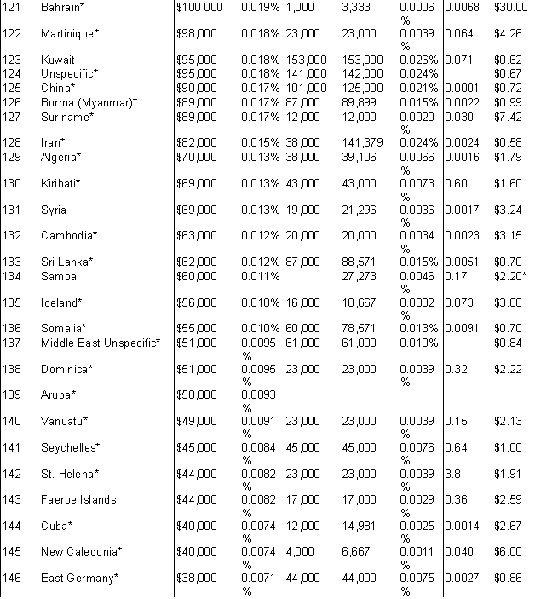
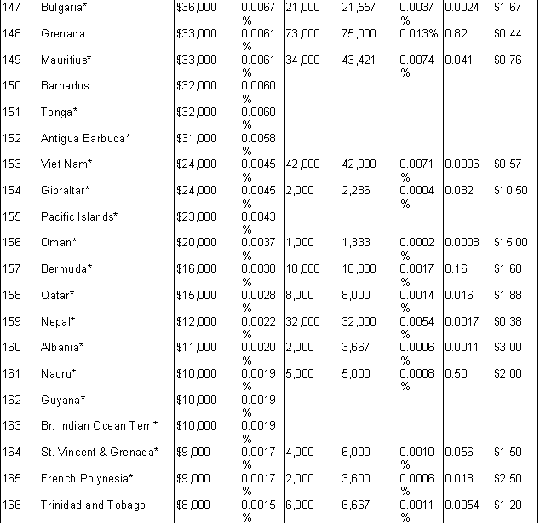
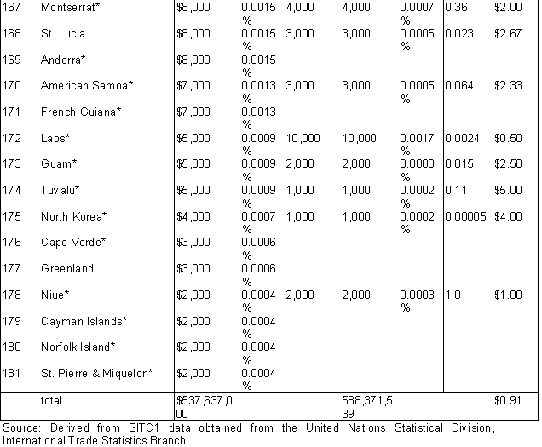
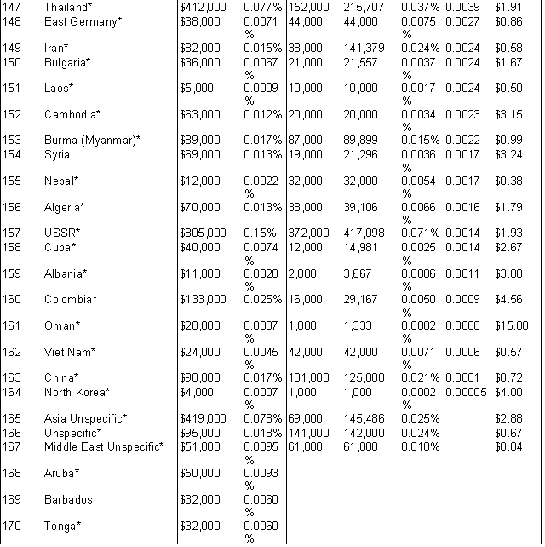
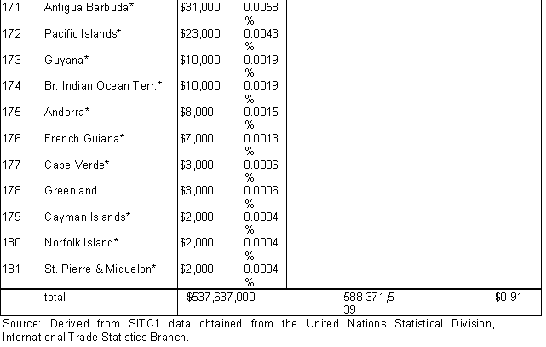
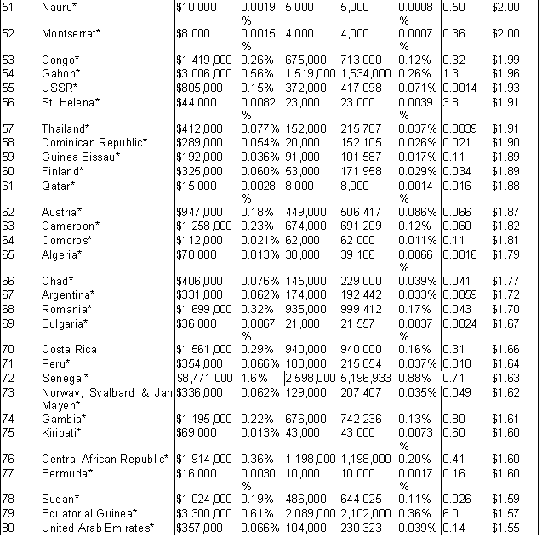
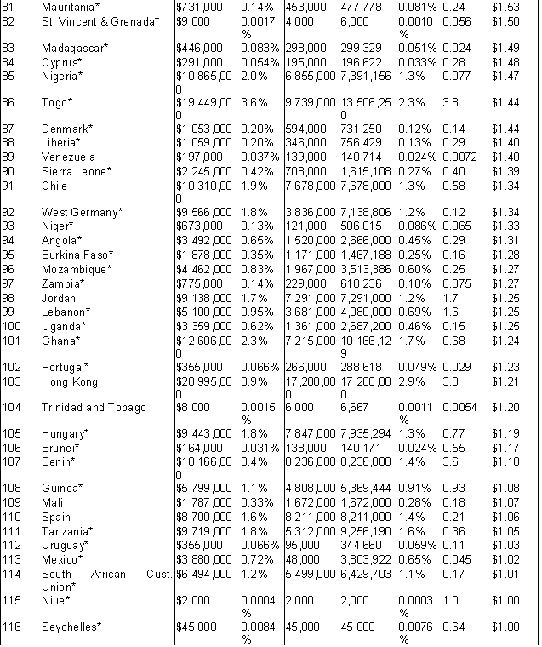
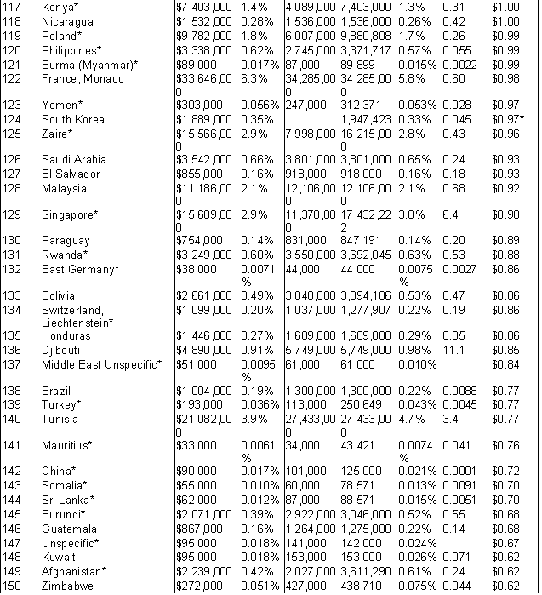
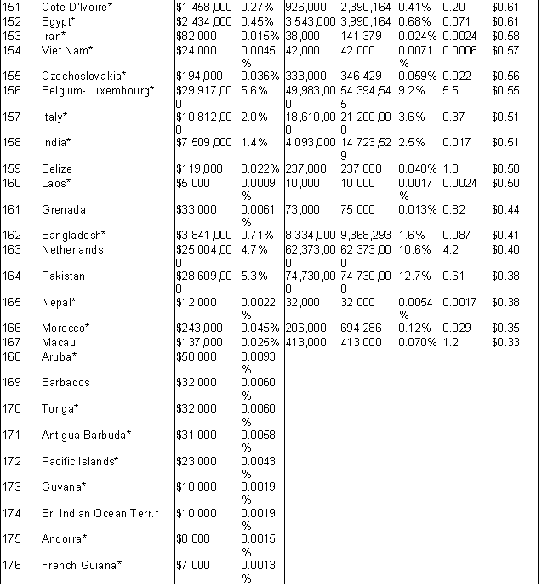
Gross (not net) export figures for the single year 1990, for all countries either reporting themselves under SITC1, or reported by their partner countries, are shown in Tables A3-A5 in Appendix 2. In 1990 there were actually 127 countries or separate trading territories with exports recorded by the UN (and 181 countries or trading territories with imports). Thus the re-use of used clothes is clearly a worldwide phenomenon, not a one-sided export from industrial to less-developed countries.
Comparing Table A3 (1990 gross exports) with the previously discussed Table A1 (net exports for the whole period 1984-'93), we see that, although a few of the other countries have changed places, Sweden was in 12th place of gross exports in 1990 (with 1.1% of total exports), just as it was for the decade as a whole. The U.S. was also in first place, but with only 25.4% of total gross exports.
In terms of weight per capita exported in 1990 (see Table A4), Belgium-Luxembourg was in first place with 6.6 kgs, followed distantly by the Netherlands with 3.6 kgs, and then (among others) by West Germany with 1.9 kgs, Denmark with 1.5 kgs, and Austria with 1.3 kgs. Presumably at least the first two figures reflect the presence of major re-exports, which is rather rare in the used-clothes trade, as discussed further in Appendix 3. The U.S. was in 11th place with 0.55 kgs in 1990, and Sweden was in 13th place with 0.43 kgs.
Despite the minor statistical problems discussed in Appendix 3, the gross export and import tables (Tables A3-A5 and A11-A13 in Appendix 2) should give somewhat more accurate prices than those reported in Table A2 (in Appendix 2) and Table A15 (in Appendix 3). Still, the variation is quite astounding: Export prices in 1990 (Table A5) ranged from highs of US$22.67 (Burma), $15.29 (Israel), $12.53 (Yugoslavia), $10.20 (El Salvador), $9.00 (Madagascar), and $8.86 (Niger), to lows of US$0.27 (Austria), $0.26 (Nauru), and $0.04 (Mali)! Sweden was in 54th place (US$1.42), and the U.S. was in 82nd place ($0.91).
Commercial used-clothes exporters: the ''rag merchants''
It is clear that there are large international transfers of used clothes occurring, but we have not yet explored how this is happening. As reported by Haggblade (1990) and Hansen (1994) and corroborated by many reports in the mass media, most used clothes traded internationally are initially donated by individuals to charity organizations in the industrial countries of North America, Europe and Japan. Most donated articles of clothing are initially sorted into one of at least three possible categories: those suitable for domestic resale in local "thrift shops"; those with no value other than recycling the fiber, for instance into "wiper cloths"; and those suitable for export.
The actual collection and sorting operations may be run by the charities themselves, or they may contract out these operations to professional management companies. In the U.S. at least, many thrift shops themselves - as well as the collection and sorting operations which supply them - are run by professional management companies, and there is some controversy as to whether the charities in whose names they act are getting a fair deal, or not. But in any case, clothes which are judged not suitable for resale locally, but which are still judged to have remaining value as clothing, are generally sold, even by the biggest charities, to "the rag merchants".
The rag merchants, as the name suggests, are "the domestic rag industry - a network of recyclers, rag makers, wholesalers, and used clothing exporters". The U.S. Council for Textile Recycling estimates that there are more than 100 commercial used-clothes exporters from the U.S. alone. The appellation "rag merchants", and even the subtitle of this paper, may be a bit misleading, however: Although rags are clearly related to used clothes, used clothes are actually quite a different commodity, and at least in U.S. exports, they are a much bigger (and growing) share of the business than rags, as illustrated by the statistics in Table 5 (below). The value of U.S. used-clothes exports has almost tripled in ten years, while rag exports have stayed virtually constant. Thus the used-clothes share of the total has grown steadily, as it has for imports as well.

Table 5: U.S. exports and imports of
used clothes and rags, 1984-'93 (US$1000s)
We have just seen evidence of the same discrimination of quality and potential use within the category of used-clothes itself. Observing the great differences in the prices of used-clothes exports and imports of different countries, we must assume that there are corresponding differences in quality, and in suitability for different purposes. Undoubtedly, such differences also exist within the exports (and imports) of any given country.
Items of clothing which are donated to charities may be reclassified as rags if they are too worn out, but we will note (in Appendix 5) much anecdotal evidence that many donated items of clothing are of very fine quality indeed. It is just these differences that the "sieve-like action" of the commercial rag industry is designed to discover and exploit. It exploits these differences by directing particular types of clothes to particular countries at particular seasons, so that those who will value those clothes the most, and will get the most benefit from them, will in fact have the opportunity to do so. (We leave aside for now the question of ability to pay, to which we shall return much later in the paper.) In the process, naturally, the "rag merchants" - including all the in-country handlers and dealers yet to be described - presumably maximize their profits. (We will explore in-country commercial distribution in-depth in the next chapter.)
In any event, the rag industry "sifts, sorts, shuffles, reshapes, bales and ultimately ships a portion of what it gets overseas as used clothing. Emerging from the sieve-like action of the rag industry is second-hand clothing sorted by fabric, garment, and sometimes by size. Thus individual used clothing bales might contain men's short-sleeved cotton shirts, or synthetic dresses, or boy's shorts, or baby clothes, or blue jeans. The sorting allows exporters to target countries and seasons, thereby increasing both the value of their exports and their ability to coordinate demand and supply patterns. After binding like items together, most commonly in 45-kilogram (100 pound) bales, exporters ship them abroad by the ton." According to all available reports, they generally do not clean extensively, repair, or restyle clothes for export; these functions are performed in the destination country, and thus provide employment and income there.
Charitable used-clothes (and other) exports
Although most used-clothes exports worldwide are handled through commercial channels similar to those described above, there are significant charitable shipments as well. Data on such shipments is not kept separately by the United Nations, nor by other international bodies, but data for the U.S. alone is given in Table 6 below, showing recent private charitable shipments of food, pharmaceuticals, and all other goods, in addition to wearing apparel. Wearing apparel seems to constitute 8-10% of total U.S. private charitable exports, while the charitable share of total U.S. used-clothes exports is 17-21%. Because the U.S. is the largest single exporter of used clothes, this data may give a rough indication of the relative share of charitable exports in total used-clothes exports worldwide.

Table 6: U.S. private charitable
exports, including food, wearing apparel, pharmaceuticals, and all other goods,
1990-'94 (US$1000s)
The definition of the term "charitable exports" is open to question, however: Many less-developed countries classify goods as charitable imports only if they are given away rather than sold; but we will see that much, and perhaps most, used-clothes imports, even on behalf of charitable organizations, are in fact sold when they arrive in-country. Thus, although goods may be "donated for relief or charity", they may in fact be sold initially; it is also suggested by some that most of the used clothes that are, in fact, given away initially, nevertheless enter the market later.
Sweden's used-clothes collections, exports, and imports
In 1992, Sweden imported 77,000 metric tons of new clothing (see Table 7, below), and almost as much fiber, yarn, and fabric (combined).
Table 7: Sweden's 1992 production, import, export, and net supply, of fiber, yarn, fabric, and clothing (1000 kgs)
| |
wool fiber |
cotton fiber |
yarn |
fabric |
clothing |
homemade fabric |
|
production |
- |
- |
9,030 |
9,470 |
? |
? |
|
imports |
420 |
11,900 |
24,600 |
22,300 |
77,000 |
- |
|
less exports |
- |
- |
4,150 |
10,600 |
? |
- |
|
net supply |
420 |
11,900 |
29,480 |
21,170 |
77,000 |
? |
Source: Statens Naturv�rdsverk (Swedish Environmental Protection Agency), 1995, p. 4 (from SCB).
The Swedish Environmental Protection Agency is concerned to know what happens to all the clothes, textiles, etc., after people in Sweden have finished using them. They state the following specific concerns:
"Cotton is the most common raw material for textiles, and cotton is one of the most pesticide-intensive fibres in terms of its cultivation. Other environmental problems in traditional cotton growing include high water consumption, soil deterioration, and competition with food production.
"The textile industry itself is characterized by numerous different mechanical and chemical processes. A host of different chemicals are used in raw material preparation. The quantity of chemicals used is also great, in many cases several hundred grams per kilogram of textile. The processes give rise to a contaminated process water, which can have high environmental impact."
The Swedish EPA reports estimates that, in the U.S. and Western Europe generally, 3-5% of household waste is textiles (including used clothes), which are typically burnt or buried, according to the normal method of trash-disposal in the various localities. In Sweden, the association of sanitation departments estimated that, for 1993, household trash consisted of about 302 kgs per inhabitant, of which about 2% was textiles, which works out to about 51,000 metric tons of used textiles in the trash. Another estimate was in the range of 50-100,000 tons.
In addition, significant amounts of used clothes are collected every year by various charitable organizations in Sweden, as elsewhere, partly for resale locally, and partly for export. According to collection estimates from the various organizations involved (shown in Table 8, below), about 10% is resold locally, roughly the same amount is considered waste, and about 80% is exported. The organizations also estimate 390 tons of shoes exported.
Table 8: Sweden's 1994 used-clothes collections, resales, and exports (1000 kgs)
| |
collected |
resold |
exported |
waste |
|
UFF (Development Aid from People to People) |
4,805 |
720 |
3,322 |
763 |
|
Praktisk Solidaritet (Practical Solidarity) |
3,686 |
153 |
3,273 |
260 |
|
Myrorna/Fr�lsningsarm�n (Salvation Army) |
2,850 |
450 |
1,950 |
450 |
|
R�da Korset (Red Cross) |
2,682 |
100 |
2,382 |
200 |
|
other |
904 |
- |
904 |
- |
|
total |
14,927 |
1,423 |
11,831 |
1,673 |
Source: Adapted from Statens Naturv�rdsverk (Swedish Environmental Protection Agency), 1995, p. 22 and Appendix 4.
By far the most popular collection method among the organizations is in neighborhood containers (about 66% by weight overall); other methods for some organizations include collections at their thrift shops, and pick-ups at home or at workplaces. Collection, sorting, and packing costs are estimated from SEK 3.80-5.50/kg, or in the neighborhood of US$0.57-0.83.
Adding weights of used clothes collected to estimates of textiles in household trash, we find that 65,000 tons or more of used clothes and textiles are disposed of each year in Sweden, or about 8 kgs per inhabitant. This estimate is consistent with estimates from Germany and the Netherlands of 8-10 kgs of clothes consumed per inhabitant per year, and is also consistent with the figure of 77,000 tons of new clothes imported into Sweden each year. Thus it appears that about 19% of the amount of new clothes imported into Sweden annually is collected by charitable organizations for re-use, and 80% of that amount (about 15% of total imports) is exported. The EPA's goal is that more used clothing and used textiles should be collected for re-use or recycling, and all of the collecting organizations indicate that they could increase their collections, although noting that financing for further investments in collection facilities would be required.
Table 9 (below) shows recent Swedish used-clothes exports, which have grown markedly during the last five years, especially in terms of total weight exported. Average prices, based on the values reported, vary considerably, but may reflect arbitrary valuation methods, rather than market values.
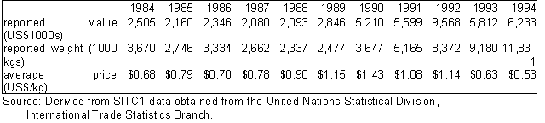
Table 9: Sweden's used-clothes
exports, 1984-'94
Swedish exports go to an amazing variety of destinations (89 in 1994), including many industrial countries, as well as many less-developed ones; 1994 exports ranked by weight, value, and price are shown in Tables A6, A7, and A8, respectively (in Appendix 2). Weights probably give a better indication of overall importance, because pricing (or valuation) methods of the various organizations involved may be somewhat arbitrary, since much of the goods may not have been handled with normal commercial procedures.
Africa remains an important destination for used clothes from Sweden: By weight (Table A6), Mozambique is in third place, and Angola in seventh. The other big recipients are now all in Europe, however: Estonia is in first place, followed by Latvia, Yugoslavia, Russia, Lithuania, Poland, Finland, and Croatia.
Nicaragua, which is first in reported value (Table A7), is eleventh by weight. By value, the U.S. is sixth, and Germany eighth; these are presumably not charitable exports arbitrarily priced, and thus may represent market values.
By price (Table A8), Australia ranks first at US$49.00/kg, followed by Canada ($21/kg), Cyprus, India, China, Hong Kong, Ethiopia, Honduras, El Salvador, Bolivia, the U.S., Norway, France, Japan, and Nicaragua.
Sweden's sources of used-clothes imports (16 in 1994) show a similar diversity, and considerable variation in price as well (see Table A9 in Appendix 2). Although there were exports to China, Ethiopia, and Poland in 1994, there were also imports from those countries. Similarly, there were both exports to and imports from Austria, Denmark, Finland, France, Germany, Hong Kong, the Netherlands, Norway, Saudi Arabia, Singapore, the United Kingdom, and the U.S. By weight, Sweden imported about 5% of the amount of used clothes that it exported; by value, about 10%. Import prices averaged US$1.21, somewhat more than twice the average export price, and ranged from $7.57 (U.S.) and $5.00 (UK), to $0.56 (Norway) and $0.50 (Austria).
Summary and conclusions
Well-functioning international commercial markets; stable and growing supply; Sweden plays a small role in worldwide exports
Used-clothes exports are a small and fairly constant proportion of world trade in textiles and new clothing. The international market appears to be extremely competitive, with many players: many firms and organizations exporting used clothes from many countries. Supply has been growing steadily for decades, and there is no reason to think that it will decline; if anything, it will continue to grow. Thus as more and more new clothes are exported from less-developed countries to industrial ones, a fairly constant proportion of them find their way back as used clothes. However, trade in used-clothes is by no means uni-directional; used clothes are traded: between industrial countries; between less-developed countries; and from less-developed to industrial countries; as well as the other way around.
The Swedish role in total exports is rather small, as one would expect based on its relative population. Thus, on the one hand, Swedish freight subsidies, if continued, will have a relatively small direct economic effect in the overall scheme of things; but, on the other hand, there is an extremely active commercial market for used clothes throughout Europe, so that it should not be at all difficult for Swedish NGOs to change their mode of operation - in other words, selling into that commercial network, or learning from their methods - if they should wish to do so.
Chapter 2: Used-Clothes Imports
Naturally, some countries and areas import far more used clothes than others, ranging in 1980 from a high of 33.8% (by weight, of all clothes and fabric imported) for Sub-Saharan Africa, to 10.8% for less-developed Asia, 7.3% for North Africa and the Middle East, and 1.8% for Latin America. Included in these averages were highs at that time over 50% for Bangladesh, Zaire, Mali and Tanzania. The value-shares of used-clothes imports (as percentages of all clothes and fabric imported) were of course much lower, ranging from a high of 5.0% for Sub-Saharan Africa, to 1.2% for less-developed Asia, 0.6% for North Africa and the Middle East, and 0.5% for Latin America.
Including domestic production as well, Haggblade calculated that "in 1980 second-hand apparel accounted for roughly 10% of all garments acquired in Bangladesh, Pakistan and the Southern African Customs Union countries... [while] the used clothing share rose to 20-30% in Benin, Ghana, Togo and Zaire, and it exceeded 50% in Haiti and Rwanda."
Although some countries and areas account for large proportions of total used-clothes imports, the trade is highly diversified, even moreso that exports. Worldwide, in the decade 1984-'93 there were 90 net used-clothes importing countries reporting on SITC2. But, as we have already seen, Sweden alone had 89 recipients for used-clothes exports in 1994. SITC1 and partner data shows that worldwide, in the single year 1990, there were actually twice that many gross importers.
Ninety net used-clothes importing countries, 1984-'93
Ninety net importing countries during the period 1984-'93 are shown in Table A10 (in Appendix 2). In the period, Pakistan was by far the largest net importer, followed, perhaps surprisingly, by Hong Kong. African, Asian, and Latin American LDCs took up the next five places, followed by France and then Spain. The next ten places again were mostly African, Asian, and Latin American LDCs, but Poland and Hungary had also already moved into the top twenty.
Gross imports of 181 countries or trading territories in 1990
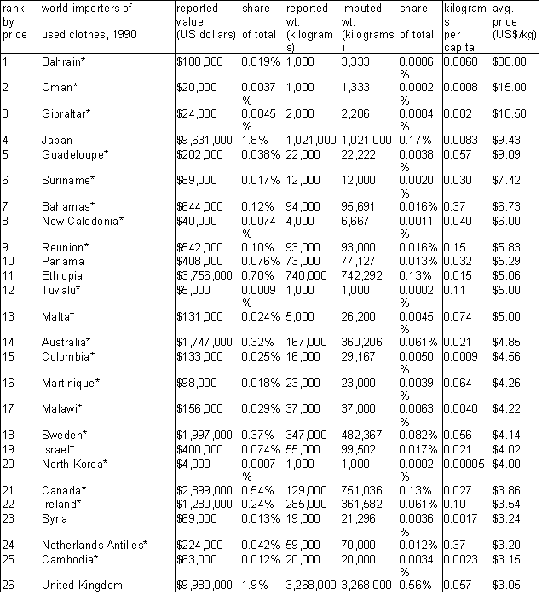
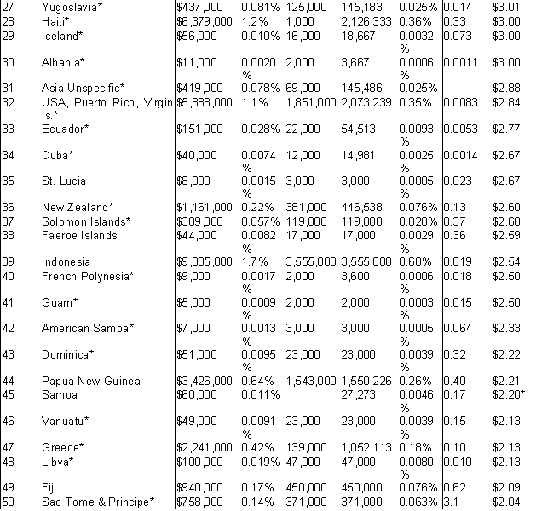
As discussed in the previous chapter, a much fuller understanding can be gained from seeing data on gross imports. We already looked briefly at 1984 SITC2 import data in Chapter 1 (Table A2 in Appendix 2). Tables A11-A13 show 1990 imports for all countries reporting using SITC1, plus their partner countries and territories: 181 in all.
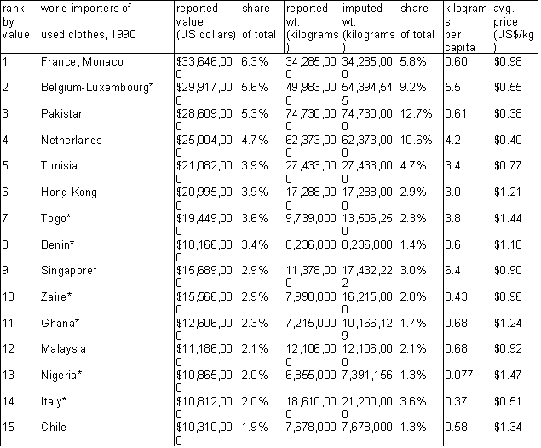
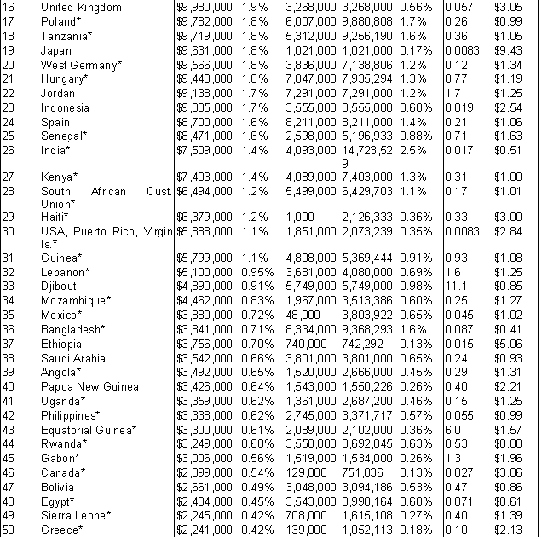
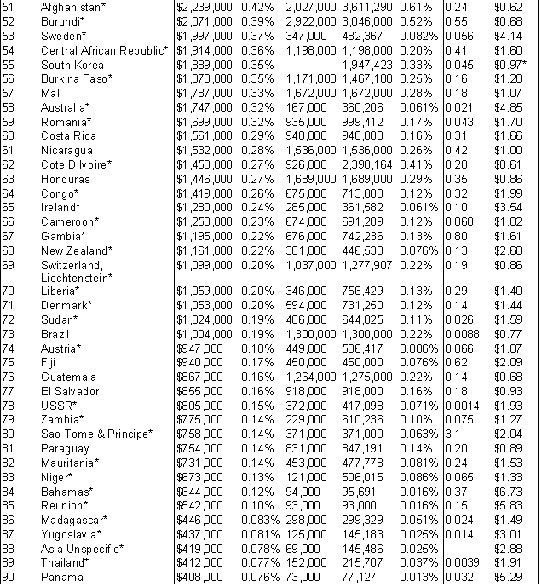
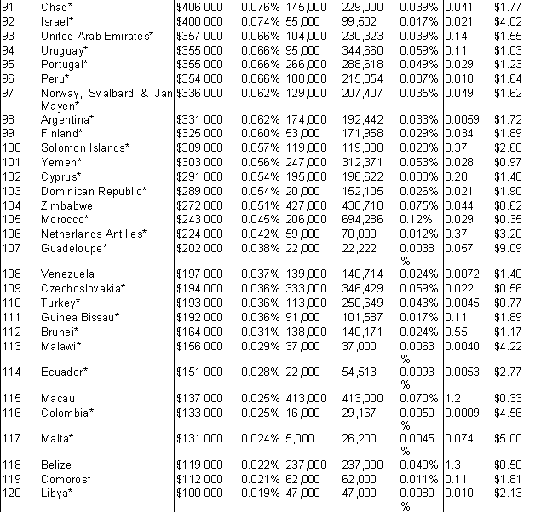
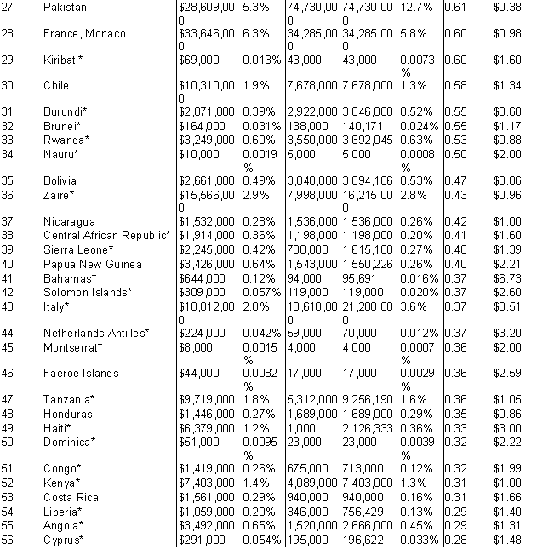
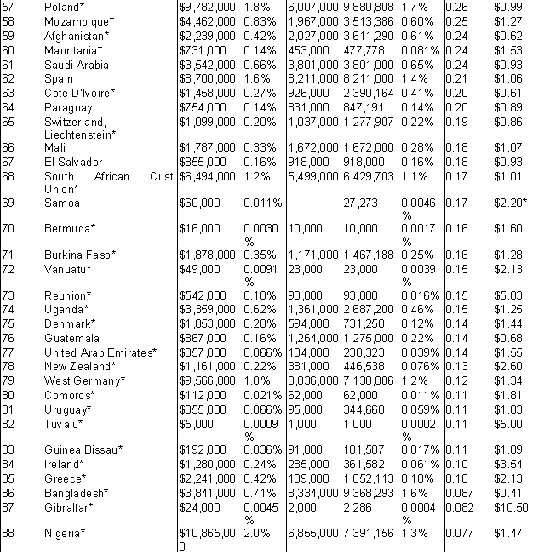
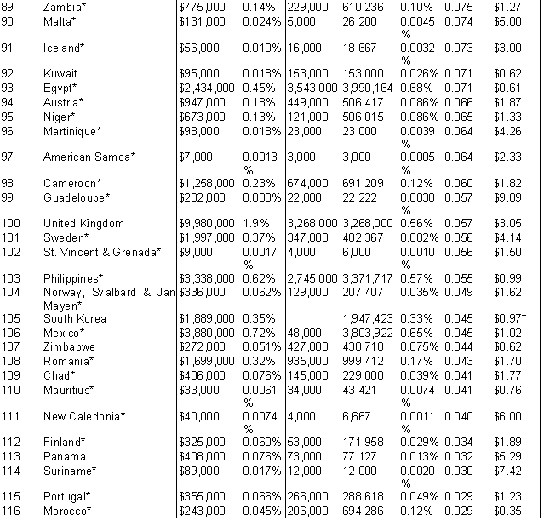
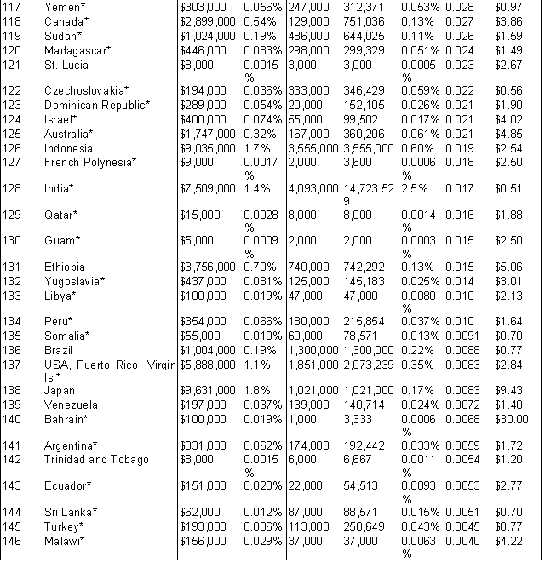
In 1990, France-Monaco was the biggest gross used-clothes importer by value (US$33,646,000, see Table A11 in Appendix 2), followed by Belgium-Luxembourg, Pakistan, Netherlands, Tunisia, Hong Kong, Togo, Benin, Singapore, and Zaire. The U.S. was in 30th place, and Sweden in 53rd place (US$1,997,000). By weight (not ranked on a separate table), Pakistan was in first place, followed by the Netherlands, both with much lower average import prices than Belgium-Luxembourg or France, which came next; Tunisia was again in fifth place, but Italy and India had joined Singapore, Hong Kong and Zaire in rounding out the top ten.
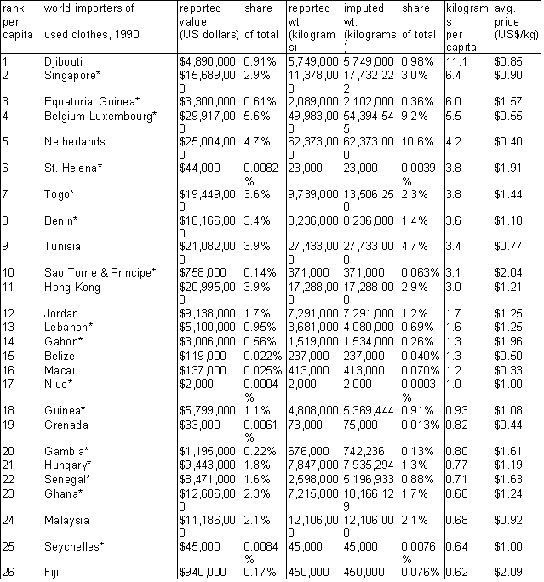
Djibouti had the highest imports per capita with 11.1 kgs (see Table A12 in Appendix 2), followed by Singapore, Equatorial Guinea, Belgium-Luxembourg, Netherlands, St. Helena, Togo, Benin, Tunisia, S�o Tom� & Pr�ncipe, Hong Kong, Jordan, Lebanon, Gabon, Belize, Macau, and Niue, all with at least one kilogram per person. De Valk (1992) reported that total annual textile "demand per capita [in Kenya] can be taken as approximately 0.9 kgs, corresponding with about 4.5 square meters." All of the countries listed immediately above imported more than that quantity of used clothes alone in 1990 (re-exports may account for some of the unexpectedly high figures, of course). Haggblade (1990) reported that "at 0.13 kilograms per capita in 1980, Sub-Saharan Africa imported approximately one used garment for every third citizen." In 1990, 78 of the 181 reported importing countries or territories imported at that level or higher. Sweden was in 101st place with 0.056 kgs, and the U.S. was 137th with 0.008 kgs.
In the previous chapter we noted the extreme variation in used-clothes import and export prices; in 1990, Bahrain had the highest import price (US$30, see Table A13 in Appendix 2), twice as high as Oman ($15) and three times as high as third place Gibraltar ($10.50). Japan ($9.43), Guadeloupe ($9.09), Suriname ($7.42), Bahamas, New Caledonia, Reunion, and Panama rounded out the top ten. Sweden was in 18th place (US$4.14), while the U.S. was in 32nd place ($2.84). At the low end were Bangladesh (US$0.41), Netherlands ($0.40), Pakistan (which imported the most weight) and Nepal (both at $0.38), Morocco ($0.35), and Macau ($0.33).
How are all these used clothes distributed once they are imported into (mostly) less-developed countries? Both economist Haggblade (regarding Rwanda before its recent civil war) and anthropologist Karen Tranberg Hansen (regarding Zambia) provide fascinating glimpses of the process.
Distribution of used clothes in Rwanda
Haggblade (1990) reported that in Rwanda the process "begins with the country's 14 used clothing importers, who order their merchandise in 45 kilogram bales, requesting the garments and fabric they believe will sell most readily at each time of year. They then sell the bales, unopened, to one of 40 wholesalers who stock them around the country. The wholesalers operate substantial businesses, commonly holding inventories on the order of 300 to 500 bales at any one time. They in turn sell their bales, still unbroken, to distributors."
Haggblade continued: "Distributors buy one to five bales at a time, immediately transporting the bales, by wheelbarrow or truck, to the outdoor public markets where used clothing is retailed. Shortly after daybreak, they break open the bales in one section of the market reserved for that purpose. They then referee a wild m�l�e in which prospective retailers swarm over the merchandise to select the prime articles for resale. Requiring considerable time and vigilance, the sorting involves lengthy haggling between distributors and retailers. Distributors, about 700 nation-wide, often retail the unsold residual directly to consumers.
"Before displaying their wares, retailers must prepare the used clothing for sale. They contract with market tailors to effect any necessary repair work or fashion-induced alterations that would improve the value of their merchandise. The retailers then clean and iron their new stock or hire others to perform these services. This activity attracts a phalanx of push-pedal sewing machines, coal-fired clothes irons and washing basins which align the perimeter of the large used clothing markets.
"When their merchandise is presentable, retailers display it in outdoor markets run by local authorities. In the largest markets, used clothing retailers often specialize - in shirts, pants or dresses - which they peddle from cement booths shaded by corrugated metal roofs. While middle-sized markets offer raised wooden platforms on which clothing can be displayed up off the ground, retailers in the smallest markets display their used clothing stock on the ground on top of the heavy canvas bale covers. In the medium and small markets, individual vendors offer a department-store range of garments which they bundle in canvas bale covers and haul by bicycle or public transport from one market to another. In all settings, retailing demands assiduous attention because of the potential for theft and because of customers' propensity to sift carefully through merchandise at many establishments before committing to a purchase. Approximately 4,700 enterprises retail used clothing in Rwanda's public markets."
Distribution of used clothes in Zambia
With reference to Zambia, Hansen (1994) reported that "most of the used clothing currently sold in local markets is imported by fifteen to twenty trading firms and their up-country outlets. Charitable organizations also import used clothing and are exempt from customs and duties if their goods are not sold for profit. The volume of second-hand clothing imported by charitable organizations, and the extent to which donated clothing is sold for profit, are difficult to estimate."
Referring to the importers, Hansen said that "some have established links with the textile manufacturing, dry goods, and transport businesses. These importers purchase used apparel from dealers in the U.S., Canada, the United Kingdom and several countries in Europe which includes not only garments but also shoes, handbags, towels, sheets, blankets and draperies. A small proportion is new, mostly factory overruns and canceled orders, but most of it is used clothing, bought by textile salvagers at bulk rates from charities in the West. A good deal of clothing that does not sell in charity shops is purchased cheaply by dealers, fumigated, sorted, packed into bales and shipped to Third World destinations.
"Used clothing is exported in standard containers which hold 200 or 400 bales weighing 45 kgs. Most dealers used 45 kg bales, but some prefer 150 kg or 300 kg bales. The containers are shipped to Zambia via Dar es Salaam [Tanzania], Durban [South Africa] and Beira [Mozambique]. Importers and clearing agents complain of pilferage at Dar, the red tape involved in port clearance, and port storage charges. In 1992, Durban was the preferred port of entry. Used clothing is competitively priced. The figures vary from US$0.44 per pound c.i.f. (cost, insurance, freight) to a designated port from a Canadian dealer (May 1991) to US$2.77 per kg c.i.f. to a designated port from an Australian dealer (July 1992). Port clearance fees, port storage, transportation charges, a variety of fees, sales tax, and customs duties considerably increase the cost.
"Although importers of used clothing complain of rising costs and uneven quality of merchandise, they recognize that demand and competition are increasing. Several importers hope to find new suppliers of quality goods and complain about uneven quality, especially of the U.S. merchandise - particularly faded, torn, and cut jeans. They also noted that the West's cold-weather clothing only sells well during June and July, the cold months in Zambia. Some considered Australia a potential source of clothing suitable for a warm climate.
"Importers pass their risks on to local buyers, who have no guarantee of the quality of the bale's contents. When purchasing a bale from an importer's warehouse outlet, the buyer selects the type of fabric (cotton, polyester, or 'wool') and clothing: for example, changa changa (mixed children's wear); girl's or women's dresses, skirts, jackets, or trousers. There are also bales with mixed fabrics, as well as bales with assorted items, e.g., women's wear. The bales are sold unopened, but some dealers allow buyers to inspect the plastic wrap and the metal straps to determine if the bale has been tampered with. Looking through the plastic wrap at the variety of colors and prints, the buyer makes a selection. After the buyer has decided, some dealers open the plastic cover to allow the buyer a closer look and feel. Of course this does not guarantee quality, and buyers complain of the many damaged, torn, faded and worn clothes in the bales.
"The price of a 45 kg bale in 1992 ranged between K15,000 (jerseys), K30,000 (blouses) and K45,000 (jackets), depending on the type of garment and fabric. Prices increase steadily as importers adjust their prices in response to higher costs and Zambia's rapid inflation. Toward the end of June, for instance, a 45 kg bale of women's 'silk' (polyester) blouses cost K34,000. It soon increased to K36,000 and then to K40,000, and by mid-August the same importer charged K42,000 for a 45 kg bale of women's 'silk' blouses.
"Trade in used clothing is large and growing in local markets, village shops, and with itinerant traders on bicycles. The salaula section in markets is many times larger than the food section in Lusaka and provincial towns. Every township in Lusaka has its salaula market; the busiest are at Kamwala and Soweto. Each of these markets has an inside and an outside salaula section. The inside section consists of covered stalls or small shops; the outside section consists of demarcated plots on which traders build intricate displays for their goods, or sell them from a pile on the ground. The outside section is the larger and busier place.
"Salaula traders are young and old, women and men, with different educational and employment histories and from many ethnic groups. Women slightly outnumber men...
"Earnings from salaula sales differ widely and depend on factors such as location, volume, type of clothing, business practices and competing demands on the trader's time and labor...
"People from all walks of life explore salaula markets. Some come with a view to buy in order to resell; others are on the lookout for that special item to complement their wardrobe. But the majority come to purchase the bulk of their household's clothing. Buying for the purpose of reselling occurs in at least two ways. The method of 'one-one' involves selecting individual items that are priced separately, usually after a bale has been opened. At that point a crowd of customers fight for the best items, and some select particular garments to resell.
"Buying with a view to reselling is also done 'on order', especially by rural visitors who subsequently sell their goods in the villages. Buying 'on-order' means buying several garments at a reduced rate. Often these are items that do not sell well in town. During the winter season Zimbabwean women and men travel to Lusaka to purchase cold-weather clothing - coats, jackets, 'wool' skirts, and jerseys. To finance their trips and obtain Zambian currency, they bring Zimbabwean products that are of better quality or scarce in Zambia, such as blankets, bath soap, tennis shoes, and fashion knitwear. They sell their Zimbabwean goods to traders in Kamwala and Soweto markets and purchase salaula with the Zambian currency earned by these sales. Or they exchange their goods directly for salaula without any cash transaction.
"Items that do not sell well in the city are brought by rural people or taken to the countryside by urban traders for sale or exchange. Such items include crimplene (polyester knit) garments, men's trousers in bright colors like red, green, and yellow, men's trousers and jackets of fabrics with large checks, and faded, torn and damaged items. Some traders make occasional rural trips and bring back chickens, fish, or produce... [while] villagers go to town particularly to purchase salaula for resale in rural areas...
"Customers evaluate their merchandise when purchasing a bale from a dealer by scrutinizing the plastic wrap and the metal straps to ensure that the bale has not been tampered with. Dealers who import bales larger than the standard ones open, sort and rebale items into 45 kg bales. Some Indian dealers are said to remove choice items in the process of rebaling; clothing presorted in this way is said to end up in shops. The customer's scrutiny in the dealer's warehouse reflects the preference for bales whose contents are fresh from their western source, untouched by dealer interference, and thus offering a range of 'new' items.
"The concern with 'newness' is particularly evident on 'opening day', when a bale is broken up for resale. At this point, it is important that garments have not been meddled with, and traders and customers prefer to open a bale publicly, enabling customers to select on the spot. A bale that is opened in the market is considered to contain new clothes. If it is opened privately, the trader might put aside choice items, causing customers to suspect that they are being presented with a second cut, and not new clothing.
"Both traders and customers are concerned with quality and style. These concerns prompt extensive recycling. Items made of fabrics that do not sell easily, for example crimplene, are turned into a variety of new garments. Crimplene trousers are remade into boys' shorts and girls' dresses. Sweaters are unraveled and the yarn re-used to crochet or knit baby blankets, jerseys, and rugs. Curtain material with colorful prints is made into women's dresses and suits, draperies with metallic sheen become men's trousers, and curtain lace ends up as trains of wedding gowns. The small-scale tailors who used to sew everyday garments have recouped lost business by repairing and altering salaula. Traders and customers bring men's trousers in large sizes to the tailor to alter and restyle with pleats at the waist, back pockets, and pegged bottoms. Tailors also sew up vents on men's jackets and turn single-breasted jackets into double-breasted chilubas...
"Some salaula is sold in more exclusive shops, such as the Caroussel Botique [sic]... [which] advertises its line of 'imported cloths' in styles of 'London Wise'... Their shop features cleaned, pressed and restyled clothing at prices slightly higher than elsewhere in the market. According to the owners, everyone knows this shop, and customers come from all over town to buy 'the latest', especially nicely restyled chilubas. Emblematic of changes following president Frederick Chiluba's take-over from Kenneth Kaunda, the chiluba suit's replacement of Kaunda's rigid Mao-inspired uniform tells a story of the opening up of society, of new opportunities, and above all, of the common man's access. 'The common man' was the previous regime's term for the masses. In short, salaula implies choice and possibility, of better lives being with reach..."
Summary and conclusions
Imports primarily to LDCs; well-functioning domestic used-clothes markets; lots of employment generated
Although most used-clothes exports go to LDCs (in 1990, about 70% by value, much more by weight), and perhaps most tend to go to the poorest countries among them, still the trade is extremely diverse, with many major importers among the industrial nations. That most exports go to LDCs is no surprise; it is totally consistent with micro-data reported in Haggblade's study - which we will review shortly - supporting the notion of used clothes as a generally inferior good: That is, as incomes go up (beyond a rather low threshold), people tend to buy less used clothes, rather than more. But it is somewhat surprising that there are such voluminous used-clothes imports into industrial countries, though the major instances may be accounted for largely by re-exporting and recycling. Nevertheless, as we noted in the previous chapter, there is great variation of quality and purpose (and price) within the general category of "used clothes", and it is apparent that they are not just an inferior good, but can also be a fashion statement, for instance - and this is just as true in LDCs as in industrial countries.
According to widespread evidence, there seem to be very well-functioning domestic used-clothes markets in most LDCs, and lots of employment generated. The sorting which is first carried out by NGOs or commercial exporters in industrial countries is carried many steps further in less-developed countries, and in the process used clothes are cleaned, repaired, restyled, and distributed hither and yon, according to highest market value and, presumably, best purpose.
Chapter 3: The general context of the used-clothes trade
This chapter deals with popular (producer, labor union and mass media) and governmental attitudes to the voluminous used-clothes trade we have just looked at, pointing out that there are some very strong negative feelings towards used-clothes markets in some parts of the Third World (and elsewhere); but also showing that national governments have not generally succumbed to pressure to restrict imports in any extraordinary way, and in fact the trend seems to be the other way, towards opening markets. While we believe it is important to understand this context for world used-clothes trade, none of this chapter is essential for understanding our specific conclusions regarding subsidies for used-clothes exports. (The parts describing producer, labor union and mass media attitudes should certainly put up a warning flag about such subsidies, however.) The next chapter deals with NGO attitudes towards and involvement in the used-clothes trade, and may thus be the most directly relevant to our final conclusions.
We noted in the Introduction that there are four possible sets of answers to the questions whether used-clothes imports generally, and subsidies thereon specifically, were good or bad (Table 0 from the Introduction is repeated as Table 10, below). There are strong intuitive arguments for both extreme positions (columns 1 and 4). On the one hand, sending surplus used clothes to less-developed countries may provide a low-cost income-transfer which actually contributes to building productive capacity, by increasing the stock of human capital in the form of better-clothed workers (this might be the position represented by column 1, especially the bottom half). Other used goods which may be donated, such as used agricultural or medical equipment, bicycles, computers or books, may even more obviously contribute to capital accumulation, and thus to the development of productive capacity.
Table 10: Qualitative effects of used-clothes imports, and of subsidies thereon
|
effects of: |
1 |
2 |
3 |
4 |
|
used-clothes imports |
good |
good |
bad |
bad |
|
subsidies thereon |
better |
bad |
good |
worse |
| | |
(not the best) |
(in catastrophes) |
|
If supplies are consistent and not wildly fluctuating (especially for any necessary goods), so that dependence does not lead to disruption and further hardship, then one could consider used clothes like any other goods, assuming that countries should produce their products of comparative advantage, and import the rest (this position is represented by the top of columns 1 and 2). Of course there may be social costs as established industries adjust to cheaper imports, but in the long-run these costs should be more than compensated for by increased productivity and income. And, assuming that freight and transaction costs are properly accounted for, there would certainly seem to be some environmental benefits from using still-serviceable goods (including surplus used clothes), rather than disposing of them, and manufacturing more elsewhere on our ecologically-strained planet.
However, others point out the disincentive effects on production, in which workers lose jobs and income when cheap imports suddenly become widely available. Thus they would argue against subsidization of exports, and perhaps in favor of tariffs or outright bans on imports (this would be column 4). Still others might argue that, although there may currently be no local textile or clothing industry to protect, development of such industries is a necessary first step in industrial development - or is one of the most convenient and beneficial industries to begin with, given that it requires relatively little capital to enter, and that clothing may claim a major share of the household budget in economies where incomes are low - and that there may be extra advantages in the form of skills and experience gained. Thus they might argue that imports must be banned (and certainly not subsidized), in order to promote the development of "infant industries".
A further range of controversy concerns the commercial export of used clothes which have been initially donated to charities in industrial countries. Donors may not realize that their donated clothes are being sold on the market, rather than being given away free to the poorest of the poor. To state it simply, the question is whether there is a place for market-based, profit-motivated businesses in the distribution of donated used clothes, or whether all steps in the process should be on a nonprofit basis. Although this question does not seem very closely related to the most specific question we have been asked to address, whether exports of used clothes directly by charitable NGOs should be subsidized by Sida, the issues it raises may prove enlightening as well, and we will investigate them further below. A philosophical note on the origin of markets, and their social and political context, is included in Appendix 4.
Because used-clothes exports arouse such strong feelings and contradictory arguments, this report may be of interest not only to Sida, but perhaps to Swedish NGOs, and possibly even to LDC governments and textile and clothing producers (including labor unions) as well. Consequently, within the basic framework of our terms of reference, we will attempt a fairly full exploration of the broad context of used-clothes exports and, throughout, will attempt to explain economic terms, theory and methodology somewhat thoroughly.
This is an economic study but, although we have specifically been asked to consider "effects on income distribution, employment, institutional structure, environment, etc.", including "effects on supply and demand, growth effects, and other long-term effects on production and the production structure", we have also been asked to consider "other questions that might come up during the course of the work and that might seem relevant."
Thus we will also try to identify and categorize some of the more important non-market factors - such as social and political factors - which should also concern us. For instance, one motivation for NGO and Sida involvement in used-clothes exports may be a feeling of solidarity (social bonds or identity), on the part of the Swedish people, with people in less-developed countries. On the other hand, particular countries may choose to ban used-clothes imports (legally and politically; or to impose high tariffs on used-clothes imports), possibly because of their effects on particular power groups in those countries, regardless of any overall economic benefits that might be possible from imports. Or, although not limiting used-clothes imports, powerful groups in some countries might be offended by them for various cultural reasons, especially if they were to be subsidized as part of "development assistance".
We have just seen (in Chapters 1 and 2, above) that there are very substantial worldwide flows of used clothes, and that lots of them are ending up in less-developed countries. Although over time those flows seem to constitute a fairly constant share of total worldwide trade in textiles and clothing, they nevertheless have been increasing dramatically in absolute terms, more than doubling over the past decade, for instance. Flows of new textiles and clothing in the opposite direction, from LDCs to industrial countries, have been increasing equally dramatically over the same period. Still, we can understand that there might be protectionist sentiment aimed against used-clothes imports in less-developed countries, just as there is a history of protectionist sentiment aimed against new-clothes imports in industrial countries (witness the history of the Multi-Fiber Arrangement).
Whether based on thorough, accurate, in-depth economic analysis or not, it is important that we understand these protectionist sentiments: They constitute one of the most important ingredients in the overall context of used-clothes imports into less-developed countries. Naturally enough, it is textile and clothing producers in LDCs, primarily represented by their producer organizations and labor unions, who believe that there is net economic damage from used-clothes imports. Consequently, we will begin this chapter with a review of some producer-organization damage estimates and some union and labor organization documents. This point of view (which we have associated with column 4 of Table 10, above) has occasionally been strongly represented in the mass media as well, and we will take a look at some Western examples, as well as looking briefly at an example of what may be a more balanced, African media view.
Protectionist sentiment focuses primarily on getting LDC governments to impose high tariffs on used-clothes imports, or to ban such imports altogether. Consequently, in the second half of this chapter we will review the recent history and current state of trade regulations regarding used-clothes imports. We will see that there seems to be no current trend in favor of increased protection against used-clothes imports, but rather a trend towards increased openness, as part of general global trade liberalization. Thus, leaving aside the more specific question of subsidies, we will find that most LDC governments take positions associated with the top half of the first two columns in Table 10, which we characterized simply as "trade is good".
The other major players in the used-clothes business (besides the commercial exporters and importers, whom we might expect to favor free trade) are the non-governmental organizations (NGOs) which collect used-clothes in industrial countries and which are involved in humanitarian and development work worldwide. In the next chapter we will examine the attitudes and practices of a number of NGOs, both international organizations, and specifically Swedish ones. We will see that some of the NGOs recently espoused the position represented by column 1 (used-clothes as a development tool directly), but that, partly for reasons represented in the top halves of columns 3 and 4 (the concern that commercial trade is damaging to local producers), many of them now essentially agree with the conclusions to which this report comes (represented by a combination of columns 2 and 3: the effects of trade are not totally clear; but subsidies are generally not the best, although necessary in catastrophes).
To begin with, we want to look at and be aware of some popular images (especially negative images) of the used-clothes trade. Because several labor union and mass media documents we wish to review are rather lengthy, they are found in Appendix 5. While we will note (both here and in Appendix 5) some weaknesses in the arguments and rhetoric presented, our main point is that many people in Third World countries, and some of their sympathizers elsewhere, have very strong negative feelings about the used-clothes trade. Given that Sida and the various Swedish NGOs have no desire to offend those people, it would be well to be aware of their feelings.
Popular images: producer organizations, labor unions, and the mass media
The Zimbabwe Clothing Council - a producer organization - is very aware of the increasing level of used-clothes imports in that country, and believes that there has been very significant damage to their industry because of it. Assuming garment-for-garment displacement, the Council concludes that the 55 twenty-foot-long containers of used clothes which were imported illegally or by charitable organizations in 1994, each containing roughly 40,000 garments, resulted in at least 5,300 lost jobs in textile and garment production, or, considering families, a loss of subsistence for 34,450 people. This is not insignificant, and when generalized across the Third World, one can imagine widespread hardship and permanent damage resulting from what used-clothes donors in industrial countries take to be charitable giving.
Naturally, labor unions representing Third World clothing-industry workers also feel strongly about the issue, and have lobbied for international action against the used-clothes trade. In 1992 the International Textile, Garment, and Leather Workers' Federation (ITGLWF) adopted the following resolution against the used-clothes trade:
"NOTING that massive imports of used clothing have created unemployment for textile and clothing workers in many countries of the world;
"CONCERNED at the fraud practised by unscrupulous companies trading in used clothing, who import it as illegal contraband by mixing it with new clothing...
"DEPLORES the trade in charitable contributions of used clothing which results in the export of used clothing at such low prices that the wages and conditions of textile and clothing workers are undermined and many jobs are lost;
"DEPLORES the attitude of governments who close their eyes to this deplorable situation, thus creating unemployment and health risks for consumers, given that the origin of the clothing and the physical health of the previous owner are not known;
"AWARE that most of this used clothing is donated by people in the United States and other countries to charities such as Goodwill and the Salvation Army, with the intention that it will be used to assist people in need when in reality it is sold for profit;
"URGES that used clothing donated for the poor should be used for that purpose and distributed free of charge, thus avoiding the trade in used clothing which has been occurring; ..."
The position above was further elaborated in a draft resolution submitted by the Workers' Group to the February 1995 International Labour Organization (ILO) Technical Meeting for the Clothing Industry, and reproduced in Appendix 5 (with some perhaps contradictory passages italicized for emphasis).
Given such strong producer organization and labor union opposition to the used-clothes trade, it is not surprising that similar themes occasionally have been picked up in the mass media. Our first example (also found in Appendix 5), much more rhetorical than the somewhat dry resolutions above, is actually from a union newspaper, Free Labour World, dated June 1993, and the author is Neil Kearney, general secretary of the ITGLWF, whom we also quoted briefly in the Introduction. Other examples (in Appendix 5) come from the Canadian media (Ottawa Citizen, 1993). We will reproduce here only one short example, from the Latin American media:
"The used-goods merchants are netting huge profits... Earnings on used shirts and dresses are high, with intermediaries averaging profits of 200%... Used car dealers earn up to 600% profit... Economists say Latin America has entered an era of backdoor imports and they describe this as a spinoff of recession and neoliberalism... Experts such as [a sociologist]... said it is no longer a question of importing goods and technology but of making do with obsolete, discarded material and garbage... [A] political scientist... said Latin Americans 'can no longer dream of wealth, but only of the crumbs of opulence. The most we can hope for is to be secondhand rich'."
A possibly more balanced, African media view
Under intense pressure from local producers (and presumably from the workers' union as well), the government of Zimbabwe has just recently (summer 1995) introduced a very substantial (perhaps, theoretically, prohibitive) import-duty on used clothes. But The Financial Gazette, published in Harare, reported that:
"Last week's introduction of import duty on second-hand clothing will not change the fortunes of the clothing and textile industry, which is currently in the doldrums due to an assortment of problems, sources within the industry have said. There is general consensus within the sector that the introduction of import duty on second-hand clothing is a short-term measure, likely to benefit clothing and textile retailers who service the domestic market, more than manufacturers who need to export... [One major textile company executive said the measure] would not in any way help resuscitate the sector, which needs exports to break even. He said large quantities of textile and clothing products would continue to be smuggled into the country, willy nilly, despite the new import duty... [T]he only permanent solution to the industry's woes was the signing of a trade agreement with South Africa and the reduction of interest rates, which currently stand at over 30%... High interest rates, withdrawal of tariff protection, coupled with the scrapping of the 9% export incentive scheme last year, contributed to the poor performance of the local industry..."
National government used-clothes trade policies and practices
Given the horror stories that we have just reviewed (including those in Appendix 5), it would not be surprising if many other countries besides Zimbabwe had recently clamped down on used-clothes imports, with high tariffs or outright bans. In fact a few do ban used-clothes imports, or impose prohibitive tariffs or impossible licensing procedures. But most are relatively open to imports - that is, with tariffs in the same range as for other clothing and textile products - and the worldwide trend generally seems to be towards greater liberalization.
Spain and some former Spanish colonies seem to present a bit of an anomaly from this trend, so we will look at their import practices first, followed by those of other industrial, transitional, and new industrial economies, and finally those of other less-developed countries. Details are provided in Appendix 6; only a brief summary is provided here. Appendix 6 concludes with an illustrative look at the textile industry in Senegal, which is interesting in the context of the larger question in our Terms of Reference (regarding used clothes and other used goods), because of Senegal's current and historical reliance on second-hand textile factories. More to the immediate point, it illustrates the complex context in which the textile industry seems to operate in many African countries, under various forms of government protection and mismanagement, and now beset by the increasing tide of used-clothes imports.
As we saw in Chapter 2, most industrial countries have significant used-clothes imports as well as exports. Spain seems to be the only industrial country with unusual (virtually prohibitory) restrictions on used-clothes imports, but it nevertheless does import substantial amounts of used clothes, and is also a significant used-clothes exporter. Worldwide, several former Spanish colonies also either still have or have recently lifted unusual restrictions on used-clothes imports, including Mexico, Chile, Venezuela, Colombia, Ecuador, Peru, and the Philippines. Even those which maintain unusual restrictions still import substantial amounts of used clothes, and many are themselves significant used-clothes exporters as well. Several have recently relaxed unusual restrictions, or removed them entirely, and many other former Spanish colonies seem not to have ever imposed them, or at least not to have had them recently.
Among transitional economies, only Bulgaria and Hungary seem to have unusual restrictions on used-clothes imports, though Bulgaria's is not very severe, and Hungary's (a quota system) is directed at all consumer goods, not just at used clothes. Poland and Russia have both had large used-clothes imports recently.
None of the new industrial economies of East and Southeast Asia impose any unusual restrictions on used-clothes imports, although tariffs may be quite high on apparel and related products generally.
Egypt bans most textile and garment imports including used clothes, although partner data for 1990 indicates that Egypt imported a large amount (and also exported a small amount) of used clothes in that year. Despite the fact that Israel has free trade agreements with the EU, EFTA, and the U.S., it also bans used-clothes imports, but again, partner data shows both imports and exports.
Despite strongly growing used-clothes imports in Sub-Saharan Africa, there seems to be a trend towards greater liberalization of the trade. South Africa seems to allow imports only for charitable purposes (that is, to be given away, not sold). Nigeria bans import of all textiles and apparel, but nevertheless tolerates significant smuggling, of used-clothes in particular. Cameroon lifted a ban on used-clothes imports in 1991; Chad and Cote D'Ivoire in 1992; Tanzania liberalized in the 1980s. Other African countries seem to have normal tariffs on used clothes, in the range of 45-90%, and trade is brisk, as we have seen.
Summary and conclusions
Very strong negative feelings towards the used-clothes trade; images often seem exaggerated and arguments weak; nevertheless, caution may be advised; only a few countries worldwide have exceptional restrictions on used-clothes imports; they often allow imports in practice, and many are themselves used-clothes exporters
Many of the arguments and much of the rhetoric used against the used-clothes trade seem wildly exaggerated and, upon analysis, many of the points made seem rather weak or fallacious. Nevertheless, the overriding impression must be of very strong negative feelings, attached to very strong perceptions of very severe damage being done. This is something that Sida and relevant Swedish NGOs should be aware of (and may in fact be the main reason why this study was requested).
If one believed that exports of used clothes to less-developed countries resulted mainly in jobs lost in those countries, one might consider that to be a strong argument against subsidizing such exports. But also, if one thought that many people in those countries believed there were such net losses - even if one did not believe it oneself - one might still consider that to be a strong argument against subsidizing such exports. Thus, given the extreme hostility of most of the images of the used-clothes trade we have just reviewed, one might want to be somewhat cautious about subsidizing used-clothes exports for that reason alone. Given the potential for contributing to a destructive or wasteful effect - or at least to the perception of a destructive effect by industries which lose sales and employees who lose jobs - it might not seem prudent for Sida to be seen as subsidizing used-clothes exports by NGOs.
While we have not attempted to do an exhaustive search of the popular media on the subject of used-clothes collection and redistribution, there seem to be two general themes in most of what we have just reviewed: One is that used-clothes exports to less-developed countries have a disincentive effect on local production, putting local garment-producers out of work; the other is that individual clothes-donors (and the general public) in industrial countries are sometimes shocked to discover that used clothes are being sold "for profit", rather than being given away free to "the poorest of the poor". An even broader expression of this issue is the question whether it is proper for commercial "for-profit" companies to have any involvement at all in the redistribution of used clothes which were originally donated by individuals to charities - not just in selling surplus used clothes overseas, but even in running commercial for-profit second-hand shops in industrial countries, and actually conducting the used-clothes collections themselves. In the next chapter we will take a brief look at this issue.
Trying to solve the former problem (lost jobs) as the ITGLWF urges, by catering to the second concern (only giving clothes away free to the poorest of the poor) probably does not solve the disincentive problem, as we discuss at some length in the second part of Appendix 4. Given our own analysis in later chapters, it is encouraging to find that an influential African voice does not seem to share in the complete demonization of the used-clothes trade like most of the other examples above.
At least so far, most governments worldwide do not seem convinced by producer organization, labor union, and media images of - and arguments against - the used-clothes trade. Most seem to take the general view that trade is positive, not just when their producers can export to foreign markets, but also when their consumers can get cheaper goods from foreign sources. There are high tariffs on used-clothes in many countries, just as there are on textiles and garments generally, to protect domestic industries; but it is primarily some former Spanish colonies (and Spain itself), plus a scattering of other countries, that have exceptional restrictions on used-clothes. Even the countries which impose exceptional restrictions often seem to have substantial used-clothes imports anyway and, when we look at the trade data in Appendix 2, we see that they are usually exporters as well.
Chapter 4: NGO attitudes and involvement in the used-clothes trade
In the previous chapter we saw that there are very strong producer, union, and media pressures aiming to ban or severely restrict the used-clothes trade, and yet most national trade policies are as open to trade in used-clothes as they are to trade in textiles and new clothes. To conclude this section on the used-clothes trade and its general context, and before we begin our own analysis of the economic effects of that trade, we want to review Swedish and international NGO attitudes and practices towards used-clothes exports in general, and more specifically towards used clothes as emergency or development aid. We want to have some idea of how NGOs utilize used clothes, and we would like to know to what extent they effectively reach and help "the poorest of the poor" with clothes aid.
In Appendix 7 we review and discuss at greater length a recent study entitled Promoting Development by Proxy: The Development Impact of Government Support to Swedish NGOs (Riddell, 1994) which analyzes the development impact of Swedish NGOs in general. The spirit of the Riddell report is well expressed in the following quote: "To the extent that Swedish taxpayers' money is not being put to its best use, it is ultimately the poor people in developing countries who are the losers. The recommendations given here are made with the express purpose of trying to ensure that these state funds, channelled through Swedish NGOs, are used to the maximum advantage of the poor. To the extent that efforts are not made to enhance efficiency, it is not the Swedish NGOs which will be the ultimate losers, it will be the poor themselves."
One of the most frequent claims made on behalf of NGO development activities is that NGOs are most innovative and know best how to target the very poor. It is also often asserted more specifically that subsidized used-clothes exports do not damage local textile or clothing production because they go only (or primarily) to the poorest of the poor. In Appendix 4 we discuss the likelihood that, even if used-clothes were actually distributed only to the very poor - who perhaps could not otherwise afford to enter the market for clothing - probably a large percentage of the used clothes would find their way onto the market anyway, so that the assertion of lack of damage is probably fallacious. Now, however, we want to look at the assumption that the clothes actually get to "the poorest of the poor" in the first place.
The Riddell report concludes that Swedish NGOs are not generally effective at reaching and helping the poorest of the poor, largely because they have an inadequate understanding of poverty, and lack an in-depth understanding of markets: "The staff and experience of Swedish NGOs do not equip them well, nor predispose them, to focus on analytic issues related to income and employment generation, or markets and market analysis... The challenge of generating income and employment in stagnant economies where markets are weak or absent surpasses the resources and capacities of many Swedish NGOs." Thus we will review not only the specific question of the extent to which used clothes exported by Swedish NGOs reach the very poor, but also the more general question of their understanding of poverty and markets, as revealed in recent studies of their activities with used clothes.
As we saw in Chapter 1, the four major Swedish organizations exporting used clothes are UFF (Utlandshj�lp fr�n Folk till Folk, or Development Aid from People to People), PS (Praktisk Solidaritet, or Practical Solidarity), Myrorna (an agency of Fr�lsningsarm�n, the Salvation Army), and SRC (Svenska R�da Korset, the Swedish Red Cross). Individual studies have reviewed the used-clothes export practices of both UFF (Interconsult, 1990a; and Denconsult, 1993) and the Swedish Red Cross (SRC, April and May, 1992); and another earlier study reviewed used-clothes exports specifically to Mozambique of both UFF and PS (Abrahamsson, 1988). In addition, another Interconsult study (1990b) reviewed the dependence of PS on Sida funding for used-clothes collection and related activities in Sweden, after which PS cut costs and increased sales of used-clothes in Sweden to reduce that dependence.
We have reviewed the above studies and have also discussed the issues involved in the current study with each of the organizations covered. The previous studies are almost all a little out of date now because of historical and organization changes since they were done, but they provide some glimpse of how the organizations have operated in the recent past. We will summarize and discuss them below, noting subsequent changes in policies and practices where we are aware of them.
We will also briefly review the attitudes and policies of some non-Swedish and international NGOs, and we will conclude with a review of some issues surrounding "for-profit" firms' involvement in NGO activities.
The naked truth (1988): PS and UFF used-clothes exports to Mozambique
The 1988 study Den Nakna Sanningen (The Naked Truth) recommended increased shipment of used clothes to Mozambique by Swedish charitable organizations (specifically PS and UFF), as well as development of increased sorting and handling capacity in Mozambique - and it recommended increased Sida aid for those purposes - for the following 10 reasons:
1. Clothes are a basic need; if the need is met, significant economic effects can result. Swedish clothes aid to Mozambique is a good example: The clothes reach the target groups and, through their use, contribute to increased employment in the countryside and to improved production of food for sale.
2. Clothes are scarce in Mozambique, where domestic production can barely supply 10% of the need. Aid recipients will need support - at a much increased level - for the next 5-10 years.
3. Used clothes are a surplus item in Sweden, and thus resources will be wasted if they are not utilized.
4. The clothes which are sent are of high quality, with an average remaining life of 2/3 of the original. The cost for transporting the clothes (SEK 7/kg) is low in relation to the clothes' value to the receivers.
5. In general, Swedish clothing aid has no negative effect on local textile production.
6. The alternative cost for import of new fabric or new clothes from competitive suppliers on the world market would be 4-5 times higher.
7. Swedish clothing aid constitutes a very important complement to other Swedish aid.
8. The sending organizations have a well-functioning relationship with the receiving organizations, and both have capacity to handle increased quantities of used clothes.
9. Clothes aid is very effective aid, and the receivers give a high priority to this aid.
10. Clothes aid strengthens the interest of the Swedish people in development issues, and thus their willingness to give aid.
The reasons given in this study for increased used-clothes exports, and subsidies thereon, can perhaps be summarized more briefly as follows: People need clothes to work. Used clothes have value and should not be wasted. The receivers like receiving subsidized used-clothes. People in Sweden like to help others by donating their used clothes. The sending and receiving organizations work well together. Because there is insufficient production in Mozambique, there is no effect on the market. To import new clothes would cost much more. Sending used clothes helps in a way that other Swedish aid does not.
We would not disagree with any of these reasons, except to point out that, even if there is insufficient production at any given time, subsidizing used-clothes imports might reduce the incentive to increase domestic production later, as we will discuss further in Chapter 8. But this view of the situation seems to rely exclusively on social and political remedies, and in analyzing alternatives, overlooks markets almost entirely. It overlooks alternative uses of the used clothes, as well as alternative sources of used clothes. In addition, it overlooks alternative uses of the funds used for subsidies, such as for employment- and income-generating projects. Thus, in the specific context of used-clothes exports, it seems to confirm the characterization of Swedish NGOs - as given in the Riddell report - as lacking an adequate conceptualization of poverty and understanding of markets.
A more detailed look at this study indicates that markets were in fact playing a big role in NGO thinking even in 1988. "The aim of clothing support is to motivate the rural population to increase surplus production for marketing purposes... Recipient [organizations] sell the major part of the... clothing to intended target groups, in exchange for either agricultural products or money... The income which results from these sales is in part used to create so-called development funds. The objective of these funds is to provide the means for locally-based development projects (for example, garment-sewing, road maintenance, warehouses, etc.)."
Nevertheless, "it is true that the clothing support does not always match local consumption patterns. This is so mostly for women in rural areas. The traditional 'capulanas' are especially in great demand. Due to a lack of availability, women cut up dresses and skirts and turn them into capulanas. Even men partly adjust clothing to local requirements. This is especially true for trousers which are cut into shorts more suitable for agricultural work." While we have seen similar "restyling" behavior in descriptions of the commercial markets in Rwanda and Zambia, in the current case this may also indicate that markets have been by-passed at one or more stages in the distribution process, with resulting inefficiency.
It is asserted with apparent approval that "the [collecting] organizations have 'eliminated' competition from commercial enterprises which collect clothing for sale on the world market." There is also the following somewhat limited discussion of alternative sources: "Another alternative to Swedish clothing support is the importation of second-hand clothing from the USA on a commercial basis. This alternative is, however, more expensive. Commercially imported second-hand clothing is also of somewhat lower quality." But in fact, data reported to the UN (shown in Table 11, below) shows that, during the period in question, there were a great number of used-clothes suppliers to Mozambique, at a great range of prices. While it is true that reported values (and thus calculated prices) may have been assigned somewhat arbitrarily in some cases (assuming that some of the clothes were donated, not sold), we nevertheless have to assume that there is a wide variety of actual market values indicated as well. It is not clear that equal value could not have been gotten for similar (or less) cost elsewhere.
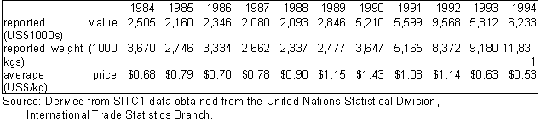
Table 11: 1986 and 1987 used-clothes
exports to Mozambique, by price
It is recognized that "Women prefer traditional, brightly colored so-called capulanas. Another step must be... complementing the clothing support with purchase of capulanas. This would reduce the rural areas' need for dresses and skirts, which could advantageously be sold to urban populations. In order to improve sorting and to tailor it to each target group, the Swedish NGOs should... examine conditions for establishing local sorting centres in Mozambique... In order to avoid negative competition for domestic textile production in the cities, the recipient [organizations] should make the selling of second-hand clothing more selective and directly aimed at intended groups. This could be done by making sales at places of work and in residential areas... The recipients should generally make a thorough analysis of the current pricing system... [because] the very low prices of second-hand clothing can in the long run create expectations and patterns regarding consumption which would aggravate the future sales and development of domestic textile production. Despite low prices, profit margins for businessmen are currently also considerable, which may negatively influence the sound distribution of income."
Thus there seems to have been a mix of methods called for - sometimes using markets, other times trying to distribute goods and income to the target groups more directly - and it is not clear that the choices were being made based on an adequate theory of poverty and a thorough understanding of markets.
Practical Solidarity's policy and practice have changed considerably in the years since this study (we will consider UFF further separately, below). Apart from refugee aid such as continues to be needed in Angola, "the clothes themselves are no longer the means for fulfilling our goals (in Mozambique and Nicaragua), but [rather] the cash that they can give to the projects we are supporting there."
Another slightly out-of-date example: the Swedish Red Cross (1992)
Like PS, the Swedish Red Cross has also changed its used-clothes distribution methods considerably in the last few years. In the late 1980s the Red Cross had a surplus of used clothes - in other words, more than were needed for refugee and other emergency needs - and on the other hand, it wanted to assist the organization-building processes of local Red Cross organizations in various LDCs. Consequently, the practice developed of allowing the local organizations to sell large quantities of used clothes, either in bulk to commercial distributors, or as individual garments in self-run thrift shops. However, after two studies commissioned by the SRC specifically to study used-clothes sales in LDCs (Swedish Red Cross, April and May 1992), the SRC decided that this was essentially a bad policy, and changed its practice. Some of the reasons for the change were:
Introducing western clothing styles via subsidized sales was not the SRC's intention or desire.
It was costly, as there was a risk of corruption (many bales of used clothes had simply disappeared), and much better monitoring was required.
There was often a bigger benefit if the clothes were sold in Sweden, and the proceeds used to support Red Cross activities in LDCs.
Thus, if used-clothes sales were to be a viable income-generating project for local organizations, it would be better if they initiated the projects themselves without being dependent on the SRC for supplies.
With the rising tide of refugee needs due to regional conflicts after the end of the Cold War, the SRC's used-clothes collections have been required elsewhere.
Only about 10% of the SRC's assistance for LDCs is in the form of used clothes, and nowadays only about 5% of the clothes exported are for sale. The latter amounts are only in fulfillment of old contracts with local organizations, which are being allowed to expire without renewal. Other than those contracts, all used clothes currently exported are in response to emergency appeals, for disaster relief, by either the International Committee of the Red Cross (ICRC) or the International Federation of the Red Cross (IFRC).
In 1992, 30-50 countries were receiving used clothes primarily for distribution to refugees, but the two studies focused on Uganda, Zimbabwe, Mozambique, Sierra Leone, Vietnam, and Poland, which were the countries involved in selling used clothes. Although the reports are now somewhat out of date because policies and practices have changed, we have reviewed and discussed them a bit more fully in Appendix 7, because it may still be instructive, especially in view of some of the generalizations about NGO attitudes and behavior made in the Riddell report, to understand some of the situations and problems that were encountered with SRC used-clothes distribution activities at that time.
The report on second-hand clothing for Uganda, Zimbabwe, Mozambique, Sierra Leone and Vietnam pointed out that: "Clothing consignments are not used primarily for disaster relief or disaster preparedness... Experience from disaster areas in other countries has shown that clothes are not a priority in the event of disasters [and may even get in the way], but... can be valuable... for relief assistance [for instance, after disaster areas have become 'normalized']." The report goes on to say that: "The guidelines treat the sale of clothes as marginal in comparison with other use. In reality, the sale of clothes has perhaps become the most important activity. Between 25-80% of the clothes are sold" in those particular countries.
Thus in some countries almost all of the used clothes were being sold, but proper monitoring and reporting was often lacking. Many entire bales of used clothes - each worth perhaps two months' local salary or more - were simply missing. There was rather arbitrary pricing of and arbitrary access to used clothes, including by local Red Cross employees, who were sometimes known to misuse the privilege of buying under-priced used clothes on credit, including for resale. There was also organizational tax avoidance, since clothes which were allowed to be imported without customs duty - on condition that they be given away free - were in fact sold. Thus in apparent confirmation of two major aspects of the Riddell study, many of the imported used clothes were not going to the very poor, but were being sold on the market, although sound business practices and market understanding were not much in evidence.
Whereas the Abrahamsson study reviewed above recommended increased sorting activities to be done in the LDC (in that case, Mozambique), the SRC studies repeatedly pointed out that "sorting and choice of clothes can be better suited to the needs of the recipients... [if] the Swedish Red Cross is able to gain a proper insight into the special needs, the climate and the culture prevailing in the various countries. Systematic and regular monitoring of the clothing consignments make it possible to increase the degree to which the clothes are suited to the recipients and ultimately to establish an 'experience register' for each country."
Given that this was basically a commercial operation in the LDCs and showed so many problems which had almost nothing to do directly with disaster preparedness or response, and even relatively little to do with relief assistance or development, the SRC was doubtful about getting further involved. It read these reports in 1992 and decided to change policies. It prefers now to stick more closely to its core mission, which may include selling used clothes in Sweden (possibly including bulk sales to export wholesalers) in order to fund its activities, and sending used clothes abroad if requested for emergency purposes by the International Red Cross, but probably not selling used clothes in LDCs itself, nor trying to use them for development purposes directly.
Combining commercial used-clothes sales with development projects (UFF)
UFF (known in English as Development Aid from People to People), a private development organization associated with Humana organizations throughout much of Europe, seems to have evolved a somewhat similar strategy, at least insofar as it primarily does not attempt to do development work via used clothes directly, but rather usually sells the clothes for the maximum price obtainable on the market, and then uses the funds for development purposes. A big difference, however, is that UFF has gone into commercial selling of used clothes in LDCs in a big way; it has taken a lot of criticism for not giving the clothes away for free, as well as for other reasons. We have reviewed two studies of UFF's used-clothes activities, which came to rather different conclusions.
The first study (Interconsult 1990) came to the conclusion that UFF did not need Sida freight subsidies for used clothes because it was selling the clothes commercially in any case, and the commercial proceeds would cover the freight costs. Consequently, Sida freight subsidies amounted to indirect funding of other UFF activities, which Sida had already chosen not to fund, at least partly because UFF chose not to open its books regarding all its international activities to Sida scrutiny, and perhaps partly to do with management style and expense.
The second study (Denconsult 1993), addressed the effects of UFF's used-clothes sales. With regard to Zambia, the report says: "The total effect of [UFF's] work - clothes sales as well as development aid work - is actually very positive." It goes on: "The positive effects of [UFF's] total activities in Zimbabwe at present exceed by far the few negative effects of the trade in second-hand clothes... The actual analysis of [UFF's] trade in second-hand clothes in Africa shows that the present positive effects by far surpass the negative ones. This tendency is naturally strengthened by the fact that the profit from [UFF's] trade in second-hand clothes finances a large part of [UFF's] development aid activities in the countries...
"In spite of [UFF's] being a rather new private development aid organization, impressive results have already been obtained... After a learning period of about 20 years where experiments, mistakes, and a number of corrections were made, [UFF] in Zambia and Zimbabwe appears today as a relatively effective private aid organization capable of reaching the poor part of the population with relatively cost-effective and viable projects within the fields of education, health, water and sanitation, agro-forestry and tree-planting. This assessment is shared by a number of international development aid organizations such as the European Development Fund, the World Bank and UNICEF, and can be derived from the fact that these organizations use [UFF] as an implementation tool for their emergency aid and poverty programmes in Zambia as well as in Angola.
"It is worth noting that this result has mainly been obtained through efforts of voluntary labor from [UFF's] permanent staff - among them a large number of young African [UFF] employees, and a large group of solidarity workers who have spent six months each on a development project. Unlike the main part of the other Scandinavian private development aid organizations, [UFF] has not received large contributions financed by the public tax-payers for its development aid work. Second-hand clothes are [UFF's] most important source for financing the development aid work in Africa."
Thus this study came to the emphatic conclusion that, on the whole, there would be negative consequences for the African economies studied if UFF were prohibited from collecting or exporting used clothes. And apparently large segments of the public agree: Despite negative publicity attached, among other things, to the fact that UFF sells almost all of its collected clothes either here in Sweden or in African LDCs, it continues to be the single biggest collector and exporter in the Swedish used-clothes market.
The importance of involving the Swedish people in development work is frequently cited as an important reason for subsidizing used-clothes exports, but UFF shows that it is possible to successfully combine charitable used-clothes collection and commercial sales with useful development projects. UFF's Annual Report is of course a public relations document, so it shows how UFF would like the public to understand these issues:
"Some of the collected clothes are sold in the UFF shops [in Denmark (and Sweden)]. The proceeds from the sale are used in full for people to people projects in Africa. After sorting, about 60% of the collected clothes are shipped to people to people projects in Africa. The clothes are sold in local [UFF]-shops and in market places in rural areas. There is a great shortage of clothes in Africa. Thus the second-hand clothes meet an important need for many poor people, who cannot afford, nor have the opportunity to buy, new clothes. African market economy is often characterized by a scarcity of merchandise. In this situation, the second-hand clothes function as a generator on the market and help induce production and trade. Importing, transporting, sorting, packing and selling second-hand clothes create many jobs in Africa... The proceeds from selling clothes in Africa are used to start and/or operate schools, enterprises, health programmes, AIDS-campaigns, child aid and environmental programs. The second-hand clothes are an important source for funding the work in Africa."
In both Europe and Africa, the UFF second-hand shops aim to produce "a good surplus for development aid". Some used-clothes are also distributed free - in Angola, less than 1% in 1994 (which was still over 11 tons).
The purposes of the "fund-raising" (used-clothes sales) activities in Africa are very clear: "The first is to generate funds for [UFF] projects...; the second is to provide good quality second-hand clothes, at a reasonable price [note: not a subsidized price], to the population... particularly in the rural areas... It means a lot to these poor people to be able to buy cheap, second-hand clothes and perhaps save some of their meager income to buy other needed commodities... The selling of second-hand clothes also stimulates the local market economy in these countries... [People] are encouraged to produce something and/or to sell something in the market in order to make money to buy the clothes... The small dealers benefit from the project because, by buying and then selling the clothes, they are able to run a small business, thereby making a living for their families."
In Mozambique, "By initiating a credit system, the project made it possible for many new vendors to start selling second-hand clothing. The credits are given with preference to those from remote areas... Many of the clients do not have the basic business knowledge necessary to run a small business. In order to help the growth of their enterprises, the project has started giving courses in 'Small Business Management'."
"To be a customer in an [UFF] shop means more than just buying an item of second-hand clothing. It is an experience in how clothing, donated by people in Europe, is transformed into a well-liked commodity and into development aid, helping children..."
"UFF and HUMANA have contributed to emergency aid programmes in various ways. [They] have developed an emergency aid package... containing new clothes suited for one person. All is packed into a bag with the size and sex marked on it. There is a pair of solid shoes, underwear, other clothes needed and a blanket. [They] have distributed thousands of emergency packages, in particular to refugees in war-stricken areas." There is a note that UFF "also distributes packages with second-hand clothing in areas with a particular need of emergency aid", but as we have noted, it seems to be a quite insignificant share of total used clothes exported.
Thus UFF, a non-profit NGO, is very actively involved in commercial sale of used clothes. We will shortly examine a slightly opposite possibility, which is that for-profit companies can be directly involved in the collection of used clothes for NGOs. But first we will finish our review of NGOs themselves by taking a quick look at the attitudes of some of the major non-Swedish and international NGOs.
Non-Swedish and international NGO attitudes towards used-clothes exports
The Salvation Army in the U.S. and Canada, and Oxfam in Britain, have expressed concern about the subsequent effects on LDC producers when they sell surplus used clothes to wholesalers on the world market. A number of international NGOs also express rather strong reservations even about utilizing second-hand clothes in emergency situations.
The International Federation of Red Cross and Red Crescent Societies states that "all used clothing distributed through Federation programs is destined for victims of natural or man-made disasters... [and even then] only on an exceptional basis." As we have just noted, the Swedish Red Cross now exports used clothes almost solely in response to requests from the International Red Cross.
Oxfam America cautions: "As with emergency food... it is [generally] more appropriate for international agencies to provide funding so that products can be bought locally, or at least within the region - [unless] local supplies are not adequate or accessible, and imports are [thus] warranted." (Food aid has a forty-year history and has been debated thoroughly in the economic literature; a sampling of that debate, illustrating the issues involved, is included as Appendix 8.)
The British Overseas Development Administration also believes: "In emergency situations, available funds are more effectively used in support of international coordinating agencies, such as UNHCR, the UN Department of Humanitarian Affairs, and the International Committee of the Red Cross. It is essential to respond in disaster situations to the precise, and sometimes changing, needs of the victims, which is done through close coordination with these international agencies and... charities, to ensure that the right items are supplied to the right people at the right time. There have been instances in the past where donated goods were not suitable for the people for whom they were directed. There is also the danger that the recipients will resent the donation of second-hand clothes (a practice banned in some countries)."
Commercial ''for-profit'' involvement in used-clothes collection and distribution
We have noted the involvement of several NGOs (specifically PS, the SRC, and UFF) in commercial sales of used clothes in LDCs, and have discussed both problems and opportunities occasioned by such practices. Another interesting possibility, which has provoked controversy in the U.S., is the involvement of commercial "for-profit" companies in used-clothes redistribution activities within the source (industrial) country, including collection, sorting, and operation of second-hand "thrift shops". It works like this:
"A key element in the formula is the relationship between local charities and ['for-profit'] thrift store chains. [For the chain], this means finding a local charity, supplying it with trucks and teaching it how to phone bank and collect donated items. [The chain] then contracts to buy truckloads of merchandise that the charity collects locally... The charities say they like the thrift store partnership because it enables them to raise a lot of money..."
The Council of Better Business Bureaus' Philanthropic Advisory Service (in the U.S.) clarifies the field by distinguishing three types of charity thrift shops:
"One is self-contained and program-related. The charity fully controls all aspects of the operation of the shop. Running the shop is actually part of the mission of the organization. The shop's secondary purpose is to raise money to pump back into the charity's program fund.
The second type of shop is controlled entirely by a nonprofit organization, but exists strictly as a fund raiser, not as a program service.
The third type is a charity thrift shop with a for-profit connection. Solicitations for second-hand goods are made on behalf of the charity, but typically a for-profit business owns and operates the shop itself. Some of the value of the donated goods goes to the charity, and the rest goes to the owner-operator."
There are obvious reasons why an NGO might want to run a shop in either of the first two modes, but why would they choose the third? They can perhaps "raise a lot of money", but cannot they do that in the first two ways also? Maybe, but maybe not. If they are well organized and have lots of volunteers, then presumably they can make money in those modes, but even then, besides the drain on the volunteers and on the NGO's organizational capacity, there may also be a substantial capital investment to set up the operation.
The Council of Better Business Bureaus notes: "Many of the charities raising money through these arrangements argue that they are getting great returns for the use of their name. First, they do not have to put up the capital (US$100,000-300,000, by one charity representative's estimation) to open the shop. 'If you tie up that $150,000 in a thrift shop, you will not have it for the programs you are trying to run.'" Another charity agreed, saying: "What people do not understand is the tremendous infusion of capital that these (for-profit) operators put into the thrift shops." Thus, "for no financial risks and for very few headaches, the charity can earn a sizable portion of its total yearly budget by signing on the dotted line..."
Some people feel that the percentage that is given to the charity - often in the range of 7-10% of gross revenues - is too small. But "as a financial manager of a veterans' organization said, even if you own and operate your own shop, 'there is no guarantee you can make 8% (profit or surplus) your first year. There is better return on your own thrift shop if you own it and operate it efficiently, but that is if you can operate it efficiently. It is not easy to do that.'" One organization "has approximately 200 thrift stores across the country, half run by the charity and half managed by for-profit entrepreneurs... [An executive] said that the professionally-run stores are a better deal for his charity. [The] wholly owned and operated stores 'do a lot worse' financially than the professionally managed ones..."
Summary and conclusions
Many used clothes sold on the market, not given to the very poor; NGOs may lack poverty understanding and market analysis; some doubt about utilizing second-hand clothes even for emergency relief; "for-profit" involvement may be beneficial in some situations
The studies we have reviewed of Swedish NGO used-clothes distribution activities in LDCs are a little out of date, because historical conditions and organizational practices have both changed since the studies were done. Nevertheless, they seem to bear out many of the points made in the Riddell study of Swedish NGOs in general: For instance, at least at the time of the studies, there often seemed to be an arbitrary mix of market and non-market methods employed; understanding of markets and of market analysis seemed limited; and there seemed to be a tendency for concentration of power, with resultant possibilities for corruption. Often the used clothes exported did not seem to benefit the poorest of the poor.
However, the problems seem to have been recognized and practices changed. PS and the SRC report rationalizing their sales operations in order to concentrate on development or relief projects, and UFF continues to do the same.
Many non-Swedish and international NGOs seem quite cautious even about utilizing second-hand clothes for emergency relief, and seem quite concerned about contributing to the international used-clothes trade via bulk sales of surplus used clothes to commercial wholesalers, although many of them do it.
UFF demonstrates an apparently successful model of an NGO heavily involved in direct commercial selling of used clothes in LDCs, while a controversial model of for-profit involvement in the collection process has been demonstrated in the U.S. The fact that UFF seems to continue to enjoy widespread public support, despite heavy negative publicity, may indicate that the people of Sweden do not insist upon direct subsidized distribution of used clothes to the very poor, but perhaps understand to some extent the intermediating power of markets to increase the benefit provided by the clothes to the poor.
|
| ||||||||||||||||||||||||||||||||||||||||||||||||||||||||||||||||||||||||||||||||||||||||||||||||||||||||||||||||||||||||||||||||||||||||||||||||||||||||||||||||||
Used Clothes as Development Aid: The Political Economy of Rags (SIDA)
Part II-A: Analysis of the effects of the used-clothes trade in general
Chapter 5: Theoretical welfare effects of unsubsidized imports
In Part I we saw that there is a large worldwide trade in used clothes, and that there are strong negative feelings towards this trade, especially on the part of LDC clothing producers and workers; that national governments for the most part are fairly tolerant of the trade; and that many NGOs have reservations about it but also participate in it in various ways. Now we will analyze the theoretical impact of used-clothes imports on economic welfare in a small LDC. The theoretical analysis we will present is rather simple, but it is important to notice carefully exactly how we do it.
To begin with, we might imagine what we take to be a fairly realistic situation in a small less-developed country. There might be:
a) masses of people too poor to buy domestically-produced
clothes; or even
b) no domestic textile production; or
c) no legal
commercial import of used clothes.
There might also be:
d) poorly
functioning factor markets resulting in massive unemployment;
e) and an
uncompetitive industry that is unable to export domestically-produced
clothes;
f) but there might also be positive external benefits associated
with actual or potential industrial production in the early stages of
industrialization - the infant industry argument.
Basically, we want to know:
1. What would be the effects on such an economy of allowing
used-clothes imports?
2. What would be the effects of subsidizing (and thus
presumably increasing) those imports?
But this is not the situation we will begin by analyzing; this is far too complex to start with. We will start with a simple, "ideal" model, and then we will consider the implications of changing various assumptions to make the situation more realistic (and complex).
Initial assumptions: Perfect markets (full employment of resources), free trade
For instance, we initially assume perfectly functioning markets, so that there are no unemployed resources (including labor), and there are no distortions (including externalities). We assume that the country does have a domestic clothing industry, but that there is no clothes export. We assume that the country allows free importation of both new and used clothes, and we assume that the economy is in external balance.
Thus we initially explicitly contradict four of our six "realistic" conditions above (b, c, d, and f). We will simply ignore one point for awhile (a: poor people), and we will actually accept (initially) only one of the conditions above (e: no exports).
We assume of course that domestic and imported new clothes and used clothes are all substitutes for each other, but not perfect substitutes. We consider these three markets separately: domestic new clothes will be designated with subscript d, imported new clothes with subscript i, and imported used clothes with subscript u; while all other goods and services are aggregated into a single sector (subscript o). We do not try to show the impact on the latter sector (all other goods and services) in our diagrams.
The first set of diagrams (Diagrams 1d, 1i, and 1u) show the situations in our three separate but interrelated clothes markets when the economy is in initial equilibrium. In Diagram 1d, the demand curve for domestic new clothes (Dd) is downward sloping, as it is for the corresponding goods in the following diagrams. Domestic supply of new clothes (Sd) increases with price. The market has price pd and quantity qd. (For the moment, ignore the shifted supply and demand curves in the diagrams, and the corresponding prices and quantities, all of which are indicated by prime ('); we will come back to them several pages further on.)
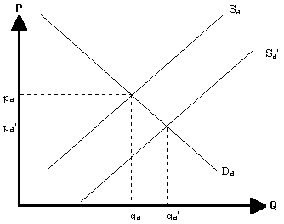
Diagram 1d: Domestic new
clothes (with production subsidy)
The next diagram (1i) represents the market for imported new clothes. Since we assume that the country in question is small, the price of imports (pi) is independent of the level of domestic demand. We thus get a horizontal supply curve (Si).
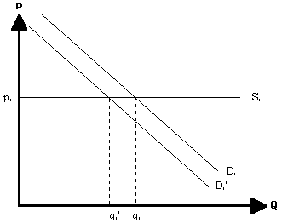
Diagram 1i: Imported new
clothes (with domestic production subsidy)
The third market is for imported used clothes (Diagram 1u). It has essentially the same characteristics as the previous one, that is, a given world market price (pu) and a horizontal supply curve (Su).
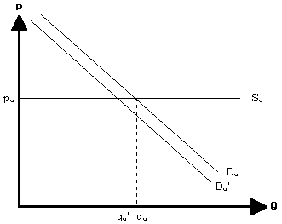
Diagram 1u: Imported used
clothes (with domestic production subsidy)
The rest of the economy (the all other goods and services sector) consists of a mixture of non-tradables and tradables: The market for non-tradables clears domestically by definition, while the price in the tradables sector is set on the world market, adjusted for trade taxes; we do not need to go into details about this sector for the analysis undertaken here.
As we have assumed initially that there are no distortions in the markets (including in factor markets such as labor), the allocation reflected in the diagrams above - including the presence of used-clothes imports - can be shown to be welfare-maximizing.
Why are used-clothes imports welfare-maximizing? (Real goods are real income)
In these simple "ideal" conditions, importing used clothes is welfare-maximizing because, on the one hand (as indicated by the downward-sloping demand curve for used clothes), some people would have been willing to pay considerably more for the used clothes they got, so that there is "consumer surplus" when they are able to buy used clothes for less; and, on the other hand (as indicated by the upward-sloping supply curve for domestic new clothes), producing more new clothes domestically instead would have cost relatively more.
Another way to look at it is that, since clothes, even used clothes, clearly have value in the marketplace, they constitute real wealth, or real income to those who receive them. Simply discarding this wealth must therefore result in a net worldwide loss, while re-using it must result in net worldwide gains. The land otherwise engaged in fiber production, the labor and capital otherwise involved in textile production, can all be put to higher and better uses than re-creating clothes which already exist, thus generating increased real income. And this is true even before considering any possible gains to the environment from having less overall production required to produce the same level of income and wealth.
Our analytic strategy
However, two types of realistic conditions which we noted above (d and f) might cause less than optimal resource allocation, and would thus imply less than maximum welfare. One of these is unemployment due to poorly functioning factor markets - which also make resource reallocation difficult - and the other is positive externalities associated with clothes production. We want to consider the effects of used-clothes imports under these two conditions. If there are negative effects, we want to consider how to counter them.
But it is not really the direct effects of used-clothes imports that we are mostly concerned with. The used-clothes imports themselves create jobs and income, and provide consumers with usable goods at cheap prices. So far, so good.
But what we are mostly concerned with are the indirect effects of used-clothes imports on other sectors of the economy - on domestic new clothes production, for instance. Since used clothes are at least a partial substitute for new clothes, allowing cheaper used-clothes imports will reduce demand for domestically-produced new clothes, causing decreased domestic production, employment, and income, at least in that sector. If we should want to counter these negative effects, to maintain production of domestic new clothes in the face of imports of competitive (used) clothes - or to increase production, or to reduce the decrease in production - we could do so either directly, with a production subsidy, or indirectly, by restricting the competing imports.
The natural order might seem to be to consider the economy with no used-clothes imports - due perhaps to a prohibitive tariff, or to an outright ban, or even to a simple lack of supply - and then to consider the change in welfare when imports come in. However, we will do the opposite. We have already constructed a hypothetical welfare-maximizing situation with open borders. We can now imagine closing the borders (restricting imports) in order to support domestic production. We can compare this indirect method of supporting domestic production with the more direct method of a production subsidy. Because the more direct production subsidy results in a cleaner, simpler analysis, we will actually do that first.
As for the reasons why we might wish to support domestic clothes production, while the first distorting condition (poorly-functioning factor markets resulting in unemployment) is the more obvious and perhaps the bigger problem, it is also the more complicated and perhaps the more intractable one, so we will look at the second condition (positive externalities) first.
Thus, to summarize our strategy, we will first analyze the results of a hypothetical production subsidy to capture a positive externality associated with clothes production, and then we will examine the effects of such a subsidy if there is unemployment. Then we will analyze the results of the alternative support mechanism - an import restriction (tariff or ban) intended to capture the same externality - and then we will again examine its effects if there is unemployment. Finally (in Chapter 8), once we understand the effects of used-clothes imports in general, we will consider the effects if we not only allow, but subsidize, used-clothes imports.
Government support via production subsidy to capture positive externality
It is often argued that there is a positive externality associated with industrial production in the early stages of industrialization - the basic infant industry argument. This implies that there are grounds for supporting the domestic clothes industry to increase production. The direct avenue to deal with this distortion would be to give production subsidies to the domestic clothing industry directly. If we do this, we shift Sd to Sd' in Diagram 1d, giving us a lower domestic market price (pd') for domestically-produced new clothes, and increased output as desired (qd'). This causes increased employment in the domestic clothing industry, and more learning by doing. If such a positive externality really exists, then this intervention is welfare enhancing.
The magnitude of the impact of such a production subsidy on the other sectors will vary with the relevant elasticities. There should be some reduction in demand for imported new clothes, reducing clothes imports to qi'. Since we assume perfect markets, this is not going to lead to a trade balance surplus, but the different effects of changing relative prices will balance external trade.
Demand for used clothes should decline somewhat, although one may assume that the degree of substitutability between new clothes and used clothes is less than that between domestic new clothes and imported new clothes. The shift in Du should be downwards, but not so much.
Finally, what happens to the rest of the economy is hard to tell: Supply should be reduced somewhat if the domestic textile sector attracts more resources. On the other hand, the used-clothes handling and distribution sector, and the imported new-clothes sector, should both shed some labor. We cannot tell a priori which effect would dominate. Still, there is going to be a restructuring of the economy under the impact of the production subsidy. Since we assume full employment of resources initially, employment levels would not change, but since the production subsidy eliminates a distortion, real income would increase over time, due to productivity increases resulting from increased industrial experience.
Other arguments for protection of infant industries
We have seen that a large share of clothing imports into industrial countries themselves originate in LDCs, but it may be difficult for new LDCs to enter the export market unless they have a secure domestic base on which to build. Given the differences required in style, and perhaps in quality as well, this does not seem absolutely necessary, as the example of multi-national manufacturing for export demonstrates.
Still, it may be that certain countries or regions, which would be capable of supporting textile and clothes production once they got started, and which might have comparative advantages in such production, nevertheless have not developed those industries due to accidents of history and perhaps the incidence of power, and may not be able to do so now or in the future without temporary protection or support. This could be the case, for example, if there are scale advantages which an entrant in the field could not take sufficient advantage of soon enough to be able to compete with lower-cost imports, and would thus be forced out of business before establishing itself. This is essentially a strategic trade argument, which might call for some form of government support to develop a new industry.
Production subsidy effects on exporting, and benefits
If the domestic industry were producing already for foreign markets, then a production subsidy would also stimulate exports. Much recent research suggests that exporting by itself has a positive externality effect on growth, by exposing the economy to an international and more competitive environment. Thus such a subsidy could have a doubly-positive effect.
Less than fully functioning markets: Unemployment
If there were unemployment, the results of a production subsidy would be less clear-cut. The employment effect would depend on the combined price and income effects. Employment would obviously increase in the domestic new clothes sector. However, despite existing unemployment, it might be that the increased competition for labor due to subsidized production would have some increasing effect on wages, which would tend to reduce employment outside the subsidized sector. It might also be the case that the shrinking used-clothes sector is more labor intensive than the expanding clothing industry, which in itself would tend to depress employment. In the end, the employment effect of a production subsidy would be uncertain, and might depend on whether a positive income effect (due to capturing positive externalities in clothing production) could compensate for other losses.
Government support via import tariffs
What about a tariff on imported clothes to support the domestic clothing industry, instead of a production subsidy? A tariff on used clothes would shift the used-clothes supply curve (Su, in Diagram 1u above) up. Exactly what would happen to the demand curve would depend on the general equilibrium effects of this price change, but the end result would be a reduced quantity of imported used clothes at a higher price than before.
This would lead to some increase in the demand for domestic new clothes, giving us a higher domestic price, and a larger quantity, as desired. There would also perhaps be some increase in the demand for imported new clothes, unless it were also controlled via trade policy intervention, such as a tariff.
The negative side-effect of tariffs
What type of welfare effect would we have in this case? There would be increased production in the domestic clothing sector, beyond the original market-determined equilibrium level. This would draw resources from the rest of the economy, where they were more productively employed at the original relative prices. But would this not be welfare improving, when there is a positive externality associated with this production?
If the positive externality is sufficiently large, this would be the case, but here, differently from the subsidy case, we cannot be sure that the overall welfare effect would be positive. The difference between the previous case and the present one is that we now not only correct the production distortion, but we also introduce a consumption distortion. This is a negative side-effect. Now consumers are optimizing against a price for imported clothes (the world market price plus the tariff) that is different from the alternative cost to the economy to import them (the world market price). Therefore, this is not an optimal intervention, although we cannot say for sure that it is welfare-reducing.
A tariff on imported new clothes would give the same consumption distortion. The positive effect on domestic clothes production might be larger, but this would be an empirical matter.
Tariffs such as these are a common result of efforts to implement a strategic trade policy in support of infant industries. But as Paul Krugman (1994) points out: "Concepts such as strategic trade policy can all too easily be used to rationalize good old-fashioned protectionism." And as the head of the new World Trade Organization, Renato Ruggiero, says: "Governments may try to preserve some jobs in uncompetitive industries by using trade barriers, but they will do so at the cost of jobs in the efficient export sectors. Studies... indicate that the annual cost of protecting a job by import barriers is typically anywhere from three to eight times the annual wage of that job... Protection... costs jobs in unprotected industries, although we never see these job losses directly reported. It is a fallacy to believe that the only effects of protection are the visible effects - jobs apparently saved in protected industries. The jobs lost in other industries are just as real. Protection increases costs, reduces sales (because it taxes consumers), and leads to fewer jobs in unprotected industries."
It has also been argued by some that, in some rural areas where markets barely exist at all, reducing the availability to consumers of a major category of important and affordable goods (used clothes) would reduce their willingness to produce goods for the market themselves, as producers - or vice versa, that encouraging availability of such consumer goods can increase their willingness to produce for the market (whereby they can earn the income to buy the consumer goods) - thus having a major impact on economic development.
Less than fully functioning markets: Unemployment again
What if there are distortions in factor markets, so that it is not so easy for resources to shift, and there is unemployment? And what if we pose the question the other way, as whether to remove an existing tariff or ban? In this case, although removing the import restriction would decrease one distortion, so that consumers were now facing the world market price in the used-clothes market, it would possibly increase unemployment, at least in the short run. The net short-run effect might well be welfare-reducing, although gains would be possible in the longer run through improving the functioning of factor markets.
Our conclusions here are thus the standard ones: If there are distortions (such as a positive externality, factor-market rigidities causing unemployment, or an import tariff or ban), one should try to remove them without creating new distortions. (We will discover a similar result when we turn to the issue of whether one should subsidize the import of used clothes.)
Conclusions
Given positive externalities and/or unemployment, imports can be damaging at least in the short run; any protective measures should be limited and temporary
The case for outright banning of used-clothes imports seems rather slim, but it is not clear that there are no negative consequences of such imports at all. Indeed, like any other import-substituting industries, textile and clothes production may be hard hit when import rules are liberalized. There may be a difficult period of restructuring, perhaps aggravated if such changes are made quickly, and national governments may want to make special efforts to help displaced workers find new employment. As we have seen, they may also come under intense pressure from domestic industries seeking protection, and they may find themselves politically required to accommodate those pressures with tariffs for awhile. Protective measures should be temporary, however, and every reasonable effort should be made to help factor markets function more smoothly and affected industries restructure towards increased productivity, perhaps for the export market directly. Such a strategy takes advantage of the increased real income which used-clothes imports can undoubtedly allow in the long run.
Chapter 6: Empirical welfare effects of unsubsidized imports
What are the actual, practical effects of all these imports in reality? Do used-clothes imports in fact disrupt or depress markets in Third World countries to such an extent, with resultant losses of jobs and income, that protection for domestic industry against cheap imports is necessary? Or, even if there are direct disincentive effects, are those effects outweighed by income gains to consumers, by distributional gains to the poor, by employment gains in related or unrelated industries, by productivity gains in restructured industries, by revenue gains to the government, by environmental gains worldwide, or by any combination of these?
In terms of empirical market analysis, these questions are at the heart of the matter. If imports cause overall damage, clearly their negative effects should not be increased via subsidies. However, we will see that, at least in the case of Rwanda, the damage is not so obvious; in fact, a case can be made that there are net benefits from used-clothes imports. It is true that Rwanda is a special case, but it is nevertheless a very interesting one. It is also the only one for which we have a good prior empirical study of economic effects.
Haggblade's analysis of the economic effects of used-clothes imports in Rwanda
Unfortunately, there is almost no literature thoroughly researching the true economic effects of used-clothes imports. The best study which exists is economist Steven Haggblade's 1990 article "The Flip Side of Fashion: Used Clothing Exports to the Third World", based primarily on his research in Rwanda before its recent civil war.
Haggblade found that, at least in a country like Rwanda with no domestic textile or ready-made apparel industries, employment gains in handling, cleaning, repairing, restyling, and distributing used clothes came very close to offsetting the related employment losses in tailoring and/or distributing new clothes. Further, comparing equal values purchased of used clothes, ready-made clothes, and tailored clothes, national income was highest with used clothes, due to higher value added domestically. Still further, these income gains meant that the relatively poor handlers, cleaners, repairers, restylers, and distributors of used clothes could earn roughly equal incomes in less time than the tailors who were (partly) displaced by used-clothing sales - in other words, there were "higher returns to labor in used-clothing distribution".
At the same time, the government reaped higher revenues (due to higher tariffs on used clothes than on imported cloth), while the relatively rich used-clothes wholesalers also benefited. Low-income consumers also gained from the availability of cheaper, used clothes, as they were able to purchase more clothes for the same expenditure, or to buy the same quantity of clothes plus something else. Since it is mostly the rural poor who buy used clothes, it was mostly they who benefited as consumers. It short, it was found that "used clothing generates maximum income per unit of sales, supplies consumers at the lowest cost, benefits the poorest consumers most directly, and generates nearly as much employment as small-scale tailoring."
As Haggblade pointed out, all of his meticulous calculations concerned only first-round effects; "they do not take into account the multiplier effects of increased real income among used-clothes consumers and suppliers." In other words, income gains may lead to better-clothed, better-fed, even better-housed and better-educated families, resulting in productivity gains for the future. How is all of this possible? Can we understand these results intuitively, in real terms?
Used clothes are real goods. If they were received for free, they would constitute real income without labor, which would not be a totally unenviable state, especially if one's time and labor were left free for other pursuits, whether income-generating or not. In the case of Rwanda in Haggblade's study, there is certainly some cost to the nation as a whole, in terms of the purchase price of used-clothes bales imported from industrial countries by wholesale importers, and the corresponding potential transfer of real goods or services out of the country to finance the purchases. But there is no domestic textile industry in Rwanda, and thus no textile production displaced. The costs of importing used clothes are apparently less than the cost of equivalent textile imports, and thus there is a net saving with the import of used clothes. Wearable clothes are produced at less cost, and in fact are largely produced by poor people, as well. Thus poor people can better afford to clothe themselves, while retaining part of their erstwhile clothing expenditure for other purposes.
Global extensions of Haggblade's analysis, including a multi-market model
However, we are not, and cannot be, simply concerned with any single country. It is possible that the fiber or textile production displaced by used-clothes exports to Rwanda is displaced in fiber- or textile-producing LDCs, either elsewhere in Africa, or elsewhere in the world. And, what is essentially the same thing, we must also consider used-clothes exports from industrial countries directly to those fiber- or textile-producing less-developed countries. If employment losses in manufacturing and distribution of new clothes in Rwanda were barely offset by employment generated with used clothes, it is clear that the overall global employment losses, including those in fiber and textile production, must be larger than the employment generated by redistributing used clothes. Unfortunately, we have found little information which would enable us to accurately estimate these losses. Empirical work might be required to rectify this lack.
A related question concerns the fact that Haggblade's estimates are based on equal values of used clothes, tailored clothes, and ready-made clothes. But the price ratios he reports for these categories are roughly 1:4:10. In other words, a used article of clothing could generally be purchased in Rwanda for roughly one-fourth the cost of a newly tailored article, or for one-tenth the cost of an imported ready-made article. Presumably, with the introduction of cheaper used-clothes imports, the entire budget previously devoted to tailored and ready-made clothes would not continue to be devoted to clothing. The fall in the average price of clothing and the increased purchasing power available would probably lead to more of all categories of clothing being purchased, but the income effect of cheaper clothes would also lead to increased purchase of other goods and services. Some of the previous clothing budget would now be shifted to those other goods and services. How much employment and income would be generated in those other industries?
This is the type of analysis we have already undertaken in the previous chapter, in a totally abstract, theoretical way. In order to properly evaluate these effects in practice, we would need to construct a multi-market model, with price and income elasticities for used clothes, for new clothes, and for all other goods and services on the consumption side, and with employment and value-added in each of these categories on the production side. If such a social accounting matrix could be constructed with relevant weighted global average values, we could evaluate the net global changes in income and employment from recycling used clothes. As we saw in our previous theoretical discussion, we should also consider externalities and the degree to which markets are functioning, the flexibility of resources. This is theoretically possible, but it would be a daunting task in practice, and we certainly do not have the data available to attempt it now.
Conclusion
Net positive or negative effects are not clear empirically
If we had a clear and strong case for damage resulting from imports, we could rule out subsidizing imports in any situation which would likely add to that damage. But in the case of Rwanda, it is not obvious that there is damage from imported used clothes - perhaps there are rather small employment losses - while in fact it appears that there are actual gains in productivity, income, and distribution, and this is only on the first round, without considering multiplier effects.
But Rwanda is a special case, without domestic textile or ready-made garment production, and empirical analysis has not considered potential losses from the loss of positive externalities possibly associated with such production. On a global scale, while ideally we believe that there must be gains from re-using still serviceable goods, in fact the results might depend on the level of externalities and the degree to which markets are functioning, or not. Thus we cannot conclude positively that that there is or is not overall damage from importing used clothes.
Chapter 7: A brief history and sociology of the used-clothes trade
We have discussed the theoretical possibility that used-clothes imports (in the presence of poorly-functioning factor markets and/or positive externalities) may cause net damage at least in the short run, but we have not been able to document that damage from the only careful, thorough empirical study available. We now take a look more broadly at the effects of re-using second-hand clothes, historically and sociologically.
LDCs: Hansen's study of used clothes in modern Zambia
Anthropologist Karen Tranberg Hansen, who has studied the distribution and re-use of second-hand clothes extensively in Africa (in Chapter 2 we quoted her description of the distribution of used clothes in Zambia), believes that "the master narrative that regards Lusaka's booming secondhand clothes markets as just another example of exchange relations that continue to link countries like Zambia to the West in dependency terms is inadequate. It reduces all that is African, and in this case Zambian and local, to mass capitulation to western-type consumption and trivializes the active engagement between people and clothing into a warped imitation of the West... Recommodified at the point of resale, the transformation of the West's cast-off clothes into 'new' garments in Zambia involves distribution and sales practices in local markets and subsequent incorporations into clothing practices that reflect and engage everyday experiences in spite of the recognizable western imprint of the garments."
Hansen goes on to report that "this trade is not new but its present scale is unprecedented. By the inter-war years [~1920-40], if not before, the used clothing trade reached Zambia from Zaire... The name of Mokambo, a busy Zambia-Zaire crossing point, became a common term for the clothes and the traders. It had a negative connotation [at that time] and people did their best to hide that they were wearing mokambo... Today, Zambians have no qualms about buying salaula; they will stop you on the street to ask if your skirt is 'from salaula or from the shops'."
Hansen continues later: "Customers demand a wide selection of new salaula items... The desire to be smartly turned out, even if the garments are shabby, makes clothes-conscious Zambians insist on immaculate ensembles whose elements are laundered and ironed. Thus, detailed care for clothing helps to transform old clothes into new ensembles.
"Customers, traders, and tailors work hard to make salaula into their own creation... The overall combination of the ensemble's elements is always in process. In the very act of appropriating them into 'the latest', Zambians undercut their western imprint...
"The rapid increase of salaula since the late 1980s has made affordable clothing available to a broad spectrum of people. This contributes toward satisfying the need for clothing and the desire for style. The wide range of salaula gives shoppers a welcome opportunity to browse and choose...
"Throughout the 1980s, urban and rural Zambians increasingly relied on saluala... The growing availability and acceptability of used clothing was the theme of a 1988 record, 'Salaula', by popular singer Teddy Chilambe. The lyrics told of the time now past when the salaula market was only for the household servant and maid. Now even the most fashionable office workers wear secondhand suits. The song praised Zaireans for bringing salaula to Zambia, and blamed those who shunned it for wasting money they should use to feed their children. Zambians no longer look down on salaula or hide the fact that they wear it. Few traders or shoppers... had questions or concerns about why or how the West's discarded clothing ends up as a desirable commodity in Zambia... What they most cared about was the availability of affordable clothing."
Hansen concludes that: "A world-systems, dependency-thesis interpretation of unilineal transfer and blame is clearly out of tune with popular Zambian sensibilities and reactions. These reactions... celebrate salaula. Chokako Weka means 'move yourself' in Nyanja. Written on the sign of the Caroussel Botique, it captures some of the popular attractions of salaula in Zambia. Salaula implies progress; the ability to dress tells of improvement. In the popular view, after years of standing in queues and ending up empty handed, when people had little money, and clothing was not piled up waiting to be bought, salaula means that ordinary people can now afford to wear clothes rather than rags. It also means that more consumers than ever before can make choices in a booming clothing market. The salaula trade offers work and therefore hope about new opportunities to young women and men who might not find formal jobs.
"Salaula is celebrated in urban and rural areas alike. Rural areas, which used to be characterized with statements like 'there is nothing there - they don't know sugar, tea, bread, clothes, what it is like,' were described in 1992 with some optimism: 'There is even salaula now.' After the long, hard years of the Kaunda regime's austerity programs and deteriorating terms of trade both between rural and urban areas and between Zambia and the world economy, commentaries on the recent rapid increase in salaula availability and consumption express not only disenchantment with the previous government and its state, but also the attainability of future hopes and aspirations."
The re-use of second-hand goods in modern industrial countries
The practice of re-using second-hand clothes (and other used goods) has by no means died out in industrial countries. The used clothes which are donated to charities in Sweden, in the U.S., and presumably in many other industrial countries, are first sorted for those suitable for resale locally. "Thrift shops" and "second-hand stores" selling used clothes at prices far below those for new clothes are by no means uncommon; some (as we discussed in Chapter 4) are even run by professional management companies operating on a for-profit basis. "Flea-markets" and other mechanisms for redistributing used clothes and other used goods are also rather common. Many families acquire large portions of their wardrobes through such mechanisms, while children are known to pass clothes down as they grow older, thus reusing clothes within families as well.
Lemire's study of the used-clothes trade in eighteenth century Britain
Used clothes (and other used goods) have been re-used extensively in many societies over long periods of time, without any obvious psychological harm, and seemingly with economic benefit. Some fascinating examples come from Beverly Lemire's 1991 book "Fashion's Favourite: The Cotton Trade and the Consumer in Britain, 1660-1800", which we quote extensively in Appendix 9. Lemire concludes:
"The trade in clothes and the movement of items of dress through society and through the market was a salient feature of pre-industrial and early industrial Britain, providing an element of choice to a greater portion of the population than has been recognized to date. Pawnbrokers, clothes salesmen, and dealers of a general sort worked in rural and urban settings, buying, trading, and selling clothes of all sorts, but looking in particular for the type of clothing they knew would be most in demand by their customers... The second-hand trade was a critical factor enabling a large portion of the population to buy more apparel. The percentage of income spent on clothing would be more flexible when a part of the cost of a suit of clothes, a gown, or accessories could be recouped from the resale of old clothes. Thus a proportionately greater access to relatively more-fashionable clothes was possible, modifying dress as the mood or the style demanded."
Used clothes for disaster relief
Clearly there are also circumstances in which the charitable provision of used clothes internationally is accepted and very much needed and appreciated. Even the well-known private development agency Oxfam, which has raised serious questions about the disincentive effects of food aid, for instance, and which almost never ships used clothes overseas, occasionally has special projects in which they do so, such as its current "'Cold Front' appeal for winter coats for Bosnia and the Transcaucasus, and T-shirts into Renamo controlled areas of Mozambique." We saw in Chapter 4 that Swedish NGOs are also involved in relief efforts of this sort.
Conclusions
Re-use of second-hand goods is a widespread phenomenon; no historical or sociological basis is found for banning used-clothes imports
Based on historical and sociological evidence, it seems clear that we cannot conclude that the export of used clothes to LDCs is categorically bad, and should perhaps be banned, but never subsidized. The re-use of second-hand clothes seem to have a variety of benefits in many times, places, and situations. To answer whether used-clothes imports should ever be subsidized, and if so, under what circumstances, we will have to consider the specific effects of subsidizing used-clothes imports.
|
| ||||||||||||||||||||||||||||||||||||||||||||||||||||||||||||||||||||||||||||||||||||||||||||||||||||||||||||||||||||||||
Used Clothes as Development Aid: The Political Economy of Rags (SIDA)
Part II-B: Analysis of the effects of subsidizing used-clothes imports
Chapter 8: Theoretical welfare effects of subsidized imports
The usual case that can be made for a subsidy, other than simply to put cash in someone's pocket or to allow someone to do something that they like to do, is that there is some public good which is not being provided because of a market failure which can be remedied via the subsidy. For instance, one could argue regarding used clothes that there is a public good in having a better-clothed and more productive workforce, better-clothed and healthier mothers and children, etc., and that in LDCs the lack of adequate clothing may be particularly acute, thus justifying subsidized development projects to provide used clothes. It might also be thought that the incidence of power has created a very unequal income distribution, causing a market failure - in that particular groups of potential consumers have no access to the market - and thus requiring remediation by subsidy.
In Chapter 5 we analyzed theoretically the effects of used-clothes imports in general, first under simple "ideal" conditions, and then with a variety of more realistic complications. We will now consider the specific effects of subsidizing used-clothes imports. We will start with the same set of markets (domestic new clothes, imported new clothes, imported used clothes, and all other goods and services) and the same set of original conditions as before (perfect markets and free trade). Thus we assume that no production subsidies are in place, and that there are no import tariffs or bans. We start from the same assumed equilibrium as before.
Introduction of a freight subsidy
What happens if we introduce a freight subsidy for used clothes? As seen in Diagram 2u, this will lower the domestic price of used clothes by the amount of the subsidy (s), from pu to pu'. Quantity will increase from qu to qu'.
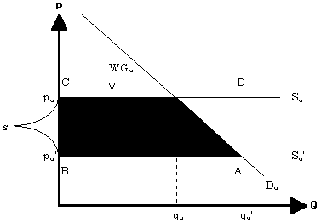
Diagram 2u: Imported used
clothes (showing welfare gain with freight subsidy, and its cost)
Because more used clothes are now available more cheaply than before, there should be a reduction in demand for both domestic and imported new clothes, although there will be a positive income effect that would tend to counteract this tendency. The size of the negative demand shifts for domestic and imported new clothes (in Diagrams 2d and 2i below) will depend on the relevant elasticities - which describe how demand for new clothes changes when the price of used clothes changes - but the shifts will in any case be in the negative direction, downward and to the left, to Dd' and Di'; and quantities sold will shift from qd to qd' and from qi to qi'.

Diagram 2d: Domestic new
clothes (showing welfare loss with used-clothes freight subsidy)

Diagram 2i: Imported new
clothes (showing welfare loss with used-clothes freight subsidy)
What the effect would be on the rest of the economy is hard to work out: It depends on how much of the resources released from the new-clothes sectors is absorbed in the used-clothes sector; one may assume that the other goods and services sector will get some extra resources, when employment in the new-clothing sectors falls.
The welfare effect in the used-clothes market (Diagram 2u above) is clearly positive: Consumer surplus increases by the shaded area, and there is thus a welfare gain labeled WGu. The domestic clothing industry (Diagram 2d above) faces a fall in demand, which leads to a lowering of price from pd to pd', and a smaller quantity sold, qd' rather than qd. This implies a reduction in consumer surplus, and a reduction in producer surplus as well, for a net welfare loss equal to the shaded area labeled WLd. In the imported new-clothes sector (Diagram 2i above), there is also a fall in demand, and therefore also a fall in consumer surplus of the shaded area, a welfare loss labeled WLi. Finally, the other goods and services sector may absorb the production factors (labor, capital, etc.) released by the domestic clothing industry, thereby increasing production and generating some increase in consumer as well as producer surplus (WGo, not shown).
What does this add up to then? Assuming (as we have done) that there are no distortions in the domestic economy, and that factor markets are fully functioning, then market prices would properly reflect social scarcities. The total welfare effect on the economy of the freight subsidy on used clothes is then equal to +WGu -WLd -WLi +WGo, which must be positive overall: The recipient economy gets goods coming in which are cheaper than before and, with working markets and in the absence of distortions, this must be good. That is, under these assumptions, although there is some restructuring required, a freight subsidy definitely helps the recipient.
The positive externality (infant industry) argument again
However, we have already noted that there may be a plausible infant industry argument based on possible positive externalities associated with clothes production. The negative welfare effect that is measured in our analysis for the domestically-produced clothes market (WLd in Diagram 2d) would then understate the loss to society of out-competing part of the sector with second-hand imports. Instead of rectifying the distortion, we have aggravated it. If these externalities are significant, the overall effect on the economy of subsidized used-clothes imports might be negative.
Less than fully functioning markets: Unemployment yet again
Similarly, if factor markets are not functioning, so that it is difficult for resources (including labor) to find alternative employment, then the negative effect measured in our analysis would again understate the true loss. Once again, instead of rectifying the distortion, we have aggravated it.
Distributional effects: Benefiting the poor
But are there no other externalities that should be considered? Yes, it is often argued that there are positive distributional effects associated with the sale of used clothes - that it primarily benefits the poor. This could be the case, and it would strengthen the argument for subsidizing imports of used clothes. In fact, if used clothes are exclusively (or primarily) purchased by people who could not afford to enter the market for new clothes - or if subsidized used clothes were given away exclusively to such people - then the last three terms of our welfare formula would drop out, so that +WGu -WLd -WLi +WGo would become just +WGu, an obvious gain. In addition, there might be positive externality (distributional) effects, in that, for instance, reducing income inequalities might reduce social tensions and the risk of political instability, or raising the incomes of the poorest population segments might significantly improve their productive capacity.
Import subsidy effects on exporting, and benefits
For simplicity in the discussion of subsidized imports of used-clothes, we have so far assumed that domestically-produced clothes are non-tradable, that is, that the domestic clothing industry does not export. How would the argument change if domestically-produced clothes were exported, and prices were thus set on the world market? Diagrams 2i and 2u (for imported new and used clothes, respectively) would be unchanged, of course, but Diagram 2d (domestic new clothes) would have to be replaced by Diagram 3d, below. Here, domestic demand for domestically-produced clothes is Dd, and the quantity purchased domestically at price pd is qdd. However, we now assume that we have comparative advantages in this sector, and are able to produce a total of qdt, given the world market price pw = pd. The difference between domestic supply and domestic demand (qdt-qdd) is then sold on the international market.
In this case, a subsidy on used-clothes imports would still reduce demand for domestically-produced clothes from Dd to Dd', but this would not affect production. Instead, exports would increase by the amount (qdd-qdd'). The negative effect of the subsidy would therefore be less. We have now assumed that international demand for the exported clothes is infinitely elastic - that is, that the international market can and will absorb whatever excess production remains after domestic demand is satisfied. This may be too extreme an assumption, so it may well be that there would be some negative effects on production even in the case where there are exports. But just as we saw in the analysis of used-clothes imports in general, exporting ameliorates any negative effects.
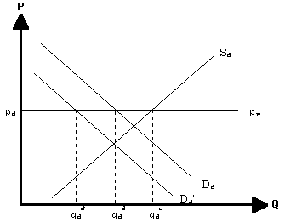
Diagram 3d: Domestic new
clothes (with exports, and used-clothes freight
subsidy)
If there is no domestic clothes production
If there does not exist any domestic clothes production at all, we would obviously not see a cutback in the production of that sector due to imports of cheap used clothes, and the negative secondary effects would thus be less. However, the introduction of subsidized imported used clothes would still constitute a problem for potential future development of the sector. This sector is recognized as one where many LDCs may be competitive, and where relatively little capital is required to get started. For instance, Toyne (1984) notes that "textiles is one of the first internationally competitive industries generally developed by developing countries." Subsidizing used-clothes imports could therefore have negative long-term effects on development by precluding or limiting potential future development of domestic production.
Dumping, and other cautions regarding who gets the subsidy, and how
Subsidies can take a number of forms and operate in a number of ways, which we need to look at. Who is helped by freight subsidies for used-clothes imports? Is it clear who is getting the benefit, and are they getting the maximum benefit possible? And is the subsidy legal?
If the clothes are being provided to individuals below market cost, then of course those individuals benefit. The International Textiles and Clothing Bureau in Geneva points out that such subsidized sales constitute dumping, and that "a subsidy to exports of used clothing for commercial purposes [is probably not] consistent with the Agreement on Subsidies and Countervailing Measures of the Uruguay Round" of GATT, because it represents unfair competition. Dumping itself (apart from the question of its legality) is not necessarily anything to be worried about: If someone wants to sell us goods at prices lower than costs, it is generally to our advantage, provided that we can use our resources fully in other activities, and provided that the dumping is not a temporary move to knock out our industries, to be followed later by higher prices. While the latter possibility is not so likely in the case we are considering here, it may be difficult - as we have discussed - for a typical LDC to find good alternative uses of resources, so that there may be substantial unemployment.
If the used clothes are sold on the market directly by the NGO, then that NGO's other projects or overhead get the benefit. If the clothes are sold on the market by some governmental, quasi-governmental, or local counterpart organization, then that organization gets the benefit. In any case, clarity of accounting and of understanding would be increased if the funds were allocated directly to the NGO or its other projects, or to the other organization involved. The used clothes can be shipped without subsidy, and the sales receipts will cover the costs. Given likely inefficiencies in sorting and handling, greater benefits may be possible if the used clothes are thus handled in a more business-like way. Providing them via subsidized freight may also lead to greater quantities being imported, and sold more cheaply, than would have otherwise been the case, which again constitutes dumping.
If the clothes are simply misappropriated somewhere along the way, then of course someone still benefits, but not the intended targets, and the resulting unbusiness-like environment is clearly not desirable either.
Conclusions
Subsidies can provide benefits and cause harm; harm may be ameliorated if domestic production is exported; subsidies may be illegal nevertheless
In ideal conditions, any subsidy which provides useful goods cheaper than before is a good thing in itself; but under more complex conditions - with positive externalities and/or unemployment, for instance - subsidies tend to aggravate rather than correct distortions. Cheap used clothes that primarily benefit the poor might give positive distributional effects, however. If domestic clothes production is being exported, any damages from used-clothes imports would be ameliorated. On the other hand, if there is no domestic clothes production, one cannot assume that there is no damage, because cheap competing imports may preclude future development. Practically speaking, subsidies which result in goods being sold below normal market price constitute dumping, which is illegal under international agreements. Subsidies may also constitute indirect funding support for various organizations or projects, or even for individuals who may misappropriate the goods. If the results are intended, it is probably better to effect them directly.
Chapter 9: Alternative costs and best use of cash and clothes
Even if there is extreme concern for poverty, and a freight subsidy for used clothes would have a tremendous impact on poverty, this would not necessarily imply that freight subsidies should be given: One must obviously consider the alternative uses of the money and, for that matter, of the clothes.
It may be helpful to reexamine our basic problem at this point. We have been asked whether used-clothes exports to less-developed countries should be subsidized. This question makes two basic assumptions, and thus we might separate the question into two more basic ones:
1. There is an assumption that used clothes exist in industrial countries and are available for subsidized export. One question we might ask is, what is the best use of these clothes?
2. There is also an assumption that development funds exist in industrial countries which might be available for subsidizing used-clothes exports, because industrial countries have a desire to help - and an interest in helping - less-developed countries develop. An obvious question we might ask is, what is the best use of these funds? What is the best way that industrial countries can help LDCs develop?
There is an obvious, simple complementarity to the two conditions (the existence of used clothes in industrial countries; and the existence of a desire on the part of people in industrial countries to help the development process in LDCs), which is to use available development funds to send available used clothes from industrial countries to LDCs. But is this the best use of the clothes, or of the development funds? These are two separate questions. Let us consider the use of the funds first.
The cost of the freight subsidy
So far, we have looked at the effects of subsidized used-clothes imports only on the recipient country, without comparing these effects with the cost to the donor, or with the alternative cost to the recipient. In Diagram 2u (in the previous chapter) we showed the cost of the subsidy: If we subsidize the transport of each unit of used clothes by s = pu - pu', and the total quantity is qu', then the total cost of the subsidy (s * qu') is equal to the rectangular area ABCD.
The alternative cost of the freight subsidy: Cash
The cost of the freight subsidy (ABCD) is clearly larger than the total increase in consumer surplus in the used-clothes market (+WGu), much (but perhaps not all) of which would accrue to the poor. We also remember the two other directly negative welfare effects, -WLd and -WLi (in Diagrams 2d and 2i, respectively), and also the loss of the positive externality that might be associated with clothes production, and the likelihood of increased unemployment resulting from subsidized used-clothes imports.
Best use of the cash
It would therefore be better to put the used-clothes subsidy funds directly in the hands of the poor, and then let them use the money as they see fit, rather than subsidizing used-clothes imports. Such transfers would have all of the distributional benefits of (or more than) subsidizing used-clothes imports, without the loss of efficiency implied by the fact that the cost exceeds the consumer surplus gain. If such cash transfers are not feasible, one could use the money for efficient projects that benefit the poor.
A freight subsidy does not eliminate a market distortion, but rather introduces one, in the form of distorted prices for used clothes. It should imply some benefit for the recipient country, but even without any possible negative secondary effects, it will not increase aggregate welfare as much as a direct transfer of money, which would allow the import of whatever is most wanted and needed. This conclusion does not change when distributional effects are considered. There are certainly better ways to help the poor directly, rather than doing it indirectly, via the used-clothes market.
Best use of the clothes
If it is clear that available development funds can be put to better use than for freight subsidies for used clothes, then it follows that the used clothes themselves can also be put to better use. As we have seen, commercial markets worldwide are willing to convert used clothes into cash, and the cash can then be put to good use in development projects.
Situations where freight subsidies would be warranted: Catastrophes, no supply
Are there any situations where freight subsidies would be warranted? What about a catastrophe situation, where there is no alternative local supply, either of domestically-produced new clothes, or of imported new or used clothes? In this case, the negative side effects of cheap used-clothes imports would not exist. Thus it is possible that there are in fact market failures which NGO projects could help to remedy with Sida-subsidized used-clothes exports.
Analytically, assume we have the situation as depicted in Diagram 4u, below: There is a demand curve for used clothes, but initially no supply. However, assume now that we were to give such a large freight subsidy that prices in the market go to zero: Then the consumer surplus gain would equal the whole triangle ABE. The cost is again equal to the rectangle ABCD, but now this may be considerably less than the gain, though this, of course, depends on the costs of transporting the goods to the country in question. The difference between this and the former case (Diagram 2u in the previous chapter) is that now there is no initial commercial supply of used clothes at all. Before, the subsidy only changed the amount of consumer surplus; now the subsidy accounts for all of it, because the existence of any supply at all is conditional upon it. Since we assume that this is a crisis situation where goods would not be available if they were not delivered by the donor, the money transfer option would not exist as an effective alternative. Thus, in such a case, the subsidy would be warranted, basically for humanitarian reasons.

Diagram 4u: Imported used
clothes (catastrophe = no supply - showing welfare gain, and its cost)
The demand curve here is taken to show what people would be willing to pay for different quantities. In the case of a complete disaster, of course, people may be destitute, and there would not be any market demand in spite of great need. The conclusion that transfers in kind would be called for would still seem valid, although we would then have to assign some value to the utility to the population of the clothes transferred.
Disaster relief is thus an example in which people in desperate need of clothing may have no capacity to enter the market to satisfy those needs, not because they themselves are poor (although they may be destitute), but because the markets and the production supporting them have disappeared. However, we have noted that many major international NGOs generally prefer not to utilize second-hand clothes as part of emergency relief, and even the Swedish Red Cross notes that used clothes are not and should not be an important part of emergency planning. There can be a need for clothes as part of relief assistance, perhaps after a catastrophe situation has "normalized", but in such situations it is noteworthy that UFF - which has been severely criticized in the media for selling used clothes commercially in Africa - nevertheless generally gives away new clothes when it comes to relief assistance. It seems that used clothes should be used if and when it can be demonstrated that the need is urgent and cannot reasonably be met from other sources, and that the supply is most appropriate to the need.
Conclusions
Subsidies generally help less than they cost, and may in fact cause harm, although they may be necessary in responding to catastrophes
What do we conclude from this theoretical exercise with regard to freight subsidies? We conclude that subsidies help LDCs get imports at lower prices, which suggests that they are welfare-enhancing. Secondly, however, we note that the aggregate welfare gain is less than the cost of the freight subsidy. It would therefore be better to use the money for direct transfers, or for more efficient projects. This applies even in the case where there is no domestic clothing industry that is negatively affected. And it may actually be easier to target the impact of other types of interventions on the poor.
Moreover, if there are positive externalities associated with domestic clothes production, then the effect of a used-clothes freight subsidy on this sector will tend to negate the welfare gain of the transfer itself, unless the unemployed resources find as good a use in other industries. However, they may be transferred to sectors with less positive external effects, or - if factor markets are less than fully functioning - they may even remain unemployed, and then the negative effect is compounded.
The policy conclusion that can be drawn from this theoretical review is thus that, under normal circumstances, Sida should cease giving freight subsidies for used-clothes exports: This is a costly way to help the poor; the money can be put to better use. The only time where such subsidies might be warranted is in catastrophes, where markets collapse, and the population requires transfers in kind. Freight subsidies should thus only be used within the framework of catastrophe aid.
|
| ||||||||||||||||||||||||
Used Clothes as Development Aid: The Political Economy of Rags (SIDA)
Part III: Summary and policy recommendations
Summary
World trade in used clothes is large and growing rapidly, but is still rather small (and constant) compared to overall trade in textiles and clothing (much of which originates in Third World countries). Used clothes are not a homogeneous good: Many industrial countries import as well as export used clothes, and many LDCs export as well as import, but the preponderance of exports winds up in Third World countries.
Producer organizations and labor unions are vociferous in protest against such "unfair" competition, but most countries have no exceptional restrictions against used-clothes imports. Swedish NGOs exporting used clothes have in the past sometimes attempted to target "the poorest of the poor", and other times have allowed used clothes to be sold somewhat arbitrarily, but now most organizations are using the market to maximize the return on used-clothes sales, and are using the proceeds for development purposes.
Under simple "ideal" conditions, used-clothes imports into LDCs should theoretically allow an increase in real income. However, the loss of possible positive externalities associated with textile or clothing production, or increased unemployment of labor and capital if factor markets are not functioning well, could cause net welfare losses. Empirical analysis of results would require rather complex study; the one actual detailed study which exists shows net gains from used-clothes imports, but is based on a special case (a country with no domestic textile production). Popular attitudes in LDCs seem generally positive, as cheap and "stylish" goods are made available, and much employment is generated in cleaning, repair, restyling, and distribution. Clothes and other goods have of course been much re-used throughout history in many parts of the world, including now in the industrial countries.
Subsidizing used-clothes exports (and thus increasing the volume of such exports) would increase any resulting damages, unless there were no effective demand (people too poor to enter the market), or no supply (as might happen during wartime, for instance). If people are too poor to enter the market, they need many things, so probably they could be better served by income-generating development projects (perhaps funded at least partly by unsubsidized used-clothes sales), rather than by subsidized used-clothes distribution, which is expensive and inefficient. There may be a role for subsidized used-clothes exports in disaster relief, although many international NGOs are somewhat skeptical about their value even here.
Thus we believe - and evidence supports - that re-using second-hand clothes is in general a good thing, and probably has economic benefits. Nevertheless, theoretical analysis - somewhat supported by empirical evidence - shows that in the real world situations encountered in most LDCs, used-clothes imports may cause economic damage. Subsidizing imports of used clothes for aid projects would increase this damage.
Even in the case of targeting "the poorest of the poor", who have no effective demand, more effective, better-targeted aid projects are possible. In catastrophe situations, where supply and/or distribution have broken down, there may be a need for subsidized imports of used clothes (although cheap new clothes may be more appropriate and more efficient for the purpose).
Policy recommendations
Thus we recommend the following policies regarding Sida subsidies for NGO export of used clothes:
1. In general, no subsidies should be given for export of used clothes, particularly if the clothes are to be sold on the market. If the organizations or projects which would have benefited financially are judged worthy of support, such support should be given directly.
2. In the case of targeting particular population groups - "the poorest of the poor" - more effective, better-targeted projects should be encouraged.
a. NGOs should be encouraged to sell their surplus used-clothes stocks into the commercial "rag merchant" network - as is widely done in most other industrial countries.
b. The proceeds, plus whatever subsidies Sida might have given for used-clothes exports, should be devoted to projects.
3. In catastrophe situations, freight subsidies for used-clothes exports should be given only as a last resort - if no better and more immediate source of supply is available. NGOs should be encouraged to find supplies as close to the scene as possible; the use of cheap new clothes should be explored for this purpose.
4. In any cases in which subsidies for used-clothes exports are given, plans should be scrutinized, and results monitored, with the following questions in mind:
a. In catastrophe situations, how has it been ascertained that local production and other closer sources are insufficient to meet the need?b. Have other alternatives been explored - such as importing from neighboring countries, commercial imports of used clothes, etc.?
c. If used-clothes are to be used for project aid with "the poorest of the poor", how are the target groups to be selected? How will distribution be monitored to be sure that they are in fact the recipients?
d. How has it been determined that they in fact have no presence in the market?
e. How were their needs ascertained? Is their highest priority used clothes? Or, for example, would they rather have the cash? If so, is there any other project possible - perhaps an income-generating project - which could more effectively use the financial resources and volunteer effort available?
f. How will the clothes be sorted to make sure that they match local needs?
g. Will the recipients be monitored to discover if there is any resale activity?
5. Any changes from current policy should be made in a carefully planned manner, so as not to lose the benefits which undoubtedly do accrue from subsidized charitable exports of used clothes, and which might be lost without compensating gains if policy changes are made precipitously.
|
| ||||||||||||||||||||||||||||||||||||||||||||||||||||||||||||||||||
Used Clothes as Development Aid: The Political Economy of Rags (SIDA)
Appendices
Appendix 1: Terms of reference for the study
Lumpens Politiska Ekonomi - begagnade varor som bist�nd
BACKGROUND
For a long time Siwithout compensating gains if policy changes are made precipitously.
For a long time Sida's NGO division has subsidized freight and related costs of transporting used goods to the Third World, as well as providing support of various kinds to the volunteer organizations involved. This "freight aid" has been given, both as a part of larger projects, and to organizations whose main activity is collection and distribution of used goods.
Non-governmental organizations (NGOs) aiming to collect, transport and distribute used goods have been created by the Swedish people as a manifestation of solidarity with people in less-developed countries. The work in Sweden is mostly done by volunteers, and the organizations usually have limited budgets and limited other operations.
Sida has no clear policy for "freight aid". An organization's chances of receiving state aid are mainly dependent, first, on Sida's knowledge of its activity, and then on Sida's judgment of its capacity and competence.
A number of studies (listed in the appendix) have been done of these activities, but they have not analyzed the effects of the aid to any great extent.
PURPOSE
The government has asked Sida to evaluate "freight aid" in order to improve the efficiency of Swedish development assistance in general. Based on the present study, Sida intends to adopt a suitable policy for "freight aid".
MEANS
Sida wants to know more about the development effects of "freight aid" - on income distribution, employment, institutional structure, environment, etc.
THE TASK
The task consists of survey and documentation, analysis, and recommendations, as follows:
Survey and documentation:
The extent of international flows of used goods, commercial as well as charitable. The largest exporting countries and the largest importing (receiving) countries. The dominant kinds of goods. [The extent of commercial flows of used clothes worldwide is fully documented in the text, and data regarding private charitable flows of all types of goods from the U.S. is also given; international data is not kept on flows of other used goods, but a list of their known categories is included. International data collection does not distinguish charitable from commercial shipments.]
The quality and remaining life of the products. Maintenance of received materials. [These questions, specifically with reference to used clothes, are discussed at length in the text. There is an extensive literature on the use of second-hand equipment in development, but as these are producer goods rather than consumer goods, and thus raise quite different issues, we have chosen to focus at this time on used clothes, and suggest a separate project if further study is desired in this area.]
The distribution chain in the receiving countries. Price-setting - how are prices set? [These questions, specifically with reference to used clothes, are discussed at length in the text.]
Organizations active in this field using Swedish aid. Volumes and current trends, both by types of goods and by countries receiving the goods. [We have not been encouraged to seek current information about specific projects or NGOs receiving such subsidies, but we present data on Swedish organizations active in collection and export of used clothes, and information on recent recipient countries.]
Analysis:
The value to the receiver, and effects on demand: Is the activity demand- or supply-driven? [These questions are discussed at length in the text, primarily for used clothes, but briefly regarding other goods as well.]
Effects on supply in receiving countries: Are the imported goods a complement to, or a substitute for, existing resources? [These questions, primarily with reference to used clothes, are discussed at length in the text.]
Effects on employment and income distribution. [These questions, specifically with reference to used clothes, are discussed at length in the text.]
Growth effects and other long-term effects on production and the production structure. [These questions, specifically with reference to used clothes, are discussed at length in the text.]
What role does the charitable operation play in relation to the commercial operation? [This question, specifically with reference to used clothes, is discussed in the text.]
What role does Sida's "freight aid" play? How are volumes, costs, and prices affected? [Empirical answers to these questions would require detailed analysis of the current circumstances and methodology of particular projects, which we have not been encouraged to pursue. Nevertheless, some theoretical answers, specifically with reference to used clothes, are provided in the text.]
Other questions that might come up during the course of the work and that might seem relevant; for example, the activity's effect on the environment. [In addition to the environment, other related questions such as political realities in less-developed countries and solidarity motives in Sweden have been briefly discussed.]
Recommendations:
What should Sida's policy on "freight aid" be? Discuss if a field study is needed in order to answer the questions above satisfactorily. If so, what form should this study take?* [Recommendations regarding Sida's policy on "freight aid" are made in the text. No field study is thought to be generally necessary, although if Sida provides freight aid for used-clothes exports in the future, careful monitoring of its effects is suggested. A thorough analysis of the efficacy of used clothes as opposed to new clothes in disaster relief might also prove useful. If there is sufficient interest, a separate study could also be undertaken focusing more specifically on used equipment.]
METHOD
It is expected that the task will be accomplished through:
study of existing reports and documents, including international statistics, and through
interviews with charitable organizations, aid agencies, and possibly with other relevant agencies or organizations.
REPORT
A written report in English is expected.
APPENDIX: Reference list
Following is a list of studies of used-clothes exports to less-developed countries, and related materials:
The Naked Truth: Swedish private organizations' clothing aid to Mozambique and its effects on local textile production. Area Forecasting Institute, Hans Abrahamsson, G�teborg, 1988.
Kl�dfrakt f�r projektbist�nd - Studie av Sidas fraktbidrag till f�reningen U-landshj�lp fr�n folk till folk i Sverige (UFF) [Clothing freight as project aid - a study of Sida's freight aid to the Swedish organization "Development Aid from People to People (DAPP)"]. Interconsult Sweden AB, 1990.
Effektivare kl�dbist�nd f�r st�rre oberoende - en organisationsstudie av Praktisk Solidaritet [More effective clothing aid for greater independence - a study of the organization Practical Solidarity]. Interconsult Sweden AB, 1990.
In Need of Clothes: Second-hand clothing for Uganda, Zimbabwe, Mozambique, Sierra Leone and Vietnam. Swedish Red Cross, 1992.
Effects of Second-Hand Clothes Sales in Developing Countries. Denconsult, 1993.
Miscellaneous data and newspaper articles.
Appendix 2: Statistical tables
Table A1: Twenty-four net used-clothes exporting countries, 1984-'93
|
rank |
exporting country |
total value (US$) |
share of total |
|
1 |
USA, Puerto Rico, & Virgin Is. |
$1,197,019,000 |
38.3% |
|
2 |
Germany (W. Germany before 1991) |
$571,653,000 |
18.3% |
|
3 |
Belgium-Luxembourg |
$344,818,000 |
11.0% |
|
4 |
Netherlands |
$319,143,000 |
10.2% |
|
5 |
Japan |
$167,701,000 |
5.4% |
|
6 |
United Kingdom |
$151,259,000 |
4.8% |
|
7 |
Italy |
$98,693,000 |
3.2% |
|
8 |
Australia |
$62,067,000 |
2.0% |
|
9 |
Canada |
$59,744,000 |
1.9% |
|
10 |
Mexico |
$34,930,000 |
1.1% |
|
11 |
Denmark |
$34,106,000 |
1.1% |
|
12 |
Sweden |
$27,020,000 |
0.9% |
|
13 |
Switzerland, Liechtenstein |
$19,952,000 |
0.6% |
|
14 |
Austria |
$11,157,000 |
0.4% |
|
15 |
Portugal |
$8,254,000 |
0.26% |
|
16 |
Finland |
$7,863,000 |
0.25% |
|
17 |
Norway, Svalbard & Jan Mayen |
$3,365,000 |
0.11% |
|
18 |
Panama |
$2,426,000 |
0.08% |
|
19 |
Iceland |
$851,000 |
0.03% |
|
20 |
China |
$220,000 |
0.007% |
|
21 |
Nepal |
$179,000 |
0.006% |
|
22 |
Morocco |
$67,000 |
0.002% |
|
23 |
Colombia |
$38,000 |
0.001% |
|
24 |
Oman |
$6,000 |
0.0002% |
Source: Derived from SITC2 data obtained from the United Nations
Statistical Division, International Trade Statistics Branch.
Note: Total
value for each country for the period is simply the sum of uncorrected annual
figures; correcting annual figures for inflation should have little effect on
rank or share.
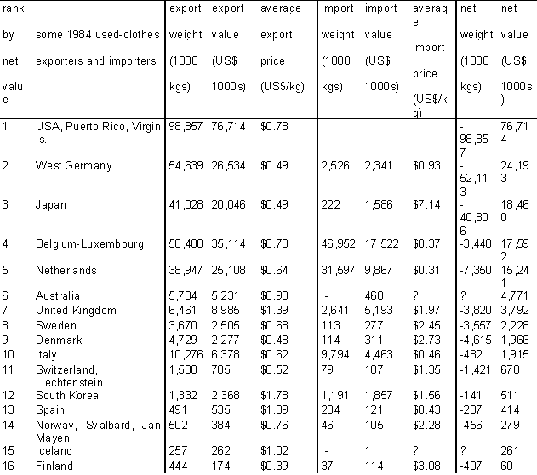
Table A2: Some 1984 used-clothes
exporters (19) and importers (51), with net weights and values, and average
prices; ranked by net value of exports or imports
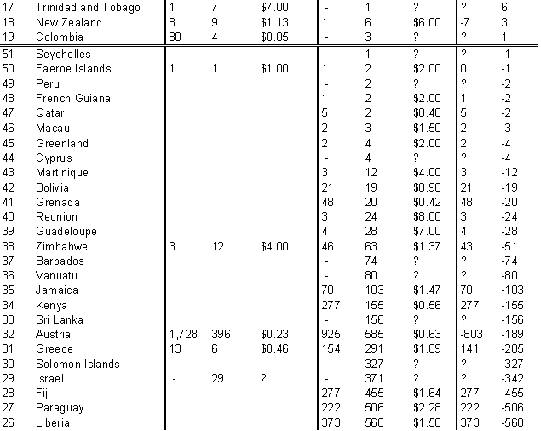
Table A2: Continued
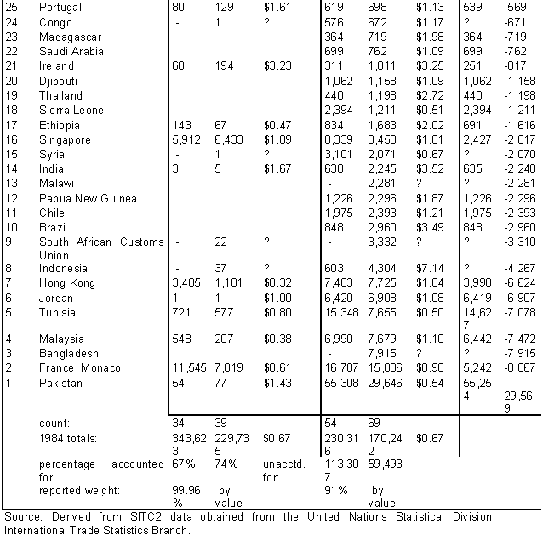
Table A2: Continued
Notes: Reflecting flows of real goods, and in order to clearly distinguish net exports from net imports, net weights are negative for net exports, positive for net imports. Similarly, reflecting financial flows, net values are positive for net exports, negative for net imports. For countries with both imports and exports, if either weight is missing, no net weight is given. Total average export and import prices are based only on those values for which weights are reported. Extreme export or import prices may indicate some problem in the data, such as partial missing weights. The absence of a listing for a particular country does not necessarily indicate that no trade occurred. For instance, countries still reporting on SITC1, or not reporting at all, do not show up. More complete data (covering more countries, and including weights per capita) is provided in Tables A3-A5 and A11-A13.
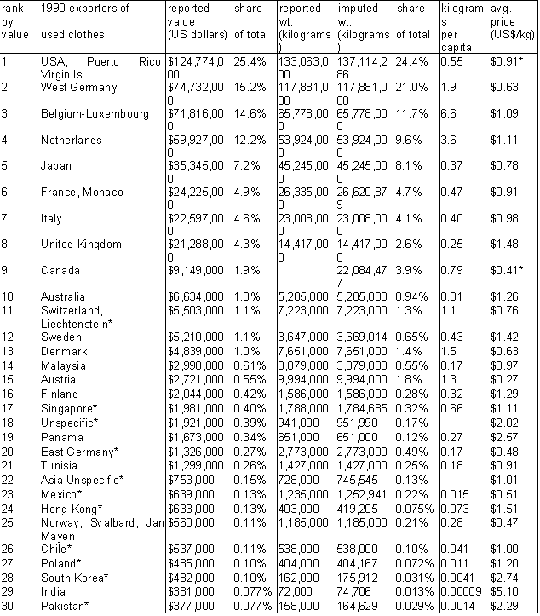
Table A3: 1990 world used-clothes
gross exporters (127) ranked by value, with reported and imputed weights, value
and weight shares of total, weights per capita, and average
prices
Table A3: Continued
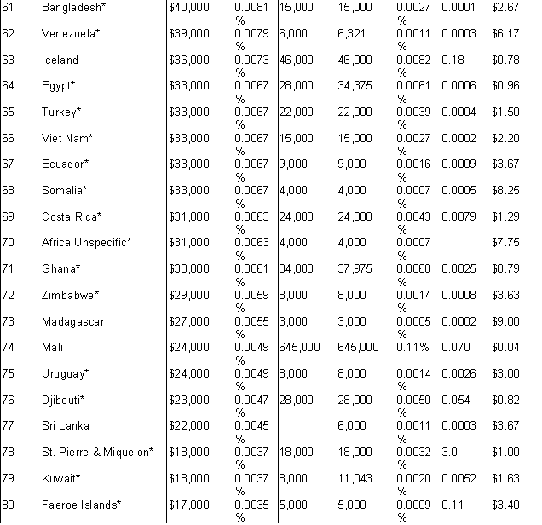
Table A3: Continued
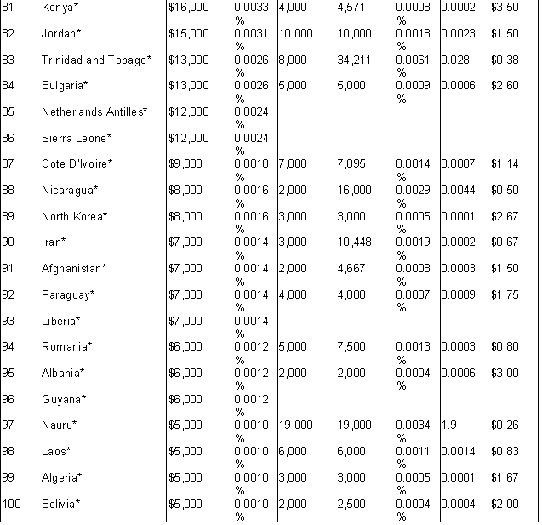
Table A3: Continued
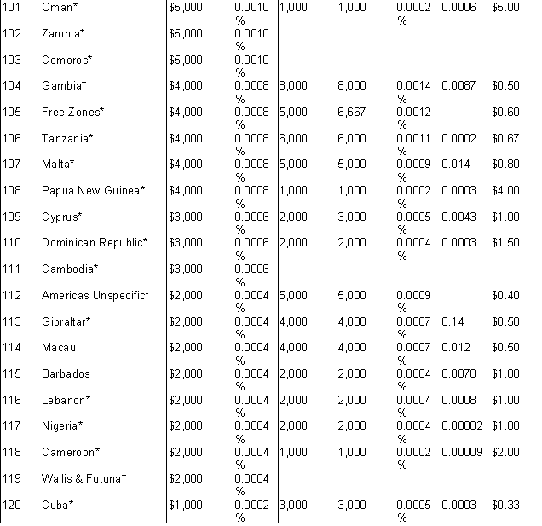
Table A3: Continued
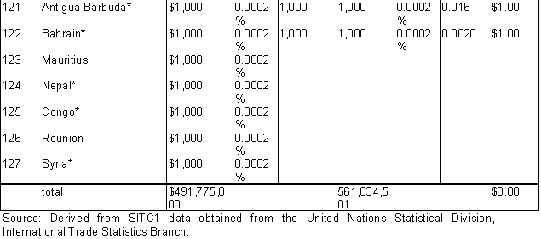
Table A3: Continued
Notes: An asterisk (*) at the end of a country name indicates that the entire line is derived from partner data rather than from data reported by the country directly. An asterisk (*) at the end of an average price indicates that the price (only) was taken from partner data, due to lack of weights in reported data. Average prices are based only on those partner transactions for which weights are reported; thus imputed weights (based on those prices) may be higher than reported weights. Extreme average prices may still indicate some problem in the data, such as partial missing weights within partner transactions. The absence of a listing for a particular country does not necessarily indicate that no trade occurred.
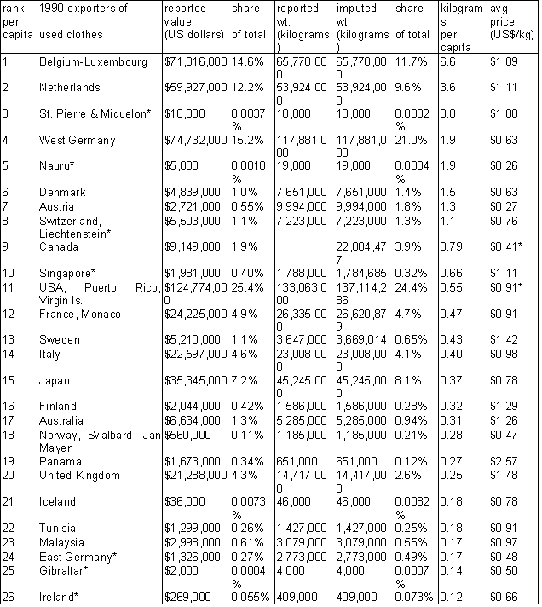
Table A4: 1990 world used-clothes
gross exporters (127) ranked by weight per capita, with values, reported and
imputed weights, value and weight shares of total, and average prices
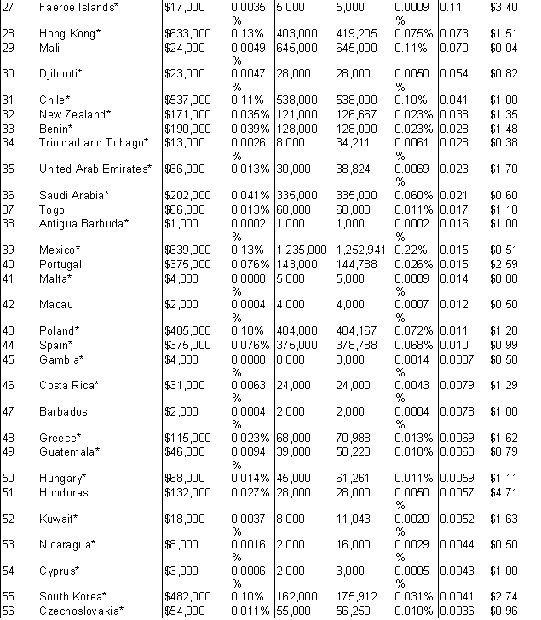
Table A4: Continued
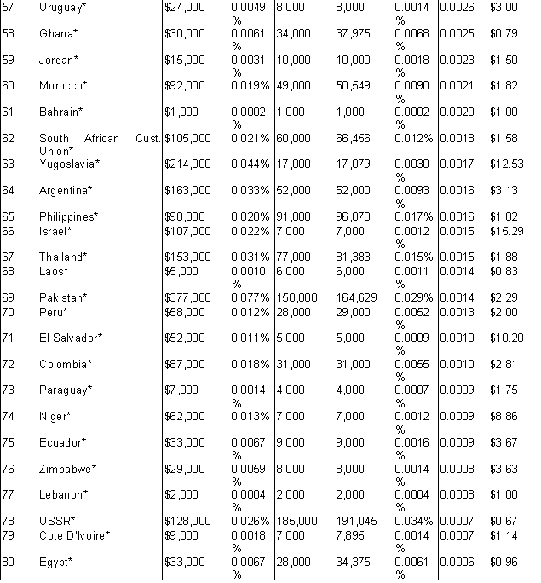
Table A4: Continued
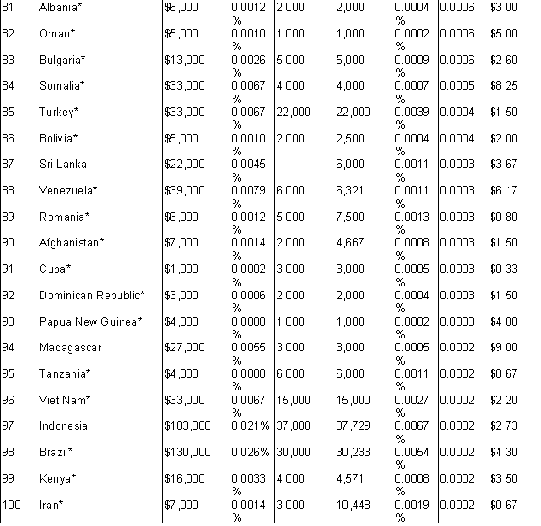
Table A4: Continued
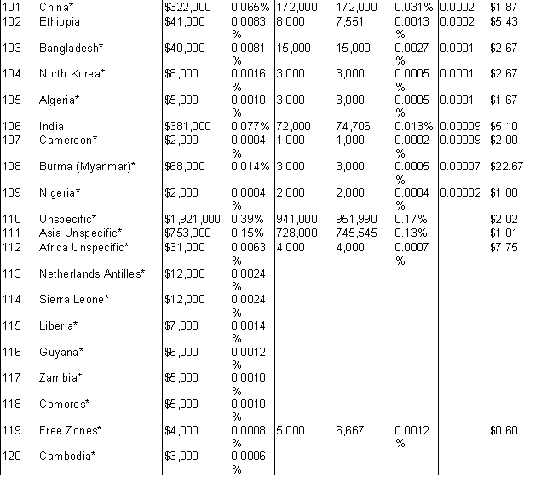
Table A4: Continued
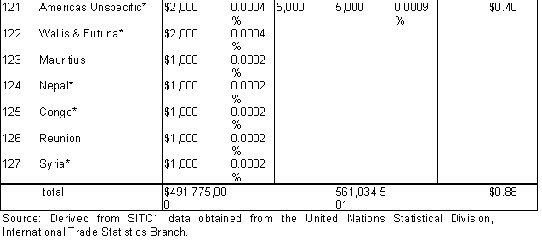
Table A4: Continued
Notes: An asterisk (*) at the end of a country name indicates that the entire line is derived from partner data rather than from data reported by the country directly. An asterisk (*) at the end of an average price indicates that the price (only) was taken from partner data, due to lack of weights in reported data. Average prices are based only on those partner transactions for which weights are reported; thus imputed weights (based on those prices) may be higher than reported weights. Extreme average prices may still indicate some problem in the data, such as partial missing weights within partner transactions. The absence of a listing for a particular country does not necessarily indicate that no trade occurred.
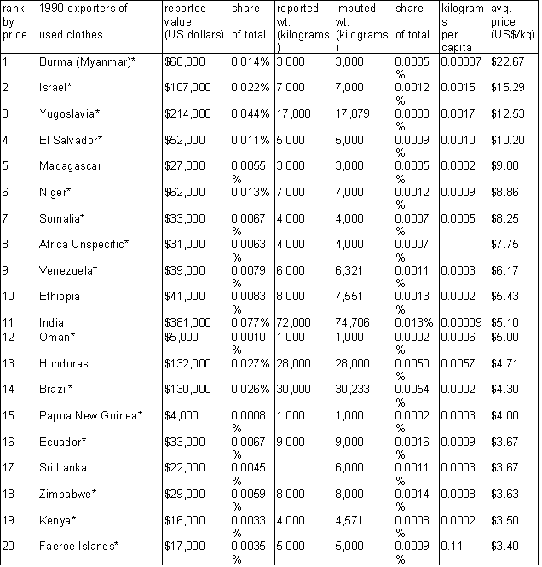
Table A5: 1990 world used-clothes
gross exporters (127) ranked by average price, with values, reported and imputed
weights, value and weight shares of total, and weights per capita
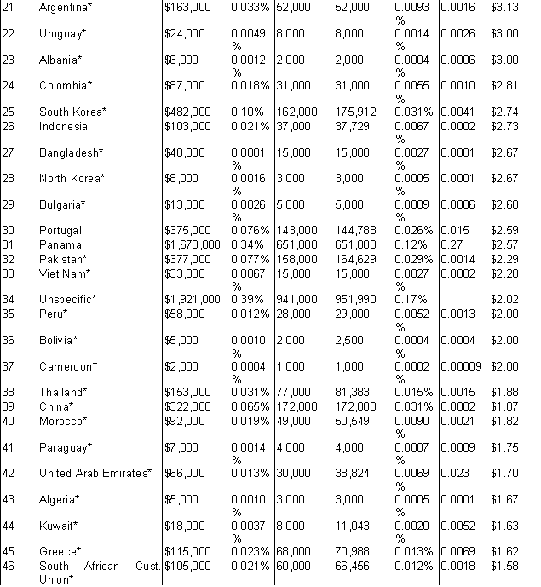
Table A5: Continued
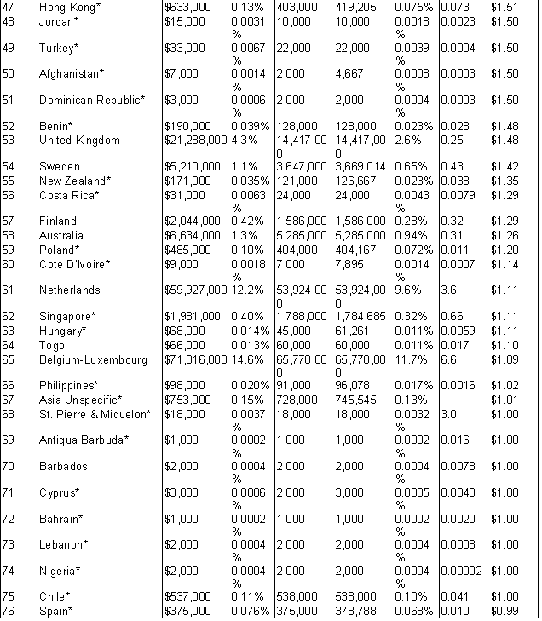
Table A5: Continued
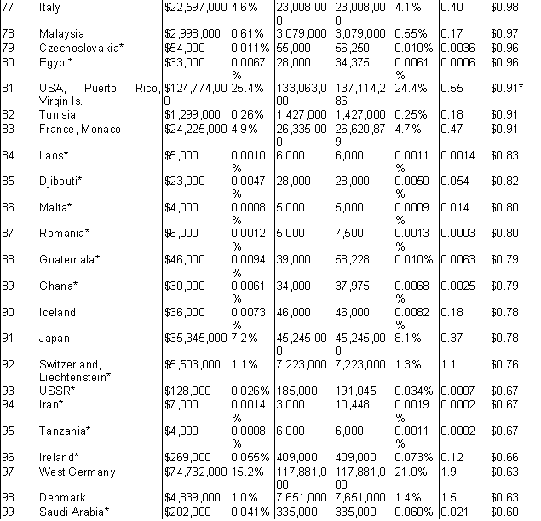
Table A5: Continued
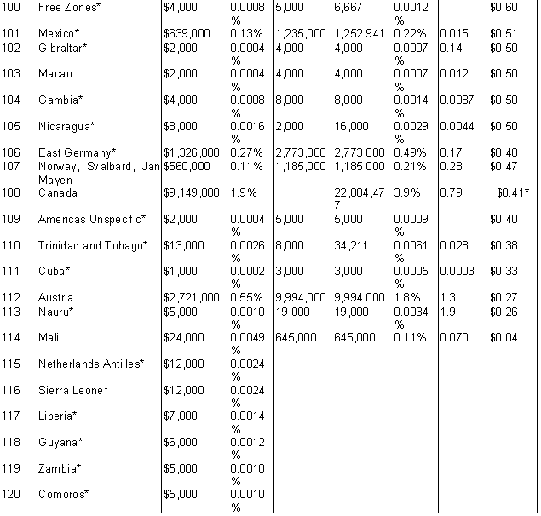
Table A5: Continued
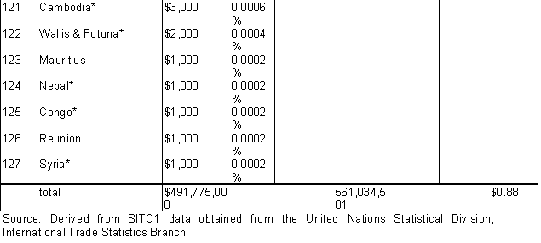
Table A5: Continued
Notes: An asterisk (*) at the end of a country name indicates that the entire line is derived from partner data rather than from data reported by the country directly. An asterisk (*) at the end of an average price indicates that the price (only) was taken from partner data, due to lack of weights in reported data. Average prices are based only on those partner transactions for which weights are reported; thus imputed weights (based on those prices) may be higher than reported weights. Extreme average prices may still indicate some problem in the data, such as partial missing weights within partner transactions. The absence of a listing for a particular country does not necessarily indicate that no trade occurred.
Table A6: 1994 recipients of Swedish used-clothes exports (89) ranked by weight, with values, prices, and weight-shares
|
Rank by weight |
1994 recipients of Swedish used-clothes exports |
reported value (US $1000s) |
reported weight (1000 kgs) |
share of total |
average price (US$/kg) |
|
1 |
Estonia |
568 |
1,875 |
15.8% |
$0.30 |
|
2 |
Latvia |
486 |
1,764 |
14.9% |
$0.28 |
|
3 |
Mozambique |
170 |
1,090 |
9.2% |
$0.16 |
|
4 |
Yugoslavia |
352 |
1,021 |
8.6% |
$0.34 |
|
5 |
Russia |
408 |
821 |
6.9% |
$0.50 |
|
6 |
Lithuania |
187 |
566 |
4.8% |
$0.33 |
|
7 |
Angola |
201 |
523 |
4.4% |
$0.38 |
|
8 |
Poland |
210 |
399 |
3.4% |
$0.53 |
|
9 |
Finland |
190 |
310 |
2.6% |
$0.61 |
|
10 |
Croatia |
227 |
308 |
2.6% |
$0.74 |
|
11 |
Nicaragua |
589 |
228 |
1.9% |
$2.58 |
|
12 |
Iraq |
29 |
225 |
1.9% |
$0.13 |
|
13 |
Ukraine |
170 |
201 |
1.7% |
$0.85 |
|
14 |
Romania |
110 |
186 |
1.6% |
$0.59 |
|
15 |
Tanzania |
107 |
173 |
1.5% |
$0.62 |
|
16 |
Benin |
12 |
139 |
1.2% |
$0.09 |
|
17 |
Rwanda |
72 |
133 |
1.1% |
$0.54 |
|
18 |
Ethiopia |
114 |
127 |
1.1% |
$0.90 |
|
19 |
Denmark |
178 |
108 |
0.91% |
$1.65 |
|
20 |
Germany |
212 |
100 |
0.85% |
$2.12 |
|
21 |
Hungary |
44 |
88 |
0.74% |
$0.50 |
|
22 |
Netherlands |
68 |
85 |
0.72% |
$0.80 |
|
23 |
United Kingdom |
105 |
82 |
0.69% |
$1.28 |
|
24 |
Brunei |
28 |
78 |
0.66% |
$0.36 |
|
25 |
Syria |
39 |
76 |
0.64% |
$0.51 |
|
26 |
USA, Puerto Rico, Virgin Is. |
265 |
65 |
0.55% |
$4.08 |
|
27 |
Albania |
21 |
59 |
0.50% |
$0.36 |
|
28 |
Niger |
7 |
49 |
0.41% |
$0.14 |
|
29 |
South African Customs Union |
29 |
45 |
0.38% |
$0.64 |
|
30 |
Zambia |
1 |
42 |
0.35% |
$0.02 |
|
31 |
Lebanon |
31 |
39 |
0.33% |
$0.79 |
|
32 |
Liberia |
11 |
35 |
0.30% |
$0.31 |
|
33 |
Honduras |
193 |
34 |
0.29% |
$5.68 |
|
34 |
Slovakia |
9 |
34 |
0.29% |
$0.26 |
|
35 |
El Salvador |
174 |
31 |
0.26% |
$5.61 |
|
36 |
France, Monaco |
98 |
31 |
0.26% |
$3.16 |
|
37 |
Belgium-Luxembourg |
3 |
29 |
0.25% |
$0.10 |
|
38 |
Zaire |
22 |
27 |
0.23% |
$0.81 |
|
39 |
Czech Rep. |
6 |
26 |
0.22% |
$0.23 |
|
40 |
Norway, Svalbard & Jan Mayen |
98 |
25 |
0.21% |
$3.92 |
|
41 |
Austria |
6 |
25 |
0.21% |
$0.24 |
|
42 |
Moldova |
2 |
24 |
0.20% |
$0.08 |
|
43 |
Guinea Bissau |
5 |
21 |
0.18% |
$0.24 |
|
44 |
Argentina |
7 |
19 |
0.16% |
$0.37 |
|
45 |
Ghana |
3 |
19 |
0.16% |
$0.16 |
|
46 |
Greece |
5 |
18 |
0.15% |
$0.28 |
|
47 |
Egypt |
7 |
16 |
0.14% |
$0.44 |
|
48 |
Azerbaijan |
4 |
14 |
0.12% |
$0.29 |
|
49 |
Georgia |
4 |
14 |
0.12% |
$0.29 |
|
50 |
Ecuador |
4 |
14 |
0.12% |
$0.29 |
|
51 |
Jordan |
4 |
14 |
0.12% |
$0.29 |
|
52 |
Mexico |
4 |
14 |
0.12% |
$0.29 |
|
53 |
Paraguay |
4 |
14 |
0.12% |
$0.29 |
|
54 |
Bosnia Herzegovina |
6 |
12 |
0.10% |
$0.50 |
|
55 |
Sudan |
6 |
12 |
0.10% |
$0.50 |
|
56 |
Belarus |
2 |
12 |
0.10% |
$0.17 |
|
57 |
Burundi |
8 |
11 |
0.093% |
$0.73 |
|
58 |
Portugal |
2 |
11 |
0.093% |
$0.18 |
|
59 |
Switzerland, Liechtenstein |
11 |
10 |
0.085% |
$1.10 |
|
60 |
Guinea |
6 |
10 |
0.085% |
$0.60 |
|
61 |
Sierra Leone |
9 |
8 |
0.068% |
$1.13 |
|
62 |
Chile |
3 |
8 |
0.068% |
$0.38 |
|
63 |
Tunisia |
2 |
7 |
0.059% |
$0.29 |
|
64 |
Bolivia |
27 |
6 |
0.051% |
$4.50 |
|
65 |
Uruguay |
14 |
6 |
0.051% |
$2.33 |
|
66 |
Morocco |
2 |
6 |
0.051% |
$0.33 |
|
67 |
Bulgaria |
1 |
6 |
0.051% |
$0.17 |
|
68 |
Saudi Arabia |
9 |
5 |
0.042% |
$1.80 |
|
69 |
Armenia |
3 |
4 |
0.034% |
$0.75 |
|
70 |
Brazil |
3 |
4 |
0.034% |
$0.75 |
|
71 |
Cyprus |
46 |
3 |
0.025% |
$15.33 |
|
72 |
India |
23 |
3 |
0.025% |
$7.67 |
|
73 |
Canada |
43 |
2 |
0.017% |
$21.50 |
|
74 |
Australia |
49 |
1 |
0.008% |
$49.00 |
|
75 |
China |
7 |
1 |
0.008% |
$7.00 |
|
76 |
Hong Kong |
7 |
1 |
0.008% |
$7.00 |
|
77 |
Ethiopia |
6 |
1 |
0.008% |
$6.00 |
|
78 |
Japan |
3 |
1 |
0.008% |
$3.00 |
|
79 |
Turkey |
9 |
- |
? |
? |
|
80 |
United Arab Emirates |
7 |
- |
? |
? |
|
81 |
Nepal |
4 |
- |
? |
? |
|
82 |
Singapore |
4 |
- |
? |
? |
|
83 |
New Zealand |
3 |
- |
? |
? |
|
84 |
Iran |
2 |
- |
? |
? |
|
85 |
Kuwait |
2 |
- |
? |
? |
|
86 |
South Korea |
2 |
- |
? |
? |
|
87 |
Ireland |
1 |
- |
? |
? |
|
88 |
Spain |
1 |
- |
? |
? |
|
89 |
Thailand |
1 |
- |
? |
? |
| |
total |
6,237 |
11,831 | |
$0.53 |