|
| ||||||||||||||||||||||||||||||||||||||||||||||||||||||||||||||||||||||||||||||||||||||||||||||||||||||||||||||||||||||||||||||||||||||||||||||||||||||||||||||||||||||||||||||||||||||||||||||||||||||||||||||||||
|
| ||||||||||||||||||||||||||||||||||||||||||||||||||||||||||||||||||||||||||||||||
By Chandrakant Turare, ARTES Institute, Glucksburg (Germany)
Image
|
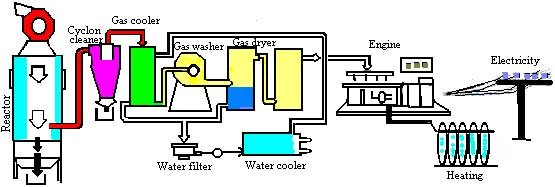
Biomass gasification, a century old technology, is viewed today as an alternative to conventional fuel. In gasification process, wood, charcoal and other biomass materials are gasified to generate so called ´producer gas´ for power or electricity generation. Gasification system basically consists of a gasifier unit, purification system and energy converters - burner or engine. This internet documentation gives total insight into gasification technology. |
|

|
| ||||||||||||||||||||||||||||||||||||||||||||||||||||||||||||||||||||||||||||||||
Overview of Gasification Technology

Image
Gasification is a century old technology, which flourished quite well before and during the second world war. The technology disappeared soon after the second world war, when liquid fuel became easily available. The interests in the gasification technology has undergone many ups and downs in running century. Today, because of increased fuel prices and environmental concern, there is renewed interest in this century old technology. Gasification has become more modern and quite sophisticated technology.

Image
The advantage of this technology is decentralized energy conversion system which operates economically even for small scale .A gas producer is a simple device consisting of usually cylindrical container with space for fuel, air inlet, gas exit and grate. It can be made of fire bricks, steel or concrete and oil barrels. The design of gasifier depends upon type of fuel used and whether gasifier is portable or stationary. Gasifier alone itself is of little use. The complete gasification system consists of gasification unit (gasifier), purification unit and energy converter - burners or internal combustion engine.

Image
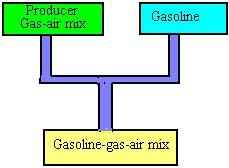
Gasification is basically a thermochemical process which converts biomass materials into gasesous component. The results of gasification is the producer gas, containing carbon monoxide, hydrogen, methane and some other inert gases. Mixed with air, the producer gas can be used in gasoline or diesel engine with little modifications.
|
|
Based on the design of gasifiers and type of fuels used, there exists different kinds of gasifiers. Portable gasifiers are mostly used for running vehicles. Stationary gasifiers combined with engines are widely used in rural areas of developing countries for many purpose including generation of electricity and running irrigation pumps. Technologies such biomass gasification which allow utilization of biomass fuel are of great importance. |

|
Theoretically, almost all kinds of biomass with moisture content of 5-30% can be gasified, however, not every biomass fuel can lead to the successful gasification. Most of the development work is carried out with common fuels such as coal, charcoal and wood. It was recognized that fuel properties such as surface, size, shape as well as moisture content, volatile matter and carbon conent influence gasification. |
|

The key to a successful design of gasifier is to understand the properties and thermal behvaiour of the fuel as fed to the gasifier. Operation of gasification system demands knowledgeable and skilled operator. Those interested in this technology must remember that it requires hard work and tolerence. Compared to conventional system such as liquid fuel run engines, biomass gasification technology is incovenient. But it is economical at many places and may lead to self-reliance in the crucial time of fuel crisis.
|
| ||||||||||||||||||||||||||||||||||||||||||||||||||||||||||||||||||||||||||||||||
Biomass as Gasification Fuel
Image
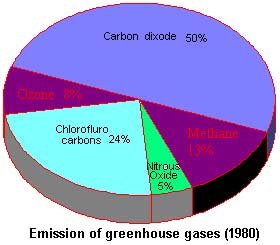
Great environmental concern is expressed over the release of CO 2 from the burning of fossil fuels. When fossil fuels are burnt, carbon from fuels react with oxygen from air and produce CO 2 . This is the reason for steady increasing CO 2 content of atmosphere. Carbon dioxide contributes to 50% of green house effect.

Image
One of the remedies to limit the rising content of CO 2 in the atmopshere is energetic use of biomass fuel. Biomass is basically an organic material, which includes wood, crop residues, solid waste, animal wastes, sewage, and waste from food processing. Biomass is made up of mainly carbon and hydrogen.

Image
When biomass is burnt, CO 2 is released in the atmosphere. Released CO 2 is absorbed by growing plants during the photosynthesis, keeping CO 2 content in the atmosphere same. Biomass gasification is one of the technologies of energetic use of biomass.

Image
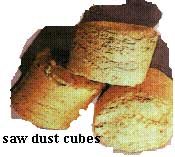
Theoretically, any biomass material with moisture content of 5-30% can be gasified as the basic composition of carbon, hydrogen and oxygen is same. This means that agricultural wastes such as cotton stalks, saw dust, nutshells, coconut husks, rice husks and forestry residues - bark, branches and trunk can be used for gasification.
|
| ||||||||||||||||||||||||||||||||||||||||||||||||||||||||||||||||||||||||||||||||
Gasification for Energy Supply
Rural areas in the developing countries are characterized by disperse population and a lack of infrastructure . Energy is the basic mean in improving the living standard and productivity. Energy is required in household for lighting and running electrical appratus such as TV and Radio. Energy is also demanded in agriculture for operating irrigation pumps and other machinery such as thresher.
Image
Gasifier-engine system combined with generator provides electrical energy for lighting, and other household purposes. Small scale gasifier system (10-30 kw) would be appropriate for multitudes of village applications in developing countries.
Image
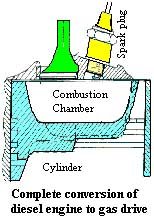
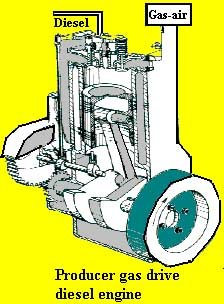
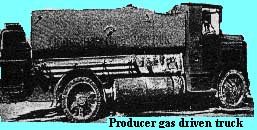
Gasifiers, when integrated with engines, provide mechanical power which can be used for running automobiles and many other stationary machinery. The use of downdraft gasifiers fueled with wood or charcoal to power cars, lorries, buses, trains, boats and ships has already proved it´s worth in the past. Before and during second world war, gasifiers were largely used to power vehicles. Most of the gasoline and diesel driven vehicles during this period were converted to producer gas drive.
Image
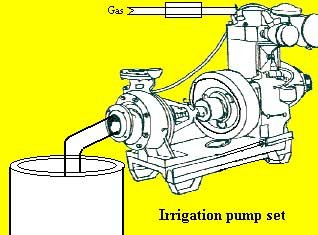
Reseach in the past shows that compared to gasifiers fueled with wood or agricultural residues, charcoal gasifiers present less operational problems and are be recommeded for village level applications. Micro scale gasification systems (1-10 kw) can be used by small and medium farmers for providing power to irrigation system. The equipment shall be small, cheap, simple and transportable.
Image
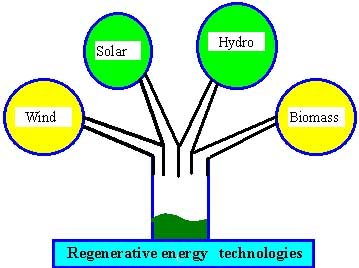
If firewood is available in sufficient amount without any danger to forest, gasifier can serve as an option for energy supply in remote areas. Because of great concern for conservation of forests and availability of fossil fuels, gasification is not seen as universally applicable technology, but act as a component within range of available regnerative energies. It can be a valuable supplement to wind, solar and hydropower.
|
| ||||||||||||||||||||||||||||||||||||||||||||||||||||||||||||||||||||||||||||||||
Gasification History and Development
The history of gasification dates back to seventeenth century. Since the conception of idea, gasification has passed through several phases of development. Yearwise development of the technology is given below.
|
1969 |
Thomas Shirley conducted crude experiments with carborated hydrogen |
|
1699 |
Dean Clayton obtained coal gas from pyrolitic experiment |
|
1788 |
Robert Gardner obtained the first patent with regard to gasification |
|
1792 |
First confirmed use of producer gas reported, Murdoc used the gas generated from coal to light a room in his house. Since then, for many years coal gas was used for cooking and heating |
|
1801 |
Lampodium proved the possibility of using waste gases escaping from charring of wood |
|
1804 |
Fourcroy found the water gas by reaction of water with a hot carbon |
|
1812 |
developed first gas producer which uses oil as fuel |
|
1840 |
First commercially used gasifier was built in France |
|
1861 |
Real breakthrough in technology with introduction of Siemens gasifier. This gasifier is considered to be first successful unit |
|
1878 |
Gasifiers were successfully used with engines for power generation |
|
1900 |
First 600 hp gasifier was exhibited in Paris. Thereafter, larger engines upto 5400 hp were put into service |
|
1901 |
J.W. Parker run a passenger vehicle with producer gas |
|
after 1901 |
In the period 1901-1920, many gasifier-engine systems were sold and used for power and electricity generation |
|
1930 |
Nazi Germany accelerated effort to convert existing vehicles to producer gas drive as part of plan for national security and independence from imported oil |
|
| |
|
1030 |
Began development for small automotive and portable gas producer. British and French Government felt that automotive charcoal gas producer is more suitable for their colonies where supply of gasoline was scarce and wood that could charred to charcoal was readily available |
| | |
|
1939 |
About 2,50,000 vehicles were registered in the Sweden. Out of them, 90 % were converted to producer gas drive. Almost all of the 20,000 tractors were operated on producer gas. 40 % of the fuel used was wood and remainder charcoal |
|
After |
After end of second world war, with plentiful gasoline and diesel available at cheap cost, gasificaton technology lost glory and importance |
|
1950- 1970 |
During this decades, gasification was " Forgotten Technology ". Many goverments in europe to felt that consumption of wood at the prevailing rate will reduce the forest, creating several environmental problems |
|
After 1970 |
The year 1970´s brought a renewed interest in the technology for power generation at small scale. Since then work is also concentrated to use fuels other than wood and charcoal. |
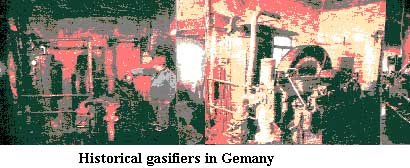
|
| ||||||||||||||||||||||||||||||||||||||||||||||||||||||||||||||||||||||||||||||||
Gasification Process
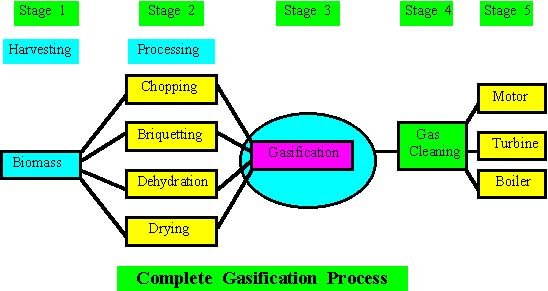
The essence of gasification process is the conversion of solid carbon fuels into carbon monoxide by thermochemical process. The gasification of solid fuel is accomplished in air sealed, closed chamber, under slight suction or pressure relative to ambient pressure. Gasification process occuring in general explained in this section.
Image
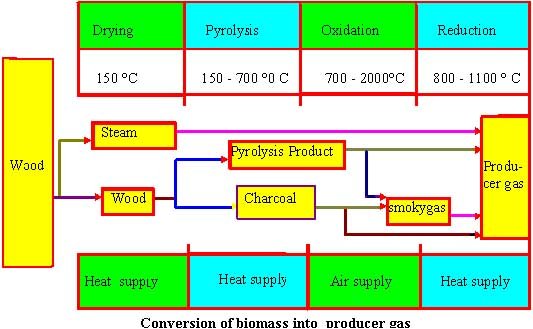
Gasification is quite complex thermochemical process. Splitting of the gasifier into strictly separate zones is not realistic, but neverthless conceptully essential. Gasification stages occurs at the same time in different parts of gasifier.
Drying
Biomass fuels consist of moisture ranging from 5 to 35%. At the temperature above 100°C, the water is removed and converted into steam. In the drying , fuels do not experience any kind of decomposition.
Pyrolysis
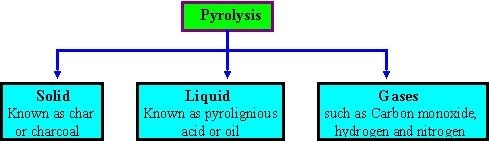
Pyrolysis is the themal decomposition of biomass fuels in the absence of oxygen. Pyrolysis involves release of three kinds of products : solid, liquid and gases. The ratio of products is influenced by the chemical composition of biomass fuels and the operating conditions. The heating value of gas produced during the pyrolysis process is low (3.5 - 8.9 MJ/m 3 ).
Image
It is noted that no matter how gasifier is built, there will always be a low temperature zone, where pyrolysis takes place, generating condensable hydrocarbon.
Oxidation
Introduced air in the oxidation zone contains, besides oxygen and water vapours, inert gases such as nitrogen and argon. These inert gases are considered to be non-reactive with fuel constituents. The oxidation takes place at the temperature of 700-2000o c.
Heterogenous reaction takes place between oxygen in the air and solid carbonized fuel, producing carbon monoxide. Plus and minus sign indicate the release and supply of heat energy during the process respectively
C + O 2 = CO 2 + 406 [ MJ/kmol]
In reaction 12.01 kg of carbon is completely combusted with 22.39 m3 of oxygen supplied by air blast to yield 22.26 m 3 of carbon dioxide and 393.8 MJ of heat.
Hydrogen in fuel reacts with oxygen in the air blast, producing
steam .
H 2 + ½ O 2 = H 2 O + 242 [
MJ/kmol]
Reduction
In reduction zone, a number of high temperature chemical reactions take place in the absence of oxygen. The principal reactions that takes place in reduction are mentioned below.
Boudouard reaction
CO 2 + C = 2CO - 172.6
[MJ/kmol]
Water-gas reaction
C + H2 O = CO + H 2
- 131.4 [MJ/kmol]
Water shift reaction
CO 2 + H 2 = CO +
H 2 O + 41.2 [MJ/kmol]
Methane production reaction
C + 2H 2 = CH 4
+ 75 [MJ/kmol]
Main reactions show that heat is required during the reduction process. Hence, the temperature of gas goes down during this stage. If complete gasification takes place, all the carbon is burned or reduced to carbon monoxide, a combustible gas and some other mineral matter is vaporized. The remains are ash and some char (unburned cabon)
|
| ||||||||||||||||||||||||||||||||||||||||||||||||||||||||||||||||||||||||||||||||
Producer Gas and it´s Constituents
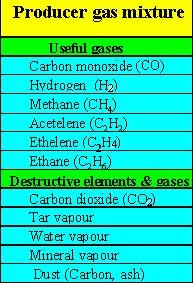
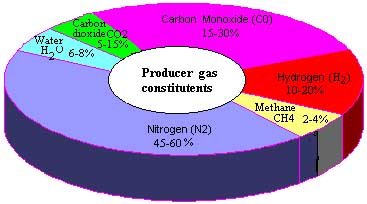
Producer gas is the mixture of combustible and non-combustible gases. The quantity of gases constituents of producer gas depends upon the type of fuel and operating condition.

Image
The heating value of producer gas varies from 4.5 to 6 MJ/m 3 depending upon the quantity of it´s constituents. Carbon monoxide is produced from the reduction of carbon dioxide and it´s quantity varies from 15 to 30 % by volume basis . Although carbon monoxide possses higher octane number of 106, it´s ignition speed is low. This gas is toxic in nature. Hence, human operator need to be careful while handling the gas .
Image
Hydrogen is also a product of reduction process in the gasifier. Hydrogen posseses the octane number of 60-66 and it increases the ignition ability of producer gas. Methane and hydrogen are responsible for higher heating value of producer gas. Amount of methane present in producer gas is very less (upto 4 %). Carbon dioxide and nitrogen are non-combustible gases present in the producer gas. Compared to other gas constituents, producer gas contains highest amount ( 45-60 %)of nitrogen. The amount of carbon dioxide varies from 5 to 15 %. Higher percentage of carbon dioxide indicates incomplete reduction . Water vapours in the proudcer gas occurs due to moisture content of air introduced during oxidation process, injection of steam in gasifier or moisture content of biomass fuels.
|
| ||||||||||||||||||||||||||||||||||||||||||||||||||||||||||||||||||||||||||||||||
Hazards with Producer Gas
Image
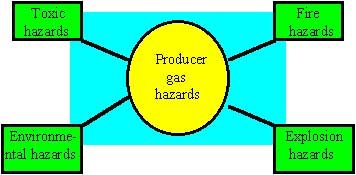
Producer gas, the mixture of carbon monoxide, hydrogen, methane
and other gases, is hazardious, if it is not handled and used properly.
Poisonous component of producer gas is carbon monoxide. All hazards associated
with use of producer gas are described here.
Fire
hazards
Image
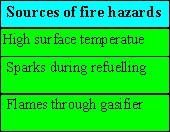
Fire risks can be minimized by taking following precautions
- Insulation of hot parts of system
- Insulation of double sluice filling device
- Installation of back-firing valve in gasifier inlet
Explosion hazards
Explosion can occur if the producer gas is mixed with sufficient amount of air to form explosive mixture. This may happens because of following several reasons :
- Air leakage into the gas system
- Air penetration during refuelling
- Air leakage into cold gasifier still containing gas which can ignite
Air leakage into the gas system does not generally give rise to explosions. To avoid the chance of explosion due presence of producer gas, if any, in cold system, it is necessary to ventilate cold system before igniting the fuel.
Toxic hazards
Image
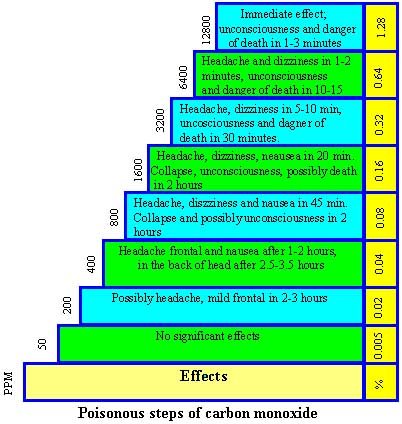
Producer gas consists of carbon monoxide, which is extremely
toxic and dangerous as it combine with haemoglobin in the blood, preventing
oxygen absorption and distribution. Carbon monoxide concentration of 50 PPM
produce no effect. As concentration increases, there arises problems of
headache, dizziness and even death also. No chronic symptoms can occur as the
result of prolonged inhalation of relatively small amounts of carbon monoxide.
Fortunately, there is less chance of gas escape during operation as gasification
system works under suction. However, situation is quite different during
starting and closing installations. To avoid the trapping of gas, it is
recommended to install the gasifier plant in the open air
Environmental hazards
During the gasification of biomass, ashes and condensate (mainly water) are produced. Ashes do not contribute to any environmental hazards and can be safely disposed. However, for the tar containing condensate, the situation is different and disposal of those form can have undesirable environmental effects. No specific information is available about the bio-degradation of the phenolic and tarry constituents of the condensates. Properties of exhuast emmission of engines running on producer gas is generally acceptable.
|
| ||||||||||||||||||||||||||||||||||||||||
Biomass Gasification - Technology and Utilisation (Individual Contributor Chandrakant)
Gas Producers (Gasifiers)
Design of gasifier depends upon type of fuel used and whether gasifier is portable or stationary. Gas producers are classified according to how the air blast is introduced in the fuel column. History of gasification reveals serveral designs of gasifiers. The most commonly built gasifiers are classied as :
Updraft gas producer
|
|
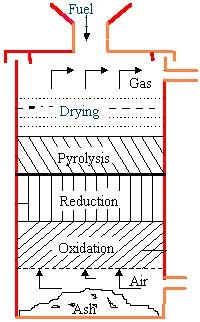
An updraft gasifier has clearly defined zones for partial combustion, reduction, and pyrolysis. Air is introduced at the bottom and act as countercurrent to fuel flow. The gas is drawn at higher location. The updraft gasifier achieves the highest efficiency as the hot gas passes through fuel bed and leaves the gasifier at low temperature. The sensible heat given by gas is used to preheat and dry fuel. Disadvantages of updraft gas producer are excessive amount of tar in raw gas and poor loading capability. Hence it is not suitable for running vehicle. |

Downdraft gas producer
|
|
In the updraft gasifier, gas leaves the gasifier with high tar vapour which may seriously interfer the operation of internal combustion engine. This problem is minimized in downdraft gasifier. In this type, air is introduced into downward flowing packed bed or solid fuels and gas is drawn off at the bottom. A lower overall efficiency and difficulties in handling higher moisture and ash content are common problems in small downdraft gas producers. The time (20-30 minutes) needed to ignite and bring plant to working temperature with good gas quality is shorter than updraft gas producer. This gasifier is preferred to updraft gasifier for internal combustion engines |
Twin-fire gas producer
|
|
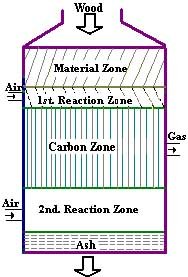
The advantage of co-current and counter-current gasifiers are combined in a so a called twin-fire gasifier. It consists of two defined reaction zones. Drying, low-temperature carbonisation, and cracking of gases occur in the upper zone, while permanent gasification of charcoal takes in lower zone. The gas temperature lies between 460 to 520 o C. Total process takes place with under pressure of -30 mbar. Twin-fire gasifier produces fairly clean gas. |
Crossdraft gas producer
|
|
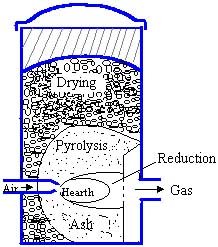
Crossdraft gas producers, although they have certain advantages over updraft and downdraft gasifiers, they are not of ideal type. The disadvantages such as high exit gas temperature, poor CO 2 reduction and high gas velocity are the consequence of the design. Unlike downdraft and updraft gasifiers, the ash bin, fire and reduction zone in crossdraft gasifiers are separated. This design characteristics limit the type of fuel for operation to low ash fuels such as wood, charcoal and coke. The load following ability of crossdraft gasifier is quite good due to concentrated partial zones which operates at temperatures up to 2000 o c. Start up time (5-10 minutes) is much faster than that of downdraft and updraft units. The relatively higher temperature in cross draft gas producer has an obvious effect on gas composition such as high carbon monoxide, and low hydrogen and methane content when dry fuel such as charcoal is used. Crossdraft gasifier operates well on dry air blast and dry fuel. |

Other gas producers
Although updraft, downdraft or crossdraft gas producers have been the most commonly built types, there is a wide variety of gasifiers which do not really fit into any of these categories and are classified as other gas producers . Some units are built to combine the advantages of crossdraft with downdraft or updraft gas producers.
|
| |||||||||||||||||||||||||||||||||||||||||||||||||||||||
Biomass Gasification - Technology and Utilisation (Individual Contributor Chandrakant)
Impact of Fuel Properties on Gasification
|
|
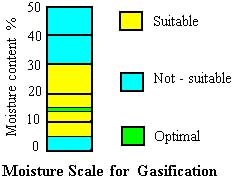
A wide range of biomass fuels such as wood, charcoal, wood waste (branches, roots, bark, saw dust) as well agricultural residues- maize cobs, coconut shells, cereal straws, rice husks, can be used as fuel for biomass gasification. Theoretically, almost all kinds of biomass with moisture content of 5-30% can be gasified; however, not every biomass fuel lead to the successful gasification. Most of the development work is carried out with common fuels such as coal, charcoal and wood. Key to a successful design of gasifier is to understand properties and thermal behaviour of fuel as fed to the gasifier. The properties of fuel which influnce the gasification are described below. |
Energy content of fuel
|
Energy content of fuel is obtained in most cases in an adiabatic, constant volume bomb calorimeter. The values obtained are higher heating values which include the heat of condensation from water formed in the combustion of fuel. The heating values are also reported on moisture and ash basis. Fuel with higher energy content is always better for gasification. The most of the biomass fuels (wood, straw) has heating value in the ragne of 10-16 MJ/kg, whereas liquid fuel (diesel, gasoline) posses higher heating value. |
|