| | | Case Studies of Neem Processing Projects Assisted by GTZ in Kenya, Dominican Republic, Thailand and Nicaragua (GTZ, 2000, 152 p.) | | | 4. Case studies of small-scale semi-industrial neem processing in Kenya, Thailand, the Dominican Republic and Nicaragua | | | Comparison of selected countries | | | 4.1 Kenya | | | (introduction...) | | | 4.1.1 Introduction, previous activities and other projects in Kenya in relation to neem | | | 4.1.2 Situation found prior to the project for neem industrialisation | | | 4.1.3 The beginning of small-scale commercial neem production | | | 4.1.4 Economic assessment of the neem processing plant in Kenya | | | 4.1.4.1 Technical and economic description of Saroneem Biopesticides Ltd | | | 4.1.4.2 Production costs | | | 4.1.5 Market potential, investment possibilities, marketing and development strategies | | | 4.1.5.1 Marketing of neem products to date | | | 4.1.5.2 Market potential | | | 4.1.5.3 Analysis of Economic production with and without the use of neem pesticides | | | 4.1.5.4 Market growth potential and substitution possibilities | | | 4.1.6 ''Lessons learnt'' | | | 4.1.6.1 Project concept | | | 4.1.6.2 Marketing and development strategies | | | 4.1.7 Investment possibilities | | | 4.1.8 Post-project experience | | | 4.1.9 References | | | 4.2 Documentation of neem activities in Thailand with special reference to the Thai Neem Products Company Ltd and the assistance provided to the DoA, Toxicological Division by CiM | | | (introduction...) | | | 4.2.1 Introduction | | | 4.2.2 Previous activities and other projects in relation to neem | | | 4.2.3 Situation found concerning abundance of neem trees and of raw material supply | | | 4.2.4 Small-scale commercial neem production | | | 4.2.5 Economical assessment of Thai Neem Products Company Ltd | | | 4.2.5.1 Selected key data of the plant | | | 4.2.5.2 Production costs | | | 4.2.5.3 Investment possibilities | | | 4.2.6 Market potential, marketing and development strategies | | | 4.2.6.1 The pesticide market in Thailand | | | 4.2.6.2 Marketing of neem products to date | | | 4.2.6.3 Market potential | | | 4.2.6.4 Market promotion | | | 4.2.6.5 Marketing channel and distribution | | | 4.2.6.6 Analysis of economic production with and without the use of neem pesticides | | | 4.2.7 ''Lessons learnt'' and recommendations | | | 4.2.8 References | | | 4.3. Small-scale industrial manufacturing of neem-based pesticides in the Dominican Republic | | | (introduction...) | | | 4.3.1 Introduction | | | 4.3.2 Previous activities and other projects related to neem | | | 4.3.3 Small-scale commercial neem manufacturing in the Dominican Republic | | | 4.3.4 Economic assessment of the neem-processing plant in the Dominican Republic | | | 4.3.4.1 Technical and economic description of FAMA's neem-processing plant | | | 4.3.4.2 Production costs of FAMA's neem-processing plant | | | 4.3.5 Market potential for neem pesticides in the Dominican Republic | | | 4.3.5.1 Marketing to date | | | 4.3.5.2 Market potential of neem pesticides | | | 4.3.5.3 Analysis of the economic production with and without the use of neem pesticides | | | 4.3.5.4 Market growth potential and substitution possibilities | | | 4.3.6 ''Lessons learnt'' - recommendations | | | 4.4 Small-scale commercial neem production in Nicaragua | | | (introduction...) | | | 4.4.1 Introduction | | | 4.4.2 Previous activities and other projects in relation to neem | | | 4.4.3 Small-scale commercial neem production in Nicaragua | | | 4.4.3.1 Seed collection | | | 4.4.3.2 Processing activities | | | 4.4.4 Economical assessment of COPINIM's processing plant in Nicaragua | | | 4.4.4.1 Technical and economic description of the neem processing plant | | | 4.4.4.2 Production costs at COPINIM's neem processing plant | | | 4.4.5 Market potential for neem pesticides in Nicaragua | | | 4.4.5.1 Marketing of neem pesticides to date | | | 4.4.5.2 Market potential | | | 4.4.5.3 Further neem manufacturers in Nicaragua | | | 4.4.5.4 Analysis of the economic production with and without the use of neem pesticides | | | 4.4.5.5 Market growth potential and substitution possibilities in Nicaragua | | | 4.4.6 ''Lessons learnt'', recommendations and development strategies | | | 4.4.7 References | | | 4.4.8 Units |
|
Case Studies of Neem Processing Projects Assisted by GTZ in Kenya, Dominican Republic, Thailand and Nicaragua (GTZ, 2000, 152 p.)
4. Case studies of small-scale semi-industrial neem processing in Kenya, Thailand, the Dominican Republic and Nicaragua
Comparison of selected countries
For this study we selected four countries representing the
conditions for neem processing on each of the continents considered. It is,
however, difficult to find a representative country in Asia; the situation of
Thailand for example is very different to that of India or Indonesia.
Nicaragua has been added although no assistance in the strict
sense has been given directly to the neem manufacturer, but traditionally good
working relations exist.
The backgrounds of all these projects vary, not only due to the
varying abundance of the neem tree, the ethno-social environment and size of the
pesticide market, but also due to political and economic frame conditions in the
individual countries. Some characteristics are presented in Table 6.
Table 6: Characteristics of the agricultural sector in
Thailand, Kenya, the Dominican Republic and Nicaragua
|
Thailand |
Kenya |
Dominican Republic |
Nicaragua |
|
Population |
54.5 million |
21.5 million |
7.9 million |
4.5 million |
|
GNP/capita |
US$ 2960 |
US$ 320 |
US$ 1600 |
US$ 380 |
|
Agric. production as a % of GNP |
11% |
29% |
13% |
35% |
|
% of population working in agricultural sector |
57% |
78% |
15% |
22.4% |
|
Insecticide market |
12 800 t (1998) imported + 6500 t local products |
1 800 t insecticide 22% = US$ 9.7 million |
1000 t, value US$ 6.8 million |
US$ 8.2 million |
|
Share of insecticide market covered by neem products (value)
|
? |
0.24% |
0.25% |
? |
The data indicate quite clearly that Thailand has the largest
pesticide market in terms of quantities and value.
While in Thailand the government is strongly supporting and
promoting the use of low-residue locally produced alternative pesticide
products, the policies in the Dominican Republic, Nicaragua and Kenya favour
high-input agriculture based on agro-chemicals. Only recently has there has been
a slight policy change due to pressure from the World Bank and other donors.
Thailand on the other hand also has considerable local pesticide
production, while no such production exists in the Dominican Republic, and only
a small Pyrethrum industry exists in Kenya, amounting to about US$ 1
million annually.
Compared to the three other countries the contribution of the
GTZ to the neem processing activities in Nicaragua is marginal and consists
mainly of testing neem products within IPM concepts.
Nonetheless there are quite a number of similarities between the
other three countries:
· All of them
export considerable quantities of agricultural produce to industrialised
countries.
· In all three countries the
pesticide market can be classified as "liberal".
· A small number of
(international) agro-chemical companies share most of the market.
· Pesticide use has increased
considerably in recent years, driven by population increase and subsequent
shortage of land.
· In all three countries
agricultural production is relatively intense, which also means that all three
countries have the same problems such as resistant pests, contaminated resources
and intoxicated labourers, and problems with high levels of pesticide residues
on crops.
Table 7 indicates the formal structure of the partners, the
availability of the raw material and the form of GTZ assistance.
Table 7: Partners, source of neem, form of assistance
provided by GTZ
|
Country |
Partners |
Source of neem raw material |
Assistance |
|
Thailand |
Entrepreneur Thai Neem Products Ltd |
Thai-Neem, A. indica and imports |
CiM/DoA |
|
Kenya |
Entrepreneur Saroneem Biopesticides Ltd |
Locally available |
GTZ/ICIPE |
|
Dominican Republic |
NGO FAMA |
Locally available and imported |
GTZ/CIM/Deutsche Welthungerhilfe |
|
Nicaragua |
NGO Copinim, DoA |
Locally available |
NGO "Stiftung Umverteilen", other NGOs, GTZ |
Our partners are in Thailand a small-scale family manufacturing
firm, exclusively engaged in neem processing; in Kenya a company previously in
the conventional agricultural supply business for about 40 years, but now
putting emphasis on bio-pesticides; and in the Dominican Republic an NGO whose
pesticide activities are focused on neem. However, the latter also conducts some
activities in the field of sustainable agricultural training.
All neem-processing units investigated are relatively small,
often family-run ventures. There are further firms (in addition to the one
mentioned offering neem products in Thailand) which also offer locally produced
neem pesticides, but these have no standardised azadirachtin content.
The following table shows some characteristic data of the
plants:
Table 8: Description of the potential capacities of the
processing units in Thailand, Kenya, the Dominican Republic and Nicaragua
|
Thailand |
Kenya |
Dominican Rep. |
Nicaragua |
|
Staff (1998) |
5+4 labourers |
2+3 labourers |
2.5 + 4 labourers + 1-2 technicians |
2 + labourers on demand |
|
Potential: |
|
|
|
75 t |
|
Neem cake |
59 t |
42 t |
12.5 t |
|
|
Alcoholic extract |
44 t |
Combined oil + alcoholic extract 42 t |
|
25 t |
|
Formulated neem oil |
4.4 t |
|
12.5 t |
75 t |
We still hope that some general principles, difficulties and
constraints - but also solutions -are illuminated by these case studies which
may help to avoid mistakes in other countries if similar projects are going to
be started (either by private entrepreneurs or technical cooperation
organisations) and that these studies help others to learn from our
experience.
4.1 Kenya
Documentation of neem activities in Kenya with special reference
to "SMALL-SCALE INDUSTRIAL PRODUCTION OF NEEM-BASED PESTICIDES IN KENYA"
compiled by A. M. Varela, H. Quentin and P. Foerster with the assistance of D.
Rocco.
4.1.1 Introduction, previous activities and other projects in Kenya in relation to neem
Neem was introduced into Kenya, in eastern Africa, during the
19th century by East Indian immigrants, who propagated the tree
essentially for its medicinal properties. Until recently, local knowledge about
the tree's uses was still limited to traditional beliefs in curative properties,
in particular for the treatment of malaria, stomach problems, fever, colds,
chest complaints and skin disorders. The leaves and/or bark and roots are boiled
and used as tea or applied directly to the affected area. Neem twigs are also
used as toothbrushes.
Currently the tree is grown in large numbers along the coast,
where it is locally known as "Mwarobaini" the tree of forty cures. In addition
to its medicinal properties, it is used as a mosquito repellent, firewood,
shade, windbreaks, boundary delineation and reforestation. The timber is used
primarily for making furniture. People have gradually learned about neem's
potential for reforestation, timber, firewood and as an insect repellent, and
more recently as a pesticide as research and awareness campaigns on the
potential of neem are being conducted in Kenya. The results are disseminated
through agricultural extension services and organisations such as the Deutsche
Gesellschaft f�r Technische Zusammenarbeit (German Technical Cooperation, GTZ),
the International Centre of Insect Physiology and Ecology (ICIPE), and several
non-governmental organisations (NGOs) (see also Foerster & Moser 2000).
In Kenya, some people use a concoction of leaves for spraying
their vegetables and ornamental gardens. A large farm, Baobab, located near
Mombasa, has been experimenting with neem for more than twenty years. Leaves are
used as protective mulch for vegetable plants as well as to control weevils in
maize storage. A mixture of neem oil and water is sprayed onto the plants. The
cake is mixed directly into the soil as protection against nematodes (DM 1994).
Research on the use of neem was limited before the 1990s. In
1991 ICIPE started trials on the use of extracts of neem bark, seeds and leaves
for controlling ticks and tick-borne diseases. Ticks, as disease vectors, are a
serious threat to livestock in Africa. These extracts showed potential for
controlling the juvenile stages of the major tick species.
Major activities on neem started in August 1994, when ICIPE
received funding from the government of Finland and the United Nations
Environment Programme (UNEP) to start a project on neem. The project objective
was building awareness of the potential uses of the neem tree among agricultural
and forestry trainers, extension personnel, health workers, and representatives
of NGOs.
Training courses and seminars to create awareness about uses of
neem were held at Mbita Point, an ICIPE field station on the shores of Lake
Victoria. The courses covered possibilities for production, application and
commercialisation of neem products in Africa. This project trained over 650
people, and demonstrated the "standard" technology, using a cold-press oil
expeller for the production of neem cake and oil. In addition research has been
supported to investigate the effect of neem against pests of banana, maize and
cowpea (Saxena 1997, Musbyimana & Saxena 1999).
Trials to determine the efficacy of neem-based products and
their performance compared to commercial insecticides for the management of
agricultural pests, have been conducted in collaboration with the Kenya
Agricultural Research Institute (KARI). For example, trials on cowpeas were
carried out at the KARI station at the coast (Mtwapa). Furthermore, there have
been studies on neem products for management of ticks.
In September 1995, the GTZ Pesticide Service Project offered a
training course for technicians in extraction and bioassays of biologically
active plant products. The course was held in Nairobi with participants from
several countries in the
region.
4.1.2 Situation found prior to the project for neem industrialisation
Abundance of neem trees
Kenya has good potential for growing neem. Based on a
conservative GIS analysis with rainfall, altitude and soil characteristics as
parameters it is estimated that over 25% of the land area in Kenya is suitable
for growing neem (DM 1995). The tree is currently found across Lamu, Taita
Taveta, Kilifi and Mombasa Districts in the Coast Province. About 30-year-old
stands of neem trees are present in Wajir, Mandera and Garissa in the North
Eastern Province. Neem trees are also found around Lake Magadi.
There is no available information on the exact number of trees
growing in Kenya; however, it can be estimated that several million stems are
fruiting in the country. In a preliminary survey done by DM (1995), neem trees
were found to be common along the coast. In Lamu District, most trees were found
bordering plots of land, around schools and along roads. In Taita Taveta
District trees were widely dispersed throughout the district. It was estimated
that an average of one to two trees could be found on most homesteads in Mwatate
Division. In Kilifi District, hundreds of mature neem trees can be seen on
either side of the main road all the way to Malindi. In Mombasa District neem
was present within Mombasa City centre, around government offices and in
residential areas. Large numbers of neem trees are also found along the main
road to Mtwapa. In North Eastern Province, the tree is confined to settlements.
So far the tree has not been planted on plantations.
Neem seeds
Several organisations have been purchasing seeds for propagation
and processing. For example, the Kenya Forestry Research Institute (KEFRI) is
active in the collection and dissemination of neem seeds to farmers. Collection
and germination of seeds is organised by the KEFRI research station at the
Coast. The KEFRI headquarters in Muguga sells the seeds to farmers. The Kenya
Forestry Seed Center has distributed neem seeds to farmers in the dry areas of
Western Kenya. The ICIPE Awareness Project has also purchased seeds for
propagation and for processing in order to produce material to be used in
trials. Seeds and seedlings are being sold at Mbita Point, ICIPE's field station
on Lake Victoria.
The Kenya Institute of Organic Farming (KIOF), a member of the
International Federation of Organic Agriculture Movements (IFOAM), is promoting
the dissemination of the existing local knowledge of the potential use of neem
leaves, seeds and bark for plant protection, and conducting demonstration
trials.
Processing activities
As stated earlier, the neem tree has been mainly used for shade
and for its curative properties, using the leaves and the bark. Seeds have been
occasionally collected for sale, mainly for propagation purposes and not for
processing. As a result, no machinery has been developed specifically for neem
processing. Baobab Farm uses a locally available hand press to extract neem oil
from entire seeds, extracting about 2 l of oil per 100 kg of clean seeds (DM
1995). The ICIPE Awareness Project at Mbita Point uses an imported "Comet" oil
expeller (manufactured by Monforts, Germany), which, although locally available,
is costly. More affordable Indian-made oil mills are locally available; however,
the quality of the steel would have to be taken into consideration to determine
their suitability for neem processing because the neem seeds/kernels are quite
abrasive. For instance, even the spindle of the Comet oil expellers, although
made of a special steel, has to be replaced after processing about 10 tonnes of
neem seed/kernel (D. Rocco, personal communication).
Need for neem products to manage pests in Kenya
Although the issue of pesticide residues is not considered in
the Plant Protection Act of Kenya, and no regular control of residues is carried
out on horticultural produce for the internal market, concerns about the levels
of pesticide residues is increasing. KARI, through the Pesticide Chemistry
Laboratory, has lately conducted studies on pesticide residues on crops such as
tomatoes (Ngatia et al. 1996). The pesticide Chemistry Laboratory, formerly
under the Kenya Agricultural Research Institute (KARI), and now under the Kenya
Plant Health Inspection Service (KEPHIS), is also a pesticide residue level
testing facility, used mainly for the horticultural export market.
The production of simple, home-made pest control products from
the neem tree has been considered an attractive option for the resource-poor
farmer in developing countries such as the majority of the Kenyan farmers.
However, as in other countries the Kenyan farmers mentioned the various
shortcomings (Moser 1996, Foerster & Moser 2000) listed in Chapter I and the
majority of the farmers prefer ready-to-use pesticides.
Apart form this local commercial production and marketing of
neem-based pesticides were expected to show the merits and benefits listed in
Chapter
I.
4.1.3 The beginning of small-scale commercial neem production
In 1994, the GTZ-IPM Horticulture Project (GTZ-IPMH) in Kenya
directed its attention towards neem as an alternative to synthetic pesticides,
in the context of integrated pest management programmes (IPM), to increase
production of horticultural crops for export and local consumption in an
environmentally sound and economically viable manner (Loehr et al 1997).
Based on experience from other countries, GTZ-IPMH focused its
efforts on establishing a small-scale industry for producing simple,
ready-to-use neem-based pesticides.
As a first step the GTZ IPMH project funded two feasibility
studies, which were conducted in the coastal area in Kenya during 1994 -1995.
The aim of these studies was to determine the economical and technical
feasibility of producing neem-based pesticides. In January 1996, a local
agrochemical company called Saroc Ltd (today: Saroneem Biopesticides Ltd) was
contracted to organise the first commercial seed collection and to establish a
pilot processing unit for extraction of oil from neem seeds. When these studies
showed that Kenya had good potential for growing neem and first experiences were
gained with processing and seed collection, measures were taken by IPMH and the
Pesticide Service Project to initiate a separate project. This was started in
mid-1996, as a two-year project called "Small scale industrialisation of
neem-based insecticides in Kenya", funded by the GTZ and set up at ICIPE. The
aim of this project was to produce simple, standardised, neem-based pesticides
which could be purchased on the market at competitive prices.
ICIPE contracted Saroc Ltd to organise collection of
seeds, to develop neem-based pesticides and to coordinate marketing of the
products. A part-time scientist was contracted by ICIPE to coordinate research
on the efficacy of the developed products and to generate the necessary
information for registration of the developed products.
|
The main activities and business of Saroc are confined to the
formulation of imported pesticides, mainly fungicides based on copper, and
importing fertiliser for the east African market. At the end of 1999 the
conventional agricultural supply wing was separated off and sold, while the
neem-processing wing continued to operate under the name of Saroneem
Biopesticides Ltd (for more data see: "description of the plant", below).
|
Development of neem products
· Seed collection:
The peak fruiting season in coastal Kenya and Tanzania is from
March to May, which coincides with the rainy season. It was found feasible to
organise collection of seeds through existing organised groups, especially
women's groups, which expressed interest in a collection scheme. However, the
feasibility studies concluded that the success of seed collection depended on
several factors, such as:
· educating and
familiarising local residents with neem and its use as an insecticide well in
advance of the fruiting season;
· training on collection,
cleaning and drying of neem seeds;
· setting the prices to take
into account factors such as seed availability, wage levels for casual workers,
the amount of time required, and opportunities of alternative sources of income.
This should involve discussion with other organisations collecting seeds (DM
1994, 1995).
Collection started in 1996, when Saroneem Biopesticides Ltd
staff met with representatives of the local authorities and rural farmers'
organisations, women's groups and pupils from primary and secondary schools. The
aim was to identify, motivate and train potential collectors. It turned out that
schoolchildren made excellent multipliers, since they pass on their knowledge
and information to their families.
During the first collection it was found that a further factor
was crucial to seed collection, namely creation of confidence between the
collecting communities and the purchaser. Due to bad experiences in the past,
villagers were extremely cautious and were not prepared to work if they were not
fully assured of payment. Nevertheless, almost 7000 kg of seeds were collected
by women's groups, schools, and local farmers. The seeds were then transported
to Nairobi for processing (Rocco 1996).
Saroneem Biopesticides Ltd organised meetings in the coastal
area and in the north-eastern region to inform the local population of the
possibilities of earning money through seed collection, and to train them in
harvesting, cleaning and drying the neem seeds. However, no collections were
made in the north-eastern region due to the high costs of transporting the seeds
to Nairobi. Thus, seed collection was concentrated along the coastal region in
Kenya (Kilifi and Malindi Districts) and Tanzania. The average distance to the
neem processing plant is about 730 km.
A series of local organisations, women's groups, farmers and
their families as well as inmates of prisons were involved in seed collection.
Since the harvest period coincides with the period of heaviest rains along the
coast, special attention had to be given to the proper storage and drying of
seeds to avoid fungal contamination and degradation of the seeds due to the high
humidity.
Luckily, at the coast the harvest of seeds is facilitated by
large colonies of fruit bats and birds, which pluck the ripe fruit off the tree,
feed on the sweet pulp and then spit out the seed, which can be found lying
under the tree. This saves depulping, which is a labour-intensive step in
processing.
The following table (9) indicates the amount of neem seeds
purchased in the last four years (since the beginning of the neem-processing
activities).
Table 9: Neem kernels purchased by Saroneem Biopesticides
Ltd
|
Year |
Neem seeds purchased (kg) |
|
1996 |
6,700 |
|
1997 |
16,755 |
|
1998 |
13,474 |
|
1999 |
31,148 |
|
Total |
68,077 |
In each season Saroneem Biopesticides Ltd purchased the total
amount of collected and usable seeds to create confidence in its collection
system and motivate the farmers to collect seeds in the forthcoming seasons.
About 17 tonnes of neem seeds were collected and delivered to
Nairobi in 1997. The collection in 1998 was hampered by the onset of unusually
heavy and long rains at the end of 1997. Many of the flowers aborted, limiting
the amount of fruit produced. Moreover, the seed quality was affected by the
prolonged moisture conditions. About 14 tonnes were collected in 1998. In 1999
in total 2000 people were involved in collecting the 31 t of neem seeds. These
are individuals and groups, mainly women and children, who see the collection of
neem seeds as an additional source of income.
Seeds were delivered to collection points and transported to
Nairobi. In 1999 the collections were organised by four agents situated in the
coastal region, which purchased the collected neem seeds on behalf of Saroneem
Biopesticides Ltd.
During the harvesting season the collected neem seeds are
checked at the collection point, and the deliverers paid promptly. There the
seeds are packed, and they are collected and transported to Nairobi twice a
week.
The collectors receive 20 KSH (70 KSH = US$ 1) for 1 kg of
usable neem seeds from the agents, or 5 KSH for lower quality seeds. The agents
in their turn get 25 KSH for 1 kg of good quality seeds and 5 KSH as lump sum
for packing and transport. The azadirachtin content was about 0.3 or 0.4% in
1999. The seeds are graded (and paid for) according to following quality
criteria: contamination by fungi, cleanliness and moisture content. Oil and
azadirachtin content are not considered because they cannot be checked on the
spot.
It is difficult to obtain reliable figures on the yield per tree
due to the heterogeneous growing conditions. According to rough estimates, about
30 kg of neem seeds are produced by a 12-15 year old tree, and about 12 kg per
tree are gathered by the collectors. The yields, however, vary from year to year
according to climatic conditions. Considering younger neem trees as resource
trees, about 3500 to 4500 neem trees are required to obtain 31 t of seeds.
Seeds are transported from the collection area to the district
capital by private pick-ups, and from there to Nairobi by frequent buses.
Transport costs for the neem manufacturing plant are 30 000 KSH/t.
For the year 2000 Saroneem Biopesticides Ltd intends to purchase
50 t neem seeds, provided sales are according to the expectations. It is
considered that it is feasible to extend and intensify the collection of seeds
if more seeds are required.
· Processing
In order to overcome the difficulties of storing seeds under the
climatic coastal conditions it was decided to undertake post-harvest development
in Nairobi. For this purpose a pilot unit was established.
Description of the pilot plant
The machinery used was developed and manufactured by testing and
adapting local machinery for groundnut processing, with the exception of a
"Comet" oil expeller manufactured in Germany. The machinery included:
· a groundnut
sheller, modified to cope with the much smaller neem seeds, for breaking the
shell to liberate the seed kernel,
· a winnower to separate the
kernels from the shell,
· an oil expeller to extract the
oil from the kernels (later a double spindle oil expeller with a higher
processing capacity was added),
· a hammer mill to crush the
neem cake,
· an automatic packing
machine.
The main problems faced during processing were:
1. Drying of seeds was difficult under the
prevailing weather conditions and in the limited space available at Saroc Ltd in
Nairobi. It was found that oil extraction was very limited unless the kernels
were properly dried.
2. Crushing neem kernel cake alone was not easy as it jammed the
hammer mill. This problem was solved by mixing the neem kernel cake with neem
shells.
3. Contamination of neem products was possible since the company
was producing agro-chemicals under the same roof.
4. The lack of equipment for analysis of azadirachtin hampered
the formulation of standard products.
After these initial experiences the pilot unit developed by
Saroc was moved to ICIPE headquarters in Nairobi. A section of the former
livestock centre was made available for the processing unit. It consisted of a
large covered shed of about 600 sq m, a large enclosed room, an office and a
laboratory block. The covered shed was suitable for drying and shelling the
seeds, whilst processing, formulation and packing could be restricted to the
enclosed area, thus minimising the risk of contamination.
The processing capacity was later increased (see above).
Formulation of neem products
Pesticides for seed treatment, soil treatment and foliar spray
were developed based on neem kernel cake powder and neem oil. Processing of neem
seeds into pesticides includes the following steps:
1. Disinfecting and drying the seeds: the seeds are
treated with a solution of calcium hypochlorite to prevent fungal growth and
subsequent aflatoxin contamination.
2. Drying the seeds: the seeds are spread in thin layers and
exposed to the sunshine. During the evening the seeds are covered with
polyethylene sheets.
3. Threshing the seeds: 50% of the seeds are passed through a
modified groundnut sheller to liberate the kernel from the seed shell.
4. Winnowing: a fan blowing through a constricted space is used
to separate shells from kernels.
5. Extraction of oil: a mixture of kernels and seeds is passed
through the mill. Trials on the most effective ways of extracting oil from the
seeds showed that a mixture of 2/3 kernels to 1/3 shells maximised the
extraction of oil.
6. Filtering the oil produces the pharmaceutical by-product
"Neemsar "O" "The neem cake can be either used to produce neem powder or for
alcoholic extraction. The quantity depends on the demands for the specific
product lines.
7. The azadirachtin content in neem cake is quantified using
high performance liquid chromatography (HPLC) at the chemistry department of
ICIPE. Standardisation of azadirachtin A content in neem cake powder is achieved
by reconstituting the neem cake with neem seed shell in appropriate proportions.
A hammer mill and mixer are used to grind and mix neem kernel cake and shells.
The final product is a neem powder of 0.5% azadirachtin, called "Neemros 0.5%
Powder".
8. For alcoholic extraction the neem cake stays in an alcoholic
extractor for 8 h. 100 l of alcohol is required for 130 kg cake. The alcohol
percolates continuously through the cake, extracting part of the remaining neem
oil and other active ingredients. The plant in Kenya has been using isopropanol
(isopropyl alcohol), due to its easy availability and cheap price (but it is now
using ethanol).
9. The neem oil (32%) is combined with alcohol (63%) and an
emulsifier (5%). This marketable product, an emulsifiable concentrate, is sold
under the trade name "Neemroc EC 0.03% W/W".
10. The extracted cake mixed with neem shells in a ratio of 1:1
is milled with a hammer mill and can be sold as organic fertiliser. To date
Saroneem Biopesticides has not traded this product.
11. Formulation of neem products: pesticides for seed treatment,
soil treatment and foliar sprays were developed based on neem kernel cake powder
and neem oil. Two formulations were developed:
A) Neemros: Neem cake powder (NCP) standardised at 0.5%
azadirachtin and
B) Neemroc EC oil: a water-miscible oil with 0.03% azadirachtin.
For clarification the processing of neem cake is explained below:
The shells are removed from 1 t of neem seeds. The shells make
up about 25% of the seeds' weight, coming to 250 kg. From the remaining 750 kg
kernels 120 kg cold neem oil is pressed (16%). This leaves 630 kg neem cake
which is mixed with 100 kg neem shells for technical reasons. Together the neem
cake and seed shells amount to 730 kg of neem powder.
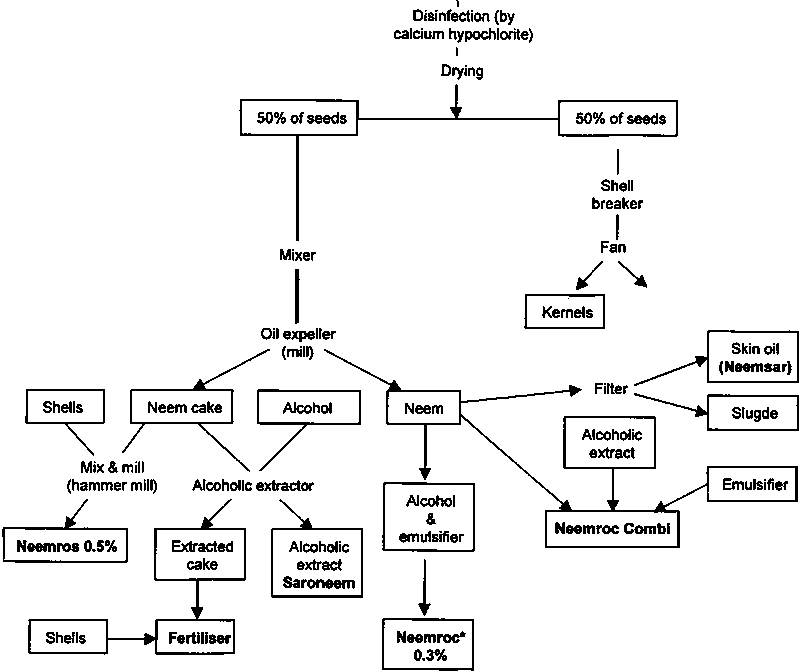
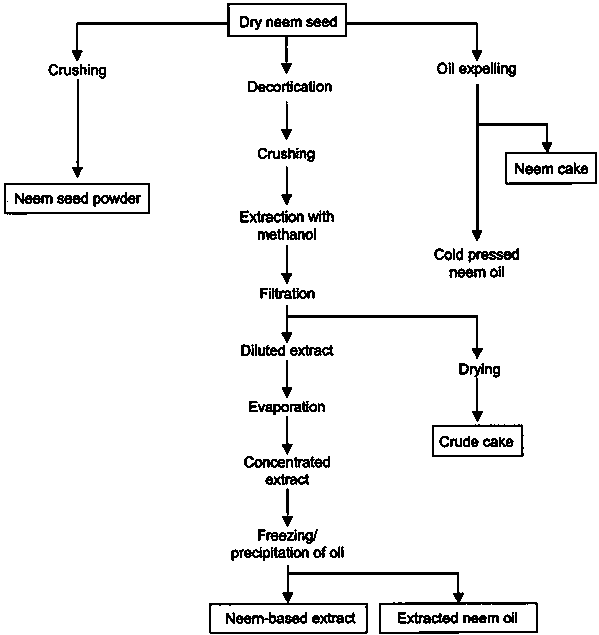
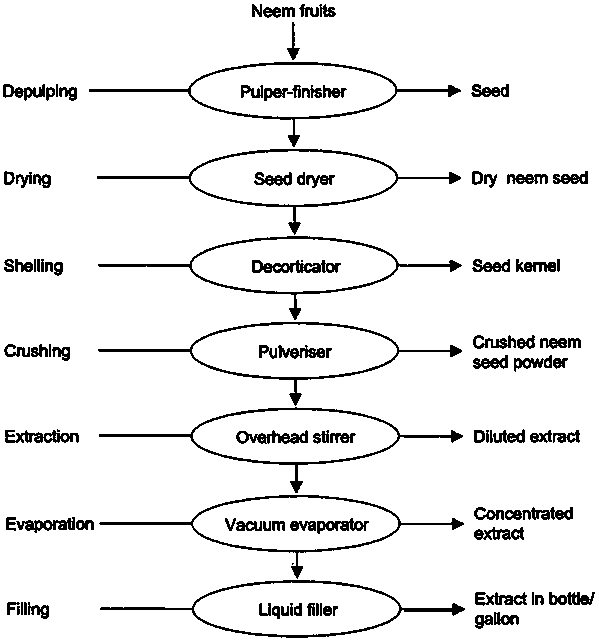
Figure 3: Processing of neem seeds
into pesticides includes the following steps:
*Officially Neemroc has a minimum azadirachtin
content of 0.03%, although it is usually higher than this.
In 1999 Saroneem Biopesticides Ltd purchased 31 t of neem seeds
and from this manufactured the following quantities of marketable products:
Table 10: Expected output of marketable neem products
|
Raw material: 31 t neem seeds |
|
Product |
Output |
|
Neemroc |
10,000 l |
|
Neemros |
10,000 kg |
|
Neemsar "O" |
60 l |
|
Organic fertiliser |
10,000 kg |
The above data concerning marketable products could vary
according to the demand. The figures are estimates based on the experience
gained in previous years.
Quality Control
Quality control takes place with regard to the following
components: aflatoxin (not desired) and azadirachtin content (desired, should be
as high as possible).
The seeds are checked for contamination with the storage fungus
Aspergillus spp. The absence of aflatoxin in the seeds and in the
finished products (neem oil, neem cake and neem powder) is regularly monitored
(twice a month) at the chemistry department at ICIPE. The technician in charge
of the analysis at ICIPE took part in a training course in extraction and
bioassays of biologically active plant products, offered by the GTZ Pesticide
Service Project in 1995. During 1996-1997 duplicates of some samples were sent
for analysis to Trifolio-M GmbH in Germany for the sake of comparison.
The shelf-life of the products was determined by monthly HPLC
azadirachtin A analysis of stored products and seeds. The changes in content of
azadirachtin A in neem cake powder, stored at room temperature, during a
ten-month period ranged from 0 to 30% reduction. The analyses showed that
azadirachtin A was better conserved when the seeds were stored and then
processed as needed.
The following table (11) provides data on azadirachtin and
aflatoxin content according to the quality control laboratory at ICIPE in the
latest analysis of products from Saroneem Biopesticides Ltd:
Table 11: Results of the quality analysis of Saroneem
Biopesticides Ltd products in October 1999:
|
Product/material |
Azadirachtin |
Aflatoxin (mg per g) |
|
Neem cake |
5 |
below the limit of determination |
|
Neem powder |
3.9 |
below the limit of determination |
|
Neem oil |
0.2 |
not detectable |
|
Filtered neem oil |
0.2 |
not detectable |
|
Neem seeds |
3.2 |
below the limit of determination |
The quality criteria for marketable neem-based pesticides are
defined as follows:
· constant
azadirachtin content
· constant
consistency
· reliable efficacy against
pests
· aflatoxin content below defined
limit
· Registration of neem-based
pesticides in Kenya
All pesticides to be used in the Kenya have to be approved by
the Pest Control Products Board (PCPB), the authority established by the
government of Kenya to take care of pesticide regulation. The requirements for
registration of plant derivatives are the same as for synthetic chemicals.
Information on chemical composition, toxicity and efficacy is required. Efficacy
trials can only be conducted by institutions recognised by the PCPB. The costs
of efficacy trials conducted by governmental institutions such as the Kenya
Agricultural Research Institute (KARI) have to be covered by the company making
the application. Other institutions charge a fixed fee for conducting efficacy
trials. Once all requirements are met, a fee of KSh 10,000 (about US$ 140) per
product has to be paid for provisional registration and 30000 KSh (ca. US$ 400)
in order to apply for permanent registration.
Applications for the registration of the two products,
Neemros® and Neemroc® were presented to the PCPB in 1996. Information on
the chemical composition and toxicology of neem and neem products was gathered
from the literature and from information provided by the GTZ Pesticide Service
Project.
Field and laboratory trials of the efficacy of the two products
for the control of key pests of several crops were conducted. These trials were
also intended to determine the frequency of application and effective rates of
application that are economically competitive with other available pesticides.
The trials on horticultural crops were carried out in collaboration with the
GTZ-IPMH Project, the ICIPE-USAID Export Vegetable IPM Project, and the Kenya
Agricultural Research Institute (KARI), as well as fruit, vegetable and
cut-flower growers. Trials on maize and banana were conducted by the ICIPE Neem
Awareness Project. Some of these studies were done as MSc theses by students
from local and German universities under the supervision of scientists from
ICIPE and the respective university.
A temporary Certificate of Registration for Neemroc® and
Neemros® for use on horticultural crops was issued by the PCPB in March
1998. Further information on efficacy of the products in the field and effects
on non-target organisms might be required in order to get a permanent
certificate of registration.
At the end of 1999 Neemroc and Neemros were provisionally
registered for horticultural crops.
These products are being tested, but are not yet registered in
Kenya for potatoes/tobacco.
· Vegetables and
fruits
· Flowers and ornamentals
· Potatoes
·
Tobacco
· Results of the efficacy
trials
Pests of brassica crops
Foliar applications with Neemros® water extracts at
concentrations of 25 and 50 g/l, and Neemroc® at 1 - 3% have compared
favourably with the Bacillus thuringiensis products Florbac and Dipel,
for control of the diamond-back moth, and with Karate for control of aphids on
kale and cabbage in greenhouse and field experiments (K�sters 1998, Okoth 1998).
Pests of French beans
Foliar applications with Neemroc® at concentrations of 1 -
3% provided very good control of A. fabae on French beans in greenhouse
trials. This aphid was also satisfactorily controlled by foliar applications of
Neemros® water extracts at a concentration of 50g/l (Maundu 1997).
Pests and diseases of tomato
Foliar sprays of Neemros® of 10 - 50 g per litre of water
controlled dipteran leaf miners Lyriomyza spp. on tomato in field
experiments (Pacho, in preparation).
Aqueous Neemros® extracts at concentrations of 5 - 50 g/l
inhibited mycelial growth, sporulation and germination of Fusarium
oxysporum fsc lycopersici. These applications reduced the
pathogenicity of the fungus (Stanley 1998).
Dipping bare-root tomato seedlings into aqueous Neemros®
extracts (50g/l) protected the seedlings when planted in soil inoculated with
mycelium of F. oxysporum fsc lycopersici compared with
plants dipped in water. The reduction in the severity of the disease increased
as the duration of dipping increased (Stanley 1998).
Soil additives with Neemros® have proven to be promising for
controlling root-knot nematodes on tomatoes. Unfortunately, conclusive data
could not be obtained since the field experiments were hampered by diseases
which wiped out the experimental plants.
Pests of cut flowers
In a commercial-scale trial, foliar sprays containing
Neemros® at 10 - 25 g/l of water applied in combination with Trigard (whose
Al is cyromazine) controlled leaf miners on Carthamus in a flower farm in
Naivasha. A significant increase in levels of the leaf miner parasitoid
Diglyphus isaea Walker was observed after synthetic pesticides were
replaced by Neemros® in the spraying programme. Application of chemicals was
reduced by 80%. Rejection of flowers due to leaf miner damage was reduced from
70% to 6%.
Management of stemborers
Products based on neem powder have proved to effectively control
stemborers on maize and sorghum. This has been demonstrated in trials with neem
seed powder conducted by the Neem Awareness Project. The trials were conducted
at Mbita Point and at the ICIPE field station at the coast. These results were
reconfirmed in trials carried out with Neemros®. Results of trials with neem
cake (NC) showed that damage and stemborer infestations on plants treated with
NC were similar to those on plants treated with Dipterex and much lower than on
untreated plants. Grain yields of NC-treated plants were also comparable to
yields from plants treated with Dipeterx and much higher than in control plants
(Anon. 1996/97).
Other potential uses of neem-based pesticides
Neem products, particularly neem-seed kernel extract and neem
oil, have proved to effectively control nematodes and the banana weevil, serious
pests of banana in Kenya (Musabyimana & Saxena 1999).
Trials on tobacco are being conducted by the British American
Tobacco Company Group (BAT), Kenya Ltd. Trials on cotton are being conducted by
an organic cotton project in Lamu District, Kenya and by the Namulonge Research
Institute in Uganda.
In addition, neem-based products have shown potential for the
management of ticks and tick-borne diseases on livestock in Kenya. Neem kernel
extracts and neem oil are being further tested (Kaaya 1997).
Further opportunities are discussed in section IV 1.5.4
below.
4.1.4 Economic assessment of the neem processing plant in Kenya
4.1.4.1 Technical and economic description of Saroneem Biopesticides Ltd
There is only one manufacturer of neem-based pesticides in
Kenya, Saroneem Biopesticides Ltd (formerly Saroc Ltd). The company is
processing neem pesticides in a one-step extraction plant (see section II.2.3).
The following provides key data on the neem-processing plant in
Kenya:
Location of the plant: on the outskirts of Nairobi at
Technoparc of the "Centre of Insect Physiology and Ecology (ICIPE)".
Owner: Saroneem Biopesticides Ltd is owned by Mr Dorian
M. Rocco, Nairobi. The building and land at ICIPE are leased from ICIPE.
For a description of the location and list of
machinery see above.
|
Capital invested: |
US$ |
43,500. |
|
Detailed breakdown: |
|
|
|
· Machinery & equipment:
|
US$ |
32,500 |
|
· Oil expeller: |
US$ |
6,000 |
|
· Electric installation: |
US$ |
500 |
|
· Raw materials: |
US$ |
4,500 |
Staff:
|
· Number of full-time employees:
|
2 |
|
· Number of part-time workers:
|
3 |
The full-time staff are working in production, distribution and
sales. The part-time workers only work in production and are requested on
demand, according to the orders received. Over the period from 1 October 1998 to
30 September 1999 they were employed for eight months.
It has to be taken into consideration that some of the work of
packing, bottling labelling, sales and administration for the fluid neem
pesticides is carried out by the non-neem-processing wing of the former Saroc
Ltd.
|
Period of Operation: |
entire year |
|
Operating days per year: |
300 days. |
Production capacity per day:
|
potential: |
440 kg neem seeds2 |
|
in 1999: |
86 kg neem seeds3 |
|
per year: |
150 t neem seeds |
2 Based on 360 production days per year
and 24 production hours per day.
3 Calculated average daily
production for 300 days of production per year.
Based on a production capacity of 360 days annually and 24
h/day, it appears that only 20% of the potential capacity is used.
The following products can be manufactured per day, using the
amount of neem seeds mentioned above:
|
Potential: |
142 l Neemroc (see below) |
|
and: |
140 kg Neemros (see below) |
|
or: |
308 kg Neemros (see below) |
|
actual: |
33 l Neemroc (see below) |
|
and: |
32 kg Neemros (see below) |
|
or: |
51 l Neemroc (see below) |
|
or: |
72 kg Neemros (see below) |
The following table (12) provides a list of the neem products of
Saroneem Biopesticides Ltd. and their prices.
Table 12: Prices and neem products offered by Saroneem
Biopesticides Ltd.
|
Product |
Retail price KSH per kg or l |
Wholesale price KSH per kg or l |
|
Neemroc EC 0.03% W/W |
400 |
330 |
|
Neemros 0.5% powder |
200 |
160 |
|
Alcoholic extract (1.0% azadirachtin) |
500 |
410 |
|
Unfiltered oil |
300 |
250 |
|
Neemsar "O" |
600 |
500 |
|
ULV formulated oil |
|
|
Product description:
· Neemroc EC 0.03%
W/W: for product description see page 39 above.
· Neemros 0.5% powder: for
product description see page 39 above.
· Alcoholic extract Saroneem "M"
1% EC (1% azadirachtin): the alcoholic extract is used for the production of
Neemros. It is sold for research purposes only and has not been registered. The
product has hardly any significance at all for the profit of the company.
· Unfiltered oil: this is also a
raw material for manufacturing Neemroc and is only sold for experimental
purposes. It has hardly any significance at all for the profit of the company.
· NEEMSAR "O": this is a
filtered oil for pharmaceutical purposes and has to be regarded as a by-product.
It is used as an insect repellent and to treat skin diseases such as fungal
infections.
· ULV formulated oil: this
product is based on neem oil and is used for experiments in mosquito control by
application to water. Currently the product is under investigation.
At the end of 1999 the following products were of commercial and
economic relevance for the company:
Neemroc, Neemros, and to a certain extent Neemsar "O" (skin
oil).

SARONEEM BIOPESTICIDES'
neem-processing unit at Techno Parc, ICIPE

Drying neem seeds at ICIPE

Cold pressing of neem oil

Labelling and packing a
mosquito-repellent based on neem oil

SARONEEM BIOPESTICIDES'
registered neem products: standardised formulated neem oil and neem cake
powder
4.1.4.2 Production costs
Investment and fixed costs
Saroneem Biopesticides Ltd has rented a plot of land and a
building, including the technical equipment, from ICIPE. The company has to pay
for any maintenance and investments in new equipment. This is important for an
economic evaluation since Saroneem Biopesticides Ltd did not have to pay the
costs of land and building etc but has to take into consideration the
depreciation of the old equipment. The present value of the buildings, including
installations and the land is approx. KSH 5,000,000. Although the value of the
buildings is of little interest, since no depreciation take place, their
estimated value is provided for information.
Table 13 provides information about items of capital
expenditure, technical equipment, specifications, cost of purchase and present
value including the annual depreciation.
In Kenya it is customary (and also required by the tax laws) to
depreciate the cost of investment items by 25% p.a, in a degressive way. This
leads to the fact that at the beginning of the utilisation period high
depreciation costs have to be considered, which decrease in the course of time.
This calculation method was also applied here. The above listed packing machine
for neem powder is not in use and therefore not considered in the depreciation.
Table 13: Technical equipment and its value
|
Equipment |
Capacity |
Cost of investment (KSH) |
Actual value (KSH) |
Actual depreciation |
Life-time (years)* |
|
Shell breaker |
20 |
30,000 |
7,000 |
1,750 |
8 |
|
Wind-separator |
200 |
5,000 |
2,100 |
525 |
8 |
|
Oil expeller DD 85 G 40 |
40 |
450,000 |
300,000 |
75,000 |
8 |
|
Hammer mill and mixer |
85 |
220,000 |
90,000 |
55,000 |
8 |
|
Packing machine |
200 |
200,000 |
100,000 |
25,000 |
8 |
|
Extraction plant |
** |
150,000 |
80,000 |
- |
8 |
|
Large scale |
|
45,000 |
20,000 |
5,000 |
8 |
|
Small scale |
|
60,000 |
40,000 |
10,000 |
12 |
|
Bottling plant for small bottles |
|
13,500 |
8,000 |
2,000 |
12 |
|
Bottles/h |
200 |
1,500 |
800 |
200 |
8 |
|
Total depreciation |
|
|
|
174,475 |
|
* purchase of new goods
** 360 kg per
day
With the exception of the two oil expellers, all investment
goods are locally produced. The oil expellers were bought second-hand in Kenya.
The quality standards of the technical equipment fulfil the market requirements.
The prices listed in Table 14 include the costs of transport and installation.
The following table presents the calculated fixed costs of
Saroneem Biopesticides Ltd for 1999/2000.
Table 14: Fixed costs of the neem-processing plant in
Kenya
|
Position |
Fixed cost per year (KSH) |
|
Depreciation of the building |
0 |
|
Maintenance of the building |
0 |
|
Depreciation of machinery and equipment |
174,475 |
|
Rent |
120,000 |
|
Full-time staff |
342,000 |
|
Inssurances |
30,000 |
|
Membership fee |
0* |
|
Cost for analysis |
150,000 |
|
Total fixed costs |
696,475 |
* Membership costs were covered up to and including
1999 by Saroc Ltd and are not a specific liability of Saroneem Biopesticides
Ltd.
The most important item of the fixed costs is the full-time
staff, at 49% of the total costs.
Variable costs
Table 15 provides information on the calculated variable costs
of Saroneem Biopesticides Ltd for the period 1999/2000.
Table 15: Variable costs of the neem-processing wing of Saroc
Ltd.
|
Item |
Amount |
Unit price (KSH) |
Total price (KSH) |
|
Raw material |
31 148 kg |
30 |
934,440 |
|
Part-time staff |
3 LF, 8 months |
250 |
138,000 |
|
Water |
|
|
0 |
|
|
|
0 |
|
Maintenance, machinery & equipment |
|
|
190,000 |
|
Transport costs |
|
|
50,000 |
|
Alcohol |
6,300 l |
50 |
315,000 |
|
Emulsifier |
500 l |
200 |
100,000 |
|
1 l plastic bottles |
10,000 pc |
12 |
12,000 |
|
20 ml plastic bottles |
3,000 pc |
4 |
12,000 |
|
Cardboard packing |
850 pc |
20 |
17,000 |
|
Labels |
10,000 |
4 |
40,000 |
|
Paper bags |
20,000 pc |
5 |
100,000 |
|
1,250 |
25 |
31,250 |
|
100 |
50 |
5,000 |
|
Product development |
|
|
75,000 |
|
Advertising |
|
|
40,000 |
|
Administration & stationery (including telephone, postage,
etc.), bottling; transport from the plant |
|
|
250,000 |
|
Interest on variable costs |
16% PA for 6 months |
|
193,415 |
|
Total variable costs |
|
|
2,611,105 |
Discussion of the costs listed above:
Detailed consideration and interpretation of each cost item
reveals that there is no potential for rationalisation, in either the fixed
costs or the variable costs.
The items where a potential for rationalisation usually exists
are discussed below.
Fixed costs:
The permanent employees are necessary for production.
Both "marketing" and "sales" are underdeveloped due to a lack of
personnel, and would actually require more staff.
The other fixed costs cannot be reduced; in the case of
"building" and "rent" they are already lower than the usual market price.
Variable costs:
The flexibility of the part-time staff to be employed only when
work is available does not give any leeway for rationalisation.
The investments in advertising and product development are at a
very low level. Especially in this area it would be advisable to intensify the
activities. However, this would increase the variable costs.
It should be emphasised that it was not easy to allocate all the
costs to a specific item, for example a non-quantifiable portion of the
transport and the running costs is actually part of the advertising and product
development costs. Also, the operational costs of Saroneem Biopesticides Ltd
were partly covered by the non-neem-manufacturing wing of Saroc.
The interest rate referring to a six-month period is line with
the market conditions and cannot be reduced. The other costs are required to
keep production running and cannot be reduced either.
Production cost per unit (l/kg or 1000 l/t)
The following table presents a cost breakdown for the specific
costs of one product unit.
Table 16:
|
Costs |
Amount |
Production cost (KSH) |
|
Raw materials |
1 t |
30,000 |
|
Alcohol |
500 l |
25,000 |
|
Emulsifier |
25 l |
5,000 |
|
1 l plastic bottles |
500 pc |
6,000 |
|
Cardboard packing |
42 pc |
840 |
|
Labels |
500 pc |
2,000 |
|
Neem oil |
162 l |
9,120 |
|
Labour and other costs |
|
9,500 |
|
Distribution, advertising |
|
3,000 |
|
Production costs of 500 l Neemroc |
KSH 90,460 |
|
Production costs of 1000 l Neemroc |
KSH 180,920 |
|
Production costs of 1 l Neemroc |
KSH 181 |
|
Contribution to covering the fixed costs and the profit of the
company |
|
for 1 l Neemroc |
|
retail price |
KSH 219 |
|
wholesale price |
KSH 149 |
Table 17 shows the production costs of 730 kg Neemros.
The production costs of 1 l neem oil are KSH 60. 120 kg neem oil
has a value of KSH 7200. Since this neem oil is further processed within the
company, it reduces the costs of the raw material. The value for the raw
material is therefore subtracted from the cost of the raw material. The costs of
KSH 22 800 have to be calculated for the interim products such as 639 kg of neem
cake and 100 kg neem shells.
Table 17: Production costs of Neemros:
|
Cost item |
Amount |
Production costs (KSH) |
|
Raw material |
1 t |
30,000 |
|
Neem cake & shells |
730 kg |
22,800 |
|
Paper bags |
3,000 pc* |
15,000 |
|
Cardboard packing |
108 pc |
2,160 |
|
Labour and other costs |
|
29,000 |
|
Distribution & advertising |
|
5,000 |
* Based on selling the total amount in 250 g paper
bags. If the product is sold in greater units e.g. 2 kg, 25 kg, the costs of
packing are reduced.
|
Production costs of 730 kg Neemros |
KSH |
73,960 |
|
Production costs of 1 t Neemros |
KSH |
101,315 |
|
Production cost of 1 kg Neemros |
KSH |
101 |
|
Contribution to covering the fixed costs and profit: |
|
Expectation of the company for 1 kg Neemros is |
|
- considering the retail price |
KSH |
99 |
|
- considering the wholesale price |
KSH |
59 |
The next table provides details on the production costs for 1000
l Neemsar "O".
Table 18: Costs of production of Neemsar "O"
|
Cost item |
Amount |
Production costs (KSH) |
|
Neem oil |
1,000 l |
60,000 |
|
20 ml plastic bottles |
50,000 |
200,000 |
|
Labour and other costs |
|
15,000 |
|
Distribution & advertising |
|
3,000 |
|
Costs of production of 1000 l Neemsar "O" |
KSH 278,000 |
|
Cost of production of 1 l Neemsar "O" |
KSH 278 |
|
Contribution to covering the fixed costs and profit of the
company: |
|
from 1 l Neemsar "O" |
|
- considering the retail price |
KSH 322 |
|
- considering the wholesale price |
KSH 222 |
External costs
No external costs such as environmental damage are caused by the
neem-processing plant.
Cash flow
Below is a calculation the cash flow of Saroneem Biopesticides
Ltd in 1999.
From the raw material purchased the following products were
manufactured:
· 10000 l
Neemroc
· 10000 kg Neemros
· 60 l Neemsar "O".
This has to be multiplied by the specific wholesale or retail
price.
Table 19: Calculated cash flow of Saroneem Biopesticides Ltd
(with non-representative cost factors eliminated):
|
Position |
KSH |
|
Income: total income |
5,261,800 |
|
Costs: |
|
- variable costs |
2,721,265 |
|
profit |
2,540,535 |
|
+ interest on variable costs |
201,575 |
|
- fixed costs |
816,475 |
|
Profit (before tax) |
1,925,635 |
|
+ depreciation |
174,475 |
|
Cash flow |
2,100,110 |
It is assumed that the entire production will be sold. Since
most of the production will be purchased by large companies at wholesale prices
(as in the past), a ratio of 30% retail prices to 70% wholesale prices is
calculated.
This calculation shows that even with consideration of the
representative market costs the neem plant in Kenya is a profitable business.
It should be taken into consideration that a range of further
products can be developed and sold based on the present products (see section
3.1.6.4 below)
For example, it is known that extracted neem cake still contains
nutrients and other active ingredients which show a positive impact on plant
growth. This could be sold as a by-product of the insecticide production. To
develop this product line it would require other marketing activities by
Saroneem Biopesticides. The target group for this organic fertiliser would be
small farmers growing vegetables. The retail price for 1 kg of extract neem cake
could be about KSH 10.
This product alone would increase the cash flow and subsequently
the profit by at least KSH
50000.
4.1.5 Market potential, investment possibilities, marketing and development strategies
4.1.5.1 Marketing of neem products to date
The project has worked in collaboration with the ICIPE Awareness
Project to disseminate information on the use of neem as a pesticide and on the
availability of neem products in Kenya. Thus, staff involved in the
industrialisation project participated as resource persons in several training
workshops organised by the ICIPE Awareness Project. Information posters and
products were exhibited at the Mombasa Agricultural show and an IPM exhibition
organised by the IPM Working Group in Kenya. As a result, a number of contacts
were established with farmers, both as suppliers of neem seeds and as purchasers
of neem products. A lot of interest arose, particularly about the
neem-processing unit and the fact that neem products were locally available. The
production unit was always open to visitors and samples given out for testing
purposes.
Contacts were made with the Kenya Institute of Organic Farming
(KIOF). It was agreed that a representative of the company would attend meetings
in the Central Province to advise farmers. The neem products will be made
available to them through Muthama District Cooperative Union distribution
network.
As soon as there were indications that the products were likely
to be registered in the near future, a concerted sales effort was undertaken by
Saroc Ltd. Some larger vegetable and flower growers who were producing for
export were approached and samples were offered to them for evaluation. In some
cases excellent pest control was achieved and sales developed
slowly.
4.1.5.2 Market potential
The current share of neem pesticides in the Kenyan market is
limited due to the following factors:
· The short time
since the pesticides were registered (at the end of 1998)
· Limited production capacities of the neem-processing
plant
· Limited resources for advertising and
distribution
· Investment required in
demonstration and training
In the period from 1 October 1998 to 30 September 1999 11 t of
neem pesticides from Saroneem Biopesticides were sold, with a value of KSH 2.725
million.
This resulted in a share of the market for different groups of
pesticides as shown in Table 20.
Table 20: Market share of neem pesticides
|
Market/group of pesticides/Market segment |
Market share* of neem pesticides Products in %* |
|
Ref. value |
Ref. volume |
|
Total pesticide market |
0.09 |
0.14 |
|
Insecticide |
0.24 |
0.63 |
|
Market segment "General Horticulture" (not including potatoes
& pineapples) |
|
|
|
Total pesticides |
|
1.53 |
|
Insecticides |
|
3.28 |
* The market share has been calculated according to
the volumes of registered neem pesticides; no illegally imported pesticides are
considered. The real share for neem products will therefore be slightly
higher.
Besides the two pesticides registered and sold by Saroneem
Biopesticides Ltd, one Indian product has been registered and application was
made for registration of two other products from the US and India in 1999.
There is a certain market potential for neem pesticides in Kenya
and there are many factors which support the assumptions that the demand will
increase in the near
future.
4.1.5.3 Analysis of Economic production with and without the use of neem pesticides
In 1999 economic analysis of horticultural and agricultural
practice with and without the application of neem-based pesticides was not easy
and was based on niche applications with only a few examples. The reasons were
the following:
· Neem-based
pesticides are not regularly applied in standard crop production.
· The market for neem pesticides
is still a niche market. Neem pesticides are only applied on a few crops and
under certain frame conditions.
· Only very few ICM or IPM
concepts exist which integrate neem products; however, no evaluations from the
fields were available.
For these reasons no detailed data based on field experience
were available at the end of 1999.
The current and potential market for neem-based pesticides can
be defined according to following criteria:
Parameter for the application of neem as a commercial pesticide:
1.) tested and registered for crop species
2.)
production methods, e.g. organic farming, IPM
3.) access to information on
neem-based pesticides
4.) farm size
5.) efficacy of conventional
pesticides
6.) market for agricultural and horticultural products
7.)
significance of pesticide residue level on agricultural produce
8.) price
compared to conventional pesticides
The different criteria are discussed below:
1.) Crop species:
Neem-based pesticides are only registered for and applied to the
few crops listed above (see page 34). At the end of 1999 neem had been tried in
other crop species on a trial basis only. With continued testing and
registration of neem-based products in further crops against further pests, both
market and demand will increase.
Also due to the limited time which has elapsed since neem
products were registered and have been marketed, there is only a little
experience from farming practice available. It is well known that the most
important flow of information is from farmer to farmer.
2.) Production methods:
The NGO Kenyan Institute of Organic Farming (KIOF), among
others, is promoting organic farming in Kenya. So far organic certification and
separate market chains are not very well developed in east Africa, including
Kenya. To date neem has been applied in Kenyan organic farming systems only to a
very limited extent. However, there is considerable potential for integrating
neem products into organic farming systems. No data is available on the total
area under certification which is cultivated with the crops suitable for the
application of neem pesticides. According to KIOF the main constraint for the
restricted use of neem in organic farming in Kenya so far has been the limited
access to neem products.
It can be stated, however that there is potentially a higher
demand for neem products in organic farming systems in the future.
No systematic integration into the ICM or IPM systems has been
worked out so far, except for very few crops; nothing from the ICM or IPM has
been transferred on a large scale and tested in practice. This aspect is also
related to point 3 below:
3.) Access to information about neem:
Only farmers who have sufficient information on the potential
and mode of action of neem pesticides apply these pesticides. Information on the
following aspects is essential:
· Which crops is the
neem product registered for?
· Which crops
can be treated?
· Which pests can be
controlled with neem pesticides?
· What is
the expected efficacy?
· What is the
mode of action?
· Easy access to suppliers of
the neem pesticides;
· Training and knowledge
about how to apply neem pesticides.
At the end of 1999 the following groups in Kenya were well
informed about the potentials of neem:
· farmers who had
already applied neem pesticides, mainly large flower and vegetable
· growers;
· organic
farming associations, the agrochemical industry, exporters on administrative
level;
· some farmers using organic
farming systems;
· large multinational
agrochemical companies.
In general most of the small farmers, most of the large farmers
not producing flowers and vegetables, the government administration, the
extension service on district level and a great number of the flower and
vegetable producers had insufficient information on neem-based pesticides.
With the "trickle down" effect of information and more intense
marketing, the demand for neem products will increase in the future.
4.) Farm size:
At the end of 1999 Saroneem Biopesticides Ltd realised 99% of
its turnover with large farms, while only between 100 and 200 kg of neem
pesticides were sold to small farmers over the last 3 years. The main consumers
of neem-based products are large growers of ornamentals and vegetable-producing
farms.
It can be assumed that also small flower and vegetable-producing
farms would apply neem, e.g. around Mt Kenya and near Nairobi, where approx. 10
000 to 15 000 small farmers are cultivating plots of 1/2 - 5 ha in size. This,
however, would require more intense marketing activities and an efficient
distribution system.
In 1999 the British American Tobacco Company (BAT) purchased a
large amount of neem products which were distributed to small farmers in Kenya
and Uganda who were growing tobacco.
This aspect is also very much related to the access of
information.
5.) Efficacy of conventional pesticides:
Indiscriminate use of pesticides leads increasingly to the
appearance of resistant pests (see Chapter 2.1). Despite sophisticated pesticide
management, especially in ornamentals and vegetables, conventional pesticides
are increasingly losing their efficacy against a range of pests. Neem pesticides
are regarded as an effective tool to break the cycle.
Table 21: Lists those pests which have often shown resistance
to conventional pesticides:
|
Crop |
Pest |
|
Ornamentals |
Leaf miners (Diptera) |
|
White cabbage |
Plutella xylostella (Lepitoptera) |
|
Roses |
Spider mites, caterpillars (Lepidoptera) |
|
French beans |
Leaf miners, aphids |
|
Tobacco |
Whiteflies, leaf miners, nematodes |
Neem pesticides were successfully applied against all the pests
mentioned except spider mites.
It can be concluded that neem pesticides are increasingly used
where conventional pesticides are no longer effective. This market is expected
to increase in the future.
6.) Market for agricultural and horticultural products,
and
7.) Significance of pesticide residue level on agricultural
produce:
Agricultural production in Kenya can be divided in two sectors:
production for the domestic market and for the export market, which is of some
relevance for the demand for neem.
The majority of the agricultural produce exported is designated
for the European Union and has to fulfil the strict requirements for minimum
residual levels of pesticides (MRLs). The guidelines for MRLs will be even
stricter and better enforced in future. Since neem decays very fast in the
environment, the demand will be related to the export volume of agricultural
produce. Based on both factors (MRLs and volume) it can be expected that the
demand will rise in future.
At the end of 1999 the agricultural produce in Kenya assigned to
domestic markets was not checked against the MRLs and most of the consumers did
not show any concern or sensitivity with regard to this problem. Recently,
however, the authorities have appealed to farmers to reduce the application of
conventional pesticides (see Chapter 2).
It can be expected for the future that as in many other
countries the consumers will show increasing concern about the contamination by
pesticides. In the long-term it might be expected that the Kenyan authorities
will pass and enforce MRLs for internal markets.
An increasing demand for neem-based products can be expected on
both the domestic and foreign markets.
8.) Price of neem products relative to conventional
pesticides
The relevance of the prices to the demand for neem-based
pesticides depends on the specific situation of the farmers.
If the farmers have severe pest problems, e.g. due to resistant
pests, the price of neem products is of secondary importance. The same holds in
cases of pest gradations in (certified) organic farming systems, e.g. according
to IFOAM standards.
The price relative to conventional pesticides could be of some
importance for other producers applying pesticides not for the sole reason of
resistant pests. The medium and long-term effects of switching to neem have to
be taken into consideration, including the avoidance of side-effects such as
intoxication, costs arising from environmental hazards and water contamination.
One good example is described above (see pests of cut flowers).
More information and more knowledge about such benefits will
improve the cost-benefit relationship and will certainly increase the demand for
neem products in the
future.
4.1.5.4 Market growth potential and substitution possibilities
For the reasons mentioned above, there is little doubt that the
market potential for neem pesticides in Kenya is much higher than the market
existing at the end of 1999.
Assuming that the volume of conventional pesticides used will be
stable or increase in the future, it is clear that there will be an increasing
demand for neem-based pesticides in the future.
The following reasons are given (dynamic scenario):
· An increasing
population will lead to an increase in agricultural production, which will
result in increased pesticide application.
· This will increase the problem
of resistant pests and further typical results of the "pesticide treadmill".
· The growing concern of
consumers and decision-makers will lead to stricter controls of MRLs, in the
short run for the export market and also in the medium-term for internal
markets.
· Currently the market share of
neem pesticides is low, leaving sufficient space for exponential increase of
sales of neem pesticides.
· The potential of neem in
farming systems is not exploited to its full extent (see below). Research will
open new market opportunities.
Potential new markets:
Fungicidal effects
Trials are currently being conducted on the control of
Alternaria and Phytophtora in potato and fusarium in tomato.
(These are not formal trials which could be used for registration, but are
demonstration trials on farmers fields, coordinated by Saroneem staff.)
Further potential target diseases are the coffee berry disease
(Colletotrichum) and coffee rust (Hemileia).
Effects promoting plant growth
In addition to the fungicidal and insecticidal effects of neem
pesticides it has been reported that the application of neem has
growth-promoting effects. If these additional properties of neem pesticides
could be communicated to small horticulture cropping farmers this would greatly
increase their demand for neem products.
Veterinary uses
Preliminary trials on tick control with neem conducted at ICIPE
have revealed excellent effects on cattle, sheep and goats. The price would be
lower than synthetic control agents and the potential market is about KSH 250
million.
Control of malaria vector (mosquito)
A further potential must be seen in using neem products to
control mosquitoes in water and housing areas. Preliminary tests conducted in
Mali and at ICIPE revealed good control properties of neem.
The market potential of all neem pesticides applicable in this
field is estimated at about KSH 100 million.
Storage
The treatment of stored agricultural produce such as pulses and
corn is only advisable if the products are guaranteed free of aflatoxin.
Aflatoxin degrades fast under UV rays, but these do not
penetrate storage rooms. Currently Kenyan neem products cannot be guaranteed
free of aflatoxin.
Currently 500 t of insecticides are used in Kenya to control
storage pests.
Pesticides
Apart from describing the potential market, one comparison with
synthetic pesticides could be based on the price and recommendations concerning
the registered neem products.
For an economic evaluation, a product/target pest/crop matrix is
required. The effects of further active substances in neem (i.e. in addition to
azadirachtin) and synergistic effects of substances added to the formulations
must be taken into consideration. Further criteria such as the abundance of
resistant pests, pesticide management, and limits on pesticide residues are also
of importance. To compare the product prices alone is not very helpful if the
additional information is not provided. Even comparison of the price per
application per ha is only of limited information value. The best thing would be
to compare cropping systems which make use of different neem products. However,
hardly any models or studies exist on this topic.
The recommended application of azadirachtin on vegetables and
ornamentals is 25 g/ha. If the azadirachtin content of the pesticide is 0.5%
this comes to about 5 l Neemroc or 5 kg Neemros per ha.
Based on the retail prices, this amounts to KSH 2000/ha for
Neemroc and KSH 1000/ha for Neemros.
The following (22) compares the price with that of competing
synthetic pesticides.
Table 22: Price comparison analyses for neem insecticides
versus conventional pesticides.
|
Product KSH kg/l |
Rate/ha KSH |
Cost/unit |
Cost/ha |
Difference/ha
a: Neemroc
b: Neemros
KSH |
|
Brigade 025 EC |
1.0 l |
1,341.36 |
1,341.36 |
a: 658.64 |
|
|
|
|
b: 341.36 |
|
Orthane 750 SP |
1.2 l |
1,978.00 |
2,373.60 |
a: 373.60 |
|
|
|
|
b: 1,373.60 |
|
Lannate 900 SP |
1.0 l |
2,720.00 |
2,720.00 |
a: 720.00 |
|
|
|
|
b: 1,720.00 |
|
Marshall 250 EC |
1.5 l |
1,020.50 |
1,530.75 |
a: 469.25 |
|
|
|
|
b: 530.75 |
|
Bulldock 0.05 GR |
8.0 kg |
98.28 |
786.24 |
a: 1,213.76 |
|
|
|
|
b: 213.76 |
|
Stalkborer |
8.0 kg |
75.00 |
600.00 |
a: 1,400.00 |
|
|
|
|
b: 400.00 |
|
Bulldock 025 |
0.6 l |
1,156.62 |
693.97 |
a: 1,306.03 |
|
|
|
|
b: 306.03 |
|
Fastac 10 EC |
1.0 l |
2,739.00 |
2,739.00 |
a: 739.00 |
|
|
|
|
b: 1,739.00 |
|
Dimethoate 400 EC |
1.5 l |
488.75 |
733.13 |
a: 1,266.87 |
|
|
|
|
b: 266.87 |
|
Ripcord 5% |
1.0 l |
931.50 |
931.50 |
a: 1,068.50 |
|
|
|
|
b: 68.50 |
|
Diazinon 600 |
2.5 l |
764.00 |
1,910.00 |
a: 90.00 |
|
|
|
|
b: 910.00 |
|
Decis 025 EC |
0.4 l |
2,125.00 |
850.00 |
a: 1,150.00 |
|
|
|
|
b: 150.00 |
|
Karate 17,5 EC |
0.75 |
908.50 |
681.38 |
a: 1,318.62 |
|
|
|
|
b: 318.62 |
|
Confidor 200 SL |
4.0 l |
7,284.38 |
29,137.52 |
a: 27,137.52 |
|
|
|
|
b: 28,137.52 |
|
Temik 15 GR |
20.0 kg |
1,027.00 |
20,540.00 |
a: 18,540.00 |
|
|
|
|
b: 19,540.00 |
|
Rhodocide 500 EC |
1.5 l |
1,199.00 |
1,798.50 |
a: 201.50 |
|
|
|
|
b: 798.50 |
|
Folimat 500 SI |
1.75 l |
1,665.00 |
2,913.75 |
a: 913.75 |
|
|
|
|
b: 1,913.75 |
|
Sumithion 50% EC |
2.5 l |
1,150.00 |
2,787.50 |
a: 787.50 |
|
|
|
|
b: 1,787.50 |
|
Dursban 480 EL |
0.75 l |
1,127.00 |
845.25 |
a: 1,154.75 |
|
|
|
|
b: 154.75 |
|
Fenitrothion |
2.0 l |
776.25 |
1,552.50 |
a: 447.50 |
|
|
|
|
b: 552.50 |
|
Gaucho 350 FS |
0.20 l |
8,671.87 |
1,734.37 |
a: 265.63 |
|
|
|
|
b: 734.37 |
|
Furadan 350 ST |
0.70 l |
1,030.70 |
721.49 |
a: 1,278.51 |
|
|
|
|
b: 278.51 |
|
Lebaycid 500 EC |
2.0 l |
1,225.62 |
2,451.24 |
a: 451.24 |
|
|
|
|
b: 1,451.24 |
|
Fenitrothion 500E |
2.0 l |
805.00 |
1,610.00 |
a: 390.00 |
|
|
|
|
b: 610.00 |
|
Metasystox 250EC |
0.50 l |
896.09 |
448.04 |
a: 1,551.96 |
|
|
|
|
b: 551.96 |
|
Azocord 290 EC |
0.75 l |
979.20 |
734.40 |
a: 1,265.60 |
|
|
|
|
b: 265.60 |
|
Sherpa 5% |
1.5 l |
717.00 |
1,075.00 |
a: 925.00 |
|
|
|
|
b: 75.00 |
|
Peropal 25 WP |
1.2 kg |
2,717.19 |
3,260.63 |
a: 1,260.63 |
|
|
|
|
b: 2,260,63 |
|
Pentac AF |
0.50 kg |
6,960.00 |
3,480.00 |
a: 1,480.00 |
|
|
|
|
b: 2,480.00 |
|
Dynamec |
0.50 kg |
4,207.00 |
2,103.50 |
a: 103.50 |
|
|
|
|
b: 1,103.50 |
|
Secure |
0.40 kg |
27,000.00 |
10,800.00 |
a: 8,800.00 |
|
|
|
|
b: 9,800.00 |
|
Apollo 50 SC |
0.70 kg |
9,396.00 |
6,577.20 |
a: 4,57720 |
|
|
|
|
b: 5,577.20 |
|
Talstar 100 EC |
0.25 l |
5,365.45 |
1,341.36 |
a: 658.64 |
|
|
|
|
b: 341.36 |
|
Sherpa DL |
1.0 l |
1,539.00 |
1,539.00 |
a: 461.00 |
|
|
|
|
b: 539.00 |
|
Polytrin C440EC |
1.0 l |
1,330.00 |
1,330.00 |
a: 670.00 |
|
|
|
|
b: 330.00 |
|
Marshal 250 EC |
1.5 l |
1,020.50 |
1,530.75 |
a: 469.25 |
|
|
|
|
b: 530.75 |
|
Xentari |
0.50 kg |
3,072.72 |
1,536.36 |
a: 463.64 |
|
|
|
|
b: 536.36 |
|
Dipel |
0.50 kg |
2,800.00 |
1,400.00 |
a: 600.00 |
|
|
|
|
b: 400.00 |
|
Thuricide HP |
0.50 kg |
1,713.00 |
856.00 |
a: 1,144.00 |
|
|
|
|
b: 144.00 |
This survey indicates that Neemroc is competitive with other
pesticides in 16 cases and Neemros is competitive with other pesticides in 28
cases.
If future demand is restricted to the present applications such
as large ornamentals, vegetables and tobacco farms, the market potential will be
somewhat restricted. There is, however, no doubt that this potential alone
justifies neem production.
To open up this market at least to a certain extent it is
necessary to promote neem for other purposes too. Further advantages of neem
products should be demonstrated, such as promotion of plant growth, no negative
effects on health and soil fertility.
Further market potential exists in the neighbouring countries
such as Uganda, where all Neemroc and Neemros products are registered as
insecticides for all crops. A further promising country is Tanzania, as are
other countries where neem pesticides have been registered, such as
Israel.
4.1.6 ''Lessons learnt''
4.1.6.1 Project concept
The main problem during the development of the project was
shortage of funds. The budget allocated for the development of the project (US$
100 000) proved to be too low. It was foreseen that the money from sales would
flow into the project activities. However, sales could not be started until the
products were registered. Temporary registration was granted in March 1998,
which was towards the end of the project. Thus, the budget was not sufficient to
develop products further and to conduct more efficacy trials.
The successful completion of the project (Varela & Rocco
1998) was possible due to the backing of projects such as GTZ-IPM Horticulture,
which funded students working on master's degrees on the efficacy of the neem
products developed for the management of key pests of horticultural crops. The
ICIPE-USAID Export Vegetable IPM Project conducted trials on crops covered by
its programme (e.g. French beans, okra). The ICIPE Awareness Project tested the
products developed by the Industrialisation Project on maize and banana.
Similarly flowers, fruit and vegetable producers offered inputs such as staff
and fields free of charge, out of interest in neem as an alternative to
synthetic pesticides. Only a few trials could be conducted with governmental
institutions such as KARI, due to the lack of funds. Saroneem Biopesticides Ltd
provided staff, transport and postal and telephone communication, as well as
laboratory facilities for formulating products. The managing director of
Saroneem Biopesticides Ltd, Mr Rocco, gave his time free of charge during the
entire duration of the project.
Seed collection was initially hampered by lack of
confidence on the part of the collectors, who had previously not been paid for
their seeds as promised. In some cases the seeds were not transported speedily
enough and they became contaminated with fungus. These problems were, however,
overcome after the initial collections. Unfortunately the project vehicle was
stolen in Tanzania during a seed collection exercise. The seeds were later
recovered but not the vehicle. Vehicles from ICIPE and from Saroneem
Biopesticides Ltd were rented for further seed collection until the end of the
project.
Some problems were experienced with the formulation of the
products, for instance maximisation of oil extraction from seeds. When the
seeds were not sufficiently dry, or when the spindle of the mill was worn out, a
considerable amount of oil remained in the cake. This led to a reduction in the
amount of oil available for formulation of Neemroc® and affected the quality
of the neem cake-based product. For example, differences in the effects of
different samples of neem powder on germination of tomato seeds are likely to be
due to differences in the neem oil content of the product. It was thought that
the oil content in the cake should not exceed 8%.
The project initially concentrated on the production of simple
pesticides based on neem oil and neem cake, as these are the easiest and
cheapest ways of getting neem pesticides onto the market. Neemros®, the neem
cake-based product, proved to be inappropriate for use in large production areas
due to its bulkiness and the processes involved before it can used for foliar
sprays, namely extraction in water and filtering. If filtration is not carried
out properly, the particles block the nozzles of the spraying equipment.
Neemroc® is user-friendlier, as it can be mixed with water and sprayed
immediately.
The registration of neem products took longer than
expected. Data generated by the students could not be used until they had
completed their thesis work. Additionally, some of the field trials were
affected by low pest incidence due to unusually long rains during "El Nino"
phenomena, especially in 1998. The labelling of the products caused considerable
delays, as the labels had to be modified several
times.
4.1.6.2 Marketing and development strategies
One of the greatest obstacles is having to conquer a certain
sustainable share of the total pesticide market for neem pesticides. It is much
easier to defend an existing marketing share than to expand into the market.
In principle the existing distribution system is suitable for
selling neem products. Until the end of 1999 this was realised by the
non-neem-processing wing of Saroneem Biopesticides Ltd. Only a small percentage
of the neem pesticides are sold directly from the factory gate.
After the separation of Saroc Ltd, the distribution and selling
rights could be awarded to Saroneem Biopesticides Ltd or to other companies. In
any case a minimum retail price should be determined.
Until the end of 1999 the user could only purchase neem products
from Saroc Ltd (now Saroneem Biopesticides Ltd). This is one reason why only a
few small farmers are buying neem products even if they are cropping according
to organic farming principles. Further reasons might be:
· Unavailable or
insufficient information on neem products and their effects;
· Unavailable or insufficient information on providers
of neem products;
· Unavailable or
insufficient information on minimum residue levels of export crops;
· Possible alternatives for minimising and avoiding
pesticide residues.
A strategy for marketing neem pesticides to vegetable farmers
has to consider the above aspects.
The focus should be placed on making neem products available to
local distributors and rural stockists. There should be emphasis on the areas
where the farm size and main crops could be expected to allow a greater demand
for neem products. Target regions are e.g. the "Vegetable Belt" around Mount
Kenya, the areas around Naivasha and Nakuru as well as the area around Nairobi.
Additionally, local substations at model farms should be set up
within the reach of local farmers to demonstrate the effects of neem products on
selected crops.
The model farmers should work as multipliers. Their selection
should include psychological and social criteria. First and foremost, those
farmers should be selected as model farmers who are cropping according to good
agricultural practices and have high yields. Also they should be broadly
respected by the local population. Ideally the local spokesmen/women should be
the model farmers.
The idea is that potential consumers of neem products get advice
on how and where to apply neem products and how they work, and they should be
able to purchase them at the same time.
As an incentive the agents would get the difference between the
wholesale and retail price. They would sell the neem products on a commission
basis. The entire model is like a franchise system. Several legal aspects of the
proposed system have to be discussed with the PCPB.
The model farmers would be trained and equipped by two or three
representatives of Saroneem Biopesticides Ltd, who would have to be newly
employed. They would have the additional task of informing and training the
farmers cultivating vegetables and ornamentals on how to apply neem pesticides
and to convince them about the advantages of neem products.
There should also be concurrent presentations, information days
and on-farm demonstration days.
The neem demonstration campaigns should be designed as follows:
Demonstration fields of approx. 1000 sq m should be set up at
the model farms in the target region, and also on other farms keeping to
standard cultivation techniques. On the demonstration fields neem pesticides
should be applied free of charge. With this demonstration it is intended to
convince small farmers not only of the pesticidal but also of the other
properties of neem, e.g. as a growth stimulant and fertiliser.
Should this assumption show some success, it can be expected
that a good proportion of the small farmers would favour neem pesticides despite
a possible price difference and/or a more laborious and complicated form of
application.
Simultaneously the farmers should be taught about the MRL
situation (see above) and potential pest resistance against pesticides.
In view of the different mode of action of neem pesticides as
compared with synthetic ones, farmers will remain disappointed if, soon after
application, they do not perceive immediate mortality of the insect pests on
their crops. It will be a long and difficult task to persuade small farmers to
start spraying early enough to give the neem application a chance to produce an
antifeedant effect in the pests, as well as enhancing the presence of predators
to act against the targeted insects. This will mean that sales of neem
pesticides will be slow to take off.
Therefore promotion and training supported by governmental or
other donors are
required.
4.1.7 Investment possibilities
It was of interest to find out whether neem pesticides and
products could be offered more cheaply and subsequently gain a larger market
share if the production units and volume of raw material were larger. For
example the costs (especially the fixed costs/unit) would decrease if neem
manufacturing were carried out on a larger scale.
Based on the data available in Kenya, Quentin (1999) calculated
that 300 t of neem kernels could be processed into the following products:
· 100,000 l
Neemroc
· 100,000 kg Neemros
· 6,000 l Neemsar "O"
It was assumed that only a minor portion of the products would
be sold directly to the final consumers and that most of the products would be
sold to wholesalers.
Based on this calculation and the availability of capital for
investment, the profit would be 39% of the turnover. This would result in a good
profit, despite a high depreciation in the first year. In the eighth year the
profit would be even better, assuming that all frame conditions remain constant.
Such processing would enable the company to build up its own
capital which is required for example to purchase 300 t of neem kernels (KSH 9
000 000) in the next harvesting season. This would be an important step in the
elimination of risks such as those arising from the severe fluctuations in
interest rates in developing countries.
However, even calculations based on 50% or 100% credit for the
start-up and investment costs and the repayments consequently required would
result theoretically in a profitable business. Even neem manufacturing based
totally on credit* would enable entrepreneurs to build up their own capital.
The calculation is based on larger volumes of the product
currently offered, new product lines could increase the profit more.
Interest rates of 8% based on the US dollar -
Basis
4.1.8 Post-project experience
ICIPE
Awareness of the potential of neem has increased remarkably, in
large part due to the ICIPE's Awareness Project and to the Neem
Industrialisation Project. Since 1994 thousands of seedlings and viable seeds
have been distributed among farmers, schools, churches, NGOs and other
interested groups in Kenya. This has stimulated the establishment of numerous
nurseries in Kenya and neighbouring countries. More than 650 persons from seven
east African countries have been trained.
Demonstration trials have also been organised by agricultural
officers of several divisions.
Neem is mainly promoted by other NGOs in addition to the ICIPE.
Thus, as mentioned earlier, KIOF has been promoting the use of home-made neem
products by farmers, and it is interested in promoting the available neem-based
products. An agreement has been reached with Saroneem Biopesticides Ltd to make
neem products available to farmers through the Muthama District Cooperative
Union distribution network. NGOs play an important role in knowledge
dissemination.
NGOs
Two organisations, the NGO the "Kenya Neem Foundation" and the
"Kenya Neem Development and Herbal Health Awareness Agency" were registered in
1997, These two organisations are promoting the neem tree in Kenya. The "Kenya
Neem Foundation" has organised neem awareness meetings in several districts of
Coast Province, Nyanza Province, Western Province and Rift Valley Province. Mr
Anthony Kithini Mwongo of the second organisation conducts seminars to sensitise
people to the potential of the neem tree in rural development and income
generation. Another NGO, "Details, Kenya", working in development and training
through appropriate initiatives for local set-ups, is creating awareness through
seminars. This NGO is seeking funds in order to boost propagation of the tree,
to conduct demonstration trials, and to create awareness of the multiple uses of
the neem tree, in the areas surrounding the lakes Bogoria and Baringo.
IPM Projects
Other IPM projects in the region have also incorporated
neem-based pesticides in their programmes. Thus, some projects have purchased
neem products from ICIPE/Saroneem Biopesticides Ltd for testing purposes. These
projects include the peri-urban vegetable IPM Project in Kenya, (developed the
by the National Resources Institute (NRI) and the CABI African Regional Centre),
the Tanzanian-German IPM Project and the GTZ "Urban Vegetable Promotion Project"
in Tanzania.
Industry
The industrial and the cottage industry sectors in Kenya have
also shown interest in the production of neem-based pesticides. This has
included interest from local businessmen in starting production of neem-based
pesticides. Some of them have visited the neem factory at ICIPE, but so far no
one has started.
Several companies producing neem-based pesticides, mainly from
India, but also the EU, have shown interest in the Kenyan market. They have
visited and given samples for testing to several flower and vegetable growers.
One Indian product, "Godrej Achook" has been granted temporary registration by
the PCPB for horticultural use in Kenya.
Research
Research on the use of neem products in horticulture has gone a
step further. It has concentrated on studies of the suitability of neem products
in IPM programmes for the major pests. Thus, studies on the effect of neem
products on parasitoids of leaf miners in tomatoes were conducted as part of a
PhD thesis at ICIPE. Studies on the effects of neem products on natural enemies
of the main pest of cabbage, namely the diamond-back moth and aphids were
conducted by a Kenyatta University student for a master's degree funded by the
GTZ-IPMH Project. Similarly, the effects of neem products on the parasitoids of
the diamond-back moth are being studied by a PhD student at ICIPE.
Research on the effects of neem products in malaria control is
going on at ICIPE. The use of neem oil as a larvicide for mosquito control is
being studied in the laboratory and field trials are planned for the near
future. Preliminary trials on the treatment of bednets with neem products have
also been conducted.
Studies on the use of neem products for control of tick and
tick-related diseases have continued, but the project on tick management has
finished. A proposal for the integrated management of ticks with neem as one of
the components has been prepared by ICIPE.
Saroc Ltd/Saroneem Biopesticides Ltd.
Saroneem Biopesticides Ltd is continuing production of
neem-based pesticides. However, the present financial situation of the company
merely allows it to pay for the raw material to be purchased next year and the
processing into formulated products. There is not enough capital for further
development of products or to conduct further trials on efficacy. As a
consequence the sales increase very slowly, mainly through personal activity.
Based on the efficacy trials performed in Kenya and results of trials conducted
in Uganda, registration for use of neem-based pesticides in Uganda was granted
early this year.
The company is working on the formulation of new neem-based
products: an alcoholic extract and a formulation containing 20% pyrethrum. The
alcoholic extract is a formulation suitable for use in large-scale applications.
The neem-pyrethrum formulation is aimed at flower production. The available neem
products are not suitable for pest management on flowers due to the slow action
of the neem products and to the extremely low tolerance to pest damage in
produce for export.
The new company Saroneem Biopesticides Ltd has been registered
and started to operate in January 2000. Besides taking over the production and
marketing of neem products in the region, this company will deal with other
natural pesticides such as microbial pesticides.
Currently, the main buyers of neem-based products are
large-scale horticultural producers. Due to the relatively high price of neem,
these products are mainly used for the management of pests that have become
resistant or are difficult to manage with conventional insecticides such as the
diamond-back moth and leaf miners. As already mentioned, horticultural
production for export is facing difficult times due to the maximum residue
restrictions in the European market. Neem could have a role as an alternative to
synthetic pesticides, depending on its acceptance, e.g. registration for use in
horticulture in Europe. According to some vegetable and flower producers
exporting to the UK, some supermarkets accept produce treated with neem products
during its production.
Small-scale producers constitute a large potential market, but
this potential has not yet been exploited due to economic constraints as
mentioned above.
Neem-based pesticides are also in demand, though on a small
scale, for organic production of vegetables and cotton. Thus, a GTZ-supported
group of cotton farmers in Llama has purchased Neemros® for further
distribution to its members. Few growers are involved in the production of
organic vegetables, which are offered locally targeting the expatriate market.
For instance, the neem products have been tested in a farm in Limuru, where
organic vegetables are produced on a small scale and sold in Nairobi. The Kenya
Institute of Organic Farming is also promoting the use of neem and contacts have
been made with Saroneem Biopesticides Ltd, but activities have not yet started.
Another organisation involved in organic farming is Farmers Own
Ltd, a subsidiary of the Kenyan/British governmental organisation, Association
for Better Land Husbandry (ABLE). This association is aiming at poverty
alleviation by establishing market-driven systems, rehabilitation of the
environment and marketing of health foods. Currently, they have pilot projects
in several districts in Western Kenya and in the Central Province. ABLE is
promoting the development of Organic and Conservation Supreme Standards and
Certification Schemes for Farmers Own Business in Kenya, in order to enable
farmers to produce for the local organic market as well as for export (The
Analyst, December 1999).
A lot of expectations have been created with both the Neem
Awareness Project and the Industrialisation Project. Nurseries have been
established and a lot of neem seedlings have been planted. It is now important
to create a market for the seeds and other neem products which could be
available in the near future.
From the experience in Kenya it is clear that when planning a
project like this, aspects such as economy of production, marketing strategies
and market potential should be investigated. A final evaluation and follow-up
after the completion of the project are desirable to monitor the transition from
a subsidised activity to a fully independent viable industry.
RISKS
It should also be borne in mind that neem processing is prone to
a double risk concerning the climatic conditions: in the harvesting year the
weather should be appropriate to produce sufficient neem fruits (which might be
affected by too much rain, for example the effects of "El Nino"). For selling
the produce any severe draught, as in 2000, will effect the sales of the
products, as much fewer vegetables, ornamentals and fruits are produced. Such
considerable climatic risks must be covered by a stock of capital or else the
small enterprises will go to the wall. This is especially true since interest
rates in developing countries often fluctuate
considerably.
4.1.9 References
DM Consultants (1994): Manufacturing a neem-based, ready-for-use
insecticide in Kenya. A technical and economic feasibility study. GTZ-IPM
Horticulture Project, Kenya.
DM Consultants (1995): Manufacturing a neem-based, ready-for-use
insecticide in Kenya. A technical and economic feasibility study, part two.
Investigating the possibilities of lowering the costs of neem seed collection
and processing in Coast Province of Kenya. GTZ-IPM Horticulture Project, Kenya.
Foerster, P. & Moser, G (2000): Status report on Global neem
Usage, 2nd revised edition. GTZ Publication, 120 pp.
ICIPE (1994): Awareness building and facilitating the use of
neem as a source of natural pesticides and other useful subprojects in
sub-Saharan Africa, pp. 47-49. In: ICIPE Annual Scientific Report.
Kaaya, G.P. (1997): Ticks and tick-borne diseases in Africa:
economic importance, control problems with acaricides and new hope based on use
of neem compounds. Paper presented at the seminar "Neem for Sustainable
Agriculture and Environmental Conservation". ICIPE, Sept. 1997.
K�sters, N. (1980): Investigations of effects of neem cake
powder and neem oil on the cabbage aphid Brevicoryne brassicae (L.) in
Kenya. Master thesis. "Institute fur Pflanzenkrankheiten und Pflanzenschutz".
University of Hanover, Germany, 70 pp.
L�hr, B., Mullins, D. & Varela, A.M. (1997): Manufacturing a
neem-based, ready-for-use insecticide in Kenya. A technical and economic
feasibility study. In: Proceedings of the National Horticulture Seminar.
Nairobi, Kenya, 30 -31 January, 1997, pp. 43-52.
Maundu, M. E. Control of the black bean aphid, Aphid
fabae Scop. Using neem-based insecticides on French beans in Kenya. Report
for GTZ-IPM-Horticulture Project. 1997. 57 pp.
Moser, G. (1996): Status report on Global neem Usage, GTZ, 39
pp.
Musabyimana, T. & Saxena, R.C. (1999): Efficacy of Neem Seed
Derivatives against Nematodes affecting Banana. Phytoparasitica, Vol. 27,
No. 1, pp. 43-50.
Ngatia, J., Kiragu, B.W., Namu, L.M. & Muchiri, P.W. (1996):
Dithiocarbamate residues on tomatoes in Kenya. In: Crop Protection for
resource-poor farmers in Kenya. Proceedings of the 1st Biennial Crop
Protection Conference, pp 40- 43.
Okoth, S.O. (1998): Control of diamondback moth Plutella
xylostella (L) (Lepidoptera: Yponomeutidae) in cabbage using neem-based
pesticides in Kenya. Master's thesis. Department of Zoology of Kenyatta
University, 70 pp.
Organic Farming, in 'The Analyst', December 1999, pp. 32-33.
Quentin, H. (1999): Kleinindustrielle Herstellung von
Niempflanzenschutzmitteln in Kenya, 105 pp. Study for the GTZ.
Rocco, D.M. (1996): Report on neem seed collection and
extraction. GTZ-IPM Horticulture Project, Nairobi, Kenya.
Saxena, R.C. (1997): Neem for sustainable agriculture and
environmental conservation. Paper presented at the seminar "Neem for Sustainable
Agriculture and Environmental Conservation". ICIPE, Sept. 1997.
Schmutterer, H. (1995): The neem tree, Azadirachta indica
A. Juss. and other meliaceous plants: sources of unique natural products for
integrated pest management, medicine, industry and other purposes. H.
Schmutterer (ed.). VCH Verlagsgesellschaft, Weinheim, FRG, 696 pp.
Stanley, K.K. (1998): Efficacy of neem kernel cake powder
against Fusarium wilt on tomato. Master's thesis. Plant Pathology and
Botany Department, Kenyatta University, Nairobi, Kenya, 95 pp.
Varela, A.M. & Rocco, D.C. (1998): Final report on the
project "Development of a Small-scale Industrialisation of Neem-based
insecticides in Kenya" for the period July 1996 - June 1998.
GTZ.
4.2 Documentation of neem activities in Thailand with special reference to the Thai Neem Products Company Ltd and the assistance provided to the DoA, Toxicological Division by CiM
Compiled by Dr. S. Praneetvatakul4, Dr. U.
Sanguanpong5, Dr. A. Sattarasart6, S.
Udomvinijsiland7 and Dr. P. Foerster, with assistance of Kun Chatri
Jampa-Ngern8 and Dr. K. Ermel9.
4 Department of Agricultural and Resource
Economics, Faculty of Economics, Kasetsart University, Bangkok, Thailand
5 Department of Postharvest Technology and
Processing, Faculty of Agricultural Engineering and Technology, Rajamangala
Institute of Technology, Bangkok, Thailand
6 Center for Applied Economics Research, Faculty of
Economics, Kasetsart University, Bangkok, Thailand
7 Department of Agricultural and Resource Economics,
Faculty of Economics, Kasetsart University, Bangkok, Thailand
8 Thai Neem Products Company, Ltd
9 CiM expert working for Department of Agriculture,
Office of Research and Development of Botanical Pesticides, Bangkok,
Thailand
4.2.1 Introduction
The agricultural cropping systems in Thailand are relatively
intense. The typical situation of increasing impacts of pesticide application on
health and the environment, and the development of resistance to pesticides
described above (see Chapter II) holds especially true for Thailand. In spite of
the impacts mentioned, both the total imported quantity and the amount of
locally formulated synthetic pesticides are steadily increasing.
The government became aware of the problem in the 1980s and set
up a programme to improve awareness, production, application and use of
botanical pesticides. Therefore, compared with other countries, the political
and administrative frame conditions for producing and using alternatives to
pesticides are comparatively good.
However, alternative pest control such as botanicals is still
limited. This is to a certain extent due to the immense market pressure and
cheap availability of synthetic pesticides and the incomplete enforcement of the
pesticide regulations. In Thailand synthetic pesticides are extremely cheap and
often of low quality, especially if the active ingredients are imported from
China and the pesticides are locally formulated by small backyard companies.
On the other hand, there are many plant species with pesticidal
properties growing in Thailand and the traditional use of botanicals was
widespread in previous generations of farmers. However, the constraints on
making use of them in the form of home-made pesticides are the same as those
found elsewhere (see Chapter II). This leads to the next step of offering
ready-to-use botanical pesticides and manufacturing them locally. The first
initiative came at the beginning of the 1990s.
The lack of quality control and standardisation of plant-derived
pesticides has led to a loss of credibility for botanically based pesticides.
The government of Thailand was aware of this problem and has
supported facilities to upgrade and improve production methods of plant-derived
pesticides in cooperation with pesticide manufacturers, and has aimed to develop
standard requirements. It was within the scope of consultancy to the DoA that a
German expert from CiM (Centrum f�r internationale Migration und Entwicklung)
assisted neem manufacturers in Thailand for 5 years (from 1994 to 1999). This
chapter presents the neem-processing plant of the Thai Neem Products Company Ltd
as an example of small-scale neem processing in Thailand. The Thai Neem Products
Company was cooperating closely with the CiM expert in the fields of technology
development and quality control improvement. Additionally Dr Praneetvatakul and
her research team have investigated the economics of neem processing and carried
out a marketing study for neem products on behalf of the GTZ's Pesticide Service
Project.
4.2.2 Previous activities and other projects in relation to neem
The use of simple water-based extracts of neem fruits and seeds
- and other botanical pesticides - for pest control is traditional knowledge
which has been passed down from one generation to the next. During the time when
the "green revolution" was being introduced and advocated (especially during the
1970s and 1980s) and chemical pesticides were being introduced, this knowledge
was largely lost and botanical pesticides were not common practice any more.
Since the late 1980s, when the effects of pesticides on farmers,
resources and consumers became obvious to everyone, the government has changed
its policy and put more emphasis on the use of botanicals. A range of projects
has started to advocate the re-introduction of botanicals and revive the
traditional knowledge.
It has been the policy of the government since the beginning of
the 1990s to assist the realisation of the self-help potential of Thai farmers
in applying alternatives to broad-spectrum pesticides with low toxicity and low
residues. One example was that in Thailand the Department of Agricultural
Extension (DoAE 1998) permitted and promoted the extension service's buying and
dissemination of neem seeds and the sale of half-finished or ready-to-use neem
products.
The focus of the governmental policy was placed on the following
aspects:
· Investigation and
promotion of botanical pesticides which could be used in crude form by the
farmers (mainly investigated by the Department of Entomology of Kasetsart
University, Bangkok)
· Development of
technologies to formulate botanicals, (responsible department: DoA, Division of
Toxic Agricultural Substances)
· Demonstrations and
training for farmers to understand the nature and advantages of botanical
pesticides, (responsible department: DoAE)
The media have spread knowledge about model farmers successfully
working solely with non-synthetic pesticides.
The use and improvement of home-made products and the
development of standardised neem extracts was assisted in the late 1980s and the
early 1990s by the NGO-supporting component of the GTZ project "Production of
Natural Insecticides from Tropical Plants". Additionally a laboratory for neem
analysis for quality control has been set up.
A range of further organisations and institutions such as
RENPAP/UNIDO/UNDP (1994), FAO (1994), CUSO, the University of Minnesota,
Misereor etc. have supported the new governmental activities to put emphasis on
the use of botanicals, with various conferences, workshops and projects, and
have investigated the adoption rate and the constraints (Mitchell 1993, Tran
1998).
Neem can be considered as an economically significant and
practically applicable means of pest control in rural areas as has been shown by
the relevant scientific research. Neem showed considerable potential for
controlling various insect pests such as Plutella xylostella, Spodoptera
litura, S. exigua, Hellula undalis, Phyllocnistis citrella, Helicoverpa
armigera, Ohiomyia phaseloi, Nephotettix virescens and spider mites
(Sombatsiri et al. 1990, 1995, 1998, Sanguanpong 1993).
The practice of mixing neem materials, especially neem oil, with
store products in a warehouse trial showed effective protection against certain
store pests (Sanguanpong 1996).
Today the knowledge is again generally available to rural
farmers. Certain farmers' groups are applying plant-derived pesticides to a
sometimes amazing extent. The constraints concerning labour, availability of raw
materials and standardisation, however, still remain the same as described
earlier (cf. Chapter II, Foerster & Moser 2000) and by the authors presented
below:
Sukthamraksa (1994) conducted an interesting farm survey in
Ratchaburi Province, Central Plains of Thailand, six years after training on the
use of neem products in 1988. After the training, about 65.4% of the sampled
households had accepted the use of neem products, mainly on vegetables (kale,
asparagus and cabbage) and ornamentals. Six years after the training, 44% of the
sampled households were still using neem pesticides. These farmers have used and
plan to use neem in the future because of the lower input costs, no negative
impacts on health, and higher efficacy than synthetic pesticides.
Of the farmers investigated, 21.4% have stopped using neem
products, due to lack of neem raw material, easy access to synthetic pesticides
and swapping from asparagus or other vegetables to field crops.
The other farmers use synthetic pesticides, because they are
easy to come by, they are convenient to use, because of the efficacy and
efficient services and lack of information about any alternatives. More than 50%
of the group have reduced their use of synthetic pesticides due to the high
costs of these pesticides (on average 1000 baht per rai per year), and the
health and environmental impacts (6.25 rai = 1 ha).
About 94.4% of the farmers who apply neem extracts use home-made
extracts. The reasons were the cheaper price and assured quality. Neem fruit
costs about 6 baht/kg from the extension officers and ground neem fruit costs 7
to 10 baht/kg.
The suggestions taken from this study were:
· Provide the
raw material, promote planting of neem trees in local areas, conduct research on
neem products.
Poorod (1995) conducted a farm survey in Phathum Thani province,
another province of the Central Plains. About 21.6% of the sampled households
used neem products in their citrus plantations for the same reasons as listed
above.
Most of the farmers (78.4%) did not apply neem products, for the
following reasons:
· Applying neem
products requires great quantities of raw material and more time.
· Extraction of neem is relatively complex.
· Lack of labour and frequent spraying of neem
products.
· Lack of experience in the proper
application of neem products.
· Low efficacy
when using neem products if compared with synthetic pesticides.
The factors which made farmers interested in neem products were:
· Number of years in
growing citrus (more than 10 years).
·
Availability of information about using neem products (positive
sign).
· Farm size (positive
sign).
Tongdang (1994) studied the factors which influence the farmers'
decision for or against applying neem pesticides in Suphan Buri province,
Central Plain of Thailand. The main motivation for farmers who have used neem
products for at least 2 years was the low toxicity. Problems raised by the
farmers include the low quality of the neem water extracts, the laborious
preparation of extracts, application and storage. The farmers observed that
using neem products lowered yields, compared to using synthetic pesticides.
However, 93% of the households continued to apply neem products due to cost
savings, safety, efficacy and higher price for the products. Only 7% stopped
using neem products. The reasons given were:
· No time for
preparation, complicated extraction procedure, not effective in terms of
controlling pests.
In this survey, about 60% of the households used neem products
in rice fields, 40% in vegetable crops, 20% on fruits and 12% in flowers (some
farmers applied neem on different crops). About 73.3% of the sampled households
applied neem products every year and 26.7% sometimes. While 58% used neem
products on their own, 42% mixed them with synthetic pesticides. The farmers
using neem products formed a group for purchasing the raw material more cheaply
in bulk amounts.
The conclusion drawn from these studies is that there is a
potential for marketing ready-made neem products. Farmers mentioned that one of
the constraints on using neem products was the complex extraction process. On
the other hand, the farmers pay more attention to the quality of home-made neem
products than they would if they purchased them.
In the beginning of the 1990s a range of neem pesticides, often
a mixture of different plant extracts was offered by some companies on the
markets. Occasional checks of quality and efficacy by the DoA, however, revealed
that the efficacy of the products was not reliable and the products are not
standardised.
Therefore the DoA supported the development and improvement of
technologies for production and formulation of biological/neem pesticides. A
pilot plant for improving neem-processing technology has been set up, including
neem oil pressing and a second extraction step for enriched neem powder. This
project was assisted by an integrated German expert from 1994 to
1999.
4.2.3 Situation found concerning abundance of neem trees and of raw material supply
Sadao, the local name for Thai neem (Azadirachta
siamensis), can be found in the north, central, north-east and south of
Thailand. It is popularly used as a farm border and a roadside tree and grows
well at altitudes below 200 metres (Willan et al. 1990). Similarly to "Sadao
Thai", the other two varieties, A indica and A. excelsa,
are naturally found in western and southern parts of Thailand respectively. Due
to the fact that Thai neem is naturally widespread, this species is considered
as the main source of raw material for commercial production in Thailand.
It is estimated that today there are approx. 1 million neem
trees in Thailand, of which 70% are A. siamensis. In the 1990s the
Forestry Department and private entrepreneurs started to use neem in their
reafforestration activities, mainly with Thai neem. Some entrepreneurs
established large plantations of 300 000 trees.
A siamensis is not as suitable for pesticide production
as A indica. The reason is its generally lower azadirachtin
content. Additionally, the higher chlorophyll content of the kernels leads to
faster degradation of azadirachtin compared to the kernels of A.
indica and greater difficulties in drying the kernels for storage.
The botanical characteristics and chemical composition of
A. siamensis are different from A. indica and
A. excelsa as shown in Tables 23 and Table 24 respectively.
Table 23: Botanical characteristics of three neem species
|
Characteristic |
A. siamensis |
A. indica |
A. excelsa |
|
Tree form |
open crown, moderate branching |
dense crown, heavy branching |
open, uneven crown |
|
Height |
15-20 m |
15-20 m |
40-50 m |
|
Flowering period |
December-January |
March-April |
March |
|
Fruit-ripening period |
April- May |
July-August |
May-June |
|
Seed size |
1.5-2.2 cm long |
1.3-1.7 cm long |
1.7-3.2 cm long |
|
1.0-1.6 cm wide |
0.8-1.1 cm wide |
1.2-2.5 cm wide |
Source: Tran, 1988
Table 24: Major chemical constituents of three neem
species
|
Variety |
Azadirachtin A |
Azadirachtin B |
1-t-3-az* |
Nimbin |
Salannin |
Marrangin |
|
A. siamensis |
++ |
++ |
++ |
- |
- |
++ |
|
A. indica |
++ |
++ |
- |
++ |
++ |
- |
|
A. excelsa |
+ |
++ |
++ |
- |
- |
++ |
Compound identified as 1
-trigloyl-3-acetylazadirachtol (Kalinowski et al. 1997)
Source: Ermel et al.
1997
4.2.4 Small-scale commercial neem production
Commercial neem products in Thailand
In Thailand, there are several commercial neem-based products
manufactured and available on the market. The locally produced neem products are
all manufactured by a few small companies. Other neem pesticides will be
imported from abroad in the near future and application has already been made
for registration (see registration below).
The Thai Neem Products Company in Suphan Buri Province is one of
the neem manufacturers who have closely cooperated with the quality control
laboratory of DoA. The main product of the Thai Neem Products Company is a neem
extract called "SADAO THAI 111". After this product line was successfully set
up, several others were produced such as "SADAO THAI 222", "SADAO THAI 444",
SADAO THAI 555", and the most recent one, "Nee-mA" (Table 27).
The following table (25) and Table 2.9 in the chapter
Technical Description give an overview of the products of Thai Neem
Products Co. Ltd., Suphan Buri Province, as an example of a commercial neem
business:
SADAO THAI 111 is a liquid neem concentrate extracted from Thai
neem seed using methanol. It contains azadiracthin as the active ingredient, at
about 0.3% (w/w) (Ermel 1999, personal communication). Recommended application
is spraying 2-3 times over the first two weeks of control, preferably in the
evening, since UV radiation, heat and humidity rapidly destroy the active
ingredient. Later the spraying interval can be modified depending on pest
infestation. Target pests are the larval stages of insects. The active compound
disrupts their hormone system during the moulting and pupation stages. The
effectiveness ranges from highly effective to less effective and ineffective
(see Chapter "Results of the efficacy trials" below, p. 78).
SADAO THAI 111 is effectively utilised on citrus and orchid
farms against leaf miners.
Table 25: Neem products produced by the Thai Neem Products
Company Limited
|
Product name |
Product description |
Size of packaging |
|
SADAO THAI 111 |
Neem seed formulation extracted by methanol |
5 litre |
|
|
1 litre |
|
|
500 ml |
|
|
100 ml |
|
SADAO THAI 222 |
Neem cake pellet |
700 g |
|
SADAO THAI 444 |
Dried neem fruit powder |
700 g |
|
SADAO THAI 555 |
Neem cake powder |
700 g |
|
Nee-mA |
Neem oil liquid soap |
350 ml |
SADAO THAI 222 is a form of neem cake pellet prepared from a
mixture of neem cake powder (neem seeds after extraction), neem oil and dried
neem fruit powder. This product contains several plant nutrients such as
nitrogen, phosphorus, potassium, calcium, magnesium, sulphur, carbohydrates and
proteins. It therefore serves as a slow release fertiliser for plants. It also
comprises nematicidal and insecticidal compounds (Ermel 1999, personal
communication). For target pests see below.
SADAO THAI 444 is a powder of dried neem fruit supplied in a
bag. The method of packaging as a "tea bag" allows rapid and easy extraction of
the powder with water. The product contains trace amounts of azadiracthin A
(Ermel 1999, personal communication) but the extracts show good antifeedant
efficiency against a broad spectrum of insect pests. Long-term trials have shown
that it does not harm the beneficial insects and has no negative impact on the
environment. For target pests see below.
Application of SADAO THAI 444 can be prepared by soaking the
"tea bag" (700 g) in 20 litres of water for 12-14 hours. It is recommended to
add an adjuvant as a sticker or spreader to the aqueous extract before spraying.
Spraying three times every 5-7 days is recommended. Later, the time interval
between sprayings may be modified depending on pest infestation. The by-products
from the extracted fruit powder can also be used as a fertiliser and to control
soil-borne pathogens.
SADAO THAI 555 is the by-product of alcoholic neem seed
extraction. It acts as a fertiliser since it contains several plant nutrients
such as nitrogen, phosphorus, potassium, calcium, magnesium, and sulphur. It can
be used in several kinds of vegetables, by applying 350 g of SADAO THAI 555 per
square metre to the soil or pot in a ratio of 1:5. For crop species see below.
Nee-mA is a liquid neem oil soap for pets. The product can be
applied against ticks and fleas. Nee-mA is mixed with water in a ratio of 1:1
for application. Application is recommended once every seven days.
The Rangsit Settakit Kan Kaset Company in Bangkok is another
producer of neem products for crop protection. The raw material that stems
mainly from Central Plains (Lopburi, Saraburi, Ratburi, Kanchanaburi, Chainat,
etc.) and the north-eastern region of Thailand includes neem fruit (200
tonnes/year) and neem seed (20 tonnes/year). The product, NEEM BOND-A, is a
mixture of neem extract and other herbs such as lemon grass and galangal. It
contains 0.1 w/v % azadirachtin SL and was registered in 1998. Additionally, the
ground neem fruit has been sold (approximately 150 tonnes at 15-20 baht/kg in
1999) until October 1999. Within the next three years the company plans to
register a new neem product for pest protection in rice and field crops.
The Ladda Company in Bangkok buys neem a product from India
(containing 3% azadirachtin) and plans to sell it in Thailand. However, at
present this product is only at the research stage (application on vegetables)
for obtaining registration, which may take another year.
The Agro Thai Company in Bangkok is preparing for registration
of a neem product. From an interview, it was obvious that Agro Thai has also
produced neem products on request, but the amount was not significant for the
market. Ground dried neem seeds are also available on the market at a cost of 40
baht/kg.
As mentioned before, Thai farmers have experience in using neem
products for crop protection. There are three neem products registered, only two
of which are available on the market. This indicates that there might be some
constraints on production, for example capital investment, lack of technology or
know-how, market potential, etc.
Neem fruit/seed collection in Thailand
In contrast to many other countries, neem fruits are of
considerable importance as raw material for the production of neem pesticides in
Thailand. The reason is that the costs of depulping in Thailand are rather high,
often making it unprofitable to apply neem kernels or process them further into
pesticides.
Seed treatment such as depulping, drying and decorticating is
done without any machinery. This is carried out by the collectors who do the
harvesting. Neem fruits are picked up from the ground or from the tree and mixed
with sand. The pulp is removed by trampling or rubbing by hand. After depulping
the seeds are washed and dried in the sun for 2-3 days.
As mentioned above, seeds or fruits are often bought by the
governmental extension service or the extension service of the pesticide
companies, and sold to the neem manufacturers.
The company Thai Neem Products Ltd basically needs two main
types of raw materials i.e. dried neem fruits and neem seeds. Recently, neem oil
has become another important raw material for the pet shampoo.
The main geographical sources of raw material are the central,
north-eastern and northern regions of Thailand, such as Karnchanaburi (228 km),
Nakhon Ratchasima (257 km), Surin (557 km), Uthai Thani (319 km), and Nakhon
Sawan provinces (340 km). The distances in parenthesis are the average driving
distances when delivering the raw material to the company.
When neem manufacturing was in its infancy, the raw materials
had to be bought at the places where neem grew. Later on, a contract was
developed between buyers and sellers. Eventually the farmers from several
provinces came to sell the neem seeds and the dried neem fruits to the company
at its site (see Figure 3).
Fruiting begins in April. May is the peak period when the
company requires high liquidity (ready cash) to buy neem fruits and seeds in
order to store them for the whole year's production. When there is a shortage
neem seeds and extracts are imported from Myanmar. Neem from Myanmar is of
better quality (concerning the azadirachtin content) than that from Thailand.
Until the end of 1999, the company imported a small amount of
raw material from abroad but it mainly processes raw material from domestic
sources.
The prices which have to be paid by the manufacturer for the raw
material are given in the following table.
Table 26: Price of neem raw material in Thailand
|
Raw material |
Price (baht/kg) |
|
Neem fruit |
4-7 |
|
Neem seed (pre-dried) |
15-25 |
Note: 20 baht = DM 1 (exchange rate in
1999)
Source: Interview
Processing: description of the processing steps
Despite recognition of the advantage of neem-based extracts as
effective and environmentally friendly botanical insecticides, adoption of neem
products for pest control in Thailand is still limited. The reason may be seen
in the limited availability of technology and equipment on the village-scale.
Furthermore, the development of appropriate technology is required not only out
of economic necessity but also for improving processing quality.
The following figure (Fig. 4) and describes selected processing
steps, using the Thai Neem Products Company Ltd as an example:

Figure 4: Flow chart of the path
from raw material to end products
Drying. The neem seeds are bought from the farmers or
collectors after they have been initially dried in the sun. For storage, and to
maintain good quality of the neem seed, it is essential to dry the seeds so that
their moisture content is lower than 10%. This is performed at the Thai Neem
Products Ltd using a rice dryer which operates a temperature of 80 C. It
requires 10 hours to reduce the moisture content of the purchased seeds from
nearly 70% to the required level.
Storing the seeds. Dried neem seeds are stored in the
cold store at a temperature of 18-20 C.
Grinding. Dried neem seeds are ground in a locally made
grinder which has a capacity of 100 kg per hour.
Description of the alcoholic extraction process
Extraction with methanol.
The best-known product of good quality is prepared from neem
seeds by extraction with methanol. For commercial EC formulations in Thailand, a
single-step extraction method is used to produce a neem-based extract (see
Chapter II.2.2.3). At Thai Neem Products Ltd. 100 kg of ground neem seeds are
mixed with 300 litres of methanol in a tank and stirred for 1-2 hours. This
results in 200 litres of neem extracts and neem cake, which still contains about
100 litres of methanol.
The 200 l of neem extracts is concentrated using a vacuum
evaporator. After about 3-4 hours, about 60 l of methanolic neem extract
concentrate is obtained (see Table 27).
Bottling & storing: The extract is then transferred
to big plastic containers and kept in a cold store. The extract is only bottled
and shipped on request.
Neem extracts are packed in different bottle sizes: 5 l, 1 l,
500 ml, and 100 ml. The bottles are labelled and are then ready for shipment.
Table 27: Current production capacity of the Thai Neem
Products Company Limited
|
Products |
Maximum production capacity |
Current production capacity* |
|
Neem extract |
200 l per day |
60 l per day |
|
Neem oil |
20 l per day |
6 l per day |
|
Neem cake |
270 kg per day |
80 kg per day |
Notes: * The company does not operate the machine
every day.
Simple description of neem cake pellet process
Drying and grinding of the neem fruits are the same as for seed.
Mixing.
Ground neem fruits are mixed with neem cake and neem oil in the
proportions 50:30:20 in a mixing machine.
Pellet pressing.
The neem fruit-cake-oil mixture is then extruded by a
pellet-pressing machine (see figure 5).

Figure 5: Flow chart of neem cake
pellet production
Packaging.
700 g of neem pellets is packed and sealed in a plastic bag. The
bag is labelled as Thai Neem 222.
Description of neem cake powder process
Drying.
The by-product of extract manufacturing, called "extracted
cake", is dried for 2-3 days.
Packaging.
700 g of dried cake is packed in a plastic bag and labelled as
Thai Neem 555.
Description of dried neem fruit powder process
Grinding.
Dried neem fruits are ground to a powder using the grinder
described above.
Packaging.
700 grams of ground neem fruit powder is packed in a cotton bag
and labelled as Thai Neem 444.
Quality control
The DoA (1998) was aware of the importance of the quality
control aspect for manufacturing reliable botanically-based pesticides.
Therefore research has been carried out during recent years to find out which
factors have to be improved in the production chain for botanical pesticides.
Technologies have been developed and manufacturers trained free of charge on
request by the DoA.
A lot of research work showed that suitable post-harvest
technology (in particular seed drying) is necessary to achieve good quality of
the raw material. High ambient temperature and high moisture content cause rapid
degradation of azadirachtin and its analogues (Ermel et al. 1997). Thus there is
a need for investigation of and investment in the drying temperature and the
equipment. Sanguanpong (1997) reported that different drying temperatures
ranging from 60-75-90 C can be used to reduce seed moisture content from initial
60% MC to 14% moisture content without any statistical change of the
azadirachtin content in neem seed. Furthermore it has been found that the drying
time required at a high temperature (90 C) was the shortest, at only 8 hours,
while drying in the sun for 1 day followed by further drying at 60 C took 21
hours. In addition, the sun drying performed by the farmers is not as effective
as drying at high temperatures.
To apply this finding to the improvement of processing quality,
there must be investment in certain equipment such as seed dryers, which must
then be employed. However, it is still necessary to develop suitable equipment
in further experiments.
Moreover, it is also necessary for such processes as seed
crushing, extraction and evaporation to invest in equipment such as
depulverisers, overhead stirrers or mixers and vacuum evaporators.
The quality (i.e. the azadirachtin content) of neem pesticides
is checked about four times a year. The neem extract is randomly sampled and
sent to the Office of Research and Development of Botanical Pesticides at the
Department of Agriculture to check the azadirachtin content by HPLC. As a
result, it is certified that the neem extract produced contains more than 0.1%
w/w azadiracthin. Hence the product meets the quality criterion set by the
government. Nonetheless, there is no quality control of other products which do
not contain azadirachtin. Additionally the DoA offered the manufacturers their
service free of charge. However, not all were interested in improving the
quality of their products.
Pesticide registration policy
In 1991, the Ministry of Agriculture and Cooperation had revised
and amended the Toxic Substance Act B.E. 2510 (1967) and B.E. 2516 (1973). This
revision included the phased registration scheme which followed closely the
guidelines prescribed by the FAO's international "Code of Conduct on the
Distribution and Use of Pesticides", a phased registration scheme comprising
three steps:
· Trial or
experimental clearance
· Provisional or
limited clearance
· Commercial or full
registration.
In 1992, the Ministry of Industry introduced the Hazardous
Substances Act, B.E. 2535, which is published and has been in force since 1995,
and repealed two former Acts. The Ministry of Agriculture and Co-operation is
responsible for regulating and overseeing matters of registration, import,
domestic production, and export concerning toxic substances. It is in charge of
quality control, container examination, testing, labelling, storage, destruction
and other relevant matters. Application for registration must be made for any
substances imported for sale or produced for export, and even the possession and
storage of such substances. This registration consists of three steps.
Even though the Thai government tries to control and prevent any
negative impacts upon human or animal health or the environment arising from the
use of hazardous substances, the adverse effects still continue to some extent
(Sombatsiri 1999).
Regarding legal constraints on pesticide use and pesticide
imports, Thailand has banned about 41 hazardous synthetic pesticides. However
there is no strict enforcement of registration policy for synthetic chemical
products or for neem products.
At present, several companies are selling neem products on the
pesticide market in Thailand. Four companies are the major players in the neem
business and only two of them have registered their products. In total three
products are registered. There are still neem products on the market which are
not registered.
The government of Thailand is trying to promote the use of
bio-pesticides to replace the synthetic ones. To achieve this objective, the
Department of Agriculture promotes alternative methods. Bacillus
thuringiensis, Nuclear Polyhedrosis Virus (NPV) and neem extracts do not
require toxicological data for registration (Wong-Ek et al. 1997). The
registration guideline set by the Department of Agriculture in the first half of
the 1990s requires La. that a neem formulation contain at least 0.1%
azadirachtin and be effective in controlling the pests specified on the label,
which has to be proved in a one-year efficacy test. In contrast to many other
countries, the efficacy tests required by the authorised institutions in
Thailand do not incur any costs to the companies applying. The registration fee
is low and the product is registered for three years.
Table 28 shows the neem products which were registered at the
end of 1999.
Table 28: Registered neem-based pesticides in Thailand (as of
1999)
|
Company name |
Product |
Azadirachtin content |
Registration date |
Raw material |
|
Thai Neem Products Co Ltd |
SADAO THAI 111 |
0.1 w/v % liquid |
25 March 1997 |
Neem seed |
|
Thai Neem Products Co Ltd |
SADAO THAI 77710 |
0.7 w/v % SL |
13 January 1999 |
Neem seed |
|
Rangsit Settakit Karn Kaset Company |
NEEM BOND-A |
0.1 w/v % SL |
5 February 1998 |
Neem fruit |
10 This product is not available on the
market (October 1999).
Source: Interview
Technical, quality, packaging and labelling requirements for
neem pesticides
The technical and quality requirements for neem pesticides in
Thailand have been taken from the registration of synthetic pesticides:
· Chemical
and physical properties
·
Toxicology
· Toxic residue on agricultural
products
· Impact on environment and animals
(bees, birds, fish, etc.)
· Efficacy
data
· Toxic residue analysis
method
Packaging requirements are as follows:
· For hazardous
liquids the packaging material should be glass or plastic bottles (100 ml, 250
ml, 1,000 ml and 2,000 ml)
· For hazardous powders the
packaging material can be cans, plastic bottles, or plastic bags in paper boxes
(100 g, 250 g, 500 g, and 1,000 g)
· For hazardous pellets the
packaging material can be plastic bags or thick paper bags (10, 15, 20 and 25
kg)
Labelling requirements for any pesticides consist of
· a label with the
words "Hazardous Substance" written in red
· the scientific name of active
ingredient
· the name and location of
producer
· the quantity of the hazardous
substance with the proportion of the active ingredient
· the expiry date
· instructions for applying the
products, information on the benefits and storage, including a warning and
diagnosis of poisoning, first aid measures and medical treatment
Results of the efficacy trials
Thai farmers apply neem products on fruit trees (citrus, mango
and grape), vegetables (asparagus11, cabbage, Chinese kale,
etc.12) and flowers (jasmine, roses, marigolds and crown of thorns,
etc.13) including orchids (Prompard 1994).
11 Neem extracts are proven to act
against the beet army worm on asparagus in Thailand (Sombatsiri 1993, Sombatsiri
& Choeikamhaeng 1997).
12 Green mustard, Chinese cabbage, onion, multiplier
onion, angle loafs, winter melon, tomato, chilli, basil, sweet basil, sweet
potato, Chinese radish, taro, cucumber, yard-long bean
13 Rose bay, queen of the night, Chinese rose, impala
lily, white champak, and aglanema plants
The efficacy of neem products against pests can be divided into
three levels:
· High efficacy:
caterpillars, leaf miners, leaf rollers, cutworms, psyllids, aphids
· Moderate efficacy: borers, fruit flies, thrips,
spider mites
· Little or no efficacy:
beaters, weevils, bugs, rust mites
If there is a pest outbreak, neem products might not effective
enough on their own and it might be necessary to apply synthetic pesticides also
in order to control the pests. More research is required on using neem products
against different pests and varying severity of pest outbreak.
Efficacy tests on the products of the Thai Neem Products Co Ltd
have revealed the following effects:
Sadao 111 (alcoholic extract): the highly susceptible insects
are cutworms, beet army worm, leaf-chewing caterpillars e.g. the diamond-back
moth, leaf-rollers, leaf-miners, aphids and psyllids. The less susceptible
insects are the American army worm, rice stem borer, shoot-boring maggots,
topborer, leaf hoppers, thrips, whiteflies, and red mites.
The insects not affected by the neem extract are flea beatles,
sucking bugs, weevils, and mealy bugs. At present, SADAO THAI 111 is effectively
used in citrus and orchid farms against leaf miners.
Sadao 222 (cake pellet): the main target pests are insect larvae
and nematodes that damage the plant roots at an early stage of growth. The
application of SADAO THAI 222 is also recommended for vegetable crops such as
Chinese kale, green mustard, cabbage, onion, and multiplier onion at a rate of 1
kg/30 - 40 sq m once a month. Other suggested plants are sweet potato, Chinese
radish, taro, cucumber, yard-long bean, and asparagus. The recommended dose is 5
-10 g (0.5 tablespoon) per hole applied to the soil around the plants once a
month. For ornamentals such as crown of thorns, jasmine, roses, marigolds,
orchids, rose bay, queen of the night, Chinese rose and impala lily, 0.5
tablespoon per plant pot is recommended.
Sadao 444 (tea bag powder): the extracts prepared can control
leaf miners, leaf rollers, leaf-chewing caterpillars, cutworm, diamond-back
moth, beet army worm, borers, citrus caterpillars, aphids, thrips and red mites.
Sadao 555 (cake powder): this can be used on several kinds of
vegetables such as Chinese kale, green mustard, cabbage, Chinese cabbage, onion,
cucumber, angle loafs, winter melon, tomato, chilli, asparagus, basil and sweet
basil. It can also be applied to several types of ornamentals such as crown of
thorns, jasmine, roses, marigolds, orchids, white champak, Chinese roses and
aglanema plants.
Other potential uses of neem-based pesticides
Neem may not only be used to manufacture azadirachtin-containing
products, but also byproducts such as oil and cake are obtained during
processing (see technical description in Chapter II).
Neem oil also is used in pet shampoos and neem cake can
generally be used as an ingredient in animal feeds, or as a fertiliser. It is
sold as neem cake powder or neem cake pellet. They have multiple uses, e.g. as
fertilisers and pesticides for controlling nematodes.
The use of neem cake as an ingredient for cattle feed seems to
be possible, but this is not practised in Thailand. When using neem as a
fertiliser, a distinction has to be made between using neem cake as organic
manure or as a nitrification inhibitor together with urea. Using neem cakes as
organic manure requires huge quantities before a significant yield increase can
be observed. Using the cake as a nitrification inhibitor together with urea
requires only amounts of up to 25 kg/ha for yield increases of 5 and 10% (Ketkar
& Ketkar
1995).
4.2.5 Economical assessment of Thai Neem Products Company Ltd
4.2.5.1 Selected key data of the plant
Thai Neem Products Company Limited is located in Suphan Buri
Province, Thailand, and managed by the Jampa-Ngern family. In total the company
employs 5 permanent staff and other labourers on a day-to-day basis.
The company was established in 1994 on an area of 1,600 sq m.
The neem extraction plant has a capacity of approximately 60
litres per day.
The production is operative on 100 days per year.
Machinery for neem processing
For processing steps see Chapter II. figure 1 and 2. For
small-scale manufacturers such as the Thai Neem Products Co Ltd, investment is
needed in certain equipment, as shown in Table 29.
Table 29: Machinery used by the Thai Neem Products Company
Ltd and production capacities
|
Items |
Production capacity |
|
Cold store |
70 t of seed |
|
Grinding machine |
100 kg/h |
|
Stirring tanks |
25 l/h |
|
Vacuum evaporator |
40 l/h |
|
Mixing machine |
600 kg/h |
|
Pellet-pressing machine |
400 kg/day |
|
Plastic containers |
200 l |
|
Bottle closer machine |
30 l/h |
The processing of neem involves many operations (as shown in
Chapter II) and requires a set of equipment. This requires a certain amount of
investment on the part of small-scale manufacturers such as the Thai Neem
Products Co Ltd, as shown in Table 30.
Table 30: Types and capacities of equipment for neem
processing used by the Thai Neem Products Co Ltd, Thailand
|
No. |
Process |
Equipment |
Quantity (pcs.) |
Price/unit (baht) |
Capacity (kg or l/h) |
|
2 |
Depulping |
Pulper- finisher |
- |
- |
not used |
|
3 |
Seed drying |
Seed dryer |
- |
- |
in fabrication |
|
4 |
Seed shelling |
Decorticator |
- |
- |
not used |
|
5 |
Seed crushing |
Pulveriser/mill |
2 |
40,000 |
500-800 kg/8 h |
|
6 |
Extraction |
Overhead stirrer |
6 |
50,000 |
200 l/8 h |
|
7 |
Evaporation |
Vacuum evaporator |
1 |
700,000 |
80 l/8 h |
|
8 |
Storage |
Settling tank |
10 |
450 |
200 l |
|
Packaging |
Liquid filler |
2 |
60,000 |
30,000 l/h |
Neem products and prices are described in Chapter 11.2.4 above
and listed in the following table of products, volumes and prices:
Table 31: Commercial neem-based extracts from the Thai Neem
Products Co Ltd
|
No. |
Trade name |
Product type |
Concentration (% Al) |
Pack size (ml or g) |
Price (baht/unit) |
Application |
|
SADAO-THAI 111 |
Methanolic extract |
0.10-0.30 |
1,000 |
580 |
see 1. |
|
|
|
0.10-0.30 |
500 |
300 |
|
|
|
|
0.10-0.30 |
100 |
80 |
|
|
SADAO-THAI 222 |
Neem cake Pellet |
- |
700 |
40 |
see 2. |
|
SADAO-THAI 444 |
Dried fruit powder (tea-bag) |
n.a. |
700 |
40 |
see 3. |
|
SADAO-THAI 555 |
Neem cake powder |
n.a. |
700 |
30 |
see 4. |
|
Nee-mA |
Neem oil shampoo For pets |
n.a. |
350 |
85 |
see 5. |
1. Mix 25-50 ml of the product directly with 20
litres of water; for controlling leaf miner (Phyllocnistis citrella)
apply to the crop 3 times daily for 5-7 days.
2. 40-50 kg/rai (1 hectare = 6.25 rai) as a soil additive and
controlling agent against soil insects and nematodes, for vegetable crops such
as Chinese kale, cabbage, onion, asparagus, yard-long bean etc., flowering
plants such as roses, jasmine and orchids etc.
3. Using the Tea-bag method, soaking 1 bag in 20 litres of water
for 12-24 hrs, and apply to the crop 3 times daily for 5-7 days.
4. Use 350 g/sq m as a soil additive or soil insect controlling
agent on vegetable crops such as Chinese kale, cabbage, lettuce, tomato etc.
5. Apply Nee-mA on wet hair, leave for 5 minutes and rinse off;
shampooing every week is
recommended.
4.2.5.2 Production costs
Investment costs
The investment required for establishing a small-scale neem
industry is not high. Investment items are land, preparation of land, water
supply, buildings and machinery for neem processing.
Land. The Thai Neem Products Company Ltd is using a 1600
sq m (1 rai) plot for manufacturing which are part of a 10 rai pomelo
plantation. The current price of land in Suphan Buri Province is about 300,000
to 400,000 baht per rai (Table 2.10). If unpaved land is bought, the preparation
of the land also has be considered, which will cost about 200,000 baht per rai.
The rent of land is rather cheap, at about 10,000 baht per rai
per year.
Water and energy supply. Thai Neem Products Company has
built a well as the main source of water. The total investment was about 100,000
baht for the motor and the pipes. The well supplies the whole plant with water.
Electricity is locally available.
Buildings. The buildings the Thai Neem Products Company
use for neem production are quite simple. The owner has designed everything
himself. About 500,000 baht was invested in the buildings. Most of the
residential parts were converted to industrial uses or have multiple uses. The
cold store was built at an investment cost of 300,000 baht.
Machinery. Several machines such as those for stirring,
grinding, sealing, mixing, seed screening, pellet pressing, and closing bottle
had to be bought for neem processing. The most expensive machine is the vacuum
evaporator, costing about 700,000 baht. The investment costs of each machine are
listed in Table 32.
Fixed costs
The fixed costs comprise depreciation, maintenance costs and
interest paid.
Depreciation. Depreciation is calculated by the strength
line method. The initial price minus the salvage value gives a value which is
divided by the effective life-time, to give the depreciation per year. Based on
this calculation, the depreciation equals 122,034 baht per year (see Table 33).
Maintenance costs. Maintenance costs are considered as
one component of the fixed costs, since the machinery needs to be kept in good
working order, whether the business is operating or not. The maintenance costs
per year of the Thai Neem Products Company total 47,500 baht.
Interest paid. Interest of about 48,000 baht per year has
been paid.
The total fixed costs of the Thai Neem Products Company are
about 217,534 baht per year.
Table 32: Investment items of the Thai Neem Products Company
Limited
|
Items |
Amount and unit |
Price per unit (baht) |
Production capacity (kg or litre/unit) |
Salvage value (baht/unit) |
Usable time (years) |
|
Land |
1 rai14 |
350,000 |
|
|
|
|
Land preparation |
1 rai (1600 sq m) |
200,000 |
|
|
|
|
Deep well |
1 well |
100,000 |
|
|
|
|
Building |
1 building |
500,000 |
|
|
|
|
Cold store |
1 room |
300,000 |
70 t |
|
15 |
|
Stirring tanks type 1 |
3 pcs |
20,000 |
25 l/h |
0 |
15 |
|
Stirring tanks type 2 |
2 pcs |
75,000 |
25 l/h |
0 |
15 |
|
Vacuum evaporator |
1 set |
700,000 |
40 l/h |
2,000 |
15 |
|
Grinder |
2 machines |
40,000 |
100 kg/h |
2,000 |
15 |
|
Sealing machine |
3 machines |
2,000 |
|
0 |
10 |
|
Mixing machine |
1 machine |
20,000 |
600 kg/h |
1,000 |
15 |
|
Seed-screening machine |
1 machine |
10,000 |
|
1,000 |
15 |
|
Pellet-pressing machine |
1 machine |
20,000 |
400 kg/day |
1,000 |
15 |
|
Plastic containers |
10 tanks |
450 |
200 I |
0 |
5 |
|
Bottle closer |
2 machines |
60,000 |
30 l/h |
1,000 |
10 |
|
Lifting car |
1 car |
100,000 |
|
30,000 |
15 |
|
Truck |
1 car |
400,000 |
|
10,000 |
23 |
14 6.25 rai equals 1 ha.
Table 33: Depreciation and maintenance costs at the Thai Neem
Products Company Limited
|
Items |
Amount |
Depreciation (baht/year) |
Maintenance costs (baht/year) |
|
Deep well |
1 |
3,333 |
0 |
|
Building |
1 |
16,667 |
0 |
|
Freezer |
1 room |
20,000 |
10,000 |
|
Stirring tanks type 1 |
3 pcs |
4,000 |
1,500 |
|
Stirring tanks type 2 |
2 pcs |
10,000 |
1,500 |
|
Evaporator machine |
1 machine |
46,533 |
5,000 |
|
Grinder |
2 machines |
5,067 |
0 |
|
Sealing machine |
3 machines |
600 |
1,500 |
|
Mixing machine |
1 machine |
1,267 |
2,000 |
|
Seed-screening machine |
1 machine |
600 |
0 |
|
Pellet-pressing machine |
1 machine |
1,267 |
5,000 |
|
Plastic containers |
10 tanks |
900 |
0 |
|
Bottle closer |
2 machines |
11,800 |
0 |
|
Lifting car |
1 car |
0 |
1,000 |
|
Truck |
1 truck |
0 |
20,000 |
|
Total |
|
122,034 |
47,500 |
The Thai Neem Products Company Ltd pays interest of 48000
baht/year, which forms part of the fixed costs.
Operating or variable costs
Operating or variable costs are those arising when the business
is in operation. They include labour, materials, packaging, electricity,
communication, marketing, transportation and other costs, as well as sales tax.
They are described below.
Costs of materials. The main variable cost is that
of the raw material and accounts for 43% of the total variable costs. It
requires high liquidity during May and June. The supply of raw material
fluctuates from year to year depending on the climatic conditions, e.g. in 1998
neem seeds were abundant while in 1999, due to heavy rains, there was a shortage
of seeds. This is one reason why the costs of raw materials vary each year (see
Table 34). The prices of dried neem seeds and dried neem fruits are about 15 and
5 baht per kg respectively (Table 26). The total material costs come to
1,034,700 baht per year.
Table 34: Costs of raw materials purchased by the Thai Neem
Products Company Limited
|
Year |
Raw materials purchased |
Quantity (tonnes) |
Total raw material costs (baht/year) |
|
1994 |
Dried neem fruits |
30 |
150,000 |
|
1995 |
Dried neem fruits |
100 |
|
|
Neem seeds |
20 |
800,000 |
|
1996 |
Dried neem fruits |
150 |
|
|
Neem seeds |
50 |
1,500,000 |
|
1997 |
Dried neem fruits |
30 |
|
|
Neem seeds |
50 |
900,000 |
|
1998 |
Dried neem fruits |
150 |
|
|
Neem seeds |
60 |
1,650,000 |
|
1999* |
Dried neem fruits |
5 |
|
|
Neem seeds |
50 |
|
|
Neem oil |
1,000 litre |
825,000 |
Note: *Data for the year 1999 are
estimated.
Labour costs. Like most small-scale industries in
Thailand, the Thai Neem Products Company is operated as a family business. The
manager, assistant manager the supervisor, two accountants and one driver are
employed and receive a fixed salary per month. Labourers are hired on a daily
basis and no permanent labourers are employed. The temporary labourers receive
about 125 baht per day. This means that the total labour costs per year run to
781,000 baht, which makes up about 30% of the total variable costs.
Packaging costs. The costs for each package are estimated
based on the material used: cotton bags, plastic bags, plastic bottles, glass
bottles, labels etc. For example, the estimated packaging costs of 1 litre neem
extract amount to 13 baht. Total packaging costs vary with the amounts sold. In
1999 they were estimated to be about 155,977 baht.
Marketing costs. Marketing promotion is done through
advertising in print. Each month the company spends about 10,000 baht on
advertising these products in agricultural journals.
Electricity costs. Electricity is the main source of
energy. All the company's machines use electricity. The estimated annual costs
of electricity are about 180,000 baht, which accounts for 7 per cent of the
total variable costs.
Communication costs. Fax and telephone costs are
estimated to come to 5,000 baht per month.
Transportation costs. These include car and truck
rentals. It is assumed that if the business is not operating, there is no need
to rent a car. Petrol is the main fuel used for transportation of most products
to the market. However, the transportation costs of dried neem fruit powder that
sent to the Department of Agricultural Extension are paid based on the weight
(in kg) of products sold. Total transportation costs are about 144,500 baht per
year.
Table 35: Estimated variable costs of the Thai Neem Products
Company Limited in the production year 1999
|
Items of variable costs |
Unit |
Price (baht/unit) |
Amount (unit) |
Variable costs (baht/year) |
% |
|
Labour costs: 1 evaporator controller, 4 hired labourers
(daily wage); the manager, assistant manager the supervisor, two accountants and
one driver |
|
|
|
781,000 |
30 |
|
Costs of materials |
|
|
|
1,034,700 |
40 |
|
- Dried neem fruits, neem seeds, neem oil |
|
|
|
825,000 |
|
|
- Methanol |
litre |
15 |
13,000 |
195,000 |
|
|
- Other substances |
litre |
70 |
210 |
14,700 |
|
|
Packaging costs for Neem-ma and dried fruit powder |
|
|
|
155,977 |
6 |
|
Marketing costs, advertising |
|
|
|
120,000 |
5 |
|
Electricity costs |
|
|
|
180,000 |
7 |
|
Communication costs |
|
|
|
60,000 |
2 |
|
Transportation costs |
|
|
|
144,500 |
6 |
|
- Truck, car rental, petrol; transportation costs for neem bags
|
month |
3,000 |
12 |
36,000 |
|
|
Other operating costs: seed drying, sales taxes |
|
|
|
126,836 |
5 |
|
Total |
|
|
|
2,603,013 |
100 |
Other operating costs. Since the company does not own a
seed dryer it had to pay for drying the seed. However, the Thai Neem Products
Company has already invested in the installation of a dryer, which will soon be
working. The other operating cost is the sales tax. Due to the economic crisis
in Thailand, the Thai government has levied a sales tax of 5%. However, based on
negotiation, the company can reduce the sales tax to 3%. In addition, products
that are sold to the Department of Agricultural Extension are subjected to a
sales tax of only 1%.
External costs
Based on the interview and observations, it seems that there are
no external costs or environmental damage from the Thai Neem Products company.
Nearly everything is recycled and all by-products of neem processing are used.
Cash flow
Break-even yield. Based on the calculation, the minimum
production required to cover the variable costs, so that the company can survive
and continue the business, is about 11,183 litre per year of neem extract. If we
assume 300 working days a year, at least 47 litres per day of neem extract are
needed to reach a profitable level (see Table 36).
Break-even point of operating days. With the current
production capacity of 60 litres per day, at least 186 days of production per
year are required to generate enough revenue to pay the costs.
Break-even price. The minimum price that will cover the
costs is about 252 baht per litre (see Table 36). It implies that with the
increasing production or a reduction of the costs for the raw material, which is
main item of total costs, the price of the product can be set lower.
Table 36: Results of a break-even analysis
|
Items |
Unit |
Break-even point |
|
Break-even yield |
Litres of neem extract/year |
11,183 |
|
Litres of neem extract/day (assuming 300 operating days a year)
|
47 |
|
Break-even point of operating day |
days/year (assuming current production capacity of 60
litres/day) |
186 |
|
Break-even price |
baht/litre |
252 |
4.2.5.3 Investment possibilities
Assumptions of investment feasibility
Praneetvatakul et al. (1999) carried out a financial investment
analysis for neem processing on a larger scale based on the following
assumptions:
· A new company
would be set up with investment costs of 5.2 million baht.
· Investment items include land
purchase, land preparation, water and energy supply installations, machinery;
operating costs are based on the key data taken from the Thai Neem Products
Company Ltd.
· Raw materials are assumed to
be available within the country. Neem seeds are the main raw material used to
produce neem extract. Nonetheless, neem fruits are also used to produce neem
fruit powder.
· Production capacity is set at
60 litres of neem extract and 330 operating days per year. The growth rate of
production is assumed to be constant for the next 15 years. A period of fifteen
years was used for investment analysis since most machinery is no longer used
after 15 years.
· An eight per cent discount
rate was used for the calculation of net present value.
· Short-term credit is assumed
to cover variable costs each year with an interest rate of 10%. Long-term credit
is also assumed to have a 10% interest rate.
Table 37: Estimated yearly production of a small-scale neem
industry
|
Products |
Unit |
Production quantity |
Estimated price (baht/unit) |
|
Neem extract |
litre |
20,000 |
450 |
|
Dried neem fruit powder |
kg |
5,000 |
46 |
|
Neem cake |
kg |
25,000 |
24 |
A cost-benefit analysis is given below.
Results of financial investment analysis
Based on the financial investment analysis of the base case
model, investing in a small-scale neem industry is quite profitable.
Four criteria are used to investigate the investment
feasibility.
· Net Present Value (NPV)
The net present value is the annual sum of net return over a
defined period of years. It is the present value of benefits minus the present
value of costs.
The investment analysis for this small-scale neem business
reveals a net present value of 15 years of 35.7 million baht. The present value
of net benefits (benefits minus costs) over the next 15 years is a value greater
than zero, indicating that it is feasible to invest in the project.
· Benefit-Cost Ratio
(BCR)
The benefit-cost ratio is the ratio of the present value of
benefits to the present value of costs. It is a criterion of relative net
gain.
The investment analysis reveals a benefit-cost ratio of 1.88,
which indicates that the value of benefit over cost is greater than 1 and hence
it is profitable to invest in the project.
· Internal Rate of Return
(IRR)
The internal rate of return is the discount rate needed for
the present value of benefits to equal the present value of costs, or it is the
rate at which the net present value will equal zero.
The investment analysis shows that the internal rate of return
equals 76%. Based on economic theory, all alternatives with an internal rate of
return exceeding the discount rate are profitable and desirable. For instance,
this implies that the money invested in the small-scale neem business is more
profitable than if it were deposited at the bank where the present interest rate
in Thailand is only 6%.
· Payback period
If the investment in a project is paid back within a
specified time, usually in the order of 3-4 years, the project is accepted.
Here the payback period equals two years, which implies that the
investment costs are already covered only two years after the business goes into
operation. This shows a very quick return on investment and hence the neem
business is quite acceptable for investment.
To summarise, with initial investment costs of about 6 million
baht it is quite attractive to invest in the neem business. It provides high
benefits, a high rate of return and quick investment turnover.
1. Sensitivity analysis
Sensitivity analysis aims at testing the unpredictable events
that might occur, for instance, what would happen if the benefit of a
small-scale neem industry were not as high as expected in the base model, or if
the costs were higher than expected in the base model.
The results of sensitivity analysis show that if there were a
reduction in benefits by 20% and/or an increase in the costs by 20%, investment
in a neem business would still be profitable.
Table 38: Results of investment analysis for a small-scale
neem industry
|
Items |
NPV |
B/C |
IRR |
Payback period |
|
Base case |
35,729,027 |
1.88 |
76% |
2 |
|
Benefit reduced by 20% |
18,901,092 |
1.50 |
42% |
2 |
|
Costs increased by 20% |
27,113,997 |
1.59 |
58% |
2 |
|
Benefit reduced by 20% and costs increased by 20% |
9,524,132 |
1.28 |
34% |
2 |
|
Notes: |
NPV: Net Present Value (million baht) |
|
B/C: Benefit-Cost Ratio |
|
IRR: Internal Rate of Return (%) |
|
Payback period is given in years |
2. Break-even analysis
Although there are several products produced by the neem
business, neem extract is the principal product of this company. Therefore the
break-even analysis will be investigated based on the revenue generated from
neem extract. Based on the data of financial investment analysis, total costs
(as used for the analysis) come to 5,032,450 baht per year. The sale price of
neem extract is 450 baht per litre. Total production of neem extract is 20,000
litre per year.
Break-even yield. Based on the calculation, the minimum
production required to cover the variable costs, so that the company can survive
and continue the business, is about 11,183 litre per year of neem extract. If we
assume 300 working days a year, at least 47 litres per day of neem extract are
needed to reach a profitable level.
Break-even point of operating days. With the current
production capacity of 60 litres per day, at least 186 days of production per
year are required to generate enough revenue to cover the costs.
Break-even price. The minimum price that will cover the
costs is about 252 baht per litre. This suggests that increasing production or
reducing the costs of the raw material, which is main item of total costs, would
allow the price of the product to be set lower.
Table 39: Results of a break-even analysis
|
Item |
Unit |
Break-even point |
|
Break-even yield |
litres of neem extract/year |
11,183 |
|
litres of neem extract/day (assuming 300 operating days a year)
|
47 |
|
Break-even point of operating day |
days/year (assuming current production capacity of 60
litres/day) |
186 |
|
Break-even price |
baht/litre |
252 |
4.2.6 Market potential, marketing and development strategies
4.2.6.1 The pesticide market in Thailand
Before the 1980s, agricultural productivity and growth of crop
output were mainly based on increasing the land area under cultivation, rather
than on yield improvements. Since the 1980s, yield improvements have become
instrumental to the maintenance of agricultural output levels. The first measure
required for yield increases was the minimisation of crop losses due to pest
infestation (ADB 1987, cited by Ruhs et al. 1999). Since then, crop protection
has become a major concern of farmers and scientists in Thailand.
Thailand's pesticide market can be classified as liberal. Import
and sale of pesticides are handled by the private sector. The main objective in
using pesticides is to improve the productivity and/or to reduce the production
risk at the farm level. Driving forces for the increasing use of pesticides in
Thailand (see Table 2.15) include limited land resources, improvement of crop
productivity, growing high value crops, inefficient use of
pesticides15, easy access to pesticides, and institutional factors,
etc. The latter include direct subsidies or taxes, indirect subsidies,
interventions in input and the commodity market, and research, education and
extension systems (Pincus et al. 1999).
15 Information on synthetic pesticides
use was mainly obtained from the private companies which produce, import and
sell them. The quality of the products is often not as specified on the label,
which might lead to misuse or inefficient use of the pesticides.
On the other hand, the indiscriminate use of pesticides has
incurred external costs such as those to the environment, and the health of
producers and consumers, etc. Jungbluth (1996) studied the guidelines of a
pesticide policy in Thailand and quantified the major externalities relating to
pesticide use. The calculations showed that the ratio of pesticide sales to
externalities is almost one to one.
The main group of pesticides used in Thailand is insecticides.
The use of insecticides almost doubled from 1981 to 1990 (see Table 40). This
indicates intensification in Thai agricultural production. Most of the
insecticides consumed are imported.
Table 40: Domestic consumption of insecticides and imported
quantities in Thailand 1981-1998
|
Year |
Domestic consumption (t) |
Imports (t) |
|
1981 |
14,069 |
6,625 |
|
1990 |
24,364 |
9,356 |
|
1995 |
6,573 |
10,560 |
|
1998 |
NA |
12,823 |
Note: During 1981-1991 the amount of insecticides
consumed was recorded as formulated products; during 1993-1996 the amount of
insecticides consumed was recorded as active ingredients and the amount of
insecticides imported was recorded as formulated products; NA = not available.
Source: Pesticides Statistics, Regulatory Division, Department
of Agriculture
The amount of insecticides imported has increased moderately. In
1998 the top ten pesticides made up almost 90% of total imports. This indicates
that the markets concentrate on a few insecticides. Imported insecticides can be
either formulated products or active ingredients that are then formulated within
the country.
One problem associated with pesticide production is the
insufficient quality of the products (Tayaputch 1992, Grandstaff 1992 cited by
Jungbluth 1996). The pesticide market in Thailand is a product differentiation
market, which means a single active ingredient can be found in various products
with different registered names. This makes it very difficult for the Designated
National Authorities to control the market and enforce the pesticide
regulations.
The liberal market encourages competition between pesticide
companies. They try to undersell each other, which in turn is driving market
prices down (see Table 41) (see Ruhs et al. 1999). In addition, factors
affecting prices of pesticides include low input costs and external factors such
as government tax policy.
Table 41: Real average price of 18 selected pesticides in per
cent in 1986-1996
|
No. |
Common Name |
1986 |
1996 |
|
1 |
Carbofuran |
27 |
18 |
|
2 |
Monocrothopos |
236 |
141 |
|
3 |
Carbaryl |
218 |
121 |
|
4 |
Endosulfan |
174 |
117 |
|
5 |
Fenitrothion |
249 |
134 |
|
6 |
Paraquat |
114 |
70 |
|
7 |
Mancozep |
218 |
96 |
|
8 |
Diazinon |
299 |
214 |
|
9 |
Phanthoate |
239 |
131 |
|
10 |
Dimethoate |
155 |
80 |
|
11 |
2,4-D Ester |
147 |
76 |
|
12 |
Captan |
131 |
82 |
|
13 |
Malathion |
118 |
80 |
|
14 |
Diazinon |
100 |
74 |
|
15 |
Methyl Parathion |
112 |
87 |
|
16 |
Zinc Phosphide |
157 |
134 |
|
17 |
Cypermethrin |
653 |
151 |
|
18 |
Denthion |
249 |
167 |
|
Average |
200 |
110 |
Source: Ruhs et al. 1999
Thirty-seven pesticide companies are large-scale producers
belonging to the Thai Crop Protection Association. The main segments in the
pesticide market are covered by international companies.
The remaining companies are small to medium-scale producers,
only some of whom belong to the Local Thai Association of Pesticides, which
currently has 46 members.
Another group of insecticides are derived from plants or other
organisms, and are imported to Thailand, but are of quite low quantity and
value. There are about three or four types, namely Bacillus thuringiensis
(78,337 kg, 51,229,366 baht in 1997), Nuclear Polyhedrosis Virus
(NPV16), neem extract (trade name is AZA17, azadirachtin
3% EC), and Rotenone (imported 3,000 kg, 83,602 baht in 1997).
16 There is no record of this at the
Regulatory Division.
17 There is no record of this at the Regulatory
Division; the amount imported is assumed to be insignificant. Moreover, it is
not possible to get information from the company that imports this product. All
that is known is the trade name and the fact that it comes from
India.
The largest amounts of pesticides are applied in the
horticultural (tropical fruits and vegetables) and rice sectors, for example
high value crops which rely on pesticides, such as fruit trees, vegetables,
cotton, sugarcane, and so on. It is, however, difficult to obtain detailed
information on the quantities applied on each
crop.
4.2.6.2 Marketing of neem products to date
Distribution of neem products can be classified as selective.
The target groups in the agricultural sector are people who can afford to pay
for the product, for example farmers growing ornamentals or farmers using neem
in fruit orchards. Due to the relatively high costs of neem formulations, most
farmers cannot afford to buy them. Instead they buy the raw
material18 and prepare their own extracts.
18 The farmers can either buy directly
from the company or through the extension officer in the area.
Additionally, the neem market has been improved due to the
sensitisation and increasing awareness of toxic pesticides which affect both
producers and consumers. This provides a good opportunity for the neem products.
The channel of product distribution ranges from the producer to the retailing
institutions and the consumers, and sometimes the product is sold directly to
the farmers19 (see Figure 2.3).
19 Direct sales in this case include a)
direct contact with the consumers and b) direct sales at the farmers' training
on using neem products (from survey).
To promote of their products, the neem manufacturing companies
cooperate with the government and education institutes. Some small-scale neem
producers started to distribute their products through cooperation with the
government officers that are working on this issue. In Thailand neem products in
agriculture are promoted by the government. Kasetsart University and the
Department of Agriculture have conducted training for farmers on the use of neem
every year. Representatives of companies are also invited as guest speakers. It
gives them a chance to present and sell their products directly to the farmers
or participants. This is a short and direct channel for product.
Some companies also distribute their products through department
stores and hypermarkets, or sometimes to the special markets (herb products). It
should be noted that companies produce on request20 and do not keep
stocks, because of the short shelf-life (one year) of the product.
20 Taking Thai Neem Products Co as an
example, there are at least 50 to 100 litres in stock. The producer is therefore
quite flexible and able to produce on request (interview).
At present, the use of neem in Thailand's agriculture can be
classified into two types:
· Use of dried neem
fruit (purchased or subsidised21
·
Use of neem extracts (purchased)
21 Department of Agricultural
Extension had provided the farmers with dried neem fruit for crop protection
until 1998.
The farmers using neem at present have had problems when
applying synthetic pesticides, for example impacts on health and resistance of
the pests. Therefore they switched to neem to protect their crops. However, the
farmers who have had no problems with synthetic pesticides still apply them. The
constraints on using neem products are the same as those mentioned in Chapter
II:
· Relatively high
price
· Lack of confidence in using neem
products
· No knockdown effect and slow
action
·
Efficacy22
22 Ermel et al. (1997)
reported that the low profile of the locally made neem insecticides mainly
depended on the quality of the raw material. Neem seed kernels obtained from the
Thai neem tree contain lower amounts of azadirachtin A than kernels from Indian
neem (Chirathamjaree et al. 1997). Additionally, the harvesting and post-harvest
conditions may adversely affect the
quality.
4.2.6.3 Market potential
Neem extracts and pure compounds have been evaluated against
more than 400 species of insect pests (Schmutterer 1995).
Neem extracts have been compared with synthetic pesticides for
controlling insect pests, for example:
· Control of insect
pests of crucifera and citrus. The results showed that the effectiveness of the
neem extracts was not significantly different from abamectin pesticide
(Sombatsiri 1995).
· Control of insect pests of
soya bean (Chaowattanawong 1988)
·
Ophiomyia phaseoli (high efficacy - as prothiophos 0.15%)
· Lamposema spp. (high efficacy - as
monocrotophos 0.15%)
· Empoasca sp.
(moderate efficacy)
· Nezara viridula
(no efficacy)
A limited price survey of retailers in Bangkok and Rangsit in
Pathum Thani Province the following prices of the insecticides, including neem
products from the could be found (see Table 42).
Table 42: Selected insecticides with trade name and price
from retailers in Bangkok and Pathum Thani, Thailand 1999
|
Common name |
Trade name |
Price (baht) |
Per unit |
|
Bacillus thuringiensis |
Thuricide HP |
700 |
1 kg |
|
Carbaryl |
Sevin 85% WP |
40-45 |
100 g |
|
Carbofuran |
Carbofuran 3% G |
60 |
1 kg |
|
Carbofuran |
Nafudan 3% G |
600 |
15 kg |
|
Carbosulfan |
Posse |
270 |
500 ml |
|
Delamethrin |
Decis 3 |
120 |
100 ml |
|
Diazinon |
Basudin 60 EC |
550 |
1000 ml |
|
Lambda-cyhalothrin |
Karate 5 EC |
100 |
100 ml |
|
Methomyl |
Lannate |
85 |
100 g |
|
Monocrotophos |
Azodrin 60 |
60 |
100 ml |
|
Monocrotophos |
Nuvacron 60 |
250 |
500 ml |
|
Azadirachtin |
SADAO THAI 555 |
35 |
700 g |
|
Azadirachtin |
ADVANTAGE |
210-260 |
1000 cc |
|
Neem products |
BIO-INSECT |
40 |
100 cc |
|
Neem products |
BIO-M |
45 |
150 cc |
Note: 20 baht = DM 1 (exchange rate in
1999)
Source: Survey in 1999
Only a few retail shops were offering neem products at all,
indicating again the need to put emphasis on developing efficient distribution
and marketing concepts for the neem pesticides. The staff of the retail shops
report that neem products have not been popular in the area, due to the lack of
a knockdown effect and the slow action, indicating the need for more efforts in
marketing, training and demonstration. There were other pesticides and
fertilisers listing their active ingredient as neem but not specifying the
quantities nor any concentration of active ingredients.
It is not realistic to make a comparison between the costs of
using synthetic and neem products without field experiments. Only limited data
has been available to date on the economics of IPM systems including neem,
compared to conventional IPM systems recommended by the agricultural extension
department or farmers' practice. This sort of data and studies would provide a
clearer picture of potential markets for neem pesticides and/or the steps
required for marketing neem products. However, the information on the
recommended pest control methods of some selected crops may give a rough idea on
which (synthetic) pesticides can be substituted by neem pesticides (see Table
43).
Table 43: Some selected crop protection recommendations from
the Department of Agriculture, 1998, and the Thai Neem product company
|
Crops |
Insects |
Insecticides |
Trade name |
Rate |
Cost (baht/ application) |
Application |
|
Vegetable |
|
|
|
0.16 ha use 160 litre |
|
|
|
Crucifers and other vegetables |
Plutella xylostella Trichoplusia ni |
Bacillus thuringiensis |
Thuricide HP |
60-100 ml/20 litre |
70 |
Spray every 4-7 days |
|
|
Delamethrin |
Decis |
10-20 ml/20 litre |
10-24 |
|
|
|
Lambda-cyhalothrin |
Karate 2.5 EC |
20-30 ml/20 litre |
20-30 |
|
|
Spodoptera exigua |
Bacillus thuringiensis |
Thuricide HP |
60-80 ml/20 litre |
56 |
Spray every 4-7 days |
|
Liriomyza brassieae |
Carbosulfan |
Posse |
50-70 ml/20 litre |
3-4,5 |
Spray every 4-7 days |
|
Phyllotreta sinuata |
Carbosulfan |
Posse |
50-75 ml/20 litre |
3-4,5 |
Spray every 4-7 days |
|
Hellula undalis |
Lambda-cyhalothrin |
Karate 2.5 EC |
20-40 ml/20 litre |
20-40 |
Spray every 4-7 days |
|
Tangerine, pomelo and lime (when 5 years old use 5 litres) |
Archips sp. |
Bacillus thuringiensis |
|
60-80 g/20 litre |
56 |
Spray every 3-5 days |
|
|
Othreis fullonia |
Carbaryl |
Servin 85% |
20 g/20 litre |
8 |
|
|
Mango (when 7 years old use 10 litres) |
Idioscopus clypealis, I. niveosparsus |
Lambda-cyhalothrin |
Karate 2.5 EC |
10 ml/20 litre |
10 |
Spray before flowering stage |
|
|
Delamethrin |
Decis |
10 ml/20 litre |
12 |
|
|
|
Carbaryl |
Servin 85% |
60 g/20 litre |
24 |
|
|
Scirtothrips dorsalis |
Lambda-cyhalothrin |
Karate 2.5 EC |
10 ml/20 litre |
10 |
Spray every 7-10 days |
|
|
Carbaryl |
Servin 85% |
60 g/20 litre |
24 |
|
|
Orchid (0.16 ha use 120 -140 litre) |
Thrips palmi and Dichromothrips corbetti |
Carbosulfan |
Posse |
30-50 ml/20 litre |
54 |
Spray every 4 days |
|
Crucifers and other vegetables |
Plutella xylostella Trichoplusia ni Spodoptera exigua
Liriomyza brassieae Phyllocnisties |
Azadirachtin |
SADAO 111 |
25-50 ml/20 litre |
29 |
7 days |
Note: For costs of insecticides see Table
2.8
Source: DoA (1998)
This table indicates that considering only the cost per
application (not taking into consideration long-term effects and the advantages
concerning the environment and health), the neem products are cheaper than
specific pesticides such as Bacillus thuringiensis but more expensive
than standard broad-spectrum insecticides such as Karate or Decis.
Neem products can replace any synthetic insecticides that are
used to control the following insects: caterpillars, leaf miners, leaf rollers,
cutworms, psyllids, aphids, borers, fruit flies, thrips, spider mites and so on.
There is a potential for neem use on vegetables, fruit trees, flowers, rice and
other field crops (maize, sorghum, soya bean, mung bean, cotton, and sesame) in
Thailand.
Despite a lack of in-depth investigations and adequate data the
following studies can provide some indications:
Teepasiri (1995) conducted a comparative study of vegetable
production costs, revenues and profits between cultivation practices using
synthetic pesticides and those using synthetic pesticides together with neem
extracts in Sai Noi district, Nonthaburi Province. The results showed that
costs, revenues and profit per unit area of farmers who used synthetic
pesticides together with neem extracts were greater than those of the farmers
who used only synthetic pesticides in vegetable production (see Table 44). It is
possible to introduce neem products with other synthetic pesticides.
Table 44: Vegetable production costs, revenues and profits in
different cultivation practices, Nonthaburi Province, Thailand
|
Items (baht/rai) |
Chinese kale |
Chinese turnip |
|
Synthetic pesticides |
Synthetic pesticides + neem |
Synthetic pesticides |
Synthetic pesticides + neem |
|
Production (kg/rai) |
2,596.40 |
2,789.68 |
1,959.10 |
2,123.02 |
|
Revenue |
15,589.89 |
16,636.13 |
5,896.89 |
6,390.29 |
|
Total costs |
9,515.92 |
10,061.52 |
5,670.99 |
6,148.26 |
|
Profit |
6,073.97 |
6,574.61 |
225.90 |
242.03 |
|
Variable costs |
7,086.99 |
7,221.53 |
4,900.55 |
5,373.37 |
|
Gross margin |
8,502.90 |
9,414.60 |
996.34 |
1,016.92 |
|
Costs of synthetic pesticides |
404.03 |
622.14 |
272.24 |
377.80 |
|
Costs of neem extracts |
- |
72.74 |
- |
47.58 |
Note: 20 baht = DM 1 (exchange rate in
1999)
Source: Teepasiri (1995)
If there is a pest outbreak, neem extracts alone might not be an
ideal concept for controlling pests. In the short run, using neem products
requires higher input costs.
In the long run, the costs might be lower than those of applying
synthetic pesticides. This is because using neem products contributes to
maintaining or creating an ecological balance in farming systems and reduces the
likelihood of pest outbreak.
A further demand for neem products might result from the export
of vegetables and fruits and the increasing controls on pesticide residue levels
by the authorities of the importing countries. However, even today some
exporters are reporting that pesticide-free products are more competitive and
fetch a higher price.
In Thailand, there is limited promotion of applying neem
products in agriculture. However, some government policies (such as
pesticide-free vegetable products, awareness of toxic synthetic pesticides via
government projects, media and the national "economic and social development
plan") encourage use of bio-pesticides such as neem products.
Due to increasing consumer awareness of toxic synthetic
pesticides, it can be expected that there will be a growing market for neem
pesticides in the future.
The reasons are as follows:
· The amount of neem
products sold increases every year.
· Due to the promotion of neem
products used in agriculture by Kasetsart University, training has transferred
information, knowledge and technology from the scientists to the farmers. In
addition, the successful application in some orchards (mango, citrus, orchid and
vegetables) will spread among the farmers.
· Regarding resistance of
insects to synthetic insecticides, an alternative may be the application of
plant-derived or other organism-derived insecticides instead of synthetic
pesticides.
· Awareness of the producers and
consumers of hygienic products.
· Government effort to control
agricultural products (vegetables) without hazardous chemicals on the market,
Bangkok.
The higher demand will be an opportunity for increased
production and better business with neem.
The questions to be answered are, whether the neem producers can
afford to cope with an increasing demand; and whether the market is guaranteed.
Other constraints in this business should be considered, for example:
· Lack of raw
material23
· Inferior quality of
raw material
· Short shelf-life of the
products
· Competitiveness in the markets for
synthetic and other insecticides
23 The fluctuation of neem
seed yield is the main problem in estimating the future supply of neem products
(expert opinion). Harvesting neem fruit is
labour-intensive.
More research on marketing and dissemination concepts is
required for neem products to communicate the information on neem to the users
(farmers), so that use of neem products can be more effective and there will be
less impact on the health of both producers and consumers. More information is
required for comparison of the use of neem products (ready-to-use products) and
other conventional insecticides on any insects or
crops.
4.2.6.4 Market promotion
According to marketing theory, consumers seldom have complete
knowledge about a product. Their exposure to the information is limited and the
information about the products changes over time (Ward 1997). Therefore,
advertising and promotion will help to provide the consumer with useful
information for their decision to purchase. For example, farmers may not be
aware of a new neem product with improved azadirachtin content (e.g. neem
containing 0.7% azadirachtin) which provides more effective pest control (the
positive impacts of the neem product on the natural enemies, ecology and the
environment, etc.).
There are two concepts of advertising and promotion: generic and
brand. Brand advertising and promotion refers to advertising exposure for
specific brands, whereas generic advertising and promotion emphasise the
product's attributes instead of being brand-specific. Normally, the main
objective of brand advertising is to increase the market share.
Assuming that consumers can hardly make a clear distinction
concerning the quality of neem products in the market, generic advertising and
promotion are recommended. Since neem products are not well known by most
farmers (Purod 1995), advertising and promotion of neem products in general is
more appropriate. The main objective of generic advertising and promotion is to
change consumers' perception and to expand their knowledge about the neem
products. However, this activity requires a considerable budget and thus support
from the national government.
In addition, the government should enforce a strict registration
policy for neem products. Otherwise, farmers who do not have the knowledge will
buy the cheap but ineffective products on the market, which would spoil the
reputation of neem pesticides in general. This would also target those companies
who have invested in improving the quality of neem production.
The message in the promotion of neem products should address the
following issues:
· Environmental
education on the effects and detrimental side-effects of pesticides
· Changing pesticide usage patterns
· Providing information on neem products
· Making farmers aware of the attributes and quality of
the existing neem products
The media for promoting neem products are as follows:
· Radio
· Newspapers
·
Books
· Stores
· Institutional distribution, e.g. Department of
Agricultural
Extension
4.2.6.5 Marketing channel and distribution
Distribution, as a marketing function, serves consumption by
making products available to consumer in the right form, time and place
(Meulenberg 1997). In some markets, distribution can stimulate demand by making
products available at a specific place and time.
The two main objectives in the distribution for neem products
are to maximise the access to target groups, and to minimise the distribution
costs. Storage and transport are core elements in a distribution process.
Storage. According to economic theory, identification of
the quantity of stock which minimises total inventory costs per time period
depends on the order quantity, carrying costs per unit of time period, ordering
costs per order, and product demand per time period. Moreover, the quality of
neem products are negatively influenced by longer storing periods. The neem
company should avoid stocking the products for a long time but deliver them at
exactly the right time. So the appropriate stock for a neem company will have to
be tailored to match these demands. Since the Thai Neem Company is already
producing on demand and holds only low stocks, not much can be improved at the
present stage.
Transport. The choice of a transport mode is based on a
trade-off between customer service and transportation costs. For example,
sending neem products via the railways or a contracting transport agency for the
supply of certain customers might be cheaper than distributing the product via
the company's own transport facilities. Nevertheless, selecting the appropriate
mode of transportation depends on the operating characteristics such as speed,
availability, reliability, capability, and frequency (Meulenberg 1997). In
addition, transport planning is another important element in marketing
management for a neem company. In economic theory, there are transportation
models available to minimise the transportation costs. However, this might be
too sophisticated for a small-scale neem company. Nevertheless, a company should
keep transportation planning in mind to minimise total transportation costs, to
satisfy the requirements of the demand in a certain location, and not exceed the
capacity constraints of the vehicles.
To summarise, the performance of distribution of neem products
can be improved by better planning methods, integrated planning of purchasing
inputs, management in the factory, and the physical distribution of final
products.
Distribution strategy. Access to the target group,
distribution efficiency and marketing channel power are the key elements of
distribution strategy. For a neem company, an intensive distribution strategy is
more appropriate than selective or exclusive distribution. That is to say a neem
company should sell the neem products through as many channels as possible.
Marketing channel.
For producers and distribution chains see Figure 6.
In 1996, there were about 28 formulators, 68 repackaging plants,
438 distributors and around 4,095 retailers conducting pesticide business in
Thailand. Distribution of agro-chemicals in Thailand goes from the producer to
the dealers and afterwards to sub-dealers or retailers. The pesticide companies
employ sales personnel for the wholesale business, as well as for retail at the
farmer's level (see Figure 6).

Pilot plant at the Toxic Division
of the Department of Agriculture, Thailand

Filling the extractor of the
pilot plant with neem cake

Bottling the neem extract

Neem products from the Thai Neem
Products Company Ltd

Figure 6: Marketing channels of
synthetic pesticides and neem products in Thailand
Note: Numbers in parenthesis are the numbers of
producers, dealers, etc.
Wholesaling is a recommended marketing channel for neem
products. A study showed that farmers in Thailand have changed their purchasing
behaviour from local markets to wholesale supermarkets such as Macro (Matichon
1999). The advantage of wholesalers is that they are more effective distributors
because of their market knowledge and handling of large product volumes. The
wholesale market for neem products supplies local pesticide shops in every
province and wholesale supermarkets e.g. Lotus.
Retailing is another option for a marketing channel for neem
products. A low price, such as by discounting, is an example of a recommended
retail price strategy for some neem products, e.g. neem powder. This is because
price and product policies are correlated. Low price strategy is suitable for a
product which require limited advise, has low purchase price and quick inventory
turnover.
A high price strategy is appropriate for high quality products
and the offer of a better service. This could be achieved by labelling the
products and providing information on them. Due to the current concern about
natural resources and the environment, labelling is another marketing strategy
for promoting neem products.
Additionally further complementary products beside neem, such as
Bt and virus products, should be offered within a "green mark" system. This is
also another attractive marketing
strategy.
4.2.6.6 Analysis of economic production with and without the use of neem pesticides
Based on the present estimated costs for neem products,
producers' opinion, and literature reviews, the prices of neem pesticides are
hardly competing with those of synthetic pesticides. However, a study on
socio-economic factors affecting the acceptance of neem extracts claimed that
the difference in cost of a pesticide is not the main determinant for acceptance
(Sukthamraksa 1994). That is to say there are several types of synthetic
pesticides in the market; some are very cheap while others are very expensive.
Consumers or farmers usually select a certain kind of pesticide based on
different criteria, such as social or community communication, existing
knowledge, information available, type of crops, experience of pesticide
poisoning, etc. In addition, based on the calculation, the profit margin of neem
extract is about 100% of the cost per unit, i.e. the profit margin is about 250
baht per litre. Hence, neem products have a chance in the pesticide market and
can compete with synthetic pesticides, if the appropriate information is
supplied and if they can enter the common marketing
channel.
4.2.7 ''Lessons learnt'' and recommendations
Technical information. There is still a lack of technical
information on the level of the manufacturers. For instance, the by-product neem
oil has not yet been fully used due to the lack of appropriate machinery and
technology. More technical information about oil pressing would add more value
to neem processing without increasing the costs. Consequently,
(i) the costs of raw material may be reduced if neem
oil is used to its full potential, and
(ii) the quality of neem extract remains unchanged while the
cost is reduced - hence the price of product can be lower.
This is an important point in making a neem product more
competitive than a synthetic pesticide.
Input supply. The supply of neem seeds and fruits
fluctuates from year to year. Raw material seems to be the most important issue
in the business. Regarding the capacity of the neem business investigated, there
is no problem with production capacity. For the time being, this means that the
production can still be expanded within the existing plant. However, an
increasing supply of neem seed raw material, either domestic or from
neighbouring countries, will contribute to the expansion of neem pesticide
production. In particular, neem supply in Thailand has yet to be investigated.
This may become the bottleneck of neem production in the future, if more
companies decide to invest in neem. Therefore, research on the raw material of
neem is needed urgently. Moreover, there has to be a programme for selecting
and/or breeding the Thai neem tree to improve the azadirachtin content of seed
kernels.
Quality conservation. Since azadirachtin is the most
important active ingredient in neem product, it can function as a quality
marker. At present, all existing neem extracts in Thailand exhibits rapid
degradation of the active ingredient during storage. Therefore, a technology for
producing neem formulations which are more stable during storage needs to be
found and implemented, in order to improve neem products in Thailand.
Recommended development and/or government support
programmes
· A generic
advertising and promotion programme for neem products,
· Regular investigation of
sub-standard and/or unregistered neem-based insecticides on the market,
· Consideration of lower tax on
the raw materials for neem products such as ethyl or isopropyl alcohol, which
are environmentally friendly and may be used as substitutes for methanol.
· An intensive survey of the
existing neem seed potential in Thailand,
· Government support programme
for neem tree plantation,
· Research on bio-technology to
improve the neem trees (fruit production and azadirachtin
content).
4.2.8 References
Chaowattanawong, P. (1988): Study on Efficacy of Neem Seed
Extracts on Insect Pests of Soya bean. Thesis. Kasetsart University.
Chirathamjaree, C., Ermel, K. & Sangwanich, A. (1997):
Azadirachtin Content of Neem Seed Kernels from Selected Locations in Thailand.
In: Biopesticides: Toxicity, Safety, Development and Proper Use. Proceedings of
the First International Symposium on Biopesticides, pp. 192-198.
DoA (1998): Crop protection recommendation. Department of
Agriculture (DoA).
DoAE (1998): Vegetables for commercial purpose 1997. Department
of Agricultural Extension (DoAE).
Ermel, K., Chirathamjaree, C. & Sangwanich, A. (1997):
Processing of Thai Neem (Azadirachta siamensis Valeton) and the Quality
Problem. In: Biopesticides: Toxicity, Safety, Development and Proper Use.
Proceedings of the First International Symposium on Biopesticides, pp. 171-184.
Ermel, K., Chirathamjaree, C. & Sangwanich, A. (1997):
Azadirachtin content and bioefficiency. In: Tran, V.M. (1998): Challenges to
Using Neem (Azadirachta siamensis Valeton, A. indica A. Juss) in
Thailand. Master of Science Thesis. Department of Forestry; University of
Minnesota, USA.
FAO (1994): Conference on Biopesticides in Thailand. Technical
Report.
Foerster, P. & Moser, G. (2000): Status Report on Global
Neem Usage. 2nd ed., GTZ Publication, 120 pp.
Jungbluth, F. (1996): Crop Protection Policy in Thailand:
Economic and Political Factors Influencing Pesticide Use. A Publication of the
Pesticide Policy Project. Hanover, December 1996. Publication Series No. 5, p.
57.
Kalinowski, H.-O., Krack, C., Ermel, K. & Chirathamjaree, C.
(1997): Isolation and characterization of 1-tigloyl-3-acetylazadirachtol from
the seed kernels of the Thai neem Azadirachta siamnesis Valeton.
Zeitschrift fuer Naturforschung, 52 b: 1413-1417.
Ketkar C.M. & Ketkar, M.S. (1995): Neem Seed Crush and
Deoiled Cake as Manure and as nitrifaction Inhibitors. 531-539. In: Schmutterer,
H. (ed.) (1995): The Neem Tree Azadirachta indica A. Juss. and other
meliaceous plants. VCH Publishers Inc., New York, USA, 696 pp.
Matichon (1999): Economic news in the Matichon newspaper, 24
October 1999.
Meulenberg, M.T.G. (1997): Distribution. In: Padberg, D.I.,
Ritson, C. & Albisu, L.M.: Agro-food Marketing, CAB International.
Mitchell, L.A. (1993): Farmers' Perceptions of Botanical
Pesticide Use in Northern Thailand. Thesis, Faculty of Graduate Studies,
University of Guelph/CUSO Thailand, 75 pp.
Pincus, J. R., Waibel, H. & Jungbluth, F. (1999): Pesticide
Policy: An International Perspective. In: Approaches to Pesticide Policy Reform
Building Consensus for Future Action. Thailand Development Research Institute
Foundation, pp. 6-27.
Poorod, Natee (1995): The Interest of Farmers Growing Citrus in
Using the Extract of Neem Seeds for Pest Control. Master's Thesis, Mahidol
University.
Praneetvatkul et al. (1999): Economics of small scale Industrial
Production of neem-based Pesticides in Thailand. Report on behalf of GTZ, 77 pp.
Prompard, C. (1994): Neem and using neem extracts in crop
protection (in Thai).
Rajapakse, R. and Van Emden, H.F. (1997): Potential of Four
Vegetable Oils and Ten Botanical Powders for Reducing Infestation of Cowpeas by
Callosobruchus maculatus, C. chinensis and C. rhodesianus.
J. stored Prod. Res. Vol. 33(1), pp. 59-68.
RENPAP/UNIDO (1994) Expert group meeting on policy issues in the
Region for bio and neem-based pesticides development, Bangkok, Thaland 1-3
September 1994. Technical report, UNIDO, Vienna, 66 pp.
Ruhs, M, N. Rattanadilok Na Phuket & Poapongsakorn, N
(1999): The Fiscal and Policy Economic Framework for Pesticide Use in Thai
Agriculture. In: Approaches to Pesticide Policy Reform Building Consensus for
Future Action. Thailand Development Research Institute Foundation, pp. 43-84.
Sanguanpong, U. (1993): Marrango/-Neem oil: Potential in the
control of the adult stage of two-spotted spider mite. Proceedings of the
32nd Kasetsart University Annual Conference.
Sanguanpong, U. (1996): Using the neem oil pellets in
controlling the rice weevil Sitopjilus oryzae. J. Nat. Res. Council Thailand,
29(1-3), pp. 6-15.
Sanguanpong, U. (1997): Quality Changes of Neem Seed from Drying
Temperatures. Proc. 36th Annual Kasetsart University Conference,
Bangkok, Thailand, pp. 217-227.
Schmutterer, H. (1995): The Neem Tree Azadirachta indica
A. Juss. and other meliaceous plants. VCH Publishers Inc., New York, USA, 696
pp.
Sombatsiri, K. (1999): Legal and Regulatory Framework for
Pesticide. In: Approaches to Pesticide Policy Reform Building Consensus for
Future Action. Thailand Development Research Institute Foundation, pp. 6-27.
Sombatsiri, K. (1995): Research on the use of neem extracts from
KU-Pilot Plant in the control of insect pests of crucifera and citrus. Annual
Report of National Research Council of Thailand.
Sombatsiri, K., Ermel, K. & Schmutterer, H. (1995): The Thai
Neem Tree. Azadirachta siamensis. In: Schmutterer, H. (eds.) (1995): The
Neem Tree. VCH Verlagsgesellschaft mbH, Weinheim, Germany, pp. 585-597.
Sombatsiri, K., Pitiyiont, V., Chaowattanawong, P. &
Thappan, N. (1990): Management of neem seed extract in controlling insects.
Proceedings of the 28th Annual Kasetsart University Conference,
Bangkok, Thailand, pp. 217-227.
Sukthamraksa, W. (1994): Socio-Economic Factors Affecting the
Acceptance of Neem-Extracts Use as an Insect Control Tool for Farmers in
Ratchaburi Province. Master's Thesis, Mahidol University.
Teepasiri, S. (1995): A Comparative Study of Vegetable
Production Costs, Revenues and Profits between Cultivation Practices Using
Chemical Substance and Those Using Chemical Substance Together with Neem Extract
in Amphoe Sai Noi, Changwat Nonthaburi. Thesis. Kasetsart University.
Tongdang, S. (1994): Factors Affecting Farmer's Adoption of Neem
(Azadirachta spp.) Products for Insect Pests Control in Suphanburi Province.
Master's Thesis. Chiangmai University.
Tran, V. M. (1998): Challenges to Using Neem (Azadirachta
siamnesis Valeton, A. indica A. Juss) in Thailand, Master's
Thesis, University of Minnesota, USA.
Ward, R.W. (1997): Advertising and Promotions. In: Padberg,
D.I., Ritson, C. & Albisu, L.M.: Agro-food Marketing, CAB International.
Wong-Ek, S., Chettanachitara, C. & Ratanawaraha, C. (1997):
The Regulation of biopesticides in Thailand. In: Biopesticides: Toxicity,
Safety, Development and Proper Use. Proceedings of the First International
Symposium on Biopesticides. pp.
279-282.
4.3. Small-scale industrial manufacturing of neem-based pesticides in the Dominican Republic
By Dr. Wilfried Leupolz24 and Dr. Peter Foerster
24 Integrated Expert/CIM,
Nicaragua
4.3.1 Introduction
Agricultural production in the Dominican Republic is
comparatively intense. The typical cycle of pesticide application as described
in Chapter II is also found in the Dominican Republic.
The MRL regulations (see Chapter II) enforced by the
industrialised countries are restricting the export of agricultural produce from
the Dominican Republic.
It is against this background that the planting and use of neem
trees were promoted in the Dominican Republic side of the island of Hispaniola
by the GTZ project "Production of natural Insecticide from tropical Plants" in
the Dominican Republic in the 1980s and first half of the 1990s (Hellpap 1996,
Brechelt 1995, Brechelt & Hellpap 1994). Later a lot of private farmers
planted neem and the NGO FAMA (Fundacion Agricultura y Medio Ambiente)
continued to promote the use of neem trees within its agricultural training
programmes. Additionally, the manufacturing of neem products was improved and
made more professional.
On the other side of Hispaniola a lot of neem was planted as a
shade tree during the 1960s by US American church groups such as "Double
Harvest" in cooperation with the national road department.
The case study presented here aims to analyse the present state
of neem manufacture and use in the Dominican Republic. It intends to identify
constraints and the intervention opportunities which are needed to help neem
pesticides acquire a greater market share and contribute substantially to a
reduction of the impacts and problems caused by synthetic
pesticides.
4.3.2 Previous activities and other projects related to neem
In contrast to many countries in Asia and Africa there was no
long-term traditional use by the local population of the neem tree. The tree was
newly introduced and disseminated in many countries in central and southern
America only few decades ago, such as in the Dominican Republic and Nicaragua.
While the planting of trees was first promoted as shade tree in
Haiti by US church groups such as "Double Harvest", the field station of the
supra-regional project "Production of natural Insecticide from tropical Plants"
in the Dominican Republic (based at the Loyola Centre, San Cristobal)
established about 500 000 neem trees from 1987 to 1995 along roadsides,
irrigation canals and small plots of fallow land. Most of the seeds originate
from Togo, although there were some seeds locally available from the few
fruit-bearing trees (which probably originated from Nigeria). Further planting
was carried out by farmers, other projects and sugar cane growers on eroded and
saline land.
At the same time the GTZ project imported neem seeds from Haiti.
These seeds were given to the farmers to train them in processing and
application of neem water extract. From 1992 onwards a collection system was set
up in the Dominican Republic, based on village traders. The raw material was
bought depending on certain quality parameters. The project modified and
improved appropriate processing machines and equipment for producing aqueous
extracts and made them available to the villagers.
Source: Hellpap, C. (1993): Experiences with Neem in the
Dominican Republic, pp. 39-42. 2nd Trifolio WS
1993.
4.3.3 Small-scale commercial neem manufacturing in the Dominican Republic
FAMA (Fundacion Agriculura y Medio Ambiente) is a
non-profit foundation which took over neem processing from the Instituto
Politecnico Loyola. The neem products are distributed by an independent
company called Exproeco (Exportadora de Productos Ecologicos, C.).
The founding members of FAMA are the sole shareholders of Exproeco. The
neem-processing plant of FAMA is located in San Cristobal, Ingenio Nuevo, near
the highway to Santo Domingo, which is 28 km away.
The original concept was that the farmers' association should
provide the processed neem raw material and in return FAMA would provide them
with the neem pesticides for distribution to the association's members. This
concept however failed. The association's members are prepared only to collect
and process the neem raw material, not to buy and apply the relatively expensive
neem pesticides. Due to the laborious process of preparing and applying aqueous
extracts of neem kernels and the high labour costs, hardly any of the 200
cooperating farmers sustainably applied the method of NKWE.
As an alternative FAMA developed a close marketing relationship
with a German importer of their products, who provide partial financing for
developing and manufacturing neem products.
Abundance of neem trees
It is estimated that at the end of 1999 there were about 1
million neem trees planted in the Dominican Republic, which would result in a
potential total yield of 4500 tonnes neem fruits or 562.5 tonnes of neem seeds.
The high price (see below) of the Dominican seeds caused the manufacturer to
look for alternative sources of the raw material which could be obtained from
neighbouring Haiti, amongst other places.
Seed collection
Neem seed collection and wet processing in the Dominican
Republic is organised by the farmers' association in the south of the island.
Three buying points for neem seeds have been set up (in Villa
Fundacion, Ganadero Azua and Duverge) with assistance of the GTZ and the NGO
"Deutsche Welthungerhilfe".
The centres are autonomous and run by farmers' associations. The
seeds are dried again in the shade at FAMA. Since no artificial dryer is
available (e.g. a solar dryer) there is a great risk that the seeds will start
to mould in the humid tropical climate.
Women and children harvest the neem fruits, and depulp, wash and
dry the seeds. Once or twice a week the seeds are picked up by a transport sent
by FAMA. Originally the wet processing involved modified coffee depulping
machines. It turned out, however, that the depulping machines damaged the neem
seeds and eventually resulted in faster fungal attack.
Therefore depulping is carried out by hand. After depulping and
washing the seeds are simply dried in the sunlight for three days. For further
details see Chapter II.
Labourers in the Dominican Republic earn comparatively high
wages of US$ 7-8/day. This factor, together with the rather inefficient
depulping technique, leads to high prices for neem seeds of Dominican origin.
Based on the prices for the Dominican raw material the manufacture of neem-based
pesticides is not profitable under the present economic conditions.
The average distance of neem trees from the decentralised
collection and buying points is about 0-5 km, and the distance between the
buying points and the neem-processing unit in San Cristobal is about 120 km.
About 1500 2 - 6-year-old neem trees grow around the collection and processing
centre for neem fruits in Duverge growing. According to FAMA these trees produce
12 kg fruit per tree and it is expected that the yields will increase to 20
kg/tree in 2001 (total amount of neem seeds: 306 tonnes). According to the
experience of Leupolz it is unrealistic to expect that all fruits from a
particular tree can be harvested. It is more realistic to expect a yield of
about 4 - 5 kg fruit per tree.
The distance from San Cristobal to Haiti (Double Harvest) is
about 320 km.
Processing
Description of FAMA's neem-processing pilot plant in San
Cristobal and processing steps:
For a general description of the technology see Chapter II.
The raw material (such as dry neem seeds, amongst other things)
is stored at the processing unit.
Production of ground neem seeds
Neem seeds are milled in a hammer mill (maximum capacity: 500
kg/h). Afterwards the seeds are packed in polyethylene bags of 50 g, 250 g, 1
kg, or 2 kg size, which are then sealed and packed in cardboard containers.
Production of neem oil
Neem seeds are decorticated in an electric thresher and
afterwards pressed in an oil expeller ("Comet", from the Monforts company,
Germany). Two kg of neem seeds results in 1 kg neem kernels after the shells are
removed. After a first pressing 1 kg of neem kernels produces 260 ml oil and 740
g neem cake. For producing 1 l neem oil approximately 4 kg neem kernels or 8 kg
neem seeds are required.
Additionally FAMA imports neem oil and blends it with the
locally produced one. Afterwards the oil is bottled and packed in units of 50
ml, 100 ml, 1 l or 200 l.
Manufacture of formulated neem oil
The following ingredients are used to manufacture 1 l formulated
neem oil:
· 500 ml raw neem
oil
· 50 g Tween 60
· 50 g Nonil Fenol 9
· 50 ml isopropyl alcohol
· 350 ml distilled water
The mixing of the ingredients results in 1 l formulated neem
oil, type ACE-Nim EC, with an azadirachtin content of 0.05%. The mixing of neem
raw oil, emulsifiers and water takes place in a stirrer which takes 1 h for 100
l solution. Afterwards the oil is bottled in 100 ml, 1 l, 3,5 l and 200 l units.
Manufacture of neem cake
The press cake is a by-product of oil pressing. The cake is
processed in a hammer mill and afterwards packed and sealed in plastic bags of
20 g, 250 g, 1 kg and 2 kg.
Summary of the calculation:
After depulping and drying 100 kg neem fruits results in 12 kg
dried neem seeds with a moisture content of 8%. Threshing 12 kg neem seeds
results in 6 kg neem kernels. This
6 kg neem kernels produces about 1560 ml oil and 4440 g neem
cake.
Quality control
There is no laboratory in the Dominican Republic which is able
to carry out analysis of azadirachtin content. In the past some analysis has
been carried out abroad to check the quality. Today quality control is therefore
mainly a check on whether the product is free of impurities and whether the
quantities are bottled correctly.
Registration of neem products
The legal regulations on the import and handling of pesticides
are laid down in the regulation no. 311 on trading of agricultural inputs and
produce and extended by Reglement 1390, of 6 October 1972. The Secretaria de
Estado de Agriculura (SEA) is the responsible national authority in the
Dominican Republic and has for example banned the import of the "Dirty Dozen",
the 12 most problematic pesticides.
For the registration of pesticides the following certifications
are required:
· Certificado de
Registro para la formuladora
·
Certificado de Regencia
Furthermore, the chemical composition and toxicity of the
product are checked. In the Dominican Republic only the formulated neem oil
requires a registration; registration is not required for ground neem seeds or
neem cake.
For export FAMA requires registration of the products within the
importing countries - which as yet it has either not applied for or has not
received. This is a major constraint on the export of neem pesticides. Although
FAMA's neem pesticides are cheaper than competing neem products, authorities
often impede the import or delay it especially when other neem pesticides are
registered in the country. The lack of registration and the increasing
enforcement of plant protection regulations indicate that FAMA will be more
restricted to the national market in
future.
4.3.4 Economic assessment of the neem-processing plant in the Dominican Republic
4.3.4.1 Technical and economic description of FAMA's neem-processing plant
Key data
FAMA's neem-processing plant is situated in San Cristobal,
Ingenio Nuevo, and comprises building of 192 sq m (housing an office, store room
and processing hall).
The owner of the plant is the NGO FAMA.
Staff of the neem processing plant and distribution service:
4 labourers, full-time
2,5 administrations (part-time)
4 technicians (part-time)
The labourers work approx. 250 days/year.
Capital invested in the neem processing plant:
The total investment is 1,323,023 pesos (US$
82,700)*25
25 16 pesos = US$ 1
Capacity of FAMA's neem-processing plant
According to FAMA, 50% of the capacity of the plant is used on
average. However, this varies:
January - March: 75%
April - June and October - December: 30%
July-September: 100%
The daily capacity of the processing plant is determined mainly
by the capacities of the machinery, which are given below:
Thresher: 30 - 50 kg/h, 8 h/day = 400 kg
day
Hammer mill: 500 kg/h, 4000 kg/day
Monforts oil expeller 10 l/h, 80
l/day
Stirrer: 100 l volume, 400 l/day
Sealing machine: 100 1 kg bag/h,
800 kg/day
The main bottlenecks in neem processing are:
· Oil
expeller
· Sorting of seeds contaminated with
fungi
· Drying the seeds
The technique for manufacturing neem-based pesticides applied by
FAMA follows the requirements of the Dominican market.
Table 45: Products manufactured by FAMA and their prices, in
1998
|
Products for plant protection |
Unit |
Price in pesos/unit |
Price in pesos/l or kg |
|
Neem raw oil |
50 ml |
25 |
800/l |
|
see above |
100 ml |
40 |
180/l |
|
see above |
1 l |
200 |
200/l |
|
see above |
200 l |
30,400 |
152/l |
|
Formulated neem oil |
100 ml |
20 |
200/l |
|
ditto |
1 l |
130 |
130/l |
|
ditto |
3.5 l |
410 |
115/l |
|
ditto |
200 l |
20,000 |
100/l |
|
Semilla molida (SM) (ground neem seeds) |
2 × 50g |
10 |
100/kg |
|
ditto |
250 g |
15 |
60/kg |
|
ditto |
1 kg |
30 |
30/kg |
|
ditto |
2 kg |
60 |
30/kg |
|
Torta molida/TM (ground neem cake) |
2 × 20 g |
7 |
1,757 kg |
|
ditto |
250 g |
10 |
40/kg |
|
ditto |
1 kg |
25 |
25/kg |
|
ditto |
2 kg |
50 |
25/kg |
|
Semillas enteras (whole seeds) |
1 kg |
20 |
20/kg |
|
Semillas viables (viable seeds) |
475 g |
45 |
100/kg |
|
Neem trees |
|
5 |
|
|
Veterinary products |
|
|
|
|
Neem paste |
200 g |
32 |
160/kg |
|
ditto |
400 g |
54 |
135/kg |
|
ditto |
17 kg |
855 |
5.30/kg |
|
Neem by-products |
|
|
|
|
Neem soap |
100 g |
15 |
|
|
Crude neem soap |
Approx. 100 g |
12 |
|
|
Mosquito/insect repellent |
125 ml |
35 |
|
|
ditto |
250 ml |
55 |
|
|
Aromatic neem oil |
25 ml |
20 |
|
Four staff are working directly for the plant 5 days/week, but
there are only four productive working days per week.
Productive hours/day: 6 (60 min × 6 = 360 min)
Given 208 labour days/year, this adds up to 74880 min/year.
The working time for a "productive unit" is 6 min which is
equivalent to the production of 1 l formulated neem oil and 1 kg neem cake. This
calculation is based on the minimum capacity of the machinery. According to this
calculation 12.5 t formulated neem oil and 12.5 t neem cake can be produced
annually.
In 1998 the following quantities were produced:
|
Formulated neem oil, |
4.646 t |
|
Raw oil |
2.780 t |
|
Total oil |
7.426 t |
|
Neem cake |
4.941 t |
59.5% of the capacity of the plant is used for oil and 39.6% for
neem cake.
Ground neem seeds are not considered in this calculation. The
grinding is, however, not very laborious and it takes 2 hours to grind 500 kg of
seeds.
Given the total amount of 11 244 tonnes annually, this
processing requires a total of 22.5 to 45 hours a year.
Bottling and labelling takes approx. 112 h/year with 2
labourers.
Threshing neem kernels

Stirrer for extracting active
ingredients from neem cake with alcohol

Hammer mill for milling seeds and
neem cake

Storage room

Harvesting neem leaves at
FAMA

Collection point for neem seeds
set up by FAMA

FAMA's neem
products
4.3.4.2 Production costs of FAMA's neem-processing plant
Investment
Selected key data for analysing FAMA's manufacture of neem in
1998:
Invested capital in the neem-processing plant (16 peso = 1
US$):
|
area |
120,000 pesos |
(US$ 7,500) |
|
transport |
80,000 pesos |
(US$ 5,000) |
|
stationery and equipment |
104,505 pesos |
(US$ 6,530) |
|
machinery |
344,628 pesos |
(US$ 21,540) |
|
others |
12,333 pesos |
(US$ 770) |
|
building (share) |
670,557 pesos |
(US$ 41,900) |
|
total investment: |
1,323,023 pesos |
(US$ 82,700) |
Machinery
· Electric thresher:
manufacturer "Saatmeister, Kurt Pelz, Maschinenbau", Germany, type: Universal
thresher, k 50, capacity: 30 - 50 kg/h, value: 194527.50 pesos
· Oil expeller: IBG-Monforts
& Reinerts, type: Comet, 2-screwed snail press, capacity: 25 kg kernel/h,
value: 224320.00 pesos
· Hammer mill: Garcia und
Llerand, brand DPM-Junior, electric motor, capacity: 500 kg/h, value: 28800. -
pesos
· Stirrer: "Talleres Liranzo",
Nicaragua
· Stainless steel tank incl.
electric motor and stirrer, volume: 100 l, value: 21500.00 pesos
Balance
Activa items are machinery and buildings, land, transport/car,
equipment, etc.
|
total |
1,332,023 |
pesos |
|
- depreciation |
84,763 |
pesos |
|
total |
1,247,260 |
pesos |
Inventory items are:
books, journals, etc.; products ready for sale; raw material,
half-finished products; items required for manufacturing; packing material;
others:
|
Sum for inventory |
629,229 |
pesos |
|
Demand to customers |
195,084 |
pesos |
|
Demand to staff |
106,973 |
pesos |
|
Grand total |
2,179,944 |
pesos |
Passiva
Credit, seeds, land, neem oil, etc; debts to be paid with
Loyola, suppliers and for investment; wage bills
|
Total |
967,985 |
pesos external capital |
|
Donations |
1,211,959 |
pesos, companies capital (share) |
|
Grand total |
2,179,944 |
pesos |
Income in 1998
|
Sale of products |
1,675,901 |
pesos |
|
Donations |
1,260,677 |
pesos |
|
Other |
40,271 |
pesos |
|
Services provided for others |
131,071 |
pesos |
|
Total |
3,107,920 |
pesos |
Costs
Variable costs
Purchase of neem raw material, packing materials, other
agricultural products; costs of imported materials; transport; costs of
distribution and sales
Raw materials
In 1998, FAMA bought 7704 kg washed neem seeds in the Dominican
Republic. It also imported 27 t neem seeds from abroad; which including
transport and other costs comes to US$ 17639 or US$ 0.65/kg seeds. The seeds are
normally of good quality, dry and free of fungal infestation, and do not cause
additional costs.
FAMA imported 5000 l neem oil at a CIF price of 46.58 pesos/l or
US$ 3.02/l.
Fixed costs
Wages including diems and assurances for 3 labourers and
employees; depreciation, maintenance for car, machinery, spares, service;
communication, banking fees, stationery, Rent, maintenance for the office,
assurances; donations; external consultancy; interest; costs of nursery;
advertising; transport, distribution costs, sales, travel; other costs
|
Grand total of fixed costs: |
1,086,939 |
pesos |
Volume of produced neem products and raw material in
1998
|
Ground neem seeds/1 kg |
1,426 kg |
|
Ground neem seeds/100 g |
2,613 kg |
|
Ground neem seeds/250 g |
7,205 kg |
|
Neem cake/1 kg |
1,151 kg |
|
Neem cake/100 g |
2,558 kg |
|
Neem cake/250 g |
1,232 kg |
|
Raw oil/1 l |
73 l |
|
Raw oil/100 ml. |
690 l |
|
Raw oil/3.5 l |
17.5 l |
|
Raw oil 200 l |
2,000 l |
|
Formulated oil/1 l |
1,054 l |
|
Formulated oil/3:5 l |
350 l |
|
Formulated oil/100 ml |
242 l |
|
Formulated oil/200 l |
3,000 l |
By-products sold in 1998
|
Entire neem seeds 7,138 kg, turnover |
|
|
Viable neem seeds 165 kg, |
|
|
Mosquito repellent, 125 ml 1,096 units |
|
|
Mosquito repellent, 250 ml 63 units |
|
|
Aromatised neem oil 96 units |
|
|
Citronella oil 14 units |
|
|
Neem soap 4,380 pc |
|
|
Neem soap, simple 1284 pc |
|
|
Neem leaves/100 g 583 units |
|
|
Neem leaves/0.5 100 units |
|
|
Neem trees 7,420 pc |
|
|
Total income: |
311,500 pesos (US$ 19,500) |
External costs
Only low quantities of waste and waste water are produced during
neem manufacture. The shells of neem seeds are used for composting. In den
Centros de Acopio (neem seed-processing units and domestic gardens of the
farmers who depulp the seeds) waste water from washing and the pulp is produced,
which however, does not cause any impacts or costs due to the small amounts.
Cash flow
The following is a cost/benefit analysis for FAMA's
above-mentioned neem-based pesticides only.
Total income resulting from the following activities in 1998:
|
Sales of products |
1,540,503.50 |
pesos |
|
Variable costs |
842,264.09 |
pesos |
|
Fixed costs |
1,003,131.00 |
pesos |
|
Total costs |
1,845,395.00 |
pesos |
|
This resulted in a loss of |
304,891.50 |
pesos26 |
26 16 Peso = 1 US$
It is therefore recommended
· To increase the
prices of the products (by applying the 120% rule);
· To increase the production (by 50%).
· This would require an investment in the
underdeveloped marketing of the products.
Production cost per unit
It is recommended to apply the "120% rule" to cover the losses.
This means that the sales price should be 120% of the variable costs, to cover
the fixed costs and produce a profit on the venture.
Example:
Applying the "120%" rule, the turnover would rise from
842,264.09 pesos to 1,010,716.80 pesos; adding in fixed costs of 842,264.09
pesos results in 1,852,980.80 pesos.
Subtract the total costs associated with the products mentioned
of 7,585.80 pesos.
Success depends on the assumption that it is possible to sell
the products at the increased prices and to increase the volume sold.
The following is a calculation based on the "120% rule".
Variable costs for the manufacture of the products, without the
wages and labour costs:
Table 46: Costs for ground neem seeds (Semilla Molida)
|
Activity |
Ground neem seeds 1 kg |
Ground neem seeds 100 g |
Ground neem seeds 250 g |
|
Quantity sold in 1998 |
1,426 kg |
2,613 kg |
7,205 kg |
|
Retail price |
25 pesos |
30.96 pesos |
25.80 pesos |
|
Variable costs - raw material and packing |
12.11 pesos |
13.73 pesos |
12.64 pesos |
|
Gross sale price |
35,650.00 pesos |
80,998.48 pesos |
185,889.00 pesos |
|
Variable total costs |
17,268.86 pesos |
35,876.49 pesos |
91,071.20 pesos |
|
Contribution of covering the fixed costs |
18,381.14 pesos |
45,021.99 pesos |
94,817.80 pesos |
|
New retail price (applying 120% rule to fixed costs) |
26.64 pesos |
30.21 pesos |
27.81 pesos |
Table 47: Cost calculation for raw neem oil
|
Activity |
Raw neem oil 1 l |
Raw neem oil 100 mml |
Raw neem oil 3.5 l |
Raw neem oil 200 l |
|
Quantity sold in 1998 |
73 units |
690 units |
5 units |
10 units |
|
Retail price |
200 pesos |
16.6 pesos |
700 pesos |
26,814 pesos |
|
Variable costs - raw material and packing |
89.52 pesos |
10.01 pesos |
310.73 pesos |
17,506 pesos |
|
Gross sales price |
14,600 pesos |
11,081.40 pesos |
3,500 pesos |
268,140 pesos |
|
Variable total costs |
6,534.96 pesos |
6,906.90 pesos |
1,553.65 pesos |
175,060 pesos |
|
Contribution for covering the fixed costs |
8,065.04 pesos |
4,174.50 pesos |
1,946.35 pesos |
93,080.00 pesos |
|
New retail price (applying 120% rule to fixed costs) |
196.94 pesos |
22.02 |
683.60 |
38,513.2 |
It is not particularly easy to allocate the costs and make clear
which costs are incurred by neem manufacture and which by training on general
agricultural activities. This is true for the costs for personnel, but also for
the costs due to the use of the car and communication. The reason is that that
all the staff work a certain amount of the time on production, information and
distribution of neem products, and also on other activities.
There is no problem with transport or the energy and water
supply here since the company has its own generator. There are sufficient
trained labourers and workers available for the manufacture of neem.
No external costs or environmental damage is caused by neem
manufacture.
4.3.5 Market potential for neem pesticides in the Dominican Republic
4.3.5.1 Marketing to date
In the Dominican Republic it is common practice to apply
synthetic insecticides. All pesticides are imported since no pesticides are
manufactured in the country, except for neem pesticides.
The Secretaria de Estado de Agriculura (SEA),
Departemento de Sanidad Vegetal Division de Registro de Plaguicidas is in
charge of supervising the import of insecticides.
In 1998 957,729 l/kg of insecticides of US$ 6,810,527.51 value
were imported to Dom Republic
In principle all agricultural inputs imported to the Dominican
Republic are free of tax, to enhance agricultural production. This also applies
to pesticides. However, traders usually have 80 - 100% mark-up on the wholesale
price and thus increase the price of agricultural inputs considerably.
IPM systems have been introduced to overcome the problems caused
by indiscriminate use of broad spectrum pesticides, but are not available for
all crops and are not applied countrywide.
The obvious main pest the farmers encounter is the whitefly
Bemisia tabaci which is resistant to all broad-spectrum
insecticides. This problem has led to a special governmental directive,
Resolution 37/99 Manejo on "Control y Prevencion de la Mosca Blanca", which
regulates the cultivation areas and times for tomatoes.
FAMA's neem-based pesticides are most effective against the
following groups of pests:
· larvae of
Lepidoptera
· aphids
· whitefly (B. tabaci)
Their neem-based pesticides compete with the pesticides shown
below:
Table 48: Price, target pests and crops of products competing
with neem pesticides in the Dominican Republic
|
Name of the product |
Price of the product US$/kg |
Pest |
Crop |
|
M.T.D. 600 |
5.00 |
Lepidoptera larvae |
Cucurbitacea |
|
|
|
Solanacea |
|
|
|
Leguminosae |
|
Decis |
17.65 |
Lepidoptera larvae |
Cucurbitacea |
|
|
|
Solanacea |
|
|
|
Leguminosae |
|
Tamaron |
10.00 |
Lepidoptera larvae |
Cucurbitacea |
|
|
|
Solanacea |
|
|
|
Leguminosae |
|
Lannate |
22.00 |
Lepidoptera larvae |
Cucurbitacea |
|
|
|
Solanacea |
|
|
|
Leguminosa |
|
Monitor |
10.00 |
Lepidoptera larvae |
Cucurbitacea |
|
|
|
Solanacea |
|
|
|
Leguminosae |
|
Diazinon |
12.94 |
Lepidoptera and aphids |
Solanacea |
|
|
|
Albemoschus |
|
|
|
Esculantum |
|
Thiodan |
11.88 |
Whitefly (B. tabaci) |
Solanacea |
|
Eviset |
20.38 |
Whitefly (B. tabaci) |
Cucurbitacea |
|
|
|
Leguminosae |
|
Danitol |
32.81 |
Whitefly (B. tabaci) |
Cucurbitacea |
|
|
|
Leguminosae |
|
Pegasus |
75.25 |
Whitefly (B. tabaci) |
Solanacea |
|
|
|
Cucurbitacea |
|
Thionex |
11.00 |
Whitefly (B. tabaci) |
Solanaceas |
|
|
|
Cucurbitacea |
|
Ekatin |
9.15 |
Whitefly and Lepidoptera |
Leguminosae |
|
|
|
Cucurbitacea |
|
Javelin |
27.94 |
Lepidoptera and whitefly |
Many |
|
Dipel |
18 |
Lepidoptera and whitefly |
Many |
The above list indicates that neem products are some of the most
expensive pesticides. An exception is the product "Pegasus" which is a selective
pesticide against whiteflies and which is more expensive than neem.
Formulated neem oil is cheaper than ground neem seeds and easier
to apply. However, these types of pesticides cannot be compared directly because
to a certain extent they affecting different pest species.
While synthetic insecticides can be applied on all sorts of
crops, neem products are currently only used in high-priced niche markets such
as vegetables, fruit and flowers. Neem is not applied on staple crops such as
corn and legumes. It is only competitive within some IPM concepts and where no
synthetic insecticides are allowed (organic farming).
Farmers applying neem in the Dominican Republic are cropping
according to IPM or organic farming principles, often assisted by projects.
To date the small-scale industrial production of neem products
in the Dominican Republic is producing a considerable amount for export.
Trading chain
In the Dominican Republic pesticides, especially insecticides
are distributed from importers to retailers. The addresses of retailers have to
be registered in a special data base. Neem products are usually not sold via the
normal agricultural supply trading system. One exception is the wholesaler LIGA.
The present market share of neem products can only be estimated:
in 1998 FAMA produced 4 200 tonnes of formulated neem oil, of which 56% has been
exported and 44% sold on the national market. Additionally most of the ground
neem seeds and cake has been exported. Given that the total value of imported
insecticides was 6.5 million dollars, neem pesticides have a market share of
about
0.25%.
4.3.5.2 Market potential of neem pesticides
The agricultural sector in the Dominican Republic is
characterised by unequal land distribution and sizes of farms (15% of farmers
cultivate 50% of the agricultural area, 80% of all farms are smaller than 5 ha).
Many farmers acquired 3-5 ha plots as the result of an agricultural reform
process. The problem related to this land is that it could not be mortgaged,
which would be necessary for buying agricultural inputs. In total nearly 2
million ha are used for agriculture.
The main agricultural export products are sugar cane, coffee,
cocoa and tobacco, but also banana and pineapple. For local consumption mainly
rice, maize and vegetables are produced.
In 1998 the following areas (in ha) were cultivated with
following selected crops, which might have a potential for neem application
(listed by the decreasing potential for neem application):
|
brassicas |
1,235 ha |
|
okra |
670 ha |
|
melons, cucumber |
1,180 ha |
|
tomato |
11,760 ha |
|
capsicum |
2,550 ha |
|
egg plant |
1,370 ha |
|
tobacco |
25,900 ha |
|
potato |
2,780 ha |
|
orange |
6,420 ha |
|
maize |
36,920 ha |
|
rice |
110,840 ha |
|
coffee |
12,560 |
|
cocoa |
148,350 |
|
peas and other pulses |
23,260 ha |
|
beans |
49,900 ha |
|
pineapple |
228,265 ha |
The export market for vegetables, fruits and flowers, especially
in the USA, is a market for neem pesticides, because the crops are checked for
residues of synthetic pesticides.
Complaints of crop samples contaminated with pesticide residues
over the permitted levels result in heavy losses, because the entire container
is sent back. It can be expected that the market demand will increase in the
future.
Vegetables cropped for export and treated according to IPM
concepts are brassicas, carrots, lettuce, onions, beetroot and garlic. According
to the MoA there is a good opportunity for neem pesticides in following crop
species:
|
· potatoes |
1,570 ha |
|
· fennel |
125 ha |
|
· cabbage |
630 ha |
|
· lettuce |
3,500 ha |
|
· carrots |
220 ha |
|
· broccoli |
95 ha |
|
· beetroot |
250 ha |
|
· onion |
310 ha |
|
· garlic |
820 ha |
The DoA recommended substituting three out of ten insecticide
applications (e.g. in tomato) with neem.
The following table (49) lists the crop species and pests where
this concept has been used successfully (according to FAMA):
Table 49: Cost comparison between neem oil and conventional
pesticides
|
Crop |
Pest |
Costs of formulated neem oil/ha US$ |
Costs for applying synthetic pesticides (US$/ha) |
|
Melon |
Lepidoptera |
22.75 |
Decis 4.41 |
|
Melon |
B. Tabaci |
45.5 |
Pegasus 56.54 |
|
Capsicum |
Aphids |
40.56 |
Diazinon 12.94 |
|
Capsicum |
Lepidoptera |
20.25 |
Dipel 18.00 |
|
Capsicum |
B. Tabaci |
4,056 |
Eviset 10.29 |
|
Tomato |
B. Tabaci |
45.5 |
Pegasus 56.54 |
|
Tomato |
Dipteros |
22.75 |
Decis 4.41 |
|
Tomato |
Aphids |
45.50 |
Diazinon 12.94 |
|
Tomato |
Lepidoptera |
20.25 |
MTD600 3.75 |
|
Cabbage |
Lepidoptera |
27.30 |
Javelin 13.97 |
|
Cabbage |
Aphids |
54.60 |
Primor 14.25 |
|
Beetroot |
Lepidoptera |
20.25 |
Dipel 18.00 |
|
Beetroot |
Aphids |
40.56 |
Monitor 10.00 |
|
Okra |
B. Tabaci |
20.25 |
Thiodan 11.88 |
|
Okra |
Lepidoptera |
20.25 |
Lannate 16.5 |
|
Okra |
Aphids |
45.50 |
Primor 14.25 |
|
Auyama |
Lepidoptera |
34.12 |
Javelin 13.97 |
|
Auyama |
B. Tabaci |
68.25 |
Pegasus 56.54 |
|
Auyama |
Aphids |
68.25 |
Primor 14.25 |
|
Lettuce |
Lepidoptera |
20.25 |
Decis 4.41 |
|
Lettuce |
Aphids |
40.56 |
MTD600 3.75 |
|
Eggplant |
Lepidoptera |
34.12 |
Javelin 13.97 |
|
Eggplant |
B. Tabaci |
68.25 |
Pegasus 56.54 |
|
Watermelon |
Lepidoptera |
34.06 |
Dipel 18.00 |
|
Watermelon |
B. Tabaci |
68.25 |
Danitol 24.61 |
|
Watermelon |
Aphids |
68.25 |
Ekatin 9.13 |
|
Cucumber |
Lepidoptera |
22.75 |
Javelin 13.97 |
|
Cucumber |
B. Tabaci |
45.50 |
Thiodan 11.88 |
|
Cucumber |
Aphids |
45.50 |
Monitor 10.00 |
In principle the preparation of the pesticide solution based on
formulated neem oil is similar to that of synthetic insecticides. The
applications, however, have to be carried out more intensively and more
thoroughly. It is also important to apply the neem pesticides in the evening or
early morning to avoid fast degradation by UV light.
To prepare a pesticide solution of ground neem seeds much more
time and additional equipment is required (see Chapter II, 2.1).
Although there are about 1000 - 2000 farmers cropping according
to organic farming regulations, the market share for neem products has been very
small in the past.
This is due to the fact that neem products are not very well
known and tested in organic cropping systems. A further potential market for
neem pesticides can be expected in this
sector.
4.3.5.3 Analysis of the economic production with and without the use of neem pesticides
For a comparison between cropping systems with synthetic
insecticides and neem pesticides the following data are required:
· costs of
insecticides for the specific control strategy
· yields as result of the specific control
strategy
· total costs of the specific
control strategy
· share of the
insecticide costs for specific control strategy
· profit of the specific control
strategy
A comprehensive study based on home-made aqueous neem kernel
extract and subsidised half-finished neem products has been conducted by Leupolz
(1995), who identified a range of constraints, and only a few crops where it was
economical to apply aqueous neem kernel extracts.
To date there is no data available on economic evaluation and
comparison of IPM systems with and without neem products or where medium and
long-term effects of neem applications have been investigated.
To get an idea of the economic production with and without neem
pesticides a rough approach might be to compare the costs of application on one
hectare of neem and conventional pesticides competing with neem.
If formulated neem oil (4 l/ha = US$ 32.50/ha) is used as a
substitute for conventional insecticides, the following price differences can be
calculated (Table 50):
Table 50: Price comparison between neem oil and conventional
pesticides
|
Insecticide |
Price US$/l or kg |
Amount/ha |
Price (US$/ha) |
Price difference (US$/ha) |
|
Thiodan |
11.88 |
1 l |
11.88 |
+22.62 |
|
Eviset |
20.58 |
0.5 lb. |
10.29 |
+22.21 |
|
Thionex |
10.93 |
1 l |
10.93 |
+21.57 |
|
Danitol |
32.81 |
0.75 l |
24.61 |
+7.89 |
|
Pegasus |
75.25 |
0.75 l |
56.44 |
-23.94 |
|
Diazinon |
12.94 |
1 l |
12.94 |
+19.56 |
|
Ekatin |
9.13 |
1 l |
9.13 |
+23.37 |
|
Monitor |
10.00 |
1 l |
10.00 |
+22.50 |
|
MTD 600 |
5.00 |
0.75 l |
3.75 |
+28.75 |
|
Pirimor |
19.00 |
0.75 kg |
14.25 |
+18.25 |
|
Decis |
17.65 |
0.25 l |
4.41 |
+28.09 |
|
Lannate |
22.00 |
0.75 kg |
16.50 |
+16.00 |
|
Dipel |
18.00 |
1 l |
18.00 |
+14.5 |
|
Javelin |
27.94 |
0.5 g |
13.97 |
+18.53 |
The survey reveals that the market potential for neem pesticides
has to be seen primarily in the substitution of specialised expensive synthetic
pesticides and expensive non-synthetic pesticides such as Pegasus, and less in
the substitution of common cheap broad-spectrum
insecticides.
4.3.5.4 Market growth potential and substitution possibilities
There is no doubt that there is a potential demand for neem
pesticides and other non-synthetic pesticides, especially for vegetables and
fruits produced for the export markets. Within the country resistance of pests
to pesticides is increasing all the time. The market for certified organic
produce is expanding greatly and will also require appropriate means for pest
control.
One product competing with neem pesticides is Bt. Today
neem-based pesticides cannot compete with cheap synthetic pesticides, but only
with specialised synthetic products such as Pegasus, which is sold for 1204
pesos/l by Bayer Dominican Republic and has to be applied at 0.75 l/ha, while
biological agents such as 500 g Bt (manufactured by Turilav) is sold for 280
pesos by LIGA (which works out at 420 pesos/ha).
A central constraint on the dissemination of neem pesticides is
the lack of distribution by the agricultural supply trading agencies. The NGO
FAMA is not in a position to set up an effective distribution service of its
own. The only agricultural supply trader selling FAMA products is LIGA, which
also sells other biological products. The area covered by LIGA's outlets is very
limited, which means that FAMA's products are not available throughout the
country, and not even in the main centres of agricultural production such as
Constanza, San Juan, La Vega and San Jose de Ocoa.
In addition to LIGA's outlets neem products can be purchased at
the "Centros des Acopio" in Azua and Bani, directly in San Cristobal at the neem
plant and at FAMA's office in Santo Domingo. However there is no doubt that
there are too few outlets.
A further related problem is that FAMA has limited staff
resources and that the time spent on distribution reduces the time left for
training and awareness-raising.
Training, qualification and extension services concerning
pesticides in the Dominican Republic have to be carried out by the agricultural
suppliers. Currently only LIGA is doing so for neem pesticides. The technicians
of the governmental extension service SEA are given advice on neem products at
IPM training. Additionally some NGOs provide information on neem within their
project activities. For example the GTZ project "Asosiacion para el dessarollo
de San Juan de Ocoa", is training about 4000 farmers, 30 of whom apply neem
pesticides on vegetables.
Transport for the distribution of pesticides is not a problem in
the Dominican Republic, if they are part of agricultural supply system.
The site where FAMA is location can be considered as optimal
concerning import of raw material and distribution of products.
A further restriction is that neem products are not included in
the widely applied credit scheme. Normally the farmers in the Dominican Republic
get agricultural inputs on credit which has to be repaid within 30
days.
4.3.6 ''Lessons learnt'' - recommendations
Potential for reducing the costs has been identified in the
following areas:
· Increase of the
total production and proportion of capacity used, especially in the months
January, April, May, June, October, November and December.
· Reduce the costs of raw
materials (by importing).
· Reduce advice and training of
the Dominican producers of neem raw material.
In future the interrelationship between conventional pesticide
usage and the potential market for neem should be investigated. Emphasis should
be placed on two aspects:
· What are the
conditions for integrating neem products into conventional trading
channels?
· What investment is
required for advertising, information materials and further
promotion?
Furthermore, it is important to provide the following services
for introducing neem pesticides? Training and advice to farmers on:
· Integration
of neem pesticides into integrated pest management concepts (combination with
other pesticides)
· Integration of neem pesticides
into organic farming systems (combination with biological
insecticides)
Credit for neem pesticides
Farmers in the Dominican Republic are used to buying
insecticides on credit. For small manufacturers of pesticides this is a problem
because they do not have sufficient capital. If the manufacturer were to
cooperate with the agricultural supply trading companies, credit could be
provided by the trading company.
Neem should not be made into a political topic. Neem pesticides
do not compete, at least to date, with the entire market of synthetic
pesticides, but only with single, more expensive insecticides of good quality
(selectivity). Due to the MRL regulation the agricultural supply trading has
increasingly to consider the needs and requirements of IPM. Neem could play an
important role within IPM concepts. There is no reason for the agricultural
supply traders not to sell such an efficient and successful product.
The same marketing rules apply to the production and
distribution of pesticides as for other products. This means that the
manufacturers of pesticides has to decide if they want to market their products
by emphasising the price or the quality. Because of the comparatively high
production costs, neem products cannot be marketed on price, but the quality and
advantages of the products should be emphasised.
Future increase in sales of neem products mainly depend on the
successful integration of neem pesticides into the conventional trading
channels. Interviews of the retail traders reveal that the price of neem
pesticides was not considered to be an important obstacle.
Need for investment
According to the analysis described above capital has to be
invested in the marketing of neem products, especially to get FAMA's neem
products into the conventional market channels. The trading agencies expect FAMA
to supply them with information and advertising materials, advertisements for
radio and TV, as well as print media.
Furthermore, sufficient samples for training and demonstration
courses are required for the merchandisers.
All this adds up at least to approx. US$ 100000 which would be
required for two years, which can be specified in a detailed marketing analysis.
Investment in processing equipment is not urgently needed until
the capacity of the present plant is used to the full.
If more seeds are processed into oil, a surplus of neem cake can
be expected which should be processed in an extraction
unit.
4.4 Small-scale commercial neem production in Nicaragua
By Dr. Wilfried Leupolz27 and Dr. Peter Foerster
27 Integrated Expert/CIM,
Nicaragua
4.4.1 Introduction
The intensity of agricultural production in Nicaragua is much
lower than that in the Dominican Republic or Thailand but there has been
frequent intoxication of the rural population and environmental pollution.
In the 1980s neem trees were planted often in plantations by a
range of NGOs, projects and by the Forestry Department in Nicaragua. Until 1990
neem raw material was processed and pesticides and veterinary products were
manufactured.
The case study presented here aims to analyse the present state
of neem manufacture and use in Nicaraguan agriculture. It intends to identify
constraints and interventions needed to help neem pesticides to gain a greater
market share and contribute substantially to a reduction of the impacts and
problems caused by synthetic
pesticides.
4.4.2 Previous activities and other projects in relation to neem
As in many Latin American countries, the neem tree has been
introduced only recently in Nicaragua.
In Nicaragua activities on planting, awareness and promotion
started in 1983. The Forestry Department started to plant neem trees for timber
usage on small plots and investigated the performance of neem under the local
growing conditions (Gruber 1991). These trees formed the source of neem seeds
for subsequent planting and processing activities. During the time of the
Sandinistas the Forestry Department closely cooperated with a range of NGOs such
as "Proyeto Insecticidas Botanicos Nim" and "Copinim", which were promoting the
planting of neem trees in plantations (of 3 ha - 200 ha), agro-forestry systems
and in and around pastures and in villages (Mandellaub 1992, Sanchez &
Gruber 1996).
In 1994 about 500 000 trees could be found in Nicaragua, and in
2000 the total number is estimated to be about 2 million fruit bearing trees.
Seminars and field days have been held by NGOs to promote the use of home-made
neem kernel water extracts and demonstration plots have been established in the
farmers' fields. Neem has mainly been used on maize, brassicas and watermelon.
The German foundation "Umverteilen" and other NGOs from abroad supported the
promotion of neem usage in Nicaragua.
In a second phase processing units for neem fruits where were
set up with the aim of obtaining consistently high quality neem kernels and
storing them appropriately. One feature of Nicaraguan neem manufacture is that
it is mainly based on neem plantations which enable better and controlled
harvesting of neem fruits/seeds. Interesting experiments have been conducted to
optimise harvesting and processing methods. Research has been carried out on the
potential usage of neem within Nicaraguan agriculture, supported by a GTZ/IPM
project (Hellpap & Mercado 1986).
Later processing units were established to produce standardised,
registered neem products such as ground neem seeds, formulated neem oil, neem
cake and alcoholic extract. Further products for veterinary uses were
manufactured.
Source: C. Hellpap, personal
communication
4.4.3 Small-scale commercial neem production in Nicaragua
4.4.3.1 Seed collection
In the 1980s and 1990s Copinim established decentralised units
in La Trinidad, Leon and Managua-Sabana Grande to process neem fruits into dried
neem kernels of high quality. Each of these centres cost about US$ 10000 to
20000.
However, these plants are not in use because the farmers prefer
to depulp and wash the seeds by hand in their own homes, although this requires
more time and water. These "Centros de Acopio" were built with donations from
international NGOs. The NGOs failed to assist the farmers to build up a stable
structure or a company which guaranteed sustainable production of neem seeds.
The farmers normally collect the seeds from their own fields or
boundaries. The fruits are harvested directly from the trees. The framers depulp
and wash them manually. Pruning takes place during harvesting time, which
enables the collectors to pick the fruits directly from the branches lying on
the ground. On average 30 kg could be picked in 6 h (5 kg/h) (Leupolz 1995). The
collectors do not differentiate between ripe and unripe fruits, because that
would require too much time. Unripe fruits are stored in the shade until they
are ripe. The average yield per tree on neem plantations is about 5 kg fruit.
After harvest the seeds were dried in the sun until they have a
moisture content of 20%. Twice a week Copinim sends a car to collect the neem
seeds from fixed collection points where the collectors are paid in cash. The
average distance to the neem plants was approx. 50 km.
At the neem processing plant Copinim dried the neem seeds with
an electric dryer to reduce the moisture content to 8 - 9%. This resulted in a
weight loss of 30% which results in a price 12 cordoba (US$ 1) for 1 kg seed.
The dried neem seeds are filled into bags and stored in a hall.
According to Copinim there is no shortage of raw material in
Nicaragua. It is calculated that each of the 2 million trees can yield 4 kg
fruit which come to 8 million kg of fruit or 1,000 tonnes of seeds. In 1999 the
manufacturers in Nicaragua processed approx. 25 tons of seed, which is about
2.5% of the potential total.
Until 1998 the NGO Copinim ran its own wet processing unit (see
Chapter II), which however has stopped working because it was not profitable.
Since 1999 this manufacturer of neem pesticides has been buying washed and
pre-dried neem seeds for an average price of 7.5 cordoba from the farmers in the
regions La Trinidad/Carazo, Leon and Los Brasiles. In 1999 Copinim bought 9
tonnes of neem seeds, whereas in 1998 it purchased 14 tonnes.
Generally the volume of raw material purchased by Copinim is
decreasing, which is due to a lack of investment capital for purchasing the
seeds, not to a lack of demand for the final products. According to the
directors, the whole of the 1999 harvest has been sold, while in 1997/98 some
problems occurred in selling the oil to the USA. The US Environmental Protection
Agency (EPA) did not allow the import of neem oil intended for shampoo
manufacture because the oil did not fulfil the quality criteria for cosmetics in
the
US.
4.4.3.2 Processing activities
Manufacture of formulated neem oil
Decortication of 400 kg neem seeds results in 200 kg of neem
kernels.
Pressing 200 kg neem kernels results in approx. 50 l neem oil
and 150 kg neem cake.
50 litres of raw oil + 20% emulsifiers results in 60 litres of
formulated neem oil, type "CE 80".
The neem oil is bottled in containers of 1 l and 20 l.
Recommended application is 4 - 10 ml/l oil in water, depending
on the occurrence of pests.
Manufacturing of neem cake (Torta de Nim, 0.3% WP)
From 400 kg neem seeds, 150 kg neem cake is left over. This is
milled with a hammer mill and packed in 2 kg or 20 kg bags.
Recommended application is 25 g/l water. According to the
manufacturer the cake has an azadirachtin content of 0.3%.
Manufacture of alcoholic neem extract (Nim Action 0.4 SL)
200 kg neem cake is mixed with 100 l alcohol for 8 h in a
mechanical stirring unit. The extract is filtered and the filtrate mixed with
emulsifiers.
1 l Nim Action 0.4 SL consists of 1% emulsifiers, 79% alcoholic
extract and up to 20% neem oil. According to Copinim the azadirachtin content is
0.4%.
The product is bottled in 1 l and 20 l units.
Manufacture of neem paste (Pasta Nim)
The neem paste is a by-product of the oil manufacture and is
basically the sediment remaining after the neem oil is filtered. The pomade is
filled in 125 g units.
All Copinim's neem products are registered by "Sanidad Vegetal".
Quality control
The raw material and products are checked for cleanliness,
contamination with fungi and correct packing and bottling. There is no
laboratory in Nicaragua which is able to check the azadirachtin
content.
4.4.4 Economical assessment of COPINIM's processing plant in Nicaragua
4.4.4.1 Technical and economic description of the neem processing plant
The following products are manufactured and offered by Copinim,
Nicaragua:
Table 51: Neem products offered by Copinim, Nicaragua
|
Neem bases pesticides |
Unit |
Price/unit in C$ |
|
Neem alcoholic extract (Nim action 04 SL) |
1 l |
120 |
|
Formulated neem oil, CE 80 |
1 l |
110 |
|
Neem cake (Torta de Nim) |
2 kg |
60 (or 30/kg) |
|
Veterinary products |
|
|
|
Neem paste |
125 g |
15 |
Key data
The plant is based in Managua, Los Brasiles km 15 carr. Nueva a
Leon, Nicaragua.
The site is comprises 28,000 sq m, of which 2,000 sq m is
covered with a roof.
The building has a size of 150 sq m and includes an office,
store room, sales room and processing unit.
Owner: the area and building was given to Cieets by a German NGO
on condition that COPINIM Cooperativa de Produccion de Insecticidas Nim,
(Copinim) is allowed to use them. It is unclear whether the processing unit
belongs to the NGO Cieets or to Copinim.
Staff:
In November 1999 two permanent staff were employed by the plant.
Other labourers are employed according to the need.
Invested capital:
Copinim owns the following machinery:
|
3 depulpers, capacity: 250 kg/h, value: |
US$ 3,000 |
|
1 pump, value: |
US$ 2,000 |
|
1 dryer, capacity: 30 kg/h, value: |
US$ 6,500 |
|
4 small depulpers, capacity: 60 kg/h, value: |
US$ 2,000 |
|
1 thresher IMEF, capacity: 60 kg/h, value: |
US$ 1,000 |
|
1 thresher "Hans Ulrich", value: |
US$ 500 |
|
1 thresher, capacity: 50 kg/h, value: |
US$ 700 |
|
1 hammer mill, capacity: 100 kg/h, value: |
US$ 1,500 |
|
600 drying sieves, value: |
US$ 2,000 |
|
1 fine sieve (1.5 mm), value: |
US$ 400 |
|
1 Monfort oil expeller, capacity: 2.5 l/h, value: |
US$ 4,000 |
|
1 stirring unit, capacity: 150 l, value: |
US$ 200 |
|
1 van "KIA", value: |
US$ 2,000 |
|
1 bus, value: |
US$ 3,000 |
Capacity
A description of the processing steps (including wet depulping
process) of Copinim's neem plant:
Table 52: Processing steps and capacity of Copinim's neem
plant
|
Process |
Potential capacity of the machinery |
Capacity used in 1998 |
Potential capacity of 1 labour/staff |
Real capacity in 1998 |
|
Selection of fruits |
8 tonnes/day |
3 tonnes/day |
150 kg/day |
150 kg/day |
|
Fruits after -ripening |
6 tonnes/day |
3 tonnes/day |
6 tonnes/day |
3 tonnes/day |
|
Depulping |
10 tonnes/day |
5 tonnes/day |
1.5 tonnes/day |
1.5 tonnes/day |
|
Washing |
5 tonnes/day |
2 tonnes/day |
1.5 tonnes/day |
1.5 tonnes/day |
|
Drying |
1.5 tonnes/day |
0.8 tonnes/day |
0.4 tonnes/day |
0.4 tonnes/day |
|
Threshing |
1 Ton/day |
0.5 tonnes/day |
0.5 tonnes/day |
0.5 tonnes/day |
|
Grinding |
1 Ton/day |
0.3 tonnes/day |
0.5 tonnes/day |
0.5 tonnes/day |
|
Formulating oil |
300 l/Day |
300 l/day |
150 l/day |
150 l/day |
|
Alcoholic extraction |
100 l/Day |
100 l/day |
100 l/day |
100 l/day |
Oil pressing is carried out by another company which charges
Copinim per unit.
The technology applied and quality of the neem pesticides match
the requirements of the local market.
Constraints
An analysis of neem processing in Nicaragua revealed the
following constraints:
· Copinim is
not able to perform any azadirachtin analysis
· The capacity of the oil expeller is not
sufficient.
· The alcoholic extraction
of the neem cake is not optimal.
· Marketing
and distribution are not effective
enough.
4.4.4.2 Production costs at COPINIM's neem processing plant
Production and maintenance costs
The following table (51) provides an overview on the production
and maintenance costs calculated on different volumes processed:
Table 53: Production and maintenance costs for different
volumes processed by Copinim:
|
Activity |
Based on 10 t neem seeds (US$) |
Based on 75 t neem seeds (US$) |
|
Drying neem seeds |
10,000 |
75,000 |
|
Direct labour |
1,500 |
4,771 |
|
Indirect labour |
3,200 |
9,513 |
|
Power |
500 |
689 |
|
Depreciation of machinery |
8,619 |
8,619 |
|
Maintenance |
1,382 |
1,382 |
|
Others |
1,890 |
2,660 |
|
Total costs of production |
27,091 |
93,425 |
|
Operating costs, administration and sales |
|
|
|
Wages |
9,500 |
13,169 |
|
Assurances |
1,270 |
1,773 |
|
Water, power, telephone |
641 |
641 |
|
Stationery |
683 |
683 |
|
Representation |
356 |
356 |
|
Depreciation |
308 |
308 |
|
Taxes |
0 |
2,600 |
|
Other costs |
1,000 |
1,600 |
|
Total operating costs |
13,758 |
21,370 |
|
Interest/repayment of credit |
2,000 |
4,780 |
|
Total expenditure |
42,849 |
119,575 |
External costs
A large amount of energy is needed for drying the neem seeds,
and therefore Copinim is currently setting up a solar drying unit costing US$
5000.
Wet processing of neem requires large amounts of water. Neem
pulp and waste water could produce environmental damage if they are not treated
appropriately.
Cash flow
If 10 t raw material is processed by Copinim the following
income can be generated:
Table 54: Calculation based on processing 10 t of neem seeds
in Nicaragua
|
Investment |
Value of the investment (US$) |
Annual depreciation (US$) |
|
Building |
75,431.89 |
3,771.55 |
|
3 depulpers |
3,000 |
600 |
|
Washing unit |
2,000 |
400 |
|
Dryer |
6,500 |
928.57 |
|
4 small depulpers |
2,000 |
666.67 |
|
1 thresher/decorticator IMEP |
1,000 |
333.33 |
|
1 thresher "Hans Ulrich" |
500 |
250 |
|
1 thresher, national brand |
700 |
100 |
|
1 hammer mill |
1,500 |
500 |
|
600 drying sieves |
2,000 |
400 |
|
1 fine sieve |
400 |
100 |
|
Oil expeller |
4,000 |
1,333 |
|
1 packing unit |
250 |
125 |
|
1 small transporter |
2,000 |
500 |
|
1 small bus |
3,000 |
600 |
|
Equipment and tools |
2,000 |
500 |
|
Total |
106,781.89 |
11,108.12 |
In 1999 about 50% of the total capacity was used by Copinim.
This is not enough to cover the costs. Given that neem is processed all year the
current amount of raw material could be increase from 9 t/annually to 200
t/annually.
Calculation of cash flow:
|
1,250 l formulated oil |
US$ 12,500 |
|
1,875 l alcoholic extract |
US$ 20,625 |
|
total turnover |
US$ 33,125 minus costs |
|
results in a loss |
- US$ 9,724 |
In 1999 the loss was concealed, because the depreciation was not
included in the calculation and the wages were not paid as agreed.
Theoretically it is possible to cover the loss by increasing the
prices:
|
A 25% price increase brings in |
US$ |
8,281.25 |
|
The remaining loss is |
US$ |
1,442.75 |
One further option is to increase production to 75 t neem seeds,
which can easily be processed by the current plant. This would result in an
increased
|
turnover of |
US$ 133,071 |
|
costs |
US$ 119,576 |
|
preliminary profit |
US$ 13,495 |
Production cost per unit if retail prices increased
This results in a cost calculation such as that for the unit of
NimCE 80/(Table 55).
Table 55: Cost analysis for single product unit of formulated
neem oil (Nim CE 80)
|
Ingredients/process |
Total costs (US$) |
% |
|
Neem seeds with shell |
7.71 |
59.06 |
|
Emulsifiers |
1.50 |
12.59 |
|
Labour costs/extraction 0.115 d.h. |
0.55 |
4.47 |
|
Labour costs/formulation 0.0066 d.h. |
0.06 |
0.48 |
|
Indirect costs |
|
|
|
Labour 0,36 d.h. |
2.76 |
17.51 |
|
Power supply |
0.005 |
0.41 |
|
Maintenance |
0.04 |
0.34 |
|
Depreciation |
0.63 |
5.16 |
|
Assurance |
0.03 |
0.027 |
|
Total production costs |
13.315 |
100 |
(d.h. = labour force day)
Retail price for 1 l formulated neem oil would be between 9.5
and 10 US dollars.
In addition to this, a further product of 3 kg neem cake is left
for producing ground neem cake or alcoholic extract.
The following table (Table 56) provides the cost analysis for 1
kg ground neem cake.
Table 56: Cost analysis for 1 kg ground neem cake
|
Direct costs |
Total costs (US$) |
% |
|
Raw material: ground neem cake |
0 |
86.08 (calculated) |
|
Labour 0.057 d.h. |
0.27 |
2.96 |
|
Labour, administration, sale 0.18 d.h. |
0.855 |
9.35 |
|
Power |
0.013 |
0.14 |
|
Maintenance |
0.069 |
0.75 |
|
Depreciation |
0.052 |
0.14 |
|
Total |
1.259 |
100 |
The retail price for 1 kg neem cake would be US$ 2.5, which
results in a profit of US$ 1.241/kg, or with 3 kg units US$ 3.723.
The loss of US$ 3.315/l formulated neem oil should be covered by
US$ 3723 from the cake production, which results in an overall profit of US$
0.41.
This calculated raw profit is too low for sustainable
production.
Another possibility is to use the cake for production of
alcoholic extract. The consequences of this calculation can be taken from the
chapter "Recommendations", see
below.
4.4.5 Market potential for neem pesticides in Nicaragua
4.4.5.1 Marketing of neem pesticides to date
As in the Dominican Republic there is also a potential market
for neem products in Nicaragua, especially for agricultural produce designated
for export (mainly fruits) and crops which are cultivated according to certified
biological farming methods.
In general the market in Nicaragua is not as well developed as
in the Dominican Republic. Still farmers have tried with assistance of NGOs to
apply neem products crops which are designated for local consumption such as
maize, rice, beans, millet and cassava. This seems to be not economical,
however, if the farmers do not apply home-made neem extracts or get them
subsidised from NGOs. The price for neem-based pesticides cannot compete with
synthetic insecticides if external costs are not taken into consideration.
In Nicaragua the sale and distribution of neem pesticides are
carried out by the conventional agricultural supply outlets. However, this is
not effectively organised. An additional marketing analysis is needed to
investigate how this system can be improved and the marketing can be
intensified.
4.4.5.2 Market potential
General data on agriculture in Nicaragua:
Nicaragua has a population of about 4.5 million, of which 22.4%
work in the agricultural sector.
The neoliberal agricultural policy since the beginning 1990s has
led to a concentration of large-scale farms which are dominating agricultural
production, although Nicaragua still has more equal land distribution than other
Latin American countries. The number of agricultural cooperatives has declined
by 50% within the last decade (from 3000 to 1500).
Small farmers receive only marginal agricultural extension from
the government, but a range of NGOs are working with farmers. Government policy
is mainly promoting agricultural production for export. It is very difficult for
small farmers and cooperatives to get access to credit provided by the
government to boost the agricultural sector, so that the main beneficiaries are
large-scale farmers.
Production according to organic farming principles is
increasing, which however mainly refers to the cash crops such as coffee.
Production of vegetables in Nicaragua is comparatively insignificant, even for
export. The major vegetables grown are tomato, cabbage and other brassicas,
onion, capsicum and carrots (see Table 57).
Table 57: Agricultural production in Nicaragua in 1998/99
(selected crops)
|
Crop species |
Production volume in t |
Cultivated area in ha |
|
Agricultural export |
|
924,355 |
|
Coffee |
5,985.3 |
91,650 |
|
Sesame |
3,287 |
18,050 |
|
Tobacco |
2,185 |
2,115 |
|
Local consumption |
|
|
|
Rice |
182,270 |
958,800 |
|
Beans |
155,956 |
250,560 |
|
Maize |
320,862 |
318,990 |
|
Sorghum |
57,522 |
55,765 |
|
Soya |
28,272 |
20,868 |
The application of insecticides in Nicaraguan farming systems is
very common. Pesticides are imported by a few large importers and distributed to
226 smaller retailers. These in turn employ merchandisers who sell the
pesticides on the market or offer them going from house to house. The
agricultural supply traders provide credit for the farmers and advise them how
to use the products.
Neem and other biological agents are distributed via the
conventional agricultural supply channels. Additionally NGOs, government
administration offices, farmers' associations and cooperatives are also selling
agro-chemicals. Therefore it is difficult for the MoA to control the pesticide
market on all levels.
Table 58 gives some indications of the costs of pesticide
application as a share of the total production costs in Nicaragua according to
Appel & Beck (1991).
Table 58: Costs of pest control in selected crops (according
to Appel & Beck, 1991)
|
Crops |
Costs of pesticide application in US$ |
% share of total production costs |
|
Cotton |
721.57 |
64.4 |
|
Industrial tomato production |
766.78 |
45.0 |
|
Cabbage |
572.07 |
44.3 |
|
Beans |
132.57 |
39.6 |
|
Tobacco |
1520.79 |
37.3 |
|
Maize |
154.6 |
32.9 |
|
Rice |
267.46 |
26.9 |
|
Maize, traditional |
43.39 |
26.5 |
|
Sesame |
103 |
20.2 |
|
Beans (traditional) |
17.63 |
10.6 |
|
Beans, traditional |
17.87 |
9 |
|
coffee, (traditional) |
10.21 |
5.1 |
Source: Beck (1997)
To regulate the introduction, use and application of pesticides
in Nicaragua the following regulations exist:
1. "El Reglamento sobre importacion, Distribucion y
uso de productos Quimicos y Quimico Biologicos para la industria Agropecuaria
(1960) facula al Ministerio de Agriculura y Ganaderia (MAG), extender
certificados de aprobacion para la importacion, fabricacion y venta de productos
para uso agropecuario".
2. Registro de Agroquimicos y Sustancias afines (1993).
3. Comision de Agroquimicos (1993).
The responsible national authority is the "Departemento de
Registro y Control de Agroquimicos de la Direccion de Sanidad Vegetal", which is
in charge of importing and trading of pesticides.
The following table (59) provides the value of imported
insecticides in Nicaragua.
Table 59: Import of selected agrochemicals from 1996-1998
|
Product |
1996 (in 1000 US$) |
1997 (in 1000 US$) |
1998 (in 1000 US$) |
|
Insecticide |
4,955.57 |
5,827.85 |
8,174.86 |
|
Others |
243.06 |
557.63 |
170.99 |
|
Total |
41,394.81 |
49,527.92 |
53,526.88 |
Source: Banco Central DGPSA - AG
No pesticides other than neem-based pesticides are manufactured
in Nicaragua.
In 1999 Copinim and the newly created venture IOSA were offering
neem products, and only low quantities of neem pesticides were imported.
The following table (60) provides information on products
offered by Copinim and their prices.
Table 60: Products offered by Copinim and their prices
|
Product/unit |
Price (cordoba) |
Application recommendations |
|
Torta Nim, price 1 kg |
30 |
25 g/l water, 0.3% azadirachtin |
|
Nim-Action O.4 SL, Price 1 l |
120 |
4-6 ml/l water, 0.4% azadirachtin |
|
· Aceite de Nim C E 80, price 1
l |
110 |
4-10 ml/l water |
|
· Pasta Nim, 125 g |
15 |
Treatment of sores and injures of animals |
All products of Copinim have been registered in Nicaragua.
Copinim is exporting to other countries in central America and has good chances
of having the products
registered.
4.4.5.3 Further neem manufacturers in Nicaragua
Neem-processing plant of Investigaciones Organicas,
S.A. (IOSA), Nicaragua
Beside the neem-processing plant of Copinim, a second plant is
currently under construction by the Donald Spencer Group, called IOSA:
Investigaciones Organicas S.A. Managua, Carr. Nueva a Leon km
13.5.
IOSA is a new company which started in the neem business in 1999
and bought about 20 t of neem fruits to be processed in its own production
plant. A large neem tree plantation at "Los Brasiles", a 50 ha plantation was
given back from Copinim to the former owner, Donald Spencer, who is selling the
neem kernels to IOSA.
IOSA is owned by a shareholder company which is directed by Dr.
K. Gruber, who formerly assisted Copinim. The company has two further members
and is located in the building of the Spencer Group. The group invested about
US$ 80 000 in machinery, while the building and plantation was already
available.
Nothing can be said about the staff numbers and capacity
utilisation, since the production will start in June 2000 with the neem harvest
in Los Brasiles and Malpaisilla. It is intended to offer ground neem seeds, raw
neem oil, formulated neem oil, neem cake and neem paste and to register all
products.
UNI-Leon has an extraction plant for perfume available
and is producing alcoholic neem extracts on request
A private chemist called Freddy Soza is producing
alcoholic neem extract under the brand "Organ Nim", which consists of an
alcoholic solvent and ground neem seeds.
The two latter manufacturers have not registered their products
and do not supply the market continuously.
The total amount of neem production in 1998 in Nicaragua was
about 5000 kg of neem products.
The customers can be divided into four groups:
· Export, mainly El
Salvador: approx. 30%
· NGOs: approx.
40%
· Agricultural supply trading:
20%
· Farmers: 10%
It is estimated that about 100 - 200 Nicaraguan farmers apply
neem pesticides frequently.
Some interesting experiments in cooperation between
manufacturers of neem pesticides and farmers failed due to financial and
organisational deficits. For such ventures it is necessary that the partners
have sufficient capital, and also economic knowledge.
Now that the Spencer Group is engaged in neem processing and
marketing, new perspectives have opened up for neem products in Nicaragua since
the group possesses its own plantations and sufficient capital to invest in the
production, and is also well
organised.
4.4.5.4 Analysis of the economic production with and without the use of neem pesticides
Leupolz (1995) investigated the economic relationship between
the application of NKWE and synthetic pesticides in crops such as maize, millet,
beans and cassava, and found that with the exception of cassava the short-term
profit from application of synthetic pesticides was higher than with NKWE under
the given conditions in 1994. At that time neem kernels were subsidised and
supplied 50% cheaper than today.
A main advantage for the farmers applying NKWE was that they
received additional permanent advice from the NGO and could optimise the total
production system. It was also revealed that inputs and yields were optimised by
the farmers applying less synthetic pesticides than recommended by rural
development banks.
No information on trials is available concerning the actual
price and cropping conditions and which compare IPM systems with and without
pesticides. Therefore for a rough approach the mere cost for pesticides
competing with neem are compared below (see Table 61). The following is
discussing insecticides, which can be substituted by neem.
Nicaraguan neem pesticides can effectively control aphids,
lepidopterous pests and white fly. There exist also a fair efficacy against
heteropterous pests.
Table 61: Price comparison of pesticides competing with neem,
and target pests
|
Product |
Aphids |
Heteroptera |
Lepidoptera |
Whitefly |
Approx. price/l or kg (US$) |
|
Neem seeds |
X |
X |
X |
X |
1.88 |
|
Neem cake |
X |
X |
X |
X |
1.56 |
|
Formulated Neem oil |
X |
X |
x |
X |
8.13 |
|
Alcoholic neem extract |
X |
X |
X |
X |
10 |
|
Decis |
X |
X |
X |
|
17.65 |
|
Diazion |
X |
X |
X |
|
12.94 |
|
Dipel |
|
|
X |
|
18 |
|
Javelin |
|
|
X |
|
27.94 |
|
Lorsban |
X |
X |
X |
|
9.71 |
|
Malathion |
X |
X |
X |
|
3.92 |
|
Turcide |
|
|
X |
|
19.00 |
|
Eviset |
|
|
|
X |
20.38 |
|
Thiodan |
|
|
|
X |
11.88 |
|
Monitor |
|
|
X |
|
10.00 |
|
Lannate |
|
|
X |
|
22.00 |
|
Tamaron |
|
|
X |
|
10.00 |
|
M.T.D. 600 |
|
|
X |
|
5.00 |
|
Pegasus |
|
|
|
X |
75.25 |
|
Danitol |
|
|
|
X |
32.81 |
|
Thionex |
|
|
|
X |
11.00 |
|
Eviset |
|
|
|
X |
20.38 |
4.4.5.5 Market growth potential and substitution possibilities in Nicaragua
In the Dominican Republic and in Nicaragua the market requires a
product which is characterised by good quality and easy handling. In addition
the packing should be stable and provide sufficient protection against humidity,
and should contain a description of how to apply the product, provide
information on the toxicity and protection needed, as well as a registration
number.
The neem manufacturers in the Dominican Republic and Nicaragua
fulfil these requirements
In both countries there are economical constraints on neem
pesticides. There are no government promotion programmes to assist neem
manufacture and use. While on the one hand the import of pesticides is free of
tax in the Dominican Republic, tax has to be paid for the import of neem raw
material for manufacturing neem pesticides.
On the other hand no constraints or conditions hinder investment
in manufacturing neem pesticides. In general any sort of foreign investment is
most welcome and supported.
One of the unfavourable frame conditions is that no national
certified or recognised laboratory is able to carry out analysis of azadirachtin
content which has so far been carried out in laboratories abroad.
Although being part of the conventional pesticide distribution
system, marketing and distribution of neem products have not been effectively
organised so far, and can and must be considerably improved.
Both neem manufacturers, Copinim and IOSA, must find strategic
partners such as the conventional agricultural supply services which have more
motivation and interest in selling the products.
Copinim has a further problem: it cannot supply the market
constantly with the required product volume. This constraint has to be overcome.
Customers of Copinim so far have been exporters of agricultural
produce, NGOs, organic farmers and research institutes.
Up to 1999 neem products were of marginal importance. Due to the
MRL regulations (see Chapter II) an increasing market potential can be expected
for those farmers who are producing for export.
A marketing strategy should focus firstly on the substitution of
more expensive biological or selective synthetic pesticides.
A further market which could be expanded is organic farming,
where hardly any alternative control measures exist which are effective as neem.
In Nicaragua the main crops are cotton, coffee, cocoa, maize, rice, sesame, soya
and to a certain extent tomatoes, but only a few vegetables.
BCS-Control (the local certification organisation for organic
farming) is accepting the application of neem product in certified organic
farming
systems.
4.4.6 ''Lessons learnt'', recommendations and development strategies
In the past it was attempted to set up a strategic partnership
between the collectors/farmers and Copinim, and to integrate farmers'
associations as investors in neem production and processing. This concept failed
- as in the Dominican Republic - due to the poverty of the farmers. Farmers
accept planting neem trees and to a certain extent they process the seeds if
they get a fixed price for pre-dried seeds (in 1999: US$ 0.63/kg, which comes to
US$ 1/kg of seeds with a moisture content of 8%).
NGOs are good customers and strategic partners for neem
processing but not good as co-investors, since their aim is not to maximise the
profit.
It is questionable whether international investors would invest
in small industrial neem processing in developing countries since turnover and
profit margin are limited. Only small ventures from industrial countries with
social and ecological intentions might be interested, but these often have
capital restrictions or no contact with a suitable partner in developing
countries.
For making neem processing in Nicaragua more profitable and
successful the following recommendations should be considered:
· Increasing of the
product price
· Increasing the total
production to enhance capacity utilisation of the plants
The minimum processing volume for processing neem as a
profitable venture is about 75 t of neem seeds. Since currently not even this
capacity is fully used it seems that small industrial processing is preferred to
large-scale processing to minimise the risk. The reasons for not using the full
capacity of the neem processing plants in Nicaragua and the Dominican Republic
are, however, the lack of investment capacity and organisational issues.
Additionally, the costs of raw materials have to be reduced,
which can be achieved, e.g. by importing cheaper neem oil from abroad.
National investors, on the other hand, are prepared to go into
neem processing if they have raw material available for processing (as the
Spencer Group) or see a chance for selling the products.
Copinim has identified 7 areas for investment:
· Purchase an oil
expeller with a capacity of 100 l oil/day
·
Laboratory for quality control (analysis of azadirachtin)
· Solar drying
· Raw
material
· Advertising
· Training in economics and optimising the
techniques
· Product
development
In the long run decorticating and packing units have to be
improved, along with storage rooms and offices.
Development strategies
Neem-based products have to match farmers' expectations of
pesticides. Farmers expect that an insecticide should be cheap, permanently
available, easy to apply, show fast action and save labour. Neem pesticides
could not fulfil all these ideal characteristics. The poorer the farmers are,
the less important they consider aspects such as ecology and health.
Neem products cannot successfully compete with cheap
broad-spectrum insecticides which are applied on staple crops. Normally farmers
with low income are not prepared to use relatively expensive neem pesticides
even if they recognise the impacts of synthetic insecticides on health and soil
fertility.
Subsistence farmers tend to accept neem pesticides only if they
get them free or - if no alternatives are available - they can produce them
themselves. Those farmers collecting and processing neem fruits to be sold for
pesticide production are using synthetic pesticides because neem is too
expensive and because the additional value of cropping (IPM) systems with neem
are not obvious to them.
Prospective customers for neem-based pesticides in conventional
agriculture are farmers with a medium or higher level of education, who are able
to calculate the economic benefits of integrated pest control.
This group is taking part in the development of IPM concepts
because they have severe problems with resistant pests or pesticide residue
levels on their crops are too high.
Therefore the marketing strategy should be to convince export
producers of the properties and advantages of neem pesticides. Wide application
of IPM principles in Nicaragua will lead to a stronger demand for neem
pesticides. A higher production volume will decrease the price for the
pesticides and subsequently increase the market share.
Further biocontrol or biotechnical control strategies are needed
for organic farming systems.
Although the properties of neem pesticides are the best
advertisement concepts should be worked out which clearly reveal the positive
medium-term and long-term impacts of neem. This should be demonstrated and
advertised to the farmers.
In addition, the farmers should have easy access to neem
pesticides. Therefore it is important to integrate neem pesticides and products
into the conventional agricultural supply trading on large scale.
Small enterprises are producing neem pesticides in small volumes
more cheaply and are more flexible in responding to market demand than
large-scale industrial neem manufacturers. Small industrial neem processing
ventures are therefore a good opportunity and are of special importance for
developing countries.
Technical cooperation (TC) organisations should therefore assist
such forms of
production.
4.4.7 References
Appel, J. & Beck, M. (1991): Costos socios-economicos. In:
Uso, manejo y riesgos asociados a plaguicidas en Nicaragua. Managua 1991, pp.
111-116.
Brechelt, A. (1994): El Insecticida Nim - una alernativa
economica para pequenos productores de hortalizas. In: Memoria. Santo Domingo,
pp. 319-333.
Brechelt, A. (1995): El Nim un Arbol para la agriculura y el
medio ambiente. Republica Dominicana.
Gruber, K. (1991): Wachstum, Fruchtertrag und Azadirachtingehalt
der Samen von Antelaea azadirachta L. auf verschiedenen Standorten in Nicaragua.
Dissertation, Berlin.
Hellpap, C. (1996): The Use of Neem by Farmers in the Dominican
Republic, In: Singh, R.P., Chari, M.S., Raheja, A.K. & Kraus, W. (eds.):
Neem and Environment, pp. 39-46, Science Publishers, Inc., Lebanon, New
Hampshire.
Hellpap C. & Mercadon, J.C. (1986): Effect of neem on the
oviposition behaviour of the fall army worm Spodoptera frugiperda Smith. Z.
angew. Entomol. 102, pp. 463-467.
Leupolz, W. (1995): Sozio�konomische Einflu�faktoren bei der
Einf�hrung von biologisch-biotechnischen Pflanzenschutzverfahren in b�uerlichen
Betrieben. Eine international vergleichende Untersuchung am Beispiel der
Produktion, Verarbeitung und Anwendung von Niemextrakten in L�ndern der Dritten
Welt. Doctoral thesis in Economics and Social Sciences at the Hamburg
University of Economics and Politics (Hochschule f�r Wirtschaft und Politik
Hamburg).
Mandellaub, B. (1992): Introduction of Neem as a simple and
efficient Method of Pest-Control for the Nicaraguan Farmers. In: Kleeberg, H.
& Zebitz, P.W. (eds.): Practice oriented Results on Use and Production of
Neem Ingredients and Pheromones I, 1st Trifolio WS, Germany, pp.
53-55.
Sanchez, C. & Gruber, A.K. (1996): A short Report on
Cultivation and Use of Neem in Nicaragua 1987-1994. In: Kleeberg, H. & P.W.
Zebitz (eds.): Practice oriented Results on Use and Production of Neem
Ingredients and Pheromones IV, Trifolio, Germany. 4th WS, pp. 117-120.
Schmutterer, H. (1995): The Neem Tree, Azadirachta indica A.
Juss. and Other Meliaceous Plants.
Weinheim.
4.4.8 Units
1 Quintal, qq = 47.5 kg
1 libra, lb 475 g
1 manzana, mz
0.7050 ha
1 tarea, ta = 628.1 sq m
Currencies:
|
cordoba: |
12 C$ |
= US$ 1 |
(as of Nov. 1999) |
|
Dominican peso: |
16 RD-$ |
= US$ 1 |
(as of Nov. 1999) |
|
cordoba: |
1 C$ |
= DM 0.27 |
(as of Jan. 93) |
|
Dominican peso: |
1 RD-$ |
= DM 0.13 |
(as of Jan. 1993) |
|
US Dollar: |
US$ |
= DM 1.86 |
(as of Nov. 1999) |
Neem products:
|
NSWE: |
aqueous extract of neem seed |
|
Nim-PSM: |
Neem pesticide |
Costs of selected pesticides for controlling aphids:
|
Product name |
Price/kg or l |
Dosage/ha |
Cost/ha |
|
ACE-Nim EC |
130 pesos |
5 l |
650 pesos |
|
Semilla Molida |
30 pesos |
30 kg |
900 pesos |
|
Torta Molida |
25 pesos |
30 kg |
750 pesos |
|
Diazinon |
210 pesos |
1 l |
210 pesos |
|
Ekatin |
155 pesos |
1 l |
155 pesos |
|
Monitor |
140 pesos |
1 l |
140 pesos |
|
M.T.D. 600 |
140 pesos |
1 l |
140 pesos |
|
304 pesos |
0.75 kg |
228 pesos |
Costs of selected pesticides for controlling whiteflies:
|
Product |
Price/kg or 1 |
Dosage/ha |
Cost/ha |
|
ACE-Nim EC |
130 pesos |
3.75 l |
487.5 pesos |
|
Semilla Molida |
30 pesos |
22.5 kg |
675 pesos |
|
Torta Molida |
25 pesos |
22.5 kg |
562.5 pesos |
|
Tiodan |
190 pesos |
1 l |
190 pesos |
|
Evicet |
326 pesos |
0.5 libra |
163 pesos |
|
Thionex |
175 pesos |
1 l |
175 pesos |
|
Danitol |
525 pesos |
0.75 l |
393.75 pesos |
|
Pegasus |
1204 pesos |
0.75 l |
903 pesos |