 |
| ||||||||||||||||||||||||||||||||||||||||||||||||||||||||||||||||||||||||||||||||||||||||||||||||||||||||||||


|
| ||||||||||||||||||||||||||||||||||||||||||||||||||||||||||||||||||||||||||||||||||||||||||||||||||||||||||||
Agroforestry technology information kit (ATIK)
November 1992
International institute of rural reconstruction (IIRR)
Silang
4118, Cavite, Philippines
Tel. No. (0969) 94-51
Fax. No. (632) 522-24-94
Department of environment and natural resources
(DENR)
Visayas Ave., Diliman
Quezon city, Philipppines
Ford foundation (FF)
6th Floor, Do�a Narcisa
Bldg.
Paseo de Roxas, Makati
Metro Manila,
Philippines
|
| ||||||||||||||||||||||||||||||||||||||||||||||||||||||||||||||||||||||||||||||||||||||||||||||||||||||||||||
Message
Agroforestry, the land management system of incorporating crop production with tree and/or livestock production, evolved to become one of the most widely promoted tools for sustaining development in the uplands. To supplement the materials used by upland development extension workers in promoting agroforestry, a group of specialists, technicians and farmers from 11 government and nongovernment organizations met at the invitation of the International Institute of Rural Reconstruction in Silang, Cavite in November 1989 to develop the Agroforestry Technology Information Kit(ATIK). In November 1992, some of the specialists, together with some farmers and an additional number of specialists and technicians, met again at IIRR to revise the ATIK.
The updated kit is handy, easy-to-understand and full of illustrations. It widely uses indigenous technologies. With this kit, it is hoped that extension workers and upland dwellers develop a better understanding and appreciation of agroforestry. The success of agroforestry as a tool for sustaining upland development, however, will depend on how this tool is introduced and implemented. Sustainable agroforestry systems can only be attained if upland dwellers are involved in the planning and establishment of such systems.
I commend all those involved in the production of this useful kit.
Angel C. Alcala Secretary Department of Environment and Natural Resources
|
| ||||||||||||||||||||||||||||||||||||||||||||||||||||||||||||||||||||||||||||||||||||||||||||||||||||||||||||
Proceedings of the workshop
Workshop to revise the agroforestry technology information kit (ATIK)
The first workshop to develop the Agroforestry Technology Information Kit- now more popularly known as ATIK - was conducted by the International Institute of Rural Reconstruction (IIRR) in its Silang Campus, Cavite, Philippines, on November 4-13, 1989. There were 39 participants to this workshop who came from 11 government and nongovernment organizations (GOs and NGOs).
ATIK was produced primarily for use by DENR technicians who have been implementing the Social Forestry Program nationwide. DENR conducted a nationwide survey among its staff who were involved in the implementation of its Integrated Social Forestry Program and also primary users of ATIK. A questionnaire was formulated, focused on the actual experiences of these technicians in using the ATIK and on specific revisions they proposed to make on the kit. A Planning Committee was created to study the technicians' proposed modifications to the ATIK, as well as to plan for the workshop'to revise it. The committee was composed of For. Domingo Bacalla of DENR, For. Moises Butic of DENR, Ms. Rowena Cabahug of UPLB College of Forestry, Dr. Romulo del Castillo of UPLB College of Forestry, Ms. Remedios Evangelista of DENR, Dr. Julian Gonsalves of IIRR, Mr. Scott Killough of IIRR and Mr. Jaime Ronquillo of IIRR.
The workshop to revise the ATIK took place also in IlRR's Campus in Silang, Cavite, on November 16-21, 1992, with 45 participants representing 13 agencies. These agencies included: the Department of Environment and Natural Resources; Farm and Resource Management Institute; Southern Mindanao Agricultural Programmer Mag-uugmad Foundation, Inc.; University of the Philippines at Los Ba�os; Upland Development Prograrn/Sungay Upland Farmers' Golden Harvest Association; Soil and Water Conservation Foundation; Quirino Livelihood Concept and Development Resource Center, Inc.; Winrock Intemational; Mindanao Baptist Rural Life Center; Visayas State College of Agriculture; International Rice Research Institute; and, IIRR.
In the workshop, the same process for materials production was followed. Old sheets and first drafts of new topics were presented by the authors in plenary sessions. These materials then underwent continuous improvements through the critiquing of the other workshop participants. Communication experts (writers, editors, layout and design artists) were on hand to assist the authors in revising/preparing the texts, illustrations and designs of their papers. Before the materials were prepared in a camera-ready format, they were submitted to their authors for final review and revision to ensure that the additional corrections were incorporated.
The major revisions of ATIK are the following:
A. Format
1. From a set of loose-leaf single sheets in folder/binder to six, pocket-size (4" × 7") booklets, individually classified and bound according to major topics.2. Using simple, white, ordinary bookpaper, rather than the thicker, colored and more expensive bristol board.
3. Using a thick binder to hold the six booklets, instead of an individual folder for each kit.
B. Content
1. Some old topics which were found not relevant/useful from the survey were dropped from the kit.2. Other topics were revised, focusing on the specific needs of the DENR technicians.
3. Additional, new topics were included, again to respond to the expressed needs of the technicians.
4. Many old topics - which were adapted by farmers -- remained as they were.
The revised ATIK - with its new format and content - is expected to further facilitate the work of DENR's 1,200 technicians in its Integrated Social Forestry (ISF) Program nationwide. Ultimately, the kit will help enable DENR's ISF's program to give the Filipino uplanders access to forest lands for a tenure of 25 years or more.
WORKSHOP TO REVISE THE AGROFORESTRY TECHNOLOGY INFORMATION KIT
(ATIK)
November 16-21, 1992 IIRR, Silang,
Cavite
|
| ||||||||||||||||||||||||||||||||||||||||||||||||||||||||||||||||||||||||||||||||||||||||||||||||||||||||||||
List of participants
Authors/Resource Persons
1. Ms. Nita Abena
Veterinarian, Appropriate Technology
Unit
Intemational Institute of Rural Reconstruction (IIRR)
Silang 4118,
Cavite
2. Ms. Emma Aguilar
Community Development
Officer
DENR-CENRO, Barotac Nuevo, lloilo
3. Mr. Pio B. Apostol
CDA/Project Leader
Patlabawon ISF
Upland Farmers Association, Inc.
Patlabawon, Patnongon, Antique
c/o DENR
Region 6, lloilo City
4. Mr. Laurito Arizala
Crops Specialist
IIRR, Silang 4118,
Cavite
5. Dr. Edwin Balbarino
Field Coordinator, Matalom Upland
Dev't. Project
Farm and Resource Management Institute (FARMI)
VISCA,
Baybay, Leyte
6. Mr. Carlos S. Basilio
Agricultural Administration
Specialist
IIRR, Silang 4118, Cavite
7. Mr. Cristituto G. Bual
Assistant Section Chief, Extension
Services Division
Southern Mindanao Agricultural Programme (SMAP)
Bago
Oshiro, Davao City
8. Mr. Agustin Calanao
Farmer, NISFFAI
Nazuni Dingle,
lloilo
9. Mr. Jose D. Cansancio
CDA Il/Forest Community
Organizer
DENR-Upland Development Program
Region Xl-4A, Digos, Davao del
Sur
10. Mr. Lapu-lapu Cerna
President, Mag-uugmad Foundation,
Inc. (MFI)
39-2 Rodriguez Apartment, Pelaez St., Cebu City
Tel. No. 220197
11. Dr. Roberto E. Coronel
Associate Professor, Institute of
Plant Breeding
University of the Philippines at Los Ba�os
College, Laguna
12. Mr. Ricardo El. S. Dayrit
Specialist, Livestock
Production
IIRR, Silang 4118, Cavite
13. Ms. Maxima Dandasan
Farmer
UDP/Sungay Upland Farmers
Golden Harvest Assn.
Sungay, Alubijid, Misamis Oriental
14. Mr. Terrence E. Davis
Extension and Training
Specialist
Southern Mindanao Agricultural Program (SMAP)
Department of
Agriculture, Davao City
Tel. No. 82-79767; Fax No. 82-62766
15. Dr. Reynaldo dela Cruz
Professor, Department of Forest
Biological Sciences
College of Forestry, UPLB, College, Laguna
Tel. No.
94-2725/94-2773; Fax No. 94-2721
16. Dr. Zosimo dela Rosa
Associate Professor,
FARMI-VISCA
Farmers' Village, VISCA, Baybay, Leyte
Tel. No. 521-2027
17. Ms. Ines Fehrman
Volunteer, Appropriate Technology
Unit
International Institute of Rural Reconstruction (IIRR)
Silang 4118,
Cavite
18. Dr. Pam Fernandez
Agronomy Department
University of
the Philippines at Los Ba�os
College, Laguna
19. Mr. Rufino C. Garcia
Research Associate
Department of
Forest Biological Science
UPLB, College, Laguna
20. Mr. Bill Granert
Managing Director
Soil and Water
Conservation Foundation
P.O. Box 309, Cebu City
Tel. No. 92312/95528; Fax
No. 922312
21. For. Nick Iscala
Social Forestry Department
Department
of Environment and Natural Resources (DENR)
Visayas Ave., Diliman, Quezon
City
22. Ms. Aida B. Lapis
Supervising Science Research
Specialist
Ecosystem Research and Development Bureau (ERDB)
College,
Laguna
Tel. No. 2269 loc. 267; Fax No. 6394-3628
23. Dr. Rodel Lasco
Assistant Professor
UPLB Agroforestry
Program
College of Forestry
UPLB, College, Laguna
Tel. No.
2599/3657/2657
Fax No. (94) 32-06
24. Dr. Ulysses Lustria
Director of Extension and Assistant
Professor
University of the Philippines at Los Ba�os College, Laguna
Tel.
No. 3358
25. Mr. Roger Magbanua
International Rice Research Institute
(IRRI)
P.O. Box 933, Manila
26. Mr. Dominador A. Martinez
Project Director
Quirino
Livelihood Concept and Development Resource Center, Inc.
Aglipay, Ouirino
3403
Tel. No. 076-6925058
27. Ms. Ophelia Q. Naje
Community Development Officer
II
DENR-PENRO
Suqui, Calapan, Oriental Mindoro
28. Mr. Armando M. Palijon
Assistant Professor
UPLB
College of Forestry
College, Laguna
Tel. No. 2599
29. Dr. Ben Parker
Institute of Animal Science
University
of the Philippines at Los Ba�os
College, Laguna
30. Mr. Raquelito M. Pastores
Assistant Director/Agroforestry
Specialist
IIRR, Silang 4118, Cavite
31. Dr. Agustin Pi�ol
Supervising Science Research
Specialist
ERDB, College, Laguna
Tel. No. 2229
32. Mr. Glorioso Qui�ones
Farmer
Liquicia, Caba, La Union
33. Ms. Rosalinda S. Reaviles
Science Research Specialist
II
ERDB, College, Laguna
Tel. No. 2229/2269/2481
34. Mr. Gregorio D. Reyes
Chief, Science Research Specialist
and Division Chief
Upland Farms Ecosystem Research Division
ERDB, College,
Laguna
Tel. No. 3481/2269/2229 loc. 230
35. Mr. Nestor Roderno
Appropriate Technology Unit
IIRR,
Silang 4118, Cavite
36. Mr. Romeo San Buenaventura
Agroforestry
Technician
IIRR, Silang 4118, Cavite
37. Seed Science and Technology Division Staff
Department of
Agronomy
University of the Philippines at Los Ba�os
College, Laguna
38. Ms. Carol Stoney
Agroforester, Winrock
Intemational
c/o ARMP, P.O. Box 290, Bogor 16001, Indonesia
Tel. No. 62
(251) 323-325
Fax No. 62 (251) 328489/325-251
39. Mr. Henrylito D. Tacio
Staff Writer
Mindanao Baptist
Rural Life Center (MBRLC)
Kinuskusan, Bansalan, Davao del Sur
40. Dr. Frederico Villamayor
Professor
PRCRTC,
VISCA
Baybay, Leyte
Tel. No. 521-2027 (Pasay Office)
Steering Committee
41. For. Domingo Bacalla
Chief, Social Forestry
Division
DENR, Visayas Ave., Diliman, Q.C.
42. For. Moises Butic
Social Forestry Division
DENR,
Visayas Ave., Diliman, Q.C.
43. Ms. Rowena Cabahug
Research Associate
UPLB
Agroforestry Program
College of Forestry, UPLB, College, Laguna
Te. No.
2657/3657
44. Dr. Romulo del Castillo
Director, UPLB Agroforestry
Program
College of Forestry
UPLB, College, Laguna
45. Ms. Remedios S. Evangelista
Social Forestry
Division
DENR, Visayas Ave., Diliman QC.
46. Dr. Julian Gonsalves
Director
Appropriate Technology
Unit/Communication Department
IIRR, Silang 4118, Cavite
47. Mr. Scott Killough
Deputy Director
Appropriate
Technology Unit
IIRR, Silang 4118, Cavite
48. Prof. Nestor Lawas
Agronomy Department
UPLB, College,
Laguna
49. Mr. Jaime P. Ronquillo
Assistant
Director
Communication Department
IIRR, Silang 4118, Cavite
Artists
50. Mr. Albert Ba�ez
UGSAD Editorial and Visual Arts
Association, Inc.
Lincoln Bend, Parkwood Greens, Pasig, M.M.
51. Mr. Boy Belardo
IIRR, Silang 4118, Cavite
52. Mr. Ric Cantada
IIRR, Silang 4118, Cavite
53. Mr. Henry Cruz
54. Mr. Mitchell Doren
UGSAD Editorial and Visual Arts
Association, Inc.
Lincoln Bend, Parkwood Greens
Maybunga, Pasig, Metro
Manila
55. Mr. Bernabe Remoquillo
Institute of Development
Communication
UPLB, College, Laguna
Editors
56. Mrs. Lyn C. Doren
IIRR, Silang, Cavite
57. Ms. Carmenia May Magno
IIRR, Silang, Cavite
Administrative Support Staff
58. Lhai Kasala
59. Jel Montoya
60. Gigi Naval
61. Angie Poblete
62. Ariel Madlangsakay
63. Secretarial Support Services
Design and layout by Carmenia May Magno
|
| ||||||||||||||||||||||||||||||||||||||||||||||||||||||||||||||||||||||||||||||||||||||||||||||||||||||||||||
Current program thrusts in upland development
Human greed, abuse and misuse of the country's forest resources have resulted in the sad state of our uplands today. Resource depletion, environmental degradation, inequitable access to resources, tenurial issues, upland poverty and the continuous influx of lowland migrants into the uplands are among the current issues in natural resources management.
In recent decades, the Philippines witnessed an unprecedented commercial exploitation of the timber resources leading to an annual rate of deforestation reported to have reached an average of 119,000 hectares during the declining years of the timber boom between 1969 to 1987. From a leading exporter of precious "Philippine Mahogany", the Philippines has become a timber deficit country where the cost of a board foot of lumber is beyond the means of an average wage eamer. The disappearance of forests has resulted in the loss of jobs and livelihood in neighboring communities; destructive floods and drought during wet and dry seasons, respectively; and, landslide and siltation of rivers and dams. Other consequences of deforestation have become common occurrences in many parts of the country.
Through the years, landlessness and unemployment have driven hundreds of thousands of poor families in the lowlands to migrate and eke out a living in upland areas where they have become "squatters" by operation of law. In many cases, these have resulted in the total destruction of remaining forest vegetation in the area. The land has become marginally productive as the top soil continues to be lost through erosion brought about by improper agricultural practices. The result is poverty and a degraded upland environment affecting not only the people who subsist in these areas, but even the poor farmers in the lowlands who likewise suffer from the inevitable consequences of forest destruction. Latest estimates show that as much as 8.25 million hectares are now severely eroded.
In view of these problems, the government has in recent years formulated programs directed at arresting resource depletion and environmental degradation while searching for solutions to the issues of secured access to land, poverty alleviation and increased sustainable productivity. Among the major programs being implemented by the Department of Environment and Natural Resources are me Integrated Social Forestry Program (ISFP) in noncritical areas of the public domain that are under various forms of cultivation; the National Forestation Program (NFP) in degraded areas and in residual stands that are inadequately stocked; the Forest Land Management Agreement (FLMA) in newly reforested areas under the NFP that need to be maintained and cared for; and, the Community Forestry Program (CFP) in residual forest lands occupied by farming families.
1. INTEGRATED SOCIAL FORESTRY PROGRAM (ISFP)
Initiated about a decade ago, the ISFP draws strength from the DENR Upland Development Program (UDP) started by the Bureau of Forest Development in 1980 which was aimed at distilling lessons and developing methodologies for participatory management of the uplands. The ISFP incorporates the best features of three people-oriented forestry programs implemented in the 1970's, i.e., Forest Occupancy Management, Communal Tree Farming and Family Approach to Reforestation. The major features include granting longterm tenurial arrangements to qualified applicants, technical and modest material assistance and institution building aimed at developing capability for community-based resource management.
ISFP addresses the twin problems of rural poverty and ecological stability in occupied forest lands. Through ISFP, forest land occupants are provided secure access to land as well as technical and material aid to make the land productive without depleting it. Secure land tenure comes through either the Certificate of Stewardship Contracts (CSCs) for individuals, or the Community Forest Stewardship Agreements (CFSAs) for community organizations. In both cases, farm families are granted renewable 25-year leases on the public land which they occupy and cultivate. In the first years of the lease, the farmer receives technical assistance for developing self-sufficiency and sustainable farming practices.
The program provides assistance in the areas of agroforestry, land tenure and community organizing. Community organizing is applied to mobilize groups to obtain stewardship contracts, promote agroforestry and soil/water conservation and build local institutions. ISFP emphasizes improvement of existing farmer practices, not introduction of new ones except in situations where such may be necessary. Participatory strategies are used to gather data, diagnose field situations and monitor technical problems. Farm visits and training courses develop farmers' skills in agroforestry and organization. In the process, community leaders are prepared to take responsibilities for continued development after the end of the project, tentatively set at five years.
Recently, the implementation of the Local Government Code obligated the DENR to devolve to the Local Government Units (LGUs) the management of all ISF project sites except some of the "model sites" (one model site per province) and the UDP sites. These projects will remain under the care of the DENR for use as learning sites where new technologies and approaches are expected to be generated. These sites will also be used as training areas for LGU technicians and other development workers as part of the outreach program of the DENR.
2. NATIONAL FORESTATION PROGRAM (NFP)
In 1988, the DENR implemented the NFP which consists of three major components, namely: reforestation, watershed rehabilitation and timber stand improvement. The reforestation component is concerned with the replanting of denuded forest lands with indigenous and exotic forest species, including fruit trees, bamboos and minor forest species. One of the reforestation strategies used is assisted natural regeneration (ANR) where augmentation planting of climax species is done to improve future yield at minimum cost. The timber stand improvement (TSI) involves the removal of over-mature and inferior trees to improve growth in logged-over areas. Reforestation, ANR and TSI are approaches used in rehabilitation of identified critical watersheds and catchment areas.
DENR enters into contract with upland settler families, community and civic/religious organizations, entrepreneurs, local and other government offices and other NGOs for any of the above NFP activities in areas identified by DENR. The contract may be for survey, mapping, planning, community organizing/training, monitoring and evaluation or actual comprehensive site development of a given area.
3. FOREST LAND MANAGEMENT AGREEMENT (FLMA)
FLMA provides a long-term tenure to the people who plant and care for trees in newly reforested areas by granting farmers access to these areas for purposes consistent with sound ecological principles. When the reforestation contract terminates after three years, the contractor may apply for an FLMA if at least 80 percent of the trees planted are surviving and properly maintained. Family contractors must organize into associations or cooperatives covering a total of at least 100 hectares. DENR employs local NGOs to help organize communities and train them in forest management.
Like stewardship contracts under ISFP, FLMAs are for 25 years, renewable for another 25 years. The contractor may use the area to grow and harvest minor forest products or interplant cash crops, fruit trees and other agricultural crops using sound agroforestry practices. The contractor may also harvest, process and sell timber when the trees mature, following the principles of sustained yield forest management. In return, the contractor provides DENR 30 percent of the total proceeds until the whole cost of reforesting the area has been recovered. The proceeds will be deposited into a "trust fund" for expanding reforestation activities.
4. COMMUNITY FORESTRY PROGRAM (CFP)
The need to democratize access in the use of the forests and allow organized upland communities to benefit from the resource compelled the government to adopt policies that would enable communities to protect, manage and rehabilitate fragmented residual and old growth forests. CFP is emerging as a community-based approach in managing certain portions of abandoned, canceled and expired areas of Timber License Agreements (TLAs).
CFP makes upland dwellers stewards of residual forest areas. Communities are awarded 25-year Community Forestry Management Agreement (CFMA). Again, these agreements are renewable for another 25 years if mutually agreeable to DENR and the community. The community organization can harvest, process and sell forest products from the area according to a management plan submitted to DENR beforehand. The plan must comply with prescribed rules and follow principles of sustained yield management.
Under the CFP, DENR assists the holder organization to set up and strengthen the community organization. This includes on-the-job training in resource inventory, preparation of forest management and conservation plans and developing livelihood opportunities. For this assistance, DENR employs qualified NGOs.
ROLE OF NGOs
Through the years, the NGOs have been doing a proactive role in upland development through advocacy, training and technical assistance. However, the latter part of the 1980s offered greater opportunities for their direct involvement in the implementation of government programs such as reforestation, social forestry and community forestry. In addition to their traditional roles, the NGOs are now involved in technical work such as survey. and mapping; resource appraisal and planning; community organizing; reforestation; resource management; and, harvesting, processing and sale of forest products.
A TOOL IN UPLAND DEVELOPMENT
Agroforestry is an important tool in the development of the uplands. If practiced properly, it helps promote soil and water conservation while increasing productivity and sustainability of upland farms to the benefit of the people.
There are traditional astute agroforestry practices being employed mostly by indigenous people in the uplands. The great majority of the population, however, remains in need of improving their system of farming the uplands to increase income and protect the environment.
Meanwhile, the number of people being engaged in promoting appropriate agroforestry technologies has dramatically increased in recent years. They come from national government agencies, various nongovernment organizations and, more recently, technicians of local government units to whom the upland development functions have been devolved.
This Agroforestry Technology Information Kit (ATIK) has been developed for use by these types of development workers as a quick reference. It consists of simple, illustrated technologies being used in various parts of the country. It is a product of a week-long materials production workshop among agroforestry practitioners in the government and nongovernment organizations, farmer groups and the academe.
TABLE 1: SUMMARY PROFILE OF DENR'S PEOPLE - ORIENTED UPLAND DEVELOPMENT PROGRAMS.
|
PARTICULARS |
ISFP |
NFP |
FLMA |
CFP |
|
Target areas |
Occupied forest lands except national parks and critical watersheds |
Denuded and understocked areas |
NFP contracted areas |
Fragmented residual and old growth forest areas |
|
Target participants |
Upland farmers and communities |
POs, NGOs, LGUs and with at least 80% families |
Community contractors |
Upland resident POs survival after 3 years |
|
Stewardship contract |
25 years |
3 years |
25 years |
25 years |
|
Funding source |
DENR and CARP |
ADB |
ADB |
ADB and USAID-NRMP |
|
DENR office concerned |
National ISF Secretariat/Social Forestry Division |
NPCO |
NPCO |
CFP Secretariat |
|
Project implementor |
DENR,NGOs and LGUs |
Contractors |
FLMA awardees |
Communities |
|
Implementing strategies |
CO-driven agroforestry intervention |
Reforestation contract |
Management contract |
Management contract/agreement |
|
| ||||||||||||||||||||||||||||||||||||||||||||||||||||||||||||||||||||||||||||||||||||||||||||||||||||||||||||
Trees and their management
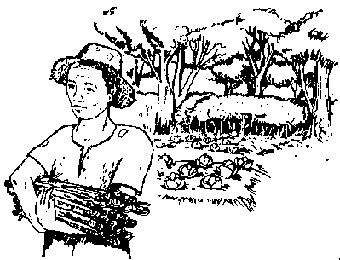
Trees have many uses to people. For this reason, the tree deserves to be given the recognition as "nature's greatest provider."
Trees and their management
From birth to death, man uses wood and other products from trees. The truth is, humanity would not have survived this long without trees. Taken collectively, trees supply life-giving oxygen and help purify the air. They provide shade and add beauty to the landscape. They serve as protective barrier for crops and animals against destructive wind. At the same time, the leaves, fruits and seeds of many species contribute to humankind's supply of work energy Furthermore, the roots of trees hold the soil together and help minimize erosion and the occurrence of floods during the rainy season. It is for these reasons that trees and woody perennials, in general, are important components of an agroforestry system.
One of the important characteristics of trees is their long life cycle (they are perennials). To a large extent, this characteristic is responsible for many of their beneficial influences to the environment and associated crops. For example, a canopy of trees provide long-term protection to soil against the erosive impact of raindrops. However, their long life also implies that farmers need to be careful in selecting trees to plant because once established, they are hard to replace.
Tree culture normally involves nursery management, tree establishment in the field, care and maintenance and harvesting.
There are cultural practices that are peculiar to trees. Seeds are not as widely available and there are usually no established centers where one can buy tree seeds. In many cases, farmers may have to rely on collecting seeds from standing trees. Tree seedlings take a longer time to raise than annual crops. Some trees may take as long as one year in the nursery before they are ready for field planting.
In the establishment of trees in the field, spacing is usually very important because it will largely control the rate of growth, size and form of the trees. One peculiar care and maintenance activity is pruning which is undertaken to remove unwanted branches or, in some cases, to suppress growth as in alley cropping.
A few years after planting, trees normally need minimal care while, at the same time, their beneficial effects continue to increase.
Harvesting of trees for wood is another unique activity.
|
| ||||||||||||||||||||||||||||||||||||||||||||||||||||||||||||||||||||||||||||||||||||||||||||||||||||||||||||
Sustainable agroforest land technology (Salt-3)
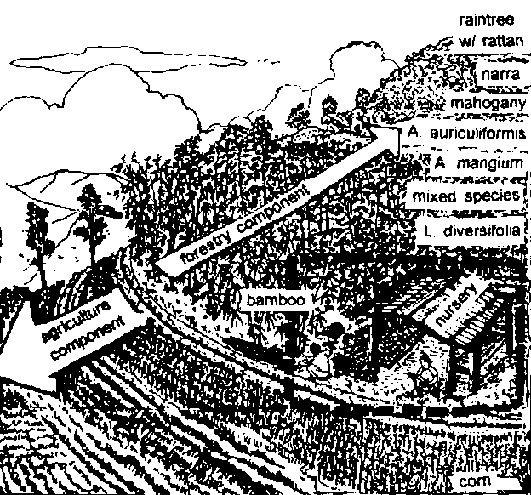
SALT-3 is a two-hectare model of a small-scale reforestation integrated with food production. The farm is devoted to about 40 percent agriculture and 60 percent forestry. This "food-wood" intercropping, as designed by the Mindanao Baptist Rural Life Center in Bansalan, Davao del Sur, shows that it can effectively conserve the soil, thereby providing abundant food, wood and income to hilly-land farmer.
Sustainable agroforest land
technology
This information material will guide you on how to establish SALT-3.
Agroforestry -- the system of land management whereby both forest and agricultural crops are produced on the same piece of land - has been regarded with high hopes by many sectors as the most probable answer to deforestation and degrading food production. SALT-3 is a variant of agroforestry and here is how to establish it on your hillyland.
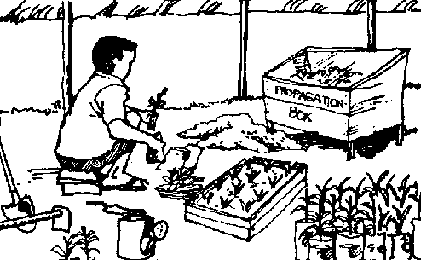
Step 1: Set up the agroforestry nursery. Ensure sufficient supply of planting materials for your agroforest farm by setting up your own nursery. Establish an accessible nursery (10 meters by 25 meters) with the' following fixtures: potting shed, transplant shed and seedbeds. Basic materials like sprinklers, shovel and spade should also be made available.
Set up the agroforestry nursery
Step 2: Care for and manage your seedlings. For better growth and field survival, the production of healthy and vigorous planting stock is necessary.
Sowing the seeds. Most forest seeds are hard to germinate so
they need scarification either by
mechanical or hot-water treatment. The most
common problem encountered in seed germination is damping off and insect
defoliators. One way of avoiding this is to treat the seeds with chemicals. In
some instances, seeds can be planted directly in plastic bags.
Sow the seeds in a sterilized soil to avoid damping off. Sterilization may be done by pouring boiling water in the soil media where you will sow the seeds. Keep the seedbeds moist at all times. Mulch and shade the plants. Transfer the seedlings later on into plastic bags.
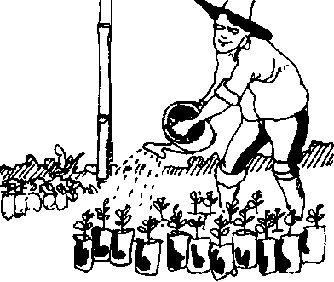
Sowing the seeds
Transplanting. Prune the roots of species that can be outplanted bare root (mahogany, teak, etc.). Do not allow weeds to compete with your transplants. Fertilizer may be applied in conjunction with watering long before transplanting. Dissolve complete fertilizer (14-14-14 or 15-15-15) at the rate of 10 g/l water. If commercial fertilizer is not available, liquid fertilizer from leguminous trees may be used.
Before transplanting them to the field, harden the seedlings first by gradually exposing them to more adverse conditions. Do this three to six months before transplanting. Seedlings ready to be planted should have sturdy, well-developed crowns and many fine, fibrous lateral roots.
Step 3: Find the contour lines and establish your hod crops on the lower half of the farm. Find the contour lines of the farm's lower half portion using an A-frame. Plant the identified contours with any of the following hedgerow species: Flemingia macrophylla, Desmodium renzonii, Gliricidia septum, Leucaena diversifolia and L. leucocephala. In acidic soils, Cassia spectabilis and/or C. siamea may be planted.
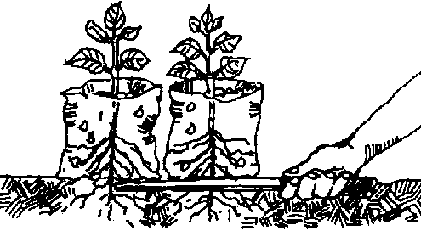
Find the contour lines
Plant preferred short-term crops (examples: ginger, corn, upland rice, sweet potato, mung bean, melon, etc.) in every first and second strip. Plant long-term crops (citrus, cacao, coffee, banana, black pepper, etc.) on every third strip. These can be intercropped with fruit trees (rambutan, durian, lanzones, guava, mangosteen etc.) following appropriate planting distances. Multistorey cropping may also be practiced (e.g., pineapple + cacao + durian) in one strip.
The earlier you establish your food and cash crops, the better off you will be in meeting your immediate needs. Follow the SALT-1 steps in establishing your food crops.
Step 4: Prepare the site for your wood crops. Locate the woodlot at the upper half of the project so that the agricultural component on the lower portion will benefit from the conserved moisture and nutrients from the wood crops.

Prepare the site for your wood crops
On areas with steep slope and with erodible soil, extra care must be exercised so as not to induce soil erosion when clearing the area. You can use either partial or complete removal of vegetation whichever is more favorable to you. Avoid burning.

Compartmentalize and space your wood
crops
Step 5: Compartmentalize and space your wood crops. For a threefold objective of soil rehabilitation, firewood production and timber growing, you can minimize the use of land space by following the high density strategy of establishing small-scale woodlots.
As jointly designed by representative foresters, agriculturists, farmers and countryside developers consulted by MBRLC in developing SALT-3 (2 ha), the following were recommended:
An intercropping layout of Samanea saman and rattan

An intercropping layout of Samanea
saman and rattan
An intercropping layout of mahogany or narra and Sesbania sesban

An intercropping layout of mahogany
or narra and Sesbania sesban
TABLE 1: SPACING OF TREES IN SALT - 3.
|
COMPONENTS ON TOP-DOWN SEQUENCE | |
SPACING | ||
| |
ha |
Initial |
Final |
Duration |
|
Samanea saman |
1/4 |
1 × 1 |
8 × 8 |
Long term |
|
Calamus merillii (as intercrop of S. saman) |
1/4 |
8 × 8 |
8 × 8 |
Long term |
|
Pterocarpus indicus |
1/8 |
2 × 2 |
4 × 4 |
Long term |
|
Sweitenia macrophylla |
1/8 |
2x 2 |
4 × 4 |
Long term |
|
Sesbania sesban(as intercrop of P. indicus and S.macrophylla) |
1/4 |
1 × 1 |
1 × 1 |
Short |
|
Acacia auriculiformis |
1/16 |
2x2 |
2x2 |
Medium term |
|
Acacia mangium |
1/16 |
2 × 2 |
2 × 2 |
Medium term |
|
Sesbania formosa |
1/8 |
1 × 1 |
1 × 1 |
Short term |
|
Leucaena diversifolia |
114 |
1 × 1 |
1 × 1 |
Short term |
|
Bambusa spp. (boundary) |
on bordor |
4-5 m |
4-6 m |
Long term |
Step 6: Outplant the trees. This may be done at the start or up to the middle of the rainy season so that seedlings can get established prior to the dry season.
You can also follow the contour when outplanting although it is not so imperative. Be sure not to break the earth-ball when setting the seedling into the planting hole. The upper part of the earth-ball should be level or slightly deeper than the edge of the hole. Soil is filled into the spaces and tamped firmly all around.
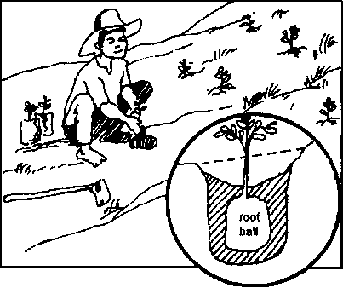
Outplant the trees
For fast recovery of the seedlings, follow basal application of 50-100 grams of complete fertilizer mixed with an equal amount of urea. Mulch the seedlings to insure higher linability.
Step 7: Intercrop your tree crops. Short and medium-term food and cash crops (ginger, sweet potato, yam, bean, cassava) can be intercropped in the forestry component during the first two years. Long-term ones like black pepper and rattan can be incorporated at the start of the second year. Geese or sheep may be raised underneath the tree crops during the following years.
For effective soil management, see to it that non-legume short-term crops are replaced by leguminous ones and vice versa in every cropping.

Do tree stand improvement
Step 8: Do tree stand Improvement. Apart from regular ring-weeding and liberation cutting, improve the stand of your trees. Remove the malformed trees. Replant the missing hills if you feel the replanted trees can still catch up.
However, replanting is laborious and expensive and should be done only to maintain required spacing or density. This is also performed when mortality is more than 30 percent.

Do tree stand improvement - continue
Step 9: Harvest your agroforest products regularly. Timely harvesting of crops saves waste. All households and useful products must be gathered, processed and marketed. In the forestry components, forage from tree prunings, fuel wood and roundwood from thinnings commence during the second year. Thin out regularly your forestry area until the timber crop spacing requirement is complied with. In some instances, minor forest crops can be planted under the trees.
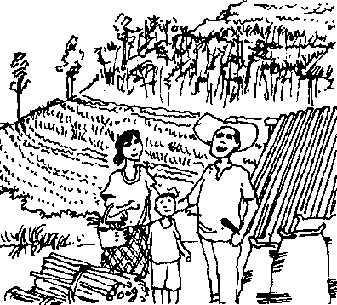
Harvest your agroforest products
regularly
Step 10: Maintain your SALT-3 farm. For one, trim the hedgerows regularly. Trim the hedgerows once they start to shade the agricultural crops. Spread trimmings evenly throughout the field to check weeds and also conserve soil moisture. Practice crop rotation in your food crop production.
TABLE 2: HARVESTING PLAN OF TREES IN SALT -3.
|
YEAR |
SPECIES |
HARVESTING METHOD |
USE |
|
1 |
None |
Selective |
Fuelwood/charcoal, fodder etc. |
|
2 |
Sesbania sesban |
All-out |
-do- |
|
3-5 |
S. sesban |
All-out |
-do- |
| |
Leucaena diversifolia |
All-out |
-do- |
| |
Samanea saman |
Selective |
-do- |
| |
Sweitania macrophylla |
Selective |
Fuelwood and light construction, etc. |
| |
Pterocarpus indicus |
Selective |
-do- |
| |
Acacia mangium |
Selective |
-do- |
| |
Acacia auriculiformis |
Selective |
-do- |
|
6-14 |
Bamboo |
Selective |
Light construction, furniture, etc. |
| |
Rattan |
Selective |
-do- |
| |
A. mangium |
All-out |
Fuelwood and light construction, etc. |
| |
Acacia auriculiformis |
All-out |
-do- |
| |
P. indicus |
Selective |
Timber and furniture |
|
15-25 |
Rattan |
All-out |
-do |
| |
P. indicus |
All-out |
-do |
| |
S. macrophylla |
All-out |
-do- |
| |
S. saman |
All-out |
-do- |
All-out harvesting refers to the harvesting of trees planted during the first year of establishment. While doing selective cutting, it is highly recommended that replanting be done.
Establishing a two-ha SALT-3 farm needs about P6,000. Cost and return analysis on the 5th year of operation shows that the technology can generate a cash net profit of P1,547.43 per month. Its return on investment (ROI) is 7.97 percent. But on top of this economic benefit, an upland farmer who follows the system has a farm that is well-protected and ameliorated soil due to integration and diversification scheme, thus resulting to a sustainable farming system.
Note: This system which was started in 1987 is still being monitored. The crops mentioned earlier are only suggestions and farmers can use any other crops suitable in their respective areas.
Sources:
Laquihon, GA., WA. Laquihon and H.R. Watson (1992).
Sustainable Agroforest Land Technobgy. A Paper presented during the 4th CEMARRDEC Symposium and Highlights.
Tacio, H.D. (1989). Sustainable Agroforest Land Technology. The PCARRD Monitor.
|
| ||||||||||||||||||||||||||||||||||||||||||||||||||||||||||||||||||||||||||||||||||||||||||||||||||||||||||||
Outplanting seedlings
Many seedlings from the wilds die when planted out in the field. High seedling mortality is often caused by careless handling and planting. While proper species choice is of primary importance, a farmer should be able to greatly increase his success in raising trees by following these guidelines.
PREPARE THE SEEDLINGS
Use only good seedlings. This means seedlings that have been properly hardened off, with a woody stem 30-50 cm tall. Discard all damaged, deformed or diseased ones. Taller seedlings may be used in cogonal areas so they will soon overtop the grass. For dry and harsh environments, older seedlings with a more developed root system and thicker stem (more sugar reserves in the stem) will survive better.
Potted seedlings will survive better in harsher sites than bare-root seedlings because they have a more complete roots system which will not be disturbed.
Make sure potted seedlings have a well-developed rootball. Do not water them on the day they are outplanted because this will soften the soil and cause it to compact when planted. Seedlings brought from a distant nursery should be brought to the planting site and allowed to recover from the transportation shock for 24 weeks before outplanting. Fruit tree seedlings purchased from a commercial or government nursery usually need to be hardened off at the planting site before outplanting as this is not done at the nursery.
Gently lift bare-root seedlings from the seedbed with a spade or shovel. Trim the tap root to about, 20 cm for easier planting. Also, trim the crown to reduce water loss through transpiration and bring it into balance with the root system. Cut back any soft green shoots, leaving at least 30 cm of woody stem.

Cut back any soft green shoots
Mud-pack bare-root seedlings when they are to be
transported. Dig a hole and mix in pure clay soil and water to make a slurry.
Rinse off the seedling roots and dip them in, coating them well. Wrap them in
folded banana stem sections or sacks and keep them in the shade. Roots and stems
are easily killed when exposed to heat or direct sunlight. If the trip is long,
remoisten the containers.
Some trees, such as Gmelina arborea, can be planted by stumps. Prepare as for bare root seedlings but cut back the stem to only 1 cm. Ideally, stumps should be 1 cm acmes. This is one way of handling overgrown seedlings.
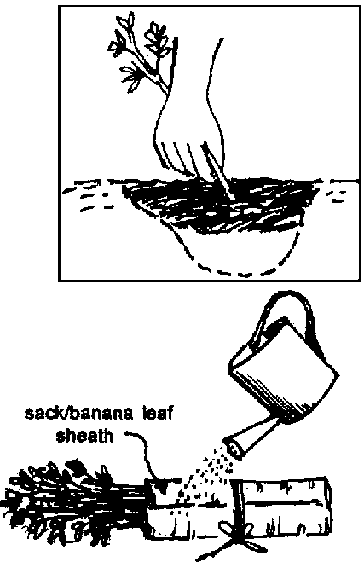
Sackbanana leaf shealth
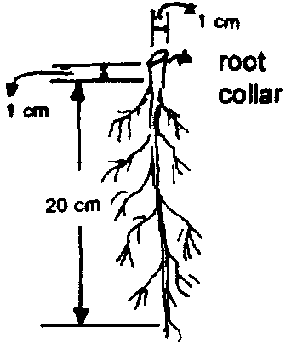
stumps should be 1 cm acmes
They are also easier to transport to the field.
OUTPLANTING
Timing of outplanting is crucial. Plant at the beginning of the rainy season but only after the soil has become fully moistened. In areas with a severe dry season, make sure trees are in the ground early enough to develop a deep root system before the dry season hits. Cuttings, such as kakawate, may be planted late in the dry season so the cut end or wound dries out before the soil becomes wet.
When outplanting potted fruit trees, slice off the bottom 1 cm off the plastic bag. This will eliminate any bend that has begun to form in the taproot. Slice the rest of the bag down the side and remove before planting.
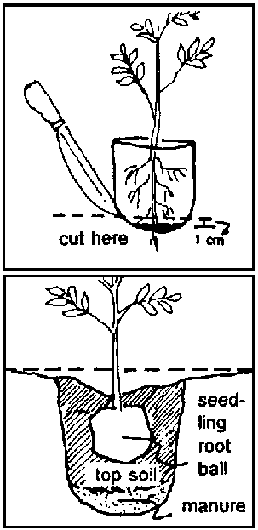
Outplanting
In poor soils, plant in a hole much larger than the root ball. If manure is to be added and has not yet been allowed to decompose, put it in the bottom of the hole and cover it with 10 cm of soil. If chemical fertilizers are to be used mix them in with the soil to be used in filling up the hole. Scrape topsoil from the area around the hole and use it to fill it up after planting the seedling. Gently step on the soil around the seedling to tamp it down firmly.
ln drier sites, recess the seedling slightly into the ground to form a small catchment to trap moisture.
Bare-root seedling outplanting is easiest with two people, one to hold the seedling upright in the hole and one to fill the hole in and tamp the soil down. Be careful not to bend the taproot.
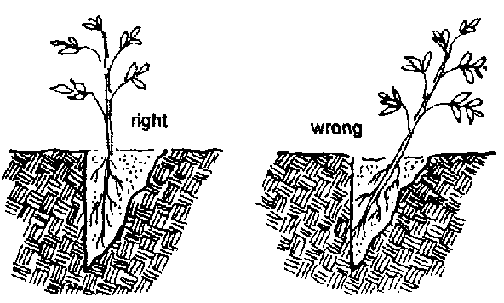
Bare-root seedling outplanting is
easiest with two people
Mulch newly planted seedlings to conserve moisture and keep soil surface temperatures cool. Apply a 10cm thick layer of mulch in a ring 10-cm away from the stem. This can be renewed every two weeks.
In areas where livestock are allowed to wander loose, fence newly planted seedlings off from grazing areas.
Erect a temporary shade for especially valuable seedlings or seedlings that have not hardened off enough. This can be as simple as two coconut leaves leaned against each other or it can be made of cogon grass.
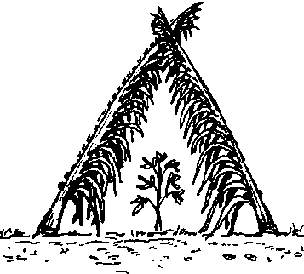
Two coconut leaves
leaned
|
| ||||||||||||||||||||||||||||||||||||||||||||||||||||||||||||||||||||||||||||||||||||||||||||||||||||||||||||
Tree pruning and care
Tree pruning is the art of cutting or removing unwanted plant growth to make the plant grow or behave the way we want it to.
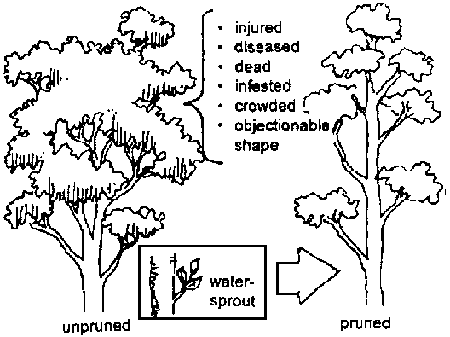
Tree pruning and care
OBJECTIVES OF TREE PRUNING
1. Removal of diseased or broken branches;
2. Removal of tree parts which will inhibit the proper growth of tree such as when one limb nubs on another limb;
3. Removal of branches to allow adequate light, to promote better fruit production and to allow wind to pass through the tree canopy;
4. Trim trees to prevent interference with electric or telephone lines (or cable TV);
5. Encourage/increase flowering and fruit production; decrease the number of fruit so larger fruits are produced;
6. Rejuvenate old plants (or trees with good coppicing ability); and,
7. Create special effects and shapes; enhance the natural lines of a tree or shape a plant to accommodate space.
Tree pruning, if done correctly, will enhance the beauty and production of a tree without causing damage and infection to the tree. Frequently, people prune a tree by cutting branches with a bolo without thought to what will happen to the cut portion of the tree. If the branch stump is not properly pruned, there is a good chance of infection to set in. Once the infection starts in the tree, it can travel to the trunk and eventually kill the tree. The damage will generally not be seen from the outside of the tree.

Growth of infection in improperly
tree
THE IDEAL TIME FOR PRUNING
1. After the harvest season for fruit bearing trees
2. Before
the rainy season for light pruning or trimming
3. Two to three months before
the rainy season for rejuvenation
4. When infection, infestation,
objectionable branches and damages are noted.
PROPER TOOLS FOR TREE PRUNING
There are a number of tools which are used to prune trees. These range in size from a small hand-held pruning shears to large pole cutters and chain saws. The size of the branch, the height above the ground and the reason for pruning will determine which tool to use.

Proper tools for tree pruning
BRANCH REMOVAL

1. Small branches
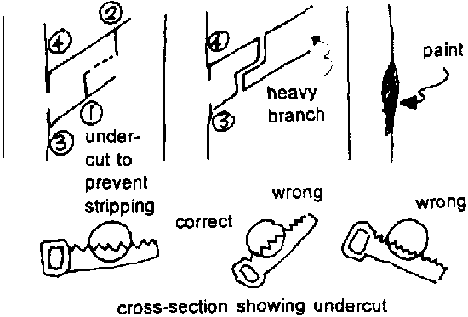
2. Large branches
DIFFERENT TYPES OF TREE-PRUNING TECHNIQUES

1. Hedges

2. Branches near houses or other
structures
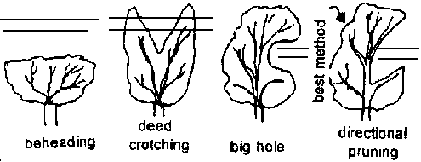
3. Telephone, electric and other
lines

4. Opening so water flows out of the
trunk
5. Cleaning all the branch stumps
6. In reforestation projects (unnecessary branches and the double stem)
Examples:

Gmelina arborea

Mahogany
7. Pruning for rejuvenation
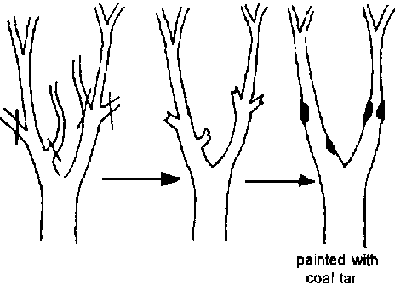
When pruning the main trunk for rejuvenation, make a slanting cut through the trunk so water will nun off the cut. If possible, paint the cut with coal tar.
Example: Coffee

Coffee
|
| ||||||||||||||||||||||||||||||||||||||||||||||||||||||||||||||||||||||||||||||||||||||||||||||||||||||||||||
Bagging of young fruits
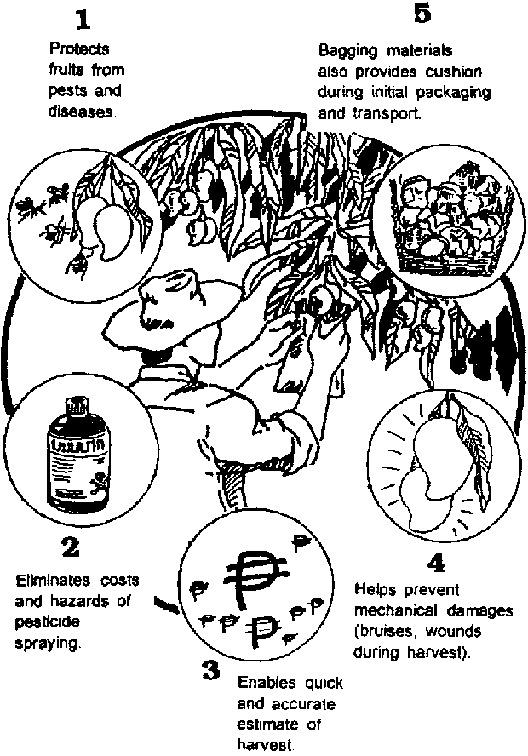
Importance
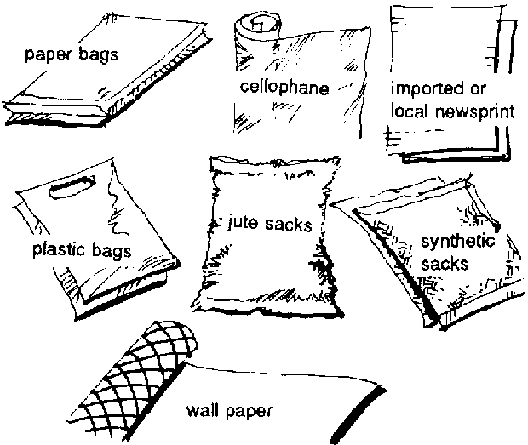
Commonly used bagging materials
TIME OF BAGGING
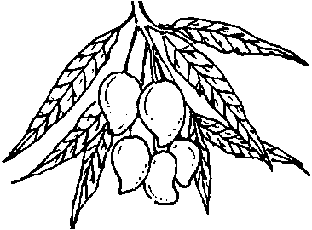
1. Mango - 55 days after flower
induction or 10-15 days after fruit set
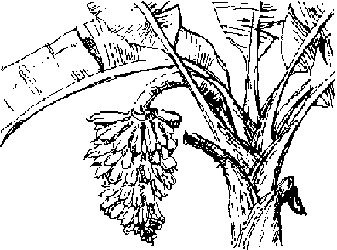
2. Banana - as soon as the male
blossom is removed (6-8 hand pair)
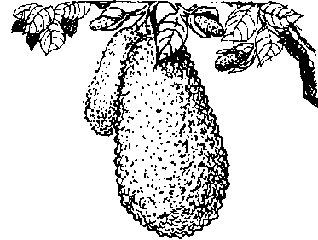
3. Jackfruit—at fist size

4. Cacao - when fruits or pods are
at least 4-6 cm in length

5. Guava - right after fruit
set
|
| ||||||||||||||||||||||||||||||||||||||||||||||||||||||||||||||||||||||||||||||||||||||||||||||||||||||||||||
Establishing bamboo farms
SPECIES AND SITE SELECTION
Bamboo plantation should be developed with extreme caution subject to local climatic conditions and irrigation facilities to ensure adequate water supply. Selection of drought-resistant species like Kauayan tinik (8. blumeana) and Bayog (B. blumeana var. Iuzmensis) may help improve bamboo production in dry areas. Whereas in high rainfall areas, Giant bamboo (D. asper), Bolo (G. Ieois) or Buho (S. lumampao) grow better than in the low-rainfall areas.
An area with moist, well-drained sand, loam or clay loam soil which is not highly acidic nor alkaline and is high in organic matter and nutrients is ideal for growing bamboos. Area not suited for agricultural crop production, along stream and riverbanks, hillsides and cogonal land can also be planted to bamboos.
SITE PREPARATION
1. Recommended spacing for kauayan tinik, kauayan kiling and kauayan tinik plantations is 7m × 7m and 5m × 5m for riverbank stabilization.
2. Clear weeds and other unwanted vegetation from the area.
3. Prepare planting holes with a dimension of about 60 cm × 60 cm × 60 cm.

Site preparation
TRANSPORT OF PLANTING STOCK
1. Harden the plants in the nursery before transporting to the
planting site.
2. Load and unload the potted propagules carefully to avoid
damage, especially to the roots.
3. If possible, plant the propagules
immediately after transporting them to the site.
PLANTING
Planting bamboo in a plantation can be done either by direct planting of cuttings or by nursery-raised cuttings.
Planting of nursery-raised cuttings
1. Loosen the soil in the prepared hole.
2. Cut and carefully remove the plastic bag without breaking the soil and damaging the roots of the propagules.
3. Place the propagules vertically in the planting hole with the soil intact.
4. Cover the planting stocks with well-pulverized top soil.
5. Gently compress the soil around the newly planted plants.
6. Water and mulch the plants when necessary.

Planting of nursery-raised cuttings
Direct planting of culm cuttings
Direct planting of bamboo in the plantation may be used when the plantation area receives enough rainfall throughout the year.
Selection and preparation of planting stock for direct planting follows the same method as that of nursery-raised cuttings. except that cuttings are directly planted in the field without the benefit of poking.
The procedures for direct planting are:
1. Haul the cuttings to the planting site/hole.
2. Loosen the soil in previously prepared planting holes.
3. Place the cuttings in a horizontal, vertical or slanting position.

The procedures for direct planting
For horizontal planting, lay the cuttings horizontally with buds sideways to the planting holes. Fill up the holes with 10 cm top soil to cover cuttings.

Water and mulch the cuttings.
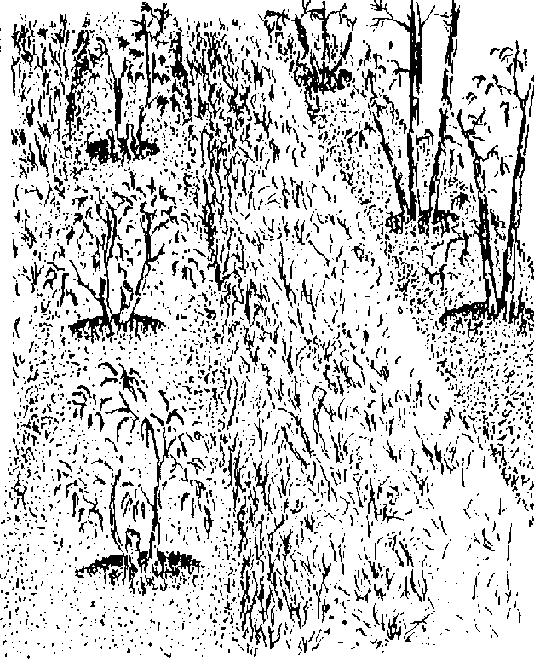
PLANTATION, MAINTENANCE AND PROTECTION
1. Conduct regular ring-weeding and strip-brushing.
2. Apply
fertilizer when necessary.
3. Construct firelines, if needed.
4. Replace
dead cuttings immediately.
Reference: UNDP/FAO/ERDB-DENR. Manual on Bamboo Farming. Unpublished.
Plantation, maintenance and
protection
|
| ||||||||||||||||||||||||||||||||||||||||||||||||||||||||||||||||||||||||||||||||||||||||||||||||||||||||||||
Philippine bamboo species: Their characteristics, uses and propagation
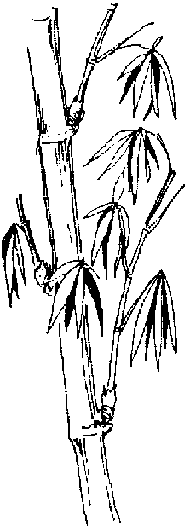
Bamboo is the tallest perennial grass that belongs to the Graminae family. Due to the long cylindrical woody stem strength and ease of workability, bamboo is a versatile material for a variety of economic uses: handicraft and furniture; farm implements; fishpen, fishcages and other fishing gears; banana props; musical instruments; pulp and paper; and, house construction. Aside from these, young shoots of some species are edible.
Demand for bamboo in the Philippines is steadily increasing However, the demand is not being currently met. Bamboo production is, therefore, a potential source of income for agroforestry farmers.
Bamboo
Bamboo also has ecological benefits as it minimizes soil erosion and stabilizes river banks. Bamboo thrives in a wide range of site conditions making it a suitable reforestation species for environmental protection.
According to a recent report, there are 12 genera, consisting of 49 species of bamboos that are growing in the Philippines -- 30 erect species and 19 climbing species. Nine erect bamboo species are presently utilized by industries for various purposes. These nine species are summarized in Table 3.
TABLE 3: CHARACTERISTICS OF SELECTED BAMBOO SPECIES
|
COMMON NAME SCIENTIFIC NAME |
CULM CHARACTERISTICS Ht. |
Diameter |
Length of Intermode |
DISTRIBUTION |
| |
(m) |
(cm) |
(cm) |
|
|
1. Kauyan tinik Bambusa blumeana |
10-25 |
10-20 |
40-60 |
Widely distributed. |
|
2. Kauayan kiling Bambusa vulgaria |
10-15 |
6-10 |
30-50 |
Low and medium altitudes. found in backyard along the periphery of cultivated lands, creeks and foothills. |
|
3. Giant bamboo Dendrocalamus as,oer |
20 |
10-20 |
12-40 |
Natural groves locally distributed in Bukidnon and South Cotabato. Cultivated lumps in Laguna, Samar and Leyte. |
|
4. Bayog Dendrocalamus |
10-15 |
8-12 |
15-30 |
Widely distributed in Ilocos Sur, Nueva Ecija, Rizal, Zambales, Pangasinan, Bulacan, Cebu, Bohol and Lanao. |
|
5. Kaychi Gigantochloa atter |
22 |
6-10 |
40-50 |
Natural stands and cultivated clumps in Davao, Surigao, Bukidnon, Samar and Leyte. |
|
6. Bolo Gigantochloa levis |
10-12 |
4-6 |
20-50 |
Growing in Laguna, Batangas, Mindoro, Palawan, Panay, Leyte, Basilan. |
|
7. Buho Schizostachyum Iumampao |
10-12 |
4-6 |
20-50 |
Growing in Laguna, Batangas, Mindoro, Palawan, Panay, Leyte, Basilan. |
|
8. Anos Schizostachyum lima |
6-8 |
2-4 |
12-60 |
Occurring in Agusan, Mindoro, Rizal, Central and Northern Luzon. |
|
9. Laak Sphaerobambos Philippinensis |
4-6 |
5 |
60-70 |
Cultivated in Davao del Norte on commercial scale. |
BAMBOO PROPAGATION METHODS
Use Bamboo Seeds. Producing bamboo using seeds is not common due to irregular flowering and fruiting of bamboos; if seeds are produced, a large percentage are infertile and have short viability. However, it is better to utilize them if seeds are available.

Bamboo seeds
Sow bamboo seeds directly in pots (polyethylene bags) or germinate them first in seedboxes or nursery beds. Seeds germinated in seedboxes may be pricked out and transferred in plastic bags after two months or more. Use either ordinary garden soil or sandy loam mixed with compost as a potting medium.
Enhance and maintain the health and vigor of the new bamboo plants. Water plants regularly. Remove competing weeds. Apply either organic (farmerprepared compost or commercially-prepared compost like biotab) or inorganic fertilizers like Urea (46-0-0) or complete (14-14-14).
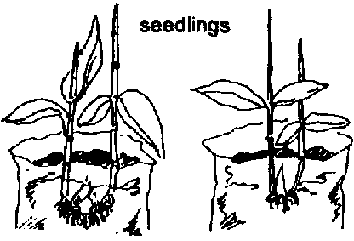
Seedlings
Use of Vegetative Parts. Vegetative parts of the plant like offset, culm cuttings and branch cuttings are preferred propagating materials.
Offset
The offset method can be applied to bamboos such as anos and buho which have loose clumps that are not producing prominent branches with well-developed basal parts. These bamboos are difficult to propagate either by culm or branch cuttings.
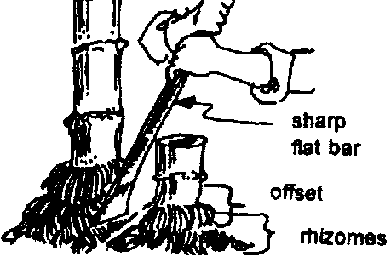
The offset method can be applied to
bamboos
Collect the offset from one to two-year-old culms during the rainy season. Planting offset directly in the field can be done. However, it is better to first raise them in the nursery to ensure higher survival and better growth and development once they are transplanted.
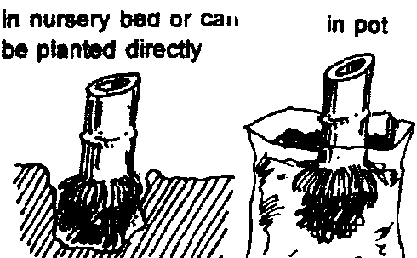
Collect the offset from one to
two-year-old culms during the rainy season
Culm cuttings
Longer culm cuttings (2 to 4 nodes) of many species of bamboos are traditionally planted directly in the field. This method is used if planting materials are near the planting area or if the purpose is only to raise a few clumps.
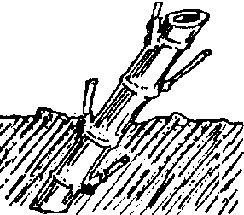
Culm cuttings
One-node culm cuffings
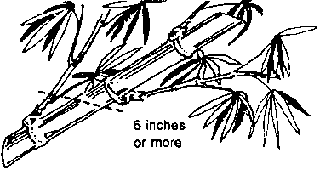
To propagate one-node culm cuttings, it is preferable to collect the culms during rainy season. Prepare the cuttings by pruning the upper portion of the branches. Saw the culm into one-node cuttings ensuring that each cutting has a branch with a prominent swollen basal portion.
These one-node culm cuttings can be raised in containers or in nursery beds. Plant the cuttings in a slanting position with the branch stub at the upper side of the node. Plant the cuttings with a portion of the culm internode the branch node exposed. Ordinary garden soil or sandy loam soil is the preferred growing medium.
One-node culm cuffings
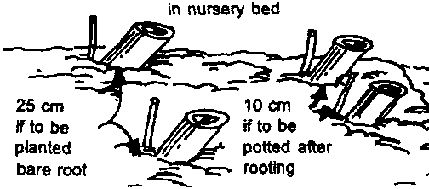
In nursey bed
In bags
For faster and easier rooting of culm cuttings, propagate initially in a sand bed with a misting system.
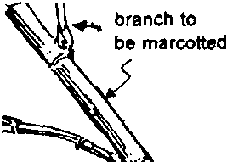
Branch-marcot culm cutting
This method can be applied using secondary culms which are characteristically smaller than mature primary culms. This method works best in culms with fully extended branches and unopened leaves.

Branch-marcot culm cutting
This propagation the following materials: marcot bags, sphagnum moss and coir dust or any similar waterabsorbing material.

This propagation the following
materials: marcot bags
Fill marcot bag with moist sphagnum moss securely tied around the culm. Cover only the lower side of the branch base with sphagnum moss. After 15 days, when roots show through the moss, cut the culm and prepare onenode rooted culm cuttings. Rooted cuttings are planted in pots (plastic bags) with ordinary garden soil or sandy loam mixed with compost.
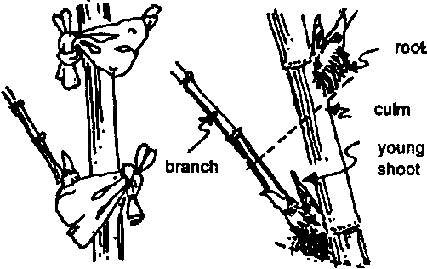
Rooted cuttings are planted in pots
Branch Cuffings
Bamboo, such as bayog, kauayan tinik and kauayan kiling which produce prominent branches, can be propagated using branch cuttings preferably during rainy season.
Gather branch cuttings with two to three nodes from one to two-year-old culms. Select branches with a well-developed base and aerial root primordia. During collection, be sure not to damage the basal part of the branch and buds.
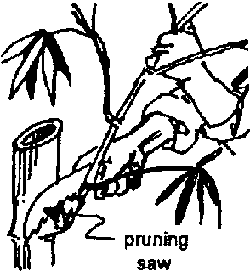
Branch Cuffings
Branch cuttings can be raised in pots or in nursery beds after collection. Branch cuttings, similar to culm cuttings, can be better rooted in a propagation sand bed before transplanting them to pots or plastic bags.
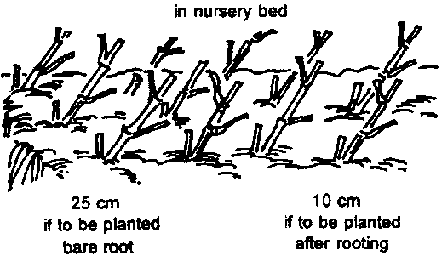
In nursey bed

To plots or plastic
bags
|
| ||||||||||||||||||||||||||||||||||||||||||||||||||||||||||||||||||||||||||||||||||||||||||||||||||||||||||||
Growing rattan
Rattan is a non-timber resource of the Philippine forest. It is the mainstay of a thriving furniture industry which generated an export value of $186.5 million in 1989. Rattan shared about 70 percent of this export amounting to US $138 million.
Rattan is a potential crop for agroforestry projects. As a projects crop, it has some advantages over other perennials of economic value. It can be planted in communal tree farms where other forest trees of commercial value, with 25-35 years rotation, have been planted. The required permanent crops, such as forest trees and fruit trees, for an upland agroforestry development can serve as the support crop for rattan. The integration of rattan plant in a community forest or any tree farm can add to land productivity. Also, while waiting for the harvest of rattan, protection and conservation of watershed areas can be enhanced.
Like other ornamental palms, rattan belongs to the Palmae family. Aside from the manufacture of fumiture, for which it is noted internationally and locally, rattan is used for making fish traps, sleeping mats, baskets, twines, toothbrushes and even the skirts of women of some tribal groups.
CHOICE OF SPECIES
There are about 90 rattans found in the country. They belong to four genera, namely: Calamus, Daemonorops, Korthalsia and Plectocomia. In commerce, there are 12 known taxa noted for its economic value. They are grouped as clustering or clump-forming and solitary types. The clustering type regenerates by itself. After the mature canes are gathered, there are a number of suckers left which when properly protected and properly raised can also be harvested later. The solitary type is also commercially valuable. However, after harvesting, there is a need to renew the planting.
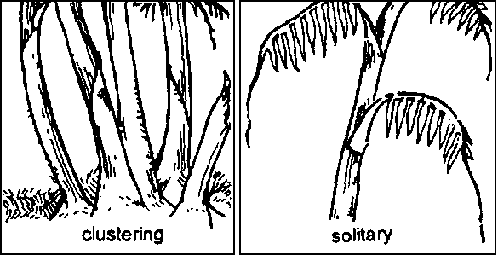
Clustering, solitary
The choice of species will depend on the end-product a farmer wishes to produce. Rattan can be raised for the production of canes or poles and for its edible fruits. For pole production, it will take 11-15 years before the first pole can be harvested. On the other hand, a seven-year old rattan can bear its first fruits (in case of lituko, Calamus manillensis).

The planting technology for the
clump-forming type
The planting technology for the clump-forming type, such as palasan and limuran, is already available.
TABLE 4: SELECTED RATTANS OF ECONOMIC VALUE.
|
COMMON NAME |
SCIENTIFIC NAME |
DISTRIBUTION |
USES |
|
Palasan |
Calamus merrillii |
Luzon, Palawan, Mindanao, Masbate |
furniture food (young shoots) |
|
Limuran |
C. ornatus var. Philippinensis |
Luzon, Mindoro, Negros, Mindanao |
furniture food (young shoots) |
|
Sika |
C. caesius |
Palawan |
Basketry |
|
Panganpanganan |
C. filispadix |
Palawan, Luzon |
Fumiture Basketry |
|
Siksik |
C. microspharion |
Palawan |
Basketry |
|
Panlis |
C. ramulosus |
Luzon |
Basketry |
|
Lukuan |
C. reyesianus |
Luzon |
Fumiture |
|
Malaccacane |
C. scipionum |
Palawan |
Fumiture |
|
Tumalim |
C mindorensis |
Luzon, Mindanao |
Furniture |
|
Lituko |
C. manillensis |
Luzon, Mindanao |
Food (fruits) |
|
Lambutan |
C. dimorphacanthus var halconensis |
Luzon, Mindoro, Panay Is., Mindanao |
Fumiture Basketry |
|
Arorog |
C. javensis |
Palawan |
Furniture |
|
Ditaan |
Daemonorops mollis |
Luzon, Visayas, Mindanao |
Fumiture |
|
Hiyod |
Daemono-rops pedicellaris |
Leyte, Mindanao |
Basketry |
SITE REQUIREMENTS
Based on the initial trial on growing rattan, the sites/areas suitable for its growth are the logged-over forests or the residual forests, communal tree farms, reforestation projects and other tree farms not scheduled for harvesting for the next 15 years. Agricultural lands planted with coconut and rubber trees are also potential sites.

Site requirements
SOME SITE FACTORS TO CONSIDER
1. Soil - Rattan grows best in deep, fertile alluvial soils with high moisture and organic content. The best sites are observed to be either sandy clay or clay loam. Rattan thrives best in soils with pH of five to almost neutral. However, in some areas where soil acidity is high, rattan exhibits fast growth once the forest canopy is opened to allow sunlight to reach outplanted seedlings.
2. Topography and elevation - It has a wide distribution and altitudinal range. In most Asian countries, it can thrive at low to high elevations of 200 to 2900 m above sea level. The topography should not be too steep.
3. Climatic requirements - Rattan grows almost everywhere in the Philippines. Rattan introduction on areas with type II climate (no dry season with very pronounced maximum rain period from November to June) has tremendous advantages over areas within types I and III climates.
ACTIVITIES IN RATTAN PLANTING STOCKS
The steps involved in the preparation of planting materials from seeds in the nursery are as follows:
1. Seed Collection and Procurement - Ripe fruits can be gathered from August to November.
2. Seed Extraction and Cleaning - Done immediately after fruit harvest. Depulping is done by hand maceration.
3. Pre-germination Treatments by Hilar Removal Hilar removal was found to hasten germination from the former 90 days to 2-3 days.
4. Fungicidal Treatments - Seeds can be soaked overnight in Delsene Mx or Captan at 2.5 q/li of water.

Locate the hilum
5. Germination -- Seeds are sown in wet gunny sacks or in sterilized soil. The development of germinants can be observed 2-3 days after sowing.
6. Transplanting - Germinants are carefully pricked and planted in plastic bags.
7. Fertilization - Complete fertilizer may be applied at a dosage of five to six grams per pot.
8. Watering and Occasional Weeding
9. Root Pruning and Hardening
10. Hauling of Seedlings to the Plantation Site

Germination process

Rattan planting stocks can be raised
Rattan planting stocks can be raised through collections of wildlings -- natural germinants found on forest floors. When properly earth-balled and transported, wildlings can be directly planted in the desired plantation site. Otherwise, wildlings should be raised in plastic bags in the nursery. The wildlings or seedlings are ready for outplanting when they reach a height of 30 cm. Through tissue culture, rattan explants can also be used.
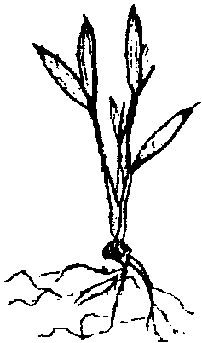
Below are the illustrations of
Palasan and Limuran for reference. (A)

Below are the illustrations of
Palasan and Limuran for reference. (B)
ACTIVITIES FOR OUTPLANTING/PLANTATION ESTABLISHMENT
1. Sib Preparation - Clearing, hole digging and staking
2. Outplanting - Removal of plastic bag without breaking the ball of earth. Rattans can be planted at a density of 400 plants/hectare.
3. Maintenance and Protection -- Weeding, replanting and fertilization
4. Opening of the canopy -- Done to allow adequate sunlight by removing branches.
5. Mulching -- For areas with prolonged dry spells.
GROWTH AND YIELD
Based on research studies and observations, Palasan and Limuran exhibit a grass stage for approximately three years. When the climbing organs (flagellum or cirrus) develop, the canes grow at the average rate of 0.70 m per year. Considering this annual cane growth, at least two four-meter poles of merchantable canes can be harvested from every plant on the 15th year. A four-meter pole of 1 inch diameter can be sold for P15.
HARVESTING
Mature canes can be harvested manually with the use of a bolo. Once the cane is cut, it is pulled manually to attain as much merchantable length as possible. The thorny leafsheath is removed by bolo or by rubbing the stem against a tree. Cleaned canes are cut into four-meter length and then bundled.
|
| ||||||||||||||||||||||||||||||||||||||||||||||||||||||||||||||||||||||||||||||||||||||||||||||||||||||||||||
Growing anahaw
DESCRIPTION
Anahaw or anahau (Livistona rotundifolia) is an erect palm reaching a height of 15 to 20 m and 25 cm in diameter. The trunk is smooth, straight, and marked with close, rather shallow obscure rings which are the leaf scars. The leaves are crowded at the top of the trunk and ascending. The green, smooth, flattened petiole may have hard, black spines. The circular, fan shaped, pleated leaf blades are 1 m in diameter and divided into segments 2.5 to 4 cm wide. The green flowers are 2 mm long. The fruit is 1.5 cm in diameter, fleshy and yellow with a hard, round, brown seed inside.

Anahaw plant
DISTRIBUTION
The species is endemic to the Philippines and most commonly found in Luzon (Benguet, La Union, Cagayan, commonly found in Luzon (Benguet, La Union, Cagayan, Pangasinan, Zambales, Pampanga, Laguna, Ouezon, Camarines, Albay), Negros, Cagayan de Oro and in the provinces of Mindanao.

The species is endemic to the
Philippines and most commonly found
USES
Anahaw is often planted as an ornamental plant for indoor and outdoor as it remains bright green even in very dry environment. The trunk is hard, strong and durable. It can be split into strips for flooring, siding and even handles of tools. It is commonly used as posts, piles in fishpen and poles. The buds and shoots are cooked as a vegetable. Mature leaves are used as roofing of houses in rural areas. The leaves last up to 15 years when properly used. The young leaves are made into raincoats, hats, fans and containers for rice, charcoal, etc.
SITE REQUIREMENTS
Typically, anahaw occurs beneath the canopy of dipterocarp and mixed species forest. It is normally scattered in forests at low to medium altitudes. It also grows on brushlands and under coconut plantations.
SEED TECHNOLOGY
Seed Collection
The best time to collect Anahaw fruits is when they are orange in color and still in the branchlets. Fallen fruits are prone to decay and fungi attack. Anahaw fruits can be collected by climbing and chipping off the branchlet using an extension pruner or a pole with a scythe
Seed Extraction
Place the newly collected fruits in clean sacks and store under a shade or inside the room for 3 to 5 days to loosen the pulp. Fruits stored this way easily ripen. After 5 days, the fruits are macerated by putting them in a basin of water to soften the pulp.
Remove the decayed pulp to extract the seeds. Immediately after depulping, soak the clean seeds in water to minimize loss of moisture. Sow the seeds on the same day.
Sowing
The folk technology (Torrente, 1990) involves two steps: (1) sow freshly depulped seeds evenly on previously prepared seedbeds; (2) press the seeds lightly in the seedbeds and cover them with soil; and, (3) cover the seedbeds with coconut leaves, cut grass or other mulching materials. Germination starts approximately 1 month after sowing.
A newly developed technology (ERDS, Region V) involves five steps:
1. Use freshly depulped seeds and remove the covering of embryo with a flat pointed knife, cutter or scalpel. This is to facilitate entry of water and air to the seed.
2. Lay-out seeds on trays lined with white tissue paper or sterilized jute sacks.
3. Saturate substrata with fungicide solution prepared (1 tsp Benlate per 2 li water).
4. Cover the sprouted seeds with the substrata material, then place a polyethylene sheet on top of the trays to preserve seed moisture.
5. Germination starts 2 to 3 days from sowing and a button-like structure will emerge at least 3 mm from the opened hilum.
Seed Storage
Seeds may be stored for 4-6 weeks without losing their viability by keeping them in airtight containers, cans or sealed plastic bags.
NURSERY PRACTICES
Potting
Grown seedlings should be collected from the seedbed when they have developed 1 cm root and 1 cm shoot. Potting is done in 4" × 6" polyethylene bags containing a mixture of 1:1:1 top soil, saw dust and sand, respectively. When the potted seedlings are 3 months old, hardening is done to prepare them for outplanting.
Maintenance of Seedlings
Potted seedlings should be kept under the green house or shed. Watering should be done every afternoon or as often as necessary. Fertilizer may be applied to the potted seedlings based on the soil and plant requirement to ensure vigorous growth.
PLANTATION ESTABLISHMENT
Site Preparation
Underbrush about 1 m strip of vegetation of the selected site where the seedlings are to be planted. Stake and dig holes at a distance of 2m × 2m prior to outplanting.
Outplanting
Outplanting should be done at the onset of the rainy season. In outplanting, the plastic bags of the potted seedlings must be removed carefully. Mulching materials should be placed at the base of the plants, while pulverized topsoil should be placed around the root system to allow good anchorage of the seedlings.
Care and Maintenance
Ring weeding should be done as often as necessary to allow normal growth and development of plants. Replace dead seedlings as soon as possible.
HARVESTING
Poles and Stems
The poles/stems are harvested et the age of 14-16 years (about 10-12 m tall and 20-25 cm in diameter). It has a natural durability period of 8 years. Poles are usually transported by trucks, with an average of 110 stems measuring 10-12 m long and 20-25 cm in diameter per truck.
Leaves
Two to three leaves can be harvested per tree per month. Spaced at 2m × 2m, a hectare of land can accommodate 2,500 plants with a corresponding yield of R18,000/year with a conservative price of PO.30/leaf
PESTS AND DISEASES
Livistona shoot borer girdles or cuts off young shoots, resulting in stunted growth and eventual death.
|
| ||||||||||||||||||||||||||||||||||||||||||||||||||||||||||||||||||||||||||||||||||||||||||||||||||||||||||||
Growing buri
Buri (Corypha elate) is one of the Philippine palms with multiple uses. Buri can survive 70 to 100 years and, for this reason, it is known as the centennial plant by many rural people.
Buri palm has many domestic and industrial economic uses, making it well known in local and international markets. Buntal fiber is the chief raw product and has a variety of uses. Buri is second to coconut and comparable to nipa in terms of economic and industrial importance.

Buri

Fruiting tree
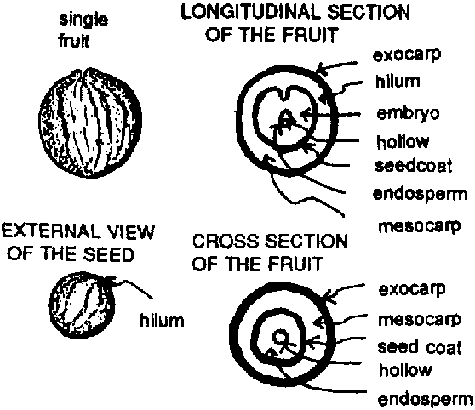
Longitudinal section of the fruit
SITE REQUIREMENTS
Buri is widely adaptable to all types of soils. It grows best at low altitudes although it can thrive on hills and plateaus up to 600 m above sea level.
PROPAGATION METHODS
Natural regeneration of burl occurs when ripe fruits naturally fall on the ground or are dispersed by animals such as fruit bats.
In field conditions, seed pre-treatment using hilar removal plus soaking the seeds overnight in a fungicidal solution can accelerate germination. Sowing seeds in sterilized soil can yield satisfactory seed germination results.
RECOMMENDED PROCEDURE FOR THE RAPID GERMINATION OF BURI
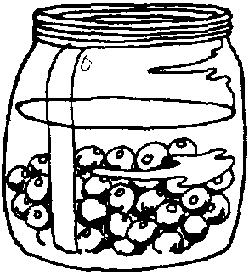
1. If the fruits were collected from the source, the pulp should be yellowish to brown in color indicating the relative maturity The fruit must be sun-dried for 2-3 days, then macerated to remove the pulp and other impurities. Seeds should be washed thoroughly with water.

Then macerated to remove the pulp and
other impurities
2. Remove the hilar cover by using a sharp cutter. Check to
ensure that the embryo is attached to the endosperm of the seed. If not
attached, soak the seeds in water for 1 to 2 weeks. If the embryo is already
attached to the endosperm of the seed. remove the hilum. Soak the seeds
overnight the fungicidal solution (Delsene Mx or Captan) before sowing.
3.
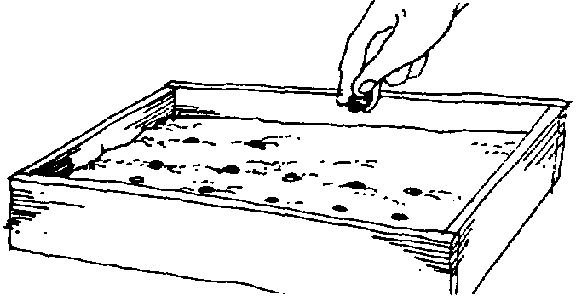
Sow the seeds in plastic trays with 3 sheets of filter paper. In the absence of
filter paper, a seed germination box may be used.
Sow the seeds in plastic trays with
3 sheets
4. Wrap the trays with plastic bags to avoid excessive drying of the substrate.
Wrap the trays with plastic bags
5. Germination starts after 2-3 days. Two-week old germinants can be planted in polyethylene bags filled with soil.

Germination starts after 2-3 days
6. When four leaves have appeared, the seedling may be planted in the field.
PLANTATION ESTABLISHMENT
1. The area should be cleared of brush.
2. Staking and preparation of planting holes are done one month before outplanting. The recommended spacing is 6m × 6m.
3. Ring weeding should be done every month. However, it is recommended to brush the whole area every three months.
4. Dead seedlings should be replaced immediately.
HARVESTING
Buri leaves can be harvested at 7 years. The scarcity of raw materials for handicraft-making is the result of the vanishing natural stands in the country.
Several parts of the burl palm have many uses:
|
Leaves |
- used as weaving material for bags, wallets, hats, trays, placemats, tissue holders, hampers and mats; used as covers for tobacco bales and also for thatches and walling. Young leaves are used in wrapping rice cakes. |
|
Petioles |
- made into buntal fibers, hats, ropes, baskets, wallets and bags; pounded and made into brooms. |
|
Midribs |
- used in making sale sets, hampers, waste baskets, trays, tables, cigarette cases, brooms and other items. |
|
Sap |
- fermented to produce wine (locally known as tuba), alcohol and vinegar; made into syrup, sugar, jam, muscovado sugar (panocha) and starch. |
|
Buds |
- eaten raw or cooked as vegetable dish. |
|
Young seeds |
- The endosperm are cooked and made into sweets. |
|
Mature seeds |
- used as buttons, playing marbles and rosary beads. |
|
Raffia fiber |
- utilized in the manufacture of cloth, good quality hats, mats and bags; The coarse fiber of young buds are made into ropes and sacks. |
|
Pitch or Ubod |
- used in salads, pickles and other recipes. |
|
Roots |
- Water from boiled roots is used as a herbal medicine beverage. |
|
Bahi |
- (the outer part of the trunk) as lumber for building/construction materials. |
|
Whole frond |
- used as shelter for fish. |
|
| ||||||||||||||||||||||||||||||||||||||||||||||||||||||||||||||||||||||||||||||||||||||||||||||||||||||||||||
Shelterbelts
Shelterbelts or windbreaks are strips of vegetation composed of trees, shrubs and vines to protect croplands from destructive winds. When established on hills, they can also act as buffer strips to minimize soil erosion. Along rivers, streams or creeks, they serve as a bank protection along farm borders, they serve as live fence and firebreaks. Shelterbelts also serve as source of agroforestry products.
Shelterbelts/windbreaks are recommended particularly in the eastern portion and other areas in the country frequently visited by typhoons.
COMPOSITION OF SHELTERBELTS
Properly established shelterbelts should be dense in their lower part and more open in the middle and upper parts. The vegetative mixture of a good shelterbelt is approximately 65 percent shrubs and vines and 35 percent tall and medium-sized trees.

Shelterbelts
CHARACTERlSTlCS OF SPECIES FOR SHELTERBELTS
In choosing species to be used in shelterbelts, the following should be considered:
1. The species should be wind-resistant.
2. It must have a deep and well-spread root system.
3. It must have a small crown and light branching habit.
4. Easy to propagate and maintain.
5. Ability to coppice.
6. Can provide other economic benefits, like food, fodder, etc.
POINTERS IN ESTABLISHING SHELTERBELTS
1. The strips should be more or less perpendicular to the main wind direction; on sloping land, the strips should follow more or less the contour lines.
2. The number of rows in the strips largely depends on the velocity of the wind. The higher the velocity, the broader the strip. Usually, the strip for shelterbelts is 1-5 rows.
3. The first and the last rows should be planted mainly to shrubs and the central rows, a combination of tall and medium-sized trees planted in small clusters of 2-5 plants of the same species.
4. Use the quincunx (triangular) method at 1 m distance between tree/shrubs.
5. In areas with high wind velocity, the shelterbelts should be about 100 m apart and about 200-300 meters in ordinary conditions
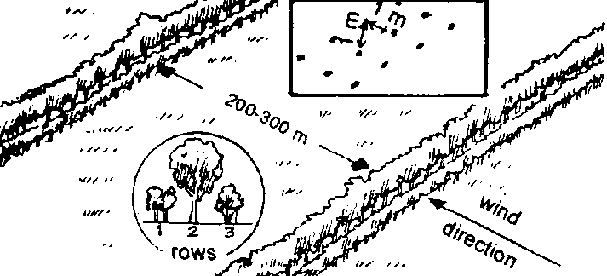
Pointers in establishing shelterbelts
SUGGESTED SPECIES FOR SHELTERBELTS
TABLE 5. TALL TREES/PALM M (over 15 m)
|
COMMON NAME |
SCIENTIFIC NAME |
COMMON NAME |
SCIENTIFIC NAME |
|
Anahau |
Livistona rotundifolia |
Mangium |
Acacia mangium |
|
Agoho |
Casuarina equisetifolia |
Akleng parang |
Albizia procera |
|
Narra |
Pterocarpus indicus |
Kamachile |
Pithecellobium dulce |
|
Teak |
Tectona grandis |
Kamagong |
Diospyros philippinenses |
|
Gmelina |
Gmelina arborea |
Thailand shower |
Cassia siamea |
|
Molave |
Vitex parviflora |
Niyog |
Cocos nucifera |
|
Antipolo |
Artocarpus blancoi |
Caribbean pine |
Pinus caribaea |
|
Santol |
Sandoricum koetjape |
Buri |
Corypha elate |
|
Sampalok |
Tamarindus indica |
Durian |
Durio zibethenus |
TABLE 6. MEDIUM-SIZED TREES/PALM (5-15 m).
|
COMMON NAME |
SCIENTIFIC NAME |
SCIENTIFIC NAME |
COMMON NAME |
|
Caimito |
Chrysophyllum cainito |
Agoho del Monte |
Casuarina rumphiana |
|
Chico |
Manilkara |
Duhat zapota |
Syzygium cumini |
|
Kasoy |
Anacaridum occidentale |
Neem |
Azadirachta indica |
|
Banaba |
Lagerstroemia speciosa |
Dapdap |
Erythrina orientalis |
|
Ipil-ipil |
Leucaena leucocephala |
Alibang-bang |
Piliostigma malabaricum |
|
Kakauwate |
Gliricidia sepium |
Pili |
Anacardium ovatum |
TABLE 7 SHRUBS (up to 5 m) AND BAMBOOS.
|
COMMON NAME |
SCIENTIFIC NAME |
|
Kawayan tinik |
Bambusa blumeana |
|
Kawayan kiling |
Bambusa vulgaris |
|
Kawayan |
Bambusa spinosa |
|
Bolo |
Gigantochloa levis |
|
Boho |
Schizostachyum lumampao |
|
Aroma |
Acacia farnesiana |
|
Bougainvillea |
Bougainvillea spectabilis |
|
Kadios |
Cajanus cajan |
|
Achuete |
Bixa orellana |
References:
Hensleigh, T.E. Agroforestry Species for the Philippines, U.S. Peace Corps.
Wiedelt, H.J. 1976. Manual of Reforestation and Erosion Control for the Philippines, GTZ, West Germany.
|
| ||||||||||||||||||||||||||||||||||||||||||||||||||||||||||||||||||||||||||||||||||||||||||||||||||||||||||||
Bank stabilization
River/stream bank erosion is the scouring, undercutting or the collapse of banks of water caused by the flow of water. The factors that contribute to this type of erosion are the soil type, the velocity and the volume of water.
Protection of the river/stream bank will lead to the stabilization of the water courses, the protection of the farm from "being eaten" by the water and making productive the area along the river or stream.

Methods of river/stream bank
stabilization
Methods of river/stream bank stabilization
A. Planting of trees, shrubs, bamboos or palms along the bank is a vegetative method of stabilization whereby the roots hold the soil in place and reduce the impact of water flow. Following are some pointers in stabilizing river/stream bank by planting:
1. In the zone from low to medium water level, only grasses and shrubs are allowed to be planted -the species that are able to survive prolonged inundation and are flexible enough not to break in the water current.2. In the zone from medium to high water level, some tree, palm or bamboo species can be planted with grasses and shrubs.
3. In the zone above the high water level, trees, palms or bamboos are planted with or without shrubs.
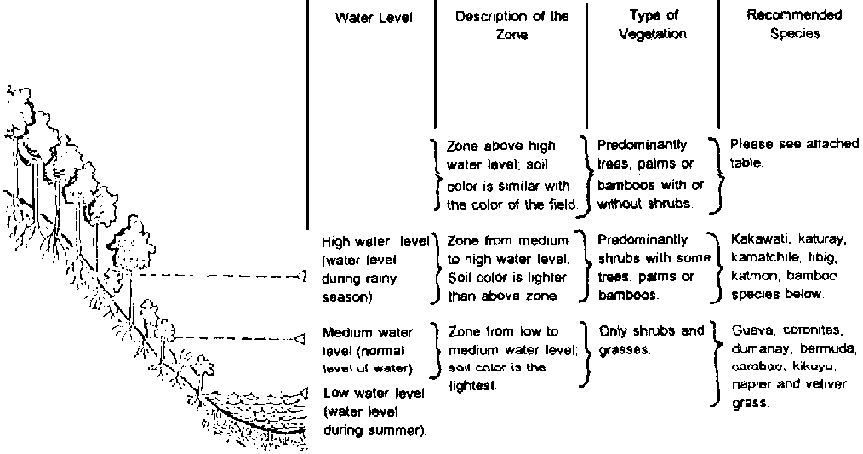
Stabilization of river/stream banks
through planting
B. Construction of temporary and emergency measures. These measures are usually applied in areas along banks that are already collapsed or in danger of collapsing. These measures are used to support the more permanent river/stream bank stabilization.
1. Rauhbaum Method -- This is the placing of dense and well-branched trees, tree tips or bamboos along the bank. It is tied and anchored by a strong peg and the butt end is pointing upstream. This measure is used to protect the bank from the direct impact of water flow while waiting for the establishment of the more permanent stabilization measures.

Rauhbaum Method
2. Temporary Groynes -- A series of temporary structures of dense and well-branched trees, tree tops or bamboos are used. These structures are placed pointing upstream, perpendicular to the flow of water and pointing downstream in order to direct the direction of flow, reduce the velocity of water and partly accept the deposition of soil sediments. The measure is used only in wide and shallow rivers or streams.
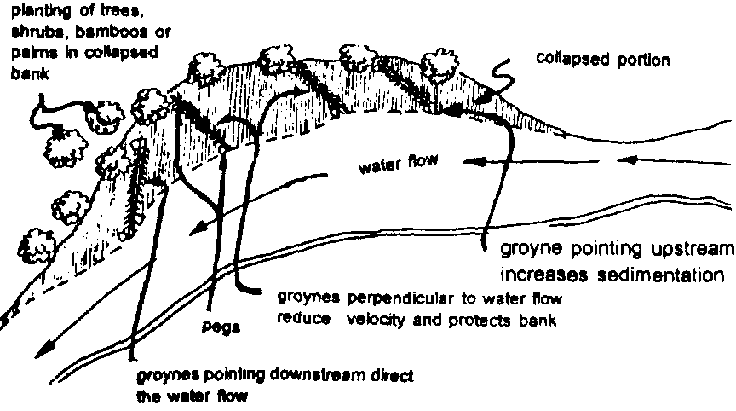
Temporary Groynes
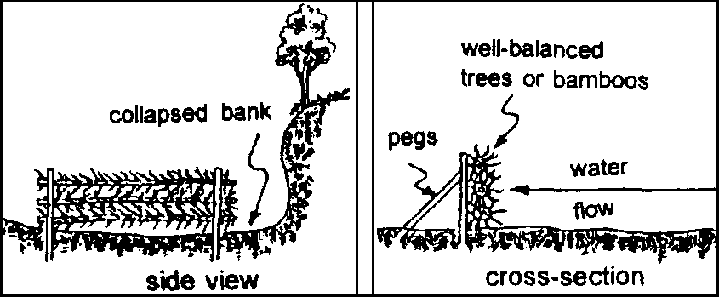
The measure is used only in wide and
shallow rivers or streams.

Plugging of river/stream bank
3. Plugging of river/stream bank - This is a temporary, measure to protect banks that are in danger of collapsing by placing dense crowns of brushwood supported by pegs along the eroded portion.

Slating pegs or posts
TABLE 8. RECOMMENDED PLANT SPECIES FOR RIVER/STREAM BANK STABILIZATION (BY Region).
|
SCIENTIFIC NAME |
COMMON NAME |
REGION | |||||||||||
| |
|
1 |
2 |
3 |
4 |
5 |
6 |
7 |
8 |
9 |
10 |
11 |
12 |
|
Serialbizia acie |
Akle |
x |
x |
x |
- |
- |
x |
- |
- |
- |
- |
- |
- |
|
Cassia spectabilis |
Antsoan dilau |
x |
x |
x |
x |
x |
- |
- |
- |
- |
- |
- |
- |
|
Acacia equisetifolia |
Acacia |
- |
- |
x |
x |
x |
x |
- |
x |
x |
- |
- |
- |
|
Spathodea campalnulata |
African tulip |
- |
- |
- |
x |
x |
- |
- |
- |
x |
x |
- |
- |
|
Paraserianthes falcataria |
Mollucan Sau |
- |
- |
- |
x |
x |
- |
- |
- |
x |
x |
- |
- |
|
Artocarpus blancoi |
Antipolo |
- |
- |
- |
- |
- |
- |
- |
x |
- |
- |
- |
- |
|
Bamboo spp |
Bamboos |
x |
x |
x |
x |
x |
x |
x |
x |
x |
x |
x |
x |
|
Nauclea orientalis |
Bangkal |
x |
x |
x |
x |
x |
x |
- |
x |
x |
- |
x |
x |
|
Alstonia macrophylla |
Batino |
x |
- |
x |
- |
- |
x |
- |
- |
- |
x |
x |
x |
|
Calophyllum inophyllum |
Bitaog |
- |
- |
x |
- |
- |
- |
- |
x |
- |
- |
- |
- |
|
Ochroma pyramidale |
Balsa |
- |
- |
- |
- |
- |
- |
- |
- |
- |
x |
- |
- |
|
Diplodiscus paniculatus |
Balobo |
- |
- |
- |
- |
- |
- |
- |
- |
x |
- |
- |
- |
|
Cinchoma. succirubra |
Cinchoma |
- |
- |
- |
- |
- |
- |
- |
- |
- |
- |
- |
x |
|
Cocos nucifera |
Niog |
- |
- |
- |
x |
x |
- |
- |
x |
x |
- |
- |
- |
|
Alstonia scholaris |
Dita |
x |
- |
x |
x |
x |
x |
x |
x |
x |
x |
x |
x |
|
Dracontomelon dao |
Dao |
- |
- |
x |
x |
- |
- |
- |
x |
- |
- |
- |
- |
|
Gmelina arborea |
Gmelina |
x |
x |
x |
x |
x |
x |
x |
x |
x |
x |
x |
x |
|
Endospermum peItatum |
Gubas |
- |
- |
- |
x |
x |
- |
- |
- |
- |
- |
- |
- |
|
Intsia bijuga |
Ipil |
x |
x |
- |
- |
- |
- |
- |
x |
- |
- |
- |
x |
|
Leucaena feucocephala |
Ipil-ipil |
- |
- |
- |
x |
x |
x |
x |
x |
x |
- |
- |
x |
|
Cananga odorata |
Ilang-ilang |
x |
- |
x |
x |
x |
x |
- |
x |
x |
x |
x |
x |
|
Sterculia foetida |
Kalumpang |
x |
x |
- |
- |
- |
- |
- |
- |
x |
- |
- |
- |
|
Anthocephalus chinensis |
Katoan |
- |
- |
- |
- |
- |
- |
- |
- |
x |
x |
- |
- |
| |
Bangkal | |
| | | | | | | | | | |
|
Toona calantas |
Kalantas |
- |
- |
- |
- |
- |
x |
- |
x |
x |
- |
- |
- |
|
Sesbania grandiflora |
Katurai |
- |
- |
- |
- |
- |
x |
- |
x |
x |
- |
- |
- |
|
Sindora inemmis |
Kayugalo |
- |
- |
- |
- |
- |
- |
- |
- |
x |
- |
- |
- |
|
Wrightia lanite |
Lanete |
x |
- |
- |
- |
- |
- |
- |
- |
- |
- |
- |
- |
|
Aleurites moluccana |
Lumbang |
- |
- |
- |
- |
- |
- |
x |
- |
- |
- |
- |
- |
|
Dracontomelon edule |
Laniko |
- |
- |
- |
- |
- |
- |
- |
x |
- |
- |
- |
- |
|
Swietenia macrophylla |
Mahogany |
x |
x |
x |
x |
x |
x |
x |
x |
x |
x |
x |
x |
|
Litsea perrottetti |
Marang |
- |
- |
- |
- |
- |
- |
- |
- |
x |
- |
- |
- |
|
Moringa oleifera |
Malunggay |
- |
- |
- |
x |
x |
- |
- |
x |
- |
- |
- |
- |
|
Cinnamomum mindanaense |
- |
- |
- |
- |
- |
- |
- |
- |
x |
- |
- |
- | |
|
Mindanao |
cinnamon | |
| | | | | | | | | | |
|
Pterocarpus indicus |
Narra |
x |
x |
x |
x |
x |
x |
x |
x |
- |
x |
x |
x |
|
Sandorium koetjape |
Santol |
- |
- |
- |
- |
- |
- |
- |
x |
- |
x |
x |
- |
|
Sindona supa |
Supa |
x |
- |
x |
x |
x |
- |
- |
x |
- |
- |
- |
- |
|
Tectona grandis |
Teak |
x |
x |
x |
- |
- |
x |
x |
- |
x |
x |
x |
x |
|
Ficus note |
Tibig |
x |
x |
x |
x |
x |
x |
x |
x |
x |
- |
- |
- |
|
Bischofia javanica |
Tuai |
- |
- |
- |
- |
- |
- |
- |
x |
- |
- |
- |
- |
|
Afzelia rhomboidea |
Tindalo |
x |
x |
x |
x |
x |
x |
x |
x |
x |
x |
x |
x |
|
Hevea brazilensis |
Para rubber |
- |
- |
- |
- |
- |
- |
- |
- |
x |
- |
- |
x |
|
Samanea saman |
Raintree |
x |
x |
x |
x |
x |
x |
x |
x |
x |
x |
x |
x |
|
Gliricidia septum |
Kakawati |
x |
x |
x |
x |
x |
x |
x |
x |
x |
x |
x |
x |
|
Terminalia catappa |
Talisai |
x |
x |
x |
x |
x |
x |
x |
x |
x |
x |
x |
x |
Sources: Area/Species Guidelines for Reforestation in the Philippines, Wiedelt, H. J. 1976. (Manual of Reforestation and Erosion Control for the Philippines, GTZ. West Germany.)
|
| ||||||||||||||||||||||||||||||||||||||||||||||||||||||||||||||||||||||||||||||||||||||||||||||||||||||||||||
Assessing the usefulness of indigenous and locally adapted trees for agroforestry
Many farmers and extension workers would like to test and promote indigenous or locally adapted tree species, but there is often little information available to them about some of these species.
Locally adapted species are attractive, because the plant material is readily available for propagation from seed, cuttings or wildlings. Because introduced species are not adapted to local pests and diseases, indigenous species may present a lower risk to the farmers. Another reason for using indigenous species is to maintain biological diversity within agroecosystems.
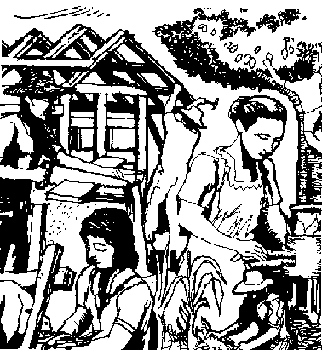
Assessing the usefulness of
indigenous and locally adapted trees for agroforestry
These materials were prepared to provide some guidelines to assessing the potential of indigenous species for use in agroforestry systems. However, these guidelines could be applied to assessing introduced species as well.
Trees are useful because they furnish a certain product that is valued or because they perform a function that is needed. Some trees provide a combination of products and functions although no one species fulfills all the possibilities that are listed below. In assessing a species' potential usefulness for agroforestry, keep in mind the objectives and needs of the farm household. Trade-offs between benefits are usually necessary; therefore, a combination of species often provides best results.
Some of the products from trees include:
· wood (for house and pen construction, bridges, boats, carts, fuelwood, furniture, poles, fencing, packing crates, barrels, pulp, tools, implements, handicrafts and musical instruments);· livestock fodder (from leaves, fruits, seeds);
· food for human consumption (fruits, nuts, spices, greens);
· medicines (from bark, fruits, seeds, roots, leaves, flowers);
· green manures (from clippings of leaves and small stems); and,
· industrial raw materials (gums, resins, dyes, oils).
Some of the functions of trees include:
· stream bank and watershed protection;· soil conservation (contour hedgerows or strips);
· soil improvement (N-fixation, nutrient cycling, soil microclimate amelioration);
· shade (around houses, bordering paths and roads, etc.) or as nurse tree for coffee and cacao;
· shelterbelts/windbreaks or firebreaks;
· live fencing;
· live trellis (for black pepper, vanilla, betel leaf, ampalaya);
· insect management: bee forage (Calliandra calothyrsus, Ceiba petandra); silk production (Morus); butterfly farming and, ornamental value and spiritual value.
ASSESSING THE USEFULNESS OF INDIGENOUS TREES FOR FUELWOOD
A good fuelwood has these qualities:
It is easy to light and keep going, especially if used in a wood-burning stove. Wood that will bum when green or wet is especially useful.
It bums well but not too quickly. Many softwoods (like pine) bum up quickly, resulting in more wood being consumed.
It bums down into coals that retain their heat for slow, even cooking or for heating houses.
The stems are not too thick or can be easily split. Wood that is very hard or has interlocking grain is difficult to split into small pieces to fit in a woodburning stove.
It can be used to make charcoal. Charcoal is easier to transport than wood so fuelwood that is to be sold is often converted into charcoal first.
It does not produce irritating smoke, unpleasant odors or give a peculiar taste to food cooked over it. Some people do not like Eucalyptus for fuelwood even though it bums well, because they think it makes food taste funny.
See Properties of Some Fuelwood Species on pages 181-191 for more information.

A good tree for producing fuelwood
has these qualities:
· is fast-growing and has a high yield of woody biomass;· sprouts back vigorously after cutting. Some species sprout best if they are cut near the base of the stem while other species are cut higher (1-2 m above ground). Wood can be harvested repeatedly from trees that have a good sprouting ability, without destroying or having to replant the tree.
· is adapted even to less fertile, drier or thinner soils than those used for more valuable agricultural crops; and,
· is multipurpose: has some other products or functions besides fuelwood.
Assessing the usefulness of indigenous trees for live fencing

Assessing the usefulness of
indigenous trees for live fencing
The best live fences are often made up of a combination of several species, such as bamboos, shrubs and vines
Species with thorns, spines, nettles or irritating late' are especially good for fencing out livestock.
The plants should form a dense hedge. Often, it i' necessary to prune the stems to encourage stump sprouting and branchiness.
The stems should be usable as living fenceposts and be able to tolerate some damage from nails and wire if wire fencing is used.
Plants that can be propagated from branch cuttings (e.g., Madre de cacao) and that can be rooted in place will produce a live fence quickly. If the plant cannot be propagated from cuttings, sufficient quantities of viable seed should be available for direct seeding.
The leaves and stems should be non-palatable to livestock.
The live fence species should not spread easily into pastures or cultivated fields.
Fire-resistant species (like Gmelina) should be used if possible.
Layering and lattice techniques can be used to make live fences more impenetrable.
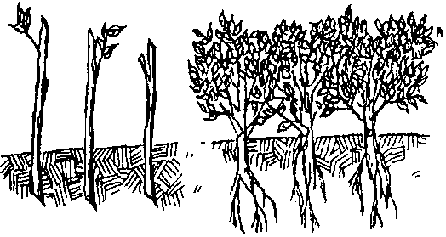
Live fence planted using cuttings.
ASSESSING THE USEFULNESS OF INDIGENOUS TREES FOR LIVESTOCK FODDER

Trees and shrubs that are suited for
fodder have these characteristics:
· The fodder is palatable and digestible. If livestock will not eat the fodder or if they cannot digest it, K does not matter how nutritious it is.· Contains no toxins.
· Is suitable for a variety of livestock.
· The leaves, fruits or seeds are nutritious with a highprotein content.
· The plants can withstand frequent pruning.
· They produce leaves year-round and are droughttolerant.
· The ratio of leaf to woody biomass production is high.
· The stems and leaves have no thorns, bristles, nettles or irritating latex.
Often, trees and shrubs that are useful as fodder crops are not suited as live fencing species and vice-versa.
ASSESSING THE USEFULNESS OF INDIGENOUS TREES FOR INTERCROPPING
Agroforestry often involves intercropping of trees or shrubs with annual or herbaceous species. Some of the features to consider in terms of their suitability for intercropping are:
· Type of root structure
Some wood plants have roots that grow deep into the earth and draw water and nutrients from far below the surface. These trees are especially suited for intercropping because they do not compete with shallow-rooted annual crops that draw most of their water and nutrients from the top soil.
Although shallowrooted species may not be as suited for intercropping, they are often useful for erosion control because their roots help bind the soil. On farms with very steep slopes, these species can be used for soil conservation. Some species form roots both close to the surface as well as in deeper soil layers.

Type of root structure
Effects of Trees on Soil and Water Conservation
Tree roots help to anchor and stabilize soil. Leaf litter and humus that build up under tree stands allow water to percolate into the lower soil layers. Ground cover vegetation under the trees can also contribute to leaf litter and humus build-up and can help to prevent soil loss. Some tree species seem to inhibit understory ground cover by secreting substances into the soil that are toxic to other plants. This is called allelopathy. If normal ground cover does not grow under a certain tree species, this species may not be suited for intercropping.
Ability to Improve soil quality
Trees can improve soil fertility by serving as "nutrient pumps", that is, they efficiently absorb nutrients from the soil. The nutrients that are concentrated in the leaves can then be resumed to the soil as green manures.
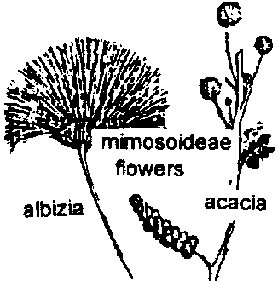
Ability to Improve soil quality
Nitrogen-fixing trees often have nitrogen-rich foliage. Many but not all members of the Legume family are N-fixing. One way to identify an N-fixer is to check the roots for nodules which look like small lumps or knots. Non-legume species that fix Nitrogen are found in the Casuarina and Alnus genera.
Using green manures can also improve soil texture, infiltration and moisture-holding capacity by increasing organic matter in the soil. Trees that have compound leaves with many small leaflets break down quickly. Larger leaves and small stems will provide a slower, longer-term release of nutrients.
Trees also affect the soil microclimate, lowering temperatures and increasing humidity, thus providing favorable conditions for beneficial microorganisms.
Shade-tolerance
A species is shade-tolerant if it can regenerate and thrive under the canopy of other trees where the amount of available light is reduced. In intercropping arrangements, there are often several layers or strata of tree and shrub species, with the lower or understory layers made up of shade-tolerant species.
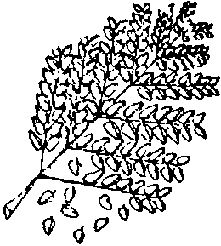
Shade-tolerance
Rate of height growth and ability to sprout after cutting
It is important to compare growth rates with respect to the strata of the intercropping system that each species will occupy. Slower growing, intolerant species should not be overtopped and shaded out by faster-growing fuelwood species (like Gliricidia) with a slow-growing intolerant fruit tree, you will have to cut the fuelwood species back at first to keep it from overtopping the fruit tree.

Rate of height growth and ability to
sprout after cutting
Crown form and leafing pattern
The size and shape of the overstory species crown and the type of foliage will affect the amount of light that penetrates down into the understory. Even if the understory plants are shade-tolerant, they still need light, especially when they flower and bear fruit. Overstory plants that have a high, small, open crown and sparse foliage (like Albizia falcataria) will allow more light through than species with deep, broad spear-heading crowns and dense foliage (like mango).
Seasonal cycles
The amount of overstory foliage can vary depending on the season, affecting the amount of light that the understory species will intercept. Although many tropical trees are evergreen, some (like Teak and Gmelina) drop their leaves during the dry season, allowing more light through. Intercropping with species that flower and fruit during the dry season will take advantage of these cycles.

Seasonal cycles
However, if a tree is planted specifically to provide shade, an evergreen species is preferable to one that has a deciduous habit. Even though Siniguelas is used to shade understory crops, it loses its leaves during the hot season when shade is most needed.
Finding the Right Niche Within the Farming System for Indigenous Tree Species
Farmers can often recognize plant species that indicate a particular type of soil condition, such as sites that have been recently cultivated, sites that have been in fallow for a long time, severely degraded soils, or soils with a high salt content. Indicator plants are also sometimes used by farmers as a preliminary method to determine soil texture or acidity.
In detemmining the farm niche that an indigenous species might fit, consider where the species occurs naturally and what that might indicate about the tree's site requirements. Is it normally found along stream banks, on thin rocky soils, on deep fertile sites or on sites that are frequently flooded? Does it grow in the forest or is it more often found growing in the open? If it grows in the forest, which strata of the canopy does it occupy? It is found mostly in open areas, where other trees rarely grow; this may indicate that it is either fire-resistant or that it can compete with other vegetation like cogon grass. Observing the natural habitat of a tree species can give you many clues as to how it may be most useful in an agroforestry system.
TABLE 9: SAMPLE ASSESSMENT OF SOME TREE SPECIES FOR INTERCROPPING.
|
ASSESSMENT CRITERIA | |
SAMPLE SPECIES | ||||
| |
Mollucan Sau |
Nangka |
Durian |
Guyabano |
Kamachile |
Gliricidia |
|
Root Structure |
deep-rooting |
shallow if system cuttings; deeper if planted from seed |
deep-rooting grown from |
shallow if grown from cuttings; deeper if planted from seed |
deep, dense root system |
shallow if grown from cuttings; deeper if planted from seed. |
|
Effect on Soil and Water |
useful for land reharevege |
useful in systems for low impact |
useful in tree cropping for erosion |
can be used effective as |
highly | |
|
Conservation |
bilitation |
sating difficult, degraded sites |
agricultural land use on steep sites |
control and |
hedgerow in hedgerows |
species |
|
N-fixing |
yes |
no |
no |
no |
yes |
yes |
|
Rate of Height and Growth |
very fast |
fast |
slow |
moderately fast |
fast |
fast |
|
Sprouting |
poor |
responds to |
poor |
responds to |
coppices |
stem |
|
Response after Cutting |
response removal of |
early removal of leader shoot and lopping |
response |
occasional pruning |
readily after cutting |
sprouts vigorously when cut at base or at 1-2 m |
|
Canopy Strata |
high |
high |
high |
middle |
middle |
middle |
|
When Mature |
overstory |
overstory |
overstory understory |
understory |
understory | |
|
Crown Form |
high, spreading crown |
deep crown, can be spreading or more compact |
high crown. spreading but not deep |
Deep compact crown |
irregularly- shaped at spreading crown; variable, depends on management |
small crown spreading |
|
Leafing Pattern |
light foliage |
dense |
fairly dense |
fairly dense |
small leaflets |
light foliage |
| |
with small |
foliage with |
foliage with |
foliage |
and fairly |
small |
| |
leaflets |
large thick |
large leaves |
|
dense |
leaflets, |
| | |
leaves | | |
foliage |
varies with |
| |
| | |
| |
season |
|
Deciduous/Evergreen |
semi- evergreen |
eve rgreen evergreen |
evergreen |
semi- |
loses leaves evergreen |
during dry season and when flowering |
|
Light Penetration |
high |
low |
low |
low |
low |
high (varies with season) |
|
Shade Tobrance light |
light shade- demanding |
moderately demanding |
slightly to tolerant when young; light demanding when older |
shade shade- tolerant |
moderately shade tolerant light |
tolerant at establishment stage, later more demanding |
|
Suitability for |
suitable as |
overstory |
overstory middle |
middle strata |
low middle | |
|
Intercropping |
overstory species or as shade for partially shade- tolerant understory crops |
species for highly shade- tolerant understory understory crops and crops or as a bonder tree around fields |
species with |
strata can |
with light |
strata with |
| |
| |
shade- tolerant sufficient light mixed perenniaI cropping systems |
be over- topped if open-grown with full penetrates through overstory |
overstory shade or open-grown with full sun sunlight |
light overstory or |
COMMONLY USED TREE SPECIES FOR AGROFORESTRY
|
SCIENTIFIC NAME |
OFFICIAL PHILIPPINE NAME/OTHER LOCAL AND COMMON NAMES |
PRINCIPAL USES |
RELATED PAPERS |
|
Acacia auriculiformis |
Japanese acacia, Auri |
Reforestation |
NET tables, SALT-3 |
|
A. mangium |
Mangium |
Reforestation |
NET tables, SALT-3 |
|
A. meamsii |
Black wattle |
| |
|
A. nepalensis |
Alder | | |
|
A. villosa | |
| |
|
Albizia lebbek |
Langil | | |
|
Albizia lebbekoides |
Kariskis, Malaganit |
| |
|
Albizia procena |
Akleng-parang, Palucheba, Palosebo, Kalai | |
|
|
Aleurites moluccana |
Lumbang |
Nut production |
|
|
Alnus japonica |
| | |
|
Anacardium occidentale |
Kasui, Kasoy, Cashew, Batuban |
Nut production, soil |
Fruit Trees for Harsh |
|
Anacolosa luzoninsis |
Galo, Aluloy, Malabignai, Matabalo, Yupa | |
|
|
Annona atemoya |
Atemoya | |
|
|
Annona muricata |
Guyabano, Bayuba, Carnaba, Labana, soursop |
Fruit production |
Asexual Propagation |
| |
|
Methods for Commonly |
Used Fruit Crops |
|
A. squamosa |
Atis |
Fruit production |
|
|
Anthocephalus chinensis |
Kaatoan bangkal |
| |
|
Antidesma bunius |
Bignai, Bugnay, Isiyo, Dabodabo, Bundeyg |
Fruit production |
|
|
Artocarpus heterophyllus |
Nangka, Langka, jackfruit |
Fruit, timber and fodder production |
Fruit Trees for Harsh Environments |
|
A. odoriatissimus |
Marang, Loloi, eloi, Madang, uloy | | |
|
Averrhoa bilimbi |
Kamias, Iba, Pias |
Fruit production |
Asexual Propagation Methods for Commonly Used Fruit Crops |
|
A. carambola |
Balimbing, Garangan |
| |
|
Azadirachta indica |
Neem tree. Nim, margosa |
Shade, roadside tree |
SALT-3 |
|
B. blumeana |
Kawayan-tinik |
| |
|
Bambusa vulgaris |
Kawayan-kiling, Kawayan | | |
|
Bixa orellana |
Achuete, Atsuete |
Commodity production |
|
|
Broussonetia luzonica |
Hirnbaba-o, Alakon, bagi | | |
|
Cajanus cajan |
Kadios, Tabios, kardis |
Soil conservation; food and tedder production | |
|
Calliandra calothyrsus |
Calliandra | |
|
|
Cananga odorata |
llang-ilang, Tangit |
Flower production |
|
|
Canarium ovatum |
|
Pili, Pilinut |
Fruit production |
|
Calliandra haematocephala |
Fire ball | |
|
|
Carica papaya |
Papaya, Kapayas, pawpaw |
Fruit production |
|
|
Cassia alata |
Palo - China |
| |
|
Cassia fistula |
Golden shower, Cana, Fistula | | |
|
Cassia siamea |
Thailand shower |
Reforestation |
SALT-3 |
|
Cassia spectabiIis |
Antsoan - diIaw, PaIucheba, Paluchena | |
|
|
Casuarina equisetifolia |
Agoho, Agosol, aroo |
Dune fixation, reforestation | |
|
Ceiba pentandra |
Kapok, Bulka, Capas, Doldol, Bulak |
Fiber production |
|
|
Chrysophyllum cainito |
Caimito, Kaimito, Starapple |
Fruit production |
SALT-3 |
|
C cochichinensis |
Saling-gogon |
| |
|
C. macroptera |
Kabuyaw, Kabugaw |
Fruit production |
|
|
C. madurensis |
Kalamansi, Lemonsito, kalamunding |
Fruit production |
|
|
Citrus grandis |
Lukban, Suha, Suwa, Pomeb, Marangkas |
Fruit production |
|
|
Cocos nucifera |
Niog, Niyog, Lubi, Coconut |
Fruit, oil production |
Multi-storied Sequential Cropping (Cavite Model) |
|
Coffea spp. |
Coffee, kape |
Commodity production |
|
|
Corypha utan |
Buri, Buli, Ebus |
| |
|
Cordia dichotoma |
Anonang | |
|
|
Crotolaria juncea |
Crotolaria | |
|
|
Cubilea cubili |
Kubili | | |
|
Delonix regia |
Fire tree |
Ornamental | |
|
Dendrocalamus merrillianus |
Bayog, Botong, butong, Paraot, Kawayan | |
|
|
Desmodium gyroides |
Karikut - rikut |
| |
|
D. rensonii |
Rensoni | |
|
|
Diospyros philippinensis |
Mabolo, Kamagong |
| |
|
Diplodiscus paniculatus |
Balobo | | |
|
Duno zibethinus |
Durian |
Fruit, timber production | |
|
Eleagnus philippinensis |
Alingaro | |
|
|
Erythrina crista-galli |
Dapdap-palong, Coral tree | | |
|
Erythrina orientalis |
Dapdap, Bagbag |
Shade for understory crops | |
|
E. fusca |
Anii | | |
|
E indica |
Dapdap | | |
|
E poeppigiana |
Dapdap | | |
|
E. stipitata |
Lubang dapdap |
| |
|
E subumbrans |
Rarang | | |
|
E variegate |
Mottled dapdap |
Shade for understory crops | |
|
Flacourtia rukam |
Bitongoi, Bitongol, Palutan, Saua-saua | |
|
|
Gliricida sepium |
Madre da Cacao, Kakawati | | |
|
Gmelina arborea |
Yemane, Melina |
Reforestation, Industrial lumber | |
|
Gnetum gnemon |
Bago, Banago, Lamparan, Nabo |
Fruit production |
|
|
Instia bijuga |
Ipil, Kita - kita |
Timber | |
|
Inocarpus fagifer |
Kayam, Polynosbn chestnut | | |
|
Lagerstroemia speciosa |
Banaba |
Flower, timber production | |
|
Lansium domesticum |
Lansones |
Fruit production |
|
|
Leucaena leucocephala |
Ipil-ipil, Kariskis, Kumpitis, Sta. Elena |
Soil conservation |
|
|
L. diversifolia |
Acid ipil-ipil |
Soil conservation |
|
|
Litchi chinensis |
Lichi, Licheas |
Fruit production |
|
|
L. chinensis var philippinensis |
Alupag |
Fruit production |
|
|
Mangifera altissima |
Paho | | |
|
M. indica |
Mangga, Mango |
Fruit production |
|
|
M. philippinensis |
Paho | | |
|
Manilkara zapota |
Chico |
Fruit, timber production | |
|
Melia dubia |
Bagalunga, Paraiso, Bulibising | | |
|
Moringa oleifera |
Malunggi, Kamunggay, Marunggay, Dool |
Food production |
|
|
Muntingia calabura |
Datiles, Aratiles, Mansanitas | | |
|
Musa spp. |
Saha, Dippig, Saging |
Fruit production |
|
|
Nephelium lappaceum |
Rambutan, Usau |
Fruit production |
|
|
Pangium edule |
Pangi Fruit production | | |
|
Paraserianthes falcataria |
Moluccan sau, Falcata, Placata |
Reforestation, Industrial timber | |
|
Peltophorum pterocarpum |
Siar, Baringbing |
| |
|
Persea americana |
Avocado |
Fruit production |
|
|
Piliostigma malabaricum |
Alibanghang, Kulibangbang, Kalibangbang |
Soil conservation |
|
|
Pinus carribaea |
Carribean pine |
| |
|
Pinus kesiya |
Benguet pine, Saleng, parua, Alal |
Reforastation |
|
|
Pithecellobium dulce |
Kamachile, Kamachilis, Damortis |
Fruit production |
|
|
Pouteria campechiana |
Thea |
Fruit production |
|
|
Psidium guajava |
Bayabas, Guyabas, guava |
Fruit production |
|
|
Pterocarpus indicus |
Narra, Nala, Dungos, Naga |
Timber | |
|
Punica granatum |
Granada |
Fruit production |
|
|
Rollinia deliciosa |
Biriba | | |
|
Sacharum officinale |
Tabu, Tubu | |
|
|
Samanea saman (Albizia saman) |
Raintree, Akasya, Acacia | | |
|
Sandoricum koetjape |
Santol, Kantol, Santor, Katul |
Fruit production |
|
|
Schizostachyum lumampao |
Buho, Bagakay, babakan | | |
|
Sesbania bispinosa |
Prickly sesban |
| |
|
S. grandiflora |
Katurai, Agati, katuday, Diana |
Soil conservation, fodder production | |
|
S. formosa |
Formosa | |
|
|
S.sesban |
Sesban |
Soil conservation |
|
|
Spondias purpurea |
Sineguelas, Sereguelas, saruelas |
Fruit production |
|
|
Swietenia macrophylla |
Big-leafed mahogany |
High-value timber |
|
|
Syzygium cumin) |
Duhat, Lomboy |
Fruit production |
|
|
S. jambos |
Tampai, Malay apple |
Fruit production |
|
|
S. polyccephaloides |
Lipotee | |
|
|
S. samarangense |
Makopa |
Fruit production |
|
|
Tamarindus indica |
Sampalok, Kalamagui, Sambag, Sanbagi, Salumagi |
Fruit production |
|
|
Tectona grandis |
Teak, Yati, Dalanang, Teka, Kayati, Segunyate |
High-value timber |
|
|
Terminalia catappa |
Talisai, Tatisi, Logo, Sakat, Dao, Salaisan |
High-value timber |
|
|
T. microcarpa |
Kalumpit, Alupi Anagep, Butuang Kotnok | |
|
|
Theobroma cacao |
Cacao, Kakaw |
Commodity production |
|
|
Trema orientalis |
Anabiong, Anadong, Mandaragon, Anagum, Anaradung, Hinlalaong, Hinagdung | | |
|
Vitex parviflora |
Molave, Camagauan, Sagat, Tagpa, Mol-awa | |
|
|
| ||||||||||||||||||||||||||||||||||||||||||||||||||||||||||||||||||||||||||||||||||||||||||||||||||||||||||||
A guide for the inventory, identification and screening of native plant species with potential for agroforestry
Native species abound in the uplands. They need to be inventoried, identified and assessed to determine their potential for agroforestry. To do these, agroforestry technicians need the necessary skills and tools. This simple guide is a helpful reference material.
STEPS
· Inventory. Make a list of native tree and shrub species common in the locality.
· Selection. Single out among the species which ones have potentials based on their productive and protective values.
· Propagule availability. Construct a local seed forecasting calendar for selected species.
· Adaptability. Determine the adaptability of species to various conditions by evaluating their distribution and/or conducting species trials.
· Integration. If adaptability of species are established, assess how the species may be integrated with crops in the agroforest farms.
INVENTORY OF LOCALLY AVAILABLE PLANT SPECIES
Avail of the help of the elderly in the community as guide and informant.
Make a preliminary list of species by spot identification in the field. Record local names and economic uses.
Collect specimens of small branch with leaves and, if possible, with flowers and fruits and bark.
Place the specimens with their label temporarily in a plastic bag or gunny sack during collection trip.
Immediately transfer the specimens to a pair of pressers. The labeled specimens are placed between sheets of newspaper and then inserted between the pair of pressers. Tie the four comers tightly together.
Label should contain the following information:
- Local Name
- Place of Collection
- Date of Collection
- Elevation
- Habitat or environmental preference
- Color of flower
- Habit
- Economic uses
Send the unknown specimens, as soon as possible, to the taxonomist for proper identification.
If specimens will not reach the taxonomist within five days, dry them by hanging the presser above the stove. This will prevent decay of specimens.
Consult taxonomy books for the official common name and scientific names. These include:
- Lexicon of Philippine Trees
- Flora Malesiana
- Enumeration of Philippine Flowering Plants
PRELIMINARY SELECTION OF SPECIES FOR TRIALS IN AGROFOREST FARMS
Single out species from the list which may be given priority for integration in agroforestry farm.
Base the selection on the uses of species and their features that may make them probably compatible with agroforestry crops.
Conduct survey on how and when local people use a particular species. The sample form below may be used.
Name of respondent: __________________ Age:________
Place of
residence:________________________________
No. of years of
residence:___________________________
If migrant, state place of
origin:
_________________________________________________
_________________________________________________
|
Name of Species |
: |
|
Local Name |
: |
|
Construction |
: |
|
Woodcraft |
: |
|
Fuelwood |
: |
|
Food |
: |
|
Feed-fodder-pasture |
: |
|
Medicine |
: |
|
Poison/Pesticide |
: |
|
Extractives (Oil, |
|
|
easential oil) |
: |
|
Exudates (gums, |
|
|
resins and latex) |
: |
|
Fiber |
: |
|
Etc. | |
After survey, refer to literature or any published books on the uses of Philippine plant species.
These include:
Brown, W. H. 1919. Philippine Fiber Plants. Phil. Burl For. Bull. 19.
Brown, W. H. 1920. Minor Products of Phil. Forests. Dept. of Agric. and Nat. Res. Burl For. Phil. Is. Bull. 22.
Brown, W. H. 1941. Useful Plants of the Phil. Manila, 3 vols.
Gana, V. Q. 1916. Some Philippine Tanbarks. Phil. Joumal of Science. Sect. A. 261-265.
Guerrero, Leon Ma. 1921. Medicinal Uses of Phil. Plants. Dept. of Agric. and Nat. Res. Burl For. Phil. Is.
Mulier, T. 1913. Industrials Fiber Plants of the Phil., Phil. Burl Ed. Bull. 9.
Quisumbing, E.1951. Medicinal Plants of the Phil. Dept. Agric. and Nat. Res. Manila. Tech. Bull. 16.
Uphoff, J.C. Th. 1968. Dictionary of Economic Plants. New York: Verkag Von J. Cramer, 591.
West, A.P. and W.H. Brown' 1920. Phil. Resins, Gums, Seed Oils and Essential Oils. Phil. Burl For. Bull. 20.
Wester, P.J. 1925. The Food Plants of the Philippines. Dept. of Agric. and Nat. Res. Burl Agric. Phil.
See also journals such as the following:
CANOPY. Published by FORI-MNR (now ERDB-DENR)
TECHNICAL NOTES. Published by FORPRIDECOM (now FPRDI-DOST)
Use index cards when extracting information from the library. Transfer the information in a logbook in alphabetical order. Example:
Anonang Cordia dichotoma EHRETIACEAE small tree
Wood for temporary construct/on, tool handles and agricultural implements (Reyes, 1938; Monsalud, 1968), fuelwood moisture free 22.49 Ibs/cu. ft. burns 4,397 cal/kg or 7,916 BTU/lb, 64,983 cal/cu. ft. or 80,728 BTU/cu. ft. (Aguilar, 1949). Bark yields best fibers made into rope. Medicinal according to Quisumbing (1961), the kernels are a good remedy for ringworm; they are powdered, mixed with oil and applied. Fruits pulpy portion eaten raw (Monsalud "al., 1986; Brown, 1966; Brown, 1921, 1961), gelatinous substance In fruit is used as glue. Leaves reported as fodder for cattle, DM 46%, Crude protein 16.8%, Crude fiber 14.7%, Ash 13.1% Ca 2.56%, P 0.22#.
Binunga Macaranga tanrius EUPHORBIACEAE small
Bark yields brown glue extract used to fasten together parts of musical instruments. Bark and haves used in making basi (Brown 1921,1951). Bark decoction medicine for dysentery (according to Heyne as cited by Quisumbing, 1951). Growth rate in Makiling 2.60 cm/year (Brown, 1919). Leaves for deer (Lopez, 1935; Sajor, 1936).
Present in a simple matrix the uses and other important information about the species. This matrix serves as the data base on plant uses for a specific locality. A sample format is shown in Table 11.
TABLE 11. ECONOMIC USES AND PROPAGATION OF LOCAL TREES AND SHRUBS COMMON IN (name of place)
|
SPECIES |
ECONOMIC USES AND PROPAGATION METHODS | |
|
Buchanania arborescens |
Size Habit |
Medium tree |
|
Balinghasai |
Construction |
x |
| |
Woodcraft |
x |
| |
Fuelwood | |
| |
Pulpwood | |
| |
Food |
Fruit |
| |
Feed/Fodder |
Fruit (swine) |
| |
Medicine | |
| |
Poison/Biocide |
Prussic acid (stem, leaves) |
| |
Exudates | |
| |
Extractives |
|
|
|
Bast Fiber | |
| |
Textile Fiber |
|
|
|
Ornamental | |
| |
Propagation |
Seed |
|
Semecarpus cuneiformis |
Size Habit |
Small tree |
|
Ligas |
Construction |
x |
| |
Woodcraft | |
| |
Fuelwood | |
| |
Pulpwood | |
| |
Food |
Fruit |
| |
Feed/Fodder |
Fruits (bats, birds) |
| |
Medicine |
Fruit (ulcer) |
| |
Poison Biocide |
Prussic acid (root/bark) |
| |
Exudates | |
| |
Extractives |
|
|
|
Bast Fiber | |
| |
Textile Fiber |
|
|
|
Ornamental | |
| |
Propagation |
Seed |
|
Cananga odorata |
Size Habit |
Large tree |
|
llang-ilang |
Construction |
x |
| |
Woodcraft |
x |
|
Fuelwood | |
|
|
Pulpwood | |
|
|
Food | | |
|
Feed/Fodder |
| |
|
Medicine | |
|
|
Poison Biocide |
| |
|
Exudates | |
|
| |
Extractives |
Flower, essential oil |
| |
Bast Fiber | |
| |
Textile Fiber |
|
|
|
Ornamental |
Flowers, necklace |
| |
Propagation |
Seed |
|
Alstonia scholaris |
Size Habit |
Large tree |
|
Dita |
Construction Woodcraft |
x |
|
Fuelwood | |
|
|
Pulpwood | |
|
|
Food | | |
|
Food/Fodder |
| |
| |
Medicine |
Bark (diarrhea, dysentery) |
| |
Poison Biocide |
Prussic acid slight (stem and leaves) |
| |
Exudates | |
| |
Extractives |
|
|
|
Bast Fiber | |
| |
Textile Fiber |
|
|
|
Omamental | |
| |
Propagation |
Stump cutting |
|
Ervatamia pandacaqui |
Size Habit |
Shrub |
|
Pandakaki |
Construction |
x |
| |
Woodcraft |
x |
| |
Fuelwood | |
| |
Pulpwood | |
| |
Food |
Fruit |
| |
Feed/Fodder |
Fruit (swine) |
| |
Medicine |
Leaves, latex, many uses |
| |
Poison Biocide |
|
|
|
Exudates | |
| |
Extractives |
leaves, bleaching agent |
| |
Bast Fiber | |
| |
Textile Fiber |
|
|
|
Ornamental | |
| |
Propagation |
No published work, but use of wildlings may succeed. |
|
Terminalia catappa |
Size Habit |
Large tree |
|
Talisai |
Construction |
x |
| |
Woodcraft |
x |
| |
Fuelwood |
x |
| |
Pulpwood | |
| |
Food |
Savory oil from kernel |
| |
Feed/Fodder |
Leaves (Tasar, silkworm) |
| |
Medicine |
Oil of kernel w/sap, leaves (leprosy) |
| |
Poison Biocide |
|
|
|
Exudates | |
| |
Extractwes |
Tannin, brown dye, black dye |
| |
Bast Fiber | |
| |
Textile Fiber |
|
|
|
Ornamental |
x |
| |
Propagation |
Fruit |
|
Cordia dichotoma |
Size Habit |
Small tree |
|
Anonang |
Construction |
|
|
Woodcraft | |
|
|
Fuelwood | |
|
|
Pulpwood | |
|
|
Food | | |
| |
Feed/Fodder |
Leaves |
| |
Medicine |
Kernel (ringworm, many uses) |
| |
Poison Biocide |
|
|
|
Exudates | |
| |
Extractives |
Fruit, gelatinous glue |
| |
Bast fiber |
bark (rope) |
|
Textile Fiber |
| |
|
Ornamental | |
|
| |
Propagation |
Cutting, seed |
|
Ehetia microphylla |
Size Habit |
Shrub |
|
Tsang gubat |
Construction |
|
|
Woodcraft | |
|
|
Fuelwood | |
|
|
Pulpwood | |
|
| |
Food |
Leaves as tea |
| |
Feed/Fodder |
|
|
|
Medicine |
Leaves (dysentery, cough, syphilis) |
| |
Poison Biocide |
|
|
|
Exudates | |
| |
Extractives |
|
|
|
Bast Fiber | |
| |
Textile Fiber |
|
|
|
Ornamental |
x |
| |
Propagation |
No published work, but use of wildlings may succeed. |
|
Ehretia philippinensis |
Size Habit |
Small tree |
|
Halimomog |
Construction |
|
|
|
Woodcraft | |
| |
Fuelwood | |
| |
Pulpwood | |
| |
Food | |
| |
Feed/Fodder |
|
|
|
Medicine |
Bark of root (dysentery, diarrhea) |
| |
Poison Biocide |
|
|
|
Exudates | |
| |
Extractives |
|
|
|
Bast Fiber | |
| |
Textile Fiber |
|
|
|
Ornamental | |
| |
Propagation |
No published work, but use of wildlings may succeed. |
|
Acalypha stipulacea |
Size Habit |
Shrub |
|
Bogus |
Construction |
|
|
Woodcraft | |
|
|
Fuelwood | |
|
|
Pulpwood | |
|
|
Food | | |
| |
Feed/Fodder |
Flowers, leaves (deer, swine) |
| |
Medicine | |
|
Poison Biocide |
| |
|
Exudates | |
|
|
Extractives |
| |
|
Bast Fiber | |
|
|
Textile Fiber |
| |
|
Ornamental | |
|
| |
Propagation |
Cutting |
|
Breynia cemua Habit |
Shrub | |
|
Matang hipon |
| |
| |
Construction |
|
|
|
Woodcraft | |
| |
Fuelwood | |
| |
Pulpwood | |
| |
Food | |
| |
Feed/Fodder |
Fruits (wildlife) |
| |
Medicine | |
|
Poison Biocide |
| |
|
Exudates | |
|
|
Extractives |
| |
|
Bast Fiber | |
|
|
Textile Fiber |
| |
|
Omamental | |
|
| |
Propagation |
No published work, but use of wildlings may succeed. |
CONSTRUCTION OF A LOCAL SEED FORECASTING SCHEDULE
Seed forecasting schedule (SFS) is a chart showing when and where seeds are available for a species in the locality. It serves as guide in seed collection.
Steps in making an SFS are:
1. Identify mother trees of selected species and healthy individuals in the locality.2. Plot these mother trees in a reference map, properly label them for documentation and monitoring purposes.
3. Mark them to notify people that the trees are under study.
4. Observe at least three mother trees per species and record every year their flowering and seeding patterns.
5. Prepare a chart using Table 12 as an example.
Aside from economic uses, base also the selection of species on characteristics. Trees and shrubs may be large, medium and small. They may have wide spreading, dome-shape crown or with horizontal or diagonal branching; leaves are sparse or dense. Roots are deep and wide or shallow and less spreading. Tolerant or intolerant to shade.

TABLE 12. A SAMPLE OF SEED
FORECASTING CALENDAR FOR LOS BA�OS, LAGUNA (Based on Observations, 1960 - 1962).
DETERMINATION OF THE ADAPTABILITY OF PRE-SELECTED SPECIES
Determine the environmental conditions preferred by the species.
Do an actual trial planting of the pre-selected species on specific agroforestry farm. Use more acceptable designs and replications.
Trials can be of two phases: preliminary trial during the first year. Based on performance (survival and growth), reject or retain species. The latter is utilized for final species trials.
An example of the result of species trials is shown in Table 13.
TABLE 13. INDICATIONS OF ADAPTABILITY OF TREES AND SHRUBS OUTPLANTED IN GRASSLAND AND OPEN FOREST BASED FROM ONE YEAR OBSERVATION (OCTOBER 1988-OCTOBER 1989) ON THEIR SURVIVAL, HEIGHT INCREMENT AND VIGOR
| |
SPECIES GRASSLAND | |
OPEN FOREST |
| | |
|
|
Scientific Name |
Common Name |
Survival |
Height Increment |
Vigor |
Survival |
Height Increment |
Vigor |
| |
|
(%) |
(%) |
|
(%) |
(%) |
|
|
I. Species with promising adaptabilty | |||||||
|
Buchanania nitida |
Balitantan |
100 |
19.56 |
Good |
92 |
13.56 |
Good |
|
Szygium cumini |
Duhat |
100 |
46.45 |
Very good |
75 |
62.82 |
Very good |
|
S. calubcob |
Kalubkob |
83 |
28.81 |
Good |
83 |
25.53 |
Very good |
|
Buchanania arborescens |
Balinghasai |
75 |
102.34 |
Very good |
58 |
106.19 |
Very good |
|
Lagerstroenia speciosa |
Banaba |
75 |
45.07 |
Poor |
92 |
24.09 |
Good |
|
Semecarpus cuneiformis |
Ligas |
75 |
44.90 |
Very good |
100 |
42.31 |
Very good |
|
II. Species with preferred adaptibility to open forest |
|||||||
|
Abarema |
Tiagkot |
16 |
69.77 |
Good |
100 |
30 16 |
Good |
|
clypearia | |
| | | | | |
|
Toona surenii Danupra |
8 |
17.86 |
Poor |
100 |
53.86 |
Very good |
|
|
Clausena brevistyla |
Kalomata |
0 |
0 |
0 |
100 |
48.02 |
Very good |
|
Celtis luzonica |
Magabuyo |
17 |
3.96 |
Poor |
92 |
22.20 |
Good |
|
Anisoptera thurifera |
Pa losapis |
8 |
- |
Poor |
83 |
45.03 |
Very good |
|
Chisocheton pentandrum |
Katong matsing |
0 |
0 |
0 |
82 |
13.65 |
Good |
INTEGRATION OF NATIVE PLANT SPECIES IN AGROFORESTRY FARM
Include the native plant species in an agroforestry farm based on their characteristics and adaptation.
Native species may be integrated in agroforestry farm as border
species, live fences, hedges,
shelterbelts/greenbelts/windbreaks, upholders
to vine crops. Also, for improving/sustaining the
productive and protective
value of the farm.
Table 14 shows information relevant for the integration of tree and shrub species in agroforest farm.
Many indigenous tree and shrub species are considered food for farm animals. The following are fodder/browse/forage species, namely: anabiong Trema orientalis, alim Mallotus multiglandulosus, kariskis Albizia lebbekoides, katmon Dillenia philippinensis, kupang (pods) Parkia roxburghii, alibangbang Bauhinia malabarica, tibig Ficus nota, antipolo Artocarpus altilis, salisi Ficus benjamina (strangler habits), binayuyu Antidesma ghaesembilla, binunga Macaranga tanarius, pahutan (young leaves) Mangifera altissima, bagtikan, (tender shoots) Parashorea malaanonan, anubing Artocarpus ovate, aplas Ficus irisana, isis F. ulmifolia, kalios Streblus asper, bolo Gigantochloa levis, libas Spondias pinnate, talisai Terminalia catappa, bogo Garuga floribunda, malubago Hibiscus tiliaceus, malatanglin Adenanthera pavonina, unik Albizia chinensis, and langil A. Iebbeck.
Before integrating native species in an agroforestry farm, ascertain if the site corresponds to the ecological requirements of the species.
TABLE 14. NATIVE SPECIES CLASSIFIED ACCORDING TO SIZE, ROLES IN SUCCESSION AND CORRESPONDING INTEGRATION IN AGROFORESTRY (Based in Carranglan, Nueva Ecija).
| |
REPRESENTATIVE SPECIES |
ADAPTATION AND HABITAT PREFERENCES |
POSSIBLE INTEGRATION IN AGROFOREST FARM | |
|
Large trees | ||||
| |
- Pioneer |
Albizia procera |
Open, drought and fire resistant |
Border fuelwood, timber crop |
| |
- Climax |
Shorea contorta |
Gullies, mid-slope with vegetation of trees, moist |
Buffer in gully, timber crop |
| |
- Intermediate |
|
Gullies, mid-slope with vegetation, tolerance for open |
Buffer in gully, timber crop |
|
Small trees | ||||
| |
- Pioneer |
Pittosporum pentandrum |
In open, drought and fine resistant |
Border, live fence fuelwood |
| |
- Climax |
Lichi chinensis var philippinensis |
In forest, moist |
Border, live fenxce, fuelwood |
|
Shrub | ||||
| |
- Pioneer |
Vitex negundo |
Open, drought and fire-resistant |
Hedge, buffer |
| |
- Climax |
Wikstroemia sp. |
Forest, moist soil |
Paper money |
| |
- Intermediate |
Leucosyske capitellata |
Forest, drought-tolerant |
Fuelwood, border, hedge, strong rope |
|
| ||||||||||||||||||||||||||||||||||||||||||||||||||||||||||||||||||||||||||||||||||||||||||||||||||||||||||||
Fruit trees for harsh environments

Fruit trees for harsh environments
TABLE 16. HARVEST SEASON AND ADAPTABILITY OF COMMONLY GROWN FRUITS.
|
SCIENTIFIC NAME |
HARVEST SEASON¹ |
ADAPTABILITY | | |
|
COMMON NAME |
Rainfall² |
Soil³ |
Elevation4 |
|
|
Annona squamosa |
Jun-Sep |
WD, PW |
SA |
L,M |
|
Atis | ||||
|
Persea americana |
May-Aug |
WD, PW |
SA |
L,M,H |
|
Avocado | |
| | |
|
Averrhoa carambola |
Jun-Aug |
WD, PW |
SA |
L,M,H |
|
Balimbing | |
| | |
|
Musa spp. |
Year round |
WD, PW |
SA |
L,M,H |
|
Banana | | | | |
|
Chrysophyllum caimito |
Jan-Mar |
WD, PW |
SA |
L,M |
|
Caimito | |
| | |
|
Citrus madurensis |
Year round |
WD, PW |
SA |
L,M,H |
|
Calamansi | |
| | |
|
Anacardium occidentale |
Mar-Jun |
WD, PD |
SA |
L,M |
|
Cashew | | | | |
|
Manilkara zapota |
Apr-Sep |
WD, PW |
SA |
L,M |
|
Chico | | | | |
|
Cocus nucifera |
Year round |
WD, PW |
SA, A |
L,M |
|
Coconut | |
| | |
|
Syzygium cumini |
Apr-Jun |
WD, PW |
SA |
L,M |
|
Duhat | | | | |
|
Durio zibethinus |
Jul-Oct |
WD PW |
SA A |
L M |
|
Durian | | | | |
|
Psidium guajava |
Jul-Sep |
WD, PD |
SA |
L,M,H |
|
Guava | | | | |
|
Anona muricata |
May-Aug |
WD, PW |
SA |
L,M |
|
Guyabano | |
| | |
|
Artocarpus hetenrophyllus |
Mar-Aug PD |
WP, PW, |
SA |
L,M |
|
Jackfruit (langka) |
| | |
|
|
Averroha balimbi |
Year round |
WD PW |
SA |
L M |
|
Kamias | | | | |
|
Lansium domesticum |
Aug-Oct |
WD, PW |
SA |
L,M |
|
Lanzones | |
| | |
|
Diospyros philippinensis |
Jun-Sep |
WD, PW, |
SA |
L,M |
|
Mabolo | | | | |
|
Syzygium samarangense |
May-Jul |
WD, PW |
SA |
L,M |
|
Makopa | | | | |
|
Citrus sinensis |
Nov-Feb |
WD, PW |
SA |
L,M,H |
|
Mandarin orange |
| | |
|
|
Mangifera indica Linn. |
Apr-Jun |
WD PD |
SA |
L,M |
|
Mango | | | | |
|
Garcinia mangostana L. |
Aug-Oct |
WD, PW |
SA |
L,M |
|
Mangosteen | |
| | |
|
Carica papaya Papaya |
Year round |
WD, PW |
SA, A |
L,M |
|
Canarius sp. |
Jun-Aug |
WD, PW |
SA |
L,M |
|
Pili | | | | |
|
Ananas sativa |
May-Jul |
WD, PW |
SA, A |
L,M,H |
|
Pineapple | |
| | |
|
Citrus grandis |
Nov-Jan |
WD, PW |
SA |
L,M,H |
|
Pomelo | | | | |
|
Nephelium eappaceum |
Jul-Sep |
WD, PW |
SA |
L,M |
|
Rambutan | |
| | |
|
Artocarpus altilis |
May-Aug |
WD, PW |
SA |
L,M |
|
Rimas | | | | |
|
Sandaricum koetjape |
Jun-Aug |
WD, PW |
SA |
L,M |
|
Santol | | | | |
|
Spondias purpurea |
Apr-Jun |
WD, PD |
SA |
L,M |
|
Siniguelas | |
| | |
|
Tamarindus indica |
Oct-Dec |
WD, PD, PW |
SA |
L,M |
|
Tamarind | |
| | |
|
Pouteria campechiana |
Nov-Mar PD |
WD, PW, |
SA |
L,M |
|
Tiessa | | | | |
|
Jan - January |
May - May |
Sep - September |
| |
|
Feb - February |
Jun - June |
Oct - October |
| |
|
Mar - March |
Jul - July |
Nov - November |
| |
|
Apr- April |
Aug - August |
Deo - December |
| |
WD - distinct wet and dry seasons
PW - pronounced wet season
PD - pronounced dry seasonA - acid
SA - slightly acid
Al - alkalineL - low
M - medium
H - high
|
| ||||||||||||||||||||||||||||||||||||||||||||||||||||||||||||||||||||||||||||||||||||||||||||||||||||||||||||
Citrus production

Species and varieties
Three species of citrus are commonly grown commercially. They are calamansi, mandarin orange and pomelo. Calamansi has no recognized horticultural varieties and, except for the variegated mutant, all trees belong to only one form.
Ladu, Szinkom and Ponkam are the leading mandarin orange varieties while Amoy Mantan, Sunwiluk and Siamese are the commercial pomelo varieties grown.
PLANTING MATERIALS
Almost all fruit nurseries specializing in citrus propagation produce shield-budded planting materials on calamandarin rootstocks.
ADAPTATIONS
Citrus is known to thrive well in both tropical and subtropical climates. Places with well-distributed rainfall are best although those with distinct wet and dry seasons are equally suitable, especially if irrigation can be provided during the dry season.
For best production, the soil should be deep, clay loam or sandy loam in texture for easy drainage, slightly acidic (pH 5.5-6.5) and rich in organic matter. Lands with flat to gently rolling terrain are preferrable although those with hilly terrain may also be utilized.
PLANTING
Flat to gently rolling lands are deep-plowed once and harrowed 2-3 times during the dry season well in advance of planting. These operations are dispensed with in hilly areas.
Plant at the onset of the rainy season. Set planting materials in previously prepared holes laid at the following planting distances: calamansi, 4-5 m; mandarin orange, 5-6 m and pomelo, 8-10 m. In hilly areas, adjust planting distances according to the slopes.
TRAINING AND PRUNING
Starting on the second year after planting, trim young citrus trees so that they have only a single trunk with 34 well-distributed primary branches. The main branches should originate at different points on the trunk from 30 to 60 cm above the ground. Remove all shoots on the trunk that sprout below 30 cm.
In subsequent years, prune regularly to remove all watersprouts as well as diseased and dead twigs.
IRRIGATION
Water the plants right after planting to effect immediate root contact with the soil. Irrigate regularly during the first dry season after planting.
Irrigation during the subsequent dry seasons can be dispensed with although it is most beneficial to the vegetative and reproductive processes of bearing trees.
FERTILIZATION
Leaf nutrient standards as fertilization have been established for other citrus species (e.g., sweet orange, grapefruit) but not for calamansi, mandarin orange and pomelo.
In their absence, only a general fertilization guide can be made. Thus, for non-bearing trees, apply 100-200 9 ammonium sulfate (or 50-100 9 urea) per tree at the onset and towards the end of the rainy season. At the start of fruiting, apply 300 9 complete fertilizer (NPK) twice a year as indicated. Increase the rate as the trees grow bigger and yield increases. At the peak of production (10-15 years old), each tree should receive at least 2 kg per application.
Use organic fertilizers to reduce the requirements for inorganic fertilizers.
Apply the fertilizer either by broadcasting it or placing it in several shallow holes beneath the tree canopy.
CONTROL OF PESTS
Rind borers (especially in pomelo), green bugs and jumping lice are the most serious pests. Control rind borers by collecting and buming infested fruits and spraying the trees with an insecticide at the pre- and post-bloom stages at 12-14 days interval for four applications.
Control green bugs and jumping lice (the vector of leaf mottling disease) by regular application of an insecticide).
CONTROL OF DISEASES
Canker, footrot and leaf mottling are the most serious diseases. Control bacterial canker (on leaves and fruits) with sprays of a copper-based fungicide. Cut down and bum infected trees.
Avoid footrot by planting only on well-drained soils. Also avoid too-close planting, too-low budding and deep planting.
Avoid leaf mottling or greening disease by using diseasefree-planting materials and by controlling the jumping lice.
HARVESTING
Harvest calamansi fruits when they have attained full size. At this stage, they are yellowish green in color and very juicy. Harvest mandarin oranges when they show color break and their juice turns subacid. Harvest pomelo when their skin turns yellowish and yields easily to finger pressure.
|
| ||||||||||||||||||||||||||||||||||||||||||||||||||||||||||||||||||||||||||||||||||||||||||||||||||||||||||||
Jackfruit production
VARIETIES
There are no standard horticultural varieties for commercial production. The Torres jackfruit, a recent selection of the U.P. at Los Ba�os, is now being popularized. The Department of Agriculture in Central Visayas has also selected several promising jackfruit varieties.
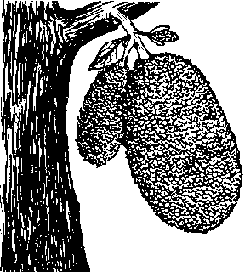
Varieties
PLANTING MATERIALS
Seedlings are still widely used but they do not come true to type. Grafted trees make better planting materials.
ADAPTATIONS
Jackfruit grows well on all climatic types although warm and moist surroundings are best.
LAND PREPARATION
Prepare the land for planting before the onset of the rainy season. For flat to gently rolling lands, plow the field once and harrow two or more times. These operations are dispensed with in very hilly areas.
PLANTING
Plant at the onset of the rainy season. The suggested planting distance for jackfruit in flat to gently rolling lands is 8-10 m. In hilly areas, adjust plant spacing according to the slopes of the land.
TRAINING AND PRUNING
Not much is known about training young jackfruit trees. But since the fruiting stalks are produced on the trunk and large branches, train the young trees to develop as many primary and secondary branches close to the ground as possible. Once this is attained, limit pruning to the removal of interlacing interior branches and diseased twigs.
IRRIGATION
Irrigate young jackfruit trees during summer. If water is readily available, continue this practice throughout the life of the trees.
FERTILIZATION
Jackfruit trees are seldom fertilized. They would grow better and produce more fruits if they are fertilized in some way. To avoid additional expense or at least reduce the need for inorganic fertilizers, apply organic materials instead. Mulching around the trunk throughout the year would substitute for fertilization.
CONTROL OF PESTS
There is no serious disease that attacks the jackfruit. However, fruit flies are very serious pests. This is effectively controlled by wrapping the fruits while still young with any of these materials: sacks, made of any material, used cement bags, leaves of coconut or banana and rice straws.
HARVESTING
The fruit is usually harvested before it ripens on the tree. A mature fruit produces a hollow sound when its spiny peel is tapped with the fingers.
|
| ||||||||||||||||||||||||||||||||||||||||||||||||||||||||||||||||||||||||||||||||||||||||||||||||||||||||||||
Mango production
VARIETIES
Carabao, Pico and Katchamitha (Indian) are the three commonly grown varieties. Carabao is grown commercially for export while Pico (for ripe fruit) and Katchamitha (for green fruit) are limited to backyard planting.

Varieties
PLANTING MATERIALS
Grafted plants are best because they come true to type, grow smaller and produce fruits earlier than seedlings.
ADAPTATIONS
Carabao and Pico grow best in places with distinct dry season that lasts for five months or longer. Katchamitha is less selective of climatic type.
Preferred for planting are those with net to gently rolling slopes, although hilly lands can also be planted. The soil should be deep, fertile, well-drained and slightly acidic.
LAND PREPARATION
This is best done before the onset of the rainy season. Shrubs and trees should be cut down, preferably uprooted and the debris removed from the site. In flat to gently rolling lands, one deep plowing and two to three harrowings are adequate. In hilly areas, these operations are dispensed with.
PLANTING
In net to gently rolling lands, the recommended planting distance is from 10 m (100 trees per ha) to 15 m (44 trees per ha) depending on the fertility of the soil and the amount of rainfall. In hilly areas, planting distance is adjusted according to the contour of the land. Planting is best done at the onset of the rainy season.
The planting hole should be just large enough to accommodate the ball of soil of the planting material. After removing the plastic bag, set the plant at the center of the hole and fill up the extra space with the previously dug top soil.
TRAINING AND PRUNING
Allow the trees to grow upright for some time. When about 50 cm high, pinch the terminal bud to force lateral shoots to sprout. Allow the shoots to mature and again pinch the terminal bud on each shoot. Repeat this process until the end of the third year. Allow all shoots to mature and start forcing them to flower.
Once the trees are bearing, limit pruning to removing weak branches at the tree interior and those damaged by pests.
IRRIGATION
Water the trees right after planting and during period when rain falls irregularly. The first dry season after planting is the most critical stage. Water the trees regularly during this whole period. During the subsequent dry seasons, the trees will survive without irrigation although they will grow better and produce more and larger fruits if irrigated.
FERTILIZATION
Soil and leaf analyses will aid the grower on the kind and amount of fertilizers to apply to the mango trees. In the absence of this information, apply 200-500 9 ammosul (or equivalent amount of urea) to each non-bearing tree (1-3 years old) at the onset and end of the rainy season. Shift to complete fertilizer (N-P-K) starting on the 4th year by applying 500 9 per tree twice a year. Increase the amount every year so that at the peak of fruiting (20-25 years old), each tree should get at least 5 kg per application.
Broadcast the fertilizer evenly or apply in several shallow holes beneath the tree canopy.
If organic fertilizers (e.g., compost, manure) are available, apply liberal amount to reduce the need for inorganic fertilizer.
CONTROL OF PESTS
Leaf hoppers and oriental fruit flies are the most serious insect pests. Control hoppers with carbaryl or malathion insecticide when the inflorescence starts to emerge. Repeat this three or more times at 7-10 days interval depending on the degree of infestation.
Control fruit flies using an attractant (e.g., methyl eugenol, powdered kalingag bark) treated with an insecticide.
Vapor heat treatment of fruits after harvest also effectively kills fruit fly eggs and larvae.
Anthracnose is the most serious disease and attacks the flowers, young leaves and young fruits. To control, spray the tree with benomyl (e.g., Benlate) or mancozeb (e.g., Dithane M-45) fungicide regularly from fruit set until a month before harvest.
FLOWER FORCING
Force mature trees to flower off-season by smudging or foliar spraying with potassium nitrate. Apply the latter at 12 percent dosage (10-20 g/li water). Commercial formulations in solution are applied at recommended dosages.
Trees can be forced to flower any month although the common practice is to time the application at the onset of the dry season in November. Even then, not all trees can be forced to flower at the same time because only those with 6-month-old shoots or older are responsive.
One spraying is enough and flowers appear after about two weeks. Trees that failed to flower or whose flowers were destroyed may be sprayed again.
FRUIT BAGGING
To reduce mechanical injuries as well as pest damage, wrap the fruits individually about 55 days after flowerforcing using used newspapers.
HARVESTING
Harvest fruits 110-120 days after flower-forcing or 82-88 days after full bloom.

Harvesting
|
| ||||||||||||||||||||||||||||||||||||||||||||||||||||||||||||||||||||||||||||||||||||||||||||||||||||||||||||
Middle to high understory shade tolerant crops
The species can grow in the understory of taller tree species. They occupy the middle to high understory. Although they are shade-tolerant, they still need some light to penetrate the canopy (about 50 percent shade/light).
TABLE 16. SPECIES DESCRIPTION.
|
SCIENTIFIC NAME |
COMMON NAME |
HEIGHT (ft.) |
USES |
|
Acacia meamsii |
Black wattle |
6-20 |
Fuelwood poles, green manure, tannin erosion control, soil improvement |
|
Albizzia lebbek |
Langil |
up to 30 |
Fuelwood timber, fodder, soil improvement |
|
Alnus nepalensis |
|
up to 30 |
Fuelwood timber, fodder, soil improvement |
|
Annona muricata |
Guyabano |
5-9 |
Fruit |
|
Averrhoa bilimbi |
Kamias |
2-12 |
Fruit |
|
Bixa orellana |
Achuete |
2-8 |
Fruit (cosmetics dye), live fence |
|
Calamus merillli and many other species |
Rattan |
up to 50 |
Furniture, fiber |
|
Calliandra calothyrsus |
Calliandra |
4-10 |
Fuelwood, fodder, erosion control, soil improvement, bee forage |
|
Casuarina equisetifolia |
Agoho |
4-10 |
Fuelwood, fodder, erosion control, soil improvement bee forage |
|
Coffea spp. |
Kafe |
4-5 |
Fruit (coffee beans), fuelwood |
|
Desmodium gyroides |
Karikut- rikut |
1-4 |
Fodder, soil improvement, erosion control |
|
Flemingia macrophylla |
Flemingia |
2-3 |
Soil imp row meet, erosion control |
|
Lancium sp. |
Lanzones |
5-9 |
Fruit |
|
Livistona rotundifolia |
Anahau Fan palm |
15-20 |
Fiber, food (fruit, buds, shoots), small timber |
|
Musa textilis |
Abaca |
1.54 |
Fiber |
|
Musa spp. Var saba |
Saba |
1.5-4 |
Fruit |
|
Pithecellobium dulce |
Kamachile |
18-20 |
Fruit, fuelwood, small timber, fodder, soil improvement, fencing |
|
Psidium guajava |
Bayabas fuelwood |
3-10 |
Fruit, erosion control |
|
Theobroma cacao |
Cacao |
5-8 |
Fruit (chocolate) |
TABLE 17. SPECIES REQUIREMENT.
|
Species name |
Shade |
Climatic |
Elevation |
Soils |
| |
Tolerance¹ |
Adaptability² | | |
|
Acacia meamsii |
M |
WD, PW |
100-2500m |
Deep fertile soils, sandy loams, shale or slate derived neutral to acid soils |
|
Albizzia lebbek |
S |
WD, PD |
Up to 1400m |
Highly adaptable including saline soils; alkaline to neutral soils |
|
Alnus nepalensis |
H |
WD, PW |
1000-3000m |
Deep loamy acid to neutral soils; also tolerates steep, rocky eroded sites |
|
Annona muricata |
M |
WD, PW |
Up to 1000m |
Suited to most soils, but does not tolerate waterlogging |
|
Averrhoa bilimbi |
S-M |
WD, PW |
Up to 500m |
Needs well-drained soil, pH can be neutral to alkaline |
|
Bixa orellana |
S |
WD, PW |
Up to 800m |
Adaptable, but prefers moist, deep, loamy soil |
|
Calamus merillii |
H |
PW | | |
|
Calliandra calothyrsus |
S |
WD |
250-1500m |
Adaptable to wide range of site conditions, including acid soils |
|
Casuarina equisetifolia |
S |
WD, PD |
Up to 500m |
Thrives on sandy soils, coastal dunes |
|
Coffea spp. |
M |
WD, PW |
Up to 750m |
Needs deep, well drained, acid to alkaline soils, but does well on day soils |
|
Desmodium gyroides |
M |
WD,PD |
Up to 1000m |
Tolerates infertile soils, adaptable to acid or alkaline soils and can tolerate water logging |
|
Flemingia macrophylla |
S-M |
WD |
Up to 2000m |
Adaptable to wide range of soils and can be grown on infertile or heavy clay soils |
|
Lancium spp. |
H |
WD, PW |
Up to 800m |
Prefers moist, fertile, medium textured, slightly acidic soil with good drainage and high organic matter content |
|
Livistona rotundifolia |
H |
WD, PD |
Low to medium elevation | |
|
Musa textilis |
M |
PW |
Up to 1600m |
Deep, friable, fertile loam with good drainage: tolerates pH from acid to alkaline |
|
Musa spp. var saba |
S |
WD, PW |
Up to 1800m |
Prefers well-drained soils, but can also tolerate heavy clays |
|
Pithecellobium dulce |
S-M |
WD, PD |
Up to 1800m |
Prefers well-drained soils, but can also tolerate heavy clays |
|
Psidium guava |
M |
WD, PD |
Up to 1500m |
Highly adaptable |
|
Theobroma cacao |
S |
PW |
Up to 700m |
Prefers soil with good moisture retention, but welt drained; does not last on clay loam soil |
1 Shade tolerance:
H = highly shade-tolerant;
M = moderately shade-tolerant;
S=sibhtly shade-tolerant
2 Climatic adaptability:
WD = with distinct wet and dry seasons
PW = pronounced wet season;
PO = pronounced dry season
|
| ||||||||||||||||||||||||||||||||||||||||||||||||||||||||||||||||||||||||||||||||||||||||||||||||||||||||||||
Low understory shade-tolerant crops
TABLE 18. SPECIES DESCRIPTION AND USE.
|
SPECIES NAME |
COMMON NAME |
SHADE |
FORM |
HEIGHT |
USE | |
| |
|
TOLERANCE |
| | | |
|
ARACEAE | ||||||
|
Acorus calamus |
Lubigan |
M |
Perennial herb |
0.5-1.5 m |
medicinal | |
|
Amorphophallus campanulatas |
Pongapong |
Perennial herb |
0.5-1.5 m |
livestock feed |
(tuber), food (stem) | |
|
Amorphophallus variabilis (A. oncophyllus) | |
H |
Perennial herb |
1.0-2.5 m |
medicinal (tuber) | |
|
Colocasia esculenta |
Gabi, Gabing Tagalog |
S |
Perennial herb |
1.0-2.0 m |
food (tuber), stem and leaves | |
|
Xanthosoma nigrum |
Gabing Cebu |
S |
Perrenial herb |
1.0-2.0 m |
food (tuber), | |
|
(Xanthosoma sagittifolium) | | | |
animal feed |
(stem and leaf) | |
|
MARANTACEAE | ||||||
|
Maranta arundinacea |
Arrowroot, Uraro |
H |
Perrenial herb |
0.5-1.0 m |
food (tuber) | |
|
TACCACEAE | ||||||
|
Tacca palmata |
|
H |
Perennial herb |
0.75-1.25m | |
|
|
DIOSCOREACEAE | ||||||
|
Dioscorea alata |
Ubi |
H |
Climbing vine |
3.0-10 m |
food (tuber) | |
|
Dioscorea bulbifera |
|
M |
Climbing vine |
3.0-10 m |
food, medicinal | |
|
Dioscorea esculenta |
Tugui |
M |
Climbing vine |
3.0-5.0 m |
food (tuber) | |
|
Dioscorea hispida |
|
M |
Climbing vine |
5.0-20 m |
food (tuber) | |
CANNACEAE
|
Canna edulis |
Edible canna |
H |
Perennial herb |
1.0-3.5 m |
hod, fodder |
BROMELIACEAE
|
Ananas comosus |
Pinya |
S |
Perennial herb |
0.5-1.25 m |
food (fruit), fiber (leaves), animal feed (leaves). |
ORCHIDACEAE
|
Vanilla fragrens (V. planifolia) |
Vanilla, Banilya |
H |
Climbing vine |
10-15 m |
Spice (pod) |
ZINGEBERACEAE
|
Amomum cardamomum |
Indonesian cardamon |
H |
Perennial herb |
1.5-3 m |
medicinal, spice (root) |
|
Boesenbergia pandurata | |
H |
Perennial herb |
0.25-0.8 m |
medicinal, spice |
|
(Kaempferia pandurata) | | | |
(root) | |
|
Catimbium malaccensis | |
H |
Perennial herb |
1.0 4 0 m |
medicinal (root) |
|
Costus spp | |
H |
Perennial hero |
0.5-3.0 m |
medicinal (root) |
|
Curcuma aeruginosa |
Wild turmeric |
H |
Perennial herb |
0.5-2.0 m |
medicinal (root) |
|
Curcuma domestica |
Luyang-dilaw, |
M |
Perennial herb |
1.0-1.5 m |
medicinal, spice, |
|
(C. longa) |
Dilaw, Kunig |
| | |
dye (root) |
|
Curcuma heyneana |
|
H |
Perennial herb |
2.0 m |
medicinal (root) |
|
Curcuma purpurascens |
|
H |
Perennial herb |
0.5-1.5 m |
medicinal, spice (root) |
|
Curcuma xanthorizza |
|
H |
Perennial herb |
0.5-2.0 m |
medicinal dye (root) |
|
C. zeodaria |
Bolon, Tamahibak, H |
Perennial herb |
0.5-2.0 m |
medicinal (root) |
|
|
|
Barak, Tamo-karsi, |
| | |
|
|
|
Luya-luyahan |
| | |
|
|
Elettaria cardamomum |
Cardamon |
H |
Perennial herb |
2.0-3.0 m |
spice |
|
Hedychium coronarium |
Kamya |
M |
Perennial herb |
1.5-3.0 m |
medicinal (root) |
|
Kaempferia galanga |
Duso, Dusog, Dusol, Galanga, Gisol, Gusol | |
Perennial herb |
0.27 m |
spice, medicinal (root) |
|
Kaempferia rotunda |
|
M |
Perennial herb |
0.5-1.0 m |
medicinal (root) |
|
Languas galanga |
|
S |
Perennial herb |
1.5-2.5 m |
medicinal, spice |
|
(Alpinia galanca) |
| | |
|
(root) |
|
Zingiber aromaticum |
Wild ginger |
M |
Perennial herb |
1.84.0 m |
medicinal. Spice (root) |
| | | | | | |
|
Zingiber cassumunar |
|
H |
Perennial hero |
1.5 m |
medicinal (root) |
|
Zingiber officinale Roxb. Luya |
M |
Perennial herb |
0.5-1.0 m | |
medicinal, spice (root) |
PIPERACEAE
|
Piper bete L |
Ikmo, Gawed, Betel vine |
H |
Climbing vine |
5.0-15 m |
medicinal (leaves) |
|
Piper cubeba |
Forest pepper |
H |
Climbing vine |
3.0-15 m |
medicinal, spice (seed) |
|
Piper nigrum |
Black pepper, Paminta |
M |
Climbing vine |
4.0-10 m |
spice (seed) |
|
Piper retrofactum (P longum) |
Long pepper |
H |
Climbing vine |
|
medicinal, spire (seed) |
LEGUMINOSAE
|
Calapogonium mucunoides |
Calapogonium |
M |
Climbing herb |
0.3-0.5 m |
green manure (leaves, stems) |
|
Centrosema pubescens |
Centrosema |
M |
Climbing herb |
0.45 m |
green manure, fodder (leaves) |
|
Desmodium gyroides |
Desmodium, Karikut-rikut |
M |
Small shrub |
1.0-2.5 m |
fodder |
|
Dolichos lablab |
Batao |
S |
Climbing herb |
1.5-6.0 m |
food (beans), buds. |
|
Mucuna pruriens |
Velvet beans, |
| | |
|
|
M. derengiana |
Kokoa | | | | |
|
Pachyrrhizus erosus |
Singkamas, Yam bean |
M |
Climbing herb |
|
food (tuber) |
|
Vigna unguiculata var. Sesquipedalis |
Long beans, Sitao |
S |
Climbing herb |
|
food (bean) |
CONVOLVULACEAE
|
Merremia mammosa |
|
H |
Climbing herb |
|
medicinal |
LABIATAE
|
Coleus amboinicus |
Oregano |
S |
Herb | |
medical (leaves) |
|
Ocimum basilicum |
Basil |
S |
Herb |
0.3-0.6 m |
medicinal |
|
Orthosiphon aristatus (O. stamineus) |
Balbas pusa |
S |
Herb |
1.0-1.5 m |
medicinal (root) |
|
Pogostemon -cablin |
Patchouli |
H |
Perennial shrub |
1.0-1.5 m |
essential oils (leaves) |
GRAMINAE
|
Brachiaria decumbens |
|
M |
Perennial grass |
0.25-0.65m |
fodder (leaves) |
|
Panicum maximum |
Guinea grass |
M |
Perennial grass |
0.8-2.5 m |
fodder (leaves) |
URTICACEAE
|
Boehmeria nivea |
Ramie |
M |
Perennial herb |
1.0-3.0 m |
fiber (leaves) |
CAPSICACEAE
|
Capsicum sp. |
Sili |
S |
Annual |
0.5-1.0 m |
food (leaves); spice (fruit) |
Note:
H = Highly shade-tolerant
M = Moderately shade-tolerant, and,
S = Slightly shade-tolerant.
TABLE 19: SPECIES REQUIREMENTS AND YIELDS
|
SPECIES NAME |
COMMON NAME |
ELEVATION |
SOILS |
RAINY |
INPUTS |
YIELDS |
| |
| | |
SEASON LENGTH (mos) | | |
|
ARACEAE | ||||||
|
Acorus calamus |
Lubigan |
< 2000 |
Clay loam |
9-12 |
L |
3000kg/ha |
|
Amorphophallus campanulatas |
Pongapong |
< 800 |
Sandy team |
4 5-9 |
L | |
|
Amorphophallus variabilis (A. oncophyllus) | |
< 700 |
Sandy loam |
6-9 |
M |
2.5kg/tuber |
|
Colocasia esculenta |
Gabi, Gabing Tagalog |
< 1000 |
Adaptable |
7.5-12 |
M |
2-17 tons/ha |
|
Xanthosoma nigrum (Xanthosoma sagittifolium) |
Gabing Cebu |
< 1000 |
Adaptable |
7 5-9 |
L |
32 500 kg/ha |
|
MARANTACEAE | ||||||
|
Maranta arundinacea |
Arrowroot, Uraro |
< 900 |
Sandy |
9-12 |
L |
75-37 tons/ha |
|
TACCACEAE | ||||||
|
Tacca palmata |
|
< 900 |
Sandy |
7.5-9 | |
|
|
DIOSCOREACEAE | ||||||
|
Diosconea alata |
Ubi |
< 800 |
Loamy clay |
7.5-12 |
M |
10-35 tons/ha |
|
Dioscorea bulbifera |
|
< 800 |
Loam, clay |
9-12 |
M |
0.5 kg/tuber |
|
Dioscorea esculenta |
Tugui |
< 700 |
loam |
7 5-12 |
M | |
| |
Dioscorea hispida |
< 850 |
Humus |
6-9 |
M | |
|
CANNACEAE | ||||||
|
Canna edulis |
Edible canna |
< 2000 |
Rich in |
6-9 |
M |
18 - 38 tons/ha |
|
BROMELIACEAE | ||||||
|
Ananas comosus |
Pinya |
< 1000 |
Adaptable |
7.5-10.5 |
M |
38-75 kg/ha |
|
ORCHIDACEAE | ||||||
|
Vanilla fragrens (V. planifolia) |
Vanilla, Banilya |
400-800 |
Rich in humus |
7.5-10.5 |
H |
800 kg/ha |
|
ZINGIBERACEAE | ||||||
|
Amomum cardamomum |
Indonesian Cardamon |
300-1500 |
Humus |
7.5-10.5 |
M | |
|
Boesenbergia pandurata | |
< 700 |
Calcareous |
6-9 |
M | |
|
(Kaempferia pandurata) | | | | | | |
|
Catimbium malaccensis | |
< 1500 |
Clay |
6-9 |
M | |
|
Costus spp | |
<1000 |
Fertile |
9-12 |
L | |
|
Curcuma aeruginosa |
Wild turmeric |
400-700 |
Adaptable |
6-9 |
L | |
|
Curcuma domestica Val. |
Luyang dilaw, |
< 2000 |
Clay team |
7.5-9 |
13 | |
|
(C. longa) |
Dilaw, Kunig |
| | |
35,000 kg/ha |
|
|
Curcuma heyneana |
|
< 750 |
Adaptable |
6-9 |
L | |
|
Curcuma purpurascens |
|
< 1000 |
Adaptable |
6-9 |
L | |
|
Curcuma xanthorizza |
|
< 750 |
Adaptable |
7.5-10.5 |
L | |
|
C. zeodaria |
Bolon, Tamahibak Barak, Tamo-karsi Luya-luyahan |
< 1000 |
Clay |
6-9 | | |
|
Elettaria cardamomum |
Cardamon |
< 1500 |
Rich humus |
9-12 |
H |
100-350 kg/ha |
|
Hedychium coronarium |
Kamya |
< 2000 |
Deep, rich |
5-12 |
L |
5.7 tons/ha |
|
Kaempferia galanga |
Duso Dusog, Dusol, Galanga, Gisol, Gusol |
80-600 |
Sand, clay |
7.5-12 |
L | |
|
Kaempferia rotunda |
|
< 750 |
Clay |
9-12 |
L | |
|
Kaempferia rotunda |
|
< 750 |
Clay |
9-12 |
L | |
|
Languas galanga (Alpinia galanga) | |
< 1200 |
Loose, fertile |
7.5-10.5 |
M | |
|
Zingiber aromaticum |
Wib ginger |
< 1000 |
Clay |
9-12 |
M | |
|
Zingiber cassumunar |
|
< 1300 |
| | |
|
|
Zingiber officinale Roxb. |
Luya |
250900 |
fertile |
9-12 |
H |
30,000 kg/ha |
|
PIPERACEAE | ||||||
|
Piper betel L |
Ikmo, Gawed, Betel vine |
< 700 |
Clay |
6-10.5 |
L |
Variable |
|
Piper cubebe |
Forest pepper |
< 400 | |
| | |
|
Piper nigrum |
Black pepper, Paminta |
< 1000 alluvium |
Rich |
9-12 |
H | |
|
Piper retrofactum (P. longum) |
Long pepper |
< 600 |
Sandy |
6-9 | | |
|
LEGUMINOSAE | ||||||
|
Calapogonium mucunoides |
< 700 |
Adaptable |
7.5-12 | |
|
6000 kg/ha |
|
Centrosema pubescens |
Centrosema |
< 300 |
Adaptable |
7.5-12 |
L | |
|
Desmodium gyroides |
Desmodium, Karikut-rikut |
400-1000 |
Adaptable |
9-12 |
M |
2000 kg/ha |
|
Dolichos lablab |
Batao |
< 500 |
Fertile |
6-9 |
M |
1400 kg/ha |
|
Mucuna pruriens |
Velvet beans |
| | |
| |
|
M derengiana |
Kokoa | | | | | |
|
Pachyrrhizus erosus |
Singkamas, Yam bean |
< 500 |
Sandy loam |
6-10.5 |
M |
95 000 kg/ha |
|
Vigna unguiculata var. |
Long bean, Sitao sesguipedalis | |
Adaptable, well- drained neutral |
drought- resistant |
H | |
|
CONVOLVULACEAE | ||||||
|
Merremia mammosa |
| | |
| | |
|
LABIATAE | ||||||
|
Coleus amboinicus |
Oregano |
< 250 |
H | | | |
|
Ocimum basilicum |
Basil |
450-110 |
Clay |
7.5-10.5 |
M | |
|
Orthosiphon aristatus (O. stamineus). |
Balbas pusa |
<1000 o.m. |
Rich in |
7.5-12 |
L | |
|
Pogostemon cablin |
Patchouli | |
| |
M | |
|
GRAMINAE | ||||||
|
Brachiana decumbens |
| | |
| | |
|
Panicum maximum |
Guinea grass |
| | |
| |
|
URTlCACEAE | ||||||
|
Boehmeria nivea |
Ramie |
< 1200 |
Rich sand loam |
9-12 |
H | |
|
CAPSICACEAE | ||||||
|
Capsicum sp. |
Sili | |
adaptable |
up to 8 months |
H | |
Note:
H = High;
M = Medium; and
L = Low.
COMMONLY-USED NITROGEN-FIXING TREE PROFILES
SAMPLE MATIX FORMAT 1.
|
SPECIES NAME |
DESCRIPTION |
SITE REQUIREMENTS |
|
Scientific name: Acacia mangium Local name Mangium |
Mangium grows to 25-30m in height. It is straight-boled and is usually branch-free up to about one half its height. It has a spreading crown and the dense foliage casts a heavy shade. Mangium has some similarities to Acacia auriculiformis but its phyllodes (flattened leaf-like petioles that replace the juvenile teevee) are longer and broader. |
Mangium prefers a rainfall range of 1500 3000mm/yr but can withstand a minimum rainfall of 750-1000mm/yr. It can survive in areas with a prolonged dry season, but growth will be affected. It can be planted on a wide spectrum of soil typos and grows well even on infertile, eroded, rocky, shallow and acidic (down to pH4.5) soils. K prefers moist, well-drained soils and coos not tolerate flooding. Mangium is wind-firm and moderately light demanding. Seedlings and young saplings are killed by fire, but older tree are fire - resistant. |
|
Scientific name: Acacia meamsii (A. decurrens var. Mollis) Local name: Black wattle |
Black wattle is a tree usually 6-10m height, may reach 15-20m. It has a good, straight stem form and a narrow crown when grown in a closed stand, but develops a spreading crown if open-grown. It has light, feathery, dark green foliage. |
Minimal rainfall requirements are 500-700mm/yr, but it grows well in much higher rainfall zones. It can only withstand 2 3 months of dry season. Black wattle grows best on sandy loams and shale or slate derived soils. It can also tolerate shallow and unproductive acid soils and on steep, unstable slopes. It does not survive well on alkaline or calcareous soils. It is a high elevation species, planted at 100-2500m in cold climate zones. Growth can be reduced if temperatures are too warm. It is moderately shade-tolerant, but can also be grown in full sun. |
|
Scientific name: Albizia lebbek Local name: Langil |
Langil grows to be a 30m single-stemmed tree with a large spreading crown, but a is also managed as a multistemmed shrub. It forms a It is suited for areas areas 500-2500mmiyr straight bole if grown in a closed stand, but a develops a low, spreading crown if open- grown. It can be easily recognized by its numerous paper-skinned pods that rattle in the wind. |
Langil is especially suited to dry areas and d can withstand a dry season up to 6 months. rainfall. It tolerates wide range of sites including both acid and alkaline soils and saline soils. On highly eroded sites, it may require more intensive safe preparation and maintenance. It can grow in full sun or partial shade and a develops fire resistance with age. |
|
Scientific name: Alnus nepalensis Local name: Alder |
Alder can grow to be a large tree, 10-30m in height. It has a spreading, deep, dense root system and a has a deep crown when grown under shade. |
Alder requires a minimum of 800mm rainfall/yr and grows best in areas where rainfall is higher and evenly distributed. It is a high elevation species, thriving in a cool climate at 1000-3000m. It grows best in moist, deep, loamy soils, but it tolerates infertile, acid, poorly drained, steep, rocky and eroded soils. Alder is wind-firm and it and eroded soils. Alder is wind-firm and it can survive occasional flooding but not lengthy waterlogging nor extremely dry soils. It tolerates shade well. |
|
Scientific name: Cajanus cajan Local name: Kadios, Pigeon pea |
Kadios is a small tree or shrub 1-5m tall. Its form highly variable, but usually described as shrubby. |
Kadios is an important crop plant in dry to moist climates. It is drought-hardy and tolerates up to 6 months dry season, with a rainfall range of 500-2500mm/yr. It is widely adaptable as to soil conditions and can be planted up to 1000m. It does not tolerate waterlogging and requires full exposure to sunlight for fruiting. |
|
Scientific name: Desmodium rensonii |
Rensoni is an erect shrub. |
Rensoni grows well in moist areas with even rainfall distribution and it also shows very good drought-tolerance. It is able to grow on acid soils. Probably best adapted to lower elevations of the uplands. |
|
Scientific name: Flemingia macrophylla |
Flemingia is a shrub, attaining 2-3m in height. It has a deep root system and produces dense foliage. It looks somewhat similar to Kadios, but does not produce edible beans. |
Flemingia is moderately drought-tolerant, but requires at best 1100mm/yr rainfall and not longer than 6 months of dry season. |
|
Scientific name: Leucaena diversifolia |
Acid ipil-ipil is a small tree up to 18m in height with usually good but sometimes shrubby form. Its appearance is very similar to that of Leucaena leucocephala, but Acid Ipil-ipil's flowers are pink rather than white and it can also be differentiated by the leaf rachis which does not have button-like glands. |
Acid Ipil-ipil grows well in a humid to dry climate with a minimum rainfall of 500mm/yr and up to 8 months, dry season. Growth is better in higher rainfall zones. Acid Ipil-ipil gets its name from the fad that it tolerates acid soils somewhat better than L. leucocephala. It is also more productive at higher elevations than giant and native ipil ipil, with best growth up to 1000m, but a can be planted up to 1500m. It is strongly light demanding. |
SAMPLE MATRIX FORMAT 2.
|
CHARACTERISTICS | |
SPECIES |
| | |
| |
Mangium |
Black wattle |
LangiI |
Alder |
Kadios |
|
Height |
25-30m |
Average 6-10; up to 15-20m |
15-30m |
15-30 cm variable |
1-5 m |
|
Stem form |
Straight |
Poor |
Often poor, but varies with stand density | |
Highly |
|
Crown form |
Spreading dense foliage |
Narrow or spreading, depending on stand density |
Spreading |
Deep crown when grown under shade | |
|
Annual rainfall |
| | |
| |
|
Optimum range |
1500-3000mm |
700-2000 |
700-2500 | |
|
|
Minimum range |
750-1000mm |
500-700 |
500-600 | |
|
|
Dry season length |
3-4 months, but tolerates prolonged dry season |
2-3 months |
2-6 months |
Prefers evenly distributed rainfall |
Up to 6 months |
|
Soil type |
Tolerates wide range, hardy on infertile, rocky, or eroded soil |
Prefers deep fertile soils, sandy loams, shale or slate derived soils |
Tolerates wide range, including saline soils |
Best in deep, loamy soils tolerates steep, rocky, eroded soils |
Widely adaptable |
|
Soil pH |
Neutral to acid |
Neutral to acid |
Alkaline to acid |
Acid to neutral |
|
|
Soil drainage |
Moist, well- drained soils, does not tolerate flooding |
Moist but well drained soils |
Free draining soils |
Prefers moist soils, but tolerate poorly- drained sites |
Does not tolerate water logging |
|
Elevation |
0-720m |
100-2500m |
0-1400 |
1000-3000m |
Up to 1000m |
|
Wind resistance |
Wind-firm |
- |
- |
Not wind firm |
|
|
Fire Resistance |
Older trees are fire-resistant |
Fire resistant |
Develops fire resistance with age | | |
|
Shade tolerance |
Moderately light demanding |
Can grow in full sun or partial shade |
Can grow in full sun or partial shade |
Tolerates shade well |
requires full sun for fruiting |
PROPERTIES OF SOME FUELWOOD SPECIES
| | |
AGE AT FIRST | | | | |
|
SCIENTIFIC NAME |
COMMON NAME |
FUELWOOD HARVEST (YEARS) |
CHARCOAL QUALITY |
SPROUTING AFTER CUTTING |
OTHER USES REQUIREMENTS |
SITE |
|
Acacia auriculiformis |
Japanese acacia |
2-5 |
Good |
Poor |
Land rehabilitation furniture, pulp shade, N-fixing, roadside tree |
Adaptable tolerates harsh sites, poor soil conditions, flooding, 4-6 months dry season, 4-600 m elevation |
|
Acacia mangium |
Mangium |
2-5 |
Fair |
Poor |
Land rehabilitation, erosion control, N- fixing pulp, timber, firebreak |
Tolerates infertile and acidic soil, rainfall 1500-3000 mm/year |
|
Acacia meamsii |
Black wattle |
3-5 |
Good |
Poor |
N-fixing, tannin, poles, green manure, windbreaks |
Grows well on shallow or poor acid soils |
|
Albizia falcataria (Paraser- ianthes falcataria) |
Moluccan |
3 |
Good |
Vigorous |
Pulp, light industrial wood, coffee shade, green manure, N- fixing, ornamental tannin |
Grows well on alkaline soils, does not tolerate prolonged drought, can tolerate 2-4 mo dry season if some rainfall occurs |
|
Albizia lebbek |
Langil |
5-10 |
Good |
Vigorous |
Fodder, N fixing, medicinal shade for plantation crops; for pulp and paper |
-Rainfall 500-2500, tolerates wide range of soils, 2-6 months dry season, adaptable but not suited for every graded sites. |
|
Alnus nepalensis |
Alder |
3-5 |
Good |
Vigorous (pollarding) |
Erosion control, N- fixing, coffee and cacao shade, fodder, tannin |
High elevations: 100-300m Tolerates infertile, acid soils |
|
Calliandra calothyrus |
Calliandra |
2-3 |
Excellent |
Vigorous |
N-fixing, erosion control, land rehabilitation, green manure, bee forage, firebreaks, coffee shade, fodder |
Optimum rainfall 2000-4000mm/yr but withstands less, tolerates dry season of 3-6 months and grows well on depleted soils and steep slopes elevation 250-800 m |
|
Cassia siamea |
Thailand shower |
2-3 |
Good |
Vigorous |
Small timber (fumiture), fodder, soil improvement |
Tolerates up to 6 months dry season with minimum rainfall 650 mm/yr. Prefers good sibs, but can grow on lateritic soil up to 800 |
|
Cassia spectabilis |
Antsoan- dilau |
3-5 |
Good |
Vigorous |
Ornamental |
Tolerates dry season of at least 3 months, thrives on poor sites, including sandy and clay soils up to 300 m |
|
Casuarina equisetifolia |
Agoho |
3 |
Excellent |
Vigorous |
Coffee shade, N-fixing, dune stabilization, live fencing, pulp |
Tolerates diverse and difficult sites, coastal areas, limestone, 6-8 months dry season, does poorly on heavy clays |
|
Eucalyptus camaldulensis | |
3-5 |
Good |
Vigorous |
Windbreaks, roadside tree, medical |
Tolerates calcacerous, acid or saline sot 4-8 mo dry season |
|
Gliricidia sepium |
Madre de Cacao |
2-3 |
Excellent |
Vigorous |
Coffee shade, green manure, N-fixing trellis tree, rat poison, fodder, insecticide |
Highly adaptable, tolerates low soil fertility, tolerates long dry season, 6 months or more, but needs at least 1000 mm/yr rainfall, windfirm |
|
Gmelina arborea |
Yemane |
3-4 |
Good |
Vigorous |
Pulp, light industrial wood, roadside trees, bee forage |
Highly adaptable, tolerates acidic calcacerous or lateritic soils and 6 7 months dry season |
|
Leucaena diversifolia |
Acid Ipil-ipil |
2-5 |
Good |
Vigorous |
Pulp, pules, N-fixing |
500 mm/yr minimum rainfall with up to 8 months dry season, somewhat tolerant of acid soils (pH 5.0) up to 1000 m |
|
Leucaena leucocephala |
Ipil-ipil |
2-5 |
Excellent |
Vigorous |
Timber, poles, fodder, N- fixing green manure |
Tolerates 6 months dry season with best rainfall range 600-1700 mm/yr, does not tolerate acid soils, elevation to 500 m |
|
Melia azedarach |
Paraiso |
5 | |
Vigorous |
Tools and implements, pulp insecticide |
Adaptable to various soils, tolerates 6 months dry season |
|
Muntingia caladura |
Datiles |
2-3 | |
Vigorous |
Fruit, ornamental |
Withstands 6 months dry season, but requires rainfall 100 mm/yr. Can tolerate sandy, limestone and saline soils up to windfirm |
|
Piliostigma malabaricum |
Alibang- bang |
4-5 |
Good |
Vigorous |
Leaves used to season foods, medicinal uses |
Requires distinct dry season, tolerates 6 months dry drought and dry rocky sites |
|
Pinus kesiya |
Benguet pine |
20 |
Poor |
No |
Timber |
Rainfall 1000 2000 mm/yr with 2-6 months dry season, grows on poor acid soils at 450-2900 m |
|
Pithecello- bium duke |
Kamachile |
34 |
Good |
Vigorous |
Construction poles, fodder, fruits, N-fixing, |
Adapts to a variety of soil conditions and 8 months dry erosion season control, live fencing, bee forage, medicinal use |
|
Psidium guajava |
Bayabas |
3-5 |
Good |
Vigorous |
Fruits, fire wood, medicinal |
adapts to a variety of soil condition |
|
Samanea saman (Albizia saman) |
Raintree |
34 |
Good |
Vigorous |
Timber, craftwood fodder, roadside tree |
Rainfall 600-2500 mm/yr with dry season up to 6 months, prefers good soils but can grow on poor acid soils up to 500-700 m |
|
Syzygium cumin) |
Duhat |
2-5 |
Good |
Vigorous |
Poles, light construction, guitars, fruits, medicinal use, roadside tree, live fencing, ornamental |
Can grow on variety of sites, including shallow, rocky soils if rainfall sufficient. Prefers distinct dry season tolerates 6-7 months drought |
|
Tamarindus indica |
Tamarind |
5 |
Excellent |
Vigorous |
Fruit, timber roadside tre shade, food seasoning (fruits and extract) |
Very drought resistant, prefers deep soils, but adapted to wide range of sites, including sandy and rock soils |
|
Trema orientalis |
Anabiong |
3-6 |
Good |
Vigorous |
Pulp, poles coffee shade, fruits, fodder, tannin |
Tolerates poor soils and 6 months dry season, but prefers humid climate |
|
| ||||||||||||||||||||||||||||||||||||||||||||||||||||||||||||||||||||||||||||||||||||||||||||||||||||||||||||
Conserving available fuelwood
The fuelwood crisis is a fight against time. The less wood there is in an area, the more the consumption of firewood threatens the survival of forests. Also, more often than not, growth rate of trees is outpaced by the rate by which they are cut. Fortunately, there are some simple ways of conserving firewood.
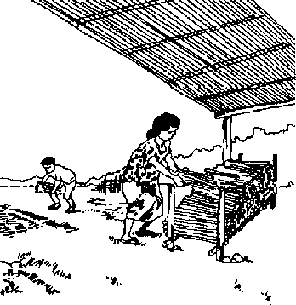
Conseving available fuelwood
1. Use trees with high calorific value.
2. Cut trees at the
right age.
TABLE 23. MINIMUM AGE AT CUTTING.
|
SPECIES |
MIN. AGE AT |
|
Gliricidia septum |
2 |
|
Leucaena leucocephala |
2 |
|
Leucaena diversifolia |
2 |
|
Acacia auriculiformis |
2 |
|
Cassia siamea |
2 |
|
Prosopis chilensis |
3 |
|
Eucalyptus camaldulensis |
3 |
|
Casuarina equisetifolia |
3 |
|
Gmelina arborea |
3 |
|
Derris indica |
4 |
3. One-and-a-half inch diameter wood would be ideal. It is easier to dry and will provide enough burning surface.
4. Improve wood drying. Moisture affects the heating value of wood. A wood with 50-percent moisture content provides at most 57 percent of its heating value as it utilizes the remaining heat to dry itself.
Dry them under the sun for two consecutive days.
Gather the sun-dried wood before the sun sets. Do not gather them late at night as they absorb moisture from the atmosphere very fast.
Pile them in an elevated and shaded platform to avoid their absorption of moisture from the soil.
Protect sun-dried firewood from rain.
Dry wood for next meal cooking over the stove to further remove moisture.
5. Use improved stoves. Open-fire stoves are known to have 10 percent or less efficiency in moderate breeze. Improved woodstoves can give as much as 25-35 percent efficiency, saving as much as half the volume of wood used in open-fire stoves.
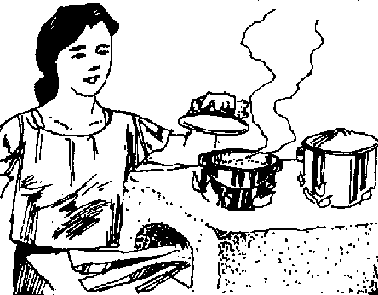
Use improved stoves
6. Other simple and practical ways to further reduce fuelwood consumption:
Before cooking hard-coated seeds like mungbeans and cowpea, soak
them in tap water ovemight.
For tough meat, add papaya or any other materials
known to speed up cooking.
If food being cooked is brought to a boil, reduce firewood. Maintain one or two species - enough to maintain the simmer.
If hot food is desired, construct a hay box to keep the food warm. No need for reheating.