 |
| ||||||||||||||||||||||||||||||||||||||||||||||||||||||||||||||||||||||||||||||||||||||||||||||||||||||||||||||||||||||||||||||||||||||||||||||||||||||||||||||||||||||||


|
| ||||||||||||||||||||||||||||||||||||||||||||||||||||||
Published by arrangement with the
Institut africain pour le
d�veloppement �conomique et social
B.P. 8008, Abidjan, C�te d'Ivoire
FOOD AND AGRICULTURE ORGANIZATION OF THE UNITED NATIONS
Rome
1976
FAO Economic and Social Development Series No. 3/3
First published 1970
Reprinted 1972
Second edition
1976
Reprinted 1983
P-69
ISBN 92-5-100142-1
© French edition, Institut africain pour le d�veloppement
�conomique et social (INADES) 1970
© English edition, FAO
1976
|
| ||||||||||||||||||||||||||||||||||||||||||||||||||||||
Preface
This manual is a translation and adaptation of "La plante la fleur," published by the Agri- Service- Afrique of the Institut africain pour le developpement economique et social (INADES), and forms part of a series. Grateful acknowledgement is made to the publishers for making available this text, which it is hoped will find widespread use at the intermediate level of agricultural education and training in English- speaking countries.
The original texts were prepared for an African environment and this is naturally reflected in the English version. However, it is expected that many of the manuals of the series a list of which will be found on the inside front cover will also be of value for training in many other parts of the world. Adaptations can be made to the text where necessary owing to different climatic and ecological conditions.
Applications for permission to issue this manual in other languages are welcomed. Such applications should be addressed to: Director, Publications Division, Food and Agriculture Organization of the United Nations, Via delle Terme di Caracalla, 00100 Rome, Italy.
The author of this English version is Mr. A.J. Henderson, former Chief of the FAO Editorial Branch.
|
| ||||||||||||||||||||||||||||||||||||||||||||||||||||||
Plan of work
FIRST WEEK
The flower.
See below
· Take a good look at the flowers where you live.
· If the okra, hibiscus, cotton and groundnuts are not in flower, look carefully at the drawings.
Make sure you recognize the male and female organs in the flowers.
· In this course there are some new words. Learn them well. Then you will follow the rest of the course more easily.
SECOND WEEK
The reproductive organs. Fertilization.
See below.
· This means you will study once more pages 10 to 15 on the reproductive organs.
· Make an effort to understand these pages, to look carefully at the flowers and the drawings.
It is very important to understand ferilization fully. If necessary, go over it again.
THIRD WEEK
The fruit. The seed. Germination.
See below.
· To help your memory, read again pages 10 to 15. They explain how fruits and seeds are formed.
· In learning how the germ grows, you will understand why it is necessary to sow seeds with great care.
FOURTH WEEK
Seeds and sowing: choosing, practical advice, storing.
See below.
What you learn this week will be useful in all your work.
· Read again with care the whole
course (especially pages 10 to 15).
· Answer
the question paper. Try to answer the questions without looking at the course.
Then look at the course to see if you have given the right
answers.
|
| ||||||||||||||||||||||||||||||||||||||||||||||||||||||
Why we study the flower, fruit and seed
You want to understand what you are doing.
You don't want to
work like a machine.
· You sow seed in order to get a good harvest, but you want to understand how the flower produces the fruit, how the fruit produces the seed, how the seed produces the plant.
You want to know how the plant reproduces itself.
· You want to understand why you must choose good varieties, selected seed; why you must disinfect seed; how you can best store the harvest.
We must study the flower, the fruit and the seed in order to understand them better and to get good harvests.
|
| ||||||||||||||||||||||||||||||||||||||||||||||||||||||||||||||||||
Better Farming Series 03 - The Plant: the Flower (FAO - INADES, 1976, 29 p.)
The flower
Where is the flower?
The stem bears buds. The buds produce leaves or flowers. Often the flowers are between the stem and the leaf.

Coofee and maize flowers
Flowers can also grow at the tip of the stem.
How flowers are made
All the plants you grow have flowers.
· The cotton flower is like the hibiscus flower. There are flowers which are alike; they belong to the same family.
· The cotton flower is not like the maize flower. There are flowers which are different; they do not belong to the same family.
· The flowers of rice, maize, sorghum are pressed close together round an axis, a main stem. They make a spike. The flowers of coffee and hibiscus are not pressed close together.
· There are flowers of all
colours: reds, yellows, violets, greens, greys.
For instance, grass flowers
are green,
Let us look at a hibiscus flower, or one of cotton, which has been cut in half with a razor blade.
The stamens are male organs.
The ovary is the female organ.

Hibbiscus flow cut in halt
Around the ovary and the stamens there are protective organs.
Let us look at a groundnut flower.
The stamens are male organs.
The ovary is the female organ.
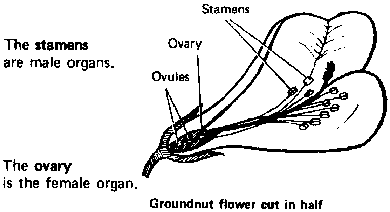
Groundnut flower cut in half
Around the ovary and stamens there are protective
organs.
They protect the stamens and the ovary.
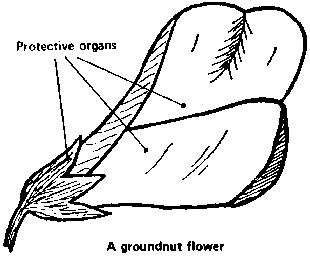
A groundnut flower
Let us look at a maize plant.
· At the tip of the stem there are a lot of little flowers.
They have stamens but no ovary.
They are male flowers.
· In the middle of the stem there is the spike (see page 6).
It consists of many flowers. Each flower has an ovary but no
stamen.
These are female flowers.
Each flower, each ovary, produces a
fruit, a seed.
· The male flowers and the female flowers also have protective organs.

A maize
plant
The stamens and ovaries
These are the most important parts of a flower.
Let us now
look in more detail at each of these parts.
This will help you to understand
the rest of the course.
· The male organs. Each stamen consists of a thread with a little bag at the end. In this little bag there is a yellow powder. This is pollen. If you touch the stamens of a flower, pollen sticks to your fingers. Pollen is produced by the stamens.
Not all flowers have the same number of stamens.
The hibiscus flower has many stamens.
The groundnut flower has ten stamens.
At the top of the maize stem there are many flowers.
Each
male flower of maize has three stamens.

A hibiscus flower
· The female organs.
With a razor blade we will cut in half an okra flower, or a
cotton or hibiscus flower.
The ovary is full of little white grains. These
are the ovules.
The ovules will produce the seed.
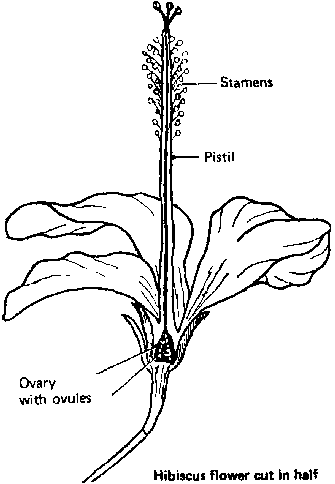
Hibiscus flower cut in half
· From the ovary grows a long tube, called the pistil.
The pistil of a hibiscus flower carries five little red globes
covered with moist hairs.
The pistil of a coffee flower has only one globe
.
The pistil of the female flowers of maize is highly developed.
On the
female flowers of maize you can see many pistils (they look like hairs).
At
the end of each pistil there is an ovary that produces a seed.
If you cut off
the pistils, there will be no
seed.
The protective organs
Take a hibiscus flower.
The male and female organs are protected by five red
petals.
These petals go all round the flower.
At the base of the petals is
a little bowl made of five green leaves. This is called the calyx.
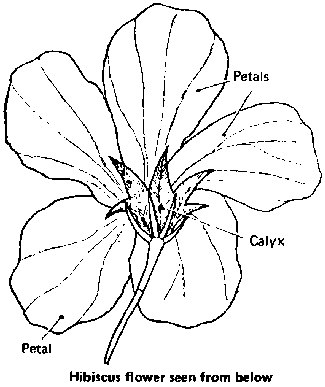
Hibiscus flower seen from below
When the flower opens, the petals come out of the calyx.
The
calyx and the petals protect the inside of the
flower.
Summary
A plant flower has always: a male part the stamens; a female part the ovary; around these two parts the protective organs.
Stamens and ovary can be in the same flower, for example, hibiscus, okra, cotton, pimento, tomato, tobacco.
Stamens and ovary can be in different flowers. Then there are male flowers and female flowers, for example, in maize and oil palm.
Stamens and ovary can be in different flowers and on different plants.
In the papaya tree, the male flowers and the female flowers are not on the same tree.
There are male papaya trees and female papaya trees. Only the female papaya trees bear fruit.
The male papaya trees cannot produce fruit, but sometimes papaya trees that have male flowers do produce fruit.
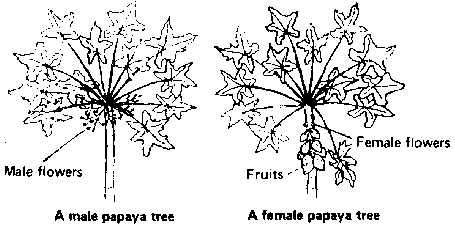
A male papaya tree & A female
papaya
tree
What the flower does
Flowers have male organs and female organs. The union of pollen and ovule produces a seed. The seed can produce a plant.
Fertilization
· How does the union of pollen and ovule take place?
The stamens produce pollen. The pollen is very light. Wind or insects can carry it a long way. The pistil hairs are moist. Pollen sticks to them. The pollen germinates in the pistil as a seed germinates in moist earth. The pollen penetrates inside the ovary and into the ovule. The ovule is fertilized.

Coffee flower cut in half
Fertilization is the union of pollen and ovule.
If the flower dries up before the pollen arrives, there is no fertilization.
When the pistil is dry, the pollen cannot germinate.
A very dry wind, for instance, can prevent fertilization and reduce the harvest.
After fertilization the ovary and the ovules swell.
The ovary becomes the fruit. The ovules become seeds.
If the ovary has only one ovule, the fruit will have only one seed, for instance, mango, avocado.
If the ovary has several ovules, the fruit will have several seeds, for instance, orange, papaya, bean, coffee.
The two ovules have produced two seeds

Coffee fruit & Coffee fruit cut
in
half
|
| ||||||||||||||||||||||||||||||||||||||||||||||||
Better Farming Series 03 - The Plant: the Flower (FAO - INADES, 1976, 29 p.)
The fruit and the seed
Plants are not all alike, Roots, stems, leaves, flowers are different. The fruits too are different.
The mango, cocoa pod, grains of maize, the avocado, papaya and cotton boll are all fruits. But they are not alike.
Mango

Mango
The fruit of the mango is covered with a hard skin.
The flesh is underneath this skin. It comes from the ovary of the flower. It is yellow, juicy, good to eat. It covers the seed.
The seed is big and hard. It comes from the ovule of the flower. It contains a germ.
In the ground the germ can produce a mango tree.
Papaya
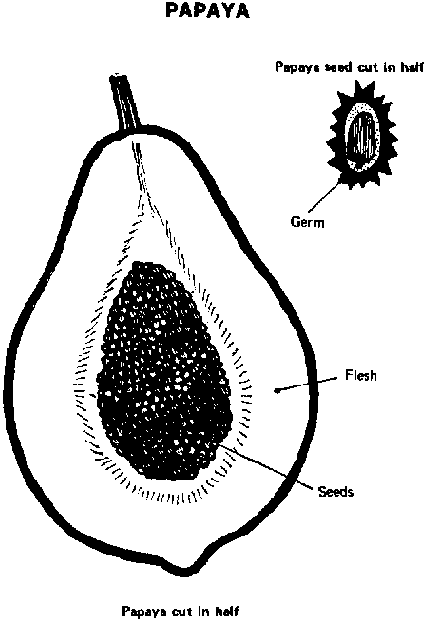
Papaya cut in half
The fruit of the papaya tree is covered with a very thin
skin.
The flesh is underneath this skin. It is yellow, juicy, good to eat. It
covers very many seeds. Each seed contains a germ. In the ground the germ can
produce a papaya
tree.
Groundnut
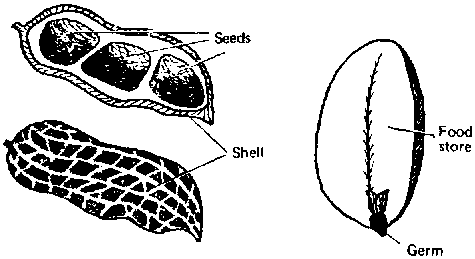
Ground nut
The fruit of the groundnut is covered with a shell. This shell is yellow; it dries when taken out of the ground.
It covers one or more seeds. Each seed contains a germ. In the ground the germ can produce a groundnut plant.
Rice

Rice
Each grain of rice is a fruit.
The fruit of rice consists of
two parts: the seed and fine, dry husks.
Each grain contains a germ. In the
ground the germ can produce a rice
plant.
Summary
The flesh of the papaya and the mango, the shell of the
groundnut and the husk of rice contain one or more seeds.
All fruits consist
of a covering containing one or more seeds.
We eat or sow only the seeds and
not the coverings of millet, groundnuts, cotton or rice.
Removing the
coverings of millet or sorghum is called threshing.
Removing the covering of
cotton is called ginning.
Removing the covering of groundnuts is called
shelling.
Removing the covering of rice is called husking.
Threshing,
ginning, shelling or husking can be done by hand in the traditional way or by
machine.
For instance, there are ginning mills for cotton.
We shall have
more to say on this in the courses on particular
crops.
|
| ||||||||||||||||||||||||||||||||||||
Better Farming Series 03 - The Plant: the Flower (FAO - INADES, 1976, 29 p.)
Seeds and sowing
How the seed grows
· A seed consists of:
· a protective covering which is more or less hard;
· a store of food;
· a germ.
· The germ is alive.
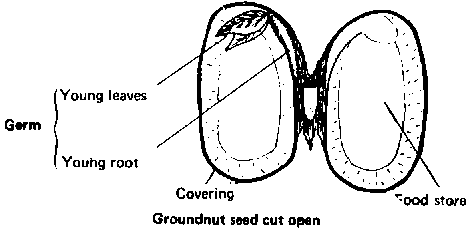
Groundnut seed cut open
The germ takes its food from the store of food built up in the
seed.
The leaves and roots cannot yet feed the plant; they are still in the
seed.
· The seed needs water.
The germ is a plant.
To grow it needs water.
The germ of a
dry seed cannot grow.
When the soil is moist, water enters the seed.
Its
skin becomes soft and splits. The germ grows.
Sowing must be done in moist
soil.
But if there is too much water, seeds die. They rot.
· The seed needs air.
The germ is a plant. It breathes.
The seed must find air in
the soil.
Before sowing, the soil must be worked so that air can get into the
soil.
The soil must not be packed too hard over the seeds.
If the soil is
packed too hard, the germ will lack air and grow badly.
The seed must not be
sown too deep. If it is, it will lack air, and its food reserves will soon be
used up. The plant will not be able to come out of the ground.
However, the
seed must be sufficiently covered. Seed that is not sufficiently covered
germinates badly. And the birds may eat it.

Seed planting
If seeds are sown at the same depth, the plants come out of the ground at the same time. They will all be the same size, and you can more easily choose the moment to put down fertilizers, apply pesticides, and harvest.
Choice of seed
· To get fine healthy plants and good harvests, you must sow good seed.
A child is like its parents.
An ailing, small plant produces
bad fruits and bad seed.
Bad seed produces bad harvests.
A modern farmer
chooses good seed and gets good harvests.
Choosing good seed does not take a
lot of work, does not take a lot of money. It only needs care.
· How to choose good seed.
To get a better harvest, you must choose better seed, better varieties.
What is a variety?
For example:
All maize plants are not alike.
The height of the plants, the
size of the heads of grain, are different.The grains are not all the same
colour, or the same shape;the harvest is not always at the same time.
There are many varieties of maize.
Some varieties give a bigger harvest.
For instance, local cotton yields 150 to 200 kilogrammes per
hectare.
Allen cotton can yield 1 000 kilogrammes per hectare.
The wild
oil palm yields about 20 kilogrammes of fruit clusters per year.
Selected oil
palm can yield 100 kilogrammes of fruit clusters per year.
Some varieties can be harvested earlier.
In northern Cameroon gara sorghum grows in 110 to 130 days; shoukouloum sorghum grows in 160 to 170 days.
Some varieties yield a better product.
Cotton fibres may be long or short.
Allen cotton has fibres
that are longer than Mono cotton.
Some varieties are more resistant to diseases.
Some varieties
of groundnuts (varieties 48- 37 and 1.041 ) do not get the disease called
rosette.
These varieties are said to be rosette- resistant.
In your home
district, what varieties do the extension officers recommend for millet,
sorghum, cotton, groundnuts, rice,
tomatoes?
Practical advice
· Buy your seed from the agricultural service.
Grow the best varieties
You will get good harvests.
To buy
seed you need money.
So as not to waste money, you must prepare your field
well, sow at the right time, do the harvesting well.
· You can produce your own seed.
Choose the finest fruits from your finest cocoa trees, from your
best field of groundnuts.
Take the best grains of maize.
The plant's good
qualities will be passed on to the new plants.

Take the best beans from the middle
of the pod
· Sort out your seed.
Do not use seed that is too old.
The germ is dead, the seed
will not germinate.
Use whole, well shaped seeds.
Remove all bad seed, all
small, broken, diseased seed, and seed eaten by insects.
Well sorted seeds
will all germinate. You will get a good density.
· Disinfect your seed.
Seed can be attacked by insects and diseases.
Protect seeds
against insects and diseases.
Mix a pesticide with the seed.
You can buy
it from the agricultural service.
The agricultural adviser will tell you how
much to use.
You must follow his advice.
· Make sure that the seeds and the pesticide are well mixed, that all the seeds are covered by the pesticide.
Equipment for treating seeds
· You must take great care. The pesticide is a poison. Wash well after handling it. Do not leave the pesticide near children.
Do not eat or give to animals any seed treated with pesticide.
Storing grain and seed
The farmer puts his harvest in granaries.
In this way he
keeps his grain and seed for the following year.
Not all granaries are
alike.
They may be made of wood or clay or basketwork.
Granaries must not
touch the ground.
Then the grain will keep dry.
Animals cannot knock over
the granary and eat the grain.
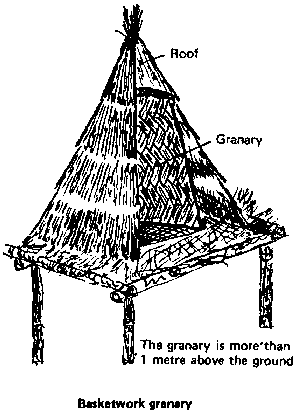
Basketwork granary
Before putting grain in granaries:
· the grain must be well
dried.
Grain that is not dry enough may rot.
It will not be any good to
eat or sow.
It is very important to dry grain well.
· the granary must be well cleaned.
Two weeks before harvest, sweep and disinfect the
granary.
Kill insects with a pesticide.
Ask advice from the agricultural officer; some pesticides are poisonous.
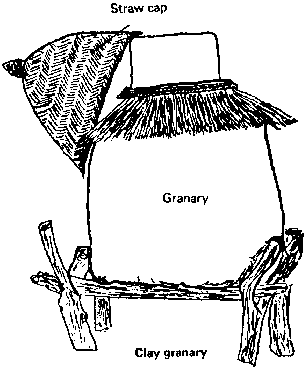
Clay
granary
|
| ||||||||||||||||||||||||||||||||||||||||||||||||||||||
Suggested question paper
FILL IN THE MISSING WORDS
The ... are the reproductive organs of the plant.
The flowers
have male organs called ... and a female organ, called ... .
These
reproductive organs are protected by the ... and the ...
The union of ...
from the stamens and of an ... contained in the ovary, produce a ...
A seed
consists of a ... some ... and a ... .
Like all living things, a seed needs
... and ... .
A farmer chooses the best seeds, the best ... .
He removes
the broken and eaten seeds, he ...the seed.
To protect them from insects and
diseases, he ... the seed.
ANSWER THE FOLLOWING QUESTIONS
What is the ovule?
What is pollen?
How is a fruit
formed?
Why must seeds be sown at the same depth?
What does the germ need
to grow?
How should seed be stored?
Explain to a friend why you use the
best seed, the best varieties.
Explain how to choose seed.
Did the courses
on the plant (Nos. 1, 2 and 3) interest you? What part did you find most
useful?